Sunday, April 26, 2026

Events of Fall

 Previously posted Nov 2018 

Yale Center for British Art
Jerusalem
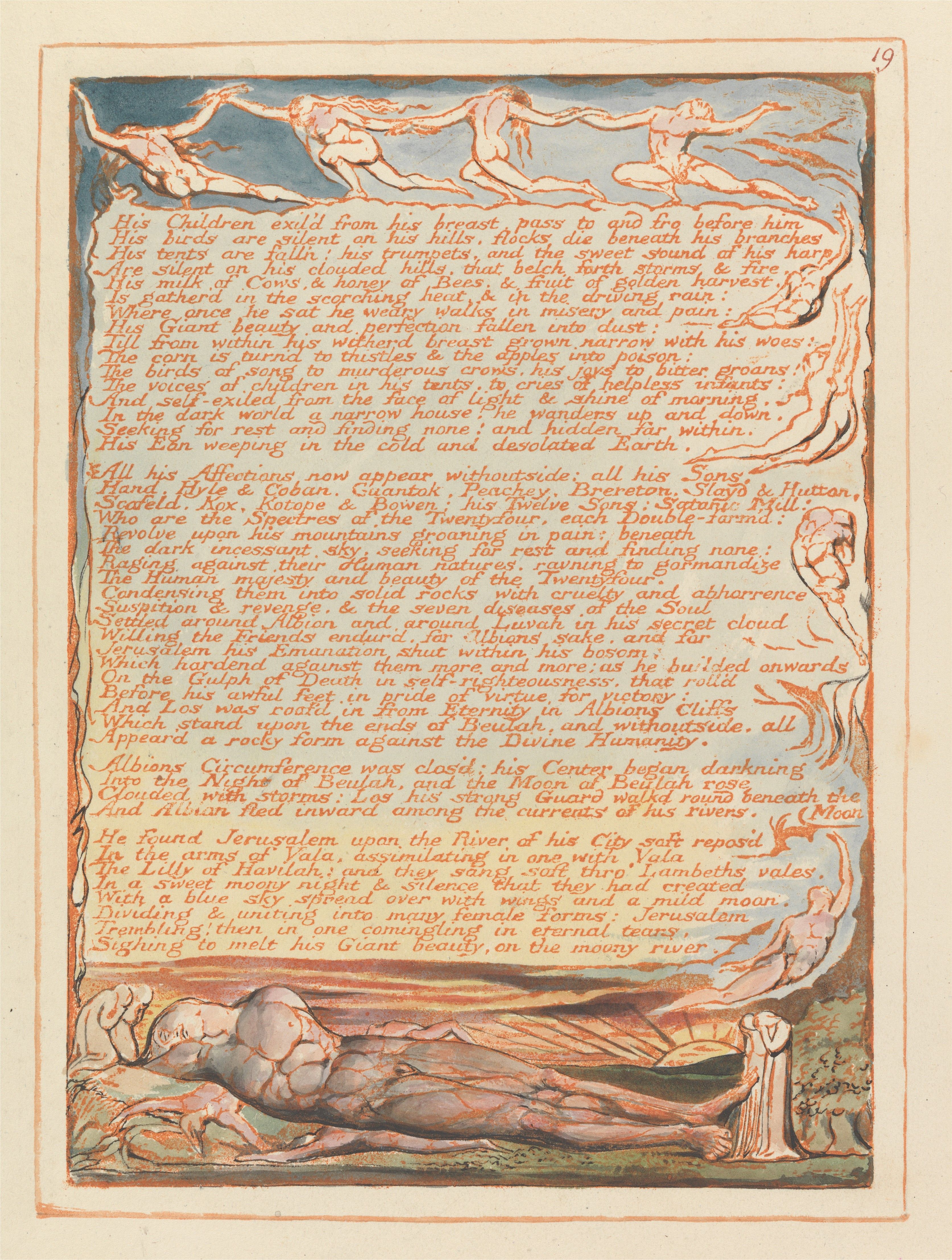
Plate 19  
 
Always fiercely eclectic, Blake has gathered his symbols here from a number of sources into a new creation: sleeping man equals fallen man living in darkness; this most general symbol fills the New Testament. For example, "Awake thou that sleepest, and Christ shall give thee light". We live by the light of reason (not always Christ's light!). Urizen, the Sun God, must be asleep to allow Luvah, like the Greek adolescent, Phaethon, to seize his Horses of Light and rise into the Chariot of Day. Zeus struck Phaethon down with a thunderbolt in the story in Ovid’s Metamorphoses. Blake used Ovid as a primary source for his borrowings from Greek mythology.

In Night ii we will find Urizen casting Luvah into the furnaces of affliction, where there is much heat but no light. What was once eternal delight has become unmitigated hell.

Luvah and Vala personify the masculine and feminine dimensions of feeling, and séparated from Luvah, Vala becomes the goddess of fallen nature. Luvah's seizure of the sun and Vala's dalliance on the pillow express in different ways the same event. The Prince of Love is bound to get his wings scorched, and the sleeping Albion is rather foolish to allow this to happen; he has lost his head over a part of himself.

Blake used this double event to say many things to us at many levels. Fundamentally Blake is saying that Man has lost his heavenly wholeness (which he calls the Divine Image) and begun to worship the material, a relatively insignificant part of himself. He turns his back upon the Divine Vision in his dream of Vala. The former is Eternal Life and the latter Eternal Death. The dalliance of Albion with Vala leads to the Eternal Death (fallenness) that we read about in the first six nights. Blake described it symbolically, in many ways, for example, "to converse in the wilds of Newton and Locke". We find here Blake's primary dialectic, between eternal vision and fallen materialism.

Other accounts of this decisive event occur at various places throughout the Four Zoas. The most definitive is that of Ahania. Her dream relates the central event, the primary fall, to an idolatrous worship; just so Blake evaluated organized religion. Albion's worship of his shadow has two immediate consequences: he breaks out with the boils of Job, a biblical symbol of the Fall of Mankind, and he exiles Luvah and Vala from their rightful place in the psychic economy.
__________________________
There are at least six occurrences of the story which I call the central event of the Fall:
K=Keynes, E=Erdman

Enitharmon's Song of Death      Night i. 261-80 K 271-2 --- (E 305)
Ambassadors from Beulah                     i. 484-559 K277-9 --- (E 311)
Ahania's vision                                       iii. 42-102 K 292-4 --- (E 326)
The Spectre of Urthona (first)              iv. 84-110 K 299-300 --- (E 334)
The Shadow of Enitharmon                 vii. 239-64 K 326 --- (E 358)
The Spectre of Urthona (second)        vii. 277-98 K 327 --- (E 359)


Monday, April 13, 2026

PRIMER - MYTH

British Museum
Illustration of the Prodigal Son.

Blake Archive
The Prodigal Son's return to his father.


Fitzwilliam Museum
The father's reception of his son.

Songs of Innocence and of Experience, Plate 45, (E 26)
"And God like a father rejoicing to see,
His children as pleasant and happy as he:
Would have no more quarrel with the Devil or the Barrel
But kiss him & give him both drink and apparel."

Myth -This passage is from Larry Clayton's book, Chapter Nine:

"Many people have called William Blake unique among English poets as the creator of a complete mythology. In a standard dictionary "without foundation in fact"  appears as the fifth meaning of 'mythical', but this is probably what the term conveys in common parlance. Therefore we must begin our study of Blake's myth by raising our consciousness of the word. 'Logos', 'myth', 'epic'--these three words have a common root. In literary and theological language myths are statements about the non-material ultimate. Some people of course avoid the non-material, considering it to be without foundation in fact; it's doubtful that any such reader has endured to his point of our study.

Blake considered the non-material to be the real; his art centered around the  endeavour to express the reality of the non-material. The meaning of his entire  artistic enterprise we may call his myth. His object was to fit all of experience into a total framework of meaning that will inform life. Our object is to grasp that total  framework; once we do that, we have a myth of meaning.

The diagram below schematically represents the shape of Blake's myth. All his  poetic and artistic work fits into this scheme of cosmic/psychic meaning. 
Only four of an infinite number of possible examples are included. The first is a general statement of Blake's scheme. Second with his story of the Prodigal Son in which Jesus gave us a personal paradigm of the history of the Chosen People and of the Human Race. Third is the career of alcoholism's progressive deterioration until the sufferer hits bottom, followed by recovery, providing a striking modern analogy, although not Blakean per se. Blake did use as a recurring motif the story of Lazarus found in the Gospel of John. But the primary paradigm of this myth is the Incarnation, Crucifixion, Resurrection, and Ascension of Christ. However Blake did not express this, probably did not fully realize it, until 1800 when he experiened an awakening.

This chapter illustrates the application of this fundamental myth in Blake's major poetic works. The development of Blake's epic will be traced through the various stages of his spiritual journey. In essence it's the same journey we all take; you could call it the history of Man. Blake called it the Circle of Destiny."

Friday, April 03, 2026

LIFE AS METAPHOR

First Posted March 2015

Few people who read Blake would deny that he is attempting to make his reader change the way he perceives his world. Our minds have been trained to see separate entities which are clearly differentiated. We have learned that things are either one thing or another. We measure and define, explain and rationalize. 

But what if words were pointers to ideas which were too big to be contained in words. What if each word opened the mind to ever expanding vistas of movement and activity. What if there were gates through which you could pass to enter unknown worlds. What if the world to which imagination can take us were all around us and inside us as well. What if we traveled through images of reality in a body which belongs to Eternity. Such a world would be the environs in which William Blake lived.

Blake's life can be thought of as a metaphor which he was using to describe the world which senses cannot access. He lived the joy and woe which permeates his poetic and visual images. He lived the death and the resurrection, and the journey of experience which connects the two. It was not enough to him to portray the Eternal, Infinite, Invisible world, he wanted to give access to that world to the brotherhood of man.

You are given the opportunity of viewing your own life as metaphor. You can become conscious that what we call reality is a mask which covers an "an immense world of delight, clos'd by your senses five". Your imagination will be expanded as was Blake's by exercising your "immortal Eyes ... inward into the Worlds of Thought".
Jerusalem, Plate 5, (E 147)
"Trembling I sit day and night, my friends are astonish'd at me.
Yet they forgive my wanderings, I rest not from my great task!
To open the Eternal Worlds, to open the immortal Eyes
Of Man inwards into the Worlds of Thought: into Eternity
Ever expanding in the Bosom of God. the Human Imagination        
O Saviour pour upon me thy Spirit of meekness & love:
Annihilate the Selfhood in me, be thou all my life!"
Four Zoas, Night VIII, Page 114, (E 385)
"he [Man] rises to the Sun
And to the Planets of the Night & to the stars that gild
The Zodiac & the stars that sullen stand to north & south
He touches the remotest pole & in the Center weeps
That Man should Labour & sorrow & learn & forget & return
To the dark valley whence he came to begin his labours anew
In pain he sighs in pain he labours in his universe
Screaming in birds over the deep & howling in the Wolf
Over the slain & moaning in the cattle & in the winds
And weeping over Orc & Urizen in clouds & flaming fires  
And in the cries of birth & in the groans of death his voice 
Is heard throughout the Universe whereever a grass grows
Or a leaf buds   The Eternal Man is seen is heard   is felt
And all his Sorrows till he reassumes his ancient bliss

Such are the words of Ahania & Enion. Los hears & weeps  
And Los & Enitharmon took the Body of the Lamb 
Down from the Cross & placd it in a Sepulcher which Los had hewn
For himself in the Rock of Eternity trembling & in despair 
Jerusalem wept over the Sepulcher two thousand Years"
Songs of Innocence & of Experience, Plate 9, (E 9)
"And we are put on earth a little space, 
we may learn to bear the beams of love,
...
SONGS 10  
For when our souls have learn'd the heat to bear
The cloud will vanish we shall hear his voice.
Saying: come out from the grove my love & care,
And round my golden tent like lambs rejoice."