Sunday, May 11, 2014

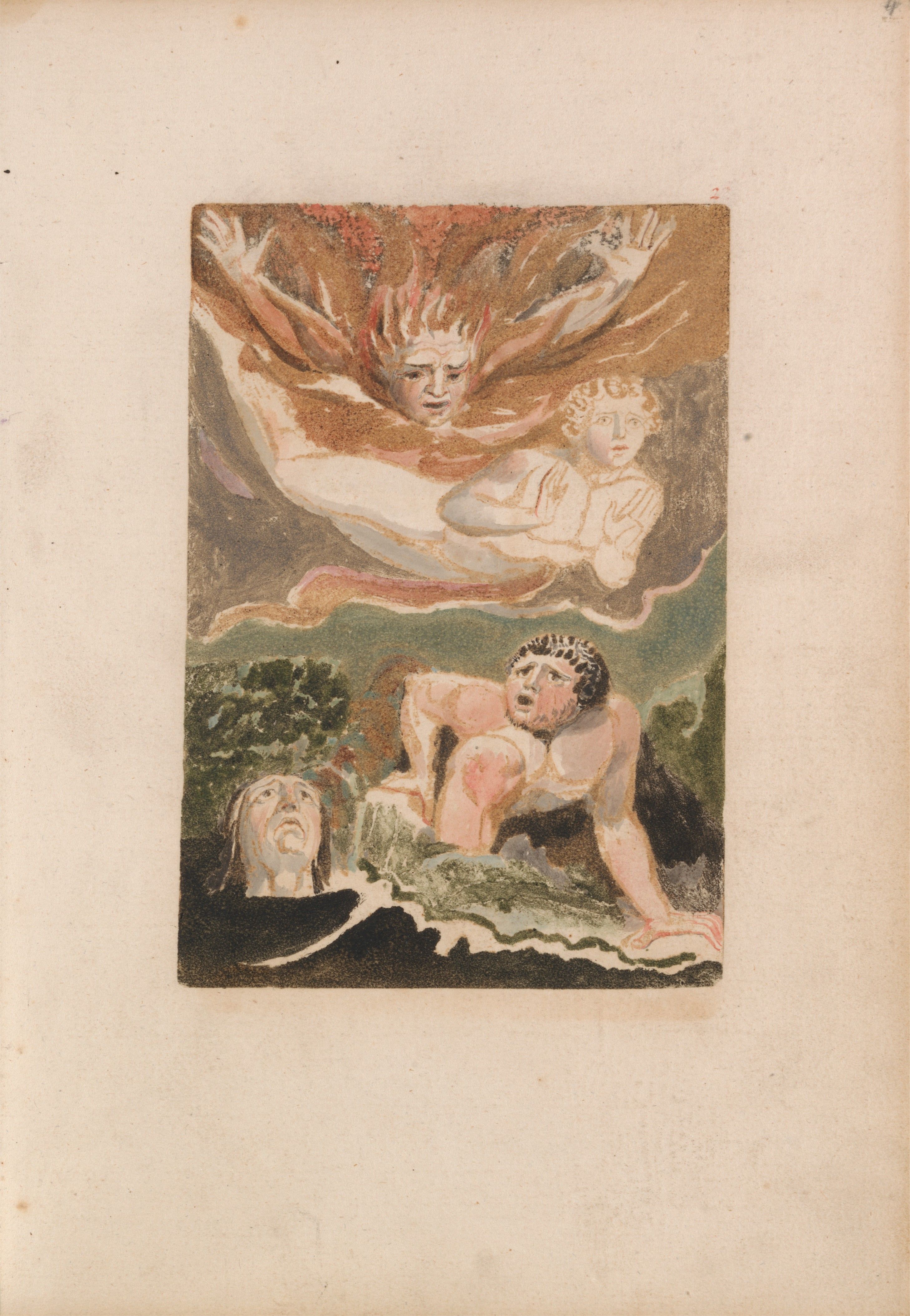
Gates of Paradise 1


There's a lot to be said about the two versions of Gates of Paradise, the first (for Children) and the second (For the Sexes). This first study is not exactly an introduction but a personal thesis  re the relationship between Father and Son.

One  important source for this work is Symbol and Image in William Blake by G.W.Digby and secondly my own intuition.

Aged Ignorance suggests an old father faced with a young son. To you men how often have you 'put the screws'  on you boy because you felt like he was not 'living up to snuff'; and as a boy how often have your wanted to crush the old man?

Rosenwald LC
Aged Ignorance
Digby  on page 39 gives the meat of these two pictures with the couplet:
 In Vain-glory hatcht & nurst
     By double Spectres Self Accurst                        
     My Son! my Son! thou treatest me
     But as I have instructed thee

And proceeds with these lines:
 In Aged Ignorance profound
   Holy & cold I clipd the Wings 
     Of all Sublunary Things

and:
   And in depths of my Dungeons
     Closed the Father & the Sons                           
(Erdman 268)

But the story ends with this happy outcome:
   But when once I did descry 
     The Immortal Man that cannot Die
   Thro evening shades I haste away 
     To close the Labours of my Day
(Erdman 269)


The text here is based on the distress King David went through with his son Absolum:
2nd Samuel 19.4:
"The king covered his face and cried aloud, "O my son Absalom! O Absalom, my son, my son!"
(Read the chapter and find out about what was happening.)

Saturday, May 10, 2014

JESUS LAMENTS


British Museum
Illustrations to Young's Night Thoughts
The religion of Jesus is the religion of life not death, of forgiveness not retribution, of self annihilation not self righteousness. When Blake looked around himself he saw that man was not the glorious creation he was intended to be, but shrunken and helpless against the powers that limited his development. Jesus had opened the minds and spirits of men to the path of recreating themselves through inner renovation. But the forces of the world closed the gates which led to eternal life by perpetuating oppressive institutions for the benefit of entrenched power. 

In our age the message of Jesus would be the same. As Blake says he would send those who had seen and heard and understood into the world of those who were afflicted by the ills that the rulers of this world inflict on the helpless. The object is to gain release from the mental prisons which cause the simple to react through anger, violence, depression, doubt, and self-hatred.

What solutions does our society have to offer to those who feel lost and abandoned, whose every effort must be devoted to providing basic necessities, who turn to mind altering drugs to escape their depression and doubt, who project their self-hatred in violence and abuse toward others? We offer them what the underprivileged were offered in Blake's day: poor paying jobs, incarceration, exclusion from the churches and schools and medical care which serve the wealthy, ready access to the drugs which condemn them to destitution and mental disease.

Blake assumed the role of the prophet. He saw that the message of Jesus had been buried or distorted or institutionalized. He expressed the wrath and pity he felt because Jesus was not followed. Blake wanted to show as clearly as he could that man could gain release from his prison once he knew what manacles his own mind had forged. 


Jerusalem, PLATE 77, (E 232)                           
                      "To the Christians. 
 I stood among my valleys of the south
And saw a flame of fire, even as a Wheel
Of fire surrounding all the heavens: it went
From west to east against the current of
Creation and devourd all things in its loud                      
Fury & thundering course round heaven & earth
By it the Sun was rolld into an orb:
By it the Moon faded into a globe,
Travelling thro the night: for from its dire
And restless fury, Man himself shrunk up           
Into a little root a fathom long.
And I asked a Watcher & a Holy-One
Its Name? he answerd. It is the Wheel of Religion
I wept & said. Is this the law of Jesus
This terrible devouring sword turning every way    
He answerd; Jesus died because he strove
Against the current of this Wheel: its Name
Is Caiaphas, the dark Preacher of Death
Of sin, of sorrow, & of punishment;
Opposing Nature! It is Natural Religion            
But Jesus is the bright Preacher of Life
Creating Nature from this fiery Law,
By self-denial & forgiveness of Sin.

Go therefore, cast out devils in Christs name
Heal thou the sick of spiritual disease           
Pity the evil, for thou art not sent
To smite with terror & with punishments
Those that are sick, like the Pharisees
Crucifying &,encompassing sea & land
For proselytes to tyranny & wrath,                
But to the Publicans & Harlots go!
Teach them True Happiness, but let no curse
Go forth out of thy mouth to blight their peace
For Hell is opend to heaven; thine eyes beheld
The dungeons burst & the Prisoners set free."    

Matthew 10
[5] These twelve Jesus sent out, charging them, "Go nowhere among the Gentiles, and enter no town of the Samaritans,
[6] but go rather to the lost sheep of the house of Israel.
[7] And preach as you go, saying, `The kingdom of heaven is at hand.'
[8] Heal the sick, raise the dead, cleanse lepers, cast out demons. You received without paying, give without pay.

Friday, May 09, 2014

Blake and Annihilation

In Blake's works there are 18 occurrences of annihilation, most of them in Milton and Jerusalem; but first is a salient place in the Four Zoas:
Erdman 368

"Thou never canst embrace sweet Enitharmon terrible Demon. Till
Thou art united with thy Spectre Consummating by pains &  
     labours                                              
That mortal body & by Self annihilation back returning    
To Life Eternal be assurd I am thy real Self  
Tho thus divided from thee & the Slave of Every passion
Of thy fierce Soul Unbar the Gates of Memory look upon me 
Not as another but as thy real Self I am thy Spectre
Thou didst subdue me in old times by thy Immortal Strength
When I was a ravning hungring & thirsting cruel lust & murder   
Tho horrible & Ghastly to thine Eyes tho buried beneath
The ruins of the Universe. hear what inspird I speak & be silent

If we unite in one[,] another better world will be        
Opend within your heart & loins & wondrous brain
Threefold as it was in Eternity & this the fourth Universe 
Will be Renewd by the three & consummated in Mental fires
But if thou dost refuse Another body will be prepared

PAGE 86 
For me & thou annihilate evaporate & be no more
For thou art but a form & organ of life & of thyself
Art nothing being Created Continually by Mercy & Love divine
Now in Milton: Plate 14:
"Distinguish therefore States from Individuals in those States.
States Change: but Individual Identities never change nor cease:
You cannot go to Eternal Death in that which can never Die.
Satan & Adam are States Created into Twenty-seven Churches       
And thou O Milton art a State about to be Created
Called Eternal Annihilation that none but the Living shall
Dare to enter: & they shall enter triumphant over Death
And Hell & the Grave! States that are not, but ah! Seem to be.

Judge then of thy Own Self: thy Eternal Lineaments explore       
What is Eternal & what Changeable? & what Annihilable!

The Imagination is not a State: it is the Human Existence itself
Affection or Love becomes a State, when divided from Imagination
The Memory is a State always, & the Reason is a State
Created to be Annihilated & a new Ratio Created                  
Whatever can be Created can be Annihilated Forms cannot
The Oak is cut down by the Ax, the Lamb falls by the Knife
But their Forms Eternal Exist, For-ever. Amen Halle[l]ujah

Thus they converse with the Dead watching round the Couch of
     Death.
For God himself enters Death's Door always with those that enter 
And lays down in the Grave with them, in Visions of Eternity
Till they awake & see Jesus & the Linen Clothes lying
That the Females had Woven for them, & the Gates of their Fathers House"

PLATE 33 [36], (E 132)
"And the Divine Voice was heard in the Songs of Beulah Saying     

When I first Married you, I gave you all my whole Soul
I thought that you would love my loves & joy in my delights
Seeking for pleasures in my pleasures O Daughter of Babylon
Then thou wast lovely, mild & gentle. now thou art terrible      
In jealousy & unlovely in my sight, because thou hast cruelly
Cut off my loves in fury till I have no love left for thee
Thy love depends on him thou lovest & on his dear loves
Depend thy pleasures which thou hast cut off by jealousy
Therefore I shew my jealousy  & set  before you Death.     
Behold Milton descended to Redeem the Female Shade
From Death Eternal; such your lot, to be continually Redeem'd
By death & misery of those you love & by Annihilation
When the Sixfold Female percieves that Milton annihilates
Himself: that seeing all his loves by her cut off: he leaves     
Her also: intirely abstracting himself from Female loves
She shall relent in fear of death: She shall begin to give
Her maidens to her husband: delighting in his delight
And then & then alone begins the happy Female joy
As it is done in Beulah, & thou O Virgin Babylon Mother of Whoredoms
Shalt bring Jerusalem in thine arms in the night watches; and
No longer turning her a wandering Harlot in the streets
Shalt give her into the arms of God your Lord & Husband.

Such are the Songs of Beulah in the Lamentations of Ololon"

And many more places in William Blake's works occur.

Researching this subject on the net I came across an article re Quietism and found this paragraph:
"The key components of Quietism, as it has traditionally been characterised, are that man's highest perfection consists of a self-annihilation, and subsequent absorption, of the soul into the Divine, even during the present life."

Regarding Tagore these paragraphs issued from the Universalistfriends.org:
" The Tagore mysticism is sad and quietist in feel. In this tone, the mysticism resonates with themes in some Quaker leaders. His writing can sound Buddhist in the call for self annihilation, but he shows more interest in engagement than detachment and in the world as a place for striving and celebration rather than suffering. The rebuttal of negation is essential to embrace optimism and appreciation of faith and grace in the present mode of existence, but it also has a tendency toward the antinomian in the assertion of freedom form established moral laws. Tagore’s is an articulate, religious struggle with universalism issues current today.

 Tagore struggled in reflection and in politics with the polarity of inside and outside, freedom and imprisonment, self and other and life and death. He was always on the side of freedom, political, social and personal, that fused into a metaphysical freedom. Or, more accurately, his sense of metaphysical freedom was expressed in his life and writings in all the political, social and personal parts of life."
 

BornRabindranath Thakur
7 May 1861
CalcuttaBengal Presidency,British India
Died7 August 1941 (aged 80)
Calcutta, Bengal Presidency, British India
OccupationPoet, short story writer, song composer, novelist, playwright, essayist, painter
LanguageBengali, English
NationalityIndia
EthnicityBengali
Notable work(s)GitanjaliGoraGhare-Baire,Jana Gana ManaRabindra SangeetAmar Shonar Bangla(other works)
Notable award(s)Nobel Prize in Literature
1913
Spouse(s)Mrinalini Devi (m. 1883–1902)
Childrenfive children, two of whom died in childhood
Relative(s)Tagore family

Erdman 139
"In the Eastern porch of Satans Universe Milton stood & said
Satan! my Spectre! I know my power thee to annihilate
And be a greater in thy place, & be thy Tabernacle
A covering for thee to do thy will, till one greater comes
And smites me as I smote thee & becomes my covering.
Such are the Laws of thy false Heavns! but Laws of Eternity
Are not such: know thou: I come to Self Annihilation
Such are the Laws of Eternity that each shall mutually
Annihilate himself for others good, as I for thee[.]
Thy purpose & the purpose of thy Priests & of thy Churches
Is to impress on men the fear of death; to teach
Trembling & fear, terror, constriction; abject selfishness
Mine is to teach Men to despise death & to go on
In fearless majesty annihilating Self, laughing to scorn
Thy Laws & terrors, shaking down thy Synagogues as webs
I come to discover before Heavn & Hell the Self righteousness
In all its Hypocritic turpitude, opening to every eye
These wonders of Satans holiness shewing to the Earth
The Idol Virtues of the Natural Heart, & Satans Seat
Explore in all its Selfish Natural Virtue & put off
In Self annihilation all that is not of God alone:
To put off Self & all I have ever & ever Amen"

Thursday, May 08, 2014

UNVEILED

A dissertation, Revolution & Revelation: William Blake and the Moral Law, by Michael Farrell of the University of Oxford clarifies Blake's use of the Bible in developing the style and content of his writing. In this paragraph it becomes clear that Blake's use of Vala's veil had antecedents in Biblical accounts:

 "2 Corinthians 3 is instructive in analysing Blake’s conception of the revolutionary Christ. The oppressive Law of the Old Testament is essentially abolished by Christ and the new Law which he establishes 'consists not of a written law but of the Spirit' (2 Cor. 3: 6). The Law of Elohim the comminatory God of Judgement is supplanted by the Law of the Spirit the merciful Law of Jehovah which operates not in an external and abstract system of moral codes but internally in and through the Spirit. The old covenant is effectively a veil separating the individual from the Spirit: 'The veil is moved only when the person is joined to Christ' (2 Cor. 3: 14). For Blake the epiphany of the Christ at the apocalypse is the ultimate revelation or unveiling of Error: the word 'revelation', etymologically, derives from the Old French reveler or Latin revelare, from re, meaning 'again', in the sense of a reversal, and velum, meaning 'veil'. The word revelation has etymological links with the word 'apocalypse', which, deriving from the Greek apokaluptein , also means to unveil or reveal. Thus in Blake’s secular apocalypse the individual must necessarily undergo a Last Judgement in casting off Error, or the old Law, and embracing Truth, the covenant or law of the Spirit." (Page 7) Creative Commons License 3.0
 
RSV
2 Corinthians 3
[2] You yourselves are our letter of recommendation, written on your hearts, to be known and read by all men;
[3] and you show that you are a letter from Christ delivered by us, written not with ink but with the Spirit of the living God, not on tablets of stone but on tablets of human hearts.
[4] Such is the confidence that we have through Christ toward God.
[5] Not that we are competent of ourselves to claim anything as coming from us; our competence is from God,
[6] who has made us competent to be ministers of a new covenant, not in a written code but in the Spirit; for the written code kills, but the Spirit gives life.
[7] Now if the dispensation of death, carved in letters on stone, came with such splendor that the Israelites could not look at Moses' face because of its brightness, fading as this was,
[8] will not the dispensation of the Spirit be attended with greater splendor?
[9] For if there was splendor in the dispensation of condemnation, the dispensation of righteousness must far exceed it in splendor.
[10] Indeed, in this case, what once had splendor has come to have no splendor at all, because of the splendor that surpasses it.
[11] For if what faded away came with splendor, what is permanent must have much more splendor.
[12] Since we have such a hope, we are very bold,
[13] not like Moses, who put a veil over his face so that the Israelites might not see the end of the fading splendor.
[14] But their minds were hardened; for to this day, when they read the old covenant, that same veil remains unlifted, because only through Christ is it taken away.
[15] Yes, to this day whenever Moses is read a veil lies over their minds;
[16] but when a man turns to the Lord the veil is removed.
[17] Now the Lord is the Spirit, and where the Spirit of the Lord is, there is freedom.
[18] And we all, with unveiled face, beholding the glory of the Lord, are being changed into his likeness from one degree of glory to another; for this comes from the Lord who is the Spirit.


Yale Center  for British Art Blake's Watercolours for the
Poems of Thomas Gray
With the help of Michael Farrell's explanation of Blake's use of the old and new covenants, and the passage he cites in Second Corinthians we can see more of Blake meaning in the following passage. Jerusalem represents the new covenant in which the law is expressed through the indwelling spirit. Albion has not been able to separate himself from dependance on the letter of the law as an external code which hides the face of God behind a veil of separation. Although the veil was removed by Christ, Albion has not freed himself from the guilt which causes him to use the veil as a 'law, a curse and a terror' against his children.

 
In his bitterness, Albion's dying curse is that Jerusalem, his own spiritual nature, be drawn 'down into this Abyss of sorrow and torture.'    


Jerusalem, Plate 23, (E 168)
"Jerusalem! Jerusalem! deluding shadow of Albion!
Daughter of my phantasy! unlawful pleasure! Albions curse!
I came here with intention to annihilate thee! But
My soul is melted away, inwoven within the Veil
Hast thou again knitted the Veil of Vala, which I for thee       
Pitying rent in ancient times. I see it whole and more
Perfect, and shining with beauty! But thou! O wretched Father!

Jerusalem reply'd, like a voice heard from a sepulcher:
Father! once piteous! Is Pity. a Sin? Embalm'd in Vala's bosom
In an Eternal Death for. Albions sake, our best beloved.         
Thou art my Father & my Brother: Why hast thou hidden me,
Remote from the divine Vision: my Lord and Saviour.

Trembling stood Albion at her words in jealous dark despair:
He felt that Love and Pity are the same; a soft repose! 
Inward complacency of Soul: a Self-annihilation!                 

I have erred! I am ashamed! and will never return more:
I have taught my children sacrifices of cruelty: what shall I answer?
I will hide it from Eternals! I will give myself for my Children!
Which way soever I turn, I behold Humanity and Pity!

He recoil'd: he rush'd outwards; he bore the Veil whole away     
His fires redound from his Dragon Altars in Errors returning.
He drew the Veil of Moral Virtue, woven for Cruel Laws,
And cast it into the Atlantic Deep, to catch the Souls of the Dead.
He stood between the Palm tree & the Oak of weeping
Which stand upon the edge of Beulah; and there Albion sunk       
Down in sick pallid languor! These were his last words, relapsing!
Hoarse from his rocks, from caverns of Derbyshire & Wales
And Scotland, utter'd from the Circumference into Eternity.

Blasphemous Sons of Feminine delusion! God in the dreary Void
Dwells from Eternity, wide separated from the Human Soul         

But thou deluding Image by whom imbu'd the Veil I rent
Lo here is Valas Veil whole, for a Law, a Terror  & a Curse!
And therefore God takes vengeance on me: from my clay-cold bosom
My children wander trembling victims of his Moral justice.

His snows fall on me and cover me, while in the Veil I fold    
My dying limbs. Therefore O Manhood, if thou art aught
But a meer Phantasy, hear dying Albions Curse!
May God who dwells in this dark Ulro & voidness, vengeance take,
And draw thee down into this Abyss of sorrow and torture,
Like me thy Victim. O that Death & Annihilation were the same!"   

Wednesday, May 07, 2014

Blake's Christianity VII


          In 'Songs of Experience' Blake expressed some biting truths about the place of the church in the lives of ordinary people:

"A little black thing among the snow,
Crying "'weep! 'weep!" in notes of woe!
"Where are thy father & mother? Say?"
"They are both gone up to the church to pray.

"Because I was happy upon the heath,
"And smil'd among the winter's snow,
"They clothed me in the clothes of death,
"And taught me to sing the notes of woe.

"And because I am happy & dance & sing,
"They think they have done me no injury,
"And are gone to praise God & his Priest & King,
"Who make up a heaven of our misery."
      (The Chimney Sweeper; Songs of Experience)

 Surely the church has become more human since Blake's day, when it could condone the employment of five year olds as chimney sweepers and in fact their legal sale by their parents for such a purpose. Even more bald in its ecclesiastical implications is "The Little Vagabond", which sounds very much like a Ranter's song:

Dear Mother, dear Mother, the Church is cold,
But the Ale-house is healthy & pleasant & warm;
Besides I can tell where I am used well,
Such usage in heaven will never do well

But if at the Church they would give us some Ale,
And a pleasant fire our souls to regale,
We'd sing and we'd pray all the live-long day,
Nor ever once wish from the Church to stray.

Then the Parson might preach, & drink, & sing,
And we'd be as happy as birds in the spring;
And modest dame Lurch, who is always at Church,
Would not have bandy children, nor fasting, nor birch.

And God, like a father rejoicing to see
His children as pleasant and happy as he,
Would have no more quarrel with the Devil or the Barrel,
But kiss him, & give him both drink and apparel.
      (The Little Vagabond)

       In  'Europe' , written about the same time, Blake recounts the degradation of the church with the cult of chivalry and the Queen of Heaven:

Now comes the night of Enitharmon's joy!
Who shall I call? Who shall I send,
That Woman, lovely Woman, may have dominion?
Arise, O Rintrah, thee I call! & Palambron, thee!
Go! tell the Human race that Woman's love is Sin;
That an Eternal life awaits the worms of sixty winters
In an allegorical abode where existence hath never come.
Forbid all Joy, & from her childhood shall the little female
Spread nets in every secret path.
      (Europe 5:1ff, Erdman 62)    

Enitharmon's grammar in the second line indicates her essential falsity, assuming the place of the true God (See  Isaiah 6 ). But after 1800 Blake rehabilitates Enitharmon, and Rahab becomes his symbol of the false church; she continually afflicts Jerusalem and finally crucifies Jesus (See The Four Zoas).

       Blake used the word 'church' in some rather unconventional ways. In Milton, Plate 37 and later in 'Jerusalem' Plate 76 he divided human history into 27 Churches, made up of three groups. The first corresponds to the nine antediluvian patriarchs (Adam to Lamech) taken from Genesis 5. The second group includes the patriarchs from Noah to Terah, the father of Abraham. For the third series Blake chose seven famous religious leaders from Abraham to Luther; each of these represents for Blake a certain type or phase of religious history:

       The first two groups were  druidic (devoted to cultic murder), but Abraham began to curtail human sacrifice when he chose a ram instead of Issac (See  Genesis 22 ). Moses brought the Law; Solomon represents Wisdom. Paul represents the early Christian Church. Constantine marks its embrace by the highest satanic power. Charlemayne founded the Holy Roman Empire, and Luther brings us to the modern age. All of these except Paul resorted to war; therefore Blake referred to these Churches as "Religion hid in war".

       Blake felt that he had described a natural progression going nowhere for "where Luther ends, Adam begins again in Eternal Circle", but this "Eternal Circle" is interrupted by Jesus, who,

"breaking thro' the Central zones of Death & Hell,/ Opens Eternity in Time & Space, triumphant in Mercy". (Jerusalem Plate 76)
There in its most concentrated form is Blake's 6000 year history of the church.

       Bear in mind that 27 is a super sinister number;  Frye described it as "the cube of thee, the supreme aggravation of three". A happier constellation of 28 (a composite of the complete numbers four and seven) occurs in 'Jerusalem' where England's cathedral cities are called the Friends of Albion. With this image Blake recognized that in spite of all its sins the church had exercised a beneficent influence upon the course of history. Blake habitually picked one of these cities to represent an important historical personage.

       For example Ely, the cathedral city of Cambridgeshire, stands for Milton, the greatest man produced by Cambridge. Verulam, an ancient name for Canterbury, represents  Francis Bacon , one of Blake's chief devils.  Professor Erdman informed us that Bath represents Rev. Richard Warner, a courageous minister who preached against war in 1804, when to do such a thing bordered on sedition. Blake's admiration for Warner led to the prominence which he gave Bath in the second chapter of 'Jerusalem'.

       Aside from these prophetic and poetic excursions the Blakean doctrine of the church found in the myth is roughly as follows: The Church is Beulah. The majority of the population exist beneath it, spiritually asleep, living what Blake called Eternal Death without even a murmur of discontent. Their eyes are closed to the spirit. They are seeds that do not generate. The hungry generally take refuge in a church and surrender their spiritual destiny into the keeping of a priest or a priestly community.

       A few still suffer hunger and eventually may  come out into the sunlight . That chosen few are, like Blake, compelled to live in a state of tension with the church that belongs to the world. The best of them continually court martyrdom and may be honored posthumously if at all. But of such is the kingdom of heaven, where like Blake they cast off the enslavement of other men's systems and create their own.

       (Nels Ferre, who may or may not have known Blake, wrote a short parable that describes the Blakean doctrine of the church as well or better than Frye did. It appears in the beginning of a small book entitled  The Sun and the Umbrella. The image of the church as an umbrella keeping us from the full force of the Sun is compelling and quite Blakean.)
(See also Religion and War)

Tuesday, May 06, 2014

WORLD OF SHADOWS

Yale Center for British Art 
Book of Urizen
Plate 4, copy C


In Blake and Tradition, Kathleen Raine's chapter The Shadowy Female traced similarities of Blake's Vala and traditional representations of the shadowy or veiled female from Isis to Boehme's Aurora. Raine demonstrated that Blake was in the mainstream of literature which conveys eternal truth through symbolic language. Blake, like Raine, immersed himself in the esoteric tradition which built, over aeons, a language of symbols to covey the meaning for which the soul hungers. 
 

These quotes from Raine and the passages she cited in Blake give a flavor of Blake's use of the traditional images in his poetry:
 
Blake and Tradition, Vol 2, Page 181
"Vala likewise, becomes the object of the love of the Eternal Man when he sinks into the sleep, or death, from eternity. He falls in love with phenomenal appearances, the 'delusions of Vala,' and from this follows every evil of the Fall and Urizen's immense and fruitless labors to order a world which is essentially unreal."

Jerusalem, Plate 83, (E 241)
"According as they weave the little embryon nerves & veins     
The Eye, the little Nostrils, & the delicate Tongue & Ears
Of labyrinthine intricacy: so shall they fold the World
That whatever is seen upon the Mundane Shell, the same
Be seen upon the Fluctuating Earth woven by the Sisters.

And sometimes the Earth shall roll in the Abyss & sometimes 
Stand in the Center & sometimes stretch flat in the Expanse,
According to the will of the lovely Daughters of Albion.
Sometimes it shall assimilate with mighty Golgonooza:
Touching its summits: & sometimes divided roll apart.
As a beautiful Veil so these Females shall fold & unfold      
According to their will the outside surface of the Earth
An outside shadowy Surface superadded to the real Surface;
Which is unchangeable for ever & ever Amen: so be it!
Page 183
"As the veil deludes the fallen man, so he takes a hand in the weaving of it, realizing the horrible nightmare he creates - profane cities:
Jerusalem, Plate 42, (E 191)
"Till Norwood & Finchley & Blackheath & Hounslow, coverd the whole Earth.
This is the Net & Veil of Vala, among the Souls of the Dead."
Page 184
"The veil is also a net that catches the souls that have sunk into the waters of materialism; for it is these who are ensnared by the seeming substantiality of appearances:
Jerusalem, Plate 59, (E 208) 
"For the Veil of Vala which Albion cast into the Atlantic Deep
To catch the Souls of the Dead: began to Vegetate & Petrify
Around the Earth of Albion. among the Roots of his Tree"
Page 184
"We are here reminded of the genesis of the veil of Enion's 'filmy woof' in the sea of matter; but this passage continues:
Jerusalem, Plate 59, (E 208) 
"Thus in process of time it became the beautiful Mundane Shell,
The Habitation of the Spectres of the Dead & the Place
Of Redemption & of awaking again into Eternity"
Page 185
"Frozen, the 'fluctuating' veil of appearance become solid and substantial, until release comes when 'I rent the Veil where the Dead dwell.' The dead dwell in the 'Veil,' because thy dwell in the illusory world of phenomenal appearances. This rending has something of the awful significance of the rending of the veil of the Temple on the day of the Crucifixion, when Mystery was at an end in the triumph of Christ.
THE GATES of PARADISE, For The Sexes, The Keys, (E 268 )
"6    I rent the Veil where the Dead dwell   
     When weary Man enters his Cave
     He meets his Saviour in the Grave"

The veil which we weave is the outer world of experience which is assigned to be the substantial or real world. It replaces the mind or soul from which it is derived. Our eternal nature falls in love with the productions of time. The veil assumes an independent existence uncontrolled by the mind which was its origin. The mind allows the veil to perpetuate itself, leading to consequences which seem alien to the mind. The veil becomes more distant from its origin in the mind until it assumes the title of objective reality. Each stage if its development tightens the snare of the materialistic outlook. The situation is not resolved until the grip of the phenomenal world on the Eternal Man is relaxed.

Four Zoas, Night IX, Page 137, (E 405)
"Urthona calld his Sons around him Tharmas calld his sons
Numrous. they took the wine they separated the Lees
And Luvah was put for dung on the ground by the Sons of Tharmas & Urthona
They formed heavens of sweetest wo[o]d[s] of gold & silver & ivory 
Of glass & precious stones They loaded all the waggons of heaven
And took away the wine of ages with solemn songs & joy

Luvah & Vala woke & all the sons & daughters of Luvah
Awoke they wept to one another & they reascended
To the Eternal Man in woe he cast them wailing into              
The world of shadows thro the air till winter is over & gone

But the Human Wine stood wondering in all their delightful Expanses
The Elements subside the heavens rolld on with vocal harmony

Then Los who is Urthona rose in all his regenerate power"
 

Monday, May 05, 2014

Christianity VI

Deists

       Deism, a form of Natural Religion denying the intervention of God in the affairs of men, pervaded the intellectual life of Blake's age. The deists were the true spiritual descendants of Bacon, Newton, and Locke as Blake understood them. Early in the 18th Century Voltaire, much taken with the English deists, had spread their peculiar faith around the intellectual circles of Europe. Deism became the fashionable faith of the upper classes in England and on the continent as well. Many Anglican clergy of that day had strong deistical leanings. Most historians believe that Washington and his associates were deists as well as vestrymen, much as recent Mexican presidents have been Masons as well as Roman Catholics.
       Throughout the early and middle 18th Century deism largely belonged to the gentility. During Blake's lifetime it filtered down to the masses. In America the deist patricians, our forefathers, used the deist staymaker, Thomas Paine, as an inflammatory propagandist for their cause. This identification of deists with political reform explains the ambiguity Blake felt and expressed toward them. He despised their Natural Religion, but admired their enlightened political views. He counted Thomas Paine a friend and found his religion relatively non-threatening and his political views refreshing. It was natural for him to react defensively against the attack on Paine of Bishop Watson, whom Blake considered a lackey of the State.
       Nevertheless Blake refuted the deist doctrine. One of his earliest theological statements was his Tractate, "There is No Natural Religion" . He dedicated the third chapter of 'Jerusalem' to the deists, and in the prose introduction addressed them very straightforwardly: the deist, he said, is "in the State named Rahab , which State must be put off before he can be the Friend of Man".
       Blake went on to make two primary charges. First, the deist "teaches that Man is Righteous in his Vegetated Spectre: an Opinion of fatal & accursed consequence to Man". Blake in contrast maintained that "Man is born a Spectre or Satan, & is altogether an Evil". Blake's second charge stems from the first: these "originally righteous" deists promote War and blame it on the spiritually religious.
       Blake deplored the hypocrisy of the philosophes, who did indeed "charge the poor Monks & religious with being the causes of War, while you acquit and flatter the Alexanders & Caesars, the Lewises & Fredericks, who alone are its causes and its actors" (Portion of Jerusalem, Plate 52)
Blake himself had blamed war on the religious, not the poor monk, but the bishop and archbishop. At a deeper level Blake knew that the man righteous in his own eyes is the man who kills, while "the Glory of Christianity is to Conquer by Forgiveness".
       Probably the prevalent opinion of the well to do churchly of deistical inclinations held that religion is a good thing to keep the masses content; they supported the Church as a primary bulwark of social stability. This attitude more than anything else motivated Blake's radical anti-churchly stance. He knew it as a perversion of everything Jesus stood for. In the great "Wheel of Religion" poem opening the fourth chapter of 'Jerusalem' he gave his final and considered opinion of the deists' Natural Religion.

                                Blake and 'Church'

       In this conlcuding section we look at Blake's relationships and at the uses he made of the word 'church' in his poetry.

Blake's Friends

       To the best of our knowledge Blake belonged to no organized church. We do know of two groups which might generically qualify as churches, using the word in its broadest possible sense. The first gathered around the radical publisher, Joseph Johnson, Blake's primary employer and the friend of Mary Wollstonecraft, Joseph Priestley, Richard Price, Thomas Paine and other radical intellectuals. While the conventional church exists as a primary bulwark of the status quo, Joseph Johnson's group by and large conceived of Christ as a revolutionary. Dissenters of a variety of persuasions, they were united by their awareness of the need for social and political change. They considered this the primary agenda of any truly spiritual communion.
       Blake was in accord with these ideas. The Johnson group nurtured him and provided the communal support which we generally associate with church groups. The second group gathered around Blake in his last decade. It was made up of young artists, some of them devout. They looked to Blake for aesthetic and spiritual guidance and provided him the communal support that lent grace to his last years.
       After Blake's Moment of Grace around 1800 he might have joined a church if he could have found one whose primary doctrine was the forgiveness of sins. But like Milton before him and Lincoln after him he never discovered a church that met his qualifications.
       Anyone who loves Blake and has had a happier experience of the church could wish for him more in the way of community. Alienated from the worshipping community by its partial theology and partial practice, he was confined to his own visions and the nurture he could find at the outer fringes of the church. In addition he learned from the Christian classics of the ages, particularly the off beat ones. St. Teresa was a favorite.

      We know little or nothing of the social agency by which the Ranter tradition came down to him. All of these are elements of the Universal Church upon which Blake drew and to which he belonged. Blessed with a worshipping fellowship beyond that of his wife, his lot might have been happier and his witness plainer to others.
       Even so the church is fortunate to have his contribution. Isaiah and Jeremiah, not to mention Jesus, also suffered alienation from their communities. At the deepest level none of the four men rejected the church, but rather the church rejected them. Blake was too deeply attached to the priesthood of the believer to be able to submit to any spiritual authority politically assigned: Let every man be "King and Priest in his own house". In the words of Foster Damon "The Church Universal was the only church that Blake recognized. Its doctrine is the Everlasting Gospel, its congregation the Brotherhood of Man, its symbol the Woman in the Wilderness, its architecture Gothic (p.82)."


Sunday, May 04, 2014

LAMBETH

British Museum
Jerusalem
Plate 46, Copy a 
William and Catherine Blake lived in the London suburb of Lambeth for the decade of the 1790's. During those years Blake was inventing the techniques he used to produce his unique art. He had acquired a small printing press when he and an associate had operated a print shop on Broad Street. The press enabled the Blakes to combine the poetry which William was writing with his own illustrations on individual engraved plates which they printed in the workshop in their home.

Their creative endeavors which they enjoyed in Lambeth became a metaphor for bringing together disparate elements. The pleasant tasks which they accomplished together were the physical side of building a structure in which ideas, emotional attachments and imagination could live.   

When Blake later wrote Jerusalem he used Lambeth as the image which brought Vala and Jerusalem together. Blake developed the character Vala to represent the physical world in all its physical beauty, and Jerusalem to represents the spiritual world in all its spiritual beauty. Although the two women may at times pull in opposite directions, in Lambeth they found a haven where they could work together. The work in the exterior world was supplemented by inner work: efforts to be helpful, loving, forgiving, kind, merciful and compassionate.

Jerusalem and Vala rightfully play complementary roles because Vala is Jerusalem's shadow. When Vala is not externalized into an entity independent of Jerusalem,  she displays all the loveliness of the substance she reflects. When Blake wanted to call attention to the interrelated roles which Vala and Jerusalem play he used Lambeth as the symbol which encompassed all he wanted his image to embody.


Jerusalem, Plate 11, (E 154)
"Vala is but thy Shadow, O thou lovliest among women!
A shadow animated by thy tears O mournful Jerusalem!    
Plate 12
Why wilt thou give to her a Body whose life is but a Shade?.
Her joy and love, a shade: a shade of sweet repose:
But animated and vegetated, she is a devouring worm:
What shall we do for thee O lovely mild Jerusalem?" 
 
Jerusalem, Plate 12 (E 155)
"And they builded Golgonooza: terrible eternal labour!

What are those golden builders doing? where was the burying-place
Of soft Ethinthus? near Tyburns fatal Tree? is that
Mild Zions hills most ancient promontory; near mournful
Ever weeping Paddington? is that Calvary and Golgotha?
Becoming a building of pity and compassion? Lo!
The stones are pity, and the bricks, well wrought affections:    
Enameld with love & kindness, & the tiles engraven gold
Labour of merciful hands: the beams & rafters are forgiveness:
The mortar & cement of the work, tears of honesty: the nails,
And the screws & iron braces, are well wrought blandishments,
And well contrived words, firm fixing, never forgotten,         
Always comforting the remembrance: the floors, humility,
The cielings, devotion: the hearths, thanksgiving:
Prepare the furniture O Lambeth in thy pitying looms!
The curtains, woven tears & sighs, wrought into lovely forms
For comfort. there the secret furniture of Jerusalems chamber    
Is wrought: Lambeth! the Bride the Lambs Wife loveth thee:
Thou art one with her & knowest not of self in thy supreme joy.

Go on, builders in hope: tho Jerusalem wanders far away,
Without the gate of Los: among the dark Satanic wheels."

Jerusalem, Plate 19, (E 164)
"And Albion fled inward among the currents of his rivers.

He found Jerusalem upon the River of his City soft repos'd       
In the arms of Vala, assimilating in one with Vala
The Lilly of Havilah: and they sang soft thro' Lambeths vales,
In a sweet moony night & silence that they had created
With a blue sky spread over with wings and a mild moon,
Dividing & uniting into many female forms: Jerusalem             
Trembling! then in one comingling in eternal tears,
Sighing to melt his Giant beauty, on the moony river.
Plate 20 
But when they saw Albion fall'n upon mild Lambeths vale:
Astonish'd! Terrified! they hover'd over his Giant limbs.
Then thus Jerusalem spoke, while Vala wove the veil of tears:
Weeping in pleadings of Love, in the web of despair.

Wherefore hast thou shut me into the winter of human life   
And clos'd up the sweet regions of youth and virgin innocence:
Where we live, forgetting error, not pondering on evil:
Among my lambs & brooks of water, among my warbling birds:
Where we delight in innocence before the face of the Lamb:
Going in and out before him in his love and sweet affection. 

Vala replied weeping & trembling, hiding in her veil.

When winter rends the hungry family and the snow falls:
Upon the ways of men hiding the paths of man and beast,
Then mourns the wanderer: then he repents his wanderings & eyes
The distant forest; then the slave groans in the dungeon of
     stone.    
The captive in the mill of the stranger, sold for scanty hire.
They view their former life: they number moments over and over;
Stringing them on their remembrance as on a thread of sorrow.
Thou art my sister and my daughter! thy shame is mine also!
Ask me not of my griefs! thou knowest all my griefs.             

Jerusalem answer'd with soft tears over the valleys.

O Vala what is Sin? that thou shudderest and weepest
At sight of thy once lov'd Jerusalem! What is Sin but a little
Error & fault that is soon forgiven; but mercy is not a Sin
Nor pity nor love nor kind forgiveness! O! if I have Sinned      
Forgive & pity me! O! unfold thy Veil in mercy & love!
Slay not my little ones, beloved Virgin daughter of Babylon
Slay not my infant loves & graces, beautiful daughter of Moab
I cannot put off the human form I strive but strive in vain
When Albion rent thy beautiful net of gold and silver twine;
Thou hadst woven it with art, thou hadst caught me in the bands
Of love; thou refusedst to let me go: Albion beheld thy beauty
Beautiful thro' our Love's comeliness, beautiful thro' pity.
The Veil shone with thy brightness in the eyes of Albion,
Because it inclosd pity & love; because we lov'd one-another!
Albion lov'd thee! he rent thy Veil! he embrac'd thee! he lov'd thee!
Astonish'd at his beauty & perfection, thou forgavest his furious love:
I redounded from Albions bosom in my virgin loveliness.
The Lamb of God reciev'd me in his arms he smil'd upon us:
He made me his Bride & Wife: he gave thee to Albion.             
Then was a time of love: O why is it passed away!"

Jerusalem, Plate 37 [41], (E 183)
"The Shuttles of death sing in the sky to Islington & Pancrass
Round Marybone to Tyburns River, weaving black melancholy as a net,
And despair as meshes closely wove over the west of London,
Where mild Jerusalem sought to repose in death & be no more.   
She fled to Lambeths mild Vale and hid herself beneath
The Surrey Hills where Rephaim terminates: her Sons are siez'd
For victims of sacrifice; but Jerusalem cannot be found! Hid
By the Daughters of Beulah: gently snatch'd away: and hid in Beulah

There is a Grain of Sand in Lambeth that Satan cannot find     
Nor can his Watch Fiends find it: tis translucent & has many Angles
But he who finds it will find Oothoons palace, for within
Opening into Beulah every angle is a lovely heaven
But should the Watch Fiends find it, they would call it Sin
And lay its Heavens & their inhabitants in blood of punishment  
Here Jerusalem & Vala were hid in soft slumberous repose
Hid from the terrible East, shut up in the South & West."

Jerusalem, Plate 84, (E 243)
"We builded Jerusalem as a City & a Temple; from Lambeth
We began our Foundations; lovely Lambeth! O lovely Hills
Of Camberwell, we shall behold you no more in glory & pride    
For Jerusalem lies in ruins & the Furnaces of Los are builded there"

Saturday, May 03, 2014

Blake's Christianity V

Methodists

All historians agree that the most vital spiritual movement in 18th Century England came with the Methodist Revival. John Wesley, born and nurtured in the bosom of the Church, reacted against the peurility of the established way. At the age of 35, after much struggle with various forms of religious unreality, he found a new level of truth; at Aldersgate "his heart was strangely warmed". Soon he followed his fellow Methodist, George Whitefield, to Bristol where he began field preaching. (This happened some two decades before Blake's birth.) For the next fifty years Wesley averaged two sermons a day and led thousands, primarily from the underclass, into a heartfelt experience of grace. 

Wesley remained until his death an Anglican priest, but after his heart warming experience he rapidly lost standing in conventional religious circles, and one by one the doors of England's churches closed against his enthusiasm. In response he claimed the world as his parish and proceeded to organize his converts in Methodist Societies. They became after his death the second largest English denomination. 

Many historians believe that the Methodist Revival prevented a social and political revolution in England. The Methodists filled the vacuum of spiritual authority manifested by the dead formalism of the established Church and the lukewarmness of the ageing dissenting groups. 

Blake and Wesley had a great deal in common. Each combined high intelligence and spiritual vision with an uncompromising temperament. These qualities led both men to a spiritual struggle continuing into middle life and reaching its climax in what I have called a Moment of Grace. 

Wesley described his as a heart warming experience. Afterward his preaching led to a similar experience in the lives of thousands. It became in fact the normative religious experience of the spiritually vital segment of the English population, both in and out of the established Church. The resemblance to the experience of George Fox is both obvious and remarkable. (The same could be said of Paul and Augustine.) 

The poem which Blake wrote in October of 1800 to his friend, Butts, certainly describes what we may call a heart warming experience. Always an individualist Blake had too critical a mind to identify himself consciously with the Methodists (who wanted to found a new denomination), but without question his Moment of Grace owed much to the Methodist movement

In the most fundamental spiritual progression of their lives Wesley and Blake were twins. Uncompromising individuals they both refused the easy spiritual path of the majority of their fellows and struggled alone until the light came. Each achieved a breakthrough to an outstanding level of spiritual creativity. 

Quite close in background and basic values, the two men were miles apart in the style of their response. Both of Wesley's grandfathers had been non-Conforming ministers. His father had returned to the established Church and served the Anglican parish of Epworth; John helped him with it for several years. Wesley knew the Church as an insider; he believed in the established procedures, and remained a part of them. But with his heart warming experience he won the freedom to break the rules when the Spirit so directed. Two instances deserve special attention: 

First, his irregular preaching was in defiance of the Church's rules; like Luther he could do no other. Second, when the American Revolution caused a shortage of Anglican priests in America, Wesley decided that he as a presbyter had authority to ordain ministers for his American societies. This more than anything else led to the creation of the Methodist Church. 

In spite of these infractions Wesley believed in and belonged to the Anglican Church. He had made free with some of its rules, but he was rigid about the rules which he imposed upon his converts. And right there of course he and Blake parted company. Blake just didn't believe in rules; he thought they all came from the devil. He admired Wesley's spirit and held his rules in contempt. 

Blake and Wesley each had an an acute social conscience; they were both friends of the common man, but in different ways. Wesley wanted to improve men's lot using religious means. Blake felt that men were victimized by tyranny, and he wanted it stopped. Neither of them shared the conventional genteel attitude that the lower classes, ordained by God to their station, should be encouraged to remain docile and expect their reward in the hereafter. They believed rather that men have the freedom to rise to whatever level their gifts and character may allow. 

Blake suffered intensely from the subtle forms of economic oppression and railed against them. His anger sparked the most searching critique of the restrictive structures of society and of the psychic attributes associated with those structures. 

Wesley lacked Blake's prophetic mind, but he had a concern for souls that led his converts first to an elevation of character and soon to an elevation of economic station. In the simplest natural terms Wesley's converts replaced drinking and gambling with praying and singing hymns--and became prosperous, just as the Quakers had done in earlier generations. 

Wesley held extremely conservative political views, but unlike most Tories he loved the poor. He devoted his life to helping them raise their circumstances, all of course a byproduct of his concern for their souls! While Blake denounced and railed against the social evils of the day, Wesley picked up one by one the fallen members of the underclass and instilled in them a means of lifting themselves up into the middle class. 

He taught them for example to "gain all you can, save all you can, give all you can". The admonition won sufficient adherents to make a tremendous contribution to the humanitarian movement. Blake wrote about the prisons of the mind; Wesley systematically visited real prisons his entire life and organized helping institutions to address the needs of prisoners and to ameliorate their distress. 

Wesley had a life changing message and organizational genius as well. Through his religious message and his Methodist societies he contributed significantly to the relief of economic distress and oppression. In contrast Blake's message was virtually incomprehensible to the kinds of people most responsive to Wesley's. In fact it is incomprehensible to most people today because it requires a level of consciousness impossible for the materially minded. 

Wesley and Blake may have been the two greatest men produced by England in the 18th Century. The work of Wesley and his fellow evangelists had immediate and far reaching consequences in the life of the world. For example his preachers exercised a great civilizing influence on the American frontier. The Methodist Church today represents the best of the American way, theologically and socially enlightened beyond the generality of the population. 

Blake's work in contrast was far ahead of his time. It had no immediate visible influence, yet it offers the best hope of the future for the English speaking world to break out of the strait jacket of dead materialism. The present age needs a spiritual revival as desperately as did Wesley's. But the Wesleyan style of revival has less to offer the modern mind than it did to the 18th Century underclass. The Blakean vision has a great deal to offer to the best minds of this century, the relatively few minds capable of an individual form of spiritual creativity. The mind of Blake offers the strongest possible protection against the mindless conformity that threatens the human race. 

Although Blake did have a copy of a Wesleyan hymnbook, we lack evidence of direct first hand experience with a Methodist group. Most certainly he would have found the discipline distasteful. But Methodism was one of the rare forms of English religious life that Blake had good words for. 

In the prose introduction to Chapter Three of 'Jerusalem' he defended Methodists and Monks against what he deemed to be the hypocritical attacks of Voltaire and the other philosophes. He named Wesley and Whitefield as the two witnesses of Revelation 11.3 , the archetypal image of the rejected and despised prophet of God (cf Milton 22:61; Erdman 118). He grouped Whitefield with St. Teresa and other gentle souls "who guide the great Winepress of Love".

Friday, May 02, 2014

CRITQUE OF MILTON

Library of Congress The Marriage of Heaven & Hell
Plate 5, Copy D
Harold Bloom as a young man was influenced by Northrop Frye's Fearful Symmetry. As one of his early books he wrote Blake's Apocalypse, A study in Poetic Argument, copyrighted in 1963. He became a prolific writer and a renowned critic. Here he addresses Blake's analysis of Milton's Paradise lost in The Marriage of Heaven & Hell
 

Bloom: "Few passages of literary analysis, and this is a surpassingly excellent analysis, have been misread as Blake's excursus on Paradise Lost. The traditional misinterpretation, with its distinguished lineage for Swinburne to C. S. Lewis, holds that Blake's reading is an antinomian one. Blake is as uninterested in moral evil as he is in moral good. Paradise Lost and the Book of Job are theodicies: they seek to justify the existence of moral evil by asserting the ultimate reality and providence of moral good. Against such theodicies, with their final appeal to the necessity of fallen nature, Blake makes a double attack, on the one hand rhetorical and ironic, on the other argumentative and prophetically serious."(Page 80)
 
In these quotes Bloom is critiquing Blake's critique of Milton. The words of Blake's The Marriage of Heaven & Hell are printed in blue

Bloom: "Plate 5 and 6 are a reading of the great English epic [Paradise Lost] deliberately, which is to say ironically, from a Devil's point of view. Why did Milton restrain his poet's desire, and how did the restrainer, or reason, usurp desire's place and come to govern the unwilling poet?" (Page 79)

  
Marriage of Heaven & Hell, Plate 5 and 6, (E 34)
  Those who restrain desire, do so because theirs is weak enough
to be restrained; and the restrainer or reason usurps its place &
governs the unwilling.
  And being restraind it by degrees becomes passive till it is
only the shadow of desire.
  The history of this is written in Paradise Lost. & the Governor
or Reason is call'd Messiah.
Bloom: "The inner history of this psychic process is written in Paradise Lost, where it is externalized as the progressive inhibition of Satan, who is degraded by his fall, from active rebellion into passive plotting against the restraints of Right Reason. The restrainer, called Messiah by Milton, is called Satan in the Book of Job." (Page 80)
 And the original Archangel or possessor of the command of the
 heavenly host, is calld the Devil or Satan and his children are
 call'd Sin & Death
  But in the Book of Job Miltons Messiah is call'd Satan.
  For this history has been adopted by both parties 
Bloom: "The two parties are Devils - or true poets who write to correct orthodoxy, and Angels - or ruined poets and theologians who write to uphold moral and religious conventions." (Page 81)
 It indeed appear'd to Reason as if Desire was cast out. but the
 Devils account is, that the Messi[PL 6]ah fell. & formed a heaven
of what he stole from the Abyss
Bloom : "The heaven of orthodoxy, or idea of restraint, was formed by the Messiah or Reason, but to get the stuff of creativity he had to 'fall' into the energetic world of imaginings, or else Reason would have no ideas to build on. So the Gospel promise to send the comforter is a desire for Desire, and the answering Jehovah of imagination, the Jehovah of the Bible, is a creator who dwells in flaming fire, not in the cold light of Milton's static heaven." (Page 81)
 This is shewn in the Gospel, where he prays to the Father to
  send  the comforter or Desire that Reason may have Ideas to build
  on, the Jehovah of the Bible being no other than he, who dwells
   in flaming fire.                                             
   Know that after Christs death, he became Jehovah.
   But in Milton; the Father is Destiny, the Son, a Ratio of the
   five senses. & the Holy-ghost, Vacuum!
   Note.  The reason Milton wrote in fetters when he wrote of
Angels & God, and at liberty when of Devils & Hell, is because he
was a true  Poet and of the Devils party without knowing it
Bloom: "Yet as Blake's altogether ironic Note to this section adds, Milton the poet could not be content with this desperate quietism. Energy and desire enter into the poem when Milton writes at liberty, for Milton's greatness was, at last, in spite of himself. Because he was a true poet, his creative exuberance burst the fetters of right reason, and the Satan who dominates the first third of the poem came into his powerful existence." (Page 82)
 

Bloom: "The Devil is the artist William Blake, at work engraving the Marriage, and the corroding fires refer metaphorically both to his engraving technique ant the satiric function of the Marriage." (Page 83)
 
Apparently Bloom's answer to the question which he asked in the second quote is that Milton's desire was too weak not to be controlled by his allegiance to orthodox beliefs. However his poetic inspiration was strong enough to escape from the restraints of reason when he wrote of the rebellion of Satan.

Thursday, May 01, 2014

Blake's Christianity IV

The proliferation of radical believers brought forth by the Puritan Revolution included a group called Ranters, who had descended from the the 16th Century Familists of Holland. The direct guidance of the Holy Spirit freed the Ranters from most or all legal restraints, and they were given to extreme statements (and demonstrations!) of their freedom. The Society of Friends grew out of this fertile soil. 

In the 17th Century George Fox, an idealistic young man, explored the wide variety of religious options present in the Commonwealth. From a strictly scriptural view point he found something lacking in each of them. For example Jesus had insisted that there should be no preeminence among the faithful ("Call no man father"). Fox found an unchristian preeminence in every religious group which he observed. 

After several years of spiritual travail Fox came into an experience of grace. Thereafter he enjoyed the direct and continuous presence of the Holy Spirit guiding his words and actions; he recognized no other control. The ultimate anti- authoritarian, Fox began going to what he called the steeple houses, where he proceeded to denounce the preeminent in each of them. Naturally he won a lot of trouble for his pains. He saw the inside of many jails (like Paul had done), but he started something that's still going on. Modern Quakers still try to be the church together without preeminence. Fox and his friends refused to doff their hats and discarded all titles of honor in favor of the familiar 'thee'. Both of these postures were solid blows aimed at the demise of hierarchical society in favor of the brotherhood of man. 

Through the centuries the idea of the inner light in a man's heart has caused various excesses, but Fox's heart was good and the Holy Spirit led him to gather numbers of people around the most admirable moral and social values. The strong anti-authoritarianism of the Friends incurred wrath and persecution from many directions; still they multiplied, witnessing to their spiritual power. By the late 18th Century they had become numerous, prosperous and respectable, and no doubt more conformed to the world than Fox's generation had been. 

Blake undoubtedly knew something of the power embodied in the Quaker movement. After the Moment of Grace the Quaker term 'self-annihilation' became a key construct of his theology. We could relate other Blakean expressions to the Quaker language. Although Blake preferred to engrave his human forms nude, when he did represent man clothed, the traditional Quaker garb appeared as a symbol of the good and faithful man. Study of Blake's works and his biographers has revealed no formal connection with the Quaker community. Nevertheless many of Blake's values clearly resemble those of the Friends: 

The Friends were anti-sacramentarian; they did not practice Baptism or Holy Communion, the two Protestant sacraments. In 'A Vision of the Last Judgment ' Blake put an apostle on each side of Jesus representing respectively Baptism and the Lord's Supper, but he proceeded to define them as follows: "All Life consists of these Two, Throwing off Error and Knaves from our company continually, & Receiving Truth or Wise Men into our Company continually." 

He also said "The outward Ceremony is Antichrist." And in the famous lines of "My Spectre" he identified the bread and wine with forgiving and being forgiven, without which we can only commune unworthily. 

As already noted Fox and his disciples had no used for priests. Blake used priests repeatedly as objects of derision. In his "French Revolution" for example the archbishop attempts to speak but finds that he can only hiss. In 'America' Blake has the "Priests in rustling scales Rush into reptile coverts". Other examples could be given to show that Blake generally thought of priests as serpents though he did not apply this evaluation to the poor and powerless priests of the people. 

The Quakers have always been noted for their refusal to participate in war. Blake's similar perspective on war is treated elsewhere. Throughout the 18th Century the Quakers vigorously opposed the slave trade, which had become a profitable element of England's commercial life. Unlike much of the establishment they had enough integrity to see clearly the spiritual implications of human bondage. They formed the first abolitionist society in England and disowned any Friend involved in the slave trade. John Woolman, perhaps the outstanding Quaker of the century, devoted his life to achieving the abolition of slavery. Blake was no Woolman, but one of his earliest prophetic works, 'Visions of the Daughters of Albion', is among other things a spirited outcry against slavery. 

The Quaker oriented reader who becomes familiar with Blake will find other significant correspondences. (Look at the Pendle Hill document Woolman and Blake.) Of all the religious groups in existence today the Quakers in their theology most nearly approximate the thought forms and theology of William Blake. Borrowing a phrase from Northrup Frye the Quakers and Blake both understood "the central form of Christianity as a vision rather than as a doctrine or ritual".