Saturday, January 14, 2012

Plate 25

 
 Text of Plate 25:
PLATE 25
And there was heard a great lamenting in Beulah: all the Regions
Of Beulah were moved as the tender bowels are moved: & they said:

Why did you take Vengeance O ye Sons of the mighty Albion?
Planting these Oaken Groves: Erecting these Dragon Temples
Injury the Lord heals but Vengeance cannot be healed:            
As the Sons of Albion have done to Luvah: so they have in him
Done to the Divine Lord & Saviour, who suffers with those that
     suffer:
For not one sparrow can suffer, & the whole Universe not suffer
     also,
In all its Regions, & its Father & Saviour not pity and weep.
But Vengeance is the destroyer of Grace & Repentance in the bosom
Of the Injurer: in which the Divine Lamb is cruelly slain:
Descend O Lamb of God & take away the imputation of Sin
By the Creation of States & the deliverance of Individuals
     Evermore Amen


Thus wept they in Beulah over the Four Regions of Albion
But many doubted & despaird & imputed Sin & Righteousness       
To Individuals & not to States, and these Slept in Ulro.
 
(Erdman 170-71) 
 
Notes:  
The scene is Ulro- a dangerous place. When Albion fell asleep, all
sorts of bad things happens, typified by the daughters of Beulah 
clothing Albion with a dreadful garment. The yarn that they used, going 
straight to his navel and around his backside, looks suspiciously like the
serpent (devil) who rules the world. 
 
The Sun, the Moon, the Stars are part of Albion, everything material, temporal,
opposed to Albion's true nature, which is Eternal.
Erdman (304) refers to Albion as a victim of Druid sacrifice. He calls the
three maidens the three fates; he cites Plates 9, 14, 19, 22, 24 with similar
messages. (Look at them again.)
 
(The garment is the material person. The soul is the Eternal person.)
 
 The two bright stars: on his arm Jupiter or Mars and on his leg Venus. 
 
 Vala in the center holds up what Erdman calls an operating tent.
 
The three females could be thought of as Vala, Rahab  and Tirzah. 
Vala has many identities (the Four Zoas was first called Vala, she was the 
emanation of Luvah, and as the contrary of Jerusalem; Vala was always veiled, 
Jerusalem always naked.
 
Tirzah is the religion of nature and materialism while Rahab represents the 
religion of law, sin, and punishment; Jerusalem is the relgiion of Love and God. 
The last quote from Peter Berger's William Blake Poet and Mystic.
The others primarily from Erdmans Illuminated Blake. 


Friday, January 13, 2012

CANTERBURY PILGRIMS IV

British Museum
Section of Canterbury Pilgrims engraving used a frontispiece for prospectus

In Blake: A Biography, Peter Ackroyd helps us to understand what Blake had learned through enduring the difficulties of earning a living through art in the milieu of early nineteenth century London. Ackroyd shows also what Blake wanted to teach his contemporaries about the trade-offs of adopting industrialised models. Quotes from Ackroyd:

"He understood how 'taste' was created and in his own oblique manner connected 'Advertizments in Newspapers' with 'Gentlemen Critics' and 'English Connoisseurs' as well as with 'Picture traders' and 'Picture dealers; here he is attacking what was essentially a middle-class genteel interest in art, propagated by the newspapers and art dealers, a fashionable taste known for its liberality and correctness but one quite unable to understand or appreciate the work of a visionary such as Blake." p 292

"He realised that, if the division between invention and execution is made, an 'Idea' or 'Design' can simply be produced on an assembly line. Art is then turned into a 'Good for Nothing Commodity' manufactured by 'Ignorant Journeymen' for a society of equally ignorant consumers." p 293

"His public address to English engravers was, in essence, not new. John Lanseer had attacked the commercialisation of engraving (and in particular Boydell) in a series of public lectures, while artists such as William Sharp and Benjamin West had criticised the beginnings of what we would now term 'mass' production. But none of them had taken their analysis as far, or as deep, as Blake. It is another example of his clairvoyant understanding of his age that he is able to draw the connection between art, industrial economics and what would become the 'consumer societies' of modern civilisation in an analysis that was not otherwise formulated until the present century. It is as if his own sense of helplessness and despair had broken him open, and he could speak clearly about the world that had come close to destroying him; it was not madness at all, but a peculiar kind of lucidity which springs from those who have nothing left to lose. But he realized well what this encroaching industrial society was about to forfeit - all imitative techniques and mechanical perceptions 'turn that which is Soul & Life into a Mill or Machine' (E 575)...All this time Blake continued his work on his engraving of Chaucer's pilgrims, redolent of a more spiritual state of England and executed by him in a style that imitated the great 'Gothic' masters of the sixteenth century." p 294

Descriptive Catalogue,Page 21, (E 536)
"The Plowman is simplicity itself, with wisdom and strength
for its stamina. Chaucer has divided the ancient character of
Hercules between his Miller and his Plowman. Benevolence is the
plowman's great characteristic, he is thin with excessive labour,
and not with old age, as some have supposed.

'He would thresh and thereto dike and delve
For Christe's sake, for every poore wight,
Withouten hire, if it lay in his might.'

Visions of these eternal principles or characters of human
life appear to poets, in all ages; the Grecian gods were the
ancient Cherubim of Phoenicia; but the Greeks, and since them the
Moderns, have neglected to subdue the gods of Priam. These Gods
are visions of the eternal attributes, or divine names, which,
when erected into gods, become destructive to humanity.
They ought to be the servants, and not the masters of man, or of
society. They ought to be made to sacrifice to Man, and not man
compelled to sacrifice to them; for when separated from man or
humanity, who is Jesus the Saviour, the vine of eternity, they
are thieves and rebels, they are destroyers.
"
________________________________________________________________

More Resources for studying Blake's Canterbury Pilgrims

The painting itself belongs to the Glasgow Museum Pollock House. Two copies of the print are in the British Museum. Learn more about Chaucer's Canterbury Tales at wikipedia.The ideal way to view the print is at the Morgan Library website. You can zoom into the image for detail including identification of each character at the bottom of print.

An article titled Interpreting Blake's Canterbury Pilgrims by Warren Stevenson is available at http://digitalcommons.colby.edu/.

Hazard Adams has written a book named William Blake on his poetry and painting: a study of a descriptive catalogue.

Thursday, January 12, 2012

plate 24

In this Plate Albion continues the discourse:
What  have I said? What have I done?
O all-powerful Human Words!
You recoil back upon me in the blood of the Lamb slain in his Children.
Two bleeding Contraries equally true, are his Witnesses against me
We reared mighty Stones: we danced naked around them:
Thinking to bring Love into light of day, to Jerusalems shame:
Displaying our Giant limbs to all the winds of heaven! Sudden
Shame siezd us, we could not look on one-another for abhorrence:
    the Blue
Of our immortal Veins & all their Hosts fled from our Limbs,
And wanderd distant in a dismal Night clouded & dark:
The Sun fled from the Britons forebead: the Moon from his mighty
    loins:
Scandinavia fled with all his mountains filld with groans, 
O what is Life & 
what is Man. O what is Death? Wherefore
Are you my Children, natives in the Grave to where I go
Or are you born to feed the hungry ravenings of Destruction
To be the sport of Accident! to waste in Wrath & Love, a weary
Life, in brooding cares & anxious labours, that prove but chaff.
O Jerusalem Jerusalem I have forsaken thy Courts
Thy Pillars of ivory & gold: thy Curtains of silk & fine
Linen: thy Pavements of precious stones: thy Walls of pearl
And gold, thy Gates of Thanksgiving thy Windows of Praise:
Thy Clouds of Blessing; thy Cherubims of Tender-mercy
Stretching their Wings sublime over the Little-ones of Albion
O Human Imagination O Divine Body I have Crucified
I have turned my back upon thee into the Wastes of Moral Law:
There Babylon is builded in the Waste, founded in Human
    desolation.
O Babylon thy Watchman stands over thee in the night
Thy severe judge all the day long proves thee O Babylon
With provings of destruction, with giving thee thy hearts desire.
But Albion is cast forth to the Potter his Children to the
    Builders
To build Babylon because they have forsaken Jerusalem
The Walls of Babylon are Souls of Men: her Gates the Groans
Of Nations: her Towers are the Miseries of once happy Families.
Her Streets are paved with Destruction, her Houses built with
    Death
Her Palaces with Hell & the Grave; her Synagogues with Torments
Of ever-hardening Despair squard & polishd with cruel skill


- 169 -Yet thou wast lovely as the summer cloud upon my hills
When Jerusalem was thy hearts desire in times of youth & love.
Thy Sons came to Jerusalem with gifts, she sent them away
With blessings on their hands & on their feet, blessings of gold,
And pearl & diamond: thy Daughters sang in her Courts:
They came up to Jerusalem; they walked before Albion
In the Exchanges of London every Nation walkd
And London walkd in every Nation mutual in love & harmony
Albion coverd the whole Earth, England encompassd the Nations,
Mutual each within others bosom in Visions of Regeneration;
Jerusalem coverd the Atlantic Mountains & the Erythrean,
From bright Japan & China to Hesperia France & England.
Mount Zion lifted his head in every Nation under heaven:
And the Mount of Olives was beheld over the whole Earth:
The footsteps of the Lamb of God were there: but now no more
No more shall I behold him, he is closd in Luvahs Sepulcher.
Yet why these smitings of Luvah, the gentlest mildest Zoa?
If God was Merciful this could not be: O Lamb of God
Thou art a delusion and Jerusalem is my Sin! O my Children
I have educated you in the crucifying cruelties of Demonstration
Till you have assum'd the Providence of God & slain your Father
Dost thou appear before me who liest dead in Luvahs Sepulcher
Dost thou forgive me! thou who wast Dead & art Alive?
Look not so Merciful upon me O thou Slain Lamb of God
I die! I die in thy arms tho Hope is banishd from me.


Thundring the Veil rushes from his hand Vegetating Knot by
Knot, Day by Day, Night by Night; loud roll the indignant
    Atlantic
Waves & the Erythrean, turning up the bottoms of the Deeps
(Erdman 169-70)
Notes:
In the first line, "O all-powerful Human Words!" 
What might that ? the Word of God?  I think, yes.
"His witnesses"? We've met that before. 
Blake named Wesley and Whitefield.
"Mighty Stones" no doubt referring to the stones
of Stonehenge.
"Scandinavia fled" suggests the wicker man, a Druidic custom leading to the burning of children.,
In the next paragraph Albion asks the age old questions: 'what is Life?' and "what is Death?'
Simply put the only real life is the Eternal one, and the only real death is the denial of Eternity ('to waste in Wrath and Love, a weary Life in brooding cares and anxious labours, that prove but chaff').
At that point he addresses Jerusalem again, giving this list of the many wonderful things to be found in 'Jerusalem's courts'. Here we see a vivid contrast between the 'earthy' and eternal lives, which is close to Blake's purpose, not just in Jerusalem but in all the rest of his work.


The Picture:
(This discussion comes from Erdman p 303.)

At the top is what Erdman  calls a 'moon ark' and rain, reminiscent of the Genesis story of the Flood.  Within the moon is a dove with wings spread (See Genesis 6:7). A few lines down, across the plate and down the right border you may see a long row of female figures, which illustrates,
"Thundring the Veil rushes from his hand Vegetating Knot by
Knot, Day by Day, Night by Night;" the first one on the border enlarged as a seductive Vala. (It looks much like the figure in Milton, Plate 26).


Here is material from other authors:

Jerusalem Explained

Paley's Jerusalem

Re line 59: Perhaps an allusion to "Marlowe's despairing Faustus, "My God, my God, look not so fierce on me"

Erdmans Illuminated Blake
Page 303:
The picture at the top of the Plate (24) has rain, an inverted 'moon ark' with a dove within it; all these elements strongly suggest the biblical story of the Flood (Genesis 7-8).


                                To be continued.


Wednesday, January 11, 2012

CANTERBURY PILGRIMS III


National Gallery of Art
Canterbury Pilgrims engraving

Blake produced his painting and his engraving of Chaucer's Canterbury Pilgrims at a time when he was hard pressed by the changes taking place in the technical and economic facets of producing art. The prospects of profit motivated artists to compete for business, use short-cuts to mass produce, pander to popular taste, and use underhanded business practices.

Blake felt he had been cheated by the publisher/bookseller Cromek in the work he had done for the edition of Blair's The Grave which Cromek issued. He was deprived of the much need income from engraving his own designs for the book although he felt he had been promised the commission by Cromek. Subsequently Blake conceived of a large cabinet picture of the Canterbury Pilgrims which he would then engrave for sale to the public. Blake recalled mentioning the project to Cromek who then engaged Blake's friend Stothard to do the very same thing. With the backing of the publisher/bookseller Stothard's picture earned considerable money while Blake's did not.

Blake felt betrayed by Cromek and by Stothard who had been his friend since student days. Blake's anger is apparent in his Descriptive Catalogue, in the Chaucer Prospectuses, and in the Public Address which were never published or delivered. Tied in with Blake's resentment of Cormek and Stothard and his hostility toward them, was his understanding of the changes in the role of art which were taking place because of the adoption of practices associated with the Industrial Revolution.

Public Address, (E 572)
PAGE 51
"In this Plate Mr B has resumed the style with which he set
out in life of which Heath & Stothard were the awkward imitators
at that time it is the style of Alb Durers Histries & the old
Engravers which cannot be imitated by any one who does not
understand Drawing & which according to Heath & Stothard Flaxman
& even Romney. Spoils an Engraver for Each of these Men have
repeatedly asserted this Absurdity to me in condemnation [P 52]
of my Work & approbation of Heaths lame imitation Stothard being
such a fool as to suppose that his blundering blurs can be made
out & delineated by any Engraver who knows how to cut dots &
lozenges equally well with those little prints which I engraved
after him five & twenty Years ago & by which he got his
reputation as a Draughtsman"
Public Address, (E 574)
PAGE 58
"In this manner the English Public have been imposed upon for
many Years under the impression that Engraving & Painting are
somewhat Else besides Drawing[.] Painting is Drawing on Canvas &
Engraving is Drawing on Copper & Nothing Else & he who pretends
to be either Painter or Engraver without being a Master of
Drawing is an Impostor. We may be Clever as Pugilists but as
Artists we are & have long been the Contempt of the Continent
Gravelot once said to My Master Basire
[you] English may be very clever in [your]
own opinions but [you] do not draw [the] draw

Resentment for Personal Injuries has had some share in this
Public Address But Love to My Art & Zeal for my Country a much
Greater."

Public Address, (E 576)
PAGE 62
"I have heard many People say Give me the Ideas. It is no
matter what Words you put them into & others say Give me the
Design it is no matter for the Execution. These People know
Nothing Of Art. Ideas cannot be Given
but in their minutely Appropriate Words nor Can a Design be made
without its minutely Appropriate Execution[.] The unorganized
Blots & Blurs of Rubens & Titian are not Art nor can their Method
ever express Ideas or Imaginations any more than Popes
Metaphysical jargon of Rhyming[.] Unappropriate Execution is the
Most nauseous
affectation & foppery He who copies does
not Execute he only Imitates what is already Executed Execution
is only the result of Invention"

Blake turned inward following the episode involving the painting and engraving of Canterbury Pilgrims. The way which he had reacted to the failure and disappointment of his project was not congruent with his self image as one who knew that the Eternal world was reality, and that what happened in the natural world were transient states. It took Blake a long time to process the experience of rejection from those he depended upon and from the public to whom he appealed. The Public Address was a first step in which his anger exploded, but it was followed by the writing of Milton and Jerusalem in which he explored the dynamics of the presence of evil in the external and internal worlds.

Carl Jung experienced a similar psychological death when he broke with Freud. The experience was followed by a long period of introspection during which Jung explored the dark recesses of his unconscious and formulated his understanding of the dynamics of the psyche.

Tuesday, January 10, 2012

plate23

Loud groand Albion from mountain to mountain & replied

PLATE 23 
Jerusalem! Jerusalem! deluding shadow of Albion!
Daughter of my phantasy! unlawful pleasure! Albions curse!
I came here with intention to annihilate thee! But
My soul is melted away, inwoven within the Veil
Hast thou again knitted the Veil of Vala, which I for thee
Pitying rent in ancient times. I see it whole and more
Perfect, and shining with beauty! But thou! O wretched Father!

Jerusalem reply'd, like a voice heard from a sepulcher:
Father! once piteous! Is Pity. a Sin? Embalm'd in Vala's bosom
In an Eternal Death for. Albions sake, our best beloved.
Thou art my Father & my Brother: Why hast thou hidden me,
Remote from the divine Vision: my Lord and Saviour.

Trembling stood Albion at her words in jealous dark despair:
He felt that Love and Pity are the same; a soft repose!

Inward complacency of Soul: a Self-annihilation!

I have erred! I am ashamed! and will never return more:
I have taught my children sacrifices of cruelty: what shall I
answer?
I will hide it from Eternals! I will give myself for my Children!
Which way soever I turn, I behold Humanity and Pity!

He recoil'd: he rush'd outwards; he bore the Veil whole away
His fires redound from his Dragon Altars in Errors returning.
He drew the Veil of Moral Virtue, woven for Cruel Laws,
And cast it into the Atlantic Deep, to catch the Souls of the
Dead.
He stood between the Palm tree & the Oak of weeping
Which stand upon the edge of Beulah; and there Albion sunk
Down in sick pallid languor! These were his last words,
relapsing!
Hoarse from his rocks, from caverns of Derbyshire & Wales
And Scotland, utter'd from the Circumference into Eternity.

Blasphemous Sons of Feminine delusion! God in the dreary Void
Dwells from Eternity, wide separated from the Human Soul

But thou deluding Image by whom imbu'd the Veil I rent
Lo here is Valas Veil whole, for a Law, a Terror & a Curse!
And therefore God takes vengeance on me: from my clay-cold bosom
My children wander trembling victims of his Moral justice.

His snows fall on me and cover me, while in the Veil I fold
My dying limbs. Therefore O Manhood, if thou art aught
But a meer Phantasy, hear dying Albions Curse!
May God who dwells in this dark Ulro & voidness, vengeance take,
And draw thee down into this Abyss of sorrow and torture,
Like me thy Victim. O that Death & Annihilation were the same! 
(Erdman 168-9) 

Notes:

Line 1 "Jerusalem! Jerusalem! deluding shadow of Albion!"
Quoting from David Whitmarsh's Jerusalem Explained,
   "Albion believes he is substance and Jerusalem a shadow. In Blake’s narrative structure, however, as seen from the true substance of infinite regeneration, Albion is the shadow."
   David points out the infinite complexity of Blake's character, Albion:
   Albion is Mankind
   Albion is England
   Albion is the eternal equivalent of the above (we're in heaven).
   Albion behaves as a fallen creature (perhaps something like the Biblical Adam.
   Albion acts as Moses (another fallen creature)Jerusalem reply'd: In paragraph two we have Catherine (Blake) trying to maintin some
self respect in the face of William's careless brilliance, and pointing out how an inflation can carry us far from (the Eternal) God. The 'bad man' (the spectre has taken control of Blake's psyche.

She obviously got to him because he confesses, expressing his humiliation.

"Trembling stood Albion at her words in jealous dark despair:
He felt that Love and Pity are the same; a soft repose!
"

This might be perceived as an element of Blake autobiography;
You may know the story of Blake telling Catherine of his rejection
by a higher class lady, the pity she showed and his statement that
he loved her because she pitied him. Love and pity both have 
contraries, good and bad, spiritual and fallen, etc. Today pity
doesn't have the prestige it may have had in Blake's day. this
passage may also be traced to Shakespeare's Othello: "She loved
me for the dangers I had passed, and I loved her that she did
pity them (This contribution from page 166 of Morton Paley's 

"He stood between the Palm tree & the Oak of weeping"
 FZ1-18.11-15 E310 has an earlier version:
"Now Man was come to the Palm tree & to the Oak of Weeping
Which stand upon the Edge of Beulah he [Albion] sunk down
From the Supporting arms of the Eternal Saviour; who disposd
The pale limbs of his Eternal Individuality
Upon The Rock of Ages. Watching over him with Love & Care"

An eloquent statement of the fall, asleep in Beulah; might it be the moment when our journey through life departs from angelic innocence to materialism?

"Therefore O Manhood, if thou art aught
But a meer Phantasy, hear dying Albions Curse!"

Albion perceives himself as dying (going to sleep in Beulah), and utters a 'final curse' (reminiscent of Job's wife).  

Monday, January 09, 2012

CANTERBURY PILGRIMS II

From Wikimedia Commons
"Chaucer's Canterbury Pilgrims. Copper engraving by William Blake, with additions in watercolour by the artist Third state, 1810–20. In the collection of the Morgan Library"Blake's painting of Chaucer's Canterbury Pilgrims which measured three feet by one foot was followed by his engraving of the same design. During the year which Blake worked on this large, intricately detailed engraving he wrote two or three prospectuses which were printed commercially for prospective buyers. The copper plate for the Chaucer engraving and a copy of the print can now be found in the Yale University Art Gallery.

Chaucer Prospectus, Second, Composite Draft, (E 568)
"BLAKE'S CHAUCER

An Original Engraving by [William Blake] from
his Fresco Painting of [Chaucers Canterbury Pilgrims]
[Mr B having from early Youth cultivated the two Arts
Painting & Engraving & during a Period of Forty Years never
suspended his Labours on Copper for a single Day Submits with
Confidence to Public Patronage & requests the attention of the
Amateur in a Large Stroke Engraving] 3 feet 1 inch long
by one foot high
[Containing Thirty original high finishd whole Length,
Portraits on Horseback Of Chaucers Characters, where every
Character & every Expression, every Lineament of Head Hand &
Foot. every particular of Dress or Costume. where every Horse is
appropriate to his Rider & the Scene or Landscape with its
Villages Cottages Churches & the Inn in Southwark is minutely
labourd not by the hands of Journeymen but by the Original Artist
himself even to the Stuffs & Embroidery of the Garments. the hair
upon the Horses the Leaves upon the Trees. & the Stones & Gravel
upon the road; the Great Strength of Colouring & depth of work
peculiar to Mr B's Prints will be here found accompanied by a
Precision not to be seen but in the work of an Original
Artist]"

The arts like all of life in Blake's time were affected by the Industrial Revolution. Mechanisation led to new styles and tools for engraving which were less labor intensive. The use of mass production techniques removed the artist from more tedious aspects of the production. Believing as Blake did in Art as a product of the Imagination, he chose to distance himself from less than 'human' means of manufacture of art.

Michael Bedard comments on the the alternatives faced by the traditional artist as the machine age gained ground in his book William Blake: The Gates of Paradise:
Page 128
"Blake's lament was the lament of an artist and craftsman who see industry and machine methods destroying both art and craft in the interest of business and profit. His plea for the integrity of the individual artist who unites idea and execution in his work. 'Michelangelo's art depends on Michelangelo's execution altogether,' he wrote. Once the two are separated, design becomes a matter of a production line, and art is no more than a commodity."

Page 140
"In rejecting the ways of the world of commerce and the spread of machine methods into the world of art, Blake embraced the Illuminated Book with renewed passion. While industrial production prided itself on the the ability to make an endless stream of Identical copies, in Illuminated Printing each copy was unique. While industry prided itself on speed and efficiency, Blake's mode of production was deliberately slow and inefficient. While industrial production was grounded on the division of labor and the distinction between those who worked with their heads and those who worked with their hands, Blake's was an artisan's spirit. He took pride in the work of his hands and relentlessly pursued the unity of head and hands in the work of art."

Blake chose to make his engraving in the traditional way he had been taught as an apprentice with Basire. He studied Chaucer using the translation from middle English. He determined the style of clothing worn in the period. He painted types of horses which he felt were appropriate to each rider. Every detail of his engraving was determined by what he could learn about the 15th century which he was representing, and the information which Chaucer had included in his poem.

In creating his engraving for the Canterbury Tales Blake deliberately rejected the influences of the Industrial Age and embraced the ways of the artisan who brought all of his own skills to an artistry which was correct, honest and conveyed the author's intent.

Sunday, January 08, 2012

Plate 97

 In the post, Going Forth, Ellie Clayton used three plates illustrating Blake's
use of the four armaments he cited in Prelude to Milton, namely:
"Bring me my bow of burning gold..
Bring me my my arrows of desire
Bring me my spear.....
Bring me my chariot of fire.."
(For Bible students this is evocative of Ephesians 6.)

My subject concerns the Finale Awakening (the Parousia or Second Coming
of Christ) associated with the Last Judgment.  Blake identified these two
things and made them NOW!. In the poem cited above the final outcome is:

"I will not cease from Mental Fight
Nor shall my Sword sleep in my hand:
Till we have built Jerusalem
In England's green and pleasant Land."

(Early in the 20th century liberal Christians preached, taught and sang the 
Coming of the Kingdom.) In the days of Jesus the only kingdom was Rome.  
In that context 'thy kingdom come' could be nothing less than revolutionary.  
But late 20 century theology had rejected the notion of 'the kingdom'. 
King George still had unpleasant connotations in America.

In fact Blake (especially early Blake) perceived the dichotomy between King and America. America in contrast to the Empire stood for Liberty; 
MHH ends with "A Song of Liberty: 
"Empire is no more! and now the lion and wolf shall cease". 
(The king would be the lion; his war would be the wolf!)

Some of the words of America (particularly Plate 6) found a place in The Four Zoas and predicted very similar language near the end of Jerusalem:

PLATE 6 (of America)
The morning comes, the night decays, the watchmen leave their
     stations;
The grave is burst, the spices shed, the linen wrapped up;
The bones of death, the cov'ring clay, the sinews shrunk & dry'd.
Reviving shake, inspiring move, breathing! awakening!
Spring like redeemed captives when their bonds & bars are burst; 

Let the slave grinding at the mill, run out into the field:
Let him look up into the heavens & laugh in the bright air;
Let the inchained soul shut up in darkness and in sighing,
Whose face has never seen a smile in thirty weary years;
Rise and look out, his chains are loose, his dungeon doors are
     open.     
And let his wife and children return from the opressors scourge;
They look behind at every step & believe it is a dream.
Singing. The Sun has left his blackness, & has found a fresher
     morning
And the fair Moon rejoices in the clear & cloudless night;
For Empire is no more, and now the Lion & Wolf shall cease."      
(Erdman 53)
************************************************************
Here's one of Ellie's quotes: 
Jerusalem , Plate 95, (E 254)
"Her voice pierc'd Albions clay cold ear. he moved upon the Rock
The Breath Divine went forth upon the morning hills, Albion mov'd
Upon the Rock, he opend his eyelids in pain; in pain he mov'd
His stony members, he saw England. Ah! shall the Dead live again

The Breath Divine went forth over the morning hills Albion rose
In anger: the wrath of God breaking bright flaming on all sides around
His awful limbs: into the Heavens he walked clothed in flames
Loud thundring, with broad flashes of flaming lightning & pillars
Of fire, speaking the Words of Eternity in Human Forms, in direful
Revolutions of Action & Passion, thro the Four Elements on all sides
Surrounding his awful Members. Thou seest the Sun in heavy clouds
Struggling to rise above the Mountains. in his burning hand
He takes his Bow, then chooses out his arrows of flaming gold
Murmuring the Bowstring breathes with ardor! clouds roll around the
Horns of the wide Bow, loud sounding winds sport on the mountain brows
Compelling Urizen to his Furrow; & Tharmas to his Sheepfold;
And Luvah to his Loom: Urthona he beheld mighty labouring at
His Anvil, in the Great Spectre Los unwearied labouring & weeping..."

And she included this one:
PLATE 97
"Awake! Awake Jerusalem! O lovely Emanation of Albion
Awake and overspread all Nations as in Ancient Time
For lo! the Night of Death is past and the Eternal Day
Appears upon our Hills: Awake Jerusalem, and come away

So spake the Vision of Albion & in him so spake in my hearing
The Universal Father. Then Albion stretchd his hand into Infinitude.
And took his Bow. Fourfold the Vision for bright beaming Urizen
Layd his hand on the South & took a breathing Bow of carved Gold
Luvah his hand stretch'd to the East & bore a Silver Bow bright shining
Tharmas Westward a Bow of Brass pure flaming richly wrought
Urthona Northward in thick storms a Bow of Iron terrible thundering.

And the Bow is a Male & Female & the Quiver of the Arrows of Love,
Are the Children of this Bow: a Bow of Mercy & Loving-kindness: laying
Open the hidden Heart in Wars of mutual Benevolence Wars of Love
And the Hand of Man grasps firm between the Male & Female Loves
And he Clothed himself in Bow & Arrows in awful state Fourfold
In the midst of his Twenty-eight Cities each with his Bow breathing"

**************************************************************************
Plate 95: 

Her voice pierced Albion's clay cold ear
he moved upon the Rock.
The Breath Divine went forth upon the morning hills, Albion mov'd
Upon the Rock, he opend his eyelids in pain; in pain he mov'd
His stony members, he saw England. Ah! shall the Dead live again

The Breath Divine went forth over the morning hills Albion rose 
In anger: the wrath of God breaking bright flaming on all sides
     around
His awful limbs: into the Heavens he walked clothed in flames
Loud thundring, with broad flashes of flaming lightning & pillars
Of fire, speaking the Words of Eternity in Human Forms, in
     direful
Revolutions of Action & Passion, thro the Four Elements on all
     sides  
Surrounding his awful Members. Thou seest the Sun in heavy clouds
Struggling to rise above the Mountains. in his burning hand
He takes his Bow, then chooses out his arrows of flaming gold
Murmuring the Bowstring breathes with ardor! clouds roll around
     the
Horns of the wide Bow, loud sounding winds sport on the mountain 
     brows
Compelling Urizen to his Furrow; & Tharmas to his Sheepfold;
And Luvah to his Loom: Urthona he beheld mighty labouring at
His Anvil, in the Great Spectre Los unwearied labouring & weeping
Therefore the Sons of Eden praise Urthonas Spectre in songs
Because he kept the Divine Vision in time of trouble.        

As the Sun & Moon lead forward the Visions of Heaven & Earth
England who is Brittannia enterd Albions bosom rejoicing,
Rejoicing in his indignation! adoring his wrathful rebuke.
She who adores not your frowns will only loathe your smiles
(Erdman 254-5)
 

Saturday, January 07, 2012

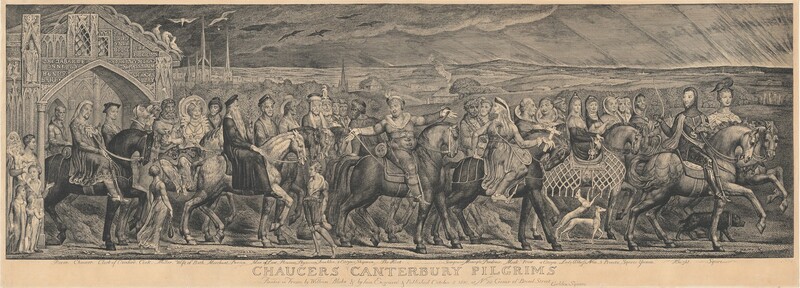
CANTERBURY PILGRIMS

Wikipedia Commons
Canterbury Pilgrims

When Blake painted his illustration for Chaucer's Canterbury Tales for his Exhibition of 1809 he included a detailed description of the painting in his Catalogue. He lists the pilgrims in the procession as Chaucer had described them. Notice too that he points out the time of day and the starting point of the pilgrimage. He remarks that he has attempted to portray features of the landscape as they would have appeared in Chaucer's time, some 400 years before Blake's own time. In spite of the lapse of time Blake feels that 'the characters themselves for ever remain unaltered' and delineate 'the classes of men.'

Descriptive Catalogue, (E 532)
"NUMBER III.
Sir Jeffery Chaucer and the nine and twenty Pilgrims on
their journey to Canterbury.

THE time chosen is early morning, before sunrise, when the jolly
company are just quitting the Tabarde Inn. The Knight and Squire
with the Squire's Yeoman lead the Procession, next follow the
youthful Abbess, her nun and three priests; her greyhounds attend
her.

'Of small hounds had she that she fed
'With roast flesh, milk and wastel bread.'

Next follow the Friar and Monk; then the Tapiser, the Pardoner,
and the Somner and Manciple. After these "Our Host," who occupies
the center of the cavalcade; directs them to the Knight
as the person who would be likely to commence their task of each
telling a tale in their order. After the Host follow the
Shipman, the Haberdasher, the Dyer, the Franklin, the Physician,
the Plowman, the Lawyer, the poor Parson, the Merchant, the Wife
of Bath, the Miller, the Cook, the Oxford Scholar, Chaucer
himself, and the Reeve comes as Chaucer has described:

'And ever he rode hinderest of the rout.'

These last are issuing from the gateway of the Inn; the Cook and
the Wife of Bath are both taking their morning's draught of
comfort. Spectators stand at the gateway of the Inn, and are
composed of an old Man, a Woman and Children.
The Landscape is an eastward view of the country, from the
Tabarde Inn, in Southwark, as it may be supposed to have
appeared in Chaucer's time; interspersed with cottages and
villages; the first beams of the Sun are seen above the horizon;
some buildings and spires indicate the situation of the great
City; the Inn is a gothic building, which Thynne in his Glossary
says was the lodging of the Abbot of Hyde, by Winchester. On
the Inn is inscribed its title, and a proper advantage is taken
of this circumstance to describe the subject of the Picture.
The words written over the gateway of the Inn, are as follow:
"The Tabarde Inn, by Henry Baillie, the lodgynge-house for
Pilgrims, who journey to Saint Thomas's Shrine at Canterbury."
The characters of Chaucer's Pilgrims are the characters
which compose all ages and nations: as one age falls, another
rises, different to mortal sight, but to immortals only the same;
for we see the same characters repeated again and again, in
animals, vegetables, minerals, and in men; nothing new occurs in
identical existence; Accident ever varies, Substance can
never suffer change nor decay.
Of Chaucer's characters, as described in his Canterbury
Tales, some of the names or titles are altered by time, but the
characters themselves for ever remain unaltered, and
consequently they are the
physiognomies or lineaments of universal human life, beyond which
Nature never steps. Names alter, things never alter. I have
known multitudes of those who would have been monks in the age of
monkery, who in this deistical age are deists. As Newton
numbered the stars, and as Linneus numbered the plants, so
Chaucer numbered the classes of men."

There were many reasons that Blake put a lot of time and energy into his painting of the Canterbury Pilgrims, some of which we will explore in later posts. First we see it only as a careful rendition of a Gothic text.

Friday, January 06, 2012

Plate 26

This short plate is a conclusive statement of what Blake tried to do in Chapter One of the poem:

SUCH VISIONS HAVE APPEARED TO ME
AS I MY ORDERED RACE HAVE WON
JERUSALEM IS NAMED LIBERTY
AMONG THE SONS OF ALBION

The form of this poem is often thought of as formless; for example the last plates (but this one) have a colloquy stretching over about four of them.

Often there appears to be no resemblance in the mental dimension of pictures and text.

Here at the end of Chapter Two Blake rises to prose; he tells us in factual terms what he has done with the 'visions that appeared to him'. (You may remember that the 'Visions' had deserted Blake for the 20 years preceding a new liberty that came to him in 1804.) His output in the earlier years became a source with which he improved on the ideas of "The Unholy Bible" and The Four Zoas. In fact he glorified them with the heavenly wisdom that you and I may strive for with our devotions.

In Chapter One Blake was trying to reach ordinary people (is it succeeding for us?). The successive chapters were addressed To the Jews, To the Deists, and To the Christians. I like to think that To the Christians was especially to those Christian poets who had received him gladly in his last years.


Thursday, January 05, 2012

READING BLAKE

From Jerusalem, Plate 64
Used on cover of The Complete Poetry & Prose of William Blake

The resources on the internet have made studying Blake easier. When Larry began reading Blake in the 1980's he was dependent on books for his sources. His 'bible' was Geoffrey Keynes' Blake: Complete Writings first published by the Oxford University Press in 1966 (a revision of his 1925 work). The authoritative text for the works of Blake is now David V Erdman's The Complete Poetry & Prose of William Blake published in 1965 and revised in 1988. We are not completely dependent on printed copy now because of access to electronic text. Erdman's text is available to download from the internet as a text file named eE. If you download the file to your computer you will have a searchable copy of all that Blake wrote.

Blake's text is also available through the Blake Digital Text Project of the University of Georgia. Access to individual books and writings is facilitated by the use of an index. Page and line numbers are provided in this format. Search of the complete text is available through the concordance.

In his acknowledgement of the generosity of David Erdman making available his edition of Blake's works, Nelson Hilton, the editor of the digital project, quotes the second paragraph from Blake's 1796 letter to George Cumberland.

Letters, (E 700)

"Lambeth 23 Decembr 1796 a Merry Christmas
Dear Cumberland
I have lately had some pricks of conscience on account of
not acknowledging your friendship to me [before]
immediately on the reciet of your. beautiful book. I have
likewise had by me all the summer 6 Plates which you desired me
to get made for you. they have laid on my shelf. without speaking
to tell me whose they were or that they were [there] at
all & it was some time (when I found them) before I could divine
whence they came or whither they were bound or whether they were
to lie there to eternity. I have now sent them to you to be
transmuted, thou real Alchymist!
Go on Go on. such works as yours Nature & Providence the
Eternal Parents demand from their children how few produce them
in such perfection how Nature smiles on them. how Providence
rewards them. How all your Brethren say, The sound of his harp
& his flute heard from his secret forest chears us to the labours
of life. & we plow & reap forgetting our labour
Let us see you sometimes as well as sometimes hear from you
& let us often See your Works
Compliments to Mr Cumberland & Family
Yours in head & heart
WILL BLAKE"

It is not Blake's writings or pictures that so many labor to present; it is the truth incorporated in his words and images which point to the perennial realities of eternity expressed in time.

Wednesday, January 04, 2012

Plate 22

[Then Vala answerd spreading her scarlet Veil over Albion]
PLATE 22
Albion thy fear has made me tremble; thy terrors have surrounded me
Thy Sons have naild me on the Gates piercing my hands & feet:
Till Skofields Nimrod the mighty Huntsman Jehovah came,
With Cush his Son & took me down. He in a golden Ark,
Bears me before his Armies tho my shadow hovers here
The flesh of multitudes fed & nouris[h]d me in my childhood
My morn & evening food were prepard in Battles of Men
Great is the cry of the Hounds of Nimrod along the Valley
Of Vision, they scent the odor of War in the Valley of Vision.
All Love is lost! terror succeeds & Hatred instead of Love
And stern demands of Right & Duty instead of Liberty
Once thou wast to me the loveliest Son of heaven; but now
Where shall I hide from thy dread countenance & searching eyes
I have looked into the secret Soul of him I loved
And in the dark recesses found Sin & can never return.

Albion again utterd his voice beneath the silent Moon

I brought Love into light of day to pride in chaste beauty
I brought Love into light & fancied Innocence is no more

Then spoke Jerusalem O Albion! my Father Albion
Why wilt thou number every little fibre of my Soul
Spreading them out before the Sun like stalks of flax to d
ry?
The Infant Joy is beautiful, but its anatomy
Horrible ghast & deadly! nought shalt thou find in it
But dark despair & everlasting brooding melancholy!

Then Albion turnd his face toward Jerusalem & spoke

Hide thou Jerusalem in impalpable voidness, not to be
Touchd by the hand nor seen with the eye: O Jerusalem
Would thou wert not & that thy place might never be found
But come O Vala with knife & cup: drain my blood
To the last drop! then hide me in thy Scarlet Tabernacle

(21:44 warshipped] perhaps a scribal error for "worshipped"; but see textual note.)


For I see Luvah whom I slew. I behold him in my Spectre
As I behold Jerusalem in thee O Vala dark and cold

Jerusalem then stretchd her hand toward the Moon & spoke

Why should Punishment Weave the Veil with Iron Wheels of War
When Forgiveness might it Weave with Wings of Cherubim

Loud groand Albion from mountain to mountain & replied

(Erdman 167-8) [continue with Plate 23]

Notes:

This plate has a colloquy among Vala, Albion, and Jerusalem; first Vala:

"Thy Sons have naild me on the Gates": is this a reference to the
crucifixion? Isn't it strange that he put these words in the mouth of Vala?
The answer might be that Vala is many things; originally she was the emanation
of Luvah; it's he rather than she who stand most often for Christ.

In line 3 Jerhovah is identified with two disreputable characters, which very
adequately reminds us that Blake didn't think much of the Old Testament God
(who brings "a thump on the head" compared to the Son's healing balm.)

"the Valley of Vision": the Bible has many valleys, but the most appropriate
is the valley of gehenna,, where the followers of Moloch sacrificed their
children. (and of course there is the 'valley of the shadow of death'.)

Albion now spoke two lines:
"I brought Love into light of day....."


Then Jerusalem comes in; she takes Albion to task for lapsing from Eternity
into the most crass materiality (joy is beautiful, but its anatomy horrible).

If you're still interested, look at the rest of the conversation (at least
the rest of it on this plate).

Notes on the Picture:
1. Upper: much like plates 18 and 20 two figures; one veiled, one naked,
suggesting Vala and Jerusalem; two figures in close proximity, but not
connected.

2. Blake showed three of the "Iron Wheels of War", said to be partially
immersed in water. (See Copy E).

And the two figures, now connected; you might say two double figures; to the
left Vala: fallen and redeemed; to the right Jerusalem: redeemed and fallen.

Erdman pointed out "three birds in the margin beside Albion's lament".

"And he pointed out the description of the Wheels at Plate 18:8-10:
Became as Three Immense Wheels, turning upon one-anotherInto Non-Entity, and their thunders hoarse appall the DeadTo murder their own Souls, to build a Kingdom among the Dead"      
(Erdman 163)


Tuesday, January 03, 2012

GOING FORTH

Image from Blake's Watercolours for
the Poems of Thomas Gray
View in Blake Archive


One of the final poetic images of Jerusalem is that of the bow and the arrows. The activity of being sent into the Eternal dimension can be seen in the bow with its 'murmuring' string. 'Arrows of Love, Are the Children of this Bow: a Bow of Mercy & Loving-kindness' sent forth as a continuation of the activity of the bow which propels them.

Blake's Visionary Forms Dramatic edited by David V Erdman and John E Grant, includes an article by Edward J Rose. On Page 460 in a note Rose states:

"The 'Arrows of Intellect' that the fourfold bowstring 'breathes with ardour' are the armaments that he employs in the intellectual battles that are waged in the 'Mental Fight' of visionary art. Visionary arrows penetrate the opacity of man and 'Open the hidden Heart in Wars of mutual Benevolence, Wars of Love'".

On these three plates of Jerusalem, Blake develops his multifaceted image to propel his reader into a visionary experience of being a 'murmuring bow-string' and a 'flaming arrow'.

Jerusalem , Plate 95, (E 254)
"Her voice pierc'd Albions clay cold ear. he moved upon the Rock
The Breath Divine went forth upon the morning hills, Albion mov'd
Upon the Rock, he opend his eyelids in pain; in pain he mov'd
His stony members, he saw England. Ah! shall the Dead live again

The Breath Divine went forth over the morning hills Albion rose
In anger: the wrath of God breaking bright flaming on all sides around
His awful limbs: into the Heavens he walked clothed in flames
Loud thundring, with broad flashes of flaming lightning & pillars
Of fire, speaking the Words of Eternity in Human Forms, in direful
Revolutions of Action & Passion, thro the Four Elements on all sides
Surrounding his awful Members. Thou seest the Sun in heavy clouds
Struggling to rise above the Mountains. in his burning hand
He takes his Bow, then chooses out his arrows of flaming gold
Murmuring the Bowstring breathes with ardor! clouds roll around the
Horns of the wide Bow, loud sounding winds sport on the mountain brows
Compelling Urizen to his Furrow; & Tharmas to his Sheepfold;
And Luvah to his Loom: Urthona he beheld mighty labouring at
His Anvil, in the Great Spectre Los unwearied labouring & weeping
...
PLATE 97
Awake! Awake Jerusalem! O lovely Emanation of Albion
Awake and overspread all Nations as in Ancient Time
For lo! the Night of Death is past and the Eternal Day
Appears upon our Hills: Awake Jerusalem, and come away

So spake the Vision of Albion & in him so spake in my hearing
The Universal Father. Then Albion stretchd his hand into Infinitude.
And took his Bow. Fourfold the Vision for bright beaming Urizen
Layd his hand on the South & took a breathing Bow of carved Gold
Luvah his hand stretch'd to the East & bore a Silver Bow bright shining
Tharmas Westward a Bow of Brass pure flaming richly wrought
Urthona Northward in thick storms a Bow of Iron terrible thundering.

And the Bow is a Male & Female & the Quiver of the Arrows of Love,
Are the Children of this Bow: a Bow of Mercy & Loving-kindness: laying
Open the hidden Heart in Wars of mutual Benevolence Wars of Love
And the Hand of Man grasps firm between the Male & Female Loves
And he Clothed himself in Bow & Arrows in awful state Fourfold
In the midst of his Twenty-eight Cities each with his Bow breathing
PLATE 98
Then each an Arrow flaming from his Quiver fitted carefully
They drew fourfold the unreprovable String, bending thro the wide Heavens
The horned Bow Fourfold, loud sounding flew the flaming Arrow fourfold

Murmuring the Bow-string breathes with ardor. Clouds roll round the horns
Of the wide Bow, loud sounding Winds sport on the Mountains brows:
The Druid Spectre was Annihilate loud thundring rejoicing terrific vanishing"

Monday, January 02, 2012

Plate 21


wikipedia collection

Then Albion broke silence and with groans reply'd

PLATE 21
O Vala! O Jerusalem! do you delight in my groans
You O lovely forms, you have prepared my death-cup:
The disease of Shame covers me from bead to feet: I have no hope
Every boil upon my body is a separate & deadly Sin.
Doubt first assaild me, then Shame took possession of me
Shame divides Families. Shame hath divided Albion in sunder!
First fled my Sons, & then my Daughters, then my Wild Animations
My Cattle next, last ev'n the Dog of my Gate. the Forests fled
The Corn-fields, & the breathing Gardens outside separated
The Sea; the Stars: the Sun: the Moon: drivn forth by my disease
All is Eternal Death unless you can weave a chaste
Body over an unchaste Mind! Vala! O that thou wert pure!
That the deep wound of Sin might be clos'd up with the Needle,
And with the Loom: to cover Gwendolen and Ragan with costly Robes
Of Natural Virtue, for their Spiritual forms without a Veil
Wither in Luvahs Sepulcher. I thrust him from my presence
And all my Children followd his loud howlings into the Deep.
Jerusalem! dissembler Jerusalem! I look into thy bosom:
I discover thy secret places: Cordella! I behold
Thee whom I thought pure as the heavens in innocence & fear:
Thy Tabernacle taken down, thy secret Cherubim disclosed
Art thou broken? Ah me Sabrina, running by my side:
In childhood what wert thou? unutterable anguish! Conwenna
Thy cradled infancy is most piteous. O hide, O hide!
Their secret gardens were made paths to the traveller:
I knew not of their secret loves with those I hated most,
Nor that their every thought was Sin & secret appetite
Hyle sees in fear, he howls in fury over them, Hand sees
In jealous fear: in stern accusation with cruel stripes
He drives them thro' the Streets of Babylon before my face:
Because they taught Luvah to rise into my clouded heavens
Battersea and Chelsea mourn for Cambel & Gwendolen!
Hackney and Holloway sicken for Estrild & Ignoge!
Because the Peak, Malvern & Cheviot Reason in Cruelty
Penmaenmawr & Dhinas-bran Demonstrate in Unbelief
Manchester & Liverpool are in tortures of Doubt & Despair
Malden & Colchester Demonstrate: I hear my Childrens voices
I see their piteous faces gleam out upon the cruel winds
From Lincoln & Norwich, from Edinburgh & Monmouth:
I see them distant from my bosom scoured along the roads
Then lost in clouds; I hear their tender voices! clouds divide

I see them die beneath the whips of the Captains! they are taken
In solemn pomp into Chaldea across the bredths of Europe
Six months they lie embalmd in Silent death: warshipped
Carried in Arks of Oak before the armies in the spring
Bursting their Arks they rise again to life: they play before
The Armies: I hear their loud cymbals & their deadly cries
Are the Dead cruel? are those who are infolded in moral Law
Revengeful? O that Death & Annihilation were the same!

Then Vala answerd spreading her scarlet Veil over Albion 
 Notes:
 
  This plate gives us Albion's statement, to be followed by Vala's answer. If you haven't read this blog before, I can tell you that Albion was Blake's term for England, or more generally Everyman (including of course you and me). Vala is Blake's name for the earthly, material (and materialistic) woman, or more properly the earthly Albion's wife (emanation!), the 'contrary' of Jerusalem, the Eternal wife or emanation of Albion.
With 'You O lovely forms' Blake means especially Vala. (It's as if a man is denouncing his wife and his mistress, but his denunciations are directed primarily at the mistress.)

 "Every boil upon my body": this sounds very much like The Book of Job. (The picture above is one of the plates of Blake's Illustrations of the Book of Job.)

What follows (the cattle, the cornfield, the sun, the moon, etc.) is a remarkable record of the earlier catastrophe when Albion fell asleep in Beulah (and slept too long!); Blake called it the Fall, and it points toward the same thing ahead for us all (the Rise, or Recovery). 

"Gwendolen and Ragan" consult the concordance.

"Jerusalem! dissembler Jerusalem!": here he changes his reproaches to Jerusalem (bride of Christ, but fallen; do you know any fallen brides of Christ?)

Much more interpretation is needed.  You could research it, just like I could.

Thanks for reading this!

Sunday, January 01, 2012

BLAKE & SOURCES

Marriage of Heaven & Hell
Plate 21
Library of Congress
Rosenwald Collection

Blake was hungry to assimilate ideas into his ever expanding system of thought as Peter Ackroyd tells us in Blake, A Biography:

"In his eclectic assumption of Taylor's Neoplatonism, in fact, we can observe the movement of Blake's mind; he picked up separate ideas, or fragments of knowledge, as he needed them. He was a synthesiser and a systematiser, like so many of his generation, but it was his own synthesis designed to establish his own system of belief. He was likely to adopt an idea he designed or read in a periodical or pamphlet with the same frequency that he borrowed notions from Swedenborg or Paracelsus. He was, above everything else, an artist and not an orthodox 'thinker': he was attracted to images or phrases as a means of interpretation, and never espoused a complete or coherently organised body of knowledge." (Page 90)

Blake's comments on Swedenborg in Marriage of Heaven & Hell point out the breadth of influences upon him and the critical evaluations he made of his sources.

Marriage of Heaven & Hell, Plate 21, (E 42)
"I have always found that Angels have the vanity to speak of
themselves as the only wise; this they do with a confident
insolence sprouting from systematic reasoning:
Thus Swedenborg boasts that what he writes is new; tho' it
is only the Contents or Index of already publish'd books
A man carried a monkey about for a shew, & because he was a
little wiser than the monkey, grew vain, and conciev'd himself as much
wiser than seven men. It is so with Swedenborg; he shews the
folly of churches & exposes hypocrites, till he imagines that all
are religious. & himself the single
PLATE 22
One on earth that ever broke a net.
Now hear a plain fact: Swedenborg has not written one new
truth: Now hear another: he has written all the old falshoods.
And now hear the reason. He conversed with Angels who are
all religious, & conversed not with Devils who all hate religion,
for he was incapable thro' his conceited notions.
Thus Swedenborgs writings are a recapitulation of all
superficial opinions, and an analysis of the more sublime, but no further.
Have now another plain fact: Any man of mechanical talents
may from the writings of Paracelsus or Jacob Behmen, produce ten
thousand volumes of equal value with Swedenborg's.
and from those of Dante or Shakespear, an infinite number.
But when he has done this, let him not say that he knows
better than his master, for he only holds a candle in sunshine."