Tuesday, January 14, 2014

Illustrations of Paradise Lost 3

wikipedia
Paradise Lost 3
William Blake

Christ offers to Redeem Man
"Amidst the glorious brightness where thou sit'st"
(The Image suggests that the Light of God is reflected by Christ) 
Angels on each side "cast Their Crowns before him" (them?)(Book 3;351-2)
Satan is down below with his spear in his right arm; his left arm is wearing a shield.
His face has a sad expression.
From William Blake at the Huntington, by Robert N. Essick, #44:

From Paradise Lost Book Three:
John Milton  
"From the pure Empyrean where he sits
High Thron'd above all highth, bent down his eye,
His own works and their works at once to view:
About him all the Sanctities of Heaven [ 60 ]
Stood thick as Starrs, and from his sight receiv'd
Beatitude past utterance; on his right
The radiant image of his Glory sat,
His onely Son; On Earth he first beheld
Our two first Parents, yet the onely two [ 65 ]
Of mankind, in the happie Garden plac't,
Reaping immortal fruits of joy and love,
Uninterrupted joy, unrivald love
In blissful solitude; he then survey'd
Hell and the Gulf between, and Satan there [ 70 ]
Coasting the wall of Heav'n on this side Night
In the dun Air sublime, and ready now
Eternal King; thee Author of all being,
Fountain of Light, thy self invisible [ 375 ]

Thron'd inaccessible, but when thou shad'st
The full blaze of thy beams, and through a cloud
Drawn round about thee like a radiant Shrine,
Dark with excessive bright thy skirts appeer, [ 380 ]
Yet dazle Heav'n, that brightest Seraphim"


and/or that Christ (in the N.T. is beginning to replace the 
'Light' of the Father (O.T.) (In life the 'father' is replaced 
by the Son, and many tycoons want their son to take their place.)

"Coasting the wall of Heaven .....,"

Christ at the Atonement   in the posture of the Crucifixion. 
Christ stands before God the Father 'High Thron'd but bent Down' (358)

"Now had the Almighty Father from above,
Thee Father first they sung Omnipotent",
Immutable, Immortal, Infinite,
(immortal invisible)

God sits bent over in a 'rectilinear' throne, his face is bent and 
hidden from the Son in front of him.

Monday, January 13, 2014

BLAKE'S COMUS 6

Prominently featured in Illustration 3 of Comus is a single bull or ox in the Thomas Set and a pair in the Butts set. Milton mentions the ox only to signify the time of day. Blake chooses to place the ox centrally in his illustration to allude to its use as a sacrificial animal. The myths surrounding Bacchus involve situations calling for sacrifice. Blake calls to our attention that sacrifice may be required in the mask without specifying who or what may be sacrificed.  

Comparing Illustration 3 of the Thomas and Butts sets we see that Blake make numerous changes although he maintained the same elements. The grapes are less prominent the second set and the boys look more mature. The boys' swords which lay on the ground in the first image do not appear in the second picture. The Butts illustration shows a path leading from the Lady toward her brothers. The form, size and position of the attendant Spirit is altered. Comus looks toward the brothers although in the first image he focused on the swords.

The conversation between Comus and the Lady which relates the incident of Comus encountering the brothers, is pictured by Blake in Illustration 2. We read here Comus' retelling of that event. By describing in glowing terms his meeting with the brothers, Comus convinces the Lady that he sincerely wishes to give her assistance. The Lady naively believes she will be safer with the smooth stranger than if she waits for her brothers return.


Wikimedia Commons
Milton's Comus
Butts Set, Illustration 3
A Mask Presented at Ludlow Castle, 1634
John Milton
Line 91
"Comus:
[To Lady] Two such I saw, what time the labour'd Oxe
In his loose traces from the furrow came,

And the swink't hedger at his Supper sate;
I saw them under a green mantling vine
That crawls along the side of yon small hill,
Plucking ripe clusters from the tender shoots,
Their port was more then human, as they stood;
I took it for a faƫry vision
Of som gay creatures of the element
That in the colours of the Rainbow live
And play i'th plighted clouds. I was aw-strook,
And as I past, I worshipt: if those you seek,
It were a journey like the path to Heav'n
To help you find them.  Lady: Gentle villager
What readiest way would bring me to that place?

Comus: Due west it rises from this shrubby point.
Lady: To find out that, good Shepherd, I suppose,
In such a scant allowance of Star-light,
Would overtask the best Land-Pilots art,
Without the sure guess of well-practiz'd feet. 

Comus: I know each lane, and every alley green
Dingle or bushy dell of this wilde Wood,
And every bosky bourn from side to side
My daily walks and ancient neighbourhood,
And if your stray attendance be yet lodg'd,
Or shroud within these limits, I shall know
Ere morrow wake, or the low roosted lark
From her thach't pallat rowse, if otherwise
I can conduct you Lady to a low
But loyal cottage, where you may be safe
Till further quest'.  Lady: Shepherd I take thy word,
And trust thy honest offer'd courtesie,
Which oft is sooner found in lowly sheds
With smoaky rafters, then in tapstry Halls
And Courts of Princes, where it first was nam'd,
And yet is most pretended: In a place
Less warranted then this, or less secure
I cannot be, that I should fear to change it,
Eie me blest Providence, and square my triall
To my proportion'd strength. Shepherd lead on.——


In the following passage in The Book of Urizen Blake uses the ox in the slaughterhouse to symbolize the sorry state which man endures under the rule of his Reasoning Power or Selfhood. In contrasting selfish and selfless love in The Clod & the Pebble, a pair of cattle join the sheep as representing lives lived for others not their own ease or pleasure. Blake sees that the weak and unprotected are sacrificed to the cruelty of self-righteous desire.
The Book of Urizen, Plate 23, (E 81)
"4. He in darkness clos'd, view'd all his race,
And his soul sicken'd! he curs'd
Both sons & daughters; for he saw
That no flesh nor spirit could keep                        
His iron laws one moment.

5. For he saw that life liv'd upon death
Plate 25
The Ox in the slaughter house moans
The Dog at the wintry door
And he wept, & he called it Pity
And his tears flowed down on the winds

6. Cold he wander'd on high, over their cities              
In weeping & pain & woe!
And where-ever he wanderd in sorrows
Upon the aged heavens
A cold shadow follow'd behind him
Like a spiders web, moist, cold, & dim                      
Drawing out from his sorrowing soul
The dungeon-like heaven dividing.
Where ever the footsteps of Urizen
Walk'd over the cities in sorrow.

7. Till a Web dark & cold, throughout all                   
The tormented element stretch'd
From the sorrows of Urizens soul
And the Web is a Female in embrio  
None could break the Web, no wings of fire." 
Songs of Innocence & of Experience, Song 32, (E 19)  
"The CLOD & the PEBBLE  

Love seeketh not Itself to please,
Nor for itself hath any care;
But for another gives its ease,
And builds a Heaven in Hells despair.

     So sang a little Clod of Clay,
     Trodden with the cattles feet:
     But a Pebble of the brook,
     Warbled out these metres meet.

Love seeketh only Self to please,
To bind another to Its delight:
Joys in anothers loss of ease,
And builds a Hell in Heavens despite." 

Sunday, January 12, 2014

Illustrations of Paradise Lost 2

Paradise Lost Book One includes:
  1. At last appear
  2. Hell-bounds, high reaching to the horrid roof,
  3. And thrice threefold the gates; three folds were brass,
  4. Three iron, three of adamantine rock,
  5. Impenetrable, impaled with circling fire,
  6. Yet unconsumed. Before the gates there sat
  7. On either side a formidable shape.
  8. The one seemed woman to the waist, and fair,
  9. But ended foul in many a scaly fold,
  10. Voluminous and vast, a serpent armed
  11. With mortal sting. About her middle round
  12. A cry of Hell-hounds never-ceasing barked
  13. With wide Cerberean mouths full loud, and rung

.Butts 2
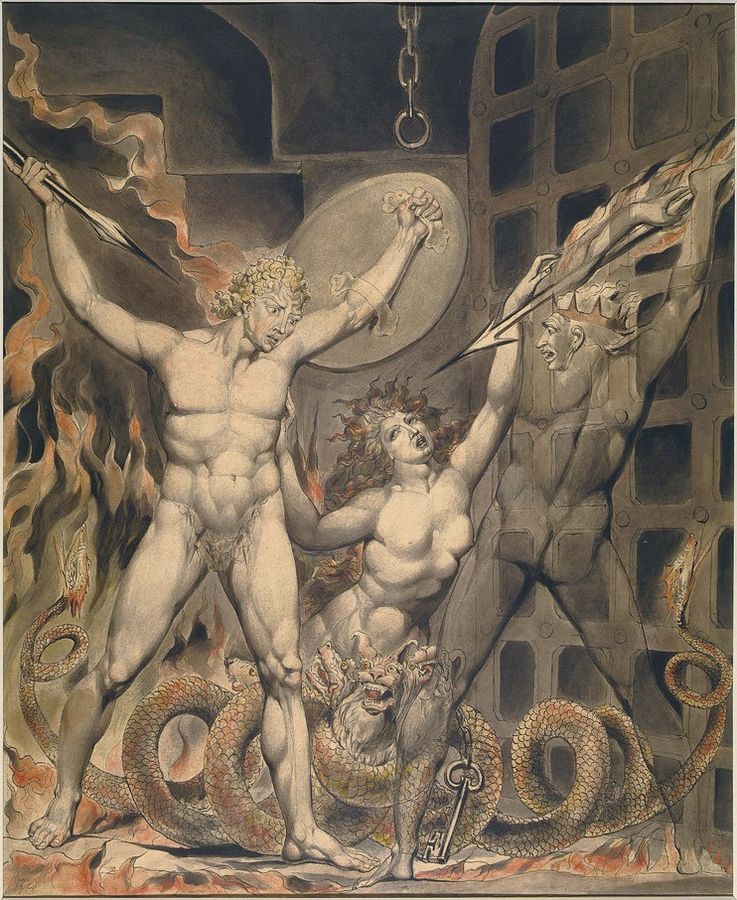
Satan, Sin, and Death:
Satan Comes to the Gates of Hell

From :Works
This Plate shows a contest between Satan and Death in the midst of Sin.
The lady between them is Sin; she seems to be trying to separate the others.

On the left is Satan; on the right is a transparent Death.
Each one has a fiery spear pointed at the other.

Under their feet are two Serpents,their mouths coming up at each border.

In the bottom center, in the coils of the serpent is a frightful creature, invocative of the Great Red Dragon of Revelation.  But Works reports:
 Below her loins are two coiled serpent's tails and the heads of four hell hounds

We can imagine a large hall open on the left and a large gate on the right, the gates of hell.

Four links of a large chain emerge from the upper center and is said to
 dangle to the right of Death's left calf.  Fire fills the passage on the left and appears along the lower edge of the design below the figures.

Satan and Death stand fighting with Sin between them. Satan, on the left, strides to the right with his arms bent upward. He holds a spear in his raised right hand and an oval shield in his left. Death's body is transparent. He stands with his back to the viewer and leans slightly to the right; with both hands he holds a fiery spear or dart which is pointed at Satan. 

Sin kneels between the two figures with her arms raised as if to separate them. Her right hand touches the left side of Satan's torso. Below her loins are two coiled serpent's tails and the heads of four hell hounds

The scene takes place in a chamber or hall with an open passage on the left and a large gate, with a lowered portcullis, on the right. These are the gates of hell. 


Saturday, January 11, 2014

BLAKE'S COMUS 5

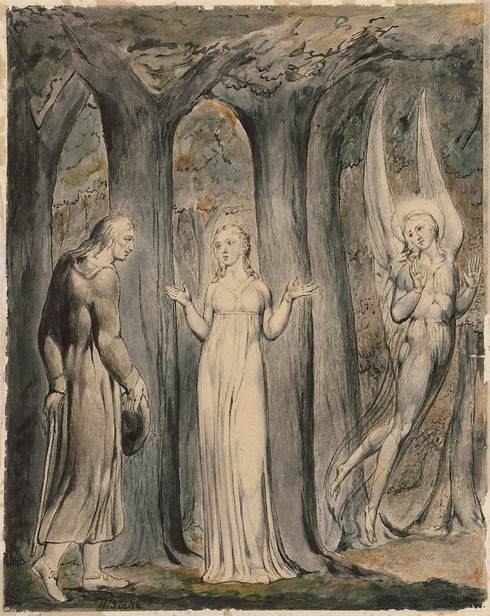
Unable to locate their sister or return to her after seeking food to sustain her, the brothers discussed her danger and her ability to protect herself. They have met, disguised as a villager, Comus who is seeking to locate the girl whose singing he had heard. Blake uses his third illustration to stress the situations portrayed by various characters. Comus with his aim to decieve and tempt the young lady, walks modestly in his long robe, carrying his walking stick and politely removing his hat. The Lady sits far removed from her brothers on the edge of the forest in which she has been lost and distressed. Above her the guardian attendant Spirit hovers surrounded  by light. The brothers have found the fruit they sought but are unaware that the innocent looking villager represents a threat to the Lady's and their own innocence.
 
Blake creates an inconsistency by picturing the brothers harvesting grapes from the vine. It is Comus who is associated with grapes and the wine they produce. Milton specifically cites Comus as being much like his father Bacchus who is the 'god of wine, freedom, intoxication and ecstasy'. The pleasure palace to which Comus wishes to lure the Lady is a Bacchanalia.

 
The younger brother fears for the Lady's safety. The elder brother believes the Lady's 'Virgin purity' will be protected by her 'hidden strength': chastity. In this third illustration both brothers are oblivious to their sister's precarious position.

Wikimedia
Original in Huntington Gallery
Milton's Comus
Illustration 3,Thomas Set
A Mask Presented at Ludlow Castle, 1634
John Milton
Line 398
"You may as well spred out the unsun'd heaps
Of Misers treasure by an out-laws den,
And tell me it is safe, as bid me hope
Danger will wink on Opportunity,
And let a single helpless maiden pass
Uninjur'd in this wilde surrounding wast.
Of night, or lonelines it recks me not,
I fear the dred events that dog them both,
Lest som ill greeting touch attempt the person
Of our unowned sister.

Line 413
Eld. Bro.
My sister is not so defenceless left
As you imagine, she has a hidden strength
Which you remember not.

2 Bro. What hidden strength,
Unless the strength of Heav'n, if you mean that?

Eld. Bro. I mean that too, but yet a hidden strength
Which if Heav'n gave it, may be term'd her own:
'Tis chastity, my brother, chastity:
She that has that, is clad in compleat steel,
And like a quiver's Nymph with Arrows keen
May trace huge Forests, and unharbour'd Heaths,
Infamous Hills, and sandy perilous wildes,
Where through the sacred rayes of Chastity,
No savage fierce, Bandite, or mountaneer
Will dare to soyl her Virgin purity,"


 Blake is aware of the intensity of the struggles which take place in human minds between following the inspiration of the Poetic Genius and submitting to the Tempter. In this passage from Jerusalem we see Los struggling against Albion's Sons to save Enitharmon:
Jerusalem, Plate 17, (E 161)
"They [Albion's sons] wooe Los continually to subdue his strength: he continually 
Shews them his Spectre: sending him abroad over the four points of heaven
In the fierce desires of beauty & in the tortures of repulse! He is
The Spectre of the Living pursuing the Emanations of the Dead.
Shuddring they flee: they hide in the Druid Temples in cold chastity:
Subdued by the Spectre of the Living & terrified by undisguisd desire.   

For Los said: Tho my Spectre is divided: as I am a Living Man
I must compell him to obey me wholly: that Enitharmon may not
Be lost: & lest he should devour Enitharmon: Ah me!
Piteous image of my soft desires & loves: O Enitharmon!
I will compell my Spectre to obey: I will restore to thee thy Children. 
No one bruises or starves himself to make himself fit for labour!

Tormented with sweet desire for these beauties of Albion
They would never love my power if they did not seek to destroy
Enitharmon: Vala would never have sought & loved Albion
If she had not sought to destroy Jerusalem; such is that false   
And Generating Love: a pretence of love to destroy love:

Cruel hipocrisy unlike the lovely delusions of Beulah:
And cruel forms, unlike the merciful  forms of Beulahs Night

They know not why they love nor wherefore they sicken & die
Calling that Holy Love: which is Envy Revenge & Cruelty          
Which separated the stars from the mountains: the mountains from Man
And left Man, a little grovelling Root, outside of Himself."

Friday, January 10, 2014

The Covering Chreub

When Blake and Milton lived, the social, economic, and political moments showed close similarities (the present moment emulates the above as well).

MHH has a lot of congruence with Paradise Lost:

The Marriage of Heaven and Hell came in 1790, soon after the end of the American Revolution and before the beginning of the French Revolution.

Milton lived while a British King was beheaded and replaced by the Commonwealth, an alternative form of government; he published Paradise Lost in 1667, a few years after the Restoration.

Blake and Milton were both dissenters and had republican feelings. They both lived in perilous times and might well have been branded as traitors.

Blake's overt use of Paradise Lost is in the two sets of Illustrations:

The Rev. Joseph Thomas set was dated 1807 and the larger Butts set in 1808:


Satan Arousing the Rebel Angels
http://commons.wikimedia.org

Butts 1

Hell is a rocky place!

Standing on a 'rock in Hell' Satan streches out his arms exhorting his rebel band, who seem pretty well 'played out' after what has happened to them; four at the bottom resemble other pictures Blake did for the four zoas, but these four are in chains.

Adam lies on a couch behind Satan's knees.

From PL Book One:

The infernal Serpent; he it was whose guile,
Stirred up with envy and revenge, deceived
The mother of mankind, what time his pride
Had cast him out from Heaven, with all his host
Of rebel Angels, by whose aid, aspiring
To set himself in glory above his peers,
He trusted to have equalled the Most High,
If he opposed, and, with ambitious aim
Against the throne and monarchy of God,
Raised impious war in Heaven and battle proud,
With vain attempt. Him the Almighty Power
Hurled headlong flaming from the ethereal sky,
With hideous ruin and combustion, down
To bottomless perdition,

Whereto with speedy words the Arch-Fiend replied:—
“Fallen Cherub, to be weak is miserable,
Doing or suffering: but of this be sure—
To do aught good never will be our task,
But ever to do ill our sole delight

As being the contrary to His high will
Whom we resist. If then His providence
Out of our evil seek to bring forth good,
Our labour must be to pervert that end,
And out of good still to find means of evil;

Blake chose the cherubims of Genesis 3:24 to relate to a passage in Ezekiel 28:

"14] Thou art the anointed cherub that covereth; and I have set thee so: thou wast upon the holy mountain of God; thou hast walked up and down in the midst of the stones of fire.
[15] Thou wast perfect in thy ways from the day that thou wast created, till iniquity was found in thee.
[16] By the multitude of thy merchandise they have filled the midst of thee with violence, and thou hast sinned: therefore I will cast thee as profane out of
the mountain of God: and I will destroy thee, O covering cherub, from the midst of the stones of fire.

Blake's illustration of Satan here resembles markedly his picture of the covering cherub:
This may be the Arch-Fiend mentioned earlier; Blake called him Lucifer.

Lucifer

This entity has many names:

the serpent
Satan
Lucifer
my Spectre
the Selfhood, and many others

Another link:
Blake and Covering Cherub

Thursday, January 09, 2014

BLAKE'S COMUS 4


Wikimedia Commons
Milton's Comus
Butts Set, Illustration 2


Milton presents the threat represented by Comus as being handed  down to him from his parents Bacchus and Circe. The disguised Comus holds behind his back his charming wand in the form of a walking stick. The spells that he is able to cast not only change his victims into animal-headed monsters but makes them unaware of the changes they have undergone.
 

Wikimedia Commons
Milton's Comus
Butts Set, Illustration 2
A Mask Presented at Ludlow Castle, 1634
John Milton
Line 61
"At last betakes him to this ominous Wood,
And in thick shelter of black shades imbowr'd,
Excells his Mother at her mighty Art, Offring to every weary Travailer,
His orient liquor in a Crystal Glasse,
To quench the drouth of Phoebus, which as they taste
(For most do taste through fond intemperate thirst)
Soon as the Potion works, their human count'nance,
Th' express resemblance of the gods, is chang'd
Into some brutish form of Woolf, or Bear,
Or Ounce, or Tiger, Hog, or bearded Goat,
All other parts remaining as they were,
And they, so perfect is their misery,
Not once perceive their foul disfigurement,
But boast themselves more comely then before
And all their friends, and native home forget
To roule with pleasure in a sensual sty."

 
The second image in the Butts set doesn't depart much from the Thomas set in composition. The emotions portrayed display subtle differences however. Perhaps the disguised Comus is more sinister and the Lady more inclined to accept the stranger's offer. The attendant Spirit is not holding the protective haemony but attempting to warn the Lady of the danger she faces. Blake may be attempting to develop greater tension through intensifying individual characteristics.


Through his power of enchantment Comus changes his victim's human countenance into that of a brutish animal. To Blake it was losing the ability to perceive the Divine Vision which led men to become degraded. Like Milton he viewed the human form as the Image of Himself by which God had crowned his creation. Milton's Comus casts the spell through which man loses the ability to see himself as human: the vehicle in which God resides. Milton included in his poem multiple themes; it can be read superficially as a defense of chastity, or more profoundly as a defense of man's innate humanity.
 
An example in Blake's Milton demonstrates a way in which Blake pictures man becoming locked in his mind by "envy of Living Form, even of the Divine Vision And of the sports of Wisdom in the Human Imagination."


Milton, Plate 3, (E 96)            
"Mark well my words! they are of your eternal salvation:        

Three Classes are Created by the Hammer of Los, & Woven  

By Enitharmons Looms when Albion was slain upon his Mountains
And in his Tent, thro envy of Living Form, even of the Divine Vision
And of the sports of Wisdom in the Human Imagination
Which is the Divine Body of the Lord Jesus, blessed for ever.
Mark well my words. they are of your eternal salvation:      

Urizen lay in darkness & solitude, in chains of the mind lock'd up
Los siezd his Hammer & Tongs; he labourd at his resolute Anvil

Among indefinite Druid rocks & snows of doubt & reasoning.

Refusing all Definite Form, the Abstract Horror roofd. stony hard.
And a first Age passed over & a State of dismal woe:"   

Wednesday, January 08, 2014

Blake and Milton II


John Milton (9 December 1608 – 8 November 1674) was an English poet, polemicistman of letters, and a civil servant for the Commonwealth of England under Oliver Cromwell. He wrote at a time of religious flux and political upheaval, and is best known for his epic poem Paradise Lost (1667), written in blank verse.
Milton's poetry and prose reflect deep personal convictions, a passion for freedom and self-determination, and the urgent issues and political turbulence of his day. 
Here are a few things Blake wrote about Milton:

In a Letter to Flaxman in 1800 Blake wrote:
Now my lot in the Heavens is this; 
Milton lovd me in childhood & shewd me his face
Ezra came with Isaiah the Prophet, but Shakespeare in riper years gave me his hand
Paracelsus & Behmen appeard to me. terrors appeard in the Heavens above
(Erdman 707)

In Plate 5  of The Marriage of Heaven and Hell he wrote: 
But in the Book of Job Miltons Messiah is call'd Satan. 
For this history has been adopted by both parties 
It indeed appear'd to Reason as if Desire was cast out. but the Devils account is, that the Messi[PL 6]ah fell. & formed a heaven of what he stole from the Abyss 
This is shewn in the Gospel, where he prays to the Father to send the comforter or Desire that Reason may have Ideas to build on, the Jehovah of the Bible being no other than he, who dwells in flaming fire.  
Know that after Christs death, he became Jehovah. 
But in Milton; the Father is Destiny, the Son, a Ratio of the five senses. & the Holy-ghost, Vacuum! 

 Note. The reason Milton wrote in fetters when he wrote of Angels & God, and at liberty when of Devils & Hell, is because he was a true Poet and of the Devils party without knowing it (Erdman 34)

[Prospectus] TO THE PUBLIC October 10, 1793.
The Labours of the Artist, the Poet, the Musician, have been
proverbially attended by poverty and obscurity; this was never
the fault of the Public, but was owing to a neglect of means to
propagate such works as have wholly absorbed the Man of Genius.
Even Milton and Shakespeare could not publish their own works.
(Erdman 692)

In a letter to Dr. Trusler in 1799 Aug16: 
I hope that none of my Designs will be destitute of Infinite Particulars which will present themselves to the Contemplator.
And tho I call them Mine I know that they are not Mine being of
the same opinion with Milton when he says That 
the Muse visits his Slumbers & awakes & governs his Song when Morn 
purples The East. 
& being also in the predicament of that prophet who says I
cannot go beyond the command of the Lord to speak good or bad
(Erdman 701)

In a letter to Dr. Trusler in 1799 Aug 23:
To Me This World is all One continued
Vision of Fancy or Imagination & I feel Flatterd when I am told
So.  What is it sets Homer Virgil & Milton in so high a rank of
Art.  Why is the Bible more
Entertaining & Instructive than any other book.  Is it not
because they are addressed to the Imagination which is Spiritual
Sensation & but mediately to the Understanding or Reason 
(Erdman 702)

The Book of Milton
Frontspiece of Milton
Rosenwald LC
An earlier post with this title is found here and includes this portrait of Milton:

Wikipedia Commons
for William Hayley

Tuesday, January 07, 2014

BLAKE'S COMUS 3

In conformity to the tradition of masks, members of the family of the honoree played roles in the performance. Lord Bridgewater's three children Alice (age 15), Lord Brackley (age 11) and Tom (age 9) played three of the principle parts: the Lady and her two brothers.

Wikimedia
Original in Huntington Gallery
Milton's Comus
Thomas Set, Illustration 2
The tale begins when the three children venture through the woods to join their parents at the installation ceremony at which this mask was performed. The sister is separated from her brothers who are looking for food to satisfy her hunger.

 
Milton and Blake follow a tradition long established in poetry and fairy tales of challenges and opportunities being initiated in an unknown wood. "Forests are traditionally a place where the way is lost and the light obscured," Damon tells us in A Blake Dictionary.


Left alone the Lady becomes susceptible to anxieties which she allays by thinking of Divine protection.

 
A Mask Presented at Ludlow Castle, 1634
John Milton
Line 205
"What might this be? A thousand fantasies

Begin to throng into my memory
Of calling shapes and beckning shadows dire,
And airy tongues, that syllable mens names
On Sands, and Shoars, and desert Wildernesses.
These thoughts may startle well, but not astound
The vertuous mind, that ever walks attended
By a strong siding champion Conscience.
O welcom pure-ey'd Faith, white-handed Hope,
Thou hov'ring Angel girt with golden wings,
And thou unblemish't form of Chastity
I see ye visibly, and now beleeve
That he, the Supreme good, t' whom all things ill
Are but as slavish officers of vengeance,
Would send a glistring Guardian if need were
To keep my life and honour unassail'd."

 
But Comus has discovered the Lady and proposes to make her prey to his nefarious designs.

 
Blake presents in his second illustration to Comus the meeting between the Lady and Comus under the observant eye of her attendant Spirit. Comus, having sensed the presence of the unprotected young woman, has transformed his visage into that of a 'harmles Villager'. Comus intends to lure the Lady to his palace and put her under his spell. The attendant Spirit performs his/her role by remaining in the background and facilitating the activities of others. Learning of Comus' plan the attendant Spirit formulates a plan too.

 
A bit like the situation between Comus and the Lady is this scene between Tharmas and Enion in the Four Zoas.


Four Zoas, Night IX, Page 131, (E 399)
"Chear up thy Countenance bright boy & go to Enion
Tell her that Vala waits her in the shadows of her garden

He went with timid steps & Enion like the ruddy morn 
When infant spring appears in swelling buds & opening flowers
Behind her Veil withdraws so Enion turnd her modest head

But Tharmas spoke Vala seeks thee sweet Enion in the shades
Follow the steps of Tharmas O thou brightness of the gardens
He took her hand reluctant she followd in infant doubts 

Thus in Eternal Childhood straying among Valas flocks
In infant sorrow & joy alternate Enion & Tharmas playd
Round Vala in the Gardens of Vala & by her rivers margin
They are the shadows of Tharmas & of Enion in Valas world"

Monday, January 06, 2014

From Milton, Plate 26

Milton, Plate 26 [28],(E 123) 
"And these the Labours of the Sons of Los in Allamanda
And in the City of Golgonooza: & in Luban: & around 
Where Souls incessant wail, being piteous Passions & Desires 
With neither lineament nor form but like to watry clouds 
The Passions & Desires descend upon the hungry winds 
For such alone Sleepers remain meer passion & appetite; 
The Sons of Los clothe them & feed & provide houses & fields 

And every Generated Body in its inward form, 
Is a garden of delight & a building of magnificence, 
Built by the Sons of Los in Bowlahoola & Allamanda 
And the herbs & flowers & furniture & beds & chambers 
Continually woven in the Looms of Enitharmons Daughters 
 In bright Cathedrons golden Dome with care & love & tears 
For the various Classes of Men are all markd out determ inate 

In Bowlahoola; & as the Spectres choose their affinities 
So they are born on Earth, & every Class is determinate 
But not by Natural but by Spiritual power alone, 
Because The Natural power continually seeks & tends to 
Destruction Ending in Death: which would of itself be Eternal Death 
And all are Class'd by Spiritual, & not by Natural power.

Sunday, January 05, 2014

BLAKE'S COMUS 2

Wikimedia Commons
Milton's Comus
Illustration 1, Butts Set 
A Mask Presented at Ludlow Castle, 1634
John Milton
Line 34
"Where his fair off-spring nurs't in Princely lore,
Are coming to attend their Fathers state,
And new-entrusted Scepter, but their way
Lies through the perplex't paths of this drear Wood,
The nodding horror of whose shady brows
Threats the forlorn and wand'ring Passinger.
And here their tender age might suffer perill,
But that by quick command from Soveran Jove
 
I was dispatcht for their defence, and guard;
And listen why, for I will tell ye now
What never yet was heard in Tale or Song
From old, or modern Bard in Hall, or Bowr"


John Milton's aspirations were high but he was slow to show any concrete results from his application to academic pursuits. He was 26 years old when he wrote A Mask Presented at Ludlow Castle which was his first poetry in English which was available for public consumption. He received a commission to write the verse for a mask to be performed at the installation of Lord Bridgewater to the post of Lord President of Wales and The Marches. A popular entertainment at courts, masks included music, dancing and performances by aristocrats as well as professionals.
Wikimedia Commons
Milton's Comus
Illustration 1, Butts Set 
 
 
We can assume that Milton was as glad to get the work writing his mask as Blake was to get the commission to illustrate it 167 years later. However both may have had reservation about the purpose which occasioned the use of their talents. Both men were torn between the desire to be true to his own vision and to produce works which would be accepted by an audience. An issue for Milton may have been the conventional use of the mask to 'glorify the court or a particular member of the aristocracy,' (Milton, Anna Beer, Page 68). Blake's affirmation of the liberty to flaunt the restrictions of society in the expression of love may have made the emphasis on chastity in Comus offensive to him.

 
About 15 years after creating the set for Rev Thomas, Blake was to make for Thomas Butts a second set of illustrations to Comus. In comparing the two sets we see how Blake had altered some of his interpretation of Milton's work. In the first illustration a fourth enchanted creature has been added, the attendant Spirit is replaced by stars, Comus is less menacing and the Lady more alarmed. The cup has been transferred to the hand of Comus. These changes and those in subsequent illustrations may represent Blake's attempt to align Milton's mask with his own myth.


Milton, Plate 26 [28],(E 123)
"And these the Labours of the Sons of Los in Allamanda:
And in the City of Golgonooza: & in Luban: & around
The Lake of Udan-Adan, in the Forests of Entuthon Benython       
Where Souls incessant wail, being piteous Passions & Desires
With neither lineament nor form but like to watry clouds
The Passions & Desires descend upon the hungry winds
For such alone Sleepers remain meer passion & appetite;
The Sons of Los clothe them & feed & provide houses & fields     

And every Generated Body in its inward form,
Is a garden of delight & a building of magnificence,
Built by the Sons of Los in Bowlahoola & Allamanda
And the herbs & flowers & furniture & beds & chambers
Continually woven in the Looms of Enitharmons Daughters          
In bright Cathedrons golden Dome with care & love & tears
For the various Classes of Men are all markd out determinate

In Bowlahoola; & as the Spectres choose their affinities
So they are born on Earth, & every Class is determinate
But not by Natural but by Spiritual power alone, Because         
The Natural power continually seeks & tends to Destruction
Ending in Death: which would of itself be Eternal Death
And all are Class'd by Spiritual, & not by Natural power.

And every Natural Effect has a Spiritual Cause, and Not
A Natural: for a Natural Cause only seems, it is a Delusion      
Of Ulro: & a ratio of the perishing Vegetable Memory."

Saturday, January 04, 2014

bible3-faith-3

      If you believe that all came originally from the One and that in the fullness of time all things in Christ are gathered together in one, then as a consequence the two paths do meet at the end as Blake claimed. We can put this in a more properly theological context with Blake's expressed response to the calvinistic doctrine of Double Predestination.

      Double Predestination contains as its lower half the grim old notion of Hell that has probably done as much as anything else in theology to discredit the Christian faith in the eyes of the modern world. Calvin taught the hoary old superstition that most of the world's population are destined to live without Christ and to die and move on to eternal torment; a lucky few have a happier destiny. The lucky few included Calvin of course and his friends, especially his obedient friends. In contrast Origen, perhaps Paul, and surely Blake believed in single predestination: the two streams converge at the end.

      Blake expended an enormous amount of his creative energy combating Double Predestination. He heaped scorn upon scorn on the calvinistic God who curses his children. His break with Swedenborg followed his discovery that Swedenborg was a "Spiritual Predestinarian, more abominable than Calvin's". He later lamented over him and called him the "Samson, shorn by the Churches".

In 'Milton' Blake ironically inverted the calvinistic categories of 'elect' and 'reprobate'. With incredible elegance he used Jesus' words on Calvin like a two edged sword. He simply pronounced on behalf of Christ the obvious truth, as if to say, "Calvin, your doctrine is of the world, and your first shall be last in my kingdom."

      Double Predestination is a consequence of a more fundamental error of Rahab, the whore of Babylon, the organized Church, "Imputing sin and righteousness to individuals". Blake addressed that error with his doctrine of states, which we look at in a moment.

     In MHH Blake examined most directly the conventional idea of Hell and pronounced it a delusion of a certain type of mind. In Vision of the Last Judgment (Erdman 552-566) he gave his straightforward views about the meaning of the biblical Hell. Again in 'Jerusalem', "What are the Pains of Hell but Ignorance, Bodily Lust, Idleness & devastation of the things of the Spirit?"

      However the conventional Hell does seem to have some biblical basis: Isaiah 66.24, Mark 9.43ff; Matthew 25.41 provide examples. How do you deal with all those scriptures? In the first place Blake felt perfectly free to discount anything in the Bible that he found incongruent with his Vision, at least to discount its conventional meaning. The immediate experience always exercised authority over anything second hand. The inerrancy of scripture, another of the Five Fundamentals, meant just about as much to him as Double Predestination.

      In the second place, although the doctrine of hell has most often been used as a means of anathematizing those with whom one disagrees, there are certainly more creative ways to deal with it. Blake chose one of these, what he called the doctrine of states. In a conversation with the "seven Angels of the Presence" Milton is told by Lucifer: "We are not individuals but states... Distinguish therefore states from individuals in those states."


Friday, January 03, 2014

BLAKE'S COMUS

Blake's first effort in illustrating Milton's poetry took place in 1801 when he had made his move to Felpham. A commission to create the watercolor illustrations to Milton's Comus, or more properly A Mask Presented at Ludlow Castle, came from Rev Joseph Thomas. Perhaps Thomas saw Milton's drama as a morality play with which he agreed. Blake, however, would not have chosen to foster a moral of upholding chastity, and Milton's motivation for writing was more complex than to promote chastity. Blake was in the habit of using whatever text he read to elicit his own reactions. His illustrations aimed to show how he agreed or disagreed with what he read. But he was subtle enough not to offend his patron by departing from the text to the degree that his patron wouldn't see what he was looking for.


Rev Thomas was satisfied enough with his illustrations to Comus to later order illustrations for two other Milton poems: On the Morning of Christ's Nativity (1807) and Paradise Lost (1809). Thomas' death in 1811 may have been what deprived Blake of further patronage from this wealthy connoisseur. 


Wikimedia
Original in Huntington Gallery
Milton's Comus
Thomas Set, Illustration 1
The first image of the series introduces Comus, the villain of the drama who strives to change the consciousness of the young Lady and her brothers. Sitting underground with her thoughts and hopes the girl is vulnerable. Frolicking along with Comus are companions under his spell which has replaced their human heads with those of animals. The Lady fortunately has an attendant Spirit hovering in the sky to protect her.     


The Lady, like Blake's Thel is beginning to ask questions about her role in life.


Thel, Plate 3, (E 4)
"O little Cloud the virgin said, I charge thee tell to me,
Why thou complainest not when in one hour thou fade away:
Then we shall seek thee but not find; ah Thel is like to thee.
I pass away. yet I complain, and no one hears my voice.

The Cloud then shew'd his golden bead & his bright form emerg'd, 
Hovering and glittering on the air before the face of Thel.

O virgin know'st thou not. our steeds drink of the golden springs
Where Luvah doth renew his horses: look'st thou on my youth,  

And fearest thou because I vanish and am seen no more.
Nothing remains; O maid I tell thee, when I pass away,           
It is to tenfold life, to love, to peace, and raptures holy:
Unseen descending, weigh my light wings upon balmy flowers;
And court the fair eyed dew. to take me to her shining tent;
The weeping virgin, trembling kneels before the risen sun,
Till we arise link'd in a golden band, and never part;           
But walk united, bearing food to all our tender flowers

Dost thou O little Cloud? I fear that I am not like thee;
For I walk through the vales of Har. and smell the sweetest flowers;
But I feed not the little flowers: I hear the warbling birds,
But I feed not the warbling birds. they fly and seek their food; 
But Thel delights in these no more because I fade away,
And all shall say, without a use this shining woman liv'd,
Or did she only live. to be at death the food of worms."

Thursday, January 02, 2014

bible3 Faith-2


       Blake had a deep grasp of what students of the Bible have called the kenosis. At his Moment of Grace it became for him an existential reality. He rewrote 4Z to show Jesus throughout the drama coming from above, hovering over Mankind, descending into mortal flesh to join us and to take on our burdens, our sorrow and pain and travail. Blake referred to this as the "dark Satanic body". This is the body we all wear until Jesus glorifies it in us.

      According to Blake's faith this coming of Jesus is the ultimate act of forgiveness for what we have become in our brokenness. It empowers us to become through a new birth what we were originally and what we are called to be again. The new birth is an alteration of consciousness. Blake had an inkling of this as early as 'The Marriage of Heaven and Hell', where he referred to it as "an improvement of sensual enjoyment" In the same plate he referred to it as a cleansing of the "doors of perception" and likened the former state to life in Plato's cave.


      In the lovely "first Light" poem he used the thoroughly biblical figure of Jesus purging away "all my mire and my clay". Forgiveness is not a temporal event, but an eternal one. The Lamb of God was slain from the foundation of the world. We must forgive not once, but seventy times seven times. Blake deals with sin and forgiveness as ultimates in his notebook poem, "My Spectre around me night and day". The poem speaks primarily to the advanced student, but with crystal clarity stanza 14 bears on the primary grace:
    & Throughout all Eternity
    I forgive you, you forgive me.
    As our dear Redeemer said:
    This the Wine & this the Bread.

      The unforgiving, accusing, egocentric, spectrous Selfhood is the stuff of Ulro, the life that is Eternal Death. Forgiveness through Self-annihilation is the stuff of that life which is life indeed. In the eternal realm Good and Evil, Virtue and Sin, all are forgiven and replaced by Truth and Error, which constitute the matter of the eternal wars of love. We fight these with Blake's weapons (the burning arrows of thought, etc.) or with Paul's "whole armor of God". Error meets an eternal consummation as we grow closer and closer to the Perfect Man. The apocalypse in Blake's structure of faith comes as an alteration of consciousness by which "this world" fades out (is consumed) and is replaced by the Eternal. Albion awakes. "Whenever any Individual Rejects Error and Embraces Truth, a Last Judgment passes upon that Individual".

      This was Blake's religion; unfortunately he does not seem to have found it in any of the churches which he knew. Instead many of his deepest convictions directly contravened the prevailing theology. He discovered that he "must create a system, or be enslated by another mans". The pages that follow trace some of the contrarieties between Blake's vision of eternal reality and the mainstream of Christian orthodoxy.

The Two Ways
      In 'Milton' Blake speaks of two streams flowing from a fountain in a rock of crystal: one goes straight to Eden; the other is more torturous. They represent of course two possible journeys through life, and he could speak of both because he lived both. The first stream represents the child-like consciousness that enabled Blake (that enables anyone gifted with it) to live every moment in the light of Eternity. The other, more common path wanders all over this God-forsaken vale of tears, but it winds up at the same place.

      That's the most incredible good news for anybody who can hear it. The apostle Paul hinted at it a time or two; perhaps it was the truth that he was forbidden to tell. Origen believed it, no doubt one of the reasons the Church Fathers kicked him out. In the 19th Century an entire denomination arose whose primary emphasis was this particular good news--the Universalists. Actually this good news could not be pronounced with authority except by someone like Blake who had traveled both journeys; he knew whereof he spoke.

Wednesday, January 01, 2014

THE PROPHET

Reposted from December 2, 2009.
Wikipedia
All Religions Are One
Plate One
"The Voice of One Crying in the Wilderness"
The figure of the prophet is rooted in Old Testament literature. The priests were in charge of the religious activities of the Jews. They developed a religion based on law. The Ten Commandments of Moses multiplied until there were laws and rules for every facet of Jewish life. Following the law was supposed to please Jehovah and induce him to protect the Israelites. But the law was broken in letter and in spirit, and the nation of Israel endured many calamities which were often interpreted as punishment from Jehovah for sinfulness. Prophets arose outside of the established religious organization to lay before the people their failures and the predicted consequences. The prophets spoke as instruments of God, attempting to lead the people into more a just, merciful, and equitable society. The Old Testament prophets usually used threats as well as promises in trying to induce the Israelites to be obedient to God as they understood him.

With his sensitivity to injustice and his vision of the elevated role man should play in God's world, Blake felt affinity for the role of prophet. He knew how the world could be, should be, and would be if man would recognize and accept the role that God offers him.

God had endowed William with outstanding gifts. He had an unusual ability to see beyond the superficial appearances around him. He had an intellect that could absorb vast amounts of information and analyze and organize it. He had communication skills as a verbal and visual artist. Recognizing these talents as gifts from God, he wanted to use them in His service.

So it seems predictable that Blake should assume the role of prophet and attempt to lead the people into a better understanding of what had gone wrong with the plans God had for mankind, and how man might get back on the right track. The right track to him was not obedience to the law as it was for the prophets of old; the right track was the New Testament innovation of being led by the Holy Spirit.

Blake created the character Los as the Eternal Prophet and allowed him to enact many of the prophetic roles Blake played himself. Like the prophet Ezekiel, Blake and Los used demonstrations, not words alone, to project their message.

Jerusalem, Plate 5, (E 147)
"I rest not from my great task!
To open the Eternal Worlds, to open the immortal Eyes
Of Man inwards into the Worlds of Thought: into Eternity
Ever expanding in the Bosom of God. the Human Imagination"

Jerusalem Plate 12, (E 155)
"Giving a body to Falshood that it may be cast off for ever."

Jerusalem, Plate 88, (E 247)
"The blow of his Hammer is Justice. the swing of his Hammer:
Mercy.
The force of Los's Hammer is eternal Forgiveness"

Jerusalem, Plate 95, (E 255)
"Because he kept the Divine Vision in time of trouble"