Sunday, September 14, 2014

Generation

       Blake used the female as the basic symbol for the material and for the materialistic viewpoint. The history of this concept goes as far back as the beginning of time. The Sun represents a masculine God, the Moon, a Goddess, such as Diana, the great goddess of Ephesus, whose priests raised a riot against the apostle Paul, reported at Acts 19.

       Long after MHH he wrote 'Jerusalem' where the "female will" approaches identity with Satan. Both terms connote a preoccupation with the material, putting it first and only. Thus when we read a passage like
The Human is but a Worm, and thou, 0 Male! Thou art
Thyself Female, a Male, a breeder of Seed, a Son & Husband; & Lo
The Human Divine is Woman's Shadow, a Vapor in the summer's heat.
Go assume Papal dignity, thou Spectre, thou Male Harlot! Arthur,
Divide into the Kings of Europe in times remote, 0 Woman-born
and Woman-nourish'd and Woman-educated & Woman-scorned!
(Jerusalem, 64.12; E215)

spoken by Vala, the personification of the "female will", we understand that Blake is not talking about what we know as the sex economy, but rather making a hard nosed statement of the nature of fallenness: the dominance of the material over the spiritual, a dominance all too evident in his age as in ours. This sad situation was always Blake's major concern, and the basic symbol with which he expressed it was that of sex. When we remember to translate male/female into spiritual/material or eternal/temporal, we make a great gain understanding of Blake.


      Milton's theory of sex influenced Blake as much as any other literary source. 'Paradise Lost' provides a definitive model for much of the sexual imagery that Blake used. Professor Frye calls our attention to a line in Book iv of P . L. describing Adam and Eve: "Hee for God only, shee for God in him". Frye reminds us that this applies only to the unfallen pair; it assigns to Adam a purely spiritual authority. The male dominance of material history Frye calls a "fallen analogy" of that spiritual relationship.
     
All this enriches our understanding of the meaning of Astarte in her many forms and of the priests' reactions to her which color virtually every word of the Old Testament and its literary descendants: God is male, the Creator. Nature is female, the Creation. The soul (of man and woman) is female in relation to her Creator. Christ is the bridegroom; in union with him we all (of both sexes) become part of the bride. The modern man can accept this only as an imperfect metaphor for spiritual reality

Generation:

       According to Blake's myth sexes begin in the moony night of Beulah where the Eternals came to rest from the arduous wars of intellect that have filled their sunny days in Eden:

      There is from Great Eternity a mild and  pleasant rest
      Named Beulah, a Soft Moony Universe, feminine, lovely,
      Pure, mild and Gentle, given in Mercy to those who sleep..
(The Four Zoas [Nt 1], 5.29; E303)

       Beulah, one of Blake's most ambiguous images, is a way station between Eden and Ulro. The Eternal, sleeping in Beulah, may rise from his sexual dreams and return to the activity of Eden, or he may fall further into Death Eternal, which is exactly what happened to Albion. Unable to find his way back to Heaven he lapsed into a deeper form of sleep where the female develops a will of her own and lures the male into the "torments of love and Jealousy". Late in 'Jerusalem' the warrior, speaking for Albion, gives a glimpse of his true (fallen) situation and laments"

Once Man was occupied in intellectual pleasures and Energies,
But now my Soul is harrow'd with grief and fear & love & desire,
And now I hate, & now I love, and Intellect is no more.
There is no time for any thing but the torments of love and desire.
(Jerusalem, 68.65; E222)

       ( There are four worlds in Blake's psychic universe:
       Eternity
       Beulah
       Generation
       Ulro)
   
 Generation or the 'sexual' symbolizes for Blake this unfortunate materialization of spirit manifested in the Fall and in a fallen Creation. He also used the term 'vegetable'.
       Man in Eternity is androgynous. In Beulah, which means Married, the sexes are divided into loving and restful contraries. With the Fall the Female Will becomes dominant; the Human Form deteriorates to the sexual in which male and female, spirit and matter, exist in a state of constant warfare. Man has fallen into the fourth world of Ulro. But whatever falls may rise again.
     
The third world, Generation, is the world of Los, fallen man's imaginative faculty. Los generates or brings forth artistic creations, structures of thought, myths of meaning, much as a woman brings forth children. These creations always turn bad (or perhaps just moldy) and are broken up and cast into Los's furnace for renewal. The process of generation and destruction would go on indefinitely, like the cycle of Nature, but the Moment of Grace breaks in upon it. Los learns to forgive. His emanation, Enitharmon, now joins him as an instrument of a regeneration offering redemptive promise. Blake proclaims, "0 holy generation, image of regeneration".

       The change in Los and Enitharmon, who together make up fallen man's imaginative faculty, prepares the ground for the generation of Jesus. The Sons of Eden announce this event in Night viii of 4Z with a paean of praise. Careful study of the entire song will cast more light on the meaning of Blake's symbolism of sex and generation; here are the final seven lines:
we now behold the Ends of Beulah, and we now behold
Where death Eternal is put off Eternally.
Assume the dark Satanic body in the Virgin's womb,
0 Lamb Divine! it cannot thee annoy. 0 pitying one,
Thy pity is from the foundation of the world, & thy Redemption
Begun already in Eternity. Come then, 0 Lamb of God,
Come, Lord Jesus, come quickly.

       What Blake reports next should be a welcome change for the by now outraged feminist. With his usual consistency he follows the divine annunciation with the appearance of Satan, and the worst thing he can say about Satan is to call him a "male without a female":

The war roar'd round Jerusalem's Gates; it took a hideous form
Seen in the aggregate, a Vast Hermaphroditic form
Heav'd like an Earthquake lab'ring with convulsive groans
Intolerable; at length an awful wonder burst
From the Hermaphroditic bosom.  Satan he was nam'd,
Son of Perdition, terrible his form, dishumaniz'd, monstrous,
A male without a female counterpart, a howling fiend
Forlorn of Eden, repugnant to the forms of life,
Yet hiding the shadowy female Vala as in an ark & Curtains,
Abhorr'd, accursed, ever dying an Eternal death,
Being multitudes of tyrant Men in union blasphemous
Against the Divine Image, Congregated assemblies of wicked men.
(The Four Zoas [Nt 8], 104[2nd].30; E378)

Saturday, September 13, 2014

SIN & VENGEANCE


British Museum Jerusalem
Plate 25
The spiral of descent from Eden could have been stopped but for the emergence of the concepts of sin and vengeance which obscured the Divine Vision and deterred man's return.
 

 When mercy and justice prevail, they work together to produce forgiveness. Without mercy, cruelty destroys the balance and vengeance follows. Because vengeance is not justice but reprisal, it destroys the vengeful as well as his victim.
 
In the world of Generation injury cannot be avoided. If, however, every injury is named a sin for which a punishment is required, there is soon an escalation to violence and vengeance. Opportunities are sought to strike out and brotherhood is destroyed. Blake uses the term 'impute sin' which implies that an infraction may be harmless until it is named a sin and becomes toxic. Blake introduced the concept of 'state' through which an individual passes in order to avoid imputing sin and to allow for the annihilation of error.

 
Man however can fall into the state of Ulro as described in Blake's Four Zoas: The Design of a Dream by Brian Wilkie and Mary Lynn Johnson:

 
"Ulro will be Blake's lowest state of existence, a world of pure unreality where all things are reduced to their lowest common denominator of spiritless physical matter. Brooding with nurselike solicitude over the ultimate home of the spectrous, the Daughters of Beulah condemn the corrupted sexuality of Tharmas and Enion, exposing the Spectre, or shadow personality in every man, for what it is in relation to full humanity, 'insane & most / Deformed.' (Page 28)
...
But the fall of man is arrested at the Ulro-point; the limits of time, space, matter, and the human body are set. The species and most human beings will survive - just barely - through Tharmas, the vestigial voice of instinct that signals the absurdity of all this unhappiness and waste, through Los, the power that makes possible even in the fallen state moments of ecstatic vision, and through that mysterious providence or hope that Blake calls Jesus, the Council of God.' (Page 83)

 
The will to survive, the vision of an alternative, and the Divine Providence enable man to abandon vengeance in exchange for life.  


Book of Ahania, Plate 5, (E 90)
"14: But now alone over rocks, mountains
Cast out from thy lovely bosom:                          
Cruel jealousy! selfish fear!
Self-destroying: how can delight,
Renew in these chains of darkness
Where bones of beasts are strown
On the bleak and snowy mountains
Where bones from the birth are buried
Before they see the light."  
    
Milton, Plate 9, (E 103)
"For Satan flaming with Rintrahs fury hidden beneath his own mildness
Accus'd Palamabron before the Assembly of ingratitude! of malice:
He created Seven deadly Sins drawing out his infernal scroll,
Of Moral laws and cruel punishments upon the clouds of Jehovah
To pervert the Divine voice in its entrance to the earth
With thunder of war & trumpets sound, with armies of disease
Punisbments & deaths musterd & number'd; Saying I am God alone   
There is no other! let all obey my principles of moral individuality
I have brought them from the uppermost innermost recesses
Of my Eternal Mind, transgressors I will rend off for ever,
As now I rend this accursed Family from my covering."

Jerusalem, Plate 25, (E 170)
"And there was heard a great lamenting in Beulah: all the Regions
Of Beulah were moved as the tender bowels are moved: & they said:

Why did you take Vengeance O ye Sons of the mighty Albion?
Planting these Oaken Groves: Erecting these Dragon Temples
Injury the Lord heals but Vengeance cannot be healed:            
As the Sons of Albion have done to Luvah: so they have in him
Done to the Divine Lord & Saviour, who suffers with those that suffer:
For not one sparrow can suffer, & the whole Universe not suffer also,
In all its Regions, & its Father & Saviour not pity and weep.
But Vengeance is the destroyer of Grace & Repentance in the bosom
Of the Injurer: in which the Divine Lamb is cruelly slain:
Descend O Lamb of God & take away the imputation of Sin
By the Creation of States & the deliverance of Individuals Evermore Amen

Thus wept they in Beulah over the Four Regions of Albion
But many doubted & despaird & imputed Sin & Righteousness       
To Individuals & not to States, and these Slept in Ulro."

Friday, September 12, 2014

Blake Primer Sex 2


Blake may have written his short poem, "Mary", with Wollstonecraft in mind; however he wrote an earlier and larger work reflecting her philosophy of sex: About the time he completed 'The Marriage of Heaven and Hell' Blake produced a large illuminated poem called 'Visions of the Daughters of Albion'. Like all of his creations VDA addresses metaphysical and political concerns. The reader unfamiliar with Blake's thought forms and symbology will find much of it enigmatic, but a number of passages transparently reveal his thoughts and feelings about the relations between man and woman:

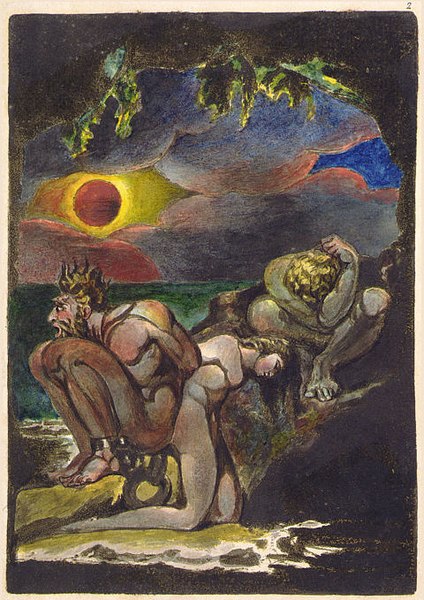
Oothoon, the soft soul of America, like an earlier maiden named Proserpine, plucks a flower and pays the price. Proserpine, you may remember, was rapt away into the underworld to be the bride of Pluto. In Oothoon's case the price began when, on her way with delight to her lover, Theotormon, she is raped by Bromion, a most rigid representative of the law, in fact a law abiding the slave trade.

Thereafter Oothoon and Bromion are bound back to back in Theotormon's cave with what is commonly known as a ball and chain. 

The poem largely consists of a colloquy among these three: Oothoon, the idealist; Bromion, the materialist; and Theotormon, a timid soul who can't make up his mind. As his name suggests, this young man is tormented by God given taboos about damaged goods. The God in this vision is named Urizen and also called the Father of Jealousy.
Typically Blake lays sexual oppression at the door of false religion. In the midst of Oothoon's lament, after a long series of Job-like questions, we read:
    " With what sense does the parson claim the labour
    of the farmer? What are his nets & gins and
    traps; & how does he surround him With cold
    floods of abstraction, and with forests of
    solitude, To build him castles and high spires,
    where kings and priests may dwell; Till she who
    burns with youth, and knows no fixed lot, is
    bound In spells of law to one she loaths? and
    must she drag the chain of Life in weary lust?
    must chilling, murderous thoughts obscure The
    clear heaven of her eternal spring;" 
    (VDA 5:17-24 Key 193)
A loveless marriage is a profanation of the greatest gift of life; nothing could arouse Blake to a whiter heat of indignation. Wollstonecraft had called it legal prostitution. In the lines that follow Oothoon names and radically disaffirms (go to VDA Plate 6, to the passage beginning "Take thy bliss, 0 Man!") the sick social attitudes that make sex a hidden and forbidden secret pleasure, and that degrade the highest sacrament, marriage, into a life sentence at hard labor:
Theotormon's jealousy casts Oothoon out and darkens her into "a solitary shadow wailing on the margin of non-entity". Blake developed this theme at the beginning of 'The Four Zoas'. There he ascribed the jealousy to Enion; it precipitated the Circle of Destiny (The Four Zoas [Nt 1], 5.)(all our sorrow!), sank Tharmas into the sea and condemned Enion to the very "margin of non-entity" of which Oothoon had spoken.
To perceive a lover or spouse as a possession (a thing) is a fatal act that brings about the deterioration of life. In fact the nature of fallenness is to degrade the person (the real) to the material (the illusory). The one tormented by jealousy loses the capability of creative life; in biblical language he covers his soul with a thick layer of miry clay, not to mention what he does to others! The profound theological corollary suggested by VDA. is that if we weren't jealous people, we wouldn't have a jealous God. Obviously the Old Testament symbol of a jealous God has other meanings, but rightly or wrongly that is what it seems to have meant to Blake.

Long before Freud's day Blake understood and described the close relationship, in fact the identity, between sexuality and creativity. He considered sexual fulfilment the primary means of artistic achievement.

 The picture in 'Milton' plate 42 portrays the post coital moment with the eagle of inspiration hovering above.
On the other hand all the evils of life Blake related to frustrated or sick sex. War in particular is perverted sexuality. The worship of the Queen of Heaven induces chastity with war as a substitute fulfilment. Blake's warrior cries, "I am drunk with unsatiated love, I must rush again to War, for the Virgin has frowned and refused."
Blake's mind was fourfold, which means that most of what he wrote is susceptible to more than one meaning. 

David Erdman in Prophet Against Empire saw VDA as political oratory at the service of the anti-slavery lobby. Oothoon is the type of the slave (of either sex); (in slave times the owner often claimed prenuptial privileges with the body of his slave). Bromion is the type of the merciless slave trader, and Theotormon of the wishy-washy conformist who can't quite bring himself to express his opposition to slavery (much as the many good Christians in America who couldn't quite bring themselves to condemn the war).

Thursday, September 11, 2014

IMAGINATION

British Museum
Songs of Innocence
Final Plate, Copy B


To Blake Imagination was the alternative to reason. Through imagination man had access to regions of thought that were unknown to reason. Reason is limited and static while imagination is expansive and dynamic. Reason delves within the spacial and temporal; imagination within the eternal.

Urthona is the Zoa who represents imagination. His work is carried on in the unconscious of man.  He corresponds to intuition in Jung's system. Urthona is an integrating force in the psyche providing the core organizing principles for the other Zoas.


Laocoon, (E 273) 
"The Eternal Body of Man is The IMAGINATION. 
that is God himself, The Divine Body, JESUS We are his Members"

Jerusalem, Plate 77, (E 231)
"I know of no other
Christianity and of no other Gospel than the liberty both of body
& mind to exercise the Divine Arts of Imagination.   
  Imagination the real & eternal World of which this Vegetable
Universe is but a faint shadow & in which we shall live in our
Eternal or Imaginative Bodies, when these Vegetable Mortal Bodies
are no more."
Jerusalem, Plate 5, (E 147) 
"Trembling I sit day and night, my friends are astonish'd at me.
Yet they forgive my wanderings, I rest not from my great task!
To open the Eternal Worlds, to open the immortal Eyes
Of Man inwards into the Worlds of Thought: into Eternity
Ever expanding in the Bosom of God. the Human Imagination        
O Saviour pour upon me thy Spirit of meekness & love:
Annihilate the Selfhood in me, be thou all my life!
Guide thou my hand which trembles exceedingly upon the rock of ages,
While I write of the building of Golgonooza,"
Jerusalem, Plate 71, E 225)
"For all are Men in Eternity. Rivers Mountains Cities Villages,
All are Human & when you enter into their Bosoms you walk
In Heavens & Earths; as in your own Bosom you bear your Heaven
And Earth, & all you behold, tho it appears Without it is Within
In your Imagination of which this World of Mortality is but a Shadow."


Wednesday, September 10, 2014

Blake Primer Sex


Following his Fundamental Presuppositions Blake, like virtually every mystic and esoteric perceived sex as the primary created duality. (Paracelsus may have best described his point.)

(The following from Franz Hartman, quoted by Percival on page 91.)
"Woman as such represents the will (including love and desire), and man as such represents intellect (including the imagination). Woman represents substance; man represents spirit. Man imagines; woman executes. Man creates images; woman renders them substantial.
    The divine man (the angel) is male and female in one; such Adam was before the woman became separated from him."
    (Blake disagreed emphatically with the biblical creation story, Blake considered the separation of the original Adam into male and female as more of a Fall than a Creation. Of course you and I and Blake as well are faced with the Reality of our circumstances. At any rate after the Fall):
    "Man was like the Sun; woman as such resembles the Moon, receiving her light from the Sun, and man without woman (in him) is a consuming fire in want of fuel.
This means that Blake (and Paracelsus) in their use of sex have a primarily metaphysical rather than a physical connotation. Nevertheless Blake began working with a sexual hangup of some sort, which he seems to have satisfactorily worked through with some 40 years of happy marriage.

In the Christian faith marriage is a sacrament, and for many of us the primary sacrament. However living the sacrament was no more common in Blake's day than in ours. 18th and 19th century England seemed largely to view marriage more as a commercial transaction.
Such a view led Blake to condemn the marriage hearse. He also condemned jealousy.

***********************

Many people have deeply misunderstood Blake's doctrine of sex. It has complex roots and abounds in parodoxes that defy casual acquaintance. But like most things the subject yields to close and careful study. If we can separate the conflicting strands of thought and resolve the parodoxes, we may achieve a better understanding of Blake, the man and the thinker, than is enjoyed by most even among his interpreters.
  In this chapter we start from the platform of his known personal experiences. Then we explore his early statements about sex in the light of what we know of his life. We examine the biblical and heterodox traditions and the symbolics of sex and finally look at the ways in which the mature Christian poet dealt with sex in his art. In the light of all this we may begin to perceive in Blake's poetry a journal of his spiritual progress; this is especially true of The Four Zoas, where the triangle of Blake, his wife, and the Spectre
bring about a reconciliation and level of understanding at the spiritual level where love finds its apogee. (Look especially at the last quatrain. Note that in this poem 'love' has a very special meaning, nothing like the use we've made of the word here.)
**************************************************
       A review of Blake's early life suggests the most normal and ordinary psychosexual development, to which the biographers testify. Through his refusal of formal education Blake appears to have escaped many of the common pathologies of sex that afflicted his age as ours. In fact he systematically held some of them up to ridicule.

       Blake never tired of painting the human form, and he usually refused to hide it with clothes. Virtually his only models were his wife and himself. We read that a friend once found them naked in the garden of their home. In all probability they were planning poses and postures for his illustrations of 'Paradise Lost'.

      In his early twenties Blake formed an emotional attachment to a young woman named Polly Wood. Unfortunately Polly had other interests, and when he showed jealousy, she asked him if he were a fool. The experience seems to have cured him of jealousy; in fact the foolishness of jealousy became a life long motif; his false God received the name (among others) of "Father of Jealousy".

       On the rebound he met a beautiful girl named Catherine Boucher, a gardener's daughter. He told Catherine his mournful story, and when she pitied him, he promptly transfered his affection to her. A year later they were married, a relationship that according to all the evidence seems to have been made in heaven. Illiterate at her marriage, Catherine Blake must have been a gifted and rare person; she had a great deal to do with Blake's enormous creativity. Her high and continuous level of affirmation released Blake from the drain of domestic preoccupations. She affirmed and encouraged his gift of vision even when it meant long hours of wakefulness while he communed with heaven. She provided the appreciative audience that the world in general denied Blake and made him a happy creative artist in the same way that J.S.Bach was happy.

       One important influence on Blake's ideology of sex came from certain left wing religious dissenters. The antinomians deeply affected Blake's world of thought. They considered marriage a part of the law which they wanted to abolish. They claimed the right, living above the law, to cohabitate with whomever, whenever and wherever they felt led. We find evidence of similar excesses among fringe groups both in the New Testament and in the 20th Century:
    Remove away that black'ning church:
    Remove away that marriage hearse:
    Remove away that man of blood:
    You'll quite remove the ancient curse.
           (An Ancient Proverb; in Songs and Ballard; Erdman p. 475)
       Blake found these ideas attractive as a young man, but no one believes that he carried them very far in practice. Libertines and hedonists have at times made Blake their hero, but they simply don't know their man. All the evidence suggests that Blake lived as a faithful and loving husband for some forty five years--and a happy one as well (This is spite of a recent fanciful 'biography' of Catherine Blake).
       What Blake hated was not monogamy but jealousy and the idea of a lover or spouse as a possession:
    He who binds to himself a joy
    Doth the winged life destroy;
    But he who kisses the joy as it flies
    Lives in Eternity's sun rise.
           (Eternity, in Songs and Ballards; Erdman 474 or Several Questions Answered )
       We have a story to the effect that early in his marriage Blake proposed to bring home a concubine (sneaking around was futhest from his thoughts!) His young wife cried at the idea, and he dropped it. In all likelihood the concubine notion came from Blake's friend, Mary Wollstonecraft, one of the earliest of liberated women.

      Blake had illustrated two of this lady's works shortly before she wrote a sensational essay called "Vindication of the Rights of Women". Mary Wollstonecraft advocated the radical equality of the sexes, which Blake endorsed. She tried to live in the freedom generally reserved for men (and claimed by few even of them!) Blake was among those who supported her in this endeavor. She lived an adventurous and tragic life and died giving birth to another Mary, who became the wife of the poet, Shelley.

       Blake had a very complex psyche one could discuss to exhaustion his various sexual attitude and points of view. According to Damon, who wrote A Blake Dictionary, Blake believed that "the domination of woman is one of the greatest forces corrupting society" (page 447); he quote as follows:
    What may Woman be
    to have power over Man from cradle to corruptible grave.
    There's a throne in every man;it's the throne of God;
    this Woman has claimed as her own and Man is no more!"
           (Jerusalem plate 30, lines 25-28)


Monday, September 08, 2014

HEGEMONY OF REASON

Yale Center for British Art
America
Plate 10, Copy
Blake lived in what some call The Age of Reason. His is said to be one of the first Romantics who ushered in a new age which demonstrated that reason, without emotions and longings is insufficient to satisfy the whole man. In his poetry Blake made reason, in the form of his Zoa Urizen, one of the major sources of the failures of society to provide for its constituents. The Age of Reason had destroyed patterns of religion, government and economics. Although intending to free man from bondage, reason's efforts had brought about forms of enslavement. Man was set on the path of materialism and reductionism when he became dependent primarily on reason. He was reduced to a being without faith, stability, security or liberty.
 
Blake's thesis was that reason had been elevated to a place of dominance over the other aspects of man's psyche. Reason then built a world where men were valued as instruments of production not compassion, where children were not nurtured or protected from exploitation, and where women were forced into defensiveness. The observation that reason imposed one view onto all, without variation or exception, caused Blake to react against the position he saw reason carving out for itself. 

Quoting from an earlier post:
"Urizen wanders about the world spinning the web of religion, carving the laws of God and unable any longer to see into the closed tents of the Eternals. Urizen, the Superego, has created a dilemma; he can say 'Thou shalt not,' but he can't say 'Thou shalt.' (“Without a vision the people perish.” Proverbs 29:18.) Urizen is at an impasse from which he cannot extricate himself. The divided self, without the Spirit or Imagination lacks the ability to live the life of joy, peace, forgiveness and brotherhood."

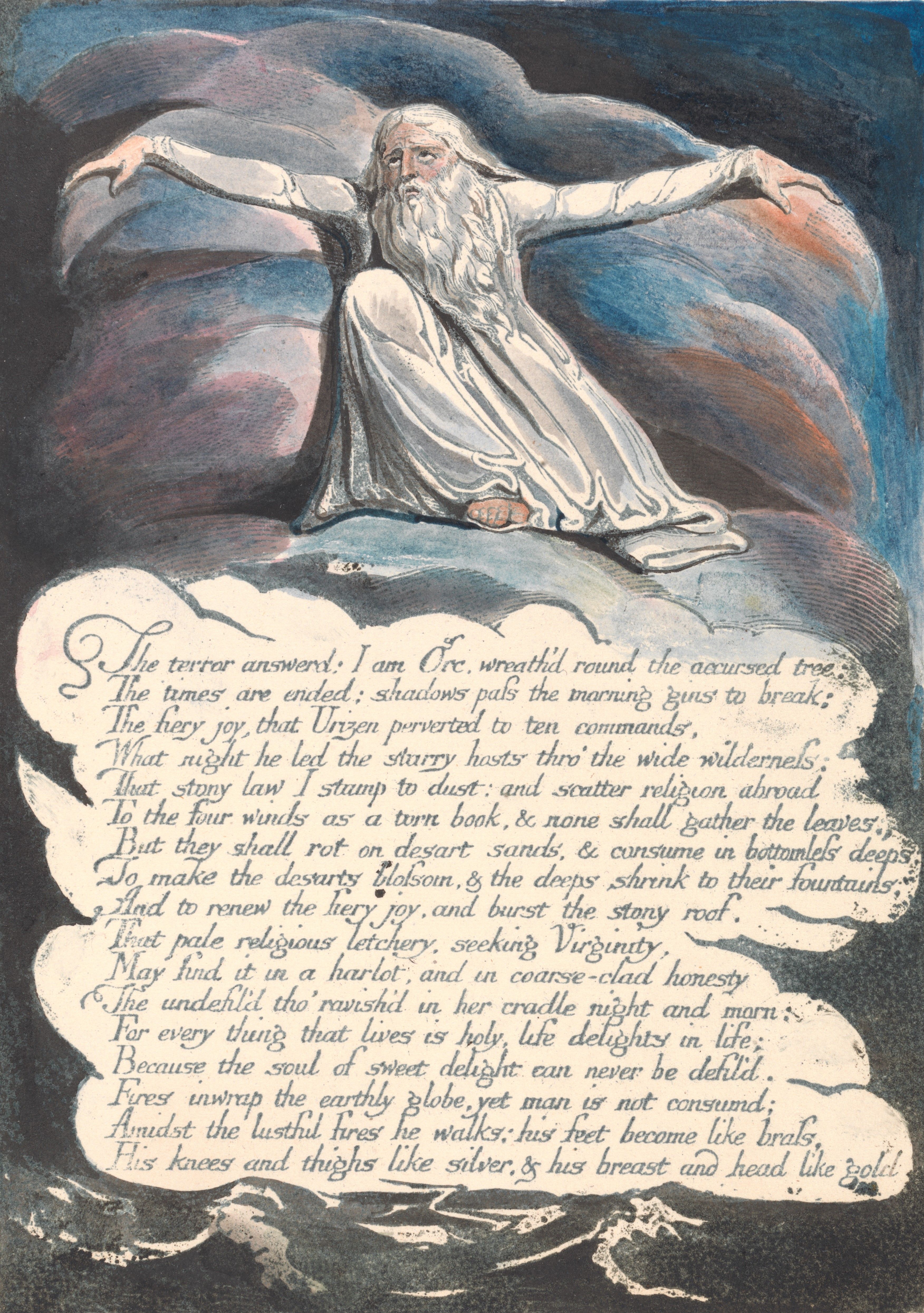
America, Plate 7, (E 53)
"Lover of wild rebellion, and transgresser of Gods Law;
Why dost thou come to Angels eyes in this terrific form?
Plate 8
The terror answerd: I am Orc, wreath'd round the accursed tree:
The times are ended; shadows pass the morning gins to break;
The fiery joy, that Urizen perverted to ten commands,
What night he led the starry hosts thro' the wide wilderness:
That stony law I stamp to dust: and scatter religion abroad      
To the four winds as a torn book, & none shall gather the leaves;
But they shall rot on desart sands, & consume in bottomless deeps;
To make the desarts blossom, & the deeps shrink to their fountains,
And to renew the fiery joy, and burst the stony roof."

Song of Los, (E 68)
"Thus the terrible race of Los & Enitharmon gave
Laws & Religions to the sons of Har binding them more
And more to Earth: closing and restraining:                      
Till a Philosophy of Five Senses was complete
Urizen wept & gave it into the hands of Newton & Locke"    
Book of Urizen, Plate 4, (E 72)
"6. Here alone I in books formd of metals
Have written the secrets of wisdom                            
The secrets of dark contemplation
By fightings and conflicts dire,
With terrible monsters Sin-bred:
Which the bosoms of all inhabit;
Seven deadly Sins of the soul. 

7. Lo! I unfold my darkness: and on
This rock, place with strong hand the Book
Of eternal brass, written in my solitude.

8. Laws of peace, of love, of unity:
Of pity, compassion, forgiveness.          
Let each chuse one habitation:
His ancient infinite mansion:
One command, one joy, one desire,
One curse, one weight, one measure
One King, one God, one Law."
Four Zoas, Night VII, PAGE 80, (E 355)
"And Urizen Read in his book of brass in sounding tones   

Listen O Daughters to my voice Listen to the Words of Wisdom
So shall [ye] govern over all let Moral Duty tune your tongue
But be your hearts harder than the nether millstone
To bring the shadow of Enitharmon beneath our wondrous tree   
That Los may Evaporate like smoke & be no more
Draw down Enitharmon to the Spectre of Urthona
And let him have dominion over Los the terrible shade

Compell the poor to live upon a Crust of bread by soft mild arts
Smile when they frown frown when they smile & when a man looks pale
With labour & abstinence say he looks healthy & happy
And when his children Sicken let them die there are enough
Born even too many & our Earth will be overrun
Without these arts If you would make the poor live with temper
With pomp give every crust of bread you give with gracious cunning 
Magnify small gifts reduce the man to want a gift & then give with pomp 
Say he smiles if you hear him sigh If pale say he is ruddy
Preach temperance   say he is overgorgd & drowns his wit
In strong drink tho you know that bread & water are all
He can afford   Flatter his wife pity his children till we can   

Reduce all to our will as spaniels are taught with art"

Sunday, September 07, 2014

More Church


In Jerusalem, pages 228-9 Blake wrote this:
For Los in Six Thousand Years walks up & down continually
That not one Moment of Time be lost & every revolution
Of Space he makes permanent in Bowlahoola & Cathedron.
Adam, Seth, Enos, Cainan, Mahalaleel, Jared, Enoch,
Methuselah, Lamech; these are the Giants mighty, Hermaphroditic
Noah, Shem, Arphaxad, Cainan the Second, Salah, Heber,
Peleg, Reu, Serug, Nahor, Terah: these are the Female Males:
A Male within a Female hid as in an Ark & Curtains.
Abraham, Moses, Solomon, Paul, Constantine, Charlemaine,
Luther. these Seven are the Male Females: the Dragon Forms 


And these the names of the Twenty-seven Heavens & their Churches
The Female hid within a Male: thus Rahab is reveald
Mystery Babylon the Great: the Abomination of Desolation
Religion hid in War: a Dragon red, & hidden Harlot
But Jesus breaking thro' the Central Zones of Death & Hell
Opens Eternity in Time & Space; triumphant in Mercy

Thus are the Heavens formd by Los within the Mundane Shell
And where Luther ends Adam begins again in Eternal Circle
To awake the Prisoners of Death; to bring Albion again
With Luvah into light eternal, in his eternal day.


The following is an extract from the Blake Primer:

Neo-platonism
       While the Church Fathers congregated in Rome, Gnosticism had its center in Alexandria, a marketplace of competing religious and philosophical ideas. There in the third century a man named  Plotinus gave birth to Neo-platonism, an amalgam of the best of Greek thought with the ethical teachings of Christ. Extremely eclectic, drawing on currents of thought from Rome to India, Plotinus's teachings became the religion of some of the later Roman Emperors.
       During the fourth century the religion of Neo-platonism disappeared as a rival of the Church. However it deeply influenced the shape of Christian theology, most notably through the mind of St. Augustine. Augustine in his spiritual journey passed through a Neo-platonic stage, which left its mark upon his Christian life and writing. Augustine occupies an anomalous position in the history of the Church: he is both a Church Father of impeccable reputation and the spiritual forebear of many theologians whose Neo-platonic bent put them on the fringe of orthodoxy:
       Erigena, Duns Scotus, William of Ockham, Meister Eckhart are a few of these Neo-platonic Christians. Some of these thinkers succeeded in remaining within the umbrella of the authorized tradition; some were partially or totally cast out. Among them they preserved to theology a breadth and a poetic dimension that burst open the priestly cocoon with the 15th Century Renaissance and the 16th Century Reformation.

The Middle Ages
       Through the Middle Ages the successors of the Church Fathers, most notably the authorities at Rome, maintained a fairly firm grip on the shape of theological and intellectual activity. They presided over an age of stability with a gradual leavening of creative change. They aborted many changes in the name of orthodoxy; the aborted change usually went underground to reappear at a more open time and place. The openness most often proved momentary. Creative truth struggled against rigid institutional necessities.
       In spite of all the Church periodically gave birth to men and women who, from the platform of the orthodox tradition, were elevated to a direct vision of God. Most of the creative change in the Church originated with such types. The Church rather uniformly discouraged mystical visions of God unless they conformed in full detail to the orthodoxy of the moment. God refused such limitations; the entire period witnessed recurring visions of great diversity. Many of these prophetically judged the priestly position. A long volume could be written about the many prophetic visions which in one way or another resemble that of our poet.
       The Church was broad enough to include and even honor many of these free spirits, but the works which followed them in the hands of their more militant disciples generally fell into ill repute. The early Franciscan movement is a case in point. St. Francis preached to his little sisters the birds; he shared the stigmata of Christ and suggested that to share Christ's poverty might be fitting for his disciples, an extremely radical idea which an extremely wealthy pope indulged. But many of Francis' disciples faced persecution of various sorts.
        Roughly contemporary with Francis another monk named  Joachim of Flora rediscovered for the nth time the dominance of the Spirit over the letter. Preaching what he called the Everlasting Gospel Joachim proposed to dispense with the corrupt and worldly political structures of the establishment and move into a New Age, the era of the Holy Spirit. The New Age would replace the age of the Church; it would be an age of freedom with everyone led directly by the Spirit.  Jeremiah had foretold this. Even Moses had said, "would to God that all the Lord's people were prophets". For the creative poet the New Age represented freedom at its best, exactly what Jesus had come to bring us. For most of the priests it represented  antinomianism at its worst.


        The Everlasting Gospel and the New Age came down the centuries through the various subterranean channels of the heterodox tradition.  Swedenborg announced its advent in 1757, which happened to be the year of Blake's birth; Blake noted this with obvious delight in 'The Marriage of Heaven and Hell'.  Years later, in the autumn of his life, Blake filled his spiritual journal with a fragmentary poem called 'The Everlasting Gospel'. It was his systematic attempt to set forth in the most direct terms possible his precise view of Christianity and its founder. He probably never concluded the project to his full satisfaction.

Saturday, September 06, 2014

GOOD & EVIL

Another of what I consider to be the essential teachings of William Blake is his attitude toward Good & Evil. He was not inclined to accept traditional definitions of any concept. He approached Good & Evil in his predictable iconoclastic way.

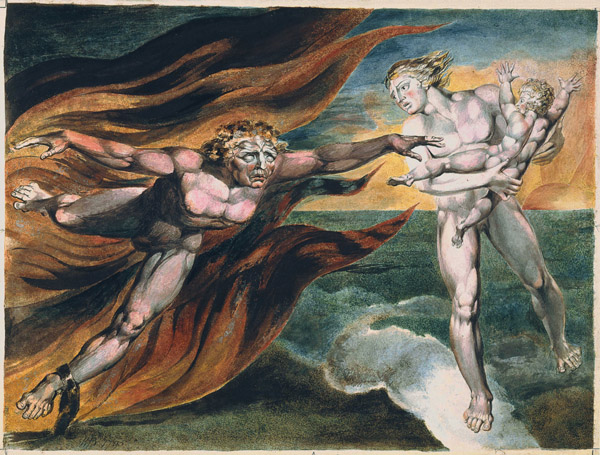
When the reasoning mind divides the contraries into categories which it labels Good and Evil it enters the state of Satan the accuser. The contraries are meant to complement and complete each other; they have no inherent moral value. They are not meant to be split asunder in opposition but to enhance one another by adding the missing piece. 

Wikipedia Commons
The Good and Evil Angels

The moral law is the result of the assignment of values to specific characteristics. When these laws are said to be the commandments of God they become instruments of oppression. 

Romans 5
[13] sin indeed was in the world before the law was given, but sin is not counted where there is no law. 

Romans 8
[28] We know that in everything God works for good with those who love him, who are called according to his purpose.

In William Blake's Circle of Destiny Milton Percival explains the beginning of the fall thus:
"The great cosmic break in which the fine relationship of the contraries is destroyed is the work of the Spectre. Blown with pride in his emanative life, he abstracts from it a set of qualities called Good. In his arrogance he believes that these qualities which he admires are due to his own activities; he does not realize that they are but the result of the undisturbed functioning of an harmonious whole."

Jerusalem, Plate 49, (E 199)
"Yet they are blameless & Iniquity must be imputed only           
To the State they are enterd into that they may be deliverd:
Satan is the State of Death, & not a Human existence:
But Luvah is named Satan, because he has enterd that State.
A World where Man is by Nature the enemy of Man
Because the Evil is Created into a State. that Men               
May be deliverd time after time evermore. Amen.
Learn therefore O Sisters to distinguish the Eternal Human
That walks about among the stones of fire in bliss & woe
Alternate! from those States or Worlds in which the Spirit travels:
This is the only means to Forgiveness of Enemies" 
An essential of Blake's teachings is that man can escape from the dominion of perceiving individuals as evil or good. Each has the potential of rejecting error by 'Conversing with Eternal Realities as they Exist in the Human Imagination.'
Vision of Last Judgment, (E 554)
"The Last Judgment when all those are Cast away who trouble
Religion with Questions concerning Good & Evil or Eating of the
Tree of those Knowledges or Reasonings which hinder the Vision of
God turning all into a Consuming fire  Imaginative Art &
Science & all Intellectual Gifts all the Gifts of the Holy Ghost
are [despisd] lookd upon as of no use & only Contention
remains to Man then the Last Judgment begins & its Vision is seen
by the [Imaginative Eye] of Every one according to the
situation he holds
The Last Judgment is not Fable or Allegory
but  Vision   Fable or Allegory are a totally distinct & inferior
kind of Poetry.  Vision or Imagination is a Representation of
what Eternally Exists.  Really & Unchangeably.  Fable or Allegory
is Formd by the Daughters of Memory.  Imagination is Surrounded
by the daughters of Inspiration who in the aggregate are calld
Jerusalem" 
Vision of Last Judgment, (E 561) 
"A Last Judgment is not for the purpose of making Bad
Men better but for the Purpose of hindering them from opressing
the Good with Poverty & Pain by means of Such Vile Arguments &
Insinuations"
Vision of Last Judgment, (E 562)
 "Here they are no longer talking of what is Good &
Evil or of what is Right or Wrong & puzzling themselves in Satans
Labyrinth But are Conversing with Eternal
Realities as they Exist in the Human Imagination   We are in a
World of Generation & death & this world we must cast off if we
would be Painters Such as Rafa[e]l Mich Angelo & the
Ancient Sculptors. if we do not cast off this world we shall be
only Venetian Painters who will be cast off & Lost from Art" 
Vision of Last Judgment, (E 563)
"Eternity Exists and All things in Eternity Independent of
Creation which was an act of Mercy I have represented
those who are in Eternity by some in a Cloud within the Rainbow
that Surrounds the Throne they merely appear as in a Cloud when
any thing of Creation Redemption or Judgment are the Subjects of
Contemplation tho their Whole Contemplation is Concerning these
things the Reason they so appear is The Humiliation of the
Reasoning & Doubting Selfhood & the Giving all up to Inspiration 
 By this it will be seen that I do not consider either the Just
or the Wicked to be in a Supreme State but to be every one of
them States of the Sleep which the Soul may fall into in its
Deadly Dreams of Good & Evil when it leaves Paradise
following the Serpent"
Vision of Last Judgment, (E 563)
"The Combats of Good & Evil is Eating of the Tree
of Knowledge The Combats of Truth & Error is Eating of the Tree
of Life"
Vision of Last Judgment, (E 564)
 "Christ comes
as he came at first to deliver those who were bound under the
Knave not to deliver the Knave He Comes to Deliver Man the
Accused & not Satan the Accuser we do not
find any where that Satan is Accused of Sin he is only accused of
Unbelief & thereby drawing Man into Sin that he may accuse him. 
Such is the Last Judgment a Deliverance from Satans Accusation
Satan thinks that Sin is displeasing to God he ought to know that
Nothing is displeasing to God but Unbelief & Eating of the Tree
of Knowledge of Good & Evil 
Men are admitted into Heaven not because they have
governd their Passions or have No Passions but because
they have Cultivated their Understandings.  The Treasures of
Heaven are not Negations of Passion but Realities of Intellect
from which All the Passions Emanate in their Eternal
Glory   The Fool shall not enter into Heaven let him be ever so
Holy.  Holiness is not The Price of Enterance into Heaven Those
who are cast out Are All Those who having no Passions of their
own because No Intellect.  Have spent their lives in Curbing &
Governing other Peoples by the Various arts of Poverty & Cruelty
of all kinds"

Thursday, September 04, 2014

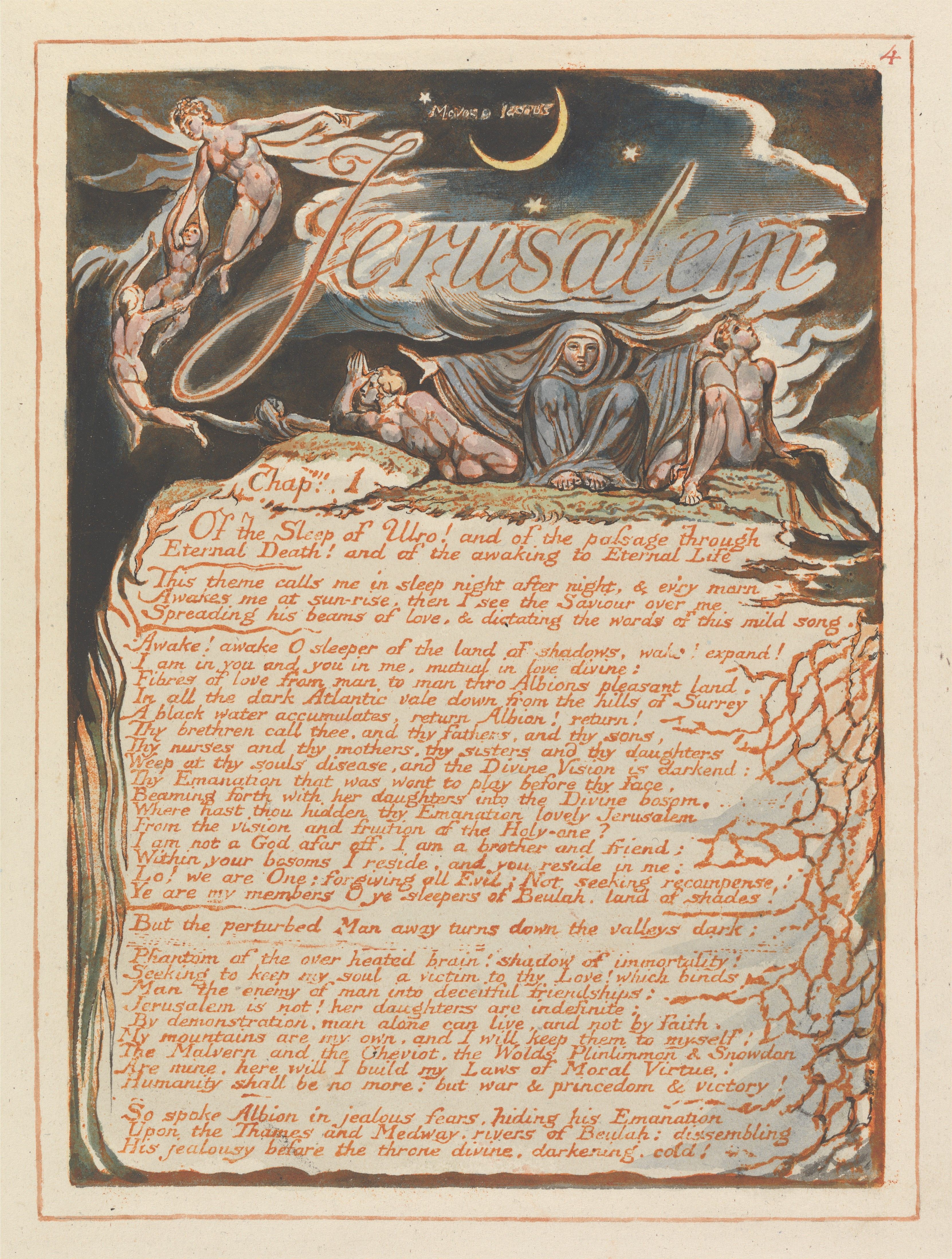
VEGETABLE GLASS

Yale Center for British Art
Jerusalem

Plate 4

The post, Divine Vision, is the first of a series of posts on Blake's essential teachings. This, the second, is intended to demonstrate that Blake saw that the outer world which seems 'real' to us should be recognized as a 'soft sexual delusion' to 'delight the wanderer'. 

When man loses sight of the spiritual dimension, the world discernible by the senses replaces it. This is the world of Vala, the outer appearances which compose her veil or 'film of matter which covers all reality'. (Damon) The veil is constructed not only of sense data, but is built of the false reasoning which supplies the Moral Law to replace the 'perception of the infinite'.

The Vegetable Glass of Nature is what man perceives to be his world after the loss of his ability to see the Divine Vision. Unable to see through the covering veil which hides the infinite and eternal, he sees projections formed by his own limited mind reflected back by the Vegetable Glass of Nature.  

Milton O Percival, on Page 265, of William Blake's Circle of Destiny writes of the sinister web woven when Albion turns away from the inward, active masculine to the outward, passive, feminine aspect:

"Matter begins its spurious existence in the mind as Albion began to fall. He moved from the inward into the outward, the feminine and the natural; he believed in it; he even set up the passive feminine, in its various aspects, as his ideal of good. In doing so he he moved into darkness and doubt, for, as Plotinus says, 'The unbelieving element is sense; it is the other, the Intellectual Principle that sees.' At the same time he confers upon the feminine a spurious life and independence. Enion found, when she first wove the web of nature, that it was 'perverse and wayward,' with a will of its own. Out of this feminine self-assertion come the Daughters of Albion, who weave the perception as narrowly as possible, and fold the world according to their will. But that will or power - an irrational thing - was conferred on them by the irrational mind. A falsity itself, it was created by a falsity. The unlit matter which the Daughters create is the product of the unlit soul. It would vanish if the soul were 'awake.'" 

Vision of Last Judgment, (E 555)
"Reality was Forgot & the Vanities of Time & Space only Rememberd
& calld Reality
...
This world of Imagination is the World of
Eternity it is the Divine bosom into which we shall all go after
the death of the Vegetated body   This World  is
Infinite & Eternal whereas the world of Generation or Vegetation
is Finite & [for a small moment] Temporal    There Exist
in that Eternal World the Permanent Realities of Every Thing
which we see are reflected in this Vegetable Glass of Nature"    
Milton, Plate 21 [23], (E 115)
"And all this Vegetable World appeard on my left Foot,
As a bright sandal formd immortal of precious stones & gold:
I stooped down & bound it on to walk forward thro' Eternity."   
Milton, Plate 29 [31], (E 127)
"Wher'eer he goes & all his neighbourhood bewail his loss:
Such are the Spaces called Earth & such its dimension:
As to that false appearance which appears to the reasoner,       
As of a Globe rolling thro Voidness, it is a delusion of Ulro
The Microscope knows not of this nor the Telescope. they alter
The ratio of the Spectators Organs but leave Objects untouchd
For every Space larger than a red Globule of Mans blood.
Is visionary: and is created by the Hammer of Los                
And every Space smaller than a Globule of Mans blood. opens
Into Eternity of which this vegetable Earth is but a shadow:"   
Jerusalem, Plate 19, (E 164)
"And Los was roofd in from Eternity in Albions Cliffs
Which stand upon the ends of Beulah, and withoutside, all
Appear'd a rocky form against the Divine Humanity.               

Albions Circumference was clos'd: his Center began darkning
Into the Night of Beulah, and the Moon of Beulah rose
Clouded with storms: Los his strong Guard walkd round beneath the Moon
And Albion fled inward among the currents of his rivers."    
Jerusalem, Plate 29 [33], (E 175)
"So spoke the Spectre to Albion. he is the Great Selfhood
Satan: Worshipd as God by the Mighty Ones of the Earth
Having a white Dot calld a Center from which branches out
A Circle in continual gyrations. this became a Heart           
From which sprang numerous branches varying their motions
Producing many Heads three or seven or ten, & hands & feet
Innumerable at will of the unfortunate contemplator
Who becomes his food[:] such is the way of the Devouring Power

And this is the cause of the appearance in the frowning Chaos[.] 
Albions Emanation which he had hidden in jealousy
Appeard now in the frowning Chaos prolific upon the Chaos
Reflecting back to Albion in Sexual Reasoning Hermaphroditic

Albion spoke. Who art thou that appearest in gloomy pomp
Involving the Divine Vision in colours of autumn ripeness        
I never saw thee till this time, nor beheld life abstracted
Nor darkness immingled with light on my furrowd field
Whence camest thou! who art thou O loveliest? the Divine Vision
Is as nothing before thee, faded is all life and joy

Vala replied in clouds of tears Albions garment embracing        

I was a City & a Temple built by Albions Children.
I was a Garden planted with beauty I allured on hill & valley
The River of Life to flow against my walls & among my trees
Vala was Albions Bride & Wife in great Eternity
The loveliest of the daughters of Eternity when in day-break    

I emanated from Luvah over the Towers of Jerusalem
And in her Courts among her little Children offering up
The Sacrifice of fanatic love! why loved I Jerusalem!
Why was I one with her embracing in the Vision of Jesus
Wherefore did I loving create love, which never yet              
Immingled God & Man, when thou & I, hid the Divine Vision
In cloud of secret gloom which behold involve me round about  
Know me now Albion: look upon me I alone am Beauty
The Imaginative Human Form is but a breathing of Vala
I breathe him forth into the Heaven from my secret Cave          
Born of the Woman to obey the Woman O Albion the mighty
For the Divine appearance is Brotherhood, but I am Love"

Wednesday, September 03, 2014

Jerusalem plate 20 and others

PLATE 20
But when they saw Albion fall'n upon mild Lambeths vale:
Astonish'd! Terrified! they hover'd over his Giant limbs.Then thus Jerusalem spoke, while Vala wove the veil of tears:
Weeping in pleadings of Love, in the web of despair.
Wherefore hast thou shut me into the winter of human life
And clos'd up the sweet regions of youth and virgin innocence:
Where we live, forgetting error, not pondering on evil:
Among my lambs & brooks of water, among my warbling birds:
Where we delight in innocence before the face of the Lamb:
Going in and out before him in his love and sweet affection.
Vala replied weeping & trembling, hiding in her veil.
When winter rends the hungry family and the snow falls:
Upon the ways of men hiding the paths of man and beast,
Then mourns the wanderer: then he repents his wanderings & eyes
The distant forest; then the slave groans in the dungeon of
stone.
The captive in the mill of the stranger, sold for scanty hire.
They view their former life: they number moments over and over;
Stringing them on their remembrance as on a thread of sorrow.
Thou art my sister and my daughter! thy shame is mine also!
Ask me not of my griefs! thou knowest all my griefs.
Jerusalem answer'd with soft tears over the valleys.
O Vala what is Sin? that thou shudderest and weepest
At sight of thy once lov'd Jerusalem! What is Sin but a little
Error & fault that is soon forgiven; but mercy is not a Sin
Nor pity nor love nor kind forgiveness! O! if I have Sinned
Forgive & pity me! O! unfold thy Veil in mercy & love!
Slay not my little ones, beloved Virgin daughter of Babylon
Slay not my infant loves & graces, beautiful daughter of Moab
I cannot put off the human form I strive but strive in vain
When Albion rent thy beautiful net of gold and silver twine;
Thou hadst woven it with art, thou hadst caught me in the bands
Of love; thou refusedst to let me go: Albion beheld thy beauty
Beautiful thro' our Love's comeliness, beautiful thro' pity.
The Veil shone with thy brightness in the eyes of Albion,
Because it inclosd pity & love; because we lov'd one-another!
Albion lov'd thee! he rent thy Veil! he embrac'd thee! he lov'd
thee!Astonish'd at his beauty & perfection, thou forgavest his furious
love:
I redounded from Albions bosom in my virgin loveliness.
The Lamb of God reciev'd me in his arms he smil'd upon us:
- 165 -
He made me his Bride & Wife: he gave thee to Albion.
Then was a time of love: O why is it passed away!
Then Albion broke silence and with groans reply'd
PLATE 21
O Vala! O Jerusalem! do you delight in my groans
You O lovely forms, you have prepared my death-cup:
The disease of Shame covers me from bead to feet: I have no hope
Every boil upon my body is a separate & deadly Sin.


 Looking over the text en toto you may notice that beginning with Vala's statement in Plate 18 there's a continuous sequence in the story to the end of Chapter One (To the Public).

     Plate 20 appears to be primarily a statement that Jerusalem made to Vala: "Then thus Jerusalem spoke...." Jerusalem is saying that Vala, her material counterpart has robbed Albion of his hold on Eternity.  The consequence (according to the Sacred Story) was the Visit to Earth of the Saviour; his compassion and passion led to universal redemption (such was Blake's faith IMO).

Tuesday, September 02, 2014

DIVINE VISION

British Museum
Book of Urizen

Copy D, Plate 8


When we look to find the essential teachings of Blake, we can settle on one as fundamental: that being unable to perceive the Divine Vision undermines man's humanity. The collapse of all that comprises an orderly system ensues when man can no longer see that God or Spirit is the central organizing force in the universe. The vision of God, like the force of gravity holds everything together and ordains the patterns of movement. But man turns away, he listens to another voice, he follows a path that leads to destruction.
 

The wanderings of man in a wilderness, in a desert or in the chartered streets of London tell of men without vision, listening to the negation of Satan or the selfishness of their own Spectre. 


Milton, Plate 2, (E 96)
"Mark well my words! they are of your eternal salvation:        

Three Classes are Created by the Hammer of Los, & Woven  
Plate 3            
By Enitharmons Looms when Albion was slain upon his Mountains
And in his Tent, thro envy of Living Form, even of the Divine Vision
And of the sports of Wisdom in the Human Imagination
Which is the Divine Body of the Lord Jesus, blessed for ever."
    
Milton, Plate 9, (E 102)
"Saying I am God alone   
There is no other! let all obey my principles of moral individuality
I have brought them from the uppermost innermost recesses
Of my Eternal Mind, transgressors I will rend off for ever,
As now I rend this accursed Family from my covering.

Thus Satan rag'd amidst the Assembly! and his bosom grew     
Opake against the Divine Vision: the paved terraces of
His bosom inwards shone with fires, but the stones becoming opake!
Hid him from sight, in an extreme blackness and darkness,
And there a World of deeper Ulro was open'd, in the midst
Of the Assembly. In Satans bosom a vast unfathomable Abyss."  
    
Milton, Plate 21 [23], (E 116)
"Watch over this World, and with your brooding wings,
Renew it to Eternal Life: Lo! I am with you alway
But you cannot renew Milton he goes to Eternal Death

So spake the Family Divine as One Man even Jesus
Uniting in One with Ololon & the appearance of One Man
Jesus the Saviour appeard coming in the Clouds of Ololon!        
Plate 22 [24]
Tho driven away with the Seven Starry Ones into the Ulro
Yet the Divine Vision remains Every-where For-ever. Amen.
And Ololon lamented for Milton with a great lamentation."
    
Milton, Plate 32 [35] (E 131)
"But the Divine Humanity & Mercy gave us a Human Form                                          
Because we were combind in Freedom & holy Brotherhood
While those combind by Satans Tyranny first in the blood of War
And Sacrifice &, next, in Chains of imprisonment: are Shapeless Rocks
Retaining only Satans Mathematic Holiness, Length: Bredth & Highth
Calling the Human Imagination: which is the Divine Vision & Fruition
In which Man liveth eternally: madness & blasphemy, against      
Its own Qualities, which are Servants of Humanity, not Gods or Lords"
    
Jerusalem, Plate 27, (E 172)
"He witherd up the Human Form,
By laws of sacrifice for sin:
  Till it became a Mortal Worm:    
But O! translucent all within.

  The Divine Vision still was seen
Still was the Human Form, Divine
  Weeping in weak & mortal clay
O Jesus still the Form was thine.      

  And thine the Human Face & thine
The Human Hands & Feet & Breath
  Entering thro' the Gates of Birth
And passing thro' the Gates of Death"
    
Jerusalem, Plate 29 [33], (E 175)    
"Turning his back to the Divine Vision, his Spectrous
Chaos before his face appeard: an Unformed Memory.

Then spoke the Spectrous Chaos to Albion darkning cold
From the back & loins where dwell the Spectrous Dead

I am your Rational Power O Albion & that Human Form              
You call Divine, is but a Worm seventy inches long"
    
Jerusalem, Plate 34 [38], (E 179)
"Turning from Universal Love petrific as he went,
His cold against the warmth of Eden rag'd with loud
Thunders of deadly war (the fever of the human soul)
Fires and clouds of rolling smoke! but mild the Saviour follow'd him,   
Displaying the Eternal Vision! the Divine Similitude!
In loves and tears of brothers, sisters, sons, fathers, and friends
Which if Man ceases to behold, he ceases to exist:"

Monday, September 01, 2014

Vision of Christ

Nowhere (that I know of) does Blake write of the physical resurrection of Jesus. He witnessed no corporeal Jesus; he didn't value the idea of a corporeal Jesus. If you want to know Blake's Jesus, you have to rise to the Eternal Jesus (generally known as the Christ).

Jesus is there, beyond the Sea of Time and Space. We are creatures of time and space (but not that alone!). Jesus also was a creature (briefly), but he was also before time and after time, and beyond space; he is Eternal. We may rise to the Eternal at any moment, as many moments as possible if that's what we want.

John 8:
"58] Jesus said unto them, Verily,verily, I say unto you, Before Abraham was, I am."

-----------------------------------------------

Like Paul had said, Blake longed to be delivered from the flesh:

Philippians.1

  1. [23] For I am in a strait betwixt two, having a desire to depart, and to be with Christ; which is far better:
  2. [24] Nevertheless to abide in the flesh is more needful for you.
    [25] And having this confidence, I know that I shall abide and continue with you all
Blake knew that to remain in the flesh was "more needful for" Catherine, and for a few young friends, (and for us!)

-----------------------------------------------

In plate 3 of Jerusalem, which is in prose Blake wrote his primary opinion of just who and what Jesus is:

"The Spirit of Jesus is continual forgiveness of Sin" (Erdman 145).

The Conventional Church had historical 'evidence' (from the earliest records that Jesus had undergone a physical resurrection; it became the focal point of C.C professions of faith. but Blake cared nothing for history or for the Conventional theology per se. (For that matter many Christian groups from N.T. days to the present have discounted a physical resurrection.)

Blake directly addressed Conventional Religion with these words from The Everlasting Gospel:

"The Vision of Christ that thou dost see
Is my Visions Greatest Enemy
.....
Thine loves the same world that mine hates
Thy Heaven doors are my Hell Gates
.........
Both read the Bible day and night
But thou readst black where I read white." (Erdman 524)