Monday, March 21, 2016

PILGRIM & EVANGELIST

Reposted from February 04, 2015. 

Pilgrims's Progress 
John Bunyan
"{12} Now, I saw, upon a time, when he was walking in the fields, that he was, as he was wont, reading in his book, and greatly distressed in his mind; and, as he read, he burst out, as he had done before, crying, "What shall I do to be saved?"
{13} I saw also that he looked this way and that way, as if he would run; yet he stood still, because, as I perceived, he could not tell which way to go. I looked then, and saw a man named Evangelist coming to him and asked, Wherefore dost thou cry? [Job 33:23]
{14} He answered, Sir, I perceive by the book in my hand, that I am condemned to die, and after that to come to judgement [Heb. 9:27]; and I find that I am not willing to do the first [Job 16:21], nor able to do the second. [Ezek. 22:14]
CHRISTIAN no sooner leaves the World but meets EVANGELIST, who lovingly him greets With tidings of another: and doth show Him how to mount to that from this below.
{15} Then said Evangelist, Why not willing to die, since this life is attended with so many evils? The man answered, Because I fear that this burden is upon my back will sink me lower than the grave, and I shall fall into Tophet. [Isa. 30:33] And, Sir, if I be not fit to go to prison, I am not fit, I am sure, to go to judgement, and from thence to execution; and the thoughts of these things make me cry.
{16} Then said Evangelist, If this be thy condition, why standest thou still? He answered, Because I know not whither to go. Then he gave him a parchment roll, and there was written within, Flee from the wrath to come. [Matt. 3.7]
{17} The man therefore read it, and looking upon Evangelist very carefully, said, Whither must I fly? Then said Evangelist, pointing with his finger over a very wide field, Do you see yonder wicket-gate? [Matt. 7:13,14] The man said, No. Then said the other, Do you see yonder shining light? [Ps. 119:105; 2 Pet. 1:19] He said, I think I do. Then said Evangelist, Keep that light in your eye, and go up directly thereto: so shalt thou see the gate; at which, when thou knockest, it shall be told thee what thou shalt do."

Illustrations to Pilgrim's Progress
Plate 3
Christian Meets Evangelist
Blake's third illustration to Bunyan's Pilgrim's Progress shows the meeting of Christian and the Evangelist. Bunyan himself could be the Evangelist since he was employed as both a tinker and an itinerant preacher. Blake pictures alternatives which are available to Pilgrim as he considers his journey: the city of destruction from which he came, the forest of confusion, the mountain of illumination, and the gate to which Evangelist directs him. The gate, however, is not pictured in the direction Evangelist points but close-by if Christian were to look back. Significantly Pilgrim is no longer is scrutinizing his book of scripture from which he could directly encounter God's Word. 

There was a broad range of dissenting Christians in England from the time of Bunyan and Milton and Fox in the 17th century to Blake's time in the 18th and 19th centuries. Although Blake and Bunyan were both dissenters their theologies were vastly different. Bunyan was from the Puritan tradition; Blake determined to create his own system rather than be enslaved to another mans. Pilgrim's Progress conforms to the approach to religious faith and practice which Bunyan sought to propagate. The path was predetermined and one's choices were limited. Bunyan and Blake both went to scripture as their primary source of spiritual teaching but approached it differently. 

Gerda Norvig explains this difference on Page 37 of Dark Figures in the Desired Country:
"The reason for this rigidity was that there was no [Puritan] sanction for interpreting episodes of Scripture as dynamic myth or vision, quite the reverse. Many influential tracts warned readers not to 'raise their contemplations by fancy and imagination above Scripture revelation' lest they dark[en] counsel without  knowledge, uttering thing which they understood not, which have no substance or spiritual food of faith in them.' Blake's conception that the purpose of scriptural prophecy, like that of art, was 'to open the immortal Eyes of Man inwards into the Worlds of Thought: into Eternity / Ever expanding' would have seemed anathema to the Puritan exegete of Bunyan's day. The inner worlds of thought were simply not felt to be trustworthy enough regions in which to find truth, and the idea of expanding into eternity would have terrified men and women who sought definitive boundaries to clarify a shaky divine identity and to keep them safely focused on the straight and narrow."

Blake searched Pilgrim's Progress for episodes which would lend themselves to support his own experience that the scripture was meant to be internalized, enabling it to become transformative. Bunyan thought in terms of altering outward behavior by following the path to salvation outlined by his Puritan faith. Blake, however recognized the critical events in Pilgrim's journey were changes in the psyche which allowed the pilgrim or the dreamer to achieve further growth toward becoming healed and whole (or individuated as Jung would define it.)

Letters, Number 52, (E 758) 
 "For O happiness never enough to be
grateful for! I have lost my Confusion of Thought while at work &
am as much myself when I take the Pencil or Graver into my hand
as I used to be in my Youth I have indeed fought thro a Hell of
terrors & horrors (which none could know but myself.) in a
Divided Existence now no longer Divided. nor at war with myself I
shall travel on in the Strength of the Lord God as Poor Pilgrim
says" 

Vision of Last Judgment, (E 554)
"The Last Judgment is not Fable or Allegory
but Vision   Fable or Allegory are a totally distinct & inferior
kind of Poetry.  Vision or Imagination is a Representation of
what Eternally Exists.  Really & Unchangeably.  Fable or Allegory
is Formd by the Daughters of Memory.  Imagination is Surrounded
by the daughters of Inspiration who in the aggregate are calld
Jerusalem     The Hebrew Bible & the Gospel of
Jesus are not Allegory but Eternal Vision or Imagination of All
that Exists   Pilgrims Progress is full of it   the Greek Poets the
same but  ought
to be known as Two Distinct Things & so calld for the Sake of
Eternal Life"  

Monday, March 14, 2016

COMPANY OF DISSENTERS


Wikipedia Commons
Marriage of Heaven & Hell
Plate 24
In any society there are those who ascribe to the system, and those who disagree with the prevailing ethos. In England the system of government was the monarchy supported by an aristocratic class. There was a state church - the Church of England - which was the required form of worship. Those who would not accept the government or church were dissenters. The government enacted laws to restrict the freedom of dissenters to associate with one another, or disseminate anti-authoritarian information, or to fully participate in their system. In spite of attempts by the government to prevent people from practicing religion as they chose, numerous sects arose among the populace. 


Blake was born into a family of dissenters. Although he was baptised as an infant in an authorized church, the family dissented from established religion. As an adult Blake also dissented from supporting the system of government which led to the oppression of the masses by the ruling authorities. His opposition to the established government and the established church became a prevailing theme in his poetry. If his poetry had been read and understood by those in authority he would have been subject to sanctions as were George Fox, John Bunyan and Thomas Paine for their activities and writings. As it was, Blake was very nearly convicted of treason after expelling a enraged soldier from his garden.


Although dissenters were opposed to the dominant motifs of their society, they were usually, with some exceptions, not outside of the structure which prevailed. If they maintained a low profile, or avoided direct confrontations, they formed threads in the economic, political and social fabric of life. Although they could not be educated in establishment schools, be buried in Church of England churchyards, publish their ideas publicly, assemble in large groups, or hold public office, their influence was felt in religion, business, art and social improvement for the underclass.


Since one of the sanctions against dissenters was that they were no eligible for burial in churchyards, alternative burial grounds were developed, of which Bunhill Fields in London was one. The influence which dissenters had on their culture is apparent in the names of people buried in Bunhill Fields. Like many dissenters buried in Bunhill Fields Blake chose to have a Church of England funeral service which would have included prayer, readings from the Old and New Testaments and singing of hymns led by a clergyman of the Church of England. Several of William's family members including his parents and his brother Robert had previously been buried in Bunhill Fields, and his wife too would subsequently rest there among a long line of dissenters.


Not just in death but in life, Blake had joined a company who had set themselves apart not to exclude those whose work maintained a system based on exclusion, but to maintain solidarity with the universality of humanity.


Songs of Experience, The Chimney Sweeper, (E 22)

"Because I was happy upon the heath, 

And smil'd among the winter's snow: 

They clothed me in the clothes of death, 
And taught me to sing the notes of woe.

And because I am happy, & dance & sing,
They think they have done me no injury:
And are gone to praise God & his Priest & King
Who make up a heaven of our misery."

Annotations to Watson, (E 615)
 "The Bible or  ^Peculiar^ Word of God, Exclusive of Conscience
or the Word of God Universal, is that Abomination which like the
Jewish ceremonies is for ever removed & henceforth every man may
converse with God & be a King & Priest in his own house"


Letters, To Cumberland, April 1827, (E 784) 
 "Flaxman is Gone & we must All soon follow every one to his
Own Eternal House Leaving the Delusive Goddess Nature & her Laws
to get into Freedom from all Law of the Members into The Mind in
which every one is King & Priest in his own House God Send it so
on Earth as it is in Heaven
I am Dear Sir Yours Affectionately
WILLIAM BLAKE" 
1ST Corinthians 15
[53] For this perishable nature must put on the imperishable, and this mortal nature must put on immortality.
[54] When the perishable puts on the imperishable, and the mortal puts on immortality, then shall come to pass the saying that is written: "Death is swallowed up in victory."

Friday, March 11, 2016

DEATH TO MORTALITY

Blake's Autograph in the Album of William Upcott, (E 698)
     "WILLIAM BLAKE one who is very much delighted with being in
good Company
                                  Born 28 Novr 1757 in London 
                                  & has died several times since
January 16 
  1826
     The above was written & the drawing annexed by the desire of
Mr Leigh how far it is an Autograph is a Question   I do not
think an Artist can write an Autograph especially one who has
Studied in the Florentine & Roman Schools as such an one will
Consider what he is doing but an Autograph as I understand it, is
Writ helter skelter like a hog upon a rope or a Man who walks
without Considering whether he shall run against a Post or a
House or a Horse or a Man & I am apt to believe that what is done
without meaning is very different from that which a Man Does with
his Thought & Mind & ought not to be Calld by the Same Name.
     I consider the Autograph of Mr Cruikshank which very justly
stands first in the Book & that Beautiful Specimen of Writing by
Mr Comfield & my own; as standing [in] the same Predicament they
are in some measure Works of Art & not of Nature or Chance
       Heaven born the Soul a Heavenward Course must hold 
     For what delights the Sense is False & Weak 
     Beyond the Visible World she soars to Seek 
     Ideal Form, The Universal Mold
  Michael Angelo.  Sonnet as Translated by Mr Wordsworth"
 
Death to his physical body came to Blake after a debilitating illness which lasted many months. He never stopped working or hoping his health would improve. We can follow Blake's final months in the letters he wrote to his friends and supporters concerning his health, his work and his spiritual condition. The receipt of money form Linnell was in payment for the commissions from Linnell to illustrate Job and Dante. 

Letters, (E 781) 

Letter 87 
"Mr Linnell, Cirencester Place, Fitzroy Square
[February 1827]
Dear Sir
     I thank you for the Five Pounds recievd to Day am getting
better every Morning but slowly. as I am still feeble &
tottering. tho all the Symptoms of
my complaint seem almost gone as the fine weather is very
beneficial & comfortable to me I go on as I think improving my
Engravings of Dante more & more" 
Letter 91
"[To] George Cumberland Esqre, Culver Street, Bristol
N 3 Fountain Court Strand 12 April 1827
Dear Cumberland
     I have been very near the Gates of Death & have returned
very weak & an Old Man feeble & tottering, but not in Spirit &
Life not in The Real Man The Imagination which Liveth for Ever.
In that I am stronger & stronger as this Foolish Body decays."
Letter 92
"[To] Mr Linnell, 6 Cirencester Place, Fitzroy Square
25 April 1827
Dear Sir
     I am going on better Every day as I think both in hea[l]th &
in Work I thank you for The Ten Pounds which I recievd from you
this Day which shall be put to the best use as also for the
prospect of Mr Ottleys advantageous acquaintance I go on without
daring to count on Futurity. which I cannot do without Doubt &
Fear that ruins Activity & are the greatest hurt to an Artist
such as I am. as to Ugolino &c I never supposed that I should
sell them my Wife alone is answerable for their having Existed in
any finishd State--I am too much attachd to Dante to think much
of any thing else--I have Proved the Six Plates & reduced the
Fighting Devils ready for the Copper I count myself sufficiently
Paid If I live as I now do & only fear that I may be unlucky
to my friends & especially that I may not be so to you
I am Sincerely yours
WILLIAM BLAKE"
Letter 93
"[To] Mr Linnell, 6 Cirencester Place, Fitzroy Square
3 July 1827
Dear Sir
     I thank you for the Ten Pounds you are so kind as to send me
at this time.  My journey to Hampstead on Sunday brought on a
relapse which is lasted till now.  I find I am not so well as I
thought I must not go on in a youthful Style--however I am upon
the mending hand to day & hope soon to look as I did for I have
been yellow accompanied by all the old Symptoms
I am Dear Sir
Yours Sincerely
WILLIAM BLAKE"

Wikimedia Commons
Illustrations to Robert Blair's The Grave
 Reunion of the Soul & the Body
But his final journey could not the postponed infinitely. He made his ultimate drawing, sang his last song, and expressed his culminating gratitude to Kate. He passed through the gate between the mortal world of Generation to the Eternal world of Resurrection. 

When Blake's friend Flaxman died he commented, "I cannot consider death as anything but removing from one room to another." In a letter to Linnell he stated, "I verily believe it Every Death is an improvement of the State of the Departed."  Blake willingly left the world of shadows or reflections to rejoin the Eternals where every thing "shines by its own Internal light." 

 
Jerusalem, Plate 77, (E 231) 
"Imagination the real & eternal World of which this Vegetable
Universe is but a faint shadow & in which we shall live in our 
Eternal or Imaginative Bodies, 
when these Vegetable Mortal Bodies are no more.
... 
What 
is Immortality but the things relating to the Spirit, which Lives 
Eternally!
 
Second Timothy 
Chapter 4 
[6] For I am now ready to be offered, and the time of my departure is at hand.
[7] I have fought a good fight, I have finished my course, I have kept the faith:
[8] Henceforth there is laid up for me a crown of righteousness, which the Lord, the righteous judge, shall give me at that day: and not to me only, but unto all them also that love his appearing.

.
 

Monday, March 07, 2016

GENERATION

Although an Immortal soul may fall from Eden and enter 
Yale Center for British Art
Laocoon Drawing
the state of Ulro by a failure of his faith in the Divine Vision, he still has the ability to return from the chaos of unbelief by passing through the stage of Generation. The Souls in Ulro are unembodied: fragments of unorganized spirit without a centering motif (Vision.) In Blake's system, if bodies (or emanative portions) are provided for the Souls seeking existence, they may enter the field of time and space, which to us is the material world or Generation.


It is informative to think of the material world as having come into existence in order to provide a place and period to acquire experience. There is a process we learn by living in the sea of time and space: we learn to see the unity as multiplicity, and the multiplicity as unity. The contribution of time and space to the process is that we actually experience in our own bodies and minds the breaking apart and coming together.
 

But the experience must occur on multiple levels. It is not enough to become mentally aware of conflict in the material world, we need to become spiritually aware that Souls are being shaped through enduring and resolving conflict, and confronting adversity.

Four Zoas, Night VIII, Page 98 [90], (E 370) 
"So Enitharmon spoke trembling & in torrents of tears

Los sat in Golgonooza in the Gate of Luban where
He had erected many porches where branchd the Mysterious Tree
Where the Spectrous dead wail & sighing thus he spoke to Enitharmon

Lovely delight of Men Enitharmon shady refuge from furious war
Thy bosom translucent is a soft repose for the weeping souls
Of those piteous victims of battle there they sleep in happy obscurity
They feed upon our life we are their victims. Stern desire
I feel to fabricate embodied semblances in which the dead
May live before us in our palaces & in our gardens of labour 
Which now opend within the Center we behold spread abroad
To form a world of Sacrifice of brothers & sons & daughters  
To comfort Orc in his dire sufferings[;] look[!] my fires enlume afresh
Before my face ascending with delight as in ancient times

Enitharmon spread her beaming locks upon the wind & said   
O Lovely terrible Los wonder of Eternity O Los my defence & guide 
Thy works are all my joy. & in thy fires my soul delights
If mild they burn in just proportion & in secret night
And silence build their day in shadow of soft clouds & dews
Then I can sigh forth on the winds of Golgonooza piteous forms  
That vanish again into my bosom   but if thou my Los
Wilt in sweet moderated fury. fabricate forms sublime      
Such as the piteous spectres may assimilate themselves into
They shall be ransoms for our Souls that we may live" 
Descriptive Catalogue, (E 541)
"The connoisseurs and artists who have made objections to
Mr. B.'s mode of representing spirits with real bodies, would do
well to consider that the Venus, the Minerva, the Jupiter, the
Apollo, which they admire in Greek statues, are all of them
representations of spiritual existences of God's immortal, to
the mortal perishing organ of sight; and yet they are embodied
and organized in solid marble.  Mr. B. requires the same latitude
and all is well.  The Prophets describe what they saw in Vision
as real and existing men whom they saw with their imaginative and
immortal organs; the Apostles the same; the clearer the organ the
more distinct the object.  A Spirit and a Vision are not, as the 
modern philosophy supposes, a cloudy vapour or a
nothing: they are organized and minutely articulated beyond all
that the mortal and perishing nature can produce.  He who does
not imagine in stronger and better lineaments, and in stronger
and better light than his perishing mortal eye can see does not
imagine at all.  The painter of this work asserts that all his
imaginations appear to him infinitely more perfect and more
minutely organized than any thing seen by his 
mortal eye.  Spirits are organized men: Moderns wish to 
draw figures without lines, and with great and heavy shadows; 
are not shadows more unmeaning than lines, and more heavy? O 
who can doubt this!"

No Natural Religion, [a], (E 2)
 IV  None could have other than natural or organic thoughts if
he had none but organic perceptions

Marriage of Heaven and Hell, Plate 14, (E 39)
 "If the doors of perception were cleansed every thing would
appear  to man as it is: infinite.
   For man has closed himself up, till he sees all things thro'
narrow chinks of his cavern."

Book of Urizen, Plate 25, (E 82)
"2. Till the shrunken eyes clouded over
Discernd not the woven hipocrisy
But the streaky slime in their heavens
Brought together by narrowing perceptions
Appeard transparent air; for their eyes                    
Grew small like the eyes of a man
And in reptile forms shrinking together
Of seven feet stature they remaind"

Jerusalem, PLATE 30 [34], (E 177)
"If Perceptive Organs vary: Objects of Perception seem to vary:  
If the Perceptive Organs close: their Objects seem to close also:"

Jerusalem, Plate 49, (E 198)
"The Visions of Eternity, by reason of narrowed perceptions,
Are become weak Visions of Time & Space, fix'd into furrows of death;
Till deep dissimulation is the only defence an honest man has left"

Annotations to Berkley, (E 664)
  "Knowledge is not by deduction but Immediate by Perception or
Sense at once    Christ addresses himself to the Man not to his
Reason   Plato did not bring Life & Immortality to Light  Jesus
only did this"  

RSV
Second Timothy 1
[5] When I call to remembrance the unfeigned faith that is in thee, which dwelt first in thy grandmother Lois, and thy mother Eunice; and I am persuaded that in thee also.
[6] Wherefore I put thee in remembrance that thou stir up the gift of God, which is in thee by the putting on of my hands.
[7] For God hath not given us the spirit of fear; but of power, and of love, and of a sound mind.
[8] Be not thou therefore ashamed of the testimony of our Lord, nor of me his prisoner: but be thou partaker of the afflictions of the gospel according to the power of God;
[9] Who hath saved us, and called us with an holy calling, not according to our works, but according to his own purpose and grace, which was given us in Christ Jesus before the world began,

Phillips
Second Timothy
1:5-7 - I often think of that genuine faith of yours - a faith that first appeared in your grandmother Lois, then in Eunice your mother, and is now, I am convinced, in you as well. Because you have this faith, I now remind you to stir up that inner fire which God gave you at your ordination. For God has not given us a spirit of fear, but a spirit of power and love and a sound mind.

1:8-12 - So never be ashamed of bearing witness to our Lord, nor of me, his prisoner. Accept, as I do, all the hardship that faithfulness to the Gospel entails in the strength that God gives you. For he has rescued us from all that is really evil and called us to a life of holiness - not because of any of our achievements but for his own purpose.

Friday, March 04, 2016

BLAKE'S DEATH

First posted by Larry on February 16, 2010.
Wikimedia Commons   Jerusalem
Frontispiece, Copy b

Entering the Door of Death (Frontispiece of Jerusalem)
The word die is carefully avoided by most of us; when a loved one dies, we say he/she passed away.

The question is - what dies? The Roman Empire died; the British Empire died? But those were not people per se; they were states, conglomerates of materiality.

So death is relative - from what to what? Ellie asked a workmate if he considered himself a body or a spirit; "a body", he said; "a spirit", she said.

So what dies? A body or a spirit or both? (In mortal life our bodies are said to actually die (cell by cell) and be renewed every 7 years.)

So at the end of mortal life what dies? the body of course, the garment that we acquired when we descended into the Sea of Time and Space and the 'daughters of Enitharmon' began to cut and splice it.

When Odysseus (or Luvah) threw the garment back to the sea goddess, he was on his way back to Eternity, where we all go sooner or later.

---------------------------------------------------
In the French Quarter in N.O. a black friend told me about her dead son; he had had an incurable and painful disease; he came to her and asked her permission to die, which she of course granted.

In one of Charles Williams' delightful metaphysical thrillers two characters are especially memorable: a saintly lady fully in tune with the life of the Spirit, and a man who generations before had been hanged; his spirit still hung around that locale, which happened to be outside her window. She met him there and gave him permission to depart in peace.

In the series called William Blake Meets Thomas Paine we witness a conversation that Will Blake had with his brother, Robert (long deceased), and we're led to believe that this was commonplace in Blake's life.

"But when once I did descry

The Immortal Man that cannot die,
Thro' evening shades I haste away
To close the labours of my day."
(From Gates of Paradise)

 
"Every Death is an improvement in the State of the Departed." (Letter 74 - to Linnell; Erdman 774)
 
By Death Eternal Blake implied descent into mortal life.
By Life Eternal he meant return to our Eternal Origin.


But what have you and I learned here in our mortal life?
(One Post can do no more than introduce this subject; it has other major ramifications.)

Tuesday, March 01, 2016

LIFE ETERNAL

For The Sexes: THE GATES of PARADISE, Plate, (E 269)
"The Keys of the Gates
...
13   But when once I did descry 
     The Immortal Man that cannot Die
14   Thro evening shades I haste away 
     To close the Labours of my Day
15   The Door of Death I open found                             
     And the Worm Weaving in the Ground
16   Thou'rt my Mother from the Womb 
     Wife, Sister, Daughter to the Tomb 
     Weaving to Dreams the Sexual strife
     And weeping over the Web of Life"

Yale Center for British Art
Illustrations for Young's Night Thoughts

The immortal life is not the life after death alone; it is the essential life of the Divine within us which is ever present and Eternal. No words can capture its essence. Neither can words adequately describe a rainbow. We can speak of its colors, calculate its arc mathematically, describe the refraction of light by ice crystals, or study its symbolic meaning. But we must see it to appreciate it. So we must open the doors of our souls to be flooded by the living waters of Life Eternal.

Nothing makes immortality real except experiencing it directly as an activating force which lives within and without. Because Blake, through his visionary sight, knew the reality of Eternal Life, he incorporated in his poetry allusions to immortality attempting to stimulate others to recognize their own connection with the Eternal.

When Blake writes:  

Milton, Plate 35 [39], (E 136) 
"There is a Moment in each Day that Satan cannot find 
Nor can his Watch Fiends find it, but the Industrious find 
This Moment & it multiply. & when it once is found 
It renovates every Moment of the Day if rightly placed", 

he is expressing a truth about connecting with immortality. Awareness of Eternity once it is perceived colors every moment of the day. Once the infinite is perceived, the finite loses its claim to predominance.
Milton, Plate 15 [17], (E 109)
"They saw his Shadow vegetated underneath the Couch
Of death: for when he enterd into his Shadow: Himself:           
His real and immortal Self: was as appeard to those
Who dwell in immortality, as One sleeping on a couch
Of gold; and those in immortality gave forth their Emanations
Like Females of sweet beauty, to guard round him & to feed
His lips with food of Eden in his cold and dim repose!           

But to himself he seemd a wanderer lost in dreary night."

Jerusalem, PLATE 99, (E 258)   
"All Human Forms identified even Tree Metal Earth & Stone. all
Human Forms identified, living going forth & returning wearied
Into the Planetary lives of Years Months Days & Hours reposing
And then Awaking into his Bosom in the Life of Immortality.

And I heard the Name of their Emanations they are named Jerusalem

                  The End of The Song
                     of Jerusalem"

 Songs of Innocence, SONG 21 (2), (E 14)
"When wolves and tygers howl for prey  
They pitying stand and weep;
Seeking to drive their thirst away,
And keep them from the sheep.
But if they rush dreadful;
The angels most heedful,    
Recieve each mild spirit,
New worlds to inherit.

And there the lions ruddy eyes,
Shall flow with tears of gold:
And pitying the tender cries, 
And walking round the fold:
Saying: wrath by his meekness
And by his health, sickness,
Is driven away,
From our immortal day. 
    
And now beside thee bleating lamb,
I can lie down and sleep;
Or think on him who bore thy name,
Graze after thee and weep.   
For wash'd in lifes river,   
My bright mane for ever,
Shall shine like the gold,
As I guard o'er the fold."  
RSV
2ND Corinthians 4
[15] For all things are for your sakes, that the abundant grace might through the thanksgiving of many redound to the glory of God. 
[16] For which cause we faint not; but though our outward man perish, yet the inward man is renewed day by day. 
[17] For our light affliction, which is but for a moment, worketh for us a far more exceeding and eternal weight of glory; 
[18] While we look not at the things which are seen, but at the things which are not seen: for the things which are seen are temporal; but the things which are not seen are eternal. 

Phillips Translation
2ND Corinthians 4
15-18
We wish you could see how all this is working out for your benefit, and how the more grace God gives, the more thanksgiving will redound to his glory. This is the reason why we never collapse. The outward man does indeed suffer wear and tear, but every day the inward man receives fresh strength. These little troubles (which are really so transitory) are winning for us a permanent, glorious and solid reward out of all proportion to our pain. For we are looking all the time not at the visible things but at the invisible. The visible things are transitory: it is the invisible things that are really permanent.


Saturday, February 27, 2016

QUIT YOUR MEANNESS

First published by Larry on Thursday, May 13, 2010.

Wikimedia Commons
Illustrations to Poems of Thomas Gray
Sam Jones was the South's most famous preacher in the late nineteenth century. Jones preached one sermon that Dad really liked and put in his sermon notebook; it was called "Quit your Meanness".

St. Paul used more elegant language: "work out your own salvation with fear and trembling for it is God which worketh in you both to will and to do of his good pleasure" (Philippians 2:12-13). That verse, prominent in my memory for many years, acquired new poignancy the other day as I was contemplating Blake's Selfhood: annihilate it!

The Selfhood goes in the circular file, but neither Blake nor you and I could do that overnight; oh no! We had to work it out with fear and trembling. The Spectre is the Selfhood, and Blake wrote:

"My spectre around me night and day
Like a wild beast guards my way;"

in the poem that has been discussed so often in this blog.

Blake had to discover his preconceived notions, his pet peeves, his resentments of everyone from Bacon, Newton, and Locke to Hayley. Once he discovered them and confessed his error, that aspect of his Selfhood was annihilated, and the Last Judgment fell upon him. In Plate 98, near the end of Jerusalem and of his poetry he joined Bacon and Newton and Locke with those he had always loved, Shakespeare, Milton, and Chaucer. It was the testimony of a happy man.

C. S. Lewis, near the end of his greatest story, Till We Have Faces, shared his Vision of that Eternal 'Moment'. Lewis had issues with Blake because of his own orthodoxy. But my vision of him is that Blake's poetry and George MacDonald's spirit had done their work in the end, enabling Lewis to envision the graduation to Eternity of "turk and jew":

"And all must love the human form,
In heathen, turk or jew.
Where Mercy, Love & Pity dwell,
There God is dwelling too"

Blake has said that "every death is an improvement in the state of the departed."

He must have substantially completed the long drawn out procedure of confessing his sins and experiencing forgiveness during mortal life because he died a very happy man.
.

Thursday, February 25, 2016

ROBERT BLAKE

The family member to whom William Blake was most attached was his brother Robert who was five years younger than he. Robert shared William's interest in art. A Robert Blake was accepted into the Royal Academy in 1782 but his date of birth does not match the probable birth date of William's brother. What is known about  William's brother is that he made drawings which influenced William. We know also, from the 1863 Gilchrist biography, that when Robert lay dying at the age of 19, William nursed him constantly for two weeks without rest and then watched as his brother's spirit ascended heavenward.
 

One of Blake's first experiments in relief etching reflects a drawing attributed to Robert by Gilchrist on the authority of Tatham, who acquired the residue of Blake's work on the death of Catherine Blake.

British Museum
Sketch by Robert Blake
Approach of Doom

British Museum
Engraving by William Blake
Approach of Doom


The experience of the death of his beloved brother confirmed Blake's belief in immortality. The spiritual presence of his brother remained real to Blake throughout his life. The notebook in which Robert had made sketches was treasured by William after his brother's death. William sketched and wrote notes and drafts of his poems in the hand-me-down notebook from his brother until every available space was filled with the inspirations which came to him.
Letters, (E 705)
[To] William Hayley Esqr, Eartham,
near Chichester, Sussex
Lambeth May 6 1800.  
Dear Sir
     I am very sorry for your immense loss, which is a repetition
of what all feel  in this valley of misery & happiness mixed--I
send the Shadow of the departed Angel.  hope the likeness is
improved.  The lip I have again lessened as  you advised & done a
good many other softenings to the whole--I know that  our
deceased friends are more really with us than when they were
apparent  to our mortal part.  Thirteen years ago.  I lost a
brother & with his spirit I  converse daily & hourly in the
Spirit.  & See him in my remembrance in the  regions of my
Imagination.  I hear his advice & even now write from his
Dictate--Forgive me for expressing to you my Enthusiasm which I
wish all to  partake of Since it is to me a Source of Immortal
Joy even in this world by it  I am the companion of Angels.  May
you continue to be so more & more & to  be more & more perswaded. 
that every Mortal loss is an Immortal Gain.  The  Ruins of Time
builds Mansions in Eternity.--I have also sent A Proof of 
Pericles for your Remarks thanking you for the kindness with
which you  Express them & feeling heartily your Grief with a
brothers Sympathy 
I remain Dear Sir Your humble Servant
WILLIAM BLAKE

Perhaps more unusual than the spiritual consolation Blake felt from Robert's constant presence, was the practical assistance which William acknowledged that he received from his brother as he worked out the technique for producing his illuminated engraved books.


This passage about William's struggle to invent a way to publish his graphic work with accompanying text is from page 70 of The Life of William Blake by Alexander Gilchrist:

"He had not the wherewithal to publish on his 
own account; and though he could be his own engraver, 
he could scarcely be his own compositor. Long and deeply 
he meditated. How solve this difficulty with his own in- 
dustrious hands? How be his own printer and publisher? 
The subject of anxious daily thought passed — as anxious 
meditation does with us all — into the domain of dreams 
and (in his case) of visions. In one of these a happy In- 
spiration befell, not, of course, without supernatural agency. 
After intently thinking by day and dreaming by night 
during long weeks and months, of his cherished objective the 
image of the vanished pupil and brother at last blended 
with it. In a vision of the night, the form of Robert 
stood before him, and revealed the wished-for secret 
directing him to the technical mode by which could be 
produced a fac-simile of song and design. On his rising 
in the morning, Mrs. Blake went out with half-a-crown, 
all the money they had in the world, and of that laid
Is. 10d. on the simple materials necessary for setting in 
practice the new revelation. Upon that investment at 
Is. 10d. he started what was to prove a principal means of 
support through his future life, — the series of poems and 
writings illustrated by coloured plates, often highly finished
afterwards by hand, — which became the most efficient and 
durable means of revealing Blake's genius to the world. 
This method, to which Blake henceforth consistently 
adhered for multiplying his works, was quite an original
one. It consisted in a species of engraving in relief both 
words and designs. The verse was written and the designs 
and marginal embellishments outlined on the copper with 
an impervious liquid, probably the ordinary stopping-out 
varnish of engravers. Then all the white parts or lights, 
the remainder of the plate that is, were eaten away with 
aquafortis or other acid, so that the outline of letter and 
design was left prominent, as in stereotype. From these 
plates he printed off in any tint, yellow, brown, blue, 
required to be the prevailing, or ground colour in his fac- 
similes ; red he used for the letter-press. The page was 
then coloured up by hand in imitation of the original 
drawing, with more or less variety of detail in the local 
hues." 

It is believed that Blake may have included the instructions for creating his illuminated books in Island in the Moon but removed them to maintain secrecy. He left this fanciful passage about how lucrative the process might prove to be.
An Island in the Moon, (E 465)
PAGE X
"them Illuminating the Manuscript--Ay said she that would be
excellent.  Then said he I would have all the writing Engraved
instead of Printed & at every other leaf a high finishd print all
in three Volumes folio, & sell them a hundred pounds a piece.
they would Print off two thousand   then said she whoever will
not have them will be ignorant fools & will not deserve to live"  

Tuesday, February 23, 2016

ULRO


New York Public Library Milton
Plate 10, Copy C
Ulro is the internal condition of blackness, opacity, and darkness which occurs when the Divine Vision is lost. It is the abode of Satan and those who are in the state of Satan. It is entered into from Beulah when Eternity falls 'in love with the productions of time.' Through the failure of Love to maintain Faith it is experienced as a fall into the void outside of existence where no light penetrates. The return to Beulah and Eden from Ulro is through Generation which is provided as a mercy by the 'ever pitying one who sees all things.'

Milton O Percival in William Blake's Circle of Destiny explains Ulro in this way:

"Nevertheless the potentialities for descent are inherent in Beulah. Danger lies in the space by which the indefinite is put off.

The nature of a Female Space is this: it shrinks the
Organs Of Life till they become Finite & Itself seems Infinite.


In short, the illusions of Beulah are taken for the reality. The portion is taken for the whole. The circumscribed belief becomes infinite and eternal, the senses shrink to the organic level, and correspondingly, the physical form appears real.

With the acceptance of space as real, 'Satanic spaces' make their appearance. Unlike the spaces of Beulah, which are illusory but evanescent, the Satanic spaces of Ulro look to their own perpetuation. Within them the phenomenal world (both ethical and physical) struggles to be taken for the real; the outer form declares itself to be more important than the inner spirit. Instead of returning the mind, after a temporary confinement in some limiting but evanescent and therefore merciful space, to the visionary reality, these spaces attempt to have their temporal illusions accepted as permanent realities.
...
The flexible spaces of Beulah here become 'perturbed, black and deadly.' Everything within this world is 'without internal light.' The souls which inhabit it have 'neither lineament nor form.' Satan whose world it is, is 'opaque, immeasurable.' ... The incoherence of Ulro is Blake's analogue for the primal chaos. Both await the shaping of the creative imagination."    


Milton, Plate 9, (E 103)
"Thus Satan rag'd amidst the Assembly! and his bosom grew     
Opake against the Divine Vision: the paved terraces of
His bosom inwards shone with fires, but the stones becoming opake!
Hid him from sight, in an extreme blackness and darkness,
And there a World of deeper Ulro was open'd, in the midst
Of the Assembly. In Satans bosom a vast unfathomable Abyss."

Milton, Plate 14 [15], (E 108)
"Then Milton rose up from the heavens of Albion ardorous!         
The whole Assembly wept prophetic, seeing in Miltons face
And in his lineaments divine the shades of Death & Ulro
He took off the robe of the promise, & ungirded himself from the oath of God

And Milton said, I go to Eternal Death! The Nations still
Follow after the detestable Gods of Priam; in pomp               
Of warlike selfhood, contradicting and blaspheming.
When will the Resurrection come; to deliver the sleeping body
From corruptibility: O when Lord Jesus wilt thou come?
Tarry no longer; for my soul lies at the gates of death.
I will arise and look forth for the morning of the grave.       
I will go down to the sepulcher to see if morning breaks!
I will go down to self annihilation and eternal death,
Lest the Last Judgment come & find me unannihilate
And I be siez'd & giv'n into the hands of my own Selfhood
The Lamb of God is seen thro' mists & shadows, hov'ring          
Over the sepulchers in clouds of Jehovah & winds of Elohim
A disk of blood, distant; & heav'ns & earth's roll dark between
What do I here before the Judgment? without my Emanation?
With the daughters of memory, & not with the daughters of inspiration[?]
I in my Selfhood am that Satan: I am that Evil" 

Milton, Plate 19 [21], (E 112)
"They are the Four Zoas that stood around the Throne Divine!
But when Luvah assum'd the World of Urizen to the South:
And Albion was slain upon his  mountains, & in his tent;     
All fell towards the Center in dire ruin, sinking down.
And in the South remains a burning fire; in the East a void.
In the West, a world of raging waters; in the North a solid,
Unfathomable! without end. But in the midst of these,
Is built eternally the Universe of Los and Enitharmon:       
Towards which Milton went, but Urizen oppos'd his path."

Milton, Plate 29 [31], (E 127)
"And if he move his dwelling-place, his heavens also move.
Wher'eer he goes & all his neighbourhood bewail his loss:
Such are the Spaces called Earth & such its dimension:
As to that false appearance which appears to the reasoner,       
As of a Globe rolling thro Voidness, it is a delusion of Ulro"

Milton, Plate 41 [48], (E 142)
"Then trembled the Virgin Ololon & replyd in clouds of despair

Is this our Feminine Portion the Six-fold Miltonic Female      
Terribly this Portion trembles before thee O awful Man
Altho' our Human Power can sustain the severe contentions
Of Friendship, our Sexual cannot: but flies into the Ulro.
Hence arose all our terrors in Eternity! & now remembrance
Returns upon us! are we Contraries O Milton, Thou & I            
O Immortal! how were we led to War the Wars of Death
Is this the Void Outside of Existence, which if enterd into
Becomes a Womb? & is this the Death Couch of Albion
Thou goest to Eternal Death & all must go with thee"                 

Milton, Plate 10 [11], (E 104)
"Every thing in Eternity shines by its own Internal light: but thou
Darkenest every Internal light with the arrows of thy quiver
Bound up in the borns of jealousy to a deadly fading Moon
And Ocalythron binds the Sun into a Jealous Globe
That every thing is fixd Opake without Internal light         

So Los lamented over Satan, who triumphant divided the Nations"

Four Zoas, Night VI, PAGE 71 (SECOND PORTION), (E 348)
"He [Urizen] could not take their fetters off for they grew from the soul
Nor could he quench the fires for they flamd out from the heart
Nor could he calm the Elements because himself was Subject
So he threw his flight in terror & pain & in repentant tears

When he had passd these southern terrors he approachd the East   
Void pathless beaten With iron sleet & eternal hail & rain
No form was there no living thing & yet his way lay thro
This dismal world. he stood a while & lookd back oer his former
Terrific voyage. Hills & Vales of torment & despair
Sighing & Wiping a fresh tear. then turning round he threw       
Himself into the dismal void. falling he fell & fell
Whirling in unresistible revolutions down & down
In the horrid bottomless vacuity falling failing falling
Into the Eastern vacuity the empty world of Luvah

The ever pitying one who seeth all things saw his fall           
And in the dark vacuity created a bosom of clay 
When wearied dead he fell his limbs reposd in the bosom of slime
As the seed falls from the sowers hand so Urizen fell & death
Shut up his powers in oblivion. then as the seed shoots forth
In pain & sorrow. So the slimy bed his limbs renewd"              

Wednesday, February 17, 2016

INTUITIVE INTROVERT

Wikimedia Commons
Europe
Plate 4


W. P. Witcutt in 1946 wrote a book titled Blake: A Psychological Study. Whatever Witcutt may have lacked in objectivity, he made up for in devotion to his personal insights. As a Jungean psychologist he attempted to fit Blake's thought into the framework of Jung's system with varying degrees of success

In trying to explain how Blake arrived at the images which peopled his poetry, Witcutt identified Blake as an intuitive introvert: intuitive as the dominant function in Blake's psyche, and introvert as the orientation to which he turned for meaning. On Page 23 we read:

"The introvert, on the contrary, is turned inward towards the inner world of his own soul. His thoughts are rationalizations of the symbols of the unconscious, not spun from the common experiences of others or from the outside world; his feelings and sensations (if either of these is his dominant function) spring from the same source; and if he is intuitive, he sees the archetypes of the unconscious clearly and vividly in his mind's eye. To the intuitive introvert the world of the imagination is far more vivid than the world of outer reality.
...
In an illuminating example, Blake tells how introverted intuition works:

Vision of Last Judgment, (E 565)
"I assert for My self that I do
not behold the Outward Creation & that to me it is hindrance &
not Action it is as the Dirt upon my feet No part of Me. What it
will be Questiond When the Sun rises  do  you  not  see  a  round 
Disk of fire somewhat like a Guinea O no no I see an Innumerable
company of the Heavenly host crying Holy Holy Holy is the Lord
God Almighty I question not my Corporeal or Vegetative Eye any
more than I would Question a Window concerning a Sight I look
thro it & not with it."  

Contrasting Blake's approach of presenting his work to that of one with dominate thinking function, Witcutt on Page 82 wrote:

"The man of dominant thought would write out these psychological events in his own abstract terminology; but to the intuitive introvert such as Blake or Shelly they appear as the conflicts of awesome figures. The commentators on Blake have usually been men of dominant thought; and from them one gains the impression that Blake first thought out these matters as they would have done, in abstract terminology of 'law' or 'desire' and so forth; and then (because he was writing in poetry) turned the abstractions into symbolic poetic figures. That is not in the least how one of Blake's temperament works. The figures first of all appeared in his imaginative vision just like a vivid dream, and enacted their dreamlike conflicts, made their speeches. It was afterwards that he puzzled, wondering, over what could be the meaning of their symbolic actions; and gave them names. His first instinct was to draw what he had seen; thus it is that Blake's poetry is really a commentary on his engravings."

The focus of Witcutt's book was on the internal dynamics of the psyche and on what the images Blake created told him, and tell us about integrating one's divided factions. On Page 124 Witcutt identified Blake's characters with dream-symbols:

"The intuitive introvert is the symbolist par excellence. He lives in a dream-world where symbols have in waking life as much vitality and meaning as to ordinary men in dreams. Like the madman he lives in a continual waking dream, but unlike the madman he knows the dream-symbols for the product of the imagination and can use them for the delight of others. To him the symbols appear as unrelated to anything else; they live their own lives as unearthly semi-divine figures seen in the minds eye...It is something never seen on earth."

Vision of Last Judgment, (E 560)
"If the Spectator could Enter into these Images in his
Imagination approaching them on the Fiery Chariot of his
Contemplative Thought if he could Enter into Noahs Rainbow or
into his bosom or could make a Friend & Companion of one of these
Images of wonder which always intreats him to leave mortal things
as he must know then would he arise from his Grave then would he
meet the Lord in the Air & then he would be happy   General
Knowledge is Remote Knowledge it is in Particulars that Wisdom
consists & Happiness too. 
Milton, Plate 2, (E 96)  
"Three Classes are Created by the Hammer of Los, & Woven 
PLATE 3,                                                 
By Enitharmons Looms when Albion was slain upon his Mountains
And in his Tent, thro envy of Living Form, even of the Divine Vision
And of the sports of Wisdom in the Human Imagination
Which is the Divine Body of the Lord Jesus, blessed for ever.
Mark well my words. they are of your eternal salvation:      

Urizen lay in darkness & solitude, in chains of the mind lock'd up
Los siezd his Hammer & Tongs; he labourd at his resolute Anvil

Among indefinite Druid rocks & snows of doubt & reasoning.

Refusing all Definite Form, the Abstract Horror roofd. stony hard.
And a first Age passed over & a State of dismal woe:" 
 

Thursday, February 11, 2016

Blake's Women

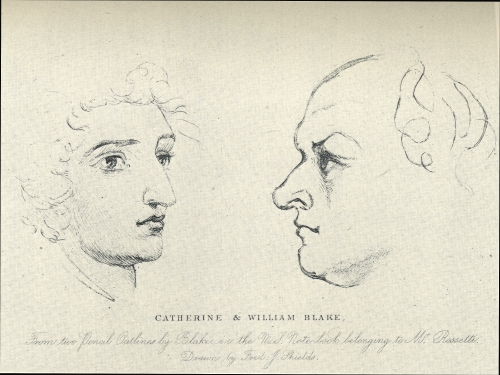
This is a reposting of Larry's June 29, 2007 post with a picture added.

Rossetti Archive
Copied by Fred J Shields from Blake's Notebook
 From sketches in Blake's Notebook which came to be known as the Rossetti Manuscript.

This is not about Catherine, Blake's wife, with whom he lived in happy conjugal relationship for 40 years (her only complaint was that he spent too much time in heaven).
 

Nor is it about the fictional Catherine, who only serves to titillate the gossip lover.
 

Nor is it about Mary Wollencraft, although the story goes that William once proposed to Catherine that he bring Mary in as a concubine; Catherine cried, and William abandoned the idea. Blake hated and despised 'jealousy', but it seems that Catherine's jealousy on this occasion solidified a very solid marriage relationship.
 
None of these, this post is about the women Blake met in heaven:

Thel was a kind of foretaste of the women to come; she exposed the seediness of mortal life and went back to heaven. In her life Blake posed the question 'is mortal life of any value?' (Raine).

Lyca is a microcosm of the three main women that Blake met in heaven. In Plate 6, 7, and 8 read two ethereally beautiful poems that reveal the kernel of the 'system' Blake developed after he said, "I must create a system or be enslaved by another man's".

Vala is the main woman in Blake's myth (The Four Zoas was originally named Vala). In the development of his story Blake splits Vala into two: Tirzah (the earthly woman) and Jerusalem (the heavenly one).
 
In To Tirzah Blake starkly presents the dichotomy:


"[Woman], what have I do to with thee?".
 

From a purely material viewpoint Blake has Jesus say this to his mother, actually a quotation from the Gospel of John 2:4. From a more significant viewpoint the woman represents mortality (Mary was his mortal mother). Jesus of course is something other than mortal. From the most significant viewpoint Blake is talking about you and me: we are made of clay, but an immortal spirit resides within the 'matter'.
 

Jerusalem of course is the obvious biblical metaphor for the "bride of Christ" and the heavenly (eternal) kingdom.