Wednesday, June 19, 2024

HUMILITY

First Posted December 2014 

Wikipedia Commons
Song of Los
Copy E, Plate 1


Blake was committed to an egalitarian society; one in which all men recognized each as Brother: as equally an expression of the Indwelling Spirit. He disagreed with any system in which some men were set up to have authority, and others to be obedient to them. His attitude to humility was a result of this belief. If a man knows himself to be directed by his Inner Spirit, his Identity, he trusts in his own integrity and not in ecclesiastical or political orders. 


Everlasting Gospel, (E 518)
"Was Jesus Humble or did he
Give any Proofs of Humility
Boast of high Things with Humble tone
And give with Charity a Stone
When but a Child he ran away                  
And left his Parents in Dismay
When they had wanderd three days long
These were the words upon his tongue
No Earthly Parents I confess
I am doing my Fathers business"
Blake saw true humility as not considering oneself as more worthy of respect of honor than others. Likewise one should not give more respect or honor to another because he was singled out to serve his Brothers in a position of responsibility. Blake saw the example which Jesus set as, "Humble to God Haughty to Man." Blake meant that a man who is confident of God working through him would not, and should not appear submissive to men who had not sought to follow the God within them. The attitude of Jesus was not defiance, submission or cooperation but trust in the Higher Power. 
Everlasting Gospel, (E 519)
"Like dr Priestly & Bacon & Newton               
Poor Spiritual Knowledge is not worth a button
For thus the Gospel Sr Isaac confutes
God can only be known by his Attributes    
And as for the Indwelling of the Holy Ghost
Or of Christ & his Father its all a boast
And Pride & Vanity of Imagination
That disdains to follow this Worlds Fashion
To teach doubt & Experiment       
Certainly was not what Christ meant
What was he doing all that time
From twelve years old to manly prime
Was he then Idle or the Less
About his Fathers business        
Or was his wisdom held in scorn
Before his wrath began to burn
In Miracles throughout the Land
That quite unnervd Lord Caiaphas hand    
If he had been Antichrist Creeping Jesus 
Hed have done any thing to please us
Gone sneaking into Synagogues
And not usd the Elders & Priests like dogs
But Humble as a Lamb or Ass
Obeyd himself to Caiaphas         
God wants not Man to Humble himself
This is the trick of the ancient Elf
This is the Race that Jesus ran  
Humble to God Haughty to Man
Cursing the Rulers before the People    
Even to the temples highest Steeple
And when he Humbled himself to God
Then descended the Cruel Rod
If thou humblest thyself thou humblest me   
Thou also dwellst in Eternity       
Thou art a Man God is no more
Thy own humanity learn to adore
For that is my Spirit of Life
Awake arise to Spiritual Strife
And thy Revenge abroad display       
In terrors at the Last Judgment day
Gods Mercy & Long Suffering
Is but the Sinner to Judgment to bring
Thou on the Cross for them shalt pray
And take Revenge at the Last Day 
Jesus replied & thunders hurld
I never will Pray for the World
Once [I] did so when I prayd ill the Garden  
I wishd to take with me a Bodily Pardon
Can that which was of Woman born   
In the absence of the Morn
When the Soul fell into Sleep
And Archangels round it weep
Shooting out against the Light
Fibres of a deadly night        
Reasoning upon its own Dark Fiction
In Doubt which is Self Contradiction
Humility is only Doubt
And does the Sun & Moon blot out
Rooting over with thorns & stems     
The buried Soul & all its Gems
This Lifes dim Windows of the Soul
Distorts the Heavens from Pole to Pole
And leads you to Believe a Lie
When you see with not thro the Eye"  
John 11
[46] But some of them went their ways to the Pharisees, and told them what things Jesus had done.
[47] Then gathered the chief priests and the Pharisees a council, and said, What do we? for this man doeth many miracles.
[48] If we let him thus alone, all men will believe on him: and the Romans shall come and take away both our place and nation.
[49] And one of them, named Caiaphas, being the high priest that same year, said unto them, Ye know nothing at all,
[50] Nor consider that it is expedient for us, that one man should die for the people, and that the whole nation perish not.
[51] And this spake he not of himself: but being high priest that year, he prophesied that Jesus should die for that nation;
[52] And not for that nation only, but that also he should gather together in one the children of God that were scattered abroad.
[53] Then from that day forth they took counsel together for to put him to death.
[54] Jesus therefore walked no more openly among the Jews; but went thence unto a country near to the wilderness, into a city called Ephraim, and there continued with his disciples.

John 18
[19] The high priest then asked Jesus of his disciples, and of his doctrine.
[20] Jesus answered him, I spake openly to the world; I ever taught in the synagogue, and in the temple, whither the Jews always resort; and in secret have I said nothing.
[21] Why askest thou me? ask them which heard me, what I have said unto them: behold, they know what I said.
[22] And when he had thus spoken, one of the officers which stood by struck Jesus with the palm of his hand, saying, Answerest thou the high priest so?
[23] Jesus answered him, If I have spoken evil, bear witness of the evil: but if well, why smitest thou me?
[24] Now Annas had sent him bound unto Caiaphas the high priest.

Sunday, June 16, 2024

Blake's Sex

Yale Center for British Art
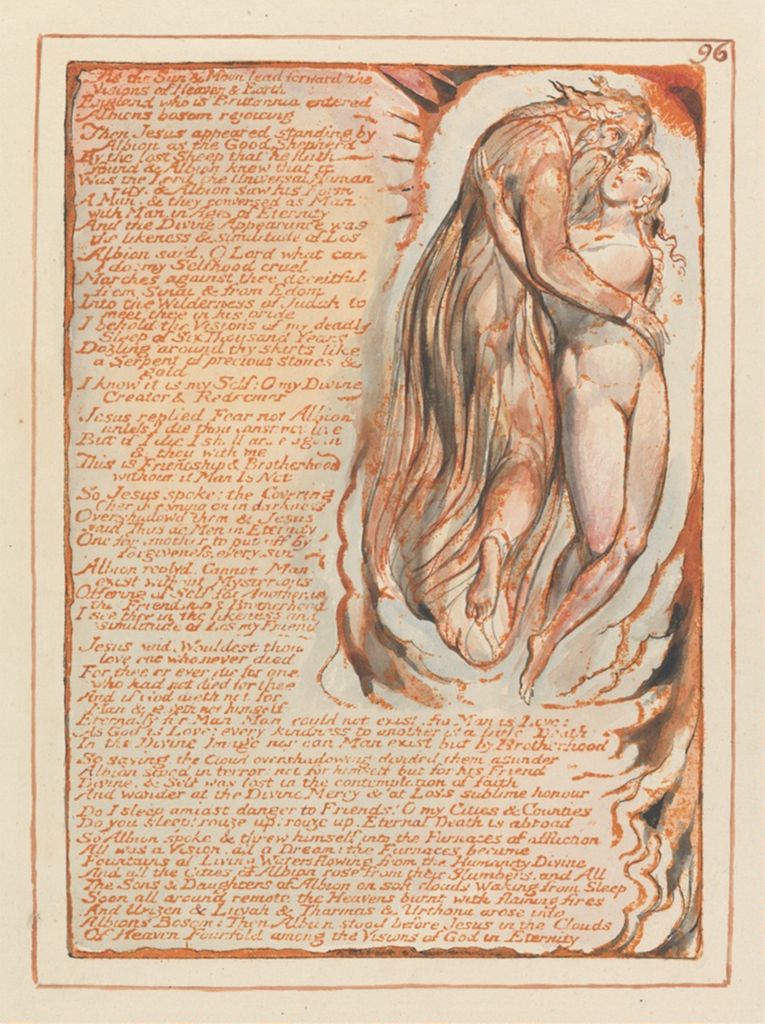
Jerusalem
Plate 96
All was a Vision, all a Dream:


In 2011 Larry posted seven times on Blake's sexual concepts, their sources, and their expression in his poetry.  

Sex I 

Sex II

Sex III

Sex IV

Sex V

Sex VI

Sex VII


BLAKE PRIMER - SEXUALITY

Summary

After all this detail We can begin our summary of Blake's theory of sex with Jesus' reply to the Sadducee's mocking question about the woman married to seven husbands: "for when they shall rise from the dead, they neither marry nor are given in marriage, but are as the angels which are in heaven."

Blake begins here, with the assumption that sexual division relates to this world, but not to Eternity. Sex appears in Beulah, a moony rest from the arduous creative activity of Eden. The "Female Will" condemns Man to the loss of Eternity, which Blake calls "the Sleep of Ulro".

Sex signifies fallenness, and the jealous and proudly chaste female symbolizes the active principle of evil, also identified with a materialistic viewpoint whose values are coercion and love of power.

Blake's vision of Jesus humanized his theory of sex. He began to use the biblical image of Jerusalem as the bride of Christ, named his last and greatest epic 'Jerusalem', and ultimately was able to rationalize the heterodox doctrine of sex with the glorified female as the emanation of the Eternal Man. Blake's female thus joined all the rest of his personal images in traveling the Circle of Destiny, materializing in the Fall and etherealizing in the Return.

Through all his journey Blake had a characteristically liberal and enlightened view of womankind, an entirely different matter from the sexual symbolism that filled his pages. His true and abiding feelings about the relation between men and women appear early in his works in his "Annotations to Lavater": "Let the men do their duty and the women will be such wonders; the female life lives from the light of the male: see a man's female dependants, you know the man." Admittedly short of the high standards of present day feminism, Blake's vision of womanhood considerably surpassed that of most of his contemporaries-- and perhaps most of ours.

End of Chapter Eight

Monday, June 10, 2024

ROMANTICISM

Illustrations to Robert Blair's The Grave
Object 10 
Our Time is Fix'd

Each Romantic poet followed his own leadings. Blake was distinctive as was each of them. The fact that he was characterized among them may be attributed to the fact they all were responding to guidance from right dominated brains. They were born into the Enlightenment period of history, a period which McGilchrist  describes as "single, knowable, consistent, certain, fixed, therefore ultimately finite", in other words left dominated. Obviously there are some individuals for whom differences are evident. They turn away from the majority culture and follow the right sides of their brains which are telling then that opposites may be equally true, that differences need not be excluded, and that there is more than is encompassed by what is already known.     
McGilchrist writes the following in his book The Master and His Emissary:

Page 354 
"In this chapter I will develop the view that romanticism is a manifestation of right-hemisphere dominance in our way of looking at the world. Here I am reminded of the fact that the right hemisphere is more inclusive, and can equally use what the left hemisphere uses as well as its own preferred approach, whereas the left hemisphere does not have that degree of flexibility or reciprocity.  
Page 355
For the Romantic mind, theory was not something abstracted from the mind and separate from it (based on representation), but present in the act of perception. There was therefore no question of 'applying' theory to life, since phenomena themselves were the source of 'theory'. Fact and theory, like particular and universal, were not opposites...The particular metaphorises the universal. 

Page 356

...Some things have to remain obscure if they are not to be untrue to their very nature: they are known, and can be expressed, only indirectly.
 
One of these is embodied existence.

Page 357

...'real people have embodied minds whose conceptual systems  arise from, are shaped by, and are given meaning through living human bodies...

The fusion of body with mind or more properly with spirit of soul, was never more keenly felt than by the Romantics. 'O Human Imagination, O Divine Body', wrote Blake.

Page 358
Unlike history seen as an intellectual realm, a repository of ideas about socio-cultural issues, tradition is an embodiment of culture: not an idea of the past, but the past itself embodied... what I believe the rise of Romanticism to be, [is] to redress the imbalance of the hemispheres, and to curtail the domination of the left." 

Right brain ideas are incorporated in Blake's poetry although, in true Romantic fashion, they are not expressed overtly.

Marriage of Heaven & Hell, Plate 4, (E 34)

                 "The voice of the Devil

  All Bibles or sacred codes. have been the causes of the
following Errors.
  1. That Man has two real existing principles Viz: a Body & a
Soul.
  2. That Energy. calld Evil. is alone from the Body. & that
Reason. calld Good. is alone from the Soul.
  3. That God will torment Man in Eternity for following his
Energies.
  But the following Contraries to these are True
  1 Man has no Body distinct from his Soul for that calld Body is
a portion of Soul discernd by the five Senses. the chief inlets
of Soul in this age
  2. Energy is the only life and is from the Body and Reason is
the bound or outward circumference of Energy. 

  3 Energy is Eternal Delight "

Marriage of Heaven and Hell, Plate 14, (E 39)
   "The ancient tradition that the world will be consumed in fire
at the  end of six thousand years is true. as I have heard from
Hell.
   For the cherub with his flaming sword is hereby commanded to 
leave his guard at the tree of life, and when he does, the whole 
creation will be consumed, and appear infinite. and holy whereas
it now  appears finite & corrupt.
   This will come to pass by an improvement of sensual enjoyment.
   But first the notion that man has a body distinct from his
soul, is to  be expunged; this I shall do, by printing in the
infernal method, by corrosives, which in Hell are salutary and
medicinal, melting apparent surfaces away, and displaying the
infinite which was hid.
   If the doors of perception were cleansed every thing would
appear  to man as it is: infinite.
   For man has closed himself up, till he sees all things thro'
narrow chinks of his cavern."
Milton, Plate 3, (E 96)                                                     t
"By Enitharmons Looms when Albion was slain upon his Mountains
And in his Tent, thro envy of Living Form, even of the Divine Vision
And of the sports of Wisdom in the Human Imagination
Which is the Divine Body of the Lord Jesus, blessed for ever.
Mark well my words. they are of your eternal salvation:"  
Milton, Plate 26 [28], (E 123)
"These are the Sons of Los! These the Visions of Eternity 

But we see only as it were the hem of their garments
When with our vegetable eyes we view these wond'rous Visions

There are Two Gates thro which all Souls descend. One Southward
From Dover Cliff to Lizard Point. the other toward the North
Caithness & rocky Durness, Pentland & John Groats House.         

The Souls descending to the Body, wail on the right hand
Of Los; & those deliverd from the Body, on the left hand
For Los against the east his force continually bends
Along the Valleys of Middlesex from Hounslow to Blackheath
Lest those Three Heavens of Beulah should the Creation destroy   
And lest they should descend before the north & south Gates
Groaning with pity, he among the wailing Souls laments."

Milton, Plate 26 [28], (E 123)
"And every Generated Body in its inward form,
Is a garden of delight & a building of magnificence,"

Milton, Plate 40 [46], (E 142)
"There is a Negation, & there is a Contrary
The Negation must be destroyd to redeem the Contraries
The Negation is the Spectre; the Reasoning Power in Man
This is a false Body: an Incrustation over my Immortal           
Spirit; a Selfhood, which must be put off & annihilated alway
To cleanse the Face of my Spirit by Self-examination."
Jerusalem, Plate 5, (E 148)
"Abstract Philosophy warring in enmity against Imagination
(Which is the Divine Body of the Lord Jesus. blessed for ever)."
Jerusalem, Plate 71, (E 224)
"And above Albions Land was seen the Heavenly Canaan
As the Substance is to the Shadow: and above Albions Twelve Sons
Were seen Jerusalems Sons: and all the Twelve Tribes spreading
Over Albion. As the Soul is to the Body, so Jerusalems Sons,
Are to the Sons of Albion: and Jerusalem is Albions Emanation    

What is Above is Within, for every-thing in Eternity is translucent:
The Circumference is Within: Without, is formed the Selfish Center 
And the Circumference still expands going forward to Eternity.
And the Center has Eternal States! these States we now explore."
Jerusalem Plate 77, (E 231)
"I know of no other
Christianity and of no other Gospel than the liberty both of body
& mind to exercise the Divine Arts of Imagination.   
  Imagination the real & eternal World of which this Vegetable
Universe is but a faint shadow & in which we shall live in our
Eternal or Imaginative Bodies, when these Vegetable Mortal Bodies
are no more.  The Apostles knew of no other Gospel.  What were
all their spiritual gifts? What is the Divine Spirit? is the Holy
Ghost any other than an Intellectual Fountain? What is the
Harvest of the Gospel & its Labours? What is that Talent which it
is a curse to hide? What are the Treasures of Heaven which we are
to lay up for ourselves, are they any other than Mental Studies &
Performances? What are all the Gifts. of the Gospel, are they not
all Mental Gifts? Is God a Spirit who must be worshipped in
Spirit & in Truth and are not the Gifts of the Spirit Every-thing
to Man? O ye Religious discountenance every one among
 
you who shall pretend to despise Art & Science! I call upon you
in the Name of Jesus! What is the Life of Man but Art & Science?
is it Meat & Drink? is not the Body more than Raiment? What is
Mortality but the things relating to the Body, which Dies? What
is Immortality but the things relating to the Spirit, which Lives
Eternally! What is the joy of Heaven but Improvement in the
things of the Spirit? What are the Pains of Hell but Ignorance,
Bodily Lust, Idleness & devastation of the things of the
Spirit?"

Wednesday, June 05, 2024

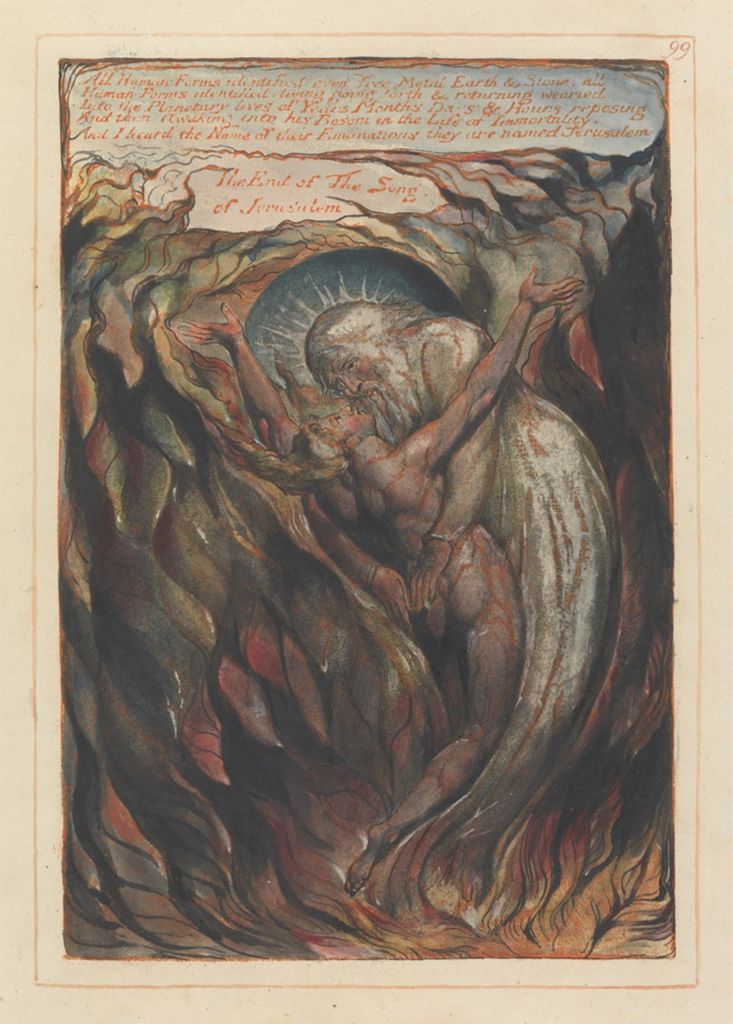
SEEING

Yale Center for British Art
Jerusalem
Plate 99

If as McGilchrist proposes the right hemisphere of the brain is designed and suited to be the master and the left hemisphere its emissary, we can look for evidence to support that postulate. McGilchrist notes that the act of seeing which may seem straightforward to the left hemisphere, is doing much more when processed by the right hemisphere. The left brain may be seeing solely with the eye whereas the right brain is using the act of seeing to go beyond the surface of an object to the substance and meaning it incorporates.

Iain McGilchrist on  Page 359-60 of The Master and His Emissary makes these statements about the act of seeing which takes place in the right hemisphere

"Every object, clearly seen, opens up a new organ or perception in us." (Goethe)

...for us to truly experience something to enter into and alter us, and there must be something in us which specifically responds to it as unique.

Understanding, then, is not a discursive explanatory process, but a moment of connection, in which we see through our experience - an apercu  or insight. ... each act of seeing, in the sense of allowing something to 'presence' for us, is in itself necessarily an act of understanding."

To Blake the act of perception is not static or solitary. Time and Space are altered as are the organs which perceive them. If we are capable of living in Eternity, if we have developed our spiritual senses sufficiently, we are not opaque to one another but share the one life which includes all.

Jerusalem, Plate 98, (E 258)

"every Word & Every Character
Was Human according to the Expansion or Contraction, the Translucence or
Opakeness of Nervous fibres such was the variation of Time & Space
Which vary according as the Organs of Perception vary & they walked
To & fro in Eternity as One Man reflecting each in each & clearly seen
And seeing: according to fitness & order. And I heard Jehovah speak" 
Letters, To Flaxman, (E 707)
"Now my lot in the Heavens is this; Milton lovd me in childhood & shewd me his face
Ezra came with Isaiah the Prophet, but Shakespeare in riper years gave me his hand
Paracelsus & Behmen appeard to me. terrors appeard in the Heavens above
And in Hell beneath & a mighty & awful change threatend the Earth
The American War began   All its dark horrors passed before my face
Across the Atlantic to France.  Then the French Revolution commencd in thick clouds
And My Angels have told me. that seeing such visions I could not subsist on the Earth
Terrific from his Holy Place & saw the Words of the Mutual Covenant Divine"
We find in the Bible the same implication that the eye is an organ which is capable of furnishing the body with light if it is used in one way and the opposite if used differently: light if looked 'thro' or darkness if it is looked 'with.'

First Corinthians 13

[12] For now we see through a glass, darkly; but then face to face: now I know in part; but then shall I know even as also I am known.

Matthew 6
[22] The light of the body is the eye: if therefore thine eye be single, thy whole body shall be full of light.
[23] But if thine eye be evil, thy whole body shall be full of darkness. If therefore the light that is in thee be darkness, how great is that darkness!
Luke 11

[34] The light of the body is the eye: therefore when thine eye is single, thy whole body also is full of light; but when thine eye is evil, thy body also is full of darkness.
[35] Take heed therefore that the light which is in thee be not darkness.
[36] If thy whole body therefore be full of light, having no part dark, the whole shall be full of light, as when the bright shining of a candle doth give thee light.

Commenting on the above verses John A Sanford in The Kingdom Within states: 
"If our eye, our spiritual insight, is dark, and we are accordingly acting out of ignorance of ourselves, our whole inner life will be dark for we will in fact be possessed by everything in ourselves of which we are unconscious."  Page 147


Auguries of Innocence, (E 492)
"Every Night & every Morn
Some to Misery are Born 
Every Morn & every Night
Some are Born to sweet delight
Some are Born to Endless Night
We are led to Believe a Lie 
When we see not Thro the Eye         

Which was Born in a Night to perish in a Night
When the Soul Slept in Beams of Light
God Appears & God is Light
To those poor Souls who dwell in Night 
But does a Human Form Display
To those who Dwell in Realms of day"
Vision of Last Judgment, (E 565)
"People flatter themselves   I will not Flatter them   Error is
Created Truth is Eternal   Error or Creation will be Burned Up &
then & not till then Truth or Eternity will appear   It is Burnt up
the Moment Men cease to behold it  I assert for My self that I do
not behold the Outward Creation & that to me it is hindrance &
not Action it is as the Dirt upon my feet No part of Me.  What it
will be Questiond When the Sun rises  do  you  not  see  a  round 
Disk of fire somewhat like a Guinea   O no no I see an Innumerable
company of the Heavenly host crying Holy Holy Holy is the Lord
God Almighty  I question not my Corporeal or Vegetative Eye any
more than I would Question a Window concerning a Sight I look
thro it & not with it."  
Letters, To Rev Dr Trusler, (E 702)
"Mirth is
better than Fun & Happiness is better than Mirth--I feel that a
Man may be happy in This World.  And I know that This World Is a
World of Imagination & Vision  I see Every thing I paint In This
World, but Every body does not see alike.  To the Eyes of a Miser
a Guinea is more beautiful than the Sun & a bag worn with the use
of Money has more beautiful proportions than a Vine filled with
Grapes. The tree which moves some to tears of joy is in the Eyes
of others only a Green thing that stands in the way.  Some See
Nature all Ridicule & Deformity & by these I shall not regulate
my proportions, & Some Scarce see Nature at all  But to the Eyes
of the Man of Imagination Nature is Imagination itself.  As a man
is So he Sees.  As the Eye is formed such are its Powers  You
certainly Mistake when you say that the Visions of Fancy are not
be found in This World.  To Me This World is all One continued
Vision of Fancy or Imagination & I feel Flatterd when I am told
So." 

Monday, May 27, 2024

INSPIRATION

British Museum
Milton
Plate 15

To Annihilate the Selfhood of Deceit & False Forgiveness

Iain McGilchrist is the author of the book The Master and his Emissary. McGilchrist postulates the right side of the brain which functions as a whole, has been preempted by the left side of the brain which process partially, primarily through reasoning.

McGilchrist portrays the romantic movement as a reaction against the enlightenment or age of reason. McGilchrist sees that left side of the brain, which processes thought in the way that Blake's Urizen did, has come to dominate man's psyche. Like Urizen the left side of the brain is rational, rigid, inflexible, and locked in the continuum of space and time - the 'here and now'. Blake's Los uses the right side of his brain by depending on imagination to see the infinite in all things, to integrate the opposites, and to act from inspiration.

There is No Natural Religion, (E 3)
"  VII The desire of Man being Infinite the possession is Infinite
& himself Infinite
     Conclusion,   If it were not for the Poetic or Prophetic
character. the Philosophic & Experimental would soon be at the
ratio of all things & stand still, unable to do other than repeat
the same dull round over again
     Application.   He who sees the Infinite in all things sees
God.  He who sees the Ratio only sees himself only.

Therefore God becomes as we are, that we may be as he is"

Marriage of Heaven and Hell, Plate 11, (E 38)
 "Isaiah answer'd. I saw no God. nor heard any, in a finite
organical perception; but my senses discover'd the infinite in
every thing, and as  I was then perswaded. & remain confirm'd;"

Milton, Plate 13, (E 108)
"The Bard replied. I am Inspired! I know it is Truth! for I Sing
Plate 14 [15]
According to the inspiration of the Poetic Genius
Who is the eternal all-protecting Divine Humanity
To whom be Glory & Power & Dominion Evermore Amen"

Milton, Plate 40 [46], (E 142)
"There is a Negation, & there is a Contrary
The Negation must be destroyd to redeem the Contraries
The Negation is the Spectre; the Reasoning Power in Man
This is a false Body: an Incrustation over my Immortal           
Spirit; a Selfhood, which must be put off & annihilated alway
To cleanse the Face of my Spirit by Self-examination.
Plate 41 [48]
To bathe in the Waters of Life; to wash off the Not Human
I come in Self-annihilation & the grandeur of Inspiration
To cast off Rational Demonstration by Faith in the Saviour
To cast off the rotten rags of Memory by Inspiration
To cast off Bacon, Locke & Newton from Albions covering          
To take off his filthy garments, & clothe him with Imagination
To cast aside from Poetry, all that is not Inspiration
That it no longer shall dare to mock with the aspersion of Madness
Cast on the Inspired,"

Tuesday, May 21, 2024

HARVARD - DANTE


Fogg Art Musem, Harvard University
Illustrations to Dante's Divine Comedy
Dante and Virgil Escaping from the Devils

Blake was continuing to work on illustrations to Dante's Divine Comedy up to the time of his death. He had been commissioned by his friend John Linnell to do so and gladly devoted himself to the project. There were 102 drawings either in process or completed when he died in 1827. Until 1918 the drawings were owned by the Linnell family who then decided to release them . Various institution were interested in owning some of all of the images but could not afford the whole set. Negotiations  resulted in distributing the drawings on three continents to five organizations and two individuals. The above picture eventually was obtained by Harvard through the bequest of Grenville Lindall Winthrop.

The above image pictures Dante and Virgil as they were passing through the Eighth circle of Hell where Devils were punishing sinners who had committed abuses in Florence. Dante and Virgil escaped from the Devils who were prohibited from leaving the 'ditch' where their work was to keep the sinners submerged in pitch. Although Blake did not shy away from picturing the cruel methods of punishing sinners in Dante's Hell, it would have given him pleasure to contemplate the protection which was afforded to Virgil and Dante as the pursued their journey through the underworld.

This article was printed in the Blake Quarterly, 1989/90 issue:

"The Dispersal of the Illustrations to Dante's Divine Comedy" by Krzysztof Z. Cieszkowski

"Purchase of 102 Illustrations to DANTE by WILLIAM BLAKE at the Linnell Sale at Christie’s, March 15th 1918.

The price was £7665. Ninety of the 102 drawings were completed. Twelve were so slight and in pencil as to be of little value. The ninety finished drawings were divided into three categories:

30 “A” Drawings

30 “B” Drawings

30 “C” Drawings

To work a plan out in round figures it was assumed that £7500 was subscribed as follows in £250 shares there being thirty such shares for the ninety drawings:

Melbourne£3000 (12 shares)
Tate Gallery£3000 (12 shares)
British Museum500 (2 shares)
Birmingham500 (2 shares)
Oxford250 (1 share)
Mr. Ricketts & Mr. Shannon250 (1 share)

it was decided to allot on the principle of one £250 share entitling to a selection of 1 “A” drawing, 1 “B” and 1 “C”. Melbourne, therefore, having 12 £250 shares received 12 “A”, 12 “B” and 12 “C” drawings, 36 in all, as the Tate also: the British Museum 6 each, and Oxford and Ricketts and Shannon 3 each.
...
Charles Ricketts acquired four works, which in 1943 entered the Fogg Art Museum at Harvard University, together with a further 19 works which had passed through various American private collections. Thus the unfinished series is currently divided between seven public and university collections in England, Australia, and the United States—a situation that would appear destined to remain unchanged."


Reading from Columbia University's Digital Dante  

Hell, Canto 21, Line 79 

“O Malacoda, do you think I’ve come,”
my master answered him, “already armed—
as you can see—against your obstacles,

without the will of God and helpful fate?
Let us move on; it is the will of Heaven
for me to show this wild way to another.”

At this the pride of Malacoda fell;
his prong dropped to his feet. He told his fellows:
“Since that’s the way things stand, let us not wound him.”

Hell Canto 23, Line 31

"If that right bank is not extremely steep,
we can descend into the other moat

and so escape from the imagined chase.”

Canto 23, Line 34

He’d hardly finished telling me his plan
when I saw them approach with outstretched wings,
not too far off, and keen on taking us.

My guide snatched me up instantly, just as
the mother who is wakened by a roar
and catches sight of blazing flames beside her,

will lift her son and run without a stop—
she cares more for the child than for herself—
not pausing even to throw on a shift;

and down the hard embankment’s edge—his back
lay flat along the sloping rock that closes
one side of the adjacent moat—he slid.

No water ever ran so fast along
a sluice to turn the wheels of a land mill,
not even when its flow approached the paddles,

as did my master race down that embankment
while bearing me with him upon his chest,
just like a son, and not like a companion.

His feet had scarcely reached the bed that lies
along the deep below, than those ten demons
were on the edge above us; but there was

nothing to fear; for that High Providence
that willed them ministers of the fifth ditch,
denies to all of them the power to leave it."


 Letters, To Linnell, (E 784)
25 April 1827
Dear Sir
I am going on better Every day as I think both in health & in Work I thank you for The Ten Pounds which I recievd from you this Day which shall be put to the best use as also for the prospect of Mr Ottleys advantageous acquaintance I go on without daring to count on Futurity. which I cannot do without Doubt & Fear that ruins Activity & are the greatest hurt to an Artist such as I am. as to Ugolino &c I never supposed that I should sell them my Wife alone is answerable for their having Existed in any finishd State--I am too much attachd to Dante to think much of any thing else--I have Proved the Six Plates & reduced the Fighting Devils ready for the Copper I count myself sufficiently Paid If I live as I now do & only fear that I may be unlucky to my friends & especially that I may not be so to you I am Sincerely yours WILLIAM BLAKE

Thursday, May 16, 2024

Radical Christianity

 Previously posted Nov 2019

British Museum
Europe
Copy D, plate 13

British Museum commentary for this plate: 

"Copy D, plate 13; above, a papal figure with bat's wings sitting on an ornate throne, floating on a cloud, with an open book on his knees; below on each side a winged gowned female figure holding a sceptre; the sceptres pointing downwards and meeting above the text at the bottom of the plate, as though they were an upside-down pair of compasses; 5 lines of verse beginning "Albions Angel rose...". 1794 Europe," 
Europe, Plate 11 [13], (E 64)
"Albions Angel rose upon the Stone of Night.
He saw Urizen on the Atlantic;
And his brazen Book,
That Kings & Priests had copied on Earth
Expanded from North to South."


 The immediate followers of Jesus were accused of turning the world upside down. They followed him in challenging all forms of worldly power including death. One can make a good case for the idea that the Christian by definition challenges the powers of the world; that's certainly the meaning of 'radical Christian'.
      
 Blake perceived the legacy that Jesus left behind in two ways. On one hand the church as the mystical body of Christ consists of those who continually challenge the authority or powers of the world. On the other hand the Church as an institution becomes one of the powers of the world. The tension between these two principles probably exists within the breast of anyone seriously interested in Christ.

  In the second century Ignatius of Antioch eloquently embodied that tension with his life. Ignatius died a martyr to the secular power of the Roman Empire. Before that happened, he had spent much of his time as an ecclesiastical authority rooting out dissenters, whom he called heretics; he did this in the course of establishing the institutional authority of what became the Roman Church.

  With Constantine these two streams of authority came together. In 312 A.D. the new emperor declared himself a Christian and assumed control of the Church. He exercised that control through the simple device of naming his most trusted servant as bishop. The Church became an arm of the political power of the empire.

  From that day to this the Church has been primarily one of the powers of the world. The power of the Church has been expressed through ecclesiastical hierarchies and creeds, both imposed upon the rank and file by various coercive techniques essentially identical with those of other worldly powers. This means that the spiritual reality of Christ vis-a-vis the Church is only actualized through the same sort of dissent that Jesus made in the beginning.

  These conclusions of course may be debated, but they represent the basic and lifelong viewpoint underlying the radical protest which was Blake's art.


Jerusalem, Plate 52, (E 201)                  

"and many believed what they saw, and
Prophecied of Jesus.
Man must & will have Some Religion; if he has not the
Religion of Jesus, he will have the Religion of Satan, & will erect the
Synagogue of Satan. calling the Prince of this World, God; and
destroying all who do not worship Satan under the Name of God.
Will any one say: Where are those who worship Satan under the
Name of God! Where are they? Listen! Every Religion that Preaches Vengeance for Sins the Religion of the Enemy & Avenger; and not the Forgiver of Sin, and their God is Satan Named by the Divine
Name Your Religion O Deists: Deism, is the Worship of the God
of this World by the means of what you call Natural Religion and
Natural Philosophy, and of Natural Morality or
Self-Righteousness, the Selfish Virtues of the Natural Heart.
This was the Religion of the Pharisees who murderd Jesus. Deism
is the same & ends in the same."

Saturday, May 11, 2024

Image of God

British Museum
Illustrations to Young's Night Thoughts

From the Blake Primer

The really exciting thing about 'The Four Zoas' is the long incubation and eventual birth of Blake's new, positive image of God concurrent with the thorough and definite laying to rest of the old one. These realities become vivid once the reader gains sufficient familiarity with the material to see the underlying currents of spiritual movement. If you like poetry, 4Z contains many beautiful lines interspersed throughout the nine Nights amidst long, bleak desert passages describing fallenness. The beautiful passages mark stirrings of the Spirit. (It has great similarity in fact to the style of Isaiah, who wrote the most beautiful parts of the O.T. surrounded by unrelieved darkness.)

Follow the speeches of Enion, the primeval mother of Los and Enitharmon. In Night i her children's increasing depravity and her maternal love lead her down into the abyss of Non-entity, in her case an abyss of consciousness. She becomes a disembodied voice sounding a note of reality over the general fallenness as it progressively develops. Her comments throughout the action preserve the feeling of human oneness that will break forth at the darkest hour. In Enion Blake found a new voice expressing a passionate love that laments but doesn't excoriate, and a faith, evolved through suffering, that the Divine Image will come to redeem. These of course are the most creative themes of the Old Testament, slowly evolving out of its generally primitive theology. Enion's speeches at the conclusion of Nights i, ii, and viii are too long to quote here, but they contain some of the most sublime poetry Blake wrote and portend the emergence of the new God of compassion.

In 4Z Blake elaborated and analyzed the God, Urizen, in the fullest detail; this version contains less heat and more light than we found in Book of Urizen. Urizen symbolizes man's thinking faculty; in the primary myth of the Fall he became estranged from his feelings. This story is told at least six times in 4Z. Blake devoted Night ii to Urizen's creation of a rocky, hard, opaque world of mathematical certainty and calculation. Anyone who has spent time on a college campus has met people highly developed intellectually and infantile emotionally. They lack the capacity to express any value more intense than "very interesting". Many, of course, have denied that value has any meaning. Imagine what kind of world they create, what spiritual climate they live in; there you have Urizen.

He is a God devoid of true feeling; he has feelings, but they're all false. He continually weeps, like the Old Testament God who wept as he punished people. He builds a world of law, devoid of feeling, devoid of compassion, devoid of humanity. His world is based upon fear of the future, and he attempts to secure himself against it at all costs. Fear defines his character and his actions until the very end of the fallen world. In Night viii Urizen is still fighting life and light. He sets out:

Four Zoas, Night viii, Page 102, (E 375)
"...to pervert all the faculties of sense
Into their own destruction, if perhaps he might avert
His own despair even at the cost of everything that breathes."

There you find a preview of the God of the superpowers of our own day. Their fear has become the guiding principle leading them toward the destruction of "everything that breathes".

Urizen's initial downfall comes in Night iii. His emanation (in this case wife), Ahania, has followed Enion, the Earth Mother, into the abyss of consciousness. She tries to share with Urizen a level of truth that he finds so unpleasant that he casts her out, and promptly falls himself like Humpty Dumpty. In Ahania's vision we have a psychologically acute and penetrating description of the incipience of a false God. It ranks with the Bible's eloquent pre-psychological denunciations of idolatry, as found for example in Isaiah 40. Blake re-used this passage in 'Jerusalem', attesting its authenticity even on the illumined side of the Divine Vision:

Jerusalem, Plate 43 [29], (E 191)
"Then Man ascended mourning into the splendors of his palace,
Above him rose a Shadow from his wearied intellect
Of living gold, pure, perfect, holy; in white linen he hover'd,
A sweet entrancing self delusion, a wat'ry vision of Man
Soft exulting in existence, all the Man absorbing.
Man fell upon his face prostrate before the wat'ry shadow,
Saying, O Lord, whence is this change? thou knowest I am nothing ...
Idolatrous to his own Shadow, words of Eternity uttering:
O I am nothing when I enter in judgment with thee.
If thou withdraw thy breath I die and vanish into Hades;
If thou dost lay thine hand upon me, behold I am silent;
If thou withhold thine hand I perish like a fallen leaf.
O I am nothing, and to nothing must return again.
If thou withdraw thy breath, behold I am oblivion."

In this parody of the Prophet Blake shows us a fundamental truth about man's image of the transcendental God. He doesn't deny the reality of a transcendental God as some of his interpreters have concluded. He denies the truth of man's image of the transcendental God, an entirely different matter.

He opposes the ascribing of qualities to the Wholly Other. According to Blake when that is done the result is something less than man. Worshiping this sub-human God the worshiper becomes something less than man himself. He represses a portion of his humanity, which Blake here calls Luvah, and that repressed portion falls upon him and afflicts him with boils from head to toe. The penalty for idolatry is brokenness and suffering, consciousness of sin, guilt, division, finitude, envy, the torments of love and jealousy, the whole bit of man's unfortunate fallen circumstances. It's all caused by the false God that man has chosen. Isaiah understood a part of this; he recognized some of the idols of others but not his own. 

Thomas Altizer, in his book on Blake, rightly took this passage as a critical revelation of the "death of God".

Man worships a shadow of his wearied intellect. No higher God is possible without the wholeness that Christ brings. Worship of a shadow of our wearied intellect leads to all the false and fatal evils that we visit upon one another from simple vanity to war.
...
The progression of Blake's poetry shows the eclipse of Christ through the long struggle of the seventeen nineties. Then he proceeded to introduce the Lamb into 4Z with a group of additional lines at strategic places. These images means relatively little to the secular reader, but cause great joy to the Christian.

The healing of Los, described in Night vii of The Four Zoas, prepares the way for Christ's coming into history. Night viii tells the story of Jesus: the Incarnation, the Crucifixion, and the Resurrection of the spiritual body. It's important to remember that in Blake's mental world and in his poetry these are psychic rather than historical events.

Blake had always worshiped the Divine Vision. In his twenty years in the wilderness the Divine Vision dimmed and lost the immediacy which had informed the beautiful poems of Innocence. Kathleen Raine points to a few lines that describe with peculiar luminosity this dimming of the Divine Vision:

Jerusalem, Plate 66, (E 219) 
"And as their eye & ear shrunk, the heavens shrunk away 
The Divine Vision became First a burning flame [Moses], then a column 
Of fire [the Exodus], then an awful fiery wheel [Ezekiel] surrounding earth & heaven: And then a globe of blood wandering distant in all unknown night [false Christianity]"

This describes Blake's personal experience and that of Mankind. But at or after Felpham he recovered the Divine Vision and realized that his name is Jesus.

He spent the rest of his life celebrating the momentous event, and the Name and proclaiming its reality in a hundred ways. It had happened to him, and it would happen to the world.

Letters, To Thomas Butts, Nov 1802, (E 720)
"And now let me finish with assuring you that Tho I have been very unhappy I am so no longer I am again Emerged into the light of Day I still & shall to Eternity Embrace Christianity and Adore him who is the Express image of God but I have traveld thro Perils & Darkness not unlike a Champion I have Conquerd and shall still Go on Conquering Nothing can withstand the fury of my Course among the Stars of God & in the Abysses of the Accuser My 

Enthusiasm is still what it was only Enlarged and confirmd" 


Thursday, May 09, 2024

ERDMAN

Wikipedia Commons
America
Plate 12

David V Erdman, in Prophet Against Empire, demonstrated how the contraries reason and energy work together to accomplish what neither could accomplish alone.  The opportunity was there for Urizen to cooperate with the Lord of Day and use the Steeds of Light to bring about an accomadation with the energy of those seeking Liberty. He listened instead, however, to Reason and found that Wrath of the oppressed had seized the reins of government in the Age of Revolution. 

Page 194

“The creeping Urizen is supplied with a long soliloquy in a passage of Night Five of The Four Zoas  which is worth taking up here for the light it casts back upon The Marriage of Heaven and Hell and A Song of Liberty and The Tyger The fatal error of the jealous king is that his fixing of the horizon ultimately limits himself more than it does the energy of the people.  Royalty can keep its crimson robes, Orleans warned, only if it stops trying to measure of each man 'the circle that he shall run'(French Revolution, P 91) Soliloquizing as he crawls in the den or narrow circle of his own ideas, the fallen Urizen of Night Five laments too late his imperial mistakes: his choice of war instead of peace, his failure to accept the opportunity to be an enlightened despot when the "mild & holy voice" of divine freedom said, "O light, spring up & shine" and "gave to me a silver sceptre & crownd me with a golden crown" to 'Go forth & guide' the people. 'I went not forth,' he laments, 'I hid myself in black clouds of my wrath, I called the stars around my feet in the night of councils dark'. (FZ's) Thus George assembled his council in 1774; thus Louis the King of France, prepared his ‘starry hosts’ in 1789 and let the spark of humanity in his bosom be 'quench’d in clouds' by 'the Nobles of France, and dark mists.' Each time, in the event, at Yorktown and again at Valmy, ‘The stars threw down their spears & fled naked away'. We fell.  Too late Urizen is sorry he refused to use his ‘Steeds of Light’.  

The language of the soliloquy is doubly revealing.  On the level of practice it is clear that ‘The stars threw down their spears’ means : the armies of counterrevolution were defeated. On the level of theory it is clear that Reason, when it refuses to assist but attempts to hinder Energy, is overthrown.  Denied the peaceful accommodation of the Steeds of Light, the just man seizes the Tigers of Wrath. Vetoed by a stubborn monarch, the French people became, as the London Times of January 7, 1792, put it, 'loose from all restraints, and, in many instances, more ferocious than wolves and tigers'. As Blake put it in Fayettethe French grew bloodthirsty and would 'not submit to the gibbet & halter.' 

If we take the tiger and horse as symbols of untamed Energy and domesticated Reason then it is obvious which of these contraries is more vital in days of revolution. In Hell is a proverbial that 'the tygers of wrath are wiser than the horses of instruction.'
...
Page 196 
The creator must have smiled at Yorktown and at Valmy, not because his people were warlike, but because they seemed ready to coexist with the Lamb, the wrath of the Tiger having done its work. The question, 'Did he smile his work to see?' is perhaps as rhetorical as the corresponding query of Orleans: 'And can Nobles be bound when the people are free, or God weep when his children are happy?'"

Four Zoas, Night V, Page 64, (E 343)
"But now my land is darkend & my wise men are departed

My songs are turned to cries of Lamentation           
Heard on my Mountains & deep sighs under my palace roofs         
Because the Steeds of Urizen once swifter than the light
Were kept back from my Lord & from his chariot of mercies

O did I keep the horses of the day in silver pastures
O I refusd the Lord of day the horses of his prince
O did I close my treasuries with roofs of solid stone            
And darken all my Palace walls with envyings & hate

O Fool to think that I could hide from his all piercing eyes
The gold & silver & costly stones his holy workmanship
O Fool could I forget the light that filled my bright spheres
Was a reflection of his face who calld me from the deep          

I well remember for I heard the mild & holy voice
Saying O light spring up & shine & I sprang up from the deep  
He gave to me a silver scepter & crownd me with a golden crown
& said Go forth & guide my Son who wanders on the ocean  

I went not forth. I hid myself in black clouds of my wrath       
I calld the stars around my feet in the night of councils dark
The stars threw down their spears & fled naked away
We fell. I siezd thee dark Urthona In my left hand falling

I siezd thee beauteous Luvah thou art faded like a flower"
America, Plate 2, (E 52)
"Silent as despairing love, and strong as jealousy,
The hairy shoulders rend the links, free are the wrists of fire;
Round the terrific loins he siez'd the panting struggling womb;
It joy'd: she put aside her clouds & smiled her first-born smile;
As when a black cloud shews its lightnings to the silent deep.   

Soon as she saw the terrible boy then burst the virgin cry.

I know thee, I have found thee, & I will not let thee go;
Thou art the image of God who dwells in darkness of Africa;
And thou art fall'n to give me life in regions of dark death.
On my American plains I feel the struggling afflictions          
Endur'd by roots that writhe their arms into the nether deep:
I see a serpent in Canada, who courts me to his love;
In Mexico an Eagle, and a Lion in Peru;
I see a Whale in the South-sea, drinking my soul away.
O what limb rending pains I feel. thy fire & my frost            
Mingle in howling pains, in furrows by thy lightnings rent;
This is eternal death; and this the torment long foretold."
French Revolution, Page 10(E 294)
"Fear not dreams, fear not visions, nor be you dismay'd with
     sorrows which flee at the morning;
Can the fires of Nobility ever be quench'd, or the stars by a
     stormy night?
Is the body diseas'd when the members are healthful? can the man
     be bound in sorrow
Whose ev'ry func,tion is fill'd with its fiery desire? can the
     soul whose brain and heart
Cast their rivers in equal tides thro' the great Paradise,
     languish because the feet
Hands, head, bosom, and parts of love, follow their high
     breathing joy?
And can Nobles be bound when the people are free, or God weep
     when his children are happy?
Have you never seen Fayette's forehead, or Mirabeau's eyes, or
     the shoulders of Target,
Or Bailly the strong foot of France, or Clermont the terrible
     voice, and your robes
Still retain their own crimson? mine never yet faded, for fire
     delights in its form.
But go, merciless man! enter into the infinite labyrinth of
     another's brain
Ere thou measure the circle that he shall run. Go, thou cold
     recluse,into the fires
Of another's high flaming rich bosom, and return unconsum'd, and
     write laws.
If thou canst not do this, doubt thy theories, learn to consider
     all men as thy equals,
Thy brethren, and not as thy foot or thy hand, unless thou first
     fearest to hurt them."


Wednesday, May 01, 2024

FOUR ZOAS PICTURED

British Museum
Book of Urizen, printed 1794 
Copy D, Plate 14


Library of Congress
Book of Urizen, printed 1818
Copy G, Plate 16 [14]
 

First Posted  October 2009

This rare image of the Four Zoas together appears in the Book of Urizen.


Blake pictured the four Eternals peering down in the unfinished world of Urizen as it divides, falling into the abyss. Most of the copies of this plate display only three of the Zoas. In Blake's characteristic way of allowing imagination to lead him as he created his images, he has added the fourth Zoa Tharmas, to the other three in the late copy.

Blake's characters have different appearances as they are represented at different levels of existence in his myth. Here they are represented at the level of the Eternals; although no physical representation at that spiritual level can be anything more than limited and false.

Nevertheless, we see Urizen on the right, looking down at his own fallen nature as it disintegrates in separation. His beard drags in the water of matter which is created as a result of his fall. Why is he old? Because he is conservatism which must always be replaced by the new and fresh.

Beside Urizen is Los, forever young, who joins Urizen in the descent in order to be the agent of the eventual return. Suggested by the fingers of Los touching the liquid below, as if paint or ink were dripping from his hand, is an intimation of the role of imagination in the regeneration process

Next to the young Los, is another older gentleman, Luvah, who as the emotions, is a level early in physic development. Luvah becomes intimately involved in the struggle to limit the downward fall of Urizen and reverse the division in Albion. At various points Luvah works with or competes with Urizen or Los, but his service is to Jesus.

The Zoa who is missing in most of the images, Tharmas, is pictured as no more than a boy. The contradiction in the character Tharmas is that he is both the 'Parent Power' and the last to be named. Mary Lynn Johnson describes him as "innocence, instinct, the binding force of the human personality, and the body." Perhaps he is closer to the id than is any other of the Zoas, and so closer to the child.

On the engraved plate, words and image work together to involve us in the fall - from the perspective of Eternity.
Book of Urizen, Plate 15 [14], (E 78)                                       
"Thus the Eternal Prophet was divided
Before the death-image of Urizen
For in changeable clouds and darkness
In a winterly night beneath,
The Abyss of Los stretch'd immense:
And now seen, now obscur'd, to the eyes
Of Eternals, the visions remote
Of the dark seperation appear'd.
As glasses discover Worlds
In the endless Abyss of space,      
So the expanding eyes of Immortals
Beheld the dark visions of Los,
And the globe of life blood trembling"