Friday, September 16, 2011

LAOCOON DRAWING

Blake copied the cast of the Laocoon in the Royal Academy in about 1815 in order to make an engraving to be included in Rees' Cyclopaedia (click on 2nd picture). He later enlarged and enhanced the engraving with text to project his own ideas about art and religion. The figures for Blake became God and his two sons Adam and Satan who were engaged in a mighty struggle with a threatening force represented by two serpents named good and evil.

Drawing for engraving included in Rees' Cyclopaedia, 1815
Yale Center for British Arts


Inscription

"This drawing was made by W. Blake in the Royal Academy Somerset House for a small plate he made of the Laocoon for the Article in the Encyclopedia. The article itself was on sculpture being written by Flaxman. When W. B was drawing this his old friend Fuseli came in & said ' Why Mr. Blake you a student you ought to teach us'

in my possession from Mrs Blake

F. Tatham"


 Laocoon, (E273)
" The whole Business of Man is the Arts; things Common
Christianity is Art; not Money.
Jesus and his Apostles; Disciples were all Artists."

Laocoon with Blake's inscriptions.

Thursday, September 15, 2011

Blake's Laocoon

Drawn & Engraved by William Blake


[Jehovah] & his two Sons Satan & Adam as they were copied
from the Cherubim Of Solomons Temple by three Rhodians &
applied to Natural Fact. or. History of Ilium
[Above the father's head:]
The Angel of the Divine Presence
[Angel of Jehovah]
[Serpent-holder]
He repented that he had made Adam
(of the Female, the Adamah)
& it grieved him at his heart

[About the serpent and figure (? Satan) to the right:]
Good
[Lilith]
Satans Wife The Goddess Nature is War & Misery & Heroism a Miser

[About the serpent and figure (? Adam) to the left:]

Evil
Good & Evil are

Riches & Poverty a Tree of Misery
propagating Generation & Death

[Remaining aphorisms, reading outward in thematic order:]

What can be Created Can be Destroyed
Adam is only The Natural Man & not the Soul or Imagination

The Eternal Body of Man is The IMAGINATION.
God himself |
that is |[Yeshua] JESUS We are his Members
The Divine Body|

It manifests itself in his Works of Art (In Eternity All is
Vision)
All that we See is VISION from Generated Organs gone as soon as
come
Permanent in The Imagination; considered as Nothing by the
NATURAL MAN

HEBREW ART is called SIN by the Deist SCIENCE

The whole Business of Man Is The Arts & All Things Common

Christianity is Art & not Money
Money is its Curse

The Old & New Testaments are the Great Code of Art

Jesus & his Apostles & Disciples were all Artists
Their Works were destroyd by the Seven Angels of the Seven
Churches in Asia. Antichrist Science

SCIENCE is the Tree of DEATH
ART is the Tree of LIFE GOD is JESUS

The Gods of Priam are the Cherubim of Moses & Solomon The Hosts
of Heaven

The Gods of Greece & Egypt were Mathematical Diagrams See Plato's

Works
There are States in which all Visionary Men are accounted Mad
Men such are Greece & Rome Such is Empire or Tax
See Luke Ch 2 v I

Art Degraded Imagination Denied War Governed the Nations

Divine Union Deriding And Denying Immediate Communion with
God
The Spoilers say Where are his Works That he did in the
Wilderness
Lo what are these Whence came they These are not the Works
Of Egypt nor Babylon Whose Gods are the Powers of this World.
Goddess, Nature. t
Who first spoil & then destroy Imaginative Art For their Glory is

War and Dominion

Empire against Art See Virgils Eneid. Lib. VI. v 848

Spiritual War
Israel deliverd from Egypt is Art deliverd from Nature &
Imitation

What we call Antique Gems are the Gems of Aarons Breast Plate

Prayer is the Study of Art
Praise is the Practise of Art
Fasting &c. all relate to Art
The outward Ceremony is Antichrist
Without Unceasing Practise nothing can be done

Practise is Art If you leave off you are Lost

A Poet a Painter a Musician an Architect: the Man
Or Woman who is not one of these is not a Christian
You must leave Fathers & Mothers & Houses & Lands
if they stand in the way of ART

The unproductive Man is not a Christian much less the Destroyer

The True Christian Charity not dependent on Money (the lifes
blood of Poor Families) that is on Caesar or Empire or
Natural Religion

For every Pleasure Money Is Useless

Money, which is The Great Satan or Reason the Root of Good & Evil
In The Accusation of Sin

Where any view of Money exists Art cannot be carried on, but War
only (Read Matthew CX. 9 & 10 v) by pretences to the Two
Impossibilities Chastity & Abstinence Gods of the Heathen

Is not every Vice possible to Man described in the Bible openly

All is not Sin that Satan calls so all the Loves & Graces of
Eternity.

If Morality was Christianity Socrates was the Saviour

Art can never exist without Naked Beauty displayed

No Secresy in Art
(Erdman 273-5)

Wednesday, September 14, 2011

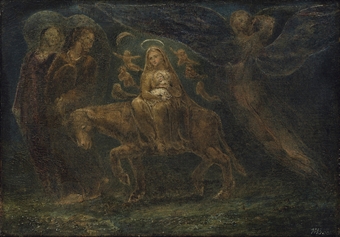
FLIGHT INTO EGYPT

William Blake wanted to make art accessible to the people since he considered art to be the whole of life and not an optional addition. One of his ideas was to paint movable temperas or 'frescos' which individuals could hang on the walls of their homes. Thomas Butts became a customer in a big way for these items by ordering in 1799, fifty temperas of Biblical subjects. The medium which Blake used for these 'frescos' proved to be less than durable leading to cracking and darkening of the surface. However a number have survived. The Blake Archive has recently added a group to their collection of images.

This image is from a Christie's offering of Blake's Flight into Egypt from 1799.


Blake pictures the holy family to be well protected on their journey under the wings of angels. Surrounding cherubs express their delight. The contrary is offered by the bedraggled but patient donkey who plods along.

Matthew 2
12] And being warned of God in a dream that they should not return to Herod, they departed into their own country another way.
[13] And when they were departed, behold, the angel of the Lord appeareth to Joseph in a dream, saying, Arise, and take the young child and his mother, and flee into Egypt, and be thou there until I bring thee word: for Herod will seek the young child to destroy him.
[14 When he arose, he took the young child and his mother by night, and departed into Egypt:

Monday, September 12, 2011

DESIGNS

Observations on the Small Book of Designs

Of the 23 images, 13 picture males, 11 picture females. The mid-point of the series - page 12 - with the inscription, 'Teach these Souls to Fly', can be seen as a turning point in the direction of movement. The next image of a skeleton in a fetal position represents a new beginning. Images of females which are concentrated in the second half of the book, mostly present positive possibilities.

There is some alteration between affirmation or negation alternatives between plates. The inscriptions on each picture offer alternatives also.

To help me remember the image in each picture I gave them labels. Blake's words in the right column are highlighted with words which suggest contraries. The Copy B pages are missing where no inscriptions are available.

...Labels..................................................Inscriptions
1 WHICH WAY------------------------------ "Which is the Way/The Right or the Left"

2 TWO WOMEN - DEATH & LIFE---- "Death & Hell/Teem with Life"
3 GLOBE OF BLOOD---------------------- "Vegetating in fibres of Blood"
4 PRISON---------------------------------------- "Who shall set/The Prisoners free"
5 FLAMING SWORD----------------------- "A Flaming sword/Revolving every way"

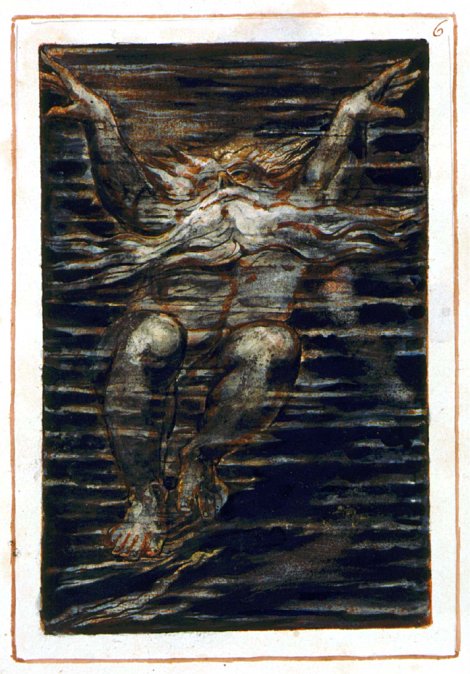
6 TIME & SPACE--------------------- "O revolving serpent/O the Ocean of Time & Space"
7 URIZEN EXPLORES--------------------- " Fearless tho in pain/I travel on"
8 FLOOD OF THARMAS
9 LOS AS DESIRE---------------------------- "Oh! Flames of Furious Desire"

10 THEL OBSERVES
11 URIZEN'S WORLD
12 LOS' WORLD--------------------------------"Teach these Souls to Fly"
13 BEGIN AGAIN

14 EMANATION--------------------------------- "Is the Female death/Become new Life"
15 RECONCILING CONTRARIES-"Does the Soul labour thus/ In Caverns of The Grave"
16 WORM OR BABE
17 ROLE OF FEMININE--------------------- "Wait Sisters/Tho all is Lost"

18 AGONY-------------------------------- "I sought Pleasure and found Pain/Unutterable"
19 HUMAN QUALITIES----------------------"Everything is an attempt/ To be Human"

20 LIFE RENEWS
21 LOOKING BACK or IMAGINATION- "The Book of my Rememberance"
22 LITTLE ONES--------------------------------- "Doth God take care of These"
23 LOVE A WORM - TENFOLD LIFE

Here is a link to images from small and large Books of Design in the British Museum.

Here are two more plates which have no counterparts in Copy A but which resemble the Small Book of Designs. We can join Blake in expressing the sentiments in the inscriptions on these last two plates.

From the Book of Urizen ...................................From the Book of Urizen
Plate 12 .................................................................Plate 9
Library of Congress...........................................Princeton University Library


"The floods overwhelmed me"............"Eternally I labour on"

Sunday, September 11, 2011

Archetypal Adolescence

In this post we'll look at several types of adolescence:

In some ways adolescence is considered unique to our culture; that's certainly true for the present form of adolescence (in our culture).

1. Blake was interested in the form of adolescence of his day; in fact he participated in it whole-heartedly like he did everything else that he did. The MHH may or may not have been written (or at least originated) in his own adolescence.  More likely it was an expression of what his own adolescence meant to him, a violent rejection of conventionality in all its forms.
Visions of the Daugherers of Albion

Visions of the Daughters of Albion also shows a 'violent rejection of conventionality', particularly conventional marriage.

Few people I know had a level of intellect comparable to Blake's: Jesus would be foremost (We might see his adolescence as his initial wilderness experience).  It was an intellect devoted to goodness and without the common flaws that color and corrupt the intellect of most of us.

2. Northrup Frye was (in my mind) a candidate for that august category.  25 years ago I was beginning a serious interest in 'our poet'  When I first read Fearful Symmetry, it was terribly obscure, but I found it compelling.  After five readings I was convinced that William Blake was 'the way to go' for me.  Now, after many years, I looked at it again.

Frye's vocabulary is awesome: on the first reading of Fearful Symmetry you may find a terrible obscurity, but that's due to the fact that Frye used words that you may not be familiar with.  So hindsight shows that if I had spent more time reading it, I might have eventualy gotten the meaning of concepts that are still very cloudy in my mind: I simply lacked the author's vocabulary-- a very simple criterion of intellect, but an important one.

Frye's  archetypal adolescence involved leaving his study of religion for the study of literature. 

3. Some peculiar adolescences are found in various forms of science fiction: note C.S.Lewis' the Narnian series, Madeleine Engle's stories and Arthur C Clarke's Childhood's End, which celebrates the  growing change in the intellect of our children.  Parents today are mystified at what their children are about, where they are-- all too often lost to them. Clarke was predicting the foreigness of the adolescence of the day he envisioned.

4. Colin Dexter, a man whose intellect places him very high in my mind, had significant things to say about the adolescence of his day. He had had a relationship with Oxford, and he perceived it as a citadel of conventionality, convention going bad, so to speak. He took part in translating his written work to videos; one of the many  that focused on adolescence is Cherubim and Seraphim

5. Some of the American Indians's culture included sending the adolescent our into the wilderness, were he (so to speak) loses his innocence.  Indian Guides emulates this custom (to varying degrees), but a more radical 'Indian related' activity is the Order of the Arrow.

6. Military training ('Boot Camp') is a time honored way that a great many of our younger generation become 'mature' (at least in the military sense).

7. The archetypal adolescence has perhaps the most vivid impact on the experience of elderly people with their grandchildren.    

(More to come!)

Saturday, September 10, 2011

DESIGN 23

David V. Erdman, who has done as much any man to make the work of Blake available to the public, makes this statement in the introduction to The Illuminated Blake:
"To say that Blake was able , as author and printer, to keep all aspects of the production of his works under his own control is to reduce to an easy formula (the Urizenic triumph) the most difficult - and endless - struggle of his life, the effort to seize the symmetries that confronted him at every step, to create simultaneously and harmoniously in words, birds, lines, colors, a living city of Art that would resurrect us from our graves to meet the Savior in the air." (Page 11)

The symmetries which confronted Blake at every step are presented in the Small Book of Designs.

Image from the British Museum.

Page 23
From the Book of Thel
Plate 4


No Inscription

Book of Thel , PLATE 3, (E 4)
"O little Cloud the virgin said, I charge thee tell to me,
Why thou complainest not when in one hour thou fade away:
Then we shall seek thee but not find; ah Thel is like to thee.
I pass away. yet I complain, and no one hears my voice.

The Cloud then shew'd his golden bead & his bright form emerg'd,
Hovering and glittering on the air before the face of Thel.

O virgin know'st thou not. our steeds drink of the golden springs
Where Luvah doth renew his horses: look'st thou on my youth,

And fearest thou because I vanish and am seen no more.
Nothing remains; O maid I tell thee, when I pass away,
It is to tenfold life, to love, to peace, and raptures holy:
Unseen descending, weigh my light wings upon balmy flowers;
And court the fair eyed dew. to take me to her shining tent;
The weeping virgin, trembling kneels before the risen sun,
Till we arise link'd in a golden band, and never part;
But walk united, bearing food to all our tender flowers"

More on the Book of Thel:
Text and Commentary;
Download a PDF of the Book of Thel from the Library of Congress.
~~~~~~~~~~~~~~~~~~~~~~~~~~~~~~~~~~~~~~~~~~~~~~~~~~~~~~~~

The inscription on the first plate of the series asks the question; 'Which Way?' The selection on the plates to be included, the inscriptions which accompanied them and the text which may be associated with them, indicate that the series was meant to answer the original question. 'Which Way' is open to us, 'Which Way' will we choose, 'Which Way' was chosen by Urizen, Thel, Los or Vala? Contrary paths are presented and the consequences of following them are pictured.

The final two plates, which are from the Book of Thel, bear only one inscription: 'Doth God take Care of These.' The text in the Book of Thel provides answers to this final question: God
'cherish'd it [the worm] With milk and oil' and 'when I pass away,It is to tenfold life, to love, to peace, and raptures holy'.

And from
Visions of Daughters of Albion referenced on Page 20: 'the soul of sweet delight Can never pass away.'
The Small Book of Designs is deserving of more attention and study than it has received. Blake did not casually gather together pictures without purpose. Just as he was exploring ways in which his printing techniques might convey more intensely the images of his imagination, he was seeking to use the images to present again his seminal vision in a form with fresh intensity.

Thursday, September 08, 2011

DESIGNS 20,21,22

With his commitment to nurturing the expression of the imagination, Blake was continually experimenting with means of presenting his ideas in fresh and accessible ways. He reinvented the verbal and visual media he used in the same flexible way that he envisioned the activity of Eternity.

In the introduction to William Blake at the Huntington, Robert N. Essick, distinguished professor of English at the University of California, Riverside, comments on the development of Blake's printing technique:

"The illuminated books of the 1790s show Blake's development as a printmaker as well as a poet...We also find a concomitant shift in Blake's habits as a colorist. In 1794 he began to paint the designs on his relief-etched plates with opaque pigments and to print these with the accompanying inked texts...Blake soon found that he could print from etched shallows or even from unetched plates. This technique, always subject to accident and variation, produced reticulated patches of color that required work with brush or pen on each impression to restore essential outlines...During this same period, hand-coloring developed in a similar direction toward darker and denser effects. The finished designs look more like paintings than tinted prints." (Page 14)

Copy F of Visions of the Daughters of Albion in the Morgan Library and Museum is a departure from the earlier technique of relief etching with water coloring. Blake was experimenting with relief etching with color printing which led to the style of printing we observe in much of the Small Book of Designs.

Page 20
Visions of the Daughters of Albion
Plate iii


No Inscription


Visions of the Daughters of Albion, Plate iii, (E 45)
"I loved Theotormon
And I was not ashamed
I trembled in my virgin fears
And I hid in Leutha's vale!
I plucked Leutha's flower,
And I rose up from the vale;
But the terrible thunders tore
My virgin mantle in twain."

Visions of Daughters of Albion, PLATE 1, (E 45)
"ENSLAV'D, the Daughters of Albion weep: a trembling lamentation
Upon their mountains; in their valleys. sighs toward America.
For the soft soul of America, Oothoon wanderd in woe,
Along the vales of Leutha seeking flowers to comfort her;
And thus she spoke to the bright Marygold of Leutha's vale
Art thou a flower! art thou a nymph! I see thee now a flower;
Now a nymph! I dare not pluck thee from thy dewy bed!
The Golden nymph replied; pluck thou my flower Oothoon the mild
Another flower shall spring, because the soul of sweet delight
Can never pass away. she ceas'd & closd her golden shrine." 

For more on this image read Visions of Daughters of Albion.

Page 21
From the Book of Urizen
Plate 5

The Book of my Rememberance


Milton , PLATE 41 [48], (E 142)
"He smiles with condescension; he talks of Benevolence & Virtue
And those who act with Benevolence & Virtue, they murder time on time
These are the destroyers of Jerusalem, these are the murderers
Of Jesus, who deny the Faith & mock at Eternal Life:
Who pretend to Poetry that they may destroy Imagination;
By imitation of Natures Images drawn from Remembrance
These are the Sexual Garments, the Abomination of Desolation
Hiding the Human lineaments as with an Ark & Curtains
Which Jesus rent: & now shall wholly purge away with Fire
Till Generation is swallowd up in Regeneration."

Descriptive Catalogue, Page 54, (E 547)
"They cause that every thing in art shall become a
Machine. They cause that the execution shall be all blocked up
with brown shadows. They put the original Artist in fear and
doubt of his own original conception. The spirit of Titian was
particularly active, in raising doubts concerning the possibility
of executing without a model, and when once he had raised the
doubt, it became easy for him to snatch away the vision time
after time, for when the Artist took his pencil, to execute his
ideas, his power of imagination weakened so much, and darkened,
that memory of nature and of Pictures of the various
Schools possessed his mind, instead of appropriate execution,
resulting from the inventions; like walking in another man's
style, or speaking or looking in another man's style and manner,
unappropriate and repugnant to your own individual character;
tormenting the true Artist, till he leaves the Florentine, and
adopts the Venetian practice, or does as Mr. B. has done, has the
courage to suffer poverty and disgrace, till he ultimately
conquers."

 For more on this image read Printing House I & II.

Page 22
From the
Book of Thel
Plate 7

Doth God take care of These

Book of Thel, Plate 5, (E 6)
"The daughter of beauty wip'd her pitying tears with her white veil,
And said. Alas! I knew not this, and therefore did I weep:
That God would love a Worm I knew, and punish the evil foot
That wilful, bruis'd its helpless form: but that he cherish'd it
With milk and oil, I never knew; and therefore did I weep,
And I complaind in the mild air, because I fade away,
And lay me down in thy cold bed, and leave my shining lot.
Queen of the vales, the matron Clay answerd; I heard thy sighs.
And all thy moans flew o'er my roof. but I have call'd them down:
Wilt thou O Queen enter my house. 'tis given thee to enter,
And to return; fear nothing. enter with thy virgin feet."

For more on this image read Thel I.

Wednesday, September 07, 2011

Frye VI

Northrup Frye I This from an article in Wikipedia:
"it was in reflecting on the similarity between Blake
and Milton that Frye first stumbled upon the "principle
of the mythological framework," the recognition that
"the Bible was a mythological framework, cosmos or body
of stories, and that societies live within a mythology"
(Hart 18). Blake thus led Frye to the conviction that
the Bible provided Western societies with the mythology
which informed all of Western literature. As Hamilton
asserts, "Blake's claim that 'the Old and New
Testaments are the Great Code of Art' became the
central doctrine of all [Frye's] criticism" (39). This
'doctrine' found its fullest expression in Frye's
appropriately named The Great Code, which he described
as "a preliminary investigation of Biblical structure
and typology" whose purpose was ultimately to suggest
"how the structure of the Bible, as revealed by its
narrative and imagery, was related to the conventions
and genres of Western literature" (Words with Power
xi)."

The magnitude of the significance of Fearful Symmetry
(in my mind at least) led me to wonder just who Frye
was; where did he come from? who was he? How did it
happen that he should write such a book?  Writing
Fearful Symmetry It was a thesis, I understood, and
something he took ten years writing: From biography:
"..in 1929. He enrolled in Victoria College of the
University of Toronto.
While still an undergraduate, he developed a deep
fascination with the complex poetic prophecies of
William Blake, particularly Milton, The Four Zoas, and
Jerusalem, considered by many scholars to be the
product of an eccentric, possibly insane, visionary. In
Frye's first year of graduate work, in which he took
concurrent training as a minister for the United Church
of Canada (primarily Methodist), Frye decided to write
a definitive book on Blake which would break Blake's
difficult symbolic code. This near obsession sustained
him through two unhappy years of graduate work at
Merton College, Oxford, where he studied with poet
Edmund Blunden in 1936-1937 and 1938-1939, after which
he taught English at Victoria College for over four
decades.  Ten-Year Labor on Blake Heavily influenced by
British scholars of myth, particularly James Frazer, he
worked diligently on the Blake book from 1934 to 1945,
finally producing Fearful Symmetry. Published in 1947,
it is still considered the definitive reading of Blake.
It shows that Blake's poetic universe was not
psychotically personal but had close affinities with
other major poetry. Basically Frye proposed that all
literature fit into a grand apocalyptic pattern of
heaven and hell. Aspects of literary expression such as
tragedy (the Fall), irony (unrelieved hell), romance
(resurrection), and comedy (communal reconciliation)
form an interconnected circular pattern analogous to
the Last Judgment or the wheel of fortune motifs common
in medieval art." Here's a study guide on Frye's The
Educated Imagination, a more elementary version of
Frye's masterpiece, an Anatomy of Criticism.  More to
come.

Thursday, March 31, 2011
Frye II

Although Fearful Symmetry was Frye's first book, it was
not the one he was famous for; that would be The
Anatomy of Criticism. It became the preeminent textbook
for literary critics. Anatomy of Criticism was a
difficult book: for specialists. He wrote another one,
a simplification of 'Anatomy', called The Educated
Imagination. For those not up for that there's a study
guide, in essence a condensation of Frye's first
condensation. You might start with that and work your
way up -- like a scholar does.

Here are two significant things that Frye said about
Fearful Symmetry.  At one point he said that if had it
to do again, he would have written a simpler
explanatory treatment of Blake, like Percival's Circle
of Destiny.

After Fearful Symmetry was done, he said that it had
within it all he had to say with The Anatomy of
Criticism.

So it appears that Frye thought he had written, with
FS, a particular case of his thesis, while 'Anatomy'
was the general case. Since that time many Blakeans
have attended to Blake's poetry, pictures and ideas
exclusively, to the exclusion of other poets and
artists. They specialize in Blake, like a doctor might
specialize in Ophthamology and know little or nothing
about other fields of medicine.

A major convention of Western literature is the way in
which stories get told. In The Educated Imagination (p.
52) Frye suggests that each story represents episodes
in the story of literature itself . As he views it, all
literature tells a largely cyclical story--"the story
of the loss and regaining of identity" (p. 55). It can
be seen in the hero's quest, where the hero leaves the
safety of his society to face a monster and returns, or
in the lover's plight, where the man is attracted to a
woman, and marries her and is buried by her. But it's
most complete representation in the West is the
Biblical story of the Fall of man from his original
home and the eventual return to a promised land or a
heavenly kingdom."

Writing Fearful Symmetry Frye had perceived that
Blake's opus was a Circle of Destiny with a departure
and a return. Early in Blake's poetic development his
circle had two points, reflected in two Contraries,
Urizen and Luvah. But it soon became Fourfold: Blake's
Myth, the System that he Created (Erdman 153). It had
as its biblical source the 1st Chapter of Ezekiel, with
the 'four living creatures. If you read Ezekiel 1 you
can't help seeing their resemblance to the Four Zoas,
forming the structure of Blake's unfinished masterpiece
called The Four Zoas.

When you form the habit of recognizing the fundamental
quality of the images Blake presents, you will be able
to see the same kinds of images in the works of other
writers. And if you have some familiarity with the
Bible you may recognize the original sources of ideas,
values, images that appear throughout literature.

Tuesday, September 06, 2011

DESIGNS 17,18,19

Joseph Viscomi, in his essay Blake's "Annus Mirabilis": The Productions of 1795, comments on the development of Blake printing techniques during the period when the Small Book of Designs was produced.

"... Blake incorporated the tools and techniques of painting, just as in illuminated prints he used the tools and processes of drawing and writing. The prints in the Small Book and Large Book are not only "free of text," but they differ even from the color-printed illuminated plates of 1794 by having been produced in a more overtly painterly manner, no doubt influenced by the larger prints of 1795. This painterliness in the small and large monotypes is no mere illusion, as it would be if the impressions were assembled from separately printed outline and colors.
Many significant differences exist between color printing relief etchings and intaglio etchings. With the former, Blake is inking plates as prints and adding colors to inked and uninked areas. He behaved even more radically with the latter works. Blake is not inking the plate; he is painting it, using etched lines as guidelines, but he is also free to improvise at will, as he did with hill and halo in Albion rose. Nothing like these had ever been produced before and no analogous printing process exists."

More from Viscomi on color printing methods.

Page 17
From the
Visions of the Daughters of Albion
Plate 3

Wait Sisters/Tho all is Lost

Visions of the Daughters of Albion, Plate 2, (E 47)
"Why does my Theotormon sit weeping upon the threshold;
And Oothoon hovers by his side, perswading him in vain:
I cry arise O Theotormon for the village dog
Barks at the breaking day. the nightingale has done lamenting.
The lark does rustle in the ripe corn, and the Eagle returns
From nightly prey, and lifts his golden beak to the pure east;
Shaking the dust from his immortal pinions to awake
The sun that sleeps too long. Arise my Theotormon I am pure.
Because the night is gone that clos'd me in its deadly black.
They told me that the night & day were all that I could see;
They told me that I had five senses to inclose me up.
And they inclos'd my infinite brain into a narrow circle,
And sunk my heart into the Abyss, a red round globe hot burning
Till all from life I was obliterated and erased.
Instead of morn arises a bright shadow, like an eye
In the eastern cloud: instead of night a sickly charnel house;
That Theotormon hears me not! to him the night and morn
Are both alike: a night of sighs, a morning of fresh tears;"

Page 18From the Book of Urizen Plate 7

Image from copy A
(British Museum)________ Image from Copy B (Tate Gallery)


I sought Pleasure and found Pain/Unutterable


Milton, PLATE 33 [36], (E 132)
"And the Divine Voice was heard in the Songs of Beulah Saying

When I first Married you, I gave you all my whole Soul
I thought that you would love my loves & joy in my delights
Seeking for pleasures in my pleasures O Daughter of Babylon
Then thou wast lovely, mild & gentle. now thou art terrible
In jealousy & unlovely in my sight, because thou hast cruelly
Cut off my loves in fury till I have no love left for thee
Thy love depends on him thou lovest & on his dear loves
Depend thy pleasures which thou hast cut off by jealousy
Therefore I shew my jealousy & set before you Death.
Behold Milton descended to Redeem the Female Shade
From Death Eternal; such your lot, to be continually Redeem'd
By death & misery of those you love & by Annihilation"

Page 19
From the Book of Urizen
Plate 11

Everything is an attempt/ To be Human

Book of Urizen, Plate 14, (E 77)
"6. Los wept obscur'd with mourning:
His bosom earthquak'd with sighs;
He saw Urizen deadly black,
In his chains bound, & Pity began,

7. In anguish dividing & dividing
For pity divides the soul"

Songs of Innocence & Experience
, Song 18, (E 12)
"For Mercy Pity Peace and Love,
Is God our father dear:
And Mercy Pity Peace and Love,
Is Man his child and care.

For Mercy has a human heart
Pity, a human face:
And Love, the human form divine,
And Peace, the human dress.

Then every man of every clime,
That prays in his distress,
Prays to the human form divine
Love Mercy Pity Peace.

And all must love the human form,
In heathen, turk or jew.
Where Mercy, Love & Pity dwell,
There God is dwelling too"

Songs of Experience, SONG 55,(E32)
"A DIVINE IMAGE

Cruelty has a Human Heart
And Jealousy a Human Face
Terror, the Human Form Divine
And Secrecy, the Human Dress

The Human Dress, is forged Iron
The Human Form, a fiery Forge.
The Human Face, a Furnace seal'd
The Human Heart, its hungry Gorge."

For more on
this image read Senses Shrink and Blake's Pity.

Monday, September 05, 2011

Blake's Symbolism

Blake was a highly symbolic poet (and painter); to understand much of his thought requires acquaintance with a body of symbols that go back to the dawn of civilization, and up to the 19th century. In an age when only the material seemed to matter Blake was (and continues to be) highly opaque to the pure materialist. Such a person will find most of Blake's ideas meaningless.

But at the deepest level his ideas are the veritable stuff of life: love and hate, good and evil, life and death, and many ideas with urgent meaning. A high proportion of people prefer to turn aside from these questions, but you can be sure that their unconscious is full of them.

Above all Blake is about matter and spirit, at the great dividing line: do you see yourself primarily as a body or as spirit?

Begin with the conclusion, to be supported by an overwhelming body of evidence stretching from Heraclitus in the 6th century BC to the present:

Our mortal life is a vale of tears to which we have lapsed from Eternity and from which we will (may?) eventually turn back into the Higher Realm. This myth conforms very closely to the Gnostics, the Platonists, and of course most of Eastern Religion. In the Christian tradition one can find vestiges of it in many of the mystics, notably Meister Eckhart, in Mexican folk culture and in fact universally.

The western mind revolts from this "never-never land" at least on the conscious level, and many readers may dismiss Blake's myth as not worth their attention. But Freud, Jung, and many other psychologists found strong evidence for it in the unconscious.

The select few who have not succumbed to the prevailing radical materialism may rightfully expect an entirely new world of grace and enchantment to open before their minds. The biblically oriented may perceive that all Blake's poetic and artistic work fits into a scheme of cosmic/psychic meaning; closely following the Bible it describes the pattern of Paradise, the Fall, a gradual redemption, and the final Rapture.

This material comes from Chapter Ten of Blake's Primer.

Sunday, September 04, 2011

DESIGNS 14,15,16

All of the images on this series of posts on the Small Book of Designs are from the British Museum. To read what the Curator writes about the book, click here and page down to comments.

From a Curator of the British Museum:
"Both books [Small and Large Books of Designs] exist in two copies (A and B). The British Museum has copies A (1856,0209.417 - 447). Copies B contain lighter impressions, produce when the inked plate was passed back through the press for a second pull, with little or no new ink added. Provenance, and documentary evidence, link the various impressions of copies A as series. The impressions in copies B are scattered among different collections and Copies B are only considered as "books" by inference from copies A. Copy B of "A Small Book of Designs" has inscriptions added by Blake."

In these posts the images from copy A and the inscription from Copy B are brought together so that the book may be considered as an Emblem Book.

Page 14
From Book of Urizen
Plate 19

Is the Female death/Become new Life

Book of Urizen
, Plate 19, (E79)
"1. But Los saw the Female & pitied
He embrac'd her, she wept, she refus'd
In perverse and cruel delight
She fled from his arms, yet he followd

2. Eternity shudder'd when they saw,
Man begetting his likeness,
On his own divided image.

3. A time passed over, the Eternals
Began to erect the tent;
When Enitharmon sick,
Felt a Worm within her womb.

4. Yet helpless it lay like a Worm
In the trembling womb
To be moulded into existence

5. All day the worm lay on her bosom
All night within her womb
The worm lay till it grew to a serpent
With dolorous hissings & poisons
Round Enitharmons loins folding,

6. Coild within Enitharmons womb
The serpent grew casting its scales,
With sharp pangs the hissings began
To change to a grating cry,
Many sorrows and dismal throes,
Many forms of fish, bird & beast,
Brought forth an Infant form
Where was a worm before.

7. The Eternals their tent finished
Alarm'd with these gloomy visions
When Enitharmon groaning
Produc'd a man Child to the light.

8. A shriek ran thro' Eternity:
And a paralytic stroke;
At the birth of the Human shadow.

9. Delving earth in his resistless way;
Howling, the Child with fierce flames
Issu'd from Enitharmon.

10. The Eternals, closed the tent
They beat down the stakes the cords
PLATE 20
Stretch'd for a work of eternity;
No more Los beheld Eternity."

For more on this image read Mental Traveller 19-21.

Page 15
From the Book of Urizen
Plate 10

Does the Soul labour thus/ In Caverns of The Grave

Four Zoas , Page 43, 44, (E 329)
"Down from the dismal North the Prince in thunders & thick clouds
As when the thunderbolt down falleth on the appointed place
Fell down down rushing ruining thundering shuddering
Into the Caverns of the Grave & places of Human Seed
Where the impressions of Despair & Hope enroot forever
A world of Darkness. Ahania fell far into Non Entity"

For more on this image read Caverns of the Grave.

Page 16
From the Book of Thel
Plate 6

No Inscription

Book of Thel, Plate 3,4, (E 5)
"The helpless worm arose, and sat upon the Lillys leaf,
And the bright Cloud saild on, to find his partner in the vale.
PLATE 4
Then Thel astonish'd view'd the Worm upon its dewy bed.

Art thou a Worm? image of weakness. art thou but a Worm?
I see thee like an infant wrapped in the Lillys leaf:
Ah weep not little voice, thou can'st not speak. but thou can'st weep;
Is this a Worm? I see thee lay helpless & naked: weeping,
And none to answer, none to cherish thee with mothers smiles."

For more on this image read Blake's Worm.

Saturday, September 03, 2011

Blake's Apprenticeship

In "London, Blake was apprenticed at the age of 14 to the "citizen and stationer of London" James Basire for £53, nearly £7,000 in modern terms, a considerable sum for James Blake, a hosier and father of five other surviving children. The apprenticeship lasted seven years and it was Basire who sent him to make the sketches at Westminster Abbey that are thought to have informed his later artistic style." (British Guardian 24 August 2011)

In the famous story of Blake's apprenticeship his father offered to engage William Ryland, the Royal engraver, and prepared to put down a princely sum for the apprenticeship, but the child objected on the basis of Ryland's looks; he told his father that he thought the man would live to be hanged. Once again the elder Blake respected the child's judgment, and sure enough, twelve years later Ryland was hanged for forgery.

(This from Wikipedia)
"On 4 August 1772, Blake became apprenticed to engraver James Basire of Great Queen Street, for the term of seven years. At the end of this period, at the age of 21, he was to become a professional engraver. No record survives of any serious disagreement or conflict between the two during the period of Blake's apprenticeship. However, Peter Ackroyd's biography notes that Blake was later to add Basire's name to a list of artistic adversaries—and then cross it out. This aside, Basire's style of engraving was of a kind held to be old-fashioned at the time, and Blake's instruction in this outmoded form may have been detrimental to his acquiring of work or recognition in later life.

After two years, Basire sent his apprentice to copy images from the Gothic churches in London (perhaps to settle a quarrel between Blake and James Parker, his fellow apprentice). His experiences in Westminster Abbey helped form his artistic style and ideas. The Abbey of his day was decorated with suits of armour, painted funeral effigies, and varicoloured waxworks. Ackroyd notes that "...the most immediate [impression] would have been of faded brightness and colour". In the long afternoons Blake spent sketching in the Abbey, he was occasionally interrupted by the boys of Westminster School, one of whom "tormented" Blake so much one afternoon that he knocked the boy off a scaffold to the ground, "upon which he fell with terrific Violence". Blake beheld more visions in the Abbey, of a great procession of monks and priests, while he heard "the chant of plain-song and chorale.""

These data should convince scholars that Blake's family was by no means poor. His career indicates significant downward social mobility, much like that of many of his disciples in the sixties generation- the flower children who came from affluent families and went from there to penury.

**************************************************************************

Friday, September 02, 2011

DESIGNS 11,12,13

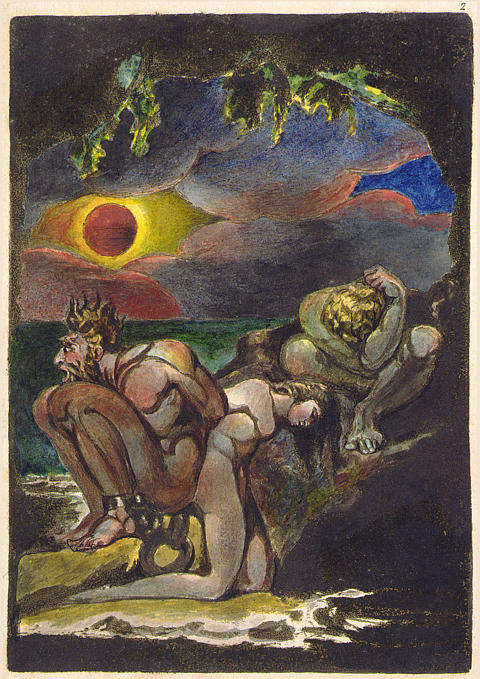
The Small Book of Designs in the British Museum contains 23 plates with images which Blake derived from 4 of his Illuminated books. Thirteen designs are from the Book of Urizen, four from Thel, four from the Marriage of Heaven & Hell and two from Visions of the Daughters of Albion.

The three pages for today's post are from the Book of Urizen. The Morgan Library's copy of Urizen can be viewed online. Notice the difference in application of color in this copy of Urizen and in Small Book of Designs.

Page 11
From Book of Urizen
Plate 27

No Inscription

Book of Urizen , Plate 20, (E 80)
"5. The dead heard the voice of the child
And began to awake from sleep
All things. heard the voice of the child
And began to awake to life.

6. And Urizen craving with hunger
Stung with the odours of Nature
Explor'd his dens around

7. He form'd a line & a plummet
To divide the Abyss beneath.
He form'd a dividing rule:

8. He formed scales to weigh;
He formed massy weights;
He formed a brazen quadrant;
He formed golden compasses
And began to explore the Abyss
And he planted a garden of fruits"

Page 12
From Book of Urizen
Plate 2

Teach these Souls to Fly

Four Zoas , Night II, Page 34, (E 324)
"The birds & beasts rejoice & play
And every one seeks for his mate to prove his inmost joy

Furious & terrible they sport & rend the nether deeps
The deep lifts up his rugged head
And lost in infinite hum[m]ing wings vanishes with a cry
The fading cry is ever dying
The living voice is ever living in its inmost joy

Arise you little glancing wings & sing your infant joy
Arise & drink your bliss
For every thing that lives is holy for the source of life
Descends to be a weeping babe
For the Earthworm renews the moisture of the sandy plain

Now my left hand I stretch to earth beneath
And strike the terrible string
I wake sweet joy in dens of sorrow & I plant a smile
In forests of affliction
And wake the bubbling springs of life in regions of dark death"

For more on this image read Stand Alone.

Page 13
From Book of Urizen
Page 8

No Inscription


Book of Los , Plate 4, (E 92)
"1: The Immortal stood frozen amidst
The vast rock of eternity; times
And times; a night of vast durance:
Impatient, stifled, stiffend, hardned.

2: Till impatience no longer could bear
The hard bondage, rent: rent, the vast solid
With a crash from immense to immense

3: Crack'd across into numberless fragments
The Prophetic wrath, strug'ling for vent
Hurls apart, stamping furious to dust
And crumbling with bursting sobs; heaves
The black marble on high into fragments

4: Hurl'd apart on all sides, as a falling
Rock: the innumerable fragments away
Fell asunder; and horrible vacuum
Beneath him & on all sides round.

5: Falling, falling! Los fell & fell
Sunk precipitant heavy down down
Times on times, night on night, day on day
Truth has bounds. Error none: falling, falling:
Years on years, and ages on ages
Still he fell thro' the void, still a void
Found for falling day & night without end.
For tho' day or night was not; their spaces
Were measurd by his incessant whirls
In the horrid vacuity bottomless."

Thursday, September 01, 2011

Blake's Prophecy

Imagine Blake as a very young child reading. The Bible was likely
his primary, if not only, reading material; so he steeped himself in it,
the way a child does with his favorite book. Frye called him a Bible
soaked Protestant. In a letter to Flaxman Blake described his
primary sources: "Now my lot in the Heavens is this: Milton lov’d me
in childhood and show’d me his face; Ezra came with Isaiah the
Prophet, but Shakespeare in riper years gave me his hand;
Paracelsus and Behmen appear’d to me; terrors appear’d in the
Heavens above;"

John Milton is thought to be England's greatest prophet, but some
people say that William Blake was the greatest prophet we have had
since St. Francis.

Moses had this to say near the end of his life: "Would to God that
all the Lord's people were prophets?"

What is a prophet? There are many definitions of the word, but
here's mine: a person who points out to people the primary choices
they have: "either this or that". If you do such and such, so and
so will happen. If you do such and such(2), so and so(2) will happen.
Your destiny is in your hands--at least to some degree.

The prophet points out to us that we must choose between 'good' and 'evil', and he lays out for us the consequences of our choice. His/her basic function is to awaken people. From Milton,
Plates 22-23; Erdman 117:

"The Witnesses lie dead in the Street of the Great City
No Faith is in all the Earth: the Book of God is trodden under
Foot:
He sent his two Servants Whitefield & Westley; were they Prophets
Or were they Idiots or Madmen? shew us Miracles!

PLATE 23 [25]
Can you have greater Miracles than these? Men who devote
Their lifes whole comfort to intire scorn & injury & death
Awake thou sleeper on the Rock of Eternity Albion awake
The trumpet of Judgment hath twice sounded: all Nations are awake
But thou art still heavy and dull: Awake Albion awake!"

Most prophets, biblically and today, become famous and are looked to and
honored Posthumously.

**********************************************************************
The Covering Cherub is the epitome of Satan. (see also Plate 14 of MHH.) But in essence they're both a state of mind.

The Catholics speak of a state of Grace and a state of Sin. As
the years went by Blake saw Satan as one state and the 'Christ
consciousness' as the other one. We've come now to the place
where we all live.

Blake's first real prophecy was The Marriage of Heaven and Hell.
In it he pointed out good and evil; only he reversed it (this
is called irony!). The devils were what we today call creative
people; the angels were those clinging to the 'good ole days'- and ways.

In mature years he gave up the youthful ironic tone for more
reasoned prophecies; We might list the 'either ors', which he
called Contraries:

Instead of good and evil
for Heaven' put Eternity;
For Hell put Ulro.
(Beulah is between; but a 'resting Eternal' is apt to go to sleep and drop into the Sea of Time and Space.)
Goolgonooza is also between, but hopefully 'coming up'.

Wednesday, August 31, 2011

DESIGNS 8,9,10

Images from the British Museum

Eight of the images in the Small Book of Designs were discovered in a Railway Timetable sold in a lot of used books in the 1970's. The images had been separated from the set and disappeared from sight for about a century and a quarter. They now belong to the Tate Gallery and are shown here by the BBC.

Page 8
From
Book of Urizen Plate 24

No Inscription

Milton , Plate 15 [17], (E 109)
"First Milton saw Albion upon the Rock of Ages,
Deadly pale outstretchd and snowy cold, storm coverd;
A Giant form of perfect beauty outstretchd on the rock
In solemn death: the Sea of Time & Space thunderd aloud
Against the rock, which was inwrapped with the weeds of death
Hovering over the cold bosom, in its vortex Milton bent down
To the bosom of death, what was underneath soon seemd above.
A cloudy heaven mingled with stormy seas in loudest ruin;
But as a wintry globe descends precipitant thro' Beulah bursting,
With thunders loud and terrible: so Miltons shadow fell
Precipitant loud thundring into the Sea of Time & Space."

Four Zoas. Page 51, (E 334)
"Tharmas before Los stood & thus the Voice of Tharmas rolld

Now all comes into the power of Tharmas. Urizen is falln
And Luvah hidden in the Elemental forms of Life & Death
Urthona is My Son O Los thou art Urthona & Tharmas
Is God. The Eternal Man is seald never to be deliverd
I roll my floods over his body my billows & waves pass over him
The Sea encompasses him & monsters of the deep are his companions
Dreamer of furious oceans cold sleeper of weeds & shells
Thy Eternal form shall never renew my uncertain prevails against thee
Yet tho I rage God over all. A portion of my Life
That in Eternal fields in comfort wanderd with my flocks
At noon & laid her head upon my wearied bosom at night
She is divided She is vanishd even like Luvah & Vala
O why did foul ambition sieze thee Urizen Prince of Light"
For more on this image read Wartry Tharmas or Air, Water, Earth & Fire.

Page 9
From Book of Urizen
Plate 3

"Oh! Flames of Furious Desire"

Jerusalem, Plate 3, (E 145)
"Reader! [lover] of books! [lover] of heaven,
And of that God from whom [all books are given,]
Who in mysterious Sinais awful cave
To Man the wond'rous art of writing gave,
Again he speaks in thunder and in fire!
Thunder of Thought, & flames of fierce desire:
Even from the depths of Hell his voice I hear,
Within the unfathomd caverns of my Ear.
Therefore I print; nor vain my types shall be:
Heaven, Earth & Hell, henceforth shall live in harmony

Of the Measure, in which
the following Poem is written"

Jerusalem, Plate 66, (E 219)
"And as their eye & ear shrunk, the heavens shrunk away
The Divine Vision became First a burning flame, then a column
Of fire, then an awful fiery wheel surrounding earth & heaven:
And then a globe of blood wandering distant in all unknown night:"

Jerusalem, Plate 68, (E 222)
"Once Man was occupied in intellectual pleasures & energies
But now my soul is harrowd with grief & fear & love & desire
And now I hate & now I love & Intellect is no more:
There is no time for any thing but the torments of love & desire"

Page 10
From Thel
Plate 2

No Inscription

Thel, Plate 1, (E 3)
"Ah! Thel is like a watry bow. and like a parting cloud.
Like a reflection in a glass. like shadows in the water.
Like dreams of infants. like a smile upon an infants face,
Like the doves voice, like transient day, like music in the air;
Ah! gentle may I lay me down, and gentle rest my head.
And gentle sleep the sleep of death. and gentle hear the voice
Of him that walketh in the garden in the evening time."

For more on this image read Thel II.