Tuesday, December 13, 2011

THE TIME RETURNS

Blake's familiar hymn from plate 1 of Milton uses the symbols of Jerusalem to represent the ideal spiritual condition, and England to represent the fallen, material condition.

Milton, Plate 1, (E 95)
"And did those feet in ancient time,
Walk upon Englands mountains green:
And was the holy Lamb of God,
On Englands pleasant pastures seen!

And did the Countenance Divine,
Shine forth upon our clouded hills?
And was Jerusalem builded here,
Among these dark Satanic Mills?

Bring me my Bow of burning gold:
Bring me my Arrows of desire:
Bring me my Spear: O clouds unfold!
Bring me my Chariot of fire!

I will not cease from Mental Fight,
Nor shall my Sword sleep in my hand:
Till we have built Jerusalem,
In Englands green & pleasant Land."

In Galatians Paul uses the symbols of Abraham's two sons to represent the same dichotomy of spirit and flesh: one by a freewoman and one by a bondwoman. Paul presents this as allegory of the two covenants; the one of bondage the other of freedom. He calls the condition of freedom Jerusalem but specifies that he speaks of the Jerusalem which is above: the mother of all.

The same desire that Blake has for building Jerusalem in England is expressed as Paul's desire that Christ be formed in those he addresses as little children. Paul calls the children of the freewoman the children of promise.

Galations 4
[ 19] My little children, of whom I travail in birth again until Christ be formed in you,
[20] I desire to be present with you now, and to change my voice; for I stand in doubt of you.
[21] Tell me, ye that desire to be under the law, do ye not hear the law?
[22] For it is written, that Abraham had two sons, the one by a bondmaid, the other by a freewoman.
[23] But he who was of the bondwoman was born after the flesh; but he of the freewoman was by promise.
[24] Which things are an allegory: for these are the two covenants; the one from the mount Sinai, which gendereth to bondage, which is Agar.
[25] For this Agar is mount Sinai in Arabia, and answereth to Jerusalem which now is, and is in bondage with her children.
[26] But Jerusalem which is above is free, which is the mother of us all.
[27] For it is written, Rejoice, thou barren that bearest not; break forth and cry, thou that travailest not: for the desolate hath many more children than she which hath an husband.
[28] Now we, brethren, as Isaac was, are the children of promise.
[29] But as then he that was born after the flesh persecuted him that was born after the Spirit, even so it is now.
[30] Nevertheless what saith the scripture? Cast out the bondwoman and her son: for the son of the bondwoman shall not be heir with the son of the freewoman.
[31] So then, brethren, we are not children of the bondwoman, but of the free.

Blake on plate 77 of Jerusalem seems to have written a continuation of the poem in Milton. In it Blake has Jerusalem call to her sister England to awake. He again recalls the ancient time of joy and love which can return if the Lamb of God but be received.

Jerusalem, PLATE 77, (E 231)
"England! awake! awake! awake!
Jerusalem thy Sister calls!
Why wilt thou sleep the sleep of death?
And close her from thy ancient walls.

Thy hills & valleys felt her feet,
Gently upon their bosoms move:
Thy gates beheld sweet Zions ways;
Then was a time of joy and love.

And now the time returns again:
Our souls exult & Londons towers,
Recieve the Lamb of God to dwell
In Englands green & pleasant bowers.
"


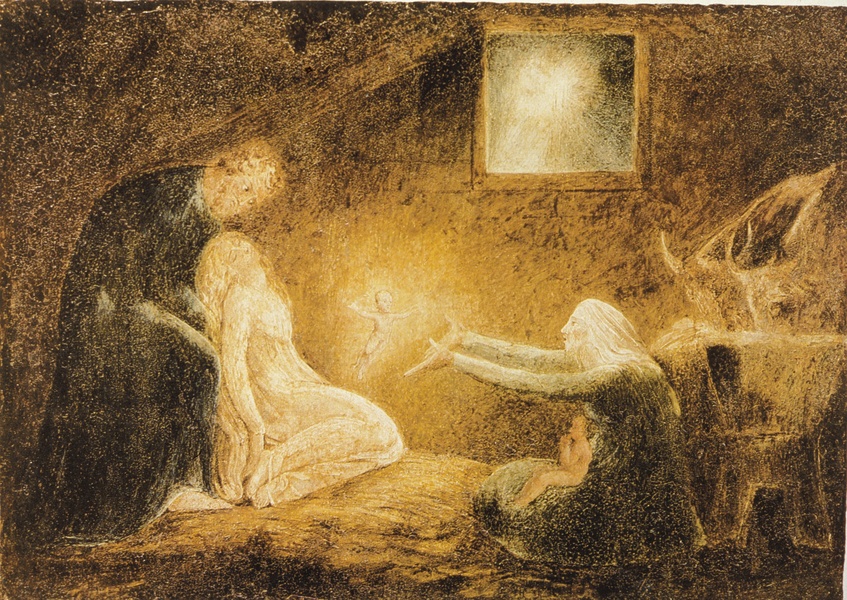
Image from Blake's illustrations for Milton's Ode on the Morning of Christ's Nativity
Painted for Thomas Butts in 1815

Sunday, December 11, 2011

ENGRAVED COPPER

The engraved copper plates for Blake's illuminated books have all been lost except for a small scrap of one plate. However the plates from which he printed the Illustrations to the Book of Job are preserved in the British Museum. John Linnell who initiated the project of having Blake engrave his illustrations to Job was Blake's partner in printing and publishing the 22 plates of the book.

When Blake engraved Job, he was 66 years old and his health was failing, but he produced what many consider his masterpiece. The weakening of his body did not seem to affect the acuity of his eye, the steadiness of his hand or the concentration of his mind; all of which were required for such precise and sustained work.

The plates were given to the British Museum by H. Linnell, a presumed descendant of John Linnell, in 1919.

These two images from the British Museum show the engraved plate and the printed image of picture seven of the series.


The inscriptions on the plate are from this passage in Job.

Job 2
[7] So went Satan forth from the presence of the LORD, and smote Job with sore boils from the sole of his foot unto his crown.
[8] And he took him a potsherd to scrape himself withal; and he sat down among the ashes.
[9] Then said his wife unto him, Dost thou still retain thine integrity? curse God, and die.
[10] But he said unto her, Thou speakest as one of the foolish women speaketh. What? shall we receive good at the hand of God, and shall we not receive evil? In all this did not Job sin with his lips.
[11] Now when Job's three friends heard of all this evil that was come upon him, they came every one from his own place; Eliphaz the Temanite, and Bildad the Shuhite, and Zophar the Naamathite: for they had made an appointment together to come to mourn with him and to comfort him.
[12] And when they lifted up their eyes afar off, and knew him not, they lifted up their voice, and wept; and they rent every one his mantle, and sprinkled dust upon their heads toward heaven.
[13] So they sat down with him upon the ground seven days and seven nights, and none spake a word unto him: for they saw that his grief was very great.

Edinger (Encounter with the Self, A Jungian Commentary on William Blake's Illustrations to the Book of Job) sees the three friends or comforters as repressed aspects of Job's psyche which
surface with the breakdown of the ego. Blake's images in the border suggest the grief of Job at the upper corners, and the failure of the guardian shepherds to keep watch in the lower corners.

This website allows one conveniently to view all the illustrations for Job.

Saturday, December 10, 2011

Plate 11

PLATE 11
To labours mighty, with vast strength, with his mighty chains,
In pulsations of time, & extensions of space, like Urns of Beulah
With great labour upon his anvils, & in his ladles the Ore
He lifted, pouring it into the clay ground prepar'd with art;
Striving with Systems to deliver Individuals from those Systems;
That whenever any Spectre began to devour the Dead,
He might feel the pain as if a man gnawd his own tender nerves.

Then Erin came forth from the Furnaces, & all the Daughters of Beulah
Came from the Furnaces, by Los's mighty power for Jerusalems
Sake: walking up and down among the Spaces of Erin:              
And the Sons and Daughters of Los came forth in perfection
    lovely!
And the Spaces of Erin reach'd from the starry heighth, to the
    starry depth.
Los wept with exceeding joy & all wept with joy together!They feard they never more should see their Father, who
Was built in from Eternity, in the Cliffs of Albion.             

But when the joy of meeting was exhausted in loving embrace;
Again they lament. O what shall we do for lovely Jerusalem?
To protect the Emanations of Albions mighty ones from cruelty?
Sabrina & Ignoge begin to sharpen their beamy spears
Of light and love: their little children stand with arrows of
    gold:   
Ragan is wholly cruel Scofield is bound in iron armour!
He shoots beneath Jerusalems walls to undermine her foundations!
A shadow animated by thy tears O mournful 
Jerusalem (Erdman 154)  Blake Archive Jerusalem Plate 11

Notes: Two pictures and the text express 'exceeding joy'.  The upper picture has a tree in each of the upper corners.  The willow implies woe and the oak implies ambition (according to Erdman on page 290 of The Illuminated Blake).

"Horace in Ode 20 of Book 2 prophesying his poetic immortality. feels himself turning into a snowy swan"; in Blakes design for poems by  William Gray...pictures a stout naked youth excepting from the sky a lyre" mounted on a singing swan. (This is the Title Page of Blake's Designs.)  

In Ovid's Metaphoses Cygnus, son of Neptune, slain in battle became a swan. All these references imply the strong personal dimension of this material in Blake's design. He was changing, like we all do,  swan, eagle, serpent, you name it (them).  

In the second paragraph of the text we learn that Erin was the first to come out of the furnace (the spaces of Erin  occurred in Plates 9, 11, and 48), followed by the Daughters of Beulah.  Coming out of the furnace seems to mean escaping from Ulro, to achieve generation, then regeneration, then Beulah, then Eternity (IMO).  

This is a happy Plate and might have been placed near the end of Jerusalem.

Friday, December 09, 2011

BLAKE & LINNELL

In 1818 the 61 year old William Blake met the 26 year old John Linnell through the son of his friend George Cumberland. The two became friends and collaborators in artistic pursuits. Linnell was important in making the final decade of Blake's life pleasant and productive.

In 1821 Linnell painted a miniature portrait of Blake in watercolor on ivory which is in the Fitzwilliam Museum, Cambridge. The Notes from an Exhibition at the Fitzwilliam in 2001 include a quote from John Linnell’s Autobiographical Notes, (f.57-58)

This image from the portrait extracted from William Blake, his life, character and genius (1893) Story, Alfred Thomas and is available from wikimedia.

Miniature in watercolor on ivory as seen at the Fitzwilliam.


Linnell on Blake

“I soon encountered Blake’s peculiarities and [was] somewhat taken aback by the boldness of some of his assertions. I never saw anything the least like madness, for I never opposed him spitefully, as many did - but being really anxious to fathom, if possible, the amount of truth which might be in his most startling assertions, I generally met with a sufficiently rational explanation in the most really friendly and conciliatory tone. Even when John Varley, to whom I introduced to Blake, and who readily devoured all the marvellous in Blake’s most extravagant utterances - even to Varley, Blake would occasionally explain unasked how he believed that both Varley and I could see the same visions as he saw - making it evident to me, that Blake claimed the possession of some powers, only in a greater degree, that all men possessed, and which they undervalued in themselves but lost through love of sordid pursuits - pride, vanity, and the unrighteous mammon” John Linnell’s Autobiographical notes, f.57-58

This letter from Blake to Linnell's wife shows something of the camaraderie and playfulness which existed among the friends.

Letters, (E 774)
To Mrs Linnell, Collinss Farm North End, Hampstead

Tuesday 11 October 1825
Dear Madam
I have had the Pleasure to see Mr Linnell set off safe in a
very comfortable Coach. & I may say I accompanied him part of the
way on his journey in the Coach for we both got in together &
with another Passenger enterd into Conversation when at length we
found that we were all three proceeding on our Journey. but as I
had not paid & did not wish to pay for or take so long a Ride.
we with some difficulty made the Coachman understand that one of
his Passengers was unwilling to Go. when he obligingly permitted
me to get out to my great joy. hence I am now enabled to tell you
that I hope to see you on Sunday morning as usual which I could
not have done if they had taken me to Gloucester
I am D.r Madam yours Sincerely
WILLIAM BLAKE

Thursday, December 08, 2011

Plate 10

Into the Furnaces & into the valleys of the Anvils of Death
And into the mountains of the Anvils & of the heavy Hammers
Till he should bring the Sons & Daughters of Jerusalem to be
The Sons & Daughters of Los that he might protect them from
Albions dread Spectres; storming, loud, thunderous & mighty      
The Bellows & the Hammers move compell'd by Los's hand.
And this is the manner of the Sons of Albion in their strength
They take the Two Contraries which are calld Qualities, with
    which

Every Substance is clothed, they name them Good & Evil
From them they make an Abstract, which is a Negation             
Not only of the Substance from which it is derived
A murderer of its own Body: but also a murderer
Of every Divine Member: it is the Reasoning Power
An Abstract objecting power, that Negatives every thing
This is the Spectre of Man: the Holy Reasoning Power             
And in its Holiness is closed the Abomination of Desolation

Therefore Los stands in London building Golgonooza
Compelling his Spectre to labours mighty; trembling in fear
The Spectre weeps, but Los unmovd by tears or threats remains

I must Create a System, or be enslav'd by another Mans           
I will not Reason & Compare: my business is to Create

So Los, in fury & strength: in indignation & burning wrath
Shuddring the Spectre howls. his howlings terrify the night
He stamps around the Anvil, beating blows of stern despair
He curses Heaven & Earth, Day & Night & Sun & Moon               
He curses Forest Spring & River, Desart & sandy Waste
Cities & Nations, Families & Peoples, Tongues & Laws
Driven to desperation by Los's terrors & threatning fears
Los cries, Obey my voice & never deviate from my will
And I will be merciful to thee: be thou invisible to all         
To whom I make thee invisible, but chief to my own Children
O Spectre of Urthona: Reason not against their dear approach
Nor them obstruct with thy temptations of doubt & despair
O Shame O strong & mighty Shame I break thy brazen fetters
If thou refuse, thy present torments will seem southern breezes  
To what thou shalt endure if thou obey not my great will.
The Spectre answer'd. Art thou not ashamd of those thy Sins
That thou callest thy Children? lo the Law of God commands
That they be offered upon his Altar: O cruelty & torment
For thine are also mine! I have kept silent hitherto,            
Concerning my chief delight: but thou hast broken silence
Now I will speak my mind! Where is my lovely Enitharmon
O thou my enemy, where is my Great Sin?  She is also thine
I said: Now is my grief at worst: incapable of being
Surpassed: but every moment it accumulates more & more  It continues accumulating to eternity! the joys of God advance
For he is Righteous: he is not a Being of Pity & Compassion
He cannot feel Distress: he feeds on Sacrifice & Offering:
Delighting in cries & tears & clothed in Holiness & solitude
But my griefs advance also, for ever & ever without end          
O that I could cease to be! Despair! I am Despair
Created to be the great example of horror & agony: also my
Prayer is vain I called for compassion: compassion mockd
Mercy & pity threw the grave stone over me & with lead
And iron, bound it over me for ever: Life lives on my
Consuming: & the Almighty hath made me his Contrary
To be all evil, all reversed & for ever dead: knowing
And seeing life, yet living not; how can I then behold
And not tremble; how can I be beheld & not abhorrd

So spoke the Spectre shuddring, & dark tears ran down his shadowy
    face
Which Los wiped off, but comfort none could give! or beam of hope
Yet ceasd he not from labouring at the roarings of his Forge
With iron & brass Building Golgonooza in great contendings
Till his Sons & Daughters came forth from the Furnaces
At the sublime Labours for Los. compelld the invisible Spectre 
 
(Erdman 152-4)(Blake Archive Plate 10)  

Notes: Very little pictorially here; Erdman, in his Illustrated Blake, felt that this may have been inserted late, when Blake had too much to say textually, so it's justs words, and we're forced to consider exclusively the text:

"Into the Furnaces" occurs 6 times in Blake, 4 of them in Jerusalem:

"They revolve into the Furnaces Southward" (Jeru 5) "Luvah was cast into the Furnaces of affliction (Jeru 7)
This one at Jeru 10 "So Albion spoke & threw himself into the Furnaces of affliction" (Jeru 96)
The stem of all these passages can be found in Daniel.

Wednesday, December 07, 2011

GOLDEN COMPASS


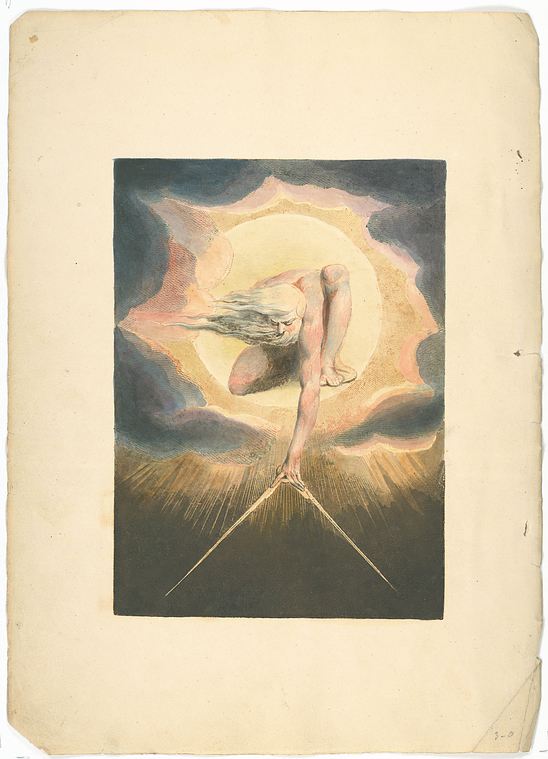
Blake originally used this image as the frontispiece of Europe a Prophecy. However he reused the copper plate to make additional prints which are known by the title 'Ancient of Days'. Two passages which appear to be sources for the image are from the Bible and from Paradise Lost.

Europe a Prophecy
New York Public Library


S. Foster Damon, in A Blake Dictionary gives this description of the process of creation as Blake understood it:
"Creation is not the beginning of existence, for all things are eternal: it is a consequence of the fall toward 'Eternal Death' (separation from Eternity)...
The process of Creation is one of dividing up the original Unity. Beginning with the separation of light from darkness, it proceeds through the six Days of Creation, culminating in the separation of man from God. After that the sexes are divided in the creation of Eve; Good and Evil, in the eating of the fruit; man and happiness in the expulsion from the Garden; soul and body, in the first murder; man from his brother in the confusion of tongues at Babel." (Page 94)

This print in the
Whitworth Gallery, University of Manchester, is thought to be the last print of this image made by Blake

Proverbs 8
[22] The LORD possessed me [Wisdom] in the beginning of his way, before his works of old.
[23] I was set up from everlasting, from the beginning, or ever the earth was.
[24] When there were no depths, I was brought forth; when there were no fountains abounding with water.
[25] Before the mountains were settled, before the hills was I brought forth:
[26] While as yet he had not made the earth, nor the fields, nor the highest part of the dust of the world.
[27] When he prepared the heavens, I was there: when he set a compass upon the face of the depth:

John Milton, Paradise Lost, Book 7
"and in his hand
He took the golden Compasses, prepar'd
In Gods Eternal store, to circumscribe
This Universe, and all created things:
One foot he center'd, and the other turn'd
Round through the vast profunditie obscure,
And said, thus farr extend, thus farr thy bounds,
This be thy just Circumference, O World.
Thus God the Heav'n created, thus the Earth,"
Auguries of Innocence, (E 495)
"Which was Born in a Night to perish in a Night
When the Soul Slept in Beams of Light
God Appears & God is Light
To those poor Souls who dwell in Night
But does a Human Form Display
To those who Dwell in Realms of day"

Tuesday, December 06, 2011

Two Spectres


There are two of Everything: a pro and a con, a good and an evil. What about this creature? We've spent years whipping the Spectre; a long time ago I came to realize that everything unpleasant, distructive, horrid came from the Spectre.

And yet...
The Spectre! is there such a thing as a good and a bad spectre? There you have it. What is good and bad? Spectrous distinctions! In the final resolution of our lives there's no longer a good and a bad.

To put it differently one dies, the other survives.

But how can we tell who's what? With 244 occurrences of the spectre in Blake how can we discriminate?

Studying the book of Milton is perhaps the best way. But The Four Zoas, a sort of preliminary to the larger Prophecies, may give a clue:

"The dread Sleep of Ulro is past. But Satan Og & Sihon  Build Mills of resistless wheels to unwind the soft threads & reveal Naked of their clothing the poor
spectres before the accusing heavens" (4Z; Erdman 376)

What's this?  the poor spectres.  I thought they were all bad; but after "The dread Sleep of Ulro is past" things are very different.

Or look at 372:
"Then Enitharmon ..... wove the Spectres
Bodies of Vegetation Singing lulling Cadences to drive away
Despair from the poor wandering spectres and Los loved them
With a parental love for the Divine hand was upon him"

But in 367-8 we read
"But then the Spectre enterd Los's bosom ....
Obdurate Los felt Pity Enitharmon told the tale
Of Urthona.
Los embracd the Spectre first as a brother Then as another Self; astonishd humanizing & in tears
In Self abasement Giving up his Domineering lust 
Thou never canst embrace sweet Enitharmon terrible Demon.
Till Thou art united with thy Spectre Consummating by pains & labours
That mortal body &amp, by Self annihilation back returning To Life Eternal be assurd I am thy real Self
Tho thus divided from thee & the Slave of Every passion Of thy fierce Soul Unbar the Gates of Memory look upon me
Not as another but as thy real Self I am thy Spectre Thou didst subdue me in old times by thy Immortal Strength When I was a ravning hungring & thirsting cruel lust & murder
Tho horrible & Ghastly to thine Eyes
tho buried beneath The ruins of the Universe.
hear what inspird I speak & be silent
If we unite in one[,] another better world will be Opend within your heart & loins & wondrous brain Threefold as it was in Eternity & this the fourth Universe Will be Renewd by the three & consummated in Mental fires..."

But this is not the critical Moment.
We might best look at MILTON:
Here is Milton at Erdman 139:

"In the Eastern porch of Satans Universe Milton stood & said
Satan! my Spectre! I know my power thee to annihilate And be a greater in thy place, & be thy Tabernacle
A covering for thee to do thy will, till one greater comes
And smites me as I smote thee & becomes my covering. Such are the Laws of thy false Heavns! but Laws of Eternity
Are not such: know thou: I come to Self Annihilation Such are the Laws of Eternity that each shall mutually Annihilate himself for others good, as I for thee".

That, my friends, is the secret of life, the Law of Love. Your Spectre is an idiot; but to truly live you have to 'kiss the idiot'. It's the worldly, materialistic selfish that you and I are, that makes up most of what we are or have become.  When Blake had his life changing experience, he stopped hating and loved the poor feeble suffering spectre within.

The Sceptre is Satan; Satan is a State; our inner sceptre/satan are the things we do and then hate for doing.

The penultimate verse of My Spectre Around me Night and Day is:
"Let us agree to give up Love
And root up the infernal grove;
Then we shall return & see
The worlds of happy Eternity,"


The dumb barking dog is acting furiously hoping for some recognition, any attention; such is our spectre.


Monday, December 05, 2011

LAW OF MOSES

To finish a series of posts on Blake's pictures related to Moses, we look at an image not of Moses but of the result of enforcing the law which Moses received from Jehovah. The son of the Israelitish woman is being stoned to death by the righteous men executing punishment for the commission of blasphemy.

Image from Wikipedia commons
Original in Tate Collection

Leviticus 24
[10] And the son of an Israelitish woman, whose father was an Egyptian, went out among the children of Israel: and this son of the Israelitish woman and a man of Israel strove together in the camp;
[11] And the Israelitish woman's son blasphemed the name of the LORD, and cursed. And they brought him unto Moses: (and his mother's name was Shelomith, the daughter of Dibri, of the tribe of Dan:)

[ 23] And Moses spake to the children of Israel, that they should bring forth him that had cursed out of the camp, and stone him with stones. And the children of Israel did as the LORD commanded Moses.

Feelings of a need for vengeance arise from the need for self protection. In fear and insecurity an individual may desire to eradicate the threat before one is attacked. The desire for personal vengeance is projected onto one's God whose image reflects the levels of psychic development one has attained. One's personal need for vengeance is reinforced by the idea that this behavior is approved and encouraged by God.

The stoning of the blasphemer is an example of the religion of Moses. The forgiveness of the woman taken in adultery who under the law deserved stoning, is the contrary example of the religion of Jesus. The practice of the religion of Jesus leaves no room for vengeance. Anything short of forgiveness, brotherhood and love is the religion of Satan because it involves becoming '
Satans' holy Trinity The Accuser The Judge & The Executioner.'

Jerusalem, Plate 52, (E 201)
"Man must & will have Some Religion; if he has not the Religion
of Jesus, he will have the Religion of Satan, & will erect the
Synagogue of Satan. calling the Prince of this World, God; and
destroying all who do not worship Satan under the Name of God.
Will any one say: Where are those who worship Satan under the
Name of God! Where are they? Listen! Every Religion that Preaches
Vengeance for Sins the Religion of the Enemy & Avenger; and not
the Forgiver of Sin, and their God is Satan, Named by the Divine
Name Your Religion O Deists: Deism, is the Worship of the God
of this World by the means of what you call Natural Religion and
Natural Philosophy, and of Natural Morality or
Self-Righteousness, the Selfish Virtues of the Natural Heart."

Jerusalem
, Plate 25, (E 170)
"Why did you take Vengeance O ye Sons of the mighty Albion?
Planting these Oaken Groves: Erecting these Dragon Temples
Injury the Lord heals but Vengeance cannot be healed:
As the Sons of Albion have done to Luvah: so they have in him
Done to the Divine Lord & Saviour, who suffers with those that suffer:
For not one sparrow can suffer, & the whole Universe not suffer also,
In all its Regions, & its Father & Saviour not pity and weep.
But Vengeance is the destroyer of Grace & Repentance in the bosom

Of the Injurer: in which the Divine Lamb is cruelly slain:"

Ghost of Abel, (E 272)
"Abel-- Are these the Sacrifices of Eternity O Jehovah, a Broken Spirit
And a Contrite Heart. O I cannot Forgive! the Accuser hath
Enterd into Me as into his House & I loathe thy Tabernacles
As thou hast said so is it come to pass: My desire is unto Cain
And He doth rule over Me: therefore My Soul in fumes of Blood
Cries for Vengeance: Sacrifice on Sacrifice Blood on Blood"

Ghost of Abel, (E 272)
"The Elohim of the Heathen Swore Vengeance for Sin! Then Thou stoodst
Forth O Elohim Jehovah! in the midst of the darkness of the Oath! All Clothed
In Thy Covenant of the Forgiveness of Sins: Death O Holy! Is this Brotherhood
The Elohim saw their Oath Eternal Fire; they rolled apart trembling over The
Mercy Seat: each in his station fixt in the Firmament by Peace Brotherhood and Love."

Sunday, December 04, 2011

Plate 9

  1.  
  2.  
  3. Text:
  4. PLATE 9
  5. Condens'd his Emanations into hard opake substances;
  6. And his infant thoughts & desires, into cold, dark, cliffs of
  7. death.
  8. His hammer of gold he siezd; and his anvil of adamant.
  9. He siez'd the bars of condens'd thoughts, to forge them:
  10. Into the sword of war: into the bow and arrow:
  11. Into the thundering cannon and into the murdering gun
  12. I saw the limbs form'd for exercise, contemn'd: & the beauty of
  13. Eternity, look'd upon as deformity & loveliness as a dry tree:
  14. I saw disease forming a Body of Death around the Lamb
  15. Of God, to destroy Jerusalem, & to devour the body of Albion
  16. By war and stratagem to win the labour of the husbandman:
  17. Awkwardness arm'd in steel: folly in a helmet of gold:
  18. Weakness with horns & talons: ignorance with a rav'ning beak!
  19. Every Emanative joy forbidden as a Crime:
  20. And the Emanations buried alive in the earth with pomp of
  21. religion:
  22. Inspiration deny'd; Genius forbidden by laws of punishment:
  23. I saw terrified; I took the sighs & tears, & bitter groans:
  24. I lifted them into my Furnaces; to form the spiritual sword.
  25. That lays open the hidden heart: I drew forth the pang
  26. Of sorrow red hot: I workd it on my resolute anvil:
  27. I heated it in the flames of Hand, & Hyle, & Coban
  28. Nine times; Gwendolen & Cambel & Gwineverra
  29. Are melted into the gold, the silver, the liquid ruby,
  30. The crysolite, the topaz, the jacinth, & every precious stone,
  31. Loud roar my Furnaces and loud my hammer is heard:
  32. I labour day and night, I behold the soft affections
  33. Condense beneath my hammer into forms of cruelty
  34. But still I labour in hope, tho' still my tears flow down.
  35. That he who will not defend Truth, may be compelld to defend
  36. A Lie: that he may be snared and caught and snared and taken
  37. That Enthusiasm and Life may not cease: arise Spectre arise!
  38. Thus they contended among the Furnaces with groans & tears;
  39. Groaning the Spectre heavd the bellows, obeying Los's frowns;
  40. Till the Spaces of Erin were perfected in the furnaces
  41. Of affliction, and Los drew them forth, compelling the harsh
  42. Spectre
***********************************************
Notes:
Much could be said about this picture:
a. Along the right border we see the inevitable tree and beneath it a figure resembling the piper who piped his song about a lamb; the context of course suggests it's the shepherd. (Do shepherds pipe? indeed, yes!)

b. The shepherd is piping to a herd of sheep; they are interpolated between lines 16 and 18.
The middle part shows the (equally) inevitable serpent, his tail coinciding with the roots of the tree. (Remember the story of Arc: we read in Plate 14: "He views the Cherub at the Tree of Life, also the Serpent, Orc the first born coild in the south" Blake associates Orc with Revolution, with the serpent climbing up the Tree of Mystery, the Dragon, and many other pointers to Ulro in its various forms.

c. The bottom picture: Oh my! What little I can get from this picture is owing to Erdman's Illuminated Blake (page 288): he suggested we look at Job 12; in that light it's much like Job's friends at the left, Job's wife prostated, Job, who has everything upside down.  The falling stars hark back to Tyger: "when the stars threw down their spears..." (Erdman 25) Another view might be Albion, gone to sleep, sending his four zoas into Ulro. It all fits together, like all Blake's work. You pick!

Friday, December 02, 2011

Plate 8

Compose


PLATE 8
Rose up against me thundering from the Brook of Albions River

- 150 -

From Ranelagh & Strumbolo, from Cromwells gardens & Chelsea
The place of wounded Soldiers. but when he saw my Mace
Whirld round from heaven to earth, trembling he sat: his cold
Poisons rose up: & his sweet deceits coverd them all over        
With a tender cloud. As thou art now; such was he O Spectre
I know thy deceit & thy revenges, and unless thou desist
I will certainly create an eternal Hell for thee. Listen!
Be attentive! be obedient! Lo the Furnaces are ready to recieve
     thee.
Courtesy of LC Rare Books and

Special Collections

--------------------------------
I will break thee into shivers! &

melt thee in the furnaces of
     death;       
I will cast thee into forms of

abhorrence & torment if thou

Desist not from thine own will,

& obey  not my stern command!

I am closd up from my children:

my Emanation is dividing
And thou my Spectre art divided

against me. But mark
I will compell thee to assist me

in my terrible labours. To beat 
These hypocritic Selfhoods on 

the Anvils of bitter Death
I am inspired: I act not for myself: 

for Albions sake
I now am what I am: a horror and 

an astonishment
Shuddring the heavens to look 

upon me: 

Behold what cruelties
Are practised in Babel & Shinar, 

& have approachd to Zions Hill  

While Los spoke, the terrible Spectre fell shuddring before him
Watching his time with glowing eyes to leap upon his prey
Los opend the Furnaces in fear. the Spectre saw to Babel & Shinar
Across all Europe & Asia. he saw the tortures of the Victims.
He saw now from the ou[t]side what he before saw & felt from 
     within
He saw that Los was the sole, uncontrolld Lord of the Furnaces
Groaning he kneeld before Los's iron-shod feet on London Stone,
Hungring & thirsting for Los's life yet pretending obedience.
While Los pursud his speech in threatnings loud & fierce.

Thou art my Pride & Self-righteousness: I have found thee out:   
Thou art reveald before me in all thy magnitude & power
Thy Uncircumcised pretences to Chastity must be cut in sunder!
Thy holy wrath & deep deceit cannot avail against me
Nor shalt thou ever assume the triple-form of Albions Spectre
For I am one of the living: dare not to mock my inspired fury 
If thou wast cast forth from my life! if I was dead upon the
     mountains
Thou mightest be pitied & lovd: but now I am living; unless
Thou abstain ravening I will create an eternal Hell for thee.
Take thou this Hammer & in patience heave the thundering Bellows
Take thou these Tongs: strike thou alternate with me: labour     
     obedient                                                   
Hand & Hyle & Koban: Skofeld, Kox  &  Kotope, labour mightily
In the Wars of Babel & Shinar, all their Emanations were
Condensd. Hand has absorbd all his Brethren in his might
All the infant Loves & Graces were lost, for the mighty Hand
(Erdman 151)


Thursday, December 01, 2011

chap2a-pics

49
50

48
47
46
40 [45]

39 [44]
38 [43]
Plate 42
Plate 37 [41]

40 [45]

MOSES & GOLDEN CALF

Moses Indignant at the Golden Calf
circa 1799-1800
Tate Collection
Blake Archive
Exodus 32

[1] And when the people saw that Moses delayed to come down out of the mount, the people gathered themselves together unto Aaron, and said unto him, Up, make us gods, which shall go before us; for as for this Moses, the man that brought us up out of the land of Egypt, we wot not what is become of him.

15] And Moses turned, and went down from the mount, and the two tables of the testimony were in his hand: the tables were written on both their sides; on the one side and on the other were they written.
[16] And the tables were the work of God, and the writing was the writing of God, graven upon the tables.

[19] And it came to pass, as soon as he came nigh unto the camp, that he saw the calf, and the dancing: and Moses' anger waxed hot, and he cast the tables out of his hands, and brake them beneath the mount.
[20] And he took the calf which they had made, and burnt it in the fire, and ground it to powder, and strawed it upon the
water, and made the children of Israel drink of it.

[26] Then Moses stood in the gate of the camp, and said, Who is on the LORD's side? let him come unto me. And all the sons of Levi gathered themselves together unto him.
[27] And he said unto them, Thus saith the LORD God of Israel, Put every man his sword by his side, and go in and out from gate to gate throughout the camp, and slay every man his brother, and every man his companion, and every man his neighbour.
[28] And the children of Levi did according to the word of Moses: and there fell of the people that day about three thousand men.

Blake understood that the stage of psychological development of the time of Moses was earlier than is ours. The emphasis on assimilating a code of moral behavior is representative of the stage of developing a superego in the order of psychic evolution. Moses represented the period of cultural development when external and internal controls on the impulsive behaviors of the id had not yet been firmly established. The expressions of wrath by God and those acting for God, which were acceptable at the time of the Exodus, appear abhorrent to the mentality of Jesus.

The vision that men have of God reflects their own consciousness. Blake's fascination with the accounts of events in the Old Testament resulted from the insight into the evolution of awareness of the cosmic relationship of God and man which they provide.

Annotations to Watson, E 617
Watson 'every fact recorded in them may be true'
WB "Impossible for the facts are such as none but the actor
could tell, if it is True Moses & none but he could write it
unless we allow it to be Poetry & that poetry inspired
[P 16] If historical facts can be written by inspiration
Miltons Paradise Lost is as true as Genesis. or Exodus. but the
Evidence is nothing for how can he who writes what he has neither
seen nor heard of. be an Evidence of The Truth of his history
...
I cannot concieve the Divinity of the Bible
to consist either in who they were written by or at what time or
in the historical evidence which may be all false in the eyes of
one man & true in the eyes of another but in the Sentiments &
Examples which whether true or Parabolic are Equally useful as
Examples given to us of the perverseness of some & its consequent
evil & the honesty of others & its consequent good This sense of
the Bible is equally true to all & equally plain to all. none can
doubt the impression which he recieves from a book of Examples.
If he is good he will abhor wickedness in David or Abraham if he
is wicked he will make their wickedness an excuse for his & so he
would do by any other book"

From Fearful Symmetry, Northrup Frye:
Page 346
"Blake's poem [Milton] attempts to recreate the central vision of life, based on the Bible, which made Milton a great Christian poet...Blake is therefore, trying to do for Milton what the prophets and Jesus did for Moses: isolate what is poetic and imaginative, and annihilate what is legal and historical."

From Chapter Six of the Blake Primer, Larry Clayton:
"Although when we read without blinders, we can see their consciousness of God changing before our eyes. Note Abraham bargaining with God for the survival of his nephew in Sodom and Moses simply defying God if he refuses to forgive the worshippers of the golden calf. In the spirit of these two revealing passages Blake in his own recreation of the biblical story dramatically portrayed an evolving God consciousness, which the black book simply cannot permit. It was Blake's willingness to let the old die that made him notably ready for the new birth. The dark night of the soul had intensified until it became the Sickness unto Death."


Blog post titled Natural Religion.

Wednesday, November 30, 2011

Plate 7

but when he [Los' spectre] saw that Los
(PLATE 7)
Was living: panting like a frighted wolf, and howling
He stood over the Immortal, in the solitude and darkness:
Upon the darkning Thames, across the whole Island westward.
A horrible Shadow of Death, among the Furnaces: beneath
The pillar of folding smoke; + by arguments of science &
by terrors:
Terrors in every Nerve, by spasms & extended pains:
While Los answer'd unterrified to the opake blackening Fiend
And thus the Spectre spoke: Wilt thou still go on to destruction?
Till thy life is all taken away by this deceitful Friendship?   
He drinks thee up like water! like wine he pours thee
Into his tuns: thy Daughters are trodden in his vintage
He makes thy Sons the trampling of his bulls, they are plow'd
And harrowd for his profit, lo! thy stolen Emanation
Is his garden of pleasure! all the Spectres of his Sons mock thee
Look how they scorn thy once admired palaces! now in ruins
Because of Albion! because of deceit and friendship! For Lo!
Hand has peopled Babel & Nineveh: Hyle, Ashur & Aram:
Cobans son is Nimrod: his son Cush is adjoind to Aram,
By the Daughter of Babel, in a woven mantle of pestilence & war.
They put forth their spectrous cloudy sails; which drive their
     immense
Constellations over the deadly deeps of indefinite Udan-Adan
Kox is the Father of Shem & Ham & Japheth, he is the Noah
Of the Flood of Udan-Adan. Hutn is the Father of the Seven
From Enoch to Adam; Schofield is Adam who was New-              
Created in Edom. I saw it indignant, & thou art not moved!
This has divided thee in sunder: and wilt thou still forgive?
O! thou seest not what I see! what is done in the Furnaces.
Listen, I will tell thee what is done in moments to thee unknown:
- 149 -
Luvah was cast into the Furnaces of
affliction and sealed,      
And Vala fed in cruel delight, the
Furnaces with fire:
Stern Urizen beheld; urgd by
necessity to keep
The evil day afar, and if perchance
with iron power
He might avert his own despair: in
woe & fear he saw
Vala incircle round the Furnaces
where Luvah was clos'd:        
With joy she heard his howlings,
& forgot he was her Luvah,
With whom she liv'd in bliss in
times of innocence & youth!
Vala comes from the Furnace in a
cloud, but wretched Luvah
Is howling in the Furnaces, in
flames among Albions Spectres,
To prepare the Spectre of Albion to reign over thee O Los,      
Forming the Spectres of Albion according to his rage:
To prepare the Spectre sons of Adam, who is Scofield: the Ninth
Of Albions sons, & the father of all his brethren in the Shadowy
Generation. Cambel & Gwendolen wove webs of war & of
Religion, to involve all Albions sons, and when they had        
Involv'd Eight; their webs roll'd outwards into darkness
And Scofield the Ninth remaind on the outside of the Eight
And Kox, Kotope, & Bowen, One in him, a Fourfold Wonder
Involv'd the Eight--Such are the Generations of the Giant Albion,
To separate a Law of Sin, to punish thee in thy members.        
Los answer'd. Altho' I know not this! I know far worse than this:
I know that Albion hath divided me, and that thou O my Spectre,
Hast just cause to be irritated: but look stedfastly upon me:
Comfort thyself in my strength the time will arrive,
When all Albions injuries shall cease, and when we shall        
Embrace him tenfold bright, rising from his tomb in immortality.
They have divided themselves by Wrath. they must be united by
Pity: let us therefore take example & warning O my Spectre,
O that I could abstain from wrath! O that the Lamb
Of God would look upon me and pity me in my fury.               
In anguish of regeneration! in terrors of self annihilation:
Pity must join together those whom wrath has torn in sunder,
And the Religion of Generation which was meant for the
     destruction
Of Jerusalem, become her covering, till the time of the End.
O holy Generation! [Image] of regeneration!            t
O point of mutual forgiveness between Enemies!
Birthplace of the Lamb of God incomprehensible!
The Dead despise & scorn thee, & cast thee out as accursed:
Seeing the Lamb of God in thy gardens & thy palaces:
Where they desire to place the Abomination of Desolation.       
Hand sits before his furnace: scorn of others & furious pride:
Freeze round him to bars of steel & to iron rocks beneath
His feet: indignant self-righteousness like whirlwinds of the
     north:
               (End of Plate 7)
- 150 -
**************************************************************
Notes:
 "but when he [Los' spectre] saw that Los
(PLATE 7)
Was living: panting like a frighted wolf...
and he sought by other means, To lure Los: by tears,
....While Los answer'd unterrified to the opake blackening Fiend
 And thus the Spectre spoke: Wilt thou still go on to destruction?
..................."
Here the first paragraph of the text has been condensed, leaving out
a wealth of adjectival interpolations.  A speaking knowledge of
elementary English grammar enables the reader to begin to get some
preliminary understanding of Blake's intentions.
So many English writers of every sort are fond of piling
dependent clauses into their sentences to the point where an
ordinary reader is sure to miss what they're basically trying
to say. Short sentences tell us more than long involved complex
ones.  This failing is one of the primary deficiencies in
understanding poetry (or prose for that matter).

Tuesday, November 29, 2011


This is Plate 2 (The Title Page)

GOD, MOSES & BLAKE

Blake has produced a powerful image of God communicating in the form of the tablets of the law, with man in the form of Moses. Moses is bowed in humility below the feet of God occupying a separate enclosed space where he is protected from the full impact of God's presence. The account of Moses receiving the law is repeated several times in the Bible with details which emphasize various aspects. The accounts may focus on the tablets of the law themselves, but just as important is the experience of Moses in encountering God through the images of fire, cloud, symbolic periods of time, thunderings, lightnings and the noise of the trumpet. Blake incorporates many of these symbols in his picture plus many faces of humans or angels surrounding the events.

Exodus 20
[18] And all the people saw the thunderings, and the lightnings, and the noise of the trumpet, and the mountain smoking: and when the people saw it, they removed, and stood afar off.
[19] And they said unto Moses, Speak thou with us, and we will hear: but let not God speak with us, lest we die.
[20] And Moses said unto the people, Fear not: for God is come to prove you, and that his fear may be before your faces, that ye sin not.
[21] And the people stood afar off, and Moses drew near unto the thick darkness where God was.
[22] And the LORD said unto Moses, Thus thou shalt say unto the children of Israel, Ye have seen that I have talked with you from heaven.

Exodus 24
[12] And the LORD said unto Moses, Come up to me into the mount, and be there: and I will give thee tables of stone, and a law, and commandments which I have written; that thou mayest teach them.
[13] And Moses rose up, and his minister Joshua: and Moses went up into the mount of God.
[14] And he said unto the elders, Tarry ye here for us, until we come again unto you: and, behold, Aaron and Hur are with you: if any man have any matters to do, let him come unto them.
[15] And Moses went up into the mount, and a cloud covered the mount.
[16] And the glory of the LORD abode upon mount Sinai, and the cloud covered it six days: and the seventh day he called unto Moses out of the midst of the cloud.
[17] And the sight of the glory of the LORD was like devouring fire on the top of the mount in the eyes of the children of Israel.
[18] And Moses went into the midst of the cloud, and gat him up into the mount: and Moses was in the mount forty days and forty nights.
Exodus 32
[15] And Moses turned, and went down from the mount, and the two tables of the testimony were in his hand: the tables were written on both their sides; on the one side and on the other were they written.
[16] And the tables were the work of God, and the writing was the writing of God, graven upon the tables.


God Writing upon the Tables of the Covenant
National Galleries of Scotland


It is not the person Moses or the written law which Blake held in high regard, it is the fact that God works in and through men. Blake saw that Moses encountered God on the mountaintop and came away with an image of God which would further the psychological and spiritual development of man.


Marriage of Heaven & Hell, Plate 23, (E 43)
"if Jesus Christ is the
greatest man, you ought to love him in the greatest degree; now
hear how he has given his sanction to the law of ten
commandments: did he not mock at the sabbath, and so mock the
sabbaths God? murder those who were murderd because of him? turn
away the law from the woman taken in adultery? steal the labor of
others to support him? bear false witness when he omitted making
a defence before Pilate? covet when he pray'd for his disciples,
and when he bid them shake off the dust of their feet against
such as refused to lodge them? I tell you, no virtue can exist
without breaking these ten commandments: Jesus was all virtue,
and acted from impulse: not from rules."

Vision of the Last Judgment, (E 556)
"beneath the falling figure of Cain is Moses casting his tables of
stone into the Deeps. it ought to be understood that the Persons
Moses & Abraham are not here meant but the States Signified by
those Names the Individuals being representatives or Visions of
those States as they were reveald to Mortal Man in the Series of
Divine Revelations. as they are written in the Bible these
various States I have seen in my Imagination when distant they
appear as One Man but as you approach they appear
Multitudes of Nations."

Jerusalem, Plate 73, (E 228)
"And all the Kings & Nobles of the Earth & all their Glories
These are Created by Rahab & Tirzah in Ulro: but around
These, to preserve them from Eternal Death Los Creates
Adam Noah Abraham Moses Samuel David Ezekiel
Dissipating the rocky forms of Death, by his thunderous Hammer
As the Pilgrim passes while the Country permanent remains
So Men pass on: but States remain permanent for ever"

Sunday, November 27, 2011

HIDING OF MOSES

Exodus
Chapter1
[13] And the Egyptians made the children of Israel to serve with rigour:
[14] And they made their lives bitter with hard bondage, in morter, and in brick, and in all manner of service in the field: all their service, wherein they made them serve, was with rigour.
[15] And the king of Egypt spake to the Hebrew midwives, of which the name of the one was Shiphrah, and the name of the other Puah:
[16] And he said, When ye do the office of a midwife to the Hebrew women, and see them upon the stools; if it be a son, then ye shall kill him: but if it be a daughter, then she shall live.
Chapter 2
[1] And there went a man of the house of Levi, and took to wife a daughter of Levi.
[2] And the woman conceived, and bare a son: and when she saw him that he was a goodly child, she hid him three months.
[3] And when she could not longer hide him, she took for him an ark of bulrushes, and daubed it with slime and with pitch, and put the child therein; and she laid it in the flags by the river's brink.
[4] And his sister stood afar off, to wit what would be done to him.
 

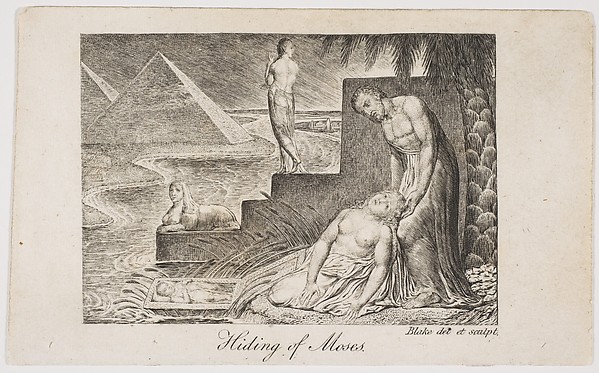
The infant set afloat on the Nile or the Hiding of Moses in the Tate Collection is not available for publication but here is a link to it.

Blake's picture of the infant Moses set afloat on the Nile calls our attention first to the fact that the scene took place in Egypt, the land to which the Israelites voluntarily moved to escape famine in their homeland. When their benefactor was no longer in power they became slave labor for the Egyptians. To control increase in the Israelite population the Pharaoh ordered that the male infants be killed. In order to avoid having her son killed, Moses' mother hid him in a floating basket on the edge of the Nile. In this scene the mother is leaving the infant to an unknown fate. The child is rescued by a daughter of Pharaoh and grows up in an Egyptian household.

The anxiety of the mother and father is evident in the picture. Realistically, they feared that the child would not survive. However the fears of the parents were not realized. The role that Moses played in the history of his people is well known. He secured their release from slavery, led them through the wilderness, presented them with a covenant from God and received the commandments from God which were to define and shape the people of Israel.

Images which Blake created of the infant Jesus and his parents closely resemble Moses and his parents. Blake was emphasizing that the role of Jesus in the New Testament and of Moses in the Old Testament are parallel. Both had their lives threatened by the authorities as infants, both emerged from the land of Egypt to introduce new teachings to their people. Both offered freedom to enslaved people: those enslaved in Egypt, and those enslaved to the 'law of sin and death'.

Notice the similarity in this illustration to Milton's On the Morning of Christ's Nativity.

This tempera painting of the nativity which Blake produced for Thomas Butts is available on wikipedia. The original is in the Philadelphia Museum of Art.


The culmination of the spiritual development which was traced through the events of the Old Testament and hinged on the character of Moses, came to fruition in Jesus. Blake in his characteristic way ties together disparate events: in this case through visual rather than verbal images. 
Metropolitan Museum of Art
Engraving of Hiding of Moses
1825