Tuesday, August 19, 2014

STRUGGLE WITHIN

British Museum
Book of Urizen
Copy D, Plate 22
The 'contending forces' of which Blake wrote were no more distant to him than was the Divine Spirit from whom his visions came. The intensity with which Blake wrote derived from the intensity of his internal experience. His invitation to us is to draw into consciousness the wars which are being waged within the furnaces of our brains because the fires which erupt among contending factions throughout the world are fueled by inner conflicts. 
 
Although Blake's Poetry and Designs, edited by Mary Lynn Johnson and John E. Grant, contains large portions of Blake's poetry and prose, its greatest value may be in the commentary by Blake's contemporaries and by twentieth century critics. Frye's comments, Blake's Treatment of the Archetype, is particularly cogent as can be seen in this excerpt:

 
"In the opening plates of Jerusalem Blake has left a poignant account of such struggle of contending forces within himself, between his creative forces and his egocentric will. He saw the Industrial Revolution and the great political and cultural changes that came with it, and he realized that something profoundly new and disquieting was coming into the world, something with unlimited possibilities for good and for evil, which it would tax all his powers to interpret. And so his natural desire to make his living as an engraver and a figure in society collided with an overwhelming impulse to tell the whole poetic truth about what he saw. The latter force won and dictated its terms accordingly. He was not allowed to worry about his audience. He revised, but was not allowed to decorate or stylize, only to say what had to be said. He was not allowed the double talk of the sophisticated poet, who can address several levels of readers at once by using familiar conceptions ambiguously. Nothing was allowed him but a terrifying concentration of his powers of utterance. 

 
What finally emerged, out of one of the hottest poetic crucibles of modern times, was a poetry almost entirely of archetypes." (Page 522)  

Jerusalem, Plate 3, (E 145)
 "Reader! [lover] of books! [lover] of
     heaven,
    And of that God from whom [all books are given,]
    Who in mysterious Sinais awful cave
    To Man the wond'rous art of writing gave,
    Again he speaks in thunder and in fire!                
    Thunder of Thought, & flames of fierce desire:
    Even from the depths of Hell his voice I hear,
    Within the unfathomd caverns of my Ear.
    Therefore I print; nor vain my types shall be:
    Heaven, Earth & Hell, henceforth shall live in harmony 

            Of the Measure, in which
              the following Poem is written"

Jerusalem, Plate 82, (E 241)
"Los saw & was comforted at his Furnaces uttering thus his voice. 

I know I am Urthona keeper of the Gates of Heaven,
And that I can at will expatiate in the Gardens of bliss;
But pangs of love draw me down to my loins which are
Become a fountain of veiny pipes: O Albion! my brother!
Plate 83
Corruptibility appears upon thy limbs, and never more  
Can I arise and leave thy side, but labour here incessant
Till thy awaking! yet alas I shall forget Eternity!
Against the Patriarchal pomp and cruelty, labouring incessant
I shall become an Infant horror. Enion! Tharmas! friends      
Absorb me not in such dire grief: O Albion, my brother!
Jerusalem hungers in the desart! affection to her children!
The scorn'd and contemnd youthful girl, where shall she fly?
Sussex shuts up her Villages. Hants, Devon & Wilts
Surrounded with masses of stone in orderd forms, determine then 
A form for Vala and a form for Luvah, here on the Thames
Where the Victim nightly howls beneath the Druids knife:
A Form of Vegetation, nail them down on the stems of Mystery:
O when shall the Saxon return with the English his redeemed brother!
O when shall the Lamb of God descend among the Reprobate!" 

Four Zoas, Night II, PAGE 28,(E 318)
"These were the words of Luvah patient in afflictions
Reasoning from the loins in the unreal forms of Ulros night

And when Luvah age after age was quite melted with woe
The fires of Vala faded like a shadow cold & pale
An evanescent shadow. last she fell a heap of Ashes              
Beneath the furnaces a woful heap in living death
Then were the furnaces unscald with spades & pickaxes
Roaring let out the fluid, the molten metal ran in channels
Cut by the plow of ages held in Urizens strong hand
In many a valley, for the Bulls of Luvah dragd the Plow          

With trembling horror pale aghast the Children of Man
Stood on the infinite Earth & saw these visions in the air
In waters & in Earth beneath they cried to one another
What are we terrors to one another. Come O brethren wherefore
Was this wide Earth spread all abroad. not for wild beasts to roam           
But many stood silent & busied in their families
And many said We see no Visions in the darksom air
Measure the course of that sulphur orb that lights the darksom day
Set stations on this breeding Earth & let us buy & sell
Others arose & schools Erected forming Instruments               
To measure out the course of heaven. Stern Urizen beheld
In woe his brethren & his Sons in darkning woe lamenting
Upon the winds in clouds involvd Uttering his voice in thunders
Commanding all the work with care & power & severity

Then siezd the Lions of Urizen their work, & heated in the forge 
Roar the bright masses, thund'ring beat the hammers, many a pyramid
Is form'd & thrown down thund'ring into the deeps of Non Entity
Heated red hot they hizzing rend their way down many a league
Till resting. each his [center] finds; suspended there they stand 
Casting their sparkies dire abroad into the dismal deep          
For measurd out in orderd spaces the Sons of Urizen  
With compasses divide the deep; they the strong scales erect
Page 29 
That Luvah rent from the faint Heart of the Fallen Man
And weigh the massy Cubes, then fix them in their awful stations

And all the time in Caverns shut, the golden Looms erected
First spun, then wove the Atmospheres, there the Spider & Worm
Plied the wingd shuttle piping shrill thro' all the list'ning threads  
Beneath the Caverns roll the weights of lead & spindles of iron
The enormous warp & woof rage direful in the affrighted deep

While far into the vast unknown, the strong wing'd Eagles bend
Their venturous flight, in Human forms distinct; thro darkness deep
They bear the woven draperies; on golden hooks they hang abroad  
The universal curtains & spread out from Sun to Sun
The vehicles of light, they separate the furious particles
Into mild currents as the water mingles with the wine."

Monday, August 18, 2014

Furnace 5

(These quotations come from The Four Zoas)

PAGE 113 (FIRST PORTION)
We behold with wonder Enitharmons Looms & Los's Forges        
And the Spindles of Tirzah & Rahab and the Mills of Satan &
     Beelzeboul                                                
In Golgonooza Los's anvils stand & his Furnaces rage          
Ten thousand demons labour at the forges Creating Continually
The times & spaces of Mortal Life the Sun the Moon the Stars
In periods of Pulsative furor beating into wedges & bars      
Then drawing into wires the terrific Passions & Affections
Of Spectrous dead. Thence to the Looms of Cathedron conveyd
The Daughters of Enitharmon weave the ovarium & the integument
In soft silk drawn from their own bowels in lascivious delight
With songs of sweetest cadence to the turning spindle & reel
Lulling the weeping spectres of the dead. Clothing their limbs
With gifts & gold of Eden. Astonishd stupefied with delight
The terrors put on their sweet clothing on the banks of Arnon  
Whence they plunge into the river of space for a period till
The dread Sleep of Ulro is past. But Satan Og & Sihon          
Build Mills of resistless wheels to unwind the soft threads &
     reveal
Naked of their clothing the poor spectres before the accusing
     heavens
While Rahab & Tirzah far different mantles prepare webs of
     torture
(376 )

-------------------------------------------------------\
[113] (SECOND PORTION)
But when Rahab had cut off the Mantle of Luvah from            
The Lamb of God it rolld apart, revealing to all in heaven
And all on Earth the Temple & the Synagogue of Satan & Mystery

Even Rahab in all her turpitude Rahab divided herself
She stood before Los in her Pride among the Furnaces          
Dividing & uniting in Delusive feminine pomp questioning him

He answerd her with tenderness & love not uninspird            
Los sat upon his anvil stock they sat beside the forge
Los wipd the sweat from his red brow & thus began
To the delusive female forms shining among his furnaces

I am that shadowy Prophet who six thousand years ago
Fell from my station in the Eternal bosom. I divided
To multitude & my multitudes are children of Care & Labour
O Rahab I behold thee I was once like thee a Son
Of Pride and I also have piercd the Lamb of God in pride & wrath
Hear me repeat my Generations that thou mayst also repent
(379)
--------------------------------------------------------
The Sun has left his blackness & has found a fresher morning    
And the mild moon rejoices in the clear & cloudless night      
And Man walks forth from midst of the fires the evil is all
     consumd
His eyes behold the Angelic spheres arising night & day
The stars consumd like a lamp blown out & in their stead behold
The Expanding Eyes of Man behold the depths of wondrous worlds
One Earth one sea beneath nor Erring Globes wander but Stars
Of fire rise up nightly from the Ocean & one Sun
Each morning like a New born Man issues with songs & Joy
Calling the Plowman to his Labour & the Shepherd to his rest
He walks upon the Eternal Mountains raising his heavenly voice  
Conversing with the Animal forms of wisdom night & day
That risen from the Sea of fire renewd walk oer the Earth

For Tharmas brought his flocks upon the hills & in the Vales
Around the Eternal Mans bright tent the little Children play
Among the wooly flocks The hammer of Urthona sounds            
In the deep caves beneath his limbs renewd his Lions roar
Around the Furnaces & in Evening sport upon the plains
They raise their faces from the Earth conversing with the Man

How is it we have walkd thro fires & yet are not consumd
How is it that all things are changd even as in ancient times  

PAGE 139
The Sun arises from his dewy bed & the fresh airs
Play in his smiling beams giving the seeds of life to grow
And the fresh Earth beams forth ten thousand thousand springs of
     life
Urthona is arisen in his strength no longer now
Divided from Enitharmon no longer the Spectre Los              
Where is the Spectre of Prophecy where the delusive Phantom
Departed & Urthona rises from the ruinous walls
In all his ancient strength to form the golden armour of science
For intellectual War The war of swords departed now
The dark Religions are departed & sweet Science reigns          

                  End of The Dream  
(406-7)
(End of The Four Zoas)                        

Sunday, August 17, 2014

GOLDEN TREASURY

In 1861 Francis Turner Palgrave compiled an anthology of poetry which proved to have wide appeal. In THE GOLDEN TREASURY Of the best Songs and Lyrical Pieces In the English Language, he included four of Blake's minor poems: one from Poetical Sketches and two from Songs of Innocence and one from Blake's notebook. In a later edition of his book, Palgrave made this statement about To the Muses:
"This beautiful lyric, printed in 1783, seems to anticipate in its imaginative music that return to our great early age of song, which in Blake's own lifetime was to prove,--how gloriously! that the English Muses had resumed their 'ancient melody':--Keats, Shelley, Byron,--he 
overlived them all." 

In 1899 Gwenllian F. Palgrave published Francis Turner Palgrave: His Journals and Memories of His Life in which we read:

"The strange but beautiful designs of the then little-known William Blake had early begun to fascinate him. Years afterwards he and the late Lord Houghton together attended Mr. Butts' sale of Blake's works, and each encouraged the other to become the possessor of many of his original drawings and engravings. It has often been said to us: 'Your father was one of the first who "preached" Blake.' Even somewhat higher still did he rank him as poet, perceiving the same qualities in his verse as in his art: the 'simple yet often majestic imagination, spiritual insight, profound feeling for grace and colour. ... His verse is narrow in its range, and at times eccentric to the neighbourhood of madness. But whatever he writes, his eye is always straight upon his subject.' My father would compare his soul with that of Fra Angelico, each living in the all-pervading presence of the spiritual life. 'To men of this class,' he has said, 'the Invisible world is the Visible, the Supernatural was the Real.'' The following letter was written in February 1845:
To Lady Palgrave
Balliol.
My dearest Mother,—. . . Yesterday evening Mr. Jowett asked me to have tea with him, after he had looked at some Greek of mine ; he was very kind and pleasant, and I hope that I shall see him oftener, now that Mr. Lake is away. He showed me a book which I dare say papa knows— W. Blake's ' Illustrations of the Book of Job.1 They are a number of little etchings, drawn and etched by Blake; and certainly they show immense power and originality. Though often quite out of drawing and grotesque, they are most interesting—far more than Flaxman, for instance. Schiavonetti's etchings in the 'Grave,' though far more correct, give but a faint idea of the force and vigour of these. If you can possibly borrow them, I am sure you will be exceedingly interested by them—I have seen nothing so extraordinary for a long time. Some, as of Job in misery, and of the Morning Stars singing for joy, are beautiful; some, as of a man tormented by dreams and the Vision of the Night, are most awful; and what adds much to the pleasure of seeing them, is that every stroke seems to do its utmost in expression, and to show that one mind both planned and executed them. Brothers, I am sure, would be much pleased with them ; at least, if they agree with their affectionate brother and your v. a. and v. d. son,
F. T. Palgrave."

Francis Palgrave was a collector as well and acquired some items created by William Blake. In the British Museum is Copy D of The Book of Urizen which was sold to the museum by Palgrave in 1859. An item now in the collection of the Tate Gallery was a gift from Palgrave to the National Gallery in 1884. Palgrave purchased The Body of Christ Borne to the Tomb from Thomas Butts, Jr. in 1852 and gave it to the National Gallery thirty-two years later. 
Wikipedia Commons
Body of Christ Borne to the Tomb
Blake poems included in THE GOLDEN TREASURY:  
Poetical Sketches, (E 417)
          "TO THE MUSES.
Whether on Ida's shady brow,
  Or in the chambers of the East,
The chambers of the sun, that now
  From antient melody have ceas'd;

Whether in Heav'n ye wander fair,                    
  Or the green corners of the earth,
Or the blue regions of the air,
  Where the melodious winds have birth;

Whether on chrystal rocks ye rove,
  Beneath the bosom of the sea                     
Wand'ring in many a coral grove,
  Fair Nine, forsaking Poetry!

How have you left the antient love
  That bards of old enjoy'd in you!
The languid strings do scarcely move!                 
  The sound is forc'd, the notes are few!" 
Songs and Ballads, [from Blake's Notebook], (E 467)
"Never pain to tell thy Love  
Love that never told can be
For the gentle wind does move
Silently invisibly

I told my love I told my love              
I told her all my heart
Trembling cold in ghastly fears
Ah she doth depart

Soon as she was gone from me
A traveller came by                            
Silently invisibly
O was no deny" 
Songs of Innocence, SONG 25 (E 16)
"Infant Joy
I have no name
I am but two days old.--
What shall I call thee?
I happy am
Joy is my name,--  
Sweet joy befall thee!

Pretty joy!
Sweet joy but two days old,
Sweet joy I call thee;
Thou dost smile. 
I sing the while
Sweet joy befall thee."
 Songs of Innocence, SONG 16, (E 11) 
"A CRADLE SONG
Sweet dreams form a shade,
O'er my lovely infants head.
Sweet dreams of pleasant streams,
By happy silent moony beams.

Sweet sleep with soft down,  
Weave thy brows an infant crown.
Sweet sleep Angel mild,
Hover o'er my happy child.

Sweet smiles in the night,
Hover over my delight.
Sweet smiles Mothers smiles
All the livelong night beguiles.

Sweet moans, dovelike sighs,
Chase not slumber from thy eyes.
Sweet moans, sweeter smiles,  
All the dovelike moans beguiles.

Sleep sleep happy child.
All creation slept and smil'd.
Sleep sleep, happy sleep,
While o'er thee thy mother weep.  

Sweet babe in thy face,
Holy image I can trace.
Sweet babe once like thee,
Thy maker lay and wept for me"

Saturday, August 16, 2014

Furnace 4


From The Four Zoas, 5th Night:

................ Enitharmon stretchd on the dreary Earth          
Felt her immortal limbs freeze stiffning pale inflexible
His feet shrink withring from the deep shrinking & withering    
And Enitharmon shrunk up all their fibres withring beneath
As plants witherd by winter leaves & stems & roots decaying
Melt into thin air while the seed drivn by the furious wind      
Rests on the distant Mountains top. So Los & Enitharmon
Shrunk into fixed space stood trembling on a Rocky cliff
Yet mighty bulk & majesty & beauty remaind but unexpansive
As far as highest Zenith from the lowest Nadir. so far shrunk   
Los from the furnaces a Space immense & left the cold           
Prince of Light bound in chains of intellect among the furnaces
But all the furnaces were out & the bellows had ceast to blow

He stood trembling & Enitharmon clung around his knees
Their senses unexpansive in one stedfast bulk remain
The night blew cold & Enitharmon shriekd on the dismal wind
(Erdman 339)      

Songs of Experience
SONGS 55 
A DIVINE IMAGE

[An early Song of Experience included in one late copy]        t

Cruelty has a Human Heart
And Jealousy a Human Face
Terror, the Human Form Divine
And Secrecy, the Human Dress

The Human Dress, is forged Iron
The Human Form, a fiery Forge.
The Human Face, a Furnace seal'd
The Human Heart, its hungry Gorge.


PLATE 10 of The Book of Urizen:
        Chap: IV.[b]

1. Ages on ages roll'd over him!
In stony sleep ages roll'd over him!
Like a dark waste stretching chang'able
By earthquakes riv'n, belching sullen fires
On ages roll'd ages in ghastly                 

Sick torment; around him in whirlwinds
Of darkness the eternal Prophet howl'd
Beating still on his rivets of iron
Pouring sodor of iron; dividing
The horrible night into watches.                                 

2. And Urizen (so his eternal name)
His prolific delight obscurd more & more
In dark secresy hiding in surgeing
Sulphureous fluid his phantasies.
The Eternal Prophet heavd the dark bellows,                      
And turn'd restless the tongs; and the hammer
Incessant beat; forging chains new & new
Numb'ring with links. hours, days & years

3. The eternal mind bounded began to roll
Eddies of wrath ceaseless round & round,                     
And the sulphureous foam surgeing thick
Settled, a lake, bright, & shining clear:
White as the snow on the mountains cold.

4. Forgetfulness, dumbness, necessity!
In chains of the mind locked up,                                 
Like fetters of ice shrinking together
Disorganiz'd, rent from Eternity,
Los beat on his fetters of iron;
And heated his furnaces & pour'd
Iron sodor and sodor of brass  
(Erdman 74)
                                
 --------------------------------------------------------
From Milton Plate 5:

While the Females prepare the Victims. the Males at Furnaces 
And Anvils dance the dance of tears & pain. loud lightnings
Lash on their limbs as they turn the whirlwinds loose upon
The Furnaces, lamenting around the Anvils & this their Song[:]

Ah weak & wide astray! Ah shut in narrow doleful form
Creeping in reptile flesh upon the bosom of the ground      
The Eye of Man a little narrow orb closd up & dark
Scarcely beholding the great light conversing with the Void
The Ear, a little shell in small volutions shutting out
All melodies & comprehending only Discord and Harmony
The Tongue a little moisture fills, a little food it cloys  
A little sound it utters & its cries are faintly heard
Then brings forth Moral Virtue the cruel Virgin Babylon

Can such an Eye judge of the stars? & looking thro its tubes
Measure the sunny rays that point their spears on Udanadan
Can such an Ear filld with the vapours of the yawning pit.  
Judge of the pure melodious harp struck by a hand divine?
Can such closed Nostrils feel a joy? or tell of autumn fruits
When grapes & figs burst their covering to the joyful air
Can such a Tongue boast of the living waters? or take in
Ought but the Vegetable Ratio & loathe the faint delight     
Can such gross Lips percieve? alas! folded within themselves
They touch not ought but pallid turn & tremble at every wind
(Erdman 98 -99)
--------------------------------------------------------------------

Friday, August 15, 2014

SPENSER'S CHARACTERS

william-blake.org
CHARACTERS FROM SPENSER'S "FAERIE QUEENE"


Poetical Sketches is a book of Blake's immature poems published by his friends when he was 26 years old. Included is An Imitation of Spenser demonstrating that he was a student of Spenser from his youth.
Poetical Sketches, Published 1783, (E 420)
  "AN IMITATION OF SPEN[S]ER.

Golden Apollo, that thro' heaven wide
  Scatter'st the rays of light, and truth's beams!
In lucent words my darkling verses dight,
  And wash my earthy mind in thy clear streams,
  That wisdom may descend in fairy dreams:         
All while the jocund hours in thy train
Scatter their fancies at thy poet's feet;
  And when thou yields to night thy wide domain,        
Let rays of truth enlight his sleeping brain.

For brutish Pan in vain might thee assay          
  With tinkling sounds to dash thy nervous verse,
Sound without sense; yet in his rude affray,
  (For ignorance is Folly's leesing nurse,              
  And love of Folly needs none other curse;)            
Midas the praise hath gain'd of lengthen'd eares,       
  For which himself might deem him neer the worse
  To sit in council with his modern peers,
And judge of tinkling rhimes, and elegances terse.

And thou, Mercurius, that with winged brow
  Dost mount aloft into the yielding sky,      
And thro' Heav'n's halls thy airy flight dost throw,
Entering with holy feet to where on high
Jove weighs the counsel of futurity;
  Then, laden with eternal fate, dost go
Down, like a falling star, from autumn sky,        
And o'er the surface of the silent deep dost fly.

  If thou arrivest at the sandy shore,
Where nought but envious hissing adders dwell,
  Thy golden rod, thrown on the dusty floor,
Can charm to harmony with potent spell;       
Such is sweet Eloquence, that does dispel
  Envy and Hate, that thirst for human gore:
And cause in sweet society to dwell
Vile savage minds that lurk in lonely cell.

  O Mercury, assist my lab'ring sense,           
That round the circle of the world wou'd fly!
  As the wing'd eagle scorns the tow'ry fence
Of Alpine bills round his high aery,
And searches thro' the corners of the sky,
  Sports in the clouds to hear the thunder's sound,   
And see the winged lightnings as they fly,       
  Then, bosom'd in an amber cloud, around
Plumes his wide wings, and seeks Sol's palace high.

  And thou, O warrior maid, invincible,          
Arm'd with the terrors of Almighty Jove!           
  Pallas, Minerva, maiden terrible,
Lov'st thou to walk the peaceful solemn grove,
  In solemn gloom of branches interwove?
Or bear'st thy Egis o'er the burning field,
  Where, like the sea, the waves of battle move?   
Or have thy soft piteous eyes beheld
  The weary wanderer thro' the desert rove?
Or does th' afflicted man thy heav'nly bosom move?"

Late in life Blake painted a large picture titled CHARACTERS FROM SPENSER'S "FAERIE QUEENE". The date of this picture is estimated to be 1825. Since it was sold by Blake's widow Catherine to the 3rd Earl of Egremont two years after Blake's death, it was not commissioned by a specific patron. The picture now belongs to the National Trust and is located at Petworth House in Sussex.

Scholars believe that Blake was commenting on Spenser's work and philosophy as well as illustrating specific events in Spenser's poetry. Damon provides details in A Blake Dictionary. Much more information is available in Blake & Spenser by Robert F. Gleckner.

Catherine was concerned for the care of the picture and gave these instructions: ‘Mr Blake had a great dislike to his pictures falling into the hands of the picture cleaners.’

To see more detail in the picture, select one of the four images and zoom to a specific area of the picture in the National Trust.

Thursday, August 14, 2014

Furnaces 3A

Blake used 'furnace' for many things:

From AMERICA a PROPHECY Plate 4; Erdman 52-53) :  
(Here 'furnace' suggests the outbreak of the Revolutionary 
War initiated by the American leaders, such as 'Boston's Angel.)

"Here on their magic seats the thirteen Angels sat perturb'd
For clouds from the Atlantic hover o'er the solemn roof.

PLATE 11
Fiery the Angels rose, & as they rose deep thunder roll'd
Around their shores: indignant burning with the fires of Orc
And Bostons Angel cried aloud as they flew thro' the dark night.

He cried: Why trembles honesty and like a murderer,
Why seeks he refuge from the frowns of his immortal station!  
Must the generous tremble & leave his joy, to the idle: to the
     pestilence!
That mock him? who commanded this? what God? what Angel!
To keep the gen'rous from experience till the ungenerous
Are unrestraind performers of the energies of nature;
Till pity is become a trade, and generosity a science,        
That men get rich by, & the sandy desart is giv'n to the strong
What God is he, writes laws of peace, & clothes him in a tempest
What pitying Angel lusts for tears, and fans himself with sighs
What crawling villain preaches abstinence & wraps himself
In fat of lambs? no more I follow, no more obedience pay.      

PLATE 12
So cried he, rending off his robe & throwing down his scepter.
In sight of Albions Guardian, and all the thirteen Angels
Rent off their robes to the hungry wind, & threw their golden
     scepters
Down on the land of America. indignant they descended
Headlong from out their heav'nly heights, descending swift as
     fires      
Over the land; naked & flaming are their lineaments seen
In the deep gloom, by Washington & Paine & Warren they stood
And the flame folded roaring fierce within the pitchy night
Before the Demon red, who burnt towards America,
In black smoke thunders and loud winds rejoicing in its terror

Breaking in smoky wreaths from the wild deep, & gath'ring thick
In flames as of a furnace on the land from North to South"

From The Four Zoas (Vala; Night the Fifth;
"And first he found the Limit of Opacity & namd it Satan
In Albions bosom for in every human bosom these limits stand  
And next he found the Limit of Contraction & namd it Adam
While yet those beings were not born nor knew of good or Evil

Then wondrously the Starry Wheels felt the divine hand. Limit
Was put to Eternal Death Los felt the Limit & saw
The Finger of God touch the Seventh furnace in terror          
And Los beheld the hand of God over his furnaces
Beneath the Deeps in dismal Darkness beneath immensity
 
PAGE 55 (SECOND PORTION)
In terrors Los shrunk from his task. his great hammer        
Fell from his hand his fires hid their strong limbs in smoke
For with noises ruinous   hurtlings & clashings & groans      
The immortal endur'd. tho bound in a deadly sleep
Pale terror siezd the Eyes of Los as he beat round            
The hurtling Demon. terrifid at the shapes
Enslavd humanity put on he became what he beheld
He became what he was doing he was himself transformd"

Tuesday, August 12, 2014

COUCH OF DEATH

University of Toronto Library
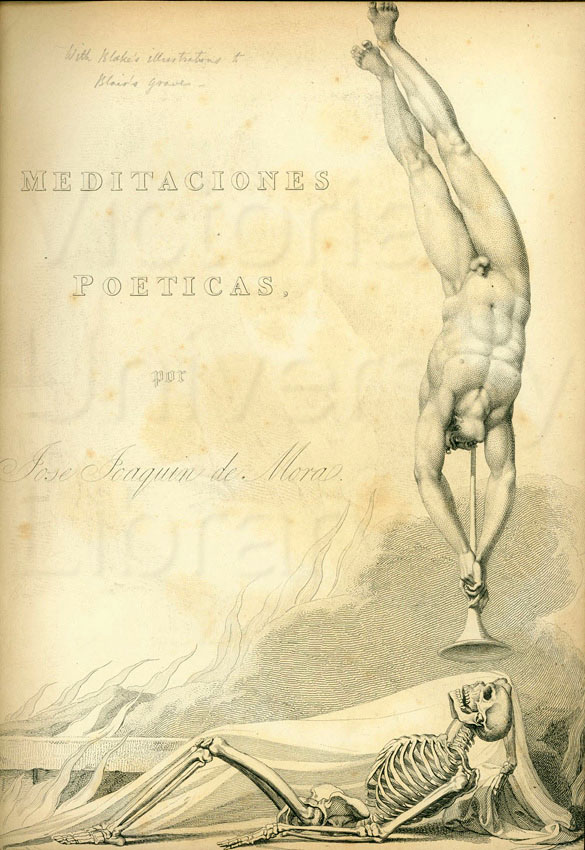
The publishing history of Blake's illustrations to Robert Blair's The Grave does not end with Cromek's publication on his edition with 12 of Blake's illustrations engraved by Schiavonetti. Cromek promoted the book aggressively and marketed 589 copies to subscribers. Cromek, however, did not long reap the fruits of his labors because he died of tuberculosis in 1812. Cromek had released publication rights to another publisher, Ackerman, who was developing a market in South America. Using Blake's designs, "Meditaciones Poeticas" written by Jose Joaquin de Mora was published by Ackerman in 1826 and printed in Mexico.

Learn more on this Spanish language website.


Gates of Paradise, (E 269)
"But when once I did descry 
The Immortal Man that cannot Die
Thro evening shades I haste away 
To close the Labours of my Day"

Poetical Sketches, (E 441)
                                   THE
                         COUCH OF DEATH.
 "The traveller that hath taken shelter under an oak, eyes
the distant country with joy!  Such smiles were seen upon the
face of the youth! a visionary hand wiped away his tears, and a
ray of light beamed around his head!  All was still.  The moon
hung not out her lamp, and the stars faintly glimmered in the
summer sky; the breath of night slept among the leaves of the
forest; the bosom of the lofty hill drank in the silent dew,
while on his majestic brow the voice of Angels is heard, and
stringed sounds ride upon the wings of night.  The sorrowful pair
lift up their heads, hovering Angels are around them, voices of
comfort are heard over the Couch of Death, and the youth breathes
out his soul with joy into eternity."

Monday, August 11, 2014

Furnace II

There are 168 occurrencies of 'furnace' in Blake's poetry and over 100 of them are in Jerusalem. We hear it first in Songs of Experience; look at 'The Tyger':
                                                                                                                            
In the Four Zoas:
Luvah was cast into the Furnaces of affliction & sealed (Night 2;; Erdman 376)                                            
In Golgonooza Los's anvils stand & his Furnaces rage 
(Night 8 Erdman 376)

In Jerusalem plate 5:
The Male is a Furnace of beryll; the Female is a golden Loom The Starry Wheels revolv'd heavily over the Furnaces; 
(Erdman 148)   

In my Furnaces into One Nation the English: & taking refuge
with solemn cadences she drew
Fibres of life out from the Bones into her golden Loom
Hand had his Furnace on Highgates heights & it reachd
To Brockley Hills across the Thames: he with double Boadicea
In cruel pride cut Reuben apart from the Hills of Surrey
Comingling with Luvah & with the Sepulcher of Luvah
For the Male is a Furnace of beryll: the Female is a golden Loom

Los cries: No Individual ought to appropriate to Himself
Or to his Emanation, any of the Universal Characteristics
Of David or of Eve, of the Woman, or of the Lord.
Of Reuben or of Benjamin, of Joseph or Judah or Levi
Those who dare appropriate to themselves Universal Attributes
Are the Blasphemous Selfhoods & must be broken asunder

Loud scream the Daughters of Albion beneath the Tongs & Hammer
Dolorous are their lamentations in the burning Forge
They drink Reuben & Benjamin as the iron drinks the fire
They are red hot with cruelty: raving along the Banks of Thames
And on Tyburns Brook among the howling Victims in loveliness
While Hand & Hyle condense the Little-ones & erect them into
A mighty Temple even to the stars: but they Vegetate
Beneath Los's Hammer, that Life may not be blotted out.
(Jerusalem Plate 90; Erdman 249-50)

                                                                Jerusalem, 92.2; E252
161. This sinful Nation Created in our Furnaces & Looms is Albion

                                                                Jerusalem, 92.6; E252:
162. Beneath the Furnaces & the starry Wheels & the Immortal Tomb
                                                                Jerusalem, 94.2; E254:
163. Revolve: & over them the Furnaces of Los & the Immortal Tomb around
                                                                Jerusalem, 94.12; E254:
164. Beneath the Furnaces & starry Wheels and in the Immortal Tomb
                                                                Jerusalem, 94.19; E254:

165. So Albion spoke & threw himself into the Furnaces of affliction
                                                                Jerusalem, 96.35; E256

166. All was a Vision, all a Dream: the Furnaces became
                                                                Jerusalem, 96.36; E256
(More to come.)


Sunday, August 10, 2014

GOLDEN BUILDERS

Republished from November 23, 2013 

Kathleen Raine's studies of William Blake and his sources in the literature of the perennial philosophy were key to unlocking many of the symbols which abound in Blake's work. But her commitment to the thought of Blake did not end with presenting links in Blake to the traditional literature which was excluded by orthodox interpreters, she became with Blake a builder of Golgonnoza. She realised that his message of psychological/spiritual development should not be buried or hidden but was meant to be put to use in transforming individual psyches and the outer world which reflects inner realities.

On page 4 of Golgonooza City of Imagination Raine calls Blake 'a patriot of the inner worlds' who wages the Mental Fight unceasing:  
"Uncomprehended though he was, Blake was not, like Yeats, an esotericist. He addressed his prophetic message 'to the Public' and whether he would be understood he did not stop to question - his vision was, to him, clear beyond all doubt. He was a patriot of the inner worlds, of the England of the Imagination whose 'golden builders' he saw at work in the creation of Golgonooza the city within the brain (golgos, skull), 'the spiritual fourfold London Eternal'. He saw his nation 'sunk in deadly sleep', victim of 'deadly dreams' of a materialism whose effects in all aspects of national life were destructive and sorrowful, wars, exploitation of human labour, sexual hypocrisy, a 'cruel' morality of condemnation and punitive laws, the denial and oppression of the soul's winged life."

Yale center for British Art
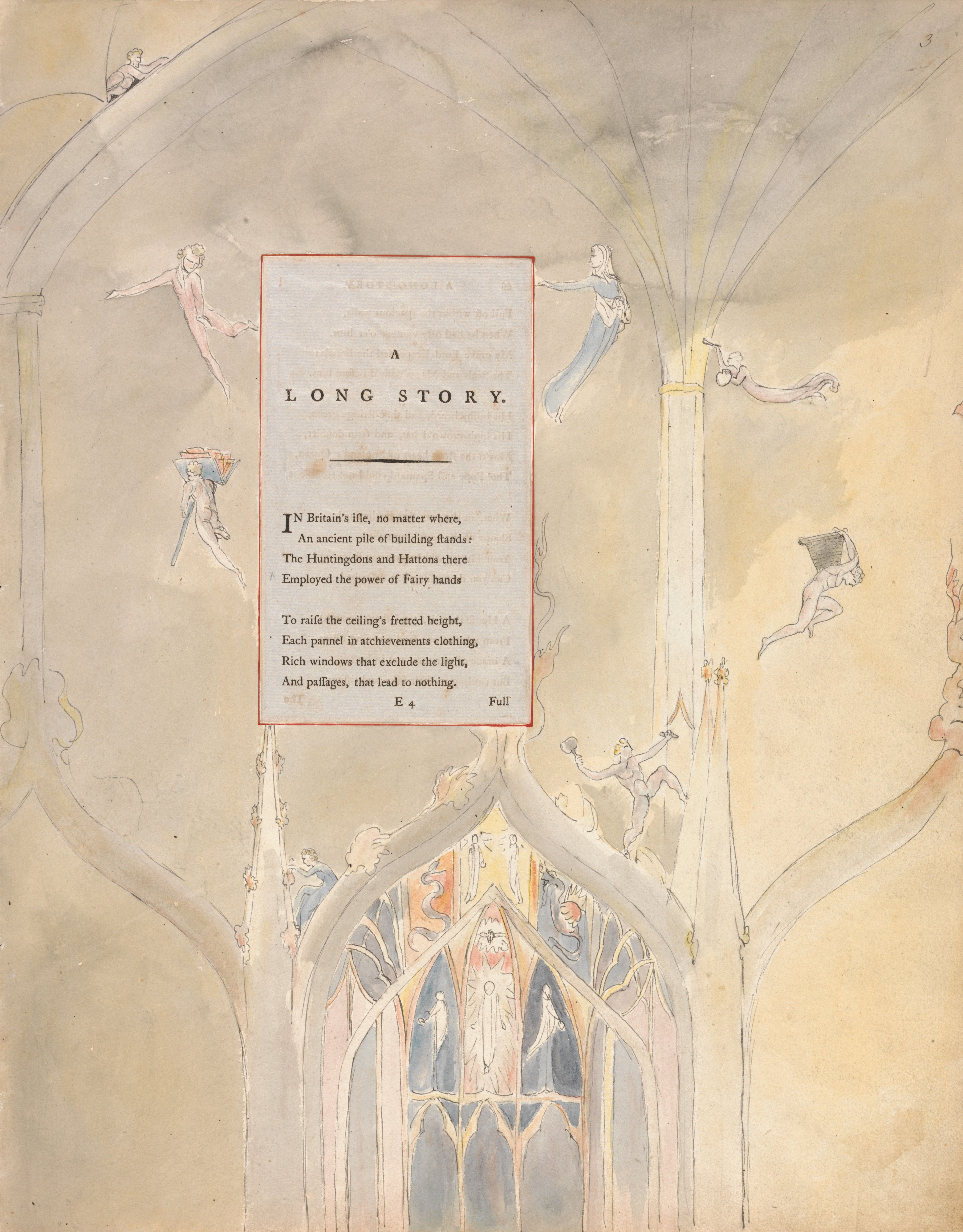
Illustrations to Poems of Thomas Gray
Design 25
Milton, Plate 1, (E 95) 
 "And did those feet in ancient time, Walk upon Englands mountains green: 
And was the holy Lamb of God, On Englands pleasant pastures seen! And did the Countenance Divine, Shine forth upon our clouded hills? And was Jerusalem builded here, Among these dark Satanic Mills? Bring me my Bow of burning gold: Bring me my Arrows of desire: 
Bring me my Spear: O clouds unfold! Bring me my Chariot of fire! 
I will not cease from Mental Fight, Nor shall my Sword sleep in my hand: 
Till we have built Jerusalem, 
In Englands green & pleasant Land."

Milton, Plate 12,(E 155) 
"And they builded Golgonooza: terrible eternal labour!
What are those golden builders doing? where was the burying-place
Of soft Ethinthus? near Tyburns fatal Tree? is that
Mild Zions hills most ancient promontory; near mournful
Ever weeping Paddington? is that Calvary and Golgotha?
Becoming a building of pity and compassion? Lo!
The stones are pity, and the bricks, well wrought affections:    
Enameld with love & kindness, & the tiles engraven gold
Labour of merciful hands: the beams & rafters are forgiveness:
The mortar & cement of the work, tears of honesty: the nails,
And the screws & iron braces, are well wrought blandishments,
And well contrived words, firm fixing, never forgotten,         
Always comforting the remembrance: the floors, humility,
The cielings, devotion: the hearths, thanksgiving:
Prepare the furniture O Lambeth in thy pitying looms!
The curtains, woven tears & sighs, wrought into lovely forms
For comfort. there the secret furniture of Jerusalems chamber    
Is wrought: Lambeth! the Bride the Lambs Wife loveth thee:
Thou art one with her & knowest not of self in thy supreme joy. 
Go on, builders in hope: tho Jerusalem wanders far away,
Without the gate of Los: among the dark Satanic wheels."

Raine's understanding of Blake's efforts to foster the spiritual attributes underlying the city in which imagination dwells is expanded on page 107:
"The sole object of all the labours of Golgonnza, 'ever building ever falling', is to provide an earthly habitation for Jerusalem. It is ever in secrecy and obscurity, in human love, in every sense of that word, that foundations of the city are laid...Blake perfectly and eloquently expresses all he felt about what a human city is, in its inner essence, as a building of human souls each individually, and all collectively labouring to embody a vision whose realization will be only when all is done 'on earth as it is in heaven', according to the archetype of the human Imagination. Blake never presented the building of Jerusalem as the work of a few men or outstanding genius or 'originality', but rather of all the city's inhabitants, the 'golden builders.'"
 
First Corinthians 3
[9] For we are labourers together with God: ye are God's husbandry, ye are God's building.
[10] According to the grace of God which is given unto me, as a wise masterbuilder, I have laid the foundation, and another buildeth thereon. But let every man take heed how he buildeth thereupon.
[11] For other foundation can no man lay than that is laid, which is Jesus Christ.
 
Video of Kathleen Raine on the imagination. 
 

Saturday, August 09, 2014

Blake's Symbols


  Blake was a highly symbolic poet (and painter); to understand much of his thought requires acquaintance with a body of symbols that go back to the dawn of civilization, and up to the 19th century. In an age when only the material seemed to matter Blake was (and continues to be) highly opaque to the pure materialist. Such a person will find most of Blake's ideas meaningless.
       But at the deepest level his ideas are the veritable stuff of life: love and hate, good and evil, life and death, and many ideas with urgent meaning. A high proportion of people prefer to turn aside from these questions, but you can be sure that their unconscious is full of them.
       Above all Blake is about matter and spirit, at the great dividing line: do you see yourself primarily as a body or as spirit?
       Begin with the conclusion, to be supported by an overwhelming body of evidence stretching from Heraclitus in the 6th century BC to the present:
       Our mortal life is a vale of tears to which we have lapsed from Eternity and from which we will (may?) eventually escape back into the Higher Realm. This myth conforms very closely to the Gnostics, the Platonists, and of course most of Eastern Religion. In the Christian tradition one can find vestiges of it in many of the mystics, notably Meister Eckhart, in Mexican folk culture and in fact universally.
       The western mind revolts from this "never-never land" at least on the conscious level, but Freud, Jung, and many other psychologists find strong evidence for it in the unconscious. At this point many readers may dismiss Blake's myth as not worth their attention.
       The select few who remain may rightfully expect an entirely new world of grace and enchantment to open before their minds. The biblically oriented may perceive that all Blake's poetic and artistic work fits into a scheme of cosmic/psychic meaning; closely following the Bible it describes the pattern of Paradise, the Fall, a gradual redemption, and the final Rapture.
       Understanding Blake's myth can be expedited by the study of Blake's women
       A most significant key to Blake's symbolism came to light only in 1947 whenArlington Court was bequeathed to the British National Trust. Among the furnishings there was a large tempera by Blake, called alternatively The Sea of Time and Space or The Cave of the Nymphs. This treasure had been hidden from public eyes for a century.
       (Most of us are unlikely to see the original, but Blake and Antiquity by Kathleen Raine offers several glimpses of the picture with a detailed account of the symbols it contains. There is no better way to begin an understanding of Blake at the deeper level than to read carefully and study this small and accessible book.)
       The picture contains the essential symbolism of Blake's myth; the theme goes back to Homer, then to Plato and Porphyry. (To understand Blake's myth one would be well advised to study this link with care--at least the first part ofTaylor's article.)
       Blake and Taylor were approximately the same age and as young men close friends. Many people think that Taylor introduced Blake to the Platonic and Neoplatonic traditions. It seems certain that Taylor's On the Homeric Cave of the Nymphs deeply influenced the painting of the Arlington Tempera. It also introduced a great number of the most common symbols used in Blake's myth; they were used over and over throughout Blake's work.
       Another good introduction to Blake's myth is The Marriage of Heaven and Hell. It comes from an angry young man pouring his scorn on the conventions that cripple us; the language is pungent, the words are pointed, provocative, and outrageous.
       A conventional person will find this whole work offensive and repulsive, but the young person at the stage of life where he's ready to kick over the traces, is quickly attracted-- if he has enough wit to understand irony and not take everything at face value.
       We might call it an ironic satire. In 1789 Blake was 32, at the height of his physical (though perhaps not mental) powers. He had experienced the Divine Vision.
       He knew it was meant for mankind, but so far limited to Jesus and a few others. But with the advent of the French Revolution he foresaw its spread throughout the world. (Of course in that he was soon doomed to disappointment-- with the appearance of Madame Guillotine.) Nevertheless with a peak of spiritual exuberance he proceeded to announce the coming New Age:
The ancient tradition that the world will be consumed in fire at the end of six thousand years is true, as I have heard from Hell. For the cherub with his flaming sword is hereby commanded to leave his guard at the tree of life, and when he does, the whole creation will be consumed and appear infinite and holy whereas it now appears finite & corrupt.... If the doors of perception were cleansed every thing would appear to man as it is, infinite. For man has closed himself up, till he sees all things thro' narrow chinks of his cavern. (Plate 14)
       For this gem Blake drew upon Genesis and Plato.
       Blake knew that the Divine Vision depended upon your ability to avert your eyes and attention from the material and to focus upon the Spiritual, the Eternal, which can only dwell in the Imagination (for Blake the Imagination was everything!). The society of Blake's day uniformly failed to do that, as does ours! Blake desperately, emphatically, and continuously endeavoured to awaken us to a spiritual consciousness, to break the 'mind forg'd manacles.
       Pursuant to this aim:
"How do you know but every bird that cuts the air Is an immense world of delight, clos'd by your senses five?" (Plate 7; E35)
And look at Plate 13:
"I then asked Ezekiel. why he eat dung, & lay so long on his right & left side? he answered. the desire of raising other men into a perception of the Infinite."(E39|
       Back in 1788 with There is No Natural Religion he had disposed of a sense-based consciousness as any kind of arbiter of the meaning of life:
Man's perceptions are not bounded by organs of perception. He percieves more than sense (tho' ever so acute) can discover.
       Look at Section VII of NNR. Reason or the ratio are his terms for comfining one's mental activity to the senses. And he thought less and less of it as he grew older. In notes on Vision of the Last Judgment he wrote:     

"I assert for myself that I do not behold the Outward Creation and that to me it is hindrance and not Action it is as the Dirt upon my feet No part of Me.        What it will be Question'd When the Sun rises do you not see a round Disk of fire somewhat like a Guinea? O no, no, I see an Innumerable company of the Heavenly host crying Holy Holy Holy is the Lord God Almighty."
       On MHH (Plate 16 Blake tells us about the prolific (prophetic types, creative people who grasp the Eternal) and the devouring (those who worship the created good). Of course he counted himself among the prolific. Middleton Murry has pointed out that in this moment of the everlasting 'good-and-evil' in which we live Blake may have projected the 'evil' upon the public who had uniformly ignored him. Murry suggested that it was a necessary "moment in his life".
       If that be true, we have the record of the moment when Blake "came to himself" to the point where he confessed that his Selfhood continued to dominate him. He eventually came to realize that one cannot operate in the Sea of Time and Space without the Selfhood; thus he faced the necessity to continually annihilate and regenerate it with his alternation between Heaven and this vale of tears in which we live. (As Christians understand, the selfhood is brought into subjection and becomes the servant of the Self (Christ)).
       In Plate 24 he promised to the world the Bible of Hell. John Middleton Murry described it as follows:
The first book of these, The Book of Urizen , is to a large degree a parody of Genesis. The Book of Ahania corresponds precisely to Exodus. The third book is The Book of Los (1795).
       MHH was prior to Blake's myth proper, like a preamble or preface. It defines ideas and terms that are to be understood as the myth evolves, a special language you have to learn to get into the major works (The Four ZoasMilton and Jerusalem)