Saturday, September 19, 2026

ALBION & ARTHUR

First posted April 2014

Although we are first struck by the resemblance of the motif of sleep in the myth of King Arthur and Blake's myth of Albion, there is another remarkable  correspondence. The female characters in the myth of Arthur are the source of much of the difficulties which destroy the kingdom. Arthur's queen Guenevere proves to be unfaithful to him. His half sister Morgan, together with her son lead the rebellion which results in the end of the fellowship of the Knights of the Round Table. Merlin loses his freedom and power to the woman who was his protege. Furthermore the motif of the virginal maiden who exercises dominion over and requires devotion from her knight is prominent in the story.

We see in Enitharmon, Vala and Enion the same characteristics displayed in the women of Camelot. Enitharmon, as the queen of heaven is most like Guenevere, queen of Camelot. They both turn from their own men to others. Enitharmon aligns herself with Urizen or the Spectre. Guenevere chooses Arthur's 'best knight' as her paramour. Each woman rules in a world where the characteristics of the female are designed to undermine the role which the male should play.
 
Vala like Morgan is bent on obscuring and subverting the culmination of the possibility for achieving the unifying vision.

 
Enion like Nimue prevents the vision of wholeness from being revealed by withdrawing and fleeing.

Yale Center for British Art
Jerusalem
Plate 54

Blake is speaking of more than the unpleasantness that results when men allow themselves to serve bossy women, he is writing about the consequences of the active, inner, spiritual principle becoming subservient to the passive, outer, material principle. 


 Here is the situation as presented in William Blake's Circle of Destiny by Milton O Percival:  

"It is easy to see, then, how great is the violence done to the divine plan when man, in his impiety, begins to reason about his apparently dual self and sets the feminine contrary above the masculine - the emanation above its spiritual source...The principles of life are thrown into reverse. The effect is taken as the cause. The emotional life takes precedence over the intellectual life. Beulah sets itself up as Eden. When this happens Eden and Beulah are both lost, and the sexual  strife of the sundered contraries is set up in Ulro. The struggle in Ulro takes many forms. It is the emotions threatening to engulf the intelligence. It is outward nature threatening to extinguish the inner light. It is conventional technique warring against original genius. It is the moral ideal of a passive rather than an active good. In brief, the division is fourfold - of the head, heart, loins, and body, with all that these imply." (Page 95)   

Jerusalem, Plate 64, (E 215)

"Of the Mundane Shell which froze on all sides round Canaan on
The vast Expanse: where the Daughters of Albion Weave the Web
Of Ages & Generations, folding & unfolding it, like a Veil of Cherubim
And sometimes it touches the Earths summits, & sometimes spreads
Abroad into the Indefinite Spectre, who is the Rational Power.
Then All the Daughters of Albion became One before Los: even Vala!
And she put forth her hand upon the Looms in dreadful howlings
Till she vegetated into a hungry Stomach & a devouring Tongue.
Her Hand is a Court of Justice, her Feet: two Armies in Battle
Storms & Pestilence: in her Locks: & in her Loins Earthquake.    
And Fire. & the Ruin of Cities & Nations & Families & Tongues

She cries: The Human is but a Worm, & thou O Male: Thou art
Thyself Female, a Male: a breeder of Seed: a Son & Husband: & Lo.
The Human Divine is Womans Shadow, a Vapor in the summers heat
Go assume Papal dignity thou Spectre, thou Male Harlot! Arthur   
Divide into the Kings of Europe in times remote O Woman-born
And Woman-nourishd & Woman-educated & Woman-scorn'd!

Wherefore art thou living? said Los, & Man cannot live in thy presence
Art thou Vala the Wife of Albion O thou lovely Daughter of Luvah
All Quarrels arise from Reasoning. the secret Murder, and        
The violent Man-slaughter. these are the Spectres double Cave
The Sexual Death living on accusation of Sin & judgment
To freeze Love & Innocence into the gold & silver of the Merchant
Without Forgiveness of Sin Love is Itself Eternal Death

Then the Spectre drew Vala into his bosom magnificent terrific"

Jerusalem, Plate 88, (E 246)
"For Man cannot unite with Man but by their Emanations 
Which stand both Male & Female at the Gates of each Humanity
How then can I ever again be united as Man with Man
While thou my Emanation refusest my Fibres of dominion.
When Souls mingle & join thro all the Fibres of Brotherhood
Can there be any secret joy on Earth greater than this? 

Enitharmon answerd: This is Womans World, nor need she any
Spectre to defend her from Man. I will Create secret places
And the masculine names of the places Merlin & Arthur.
A triple Female Tabernacle for Moral Law I weave
That he who loves Jesus may loathe terrified Female love  
Till God himself become a Male subservient to the Female.

She spoke in scorn & jealousy, alternate torments; and
So speaking she sat down on Sussex shore singing lulling
Cadences, & playing in sweet intoxication among the glistening
Fibres of Los:"

Friday, September 18, 2026

GIANT ALBION

 First posted April 2015

Jerusalem: The Emanation of The Giant Albion, Plate 1, Frontispiece, (E 144) 
"There is a Void, outside of Existence, which if enterd into
Englobes itself & becomes a Womb, such was Albions Couch
A pleasant Shadow of Repose calld Albions lovely Land

His Sublime & Pathos become Two Rocks fixd in the Earth
His Reason his Spectrous Power, covers them above                
Jerusalem his Emanation is a Stone laying beneath
O behold the Vision of Albion

Half Friendship is the bitterest Enmity said Los
As he enterd the Door of Death for Albions sake Inspired
The long sufferings of God are not for ever there is a Judgment 

Every Thing has its Vermin O Spectre of the Sleeping Dead!"

The following is reposted from April 12, 2014.
British Museum
Jerusalem
Plate 19


Descriptive Catalog, (E 543) 

"The giant Albion, was Patriarch of the Atlantic, he is the Atlas of the Greeks, one of those the Greeks called Titans. The stories of Arthur are the acts of Albion, applied to a Prince of the fifth century, who conquered Europe, and held the Empire of the world in the dark age, which the Romans never again recovered."

The mythology which is formative for the British is the Legend of King Arthur. Kathleen Raine's chapter The Sleep of Albion, in her book Golgonooza: City of Imagination connects King Arthur and Blake's Albion.
 
Raine:
"Above all the Matter of Britain centres about a fifth-century, Romanized British king or warleader, King Arthur, his chivalry, his court at Camelot, his round table, and the mysterious sanctity, neither wholly Christian nor wholly pagan, of the Holy Grail and its Quest." (Page 161)

 
"And finally there is the legend of Arthur's death-sleep, somewhere in a secret cave where, with his knights around him, he awaits the time when he will return to restore just rule to his kingdom and to repel its enemies." (Page 163)

 
"The unfamiliar supernatural figures are those 'gods' or archetypal energies Blake discerned within the national collective life; and the central figure, whose inner drama is the theme of the whole drama is 'the Giant Albion', the collective person, so to speak, of the nation...Albion  is the sleeping 'giant' (not a king, for the 'giant' is not one man but a nation) for whose re-awakening  the 'four Zoas' and the other persons of the myth, labor." (Page 167)

 
"Blake was versed in the Arthurian literature and traditions and it is plain that the Sleeping Arthur is the model of  the majestic sleeping form of the Giant Albion." (Page 167)

 
"But the 'sleep' of the Giant Albion is conceived by Blake not as the mere passage of time but as a state of apathy, of lowering of consciousness, of forgetfulness of higher things." (Page 171)

 
"Albion's state of 'eternal death' therefore is seen not in terms of some comfortable remote myth but clearly and precisely identified as the materialist ideology to which the West has succumbed." (Page 175)

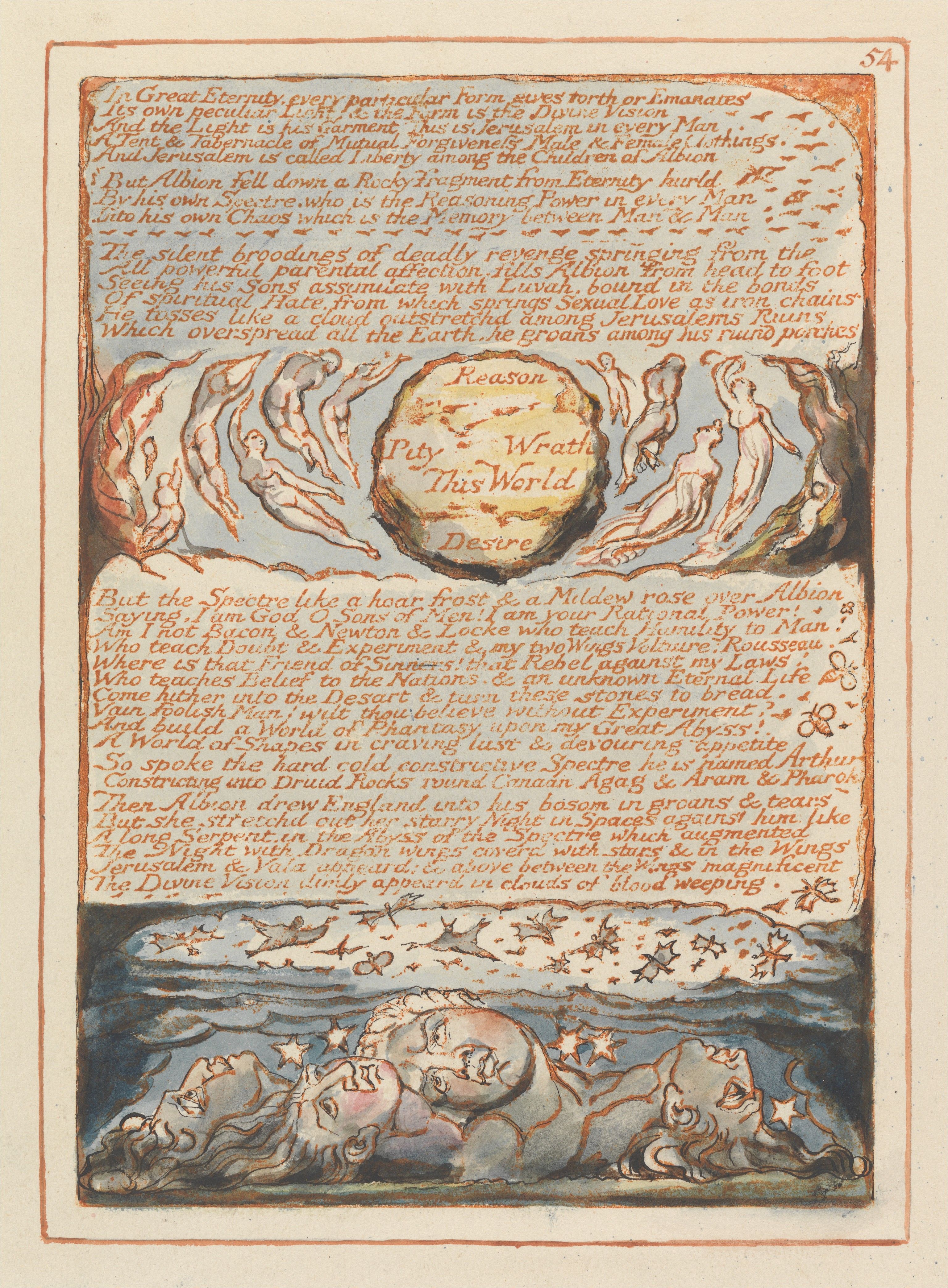
Jerusalem, Plate 54, (E 203)

"But the Spectre like a hoar frost & a Mildew rose over Albion    
Saying, I am God O Sons of Men! I am your Rational Power!
Am I not Bacon & Newton & Locke who teach Humility to Man!
Who teach Doubt & Experiment & my two Wings Voltaire: Rousseau.
Where is that Friend of Sinners! that Rebel against my Laws!

Who teaches Belief to the Nations, & an unknown Eternal Life     
Come hither into the Desart & turn these stones to bread.
Vain foolish Man! wilt thou believe without Experiment?
And build a World of Phantasy upon my Great Abyss!
A World of Shapes in craving Lust & devouring appetite

So spoke the hard cold constrictive Spectre he is named Arthur   
Constricting into Druid Rocks round Canaan Agag & Aram & Pharoh

Then Albion drew England into his bosom in groans & tears
But she stretchd out her starry Night in Spaces against him. like
A long Serpent, in the Abyss of the Spectre which augmented
The Night with Dragon wings coverd with stars & in the Wings     
Jerusalem & Vala appeard: & above between the Wings magnificent
The Divine Vision dimly appeard in clouds of blood weeping."

Arthur is not a hero to Blake but a state through which man travels; a stage of development which is demolished when man reaches the subsequent stage of development. The Spectre, man's rational power is here named Arthur perhaps in response to Arthur's failure to achieve the Holy Grail. Blake continues his list of British Royalty who created an empire through military, political and economic power but failed to give their people the liberty to develop their inner lives. To Blake it is the prophets and poets who create the conditions in which man's humanity can reach fruition.

Jerusalem, Plate 73, (E 228) 

"Voltaire insinuates that these Limits are the cruel work of God
Mocking the Remover of Limits & the Resurrection of the Dead     
Setting up Kings in wrath: in holiness of Natural Religion
Which Los with his mighty Hammer demolishes time on time
In miracles & wonders in the Four-fold Desart of Albion
Permanently Creating to be in Time Reveald & Demolishd
Satan Cain Tubal Nimrod Pharoh Priam Bladud Belin                
Arthur Alfred the Norman Conqueror Richard John
[Edward Henry Elizabeth James Charles William George]
And all the Kings & Nobles of the Earth & all their Glories
These are Created by Rahab & Tirzah in Ulro: but around

These, to preserve them from Eternal Death Los Creates           
Adam Noah Abraham Moses Samuel David Ezekiel
[Pythagoras Socrates Euripedes Virgil Dante Milton]  
Dissipating the rocky forms of Death, by his thunderous Hammer
As the Pilgrim passes while the Country permanent remains
So Men pass on: but States remain permanent for ever
Wikimedia and Yale Center for British Arts
Jerusalem, Plate 19, Detail

Saturday, September 12, 2026

FINE ARRAY

First posted March 2011

_____________________________________                 Gates of Paradise, Plate 6


The subject of this poem from Blake's early book Poetical Sketches superficially is a love affair which ended in disappointment and depression. It is also possible to understand the poem as a statement of the young man's dawning awareness of the illusions encountered in the mental world we construct. We come to expect that when Blake uses a word, it is a metaphor for an underlying concept. A poem about losing one's true love from Blake is more likely to be about 'cracking the cosmic egg' which has imprisoned one in unawareness. It is probably about a death that leads to a rebirth.

Poetical Sketches, (E 416)

SONG.

"My silks and fine array,
My smiles and languish'd air,
By love are driv'n away;
And mournful lean Despair
Brings me yew to deck my grave:
Such end true lovers have.

The artificiality of innocence is forced away by experience. Simple pleasures are replaced by the sorrows of experience.

"His face is fair as heav'n,
When springing buds unfold;
O why to him wast giv'n,
Whose heart is wintry cold?
His breast is love's all worship'd tomb,
Where all love's pilgrims come,"

Loveliness and simplicity are appearances; within is the difficult effort of finding truth through dealing with contraries.

'Bring me an axe and spade,
Bring me a winding sheet;
When I my grave have made,
Let winds and tempests beat:
Then down I'll lie, as cold as clay.
True love doth pass away!"

When one dies to the outward and enters the inward, one gives up expectations of affirmation and appreciation and success.

Tuesday, September 01, 2026

Becoming Himself

From Chapter One of Larry's Blake Primer

Fitzwilliam Museum
William Blake by John Linnell
c. 1825

  Blake knew a secret. He was possessed by realities foreign to the general mind. He knew that trees were full of angels. He knew and vividly experienced an inner world so real that it made the external world by comparison a thing of shadows. He even had some support for his ideas. He discovered that the Gnostics, Plotinus, Paracelsus, Boehme, and a host of others had reported on those realities, not to mention Elijah, John, Stephen, and a few other such types. To the conditioned mind of his day (and ours) all these reports were just stories, but to Blake they were imaginative realities. Imagination was more real to him than any cold blooded materiality.

With such a psyche how could he possibly trust himself to the sense deadening compromises by which most of us make our way in the world? When the chips were down, he always chose principle, conviction, imagination, and never mind the cost. The surprising thing is not that he failed to make his way, but that he managed to survive in this world for almost seventy years. He did have a strong instinct for survival.

So Blake lived in the world without beoming a worldling, and he learned to fight back. His defense mechanism was telling about his own world. In fact he turned it into a counteroffensive, which he launched with a bang in 1789. He wrote a strange document called The Marriage of Heaven and Hell in which he stood the dominant consciousness on its head. (This work probably contains more famous Blake quotes than any other.)

"The Marriage of Heaven and Hell' embodies new communicative skills which Blake used to raise consciousness, not among his contemporaries, few of whom ever saw it, but among later generations. In MHH and in subsequent prophecies he describes a world of thought, imagination and reality foreign to the socially conditioned mind. He deconditions us and reprograms us, or in his language he attempts to raise us "into a perception of the infinite." (Cf Blake's conversation with Ezekiel in MHH: in the first of the Memorable Fancies)

MHH celebrates Blake's discovery of his identity as a prophet and of the use of irony, which he likely learned from Isaiah. He called himself a devil, but that does not have the satanic implications that simpletons have ascribed to it; all his life Blake showed implacable enmity to Satan. Still perhaps his greatest weapon was the ability to turn conventional ideas upside down and let us see another reality beside the prevailing group-think. "Without Contraries is no progression". (MHH Plate 3; Erdman p. 34)

For example laws are for the protection of society--or sometimes for the advantage of those who make them. Wealth is virtue--or sometimes thievery. Worship is life giving--unless it's idolatrous. War is terrible--but also profitable. These are called antinomies. Blake called them contraries, and the Proverbs of Hell in MHH express his realization that much of the world's thinking is illegitimately one sided. In a strange way Blake's vision showed him the other side of the coin. This is what he shared in the decades when he fought back.

In a letter written to William Hayley Blake indicated that he had lost his vision about 1783 and regained it exactly twenty years later. From this we may surmise that Blake had chosen the world (or attempted to) when vision left him, but he apparently had a large reservoir of visionary capital which he lived on during his twenty years in the wilderness.

He also had a Christian friend, Thomas Butts, a minor civil servant who saw something in Blake that most people had missed. (In this letter Blake explained to Butts, with great poetic brilliance his experience "on the sands at Felpham"). Though Butts probably had no unusual visionary gifts himself, he did recognize them in his friend Blake. To encourage him he occasionally purchased Blake's pictures. As Butts became more aware of Blake's poverty, he commissioned him to paint fifty pictures at a guinea each and gave him complete freedom to choose his subjects. Butts' financial generosity made it possible for Blake and his wife to survive; in all likelihood his spiritual support was even more decisive.

A series of letters which Blake wrote Butts suggest a relationship of mutual warmth. Major Butts affirmed Blake in such a way that in these letters Blake dropped the cryptic and enigmatic style which had become almost a part of him and reverted to the limpid clarity seen in the 'Songs of Innocence'. Blake made every effort to explain himself to Butts, and we are rewarded in the Butts correspondence with some of the most revealing glimpses of his mind and being.

Blake tried to repay Butts for his kindness by offering him spiritual direction. However it seems likely that the relationship was the reverse, at least until the moment when Blake became confirmed in the Lordship of Christ. If Blake had a spiritual midwife, it must have been the humble customs officer.

As the century drew to a close, in spite of his friendship with Butts Blake's spirits began to sink. Cash and work were scarce. He began to suffer from melancholy, avoid his friends and shrink from social scenes.

Then in 1800 he received an invitation from a wealthy popular poetaster named William Hayley to move to Felpham, a village by the sea, and to collaborate in some artistic projects. Hayley in fact took Blake under his wing and set out to make a success of him. In particular he set him to painting miniature portraits and secured numbers of commissions for him. At the same time he strongly discouraged Blake's interest in writing.

This proved to be Blake's last temptation. Naturally he felt grateful for Hayley's interest and sponsorship, but as time went on it became increasingly clear that Hayley meant for him to become a man of the world (painting portraits) and to turn his back on the eternal (stop writing poetry). It was the climactic struggle between the two principles for possession of the artist's soul. We find the struggle aptly expressed in the extravagant words of a spiritual report which Blake wrote to Butts on January 10, 1803. (For the pertinent portion of this letter see Erdman at the bottom of 724 and top of 725.)

A more reasoned explanation of this archetypal problem came in a letter to George Cumberland in July 1800:

"I myself remember when I thought my pursuits of Art a kind of Criminal Dissipation and neglect of the main chance which I hid my face for not being able to abandon as a Passion which is forbidden by Law & Religion."

By the main chance he meant of course seeking conventional success.

After three years at Felpham it appears that Butt's support helped Blake to make the right final decision. An unpleasant altercation with a drunken soldier leading to a trial for sedition also helped. In 1803 he returned to London, richer only in experience, but confirmed in his determination to give his spiritual visions priority in his life.