Sunday, October 25, 2009

URIZEN & AHANIA

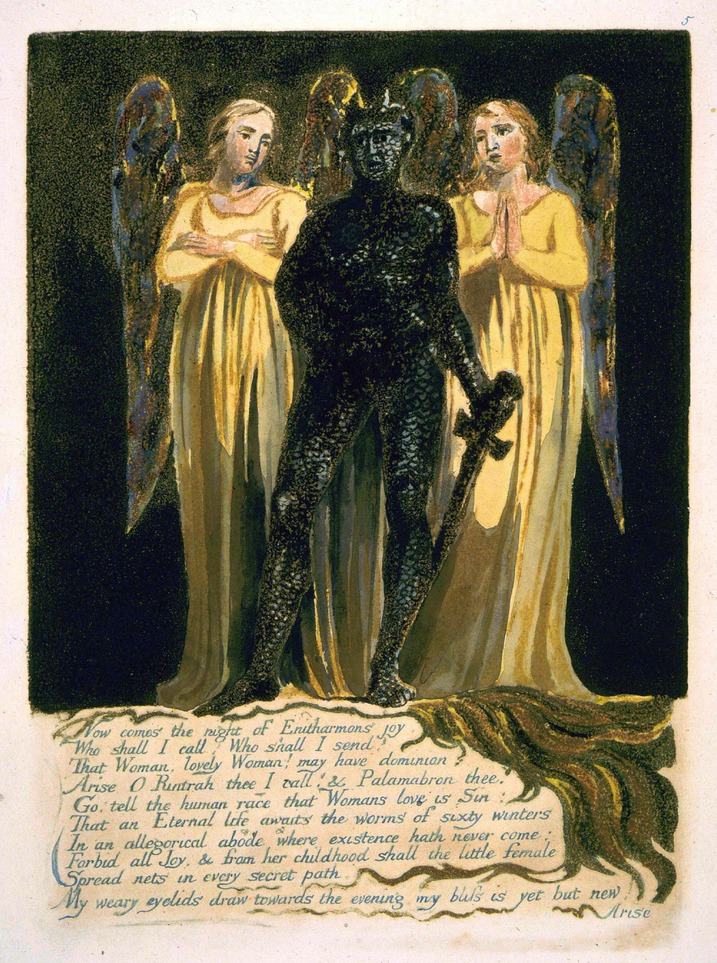
Contained in The Book of Ahania, is the account of the anger of Urizen at Fuzon for assuming leadership of the children of Urizen, as he did at the end of the Book of Urizen. The struggle between the father and son leaves them both maimed. Following that account Urizen's Emanation, Ahania, laments the disintegration of Urizen and reminisces on the happy days they shared in Eternity.

Book of Ahania, Chap V
 
4: "Weeping I walk over rocks
Over dens & thro' valleys of death
Why didst thou despise Ahania
To cast me from thy bright presence
Into the World of Loneness
5: I cannot touch his hand:
Nor weep on his knees, nor hear
Blake Archive
Book of Ahania
Plate 1


His voice & bow, nor see his eyes
And joy, nor hear his footsteps, and
My heart leap at the lovely sound!"

Seeing the conditions that Urizen's system have created, Ahania attempts to show Urizen the consequences of the path that that he is following. The results of her entreaties are not what she desires.


 Image of Urizen and Ahania 


In Four Zoas, Plate 38:12,(E 326) we read: 
 "Ahania bow'd her head & wept seven days before the King 
And on the eighth day when his clouds unfolded from his throne
She rais'd her bright head sweet perfumd & thus with heavenly voice
O Prince the Eternal One hath set thee leader of his hosts 
Leave all futurity to him Resume thy fields of Light
Why didst thou listen to the voice of Luvah that dread morn
To give the immortal steeds of light to his deceitful hands 
No longer now obedient to thy will thou art compell'd 
To forge the curbs of iron & brass to build the iron mangers
To feed them with intoxication from the wine presses of Luvah 
Till the Divine Vision & Fruition is quite obliterated" 

Plate 43:1 (E 328)
"Then thunders rolld around & lightnings darted to & fro
His visage changd to darkness & his strong right hand came forth 
To cast Ahania to the Earth be siezd her by the hair
And threw her from the steps of ice that froze around his throne"

Unfortunately for Urizen, he is worse off without Ahania than he was with her. Percival, on page 28 of Circle of Destiny, explains it thus: "Separated from Ahania, Urizen becomes the 'selfish father of men.' A spirit of wrath replaces the tolerance toward which his feminine desire inclined him....So long as an intuitive understanding of the objects of sense is maintained, the senses are the feeders of the mind; when that understanding is lost they are the mind's destroyers. With Ahania cast out and his intuitive comprehension gone, Urizen is overwhelmed by the world of sense, incapable of seeing that it, too, is holy. Thus overcome he loses the power to create and becomes an impotent figure."

The downward spiral has not yet reached its nadir.

Friday, October 23, 2009

BLAKE & PAUL

Returning to an important concept in Blake, that of Fourfold Vision, I find a familiar passage from Paul can be seen as recognizing Fourfold Vision. In a letter to Thomas Butts, Blake says:

"Now I a fourfold vision see
And a fourfold vision is given to me
Tis fourfold in my supreme delight
And three fold in soft Beulahs night
And twofold Always. May God us keep
From Single vision & Newtons sleep" To Butts, 22 Nov 1802

Illustration for Milton's Paradise Lost

Now looking at I Corinthians 13 we read:
9
"For we know in part, and we prophesy in part.
10
But when that which is perfect is come, then that which is in
part shall be done away.
11
When I was a child, I spake as a child, I understood as a child,
I thought as a child: but when I became a man, I put away
childish things.
12
For now we see through a glass, darkly; but then face to face:
now I know in part; but then shall I know even as also I am
known."

The 'child' can represent single vision, Newton's sleep or sensation. Seeing 'through a glass darkly,' as a limited form of vision can be twofold vision: 'Always' (or ordinary), using only the intellect. The term 'face to face' suggests relationship or threefold vision referred to as 'in soft Beulah's night,' where emotion of feeling is introduced as an additional factor. Fourfold vision is 'knowing as we are known,' Blake's supreme delight, which Blake called Imagination and Jung called Intuition.

In A Blake Dictionary Damon explains on page 436 that, "Single vision is not properly "vision" at all: it is seeing with the physical eye only the facts before it. It 'it leads you to Believe a Lie / When you see with, not thro' the Eye'" (Everlasting Gospel, E 520)

Thursday, October 22, 2009

URIZEN & PSYCHE

Blake often tells the same story from the viewpoint of various characters. In the Book of Urizen, we see the Fall from Urizen's perspective. The breaking apart of the unity of Eternity results in Urizen finding himself in a void, formless yet dividing. There is, as yet, no outer reality, but the inner activity of Urizen begins to construct a mental world of uniformity, stability, laws, secrets and sins.

Is this a tale of the formation of the psyche from the point of view of the Superego? Comparing itself to the Id, the Superego would see itself as reason, self-control, necessary restraint, the means of functioning in the world. But the consequences of emerging from the undifferentiated whole, would not be apparent to the emerging Superego.

Urizen, the setter of limits, is without limits himself. So Los the vehicular form of the Zoa Urthona, is assigned by the Eternals 'to confine the obscure separation alone.' (BU5:40;E73) Los, 'Cursing his lot,' undertakes the task of creating a world and a form in which Urizen can function.

In Blake's scheme error is a state which can be destroyed once it is recognized and limited. Urizen's system is allowed to develop until it can be recognized as error.

Book of Urizen, Plate 16 (BU15.5; E78 )

"The Abyss of Los stretch'd immense:
And now seen, now obscur'd, to the eyes
Of Eternals, the visions remote
Of the dark seperation appear'd.
As glasses discover Worlds
In the endless Abyss of space,
So the expanding eyes of Immortals
Beheld the dark visions of Los,
And the globe of life blood trembling"

The process of differentiation continued with the division of Enitharmon (space), Orc (energy or change), Thiriel (air), Utha (water), Grodna (earth) and Fuzon (fire).

Urizen is not pleased with the emerging world: 'Urizen sicken'd to see His eternal creations appear.' Apparently it doesn't measure up to the world he left in Eternity.

He realizes: 'That no flesh nor spirit could keep His Iron laws one moment.'

Urizen wanders about the world spinning the web of religion, carving the laws of God and unable any longer to see into the closed tents of the Eternals. Urizen, the Superego, has created a dilemma; he can say 'Thou shalt not,' but he can't say 'Thou shalt.' (“Without a vision the people perish.” Proverbs 29:18.) Urizen is at an impasse from which he cannot extricate himself. The divided self, without the Spirit or Imagination lacks the ability to live the life of joy, peace, forgiveness and brotherhood.

The rest of Blake's myth deals with healing the division and restoring the psyche to Eternity (and of course, telling of the tale from other points of view.)

Urizen Ensnared
.

Tuesday, October 20, 2009

ANIMA & EMANATION


Blake’s women - Enitharman, Enion, Ahania, Vala, and Jerusalem are each associated with a male - Los, Tharmas, Urizen, Luvah, and Albion as an Emanation. In Eternity the Emanations do not have a separate existence. As the fall occurs they acquire outer forms, independent wills and the desire to dominate. Daman says they ”fight regeneration (which seems to them like annihilation).”


Marriage of Heaven and Hell, Title page (How many paired figures do you see? and Why is she suspended above the abyss?)

In Jungian psychology there is an aspect of the unconscious which is called the Anima. In the process of individuation, the Anima which has been projected on the people to whom one is related (mother, sister, wife, boss) is explored and assimilated through bringing unconscious material to light. Since the unconscious inner Anima determines relationships to outer persons by projecting the inner content onto real people, outer relationships are repaired by withdrawing projections (removing the Anima’s will or ability to dominate.)

Carl Jung states:
“The projection-forming factor is the anima. Wherever she appears in dreams, phantasies or visions, she appears personified, thereby demonstrating that basically she possesses all the outstanding characteristics of a female person. She is not an invention of the conscious, but a spontaneous production of the unconscious; neither is she a substitute figure for the mother. On the contrary, there is every likelihood that those numinous attributes which make the Mother imago so dangerously powerful derive from the collective archetype, the anima, which is incarnated anew in every male child." (Spring, 1950, p. 5)

Quoted in an article By Paul Watsky

As Blake dealt with unconscious factors in the psyche as characters in his mythic constructions, he explored the relationships and the dynamics of achieving mental wholeness which he associated with Albion and his Emanation Jerusalem. In describing the conclusion of Jerusalem Damon says, “Albion awakes and rises; Jesus appears; and Albion sacrifices himself;...Then Eternity is re-established, and all becomes one in the Divine Vision.” (A Blake Dictionary, page 213)

The following interchange between Enitharmon and Los (Jerusalem, Plate 92) expresses Enitharmon’s fear that she will be replaced by another female if she accepts annihilation but Los reveals that there will be no division into sexes in Eternity.

“My Looms will be no more & I annihilate vanish for ever
Then thou wilt Create another Female according to thy Will.

Los answerd swift as the shuttle of gold. Sexes must vanish & cease
To be, when Albion arises from his dread repose O lovely Enitharmon:”

But as Los states, it is not that the Emanations are lost in Eternity, but that the division into ‘sexes‘ will be no more. The multiple facets of the psyche will be acknowledged, balanced, and restored to their proper roles as they are integrated into a unified functioning whole.

In Blake as in Jung, masculine and feminine aspects of the personality contribute to the complete individual. The Anima in Jung and the Emanations in Blake can be the root of harmful behaviors; but when properly recognized and attended to, they fulfill vital roles in the human psyche.

Sunday, October 18, 2009

SPIRITUAL CAUSE

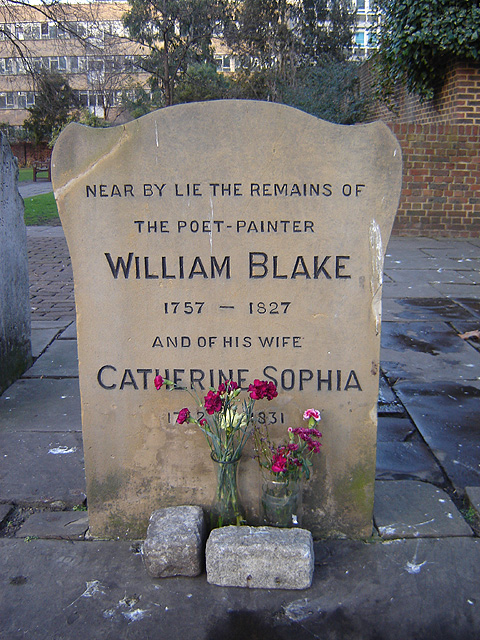
Synchronicity is a term Carl Jung coined to describe events which seemed to be connected in an acausal manner. That three men from different backgrounds in whom I'm particularly interested, found their final resting place together impresses me as synchronistic. Buried close to the same location in London are George Fox, who died in 1690; John Wesley, who died in 1791; and William Blake who died in 1827. George Fox and William Blake are buried in the Bunhill Fields Burying Ground and John Wesley is buried just across the street behind his home.

Fox's Grave
Wesley's Grave
Blake's Grave

 Although these three men shared a passion for being in touch in a direct way with God, they were not associated in life. Blake expressed admiration for Wesley's witness to "Faith in God the dear Saviour who took on the likeness of men" (in Milton , Plate 22). They all 'dissented' from orthodox religious practice in distinctive ways. George Fox urged the practice of silent worship, John Wesley preached a religion of transforming experience, and William Blake used poetry and visual images to develop the Imagination and awaken the Universal Man. Their efforts to spread their own understanding of the best methods of cultivating a relationship with God, occupied the full effort of each. It seems particularly appropriate to me that one might visit the graves of all three within a few minutes and meditate on their similarities and differences.

William Blake expressed an idea close to the concept of synchronicity in these words from Milton, Plate 26:

"And every Natural Effect has a Spiritual Cause, and Not
A Natural: for a Natural Cause only seems, it is Delusion"

There is a Spiritual Cause for Fox, Wesley and Blake resting together.

Saturday, October 17, 2009

HONORING GIFTS

Each one speaks according to the gifts he has received. The knowledge of this insight and of its corollary - that we recognize and respect the gifts of others as well as our own gifts - overcomes barriers among us. Here are four statement about the innate gifts from four sources. Out of their own unique gifts, each of these men express congruent ideas from varied perspectives. Let's listen to June Singer speaking of Carl Jung, and to statements from William Blake, George Fox, and Paul the Apostle.

Dr. Singer: from an Interview in 1998 - Complete Interview

"Jung’s great contribution to psychotherapy was his affirmation of the genius (daemon, guiding spirit) in every individual. He had the greatest respect for the individual, a trust in the authenticity of each person’s inner self-knowledge. Consequently he did not often assert his own views as an analyst, but rather worked to evoke the analysand’s own unconscious material and allow it to speak for itself. Trust in the unconscious, not a blind trust but the way you trust any teacher–you must find out for yourself what the wise person can teach you."

William Blake, Jerusalem, Plate 91

"Go, tell them that the Worship of God, is honouring his gifts
In other men: & loving the greatest men best, each according
To his Genius: which is the Holy Ghost in Man; there is no other
God, than that God who is the intellectual fountain of Humanity;
He who envies or calumniates: which is murder & cruelty,
Murders the Holy-one: Go tell them this & overthrow their cup,
Their bread, their altar-table, their incense & their oath:
Their marriage & their baptism, their burial & consecration:
I have tried to make friends by corporeal gifts but have only
Made enemies: I never made friends but by spiritual gifts;
By severe contentions of friendship & the burning fire of thought.
He who would see the Divinity must see him in his Children
One first, in friendship & love; then a Divine Family, & in the midst
Jesus will appear; so he who wishes to see a Vision; a perfect Whole
Must see it in its Minute Particulars;"

George Fox, Journal

"...So, Friends, come into that which is over all the spirits of the world, fathoms all the spirits of the world, and stands in the patience; with that, ye may see where others stand, and reach that which is of God in every one. Here is no strife, no contention, out of transgression; for he that goeth into strife, and into contention, is [away] from the pure spirit...."

Paul, Letter to the Ephesians

4:11-13 - "His 'gifts to men' were varied. Some he made his messengers, some prophets, some preachers of the Gospel; to some he gave the power to guide and teach his people. His gifts were made that Christians might be properly equipped for their service, that the whole body might be built up until the time comes when, in the unity of the common faith and common knowledge of the Son of God, we arrive at real maturity - that measure of development which is meant by the "fullness of Christ".

4:14-16 - We are not meant to remain as children at the mercy of every chance wind of teaching and the jockeying of men who are expert in the craft presentation of lies. But we are meant to hold firmly to the truth in love, and to grow up in every way into Christ, the head. For it is from the head that the whole body, as a harmonious structure knit together by the joints with which it is provided, grows by the proper functioning of individual parts to its full maturity in love."

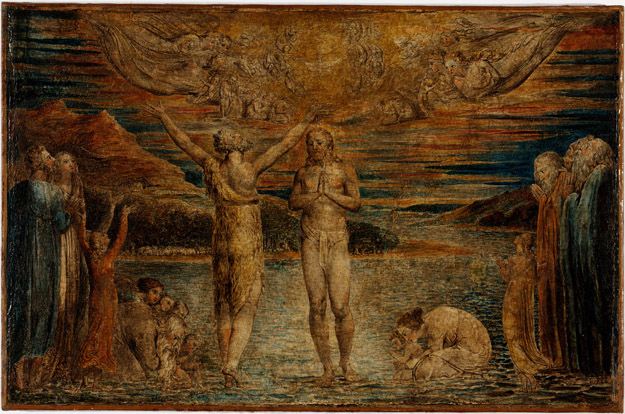
The Baptism of Christ

.

Friday, October 16, 2009

Orc for the Unlearned

Blake has many characters; to understand Blake we need to become acquainted with his characters.  One good way to do that is to put his name on the Concordance; then review the occurrences of the name.  This will give you at least an introductory acquaintance with the character.

The first occurrence of Orc per se is in America, a Prophecy, 1.1; E51 with:
"The shadowy daughter of Urthona stood before red Orc."  If you read America you might conclude that Orc was a symbol or icon of Revolution.

"The red flames of Orc," pictured on America Plate 10.   

He was that, but as Blake's corpus progresses, we find that Orc was other things as well -- many other things in fact.

Los, through his emanation, Enitharmon, gave birth to Orc, his first born.  (This is not a matter of a human birth, but a figure of speech, as if
the Boston Teaparty gave birth to the American Revolution.)

But Blake carried the figure further; he described an archetypal father and son suffering under the Oedipus complex.  Los, out of jealously, took Orc to the top of a mountain and chained him there to a large rock.  What in the world is Blake trying to say?  Your guess, but I might think he's expressing his disenchantment with Revolution.

As a youth Blake, like a lot of Brits, was a fervent (American) patriot.  Likewise the French Revolution until the guillotine became common; disillusionment struck and Blake took off his red cap.He also wrote a poem expressing more pointedly his feelings about the matter:

"The hand of Vengeance found the bed
To which the Purple Tyrant fled;
The iron hand crush'd the Tyrant's head
And became a Tyrant in his stead."

If you have  access to Damon's Blake Dictionary, you may find much more data on Orc  than this humble post can provide.

Good luck and let me know what you think.

Thursday, October 15, 2009

LOS AND ORC

Northrop Frye wrote on page 251 of FEARFUL SYMMETRY:
"The rising Orc has been visualized as killing a dragon and as pushing a rock from his tomb, but neither if these images is really exact. When a new life is born, a new form emerges from unorganized matter, and the "victory" of the rising Orc is the only kind of victory that is possible: the conquest of the creator over his material, the reduction of a monster to a shape. We must now superimpose another pattern on this one. Just as Satan or the monster of death is overcome by Orc, so Orc himself is a monster of natural life (hence his association with the serpent) who must be in turn be overcome, or shaped into a form, by someone else. And as Orc shapes life out of death, so this someone shapes the conscious vision out of life which is the imagination proper, the character or identity, and so constructs a Being from the Becoming. Orc brings life into time; the shaper brings life in time into eternity, and as Orc is the driving power of Generation, so his shaper is the power of Regeneration. This shaper is the driving force of all of Blake's later poems, Los the blacksmith, the divine artificer, the spiritual form of time, the Holy Spirit which spoke by the prophets."


MILTON Plate 24 reads:
"Los is by mortals nam'd Time. Enitharmon is nam'd Space
But they depict him bald and aged who is in eternal youth
All powerful and his locks flourish like the brows of morning
He is the Spirit of Prophecy, the ever apparent Elias.
Time is the mercy of Eternity; without Times swiftness
Which is the swiftest of all things: all were eternal torment:
All the Gods of the Kingdoms of Earth labour in Los's Halls.
Every one is a fallen Son of the Spirit of Prophecy
He is the Fourth Zoa, that stood arou[n]d the Throne Divine."

Wikipedia Commons
Book of Urizen
Copy G
Los at the forge with Enitharmon and Orc


Frye continues:
"Orc, the amorphous cub whom Los has to lick into shape, is Los' first-born son, as Los is the Holy Spirit or incubating power from whom all life proceeds. And as no life reaches eternity without first going through the physical world, the young Orc is bound by Los to the latter."

So through the fall, Los and Orc each become the prisoner of the other that the work of regeneration may ultimately be accomplished.

Wednesday, October 14, 2009

DIVINE MERCY

Blake's Jerusalem, Plate 32, Lines 50-56

"Then those in Great Eternity who contemplate on Death
Said thus. What seems to Be: Is: To those to whom
It seems to Be, & is productive of the most dreadful
Consequences to those to whom it seems to Be: even of
Torments, Despair, Eternal Death; but the Divine Mercy
Steps beyond and Redeems Man in the Body of Jesus Amen
And Length Bredth Highth again Obey the Divine Vision Hallelujah"

Here Blake indicates that we give 'reality' to what seems to be. This 'reality' is evidenced by its consequences. Through the Divine Mercy this situation can be reversed, and we may become those to whom, what seems to be is the Divine Vision.

From this, evil seems to be an illusion caused by failure to participate in the Body of Jesus. Through the Divine Mercy we are released from this illusion. We "shall see reality whole and face to face." (1 Corinthians 13:12b)

Paul's Second Letter to Timothy (Phillips Translation)

1: 6 - "I now remind you to stir up that inner fire which God gave you at your ordination. For God has not given us a spirit of fear, but a spirit of power and love and a sound mind.

1:8-12 - "So never be ashamed of bearing witness to our Lord, nor of me, his prisoner. Accept, as I do, all the hardship that faithfulness to the Gospel entails in the strength that God gives you. For he has rescued us from all that is really evil and called us to a life of holiness - not because of any of our achievements but for his own purpose. Before time began he planned to give us in Christ the grace to achieve this purpose, but it is only since our saviour Jesus Christ has been revealed that the method has become apparent. For Christ has completely abolished death, and has now, through the Gospel, opened to us men the shining possibilities of the life that is eternal."

Don't Blake and Paul both tell us that evil has no grip upon us; that what Jesus has to give to us - that which is Eternal - abolished death and allows us to see the true picture that Christ reveals?

Vala veiled and Jerusalem with three daughters.
.

Monday, October 12, 2009

PICTURES ADDED

We have added pictures links to many of the older posts. These are not necessarily images which appear with the text quoted, but other of Blake's pictures which illustrate some aspect of the material treated in the post. Many of the links are to the Blake Archive but we also link to the Tate, the Huntington, other museums, and to a site called the Complete Blake.

Blake continued to produced watercolors, sketches, engravings and, temperas throughout his life. Much of his output is now in museum collections, and made available to the public through the internet. His poetry and pictures complement each other; they both focus our attention on his vision of the Infinite which he felt compelled to communicate.

To understand Blake it's best to read both the words and pictures.Jerusalem, Plate 40 Click on next link and then on the picture for Enlargement On the right margin of this image Erdman (in The Illuminated Blake) identifies the figures as Los and Enitharmon, but in their "mundane vehicles" as William and Catherine Blake. "Here he is walking in the line, which his right foot sends spiraling down to Catherine's arms and feet." Their exuberance in decorating this plate seems to come from these lines in the passage:
"But Glory to the Merciful One for he is of tender mercies!
And the Divine Family wept over him as One Man."

Sunday, October 11, 2009

GOLDEN STRING


Blake introduces Chapter 4 of Jerusalem, "To the Christians", with a
promise. He intends to lead us through 'heavens gate' if we follow the 'golden string' which he places in our hands.

Jerusalem, Plate 77, (E 231)
"I give you the end of a golden string,
Only wind it into a ball:
It will lead you in at Heavens gate,
Built in Jerusalems wall."

The 'golden string' used only once in Blake's poetry, is an image which is rich in associations. It recalls the string which Ariadne gave to Theseus to lead him out of the maze of the Minotaur. It reminds us of the thread which measures the length of life and is cut by the Fates. (Moirae - Wiki) It leads us to think of the path we travel through life with all its twists and turns.

But Blake's image goes beyond that. It postulates that the end of the golden string is given to us and we have more to do than follow it. We actively wind it into a ball. If we don't keep the string taut and keep winding it, we may lose our way and wander off into unknown territory. But by winding it and following, it will lead us to our to our destiny or destination.

We are headed toward Jerusalem:

Jerusalem, Plate 54, (E203)
"In Great Eternity, every particular Form gives forth or Emanates
Its own peculiar Light, & the Form is the Divine Vision
And the Light is his Garment This is Jerusalem in every Man
A Tent & Tabernacle of Mutual Forgiveness Male & Female Clothings.
And Jerusalem is called Liberty among the Children of Albion"

                     Wikipedia Commons
River of Life


This image articulates the cutting of the thread, the flow of the stream, the guidance of Jesus, the tree of life, the rising sun, and company of angels and much more.


 Four Zoas, Page 33, (E 322)
"Thus were the stars of heaven created like a golden chain
To bind the Body of Man to heaven from failing into the Abyss
Each took his station, & his course began with sorrow & care"


Friday, October 09, 2009

Blake's God

Do you realize that everyone has his own God?
A vision of God! that's all anyone has, their
vision of God. Apparently the vision of God
that most people have is a 'mean God', a God
who will send you to hell if you don't obey him.
Good Christians seem to believe that in spite
of the loving vision that Jesus gave us.

Not so for Blake; at least not for the mature
Blake. As a youth? Perhaps. His early poems
focused on negative images, images of
restraint; the angels restrained us; so Blake
chose to belong to the Devil's party; he
rebelled against a 'thou shalt not' God (look
at The Marriage of Heaven and Hell.)

He called God Old Nobodaddy; he came to
believe that Urizen represented God; he had
Urizen to say just that. Three times in Night
1, page 12 of The Four Zoas he said I am God .

The mature Blake wrote in his Comments on A Vision of the Last Judgment (Erdman 565):

"Thinking as I do that the Creator
of this world is a cruel being, and
being a worshipper of Christ, I have to
say: "the Son! oh how unlike the Father":
First God Almighty comes with a thump on
the head; then J.C. comes with a balm
to heal it."

For Blake the Son had become God; he
perceived Forgiveness as the greatest
gift we have from him. After his conversion
that was his chief theme and his way of
salvation.

Christ Offers to Redeem Man

If you would like to pursue this subject a bit
further click on Blake's thoughts on God.

If you have a question or comment click here.

BLAKE'S GENERATION

.
From the Book of Genesis

Milton Percival in Circle of Destiny, explains the level or 'world' which Blake calls generation.

"..This is double vision, a correlative of the sexual world of
Generation. The object is outward, corporeal, feminine; the
imaginative image is masculine. Both assert themselves,
each challenging the other's right. The world of generation
might indeed be thought of as a training school in vision.
It may slip back into Ulro, or ascend to Beulah. This is
Los's world, the world of the loins, twofold and sexual;
corporeal, yet struggling to be spiritual" (272-3)

Percival describes the world of generation as Los's world. It
is our world too, a divided world, pulled upward and
downward. The contraries manifest themselves in such
conditions.

"Since there is no chasm, in Blake's system, between man
and nature, the struggle toward regeneration in the natural
world must be thought of, equally with the struggle in the
spiritual world, as the work of Los. Los with his hammer
vehemently constricting, hardening and fixing, eternally
creating only to destroy the false work he has created, is
Blake's dramatization of the process he saw as constantly
at work. For destruction is as essential as creation. For
this reason the natural world is cast in mortal form. Death
and decay are its attributes. It's vegetable life, like Los's
systems, is "continually building and continually decaying."
The invisible fires in which these vegetable forms consume
are the fires of vegetation or generation which also light
the furnaces of Los. Just as the Soul of man is purified in
the "furnaces of affliction," so is the physical world
destroyed and renewed in the fires of "generation or
vegetation." The necessary change is in both cases
accomplished by death in fire."

Blake prefers not to use the terms 'good and evil' in talking
about his worlds because the outcome has already been
decided. Whatever happens along the way, whether it
appears to be constructive or destructive, moves the
process toward wholeness, reintegration, regeneration -
the Eternal completeness in which nothing is lost and
nothing wasted.

Thursday, October 08, 2009

POETIC GENIUS

BLAKE'S SUBLIME ALLEGORY, Edited by Stuart Curran and Joseph Anthony Wittreich, Jr.
 
This book is a useful addition to the Blake shelf in our library. It is easier to understand than some and more thorough than others. In addition to the helpful essay 'On Reading the Four Zoas' by Mary Lynn Johnson and Brian Wilkie, are several others including 'The Aim of Blake's Prophecies' by Jerome McGann, which I particularly like.
 
From page 16, I quote:
"...The demand is that we set the poem's terms into successively different types of relations to each other. Blake's art is a sort of Glass Bead Game. (Hermann Hesse, The Glass Bead Game) To "make sense" of his works we establish in and for them different forms of order, based on shifting sets of dissociations and associations, contrasts and analogies. To cease the act of creating these relations, or ironically, unbuilding them again, is to lapse into single vision."
 
page 17 "Every line ought to be an opportunity for outwitting Satan's watch fiends, while every poem as a whole is designed as a spiritual exercise for the encouragement of universal prophecy."
 
page 20 "Golgonooza is the house whose windows of the morning open out to the worlds of eternity, where Jesus dwells. We were never meant to live in, or with it but through it."
 
page 21 "...artists must approach the world not with creations which will trap men but with visions that will encourage imaginative activity."
Wikipedia Commons
Book of Urizen
Plate 4

Trapped in the Cave of the Mind

The point to me is that Blake did not write poetry whose meaning is discernible in static images, methods, or rules. He wrote to encourage the kind of discernment or perception which characterizes intuitive, imaginative, immediate response to the image which presents itself.

The way he wrote, what he wrote, and why he wrote are all one piece: imagination permeates all. He didn't want us to exit by the same door we entered, so he closed that one door and left all the others open.


Wednesday, October 07, 2009

Who is Rintrah?


Yale Center for British Art
Europe
                                      Plate 8 

In Blake's poetry Rintrah is mentioned 48 times, first
in MHH, then in Europe, the Four Zoas, Milton, and
Jerusalem. He obviously had a special meaning to
Blake, but shades and nuances of the meaning occurred
throughout.

1, At the beginning (and end) of MHH Rintrah roared;
perhaps in his mind at that moment Rintrah represented
the angry young man who would write the revolutionary
material just ahead.

2. In plates 5 and 8 of Europe Rintrah is pictured as a
mailed knight of the queens of England and France,
daughters of Enitharmon, who entice Rintrah into the
hideous war between the two countries.

3. Rintrah's identity is best seen in the Four Zoas:

"And these are the Sons of Los & Enitharmon. Rintrah Palamabron
Theotormon Bromion Antamon Ananton Ozoth Ohana
Sotha Mydon Ellayol Natho Gon Harhath Satan
Har Ochim Ijim Adam Reuben Simeon Levi Judah Dan Naphtali
Gad Asher Issachar Zebulun Joseph Benjamin David Solomon
Paul Constantine Charlemaine Luther Milton"
(FZ8-107.6 Erdman 380)

4. At the beginning of Milton (Plates 3-7) we have The
Bard's Song. Rintrah has a prominent place here.
Enitharmon - The Shadowy Female - has brought forth all
Los's Family: Orc, Rintrah, Palamabron, and finally
Satan. We see these last three in Plate 10. Satan is the fiery 
one; Rintrah is next, and behind Rintrah is his peaceable 
brother, Palamabron.

(Elsewhere Blake referred to Satan as a state, not an
individual. He is the 'state of Error'.)
.

Tuesday, October 06, 2009

Blake's Purpose

1. "Would to God that all the Lord's people were prophets"; Blake quoted this verse at the end of the Preface to Milton. (It was quoted from (Numbers 11:29).)

This is very close to Blake's primary purpose. What
did Blake mean by 'prophet': a person who has a vision
and who shares it.

2. "What it will be Questiond When the Sun rises do you not see a round Disk of fire somewhat like a Guinea O no no I see an Innumerable company of the Heavenly host crying Holy Holy Holy is the Lord God Almighty" (Vision of the Last Judgment E566)

Now what in the world does this mean? Read the
things: not the corporeal, but the visionary.

The Task of Los is to "transform the round glob into living forms." (Erdman)

3. Look also at the end of Marriage of Heaven and Hell:
"Everything that lives is holy". How do you read that?
I think by holy he means the visionary, the Beyond
accompaniment or source of everything material -- such
as the sun.

Look at what immediately follows the 'Holy,Holy,Holy
passage:
"I question not my Corporeal or Vegetative Eye any
more than I would Question a Window concerning a
Sight; I look thro it & not with it."

As Above, so Below
Hermeticism? you bet. Actually
the idea goes way, way back in Greek thought.

4. Here's another indicator of Blake's purpose. In his
visionary meeting with Ezekiel he asked the old prophet
why he did certain very extravagant things: Ezekiel's
answer (and Blake's) was "the desire of raising other
men into a perception of the infinite;"

So we may think materially (with the 'Vegetative Eye'),
or we may envision. These are the two contraries!

What is your vision?

Monday, October 05, 2009

4Z's PICTURED

Click on this link: Image of the Four Zoas
This rare image of the Four Zoas together appears in the First Book of Urizen.

Blake pictures the four Eternals peering down in the unfinished world of Urizen as it divides, falling into the abyss. Most of the copies of this plate display only three of the Zoas. In Blake's characteristic way of allowing imagination to lead him as he creates his images, he has added the fourth Zoa, Tharmas to the other three in this late copy.

Blake's characters have different appearances as they are represented at different levels of existence in his myth. Here they are represented at the level of the Eternals; although no physical representation at that spiritual level can be anything more than limited and false.

Nevertheless, we see Urizen on the right, looking down at his own fallen nature as it disintegrates in separation. His beard drags in the water of matter which is created as a result of his fall. Why is he old? Because he is conservatism which must always be replaced by the new and fresh.

Beside Urizen is Los, forever young, who joins Urizen in the descent in order to be the agent of the eventual return. Suggested by the fingers of Los touching the liquid below as if paint or ink were dripping from his hand, is an intimation of the role of imagination in the regeneration process

Next to the young Los, is another older gentleman, Luvah, who as the emotions, is a level early in physic development. Luvah becomes intimately involved in the struggle to limit the downward fall of Urizen and reverse the division in Albion. At various points Luvah works with or competes with Urizen or Los, but his service is to Jesus.

The Zoa who is missing in most of the images, Tharmas, is pictured as no more than a boy. The contradiction in the character Tharmas is that he is both the 'Parent Power' and the last to be named. Mary Lynn Johnson describes him as "innocence, instinct, the binding force of the human personality, and the body." (p. 206) Perhaps he is closer to the id than any other of the Zoas, and so closer to the child.

On the engraved plate, words and image work together to involve us in the fall - from the perspective of Eternity.
PLATE 15  of The Book of Urizen                                            
"Thus the Eternal Prophet was divided
Before the death-image of Urizen
For in changeable clouds and darkness
In a winterly night beneath,
The Abyss of Los stretch'd immense:
And now seen, now obscur'd, to the eyes
Of Eternals, the visions remote
Of the dark seperation appear'd.
As glasses discover Worlds
In the endless Abyss of space,      
So the expanding eyes of Immortals
Beheld the dark visions of Los,
And the globe of life blood trembling"

Saturday, October 03, 2009

WHY RAM HORN'D?

Perhaps it is inevitable that archetypal images appear in many settings with varied associations. The archetype of the shepherd and the sheep fits that description. In Blake the shepherd recurs as a metaphor for more than one of his characters. For instance Tharmas is the shepherd, just as Urthona is the blacksmith, Urizen is the plowman and Luvah is the weaver. The ram and the lion appear as protectors of the fold which is the role usually assigned to the shepherd.

In Night IX of the Four Zoas which is a culmination of the myth of the fall and division of Albion and his redemption and reunification, there is a passage describing
the ram in that protective role midst some of Blake's loveliest poetic images. This passage deals not with Tharmas but with Luvah and his emanation Vala.


Four Zoas, Night IX, Page 128, (E 397)   
"So spoke the Sinless Soul & laid her head on the downy fleece
Of a curld Ram who stretchd himself in sleep beside his mistress
And soft sleep fell upon her eyelids in the silent noon of day"


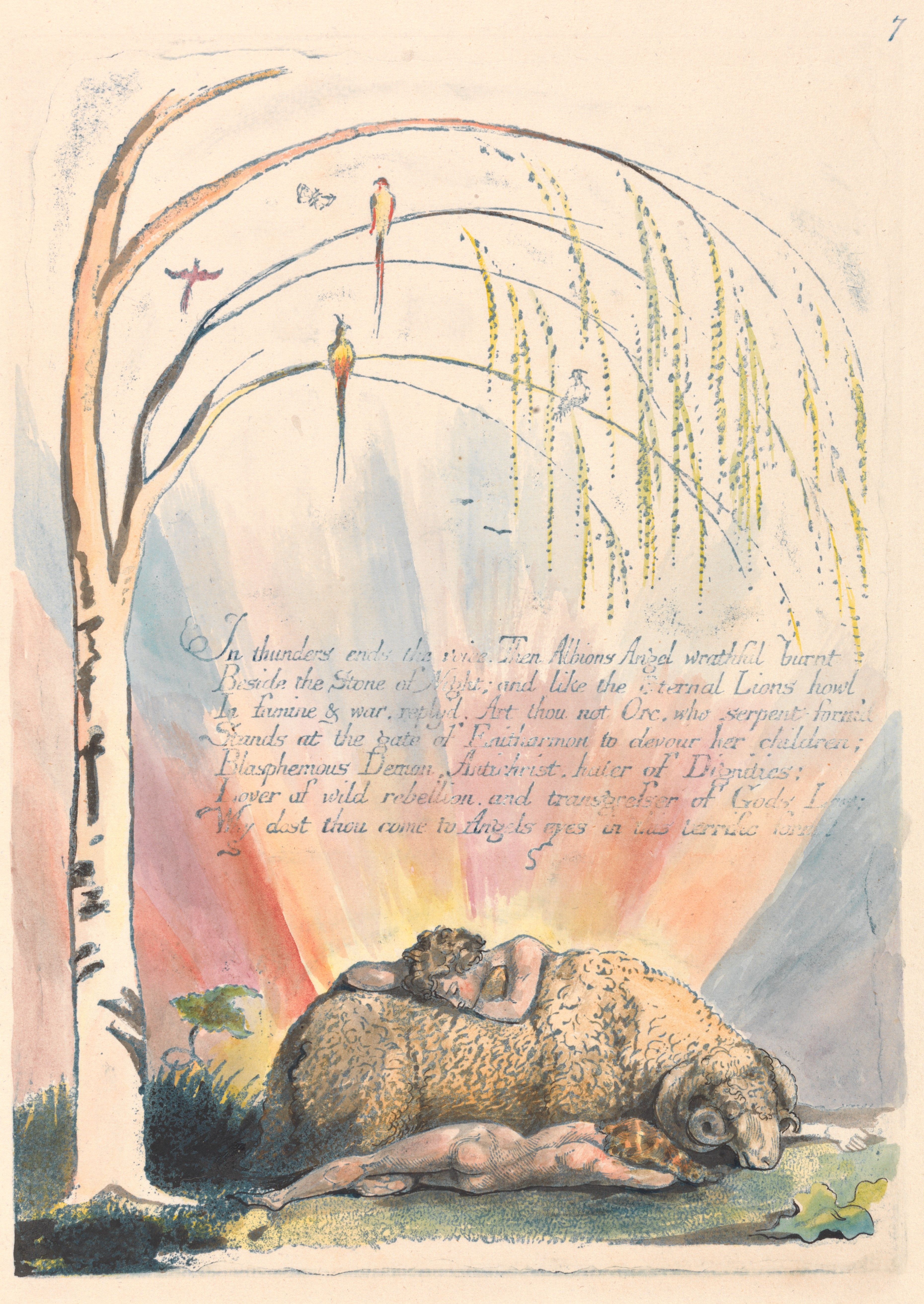
The poetic image of Vala asleep beside the ram recalls a visual image from America A Prophecy, a scene of great peace and pastoral beauty. This image is ironically in the midst of an account of outbreak of revolution, the activity of Orc who is best known as Los's son.

Yale Center for British Art
America. A Prophecy
Plate 7, Copy M
 

This brings us to the poem from which Larry named this blog. In a letter to his friend Thomas Butts, Blake enclosed a poem know as 'My First Vision of Light' which included these lines:

" ...And I heard his voice Mild
Saying This is My Fold
O thou Ram hornd with gold
Who awakest from sleep
On the sides of the Deep
On the Mountains around
The roarings resound
Of the lion & wolf
The loud sea & deep gulf
These are guards of My Fold
O thou Ram hornd with gold"

Here Blake himself became the 'Ram hornd with Gold' and identified his 'fold' and the protective elements around it. It was a transforming experience for him, encouraging him to overcome the temptation to write for a popular audience and henceforth to speak only from the internal, eternal Imagination.

.

Thursday, October 01, 2009

LOS: POET & PROPHET

Los is the hero of Blake's myth as developed in the prophetic books. Among his many names are Eternal Poet and Eternal Prophet. As Blake's alter-ego he was the Creative Imagination, always expanding into new projects and endeavors. As a blacksmith he uses his furnaces to shape humanity through fire and the blows of his hammer. He holds the vision in times of trouble. He takes the materials at hand and puts them to the service of Jerusalem, the image of Divine Inspiration.

In describing this picture Erdman says: "The poet /blacksmith Los, naked with his steel hammer in a firm cushion of cloud, rests "wearied" from his intellectual labors, and regards the completed song/sun with anxious compassion."
British Museum
Song of Los
Plate 8, Copy A
Los as Time, together with Enitharmon as Space brings change. He represents evolution, not in the sense of progress but of opportunity. The information, structures, and insights developed by one generation are available for use by succeeding generations to build upon. Urizen sought fixed structure and predictability. Not so Los. Nothing for him would be more deadly than restating repeatedly the same ideas in different words or applying the same rules to every situation.

The huge advances in scientific thought have come not by using a template but by creating new ways of thinking, new avenues of questioning, new fields of research. Psychology itself had a burst of development when scientific techniques were applied to understand the mysteries of human behavior which had baffled the human mind from the time man became self-reflective. We are following Los when we seek new paths and expand the horizons of our pursuits.

As William Blake said in two of his early works:

All Religions Are One
"PRINCIPLE 4.
As none by traveling over known lands can find out
the unknown. So from already acquired knowledge Man could not
acquire more. therefore an universal Poetic Genius exists"

There is No Natural Religion (b)
"I Mans perceptions are not bounded by organs of perception. he
percieves more than sense (tho' ever so acute) can discover.
II Reason or the ratio of all we have already known. is not
the same that it shall be when we know more.
IV The bounded is loathed by its possessor. The same dull round
even of a univer[s]e would soon become a mill with complicated
wheels."

Blake spoke of dark Satanic Mills.

Wednesday, September 30, 2009

BLAKE & FORGIVENESS

In the GOSPEL OF MARK we read:

10:17 - As he began to take the road again (after welcoming
the children), a man came running up and fell at his feet,
and asked him, "Good Master, what must I do to be sure of
eternal life?"
10:18-19 - "I wonder why you call me good," returned Jesus.
"No one is good - only God"

We learn from Blake too, that 'good and evil' are terms of
judgment not forgiveness. Even Jesus did not wish to be
called 'good.' Calling him 'good' forces us back into the old
system of law and vengeance. The New Testament teaches
that the alternative to the law is 'the inspiration of the Holy
Spirit' through whom we can love, trust, forgive and hope
for the glorious unfolding of God's grace.

JERUSALEM plate 49

"Because the Evil is Created into a State. that Men
May be deliverd time after time evermore. Amen.
Learn therefore O Sisters to distinguish the Eternal Human
That walks about among the stones of fire in bliss & woe
Alternate! from those States or Worlds in which the Spirit travels:
This is the only means to Forgiveness of Enemies"

In Circle of Destiny Milton Percival explains the beginning of the fall thus:
"The great cosmic break in which the fine relationship of the contraries is destroyed is the work of the Spectre. Blown with pride in his emanative life, he abstracts from it a set of qualities called Good. In his arrogance he believes that these qualities which he admires are due to his own activities; he does not realize that they are but the result of the undisturbed functioning of an harmonious whole."

So partaking of the 'fruit of the tree of good and evil' means naming part of the whole, good and claiming it as one's own. Forgiveness is the reversal of that process. By not claiming good as one's own or as something anyone can possess, we put God who includes all things into the right position. We recognize Evil as a State, not a quality or a human being. Forgiveness loses sight of the State by focusing on the individual as part of the Divine Being.

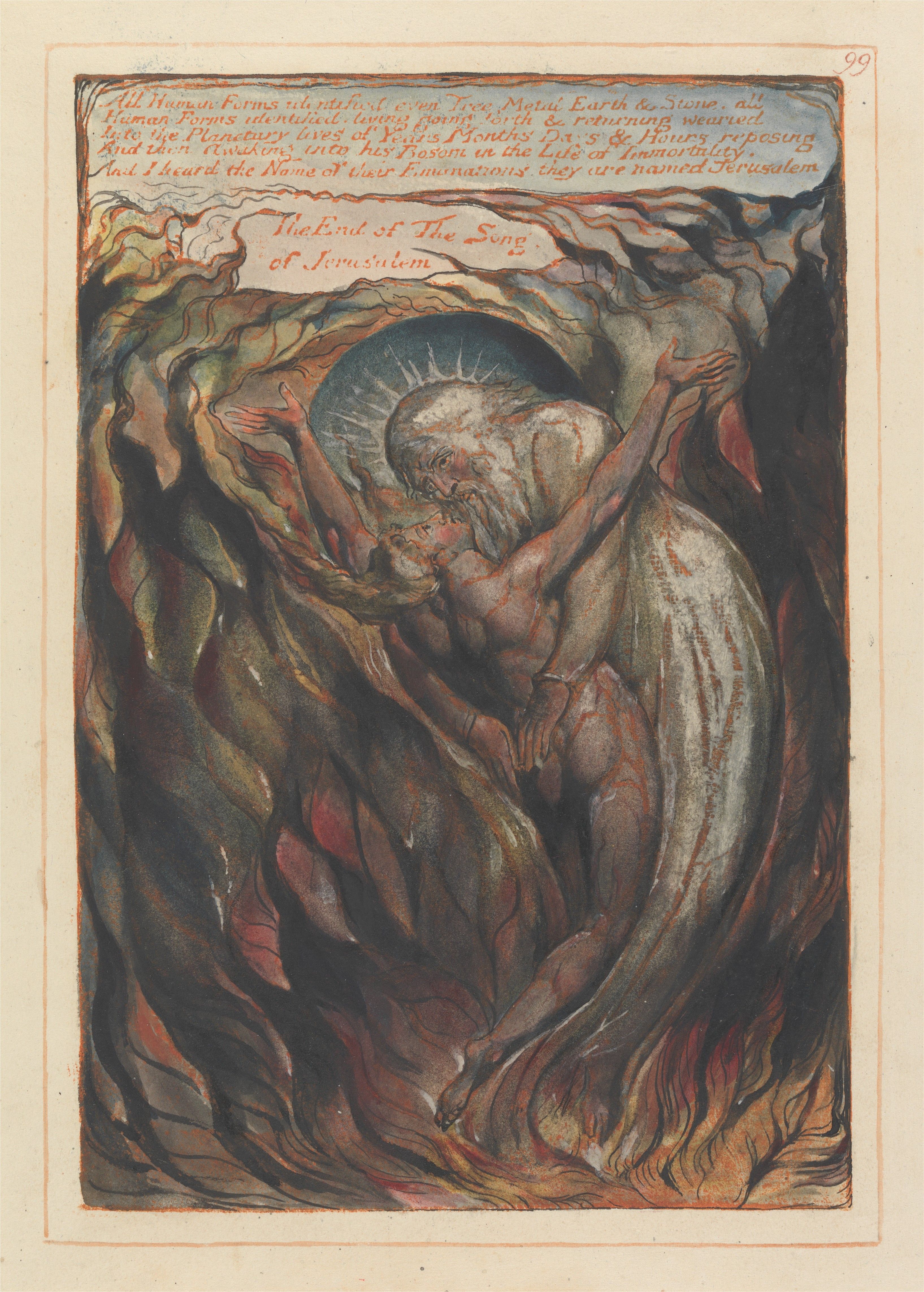
JERUSALEM Plate 99 

Erdman says of this image: "God does not appear as beams of light to outshine the flames of Hell but as a human father welcoming a lost prodigal."

   
Yale Center for British Art   

Tuesday, September 29, 2009

Circle of Destiny II

Blake De antro nympharum Tempera Arlington Court Devon.jpg

The last post included a link to the Arlington Tempera. You may see it as an excellent portrayal of the Circle of Destiny.
One of the common names for the picture is The Sea of Time and Space. However Damon suggested The Circle of Life as a more appropriate term.

The sea in the picture is only one of several vital scenes; it occurs in the left foreground. The right hand part portrays the Cave of the Nymphs, found in the 13th book of the Odyssey. In fact it's from an interpretation of the cave by Porphyry, a 3rd century a Neoplatonist philosopher.
The upper left portrays Eternity. The center shows two prominent characters. The man kneeling on the shore has been given several names: Odysseus by Kathleen Raine, Luvah by Damon, Albion/Jesus by Digby, or better yet, Everyman (you and I). He has gotten close to completion of the circle of destiny; without looking at the sea he is throwing the girdle of Leucothea which she had lent him to be able to swim ashore (Blake used Book 5 of the Odyssey for this feature).
Behind 'Everyman' stands a woman, perhaps Athene (Raine), Vala (Damon), the anima (Digby). (This shows how Blake says different things to different people -- much like the Bible!)
On the right side of the picture there's an image you might imagine as a double escalator with the right side going down and the left up. Down the northern come the souls with a hankering for mortal life. Up the southern may go Everyman:
"when once he did descry

the immortal man who cannot die
Through evening shades he hastes away
to close the labors of his day."
We can only suppose that Everyman, responding to the radiant woman's signal, looked up and moved!
There's a lot more to the circle of destiny; if anyone shows an interest, I'll be glad to expand on it.
Tell me what you think.

Monday, September 28, 2009

The Circle of Destiny

In Night One of The Four Zoas, after a disheartening relationship with Enion, his emanation [wife?], Tharmas reluctantly:

"Turnd round the circle of Destiny with tears & bitter sighs,
And said. Return O Wanderer when the Day of Clouds is oer" (Night 1; chapter 5, lines 11 and 12).

The Day of Clouds? Another name for the Circle of Destiny? Or we might call it 'this vale of tears'.

The Circle of Destiny! Percival wrote a book with that name, actually more elementary and hence better for new Blakeans than Fearful Symmetry by Northrup Frye.

The circle of destiny encapsulates Blake's myth perhaps more concisely than any thing else. The rest of The Four Zoas describes the journey Albion (and all of us as well) went through to get back to the Eden he had lost.

Well another concise statement of Blake's purpose came in Plate 12 of The Marriage of Heaven and Hell: When Blake asked Ezekiel the reason for some of his bizarre behavior, he replied with "the desire of raising others [humans] into a perception of the infinite".

So what is the Circle of Destiny that Blake charged his character, Tharmas with? One of the best answers comes in Blake's magnificent Arlington Tempera.

More to come!

National Trust  
Arlington Court
Sea of Time and Space

Sunday, September 27, 2009

CHIMNEY SWEEPER

SONGS of INNOCENCE 12 (E 10)
THE CHIMNEY SWEEPER

"When my mother died I was very young,
And my father sold me while yet my tongue
Could scarcely cry weep weep weep weep.
So your chimneys I sweep & in soot I sleep,


Theres little Tom Dacre, who cried when his head
That curl'd like a lambs back, was shav'd, so I said.
Hush Tom never mind it, for when your head's bare,
You know that the soot cannot spoil your white hair.

And so be was quiet, & that very night,
As Tom was a sleeping he had such a sight,
That thousands of sweepers Dick, Joe, Ned & Jack
Were all of them lock'd up in coffins of black,

And by came an Angel who had a bright key,
And he open'd the coffins & set them all free.
Then down a green plain leaping laughing they run
And wash in a river and shine in the Sun.

Then naked & white, all their bags left behind,
They rise upon clouds, and sport in the wind.
And the Angel told Tom if he'd be a good boy,
He'd have God for his father & never want joy.

And so Tom awoke and we rose in the dark
And got with our bags & our brushes to work.
Tho' the morning was cold, Tom was happy & warm,
So if all do their duty, they need not fear harm.
"

Weep, weep, weep doesn't just mean sweep, sweep, sweep it
also means weep, weep, weep!
This introduces a note of sadness, an emotional content to the
poem. The plight of the child and of children like him is brought
to our attention. The child is aware of his situation and feels it
deeply. His dream of seeing himself and his friends being locked
in coffins frightens him as would the actual experience of
climbing the narrow spaces within chimneys.
The Angel has a 'key' to release him and his friends. From the
experience the children have with the Angel, I suspect Blake was
using the Angel to represent the religious position taken by the
established church saying: 'forget about your pain', 'be a good
boy', 'God will reward you later.' Could the Angel's key be church
doctrines which soothe the conscience of the believers? That
Tom was 'happy and warm' because of his experience with the
Angel seems false, spoken ironically.
Can children be trapped in many ways - by their poverty, by the
neglect of their families, by the economic structure of their
society, by living in this mortal flesh, by a church whose doctrines
supported oppression? Yes, in all these ways and many more, of
which Blake was acutely aware and to which he wanted to
sensitize us.

SONGS OF EXPERIENCE, 37, THE CHIMNEY SWEEPER
(E 22)


Blake doesn't set limits on how his
poem can be interpreted. He
presents it to us, and we respond
according to our psychological,
spiritual, social or political condition.
As Damon (A Blake Dictionary)
says, "symbolism is a dream which
fails it its entire meaning is obvious."


Saturday, September 26, 2009

CHILDREN ROUND FIRE

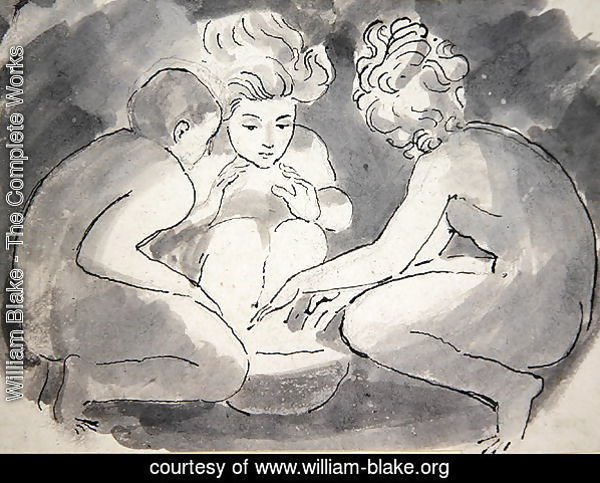
As I read "The Chimney Sweeper" presented in the post above, I realized the the boy in this picture and Tom Dacre of the poem both have shaved heads. So the little boy represented in the picture is likely a chimney sweeper, and all three around the fire represent street children huddled together for warmth as well as light.

https://www.william-blake.org/Children-Round-A-Fire.html

 LET US BE THE CHILDREN AROUND BLAKE'S FIRE


Friday, September 25, 2009

MINUTE PARTICULARS

From William Blake's Jerusalem: Plate 91

"He who would see the Divinity must see him in his Children
One first, in friendship & love; then a Divine Family, & in the midst
Jesus will appear; so he who wishes to see a Vision; a perfect Whole
Must see it in its Minute Particulars; Organized & not as thou
O Fiend of Righteousness pretendest; thine is a Disorganized
And snowy cloud: brooder of tempests & destructive War
You smile with pomp & rigor: you talk of benevolence & virtue!
I act with benevolence & virtue & get murderd time after time:
You accumulate Particulars, & murder by analyzing, that you
May take the aggregate; & you call the aggregate Moral Law:
And you call that Swelld & bloated Form; a Minute Particular.
But General Forms have their vitality in Particulars: & every
Particular is a Man; a Divine Member of the Divine Jesus.

So Los cried at his Anvil in the horrible darkness weeping!"


Looking at this passage as a whole, we look into a conundrum. Part of the problem is that if we try to apply it to others, we are either fault-finding or projecting. If we apply it to ourselves, we are called Jungians. Let's take it one section at a time.

"He who would see the Divinity must see him in his Children
One first, in friendship & love; then a Divine Family, & in the midst
Jesus will appear;"

This path to Jesus may be thought of as the path through 'innocence'.
It is direct and uncomplicated but not open to many of us. It is the way of participating in the creative process through immersion in God's
love.

The following lines suggest a more complex process of achieving wholeness. It involves altering consciousness and breaking down the patterns that dominate our thinking. Blake is looking deep into the
human psyche:

"o he who wishes to see a Vision; a perfect Whole
Must see it in its Minute Particulars; Organized & not as thou
O Fiend of Righteousness pretendest; thine is a Disorganized
And snowy cloud: brooder of tempests & destructive War"

He focuses our attention on the processes through which we organize people, places, things, ideas or whatever, convincing ourselves that it is the right way, the only way. Perceiving reality in the wrong way(materialistically and legalistically) gives a clouded, distorted picture which leads to anger and destructiveness.

"You smile with pomp & rigor: you talk of benevolence & virtue!
I act with benevolence & virtue & get murderd time after time:"

Then he talks of hiding behind the persona and failing to connect with the 'real' in others thereby taking the life from them and from ourselves.

"You accumulate Particulars, & murder by analyzing, that you
May take the aggregate; & you call the aggregate Moral Law:
And you call that Swelld & bloated Form; a Minute Particular."

He points out the errors of living in the mind and constructing further defenses against the 'real' (spiritual) world, leading to a confusion of categories.

"But General Forms have their vitality in Particulars: & every
Particular is a Man; a Divine Member of the Divine Jesus."

Now he reaches the level of integration: SEEING the Divine Image in all, including within ourselves. This is Blake's reply to his implied question of how to 'see a Vision, a Perfect whole.'

"So Los cried at his Anvil in the horrible darkness weeping!"

Los is undergoing this process himself and watching with anguish as humanity is remolded and reborn.

Jesus as the healer: The Raising of Lazarus

Thursday, September 24, 2009

NECESSITIES

Matthew 6:28
"Consider the lilies, how they grow: they toil not, neither do they spin; yet I say unto you, Even Solomon in all his glory was not arrayed like one of these. But if God doth so clothe the grass in the field, which to-day is, and to-morrow is cast into the oven; how much more shall he clothe you, O ye of little faith? And seek not ye what ye shall eat, and what ye shall drink, neither be ye of doubtful mind. For all these things do the nations of the world seek after: but your Father knoweth that ye have need of these things. Yet seek ye his kingdom, and these things shall be added unto you. Fear not, little flock; for it is your Father's good pleasure to give you the kingdom."

When I read this passage prosaically, it is hard to accept because I know rationally that everything is not provided for in the natural world. There are those who go hungry and who suffer needs of all sorts. When I first heard these words sung I recognized them as poetry. Then they spoke to me at a different level. I knew they spoke of a deeper aspect of God's provision. I knew that God's love is all encompassing, and that we need to look from a God's eye view to see that God provides for out every need.


A view of necessities: The Piper
Songs of Innocence, Frontispiece


In this letter to his friend Anna Flaxman, Blake who often suffered need because there was little market for his art, indicates that God provides the true necessities - 'The Bread of sweet Thought' and the 'Wine of Delight.' His mind and his spirit were adequately provided for even in times when his body suffered from deprivation.


Letters, "To my dear Friend Mrs Anna Flaxman" (E 709)

"The Bread of sweet Thought & the Wine of Delight
Feeds the Village of Felpham by day & by night
And at his own door the blessd Hermit does stand
Dispensing Unceasing to all the whole Land
W. BLAKE"