Friday, November 19, 2010

Blake's Forgiveness

At a certain point Jesus came into Blake's consciousness as a new experience. It came from Beyond. That is to say it was not an inward expression of Blake's psyche; it came like the Son of God who had joined the three friends in Nebuchadnezzar's furnace. It wasn't something he thought of; it was something that happened to him.

Blake, like all of us was in the Furnace when the experience of forgiveness and self-annihilation came; they are two sides of the same coin. No one forgives until he has found the grace to annihilate at least momentarily the law bound accusing spectre which is his Selfhood (J33 (29)18-19) And this is only possible as an act of the Imagination, which is eternal, which is Christ. Whenever you successfully annihilate your old self to the point of truly forgiving another, the eternal Christ is alive and at work in your soul. In fact it is he who does it. He is in you, and you are in him; that's eternal life.

Reduced to its barest essential that's what Jesus finally came to mean for Blake. The only unique thing about the man of Nazareth was that he taught forgiveness of one's enemies. In this sense he incarnated God. God is love, is forgiveness. "If Morality was Christianity, Socrates was the Saviour." Unlike Socrates Jesus was a man in whom God dwelt through his vision and his acts of forgiveness.

The significance of the resurrection lies in the coming to life of Forgiveness, Jesus, in you and me. In this way we defeat death.

"There is not one Moral Virtue that Jesus Inculcated but Plato
and Cicero did Inculcate before him; what then did Christ
Inculcate? Forgiveness of Sins. This alone is the Gospel,
and this is the Life and Immortality brought to light by Jesus,
Even the Covenant of Jehovah, which is This: If you forgive
one another your Trespasses, so shall Jehovah forgive you,
That he himself may dwell among you; but if you Avenge, you
Murder the Divine Image, and he cannot dwell among you; because
you Murder him he arises again, and you deny that he is Arisen,
and are blind to Spirit."
(Textual note for EG; E875)

It's quite a trick (or gift) to go from Time to Eternity. Blake showed how in several ways. (See also the Chapter on God.)

Thursday, November 18, 2010

MID LIFE CRISIS

The parallels are so apparent in the thinking of Jung and Blake that we must recognize that they were under many of the same influences. I have been looking for ways in which Jung's insights are apparent in Blake's writing and have found what I was looking for. Each of the men had immersed himself in the perennial philosophy. Each was introverted and intuitive. Each had experienced a mid-life crisis which involved new self-awareness and new prioritization. The internal and external experiences of the two men led them to understand their own mental landscape and to extrapolate it to humanity. Coming from different perspectives and using different disciplines, they were each led to awareness of congruent interpretations of the nature of man and God.

I have found it a worthwhile enterprise is to read Blake looking for Jungian ideas, and to read Jung looking for Blakean ideas. The minds of two giants give insight into the messages of the other.

David L. Hart writing in The Cambridge Compannion to Jung, edited by Polly Young-Eisendrathand Terence Dawson gives an overview of the process of psychological development as seen by Jung on page 100:

"In a general way the whole development of an individual's life is seen by Jung as a gradual emergence out of the ego's control and into the realm of the Self - out of merely personal values and into those of more impersonal and collective meaning. The first half of life normally devoted to establishing a secure place in the world; education, profession, family, a personal identity. But at mid-life that crisis threatens whose ubiquity and importance Jung helped to clarify in the public mind. It is at bottom a spiritual crisis, the challenge to seek and discover the meaning of life. To meet this challenge, none of the tools of the first half of life are adequate. It is not a question of further conquests or acquisitions; it is more a question of exploration of the soul, for its own sake, letting go of the familiar demands of the ego to be fed and gratified. Therefore it is often felt as a loss, and is often powerfully resisted; and yet the psyche, with its own powerful demand to be realized, will persist in confronting consciousness with new and unheard-of views of life's meanings and possibilities. It is here that Jung sees the real work of individuation beginning, for from this point on, everything depends on the broadening of consciousness. Without a real sense that this change carries the true meaning of one's life, and a willingness to take on the inner voyage of discovery, one can fall into despair and a repetitive existence, which in effect only marks time until the end. The challenge of the second half of life is to prepare for death in a questioning, seeking, and conscious way accepting both the pain of disillusionment and the wonder of growth into ever new views of spiritual and psychological reality."


The following passage can be seen as describing Los's mid-life crisis. It focuses on Los' recognition of the contribution he made to his alienation from Enitharmon, the benefits he becomes aware of in cooperation, and the positive outcome that results from working together. Blake uses this incident as a turning point in his myth leading to the climactic restructuring of regeneration.


Four Zoas
, Page 98 [90], (E 369)
"O Enitharmon
Couldst thou but cease from terror & trembling & affright
When I appear before thee in forgiveness of ancient injuries
Why shouldst thou remember & be afraid. I surely have died in pain
Often enough to convince thy jealousy & fear & terror
Come hither be patient let us converse together because
I also tremble at myself & at all my former life

...
Enitharmon spread her beaming locks upon the wind & said
O Lovely terrible Los wonder of Eternity O Los my defence & guide
Thy works are all my joy. & in thy fires my soul delights
If mild they burn in just proportion & in secret night
And silence build their day in shadow of soft clouds & dews
Then I can sigh forth on the winds of Golgonooza piteous forms
That vanish again into my bosom but if thou my Los
Wilt in sweet moderated fury. fabricate forms sublime
Such as the piteous spectres may assimilate themselves into
They shall be ransoms for our Souls that we may live...
But Los loved them & refusd to Sacrifice their infant limbs
And Enitharmons smiles & tears prevaild over self protection
They rather chose to meet Eternal death than to destroy
The offspring of their Care & Pity Urthonas spectre was comforted
But Tharmas most rejoicd in hope of Enions return
For he beheld new Female forms born forth upon the air
Who wove soft silken veils of covering in sweet rapturd trance
Mortal & not as Enitharmon without a covering veil

First his immortal spirit drew Urizen[s] Shadow away
From out the ranks of war separating him in sunder
Leaving his Spectrous form which could not be drawn away
Then he divided Thiriel the Eldest of Urizens sons
Urizen became Rintrah Thiriel became Palamabron
Thus dividing the powers of Every Warrior
Startled was Los he found his Enemy Urizen now
In his hands. he wonderd that he felt love & not hate
His whole soul loved him he beheld him an infant
Lovely breathd from Enitharmon he trembled within himself

End of The Seventh Night "

Wednesday, November 17, 2010

As We Forgive

Blake's annotations to Thornton's translation of the Lord's Prayer (Erdman 667-70) indicates his contempt for the forms of conventional religion. But he lived with it all his life.

If we don't forgive, we're not forgiven. A fundamental, ubiquitous (virtually universal) sin is to project our failings on to another. The biblical term was the scapegoat. We have many, including our many prejudices, and Blake was no exception.

Start with the schoolmaster when he was six; move on to Sir Joshua Reynolds, the first and perhaps greatest artistic disaffirmation. Move on again to Bacon, Newton, and Locke, Blake's fundamental philosophical enemies. Finally there was Hayley, his corporeal friend.

These were lifelong attitudes. Plate 98, (line 10) of Jerusalem shows how, when and where he forgave all these people; it represented the universal forgiveness, "when once [he] did descry, the immortal man who cannot die".

Blake was ready to move on (decisively!).

So much for Blake, but what about me (and maybe you). Reading Blake & Persona led me to understanding that I have some more forgiveness to seek. In my youth I presented a formidable persona like don't touch me; don't try to get close to me; there's no way!. As a Christian (and then Blakean Christian) I thought I had given that up, but reflecting on recent exchanges I see it's still there. God forgive us for hiding from everyone.

Tuesday, November 16, 2010

BLAKE & PERSONA

Another of Jung's aspects of the psyche is the persona. This is the means through which the individual presents himself to the outer world. The persona is thought of as a mask behind which is hidden one's less presentable characteristics. The interaction with the outer world is transacted by the persona. This is exhibited in an artificial and superficial level of relationship which prevents individuals from making deep or real connections with others.

Here is a quote from C G Jung in
"The Relations between the Ego and the Unconscious" (1928), in CW 7: Two Essays on Analytical Psychology. (Page 305): "The persona is a complicated system of relations between individual consciousness and society, fittingly enough a kind of mask, designed on the one hand to make a definite impression upon others, and, on the other, to conceal the true nature of the individual." More quotes are available at this website.

Carl Rogers developed person-centered therapy as a means of connecting with the real person hidden beneath the superficial persona. By not hiding behind his own persona or being distracted by the client's persona, he subverted defense mechanisms which hinder therapy.

Quoting from the Wiki site:
"Rogers suggested that the incongruent individual, who is always on the defensive and cannot be open to all experiences, is not functioning ideally and may even be malfunctioning. They work hard at maintaining/protecting their self concept. Because their lives are not authentic this is a difficult task and they are under constant threat. They deploy defense mechanisms to achieve this. He describes two mechanisms: distortion and denial. Distortion occurs when the individual perceives a threat to their self concept. They distort the perception until it fits their self concept."

There are several ways in which Blake uses psychological constructs similar to the persona to delineate the multiplicity of psychic phenomena. One is his use of 'states' as passing stages through which man proceeds along his journey. The states must be discarded if the Identity is to be achieved.

Milton, PLATE 32 [35], (E 132)
"Distinguish therefore States from Individuals in those States.
States Change: but Individual Identities never change nor cease:
You cannot go to Eternal Death in that which can never Die.
Satan & Adam are States Created into Twenty-seven Churches
And thou O Milton art a State about to be Created
Called Eternal Annihilation that none but the Living shall
Dare to enter: & they shall enter triumphant over Death
And Hell & the Grave! States that are not, but ah! Seem to be."

Blake also creates a scenario in which man is prevented from connection from his inner self in the same way that he is when the persona acts a mask behind which a person hides. Blake uses the Emanation as a connective force between individuals. If a man is not in contact with his Emanation he becomes unable to sympathize with other people (According to Damon).

Jerusalem, Plate 39, (E 187)
"Man is adjoind to Man by his Emanative portion:
Who is Jerusalem in every individual Man"

Jerusalem, Plate 53, (E 203)
"Because
Man divided from his Emanation is a dark Spectre
His Emanation is an ever-weeping melancholy Shadow"

Jerusalem, Plate 54, (E 203)
"In Great Eternity, every particular Form gives forth or Emanates
Its own peculiar Light, & the Form is the Divine Vision
And the Light is his Garment This is Jerusalem in every Man
A Tent & Tabernacle of Mutual Forgiveness Male & Female Clothings."

An additional form of seeing characteristics of the persona in Blake is apparent on Plate 16 of Milton. We have Milton removing his garment as he prepares to undertake his mission of reconciling with his false or mistaken dimensions. We can see the clothing which he wore as an obstruction to his development. Later he says:


Milton, PLATE 41 [48], (Erdman 142)
"To bathe in the Waters of Life; to wash off the Not Human
I come in Self-annihilation & the grandeur of Inspiration
To cast off Rational Demonstration by Faith in the Saviour
To cast off the rotten rags of Memory by Inspiration
To cast off Bacon, Locke & Newton from Albions covering
To take off his filthy garments, & clothe him with Imagination
To cast aside from Poetry, all that is not Inspiration"

Library of Congress
Milton
Plate 16


So removing garments can represent breaking through the unreal facade so that the Eternal can be expressed and can connect humanity in brotherhood. 


.

Monday, November 15, 2010

Natural Religion

After the Biblical Fall the Old Testament drama unfolds as a protracted struggle between two Gods. In every age the majority of Mankind have worshipped Mother Earth, Matter or the recurring cycle of vegetative life. She has many names; in the Bible one of the most common is Astarte. In our day "Astarte" exacts an acceptance of things as they are, an attempt to flow with the stream of Nature. The Bible called this "whoring after other gods".
Blake called it Natural Religion or Druidism. He meant by Natural Religion the worship of the principle of fallen life; those most conformed and faithful to it become the rulers of this world. Natural Religion involves choosing to remain at the level of the material, which Blake called vegetative life.
The believer in Natural Religion closes his mind to the reality of spiritual development; he turns his back upon the Spirit. Unable to endure the tension of struggling and waiting for spiritual evolution he erects a golden calf. He either acquiesces in or actively contributes to the brutishness and horror of a life that "lives upon death".
The Bible and Blake's poetry alike are filled with gory images of this ultimate horror, which comes from identifying life with the merely natural. T.S.Eliot said in The Sacred Wood that Blake's poetry is unpleasant, as all great poetry is unpleasant. It is "unpleasant" basically because Blake, like the Bible, insists on calling a spade a spade. Nowhere is Blake closer to the Bible than in his constant reiteration of the ultimate horror of unredeemed life, celebrated in page after page of minute particulars.
Blake and the Bible both insistently remind us that Nature is fallen , and that one flows with this fallen Nature to one's destruction. Abraham and Moses knew a higher God: he was above Nature; he was Spirit. He called men to rise above the natural and to become sons of a God opposed to everything Astarte stood for, to live by the laws, not of earth, but of heaven.
The children of Abraham tried to put this God first, but rarely with notable success. Instead at every opportunity they turned away from Jehovah "under every green tree", back to Nature. This inevitably led back to Captivity in the iron furnaces of Egypt/Babylon/Rome, etc. The biblical cycle discussed above thus relates to the alternating dominance of Jehovah and Astarte. Blake's myth recreates this biblical story, but with one vital difference.
Vala and her fellow females--Tirzah, Rahab, the Daughters of Albion--represent the various forms of Astarte, the Earth Goddess. Urizen represents Jehovah, the Sky God. But in 'The Four Zoas' both are fallen. Blake claims that the Hebrew consciousness of God is flawed at best. Secular materialists had reached this conclusion long before, but it was a startling and revolutionary idea for a man like Blake, embedded in the biblical faith and firmly attached to the life of the Spirit.
Blake had made as serious a commitment to the Eternal as anyone could, and now at the mid point of his life he saw an Eternal without a God worthy of worship. It was a dark night of the soul indeed!
This honest and painful confrontation with what was for Blake an existential reality has made him into the pariah of the orthodox. The black book has no place for any criticism of the Hebrew consciousness of God; he is perfect from first to last, and everything the Bible says about him is perfect (inerrant!) as well. The superstitious awe which has been called bibliolatry forbids any questions of Abraham's God or Moses' God.
Although when we read without blinders, we can see their consciousness of God changing before our eyes. Note Abraham bargaining with God for the survival of his nephew in Sodom and Moses simply defying God if he refuses to forgive the worshipers of the golden calf. In the spirit of these two revealing passages Blake in his own recreation of the biblical story dramatically portrayed an evolving God consciousness, which the black book simply cannot permit. It was Blake's willingness to let the old die that made him notably ready for the new birth. The dark night of the soul had intensified until it became the Sickness unto Death."
(The above taken from Chapter Six of the Blake Primer.)

Sunday, November 14, 2010

BLAKE & SHADOW

Quote from the New York Association of Analytic Psychology web page:
"The SHADOW contains the unconscious aspects of our personality that have been lost, rejected or never integrated. If we can identify and acknowledge these unconscious, unrecognized or disowned parts of ourselves we are less likely to blame others for our problems. In addition, the conscious integration of the energy inherent in shadow material can enrich and enliven us. Thus Jung viewed shadow integration as a moral as well as a psychological process which, he believed, holds the most hope for us as individuals and for society as a whole."

On page 5 of Meeting the Shadow, The Hidden Power of the Dark Side of Human Nature, edited by Connie Zweig and Jeremiah Abrams we read that:
"Many forces play a role in forming our shadow selves, ultimately determining what is permitted expression and what is not. Parents, siblings, teachers, clergy, and friends create a complex environment in which we learn what is kind, proper, moral behavior, and what is mean-spirited, shameful, and sinful...
We cannot look directly into this hidden domain. The shadow by nature is difficult to apprehend. It is dangerous, disorderly, and forever in hiding, as if the light of consciousness would steal its very life."

We cannot look directly into Blake's shadow nor did he write directly about what Jung called the shadow. Blake did understand that the psyche may be governed by aspects of the unconscious which take over the functions of other portions.

Marriage of Heaven and Hell, PLATE 5, (E 34)
"Those who restrain desire, do so because theirs is weak enough
to be restrained; and the restrainer or reason usurps its place & governs the unwilling.
And being restraind it by degrees becomes passive till it is only the shadow of desire."

John Middleton Murry's book William Blake, speaks of Blake's dealing with the Selfhood which, though not the shadow, is a psychic force which shares characteristics with it. According to Murry, the Selfhood in Blake's unconscious had grown because of his recognition of the world's opacity of Urizen; "But when Los was in the condition of forgiveness, visited by the Eternal Vision, he loved Urizen; and Urizen being loved, became other."

Murry's description of Blake's experience with his Selfhood resembles accounts of experiences of shadow encounters in Jungian therapy. "Blake's experience of the Selfhood was very deep. He had seen it face to face; known it, so to speak, in essence. For the Selfhhood had grown to power in him in pondering the mystery of that finite creation which he knew to be infinite. Out of the effort to exorcise the Selfhood in men, his Selfhood had grown. Once he could accept that mystery, in all humanity, and know himself forgiven; once he could see that this was the inevitable destiny of the pilgrim towards Eternity, and that the process of Life itself, at its very acme of spiritual intensity and candor, created the Selfhood as a means by which it grew - the heart of the 'mystery of iniquity' lay open to him. He knew the origin, in himself. Providence had begun indeed."

Four Zoas, Night 7, Page 95, (E 367)
"Los embracd the Spectre first as a brother
Then as another Self; astonishd humanizing & in tears
In Self abasement Giving up his Domineering lust

Thou never canst embrace sweet Enitharmon terrible Demon. Till
Thou art united with thy Spectre Consummating by pains &
labours
That mortal body & by Self annihilation back returning
To Life Eternal be assurd I am thy real Self
Tho thus divided from thee & the Slave of Every passion
Of thy fierce Soul Unbar the Gates of Memory look upon me
Not as another but as thy real Self I am thy Spectre"

Blake acknowledged that our dark side, the unaccepted and unacceptable, will play havoc with our intentions until it is brought into the light and seen as a vital part of our make-up.
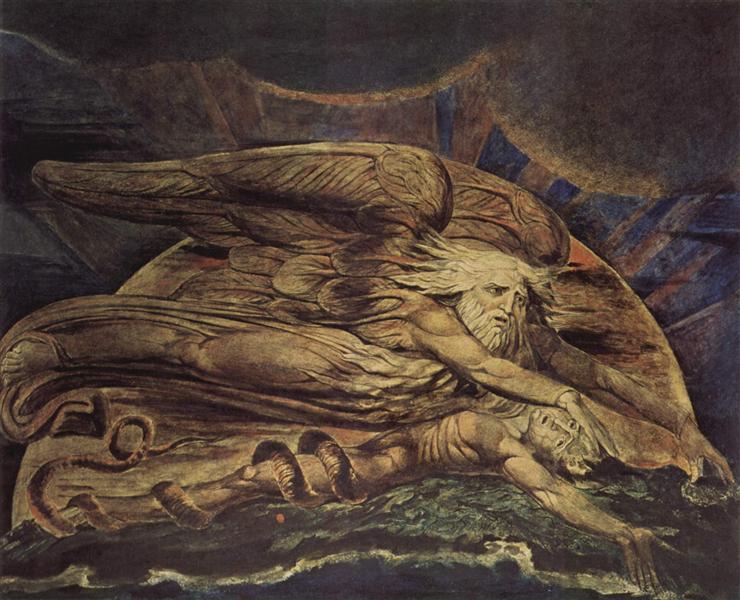
ELOHIM CREATING ADAM

Saturday, November 13, 2010

Two Kinds of Love

"Let us agree to give up (female) love;
then shall we be happy in Eternity." (From My Spectre)

Like everything else love has its contraries ("without contraries is no progression").

The little poem, The Clod and the Pebble, shows the two kinds of love succinctly:

"Love seeketh not itself to please,
Nor for itself hath any care,
But for another gives its ease,
And builds a heaven in hell's despair."

So sung a little Clod of Clay,
Trodden with the cattle's feet,
But a Pebble of the brook
Warbled out these metres meet:

"Love seeketh only Self to please,
To bind another to its delight,
Joys in another's loss of ease,
And builds a hell in heaven's despite."

Blake did have a happy faculty of being pointed succinctly.

Friday, November 12, 2010

BLAKE & WHOLENESS

Jerusalem, PLATE 63, (E 213)
"Jehovah stood among the Druids in the Valley of Annandale
When the Four Zoas of Albion, the Four Living Creatures, the Cherubim
Of Albion tremble before the Spectre, in the starry likeness of the Plow
Of Nations. And their Names are Urizen & Luvah & Tharmas & Urthona"

Milton Percival, author of William Blake's Circle of Destiny, was capable of revealing psychological meaning in Blake's poetry and pictures. He understood that Blake was depicting internal dynamics as he presented his Four Mighty ones in the one giant body of Albion.

On page 20 we read:
"It is in his presentation of the Zoas that much of the power of Blake's myth lies. They are not the bloodless abstractions common to allegory. Blake believed in them. They are in consequence realities of the imagination, with power to terrify us as they terrified their creator. No other poet has given us so profound a sense of the helplessness of man before the primal forces of life; and no other poet, so passionate a denial of that helplessness. He fears these forces, because he sees them as demonic, with power over him; but he takes hope from the fact that these forces are in him - that they are himself. When man shall have brought them again into harmony, they will become his willing servants."

Jung touches on several of the same paradigms of psychic development as does Percival in this passage from his Psychological Commentary in Tibetan Book of the Dead, Edited by W. Y. Evans-Wentz:

"Fear of self-sacrifice lurks deep in every ego, and this fear is often only [of] the precariously controlled demand of the unconscious forces to burst out in full strength. No one who strives for selfhood (individuation) is spared this dangerous passage, for that which is feared also belongs to the wholeness of the self -- the sub-human, or supra-human world of psychic ‘dominants’ (archetypes) from which the ego originally emancipated itself with enormous effort, and then only partially, for the sake of a more or less illusory freedom. This liberation is certainly a very necessary and very heroic undertaking, but it represents nothing final: it is merely the creation of a subject, who, in order to find fulfillment, has still to be confronted by an object. This [object], at first sight, would appear to be the world, which is swelled out with projections for that very purpose. Here we seek and find our difficulties, here we seek and find our enemy, here we seek and find what is dear and precious to us; and it is comforting to know that all evil and all good is to be found out there, in the visible object, where it can be conquered, punished, destroyed, or enjoyed. But nature herself does not allow this paradisal state of innocence to continue for ever. There are, and always have been, those who cannot help but see that the world and its experiences are in the nature of a symbol, and that it really reflects something that lies hidden in the subject himself, in his own trans-subjective reality."

In the beginning of the Book of Urizen Blake expresses a recognition of the disturbance in the psyche which has given power to a force which is 'Obscure, shadowy, void, solitary.' He gladly hears the call to have the 'dark visions of torment' revealed to him.

Urizen, PLATE 2, (E 74)
"PRELUDIUM TO THE [FIRST] BOOK OF URIZEN

Of the primeval Priests assum'd power,
When Eternals spurn'd back his religion;
And gave him a place in the north,
Obscure, shadowy, void, solitary.

Eternals I hear your call gladly,
Dictate swift winged words, & fear not
To unfold your dark visions of torment."

Entering in the dark, unknown aspects of the psyche changes the occupation of the mind to the experience of emotional states which are both pleasant and painful and which appear to be outside of the mind.

Jerusalem, Plate 68, (E 222)
"Sometimes I curse & sometimes bless thy fascinating beauty
Once Man was occupied in intellectual pleasures & energies
But now my soul is harrowd with grief & fear & love & desire
And now I hate & now I love & Intellect is no more:
There is no time for any thing but the torments of love & desire
The Feminine & Masculine Shadows soft, mild & ever varying
In beauty: are Shadows now no more, but Rocks in Horeb"

To be torn asunder, to be under the control of your own wrath, to experience fury, anguish and terror - these are the 'far worse' things of which Los and Blake know. But they know too that Albion will be made whole.

Jerusalem, Plate 7, (E 150)
"Los answer'd. Altho' I know not this! I know far worse than this:
I know that Albion hath divided me, and that thou O my Spectre,
Hast just cause to be irritated: but look stedfastly upon me:
Comfort thyself in my strength the time will arrive,
When all Albions injuries shall cease, and when we shall
Embrace him tenfold bright, rising from his tomb in immortality.
They have divided themselves by Wrath. they must be united by
Pity: let us therefore take example & warning O my Spectre,
O that I could abstain from wrath! O that the Lamb
Of God would look upon me and pity me in my fury.
In anguish of regeneration! in terrors of self annihilation:
Pity must join together those whom wrath has torn in sunder,
And the Religion of Generation which was meant for the destruction
Of Jerusalem, become her covering, till the time of the End."

The reunification of Albion, the archetype of the complete (individuated) individual and of the undivided mankind, restores the connection between humanity and the 'Universal Father' in 'Infinitude.'

Jerusalem, PLATE 97, (E 256)
"Awake! Awake Jerusalem! O lovely Emanation of Albion
Awake and overspread all Nations as in Ancient Time
For lo! the Night of Death is past and the Eternal Day
Appears upon our Hills: Awake Jerusalem, and come away

So spake the Vision of Albion & in him so spake in my hearing
The Universal Father. Then Albion stretchd his hand into Infinitude."


Image from Jerusalem, Plate 99

Thursday, November 11, 2010

Blake's War III

What can be said in addition to what we already have in Blake's War and in More on Blake's War? What is War about anyway? Is it about a country that fancies itself stronger than another country and presumes to attempt to work its will on the (thought to be) weaker country? Is that the way the British Empire (yet abuilding in Blake's day) developed? the intention of King George on America? The first seemed to succeed, until World War II in fact; the second? not quite! Blake memorialized that Failure in War.

Blake knew that War is doomed to failure by any measure; he was well acquainted with what Jesus had said: they that take up the sword shall perish by the sword. He expressed this most aptly with The Grey Monk.

Blake wrote twice about the Grey Monk (in E201-2 and in 489-90).
The first one is found in Jerusalem Plate 52; Erdman 201-2); it concludes with
"For a Tear is an Intellectual thing;
And a Sigh is the Sword of an Angel King
And the bitter groan of a Martyrs woe
Is an Arrow from the Almighties Bow!"

as does the Grey Monk from (the Pickering Manuscript) with an additional quatrain:
"But vain the Sword & vain the Bow
They never can work Wars overthrow
The Hermits Prayer & the Widows tear
Alone can free the World from fear

For a Tear is an Intellectual Thing
And a Sigh is the Sword of an Angel King
And the bitter groan of the Martyrs woe
Is an Arrow from the Almighties Bow

The hand of Vengeance found the Bed
To which the Purple Tyrant fled
The iron hand crushd the Tyrants head
And became a Tyrant in his stead"
(Erdman
489-90).

One might say that Washington lost (almost) every battle-- and won the war. Mao lost every battle-- and won the war; Ho Chi Minh lost every battle-- and won the war. America has won every battle in Afghanistan-- and what?

Perhaps the most dominant theme is Blake's Complete Works was the plaintive, 'why do we take up the sword?'

Wednesday, November 10, 2010

BLAKE'S PSYCHE


In 1946 W. P. Witcutt published a little book named Blake a psychological study. In his introduction he states: "It is only in recent years that the problems of mythology and symbolism have been attacked scientifically, by the psychologists of the school of Jung, and the instrument of the Jungian psychology can provide a key to understanding Blake." He proceeds to present the psychology of Blake himself and of Blake's writing in Jungian thought forms.

He describes Blake as an intuitive introvert. Witcutt quotes from Jung : "Introverted intuition perceives all the background of consciousness with almost the same distinctness as extroverted sensation senses outer objects. For intuition, therefore, the unconscious images attain to the dignity of things or objects."
"Introverted intuition apprehends the images which arise from the a priori, i.e., the inherited foundations of the unconscious mind." (Jung, Psychological Types) Page 24

Continuing with quotes from Witcutt:
Page 24
"The intuitive introvert perceives, waking, what others only dream.' ...To the Intuitive poet Nature is a screen drawn across the face of reality; of value in that it provides symbols for his exuberant imagination to use."

Page 33
"Blake's Four Zoas are not, then, peculiar to himself. They form a theme running through all literature though only Blake presents them as it were in the crude mythological form.
One function of the four is always dominant, with whom the ego or conscious self identifies itself; the other three are repressed into the unconscious, some more and some less. With Blake the dominant function was obviously intuition; in Blakean mythology this function is symbolized by the daemon Los."

Page 44
"Jung opposes thought to feeling and intuition to sensation. A man of dominant thought represses feeling to the lowest place in his unconscious mind, and the intuitive does the same for sensation. Thought and feeling, and intuition and sensation therefore stand at opposite poles from one another."

Page 35
"The thinking function in Blake's Mythology is personified in the figure Urizen, 'the Eternal Mind,' 'the Prince of Light,' the possessor of 'the steeds of Urizen, once swifter than light, which symbolize thoughts, and of 'the mountains of Urizen, once of silver, where the sons of Wisdom dwelt.' ...He is Zeus, the God of the soul, the lawgiver."

Page 26
"The reasoning faculty was not Blake's strong point. He tells us himself that he repressed it. We cannot have it all ways, and the intuitive is not a reasoner. His value lies in the poetry - an everlasting of the English race - and in the light it sheds upon the inner structure of the soul. He is not a philosopher, but a guide to the inner world of symbols."

Page 114
"Thought was not Blake's dominant function, but in all probability it was his secondary or auxiliary function. The auxiliary function, Jung tells us, partakes of the outward conscious attitude of the dominant function; that is to say, in Blake's case it was introverted. It is the nature of introverted thought to be original; not to derive from the thought of other men - or from facts - but from the array of unconscious images."
................................................................................Europe, Plate 2
Page 123
"What to thought appears as an abstract concept appears to intuition as a symbol; thus Blake personifies thought itself as the kingly figure of Urizen. Thought processes are not the real object of poetry... High poetry is of two kinds, imaginative (or intuitive), and the poetry derived from the things of the senses, derived from the function of sensation; that is, derived from the two 'irrational' functions of intuition and sensation, irrational 'because their commissions and omissions are based not upon reasoned judgment but upon the absolute intensity of perception.'" ( quote from Jung, Psychological Types)

I have selected quotes from throughout Witcutt to show how he treats Blake as a person and how he treats the myth Blake created - both as stemming from the psychological profile of Blake's mind. Running through the passages are the concepts of intuition and reason which seemed to dominate Blake's self-perception and the subject matter of his writing.

Witcutt has taken the system of Blake and the system of Jung and examined them in such a way that each enlightens our understanding of the other. You may not agree with the system which Witcutt creates, but you may find that considering it stimulates your thought about your own system.

Annotations to Wordsworth's Poems (E 665)
"One Power alone makes a Poet: Imagination, the Divine Vision."

Jerusalem
, Plate 77, (E 231)
"Imagination the real & eternal World of which this Vegetable
Universe is but a faint shadow & in which we shall live in our
Eternal or Imaginative Bodies, when these Vegetable Mortal Bodies
are no more."

Tuesday, November 09, 2010

Satan and the Spectre

Years ago, sitting in a young adult group in a Methodist church I listened to the pastor trying to convince us that Satan was a real person; a young rebel maintained that people had created Satan just like they created God. In regard to Satan the 'young rebel' was right. 

 Satan is the God of this World; Satan and his world will pass away, but we may (will!) be translated to the Eternal Realm from which we came; such is Blake's theology. 

-------------------------------------------- 

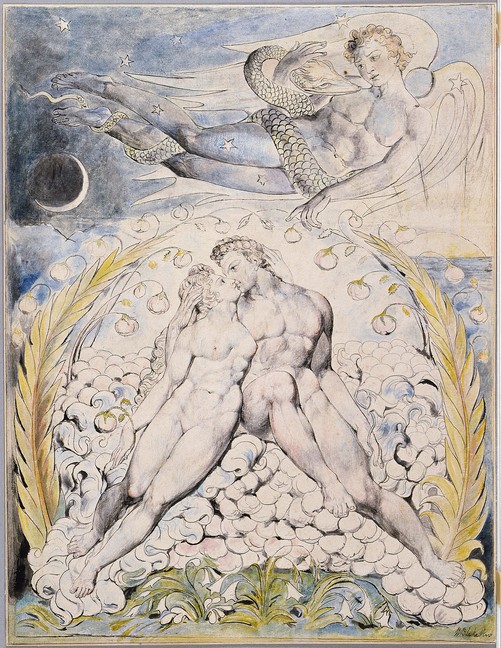
To all intents and purposes John Milton's epic, Paradise Lost has become a part of the Bible; most Bible students have their concept of Satan and his doings from Milton. Blake was deeply influenced by the prophet he considered his predecessor; he produced a series of pictures illustrating the work: (Are these apples or some other fruit)? Adam and Eve are in the lower plane, Satan up in the air. We see Adam and Eve comfortably ensconced in the garden. Satan seems equally comfortable on a cloud with his pet snake. In the story in Genesis 3 Satan is not named, but from that time the Serpent and Satan have been seen as two names for the same entity. 

One of Blake's last works, Illustrations to the Book of Job, has several representations of Satan; here's one: Satan has just been given permission by God (Job 2) to work his will on Job, but he can't take his life. (You may find here in this blog the whole series of pictures of Blake's Illustrations to the Book of Job. They are scattered through the posts of this blog between June 8 and July 25, 2010.) 

When writing of a personal Satan Blake usually used the term, Spectre. In general Satan is the ruler of the (material) world; the Spectre is the ruler of you and me whenever we give in to a temptation to be less (spiritually) than we can be. Once again in the system Blake created Satan and the Spectre are to be annihilated, but people go on to Eden (or perhaps a boot camp for it).

Monday, November 08, 2010

MYSTICAL MARRIAGE

From Robert Blair's The Grave
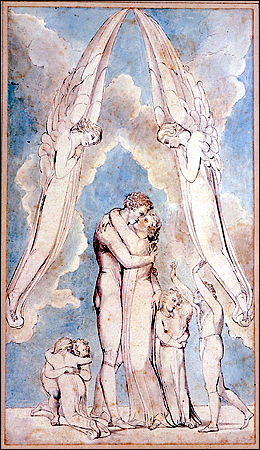
The Meeting of the Family in Heaven


Both Blake and Jung involved themselves in the study of alchemy as a source of symbols for the regeneration of the primordial wholeness of the psyche. The union, reunion, or marriage of the contraries represented by male and female appears in the work of Jung and Blake as it does in alchemy, as the means to resolve the divisions in the psyche.


Here are two passages concerning Jung's use of the symbol of marriage:

From Man and His Symbols, Edited by Carl Jung
"Man's knowledge (logos) encounters women's relatedness (Eros) and their union is represented as that symbolic ritual of a sacred marriage..." Page 126

From Cambridge Companion to Jung, (Page 96, chapter by David L. Hart)
"That the work of wholeness is involved in alchemical symbolism is shown by the constant conjunction of opposites in its imagery: the marriage of sun and moon, of fire and water, of king and queen. This last conjunction forms the basis of Jung's study of the inner processes of the transference, that mysterious and unique relationship that undergirds the work of individuation as it proceeds in analysis. The transference, for Jung, is not a one-sided affair, nor is it merely the projection of parental images from the client onto the analyst. It is not even all that combined with the analyst's projections onto the client. It is, rather, a truly symbolic event in which both persons are changed, and inner 'marriage' leading, as one would expect, to a new, third being, comprising both individuals and yet transcending them."

Blake's use of the symbol of marriage is treated here in Northrup Frye's Fearful Symmetry:
"In eternity all the homes of the soul, the body, the palace, the city and the garden are one; and the eternal community of men is also the real presence of a divine body, whose blood is the new wine created from the water of nature." (Page 351)
"This enlightenment destroys the 'female will' for Milton and enables him to attain his emanation Ololon. We have spoken before of the ambiguity of the word 'consummation' in referring to the two chief aspects of the Last Judgment, the burning world and the sacred marriage. In Milton, too, the sacred marriage follows the vision of the absorption of nature into a fiery city." (Page 354)
"In the second part of Milton, Ololon appears in the world as a twelve-year-old girl, a child with a child's untouchable beauty, not yet a bride of a sacred marriage but a breastless 'little sister' like the one in the Song of Songs. She is respectfully referred to as the 'Virgin Ololon' for several pages; but as the physical world burns up before Milton's eyes, all images of a separated female will cease to mean anything, her virginity splits away from her and runs shrieking into chaos, as the bride Ololon, purified of the stain of virginity, stands before the poet in his final consummation." (Page 355)

Milton, Plate 40 [46], (E143)
"Then trembled the Virgin Ololon & replyd in clouds of despair

Is this our Femin[in]e Portion the Six-fold Miltonic Female
Terribly this Portion trembles before thee O awful Man
Altho' our Human Power can sustain the severe contentions
Of Friendship, our Sexual cannot: but flies into the Ulro.
Hence arose all our terrors in Eternity! & now remembrance
Returns upon us! are we Contraries O Milton, Thou & I
O Immortal! how were we led to War the Wars of Death
Is this the Void Outside of Existence, which if enterd into
Plate 42 [49]
Becomes a Womb? & is this the Death Couch of Albion
Thou goest to Eternal Death & all must go with thee

So saying, the Virgin divided Six-fold & with a shriek
Dolorous that ran thro all Creation a Double Six-fold Wonder!
Away from Ololon she divided & fled into the depths
Of Miltons Shadow as a Dove upon the stormy Sea.

Then as a Moony Ark Ololon descended to Felphams Vale
In clouds of blood, in streams of gore, with dreadful thunderings
Into the Fires of Intellect that rejoic'd in Felphams Vale
Around the Starry Eight: with one accord the Starry Eight became
One Man Jesus the Saviour. wonderful! round his limbs
The Clouds of Ololon folded as a Garment dipped in blood
Written within & without in woven letters: & the Writing
Is the Divine Revelation in the Litteral expression:
A Garment of War, I heard it namd the Woof of Six Thousand Years

And I beheld the Twenty-four Cities of Albion
Arise upon their Thrones to Judge the Nations of the Earth
And the Immortal Four in whom the Twenty-four appear Four-fold
Arose around Albions body: Jesus wept & walked forth
From Felphams Vale clothed in Clouds of blood, to enter into
Albions Bosom, the bosom of death & the Four surrounded him
In the Column of Fire in Felphams Vale; then to their mouths the Four
Applied their Four Trumpets & them sounded to the Four winds

Terror struck in the Vale I stood at that immortal sound
My bones trembled. I fell outstretchd upon the path
A moment, & my Soul returnd into its mortal state
To Resurrection & Judgment in the Vegetable Body
And my sweet Shadow of Delight stood trembling by my side

Immediately the Lark mounted with a loud trill from Felphams Vale
And the Wild Thyme from Wimbletons green & impurpled Hills
And Los & Enitharmon rose over the Hills of Surrey
Their clouds roll over London with a south wind, soft Oothoon
Pants in the Vales of Lambeth weeping oer her Human Harvest
Los listens to the Cry of the Poor Man: his Cloud
Over London in volume terrific, low bended in anger.

Rintrah & Palamabron view the Human Harvest beneath
Their Wine-presses & Barns stand open; the Ovens are prepar'd
The Waggons ready: terrific Lions & Tygers sport & play
All Animals upon the Earth, are prepard in all their strength
Plate 43 [50]
To go forth to the Great Harvest & Vintage of the Nations"


S. Foster Damon clarifies it all in A Blake Dictionary, Page 308:
"But then the sixfold Emanation divides from Ololon and like the repentant wife seeks refuge in Milton's bosom. Then 'as a Moony Ark Ololon descended ... into the Fires of Intellect': love and wisdom are combined. The Starry Eight become Jesus; Ololon's clouds are his wedding garment; and Jesus becomes one with mankind. The mystical union has been achieved, and Blake falls fainting on his garden path." (Milton, Plate 42)

Sunday, November 07, 2010

The 27 Churches


In Milton Plate 37 you may read:
"And these the names of the Twenty-seven Heavens & their Churches Adam, Seth, Enos, Cainan, Mahalaleel, Jared, Enoch, Methuselah, Lamech: these are Giants mighty Hermaphroditic
Noah, Shem, Arphaxad, Cainan the second, Salah, Heber, Peleg, Reu, Serug, Nahor, Terah, these are the Female-Males

A Male within a Female hid as in an Ark & Curtains, Abraham, Moses, Solomon, Paul, Constantine, Charlemaine Luther, these seven are the Male-Females, the Dragon Forms
Religion hid in War, a Dragon red & hidden Harlot"

You may find more detail on the twenty-seven Churches at Jerusalem Plate 75:
"And these the names of the Twenty-seven Heavens & their Churches Adam, Seth, Enos, Cainan, Mahalaleel, Jared, Enoch, .....
Noah, Shem, Arphaxad, Cainan the Second, Salah, Heber, Peleg, Reu, Serug, Nahor, Terah:
....
(these are the pagan gods of Asia):
Abraham, Moses, Solomon, Paul, Constantine, Charlemaine, Luther. (these are the course of judaism and Christianity) ....these Seven are the Male Females: the Dragon Forms
The Female hid within a Male: thus Rahab is reveald Mystery Babylon the Great: the Abomination of Desolation Religion hid in War: a Dragon red, & hidden Harlot
But Jesus breaking thro' the Central Zones of Death & Hell Opens Eternity in Time & Space; triumphant in Mercy"

The twenty-seven Churches are encapsulated in the Whore of Babylon and her seven-headed beast (the double organization of Church and State):

"Thus are the Heavens formd by Los within the Mundane Shell
And where Luther ends Adam begins again in Eternal Circle To awake the Prisoners of Death, to bring Albion again With Luvah into light eternal, in his eternal day."

So what in the world can all this mean? I can't explain it completely, but here's a try: look especially at this line:
"And where Luther ends Adam begins again in Eternal Circle".

He's talking of course about the Circle of Destiny.

Blake has given these names to various ages or cultures found in the pre-biblical period, the two testaments, and the 2000 years after; Blake perceived a period of 6000 years in all (very much like some fundamental Christians who think the world was created in 4004 B.C).

Damon in A Blake Dictionary (pp 34-35) casts much light on the twenty seven churches: they all exist in Ulro.

Saturday, November 06, 2010

BLAKE & INDIVIDUATION

Image from Book of Urizen 'Eternity shutter'd when they saw Man begatting his likeness On his own divided image." 

The process of individuation was developed by Carl Jung to make the unconscious known to the conscious mind in order to reveal the whole person. It has been called a process of self-actualization.  

Claire Dunne, who wrote Carl Jung, Wounded Healer of the Soul, explains individuation thus: "Individuation is the experience of a natural law, an inner self-regulating process by which man becomes a whole human being acknowledging and living the total range of himself. In the process the ego is ultimately faced with something larger than itself, a force that it yields to and serves. The human being thus recognizes itself as both material and spiritual, conscious and unconscious." (Page 61) 

She quotes Jung in this statement on Page 62: 

"Individuation does not only mean that man has become truly human as distinct from animal, but that he is to become partially divine as well. That means practically that he becomes adult, responsible for his existence, knowing that he does not only depend on God but that God also depends on man." (L2, P316, letter to Elined Kotschnig) 

 Jung's process of individuation involves the willingness to recognize components of the unconscious, to look at how they relate to the conscious mind and integrate then into a whole which is larger than the ego's domain. Blake describes the recognition of multiple internal forces which must be acknowledged and assimilated into a functioning whole. Both men are preoccupied with the process of taking apart the buried influences which direct and control the outer man and reassembling them consciously into a true man in touch with the Totality beyond the individual. 

The dividing, subduing, and restoring is repeated in Blake uncountable times; here's one example: 

Jerusalem, PLATE 17, (E 161) 

His Spectre divides & Los in fury compells it to divide:
To labour in the fire, in the water, in the earth, in the air,
To follow the Daughters of Albion as the hound follows the scent
Of the wild inhabitant of the forest, to drive them from his own:
To make a way for the Children of Los to come from the Furnaces  
But Los himself against Albions Sons his fury bends, for he
Dare not approach the Daughters openly lest he be consumed
In the fires of their beauty & perfection & be Vegetated beneath
Their Looms, in a Generation of death & resurrection to forgetfulness
They wooe Los continually to subdue his strength: he continually 
Shews them his Spectre: sending him abroad over the four points of heaven
In the fierce desires of beauty & in the tortures of repulse! He is
The Spectre of the Living pursuing the Emanations of the Dead.
Shuddring they flee: they hide in the Druid Temples in cold chastity:
Subdued by the Spectre of the Living & terrified by undisguisd desire.   

For Los said: Tho my Spectre is divided: as I am a Living Man
I must compell him to obey me wholly: that Enitharmon may not
Be lost: & lest he should devour Enitharmon: Ah me!
Piteous image of my soft desires & loves: O Enitharmon!
I will compell my Spectre to obey: I will restore to thee thy Children. 
No one bruises or starves himself to make himself fit for labour!      


Friday, November 05, 2010

How Blake Read the Gospel

All his life Blake read the Bible, loved it, and engaged in dialogue with its immortal authors. Virtually every line of his poetry and every picture he painted had direct reference to some biblical idea that Blake had meditated upon.

In vivid contrast many of the orthodox don't read the Bible at all; they just wave it! Little wonder they dislike Blake. His early ironic description of his work as the Bible of Hell certainly helped to confirm their prejudice.

_____________________________________________

"Thou read'st black where I read white."
( Everlasting Gospel.

There are essentially two ways to read the Bible; Blake referred to them as black and white. What did he mean? We might look at Urizen's Book of Brass as the black book. It's a book of rules, a book of law. It tells people what to do, and more poignantly, what not to do.

Even today ordinary people see the Bible in this way, which helps to explain why hardly anyone reads it today. The few who do read it dutifully and dully. Such a reading constrains consciousness; it makes the reader obedient and unimaginative. The faithful few who feel that they should read their Bible often approach it in a child like way bordering on the childish. Reading the black book inhibits the imagination, deadens the mind and prevents spiritual development. At its worst it has led to many instances of religious persecution and mass murder.

But Blake read it white. The white book is not a book of rules, but a book of visions, a book of wonders. It provokes thought, causes the imagination to soar. Blake must have learned to read at about the age of four, when he had his first vision-- the frightful face at the window. Perhaps we've all been frightened by the Bible in one way or another; most people have had a sufficiently negative experience to leave it strictly alone. But little William overcame his fright and kept reading, and the next vision we hear of was more positive--a tree full of angels.

All the evidence suggests that for the next sixty five years Blake's Bible reading and his visions went hand in hand; his art is the record of it all. Whoever becomes really interested in Blake's visions will find himself reading the Bible because that's where most of them begin. In spite of this his secular critics have looked all over the world for his sources.

One of the greatest things that Blake has to offer the reader is that he makes you see and read the Bible in a new and better way. Not for nothing did the youthful circle of admirers of Blake's last years refer to him as the Interpreter.

The black book has most often been read as law, as history, in a restricted, literal interpretation. If the priest can get people to see it this way, and only this way, then he has secure control over his flock of sheep. In contrast Blake suggests that it's symbolic. Although written in categories of time and space, the temporal dimension is only instrumental; it points to the Beyond, the Eternal, the Real.

Too often people reading 'black' concern themselves with foolish questions such as "Did it really happen? Was Jonah really swallowed by the whale, or rather by the big fish?" But in Blake's vision that isn't the important thing. The important thing is "What does it mean?" The reader of the black book gets himself tied up in knots about the veracity or historicity of Jonah and his aquatic friend.

Blake shows you the Jonah in your psyche and helps you get some grasp of what the turbulent sea means to you personally. It's experiential, exciting! it puts you in touch with reality!, which is not material at all but spiritual. Literal or symbolic is black or white, and probably the two minds will never meet. At this point I simply urge you to join Blake and read white:

    "Why is the Bible more Entertaining & Instructive than any other book? Is it not because [it is] addressed to the Imagination which is Spiritual Sensation, and but mediately to the Understanding or Reason?"
    (Letter To Trusler; Erdman 702-3)

    All of the above is taken from Chapter Six of the Blake Primer.

Thursday, November 04, 2010

BLAKE & UNCONSCIOUS

Robert Blair's The Grave
The conscious mind is generally thought to be under the control of the Ego although the Ego's control is far from complete. Aspects of the Unconscious mind may influence perception and behavior more than the Ego does. Blake often speaks of the personified aspects on the Unconscious as they act within the human mind. In these passages we have the six women in John Milton's actual earthly life playing roles in Blake's poem Milton. Blake sees that the six females had 'represented and contained' mental constructs of Milton's psyche. Now they are to play multiple roles in Blake's poem. Their Human Imaginative essences remain in 'their eternal spheres'; their bodies are separated from the Divine Vision in dark Ulro where Milton also wandered.

The drama of the struggle is played out in the unconscious.

Milton, PLATE I7 [19], (E 110)
"In those three females whom his Wives, & those three whom his Daughters
Had represented and containd, that they might be resum'd
By giving up of Selfhood: & they distant view'd his journey
In their eternal spheres, now Human, tho' their Bodies remain clos'd
In the dark Ulro till the Judgment: also Milton knew: they and
Himself was Human, tho' now wandering thro Death's Vale
In conflict with those Female forms, which in blood & jealousy
Surrounded him, dividing & uniting without end or number.

He saw the Cruelties of Ulro, and he wrote them down
In iron tablets: and his Wives & Daughters names were these
Rahab and Tirzah, & Milcah & Malah & Noah & Hoglah,
They sat rangd round him as the rocks of Horeb round the land
Of Canaan: and they wrote in thunder smoke and fire
His dictate; and his body was the Rock Sinai; that body,
Which was on earth born to corruption: & the six Females
Are Hor & Peor & Bashan & Abarim & Lebanon & Hermon
Seven rocky masses terrible in the Desarts of Midian.

But Miltons Human Shadow continu'd journeying above
The rocky masses of The Mundane Shell; in the Lands
Of Edom & Aram & Moab & Midian & Amalek."

Milton, PLATE 21 [23] (E 115)
And down descended into Udan-Adan; it was night:
And Satan sat sleeping upon his Couch in Udan-Adan:
His Spectre slept, his Shadow woke; when one sleeps th'other wakes"

Milton, Plate 21 [23] (E 116)
"This World beneath, unseen before: this refuge from the wars
Of Great Eternity! unnatural refuge! unknown by us till now!
Or are these the pangs of repentance? let us enter into them

Then the Divine Family said. Six Thousand Years are now
Accomplish'd in this World of Sorrow; Miltons Angel knew
The Universal Dictate; and you also feel this Dictate.
And now you know this World of Sorrow, and feel Pity. Obey
The Dictate! Watch over this World, and with your brooding wings,
Renew it to Eternal Life: Lo! I am with you alway
But you cannot renew Milton he goes to Eternal Death

So spake the Family Divine as One Man even Jesus
Uniting in One with Ololon & the appearance of One Man
Jesus the Saviour appeard coming in the Clouds of Ololon!

Tho driven away with the Seven Starry Ones into the Ulro
Yet the Divine Vision remains Every-where For-ever. Amen."


Claire Dunn in her book Carl Jung: Wounded Healer of the Soul, quotes Jung in in Memories, Dreams, Reflections saying:

"The aim of both of these dreams is to effect a reversal of the relationship between ego-consciousness and the unconscious, and to represent the unconscious as the generator of the empirical personality. This reversal suggests that in the opinion of the 'other side,' our unconscious existence is the real one and our conscious world a kind of illusion, an apparent reality constructed for a specific purpose, like a dream which seems a reality as long as we are in it. It is clear that this state of affairs resembles very closely the Oriental concept of Maya." ( Page 205)

Wednesday, November 03, 2010

More on Blake's War

The earlier post concerned Blake's attitude toward War and his statements re it. Here I want to point out some of the biblical terms so familiar to Blake that he used them repeatedly.

Here is the complete 'wrestling' verse that was quoted partially at the beginning of the former post:
"For we wrestle not against flesh and blood, but against principalities, against powers, against the rulers of the darkness of this world, against spiritual wickedness in high places" (KJV) (if you're wondering about 'principalities' and 'powers', look at any one of Walter Wink's books; he elaborates the two words thoroughly.)

In the Preface to Milton (a hymn which came to be called Jerusalem) he undoubtedly had Ephesians 6:13-15 in mind. Here are the salient passages:

"Bring me my Bow of burning gold:
Bring me my Arrows of desire:
Bring me my Spear: O clouds unfold!
Bring me my Chariot of fire!
I will not cease from Mental Fight,

Nor shall my Sword sleep in my hand:
Till we have built Jerusalem,
In Englands green & pleasant Land.
(Erdman 95-96)
__________________________________

The harvest (the plow, the sickle, the winepress) are vivid images in Blake and in the Bible, usually meaning much the same thing:

From Revelation 14:
[15] And another angel came out of the temple, crying with a loud voice to him that sat on the cloud, Thrust in thy sickle, and reap: for the time is come for thee to reap; for the harvest of the earth is ripe.
[16] And he that sat on the cloud thrust in his sickle on the earth; and the earth was reaped.
[17] And another angel came out of the temple which is in heaven, he also having a sharp sickle.
[18] And another angel came out from the altar, which had power over fire; and cried with a loud cry to him that had the sharp sickle, saying, Thrust in thy sharp sickle, and gather the clusters of the vine of the earth; for her grapes are fully ripe.
[19] And the angel thrust in his sickle into the earth, and gathered the vine of the earth, and cast it into the great winepress of the wrath of God.
[20] And the winepress was trodden without the city, and blood came out of the winepress, even unto the horse bridles, by the space of a thousand and six hundred furlongs.

Now look at Milton, Plate 25 [27]:

"Loud shout the Sons of Luvah, at the Wine-presses as Los
descended
With Rintrah & Palamabron in his fires of resistless fury.

The Wine-press on the Rhine groans loud, but all its central
beams
Act more terrific in the central Cities of the Nations
Where Human Thought is crushd beneath the iron hand of Power.
There Los puts all into the Press, the Opressor & the Opressed
Together, ripe for the Harvest & Vintage & ready for the Loom.

They sang at the Vintage. This is the Last Vintage! & Seed
Shall no more be sown upon Earth, till all the Vintage is over
And all gatherd in, till the Plow has passd over the Nations
And the Harrow & heavy thundering Roller upon the mountains

And loud the Souls howl round the Porches of Golgonooza
Crying O God deliver us to the Heavens or to the Earths,
That we may preach righteousness & punish the sinner with death
But Los refused, till all the Vintage of Earth was gatherd in."
_______________________________________

Now focus on the valley:
Joel 3:12-15 (King James Version)
[12] Let the heathen be wakened, and come up to the valley of Jehoshaphat: for there will I sit to judge all the heathen round about.
Joel 14:
[13] Put ye in the sickle, for the harvest is ripe: come, get you down; for the press is full, the fats overflow; for their wickedness is great.
[14] Multitudes, multitudes in the valley of decision: for the day of the LORD is near in the valley of decision.
[15] The sun and the moon shall be darkened, and the stars shall withdraw their shining.

And this from Blake:

14Multitudes, multitudes in the valley of decision: for the day of the LORD is near in the valley of decision.

"Great is the cry of the Hounds of Nimrod along the Valley
Of Vision, they scent the odor of War in the Valley of Vision.
All Love is lost! terror succeeds & Hatred instead of Love"
(Jerusalem 22:9 Erdman 267)

Here is a web site on the Valley of Decision.

Tuesday, November 02, 2010

BLAKE & ARCHETYPES

ARCHETYPE (ANALYTICAL PSYCHOLOGY)

"The scientific hypothesis of the archetype was proposed by Jung as an innate formal element that structures the psyche at its most basic levels. In itself psychoid and therefore anchored in reality beyond the psyche (in "spirit" or nous, the non-biological mind), the archetype is responsible for coordinating and organizing the psyche's homeostatic balance and its programs for development and maturation. Essentially there is one master archetype, the self, which defines the skeletal form of human wholeness. The archetype itself is not available directly to experience—only its images and created patterns can become manifest ..."

In 1946 W.P. Witcutt wrote a little book called Blake a psychological study, which makes this statement on Page 17:

"There is in the unconscious mind a substratum of images which are fundamentally the same for all men, no matter what the period or race. Jung has called the collectivity of them the 'collective unconscious,' and the images themselves the archetypes of the unconscious, or the primordial images."

The following two passages evoke the archetypes as Blake was aware of them. Although Blake did not use the word 'archetype' he understood the concept. In the first quote we read of the permanence of the images which are beyond time and space. The outward manifestations vanish from sight but the 'destind lineaments' which underlie them remain. Jung's archetypes are not lost either but surface in the human mind through dreams which bring forth unconscious content.

Milton, PLATE 22 [24], (E117)
"I am that Shadowy Prophet who Six Thousand Years ago
Fell from my station in the Eternal bosom. Six Thousand Years
Are finishd. I return! both Time & Space obey my will.
I in Six Thousand Years walk up and down: for not one Moment
Of Time is lost, nor one Event of Space unpermanent
But all remain: every fabric of Six Thousand Years
Remains permanent: tho' on the Earth where Satan
Fell, and was cut off all things vanish & are seen no more
They vanish not from me & mine, we guard them first & last
The generations of men run on in the tide of Time
But leave their destind lineaments permanent for ever & ever."

The second passage more dramatically presents Blake's understanding of the psychic patterns which exist outside of our conscious awareness and influence the way we perceive events in the outer world. How very like Jung's archetypes are the 'Sculptures of Los's Halls' whose 'combinations wrought with wondrous Art [portray] All that can happen to Man.' To complete the passage Blake adds the archetypal events of the Old and New Testaments which are repeated in humanity as each individual man travels his 'pilgrimage of seventy years.'

Jerusalem, Plate 16, (E 161)
"All things acted on Earth are seen in the bright Sculptures of
Los's Halls & every Age renews its powers from these Works
With every pathetic story possible to happen from Hate or
Wayward Love & every sorrow & distress is carved here
Every Affinity of Parents Marriages & Friendships are here
In all their various combinations wrought with wondrous Art
All that can happen to Man in his pilgrimage of seventy years
Such is the Divine Written Law of Horeb & Sinai:
And such the Holy Gospel of Mount Olivet & Calvary:"

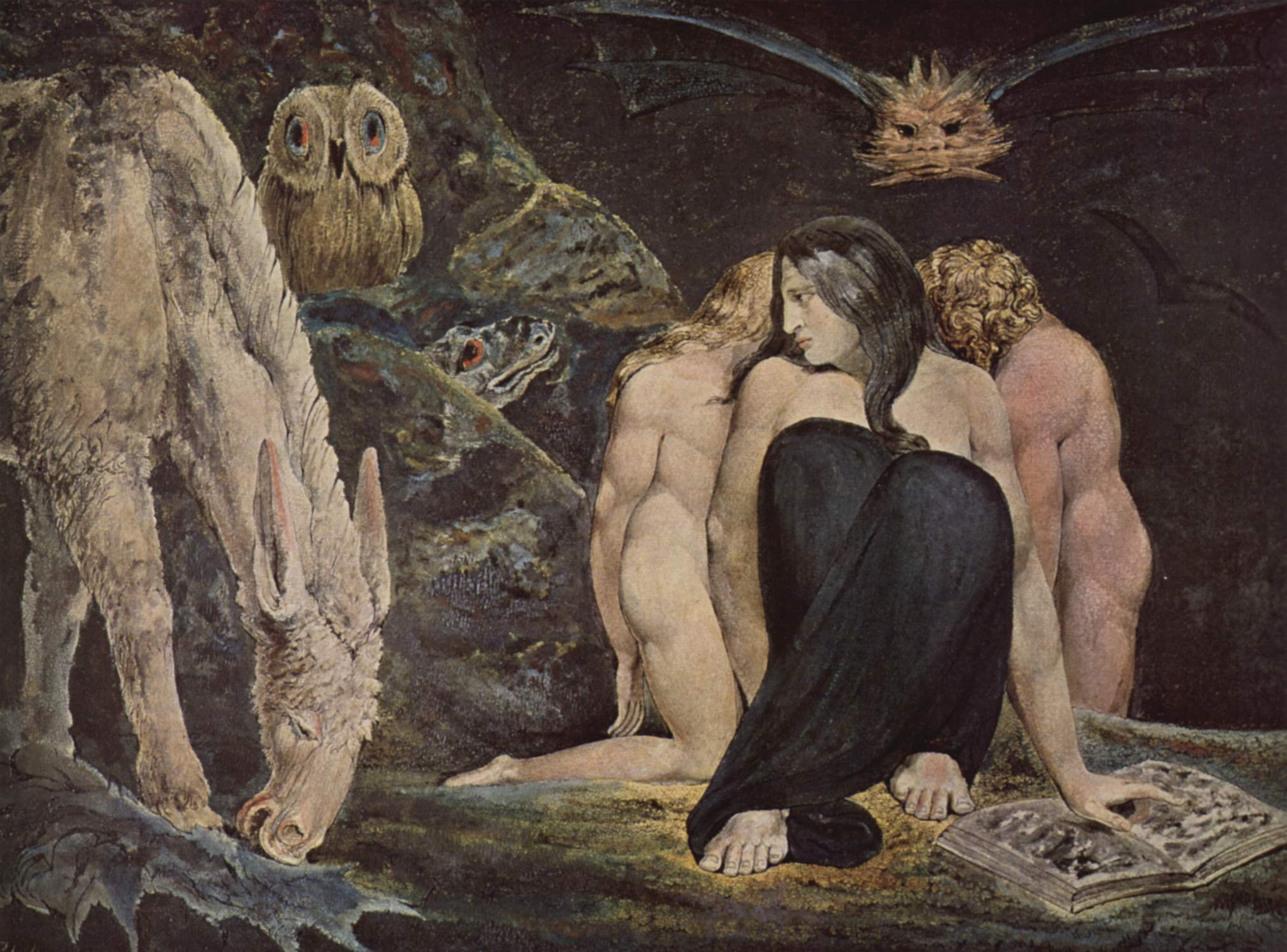
One of Blake's pictures which I find particularly archetypal is called 'Hecate or The Night of Enitharmon's Joy', c. 1795.

Monday, November 01, 2010

The Immortal Man

"When at last I did descry the Immortal Man who cannot die, through evening shades I haste away to close the labors of my Day" (from Gates of Paradise).

It appears (to me at least) that no man has ever been more transparent in his life and works than William Blake. It seems that few of his many brilliant interpreters have come close to an overriding perception of Blake as a person; the one who may have come closest is Middleton Murry although his knowledge of Blake's work seemed relatively superficial.

Blake wandered through the Sea of Time and Space for forty years. To get along in this world was a sorry business for a man of his gifts of Intellect and Moral Fiber. He had a beautiful sunny side (evidenced by his Songs of Innocence), soon and often overridden by his caustic disappropation of the Culture he had to live in.

Life consists of contraries ("Without Contraries is no progression" MHH 3; E34). One of Blake's primary Contraries (and perhaps that of all Men of God) was the choice between following the Divine Vision-- or the 'Main Chance'.

In his letter 51 (Erdman 576) to William Hayley (2004) he told him (and us) that for ('exactly') twenty years he had followed the second one. Until at last [he] "descried the Immortal Man...."

That vision set him free from the tyranny of 'the Main Chance' and gave him some years of Creativity, which ended with a song on his lips. (Look at the last paragraph of Chap1.htm.)