Tuesday, March 15, 2011

The Confession of the Elect

Wikimedia
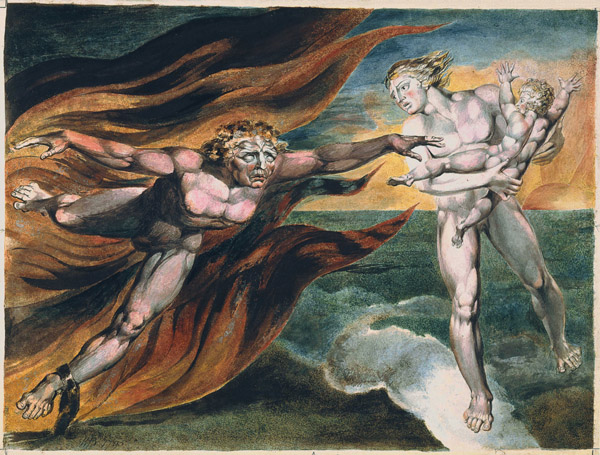
Good and Evil Angels Struggling for Possession of a Child
Original in Tate

In MHH Blake found only two categories of people, whom he called Angels and Devils. He strongly intimated that he belonged to the second category. But when he wrote Milton he described three Classes of Men: the Elect, the Redeemed, and the Reprobate. Blake used these terms ironically; for him they meant something entirely differently than the conventional meanings.  In the course of time it became clear that Blake's Elect were the 'holier than thou', the judgmental, the accusers, the punishers, which of course put them in the same class as Satan, the original Accuser. 

"For Satan flaming with Rintrahs fury hidden beneath his own mildness....  
He created Seven deadly Sins drawing out his infernal scroll,  
Of Moral laws and cruel punishments upon the clouds of Jehovah 
To pervert the Divine voice in its entrance to the earth  
With thunder of war & trumpets sound, with armies of disease 
Punishments & deaths musterd & number'd; Saying I am God alone 
There is no other!" (Milton, plate 9; (Erdman 203)  

The Redeemed were a class of people who believed, under the influence of the Elect that they were convinced of their sin and suffered mightily. In Plates 6 and 7 of Milton Blake defined the three Classes of Men:  

"The Web of Life is woven: & the tender sinews of life created 
 And the Three Classes of Men regulated by Los's hammer.  
The first, The Elect from before the foundation of the World:  
The second, The Redeem'd. The Third, The Reprobate & form'd 
To destruction from the mothers womb: follow with me my plow!  
Of the first class was Satan"  

Although Satan is here included in the Class of Men, Blake basically defines him as a State (in which everyone may find themselves sometimes). Jesus belonged to the reprobates; among the reprobates, the transgressors we read in Isaiah 53: 

"[8] He was taken from prison and from judgment: and who shall declare his generation? for he was cut off out of the land of the living: for the transgression of my people was he stricken. 
[9] And he made his grave with the wicked.... 
[12] because he hath poured out his soul unto death: and he was numbered with the transgressors;" 

And in Milton Plate 13, lines 6 and 7 we read: 

"He died as a Reprobate. he was Punish'd as a Transgressor!  
Glory! Glory! Glory! to the Holy Lamb of God" 

In Milton; Plate 13; Erdman 107 things come out right; it's the Apocalypse:  

"The Elect shall meet the Redeem'd. on Albions rocks they shall meet  
Astonish'd at the Transgressor, in him beholding the Saviour. 
And the Elect shall say to the Redeemd. 
We behold it is of Divine Mercy alone! of Free Gift and Election that we live.  
Our Virtues & Cruel Goodnesses, have deserv'd Eternal Death. 
Thus they weep upon the fatal Brook of Albions River."

Monday, March 14, 2011

HEAVEN BORN

As you read through posts to our blog, you may have noticed themes or threads which run through them. Various ideas resurface in different forms in multiple posts. We are led to do this by following Blake's dominant ideas which are expressed in many guises throughout his works and his lifetime.

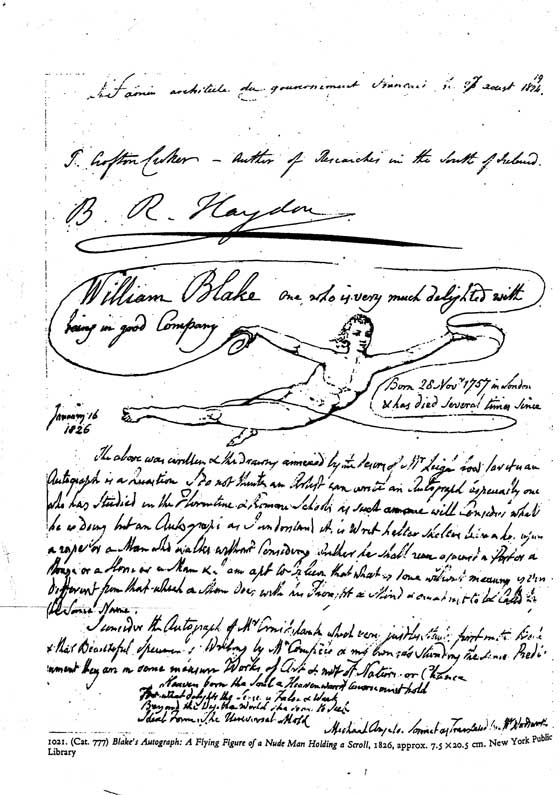
As an example I will follow the post on Michelangelo with another mention of him in another context many years after the portrait of Michelangelo was engraved in 1801. In 1826 Blake produced his 'autograph' in the Album of William Upcott. Mr. Upcott made a hobby of collecting autographs of famous men as well as friends and associates. He eventually had a collection of 2069 in 31 volumes. Blake provided more than a simple autograph.

When Blake says at the beginning of his autograph that he is delighted with the company, he may be referring to all the influential people who also signed their autographs. Blake's reference to having died several times intimates that he has been reborn several times as well. Blake indicates that the word 'autograph' should not be used both for something written unconsciously and something done with 'thought & mind'. His own autograph and two others he considers to be 'Works of Art & not of Nature or Chance.'

Finally I get to the connection with Michelangelo. Blake concludes with a sonnet by Michelangelo translated by Wordsworth. But of course it is not just any sonnet but one which conveys Blake's understanding of the connection of the soul of man with the source from which it originates. Blake's autograph is not only words but a visual image as well. The soaring soul seeking the 'Universal Mold' is seen in the youth with arms outstretched (reminiscent of Glad Day): Blake himself released from the garment of the body.

Miscellaneous Prose, (E698)
"WILLIAM BLAKE one who is very much delighted with being in
good Company
Born 28 Novr 1757 in London
& has died several times since
January 16
1826
The above was written & the drawing annexed by the desire of
Mr Leigh how far it is an Autograph is a Question I do not
think an Artist can write an Autograph especially one who has
Studied in the Florentine & Roman Schools as such an one will
Consider what he is doing but an Autograph as I understand it, is
Writ helter skelter like a hog upon a rope or a Man who walks
without Considering whether he shall run against a Post or a
House or a Horse or a Man & I am apt to believe that what is done
without meaning is very different from that which a Man Does with
his Thought & Mind & ought not to be Calld by the Same Name.
I consider the Autograph of Mr Cruikshank which very justly
stands first in the Book & that Beautiful Specimen of Writing by
Mr Comfield & my own; as standing [in] the same Predicament they
are in some measure Works of Art & not of Nature or Chance

Heaven born the Soul a Heavenward Course must hold
For what delights the Sense is False & Weak
Beyond the Visible World she soars to Seek
Ideal Form, The Universal Mold

Michael Angelo. Sonnet as Translated by Mr Wordsworth"

Sunday, March 13, 2011

Blake's Wrath

A Poison Tree
"I was angry with my friend:
I told my wrath, my wrath did end.
I was angry with my foe:
I told it not, my wrath did grow.

And I watered it in fears
Night and morning with my tears,
And I sunned it with smiles
And with soft deceitful wiles.

And it grew both day and night,
Till it bore an apple bright,
And my foe beheld it shine,
And he knew that it was mine -

And into my garden stole
When the night had veiled the pole;
In the morning, glad, I see
My foe outstretched beneath the tree."
(Blake's Anger)

In a period of time look at this a dozen times. Now look again, and you may see something entirely different (is it double vision?)

Once there was a person who had married a man (late in life) whom she didn't know very well. He was wealthy, and he had a facade that impressed everyone with his goodness and benevolence (Matthew 23:27).

But as time went on, at home he seemed different; he was different; he was very different. He was a paragon of hypocritic holiness (line 26). She assumed the same role; they might fight like cats and dogs, but in public they were paragons of virtue; she (seemed to) loved and served their friends.

Then he died; their friends were no longer hers; she couldn't wait to get clear of them. Her Wrath had found an object in their mutual friends. Sad!

In A Poison Tree we see two Contraries; or is one of them a Negative?

How many ministers see their marriage disintegrate- and ruin their careers. No one knows why she left him for another; but she knows. The minister poured all his goodness on the parishioners, and had none left for his family. Hypocritic holiness was too delightful. So the poor wife leaves, or has a breakdown, or becomes interested in other men. Sad!

Blake felt considerable Wrath against many people, as in Erdman 639:
"I was once looking over the Prints from Rafael & Michael Angelo. in the Library of the Royal Academy Moser came to me & said You should not Study these old Hard Stiff & Dry Unfinishd Works of Art, Stay a little & I will shew you what you should Study. He then went& took down Le Bruns & Rubens's Galleries How I did secretly Rage. I also spoke my Mind [line cut away] I said to Moser, These things that you call Finishd are not Even Begun how can they then, be Finishd? The Man who does not know The Beginning, never can know the End of Art" (from Blake & Michaelangelo)

Blake had a special place (and meaning) for the word wrath:

"The wrath of the lion is the wisdom of God" (MHH, plate 8; Erdman 36);

"Los rag'd and stamp'd the earth in his might & terrible wrath!
He stood and stampd the earth! then he threw down his hammer in rage &
In fury: then he sat down and wept, terrified! Then arose
And chaunted his song, labouring with the tongs and hammer:"
(Jerusalem plate 6; E149)

Saturday, March 12, 2011

BLAKE & MICHELANGELO

In A Blake Dictionary, S. Foster Damon states, "Michelangelo was to Blake's painting what Milton was to Blake's poetry." Although Blake never had the opportunity to see Michelangelo's great frescoes in Italy he became acquainted through prints and copies with the power and mastery of Michelangelo. From the time Blake was a child he acquired prints of the old masters as opportunities arose. He reluctantly sold his collection in 1821 when his finances had reached at a low ebb.


Michelangelo before the Roman Colosseum,
Fuseli's Lectures on Painting from 1801,
Engraved by Blake for Fuseli


Blake had no patience with those who did not recognize that Michelangelo and Raphael stood at a zenith of artistic accomplishment.


Annotations to Reynolds , (E 639)
"I was once looking over the Prints from Rafael & Michael Angelo. in the Library of the Royal Academy Moser came to me & said You should not Study these old Hard Stiff & Dry Unfinishd Works of Art, Stay a little & I will shew you what you should Study. He then went& took down Le Bruns & Rubens's Galleries How I did secretly Rage. I also spoke my Mind [line cut away]I said to Moser, These things that you call Finishd are not Even Begun how can they then, be Finishd? The Man who does not know The Beginning, never can know the End of Art"

What Blake admired in art was the expression of the inner connection with Eternal realities. Art that involved itself with the superficial whether in technical skill, subject matter or popular style, was not worth his attention. He saw in Michelangelo and Raphael the finest ability to present the depths of man in relationship God. He associated their skills with presenting the lineament of man, (God's image in man) as expressed in line and color.

Descriptive Catalogue , Page 46, (E 544)
"Painting and Sculpture as it exists in the remains of Antiquity and in the works of more modern genius, is Inspiration, and cannot be surpassed; it is perfect and eternal. Milton, Shakspeare, Michael Angelo, Rafael, the finest specimens of Ancient Sculpture and Painting, and Architecture, Gothic, Grecian, Hindoo and Egyptian, are the extent of the human mind. The human mind cannot go beyond the gift of God, the Holy Ghost. To suppose that Art can go beyond the finest specimens of Art that are now in the world, is not knowing what Art is; it is being blind to the gifts of the spirit."

Art, to Blake, was the projection in the world of the Imagination in Man. The Imagination being the connection between God and man was in other words the Holy Spirit. Since Art represented the activity of the Divine Body it was not to be taken lightly or distorted by men who had no perception of the infinite

Descriptive Catalogue, Page 27, (E 538)
"As there is a class of men, whose whole delight is in the destruction of men, so there is a class of artists, whose whole art and science is fabricated for the purpose of destroying art. Who these are is soon known: "by their works ye shall know them." All who endeavour to raise up a style against Rafael, Mich.[a]ngelo, and the Antique; those who separate Painting from Drawing; who look if a picture is well Drawn; and, if it is, immediately cry out, that it cannot be well Coloured-- those are the men."

The production of graphic art occupied more of Blake's time and energy than did his writing of poetry and prose. Until the day he died he kept his pen, pencils and paints at the ready to allow the images from his spirit to flow onto the paper.


Friday, March 11, 2011

The Universal Symbols

Mon 07 Mar 2011 08:51:09 AM EST
Perhaps Blake's greatest gift to any of us may be the Faculty of perceiving the realities around us in terms of the Universal Symbols:

For example the character Jane in Jane Eyre may serve as a Christ Symbol (or
in Blake's lexicon as Eternity). Rochester represents Everyman; the flossie, whom he was considering marriage to, is the Way of the World, the purely material.

The half cousin who wanted Jane to marry him and go to Africa with him represents Conventional Religion; his daughters are the Blakean Redeemed.

Rochester's wife is the victim of his accumulated moral failings, which led to spiritual blindness.

The happy ending is echoed by the ending of most Detective Stories. The crime is solved, the detective enjoys real life, the harm remains, but it no longer affects him. In the Sacred Story every tear has been wiped away.

In this post I've expressed the reality of the story in terms of the Blakean universal symbols. That's only one of many ways you might find universal meaning is a work of art.

IMO it was Northrup Frye who introduced to the Blake community (in 1947) to an understanding of Blake's use of symbols,images, metaphor; armed with that knowledge understanding of his poetry, his myth, the import of his pictures proceeded apace. But that's appropriate for another post.

Thursday, March 10, 2011

MENTAL FIGHT

Michael Binding the Dragon
Harvard Art Museums

Rev.12
[7] And there was war in heaven: Michael and his angels fought against the dragon; and the dragon fought and his angels,
[8] And prevailed not; neither was their place found any more in heaven.
[9]
And the great dragon was cast out, that old serpent, called the Devil,
and Satan, which deceiveth the whole world: he was cast out into the
earth, and his angels were cast out with him.

Blake was not timid about describing in violent terms the 'mental fight' necessary to rid man of his bondage to the destructive forces which kept him from recognizing Jesus.


Everlasting Gospel , Page 100, (E 523)
"And Jesus voice in thunders sound
Thus I sieze the Spiritual Prey
Ye smiters with disease make way
I come Your King & God to sieze
Is God a Smiter with disease
The God of this World raged in vain
He bound Old Satan in his Chain
And bursting forth his furious ire
Became a Chariot of fire
Throughout the land he took his course
And traced Diseases to their Source
He cursd the Scribe & Pharisee
Trampling down Hipocrisy
Where eer his Chariot took its way
There Gates of Death let in the Day
Broke down from every Chain & Bar
And Satan in his Spiritual War
Dragd at his Chariot wheels loud howld
The God of this World louder rolld
The Chariot Wheels & louder still
His voice was heard from Zions hill
And in his hand the Scourge shone bright
He scourgd the Merchant Canaanite
From out the Temple of his Mind
And in his Body tight does bind
Satan & all his Hellish Crew
And thus with wrath he did subdue"

Milton, Plate 1, (E 95)
"Bring me my Bow of burning gold:
Bring me my Arrows of desire:
Bring me my Spear: O clouds unfold!
Bring me my Chariot of fire!
I will not cease from Mental Fight,
Nor shall my Sword sleep in my hand:
Till we have built Jerusalem,"

The fiery chariot, the chains and scourge, the bow and spear and the arrows of thought: these are weapons with which hypocrisy, disease and greed shall be defeated and bound and lose their power to harm. Milton Klonsky in William Blake: The Seer and His Visions (Page 65) points out, however, that Michael is entwined with the Dragon and bound by the same chain which binds his contrary. In Milton, Blake intimates that the contention between Michael and Satan is the substance of the world of generation.

Milton, Plate 8, (E 102)
"Till Michael sat down in the furrow weary dissolv'd in tears
Satan who drave the team beside him, stood angry & red
He smote Thulloh & slew him, & he stood terrible over Michael
Urging him to arise: he wept! Enitharmon saw his tears
But Los hid Thulloh from her sight, lest she should die of grief
She wept: she trembled! she kissed Satan; she wept over Michael
She form'd a Space for Satan & Michael & for the poor infected[.]
Trembling she wept over the Space, & clos'd it with a tender Moon"

Wednesday, March 09, 2011

Enlightenments

We all reach God in some way, but among those closest to God were several Soldiers of the Cross. These examples all show a long continued inner turmoil and struggle rewarded in due course by that special gift that Eternity offers to the most faithful.

-----------------------------------------------------

His heart leapt for joy

“Now after I had received that opening from the Lord that to be trained at Oxford or Cambridge was not enough to equip a man to be a minister of Christ, I respected the priests less, and looked more after the dissenting Christians. And among them I saw there was some tenderness, and many of them came afterwards to be convinced, for they had some openings from God. But as I had forsaken all the priests, so I left the separatist Preachers, also, together with those called the most experienced people. For I saw there was no one among them all who could speak to my condition. And when all my hope in them and in all men were gone, so that I had nothing outwardly to help me, nor could I even tell what to do, then, Oh then, I heard a voice which said, “There is one — even Christ Jesus — who can speak to thy condition!” And when I heard it, my heart leapt for joy. Then the Lord showed me why there was no one on the earth who could speak to my condition. The reason was that I was to give him all the glory. For all are concluded under sin, and shut up in unbelief as I had been, so that Jesus Christ might have the pre-eminence, as the one who enlightens, and gives grace, faith and power. So, when God works, who shall prevent it? And I knew this experimentally through my experiences.”"
(From the Journal of George Fox)
------------------------------------------------------------------------------

The Loss of the Burden in Pilgrims Progress

Blake's Illustrations to Bunyan's Pilgrims Progress

Christian is at the Cross; his burden is cast off (at the lower left of the picture):
"To take my cross up day by day,
And serve the Lord with fear.
Now I saw in my dream, that they went on,
and Great-Heart before them. So they went,
and came to the place where Christian's
burden fell off his back and tumbled into a
sepulchre. Here then they made a pause; and
here also they blessed God."
(from Pilgrim's Progress)

----------------------------------------------

His Heart was strangely warmed

.John Wesley was a super-Christian at Oxford. He demanded rigorous adherence to certain practices, carried out by his disciples; they were called methodists.
Once ordained he went to Georgia to save the heathen, but he came to realize that
he needed salvation himself.

Returning to England there was a terrible storm at sea and everyone quailed with fear for their lives; everyone that is except a group of Moravians who continued in prayer and showed great equanimity.

Back in London Wesley continued to worry about his salvation until, in 1738:
"In the evening I went very unwillingly to a society in Aldersgate Street, where one was reading Luther’s preface to the Epistle to the Romans. About a quarter before nine, while he was describing the change which God works in the heart through faith in Christ, I felt my heart strangely warmed. I felt I did trust in Christ, Christ alone, for salvation; and an assurance was given me that he had taken away my sins, even mine, and saved me from the law of sin and death."

He was generally considered to be the greatest man in the 18th century and was thought by many to have saved England from Revolution.
----------------------------------------------------------------------

The Truchsessian Museum

The Enlightenment of William Blake was on this wise:
"O lovely Felpham, parent of Immortal Friendship, to thee I am eternally
indebted for my three years rest from perturbation and the strength I now
enjoy. Suddenly, on the day after visiting the Truchsessian Gallery of
pictures, I was again enlightened with the light I enjoyed in my youth, and
which has for exactly twenty years been closed from me as by a door and by window-shutters. Consequently I can, with confidence, promise you ocular demonstration of my altered state on the plates I am now engraving after
Romney, whose spiritual aid has not a little conduced to my restoration to
the light of Art." (Erdman 756)
He wrote this in Letter 51 (To William Hayley) 23 October 1804.

-----------------------------------------------------

Renunciation

".....Albert Schweitzer's biography of J. S. Bach, written in 1905, had also proved an immediate success. At 30 years of age Schweitzer was tall, broad-shouldered, darkly handsome, and a witty charismatic writer, preacher, and lecturer: clearly, a bright future lay before him. However, one spring morning in 1905, he experienced a
stunning religious revelation: it came to him that at some point in the years just ahead he must renounce facile success and devote himself unsparingly to the betterment of mankind's condition.

Accordingly, several years later, Schweitzer threw over his several careers as author, lecturer, and organ recitalist and plunged into the study of medicine - his aim being to go to Africa as a medical missionary. He won his medical degree in 1912. The year before, he had married Helene Bresslau, a professor's daughter who had studied nursing in order to work at his side in Africa; in 1919 the couple had a daughter, Rhena.

In 1913 the Schweitzers journeyed to what was then French Equatorial Africa. There, after various setbacks, they founded the Albert Schweitzer Hospital at Lambaréné, on the Ogooué River, "at the edge of the primeval forest." This area now lies within the independent West African republic of Gabon. Funds were scarce and equipment primitive, but native Africans thronged to the site, and in the decades that followed, many thousands were treated." (From Answers.Com)

Tuesday, March 08, 2011

BLAKE'S ANGER

Blake is described as having had a fiery personality. He was outspoken and easily provoked by injustice. His more self-controlled or conventional friends or acquaintances may have seen his as overly emotional or expressive. He wrote this poem out of the understanding he developed of his own anger and the anger he saw in others. He didn't advocate 'acting out' anger nor did he advocate suppressing the anger which needed an outlet of expression.

Songs of Innocence and of Experience, Song 49, (E 28)

 
A POISON TREE.

"I was angry with my friend;
I told my wrath, my wrath did end.
I was angry with my foe:
I told it not, my wrath did grow.

And I waterd it in fears,
Night & morning with my tears:
And I sunned it with smiles,
And with soft deceitful wiles.

And it grew both day and night.
Till it bore an apple bright.
And my foe beheld it shine,
And he knew that it was mine.

And into my garden stole,
When the night had veild the pole;
In the morning glad I see;
My foe outstretchd beneath the tree."

Here are two instances of anger, but one is toward a friend, someone who is not the object of projection, someone who is not seen as a threat to one's self-image . Self-knowledge and openness allow the situation to be aired rather than projected. The anger ends because it is not projected, it is not perceived in terms of the friend wanting to do harm or destroy his friend. It is left at the level a of a 'state' that can be annihilated through forgiveness.

The opposite is true with one who is seen as the enemy. With him we neither see ourselves or the other honestly. We feel justified in seeking to do him harm, because our fears tell us us to strike the first blow. The enemy is someone who is carrying our Shadow, the aspects of our psyche which our Ego and Super-ego find most unacceptable and threatening. We strike out against the enemy attempting to to rid ourselves of the inner darkness.

To begin to withdraw projections we must look within first, to identify both good and not good inside ourselves. Then we look in others to find both qualities in them. A good start to withdrawing projection is to focus more on the not good in ourselves and the good in others.

Sunday, March 06, 2011

IMMORTAL EYES

Blake's works both literary and visual were at the service of his VISION. As he defines his 'great task' :

Jerusalem, Plate 5, (E147)
"Trembling I sit day and night, my friends are astonish'd at me.
Yet they forgive my wanderings, I rest not from my great task!
To open the Eternal Worlds, to open the immortal Eyes
Of Man inwards into the Worlds of Thought: into Eternity
Ever expanding in the Bosom of God. the Human Imagination
O Saviour pour upon me thy Spirit of meekness & love:
Annihilate the Selfhood in me, be thou all my life!
Guide thou my hand which trembles exceedingly upon the rock of ages,
While I write of the building of Golgonooza"

Or putting the answer to the question of what was Blake trying to do into the words of his fellow visionary Ezekiel:

Marriage of Heaven and Hell, Plate 13, (E 39)
"I then asked Ezekiel. why he eat dung, & lay so long on his
right & left side? he answerd. the desire of raising
other men into a perception of the infinite"

Blake was not creating pictures or poems but avenues through which our minds might be opened to perceiving 'Eternal Worlds' through 'immortal eyes'. To judge his work worthily is to ask how well he succeeds in being 'transparent to transcendence' (quoting Joseph Campbell).


Songs of Innocence, Song 13
The Little Boy lost

Saturday, March 05, 2011

Redeem the Time

Blake had nothing but extravagant praise for John Wesley:
"But then I rais'd up Whitefield, Palamabron raisd up Westley,
And these are the cries of the Churches before the two
Witnesses['] t
Faith in God the dear Saviour who took on the likeness of men:
Becoming obedient to death, even the death of the Cross
The Witnesses lie dead in the Street of the Great City
No Faith is in all the Earth: the Book of God is trodden under
Foo
t:
He sent his two Servants Whitefield & Westley; were they Prophets
Or were they Idiots or Madmen? shew us Miracles!"
Can you have greater Miracles than these? Men who devote
Their lifes whole comfort to intire scorn & injury & death"

(Milton: plates 22 and 23)

This is evident in the Preface to Chapter Four of Jerusalem:
".....We are told to abstain from fleshly desires that we may lose no
time from the Work of the Lord. Every moment lost, is a moment
that cannot be redeemed every pleasure that intermingles with the
duty of our station is a folly unredeemable & is planted like the
seed of a wild flower among our wheat. All the tortures of
repentance. are tortures of self-reproach on account of our
leaving the Divine Harvest to the Enemy, the struggles of
intanglement with incoherent roots."
Like Wesley the Urgency was upon him.

But he had virtually nothing to say for Methodists (or Quakers for that matter).
--------------------------------------------------------------------
This from the mouth of John Wesley:
'On Redeeming The Time'
By John Wesley
Sermon 93
(text from the 1872 edition - Thomas Jackson, editor)

Redeeming the time. Ephesians 5:16
1. "See that ye walk circumspectly," says the Apostle in the preceding verse, "not as fools, but as wise men, redeeming the time;" saving all the time you can for the best purposes; buying up every fleeting moment out of the hands of sin and Satan, out of the hands of sloth, ease, pleasure, worldly business; the more diligently, because the present "are evil days," days of the grossest ignorance, immorality, and profaneness.
2. This seems to be the general meaning of the words. But I purpose, at present, to consider only one particular way of redeeming the time," namely, from sleep.
3. This appears to have been exceeding little considered, even by pious men. Many that have been eminently conscientious in other respects, have not been so in this. They seemed to think it an indifferent thing, whether they slept more or less; and never saw it in the true point of view, as an important branch of Christian temperance.
That we may have a more just conception hereof, I will endeavour to show,
I. What it is to "redeem the time" from sleep.
III. The evil of not redeeming it. And
III. The most effectual manner of doing it.

I.
1. And, First, What is it to "redeem the time" from sleep? It is, in general, to take that measure of sleep every night which nature requires, and no more; that measure which is the most conducive to the health and vigour both of the body and mind.
2. But it is objected, "One measure will not suit all men; -- some require considerably more than others. Neither will the same measure suffice even the same persons at one time as at another. When a person is sick, or, if not actually so, yet weakened by preceding sickness, he certainly wants more of this natural restorative, than he did when in perfect health. And so he will when his strength and spirits are exhausted by hard or long-continued labour."
3. All this is unquestionably true, and confirmed by a thousand experiments. Whoever, therefore, they are that have attempted to fix one measure of sleep for all persons did not understand the nature of the human body, so widely different in different persons; as neither did they who imagined that the same measure would suit even the same person at all times. One would wonder, therefore, that so great a man as Bishop Taylor should have formed this strange imagination; much more, that the measure which he has assigned for the general standard should be only three hours in four-and- twenty. That good and sensible man, Mr. Baxter, was not much nearer the truth; who supposes four hours in four and twenty will suffice for any man. I knew an extremely sensible man, who was absolutely persuaded that no one living needed to sleep above five hours in twenty-four. But when he made the experiment himself, he quickly relinquished the opinion. And I am fully convinced, by an observation continued for more than fifty years, that whatever may be done by extraordinary persons, or in some extraordinary cases (wherein persons have subsisted with very little sleep for some weeks, or even months) a human body can scarce continue in health and vigour, without at least, six hours' sleep in four-and-twenty. Sure I am, I never met with such an instance: I never found either man or woman that retained vigorous health for one year, with a less quantity of sleep than this.
4. And I have long observed, that women, in general, want a little more sleep than men; perhaps, because they are, in common of a weaker, as well as a moister, habit of body. If, therefore, one might venture to name one standard, (though liable to many exceptions and occasional alterations) I am inclined to think this would come near to the mark: Healthy men, in general, need a little above six hours' sleep, healthy women, a little above seven, in four-and-twenty. I myself want six hours and a half, and I cannot well subsist with less.
5. If anyone desires to know exactly what quantity of sleep his own constitution requires, he may very easily make the experiment which I made about sixty years ago: I then waked every night about twelve or one, and lay awake for some time. I readily concluded that this arose from my lying longer in bed than nature required. To be satisfied, I procured an alarum, which waked me the next morning at seven; (near an hour earlier than I rose the day before) yet I lay awake again at night. The second morning I rose at six; but, notwithstanding this, I lay awake the second night. The third morning I rose at five; but, nevertheless, I lay awake the third night. The fourth morning I rose at four; (as, by the grace of God, I have done ever since) and I lay awake no more. And I do not now lie awake (taking the year round) a quarter of an hour together in a month. By the same experiment, rising earlier and earlier every morning, may anyone find how much sleep he really wants.

II.
1. "But why should anyone be at so much pains? What need is there of being so scrupulous? Why should we make ourselves so particular? What harm is there in doing as our neighbours do? -- suppose in lying from ten till six or seven in summer, and till eight or nine in winter?"
2. If you would consider this question fairly, you will need a good deal of candour and impartiality; as what I am about to say will probably be quite new; different from anything you ever heard in your life; different from the judgment, at least from the example, of your parents and your nearest relations; nay, and perhaps of the most religious persons you ever were acquainted with. Lift up, therefore, your heart to the Spirit of truth, and beg of him to shine upon it, that without respecting any man's person, you may see and follow the truth as it in Jesus.
3. Do you really desire to know what harm there is in not redeeming all the time you can from sleep? suppose in spending therein an hour a day more than nature requires? Why, First, it hurts your substance; it is throwing away six hours a week which might turn to some temporal account. If you can do any work, you might earn something in that time, were it ever so small. And you have no need to throw even this away. If you do not want it yourself, give it to them that do; you know some of them that are not far off. If you are of no trade, still you may so employ the time that it will bring money, or money's worth, to yourself, or others.
4. The not redeeming all the time you can from sleep, the spending more time therein than your constitution necessarily requires, in the Second place, hurts your health. Nothing can be more certain than this, though it is not commonly observed, because the evil steals on you by slow and insensible degrees. In this gradual and almost imperceptible manner it lays the foundation of many diseases. It is the chief real (though unsuspected) cause of all nervous diseases in particular. Many inquiries have been made, why nervous disorders are so much more common among us than among our ancestors. Other causes may frequently concur; but the chief is, we lie longer in bed. Instead of rising at four, most of us who are not obliged to work for our bread lie till seven, eight, or nine. We need inquire no farther. This sufficiently accounts for the large increase of these painful disorders.
5. It may be observed, that most of these arise, not barely from sleeping too long, but even from what we imagine to be quite harmless, the lying too long in bed. By soaking (as it is emphatically called) so long between warm sheets, the flesh is, as it were, parboiled, and becomes soft and flabby." The nerves, in the mean time, are quite unstrung, and all the train of melancholy symptoms -- faintness, tremors, lowness of spirits, (so called) come on, till life itself is a burden.
6. One common effect of either sleeping too long, or lying too long in bed, is weakness of sight, particularly that weakness which is of the nervous kind. When I was young, my sight was remarkably weak. Why is it stronger now than it was forty years ago? I impute this principally to the blessing of God, who fits us for whatever he calls us to. But undoubtedly the outward means which he has been pleased to bless was the rising early in the morning.
7. A still greater objection to the not rising early, the not redeeming all the time we can from sleep, is, it hurts the soul, as well as the body; it is a sin against God. And this indeed it must necessarily be, on both the preceding accounts. For we cannot waste, or (which comes to the same thing) not improve, any part of our worldly substance, neither can we impair our own health, without sinning against Him.
8. But this fashionable intemperance does also hurt the soul in a more direct manner. It sows the seeds of foolish and hurtful desires; it dangerously inflames our natural appetites; which a person stretching and yawning in bed is just prepared to gratify. It breeds and continually increases sloth, so often objected to the English nation. It opens the way, and prepares the soul, for every other kind of intemperance. It breeds an universal softness and faintness of spirit, making us afraid of every little inconvenience, unwilling to deny ourselves any pleasure, or to take up or bear any cross. And how then shall we be able (without which we must drop into hell) to "take the kingdom of heaven by violence?" It totally unfits us for "enduring hardship as good soldiers of Jesus Christ;" and, consequently, for "fighting the good fight of faith, and laying hold on eternal life."
9. In how beautiful a manner does that great man, Mr. [William] Law treat this important subject! [Viz., Redeeming time from Sleep] Part of his words I cannot but here subjoin, for the use of every sensible reader.
"I take it for granted that every Christian who is in health is up early in the morning. For it is much more reasonable to suppose a person is up early because he is a Christian, than because he is a labourer, or a tradesman, or a servant.
"We conceive an abhorrence of a man that is in bed when he should be at his labour. We cannot think good of him, who is such a slave to drowsiness as to neglect his business for it.
"Let this, therefore, teach us to conceive how odious we must appear to God, if we are in bed, shut up in sleep, when we should be praising God; and are such slaves to drowsiness as to neglect our devotions for it.
"Sleep is such a dull, stupid state of existence, that, even among mere animals, we despise them most which are most drowsy. He, therefore, that chooses to enlarge the slothful indolence of sleep, rather than be early at his devotions, chooses the dullest refreshment of the body, before the noblest enjoyments of the soul. He chooses that state which is a reproach to mere animals, before that exercise which is the glory of angels.
10. "Besides, he that cannot deny himself this drowsy indulgence, is no more prepared for prayer when he is up, than he is prepared for fasting or any other act of self-denial. He may indeed more easily read over a form of prayer, than he can perform these duties; but he is no more disposed for the spirit of prayer, than he is disposed for fasting. For sleep thus indulged gives a softness to all our tempers, and makes us unable to relish any thing but what suits an idle state of mind, as sleep does. So that a person who is a slave to this idleness is in the same temper when he is up. Every thing that is idle or sensual pleases him. And every thing that requires trouble or self-denial, is hateful to him, for the same reason that he hates to rise.
11. "It is not possible for an epicure to be truly devout. He must renounce his sensuality, before he can relish the happiness of devotion. Now, he that turns sleep into an idle indulgence, does as much to corrupt his soul, to make it a slave to bodily appetites, as an epicure does. It does not disorder his life, as notorious acts of intemperance do; but, like any more moderate course of indulgence, it silently, and by smaller degrees, wears away the spirit of religion, and sinks the soul into dullness and sensuality.
"Self-denial of all kinds is the very life and soul of piety; but he that has not so much of it as to be able to be early at his prayers cannot think that he has taken up his cross, and is following Christ.
"What conquest has he got over himself? What right hand has he cut off? What trials is he prepared for? What sacrifice is he ready to offer to God, who cannot be so cruel to himself as to rise to prayer at such a time as the drudging part of the world are content to rise to their labour?
12. "Some people will not scruple to tell you, that they indulge themselves in sleep because they have nothing to do; and that if they had any business to rise to they would not lose so much of their time in sleep. But they must be told that they mistake the matter; that they have a great deal of business to do; they have a hardened heart to change; they have the whole spirit of religion to get. For surely he that thinks he has nothing to do, because nothing but his prayers want him, may justly be said to have the whole spirit of religion to seek.
"You must not therefore consider how small a fault it is to rise late; but how great a misery it is to want the spirit of religion, and to live in such softness and idleness as make you incapable of the fundamental duties of Christianity.
"If I was to desire you not to study the gratification of your palate, I would not insist upon the sin of wasting your money, though it is a great one; but I would desire you to renounce such a way of life, because it supports you in such a state of sensuality as renders you incapable of relishing the most essential doctrines of religion.
"For the same reason, I do not insist much upon the sin of wasting your time in sleep, though it be a great one; but I desire you to renounce this indulgence, because it gives a softness and idleness to your soul, and is so contrary to that lively, zealous, watchful, self-denying spirit, which was not only the spirit of Christ and his Apostles, and the spirit of all the saints and martyrs that have ever been among men, but must be the spirit of all those who would not sink in the common corruption of the world.
13. "Here, therefore, we must fix our charge against this practice. We must blame it, not as having this or that particular evil, but as a general habit that extends itself through our whole spirit, and supports a state of mind that is wholly wrong.
"It is contrary to piety; not as accidental slips or mistakes in life are contrary to it; but in such a manner as an ill state of body is contrary to health.
"On the other hand, if you was to rise early every morning, as an instance of self-denial, as a method of renouncing indulgence, as a means of redeeming your time and fitting your spirit for prayer, you would soon find the advantage. This method, though it seems but a small circumstance, might be a means of great piety. It would constantly keep it in your mind, that softness and idleness the bane of religion. It would teach you to exercise power over yourself, and to renounce other pleasures and tempers that war against the soul. And what is so planted and watered, will certainly have an increase from God."

III.
1. It now only remains to inquire, in the Third place, how we may redeem the time, how we may proceed in this important affair. In what manner shall we most effectually practise this important branch of temperance?
I advise all of you who are thoroughly convinced of the unspeakable importance of it, suffer not that conviction to die away, but instantly begin to act suitably to it. Only do not depend on your own strength; if you do, you will be utterly baffled. Be deeply sensible that as you are not able to do anything good of yourselves, so here, in particular, all your strength, all your resolution, will avail nothing. Whoever trusts in himself will be confounded. I never found an exception. I never knew one who trusted in his own strength that could keep this resolution for a twelve-month.
2. I advise you, Secondly, cry to the Strong for strength. Call upon Him that hath all power in heaven and earth, and believe that he will answer the prayer that goeth not out of feigned lips. As you cannot have too little confidence in yourself, so you cannot have too much in him. Then set out in faith; and surely his strength shall be made perfect in your weakness.
3. I advise you, Thirdly, add to your faith, prudence: Use the most rational means to attain your purpose. Particularly begin at the right end, otherwise you will lose your labour. If you desire to rise early, sleep early; secure this point at all events. In spite of the most dear and agreeable companions, in spite of their most earnest solicitations, in spite of entreaties, railleries, or reproaches, rigorously keep your hour. Rise up precisely at your time, and retire without ceremony. Keep your hour, notwithstanding the most pressing business: Lay all things by till the morning. Be it ever so great a cross, ever so great self-denial, keep your hour, or all is over.
4. I advise you, Fourthly, be steady. Keep your hour of rising without intermission. Do not rise two mornings, and lie in bed the third; but what you do once, do always. "But my head aches." Do not regard that. It will soon be over. "But I am uncommonly drowsy; my eyes are quite heavy." Then you must not parley; otherwise it is a lost case; but start up at once. And if your drowsiness does not go off, lie down for awhile an hour or two after. But let nothing make a breach upon this rule, rise and dress yourself at your hour.
5. Perhaps you will say, "The advice is good; but it comes too late! I have made a breach already. I did rise constantly and for a season, nothing hindered me. But I gave way by little and little, and I have now left it off for a considerable time." Then, in the name of God, begin again! Begin to-morrow; or rather to-night, by going to bed early, in spite of either company or business. Begin with more self-diffidence than before, but with more confidence in God. Only follow these few rules, and, my soul for yours, God will give you the victory. In a little time the difficulty will be over; but the benefit will last for ever.
6. If you say, "But I cannot do now as I did then; for I am not what I was: I have many disorders, my spirits are low, my hands shake; I am all relaxed," -- I answer: All these are nervous symptoms; and they all partly arise from your taking too much sleep: Nor is it probable they will ever be removed, unless you remove the cause. Therefore, on this very account, (not only to punish yourself for your folly and unfaithfulness, but) in order to recover your health and strength, resume your early rising. You have no other possible means of recovering, in any tolerable degree, your health both of body and mind. Do not murder yourself outright. Do not run on in the path that leads to the gates of death! As I said before, so I say again, In the name of God, this very day, set out anew. True, it will be more difficult than it was at the beginning. But bear the difficulty which you have brought upon yourself, and it will not last long. The Sun of Righteousness will soon arise again, and will heal both your soul and your body.
7. But do not imagine that this single point, rising early, will suffice to make you a Christian. No: Although that single point, the not rising, may keep you a Heathen, void of the whole Christian spirit; although this alone (especially if you had once conquered it) will keep you cold, formal, heartless, dead, and make it impossible for you to get one step forward in vital holiness, yet this alone will go but a little way to make you a real Christian. It is but one step out of many; but it is one. And having taken this, go forward. Go on to universal self-denial, to temperance in all things, to a firm resolution of taking up daily every cross whereto you are called. Go on, in a full pursuit of all the mind that was in Christ, of inward and then outward holiness; so shall you be not almost but altogether, a Christian; so shall you finish your course with joy: You shall awake up after his likeness, and be satisfied.
[Jan. 20, 1782]

Acknowlegements
[Edited by George Lyons for the Wesley Center for Applied Theology.] The text for John Wesley's sermons originally came from the Christian Classics Ethereal Library.
Friday, March 04, 2011

THE POET & MYSTIC

The visionary state, the experience of seeing fourfold, which so characterizes Blake's poetry is not easy for ordinary mortals to grasp. Many who would aspire to enter such a state would call it a mystical experience. Pierre Berger wrote the book titled William Blake: Poet and Mystic in which he attempts: "to give as comprehensible a description as possible of the universe that he saw in his visions. Finally, and chiefly, we shall endeavour to show the influence of the visionary upon the poet, searching his works for signs of the mystical and imaginative spirit that produced them".

The progression through the four states which we treated in the post On the Walk to Lavant is explored at length by Berger with emphasis on the the visionary state:
"It is when he leaves our world to describe the other that his imagination attains its full creative power. His creations are no longer the personification of a material object, the soul of some lifeless thing, the embodiment of a metaphor : they come whole from his brain, produced out of nothing. In these far-off regions, our world has ceased to exist, even as a delusive mirage. 'Nothing is, but what is not.' [ Macbeth, Act I, Sc. iii] This imaginative quality Blake regarded as indispensable in all true art. 'The man who never in his mind and thoughts travelled to heaven is no artist.' [ Notes to Sir Joshua Reynolds : Discourse III (E 647).] Now, therefore, the trend of his imagination is towards the evocation of things without form, the creation of beings that exist only in the nebulous kingdom of his dreams.
But, according to his own view, it is the true sign of genius to see the things of the imagination as clearly as we see the things of the material world, in the same abundance, and with the same precision of detail, the same distinctness of line, form and colour.
'A spirit and a vision are not, as the modern philosophy supposes, a cloudy vapour, or a nothing. They are organised and minutely articulated beyond all that the mortal and perishing nature can produce. He who does not imagine in stronger and better lineaments and in stronger and better light than his perishing and mortal eye can see, does not imagine at all. The painter of this work {i.e.y Blake) asserts that all his imaginations appear to him infinitely more perfect and more minutely organised than anything seen by his mortal eye. Spirits are organised men.' [ Descriptive Catalogue : No. IV. (E 541)]

We might expect, therefore, to find in his representation of his dreams the same impression of strength and solidity that we ourselves get from contact with material things.
...
His most vigorous descriptions are those of visionary scenes : Los working at his forge and engaged in the building of Golgonooza ; the Zoas waging their eternal wars in the human soul and becoming vast personalities, each with his own universe ; creations that are half symbolic, half allegorical, the languishing Thel, the love-tormented Oothoon, the jealous Theotormon, Vala tender and sinful, Jerusalem the divine bride. We have only to recall all these myths to realise the power of their creator's imagination. It is in this, then, that Blake's strength lies : in the faculty that enabled him to create a world wholly different from ours, freed from the laws of time and space, existing only in his dreams, and as far removed from reality as the wildest ideal can be. Nowhere else can we find Titans like the Zoas, worlds as terrific as Urizen's, a paradise as sweet as the " moony " Beulah, or bodiless creatures of the air like the spirits by which the Prophetic Books are peopled. (Page 264-5)
...
The other poets are always struck with wonder and astonishment at the vastness of their own creations : they set their characters in action, and then watch their acts in terror and admiration. Blake has left the earth so utterly out of sight that his personages do not appear to him as gigantic at all. He has no longer any consciousness of what is possible or impossible from man's point of view. He has forgotten all the physical laws which his characters are perpetually defying. He feels no wonder at seeing them die and come to life again, divide and become absorbed in each other, traverse measureless abysses, crush whole worlds in their titanic struggles, and make the infinite resound with their shouting. To him, there is nothing miraculous in all these things. They are the common phenomena of his visionary universe, and his poems are full of them. It is from this that the Prophetic Books derive the tone of more than Miltonic grandeur which is so often their chief characteristic, and which makes them read like fragments of a great epic history, re-echoing the tumults of vast prehistoric wars, or the thunders of some frightful cosmic revolution in the world of the infinite." (Page 270)

Blake's Water-Colours for the Poems of Thomas Gray
The Descent of Odin

In these words Blake invites us to join him in his visionary world and be happy.

Descriptions of the Last Judgment, (E 560)
"If the Spectator could Enter into these Images in his
Imagination approaching them on the Fiery Chariot of his
Contemplative Thought if he could Enter into Noahs Rainbow or
into his bosom or could make a Friend & Companion of one of these
Images of wonder which always intreats him to leave mortal things
as he must know then would he arise from his Grave then would he
meet the Lord in the Air & then he would be happy"

Thursday, March 03, 2011

Blake's Urgency

In his later years Blake wrote and drew with a keen sense of
urgency. Undoubtedly familar with Ephesians 5:16 he may have
read John Wesley's famous sermon On Redeeming the Time.

Blake had little to say about Wesley and nothing I can find re the Wesleyans-- for some rather obvious reasons: in those days
Wesley's Methodists were part of the Anglican Church for which
Blake had little or no use; they were not churches, but chapels!
(In UMC and other Methodists groups today many churches carry the name of Wesley Chapel.)

How did John Wesley impact our hero? At one place he gives the credit due:
"But then I rais'd up Whitefield, Palamabron raisd up Westley,
And these are the cries of the Churches before the two
Witnesses['] t
Faith in God the dear Saviour who took on the likeness of men:
Becoming obedient to death, even the death of the Cross
The Witnesses lie dead in the Street of the Great City
No Faith is in all the Earth: the Book of God is trodden under
Foo
t:
He sent his two Servants Whitefield & Westley; were they Prophets
Or were they Idiots or Madmen? shew us Miracles!"
Can you have greater Miracles than these? Men who devote
Their lifes whole comfort to intire scorn & injury & death"

Milton Plate 22 and 23)

In one particular the two men had much in common.
Wesley wrote a sermon on Ephesian 5, verse 16:
"Redeeming the time, because the days are evil."

Blake described this same sense of urgency in the beginning of
Chapter Four of Jerusalem (Plate 77), which includes:

"We are told to abstain from fleshly desires that we may lose no time from the Work of the Lord. Every moment lost, is a moment that cannot be redeemed every pleasure that intermingles with the duty of our station is a folly unredeemable & is planted like the seed of a wild flower among our wheat."

And even more pointed are two lines near the end of Gates of Paradise (For the Sexes):
"
But when once I did descry The Immortal Man that cannot Die
Thro evening shades I haste away To close the Labours of my Day" (Erdman 269)

For all of us as the years grow longer and the days shorter, we may have a similar sense of urgency, depending upon to what degree we can say "
Lord, now lettest thou thy servant depart in peace, according to thy word:
For mine eyes have seen thy salvation, Which thou hast prepared before the face of all people" (Luke 2:29-31). Such was the case with William Blake.

Wednesday, March 02, 2011

ON THE WALK TO LAVANT

Illustration to Pastorals of Virgil

This section of a letter Blake wrote to his most trusted friend, Thomas Butts, contains a passage which is often quoted because it reveals Blake's meaning of Fourfold vision. The verses leading up to the well known verse deserve attention too.

Letters, (E 721)
To Thomas Butts (Nov. 22, 1802)...
"But I will bore you more with some Verses which My Wife desires me to Copy out & send you with her kind love & Respect they were Composed a twelvemonth ago while Walking from Felpham to Lavant to meet my
Sister...

"Must the duties of life each other cross"
"Must every joy be dung & dross"
"Must my dear Butts feel cold neglect"
"Because I give Hayley his due respect'
"Must Flaxman look upon me as wild"
"And all my friends be with doubts beguild'
"Must my Wife live in my Sisters bane"
"Or my sister survive on my Loves pain'
"The curses of Los the terrible shade"
"And his dismal terrors make me afraid"

So I spoke & struck in my wrath
The old man weltering upon my path
Then Los appeard in all his power
In the Sun he appeard descending before
My face in fierce flames in my double sight
Twas outward a Sun: inward Los in his might

"My hands are labourd day & night"
"And Ease comes never in my sight"
"My Wife has no indulgence given"
"Except what comes to her from heaven"
"We eat little we drink less"
"This Earth breeds not our happiness"
"Another Sun feeds our lifes streams"
"We are not warmed with thy beams"
"Thou measurest not the Time to me"
"Nor yet the Space that I do see"
"My Mind is not with thy light arrayd"
"Thy terrors shall not make me afraid"

When I had my Defiance given
The Sun stood trembling in heaven
The Moon that glowd remote below
Became leprous & white as snow
And every Soul of men on the Earth
Felt affliction & sorrow & sickness & dearth
Los flamd in my path & the Sun was hot
With the bows of my Mind & the Arrows of Thought
My bowstring fierce with Ardour breathes
My arrows glow in their golden sheaves
My brothers & father march before
The heavens drop with human gore"

- poem continued below comments -

The poem enclosed in a letter to Butts is occasioned by the mundane event of a walk to Lavant to meet his sister. Blake's thoughts were not on the walk itself or places he traveled through. As he walked he composed a poem which was provoked by thoughts of relationships with the people in his life. Apparently, during the journey, he went through the complete four stage process of transcending from single to fourfold vision:

1. Being aware of outward events:
'Must the duties of life each other cross'
2. Seeing reality beyond the outer:
"This Earth breeds not our happiness"
"Another Sun feeds our lifes streams"
3. Seeing the universal experience:
'And every Soul of men on the Earth
Felt affliction & sorrow & sickness & dearth'
4. Entering the visionary, creative state:
'With the bows of my Mind & the Arrows of Thought
My bowstring fierce with Ardour breathes
My arrows glow in their golden sheaves'

The ability to experience fourfold was both a gift and a burden to Blake. He claimed elsewhere in this poem that double vision was always with him but his friends and associates were not aware of his transcending the mundane frictions of human relations consistently. The squabbles and affronts of business and intellect made trouble for Blake. But he also had trouble because he saw the roots of human behavior and the implication of seeing only immediate individual consequences of everything going on rather than seeing permanent consequences for humanity. He was often misunderstood because his experience of the spiritual dimensions went beyond that of his associates.

In this poem Blake appears at a very personal level. We see his struggle and triumph but we know the process is not an accomplished fact; it will be repeated as often as necessary to reach the final gate of paradise.

"Now I a fourfold vision see
And a fourfold vision is given to me
Tis fourfold in my supreme delight
And three fold in soft Beulahs night
And twofold Always. May God us keep
From Single vision & Newtons sleep"
__________________________________________________________________

This seems to be the simplest way to connect to the complete poem
enter  https://blake.lib.asu.edu/html/home.html
click on the final entry [The Letters] (Index)
click on Letter 23 To Thomas Butts
 __________________________________________________________________

Complete Letter to Butts this link is invalid but you can use the concordance to read the complete poem.  

Go to CONCORDANCE
http://victorian-studies.net/concordance/blake/

USING DOWN ARROWS CHOOSE
 Blake, William   and    Poetry and Prose

QUERY
Enter phrase for search (for instance 'fourfold vision') CLICK search

from list of instances RIGHT CLICK ON NUMBER (left column) of matching instance

CHOOSE open in new tab and GO TO NEW TAB which opens
 
THE POEM BEGINS ON LINE NUMBER 39145


Tuesday, March 01, 2011

Blake's Faith - II

A Prayer to God:
"that they may be one, even as we are one: I in them
and thou in me, that they may be made perfect in one."
(John 17:20-22)

The theologues of the forties and fifties learned from Paul Tillich that everyone has an ultimate concern, which is his God. People in Alcoholics Anonymous have told some of their theologically confused members that, lacking any better God, they may worship a 'pot on the mantle', anything at all to break that devotion to the bottle which is actually the worship of a lower form of the self. To remain sober one must believe in a Higher Power of some sort.

The important thing is that one's Higher Power not be a projection of some lower form of self; that's idolatry. The person seriously interested in ultimate reality engages in a life long search for the most real image he can discover, the image of his God. A person's best image of God nurtures his spirit as he goes through life.

The Bible contains a multiplicity of images of God. For example we read about the finger of God, the nostrils of God, even the backside of God. All his life Blake maintained a high level of respect for the Bible as vision. Nevertheless he refused to worship other men's visions of God:

"I (you!) must create a system, or be enslaved by another man's"
(Jerusalem, 10.21; E153)".

He's saying that we have a choice: to adhere to the conventions (whatever conventions may be for us) or to create our own values from our own experience. Blake did this for a lifetime, creating his own myth of meaning, and with his creative works he expressed it over and over again.

The only thing Blake really trusted was his own immediate direct vision, and he possessed his soul in varying degrees of patience until that vision clarified (and you may be sure that it was criticized, corrected and amended over and over again. The 'Felpham Moment' marks the decisive clarification of Blake's vision of God. Even then the Father remained for Blake a symbol of subjection to the other man's vision, of spiritual tyranny. His own vision came to center upon Jesus.

Nobodaddy, Father of Jealousy, Urizen, all the creator and authority figures that filled the young Blake's mind, represented in essence his rejection of other men's images of God. The "Vision of Ahania" (4Z: chapter 3, 39.13ff; E327) expressed Blake's dawning awareness of a fundamental spiritual truth: the transcendental image which had dominated institutional religion is most often a projection of man's primitive negativities. The ultimate negativities, repressed into the unconscious, irupt into consciousness as the ultimate positivity, a God built upon sand, a "shadow from his wearied intellect". This passage, probably as much as anything else in his experience, inspired Thomas Altizer in the sixties to launch his Death of God movement.

Blake depreciated the God of Law and Wrath in order to exalt the God of Forgiveness. He believed that the far off, elusive, mysterious, transcendental image of God freezes man into spiritual immobility. He wanted to liberate men's minds from this imposture and put them in touch with the true source of creativity:

"Seek not thy heavenly father then beyond the skies,
There Chaos dwells & ancient Night & Og & Anak old. " (Milton 20:33-34)

"I am not a God afar off, I am a brother and friend;
Within your bosoms I reside, and you reside in me:
Lo! we are One, forgiving all Evil, Not seeking recompense.
Ye are my members...."
(Jerusalem 4:18-21)

The prophetic poems which Blake wrote prior to 1800 concern his efforts to know, describe and deal with the old, jealous, wrathful, creator image; he finally dismissed it as a "shadow from his wearied intellect" (FZ3-40.3). The later, major prophecies, Milton and Jerusalem, also contain this theme, happily outweighed by the new vision.

Prior to the Felpham Moment Blake had worshipped his own visionary endowment, his Pot on the Mantle; he called it the Poetic Genius and later the Imagination.

The evolving figure of Los building Golgonooza personified what we might call a pre-Christian God. When grace fell upon Blake, he came to see the true embodiment of God in Jesus.

In a letter (22) to his friend and patron, Thomas Butts, he described the experience of redemption that had come to him:

"And now let me finish with assuring you that tho I have been very unhappy I am so no longer I am again Emerged into the light of Day I still & shall to Eternity Embrace Christianity and Adore him who is the Express image of God..."
(Erdman 718)