Saturday, November 10, 2012

Sexuality 6


At the very beginning of Blakes' poem, Jerusalem, he makes us fully aware that the new 
woman represents something entirely other than the disreputable matter of earlier writing. 
She is just the opposite; she is Spirit or rather the manifestation of Spirit in this world. 
The Saviour confronts the sleeping Albion and identifies his disease,
"where hast thou hidden thy Emanation, lovely Jerusalem". 
But the "perturbed Man" denies Christ and denies Jerusalem: 

"Jerusalem is not! her daughters are indefinite: By demonstration man alone can live, and not by faith." 

A few lines further the poet announces that 
"Jerusalem is scatter'd abroad like a cloud of smoke thro' nonentity.
Moab & Ammon & Amalek & Canaan & Egypt & Aram
Receive her little ones for sacrifices and the delights of
cruelty."

The place names represent the six heathen nations or the powers of evil that surround 
the Chosen People. The import of all this in another biblical phrase is that "He who 
departs from evil makes himself a prey". 

Very shortly we meet the Daughters of Albion; they represent the feminine dimension of
the materialistic impulses of Man: 

"Names anciently remember'd, but now contemn'd as fictions. Although in every bosom 
they controll our Vegetative powers". 

Eventually a redemptive moment occurs when, Los having subdued and integrated his 
Spectre, his Sons and Daughters "come forth from the Furnaces".

Erin, like America a symbol of redemption, addresses Jerusalem: 

"Vala is but thy Shadow, 0 thou loveliest among women!
A shadow animated by thy tears, 0 mournful Jerusalem!
Why wilt thou give to her a Body whose life is but a Shade?
Her joy and love, a shade, a shade of sweet repose:
But animated and vegetated she is a devouring Worm.
What shall we do for thee, 0 lovely mild Jerusalem?"

The fallen Sons of Albion express the opposite viewpoint. In Plate 18, in a prophetic
statement worthy of Isaiah in its irony, the twelve Sons of Albion describe explicitly and
in detail their relationship to Jerusalem and to Vala:

Cast, Cast ye Jerusalem forth! The Shadow of delusions!

The Harlot daughter! Mother of pity and dishonourable forgiveness!
Our Father Albion's sin and shame! But father now no more,
Nor sons, nor hateful peace & love, nor soft complacencies,
With transgressors meeting in brotherhood around the table
Or in the porch or garden. No more the sinful delights
Of age and youth, and boy and girl, and animal and herb,
And river and mountain, and city & village, and house and family,
Beneath the Oak and Palm, beneath the Vine and fig tree,
In Self-denial!--But War and deadly contention Between
Father and Son, and light and love! All bold asperities
Of Haters met in deadly strife, rending the house & garden
The unforgiving porches, the tables of enmity, and beds
And chambers of trembling & suspicion, hatreds of age & youth,
And boy & girl, & animal & herb, & river & mountain,
And city & village, and house & family, That the Perfect
May live in glory, redeem'd by Sacrifice of the Lamb
And of his children before sinful Jerusalem. To build
Babylon the City of Vala, the Goddess Virgin-Mother.
She is our Mother! Nature! Jerusalem is our Harlot-Sister
Return'd with Children of pollution to defile our House
With Sin and Shame. Cast, Cast her into the Potter's field!
Her little ones She must slay upon our Altars, and her aged
Parents must be carried into captivity: to redeem her Soul,
To be for a Shame & a Curse, and to be our Slaves for ever.

In an extended passage too long to quote here Blake gives a colloquy with the fainting, 
confused Albion and the two females competing for his heart. It's actually a recreation of 
the earlier colloquy in VDA, and infinitely richer and fuller. Albion wavers exactly like 
Theotormon; Vala, like Bromion, is implacably blind, and Jerusalem has the eloquence of 
the earlier heroine. In this scene, like the earlier one, Blake describes the eternal battle 
between faith and worldliness. 

Look also at the passage on Plates 32-34 and remember that Albion, Vala and Los each
speaks from his own viewpoint. To understand Blake's vision the reader must
imaginatively enter the psychic state of each of the three characters. Los most often
speaks from the poet's true standpoint, and the following lines put his position about as
plainly as it can be put: 

"What may Man be? who can tell! but what may Woman be
To have power over Man from Cradle to corruptible Grave?
There is a Throne in every Man, it is the Throne of God:
This, Woman has claim'd as her own, and Man is no more!
Albion is the Tabernacle of Vala and her Temple,
And not the Tabernacle and Temple of the Most High.
0 Albion, why wilt thou Create a Female Will?"

A few lines along he adds further meaning to his term:

"Is this the Female Will, 0 ye lovely Daughters of Albion, To
Converse concerning Weight & Distance in the Wilds of Newton
& Locke?"

As the epic progresses, Blake continues to define the two women:

Man is adjoin'd to Man by his Emanative portion
Who is Jerusalem in every individual Man, and her
Shadow is Vala, builded by the Reasoning power in Man."

The idea of building Jerusalem gains prominence in Blake's poetry after the Moment of
Grace. Jerusalem, "a city, yet a woman", is builded in the heart of every man by acts of
love and kindness, and this is the work of the imagination. 

As the third chapter of 'Jerusalem' begins, Blake describes Jerusalem for us once more: 

In Great Eternity every particular Form gives forth or Emanates
Its own peculiar Light, and the Form is the Divine Vision
And the Light is his Garment. This is Jerusalem in every Man,
A Tent & Tabernacle of Mutual Forgiveness, Male and Female Clothings.
And Jerusalem is called Liberty among the Children of Albion.

Friday, November 09, 2012

BLAKE'S MESSAGE II

S. Foster Damon, the author of A Blake Dictionary, an indispensable aid in deciphering Blake's symbolic system, was following in Blake's footsteps in sharing the knowledge he acquired. In this passage he sees Blake as the pathfinder in pursuing the unexplored territory of man's soul and intellect. 
Introduction, Page IX:


"Blake's basic purpose was the discovery and recording of new truths about the human soul. For him the most exciting thing possible was the discovery of these truths. Hunting for them and warfare over them with other thinkers were the joys of his 'eternity' (
Mil 35:2). His 'long resounding strong heroic [lines are] marshall'd in order for the day of Intellectual Battle' (FZ i:5). The 'Births of Intellect' come to us through the 'Divine Humanity' (LJ, K623).  'The Treasures of Heaven are...Realities of Intellect, from which all the Passions Emanate Uncurbed in their Eternal Glory' (LJ, K 615). These truths are the only possible basis for genuine belief. With a few trifling exceptions, Blake never wrote a poem or painted a picture without intellectual meaning.

Yale Center for British Art
Book of Urizen
Copy C, Plate 22


So profound were his researches in the terra incognita that he was hailed as the Columbus of the psyche, in whose course Freud and Jung, among others, were to follow. So novel was everything in this new world that no vocabulary was prepared for him. But these psychic forces were so real that he had to name them. Thence arose his special mythology, for these forces were living creatures.

Blake was not content only to record: he wanted to force his reader to think along with him." 


Vision of the Last Judgment, Page 85, (E 562)
"Jesus is surrounded by Beams of Glory in which are
seen all around him Infants emanating from him   these represent
the Eternal Births of Intellect from the divine Humanity"  

Jerusalem, Plate 77, (E 231)
 Imagination the real & eternal World of which this Vegetable
Universe is but a faint shadow & in which we shall live in our
Eternal or Imaginative Bodies, when these Vegetable Mortal Bodies
are no more.  The Apostles knew of no other Gospel.  What were
all their spiritual gifts? What is the Divine Spirit? is the Holy
Ghost any other than an Intellectual Fountain? What is the
Harvest of the Gospel & its Labours? What is that Talent which it
is a curse to hide? What are the Treasures of Heaven which we are
to lay up for ourselves, are they any other than Mental Studies &
Performances? What are all the Gifts. of the Gospel, are they not
all Mental Gifts? Is God a Spirit who must be worshipped in
Spirit & in Truth and are not the Gifts of the Spirit Every-thing
to Man? O ye Religious discountenance every one among
you who shall pretend to despise Art & Science! I call upon you
in the Name of Jesus! What is the Life of Man but Art & Science?
is it Meat & Drink? is not the Body more than Raiment? What is
Mortality but the things relating to the Body, which Dies? What
is Immortality but the things relating to the Spirit, which Lives
Eternally! What is the joy of Heaven but Improvement in the
things of the Spirit? What are the Pains of Hell but Ignorance,
Bodily Lust, Idleness & devastation of the things of the
Spirit[?] 
  Answer this to yourselves, & expel from among you those who
pretend to despise the labours of Art & Science, which alone are
the labours of the Gospel: Is not this plain & manifest to the
thought? Can you think at all & not pronounce heartily! That to
Labour in Knowledge. is to Build up Jerusalem: and to Despise
Knowledge, is to Despise Jerusalem & her Builders." 

Thursday, November 08, 2012

Sexuality 5


                    The Two Women

       When Blake began to work on his epic myth, he intended to focus upon the wicked career of 

Vala, but as time went by, he became more interested in the Zoas, which no doubt helped to relieve 
the anti-feminine bent of his metaphysics. Vala temporarily sank to the level of a minor character, 
and Blake laid most of the guilt for man's sorry state upon Urizen. Moment of Grace brought 
another significant change:  Vala divided into two females,  Rahab and Jerusalem, both of whom 
issue from Enitharmon.

       When Blake gave Rahab the alternate name of Babylon, he came into conformance with the 
basic symbology of the Bible. Throughout the scripture we read about these two women/cities. 
Jerusalem is at least potentially the city of God, while Babylon always represents the seat of the 
God of this World. In his last epic, Jerusalem, Blake's Vala has become virtually interchangeable 
with Babylon.

       We have already noted the biblical sources of Blake's two symbolic women in the 12th and
17th chapters of Revelation. In the first of these John sees a woman "clothed with the sun and 
the moon under her feet". In the second he described "the great whore that sitteth upon many 
waters". These two women in the Bible aptly prefigure Blake's Jerusalem and Vala, and a careful 
study of the two chapters will help the reader to shape in his own mind the identity of Blake's two 
characters.

       John and Blake both drew their paired women from earlier sources. Frye calls them "royal
metaphors" for the twin totalities of good and evil, of redemption and damnation that fill the pages
of the Bible. The Tower of Babel, the first city of sin, led to the confusion of tongues. Following 
God's command Abraham, the father of the Hebrews, left Ur, a few miles from Babylon and 
eventually settled in the Promised Land. The first Captivity occured in Egypt, which later biblical 
literature often treats as synonymous with Babylon. The second Captivity took place at 
Babylon. A later captivity was to Rome, which John the Apocalyptist called Babylon: in
Revelation he celebrated the burning of the Whore of Babylon.

       Meanwhile Melchizidek, King of Salem and priest of the Most High God, had blessed Abraham.
Some centuries later David established Jerusalem as his capital. The Song of Solomon is a poem 
and love song about a king and his bride. This theme became a primary symbol of the relation 
between Jerusalem, representing the Chosen People, and God. The prophets constantly referred 
to Jerusalem as a woman, married to God, but too often faithless, whoring after other gods. 
Hosea's stories about the love of the betrayed husband for his faithless wife, Gomer, poetically 
express the highest level of the Hebrew consciousness of God. On occasion the prophets became 
so enraged that they identified Jerusalem with Babylon. For example John spoke of "the great city 
which spiritually is called Sodom and Egypt, where also our Lord was crucified".

      This biblical background prepares us to cope with the woman found in Blake's poem, 
'Jerusalem' .  As we have seen, in the poetry of the first half of Blake's life the woman is sinister. 
She represents the material; the material is unworthy, reprehensible, satanic. This is the typical 
Gnostic position and to a lesser extent the Neo-platonic position. Blake stated it very explicitly and 
with his usual hyperbole in 'Visions of the Last Judgment'  (See also the image): 

"I assert for My Self that I do not behold the outward Creation & that to me it is hindrance and 
not Action;  it is as the Dirt upon my feet. No part of Me."

       He wrote that as late as 1810. Nevertheless after the Moment of Grace Blake's perspective on 
matter (and Woman!) softened. At first there had been only the sinister woman, but now the Woman 
of Grace appeared as well.

       In the poem, Jerusalem, we find a discourse and a conflict between these two women. Vala
speaks for the kingdom of Satan, and Jerusalem speaks for the kingdom of Heaven. Their 
interaction dominates the poem and must fascinate anyone interested in those two subjects. The 
epic is a straightforward conflict between light and darkness as Blake understood those two realities. 
Vala wins most of the battles, but we always know who must win the war.

       Blake describes reality imaginatively and dramatically in terms of ultimate value; this is basically
an expression of faith. If one believes in the higher values: in spirit, in truth, in justice and love, then 
one imagines these things ultimately victorious. Blake did, and he concluded the passage from VLJ 
quoted above: 

"What, it will be Question'd, 'When the Sun rises, do you not see a round disk of fire somewhat like a 
Guinea?  0 no, no, I see an Innumerable company of the Heavenly host crying 'Holy, holy, Holy is 
the Lord God Almighty.'" 

In Blake's final epic Vala represents the guinea sun and Jerusalem the "innumerable company of 
the Heavenly host".  Needless to say those who see only the guinea sun will not be attracted to the poem.

Wednesday, November 07, 2012

BLAKE'S MESSAGE

The message Blake intended to deliver is seen variously by individuals who study him according to the framework in which in which they work. David Erdman viewed Blake within the "intellectual and social history of his times." Erdman, in Prophet Against Empire, finds Blake's message in the climax of Jerusalem as Albion is able to realistically view the conditions that exist around him. Albion's eyes are opened allowing Britannia to initiate a transformed society.

Erdman (
Page 485):

"In Blake's final 'Visions of Heaven & Earth' (J.96) he sees a revolutionized Britannia reversing the original Temptation by leading Albion into Paradise...But these revolutions swiftly compelled his dislocated Zoas to resume their proper places as 'Sons of Eden.' Whereupon 'England who is Britannia entered Albion's bosom rejoicing, Rejoicing in his indignation! adoring his wrathful rebuke' (J. 94-95).

After this visionary preview, the rest is easy. Blake knows that the prophetic wrath he has had such difficulty trying to control will be fully vindicated when Albion learns to express it adequately and generously in Action and Passion. Vox Populi, vox dei. The wrath in his bosom has really come from the Divine Humanity in his bosom, as he now discovers when Jesus appears, ready to converse 'as Man with Man, in Ages of Eternity And the Divine Appearance was the likeness & similitude of Los.' Albion is quickly given to understand that the angry prophet has been his true friend all along, dying for him continually - for every kindness to another is a little Death In the Divine Image nor can Can Man exist but by Brotherhood' (J. 96).

Now for a moment it is Albion who views with alarm the condition of the world, which Hand has hidden from him:  

'Do I sleep amidst danger to Friends! O my Cities & Counties
Do you sleep! rouze up! rouze up. Eternal Death is abroad'

But this act in itself accomplishes the revolution, demonstrating as it does that Albion has begun to think 'not for himself but for his Friend."

Jerusalem, Plate 96, (E 255)                                                        
"As the Sun & Moon lead forward the Visions of Heaven & Earth
England who is Brittannia entered Albions bosom rejoicing    

Then Jesus appeared standing by Albion as the Good Shepherd
By the lost Sheep that he hath found & Albion knew that it
Was the Lord the Universal Humanity, & Albion saw his Form     
A Man. & they conversed as Man with Man, in Ages of Eternity
And the Divine Appearance was the likeness & similitude of Los

Albion said. O Lord what can I do! my Selfhood cruel
Marches against thee deceitful from Sinai & from Edom
Into the Wilderness of Judah to meet thee in his pride       
I behold the Visions of my deadly Sleep of Six Thousand Years
Dazling around thy skirts like a Serpent of precious stones & gold
I know it is my Self. O my Divine Creator & Redeemer

Jesus replied Fear not Albion unless I die thou canst not live
But if I die I shall arise again & thou with me            
This is Friendship & Brotherhood without it Man Is Not

So Jesus spoke! the Covering Cherub coming on in darkness
Overshadowd them & Jesus said Thus do Men in Eternity
One for another to put off by forgiveness, every sin"
 
Blake Archive
Illustrations to Young's Night Thoughts
Page 9  


The entry into a new world of expanded consciousness is initiated by the experience of awakening from the sleep of false assumptions. Albion's sleep originated when he accepted Vala 
as the real and lost his ability to perceive Eternity. 
His awakening came when he could see the natural, political and social world from the perspective of Eternity: when he could converse 'as Man with Man' with the Universal Humanity.   


Tuesday, November 06, 2012

Sexuality 4


The Woman


       A little poem which Blake attached to the end of 'Songs of Experience' casts light on 
his metaphysics as it relates to Mother Nature:
  
  To Tirzah
      Whate'er is Born of Mortal Birth
      Must be consumed with the Earth
      To rise from Generation free:
      Then what have I to do with thee? 

      The Sexes sprung from Shame & Pride,
      Blow'd in the room; in evening died;
      But Mercy chang'd Death into Sleep;
      The Sexes rose to work & weep.
      Thou, Mother of my Mortal part,
      With cruelty didst mould my Heart,
      And with false self-deceiving tears
      Didst bind my Nostrils, Eyes and Ears:
      Didst close my Tongue in senseless clay,
      And me to Mortal Life betray.
      The Death of Jesus set me free:
       "What have I to do with thee?" Here Blake quotes the words which Jesus spoke to his 
mother at the wedding of Cana, which indicates the symbolic signification which Mary had 
for him, "Thou, Mother of my Mortal part"--my material part, my temporal part! Like Paul 
Blake wants us to know that the "things which are seen" are passing. He goes further than 
Paul in suggesting that the "things which are seen" are also cruel and oppressive.

Yale Center for British Arts
Plate 85 of Jerusalem 

       In Blake's prophecies after VDA the female comes to symbolize
the temporal. Sheis associated with the fallen Sea of Time and Space.
 
The first earthly female, Enitharroon, has her origin in a ghastly parody 
of  the story of Adam and Eve: After Los chained Urizen into the fallen 
forms of creation, he sickened and "became what he beheld", and 
Enitharmon materialized as a Globe of Blood from his bosom.

       In "The Four Zoas" Enitharmon has a different origin; she and Los
 are born from the union of Enion and the Spectre of Tharmas. She is 
an altogether sinister female until the Moment of Grace. When Los 
comments on the burdens of their parents, she replies: 
To make us happy let them weary their immortal powers
      While we draw in their sweet delights, while we return them scorn
      On scorn to feed our discontent; for if we grateful prove
      They will withhold sweet love, whose food is thorns and  bitter roots.
(The Four Zoas [Nt 1], 10.3; E305)
and proceeds to sing him the "Song of Death"
A thoroughgoing materialist, she has only the love of
the Pebble
; she sees the love of the Clod of Clay simply as a 

weakness to exploit. Enitharmon leads 
Los to the "Feast of Envy" (The Four Zoas [Nt 2], 23.10; E313), one of Blake's first and greatest 
epiphanies of Evil.
       At the end of Night ii we find Enitharmon at her worst,
using her susex appeal to tease and frustrate, luring Los on only to withdraw, 
determined to possess him and give nothing:

     for thou art mine,
 Created for my will, my slave, tho' strong, tho' I am weak.
 Farewell, the God calls me away.  I depart in my sweet bliss,
(The Four Zoas [Nt 2], 34.46; E323)
and a few lines further:
 The joy of woman is the death of her most best beloved
 Who dies for Love of her
 In torments of fierce jealousy and pangs of adoration.
       These lines perhaps led some to postulate sexual deprivation in Blake's marriage. They 
certainly reveal first hand experience with a teasing bitch of the worst sort. But in my opinion 
Catherine could not possibly have been such a woman. However any who have seen 
materialistic lovers know that it rings true.

       With the fall of Urizen Enitharoon loses her vicious side and becomes simply a clinging, 
dependent woman. She gives birth to Orc and centers her affection upon him until the 
Moment of Grace. At that point she begins to cooperate with Los in the building of Golgonooza.

       A much more sinister female is Vala. In Night vii, at the critical hinge of Blake's myth, the 
Spectre of Urthona and the Shadow of Enitharmon meet beneath the Tree of Mystery and 
compare notes. Each gives his version of the Fateful Fall, and they agree that the cause was 
a female. Here is the Shadow's version:
      Among the Flowers of Beulah walk'd the Eternal Man & saw
      Vala, the lilly of the desart melting in high noon;
      Upon her bosom in sweet bliss he fainted.  Wonder siez'd
      All heaven; they saw him dark;
       And the Spectre's version:
      One dread morn of gory blood
      The manhood was divided, for the gentle passions, making way
      Thro' the infinite labyrinths of the heart & thro' the nostrils
      issuing
      In odorous stupefaction, stood before the Eyes of Man
      A female bright. 
       Ahania's vision in Night iii makes the same point. (Bear in mind that in Blake's primary 
mythology the female represents materiality.) Again the reader should note that in all three 
of these accounts of the Fall the blame attaches, not to sensual enjoyment, but to the 
preoccupation with the material which it symbolizes. Blake uses these most vivid concrete 
images to arouse his reader to the consciousness that Man has turned his back upon the 
eternal. This becomes clearer as you read further, especially in the first of the three  
examples given above.

       Vala, called the goddess of Nature, generally stands for preoccupation with the material. 
'Bacon, Newton, Locke', the Unholy Trinity of Materialism, and Satan, the God of this World, 
serve as alternative symbols for the same misfortune, but again and again Blake returns to the 
Female Will. He names her Vala in his early works. In the fully matured myth the concept 
broadens to include other female characters: RahabTirzah, and the Daughters of Albion, but 
all these females represent various facets of Vala.

Monday, November 05, 2012

EIGHTH DIVINE IMAGE III

There is a tug of war going on between the manifestation of the Eighth Eye and the Reactor in the Forests of Albion. Within the mind of man there is confusion: to which image of God will we give our allegiance. Satan claims godship and is worshipped as God of this World. He convinces us that the here and now are the real and that Eternity is the illusion; he promotes war and repressive control through the accusation of sin and the fear of hell; he diverts man from the use of his imagination by elevating nature (the material) into the state of a goddess. Satan is a deception from which man must escape. Clarity of vision is not fooled by the veils and nets which seek to entrap. Realising that man is made in God's Image leads to the a perception of God within, who is not an accuser, judge or punisher but the source of Mercy, Pity, Peace and Love.

Songs of Innocence, 18, (E 12) 
"The Divine Image.  

To Mercy Pity Peace and Love,
All pray in their distress:
And to these virtues of delight
Return their thankfulness.

For Mercy Pity Peace and Love,  
Is God our father dear:
And Mercy Pity Peace and Love,
Is Man his child and care.

For Mercy has a human heart
Pity, a human face:
And Love, the human form divine,
And Peace, the human dress.

Then every man of every clime,
That prays in his distress,
Prays to the human form divine   
Love Mercy Pity Peace.

And all must love the human form,
In heathen, turk or jew.
Where Mercy, Love & Pity dwell,
There God is dwelling too" 
Northrop Frye, in Fearful Symmetry, has something to say about the progress of man through the Eyes of God and the formidable opposition to the transition to the Eighth Eye which is waged by Satan as the adversary to God and man.
"The crucified Christ is the visible form of Man's dream state, and whatever is completely visible is transparent, that means the crucified Christ is a prism or lens of reality, that is, an eye, which Man is slowly trying to open. The word 'eye' associates itself at once with another part of Blake's symbolism. Seven Eyes of God, seven increasingly clear visions of the unity of God and Man in one body, in one city, have completed their work, and we are now searching for the eighth. He is still elusive, still hiding in the forests, as Blake says, and when we do get him we will have a new perception of God which will be a final confirmation of either the Blakean or the Lockian view of reality, either a newborn God or an Antichrist. Of Antichrist Paul says: 'And ye know now what withholdeth that he might be revealed in time', and Blake adds, 'But you cannot behold him until he be revealed in his system.' He also tells us to look through and not with our own eyes."  (Page 401)

2nd Thessalonians 2
[3] Let no man deceive you by any means: for that day shall not come, except there come a falling away first, and that man of sin be revealed, the son of perdition;
[4] Who opposeth and exalteth himself above all that is called God, or that is worshipped; so that he as God sitteth in the temple of God, shewing himself that he is God.
[5] Remember ye not, that, when I was yet with you, I told you these things?
[6] And now ye know what withholdeth that he might be revealed in his time.

Jerusalem, Plate 43 [29], (E 191)
"Then the Divine Vision like a silent Sun appeard above
Albions dark rocks: setting behind the Gardens of Kensington
On Tyburns River, in clouds of blood: where was mild Zion Hills
Most ancient promontory, and in the Sun, a Human Form appeard
And thus the Voice Divine went forth upon the rocks of Albion    

I elected Albion for my glory; I gave to him the Nations,
Of the whole Earth. he was the Angel of my Presence: and all
The Sons of God were Albions Sons: and Jerusalem was my joy.
The Reactor hath hid himself thro envy. I behold him.
But you cannot behold him till he be reveald in his System       
Albions Reactor must have a Place prepard: Albion must Sleep
The Sleep of Death, till the Man of Sin & Repentance be reveald.
Hidden in Albions Forests he lurks: he admits of no Reply
From Albion: but hath founded his Reaction into a Law
Of Action, for Obedience to destroy the Contraries of Man[.]     
He hath compelld Albion to become a Punisher & hath possessd
Himself of Albions Forests & Wilds! and Jerusalem is taken!"  
Inferno, Canto II, 139-141
Dante and Virgil enter the wood


Satan has not yet been revealed in his system but the Divine Vision makes itself known to mankind offering itself as the Divine Humanity.  


 Jerusalem, Plate 44 [30], (E 193)
"And the Divine hand was upon them bearing them thro darkness
Back safe to their Humanity as doves to their windows:
Therefore the Sons of Eden praise Urthonas Spectre in Songs
Because he kept the Divine Vision in time of trouble.            

They wept & trembled: & Los put forth his hand & took them in
Into his Bosom: from which Albion shrunk in dismal pain;
Rending the fibres of Brotherhood & in Feminine Allegories
Inclosing Los: but the Divine Vision appeard with Los
Following Albion into his Central Void among his Oaks.           

And Los prayed and said. O Divine Saviour arise
Upon the Mountains of Albion as in ancient time. Behold!
The Cities of Albion seek thy face, London groans in pain
From Hill to Hill & the Thames laments along the Valleys"

Sunday, November 04, 2012

Sexuality 3


According to Blake's myth sexes began in the moony night of
Beulah where the Eternals  came to rest from the arduous wars of 
intellect that have filled their sunny days in Eden:

"There is from Great Eternity a mild and pleasant rest
Named Beulah, a Soft Moony Universe, feminine, lovely,
Pure, mild and Gentle, given in Mercy to those who sleep.."
(The Four Zoas [Nt 1], 5.29; E303)

       Beulah, one of Blake's most ambiguous images, is a way station 
between Eden and Ulro. The Eternal, sleeping in Beulah, may rise from 
his sexual dreams and return to the activity of Eden, or he may fall 
further into Death Eternal, which is exactly what happened to Albion. 
Unable to find his way back to Heaven he lapsed into a deeper form of 
sleep where the female develops a will of her own and lures the male 
into the "torments of love and Jealousy". Late in 'Jerusalem' the 
warrior, speaking for Albion, gives a glimpse of his true (fallen) 
situation and laments":

"Once Man was occupied in intellectual pleasures and Energies,
But now my Soul is harrow'd with grief and fear & love & desire,
And now I hate, & now I love, and Intellect is no more.
There is no time for any thing but the torments of love and desire."
(Jerusalem, 68.65; E222)

(There are four worlds in Blake's psychic universe;

Eternity

Beulah

Generation

Ulro


**********************************************************************************


      Generation or the 'sexual' symbolizes for Blake this 
unfortunate materialization of spirit manifested in the Fall and in a 
fallen Creation. He also used the term 'vegetable'.

       Man in Eternity is androgynous. In Beulah, which means 
Married, the sexes are divided into loving and restful contraries. 
With the Fall the Female Will becomes dominant; the Human Form 
deteriorates to the sexual in which male and female, spirit and 
matter, exist in a state of constant warfare. Man has fallen into the
fourth world of Ulro. But whatever falls may rise again.

       The third world, Generation, is the world of Los, fallen man's 
imaginative faculty. Los generates or brings forth artistic 
creations, structures of thought, myths of meaning, much as a woman 
brings forth children. These creations always turn bad (or perhaps 
just moldy) and are broken up and cast into Los's furnace for 
renewal. The process of generation and destruction would go on 
indefinitely, like the cycle of Nature, but the Moment of Grace 
breaks in upon it. Los learns to forgive. His emanation, Enitharmon, 
now joins him as an instrument of a regeneration offering redemptive 
promise. Blake proclaims, "0 holy generation, image of regeneration".
(See also Blake's biography and Notes.)

       The change in Los and Enitharmon, who together make up fallen 
man's imaginative faculty, prepares the ground for the generation of 
Jesus. The Sons of Eden announce this event in Night viii of 4Z with 
a paean of praise. Careful study of the entire song will cast more 
light on the meaning of Blake's symbolism of sex and generation; here 
are the final seven lines:

"we now behold the Ends of Beulah, and we now behold
Where death Eternal is put off Eternally.
Assume the dark Satanic body in the Virgin's womb,
0 Lamb Divine! it cannot thee annoy. 0 pitying one,
Thy pity is from the foundation of the world, & thy Redemption
Begun already in Eternity. Come then, 0 Lamb of God,
Come, Lord Jesus, come quickly."

       What Blake reports next should be a welcome change for the by 
now outraged feminist. With his usual consistency he follows the 
divine annunciation with the appearance of Satan, and the worst thing 
he can say about Satan is to call him a "male without a female":

"The war roar'd round Jerusalem's Gates; it took a hideous form
Seen in the aggregate, a Vast Hermaphroditic form
Heav'd like an Earthquake lab'ring with convulsive groans
Intolerable; at length an awful wonder burst
From the Hermaphroditic bosom. Satan he was nam'd,
Son of Perdition, terrible his form, dishumaniz'd, monstrous,
A male without a female counterpart, a howling fiend
Forlorn of Eden, repugnant to the forms of life,
Yet hiding the shadowy female Vala as in an ark & Curtains,
Abhorr'd, accursed, ever dying an Eternal death,
Being multitudes of tyrant Men in union blasphemous
Against the Divine Image, Congregated assemblies of wicked men."

(The Four Zoas [Nt 8], 104[2nd].30; E378)


An earlier version of this material may be found at Chapter Eight of the Blake Primer.

Saturday, November 03, 2012

EIGHTH DIVINE IMAGE II

It is in Milton that Blake develops his concept of the Eighth Image of God. First the Eighth Divine Image appears as Milton's sleeping body which arose and walked with the seven in Eden. The intimation here is that Milton has the potential for being the Eighth Image himself.

Milton, Plate 15 [17], (E 109)
"As when a man dreams, he reflects not that his body sleeps,
Else he would wake; so seem'd he entering his Shadow: but
With him the Spirits of the Seven Angels of the Presence
Entering; they gave him still perceptions of his Sleeping Body;
Which now arose and walk'd with them in Eden, as an Eighth   
Image Divine tho' darken'd; and tho walking as one walks
In sleep; and the Seven comforted and supported him."
The Shadowy Eighth is with the Seven in Beulah when the heavens are rended and the descent is made into the deeps of Ulro. The Shadowy Eighth and Los join the Watchers of the Ulro in desperation.
Milton, Plate 20 [22], (E 114) 
"But many of the Eternals rose up from eternal tables
Drunk with the Spirit, burning round the Couch of death they stood
Looking down into Beulah: wrathful, fill'd with rage!            
They rend the heavens round the Watchers in a fiery circle:
And round the Shadowy Eighth: the Eight close up the Couch
Into a tabernacle, and flee with cries down to the Deeps:
Where Los opens his three wide gates, surrounded by raging fires!
They soon find their own place & join the Watchers of the Ulro.  

Los saw them and a cold pale horror coverd o'er his limbs
Pondering he knew that Rintrah & Palamabron might depart:
Even as Reuben & as Gad; gave up himself to tears.
He sat down on his anvil-stock; and leand upon the trough.
Looking into the black water, mingling it with tears.            

At last when desperation almost tore his heart in twain
He recollected an old Prophecy in Eden recorded,
And often sung to the loud harp at the immortal feasts
That Milton of the Land of Albion should up ascend
Forwards from Ulro from the Vale of Felpham; and set free        
Orc from his Chain of Jealousy, he started at the thought"
The Eighth then joined with the Seven becoming the Eight Immortal Starry-Ones who rejoice at the descent of Ololon.  
Milton, Plate 35 [39], (E 135)
"And Ololon examined all the Couches of the Dead.
Even of Los & Enitharmon & all the Sons of Albion
And his Four Zoas terrified & on the verge of Death
In midst of these was Miltons Couch, & when they saw Eight
Immortal Starry-Ones, guarding the Couch in flaming fires        
They thunderous utterd all a universal groan falling down
Prostrate before the Starry Eight asking with tears forgiveness
Confessing their crime with humiliation and sorrow.

O how the Starry Eight rejoic'd to see Ololon descended!
And now that a wide road was open to Eternity,   
              
By Ololons descent thro Beulah to Los & Enitharmon,"

The culmination of the descent of Ololon to Felpham's Vale and into the Fires of Intellect is the release of the Divine Revelation in the 'Litteral' expression. The Starry Eight became One Man Jesus the Saviour and Ololon becomes his garment.

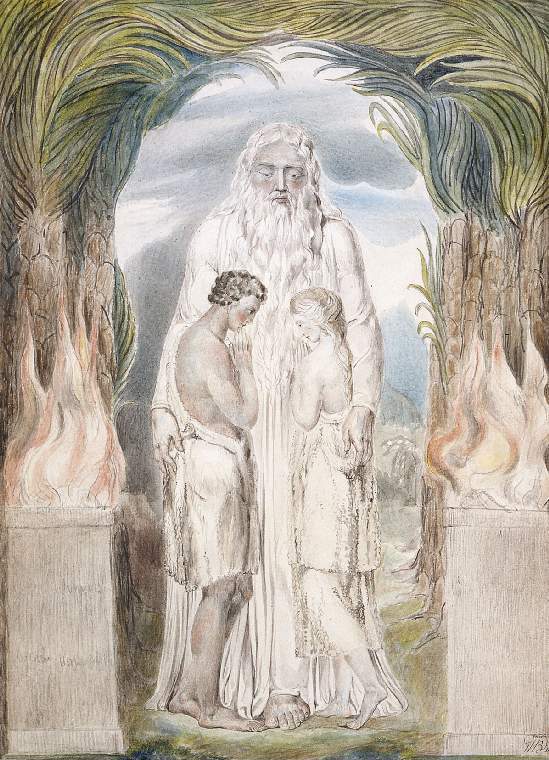
The Angel of the Divine Presence
original in Fitzwilliam Museum


Milton, Plate 42 [49], (E 143) 
"Then as a Moony Ark Ololon descended to Felphams Vale 
In clouds of blood, in streams of gore, with dreadful thunderings 
Into the Fires of Intellect that rejoic'd in Felphams Vale 
Around the Starry Eight: with one accord the Starry Eight became 
One Man Jesus the Saviour. wonderful! round his limbs 
The Clouds of Ololon folded as a Garment dipped in blood 
Written within & without in woven letters: & the Writing 
Is the Divine Revelation in the Litteral expression: 
A Garment of War, I heard it namd the Woof of Six Thousand Years"
 

Read posts on Ololon, the Moony Ark, and the Mystical Marriage for further detail.


Friday, November 02, 2012

Sexuality II

       A loveless marriage is a profanation of the greatest gift of life; nothing could arouse Blake to a whiter heat of indignation. Wollstonecraft had called it legal prostitution. In the lines that follow Oothoon names and radically disaffirms (go to VDA Plate 6, ) the sick social attitudes that make sex a hidden and forbidden secret pleasure, and that degrade the highest sacrament, marriage, into a life sentence at hard labor:
       Theotormon's jealousy casts Oothoon out and darkens her into "a solitary shadow wailing on the margin of non-entity". Blake developed this theme at the beginning of 'The Four Zoas'. There he ascribed the jealousy to Enion; it precipitated the Circle of Destiny (The Four Zoas [Nt 1], 5.)(all our sorrow!), sank Tharmas into the sea and condemned Enion to the very "margin of non-entity" of which Oothoon had spoken.
       To perceive a lover or spouse as a possession (a thing) is a fatal act that brings about the deterioration of life. In fact the nature of fallenness is to degrade the person (the real) to the material (the illusory). The one tormented by jealousy loses the capability of creative life; in biblical language he covers his soul with a thick layer of miry clay, not to mention what he does to others! The profound theological corollary suggested by VDA. is that if we weren't jealous people, we wouldn't have a jealous God. Obviously the Old Testament symbol of a jealous God has other meanings, but rightly or wrongly that is what it seems to have meant to Blake.
       Long before Freud's day Blake understood and described the close relationship, in fact the identity, between sexuality and creativity. He considered sexual fulfilment the primary means of artistic achievement. The picture in 'Milton' plate 42 portrays the post coital moment with the eagle of inspiration hovering above.
       On the other hand all the evils of life Blake related to frustrated or sick sex. War in particular is perverted sexuality. The worship of the Queen of Heaven induces chastity with war as a substitute fulfilment. Blake's warrior cries, "I am drunk with unsatiated love, I must rush again to War, for the Virgin has frowned and refused."
       Blake's mind was fourfold, which means that most of what he wrote is susceptible to more than one meaning. David Erdman in Prophet Against Empire saw VDA as political oratory at the service of the anti-slavery lobby. Oothoon is the type of the slave (of either sex); (in slave times the owner often claimed prenuptial privileges with the body of his slave). Bromion is the type of the merciless slave trader, and Theotormon of the wishy-washy conformist who can't quite bring himself to express his opposition to slavery (much as the many good Christians in America who couldn't quite bring themselves to condemn the war).
Here is an interesting file on Oothoon and her two men.

ii

Sex as Symbol

       Blake used the female as the basic symbol for the material and for the materialistic viewpoint. The history of this concept goes as far back as the beginning of time. The Sun represents a masculine God, the Moon, a Goddess, such as Diana, the great goddess of Ephesus, whose priests raised a riot against the apostle Paul, reported at Acts 19.
       Long after MHH he wrote 'Jerusalem' where the "female will" approaches identity with Satan. Both terms connote a preoccupation with the material, putting it first and only. Thus when we read a passage like
The Human is but a Worm, and thou, 0 Male! Thou art
Thyself Female, a Male, a breeder of Seed, a Son & Husband; & Lo
The Human Divine is Woman's Shadow, a Vapor in the summer's heat.
Go assume Papal dignity, thou Spectre, thou Male Harlot! Arthur,
Divide into the Kings of Europe in times remote, 0 Woman-born
and Woman-nourish'd and Woman-educated & Woman-scorned!
(Jerusalem, 64.12; E215)
spoken by Vala, the personification of the "female will", we understand that Blake is not talking about what we know as the sex economy, but rather making a hard nosed statement of the nature of fallenness: the dominance of the material over the spiritual, a dominance all too evident in his age as in ours. This sad situation was always Blake's major concern, and the basic symbol with which he expressed it was that of sex. When we remember to translate male/female into spiritual/material or eternal/temporal, we make a great gain in our understanding of Blake.      

Milton's theory of sex influenced Blake as much as any other literary source. 'Paradise Lost' provides a definitive model for much of the sexual imagery that Blake used. Professor Frye calls our attention to a line in Book iv of P . L. describing Adam and Eve: "Hee for God only, shee for God in him" Frye reminds us that this applies only to the unfallen pair; it assigns to Adam a purely spiritual authority. The male dominance of material history Frye calls a "fallen analogy" of that spiritual relationship.
       All this enriches our understanding of the meaning of Astarte in her many forms and of the priests' reactions to her which color virtually every word of the Old Testament and its literary descendants: God is male, the Creator. Nature is female, the Creation. The soul (of man and woman) is female in relation to her Creator. Christ is the bridegroom; in union with him we a11 (of both sexes) become part of the bride. The modern man can accept this only as an imperfect metaphor for spiritual reality.

An earlier version of this material may be found at Chapter Eight of the Blake Primer.