Monday, October 13, 2014

MISERIES

Yale Center for British Art
Europe a Prophecy
Plague, Plate 13
Yale Center for British Art
Europe a Prophecy
Famine, Plate 8
Yale Center for British Art
Europe a Prophecy
Terror, Plate 17
Yale Center for British Art
Europe a Prophecy
Blight, Plate 10
Yale Center for British Art
Europe a Prophecy
Imprisonment, Plate 15
These five plates from Europe do not illustrate the text but reveal "a litany of the miseries of the Fallen world and, in historical terms, of the Ancien Regime: Plague, Famine, Terror, Blight, and Imprisonment," as stated by David Bindman on Page 106 in William Blake: His Art and Times. 


You can learn here more about conditions during the Ancien Regime which preceded the French Revolution. Resistance to the regime became too widespread to avoid revolution: 

Kropotkin, P. (1927). The Great French Revolution, 1789-1793 (N. F. Dryhurst, Trans.) New York: Vanguard Printings. (Original work published 1909)

THE SPIRIT OF REVOLT: THE RIOTS
"If there had been only their few attempts at resistance France might have waited many years for the overthrow of royal despotism. Fortunately a thousand circumstances impelled the masses to revolt. And in spite of the fact that after every outbreak there were summary hangings, wholesale arrests and even torture for those arrested, the people did revolt, pressed on one side by their desperate misery' and spurred on the other by those vague hopes of which the old woman spoke to Arthur Young. They rose in numbers against the governors of provinces, tax-collectors, salt-tax agents and even against the troops, and by so doing completely disorganised the governmental machine. From 1788 the peasant risings became so general that it was impossible to provide for the expenses of the State, and Louis XVI., after having refused for fourteen years to convoke the representatives of the nation, lest his kingly authority should suffer, at last found himself compelled to convoke, first the two Assemblies of Notables, and finally the States-General."


by William Blake, (E 385)
                       THE
                 FRENCH REVOLUTION.  
                      A POEM,
                  IN SEVEN BOOKS.

                  BOOK THE FIRST.

           LONDON: Printed for J. Johnson, No 72,
              St Paul's Church-yard. MDCCXCI.
                 (Price One Shilling.)
...

"From my window I see the old mountains of France, like aged men, fading away.

Troubled, leaning on Necker, descends the King, to his chamber of council; shady mountains
In fear utter voices of thunder; the woods of France embosom the sound;
Clouds of wisdom prophetic reply, and roll over the palace roof heavy,
Forty men: each conversing with woes in the infinite shadows of his soul,
Like our ancient fathers in regions of twilight, walk, gathering round the King;
Again the loud voice of France cries to the morning, the morning prophecies to its clouds."

Sunday, October 12, 2014

Appendix 1

Some readers may want to pursue the study of Blake beyond the
elementary introduction which we have provided. Such a pursuit
could well begin with a review of the literature on Blake. We can
dispose of the l9th Century with a couple of pages and proceed to
the standard interpretive works.


The descent of Blake's thought from his death down to the present
follows two streams, which we may call the secular and the spiritual.
This is a rational and obviously imperfect categorization,
nevertheless revealing.

The secular stream,  the wider of the two, includes most of the better
known Blakeans and a variety of types: literary and other aesthetes,
historians, political writers, and psychologists. Needless to say many
of these Blakeans had spiritual interests of one sort or another.

However the narrow band of what I will call the spiritual type
consists of writers with an explicitly spiritual orientation; their
primary interest in Blake lies in the realm of his spiritual ideas.
By and large they confessed the same basic interest in the eternal
that Blake expressed with every line of his art, literary or
graphic. This narrow band understood what Blake meant by art quite
differently than did the others; they perceived art as a synonym for
the life of the spirit. Most of those who called themselves Christians
recognized Blake as one.

Unfortunately most avowed Christian writers and scholars have
viewed Blake with horror, advocating 'free love'; they haven't taken
the trouble to study Blake sufficiantly to realize how thoroughly
Christian his ideas are.

Saturday, October 11, 2014

DEADLY SLEEP

British Museum Large Book of Designs excerpted from "Visions of the Daughters of Albion"
 THE PROPHETIC BOOKS OF WILLIAM BLAKE JERUSALEM EDITED BY E. R. D. MACLAGAN AND A. G. B. RUSSELL 1904 Introduction "Man is at once the stage and the protagonist in the drama with which Blake is concerned, the Fourfold Man, called sym- bolically by the name of Albion, " our ancestor, in whose sleep or Chaos creation began,"; and his state depends on the union and agreement of the four elements that are met in him. Beside the Humanity, or central personality of the individual, stand the Spectre, the reasoning power, and the Emanation (a word sometimes abridged into Eon,) the emotional and imaginative life, with the Shadow, which seems to be desire, restrained and become passive, " till it is only the shadow of desire." When these are united, and especially when the Spectre and the Emanation, contraries in whose inter- action all other contraries are involved, are balanced and at peace, Man is in the state of salvation, which Boehme called temperature ; when Spectre and Emanation have parted, Man is in a fallen state, and can only be redeemed by their reconciliation. This fall into divison, and resurrection into unity, is the main subject of "Jeru- salem " and indeed of most of the Prophetical books ; for the part- ix ing of Reason and Imagination is the great tragedy, through which the Spectre becomes cold and the Emanation weak, the Shadow turns cruel, and the Humanity is overcome by deadly sleep (15, 6). A sleep, too, full of dreams, in which Man wavers between evil and good, drawn alternately by the male Spectre and the female Emanation, and so called by Blake hermaphroditic: a sleep from which only Christ, the Divine Imagination, can save the fallen Man, by reuniting him with Jerusalem, his Emanation, and saving him from the dominion of his Spectre, the great selfhood, called Satan." 
Four Zoas, Night I, Page 11, (E 825)
[deleted lines]  
"Refusing to behold the Divine image which all behold
          And live thereby. he is sunk down into a deadly sleep
          But we immortal in our own strength survive by stern debate
          Till we have drawn the Lamb of God into a mortal form
          And that he must be born is certain for One must be All

          And comprehend within himself all things both small & great
          We therefore for whose sake all things aspire to be & live
          Will so recieve the Divine Image that amongst the Reprobate
          He may be devoted to Destruction from his mothers womb" 

Friday, October 10, 2014

Polypus 2

This material comes from The Book of Milton

From Plate 35 (Erdman 134):
So spake Ololon in reminiscence astonishd, but they
Could not behold Golgonooza without passing the Polypus
A wondrous journey not passable by Immortal feet, & none
But the Divine Saviour can pass it without annihilation.
For Golgonooza cannot be seen till having passd the Polypus
It is viewed on all sides round by a Four-fold Vision
Or till you become Mortal & Vegetable in Sexuality
Then you behold its mighty Spires & Domes of ivory & gold

(In the first line Ololon spoke, but who were 'they'? Some
daughters of Beulah?) 'Passing the Polypus' could only
mean going through the miserable mess we've made of
out World; of course what Jesus did. And now we see
that Ololon, the emanation of Milton, does that.)

And Ololon examined all the Couches of the Dead.
Even of Los & Enitharmon & all the Sons of Albion
And his Four Zoas terrified & on the verge of Death
In midst of these was Miltons Couch, & when they saw Eight
Immortal Starry-Ones, guarding the Couch in flaming fires
They thunderous utterd all a universal groan falling down
Prostrate before the Starry Eight asking with tears forgiveness
Confessing their crime with humiliation and sorrow.

(The universal groan echoes Romans 8:22 
For we know that the whole creation groaneth and travaileth 
in pain together until now.
23 And not only they, but ourselves also, which have the firstfruits 
of the Spirit, even we ourselves groan within ourselves, waiting for 
the adoption, to wit, the redemption of our body.)
**********************************************
Plate 36; Erdman 135-6:
the Lark is a mighty Angel.
(Damon 234: The Lark is a new idea coming as inspiration in the
dawn.....by definition a messenger...)
For Ololon step'd into the Polypus within the Mundane Shell
They could not step into Vegetable Worlds without becoming
The enemies of Humanity except in a Female Form

And as One Female, Ololon and all its mighty Hosts
Appear'd: a Virgin of twelve years nor time nor space was
To the perception of the Virgin Ololon but as the
Flash of lightning but more quick the Virgin in my Garden
Before my Cottage stood, for the Satanic Space is delusion
(Blake sees this reality at home. and Los took him for the
trip of Milton' s , from Heaven to Redemption:)

For when Los joind with me he took me in his firy whirlwind
My Vegetated portion was hurried from Lambeths shades
He set me down in Felphams Vale & prepard a beautiful
Cottage for me that in three years I might write all these Visions
To display Natures cruel holiness: the deceits of Natural Religion.
(Blake 's revival of mental energy and perception is expressed with
the Bard's Song.)
Songs of Innocence and Experince
Wikipedia
Object 54
********************************************************************
Plate 37-38 (E137-8):
The Heavens are the Cherub, the Twelve Gods are Satan
And the Forty-eight Starry Regions are Cities of the Levites
The Heads of the Great Polypus, Four-fold twelve enormity
In mighty & mysterious comingling enemy with enemy
Woven by Urizen into Sexes from his mantle of years[.]
And Milton collecting all his fibres into impregnable strength
Descended down a Paved work of all kinds of precious stones
Out from the eastern sky; descending down into my Cottage
Garden: clothed in black, severe & silent he descended.

The Spectre of Satan stood upon the roaring sea & beheld
Milton within his sleeping Humanity! trembling & shuddring
He stood upon the waves a Twenty-seven-fold mighty Demon
Gorgeous & beautiful: loud roll his thunders against Milton
Loud Satan thunderd, loud & dark upon mild Felpham shore
Not daring to touch one fibre he howld round upon the Sea.

Here Milton faces Satan, just as Jesus had known centuries
before.

Thursday, October 09, 2014

AWFUL VISION

Library of Congress Jerusalem
Plate 54, Copy I
 

Blake rarely speaks in his own voice. On Plate 25 of Jerusalem, speaking in the first person, he allows us to directly share his 'awful vision.' Albion is divided fourfold: into his Humanity, his Emanation, his Spectre and his Shadow. This is the nature of Albion's sleep: that his Humanity allows his Emanation, Spectre and Shadow to run rampant devastating the nation in 'terrors and scourges', in tyrannic works, in 'deadly fear.' 
 
Blake endures the 'awful vision' until it is resolved beyond the chaos. Albion will sleep; he will remain in his status of internal contentions, and outward turmoil until the Divine Hand provides the denouement by sending an infant into the manger at Bethlehem. 

 
Jerusalem, plate 25, (E 158)
"such is my awful Vision.   

I see the Four-fold Man. The Humanity in deadly sleep
And its fallen Emanation. The Spectre & its cruel Shadow.
I see the Past, Present & Future, existing all at once
Before me; O Divine Spirit sustain me on thy wings!
That I may awake Albion from His long & cold repose.             
For Bacon & Newton sheathd in dismal steel, their terrors hang
Like iron scourges over Albion, Reasonings like vast Serpents
Infold around my limbs, bruising my minute articulations

I turn my eyes to the Schools & Universities of Europe
And there behold the Loom of Locke whose Woof rages dire  
Washd by the Water-wheels of Newton. black the cloth
In heavy wreathes folds over every Nation; cruel Works
Of many Wheels I View, wheel without wheel, with cogs tyrannic
Moving by compulsion each other: not as those in Eden: which
Wheel within Wheel in freedom revolve in harmony & peace. 

I see in deadly fear in London Los raging round his Anvil
Of death: forming an Ax of gold: the Four Sons of Los
Stand round him cutting the Fibres from Albions hills
That Albions Sons may roll apart over the Nations
While Reuben enroots his brethren in the narrow Canaanite    
From the Limit Noah to the Limit Abram in whose Loins
Reuben in his Twelve-fold majesty & beauty shall take refuge
As Abraham flees from Chaldea shaking his goary locks
But first Albion must sleep, divided from the Nations

I see Albion sitting upon his Rock in the first Winter           
And thence I see the Chaos of Satan & the World of Adam
When the Divine Hand went forth on Albion in the mid Winter
And at the place of Death when Albion sat in Eternal Death
Among the Furnaces of Los in the Valley of the Son of Hinnom"

Wednesday, October 08, 2014

Polypus 1

The word 'Polypus' appears in Blake's poetry often. In Medicine a 'polypus' is a tumor, usually with a narrow base, somewhat resembling a pear, - found in the nose, 
uterus, etc., and produced by hypertrophy of some portion of the mucous membrane 

For Blake 'polypus' may be thought of as the ultimate evil.


From page 163 of Easson and Easson's commentary on Milton a Poem by William Blake:
A sea aenemone like Vala is "adjoin'd to Beulah as the Polypus to the Rock"

Then view'd from Miltons Track they see the Ulro: a vast Polypus 
(E134; Plate 35: So spake Ololon in reminiscence astonishd, but they 
And Ololon examined all the Couches of the Dead. 
(Erdman 119) Plate24:
Plate 35 (E135):

Enveloping the Mundale Egg, the fallen world of Adam, Satan's Space, Entuthon, Benython and Ulro is Blake's Polypus.

(The Four Zoas [Nt 7b], 87[95][1st].2; E367)


From MILTON:
(Plate 34; Erdman 134)
But Ololon sought the Or-Ulro & its fiery Gates
And the Couches  of the Martyrs: & many Daughters of Beulah
Accompany them down to the Ulro with soft melodious tears
To where the Contraries of Beulah War beneath Negations Banner.

Of living fibres down into the Sea of Time & Space growing 
A self-devouring monstrous Human Death Twenty-seven fold. 
Within it sit Five Females & the nameless Shadowy Mother 
Spinning it from their bowels with songs of amorous delight 
And melting cadences that lure the Sleepers of Beulah down 
The River Storge (which is Arnon) into the Dead Sea: 
Around this Polypus Los continual builds the Mundane Shell
(Plate 34; Erdman 134)

Could not behold Golgonooza without passing the Polypus 
A wondrous journey not passable by Immortal feet, & none 
But the Divine Saviour can pass it without annihilation. 
For Golgonooza cannot be seen till having passd the Polypus 
It is viewed on all sides round by a Four-fold Vision 
Or till you become Mortal & Vegetable in Sexuality 
Then you behold its mighty Spires & Domes of ivory & gold

Even of Los & Enitharmon & all the Sons of Albion 
And his Four Zoas terrified & on the verge of Death 
In midst of these was Miltons Couch, & when they saw Eight 
Immortal Starry-Ones, guarding the Couch in flaming fires 
They thunderous utterd all a universal groan falling down 
Prostrate before the Starry Eight asking with tears forgiveness 
Confessing their crime with humiliation and sorrow.


"Arise O Sons give all your strength against Eternal Death
A Web of Death: & were it not for Bowlahoola & Allamanda
No Human Form but only a Fibrous Vegetation
A Polypus of soft affections without Thought or Vision
Must tremble in the Heavens & Earths thro all the Ulro space[.]
Throw all the Vegetated Mortals into Bowlahoola
But as to this Elected Form who is returnd again
He is the Signal that the Last Vintage now approaches
Nor Vegetation may go on till all the Earth is reapd
So Los spoke." 


But Ololon sought the Or-Ulro & its fiery Gates
And the Couches of the Martyrs: & many Daughters of Beulah
Accompany them down to the Ulro with soft melodious tears
A long journey & dark thro Chaos in the track of Miltons course
To where the Contraries of Beulah War beneath Negations Banner
Then view'd from Miltons Track they see the Ulro: a vast Polypus
Of living fibres down into the Sea of Time & Space growing
A self-devouring monstrous Human Death Twenty-seven fold[.]
Within it sit Five Females & the nameless Shadowy Mother
Spinning it from their bowels with songs of amorous delight
And melting cadences that lure the Sleepers of Beulah down
The River Storge (which is Arnon) into the Dead Sea:
Around this Polypus Los continual builds the Mundane Shell
Plate 29; E 126:
But Rintrah & Palamabron govern over Day & Night 
In Allamanda & Entuthon Benython where Souls wail: 
Where Orc incessant howls burning in fires of Eternal Youth, 
Within the vegetated mortal Nerves; for every Man born is joined 
Within into One mighty Polypus  and this Polypus is Orc.

Tuesday, October 07, 2014

ESSENTIAL TEACHINGS

British Museum
Illustrations to Young's Night Thoughts 
In order to emphasize some of the Essential Teachings of Blake which may have been skipped in my haphazard way of blogging, I wrote a series of seventeen posts which incorporate many of the most important of Blake's ideas.

  
DIVINE VISION
VEGETABLE GLASS
GOOD & EVIL
HEGEMONY OF REASON
IMAGINATION
SIN & VENGEANCE
FOURFOLD HUMAN
SELF-ANNIHILATION
AWAKE FROM SLEEP
FORGIVING
INTERNAL GOD
CREATION OF STATES
CONSCIOUSNESS
SPIRITUAL CAUSES

MAN'S JOURNEY
ERROR & TRUTH
WILLING SACRIFICE

 
These are transformative ideas. It is the opportunity of the individual's essential identity to undergo experience in order for the seed within him to germinate and grow into a tree. Blake has discerned aspects of the process which man goes through as he strives toward psychological wholeness and spiritual enlightenment. Blake gives us the benefit of his intense struggles along his journey in order that we may be willing to contemplate our own potential for altering our ability to perceive.
Vision of Last Judgment,(E 559)
"If the Spectator could Enter into these Images in his
Imagination approaching them on the Fiery Chariot of his
Contemplative Thought if he could Enter into Noahs Rainbow or
into his bosom or could make a Friend & Companion of one of these
Images of wonder which always intreats him to leave mortal things
as he must know then would he arise from his Grave then would he
meet the Lord in the Air & then he would be happy   General
Knowledge is Remote Knowledge it is in Particulars that Wisdom
consists & Happiness too."
Kay and Roger Easson, in Milton: A Poem by William Blake, emphasize Blake's role as a teacher:

"To read William Blake's illuminated books is to participate in a spiritual education. To read Blake's Milton is to discover the nature of that spiritual education concurrently with the education itself. Although Milton is incredibly beautiful in its combination of word and illustration and although its complexity stimulates intellectual scrutiny, it is a prophecy and like all prophecy, it provides spiritual instruction. William Blake is a spiritual teacher, a prophet who, having 'discover'd the infinite in every thing' is committed to 'raising other men into a perception of the infinite' (The Marriage of Heaven and Hell). And, Milton is the book in which Blake teaches how 'all the Lord's people' can become prophets. In Milton Blake defines the spiritual journey which renews prophecy in every moment of  human time." (Page 135)


Marriage of Heaven & Hell, Plate 16, (E 42)
"The man
who never alters his opinion is like standing water, & breeds
reptiles of the mind." 
Jerusalem, Plate 91, (E 251)
"Los beheld undaunted furious

His heavd Hammer; he swung it round & at one blow,
In unpitying ruin driving down the pyramids of pride
Smiting the Spectre on his Anvil & the integuments of his Eye
And Ear unbinding in dire pain, with many blows,            
Of strict severity self-subduing, & with many tears labouring.

Then he sent forth the Spectre all his pyramids were grains
Of sand & his pillars: dust on the flys wing: & his starry
Heavens; a moth of gold & silver mocking his anxious grasp
Thus Los alterd his Spectre & every Ratio of his Reason       
He alterd time after time, with dire pain & many tears
Till he had completely divided him into a separate space.

Terrified Los sat to behold trembling & weeping & howling
I care not whether a Man is Good or Evil; all that I care
Is whether he is a Wise Man or a Fool. Go! put off Holiness    
And put on Intellect: or my thundrous Hammer shall drive thee
To wrath which thou condemnest: till thou obey my voice

So Los terrified cries: trembling & weeping & howling! Beholding"

Four Zoas, Page 49, (E 333)
"The Spectre of Urthona seeing Enitharmon writhd    
His cloudy form in jealous fear & muttering thunders hoarse      
And casting round thick glooms. thus utterd his fierce pangs of heart

Tharmas I know thee. how are we alterd our beauty decayd
But still I know thee tho in this horrible ruin whelmd
Thou once the mildest son of heaven art now become a Rage
A terror to all living things. think not that I am ignorant      
That thou art risen from the dead or that my power forgot"

Songs & Ballads, (E 485)
The Mental Traveller 
...
"And to Allay his freezing Age
The Poor Man takes her in his arms
The Cottage fades before his Sight
The Garden & its lovely Charms    

The Guests are scatterd thro' the land
For the Eye altering alters all
The Senses roll themselves in fear
And the flat Earth becomes a Ball

The Stars Sun Moon all shrink away  
A desart vast without a bound
And nothing left to eat or drink
And a dark desart all around"

Descriptive Catalogue, (E 532)
"Of Chaucer's characters, as described in his Canterbury
Tales, some of the names or titles are altered by time, but the
characters themselves for ever remain unaltered, and 
consequently they are the

physiognomies or lineaments of universal human life, beyond which
Nature never steps.  Names alter, things never alter.I have
known multitudes of those who would have been monks in the age of
monkery, who in this deistical age are deists.  As Newton
numbered the stars, and as Linneus numbered the plants, so
Chaucer numbered the classes of men."

Monday, October 06, 2014

Blake's Style

       Throughout the 19th Century the works of William Blake suffered almost total neglect. His message simply surpassed contemporary currents of thought. A voracious reader, Blake mastered (and used) the symbology of the Bible, Plato, the Neoplatonists, Greek mythology, Paracelsus, Boehme, and God knows what else. 

       During the 20th century his reputation as a poet and thinker steadily grew. His most popular collection of poems, 'Songs of Innocence and Experience', has won general recognition as a classic.
       Blake's three largest works, called the major prophecies, still offer technical difficulties that may defeat the casual reader. Once they were thought to represent the eccentric vagaries of an unbalanced mind; many people considered Blake insane. Intensive Blake scholarship over the past eighty years has slowly deciphered the cryptograms and clarified (at least some of) the mysteries.

       What had seemed the most insane passages often proved on closer examination to be the most rational and meaningful. A growing body of translation and interpretation has made the major prophecies accessible and rewarding to the reader willing to take reasonable pains with them. They are now about as accessible to the general reader as is the Bible.

       A systematic acquaintance with Blake's literary peculiarities will enhance the reader's enjoyment of his poetry. This chapter introduces a few guiding principles of his thought processes and literary and artistic style. First of all we should note that Blake combined word and picture in a unique synthesis.

       Although he wrote unadorned poems and painted wordless pictures, his primary mode of expression was the illuminated manuscript, an intimate blend of graphic and verbal art. To provide a full exposition of this unique double form is beyond the modest goal of this book. At this point the illuminated form is simply mentioned as a most distinctive facet of Blake's art.

       One simple clue to reading Blake concerns his use of dialogue; he spoke with many voices. He exercised this freedom especially with the larger prophecies, the three major works. These on first reading may seem to present insuperable difficulties, but the reader who pays close attention to the identity of the speaker at each point will thereby break down the forest into manageable groves of trees. In his three long poems Blake gave titles to various elements or speeches; they became units, landmarks or guideposts, casting light on what at first seemed general confusion.

       In Night i of 'The Four Zoas' for example we find Enitharmon's Song of Death (FZ1-10.9; E305), the "Nuptial Song" of the "demons of the deep" (FZ1-13.20; E308), and the message of the Daughters of Beulah, which they call the "Wars of Death Eternal"(FZ1-21.13; E311). These three songs comprise three of the many selves of the human psyche; needless to say their ideas and attitudes vary immensely. They all describe the same event, but they see it, oh, so differently. They use the same words with different meanings. For example consider that what the daughters call "Death Eternal" the demons call marriage. In this way Blake challenges the reader and stretches his mind and immensely rewards whoever will accept the challenge. He gives us the end of a golden string.

Sunday, October 05, 2014

WILLING SACRIFICE

Blake gives attention to two forms of sacrifice: the sacrifice of others, and the sacrifice of self. To Blake nothing could be farther from God's intent for man than that he sacrifice others for his own benefit. Blake would include war, corporal punishment, prostitution, slavery and child labor among the ways man sacrifices others for himself. These are perversions of the sacrifice which characterizes Eternity: the continual mutual forgiveness of the debt that is owed.
Jerusalem, Plate 27, (E 174)
  "If Humility is Christianity; you O Jews are the true
Christians; If your tradition that Man contained in his Limbs,
all Animals, is True & they were separated from him by cruel
Sacrifices: and when compulsory cruel Sacrifices had brought
Humanity into a Feminine Tabernacle, in the loins of Abraham &
David: the Lamb of God, the Saviour became apparent on Earth as
the Prophets had foretold? The Return of Israel is a Return to
Mental Sacrifice & War.  Take up the Cross O Israel & follow
Jesus."

Jerusalem, Plate 28, (E 174)
"He sat by Tyburns brook, and underneath his heel, shot up!
A deadly Tree, he nam'd it Moral Virtue, and the Law             
Of God who dwells in Chaos hidden from the human sight.

The Tree spread over him its cold shadows, (Albion groand)
They bent down, they felt the earth and again enrooting
Shot into many a Tree! an endless labyrinth of woe!

From willing sacrifice of Self, to sacrifice of (miscall'd) Enemies  
For Atonement: Albion began to erect twelve Altars,
Of rough unhewn rocks, before the Potters Furnace
He nam'd them Justice, and Truth. And Albions Sons
Must have become the first Victims, being the first transgressors
But they fled to the mountains to seek ransom: building A Strong 
Fortification against the Divine Humanity and Mercy,
In Shame & Jealousy to annihilate Jerusalem!"

Jerusalem, Plate 48, (E 197)
"The Place of Holy Sacrifice! 
Where Friends Die for each other: will become the Place,
Of Murder, & Unforgiving, Never-awaking Sacrifice of Enemies
The Children must be sacrific'd! (a horror never known
Till now in Beulah.) unless a Refuge can be found
To hide them from the wrath of Albions Law that freezes sore     
Upon his Sons & Daughters, self-exiled from his bosom"

British Museum
Illustration to Young's Night Thoughts
Christian Triumph
Sacrifice in Eternity bears no resemblance to the sacrifice of others in time which prevents individuals from becoming expressions of the Holy Spirit within them. In Eternity there is no tally sheet to track the debt of each to each. Being part of the Brotherhood enables each to give and receive without thought of repayment. Each does not even owe a debt of gratitude for all share in the mercy whose supply is unlimited. Jesus is the Elder Brother who stands beside us. He willingly shares our burdens and sorrows for he took on the Robe of Blood and becomes a mortal man.
  
Milton Percival in William Blake's Circle of Destiny expands our understanding of the role of Christ as a sacrifice:
 
"Since Christ descends to take on and put off mortality, we see him in two forms - an eternal form and a mortal form, a 'human' form and a 'sexual' form. The one is the supernal Christ, embodied in the Divine Vision, which man need never have lost. The other is the mortal and sexual Christ, image of the spirit of forgiveness reborn after ages of struggle between the sundered contraries. He has assumed the body of death that he may put it off in a spiritual rebirth. This body of death - the whole religious structure reared on the selfhood - is the 'mortal' body which is crucified on the 'stems of Mystery.' Christ descends into the grave of time and the 'dark religions,' but he leaves there his mortal body and rises again into eternal life. In the life of the mortal Christ there is, then, an image of man's spiritual history. Christ's maternal birth, his crucifixion, and his resurrection have all a symbolic cosmic value." (Page 141)


The self sacrifice that is required of man is not pain and torture but the willingness to relinquish everything that separates then from reaching the full potential as Children of God.

First John 3
[2] Beloved, we are God's children now; it does not yet appear what we shall be, but we know that when he appears we shall be like him, for we shall see him as he is.

Jerusalem, Plate 60, (E 211)
"I heard his voice in my sleep O his Angel in my dream:

'Saying, Doth Jehovah Forgive a Debt only on condition that it shall
Be Payed? Doth he Forgive Pollution only on conditions of Purity
That Debt is not Forgiven! That Pollution is not Forgiven
Such is the Forgiveness of the Gods, the Moral Virtues of the    
Heathen, whose tender Mercies are Cruelty. But Jehovahs Salvation
Is without Money & without Price, in the Continual Forgiveness of Sins
In the Perpetual Mutual Sacrifice in Great Eternity! for behold!
There is none that liveth & Sinneth not! And this is the Covenant
Of Jehovah: If you Forgive one-another, so shall Jehovah Forgive You:    
That He Himself may Dwell among You.'"
Jerusalem, Plate 96, (E 256)
"Albion replyd. Cannot Man exist without Mysterious          
Offering of Self for Another, is this Friendship & Brotherhood
I see thee in the likeness & similitude of Los my Friend

Jesus said. Wouldest thou love one who never died
For thee or ever die for one who had not died for thee
And if God dieth not for Man & giveth not himself           
Eternally for Man Man could not exist. for Man is Love:
As God is Love: every kindness to another is a little Death
In the Divine Image nor can Man exist but by Brotherhood

So saying. the Cloud overshadowing divided them asunder
Albion stood in terror: not for himself but for his Friend     
Divine, & Self was lost in the contemplation of faith
And wonder at the Divine Mercy & at Los's sublime honour"

Four Zoas, Night VII, Page 98 [96], (E 371) 
"As the Eldest brother is the fathers image So Orc became
As Los a father to his brethren & he joyd in the dark lake
Tho bound with chains of Jealousy & in scales of iron & brass

But Los loved them & refusd to Sacrifice their infant limbs   
And Enitharmons smiles & tears prevaild over self protection
They rather chose to meet Eternal death than to destroy
The offspring of their Care & Pity Urthonas spectre was comforted"

Four Zoas, Night VIII, Page 17 [115],  (E 381) 
"Jerusalem pitying them wove them mantles of life & death
Times after times And those in Eden sent Lucifer for their Guard
Lucifer refusd to die for Satan & in pride he forsook his charge
Then they sent Molech Molech was impatient They sent
Molech impatient They Sent Elohim who created Adam
To die for Satan Adam refusd but was compelld to die
By Satans arts. Then the Eternals Sent Shaddai
Shaddai was angry Pachad descended Pachad was terrified
And then they Sent Jehovah who leprous stretchd his hand to Eternity
Then Jesus Came & Died willing beneath Tirzah & Rahab" 

Saturday, October 04, 2014

Mundane 3

          Erdman   PLATE 20 [22]   page 114
....................
Now Albions sleeping Humanity began to turn upon his Couch;
Feeling the electric flame of Miltons awful precipitate descent.

'He came down' like Jesus Milton came down from Heaven

to save us all.  Albion represents 'us all'; we are asleep on 0ur 
materialistic 'couch' (or perhaps in Ulro!)

What follows in a beautiful poem:

Seest thou the little winged fly, smaller than a grain of sand?
It has a heart like thee; a brain open to heaven & hell,
Withinside wondrous & expansive; its gates are not clos'd,
I hope thine are not: hence it clothes itself in rich array;
Hence thou art cloth'd with human beauty O thou mortal man.
Seek not thy heavenly father then beyond the skies:

(Blake cautions us against the conventional faith with no
conception of 'the God within'.)
There Chaos dwells & ancient Night & Og & Anak old:
For every human heart has gates of brass & bars of adamant,
Which few dare unbar because dread Og & Anak guard the gates
Terrific! and each mortal brain is walld and moated round
Within: and Og & Anak watch here; here is the Seat
Of Satan in its Webs; for in brain and heart and loins
Gates open behind Satans Seat to the City of Golgonooza
Which is the spiritual fourfold London, in the loins of Albion

Thus Milton fell thro Albions heart, travelling outside of Humanity
Beyond the Stars in Chaos in Caverns of the Mundane Shell.

Both the City of Golgonooza and the Mundane Shell represent
Los's attempt to rescue humanity from Ulro.

But many of the Eternals rose up from eternal tables
Drunk with the Spirit, burning round the Couch of death they stood
Looking down into Beulah: wrathful, fill'd with rage!
They rend the heavens round the Watchers


The frontispiece of Blake's  Jerusalem pictures a man clothed as a watchman entering a dark doorway. He carries the watchman's light to illuminate the 'perilous path' whose entry he steps into wearing his sandals (which he strapped on in the poem Milton). The figure is Los beginning his journey through the underworld which Persephone entered before him. Blake describes it as 'the passage through Eternal Death! and of the awaking to Eternal Life.' (Jerusalem, Plate 4, E 146)

in a fiery circle:
And round the Shadowy Eighth: the Eight close up the Couch
.............

From The Four Zoas, Night one:
Then they Elected Seven. called the Seven
Eyes of God & the Seven lamps of the Almighty
The Seven are one within the other the Seventh is named Jesus
The Lamb of God blessed for ever
(Erdman  312 -13)
.........

                                      Page 115
Into a tabernacle, and flee with cries down to the Deeps:
Where Los opens his three wide gates, surrounded by raging fires!
They soon find their own place & join the Watchers of the Ulro.
Los saw them and a cold pale horror coverd o'er his limbs
Pondering he knew that Rintrah & Palamabron might depart:
Even as Reuben & as Gad; gave up himself to tears.
He sat down on his anvil-stock; and leand upon the trough.
Looking into the black water, mingling it with tears.

Friday, October 03, 2014

ERROR & TRUTH


Wikimedia Commons
Mercy and Truth are Met Together,
Righteousness and Peace Have Kissed Each Other
The progress of man along his Spiritual Journey cannot proceed unless he is able to remove the error to which he is subject. Error is the paradigms which weave the nets which capture man's imagination and prevent him from perceiving clearly.

Error is to be replaced by truth. Error can be recognized and removed when it continues to the point that its futility is revealed by its failure to solve problems and instead to add to them.  The process  of removing error is performed by Los, the Imagination, into whose furnaces error is thrown to be consumed. The destruction of error depends upon giving it definite form which then can be cast off.  Until an individual can see his error and release it to be destroyed, he will be in its power.
  
Much of Blake's writing is directed toward revealing error, not in individual men, but in the society man has created. Man's oppressive systems of government, religion, and economics result from the erroneous assumptions he makes about the value of man and the benevolence of God. The same process of exposing error in individuals in order to reveal its failure, Blake applies to every institution and philosophy he examines. Not until error has been examined, disclosed and removed can Truth and Eternity appear. 

From Minna Doskow's book William Blake's Jerusalem:
"By providing form to the indefinite, science and mathematics have a redemptive use beyond their limited understanding; for they provide the concrete basis on which imagination works. So does Los's Spectre, who represents rational error, for he works under Los's compulsion for imaginative ends." (Page 57)


Jerusalem, Plate 12, (E 155)
"I saw the finger of God go forth                
Upon my Furnaces, from within the Wheels of Albions Sons:
Fixing their Systems, permanent: by mathematic power
Giving a body to Falshood that it may be cast off for ever."

Jerusalem, Plate 55, (E 205)  
"For Art & Science cannot exist but in minutely organized Particulars
And not in generalizing Demonstrations of the Rational Power.
The Infinite alone resides in Definite & Determinate Identity
Establishment of Truth depends on destruction of Falshood continually"  

Jerusalem, Plate 37 [41], (E 184)
"Each Man is in 
his Spectre's power
Untill the arrival
of that hour,
When his Humanity awake
And cast his Spectre
into the Lake"
  
Vision of Last Judgment, (E 565)
"Error is Created Truth is Eternal Error or Creation will be Burned Up &
then & not till then Truth or Eternity will appear It is Burnt up
the Moment Men cease to behold it I assert for My self that I do
not behold the Outward Creation & that to me it is hindrance &
not Action it is as the Dirt upon my feet No part of Me."

Jerusalem, Plate 42, (E 189)
"Los answerd. Righteousness & justice I give thee in return
For thy righteousness! but I add mercy also, and bind            
Thee from destroying these little ones: am I to be only
Merciful to thee and cruel to all that thou hatest[?]
Thou wast the Image of God surrounded by the Four Zoa's
Three thou hast slain! I am the Fourth: thou canst not destroy me.
Thou art in Error; trouble me not with thy righteousness. 
I have innocence to defend and ignorance to instruct:
I have no time for seeming; and little arts of compliment,
In morality and virtue: in self-glorying and pride."

Jerusalem, Plate 41 [46], (E 188)
And Ely, Scribe of Los, whose pen no other hand
Dare touch! Oxford, immortal Bard! with eloquence
Divine, he wept over Albion: speaking the words of God
In mild perswasion: bringing leaves of the Tree of Life.

Thou art in Error Albion, the Land of Ulro:               
One Error not remov'd, will destroy a human Soul
Repose in Beulahs night, till the Error is remov'd
Reason not on both sides. Repose upon our bosoms
Till the Plow of Jehovah, and the Harrow of Shaddai
Have passed over the Dead, to awake the Dead to Judgment.     
But Albion turn'd away refusing comfort."

Vision of Last Judgment, (E 562) 
"All Life consists of these Two Throwing off Error & Knaves from
our company continually & recieving Truth or Wise Men into our
Company Continually." 
Psalms 85  
[9] Surely his salvation is nigh them that fear him; that glory may dwell in our land. 
[10] Mercy and truth are met together; righteousness and peace have kissed each other.
[11] Truth shall spring out of the earth; and righteousness shall look down from heaven. 
. 

Thursday, October 02, 2014

Mundane 2

From Wikipedia:
Book II of 'Milton' finds Blake in the garden of his cottage in Felpham. 
Ololon, a female figure linked to Milton, descends to meet him. Blake 
sees a skylark, which mutates into a twelve-year-old girl, who he thinks 
is one of his own muses. He invites her into his cottage to meet his wife. 
The girl states that she is actually looking for Milton. Milton then descends 
to meet with her, and in an apocalyptic scene he is eventually unified with 
the girl, who is identified as Ololon and becomes his own feminine aspect.


Plate 33 of Book of Milton (Erdman 133-34)
But Ololon sought the Or-Ulro & its fiery Gates
And the Couches of the Martyrs: & many Daughters of Beulah
Accompany them down to the Ulro with soft melodious tears
A long journey & dark thro Chaos in the track of Miltons course
To where the Contraries of Beulah War beneath Negations Banner
Then view'd from Miltons Track they see the Ulro: a vast Polypus
Of living fibres down into the Sea of Time & Space growing
A self-devouring monstrous human Death Twenty-seven fold
Within it sit Five Females & the nameless Shadowy Mother
Spinning it from their bowels with songs of amorous delight
And melting cadences that lure the Sleepers of Beulah down
The River Storge (which is Arnon) into the Dead Sea:
Around this Polypus Los continual builds the Mundane Shell
Four Universes round the Universe of Los remain Chaotic
Four intersecting Globes, & the Egg form'd World of Los
In midst; stretching from Zenith to Nadir, in midst of Chaos.
One of these Ruind Universes is to the North named Urthona
One to the South this was the glorious World of Urizen
One to the East, of Luvah: One to the West; of Tharmas.
But when Luvah assumed the World of Urizen in the South
All fell towards the Center sinking downward in dire Ruin

PLATE 59 of Jerusalem:
And formed into Four precious stones. for enterance from Beulah
For the Veil of Vala which Albion cast into the Atlantic Deep
To catch the Souls of the Dead: began to Vegetate & Petrify
Around the Earth of Albion. among the Roots of his Tree
This Los formed into the Gates & mighty Wall, between the Oak
Of Weeping & the Palm of Suffering beneath Albions Tomb,
Thus in process of time it became the beautiful Mundane Shell,
The Habitation of the Spectres of the Dead & the Place
Of Redemption & of awaking again into Eternity
For Four Universes round the Mundane Egg remain Chaotic
One to the North; Urthona: One to the South; Urizen:
One to the East: Luvah: One to the West, Tharmas;
They are the Four Zoas that stood around the Throne Divine
Verulam: London: York & Edinburgh: their English names
But when Luvah assumed the World of Urizen Southward
(/Erdman 2O7-8)

From Jerusalem Plate 92 (Erdman 251-2):
Amalek, Edom, Egypt, Moab, Ammon, Ashur, Philistea, around Jerusalem
Where the Druids reard their Rocky Circles to make permanent Remembrance
Of Sin. & the Tree of Good & Evil sprang from the Rocky Circle & Snake
Of the Druid, along the Valley of Rephaim from Camberwell to Golgotha
And framed the Mundane Shell Cavernous in Length Bredth & Highth

Wednesday, October 01, 2014

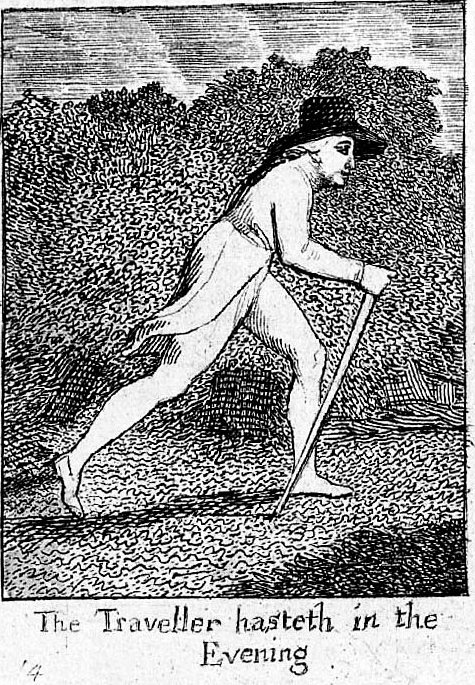
MAN'S JOURNEY


Wikimedia Commons
For the Sexes: The Gates of Paradise
Plate 14
The metaphor of the journey is a persistent theme in Blake's works. Blake's book Milton is organized around the poet Milton's journey from his home in Eternity to the location of his unfinished work on earth. The Gates of Paradise follows man through his physical, social and spiritual development on the journey through life which each is called to undertake. Each of Blake's mythopaeic characters progress through stages of development as he or she undertakes a journey of overcoming obstacles and receiving Truth.

As Blake sees man's journey, it is never limited to either mental processes or physical experiences. The internal work through which man progresses on his journey is complemented by it becoming manifest in the obstacles and opportunities he encounters in the outer world. The journey for Blake does have an endpoint, a destination. His term for this is the Last Judgment when all thing are set right and a new dispensation begins. Although Blake would have welcomed the Apocalypse as envisioned by John in the Revelation, he welcomed even more vigorously the internal transformations which brought him closer to the status when the Imagination in him was ever present.

Isaiah 11
[9] They shall not hurt or destroy
in all my holy mountain;
for the earth shall be full of the knowledge of the LORD
as the waters cover the sea.


Milton, Plate 16 [18], (E 111)
"For travellers from Eternity. pass outward to Satans seat,
But travellers to Eternity. pass inward to Golgonooza."

Milton, Plate 2, (E 96)
"Daughters of Beulah! Muses who inspire the Poets Song
Record the journey of immortal Milton thro' your Realms
Of terror & mild moony lustre, in soft sexual delusions
Of varied beauty, to delight the wanderer and repose
His burning thirst & freezing hunger!"

Four Zoas, Night VI, Page 70,  (E 346)  
"Los brooded on the darkness. nor saw Urizen with a Globe of fire
Lighting his dismal journey thro the pathless world of death 

Writing in bitter tears & groans in books of iron & brass
The enormous wonders of the Abysses once his brightest joy

For Urizen beheld the terrors of the Abyss wandring among        
The ruind spirits once his children & the children of Luvah
Scard at the sound of their own sigh that seems to shake the immense
They wander Moping in their heart a Sun a Dreary moon
A Universe of fiery constellations in their brain
An Earth of wintry woe beneath their feet & round their loins  
Waters or winds or clouds or brooding lightnings & pestilential plagues
Beyond the bounds of their own self their senses cannot penetrate
As the tree knows not what is outside of its leaves & bark"

Jerusalem, Plate 62, (E 213)
[Jesus speaking to Jerusalem]
"for I cannot leave them in the gnawing Grave.
But will prepare a way for my banished-ones to return
Come now with me into the villages. walk thro all the cities.
Tho thou art taken to prison & judgment, starved in the streets
I will command the cloud to give thee food & the hard rock       
To flow with milk & wine, tho thou seest me not a season
Even a long season & a hard journey & a howling wilderness!"

Jerusalem, Plate 95, (E 254)
[Brittannia speaking]
"Her voice pierc'd Albions clay cold ear. he moved upon the Rock
The Breath Divine went forth upon the morning hills, Albion mov'd
Upon the Rock, he opend his eyelids in pain; in pain he mov'd
His stony members, he saw England. Ah! shall the Dead live again

The Breath Divine went forth over the morning hills Albion rose 
In anger: the wrath of God breaking bright flaming on all sides around
His awful limbs: into the Heavens he walked clothed in flames
Loud thundring, with broad flashes of flaming lightning & pillars
Of fire, speaking the Words of Eternity in Human Forms, in direful
Revolutions of Action & Passion, thro the Four Elements on all sides  
Surrounding his awful Members. Thou seest the Sun in heavy clouds
Struggling to rise above the Mountains. in his burning hand
He takes his Bow, then chooses out his arrows of flaming gold
Murmuring the Bowstring breathes with ardor! clouds roll around the
Horns of the wide Bow, loud sounding winds sport on the mountain brows
Compelling Urizen to his Furrow; & Tharmas to his Sheepfold;
And Luvah to his Loom: Urthona he beheld mighty labouring at
His Anvil, in the Great Spectre Los unwearied labouring & weeping
Therefore the Sons of Eden praise Urthonas Spectre in songs
Because he kept the Divine Vision in time of trouble.        

As the Sun & Moon lead forward the Visions of Heaven & Earth"

Vision of Last Judgment, (E 562)
"What are all the Gifts of the
Spirit but Mental Gifts whenever any Individual Rejects Error &
Embraces Truth a Last Judgment passes upon that Individual"

Songs of Innocence & of Experience, Song 43, (E 25)
"AH! SUN-FLOWER

Ah Sun-flower! weary of time,
Who countest the steps of the Sun:
Seeking after that sweet golden clime
Where the travellers journey is done.

Where the Youth pined away with desire,
And the pale Virgin shrouded in snow:
Arise from their graves and aspire,
Where my Sun-flower wishes to go."

For The Sexes The Gates of Paradise, (E 268) 
"Keys of the Gates
13   But when once I did descry 
     The Immortal Man that cannot Die
14   Thro evening shades I haste away 
     To close the Labours of my Day" 
2nd Peter 1
[Peter speaking]
[18] we heard this voice borne from heaven, for we were with him on the holy mountain.
[19] And we have the prophetic word made more sure. You will do well to pay attention to this as to a lamp shining in a dark place, until the day dawns and the morning star rises in your hearts.
[20] First of all you must understand this, that no prophecy of scripture is a matter of one's own interpretation,
[21] because no prophecy ever came by the impulse of man, but men moved by the Holy Spirit spoke from God.