Tuesday, December 09, 2014

Style 3


As we have seen, Blake like the biblical writers expressed 
the eternal by means of metaphors or symbols from sense 
experience. Logical positivists deny meaning either to 
the eternal per se or to value of any sort (other than 
quantitative); Blake of course stood at the opposite pole. 
He despised the mental world of the positivists whom he 
knew best: Bacon, Newton, and Locke. They had directed 
men's thoughts away from the spiritual and toward the 
natural world. In violent reaction Blake refused any 
significance to natural events aside from their eternal 
value.


Jonathan Swift, with his Lilliputians and his talking 
horses, had developed irony into a fine art and a 
popular form of English writing. Irony among other things 
separates out the less bright. When Blake makes a 
statement like, "As I was walking among the fires of 
Hell, delighted....", whoever attempts to read this 
literally thereby excludes himself from understanding. 
But ask the question--what does Blake mean by the fires 
of Hell? A few lines before he had said that hell or 
evil is "the active springing from Energy". In this way 
he responds to the viewpoint of the pious. The knowledge 
of irony makes us aware that he disagrees with their 
value structure. Blake suggests that the 'religious' 
most likely would perceive his ideas as evil, so he 
ironically accepts their judgment as if to say, "Okay, 
I'm evil; if delighting in energy is evil, then I'm evil." 
He must have been in contact with some soul deadening 
religionists when he wrote this.

A real tail-twister, MHH has thrilled thousands of 
sophomores and helped them to endure frustrating 
experiences with "good people". Writing shortly 
before Hegel Blake, with his doctrine of contraries 
(reason and energy, innocence and experience, love 
and jealousy, heaven and hell), vividly displayed 
the obverse of every truth which he considered. 
He often simply assumed the obvious or conventional 
wisdom as a starting point, not bothering to state it 
explicitly. Instead he went directly to its opposite, 
calling our attention to the dimension of truth buried 
on the other side of the conventional. From this dialectic 
he finally arrived at a synthesis.

       He had a habit of inverting the meaning of the most 
sacred words, for example "holiness". For Blake, as for many 
others since his day, the holy most often seemed holier than 
thou. Sometimes he used the word with an alliterative 
adjective such as "hypocritic holiness":
"For then the Body of Death was perfected in hypocritic holiness, 
(Milton 13.25; Erdman 107
Holiness characterizes the self righteous pharisee, who is 
most insidious because he judges as non-holy all those who 
don't measure up to his standard: "God, I thank thee that 
I am not as other men." Holiness of course relates to the 
law, which Blake despised for its life denying power. 
Furthermore he thought holiness often rather stupid. In 
a climactic speech near the end of 'Jerusalem' Los cries:
"I care not whether a Man is Good or Evil; all that I care 
Is whether he is a Wise Man or a Fool. Go, put off Holiness 
And put on Intellect...."


       Having excoriated (false) holiness Blake also tells us
that the word really means with his sacred line, found at the 
end of MHH:
    "Everything that lives is holy".
Since he wrote it, only a few great souls in the west, like 
Albert Schweitzer with his "reverence for life", have risen 
to that level of vision.


    'Religion', like holiness, Blake almost always used as 
a pejorative. A deeply religious man, though he might have 
denied it at times, Blake keenly focused on the seedy side 
of religion: the greedy priest, the life denying marriage law, 
the blasphemous alliance between an established church and the military lust of an oppressive crown. "Religion" for Blake 
most often conveyed these dire meanings, the sort of thing 
that "good people" feel should be slurred over or ignored.

       "Elect" and "reprobate" are two words known today primarily by theologians. In Blake's day they were more common. They came into prominence with Calvin's Institutes. The two words basically differentiate the "good people", bound for heaven, from the others. The doctrine of election represented the core or key of Calvinism. Blake adopted the conventional meanings, but he related them, not to the conventional God, but to the God of this World. His elect are those fully conformed to the God of this World. His reprobate is Jesus and others like him who are despised and persecuted by the elect. The Bard's Song" (Plate 2, line 22), the first third of Blake's major poem, 'Milton', concerns the creation of the three classes of men: the Elect, the Redeemed and the Reprobate:
"Of the first class was Satan...."
       For more on The Bard's Song look at a file in the Yahoo Blake group called The Farm at Felpham.
       With such inversions Blake provokes his reader to think more deeply about these terms of value. As you go through the hundreds of pages of Blake's poetry, these and similar terms recur at frequent intervals. The reader who keeps in mind the ironic dimension has a good chance to get the full and vivid impact of Blake's meaning.

Monday, December 08, 2014

PAINE & BLAKE 6

Blake, like Jung after him, proposed a higher level of thinking than reasoning. This level Blake called imagination. Blake can't be considered averse to reasoning since his reasoning skills are obvious in his writing. He and Paine were alike in applying their abilities to think rationally and logically when reading the Bible. Since their day Bible scholarship has continued to study the Bible in the light of history, archeology, contradictory material, and mythology instead of seeing it as an object of faith to be worshiped without questioning.

Blake and Paine both applied their reason to reading the Bible. They both learned the facts, became acquainted with the characters and committed the stories to memory. Paine saw all the faults in a document which had been assembled over hundreds of years. But Blake progressed beyond that to the stage of discerning the spiritual insights to which the assorted material included in the Bible points. He saw the importance of the failures and disappointment portrayed in biblical accounts, he saw patterns which were repeated for the sake of mastering the lessons which need to be learned, he saw individuals whose spiritual development were examples for others to follow in spite of their missteps.

It appears that Paine received the Bible literally and wanted to discard everything which he could not explain, understand or replicate. But when he looked past the written scripture,  he found truth everywhere he looked as indicate in this quote from Age of Reason:

"That which is revelation to me, exists in something which no human mind can invent, no human hand can counterfeit or alter.

The Word of God is the Creation we behold; and this word of God revealeth to man all that is necessary for man to know of his Creator.
Do we want to contemplate his power? We see it in the immensity of his creation.
Do we want to contemplate his wisdom? We see it in the unchangeable order by which the incomprehensible whole is governed.
Do we want to contemplate his munificence? We see it in the abundance with which he fills the earth.
Do we want to contemplate his mercy? We see it in his not withholding that abundance, even from the unthankful.
Do we want to contemplate his will, so far as it respects man? The goodness he shows to all, is a lesson for our conduct to each other.
 

In fine — Do we want to know what God is? Search not the book called the Scripture, which any human hand might make, or any impostor invent; but the scripture called the Creation."

That Blake was satisfied with Paine's declaration of his personal experience of God is clear in Blake's final note on Watson's book.

Annotation to Watson, (E 619)
     "It appears to me Now that Tom Paine is a better Christian
than the Bishop
     I have read this Book with attention & find that the Bishop
has only hurt Paines heel while Paine has broken his head the
Bishop has not answerd one of Paines grand objections" 
 
Wikimedia Commons
Drawing for Pastorals of Virgil 
Thenot and Colinet Converse Seated Beneath Two Trees 
 

Sunday, December 07, 2014

Style 2


To see a World in a Grain of Sand
 And a Heaven in a Wild Flower,
 old Infinity in the palm of your hand
 And Eternity in an hour. (Blake)

While we look not at the things which are seen,
 But at the things which are not seen:
 or the things which are seen are temporal;
 but the things which are not seen are eternal. (Paul)

In The Marriage of Heaven and Hell (the 2nd Memorable Fancy) Blake placed in the mouth of Ezekiel a statement of his own primary purpose as an artist and as a man, "the desire of raising other men into a perception of the infinite". That basic aim pervades Blake's art; he was supremely interested in what he called the infinite or the eternal, and he believed that every man has access to it through his imagination.

In the majority culture people consider the material realm to be the real. This viewpoint is so dominant that in mathematics we speak of real and imaginary numbers as opposites. But Blake understood that our only experience of the material comes through our images of it. He saw reality as existing beyond the material. Like Plato he believed that the material lacks substance; it is only the shadow of the real. The real is the infinite or the eternal, accessible through the imagination.

All this does not mean that Blake was otherworldly in the conventional sense His heaven existed very much in the here and now; its reality was not geographical but psychic. His poetry reflects a vital interest in everything around him: personal relationships, the social scene, politics, all the works of art and literature that he encountered.

All these things became the raw material for the eternal vision that haunted his mind. No one of Blake's era recorded a more intense experience of life, a more gripping drama of the passing scene. The political events and military campaigns of Europe march through his poems and pictures. People have written lengthy and meaningful books on Blake as a political commentator.

However from the perspective of two centuries the political level of his thought pales beside the spiritual dimension which was always his deepest concern. The political events interested Blake primarily as expressions of the human spirit.

Poetry by its nature yields meaning at more than one level. Most of Blake's poetry has significance at three primary levels: political or historical, personal or psychological, and religious or metaphysical. Blake would have denied these distinctions because life to him was all one.

He saw the political spiritually, the historical metaphysically. This means that the reader may encounter an initial confusion, but if he perseveres in the face of the complexities of symbols and thought forms, he eventually discovers a wealth of meaning. Once again the guiding principle is that everything points to and converges upon the eternal reality underlying what Blake called the shadows of mortal life.

To think and speak eternally is no small achievement for him or for us. Pursuing this aim he floundered for many years (See Chapter One).

The words of Los in The Four Zoas record the moment when Blake got a firm grip on what he sought for himself and for us: ...I already feel a World within Opening its gates, & in it all the real substances Of which these in the outward World are shadows which pass away. |FZ7a-86.7; E368| After twenty years in the visionary wilderness that "World within" opened its gates into the mind of the mature artist and poet.

Then he began to exercise the greatest freedom in his artistic use of the shadows. They served him in every conceivable way to elucidate the real world within. All the shadows, all natural phenomena, all historical events, all works of art, his own included, he treated as fluctuating insubstantials which illustrate or point to the eternal reality.

Blake thought so much of Infinity that he learned to take great liberties with time and space. In this he followed the style of the most imaginative books of the Bible. As a young man sitting at the feet of Swedenborg he had learned the doctrine of correspondences which had come down from the Bible through the heterodox tradition. As Blake applied it, every material thing has a spiritual or eternal referrent. In the words of the alchemical tradition, "As above, so below".

In the Book of Revelation for example Babylon, a code word for Rome, more generally connotes the citadel of worldly power and evil. Blake of course used it in the same way. He used geographical locations of all sorts to point to spiritual realities. Africa symbolizes slavery in all its forms, particularly the "mind forg'd manacles" (from London) of the moral law. America symbolizes the hope of freedom. In the 16th plate of 'Jerusalem' (J16.36ff; E160) Blake went to extremes with this sort of symbolization; he superimposed the territorial tribes of Israel upon the map of England. The lapse into obscurantism was an unfortunate attempt to evoke spiritual values from a very prosaic material reality.

He more often succeeded in translating historical events and personages into spiritual realities. Constantine and Charlemayne symbolize war with religion as its handmaid. Albion is Blake's master symbol for Man, but sometimes Moses symbolizes Man; Michael and Satan then symbolize the forces of light and darkness in contest for Man. In Blake's last great work, Job became the archetypal man.

Some of his symbols (Orc, Urizen, Los) Blake elaborated into the dramatis personae of his complete myth. Their identities, not immediately apparent, grow and take on new and fuller meaning throughout a life time of reading Blake. The fascination of the prophecies lies in watching these strange symbols come forth from the mists of confusion and speak with ever increasing authority to the reader about himself and his world.

Beginning with the traditional language of symbolic discourse Blake learned to translate every facet of man's experience into a symbol of the ultimate:
...Each grain of Sand,
Every Stone on the Land,
Each rock & each hill,
Each fountain & rill,
Each herb & each tree,
Mountain, hill, earth & sea,
Cloud, Meteor & Star,
Are Men Seen Afar. (from Blake poem, To Thomas Butts)

And two years later, in another letter poem:
For double the vision my Eyes do see,
And a double vision is always with me.
With my inward Eye 'tis an old Man grey;
With my outward, a Thistle across my way.

Blake used earlier works of art as symbols which he put together to convey his thoughts about the eternal struggle and flux of values. He used the Bible, Milton, earlier Blake in the same way, all as a reservoir of ideational symbols combined into new forms to convey spiritual truth. This habit of mind can be described awkwardly at best. But it can be experienced vividly by the reader who will live into Blake's poetry. It's one of the ways in which he expressed his "desire of raising other men into a perception of the infinite".

                                        ***************************************

Saturday, December 06, 2014

PAINE & BLAKE 5

Paine began Age of Reason with this statement:
 
"It has been my intention, for several years past, to publish my thoughts upon religion. I am well aware of the difficulties that attend the subject, and from that consideration, had reserved it to a more advanced period of life. I intended it to be the last offering I should make to my fellow-citizens of all nations, and that at a time when the purity of the motive that induced me to it, could not admit of a question, even by those who might disapprove the work.

The circumstance that has now taken place in France of the total abolition of the whole national order of priesthood, and of everything appertaining to compulsive systems of religion, and compulsive articles of faith, has not only precipitated my intention, but rendered a work of this kind exceedingly necessary, lest in the general wreck of superstition, of false systems of government, and false theology, we lose sight of morality, of humanity, and of the theology that is true."

Watson's replied to Paine's effort to stake out a moderate position between established religion and atheism by saying:

"I hope there is no want of charity in saying, that it would have been fortunate for the christian world, had your life been terminated before you had fulfilled your intention."
 
In contrast to Watson's desire that Paine's life had been terminated, is the effort Paine made in the French Convention to prevent the guillotining of King Louis XVI who was being held in custody awaiting sentencing.  Against furious opposition, Paine said in part, "what today seems an act of justice may [in the future] appear an act of vengeance."

William Blake's note on Watson's writing that Paine's death would have been fortunate was:

"Presumptuous Murderer dost thou O Priest wish thy brothers
death when God has preserved him"
Blake found it easy to find much in Paine with which to agree and little in Watson.

Jerusalem, Plate 47, (E 196)
"Hark! the mingling cries of Luvah with the Sons of Albion
Hark! & Record the terrible wonder! that the Punisher
Mingles with his Victims Spectre, enslaved and tormented         
To him whom he has murderd, bound in vengeance & enmity
Shudder not, but Write, & the hand of God will assist you!
Therefore I write Albions last words. Hope is banish'd from me.
Plate 48
These were his last words, and the merciful Saviour in his arms
Reciev'd him, in the arms of tender mercy and repos'd
The pale limbs of his Eternal Individuality
Upon the Rock of Ages. Then, surrounded with a Cloud:
In silence the Divine Lord builded with immortal labour,         
Of gold & jewels a sublime Ornament, a Couch of repose,
With Sixteen pillars: canopied with emblems & written verse.
Spiritual Verse, order'd & measur'd, from whence, time shall reveal.
The Five books of the Decologue, the books of Joshua & Judges,
Samuel, a double book & Kings, a double book, the Psalms & Prophets 
The Four-fold Gospel, and the Revelations everlasting
Eternity groan'd. & was troubled, at the image of Eternal Death!"
British Museum
Jerusalem

Copy A, Plate 51

Friday, December 05, 2014

Shakespeare 8

Queen Katharine's Dream', illustration to 'Henry VIII' IV, ii, formerly in an extra-illustrated second folio edition of Shakespeare (1632); the Queen an effigy on a monument, two sleeping figures below, many small musical angels floating upwards. 1809 Pen and grey ink, and watercolour
© The Trustees of the British MuseumFrom 
Wikipedia:

Henry VIII of England
  1. Henry VIII was King of England from 21 April 1509 until his death. He was Lord, and later assumed the Kingship, of Ireland, and continued the nominal claim by English monarchs to the Kingdom of France. Wikipedia
  2. Spouse: Catherine Parr (m. 1543–1547), More

Henry VIII is a history play generally believed to be a collaboration between William Shakespeare and John Fletcher, based on the life of Henry VIII of England. An alternative title, All is True, is recorded in contemporary documents, the title Henry VIII not appearing until the play's publication in the First Folio of 1623. Stylistic evidence indicates that individual scenes were written by either Shakespeare or his collaborator and successor,John Fletcher. It is also somewhat characteristic of the late romances in its structure. It is noted for having more 
stage directions than any of Shakespeare's other plays.[1]
During a performance of Henry VIII at the Globe Theatre in 1613, a cannon shot employed for special effects ignited the theatre's thatched roof (and the beams), burning the original building to the ground..

Here is the passage that perhaps incited Blake to draw 'Katherine's Dream:


QUEEN KATHARINE
Lord cardinal,
To you I speak.
Your pleasure, madam?
Sir,
I am about to weep; but, thinking that
We are a queen, or long have dream'd so, certain
The daughter of a king, my drops of tears
I'll turn to sparks of fire.

***************************************************************
The daughter of Queen Isabella I of Castile and King Ferdinand II of Aragon, Catherine was three years old when she was betrothed to Prince Arthur, heir apparent to the English throne. They married in 1501, and Arthur died five months later. In 1507, she held the position of ambassador for the Spanish Court in England, becoming the first female ambassador in European history.[1] Catherine subsequently married Arthur's younger brother, the recently succeeded Henry VIII, in 1509. For six months in 1513, she served as regent of England while Henry VIII was in France. During that time the English won the Battle of Flodden, an event in which Catherine played an important part.[2]
By 1525, Henry VIII was infatuated with his mistress, Anne Boleyn, and dissatisfied that his marriage to Catherine had produced no surviving sons, leaving their daughter, the future Mary I of England, as heiress presumptive at a time when there was no established precedent for a woman on the throne. He sought to have their marriage annulled, setting in motion a chain of events that led to England's schism with the Catholic Church. When Pope Clement VII refused to annul the marriage, Henry defied him by assuming supremacy over religious matters. In 1533 their marriage was declared invalid and Henry married Anne on the judgement of clergy in England, without reference to the Pope. Catherine refused to accept Henry as Supreme Head of the Church of England and considered herself the King's rightful wife and queen, attracting much popular sympathy.[3] Despite this, she was acknowledged only as Dowager Princess of Wales by Henry. After being banished from court, she lived out the remainder of her life at Kimbolton Castle, and died there on 7 January 1536. Catherine's English subjects held her in high esteem, and her death set off tremendous mourning among the English people.[4]

Thursday, December 04, 2014

PAINE & BLAKE 4


British Museum
Illustrations to Young's Night Thoughts
When we compare the three following statements made by Paine, Watson and Blake we get an idea of the theological positions which divided them. Their political attitudes were aligned closely with their religious commitments. Paine was the revolutionary: his hopes were in bringing justice, mercy and happiness into the world in which he lived. Watson was the conformist: his hopes were in preserving the status quo which included the ruling monarchy and the church which was established by the government. The Bible was the instrument through which the conventional practices were supported. Blake was oriented toward the Kingdom of Heaven not earthly kingdoms: the change he most sought was that all mankind may be awakened to the presence of God within.   

Paine, The Age o Reason, Part 1:
"I believe in one God, and no more; and I hope for happiness beyond this life.
I believe in the equality of man; and I believe that religious duties consist in doing justice, loving mercy, and endeavoring to make our fellow-creatures happy."


Watson, Apology for the Bible:
"The Supreme Being selected one family from an idolatrous world; nursed it up, by various acts of his providence, into a great nation; communicated to that nation a knowledge of his holiness, justice, mercy, power, and wisdom; disseminated them, at various times, through every part of the earth, that they might be a 'leaven to leaven the whole lump,' that they might assure all other nations of the existence of one Supreme God, the creator and preserver of the world, the only proper object of adoration."

Blake, There is no Natural Religion:
"The desire of Man being Infinite the possession is Infinite
& himself Infinite
     Conclusion,   If it were not for the Poetic or Prophetic
character. the Philosophic & Experimental would soon be at the
ratio of all things & stand still, unable to do other than repeat
the same dull round over again
     Application.   He who sees the Infinite in all things sees
God.  He who sees the Ratio only sees himself only.

Therefore God becomes as we are, that we may be as he is"

Blake and Paine were dissenters from the religion authorized and paid for by the state through the tithes of everyone. Bishop Watson was employed by the state religion, the Anglican Church, and his salary was paid by those compulsory tithes. Blake and Paine went further than most dissenters in that they joined no religious organization. The kept their worship private and publicly served their fellow man according the conscience God planted within.

Wednesday, December 03, 2014

Shakespeare 7

From Wikipedia
Henry IV, Part 1 is a history play by William Shakespeare, believed to have been written no later than 1597. It is the second play in Shakespeare's tetralogy dealing with the successive reigns of Richard II, Henry IV (two plays, including Henry IV, Part 2), and Henry V. Henry IV, Part 1 depicts a span of history that begins with Hotspur's battle at Homildon in Northumberland against the Douglas late in 1402, and ends with the defeat of the rebels atShrewsbury in the middle of 1403.[1] From the start it has been an extremely popular play both with the public and critics.[2]


illustration to 'Henry IV, Part I' IV, i, 108-9
by William Blake

"As if an angel dropped down from the clouds', illustration to 'Henry IV, Part I' IV, i, 108-9, formerly in an extra-illustrated second folio edition of Shakespeare (1632); a nude girl reclining on clouds with a book, 
a male angel and Pegasus below, sun rays behind. 1809 Pen and grey ink, and watercolour"

Here is some text from the play:
(Sir Richard Vernon  (c. 1389 – 1451) was an English landowner, MP and speaker of the House of  Commolns.

Hotspur is a nickname of Sir Henry Percy (1364–1403), known as Harry Hotspur, eldest son of the 1st Earl of Northumberland.
Prince Harry or Hal, a character in Shakespeare's Henry IV, part 1 and Henry IV, part 2, based on the future King Henry V)

 Enter Sir Richard Vernon.

  Hot. My cousin Vernon! welcome, by my soul.
  Ver. Pray God my news be worth a welcome, lord.
    The Earl of Westmoreland, seven thousand strong,
    Is marching hitherwards; with him Prince John.
  Hot. No harm. What more?
  Ver. And further, I have learn'd
    The King himself in person is set forth,
 Hot. He shall be welcome too. Where is his son,
    The nimble-footed madcap Prince of Wales,
    And his comrades, that daff'd the world aside
    And bid it pass?
  Ver. All furnish'd, all in arms;
    All plum'd like estridges that with the wind
    Bated like eagles having lately bath'd;
    Glittering in golden coats like images;
    As full of spirit as the month of May
    And gorgeous as the sun at midsummer;
    Wanton as youthful goats, wild as young bulls.
    I saw young Harry with his beaver on
    His cushes on his thighs, gallantly arm'd,
    Rise from the ground like feathered Mercury,
    And vaulted with such ease into his seat
    As if an angel dropp'd down from the clouds
    To turn and wind a fiery Pegasus
    And witch the world with noble horsemanship.
  Hot. No more, no more! Worse than the sun in March,
    This praise doth nourish agues. Let them come.
    They come like sacrifices in their trim,
    And to the fire-ey'd maid of smoky war
    All hot and bleeding Will we offer them.
    The mailed Mars Shall on his altar sit
    Up to the ears in blood. I am on fire
    To hear this rich reprisal is so nigh,
    And yet not ours. Come, let me taste my horse,
    Who is to bear me like a thunderbolt"

*****************************************************

Tuesday, December 02, 2014

PAINE & BLAKE 3

This post is a continuation of an earlier post.

In 1792 after Thomas Paine managed to leave England before he was arrested, he arrived in France to respect and honors. He had left behind unrest in his native land because of statements in Rights of Man (1791) supporting republicanism and opposing monarchy.  Propaganda to discredit Paine's ideas, which were addressed to the poor and oppressed, was widely distributed.

Michael Bedard, on page 71 of William Blake: The Gates of Paradise, made this concise statement of the frightening regulations established by the government:
"The government instituted programs of intimidation to root out revolutionaries. People were pressured to declare loyalty to the Crown and to name those suspected of holding revolutionary views. Radicals, such as Johnson and his circle, were under increasing suspicion." 


In June of 1793 Blake was so concerned about government intimidation that he wrote in his Notebook: "I say I shant live five years And if I live one it will be a Wonder."

Conditions developing in France were contributing to the fears of officials in the British government which responded with repressive measures. When Robespierre rose to power in 1793 the Reign of Terror commenced and tens of thousands lost their lives. Paine too was imprisoned but narrowly escaped death and gained release with the assistance of James Munroe who was serving as American Minister to France. The Age of Reason, part of which Paine completed while in prison, was published in London in 1794 and 1795. Paine's attack on conventional Biblical interpretation, and traditional religious practices and beliefs created widespread outrage in England. 

The British government reacted by enacting laws restricting assembly and expanding the definition of treason to include speaking and writing even if no action followed. In order to detain people without evidence, habeaus corpus was suspended by Parliament for a period of months.

Among the publications written at the behest of the government to refute the Age of Reason was Bishop Watson's  An Apology for the Bible published in 1796. Blake was not among those who wrote publicly in opposition to Watson's book and in support of Paine's Age of Reason, but he made his views known in his annotations to Watson's book 1798.

Blake's move to Felpham in 1800 was the result of many pressures but the repression of free men in London was surely a factor. Blake's viewpoint was different from the majority and decidedly anti-authority. 

Annotations to An Apology for the Bible, (E 611) 
by R. Watson,  Bishop of Landaff.  London,  1797

BACK OF TITLE PAGE
"Notes on the B[ishop] of L[andaff]'s Apology for the Bible by
William Blake

     To defend the Bible in this year 1798 would cost a man his
life
     The Beast & the Whore rule without controls 
     It is an easy matter for a Bishop to triumph over Paines
attack but it is not so easy for one who loves the Bible
     The Perversions of Christs words & acts are attackd by Paine
& also the perversions of the Bible; Who dare defend
either the Acts of Christ or the Bible Unperverted?
     But to him who sees this mortal pilgrimage in the light that
I see it.  Duty to country is the first
consideration & safety the last
     Read patiently take not up this Book in all idle hour the
consideration of these things is the whole
duty of man & the affairs of life & death trifles sports of time
But these considerations business of Eternity
     I have been commanded from Hell not to print this as it is
what our Enemies wish"

Blake's reading of the Bible was closer to that of Thomas Paine than to that of Bishop Watson.

Everlasting Gospel, (E 524)
"The Vision of Christ that thou dost see
Is my Visions Greatest Enemy
Thine has a great hook nose like thine
Mine has a snub nose like to mine
Thine is the Friend of All Mankind    
Mine speaks in parables to the Blind
Thine loves the same world that mine hates
Thy Heaven doors are my Hell Gates   
Socrates taught what Melitus
Loathd as a Nations bitterest Curse    
And Caiphas was in his own Mind
A benefactor of Mankind
Both read the Bible day & night
But thou readst black where I read white"

Monday, December 01, 2014

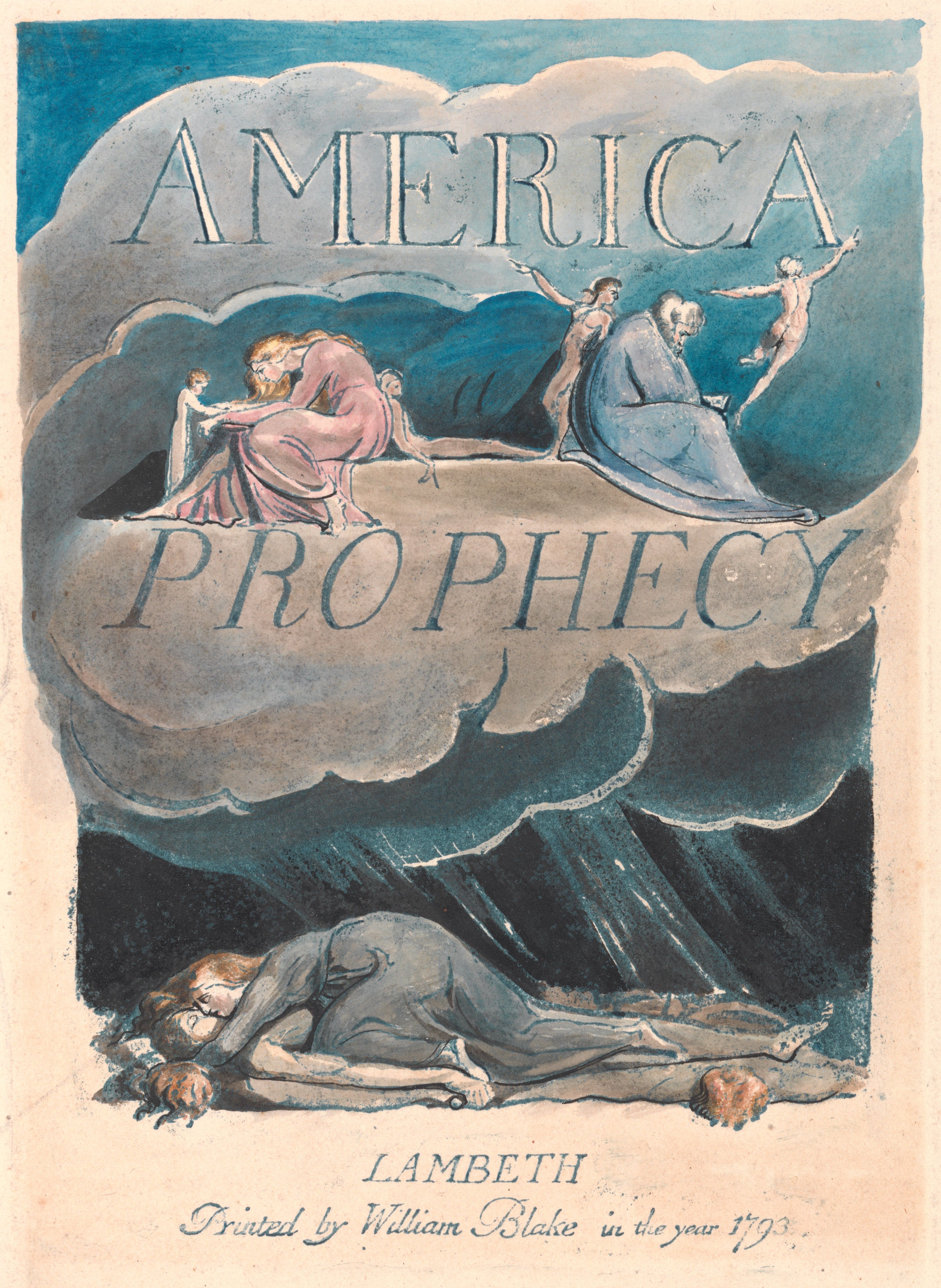
America

Yale Center for British Art
America
Title Plate

At PAINE & BLAKE 2  the picture was used at the beginning of an essay on the two men.

Many or most of Blake's plates show two (upper and lower) levels: the one above relates to what we see as Heaven or the Eternal; the one below relates to 'this world'.

Here I design to describe the picture for itself:

(From Illuminated Blake, page 138)
The lower level is a scene of warfare: notice the two (severed or prone?) heads to the right and left. 

Above them is a fallen soldier, still clutching his sword; a woman overshadows him, hoping to revive him with a kiss.

The upper level, between America and Prophecy shows two figures turned away, perhaps sitting on a rock or cloud?  On the right a portly or large man with a woman on his back and an arm pointing out.

In front of him is a flying figure heading onward.

On the left is a woman, bent over, perhaps reading a book. Behind her is a smaller figure sitting on the cloud with his back propped up against the back of the larger figure.

In front of her is  a smaller figure perhaps reading the book with her.