William Blake: Religion and Psychology

Here you may meet William Blake, join hands in a discussion, ask questions. This is your Blake Commentary.

Wednesday, December 17, 2014

Shakespeare 11


The Tempest
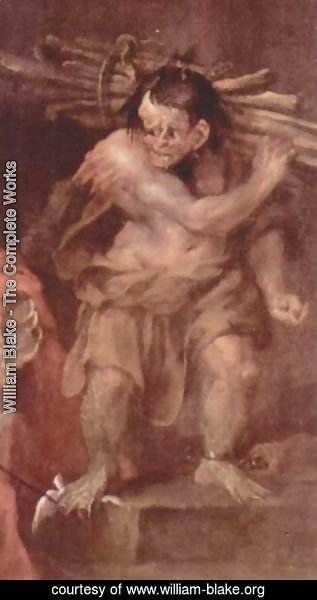
Hogarth
From Wikimedia Commons
Shakespeare's Tempest


Characters:

Prospero: the deposed duke of Milan (looking over Miranda's right shoulder)

Caliban: a native on the island (on the far right)

Miranda: Prospero's daughter (at the center with a lamb?)

Ariel: rescued by Prospero from enslavement by a witch (on the top left)

Antonio: Prospero's brother who tried to take his place as duke of Milan (maybe on the left)

On the right edge is the picture purported to be by William Blake

Companion To Shakespeare'
Pages 19-21:

Shakespeare wrote The Tempest in 1610, near the end of his career. It was performed first for King James I.
The Tempest is a play by William Shakespeare, believed to have been written in 1610–11, and thought by many critics to be the last play that Shakespeare wrote alone. It is set on a remote island, where Prospero, the rightful Duke of Milan, plots to restore his daughter Miranda to her rightful place using illusion and skilful manipulation. He conjures up a storm, the eponymous tempest, to lure his usurping brother Antonio and the complicit King Alonso of Naples to the island


From Wikipedia a summary of the story:
Magician Prospero, rightful Duke of Milan, and his daughter, Miranda, have been stranded for twelve years on an island after Prospero's jealous brother Antonio (aided by Alonso, the King of Naples) deposed him and set him adrift with the then-3-year-old Miranda. 
Gonzalo, the King's counsellor, had secretly supplied their boat with plenty of food, water, clothes and the most-prized books from Prospero's library. Possessing magic powers due to his great learning, Prospero is reluctantly served by a spirit, Ariel, whom Prospero had rescued from a tree in which he had been trapped by the cruel witch, Sycorax, after he had refused to obey her. Prospero maintains Ariel's loyalty by repeatedly promising to release the "airy spirit" from servitude. 

Caliban, a deformed monster and the only non-spiritual inhabitant before the arrival of Prospero, was initially adopted and raised by him. He taught Prospero how to survive on the island, while Prospero and Miranda taught Caliban religion and their own language. Following Caliban's attempted rape of Miranda, he had been compelled by Prospero to serve as the magician's slave. In slavery, Caliban has come to view Prospero as a usurper and has grown to resent him and his daughter. Prospero and Miranda in turn view Caliban with contempt and disgust.

In the conclusion, all the main characters are brought together before Prospero, who forgives Alonso. He also forgives Antonio and Sebastian, but warns them against further betrayal. Ariel is charged to prepare the proper sailing weather to guide Alonso and his entourage (including Prospero and Miranda) back to the Royal fleet and then to Naples, where Ferdinand and Miranda will be married. After discharging this task, Ariel will finally be free. Prospero pardons Caliban, who is sent to prepare Prospero's cell, to which Alonso and his party are invited for a final night before their departure. (It is however not made clear whether, after their departure, Caliban will remain on the island or whether he will be taken to Naples). Prospero indicates that he intends to entertain them with the story of his life on the island. Prospero has resolved to break and bury his magic staff, and "drown" his book of magic, and in his epilogue, shorn of his magic powers, he invites the audience to set him free from the island with their applause.

***********************************************


Posted by Larry Clayton at 5:51 AM 3 comments:
Labels: Shakespeare

Tuesday, December 16, 2014

VISIONARY STATE

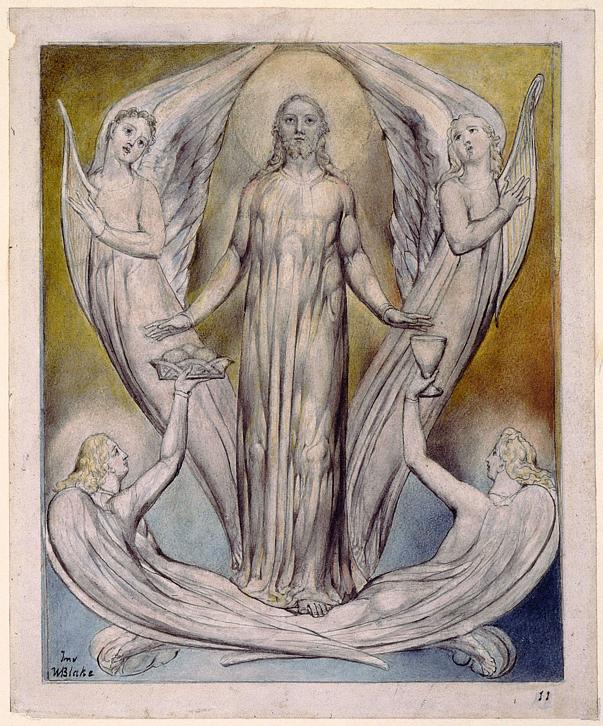
When Blake created images of The Last Judgment he was attempting to convey in as complete a manner as possible his fourfold vision: the complete panoply of creation, fall and apocalypse. These are comments Blake made on the section surrounding Jesus in his image of the Last Judgement. (Version now lost.)  

Vision of Last Judgment, (E 562)
"Over the Head of the Saviour & Redeemer The Holy
Spirit like a Dove is surrounded by a blue Heaven in which are
the two Cherubim that bowd over the Ark for here the temple is
opend in Heaven & the Ark of the Covenant is as a Dove of Peace  
The Curtains are drawn apart Christ having rent the Veil The
Candlestick & the Table of Shew bread appear on Each side a
Glorification of Angels with Harps surround the Dove 
     The Temple stands on the Mount of God from it flows on each
side the River of Life on whose banks Grows the tree of Life
among whose branches temples & Pinnacles tents & pavilions" 
In the following lines Blake tells something of the process of reaching Fourfold Vision through which he integrated into one picture all the spiritual events of history. To perceive 'face to face' and not 'through a glass darkly', one must 'give up Love': that is dualistic thinking which is represented by sexual divisions. Further one must 'root up the infernal grove', the dark, confused logic derived from denying the reality of the Eternal, Infinite world of the Spirit. Then shall man live in the state of mutual forgiveness which delights and sustains mankind. 


Wikimedia Commons
Illustrations to Milton's Paradise Regained
Image 11
Letters, To Thomas Butts, (E 722)  
"Now I a fourfold vision see 
And a fourfold vision is given to me 
Tis fourfold in my supreme delight"


Songs and Ballads, My Spectre, (E 477)
"Let us agree to give up Love 
And root up the infernal grove 
Then shall we return & see 
The worlds of happy Eternity &

Throughout all Eternity 
I forgive you you forgive me 
As our dear Redeemer said 
This the Wine & this the Bread" 
  
 John Masefield caught some of the same ability to bring together varied images of spiritual development in his hymn written in 1911.  

O Christ, who holds the open gate,
O Christ who drives the furrow straight,
O Christ, the plow, O Christ, the laughter
of holy white birds flying after.

Lo, all my heart's field red and torn,
and thou wilt bring the young green corn,
the young green corn divinely springing,
the young green corn for ever singing.

And when the field is fresh and fair
thy blessèd feet shall glitter there,
and we will walk the weeded field,
and tell the golden harvest's yield.

The corn that makes the holy bread
by which the soul of man is fed,
the holy bread, the food unpriced,
thy everlasting mercy, O Christ.
Posted by ellie Clayton at 7:11 AM No comments:
Labels: Vision

Monday, December 15, 2014

Shakespeare 10

Timons of Athens


British Museum
This from Wikipedia:
Timon of Athens is a collaborative play by William Shakespeare and perhaps Thomas Middleton about the fortunes of an Athenian named Timon (and probably influenced by the philosopher of the same name). The central character is a well beloved citizen of Athens who through tremendous generosity spends his entire fortunes on corrupt hangers-on only interested in getting the next payout. Timon of Athens is one of Shakespeare's most obscure and least-known works. It was originally grouped with the tragedies, but some scholars name it one of the problem plays.

Synopsis
In the beginning, Timon, later a misanthrope, is a wealthy and generous Athenian gentleman. He hosts a large banquet, attended by nearly all the main characters. Timon gives away money wastefully, and everyone wants to please him to get more, except for Apemantus, a churlish philosopher whose cynicism Timon cannot yet appreciate. He accepts art from Poet and Painter, and a jewel from the Jeweller, but by the end of Act 1, he has given that away to another friend. Timon's servant, Lucilius, has been wooing the daughter of an old Athenian. The man is angry, but Timon pays him three talents in exchange for the couple being allowed to marry, because the happiness of his servant is worth the price. Timon is told that his friend, Ventidius, is in debtor's prison. He sends money to pay Ventidius's debt, and Ventidius is released and joins the banquet. Timon gives a speech on the value of friendship. The guests are entertained by a masque, followed by dancing. As the party winds down, Timon continues to give things away to his friends; his horses, and other possessions. The act is divided rather arbitrarily into two scenes but the experimental and/or unfinished nature of the play is reflected in that it does not naturally break into a five-act structure.
Now Timon has given away all his wealth. Flavius, Timon's steward, is upset by the way Timon has spent his wealth, overextending his munificence by showering patronage on the parasitic writers and artists, and delivering his dubious friends from their financial straits; this he tells Timon when he returns from a hunt. Timon is upset that he has not been told this before, and begins to vent his anger on Flavius, who tells him that he has tried repeatedly in the past without success, and now he is at the end; Timon's land has been sold. Shadowing Timon is another guest at the banquet: the cynical philosopher Apemantus, who terrorises Timon's shallow companions with his caustic raillery. He was the only guest not angling for money or possessions from Timon. Along with a Fool, he attacks Timon's creditors when they show up to make their demands for immediate payment. Timon cannot pay, and sends out his servants to make requests for help from those friends he considers closest.
Timon's servants are turned down, one by one, by Timon's false friends, two giving lengthy monologues as to their anger with them. Elsewhere, one of Alcibiades's junior officers has reached an even further point of rage, killing a man in "hot blood." Alcibiades pleads with the Senate for mercy, arguing that acrime of passion should not carry as severe a sentence as premeditated murder. The senators disagree, and, when Alcibiades persists, banish him forever. He vows revenge, with the support of his troops. The act finishes with Timon discussing with his servants the revenge he will carry out at his next banquet.
Timon hosts a smaller party, intended only for those he feels have betrayed him. The serving trays are brought in, but under them the friends find rocks and lukewarm water. Timon sprays them with the water, throws the dishes at them, and flees his home. The loyal Flavius vows to find him.
Timon renounces society (1803 engraving for Shakespeare, Timon of Athens, Act IV, Scene 1)
Cursing the city walls, Timon goes into the wilderness and makes his crude home in a cave, sustaining himself on roots. Here he discovers an underground trove of gold. The knowledge of his discovery spreads. Alcibiades, Apemantus, and three bandits are able to find Timon before Flavius does. Accompanying Alcibiades are two prostitutes, Phrynia and Timandra, who trade barbs with the bitter Timon on the subject of venereal disease. Timon offers most of the gold to the rebel Alcibiades to subsidise his assault on the city, which he now wants to see destroyed, as his experiences have reduced him to misanthropy. He gives the rest to his whores to spread disease, and much of the remainder to Poet and Painter, who arrive soon after, leaving little left for the senators who visit him. When Apemantus appears and accuses Timon of copying his pessimistic style, the audience is treated to the spectacle of a mutually misanthropic exchange of invective.
Flavius arrives. He wants the money as well, but he also wants Timon to come back into society. Timon acknowledges that he has had one true friend in Flavius, a shining example of an otherwise diseased and impure race, but laments that this man is a mere servant. He invites the last envoys from Athens, who hoped Timon might placate Alcibiades, to go hang themselves, and then dies in the wilderness. Alcibiades, marching on Athens, then throws down his glove, and ends the play reading the bitter epitaph Timon wrote for himself, part of which was composed by Callimachus:
"Here lies a wretched corpse of wretched soul bereft:Seek not my name: a plague consume you wicked caitiffs left!"Here lie I, Timon, who alive, all living men did hate,Pass by, and curse thy fill, but pass and stay not here thy gait."
************************************************

From Gutenberg:
This was taken from a copy of Shakespeare's first folio and it is as close as I can come in ASCII to the printed text.

The elongated S's have been changed to small s's and the conjoined ae have been changed to ae. I have left the spelling, punctuation, capitalization as close as possible to the printed text. I have corrected some spelling mistakes (I have put together a spelling dictionary devised from the spellings of the Geneva Bible and Shakespeare's First Folio and have unified spellings according to this template), typo's and expanded abbreviations as I have come across them. Everything within brackets [] is what I have added. So if you don't like that you can delete everything within the brackets if you want a purer Shakespeare.

Posted by Larry Clayton at 3:00 AM No comments:
Labels: Shakespeare

Sunday, December 14, 2014

HUMILITY

British Museum
Song of Los
Plate 1, Copy A
Blake was committed to an egalitarian society; one in which all men recognized each as Brother: as equally an expression of the Indwelling Spirit. He disagreed with any system in which some men were set up to have authority, and others to be obedient to them. His attitude to humility was a result of this belief. If a man knows himself to be directed by his Inner Spirit, his Identity, he trusts in his own integrity and not in ecclesiastical or political orders. 
Everlasting Gospel, (E 518)
"Was Jesus Humble or did he
Give any Proofs of Humility
Boast of high Things with Humble tone
And give with Charity a Stone
When but a Child he ran away                  
And left his Parents in Dismay
When they had wanderd three days long
These were the words upon his tongue
No Earthly Parents I confess
I am doing my Fathers business"
Blake saw true humility as not considering oneself as more worthy of respect of honor than others. Likewise one should not give more respect or honor to another because he was singled out to serve his Brothers in a position of responsibility. Blake saw the example which Jesus set as, "Humble to God Haughty to Man." Blake meant that a man who is confident of God working through him would not, and should not appear submissive to men who had not sought to follow the God within them. The attitude of Jesus was not defiance, submission or cooperation but trust in the Higher Power. 
Everlasting Gospel, (E 519)
"Like dr Priestly & Bacon & Newton               
Poor Spiritual Knowledge is not worth a button
For thus the Gospel Sr Isaac confutes
God can only be known by his Attributes    
And as for the Indwelling of the Holy Ghost
Or of Christ & his Father its all a boast
And Pride & Vanity of Imagination
That disdains to follow this Worlds Fashion
To teach doubt & Experiment       
Certainly was not what Christ meant
What was he doing all that time
From twelve years old to manly prime
Was he then Idle or the Less
About his Fathers business        
Or was his wisdom held in scorn
Before his wrath began to burn
In Miracles throughout the Land
That quite unnervd Lord Caiaphas hand    
If he had been Antichrist Creeping Jesus 
Hed have done any thing to please us
Gone sneaking into Synagogues
And not usd the Elders & Priests like dogs
But Humble as a Lamb or Ass
Obeyd himself to Caiaphas         
God wants not Man to Humble himself
This is the trick of the ancient Elf
This is the Race that Jesus ran  
Humble to God Haughty to Man
Cursing the Rulers before the People    
Even to the temples highest Steeple
And when he Humbled himself to God
Then descended the Cruel Rod
If thou humblest thyself thou humblest me   
Thou also dwellst in Eternity       
Thou art a Man God is no more
Thy own humanity learn to adore
For that is my Spirit of Life
Awake arise to Spiritual Strife
And thy Revenge abroad display       
In terrors at the Last Judgment day
Gods Mercy & Long Suffering
Is but the Sinner to Judgment to bring
Thou on the Cross for them shalt pray
And take Revenge at the Last Day 
Jesus replied & thunders hurld
I never will Pray for the World
Once [I] did so when I prayd ill the Garden  
I wishd to take with me a Bodily Pardon
Can that which was of Woman born   
In the absence of the Morn
When the Soul fell into Sleep
And Archangels round it weep
Shooting out against the Light
Fibres of a deadly night        
Reasoning upon its own Dark Fiction
In Doubt which is Self Contradiction
Humility is only Doubt
And does the Sun & Moon blot out
Rooting over with thorns & stems     
The buried Soul & all its Gems
This Lifes dim Windows of the Soul
Distorts the Heavens from Pole to Pole
And leads you to Believe a Lie
When you see with not thro the Eye"  

John 11
[46] But some of them went their ways to the Pharisees, and told them what things Jesus had done.
[47] Then gathered the chief priests and the Pharisees a council, and said, What do we? for this man doeth many miracles.
[48] If we let him thus alone, all men will believe on him: and the Romans shall come and take away both our place and nation.
[49] And one of them, named Caiaphas, being the high priest that same year, said unto them, Ye know nothing at all,
[50] Nor consider that it is expedient for us, that one man should die for the people, and that the whole nation perish not.
[51] And this spake he not of himself: but being high priest that year, he prophesied that Jesus should die for that nation;
[52] And not for that nation only, but that also he should gather together in one the children of God that were scattered abroad.
[53] Then from that day forth they took counsel together for to put him to death.
[54] Jesus therefore walked no more openly among the Jews; but went thence unto a country near to the wilderness, into a city called Ephraim, and there continued with his disciples.


John 18
[19] The high priest then asked Jesus of his disciples, and of his doctrine.
[20] Jesus answered him, I spake openly to the world; I ever taught in the synagogue, and in the temple, whither the Jews always resort; and in secret have I said nothing.
[21] Why askest thou me? ask them which heard me, what I have said unto them: behold, they know what I said.
[22] And when he had thus spoken, one of the officers which stood by struck Jesus with the palm of his hand, saying, Answerest thou the high priest so?
[23] Jesus answered him, If I have spoken evil, bear witness of the evil: but if well, why smitest thou me?
[24] Now Annas had sent him bound unto Caiaphas the high priest.

Posted by ellie Clayton at 6:18 AM No comments:
Labels: Jesus

Saturday, December 13, 2014

Shakespeare Richard III


Richard III is a historical play by William Shakespeare, believed to have been written in approximately 1592.  The play begins like this:
"ACT I. SCENE 1.
London. A street
Enter RICHARD, DUKE OF GLOUCESTER, solus
  GLOUCESTER. Now is the winter of our discontent"

On the eve of the
Battle of Bosworth Field, Richard dreams that he's visited by the ghosts of some of his murder victims – Prince Edward, King Henry VI, Clarence, Rivers, Gray, Vaughan, the young princes, Hastings, Lady Anne, and Buckingham. (The stage sure gets crowded during this scene.)

Each of the ghosts recalls what Richard has done to them and condemns him to death on the battlefield. Each one chants "Despair and die" (5.5).
(Oh, and did we mention how the ghosts also pay Richmond a visit (in his dream, of course) in order to give the guy a pre-battle pep-talk? It's a terrifying moment, and Richard's pretty shaken up when he awakens. Check out his reaction:)
"Methought the souls of all that I had murder'd
Came to my tent; and every one did threat
To-morrow's vengeance on the head of Richard."
 (5.5.5)
Shakespeare's point? It seems pretty clear that Richard's evil doings have come back to haunt him – literally.

Here's some of the text:
King Richard ii
British Museum


  • Richmond (Henry VII). Good lords, conduct him to his regiment: 3575
    I'll strive, with troubled thoughts, to take a nap,
    Lest leaden slumber peise me down to-morrow,
    When I should mount with wings of victory:
    Once more, good night, kind lords and gentlemen.
    [Exeunt all but RICHMOND] 3580
    O Thou, whose captain I account myself,
    Look on my forces with a gracious eye;
    Put in their hands thy bruising irons of wrath,
    That they may crush down with a heavy fall
    The usurping helmets of our adversaries! 3585
    Make us thy ministers of chastisement,
    That we may praise thee in the victory!
    To thee I do commend my watchful soul,
    Ere I let fall the windows of mine eyes:
    Sleeping and waking, O, defend me still!

  • [Sleeps]

[Enter the Ghost of Prince Edward, son to King Henry VI]
  • Prince Edward. [To KING RICHARD III]
    Let me sit heavy on thy soul to-morrow!
    Think, how thou stab'dst me in my prime of youth 3595
    At Tewksbury: despair, therefore, and die!
    [To RICHMOND]
    Be cheerful, Richmond; for the wronged souls
    Of butcher'd princes fight in thy behalf
    King Henry's issue, Richmond, comforts thee.3600
[Enter the Ghost of King Henry VI]
  • Henry VI. [To KING RICHARD III]
    When I was mortal, my anointed body
    By thee was punched full of deadly holes
    Think on the Tower and me: despair, and die! 3605
    Harry the Sixth bids thee despair, and die!
    [To RICHMOND]
    Virtuous and holy, be thou conqueror!
    Harry, that prophesied thou shouldst be king,
    Doth comfort thee in thy sleep: live, and flourish!3610
[Enter the Ghost of CLARENCE]
  • George Plantagenet (Duke of Clarence). [To KING RICHARD III]
    Let me sit heavy on thy soul to-morrow!
    I, that was wash'd to death with fulsome wine,
    Poor Clarence, by thy guile betrayed to death! 3615
    To-morrow in the battle think on me,
    And fall thy edgeless sword: despair, and die!—
    [To RICHMOND]
    Thou offspring of the house of Lancaster
    The wronged heirs of York do pray for thee 3620
    Good angels guard thy battle! live, and flourish!
[Enter the Ghosts of RIVERS, GRAY, and VAUGHAN]
  • Lord (Earl) Rivers. [To KING RICHARD III]
    Let me sit heavy on thy soul to-morrow,
    Rivers. that died at Pomfret! despair, and die!3625
  • Lord Grey. [To KING RICHARD III]
    Think upon Grey, and let thy soul despair!
  • Sir Thomas Vaughan. [To KING RICHARD III]
    Think upon Vaughan, and, with guilty fear,
    Let fall thy lance: despair, and die!3630
  • All. [To RICHMOND]
    Awake, and think our wrongs in Richard's bosom
    Will conquer him! awake, and win the day!
[Enter the Ghost of HASTINGS]
  • Lord Hastings. [To KING RICHARD III] 3635
    Bloody and guilty, guiltily awake,
    And in a bloody battle end thy days!
    Think on Lord Hastings: despair, and die!
    [To RICHMOND]
    Quiet untroubled soul, awake, awake! 3640
    Arm, fight, and conquer, for fair England's sake!
[Enter the Ghosts of the two young Princes]
  • Princes. [To KING RICHARD III]
    Dream on thy cousins smother'd in the Tower:
    Let us be led within thy bosom, Richard, 3645
    And weigh thee down to ruin, shame, and death!
    Thy nephews' souls bid thee despair and die!
    [To RICHMOND]
    Sleep, Richmond, sleep in peace, and wake in joy;
    Good angels guard thee from the boar's annoy! 3650
    Live, and beget a happy race of kings!
    Edward's unhappy sons do bid thee flourish.
[Enter the Ghost of LADY ANNE]
  • Lady Anne. [To KING RICHARD III]
    Richard, thy wife, that wretched Anne thy wife, 3655
    That never slept a quiet hour with thee,
    Now fills thy sleep with perturbations
    To-morrow in the battle think on me,
    And fall thy edgeless sword: despair, and die!
    [To RICHMOND] 3660
    Thou quiet soul, sleep thou a quiet sleep
    Dream of success and happy victory!
    Thy adversary's wife doth pray for thee.
[Enter the Ghost of BUCKINGHAM]
  • Duke of Buckingham. [To KING RICHARD III] 3665
    The last was I that helped thee to the crown;
    The last was I that felt thy tyranny:
    O, in the battle think on Buckingham,
    And die in terror of thy guiltiness!
    Dream on, dream on, of bloody deeds and death: 3670
    Fainting, despair; despairing, yield thy breath!
    [To RICHMOND]
    I died for hope ere I could lend thee aid:
    But cheer thy heart, and be thou not dismay'd:
    God and good angel fight on Richmond's side; 3675
    And Richard falls in height of all his pride.
[The Ghosts vanish]
[KING RICHARD III starts out of his dream]
  • Richard III (Duke of Gloucester). Give me another horse: bind up my wounds.
    Have mercy, Jesu!—Soft! I did but dream. 3680
    O coward conscience, how dost thou afflict me!
    The lights burn blue. It is now dead midnight.
    Cold fearful drops stand on my trembling flesh.
    What do I fear? myself? there's none else by:
    Richard loves Richard; that is, I am I. 3685
    Is there a murderer here? No. Yes, I am:
    Then fly. What, from myself? Great reason why:
    Lest I revenge. What, myself upon myself?
    Alack. I love myself. Wherefore? for any good
    That I myself have done unto myself? 3690
    O, no! alas, I rather hate myself
    For hateful deeds committed by myself!
    I am a villain: yet I lie. I am not.
    Fool, of thyself speak well: fool, do not flatter.
    My conscience hath a thousand several tongues, 3695
    And every tongue brings in a several tale,
    And every tale condemns me for a villain.
    Perjury, perjury, in the high'st degree
    Murder, stem murder, in the direst degree;
    All several sins, all used in each degree, 3700
    Throng to the bar, crying all, Guilty! guilty!
    I shall despair. There is no creature loves me;
    And if I die, no soul shall pity me:
    Nay, wherefore should they, since that I myself
    Find in myself no pity to myself? 3705
    Methought the souls of all that I had murder'd
    Came to my tent; and every one did threat
    To-morrow's vengeance on the head of Richard.
Posted by Larry Clayton at 3:00 AM No comments:
Labels: Shakespeare

Friday, December 12, 2014

BLAKE & MIRACLE

British Museum
Illustrations to Young's Night Thoughts
In a letter of 1799 to his friend George Cumberland, Blake wrote, "As to Myself about whom you are so kindly Interested. I live by Miracle." (E 704) Blake was writing at a low point of his career not a high point. He was sustained by his faith in "the infinite in every thing", words he had put into the mouth of Isaiah in The Marriage of Heaven and Hell. Blake believed with Isaiah that "a firm perswasion" could make a thing so. The ability to discern a miracle to Blake came through seeing everything from the Infinite, Eternal perspective, not from the perspective of Urizen whose philosophy was based on doubt.

Seeing miracles, having faith, perceiving the infinite in every thing, moving mountains: all of these a ways of expressing man's essential nature of being a vehicle through whom God acts.  

Marriage of Heaven & Hell, Plate 12, (E 38) 
                    "A Memorable Fancy.                            
   "The Prophets Isaiah and Ezekiel dined with me, and I asked
them how they dared so roundly to assert. that God spake to them; 
and  whether they did not think at the time, that they would be 
misunderstood, & so be the cause of imposition.
   Isaiah answer'd. I saw no God. nor heard any, in a finite
organical perception; but my senses discover'd the infinite in
every thing, and as  I was then perswaded. & remain confirm'd;
that the voice of honest indignation is the voice of God, I cared
not for consequences but  wrote.
   Then I asked: does a firm perswasion that a thing is so, make
it so?
   He replied.  All poets believe that it does, & in ages of
imagination
this firm perswasion removed mountains; but many are not capable
of a firm perswasion of any thing."

Matthew 21
[18] In the morning, as he was returning to the city, he was hungry.
[19] And seeing a fig tree by the wayside he went to it, and found nothing on it but leaves only. And he said to it, "May no fruit ever come from you again!" And the fig tree withered at once.
[20] When the disciples saw it they marveled, saying, "How did the fig tree wither at once?"
[21] And Jesus answered them, "Truly, I say to you, if you have faith and never doubt, you will not only do what has been done to the fig tree, but even if you say to this mountain, `Be taken up and cast into the sea,' it will be done.
[22] And whatever you ask in prayer, you will receive, if you have faith."

Descriptive Catalogue, (E 543)
"Mr. B. has done, as all
the ancients did, and as all the moderns, who are worthy of fame,
given the historical fact in its poetical vigour; so as it always
happens, and not in that dull way that some Historians pretend,
who being weakly organized themselves, cannot see either miracle
or prodigy; all is to them a dull round of probabilities and
possibilities; but the history of all times and places, is
nothing else but improbabilities and impossibilities; what we 
should say, was impossible if we did not see it always before our 
eyes."
It may have seemed improbable that Paine's Common Sense would have been pivotal in the breaking away of the British Colonies from their parent. Equally improbable it would have seemed that the Disciples of Jesus would have become new wineskins that hold the new wine which fermented through the ministry of Jesus. And how improbable is it that the work of William Blake which was known to a few hundred people in his lifetime is viewed and read and contemplated by hundreds of thousands through the 'miracle' of the internet today?    

British Museum's video of William Blake's Spiritual Visions. 
Posted by ellie Clayton at 7:03 AM No comments:

Thursday, December 11, 2014

Style 4

      The notebook poem which begins, "My Spectre around me night and day" merits study as an approach to understanding the use of Blake's symbolism to express his deepest feelings about life. I quote the climax of it. In the first verse Blake means by 'love' very much what Paul in Romans 8 meant by 'flesh'. In the second, without using the word, he expresses in the fullest possible way what divine love meant to him:
    Let us agree to give up Love,
    And root up the infernal grove;
    Then shall we return & see
    The worlds of happy Eternity.

    & Throughout all Eternity
    I forgive you, you forgive me.
    As our dear Redeemer said:
    This the Wine & this the Bread.
(from Broken Love) As these lines suggest, Blake had a strong sense of reticence about using the sacred words in the sacred sense, perhaps because he had so exhaustively explored their profane senses. Nevertheless in the poem "William Bond" from the Pickering Manuscript he gave an exquisite portrait of romantic love, purified of fallenness and filled with the divine. Read the last two verses:
       I thought Love liv'd in the hot sun shine,
But O, he lives in the Moony light!
I thought to find Love in the heat of day,
But sweet Love is the Comforter of Night.
       Seek Love in the Pity of others' Woe,
In the gentle relief of another's care,
In the darkness of night & the winter's snow,
In the naked & outcast, Seek Love there!

       If its visions of love express the quality of a culture, so also does the face which it presents to death. Our society expends enormous sums on the professional removal of all evidence of death from our consciousness, even in the teeth of the stark reality. Ernest Becker, in The Denial of Death, showed the ubiquity of this impulse in American culture. His title, a poetic term, can just as easily mean one thing as the other. Like all symbols of value we encounter good denials of death and bad ones.
       The poetry of Walt Whitman expresses one of the best. Like our poet Whitman was so sure of Eternity that the end of natural life had no terrors for him. He gained first hand experience with death as a hospital volunteer during the Civil War. Exceptionally memorable is his address to a dying soldier, "I don't commiserate, I congratulate you". Here is the exact opposite of the forms of denial most often exercised by the mortician, who simply does all he can to encourage us not to think about it.
       In one of his earliest writings Blake explored the meaning of death to an ordinary young man and his loved ones. The Couch of Death (Erdman 441) voices the common fears of humanity but moves to the faithful reality that Blake possessed throughout his days, ending "and the youth breathes out his soul with joy into eternity".
       Blake's idealism found expression in the simple inversion of death, an idea that goes back as far as Heraclitus, who speaking of the Eternals said, "we live their death, and we die their life". The thought comes down to us through Euripides, Plato, and many others as late as Thomas Wolfe.
Most often when Blake speaks of " Death Eternal" he expresses the viewpoint of the Eternals, what  they meant by the term "this mortal life". Three times in Plate 14 of Milton the poet in Heaven, having heard the "Bard's Song" about Satan and recognizing Satan as his own Self- hood, says, "I go to Eternal Death!". He clearly means to return to this world, reenacting the kenosis (self emptying) of Christ.
       Otherwise Blake used the word 'death' more straightforwardly than he had used 'love' and in two general senses. In fairly common parlance death is the opposite of the creative. Speaking of the Law in 'Jerusalem' the Divine Voice says:
    "No individual can keep these Laws, for they are death to every energy of man and forbid the springs of life."
       If you read Paul's epistles, you will discover that he used 'death' in the same ways. For example "And you hath he quickened, who were dead in trespasses and sins" (Ephesians 2:1). Paul is always reminding the Christian that he participates in the death and resurrection of Christ.
       Secondly, Blake used 'death' in its most proper sense as the end of mortal life, but whenever he touched this subject, he always denied the materialistic viewpoint that death is the end. A clear example comes in Gates of Paradise, a short synoptic and pictorial description of Blake's myth of life:
    " But when once I did descry The Immortal Man that cannot Die, Thro' evening shades I haste away To close the Labours of my Day."
       Though he lived intensely, the love of the Ideal and his life long visions of Eternity led Blake to yearn for the Beyond and to depreciate material existence. Like the apostle Paul he had a "desire to depart, and to be with Christ; which is far better". Blake made a deliberate attempt through the aid of the doctrine of correspondences to live each moment of earthly life in the eternal realm, "to see a World in a Grain of Sand". 
    "I assert for My Self that I do not behold the outward Creation & that to me it is hindrance & not Action; it is as the Dirt upon my feet, No part of Me."
And as stated in CHAPTER ONE he died with a song of praise on his lips. His life and all his art provide a convincing testimony for the reality of the Beyond. It was really Death that was "Dirt upon his feet".
       Finally Blake used 'death' in the uniquely Christian context of self giving. At the end of 'Jerusalem' Jesus explains to Albion the meaning of his own death and its significance as a universal form of relationship:
           ...Fear not Albion: unless I die thou canst not live;
    But if I die I shall arise again & thou with me.
    This is Friendship & Brotherhood: without it Man is Not. ...
    ....Wouldest thou love one who never died
    For thee, or ever die for one who had not died for thee?
    And if God dieth not for Man & giveth not himself
    Eternally for Man, Man could not exist; for Man is Love
    As God is Love; every kindness to another is a little Death In the Divine Image, nor can Man exist but by Brotherhood.
       These explorations of 'love' and 'death' may help the reader to grasp some of the poetic meanings attached to Blake's other terms of value, words like heaven and hell, good and evil, truth and error. Always watch for irony, for the other point of view, the reverse side of the coin. In such ways Blake continually provokes the intellect. He delights the person who enjoys an intellectual challenge--and frustrates others. He intimated as much in a letter to Dr. Trusler, who likely belonged to the second category:
    " But you ought to know that What is Grand is necessarily
    obscure to Weak men. That which can be made Explicit to
    the Idiot is not worth my care. The wisest of the Ancients
    consider'd what is not too Explicit as the fittest for
    Instruction, because it rouzes the faculties to act. I
    name Moses, Solomon, Esop, Homer, Plato."
So much for Blake's use of words; the Word now engages our attention. Conventional Christian thought, following the Prologue of John, identifies the Word or Logos with the Eternal Christ, incarnated by Jesus. In addition we have the Written Word, the Bible, the record of God's dealings with Man. Broadening this somewhat we get the Living Word, the Spirit of the first two falling upon the heart of the believer. This approximates the meaning of the Word for Blake. Finally, in his eternal vision the Word was not confined to the content of the Bible, but included all of God's statements to the world.
The Word was a Man who contained among his parts everything in the universe. The artist proclaims the Word, and Blake perceived it as successively recreated by each generation. He understood the Bible in this way as a series of recreations of the Word. So also was the work of Origen, Plotinus, Paracelsus, Boehme, Swedenborg, all recreators of the Word.
Blake rightly perceived Milton's poetry, especially his epic poem, 'Paradise Lost', as the definitive English recreation of the Word, and he hoped to do for later generations what Milton had done for earlier ones. All of the artists named, and of course innumerable others, had dealt extensively with the Bible, interpreting it, commenting upon it, correcting it, adding to it. Lacking the usual superstitious awe of the Bible Blake saw all of these as legitimate activities and indeed as the appropriate vocation of every artist; in that way man becomes One and Christ is formed.
Posted by Larry Clayton at 3:00 AM No comments:
Labels: Larry's Blake

Wednesday, December 10, 2014

PAINE & BLAKE 7

British Museum
Illustrations to Young's Night Thoughts
To Blake contraries did not contradict each other but complemented the other. We can see the thought of Blake and Paine as contraries. Although Blake was primarily guided by vision and Paine by reason, they agreed on the source of their image of reality. If the 'Almighty Power' chose to reveal himself to Blake through imagination and to Paine through nature, it was still God who was revealed. Just as Blake could say, 'everything is holy', Paine could say, 'everything, therefore, is miracle, in one sense'. The holiness or the miracle of everything is not always obvious from the world's point of view. One must be capable of seeing from the Eternal perspective to know that God is revealed in everyone and everything.


Blake and Paine agreed that there was no such thing as a miracle in Watson's sense - of God giving an arbitrary command to prove his superior power to unbelieving subjects. Miracles were discernible to those whose spiritual consciousness had been awakened. Blake saw that Paine himself had been the vehicle for the working of miracles by writing pamphlets which gave men the courage to release themselves from their 'mind forged manacles', and thereby forge free societies.
Thomas Paine wrote in Age of Reason:
"To an almighty power, it is no more difficult to make the one than the 
other, and no more difficult to make millions of worlds than to make 
one. Everything, therefore, is a miracle, in one sense, whilst in the 
other sense, there is no such thing as a miracle. It is a miracle when 
compared to our power and to our comprehension, if not a miracle 
compared to the power that performs it; but as nothing in this 
description conveys the idea that is affixed to the word miracle, it is 
necessary to carry the inquiry further.

Mankind have conceived to themselves certain laws, by which what they 
call nature is supposed to act; and that miracle is something contrary 
to the operation and effect of those laws; but unless we know the whole 
extent of those laws, and of what are commonly called the powers of 
nature, we are not able to judge whether anything that may appear to us 
wonderful or miraculous be within, or be beyond, or be contrary to, her 
natural power of acting."
William Blake wrote this in his annotations to Watson's Apology for the Bible which was his reply to Age of Reason. 
 "Jesus could not do miracles where unbelief hinderd hence we
must conclude that the man who holds miracles to be ceased puts
it out of his own power to ever witness one   The manner of a
miracle being performd is in modern times considerd as an
arbitrary command of the
agent upon the patient but this is an impossibility not a miracle
neither did Jesus ever do such a miracle.  Is it a greater
miracle to feed five thousand men with five loaves than to
overthrow all the armies of Europe with a small pamphlet.
look over the events of your own life & if you do not find that
you have both done such miracles & lived by such you do not see
as I do   True I cannot do a miracle thro experiment & to
domineer over & prove to others my superior power as neither
could Christ   But I can & do work such as both astonish &
comfort me & mine   How can Paine the worker of miracles ever
doubt Christs in the above sense of the word miracle   But how
can Watson ever believe the above sense of a miracle who
considers it as an arbitrary act of the agent upon an unbelieving
patient. whereas the Gospel says that Christ could not do a
miracle because of Unbelief 
     If Christ could not do miracles because of Unbelief
the reason alledged by Priests for miracles is false for those
who believe, want not to be confounded by miracles.  Christ & his
Prophets & Apostles were not ambitious miracle mongers"
(E 616)
Posted by ellie Clayton at 6:06 AM No comments:
Newer Posts Older Posts Home
Subscribe to: Posts (Atom)

Followers

DIVINE ECONOMY

DIVINE ECONOMY
Free e-book. Click on image to view.

Blog Archive

  • ▼  2026 (39)
    • ▼  September (5)
      • JOHN THE BAPTIST
      • ALBION & ARTHUR
      • GIANT ALBION
      • FINE ARRAY
      • Becoming Himself
    • ►  August (5)
    • ►  July (4)
    • ►  June (4)
    • ►  May (5)
    • ►  April (4)
    • ►  March (4)
    • ►  February (4)
    • ►  January (4)
  • ►  2025 (69)
    • ►  December (8)
    • ►  November (8)
    • ►  October (5)
    • ►  September (4)
    • ►  August (7)
    • ►  July (5)
    • ►  June (6)
    • ►  May (5)
    • ►  April (5)
    • ►  March (6)
    • ►  February (5)
    • ►  January (5)
  • ►  2024 (65)
    • ►  December (6)
    • ►  November (3)
    • ►  October (7)
    • ►  September (4)
    • ►  August (2)
    • ►  July (7)
    • ►  June (6)
    • ►  May (6)
    • ►  April (6)
    • ►  March (7)
    • ►  February (5)
    • ►  January (6)
  • ►  2023 (90)
    • ►  December (8)
    • ►  November (7)
    • ►  October (7)
    • ►  September (7)
    • ►  August (8)
    • ►  July (7)
    • ►  June (7)
    • ►  May (7)
    • ►  April (8)
    • ►  March (10)
    • ►  February (7)
    • ►  January (7)
  • ►  2022 (97)
    • ►  December (11)
    • ►  November (8)
    • ►  October (7)
    • ►  September (8)
    • ►  August (8)
    • ►  July (8)
    • ►  June (10)
    • ►  May (4)
    • ►  April (9)
    • ►  March (7)
    • ►  February (5)
    • ►  January (12)
  • ►  2021 (96)
    • ►  December (1)
    • ►  October (12)
    • ►  September (6)
    • ►  August (7)
    • ►  July (9)
    • ►  June (11)
    • ►  May (10)
    • ►  April (11)
    • ►  March (10)
    • ►  February (10)
    • ►  January (9)
  • ►  2020 (107)
    • ►  December (9)
    • ►  November (9)
    • ►  October (9)
    • ►  September (9)
    • ►  August (9)
    • ►  July (10)
    • ►  June (8)
    • ►  May (9)
    • ►  April (14)
    • ►  March (7)
    • ►  February (7)
    • ►  January (7)
  • ►  2019 (111)
    • ►  December (9)
    • ►  November (9)
    • ►  October (10)
    • ►  September (9)
    • ►  August (10)
    • ►  July (10)
    • ►  June (9)
    • ►  May (9)
    • ►  April (10)
    • ►  March (10)
    • ►  February (7)
    • ►  January (9)
  • ►  2018 (142)
    • ►  December (5)
    • ►  November (15)
    • ►  October (15)
    • ►  September (15)
    • ►  August (10)
    • ►  July (27)
    • ►  June (12)
    • ►  May (5)
    • ►  April (10)
    • ►  March (9)
    • ►  February (9)
    • ►  January (10)
  • ►  2017 (106)
    • ►  December (11)
    • ►  November (12)
    • ►  October (9)
    • ►  September (9)
    • ►  August (11)
    • ►  July (10)
    • ►  June (9)
    • ►  May (9)
    • ►  April (5)
    • ►  March (9)
    • ►  February (9)
    • ►  January (3)
  • ►  2016 (90)
    • ►  December (2)
    • ►  November (7)
    • ►  October (8)
    • ►  September (7)
    • ►  August (9)
    • ►  July (7)
    • ►  June (7)
    • ►  May (9)
    • ►  April (11)
    • ►  March (9)
    • ►  February (7)
    • ►  January (7)
  • ►  2015 (294)
    • ►  December (9)
    • ►  November (9)
    • ►  October (16)
    • ►  September (21)
    • ►  August (31)
    • ►  July (31)
    • ►  June (30)
    • ►  May (29)
    • ►  April (30)
    • ►  March (30)
    • ►  February (28)
    • ►  January (30)
  • ►  2014 (355)
    • ►  December (30)
    • ►  November (30)
    • ►  October (31)
    • ►  September (28)
    • ►  August (28)
    • ►  July (30)
    • ►  June (28)
    • ►  May (32)
    • ►  April (30)
    • ►  March (31)
    • ►  February (26)
    • ►  January (31)
  • ►  2013 (349)
    • ►  December (28)
    • ►  November (30)
    • ►  October (29)
    • ►  September (28)
    • ►  August (29)
    • ►  July (33)
    • ►  June (28)
    • ►  May (31)
    • ►  April (25)
    • ►  March (30)
    • ►  February (27)
    • ►  January (31)
  • ►  2012 (350)
    • ►  December (28)
    • ►  November (23)
    • ►  October (29)
    • ►  September (30)
    • ►  August (31)
    • ►  July (31)
    • ►  June (29)
    • ►  May (29)
    • ►  April (29)
    • ►  March (33)
    • ►  February (28)
    • ►  January (30)
  • ►  2011 (341)
    • ►  December (29)
    • ►  November (30)
    • ►  October (30)
    • ►  September (28)
    • ►  August (25)
    • ►  July (29)
    • ►  June (25)
    • ►  May (29)
    • ►  April (30)
    • ►  March (30)
    • ►  February (25)
    • ►  January (31)
  • ►  2010 (335)
    • ►  December (31)
    • ►  November (30)
    • ►  October (26)
    • ►  September (28)
    • ►  August (26)
    • ►  July (25)
    • ►  June (27)
    • ►  May (28)
    • ►  April (29)
    • ►  March (30)
    • ►  February (26)
    • ►  January (29)
  • ►  2009 (115)
    • ►  December (26)
    • ►  November (30)
    • ►  October (25)
    • ►  September (22)
    • ►  August (12)
  • ►  2008 (4)
    • ►  September (1)
    • ►  February (1)
    • ►  January (2)
  • ►  2007 (11)
    • ►  December (2)
    • ►  November (1)
    • ►  September (1)
    • ►  August (2)
    • ►  July (1)
    • ►  June (1)
    • ►  May (3)
  • ►  2006 (5)
    • ►  October (1)
    • ►  September (4)
  • ►  2004 (1)
    • ►  November (1)

Labels

  • 100 QUOTES (10)
  • Ahania (11)
  • Albion (109)
  • america (30)
  • Annihilate (34)
  • appendix (9)
  • ARCHETYPE (16)
  • Arlington tempera (43)
  • beulah (6)
  • Bible (205)
  • bible3 (19)
  • Blake archive (12)
  • Blake's Christianity (14)
  • Blake's Milton (160)
  • Blake's purpose (10)
  • Boehme (10)
  • Book of Designs (24)
  • books (4)
  • Bread and Wine (7)
  • Bunyan (33)
  • C S Lewis (17)
  • Church (24)
  • Comus (16)
  • Consciousness (75)
  • Conversion (24)
  • Damon (40)
  • Dante (71)
  • DIVINE ECONOMY (3)
  • Dylan (14)
  • Edinger (18)
  • Emanations (35)
  • Engraving (51)
  • Enitharmon (40)
  • Erdman (43)
  • Essential Teachings (58)
  • Eternity (78)
  • Europe (40)
  • Experience (70)
  • Eyes of God (17)
  • Ezekiel (19)
  • Faith (18)
  • Fearful Symmetry (14)
  • Forgiveness (70)
  • Four Zoas (107)
  • Four Zoas Night I (35)
  • Four Zoas Night II (8)
  • Four Zoas Night III (3)
  • Four Zoas Night IV (4)
  • Four Zoas Night IX (38)
  • Four Zoas Night V (6)
  • Four Zoas Night VI (4)
  • Four Zoas Night VII (20)
  • Four Zoas Night VIII (18)
  • Fourfold (42)
  • Friends (12)
  • Frye (105)
  • furnaces (15)
  • Future age (14)
  • Gates of Paradise (59)
  • Genesis (26)
  • God (76)
  • God-a (13)
  • Golgoonooza (11)
  • Good and Evil (47)
  • Homer (9)
  • Hughes' Jerusalem (6)
  • Imagination (143)
  • Immortal Gain (26)
  • Innocence (44)
  • Jerusalem (142)
  • Jesus (209)
  • Job (95)
  • Joy (14)
  • Jung (98)
  • Larry's Blake (35)
  • Los (120)
  • Luvah (34)
  • marriage of heaven and hell (74)
  • McGilchrist (8)
  • Mental Traveller (14)
  • MHH (27)
  • Michelangelo (23)
  • Milton (65)
  • Moravian (17)
  • Moses (18)
  • mundane (5)
  • Mythology (56)
  • notes (10)
  • paradise lost (23)
  • Paul (19)
  • Perception of the Infinite (29)
  • Percival (42)
  • perga (11)
  • pilgrim (18)
  • Poetic language (17)
  • Primer (18)
  • Prophet (26)
  • Psychology (84)
  • Quaker (34)
  • Raine (69)
  • Ram Horn'd with gold (44)
  • Revelation (21)
  • Rintrah (9)
  • Robes of blood (3)
  • Sexuality (9)
  • Shakespeare (22)
  • Singer (15)
  • Songs of Innocence (23)
  • sources (19)
  • Spirit (46)
  • Symbols (63)
  • Tharmas (34)
  • Thel (33)
  • Thomas Butts (50)
  • Urizen (104)
  • Urthona (45)
  • Vala (33)
  • Vision (106)
  • Visions (13)
  • Women (21)
  • Wounded Healer (6)

Followers

CONCORDANCE

http://victorian-studies.net/concordance/blake/

 LARRY'S BOOK

Ram Horn'd with Gold

Links to Online Blake

The links provide the best Blake online:

1. The Primer is Larry Clayton's online book with a comprehensive description of Blake's work especially emphasizing his spiritual dimension.

2. Contents of Complete Works

3. The Blake Archive allows you to read the text and view the pictures of all of his illuminated works.

4. Erdman: The Complete Poetry & Prose of William Blake Our page numbers are referenced to this volume.

5. Download Complete Poetry & Prose of William Blake

Contributors

  • Larry Clayton
  • ellie Clayton

blake1

Hit Counter by Digits
Simple theme. Powered by Blogger.