Saturday, January 09, 2016

EMANATION

Wikimedia Commons
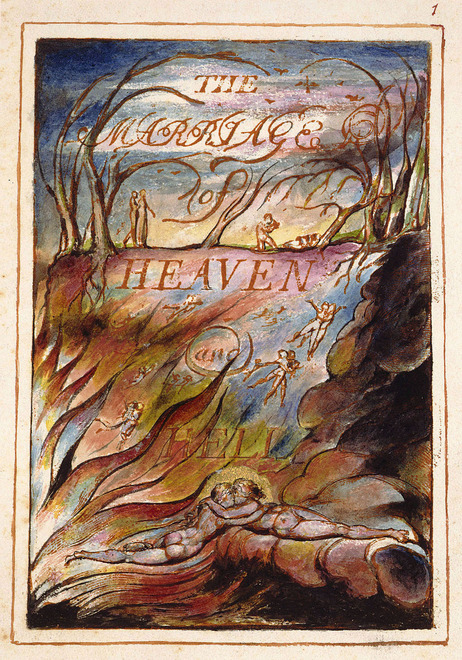
Marriage of Heaven & Hell
Plate 1, Copy I
Associated with each of the Zoas is an Emanation, the female counterpart of the male. Ahania is the feminine nature of Urizen, Enion of Tharmas, Vala of Luvah, and Enitharmon of Los who stands in for Urthona. Blake is not reluctant to picture the Emanations as they appear in the natural world but their appearance in Eternity is beyond even Blake.

Blake was indebted to the heterodox tradition for his development of the concept of emanation. A Christian Gnostic theologian of the third century presented the idea of emanation descending from God into lower forms of existence. The emanations were "not separate existencies so much as personified agencies." However, like Blake, Valentinius saw the the emanative portions falling into "only a partial knowledge of the hidden God."

As we read in Frye's
Fearful Symmetry, "The word "emanation" in Blake means the object-world; creature in Eden, female in Beulah, object or nature in Generation, abstraction in Ulro." (Page 127). We follow in Blake the descent of the emanation through the four levels of spiritual consciousness as she attempts to reascend to "depth which the understanding cannot fathom."   

Brief Analysis of the Sects, Heresies, and Writers of the First Three Centuries PRINTED FOR JAMES COOPER, TRINITY STREET, in 1857 elucidates the concept of emanations:
Page 29
To read the Greek words go to the website.
Valentinus 
"The theory of emanations, which was in some measure 
adopted by all Gnostics, received considerable increase 
from the fertility of his speculative powers. He supposed 
a Supreme Being, infinite, invisible, incomprehensible, 
and therefore called Bv0o^, the depth which the under- 
standing cannot fathom, who, having spent numberless 
ages in repose, resolved to reveal himself, and for this 
purpose employed his thought, Evvota, also called 2t^, 
silence, who alone had dwelt with, or within him. The 
first manifestations, or ^ons, produced, were NoO?^ in- 
telligence, and *A\i]0€ia, truth. 

These ^ons are to be considered only as revealed forms 
of the Supreme Being ; not separate existencies so much 
as personified agencies, whose combination constituted the 
Plenoma, or fulness, of the attributes and perfections 
of the Godhead. They comprised altogether thirty ^ons, 
of whom half were supposed to be males, «.6., active 
agencies, and the other half females, t.e., passive principles. 

In proportion as these -^ons were removed from the 
Supreme God, they decreased in knowledge and perfection. 
The lower ^ons had, therefore, only a partial knowledge 
of the hidden God, and the desire of one of them in 
particular, 'Siorjyiaj to know more of him produced a con- 
cision in the Pleroma, one result of which was that Jio(f>ia 
gave birth to an imperfect being, who was incapable of 
remaining in the Pleroma, and was cast out into Chaos, i 
This being, called Achamoth, formed the Demiurgos, by ] 
whom the world was made, and reduced tVva wvia «a.^ 
Bbapeless mass of matter to some degr^^ oi ot'^ax* ^^Q^"

Jerusalem, Plate 92, (E 252)
"Los answerd swift as the shuttle of gold. Sexes must vanish & cease
To be, when Albion arises from his dread repose O lovely Enitharmon:
When all their Crimes, their Punishments their Accusations of Sin: 
All their Jealousies Revenges. Murders. hidings of Cruelty in Deceit
Appear only in the Outward Spheres of Visionary Space and Time.
In the shadows of Possibility by Mutual Forgiveness forevermore
And in the Vision & in the Prophecy, that we may Foresee & Avoid
The terrors of Creation & Redemption & Judgment. Beholding them 
Displayd in the Emanative Visions of Canaan in Jerusalem & in Shiloh
And in the Shadows of Remembrance, & in the Chaos of the Spectre"

Vision of Last Judgment, (E 562)
"Jesus is surrounded by Beams of Glory in which are
seen all around him Infants emanating from him   these represent
the Eternal Births of Intellect from the divine Humanity   A
Rainbow surrounds the throne & the Glory in which youthful
Nuptials recieve the infants in their hands In Eternity Woman is
the Emanation of Man she has No Will of her own There is no such
thing in Eternity as a Female Will"   
  

Tuesday, January 05, 2016

MUNDANE EGG

New York Public Library
Milton
Copy C, Plate 34
We live in the mundane egg surrounded by the mundane shell. The egg is the physical world where we perceive with our physical senses. All which is experienced in the mundane egg is projected on the mundane shell which surrounds and encloses the physical world. Recorded on the mundane shell are the images of the history of what happens within time and space.

The mental world is represented by the worlds of Tharmas, Urthona, Luvah and Urizen, who overlap the mundane egg. The earth is entirely within the world of Urthona and is impinged upon by the worlds of Tharmas and Luvah. The world of Urizen is within the mundane egg but outside of the earth. Within the mental world of Urizen it is the state of Satan. The void is outside of existence surrounding the mental worlds.

Jerusalem, Plate 1, (E 144)
"There is a Void, outside of Existence, which if enterd into
Englobes itself & becomes a Womb, such was Albions Couch
A pleasant Shadow of Repose calld Albions lovely Land

His Sublime & Pathos become Two Rocks fixd in the Earth
His Reason his Spectrous Power, covers them above                
Jerusalem his Emanation is a Stone laying beneath
O [Albion behold Pitying] behold the Vision of Albion"    

Milton, Plate 17 [19], (E 110)
"But Miltons Human Shadow continu'd journeying above
The rocky masses of The Mundane Shell; in the Lands
Of Edom & Aram & Moab & Midian & Amalek.                         

The Mundane Shell, is a vast Concave Earth: an immense
Hardend shadow of all things upon our Vegetated Earth
Enlarg'd into dimension & deform'd into indefinite space,
In Twenty-seven Heavens and all their Hells; with Chaos
And Ancient Night; & Purgatory. It is a cavernous Earth  
Of labyrinthine intricacy, twenty-seven folds of opakeness
And finishes where the lark mounts; here Milton journeyed
In that Region calld Midian among the Rocks of Horeb
For travellers from Eternity. pass outward to Satans seat,
But travellers to Eternity. pass inward to Golgonooza."    

Milton, Plate 19 [21], (E 112)
"Four Universes round the Mundane Egg remain Chaotic    
One to the North, named Urthona: One to the South, named Urizen:
One to the East, named Luvah: One to the West, named Tharmas
They are the Four Zoa's that stood around the Throne Divine!
But when Luvah assum'd the World of Urizen to the South:
And Albion was slain upon his  mountains, & in his tent;     
All fell towards the Center in dire ruin, sinking down.
And in the South remains a burning fire; in the East a void.
In the West, a world of raging waters; in the North a solid,
Unfathomable! without end. But in the midst of these,
Is built eternally the Universe of Los and Enitharmon:       
Towards which Milton went, but Urizen oppos'd his path."
Milton, Plate 34 [38], (E 134)
"Here in these Chaoses the Sons of Ololon took their abode        

In Chasms of the Mundane Shell which open on all sides round
Southward & by the East within the Breach of Miltons descent
To watch the time, pitying & gentle to awaken Urizen
They stood in a dark land of death of fiery corroding waters
Where lie in evil death the Four Immortals pale and cold         
And the Eternal Man even Albion upon the Rock of Ages[.]
Seeing Miltons Shadow, some Daughters of Beulah trembling
Returnd, but Ololon remaind before the Gates of the Dead

And Ololon looked down into the Heavens of Ulro in fear
They said. How are the Wars of Man which in Great Eternity 
Appear around, in the External Spheres of Visionary Life
Here renderd Deadly within the Life & Interior Vision
How are the Beasts & Birds & Fishes, & Plants & Minerals
Here fixd into a frozen bulk subject to decay & death[?]
Those Visions of Human Life & Shadows of Wisdom & Knowledge"
Jerusalem, Plate 42, (E 190)
"And Los drew his Seven Furnaces around Albions Altars
And as Albion built his frozen Altars, Los built the Mundane Shell,
In the Four Regions of Humanity East & West & North & South,
Till Norwood & Finchley & Blackheath & Hounslow, coverd the whole Earth.
This is the Net & Veil of Vala, among the Souls of the Dead."
Jerusalem, Plate 76, (E 231)
"But Jesus breaking thro' the Central Zones of Death & Hell
Opens Eternity in Time & Space; triumphant in Mercy

Thus are the Heavens formd by Los within the Mundane Shell
And where Luther ends Adam begins again in Eternal Circle
To awake the Prisoners of Death; to bring Albion again           
With Luvah into light eternal, in his eternal day."

Four Zoas, Night Page II, Page 24, (E 314) 
"Mighty was the draught of Voidness to draw Existence in

Terrific Urizen strode above, in fear & pale dismay
He saw the indefinite space beneath & his soul shrunk with horror
His feet upon the verge of Non Existence; his voice went forth

Luvah & Vala trembling & shrinking, beheld the great Work master 
And heard his Word! Divide ye bands influence by influence
Build we a Bower for heavens darling in the grizly deep
Build we the Mundane Shell around the Rock of Albion

The Bands of Heaven flew thro the air singing & shouting to Urizen
Some fix'd the anvil, some the loom erected, some the plow       
And harrow formd & framd the harness of silver & ivory
The golden compasses, the quadrant & the rule & balance
They erected the furnaces, they formd the anvils of gold beaten in mills
Where winter beats incessant, fixing them firm on their base
The bellows began to blow & the Lions of Urizen stood round the anvil" 
Four Zoas, Night II, Page 32, (E 321)
"And the Divine Vision appeard in Luvahs robes of blood
Thus was the Mundane shell builded by Urizens strong power"

Friday, December 25, 2015

URIZEN

The fall of Urizen

British Museum
Book of Urizen
Copy B, Plate 8
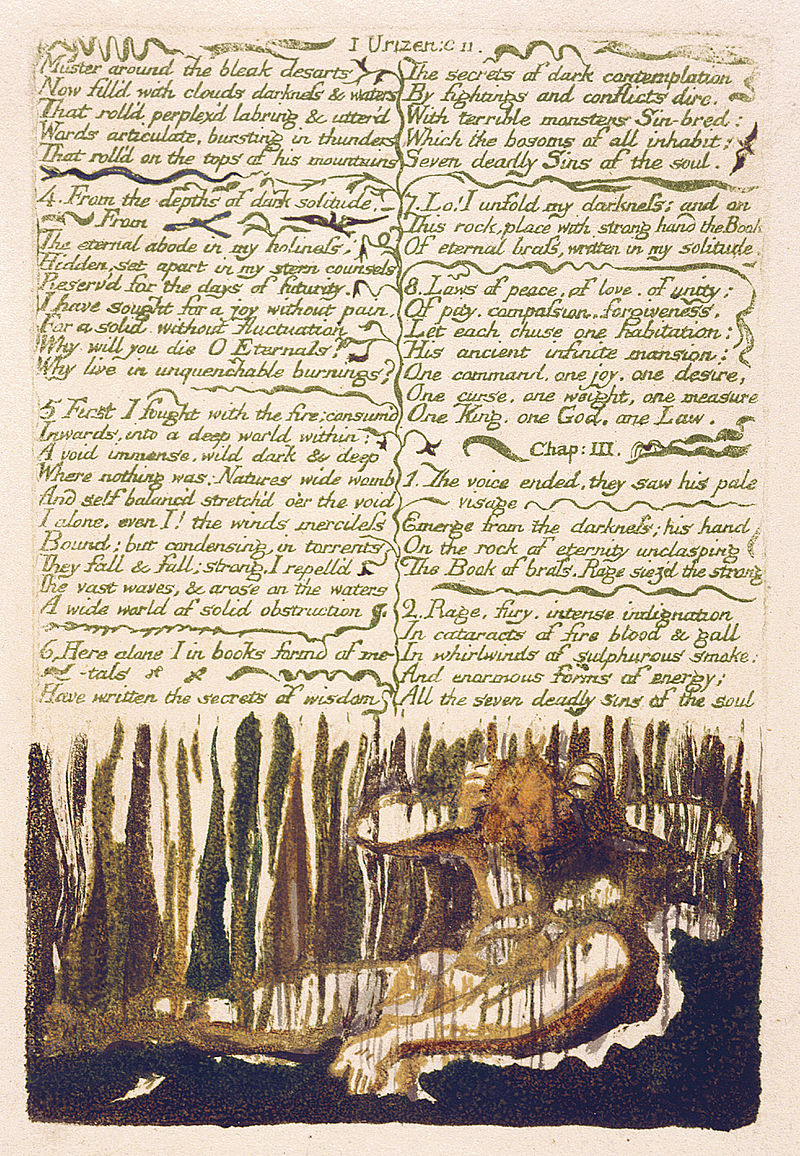
Although Blake created multiple images of Urizen, he often represented him as a bearded, white haired old man. To see the younger, unfallen Urizen we must refer to the portrayals of the element Air in the Gates of Paradise and in the Book of Urizen.
 
The first mentions of Urizen are in Visions of Daughters of Albion, America, and Europe. The First Book of Urizen is devoted to a struggle between Los and Urizen which results in mankind being "bound down to earth by their narrowing perceptions."  
The Publishers Note in Dover Publications' Book of Urizen states: "The Book of Urizen recounts the creation of the world and of mankind and explains man's fall from unity with the spiritual and the eternal to a state of dualistic isolation in a merely  materialistic reality."
British Museum
Book of Urizen
Copy B, Plate 8


British Museum
Book of Urizen
Copy D, Plate 20


This image of Urizen printed on a separate page bears the inscription, "Frozen doors to mock The World: while they within torments uplock." Erdman's comment on this inscription is that Urizen's chains forged by his own mind to mock the world instead lock him into his own torments. (The Illuminated Blake


America, Plate 8, (E 54)  
"The terror answerd: I am Orc, wreath'd round the accursed tree: 
The times are ended; shadows pass the morning gins to break; 
The fiery joy, that Urizen perverted to ten commands, 
What night he led the starry hosts thro' the wide wilderness:" 

Wikipedia Commons
America
Copy A, Plate 10


Visions of Daughters of Albion, Plate 5, (E 48)

"But when the morn arose, her lamentation renewd, 
The Daughters of Albion hear her woes, & eccho back her sighs.
 O Urizen! Creator of men! Mistaken Demon of heaven: 
 
Thy joys are tears! thy labour vain, to form men to thine image. 
How can one joy absorb another? are not different joys 
Holy, eternal, infinite! and each joy is a Love."  
 
Four Zoas, Night V, PAGE 65, (E 344)
"Thy pure feet stepd on the steps divine. too pure for other feet
And thy fair locks shadowd thine eyes from the divine effulgence
Then thou didst keep with Strong Urthona the living gates of heaven
But now thou art bound down with him even to the gates of hell

Because thou gavest Urizen the wine of the Almighty             
For steeds of Light that they might run in thy golden chariot of pride
I gave to thee the Steeds   I pourd the stolen wine 
And drunken with the immortal draught fell from my throne sublime

I will arise Explore these dens & find that deep pulsation
That shakes my caverns with strong shudders. perhaps this is the night
Of Prophecy & Luvah hath burst his way from Enitharmon
When Thought is closd in Caves. Then love shall shew its root in deepest Hell"

Four Zoas, Night IX, Page 120, (E 389)
"The Eternal Man sat on the Rocks & cried with awful voice

O Prince of Light where art thou   I behold thee not as once
In those Eternal fields in clouds of morning stepping forth 
With harps & songs where bright Ahania sang before thy face
And all thy sons & daughters gatherd round my ample table
See you not all this wracking furious confusion
Come forth from slumbers of thy cold abstraction come forth
Arise to Eternal births shake off thy cold repose 
Schoolmaster of souls great opposer of change arise
That the Eternal worlds may see thy face in peace & joy
That thou dread form of Certainty maist sit in town & village
While little children play around thy feet in gentle awe
Fearing thy frown loving thy smile O Urizen Prince of light" 

Four Zoas, Night IX, Page 122, (E 391)
"Urizen Said. I have Erred & my Error remains with me
What Chain encompasses in what Lock is the river of light confind
That issues forth in the morning by measure & the evening by carefulness
Where shall we take our stand to view the infinite & unbounded
Or where are human feet for Lo our eyes are in the heavens   

He ceasd for rivn link from link the bursting Universe explodes
All things reversd flew from their centers rattling bones
To bones join, shaking convulsd the shivering clay breathes
Each speck of dust to the Earths center nestles round & round
In pangs of an Eternal Birth in torment & awe & fear"
 
Milton, Plate 18 [20], (E 112)
"Urizen emerged from his Rocky Form & from his Snows,
Plate 19 [21]
And he also darkend his brows: freezing dark rocks between
The footsteps. and infixing deep the feet in marble beds:
That Milton labourd with his journey, & his feet bled sore
Upon the clay now chang'd to marble; also Urizen rose,
And met him on the shores of Arnon; & by the streams of the brooks    

Silent they met, and silent strove among the streams, of Arnon
Even to Mahanaim, when with cold hand Urizen stoop'd down
And took up water from the river Jordan: pouring on
To Miltons brain the icy fluid from his broad cold palm.
But Milton took of the red clay of Succoth, moulding it with care
Between his palms: and filling up the furrows of many years
Beginning at the feet of Urizen, and on the bones
Creating new flesh on the Demon cold, and building him,
As with new clay a Human form in the Valley of Beth Peor."

Library of Congress
Milton
Copy D, Plate 45
 

Having been transformed by his encounter with Milton, Urizen casts off his Selfhood and is given a human form. A subdued Urizen is shown on Plate 45 of Milton.  


Monday, December 21, 2015

LUVAH

Wikimedia Commons
Book of Urizen
Plate 22

On Plate 22 of the Book of Urizen which pictured all four of the elements, Blake gave us clues to how the Zoas were developing in his imagination. In copy C we see the most striking image of fire because of the coloring Blake chose. Of the four elements fire is the one which is most active. It is unpredictable, capable of bringing about dramatic change, and it provides creative and destructive possibilities.

By associating Fire with the Zoa Luvah, Blake indicated the hazardous nature of his Zoa of emotion.


Milton Percival, in Blake's Circle of Destiny, introduces us to the Eternal Luvah who practices the joys of forgiveness, love and delight:

"For the moon of love signifies forgiveness of sin, the constant fulfilment of the religion of Jesus. No matter what mistakes may be committed, no matter how distraught the world may be, the solution of the problem, though unapparent to the mind at present, will eventually be found if only the emotions remain forgiving. For this reason Luvah shares with Urthona, another of the Zoas, the distinction of being a keeper of the gates of heaven.

'Mutual Forgiveness of each Vice Such are the Gates of Paradise'
 
But Luvah is more than forgiveness. He is the whole gamut of the emotions, especially the active emotions as opposed to the passive ones personified in Vala, his Emanation. Conspicuous among the active emotions is 'eternal delight' which Blake associated with energy. In his unfallen state, when energy was not yet restrained, Luvah is that delight - the characteristic Blakean joy that springs from a believing head, a loving heart, a creative imagination, and open vigorous senses. Therefore he is the cupbearer, serving the golden wine around the eternal tables." (Page 29)
Wikimedia Commons
Marriage of Heaven & Hell 
Plate 5


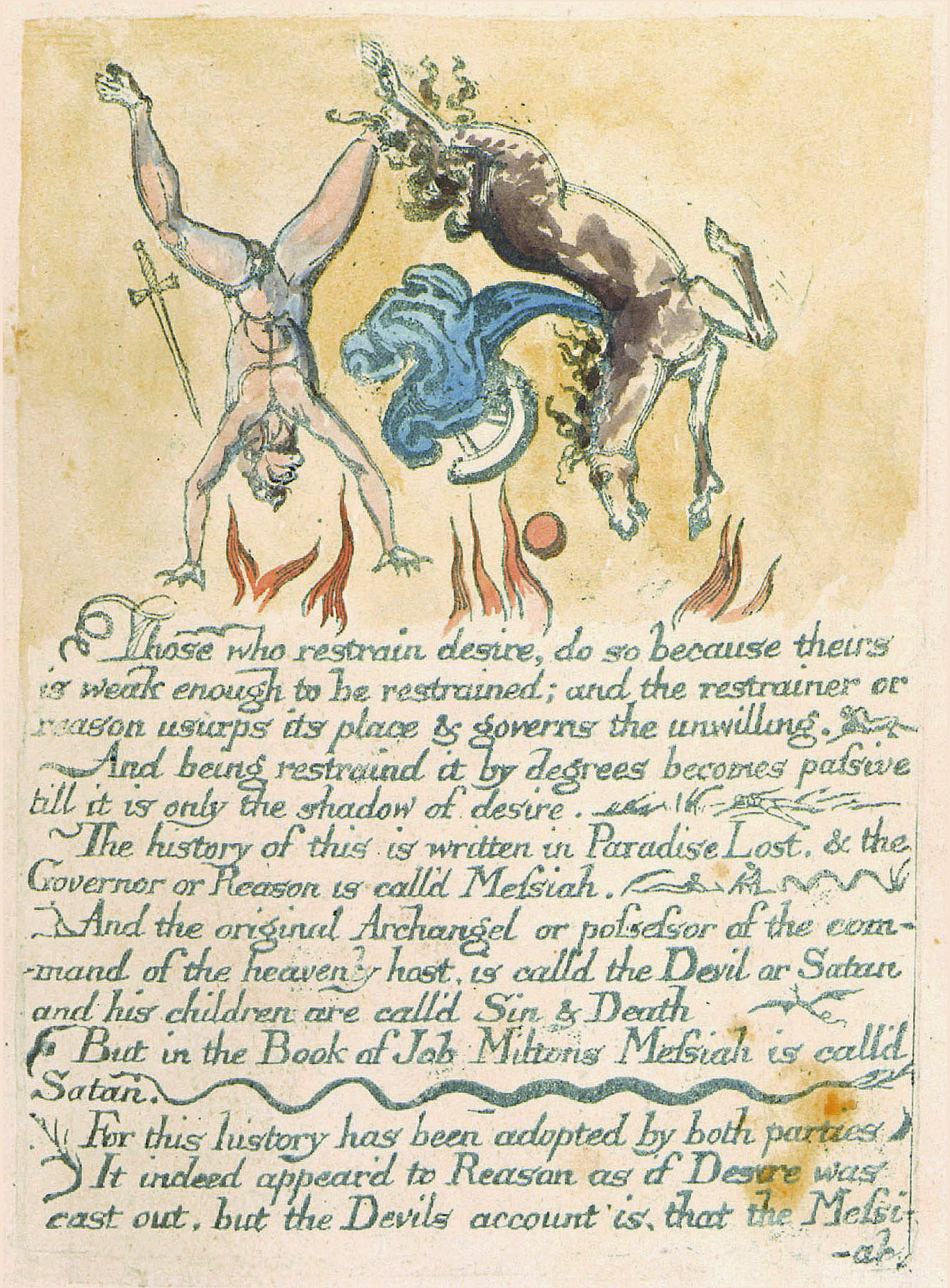
In his Eternal guise Luvah was privileged to be the cup bearer of the Eternals, and with Urthona was keeper of the gates of Heaven. But Luvah fell from his lofty height when he and Urizen plotted to change the arrangement of the psychological functions. This image from Marriage of Heaven & Hell portrays a fall of a man and his energies; his horse and his sword descend into the fiery excess of passion. We read about such a fall in the Four Zoas.


Four Zoas, Night V, Page 64, (E 344)
[Urizen speaks] 
"I well remember for I heard the mild & holy voice
Saying O light spring up & shine & I sprang up from the deep  
He gave to me a silver scepter & crownd me with a golden crown
& said Go forth & guide my Son who wanders on the ocean       

I went not forth. I hid myself in black clouds of my wrath       
I calld the stars around my feet in the night of councils dark
The stars threw down their spears & fled naked away
We fell. I siezd thee dark Urthona In my left hand falling

I siezd thee beauteous Luvah thou art faded like a flower
And like a lilly is thy wife Vala witherd by winds               
When thou didst bear the golden cup at the immortal tables
Thy children smote their fiery wings crownd with the gold of heaven

PAGE 65 
Thy pure feet stepd on the steps divine. too pure for other feet
And thy fair locks shadowd thine eyes from the divine effulgence
Then thou didst keep with Strong Urthona the living gates of heaven
But now thou art bound down with him even to the gates of hell

Because thou gavest Urizen the wine of the Almighty             
For steeds of Light that they might run in thy golden chariot of pride
I gave to thee the Steeds   I pourd the stolen wine
And drunken with the immortal draught fell from my throne sublime"
The high regard which Blake held for the passions is revealed in this passage:

Vision of Last Judgment, (E 564)
"Men are admitted into Heaven not because they have
governd their Passions or have No Passions but because
they have Cultivated their Understandings.  The Treasures of
Heaven are not Negations of Passion but Realities of Intellect
from which All the Passions Emanate in their Eternal
Glory   The Fool shall not enter into Heaven let him be ever so
Holy.  Holiness is not The Price of Enterance into Heaven Those
who are cast out Are All Those who having no Passions of their
own because No Intellect.  Have spent their lives in Curbing &
Governing other Peoples by the Various arts of Poverty & Cruelty
of all kinds   Wo Wo Wo to you Hypocrites" 

Each of the Zoas was associated with a World in which his dominant principles were held. Luvah's World was Beulah which Damon tells us, was created by the Lamb 'as a refuge from the gigantic warfare of ideas in Eternity.' The gentle emotions of 'love & pity & sweet compassion' were the healing balm in Beulah for the exhausted, weak and terrified.
     
Milton, Plate 30 [33], (E 129)
"Beulah is evermore Created around Eternity; appearing
To the Inhabitants of Eden, around them on all sides.
But Beulah to its Inhabitants appears within each district       
As the beloved infant in his mothers bosom round incircled
With arms of love & pity & sweet compassion. But to
The Sons of Eden the moony habitations of Beulah,
Are from Great Eternity a mild & pleasant Rest."

The images of Fire which Blake engraved for the two versions of Gates of Paradise (For Children, and For the Sexes) show that he trusted emotions less as he aged because they 'end in endless strife.'
British Museum
For The Sexes: The Gates of Paradise

1820
Copy B, Plate 9

British Museum
For Children: The Gates of Paradise
1793
Copy B, Plate 7


Saturday, December 19, 2015

THARMAS

In the post Urthona we saw that Blake created an image in the Book of Urizen which portrayed the four Elements as four faces of man. Blake reused the same copper plate to make modified images. The man emerging from the depths of a dark body of water later was pictured in an engraving in which he was alone. In the Small Book of Designs which he printed for his friend Ozias Humphery, Blake included this image which was a prototype for the Zoa Tharmas immersed in the water of materiality. 

British Museum
Small Book of Designs
The terms most closely associated with Tharmas are water, the body, the senses, and the Sea of Time and Space. The First Night of the Four Zoas gives an account of the fall of Tharmas which initiated the disintegration of the unified psyche. When Enion, the emanation of Tharmas, fled or was cast out, the implicit connection between the Eternal and the temporal was broken. As the Parent Power Tharmas is the source of life and the energy which sustains it.

Four Zoas, Night I, PAGE 4, (E 301)
"In Eden; in the Auricular Nerves of Human life
Which is the Earth of Eden, he his Emanations propagated
Fairies of Albion afterwards Gods of the Heathen, Daughter of Beulah Sing
His fall into Division & his Resurrection to Unity
His fall into the Generation of Decay & Death & his Regeneration 
   by the Resurrection from the dead 

Begin with Tharmas Parent power. darkning in the West

Lost! Lost! Lost! are my Emanations      Enion O Enion
We are become a Victim to the Living We hide in secret 
I have hidden Jerusalem in Silent Contrition    O Pity Me 
I will build thee a Labyrinth also O pity me    O Enion   
Why hast thou taken sweet Jerusalem from my inmost Soul   
Let her Lay secret in the Soft recess of darkness & silence
It is not Love I bear to [Jerusalem] It is Pity      
She hath taken refuge in my bosom & I cannot cast her out.

The Men have recieved their death wounds & their Emanations are fled 
To me for refuge & I cannot turn them out for Pitys sake

Enion said--Thy fear has made me tremble thy terrors have surrounded me
All Love is lost Terror succeeds & Hatred instead of Love
And stern demands of Right & Duty instead of Liberty.
Once thou wast to Me the loveliest son of heaven--But now        
 
Why art thou Terrible and yet I love thee in thy terror till
I am almost Extinct & soon shall be a Shadow in Oblivion
Unless some way can be found that I may look upon thee & live
Hide me some Shadowy semblance. secret whispring in my Ear
In secret of soft wings. in mazes of delusive beauty             
I have lookd into the secret soul of him I lovd
And in the Dark recesses found Sin & cannot return

Trembling & pale sat Tharmas weeping in his clouds"
 
British Museum
Gates of Paradise
Copy B, Plate 6
Blake's image of Water in Gates of Paradise presents a picture of a man sitting in the rain and mournfully looking down into a body of water, feeling the same regret which Tharmas felt over the transition to the world of matter when he turned the Circle of Destiny.

Four Zoas, Night I, Page 5, (E 302)
"Tharmas groand among his Clouds 
Weeping, then bending from his Clouds he stoopd his innocent head
And stretching out his holy hand in the vast Deep sublime 
Turnd round the circle of Destiny with tears & bitter sighs  And said. Return O Wanderer when the Day of Clouds is oer" 


Wikipedia Commons
Book of Urizen
Plate 4
Although Tharmas is never named in the Book of Urizen, his presence is discernable. On Plate 4 we see an agonized figure sitting in water and showered by rain. On Page 5 we read of the ocean of voidness which appeared when Eternity was sundered.
Book of Urizen, Plate 5, (E 72)
"In living creations appear'd   
In the flames of eternal fury. 

3. Sund'ring, dark'ning, thund'ring!
Rent away with a terrible crash
Eternity roll'd wide apart                                       

Wide asunder rolling
Mountainous all around
Departing; departing; departing:
Leaving ruinous fragments of life
Hanging frowning cliffs & all between                            
An ocean of voidness unfathomable."

Wednesday, December 16, 2015

URTHONA

Perhaps Blake didn't intend to produce a visual image of Urthona because he is invisible to natural sight. Although spiritual sight may be in touch with him, he would not leave a visual image which fathomed his identity. Like a person who does not want to be photographed, he left only images which were unclear or contain limited information.
Wikipedia Commons
Book of Urizen
Plate 24
 

First we look at an image of four beings whom some identify as Sons of Urizen, the Zoa whose command of thought allowed for differentiation of forms. Blake was clearly portraying manifestations of the four elements wearing the garments of humans but acting out forces which are in control of the natural world. They are identified as fire, air, earth and water. The element associated with Urthona, whose home is underground, is seen emerging from the earth with the look of dismay. He is a powerful figure staring in wonder at an unknown world. 


An image in the Book Of Los shows only the backside of a figure whom we can see as Urthona. Similarly Jehovah showed only his backside to Moses.
 

Wikipedia Commons
Book of Los
Plate 2
Exodus 33
[17] And the LORD said unto Moses, I will do this thing also that thou hast spoken: for thou hast found grace in my sight, and I know thee by name.
[18] And he said, I beseech thee, shew me thy glory.
[19] And he said, I will make all my goodness pass before thee, and I will proclaim the name of the LORD before thee; and will be gracious to whom I will be gracious, and will shew mercy on whom I will shew mercy.
[20] And he said, Thou canst not see my face: for there shall no man see me, and live.
[21] And the LORD said, Behold, there is a place by me, and thou shalt stand upon a rock:
[22] And it shall come to pass, while my glory passeth by, that I will put thee in a clift of the rock, and will cover thee with my hand while I pass by:
[23] And I will take away mine hand, and thou shalt see my back parts: but my face shall not be seen. 

 
British Museum Gates of Paradise
Copy B, plate 7


In Gates of Paradise Earth is viewed from the front but confined again in a rocky enclosure. As Blake's label states he 'Struggles into Life.' Urthona's struggle is to be made known. Unless he is recognized and given expression he remains an unconscious potential trapped in a cave without exit. In Blake's myth Urthona stays hidden but produces a form which is active in our world. Los is the 'vehicular form' of Urthona and his work is to make the Eternal world visible to Man.


Jerusalem, Plate 53, (E 202) 
"But Los, who is the Vehicular Form of strong Urthona
Wept vehemently over Albion where Thames currents spring
From the rivers of Beulah; pleasant river! soft, mild, parent stream
And the roots of Albions Tree enterd the Soul of Los
As he sat before his Furnaces clothed in sackcloth of hair       
In gnawing pain dividing him from his Emanation;
Inclosing all the Children of Los time after time.
Their Giant forms condensing into Nations & Peoples & Tongues
Translucent the Furnaces, of Beryll & Emerald immortal:
And Seven-fold each within other: incomprehensible               
To the Vegetated Mortal Eye's perverted & single vision
The Bellows are the Animal Lungs. the hammers, the Animal Heart
The Furnaces, the Stomach for Digestion; terrible their fury
Like seven burning heavens rang'd from South to North
Here on the banks of the Thames, Los builded Golgonooza,   
Outside of the Gates of the Human Heart, beneath Beulah
In the midst of the rocks of the Altars of Albion. In fears
He builded it, in rage & in fury. It is the Spiritual Fourfold
London: continually building & continually decaying desolate!
In eternal labours: loud the Furnaces & loud the Anvils          
Of Death thunder incessant around the flaming Couches of
The Twentyfour Friends of Albion and round the awful Four
For the protection of the Twelve Emanations of Albions Sons
The Mystic Union of the Emanation in the Lord; Because   
Man divided from his Emanation is a dark Spectre                 
His Emanation is an ever-weeping melancholy Shadow
But she is made receptive of Generation thro' mercy
In the Potters  Furnace, among the Funeral Urns of Beulah
From Surrey hills, thro' Italy and Greece, to Hinnoms vale."
.

Monday, December 14, 2015

MUTUAL COVENANT

Blake was unusual in that he approached his work from the perspective of both verbal and visual communication. The two art forms stimulated different areas of understanding and enhanced the completeness of the meaning transmitted.   

This blog will turn now to looking at visual images of the characters in Blake's myth. Blake was generous in providing images along with his text but he was stingy in providing identification of what he was representing. Although each reader/viewer must respond in his own way to what he reads/sees, we benefit from one another's perceptions. Perhaps by focusing on a specific image associated with each Zoa and Emanation, I will provide a family portrait showing how disparate entities can be fitted together.

Yale Center for British Art   
Jerusalem
Copy E, Plate 92

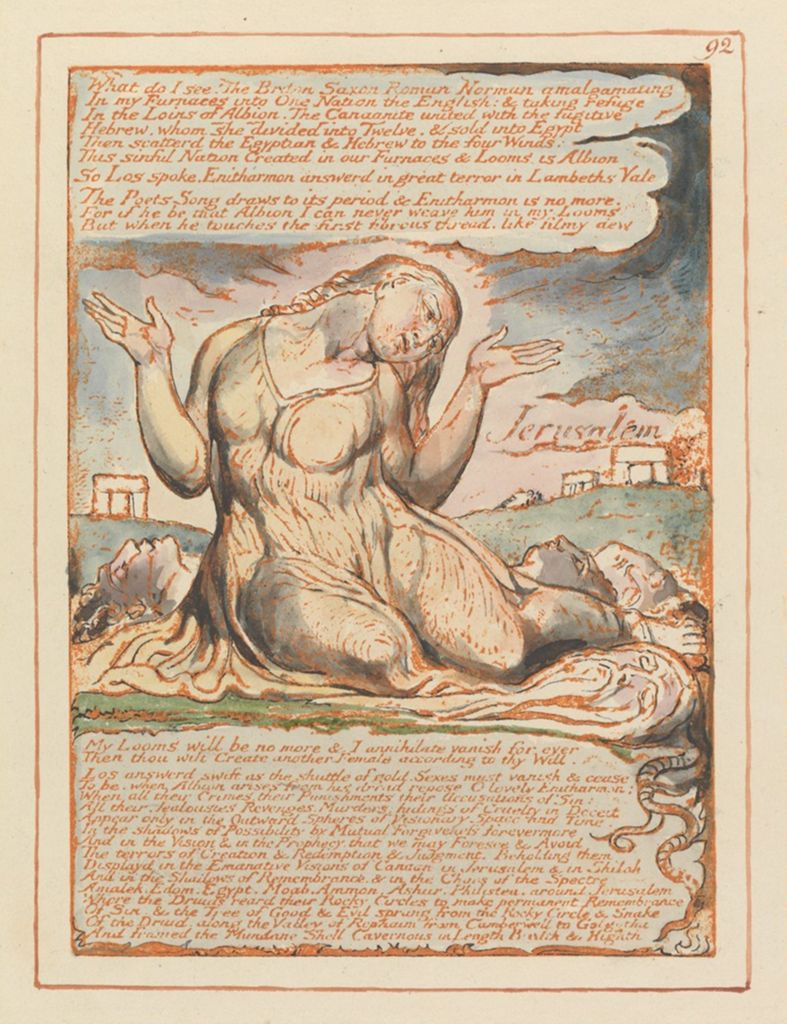
This image from Jerusalem incorporates Jerusalem surrounded by partially buried heads of the the Four Zoas. As mental constructs the Zoas work underground and become recognized in the outer world as activities we experience in our passage through life. In this image Jerusalem is the drawing together of all of the Emanations as a manifest expression of Man's underlying Humanity.  

W. P. Witcutt's book, Blake: A Psychological Study gives this introduction to his views on 'Blake's interior universe:'

"The chief figures of Blake's interior universe were four daemons or gods he called Los or Urthona, Urizen, Luvah or Orc, and Tharmas. Blake was quite aware that his epics were about what we now call psychological states and that the demonic figures which inhabited them were fragments of the personality. He tells us plainly that Urizen is thought, Luvah love, and Los 'Prophecy.' To the man of dominant reason it may seem strange that these abstractions (as they appear to him) should be clothed with personalities and names; but this is how they appear to all of us in dreams. But not only in dreams. Blake's Four Zoas appear quite frequently in literature, particularly in the novel...The novel is our modern form or myth." ( Page 30)

Four Zoas, Night I, Page 3, (E 300)
"Four Mighty Ones are in every Man; a Perfect Unity                   
Cannot Exist. but from the Universal Brotherhood of Eden"                 

Jerusalem, Plate 98, (E 257)
"And every Man stood Fourfold, each Four Faces had. One to the West
One toward the East One to the South One to the North. the Horses Fourfold
And the dim Chaos brightend beneath, above, around! Eyed as the Peacock
According to the Human Nerves of Sensation, the Four Rivers of the Water of Life

South stood the Nerves of the Eye. East in Rivers of bliss the Nerves of the
Expansive Nostrils West, flowd the Parent Sense the Tongue. North stood
The labyrinthine Ear. Circumscribing & Circumcising the excrementitious
Husk & Covering into Vacuum evaporating revealing the lineaments of Man
Driving outward the Body of Death in an Eternal Death & Resurrection   
Awaking it to Life among the Flowers of Beulah rejoicing in Unity
In the Four Senses in the Outline the Circumference & Form, for ever
In Forgiveness of Sins which is Self Annihilation. it is the Covenant of Jehovah

The Four Living Creatures Chariots of Humanity Divine Incomprehensible
In beautiful Paradises expand These are the Four Rivers of Paradise   
And the Four Faces of Humanity fronting the Four Cardinal Points
Of Heaven going forward forward irresistible from Eternity to Eternity

And they conversed together in Visionary forms dramatic which bright
Redounded from their Tongues in thunderous majesty, in Visions

In new Expanses, creating exemplars of Memory and of Intellect  
Creating Space, Creating Time according to the wonders Divine
Of Human Imagination, throughout all the Three Regions immense
Of Childhood, Manhood & Old Age[;] & the all tremendous unfathomable Non Ens
Of Death was seen in regenerations terrific or complacent varying
According to the subject of discourse & every Word & Every Character
Was Human according to the Expansion or Contraction, the Translucence or
Opakeness of Nervous fibres such was the variation of Time & Space
Which vary according as the Organs of Perception vary & they walked
To & fro in Eternity as One Man reflecting each in each & clearly seen
And seeing: according to fitness & order. And I heard Jehovah speak 
Terrific from his Holy Place & saw the Words of the Mutual Covenant Divine"

The Mutual Covenant:

Leviticus 26
[12] And I will walk among you, and will be your God, and ye shall be my people.

Thursday, December 10, 2015

ASSENT TO REALITY

 Four Zoas, Night IX, Page 139, (E 407) 
"The Sun arises from his dewy bed & the fresh airs 
Play in his smiling beams giving the seeds of life to grow 
And the fresh Earth beams forth ten thousand thousand springs of life 
Urthona is arisen in his strength no longer now 
Divided from Enitharmon no longer the Spectre Los 
Where is the Spectre of Prophecy where the delusive Phantom 
Departed & Urthona rises from the ruinous walls 
In all his ancient strength to form the golden armour of science 
For intellectual War The war of swords departed now 
The dark Religions are departed & sweet Science reigns 

                      End of The Dream"

Blake saw human development as process not product. The Four Zoas was intended not to delineate the Man who has been transformed, but to demonstrate the process through which Man goes to arrive at transformation. The unified status which he attained was not a permanent condition but a jumping off point for continued differentiation and integration. The tools which had served Man in his earth-bound life had been war and religion through which he had hammered out his existence in a natural world of limitations and uncertainties. With no further need to be in conflict within himself Man turns to his inner resources to guide his further progress.

Growing seeds, flowing springs, and ruined walls made possible a new paradigm to represent the activity of the New Man: Intellectual War supported by 'the golden armour of science' growing out of intuition and imagination supplied by Urthona.        

The images which Blake choose to structure the progress of Man through life are set forth in this passage from Frye's Fearful Symmetry. Frye traces stages of developmental potential through the the vegetative seed, to the mammalian embryo, to the oviparous egg. In this illustration for Milton's On the Morning of Christ's Nativity, we notice in the foreground a female figure lying in the snow. Blake was calling to our minds Vala as an image of the natural world where the seed contains the potential for development. In the center of the picture is an enclosed space in which the holy family rejoices in the arrival of new life. The enclosure is the womb in which the new man is nurtured until he is born of the spirit. The winged being in the arc of a rainbow partakes of the Dove of the Spirit which has been released from the egg of mortality.


Wikimedia Commons
Illustrations to Milton's On the Morning of Christ's Nativity 
Butts Set, Page 1
Northrop Frye:
"The natural man is, speaking in terms of conscious vision, an imaginative seed. Just as a seed is a dry sealed packet of solid 'matter,' so the natural mind is a tight skull-bound shell of abstract ideas. And just as a seed is surrounded by a dark world which we see as an underworld, so the physical universe, which surrounds the natural man on all sides, and is dark in the sense that he cannot see its extent, is the underworld of the mind, the den of Urthona, the cave of Plato's Republic. The majority of seeds in nature die as seeds, and in human life all natural men, all the timid, all the stupid, all the evil, remain in the starlit cavern of the fallen mind, hibernating in the dormant winter night of time. They are embryos of life only, infertile seeds, and die within the seed world. The possibility of life within them remains in the embryonic form of abstract ideas, shadows and dreams. Some of the dreams are troubled visions of the real world of awakened consciousness; others are the nightmares of paralyzing horror which all minds in a stupor of inertia are prone to. Here or there a seed puts out a sprout into the real world, and when it does so it escapes from the darkness of burial into the real world into the light of immortality. Such a seed would only have begun its development, for the vegetable life is not the most highly organized form of life, because it is till bound to nature. The animal symbolizes a higher stage of development by breaking its navel-string, and this earth-bound freedom of movement is represented in our present physical level.

The bird is not a higher form of imagination than we are, but its ability to fly symbolizes one, and men usually assign wings to what they visualize as superior forms of human existence. In this symbolism the corresponding image of nature would be neither the seed-bed of the plant nor the suckling mother of the mammal, but the egg, which has been used as a symbol of the physical universe from the most ancient times. We think of the cosmic egg chiefly in connection of the Gnostic or Orphic imagery, but the account of creation in Genesis as a watery chaos surrounded by the shell of 'firmament,' which the Spirit of God, later visualized as a dove, broods upon and brings to life, also has oviparous overtones. In Blake the firmament is the mundane shell, the indefinite circumference of the physical world through which the mind crashes on its winged assent to reality."
(Page 347-8)  

Saturday, December 05, 2015

URTHONA RISES [139]

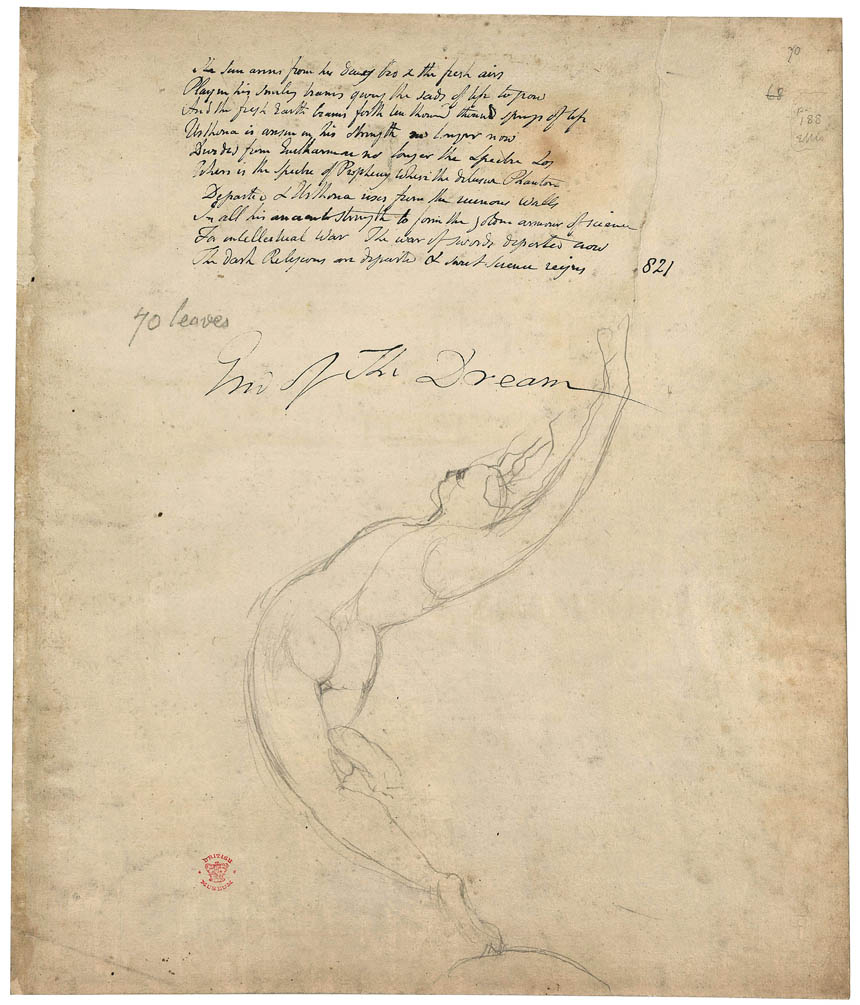
We have reached the end once again of the Four Zoas having commented on additional pages from Night IX. Perhaps the final page will strike more chords in the music played by the heavenly orchestra since you have read of the resolution of the Zoas and their Emanations. Perhaps the Bread of Life and the Wine of Eternity will be more available having followed the milling of the grain and the crushing of the grapes. If Blake's words and images have entered deep within your psyche they will remain with you to be retrieved at appropriate times as you travel your Spiritual Journey.

Reposted from August 21, 2015

Blake Archive
Four Zoas
Page 139

Four Zoas, Night IX, Page 139, (E 407)
"The Sun arises from his dewy bed & the fresh airs
Play in his smiling beams giving the seeds of life to grow
And the fresh Earth beams forth ten thousand thousand springs of life
Urthona is arisen in his strength no longer now
Divided from Enitharmon no longer the Spectre Los                
Where is the Spectre of Prophecy where the delusive Phantom
Departed & Urthona rises from the ruinous walls
In all his ancient strength to form the golden armour of science
For intellectual War The war of swords departed now
The dark Religions are departed & sweet Science reigns           

                  End of The Dream"
The final page of the Four Zoas is a response to early lines in Blake's poem where he declared his intention of giving an account of the Zoa named Urthona: 

"His fall into Division & his Resurrection to Unity His fall into the Generation of Decay & Death & his Regeneration by the Resurrection from the dead"
 
The Element of Urthona is the Earth which we call our home. Blake begins and ends his poem with the Earth which is the site in which transformation must be revealed. Within the psyche of man, Urthona dwells in the Unconscious to which man turns to touch his Eternal nature. It is through Urthona that man exercises his spiritual perception and discerns vision. Through Urthona man is connected to the Eternal; not by reason, sensation or emotion but by intuition.

The dark religions which have departed are religions which were provided by the Eyes of God so that man may not fall into the abyss. There is not longer need for a religion of human sacrifice, vengeance, moral law, rationalism or a distant God reigning in the sky. Man's awareness of God residing within his own Soul is all the religion he needs. Blake's 'Sweet Science' will reign because man is able to behold everything as holy.  

Four Zoas, Page 3, Night I, (E 301) 
"Los was the fourth immortal starry one, & in the Earth
Of a bright Universe Empery attended day & night                 
Days & nights of revolving joy, Urthona was his name
PAGE 4,       
In Eden; in the Auricular Nerves of Human life
Which is the Earth of Eden, he his Emanations propagated
Fairies of Albion afterwards Gods of the Heathen, Daughter of Beulah Sing
His fall into Division & his Resurrection to Unity
His fall into the Generation of Decay & Death & his Regeneration by the 
Resurrection from the dead"
Some complain that Blake did not make it clear how the transformation from the fallen world to the unfallen world took place. The change took place in increments and could have been interrupted by a misstep at any point. But the process continued until suddenly mankind had left behind his old self and acquired a new vision, a new power, and a new image of himself and his world.
 

This passage from Northrop Frye's Fearful Symmetry may clarify the process through which man attains higher consciousness:

Page 259 -260
"Man stands at the level of conscious life: immediately in front of him is the power to visualize the eternal city and garden he is trying to regain; immediately behind him is an unconscious, involuntary and cyclic energy, much of which still goes on inside of his own body. Man is therefore a Luvah or form of life subject to two inpulses, one the prophetic impulse leading him forward to vision, the other the natural impulse which drags him back to unconsciousness and finally to death.
...
The imagination says that man is not chain-bound but muscle-bound; that he is born alive and everywhere dying in sleep; and that when the conscious imagination in man perfects the vision of the world of consciousness, at that point man's eyes will necessarily be open.
...
Every advance of truth forces error to consolidate itself in a more obviously erroneous form, and every advance of freedom has the same effect on tyranny. Thus history exhibits a series of crises in which a sudden flash of imaginative vision (as in the French Revolution) bursts out is counteracted by a more ruthless defense of the status quo, and subsides again. The evolution come in the fact that the opposition grows sharper each time, and will one day present a clear-cut alternative of eternal life or extermination."


Renewed Albion. 

Wednesday, December 02, 2015

WORKS OF URTHONA II [138]

Continuation of Works of Urthona
 

Blake presented the culmination of the Four Zoas at multiple levels or from varied perspectives. We looked at page 138 as Blake represented the reassembling of the Ancient man from divided Zoas which has assumed independent functioning when man fell from his original condition. Urthona and Tharmas, working together in Man's unconscious mind, were cooperating to provide the Bread and Wine which would sustain the unified Divine Humanity.
 

Blake inserted the following lines to portray Man in his glory as he was restored to wholeness. As man recovered, his world recovered also. Man and Nature interacted as reflections of each other, each giving and receiving, transforming and being transformed. Because the accident has been incinerated in the furnace of experience, the essence was released to walk into the unchanging but dynamic world of Eternity.

Four Zoas, Night IX, Page 138, (E 406)
"The Sun has left his blackness & has found a fresher morning     
And the mild moon rejoices in the clear & cloudless night 
And Man walks forth from midst of the fires the evil is all consumd
His eyes behold the Angelic spheres arising night & day
The stars consumd like a lamp blown out & in their stead behold
The Expanding Eyes of Man behold the depths of wondrous worlds 
One Earth one sea beneath nor Erring Globes wander but Stars
Of fire rise up nightly from the Ocean & one Sun
Each morning like a New born Man issues with songs & Joy
Calling the Plowman to his Labour & the Shepherd to his rest
He walks upon the Eternal Mountains raising his heavenly voice   
Conversing with the Animal forms of wisdom night & day
That risen from the Sea of fire renewd walk oer the Earth

For Tharmas brought his flocks upon the hills & in the Vales
Around the Eternal Mans bright tent the little Children play
Among the wooly flocks The hammer of Urthona sounds              
In the deep caves beneath his limbs renewd his Lions roar
Around the Furnaces & in Evening sport upon the plains
They raise their faces from the Earth conversing with the Man

How is it we have walkd thro fires & yet are not consumd
How is it that all things are changd even as in ancient times"
  
When he illustrated Milton's L'Allegro, Blake provided a picture which echoes the poetic image of the New Born Man in the fresher morn of a sun restored to its original splendor. The archetypal themes running through the body of Blake's work motivate us to find enhancements to his symbols in unexpected places. 


Wikimedia Commons
Morgan Library
Blake's Illustrations to Milton's L'Allegro 
'The Sun at His Eastern Gate'

Tuesday, December 01, 2015

WORKS OF URTHONA [138]

Reposted from August 19, 2015
Blake Archive
Manuscript in British Library
Four Zoas
Page 138

Four Zoas, Night IX, PAGE 138, (E 406)
"Then Dark Urthona took the Corn out of the Stores of Urizen
He ground it in his rumbling Mills Terrible the distress
Of all the Nations of Earth ground in the Mills of Urthona
In his hand Tharmas takes the Storms. he turns the whirlwind Loose
Upon the wheels the stormy seas howl at his dread command        
And Eddying fierce rejoice in the fierce agitation of the wheels
Of Dark Urthona Thunders Earthquakes Fires Water floods
Rejoice to one another loud their voices shake the Abyss
Their dread forms tending the dire mills The grey hoar frost was there
And his pale wife the aged Snow they watch over the fires        
They build the Ovens of Urthona Nature in darkness groans
And Men are bound to sullen contemplations in the night
Restless they turn on beds of sorrow. in their inmost brain
Feeling the crushing Wheels they rise they write the bitter words
Of Stern Philosophy & knead the bread of knowledge with tears & groans

Such are the works of Dark Urthona Tharmas sifted the corn
Urthona made the Bread of Ages & he placed it
In golden & in silver baskets in heavens of precious stone
And then took his repose in Winter in the night of Time

The Sun has left his blackness & has found a fresher morning     
And the mild moon rejoices in the clear & cloudless night  
And Man walks forth from midst of the fires the evil is all consumd
His eyes behold the Angelic spheres arising night & day
The stars consumd like a lamp blown out & in their stead behold
The Expanding Eyes of Man behold the depths of wondrous worlds 
One Earth one sea beneath nor Erring Globes wander but Stars
Of fire rise up nightly from the Ocean & one Sun
Each morning like a New born Man issues with songs & Joy
Calling the Plowman to his Labour & the Shepherd to his rest
He walks upon the Eternal Mountains raising his heavenly voice   
Conversing with the Animal forms of wisdom night & day
That risen from the Sea of fire renewd walk oer the Earth

For Tharmas brought his flocks upon the hills & in the Vales
Around the Eternal Mans bright tent the little Children play
Among the wooly flocks The hammer of Urthona sounds              
In the deep caves beneath his limbs renewd his Lions roar
Around the Furnaces & in Evening sport upon the plains
They raise their faces from the Earth conversing with the Man
How is it we have walkd thro fires & yet are not consumd 
How is it that all things are changd even as in ancient times"
As Blake was reaching the conclusion of the Four Zoas the fireworks were over. The wheat had been separated from the chaff: truth from error. The Zoas were in their rightful places satisfied to do their work and appreciative of the work done by their brother Zoas. Urthona was here the oldest brother, older even than Tharmas: man's consciousness of his spiritual nature was more fundamental than his consciousness of himself as a body.
 
The processes of the human brain were served by the forces of nature not the reverse as was the case when nature dictated to man and mediated reality from outer to inner. The working of Urizen was to supply grain to the mills of Urthona from which he made the Bread of Life. Man was no longer fed on the bread made by Urizen - bitter words or stern philosophy.
 
The spiritual wisdom of Urthona would be served to mankind as he worked, and loved and grew wise and beautiful. Each individual would be transformed by his restored ability to perceive the infinite in all things.