Wednesday, February 17, 2016

INTUITIVE INTROVERT

Wikimedia Commons
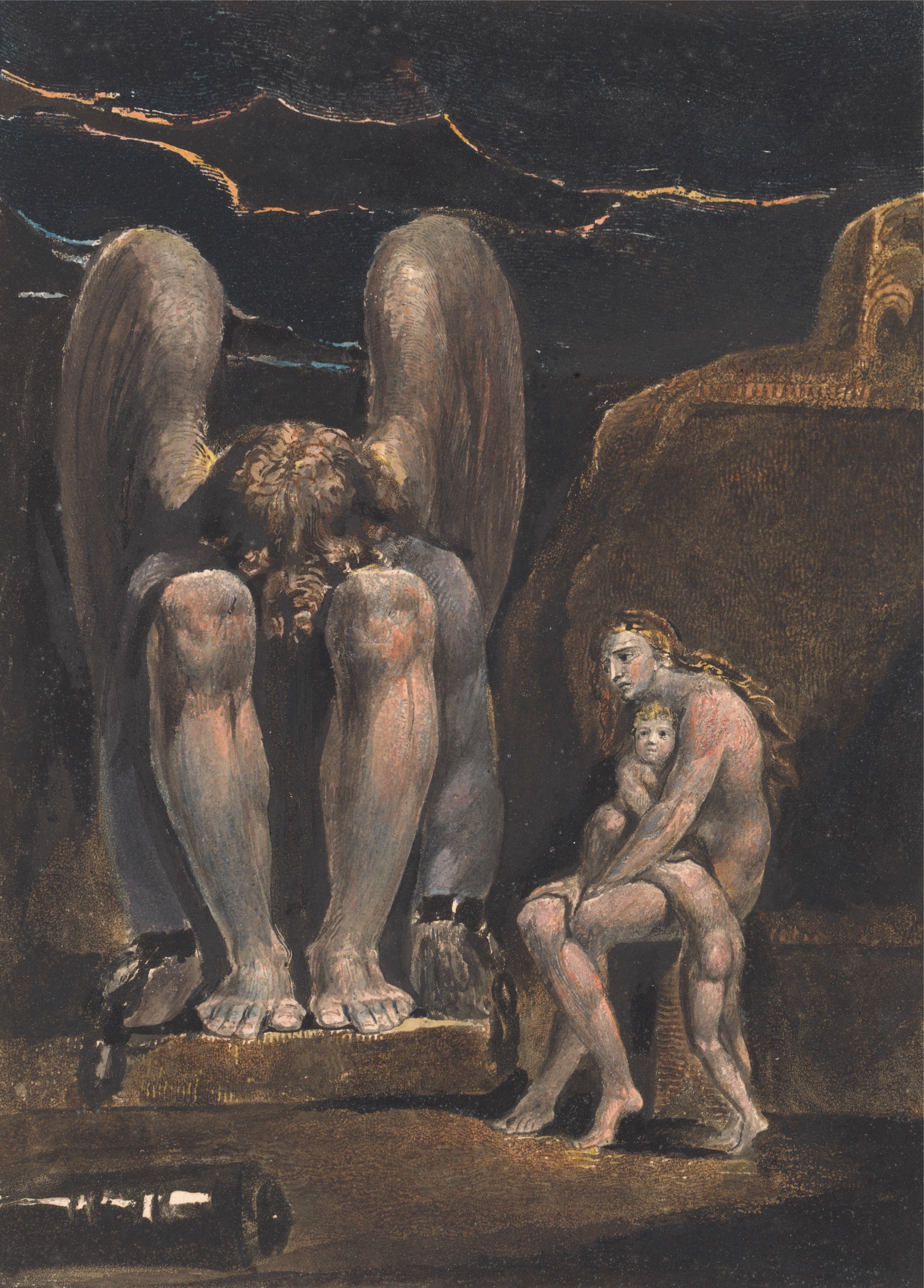
Europe
Plate 4


W. P. Witcutt in 1946 wrote a book titled Blake: A Psychological Study. Whatever Witcutt may have lacked in objectivity, he made up for in devotion to his personal insights. As a Jungean psychologist he attempted to fit Blake's thought into the framework of Jung's system with varying degrees of success

In trying to explain how Blake arrived at the images which peopled his poetry, Witcutt identified Blake as an intuitive introvert: intuitive as the dominant function in Blake's psyche, and introvert as the orientation to which he turned for meaning. On Page 23 we read:

"The introvert, on the contrary, is turned inward towards the inner world of his own soul. His thoughts are rationalizations of the symbols of the unconscious, not spun from the common experiences of others or from the outside world; his feelings and sensations (if either of these is his dominant function) spring from the same source; and if he is intuitive, he sees the archetypes of the unconscious clearly and vividly in his mind's eye. To the intuitive introvert the world of the imagination is far more vivid than the world of outer reality.
...
In an illuminating example, Blake tells how introverted intuition works:

Vision of Last Judgment, (E 565)
"I assert for My self that I do
not behold the Outward Creation & that to me it is hindrance &
not Action it is as the Dirt upon my feet No part of Me. What it
will be Questiond When the Sun rises  do  you  not  see  a  round 
Disk of fire somewhat like a Guinea O no no I see an Innumerable
company of the Heavenly host crying Holy Holy Holy is the Lord
God Almighty I question not my Corporeal or Vegetative Eye any
more than I would Question a Window concerning a Sight I look
thro it & not with it."  

Contrasting Blake's approach of presenting his work to that of one with dominate thinking function, Witcutt on Page 82 wrote:

"The man of dominant thought would write out these psychological events in his own abstract terminology; but to the intuitive introvert such as Blake or Shelly they appear as the conflicts of awesome figures. The commentators on Blake have usually been men of dominant thought; and from them one gains the impression that Blake first thought out these matters as they would have done, in abstract terminology of 'law' or 'desire' and so forth; and then (because he was writing in poetry) turned the abstractions into symbolic poetic figures. That is not in the least how one of Blake's temperament works. The figures first of all appeared in his imaginative vision just like a vivid dream, and enacted their dreamlike conflicts, made their speeches. It was afterwards that he puzzled, wondering, over what could be the meaning of their symbolic actions; and gave them names. His first instinct was to draw what he had seen; thus it is that Blake's poetry is really a commentary on his engravings."

The focus of Witcutt's book was on the internal dynamics of the psyche and on what the images Blake created told him, and tell us about integrating one's divided factions. On Page 124 Witcutt identified Blake's characters with dream-symbols:

"The intuitive introvert is the symbolist par excellence. He lives in a dream-world where symbols have in waking life as much vitality and meaning as to ordinary men in dreams. Like the madman he lives in a continual waking dream, but unlike the madman he knows the dream-symbols for the product of the imagination and can use them for the delight of others. To him the symbols appear as unrelated to anything else; they live their own lives as unearthly semi-divine figures seen in the minds eye...It is something never seen on earth."

Vision of Last Judgment, (E 560)
"If the Spectator could Enter into these Images in his
Imagination approaching them on the Fiery Chariot of his
Contemplative Thought if he could Enter into Noahs Rainbow or
into his bosom or could make a Friend & Companion of one of these
Images of wonder which always intreats him to leave mortal things
as he must know then would he arise from his Grave then would he
meet the Lord in the Air & then he would be happy   General
Knowledge is Remote Knowledge it is in Particulars that Wisdom
consists & Happiness too. 
Milton, Plate 2, (E 96)  
"Three Classes are Created by the Hammer of Los, & Woven 
PLATE 3,                                                 
By Enitharmons Looms when Albion was slain upon his Mountains
And in his Tent, thro envy of Living Form, even of the Divine Vision
And of the sports of Wisdom in the Human Imagination
Which is the Divine Body of the Lord Jesus, blessed for ever.
Mark well my words. they are of your eternal salvation:      

Urizen lay in darkness & solitude, in chains of the mind lock'd up
Los siezd his Hammer & Tongs; he labourd at his resolute Anvil

Among indefinite Druid rocks & snows of doubt & reasoning.

Refusing all Definite Form, the Abstract Horror roofd. stony hard.
And a first Age passed over & a State of dismal woe:" 
 

Thursday, February 11, 2016

Blake's Women

This is a reposting of Larry's June 29, 2007 post with a picture added.

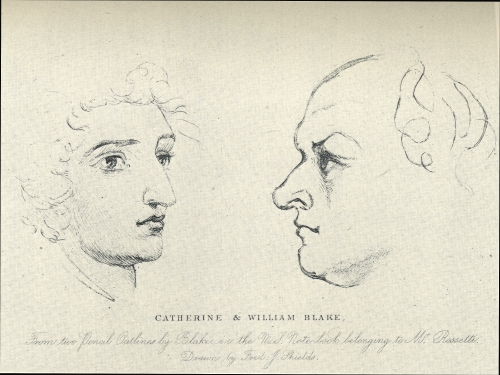
Rossetti Archive
Copied by Fred J Shields from Blake's Notebook
 From sketches in Blake's Notebook which came to be known as the Rossetti Manuscript.

This is not about Catherine, Blake's wife, with whom he lived in happy conjugal relationship for 40 years (her only complaint was that he spent too much time in heaven).
 

Nor is it about the fictional Catherine, who only serves to titillate the gossip lover.
 

Nor is it about Mary Wollencraft, although the story goes that William once proposed to Catherine that he bring Mary in as a concubine; Catherine cried, and William abandoned the idea. Blake hated and despised 'jealousy', but it seems that Catherine's jealousy on this occasion solidified a very solid marriage relationship.
 
None of these, this post is about the women Blake met in heaven:

Thel was a kind of foretaste of the women to come; she exposed the seediness of mortal life and went back to heaven. In her life Blake posed the question 'is mortal life of any value?' (Raine).

Lyca is a microcosm of the three main women that Blake met in heaven. In Plate 6, 7, and 8 read two ethereally beautiful poems that reveal the kernel of the 'system' Blake developed after he said, "I must create a system or be enslaved by another man's".

Vala is the main woman in Blake's myth (The Four Zoas was originally named Vala). In the development of his story Blake splits Vala into two: Tirzah (the earthly woman) and Jerusalem (the heavenly one).
 
In To Tirzah Blake starkly presents the dichotomy:


"[Woman], what have I do to with thee?".
 

From a purely material viewpoint Blake has Jesus say this to his mother, actually a quotation from the Gospel of John 2:4. From a more significant viewpoint the woman represents mortality (Mary was his mortal mother). Jesus of course is something other than mortal. From the most significant viewpoint Blake is talking about you and me: we are made of clay, but an immortal spirit resides within the 'matter'.
 

Jerusalem of course is the obvious biblical metaphor for the "bride of Christ" and the heavenly (eternal) kingdom.

Monday, February 08, 2016

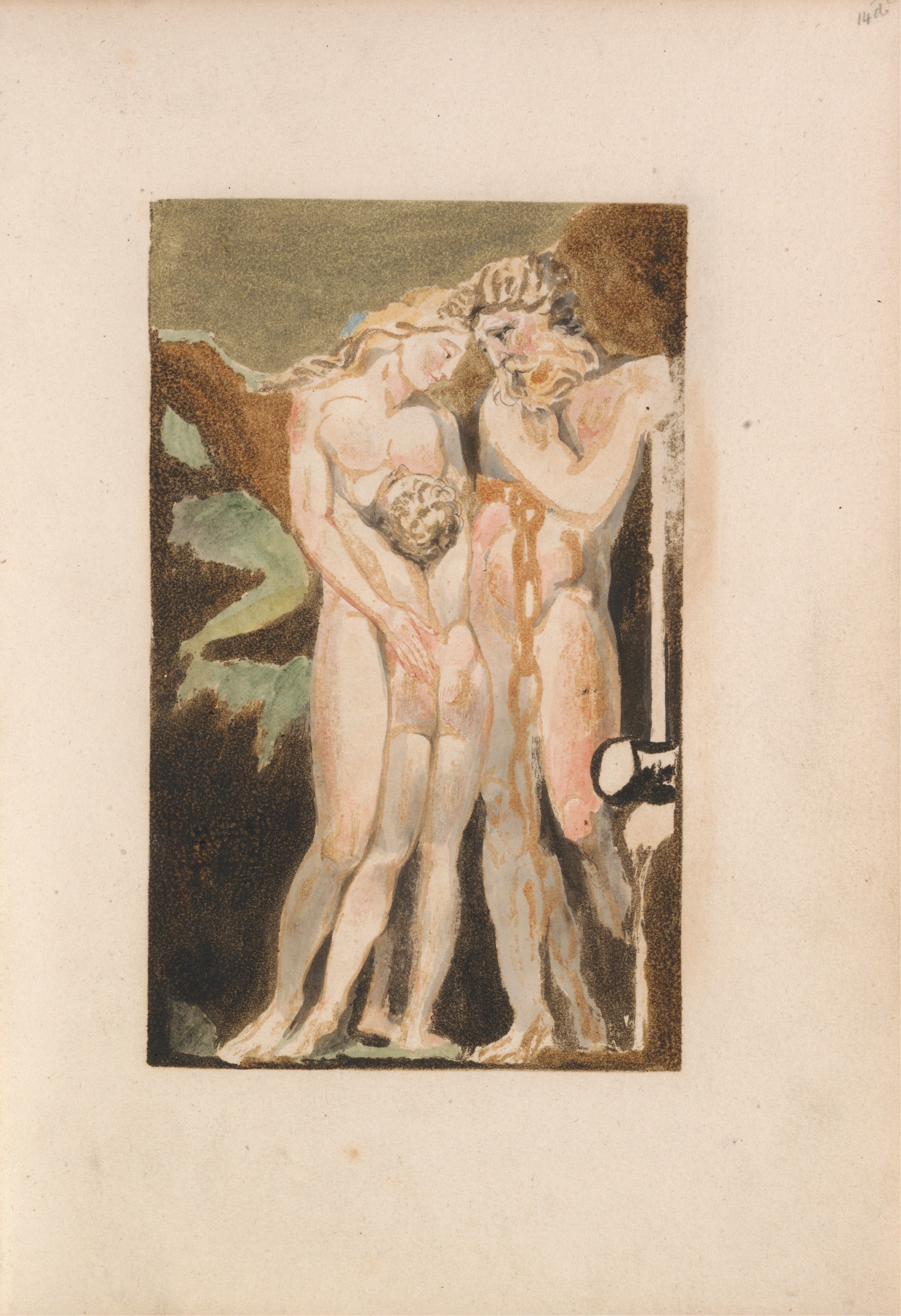
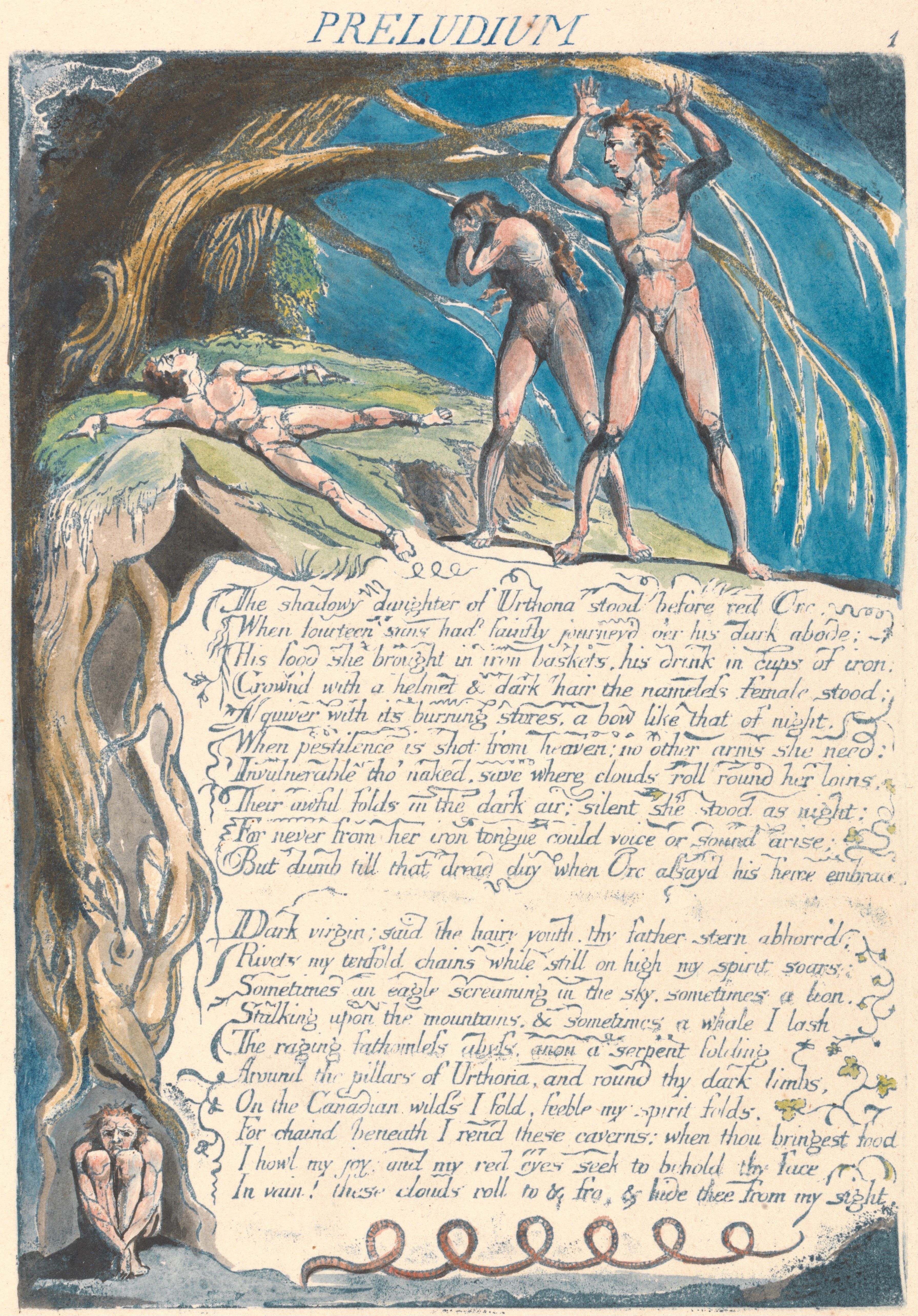
ORC

America
Plate 4
Enlarged Segment
 
Blake lived through an age of revolution. He was 19 years old when the American colonies declared their independence from the British Empire. When he was 36 the French executed their monarch. He observed the cycle and consequences of revolution at home and abroad. Blake's character Orc was developed in response to his observation of actual revolution.

Blake's first mention of Orc by name is in the Preludium to America published in 1793. Orc is portrayed as having reached maturity, burst his bonds a restraint and exploded into Revolution.

 
Yale Center for British Art
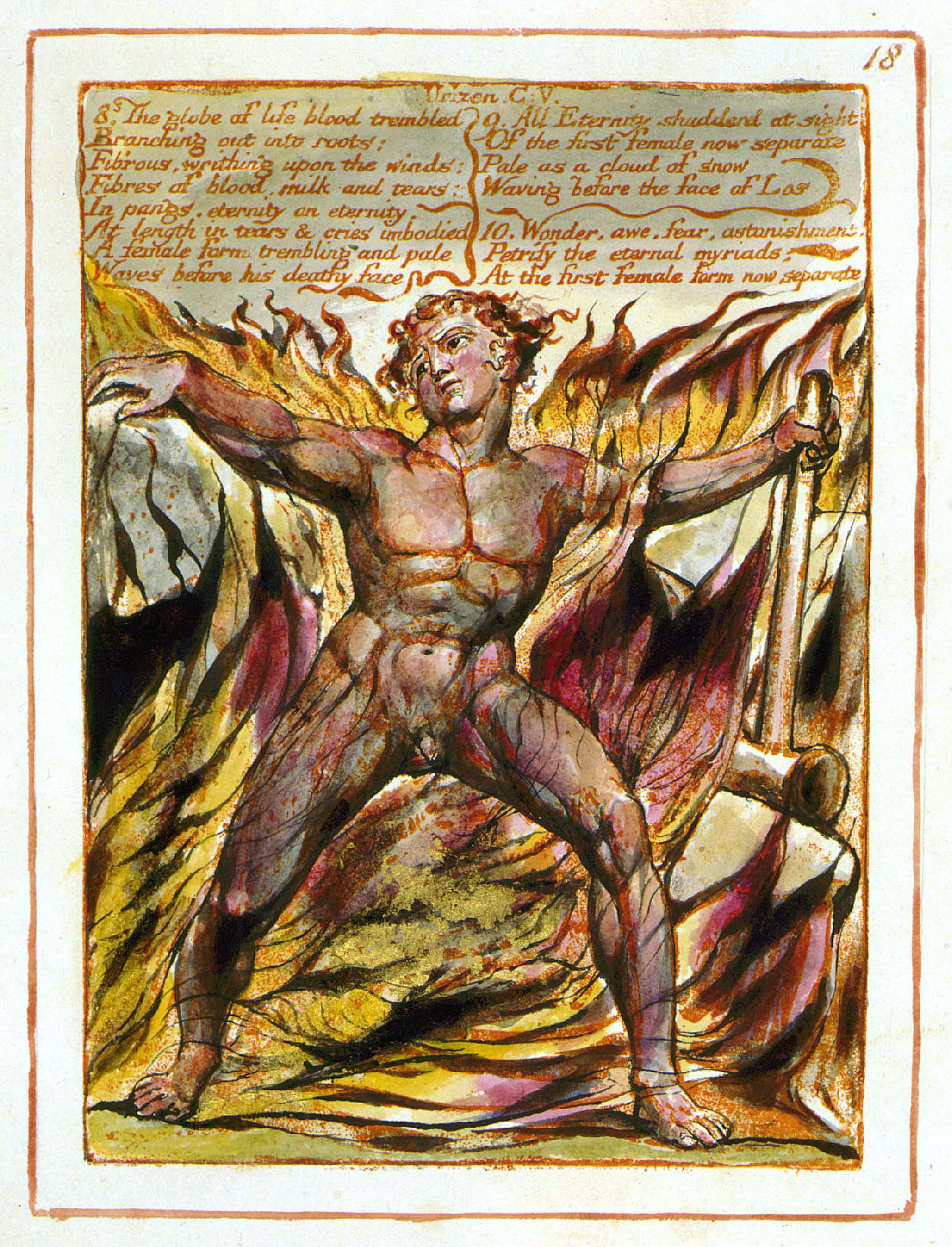
Urizen
Copy A, Plate 18
 
To Blake Orc originated through Los and Enitharmon. Los personified the voice of prophecy which spoke God's word to an alienated world. Enitharmon represented the world to which the prophecy was spoken. Their child Orc choose to ally himself with Enitharmon and her world. Orc like his father sought change but he hadn't the self restraint of Los. Orc's revolutionary powers were pitted against Urizen's restrictive efforts to construct a world which could not accommodate the unpredictability of imagination. Orc, however, eventually submitted to Urizen's dictates. Allied with Urizen's life-denying thinking, Orc's emotion-driven activities degenerated into terrorism and anarchy.


Yale Center for British Art
America
Plate 12, Copy A
 
 
In Fearful Symmetry Northrop Frye states on page 217:
"Revolution attracts sympathy more because it is revolution than because of what it proposes to substitute... But as Orc stiffens into Urizen, it becomes manifest that the world is so constituted that no cause can triumph in it and still preserve its imaginative integrity. The imagination is mental, and never has a preponderance of physical force on its side."
Frye continues with this quote from Blake:  

Vision of Last Judgment, (E 564)  "The Whole Creation Groans to be deliverd there will always be as many Hypocrites born as Honest Men & they will always have superior Power in Mortal Things You cannot have Liberty in this World without what you call Moral Virtue & you cannot have Moral Virtue without the Slavery of that half of the Human Race who hate what you call Moral Virtue"
 
Paul had stated in the New Testament that we wait in hope for the ultimate transformation which will not come about by use of physical force.  
Romans 8
[22] For we know that the whole creation groaneth and travaileth in pain together until now.
[23] And not only they, but ourselves also, which have the firstfruits of the Spirit, even we ourselves groan within ourselves, waiting for the adoption, to wit, the redemption of our body.
[24] For we are saved by hope: but hope that is seen is not hope: for what a man seeth, why doth he yet hope for?
[25] But if we hope for that we see not, then do we with patience wait for it.
 
Yale Center for British Art
America
Plate 3, Copy A
Four Zoas, Night V, Page 60, (E 340)
"Tharmas laid the Foundations & Los finishd it in howling woe
But when fourteen summers & winters had revolved over 
 
Their solemn habitation Los beheld the ruddy boy 
Embracing his bright mother & beheld malignant fires 
In his young eyes discerning plain that Orc plotted his death 
Grief rose upon his ruddy brows. a tightening girdle grew 
Around his bosom like a bloody cord. in secret sobs 
He burst it, but next morn another girdle succeeds 
Around his bosom.  Every day he viewd the fiery youth 
With silent fear & his immortal cheeks grew deadly pale   
Till many a morn & many a night passd over in dire woe 
Forming a girdle in the day & bursting it at night   
The girdle was formd by day by night was burst in twain 
Falling down on the rock an iron chain link by link lockd   
Enitharmon beheld the bloody chain of nights & days 
Depending from the bosom of Los & how with griding pain 
He went each morning to his labours. with the spectre dark 
Calld it the chain of jealousy. Now Los began to speak 
His woes aloud to Enitharmon. since he could not hide 
His uncouth plague. He siezd the boy in his immortal hands
While Enitharmon followd him weeping in dismal woe              
Up to the iron mountains top & there the Jealous chain
Fell from his bosom on the mountain. The Spectre dark
Held the fierce boy Los naild him down binding around his limbs
The accursed chain O how bright Enitharmon howld & cried
Over her son. Obdurate Los bound down her loved joy" 
Milton, Plate 18 [20], (E 111)
"Orc answerd. Take not the Human Form O loveliest. Take not
Terror upon thee! Behold how I am & tremble lest thou also
Consume in my Consummation; but thou maist take a Form
Female & lovely, that cannot consume in Mans consummation
Wherefore dost thou Create & Weave this Satan for a Covering[?]  
When thou attemptest to put on the Human Form, my wrath  
Burns to the top of heaven against thee in Jealousy & Fear.
Then I rend thee asunder, then I howl over thy clay & ashes
When wilt thou put on the Female Form as in times of old
With a Garment of Pity & Compassion like the Garment of God      
His garments are long sufferings for the Children of Men
Jerusalem is his Garment & not thy Covering Cherub O lovely
Shadow of my delight who wanderest seeking for the prey."

So spoke Orc when Oothoon & Leutha hoverd over his Couch"
Milton, Plate 29 [31], (E 127)
"But Rintrah & Palamabron govern over Day & Night
In Allamanda & Entuthon Benython where Souls wail:
Where Orc incessant howls burning in fires of Eternal Youth,
Within the vegetated mortal Nerves; for every Man born is joined 
Within into One mighty  Polypus, and this Polypus is Orc.

But in the Optic vegetative Nerves Sleep was transformed
To Death in old time by Satan the father of Sin & Death
And Satan is the Spectre of Orc & Orc is the generate Luvah"
Milton, Plate 40 [46], (E 141)
"I heard Ololon say to Milton

I see thee strive upon the Brooks of Arnon. there a dread
And awful Man I see, oercoverd with the mantle of years.   
I behold Los & Urizen. I behold Orc & Tharmas;
The Four Zoa's of Albion & thy Spirit with them striving
In Self annihilation giving thy life to thy enemies"

Northrop Frye, Fearful Symmetry on Page 218:
"Orc is completely bound to the cyclic wheel of life. He cannot represent an entry into the new world, but only the power of renewing an exhausted form of the old one."

Christopher Z Hobson
The Chained Boy: Orc and Blake's Idea of Revolution

Monday, February 01, 2016

ENITHARMON

British Museum
Small Book of Designs
'Is the Female death/Become new Life
'

Since we have considered each of the Zoas individually and have looked at three of the Emanations, we have some familiarity with Enitharmon from her associations. She and Los have been described as the twin children of Enion. She, like Los is physically active in the world we know, the world of generation. She and Los, as Space and Time, provide the conditions, in fact, which allow the world of matter to exist. Although they are the framework of the generated world they are also participants in its development and play essential roles in bringing about redemption of fallen mankind.

Jerusalem, Plate 14, (E 158)
"Los also views the Four Females:
Ahania, and Enion, and Vala, and Enitharmon lovely.              
And from them all the lovely beaming Daughters of Albion,
Ahania & Enion & Vala, are three evanescent shades:
Enitharmon is a vegetated mortal Wife of Los:
His Emanation, yet his Wife till the sleep of death is past."

Enitharmon and Los are the parents of a fiery, rebellious child named Orc, whose inclination is to bring about change by aggressive means. More will be said about this in a post about Orc.
 
Two events involving Enitharmon are decisive in determining the course of Blake's myth. Both events fracture the relationship between Los and Enitharmon and both have implications for man's fall from Eternity. 

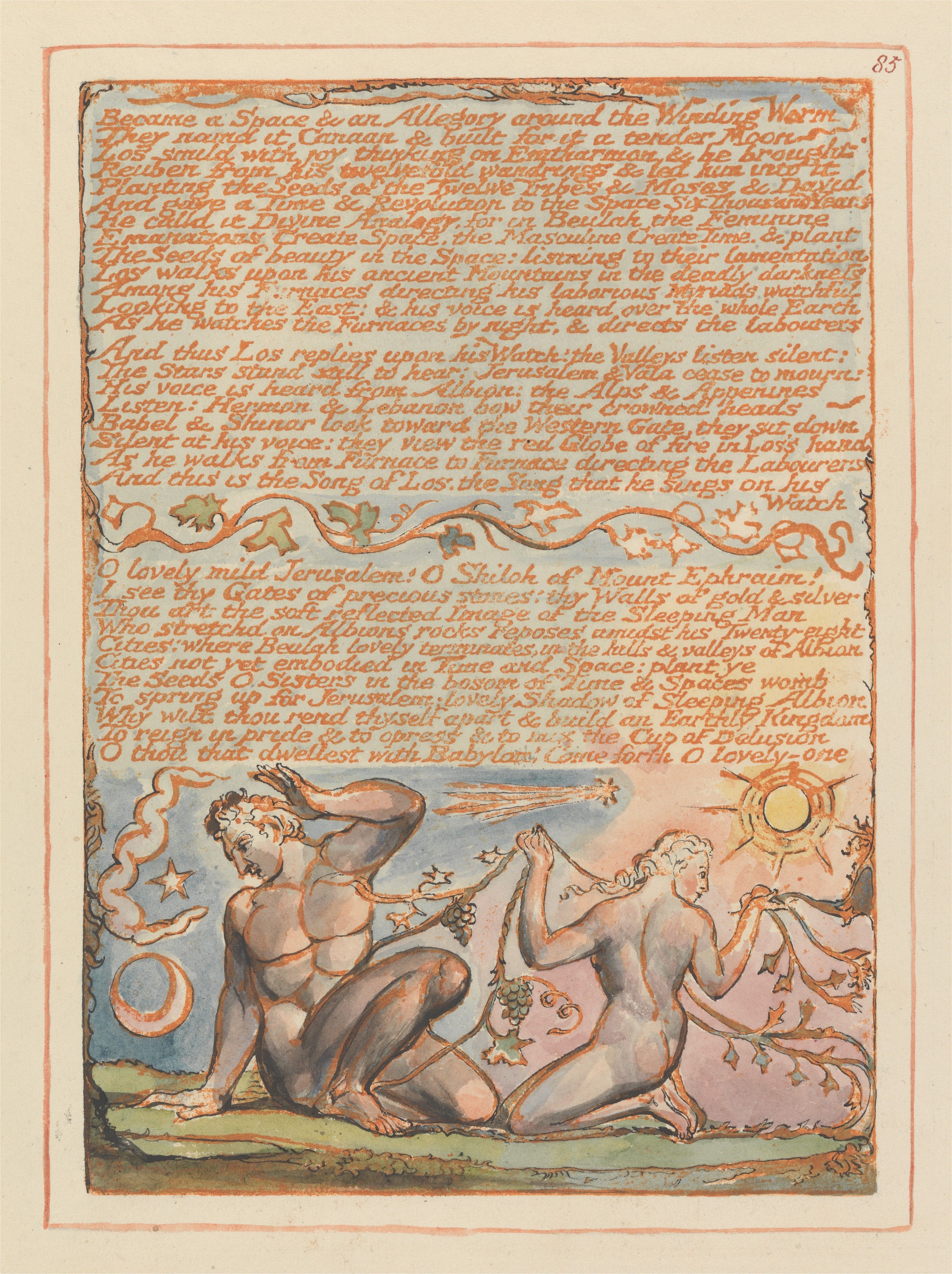
Yale Center for British Art
Jerusalem
Plate 85, Copy E

The first event is the striking of Enitharmon by Los. The blow which Los struck was not unprovoked but it was decisive. It fractured the possibility of Enitharmon trusting Los completely. Although Los regretted his action and tried to make amends it remained with him as a source of self-contempt. The labels of terror and woe for these two characters can be seen to originate in this incident.

Blake attributed to Enitharmon's reaction the 18 hundred year of dominance of Christianity by the feminine, outward and material from the time of the crucifixion to Blake's day. Los or Prophecy forced his outer manifestation into a false premise in the material world. Enitharmon turned away from Los and toward Urizen adopting the mistaken ideas that 'woman's love is sin', that Eternity is only experienced after life on earth, and that all joy is forbidden.

Wikimedia Commons
Europe
Plate 9
The second decisive event is the breaking of Enitharmon's heart over the jealousy of and punishment of her son Orc by Los. Enitharmon reacted to her heartbreak by asserting her independence and influencing the development of the world according to principles which maintained the separations which Los struggled to mend. 

Pictured is Enitharmon awaking Orc at the end of her night of joy.
Four Zoas, Night VII, Page 87, (E 369) 
"Los trembling answerd Now I feel the weight of stern repentance
Tremble not so my Enitharmon at the awful gates    
Of thy poor broken Heart I see thee like a shadow withering
As on the outside of Existence but look! behold! take comfort!
Turn inwardly thine Eyes & there behold the Lamb of God
Clothed in Luvahs robes of blood descending to redeem
O Spectre of Urthona take comfort O Enitharmon   
Couldst thou but cease from terror & trembling & affright
When I appear before thee in forgiveness of ancient injuries  
Why shouldst thou remember & be afraid. I surely have died in pain
Often enough to convince thy jealousy & fear & terror
Come hither be patient let us converse together because  
I also tremble at myself & at all my former life

Enitharmon answerd I behold the Lamb of God descending
To Meet these Spectres of the Dead I therefore fear that he
Will give us to Eternal Death fit punishment for such
Hideous offenders Uttermost extinction in eternal pain    
An ever dying life of stifling & obstruction shut out
Of existence to be a sign & terror to all who behold
Lest any should in futurity do as we have done in heaven
Such is our state nor will the Son of God redeem us but destroy

PAGE 98 [90] 
So Enitharmon spoke trembling & in torrents of tears"

Monday, January 25, 2016

LOS

Los was the hero of Blake's poetry, but like most heroes he was not unblemished. He was multi-talented, being a prophet, a poet, an artist, a builder, a blacksmith, a warrior and a friend. Using our contemporary vocabulary he was also, a therapist, a social worker, a visionary and a protester. He was a husband working out a marriage to a independent, feminist woman. He was the jealous father to a rebellious son whose raw power was willing to use methods his parent would not use.
British Museum
Song of Los
Copy A, Plate 8

Jerusalem, PLATE 45 [31], (E 194) 
"What shall I do! what could I do, if I could find these
Criminals I could not dare to take vengeance; for all things are so constructed
And builded by the Divine hand, that the sinner shall always escape,
And he who takes vengeance alone is the criminal of Providence;
If I should dare to lay my finger on a grain of sand In way of vengeance;
I punish the already punishd: O whom Should I pity if I pity not the sinner who is gone astray!
O Albion, if thou takest vengeance; if thou revengest thy wrongs Thou art for ever lost!
What can I do to hinder the Sons Of Albion from taking vengeance? or how shall I them perswade.

So spoke Los, travelling thro darkness & horrid solitude:"


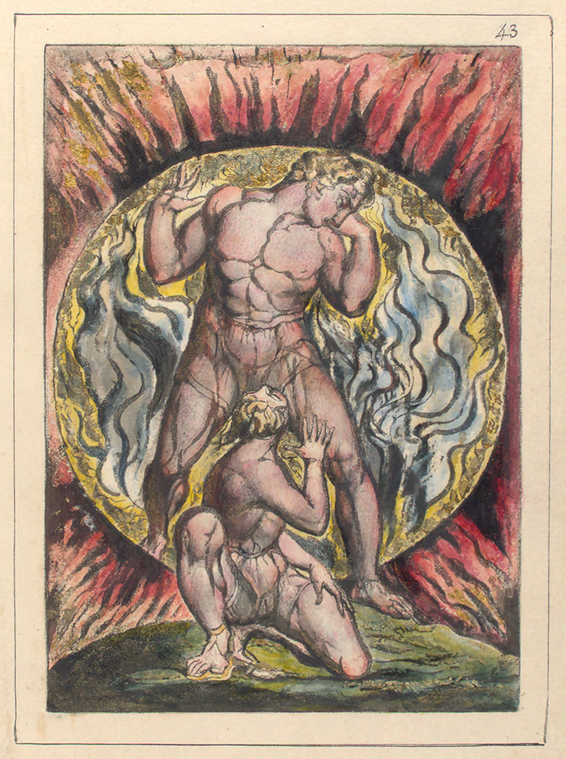
Los was Blake's alter ego attempting those feats of physical, intellectual and spiritual achievement which Blake admired. Blake gave this dramatic account of becoming one with Los.

New York Public Library
Milton
Plate 43, Copy C
Milton, Plate 22 [24], (E 116)
"Tho driven away with the Seven Starry Ones into the Ulro
Yet the Divine Vision remains Every-where For-ever. Amen.
And Ololon lamented for Milton with a great lamentation. 

  While Los heard indistinct in fear, what time I bound my sandals
On; to walk forward thro' Eternity, Los descended to me:
And Los behind me stood; a terrible flaming Sun: just close
Behind my back; I turned round in terror, and behold.
Los stood in that fierce glowing fire; & he also stoop'd down
And bound my sandals on in Udan-Adan
; trembling I stood
Exceedingly with fear & terror, standing in the
Vale Of Lambeth: but he kissed me and wishd me health.
 
And I became One Man with him arising in my strength:
Twas too late now to recede. Los had enterd into my soul:
His terrors now posses'd me whole! I arose in fury & strength.
"


Los and Urizen were the two most durable characters in Blake's work. Los, as the representative of Urthona in the physical world, struggled to prevent Urizen, the reasoning mind, from obscuring the perception of the Infinite, Eternal Soul which inhabits every being. Blake suffered with Los the anguish of seeing Jerusalem disdained and Vala enthroned.

Wikimedia Commons
Urizen
Copy G, Plate 18
Four Zoas, Night IV, Page 51, (E 334)
"O why did foul ambition sieze thee Urizen Prince of Light
And thee O Luvah prince of Love
till Tharmas was divided
And I what can I now behold but an Eternal Death
Before my Eyes & an Eternal weary work to strive
Against the monstrous forms that breed among my silent waves
Is this to be A God far rather would I be a Man
To know sweet Science & to do with simple companions
Sitting beneath a tent & viewing sheepfolds & soft pastures
 
Take thou the hammer of Urthona rebuild these furnaces
Dost thou refuse mind I the sparks that issue from thy hair


Page 52
I will compell thee to rebuild by these my furious waves
Death choose or life thou strugglest in my waters, now choose life
And all the Elements shall serve thee
to their soothing flutes
Their sweet inspiriting lyres thy labours shall administer
And they to thee only remit not faint not thou my son
Now thou dost know what tis to strive against the God of waters 

  So saying Tharmas on his furious chariots of the Deep
Departed far into the Unknown & left a wondrous void
Round Los
. afar his waters bore on all sides round. with noise
Of wheels & horses hoofs & Trumpets Horns & Clarions
Terrified Los beheld the ruins of Urizen beneath
A horrible Chaos to his eyes. a formless unmeasurable Death
Whirling up broken rocks on high into the dismal air
And fluctuating all beneath in Eddies of molten fluid
Then Los with terrible hands siezd on the Ruind Furnaces
Of Urizen. Enormous work: he builded them anew
Labour of Ages in the Darkness & the war of Tharmas

And Los formd Anvils of Iron petrific. for his blows
Petrify with incessant beating many a rock. many a planet
But Urizen slept in a stoned stupor in the nether Abyss"


There are 97 posts which have the label Los on this blog.

Thursday, January 21, 2016

AHANIA


Wikipedia Commons
Book of Ahania
Plate 2


Perhaps it should come as no surprise that Urizen did not make an ideal husband. In the beginning, however, Urizen and Ahania were compatible. Urizen engaged in strenuous work and Ahania provided relaxation and rest. Gradually Urizen's work became more burdensome to him and Ahania noticed his darker side. Ahania had been treated by Urizen as a part of himself with no mind or will of her own. When she began to see Urizen's depression about the present and fears about the future, Urizen recognized that she had a life of her own. Rather than listen to Ahania's observations reflected back to him, he threw her out. Of course, the irony is that the changes Urizen saw taking place in Ahania were taking place in himself.


Wikipedia Commons
Book of Ahania
Plate 1

Book of Ahania, Plate 2, (E 84)
7: Dire shriek'd his invisible Lust                           
Deep groan'd Urizen! stretching his awful hand
Ahania (so name his parted soul)
He siez'd on his mountains of jealousy.
He groand anguishd & called her Sin,

Kissing her and weeping over her;           
Then hid her in darkness in silence;
Jealous tho' she was invisible.

8: She fell down a faint shadow wandring
In chaos and circling dark Urizen,
As the moon anguishd circles the earth;     
Hopeless! abhorrd! a death-shadow,
Unseen, unbodied, unknown,
The mother of Pestilence.


Book of Ahania, Plate 5, (E 89)
"13: The sweat poured down thy temples           
To Ahania return'd in evening
The moisture awoke to birth
My mothers-joys, sleeping in bliss.

14: But now alone over rocks, mountains
Cast out from thy lovely bosom:                          
Cruel jealousy! selfish fear!
Self-destroying: how can delight,
Renew in these chains of darkness
Where bones of beasts are strown
On the bleak and snowy mountains
Where bones from the birth are buried
Before they see the light.

       FINIS" 
Ahania was meant to be the mind's delight in the embodiment of ideas in the outer world. Without Urizen to supply the ideas which fed the blissful images of her world, she was sucked toward the void and lamented on the borders of nonentity. Contrarily, without Ahania, Urizen's work was futile and sterile, never bringing to life his spontaneous outpouring of thought. He focused instead on limiting creativity, emotion, and enjoyment of the present moment.


Four Zoas, Night II, Page 36, (E 325)
Wikimedia Commons 
National Gallery
Sketch for Book of Ahania 


"It is an easy thing to rejoice in the tents of prosperity 
Thus could I sing & thus rejoice, but it is not so with me!  
Ahania heard the Lamentation & a swift Vibration Spread thro her Golden frame. She rose up eer the dawn of day 
When Urizen slept on his couch. drawn thro unbounded space 
Onto the margin of Non Entity the bright Female came 
There she beheld the Spectrous form of Enion in the Void 
And never from that moment could she rest upon her pillow End of the Second Night"


Four Zoas, Night III, Page 42, (E 328)
"She ended. for [from] his wrathful throne burst forth the black hail storm

Am I not God said Urizen. Who is Equal to me
Do I not stretch the heavens abroad or fold them up like a garment

He spoke mustering his heavy clouds around him black opake
Page 43 
Then thunders rolld around & lightnings darted to & fro
His visage changd to darkness & his strong right hand came forth 
To cast Ahania to the Earth be siezd her by the hair
And threw her from the steps of ice that froze around his throne

Saying Art thou also become like Vala. thus I cast thee out      
Shall the feminine indolent bliss. the indulgent self of weariness
The passive idle sleep the enormous night & darkness of Death
Set herself up to give her laws to the active masculine virtue
Thou little diminutive portion that darst be a counterpart
Thy passivity thy laws of obedience & insincerity
Are my abhorrence. Wherefore hast thou taken that fair form
Whence is this power given to thee! once thou wast in my breast
A sluggish current of dim waters. on whose verdant margin
A cavern shaggd with horrid shades. dark cool & deadly. where
I laid my head in the hot noon after the broken clods            
Had wearied me. there I laid my plow & there my horses fed
And thou hast risen with thy moist locks into a watry image
Reflecting all my indolence my weakness & my death
To weigh me down beneath the grave into non Entity
Where Luvah strives scorned by Vala age after age wandering      
Shrinking & shrinking from her Lord & calling him the Tempter
And art thou also become like Vala thus I cast thee out." 

Monday, January 18, 2016

CREATIVE EXTREMISTS

This post was first published in August 2013 in celebration of the  50th Anniversary of the March on Washington. It is republished today in honor of Martin Luther King's 86TH birthday.
 
There follows a quote from Martin Luther King's letter written from the jail in Birmingham, Alabama in April of 1963. King had been jailed for refusing to discontinue his protests against the abuse of justice in the segregated South. He took the opportunity of his imprisonment to make a statement of the foundations of the movement to non-violently enact 'extreme' measures to replace the passive acceptance of conditions which were an outrage to the conscience of just men.
 
"I am cognizant of the interrelatedness of all communities and states. I cannot sit idly by in Atlanta and not be concerned about what happens in Birmingham. Injustice anywhere is a threat to justice everywhere. We are caught in an inescapable network of mutuality, tied in a single garment of destiny. Whatever affects one directly, affects all indirectly. Never again can we afford to live with the narrow, provincial "outside agitator" idea. Anyone who lives inside the United States can never be considered an outsider anywhere within its bounds.
...
Oppressed people cannot remain oppressed forever. The yearning for freedom eventually manifests itself, and that is what has happened to the American Negro. Something within has reminded him of his birthright of freedom, and something without has reminded him that it can be gained. Consciously or unconsciously, he has been caught up by the Zeitgeist, and with his black brothers of Africa and his brown and yellow brothers of Asia, South America and the Caribbean, the United States Negro is moving with a sense of great urgency toward the promised land of racial justice. If one recognizes this vital urge that has engulfed the Negro community, one should readily understand why public demonstrations are taking place. The Negro has many pent up resentments and latent frustrations, and he must release them. So let him march; let him make prayer pilgrimages to the city hall; let him go on freedom rides -and try to understand why he must do so. If his repressed emotions are not released in nonviolent ways, they will seek expression through violence; this is not a threat but a fact of history. So I have not said to my people: "Get rid of your discontent." Rather, I have tried to say that this normal and healthy discontent can be channeled into the creative outlet of nonviolent direct action. And now this approach is being termed extremist. But though I was initially disappointed at being categorized as an extremist, as I continued to think about the matter I gradually gained a measure of satisfaction from the label. Was not Jesus an extremist for love: "Love your enemies, bless them that curse you, do good to them that hate you, and pray for them which despitefully use you, and persecute you." Was not Amos an extremist for justice: "Let justice roll down like waters and righteousness like an ever flowing stream." Was not Paul an extremist for the Christian gospel: "I bear in my body the marks of the Lord Jesus." Was not Martin Luther an extremist: "Here I stand; I cannot do otherwise, so help me God." And John Bunyan: "I will stay in jail to the end of my days before I make a butchery of my conscience." And Abraham Lincoln: "This nation cannot survive half slave and half free." And Thomas Jefferson: "We hold these truths to be self evident, that all men are created equal . . ." So the question is not whether we will be extremists, but what kind of extremists we will be. Will we be extremists for hate or for love? Will we be extremists for the preservation of injustice or for the extension of justice? In that dramatic scene on Calvary's hill three men were crucified. We must never forget that all three were crucified for the same crime--the crime of extremism. Two were extremists for immorality, and thus fell below their environment. The other, Jesus Christ, was an extremist for love, truth and goodness, and thereby rose above his environment. Perhaps the South, the nation and the world are in dire need of creative extremists."


William Blake could be added to the list of men who were willing to advocate extreme measures to effect the changes which would reverse oppression. He spoke through his poetry especially through the prophetic voice of Los and in the following poem.
Yale Center for British Art
America, A Prophecy
 
Frontispiece

Songs and Ballads, (E 489)
          The Grey Monk                    
"I die I die the Mother said
My Children die for lack of Bread          
What more has the merciless Tyrant said
The Monk sat down on the Stony Bed         

The blood red ran from the Grey Monks side 
His hands & feet were wounded wide
His Body bent his arms & knees
Like to the roots of ancient trees

His eye was dry no tear could flow
A hollow groan first spoke his woe 
He trembled & shudderd upon the Bed        
At length with a feeble cry he said

When God commanded this hand to write
In the studious hours of deep midnight
He told me the writing I wrote should prove
The Bane of all that on Earth I lovd       

My Brother starvd between two Walls
His Childrens Cry my Soul appalls
I mockd at the wrack & griding chain    
My bent body mocks their torturing pain 

Thy Father drew his sword in the North
With his thousands strong he marched forth
Thy Brother has armd himself in Steel     
To avenge the wrongs thy Children feel    

But vain the Sword & vain the Bow 
They never can work Wars overthrow
The Hermits Prayer & the Widows tear
Alone can free the World from fear

For a Tear is an Intellectual Thing        
And a Sigh is the Sword of an Angel King 
And the bitter groan of the Martyrs woe    
Is an Arrow from the Almighties Bow

The hand of Vengeance found the Bed 
To which the Purple Tyrant fled
The iron hand crushd the Tyrants head 
And became a Tyrant in his stead"

Saturday, January 16, 2016

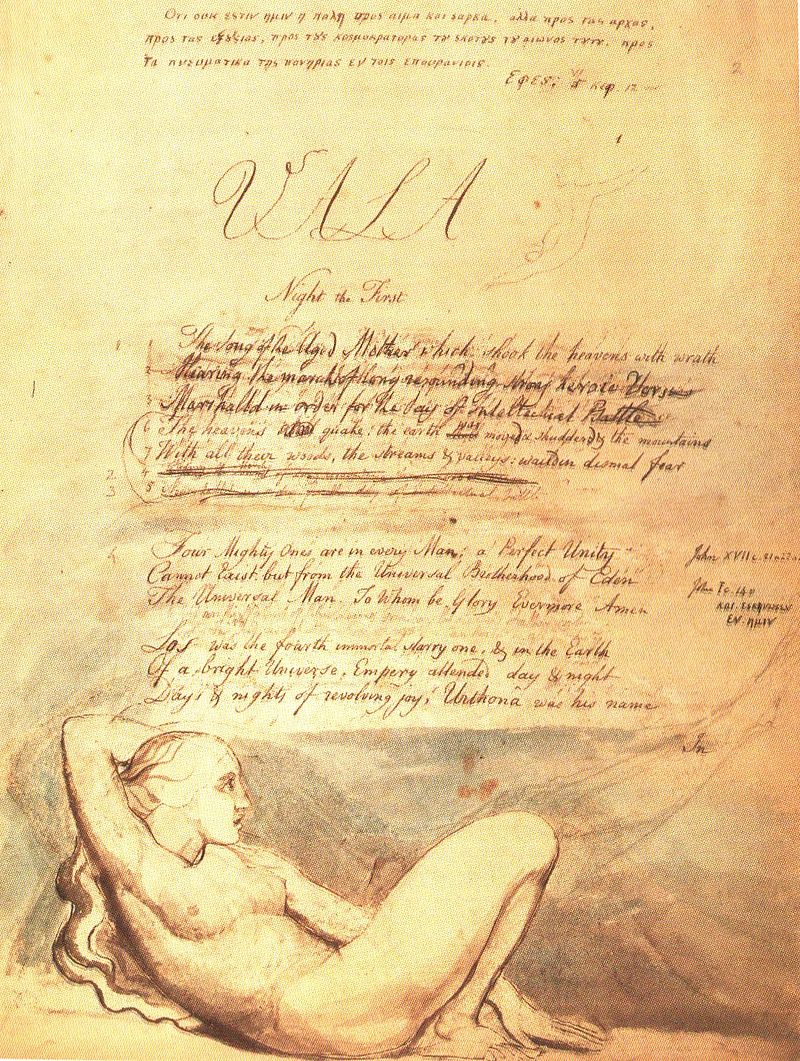
VALA

Wikimedia Commons
Four Zoas, Night I
Page 3


Jerusalem, Plate 29 [33], (E 175)
"Vala replied in clouds of tears Albions garment embracing      

I was a City & a Temple built by Albions Children.
I was a Garden planted with beauty I allured on hill & valley
The River of Life to flow against my walls & among my trees
Vala was Albions Bride & Wife in great Eternity
The loveliest of the daughters of Eternity"


Blake often portrayed the original fall of man in terms of a plot between Urizen, man's reasoning mind and Luvah, man's emotional heart. But as the battleground shifted Luvah's emanation Vala, became prominent in the development of the myth. Blake's first epic was originally named Vala, not the Four Zoas.  Blake saw that man was enthralled by his attachment to the natural world represented by Vala. The object to which the emotions respond had replaced the activity of engaging in spontaneous emotional involvement. Man began to serve Vala, as Nature, instead of being served by nature. The label 'good' was attached to the feminine world of externals, resulting in the neglect of the masculine internal world. 

The Eternal world of Luvah and Vala had been Beulah, the state of sweet repose where there is no dissension and contraries are equally true. Outside of Beulah, Vala assumed several identities: she was the temptress who lured Albion away from Jerusalem; she was the veil which concealed from man the recognition of Eternity; she was the means by which the moral law was imposed on man; she was the instrument of vengeance when her religion of Mystery gained power. 

Yale Center for British Art
                         Jerusalem
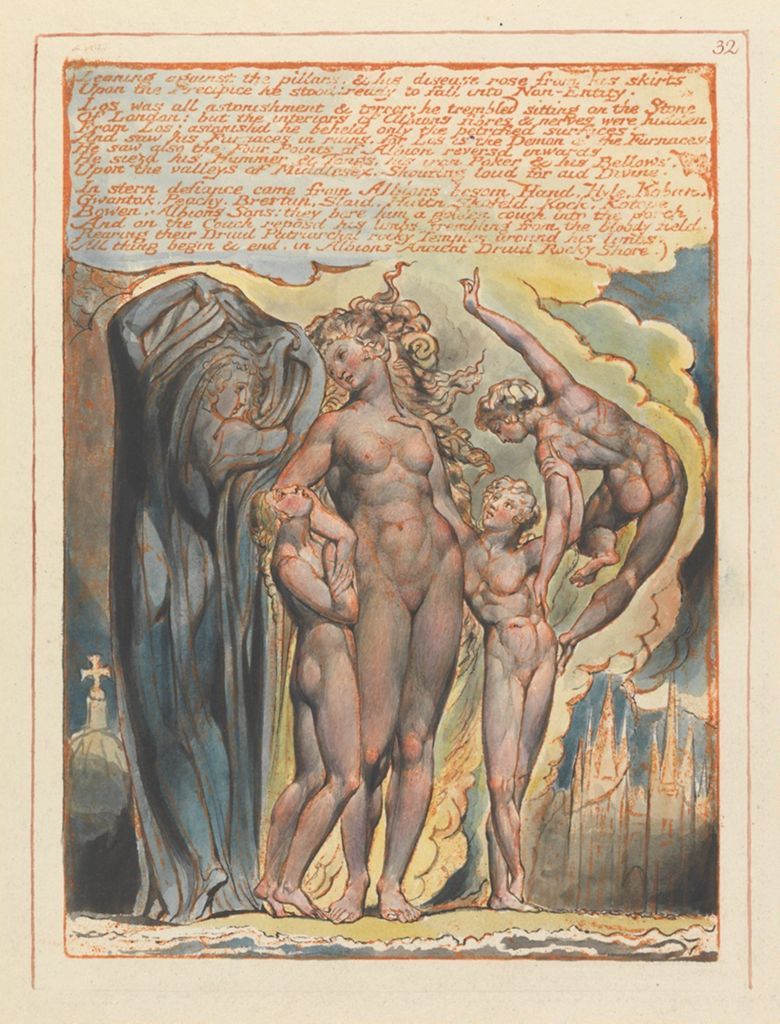
Plate 32
Vala & Enitharmon


      .

Four Zoas, Night I, Page 1, (E 305)
"Hear! I will sing a Song of Death! it is a Song of Vala!
The Fallen Man takes his repose: Urizen sleeps in the porch
Luvah and Vala woke & flew up from the Human Heart
Into the Brain; from thence upon the pillow Vala slumber'd.
And Luvah seiz'd the Horses of Light, & rose into the Chariot of Day
Sweet laughter siezd me in my sleep! silent & close I laughd
For in the visions of Vala I walkd with the mighty Fallen One
I heard his voice among the branches, & among sweet flowers."


 Jerusalem, Plate 29 [33], (E 176)
"thou & I, hid the Divine Vision
In cloud of secret gloom which behold involve me round about  
Know me now Albion: look upon me I alone am Beauty
The Imaginative Human Form is but a breathing of Vala
I breathe him forth into the Heaven from my secret Cave          
Born of the Woman to obey the Woman O Albion the mighty
For the Divine appearance is Brotherhood, but I am Love"
Yale Center for British Art
Jerusalem
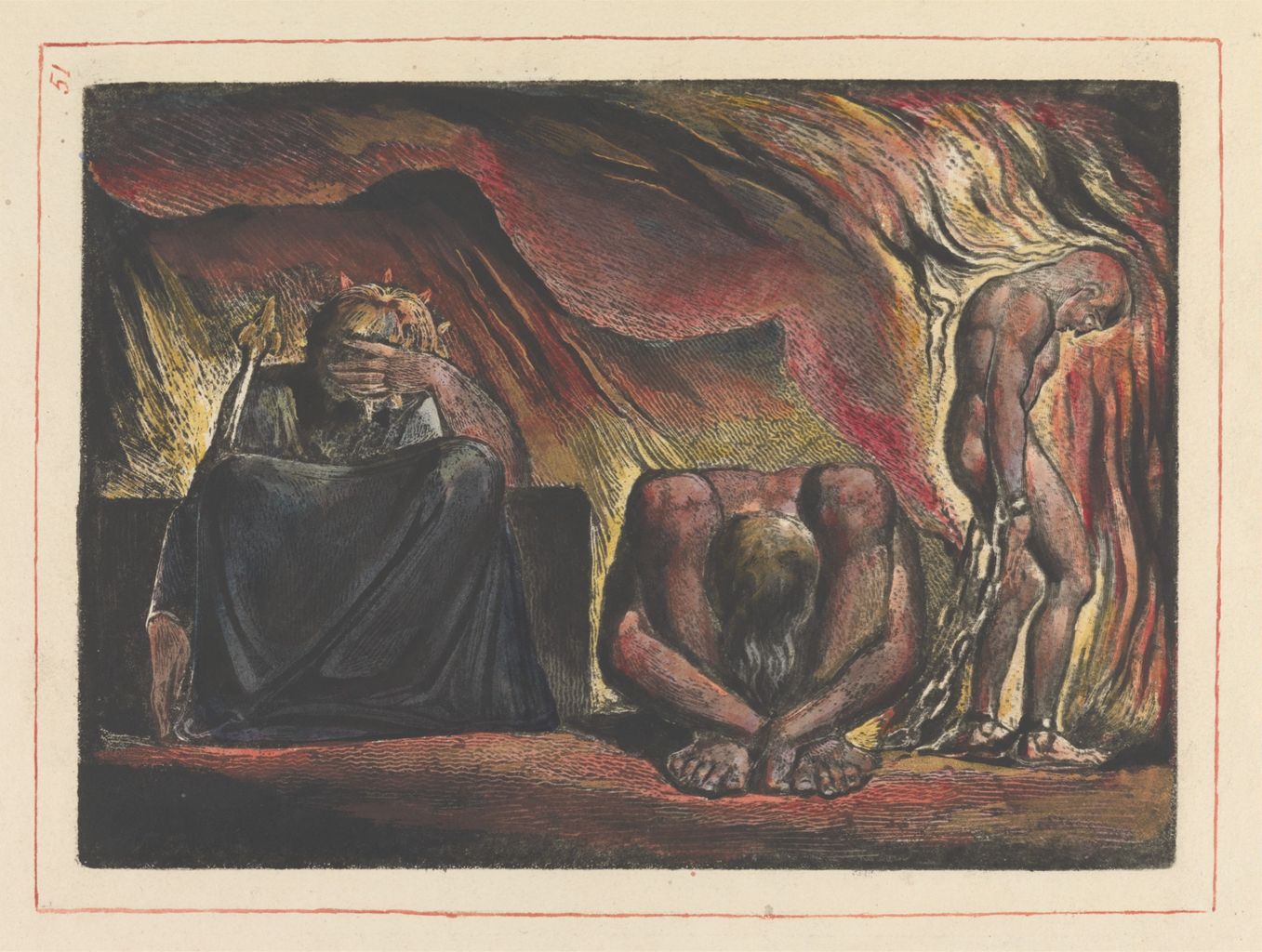
Plate 51
Vala, Hyle, Skofield

Thursday, January 14, 2016

ENION

Yale Center for British Art
Jerusalem
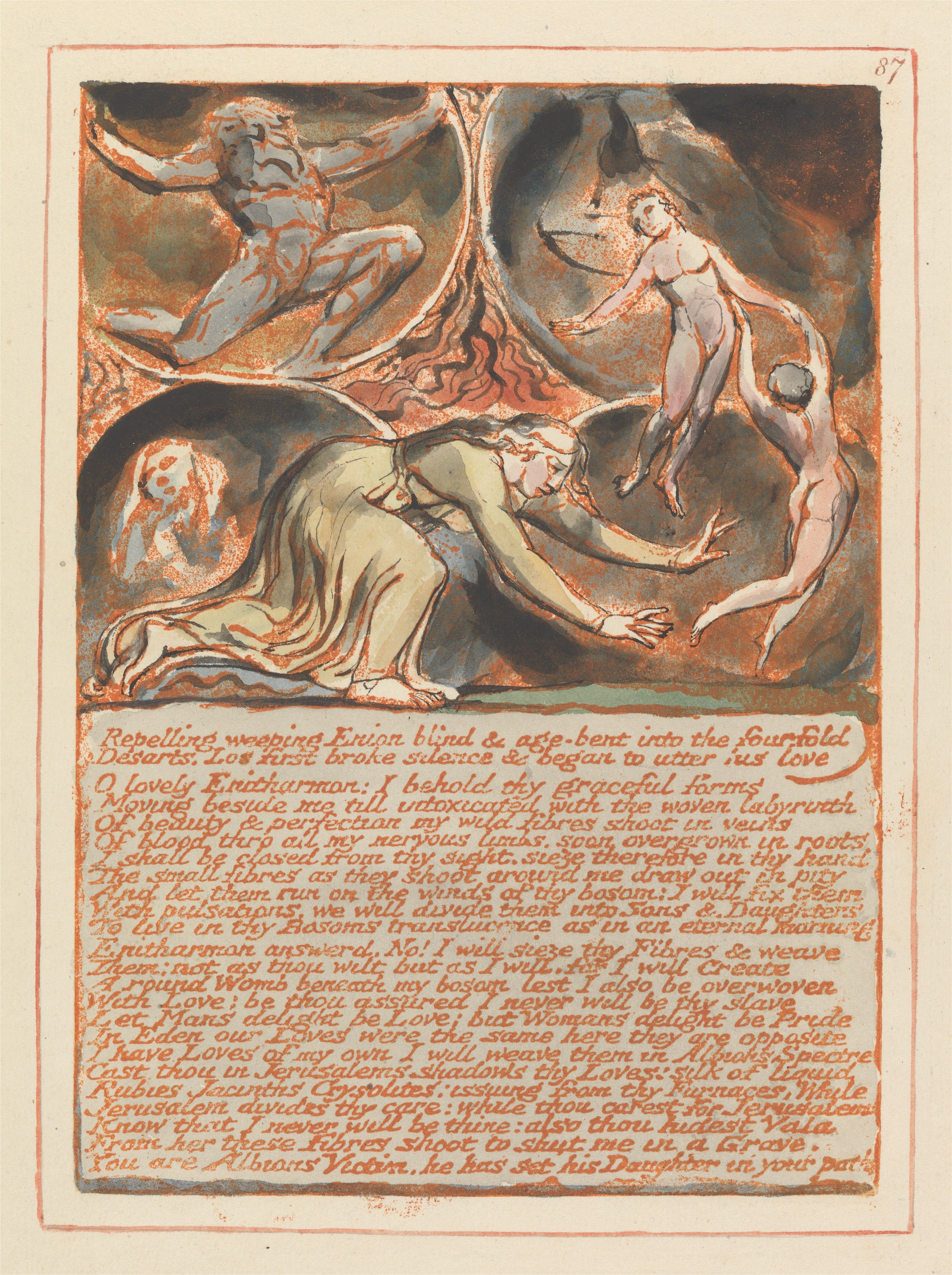
Plate 87, Copy E

The separation of Tharmas from his emanation Enion is intimately bound to the creation of what we perceive as the world of matter. One way we can envision this is that the consciousness of man developed to the point where he discriminated between what went on in own mind, and what was reflected to his mind through his senses from an outer world of material objects. Blake prefers for us to envision this as Enion fleeing from Tharmas and becoming the mother of Time & Space. Tharmas could not reverse the process once it had begun. Enion was destined to wander sorrowfully outside of the Eternal world which she and Tharmas had enjoyed before the separation took place.
 

Enion seems to be the character who carried the burden of the separation and descent more than any other. She had lost her connection with the inner world when she became alienated from Tharmas. Her children withdrew from her and formed from her substance a world she could not enter. Her response was to speak laments which articulated the condition of humanity in a world without consciousness of Eternity.

Four Zoas, Night I, Page 4, (E 301)
"Begin with Tharmas Parent power. darkning in the West

Lost! Lost! Lost! are my Emanations      Enion O Enion  
We are become a Victim to the Living We hide in secret  
I have hidden Jerusalem in Silent Contrition    O Pity Me
I will build thee a Labyrinth also O pity me    O Enion  
Why hast thou taken sweet Jerusalem from my inmost Soul  
Let her Lay secret in the Soft recess of darkness & silence
It is not Love I bear to [Jerusalem] It is Pity    
She hath taken refuge in my bosom & I cannot cast her out.

The Men have recieved their death wounds & their Emanations are fled 
To me for refuge & I cannot turn them out for Pitys sake   
Enion said--Thy fear has made me tremble thy terrors have surrounded me  
All Love is lost Terror succeeds & Hatred instead of Love
And stern demands of Right & Duty instead of Liberty.
Once thou wast to Me the loveliest son of heaven--But now        
 
Why art thou Terrible and yet I love thee in thy terror till
I am almost Extinct & soon shall be a Shadow in Oblivion
Unless some way can be found that I may look upon thee & live
Hide me some Shadowy semblance. secret whispring in my Ear
In secret of soft wings. in mazes of delusive beauty             
I have lookd into the secret soul of him I lovd
And in the Dark recesses found Sin & cannot return

Trembling & pale sat Tharmas weeping in his clouds"

Four Zoas, Night I, PAGE 8, (E 304) 
"Till with fierce pain she brought forth on the rocks her sorrow & woe
Behold two little Infants wept upon the desolate wind.

The first state weeping they began & helpless as a wave
Beaten along its sightless way growing enormous in its motion to
Its utmost goal, till strength from Enion like richest summer shining               
Raisd the bright boy & girl with glories from their heads out beaming      
Drawing forth drooping mothers pity drooping mothers sorrow  

They sulk upon her breast her hair became like snow on mountains
Weaker & weaker, weeping woful, wearier and wearier
Faded & her bright Eyes decayd melted with pity & love           
Page 9
And then they wanderd far away she sought for them in vain 
In weeping blindness stumbling she followd them oer rocks & mountains
Rehumanizing from the Spectre in pangs of maternal love
Ingrate they wanderd scorning her drawing her Spectrous Life
Repelling her away & away by a dread repulsive power             
Into Non Entity revolving round in dark despair.
And drawing in the Spectrous life in pride and haughty joy   
Thus Enion gave them all her spectrous life

Then Eno a daughter of Beulah took a Moment of Time          
And drew it out to Seven thousand years with much care & affliction
And many tears & in Every year made windows into Eden 

She also took an atom of space & opend its center
Into Infinitude & ornamented it with wondrous art
Astonishd sat her Sisters of Beulah to see her soft affections
To Enion & her children & they ponderd these things wondring     
And they Alternate kept watch over the Youthful terrors
They saw not yet the Hand Divine for it was not yet reveald
But they went on in Silent Hope & Feminine repose

But Los & Enitharmon delighted in the Moony spaces of Eno"
Four Zoas, Night VIII, PAGE 114 [110], (E 385) 
"He touches the remotest pole & in the Center weeps
That Man should Labour & sorrow & learn & forget & return
To the dark valley whence he came to begin his labours anew
In pain he sighs in pain he labours in his universe
Screaming in birds over the deep & howling in the Wolf
Over the slain & moaning in the cattle & in the winds
And weeping over Orc & Urizen in clouds & flaming fires   
And in the cries of birth & in the groans of death his voice 
Is heard throughout the Universe whereever a grass grows
Or a leaf buds   The Eternal Man is seen is heard   is felt
And all his Sorrows till he reassumes his ancient bliss

Such are the words of Ahania & Enion. Los hears & weeps"