Thursday, March 21, 2019

Sin


Wikipedia Commons
Small Book of Designs
Copy A, Plate 11

This is an extract from Chapter Four (FAITH) of Ram Horn'd With Gold by Larry Clayton.

"Whosoever of you are justified by the law: ye are fallen from grace" Galatians 5:4

Just as he redefined hell, so Blake redefined sin. The only sin for Blake in hindering, oneself or another: "Murder is Hindering Another, Theft is Hindering Another." To subvert one's individuality is the sin against the Holy Spirit. "He who desires but acts not, breeds pestilence".

The responsibility for hindering another falls upon the Lawmaker and Enforcer, who has polluted life with his prohibitions: "over the doors Thou shalt not" (EUROPE, a Prophecy, 12.28; Erdman 64). One could say that Blake took Paul's letters to the Romans and to the Galatians too seriously. Luther had taken those epistles seriously enough to throw off the Roman yoke. Blake took them more radically and threw off the mosaic yoke--as Paul had suggested.

Paul had identified the Law with the flesh and opposed it with the Spirit. Our poet took with utmost seriousness these stirring passages calling the Christian to freedom from the Law. He didn't have the benefit of the 'interpretations' of such ideas afforded by the educational process. Sin stems from our ideas of morality, which Blake called hindering. When we presume to know what someone else should or must do, we have entered the state of Caiaphas, the Pharisee, who crucified Jesus, but "was in his own Mind/a benefactor to Mankind."

We lay down the law to another--our law--and thus violate the other's nature: "One law for the Lion and Ox is Oppression". We tell him what to do, and then we use the power of the Accuser, the God of this World, to compel him to do it and to punish him for his failures. This is sin, the way life happens in Ulro. As we have seen, Blake didn't call it life, he called it Eternal Death. Paul had said, "The wages of sin is death but the gift of God is eternal life."

The categories of sin and righteousness divide mankind. The division often proceeds to the point of physical violence. Corporeal war always rests upon a base of self righteousness and condemnation of the sins of the enemy. Religion too often allies itself with those attitudes and their violent results. Long before the peaceniks of the sixties Blake said in effect, "Make love, not war!" He said it at great length in dozens of different ways. He saw war as the ultimate end of hindering another. In the Book of Urizen we read how Urizen, the great Lawgiver (who lives in all of us!) discovers that none of his children can obey his laws, "for he saw that no flesh nor spirit could keep His iron laws one moment" (Cf There is none righteous, no, not one).

Annotations to Lavater, (E 601)
"Every mans leading propensity ought to be calld his leading Virtue & his good Angel But the Philosophy of Causes & Consequences misled Lavater as it has all his contemporaries. Each thing is its own cause & its own effect Accident is the omission of act in self & the hindering of act in another, This is Vice but all Act from Individual propensity is Virtue. To hinder another is not an act it is the contrary it is a restraint on action both in ourselves & in the person hinderd. for he who hinders another omits his own duty. at the time Murder is Hindering Another Theft is Hindering Another Backbiting. Undermining Circumventing & whatever is Negative is Vice But the origin of this mistake in Lavater & his contemporaries, is, They suppose that Womans Love is Sin. in consequence all the Loves & Graces with them are Sin."

So we see that Blake opposed the idea of sin; he opposed morality; he opposed Law. Paradoxically Blake lived a very law abiding life. Only such a person can afford the luxury of antinomianism without losing his integrity. For example Blake despised the marriage laws--and lived as a faithful and dutiful husband for forty years. But beyond the surface absurdities of his anarchism Blake tells us something profound about life: Goodness cannot be compelled; goodness grows only in a context of freedom. "To the pure all things are pure". Blake was basically pure; one of his mottoes was "everything that lives is holy". That in itself would have been enough to make him famous.

If we can suspend our judgments about people's conduct and stop tormenting ourselves because of our failures to do the good which we have laid upon ourselves, if we can accept what we have called bad, but which may be simply disowned facets of our true nature, in Blake's terminology if we can forgive, then we can put sin behind us and receive the gift of eternal life. Blake, drinking deeply from the primary fountains of scripture, intuitively expressed these universal truths in poetic terms. One hundred years later Jung came along and clothed them with the respectability of a scientific jargon.

From what has been said it is obvious that Blake didn't believe in Sin as it is commonly understood: "Satan thinks that Sin is displeasing to God; he ought to know that Nothing is displeasing to God but Unbelief & Eating of the Tree of Knowledge of Good & Evil". Jerusalem, Blake's symbol of the redeemed and pure consciousness, speaking to Vala, his symbol of the fallen mind, expressed Blake's candid evaluation of Sin as such: "Oh Vala...what is sin but a little error & fault that is soon forgiven?" (Jerusalem, 20.22; E165)

Vision of Last Judgment, (E 654)
"Christ comes
as he came at first to deliver those who were bound under the
Knave not to deliver
the Knave He Comes to Deliver Man the [Forgiven] Accused & not Satan the Accuser we do not find any where that Satan is Accused of Sin
he is only accused of Unbelief & thereby drawing Man into Sin
that he may accuse him. Such is the Last Judgment a Deliverance from Satans Accusation Satan thinks that Sin is displeasing to God he ought to know that Nothing is displeasing to God but Unbelief & Eating of the Tree of Knowledge of Good & Evil
Men are admitted into Heaven not because they have
curbed & governd their Passions or have No Passions but because they have Cultivated their Understandings.
The Treasures of Heaven are not Negations of Passion but Realities of Intellect from which All the Passions Emanate Uncurbed in their Eternal Glory The Fool
shall not enter into Heaven let him be ever so Holy. Holiness is not The Price of Enterance into Heaven Those who are cast out Are All Those who having no Passions of their own because No Intellect. Have spent their lives in Curbing & Governing other Peoples by the Various arts of Poverty & Cruelty of all kinds Wo Wo Wo to you Hypocrites"

Tuesday, March 19, 2019

FALL OF MAN

VICTORIA AND ALBERT MUSEUM
London
The Fall of Man
1807
 
This picture is obviously one of those in which Blake was trying to bring together his message in one single statement. We can either focus on the minute particulars and let them lead us in multiple directions or we can let ourselves be absorbed in a total, inclusive portrayal of the dynamics of life. The title FALL OF MAN falls short of the action which can be discerned in the image.

If you have been carefully observing the images which are posted in this blog you will be reminded of figures which Blake used elsewhere: in his Illuminated Books, in his illustrations to books by other authors, in his illustrations to the Bible, and in the individual drawing which came spontaneously from his pen, pencil, graver or brush. Each figure becomes a word which identifies a symbol which becomes part of a vocabulary. Using the vocabulary he makes statements which define relationships which tell the story of humanity.

When Blake wrote this passage commenting on his illustration to Chaucer's Canterbury Pilgrims, he was recognizing that the archetypal states are expressed in individuals and reveal to us stages along the journey of life.

Descriptive Catalogue, (E 536)
"Every age is a Canterbury Pilgrimage; we all pass on, each sustaining one or other
of these characters; nor can a child be born, who is not one of
these characters of Chaucer, The Doctor of Physic is described as
the first of his profession; perfect, learned, completely Master
and Doctor in his art. Thus the reader will observe, that
Chaucer makes every one of his characters perfect in his kind,
every one is an Antique Statue; the image of a class, and not of
an imperfect individual."

But Blake may also have been suggesting an alternative way to view this image. What is going on in the outer experience of humanity is also going on in the inner experience of the individual's mind. Blake is showing the divisions which the psyche experiences internally just as as he was showing it in his four zoas, in his emanations and in Albion and his sons and daughters. So you can look in the image for the major divisions which psychology recognizes as the way the mind is organized, and for particular expressions which may be part of your own psyche.

It is easy to see various compartments in the picture and figures outside of the compartments. When we see the picture as the FALL OF MAN, the figures are in a process of descent on the right side of the picture and assent on the left side. Even the figures trapped in the lowermost darkest levels or compartments are being invited to begin the journey upward. And most notable is that the figure on the throne at the top of the picture is looking with compassion at those who are falling, and is in the process of stepping down instead of remaining distant.

Learn more from the post Day of Judgment


Monday, March 18, 2019

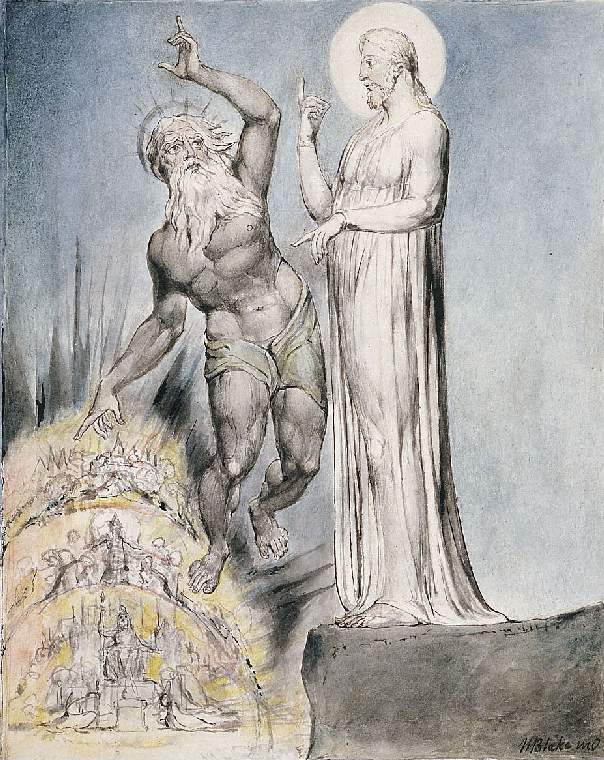
Heaven and Hell

Wikimedia Commons
Original in Fitzwilliam Museum
Illustrations to Paradise Regained 
Satan tempts Christ with the Kingdoms of the Earth
This is an extract from Chapter Four (FAITH) of Ram Horn'd With Gold by Larry Clayton.

Heaven and Hell

       Who among us shall dwell with everlasting burnings? (Isaiah 33:14)
   
 No one knows of the Beyond. Still men throughout history have seen visions of it. These visions have informed their faith and galvanized them to the words and deeds by which they have lived. Look now at Blake's visions of Heaven and Hell:

       For Isaiah (and Blake) 'everlasting burnings' had connotations opposite to those of conventional thinking.Indeed throughout the Bible fire symbolizes God more often than the Devil: "our God is a consuming fire". Note also the burning bush seen by Moses and the forks of flame at Pentecost. In Eden every bush burns and flaming tongues fill the air; Blake referred to them as burning arrows of thought.

       Blake's eternity, both here and hereafter, is characterized by two intense activities, War and Hunting (Milton: Plate 35:2), "the Two Fountains of the River of Life". Both are intellectual in nature and aimed at growth into Truth. In this world they have been prostituted into "corporeal war" and the killing of the innocent. War and Hunting of course exhaust the eternals, so periodic rest is provided in what might be called Lower Heaven; Blake called it Beulah:
    "There is from Great Eternity a mild & pleasant rest Nam'd Beulah, a soft Moony Universe, feminine, lovely, Pure, mild & Gentle, given in Mercy to those who sleep, Eternally created by the Lamb of God around, On all sides, within & without the Universal Man."
           4Z (Night 1 5:29-31)
       Blake tells us relatively little about Eden, but in his larger poems he had a lot to say about Beulah. He described it as a sort of way station between Eden and Ulro, which we might roughly translate as this vale of tears. Two way traffic passes through Beulah. Those who reach it from Ulro are in good shape and headed for something better. Those coming from the other direction are also okay for the moment but in deadly peril if they go farther.

       We could also call Ulro "this world". In a sense "this world" is as close to the conventional hell as Blake got. In Blake as in the Bible, especially in Paul, "this world" has a technical meaning. It does not mean the present stage of life as opposed to a heavenly (or hellish) existence beyond physical death. Basically "this world" means a level of consciousness that sees only the material, which Blake called the corporeal. Ulro is the state in which "Reality was forgot, and the Vanities of Time and Space only Remembered and called Reality" (Vision of the Last Judgment; Erdman 555; his comments on an astounding canvas; it concerns Revelation 20:11-15).

       Ulro, Blake's hell, denotes a form of blindness or sleep, from which one may awaken:
    "Of the Sleep of Ulro! and of the passage through Eternal Death! and of the awaking to Eternal Life..." (Jerusalem Chapter One)
       This is his theme, Blake tells us. Students of the New Testament know that sleep and waking are thoroughly biblical figures for the spiritual realities which concerned Blake here. He envisioned Eternal Death as the fallenness of "this world" through which we pass before "awaking to Eternal Life". Blake thus saw hell as man's fallen state before the coming of Jesus to awaken us and set us free.

       The biblical writers as they are generally understood had not adequately grasped the fullness of Jesus' power to rescue mankind totally from the darkness which Blake called Eternal Death. They wrote most of the New Testament in a time of persecution. In their effort to stiffen the spine of the believer in the face of that persecution they retreated into a degree of thralldom to the Old Testament God of Wrath, in the spirit of Jonathan Edwards' sermon,"Sinners in the Hands of an Angry God".

       One can readily understand why the worldly ecclesiastics who followed Peter and Paul picked up on the angry God. All too often he became their primary weapon; the image of hell is the ultimate form of coercion. Blake made no such mistake, probably because of the ten years which he had spent confronting and subduing that "shadow from his wearied intellect", years of suffering, but it turned to glory.
"Albion walkd on the steps of fire before his Halls
And Vala walkd with him in dreams of soft deluding slumber.
He looked up & saw the Prince of Light with splendor faded       
Then Albion ascended mourning into the porches of his Palace
Above him rose a Shadow from his wearied intellect:
Of living gold, pure, perfect, holy: in white linen pure he hoverd
A sweet entrancing self-delusion a watry vision of Albion
Soft exulting in existence; all the Man absorbing!"
(Jerusalem, Plate 43 [29], Erdman 191)  
       In those years he laid to rest the Punisher who has afflicted the minds of believers through the centuries, but he retained the creative possibility which represents the best of the Christian faith. The rationalists and deists had thrown out both and confined us to Ulro, which today threatens to engulf mankind. The reader must decide for himself whose hell is most real--the place of unending punishment or the sleep from which man may awaken.

Tuesday, March 12, 2019

Death

Wikipedia Commons 
Illustrations to The Grave
Designed by Blake engraved by Schiavonetti
This is an extract from Chapter Two of Ram Horn'd With Gold by Larry Clayton. 

If its visions of love express the quality of a culture, so also does the face which it presents to death. Our society expends enormous sums on the professional removal of all evidence of death from our consciousness, even in the teeth of the stark reality. Ernest Becker, in The Denial of Death, showed the ubiquity of this impulse in American culture. His title, a poetic term, can just as easily mean one thing as the other. Like all symbols of value we encounter good denials of death and bad ones.
      
The poetry of Walt Whitman expresses one of the best. Like our poet Whitman was so sure of Eternity that the end of natural life had no terrors for him. He gained first hand experience with death as a hospital volunteer during the Civil War. Exceptionally memorable is his address to a dying soldier, "I don't commiserate, I congratulate you". Here is the exact opposite of the forms of denial most often exercised by the mortician, who simply does all he can to encourage us not to think about it.

In one of his earliest writings Blake explored the meaning of death to an ordinary young man and his loved ones. The Couch of Death (Erdman 441) voices the common fears of humanity but moves to the faithful reality that Blake possessed throughout his days, ending "and the youth breathes out his soul with joy into eternity".


Couch of Death 
"...Sorrow linked them together,
leaning on one another's necks alternately--like lilies, dropping
tears in each other's bosom, they stood by the bed like reeds
bending over a lake, when the evening drops trickle down.  His
voice was low as the whisperings of the woods when the wind is
asleep, and the visions of Heaven unfold their visitation. 
Parting is hard, and death is terrible; I seem to walk through a
deep valley, far from the light of day, alone and comfortless!
The damps of death fall thick upon me! Horrors stare me in the
face! I look behind, there is no returning; Death follows after
me; I walk in regions of Death, where no tree is; without a
lantern to direct my steps, without a staff to support me."
Blake's idealism found expression in the simple inversion of death, an idea that goes back as far as Heraclitus, who speaking of the Eternals said, "we live their death, and we die their life". The thought comes down to us through Euripides, Plato, and many others as late as Thomas Wolfe.
Most often when Blake speaks of "Death Eternal" he expresses the viewpoint of the Eternals; they meant by the term "this mortal life". Three times in Plate 14 of Milton the poet in Heaven, having heard the "Bard's Song" about Satan and recognizing Satan as his own Self- hood, says, "I go to Eternal Death!". He clearly means to return to this world, reenacting the kenosis (self emptying) of Christ.

Otherwise Blake used the word 'death' more straightforwardly than he had used 'love' and in two general senses. In fairly common parlance death is the opposite of the creative. Speaking of the Law in 'Jerusalem' the Divine Voice says:
"No individual can keep these Laws, for they are death To every energy of man and forbid the springs of life."

If you read Paul's epistles, you will discover that he used 'death' in the same ways. For example "And you hath he quickened, who were dead in trespasses and sins" (Ephesians 2:1). Paul is always reminding the Christian that he participates in the death and resurrection of Christ.

Secondly, Blake used 'death' in its most proper sense as the end of mortal life, but whenever he touched this subject, he always denied the materialistic viewpoint that death is the end. A clear example comes in Gates of Paradise, a short synoptic and pictorial description of Blake's myth of life:
" But when once I did descry The Immortal Man that cannot Die, Thro' evening shades I haste away To close the Labours of my Day."

Though he lived intensely, the love of the Ideal and his life long visions of Eternity led Blake to yearn for the Beyond and to depreciate material existence. Like the apostle Paul he had a "desire to depart, and to be with Christ; which is far better". Blake made a deliberate attempt through the aid of the doctrine of correspondences to live each moment of earthly life in the eternal realm, "to see a World in a Grain of Sand". Expressed negatively,
"I assert for My Self that I do not behold the outward Creation & that to me it is hindrance & not Action; it is as the Dirt upon my feet, No part of Me."

And as stated in CHAPTER ONE he died with a song of praise on his lips. His life and all his art provide a convincing testimony for the reality of the Beyond. It was really Death that was "Dirt upon his feet".

Finally Blake used 'death' in the uniquely Christian context of self giving. At the end of 'Jerusalem' Jesus explains to Albion the meaning of his own death and its significance as a universal form of relationship:
      "...Fear not Albion: unless I die thou canst not live;
But if I die I shall arise again & thou with me.
This is Friendship & Brotherhood: without it Man is Not. ...
....Wouldest thou love one who never died
For thee, or ever die for one who had not died for thee?
And if God dieth not for Man & giveth not himself
Eternally for Man, Man could not exist; for Man is Love
As God is Love; every kindness to another is a little Death 
In the Divine Image, nor can Man exist but by Brotherhood.

*************************************
     These explorations of 'love' and 'death' may help the reader to grasp some of the poetic meanings attached to Blake's other terms of value, words like heaven and hell, good and evil, truth and error. Always watch for irony, for the other point of view, the reverse side of the coin. In such ways Blake continually provokes the intellect. He delights the person who enjoys an intellectual challenge--and frustrates others. He intimated as much in a letter to Dr. Trusler, who likely belonged to the second category:
" But you ought to know that What is Grand is necessarily
obscure to Weak men. That which can be made Explicit to
the Idiot is not worth my care. The wisest of the Ancients
consider'd what is not too Explicit as the fittest for
Instruction, because it rouzes the faculties to act. I
name Moses, Solomon, Esop, Homer, Plato."

Sunday, March 10, 2019

Love

Wikipedia Commons 
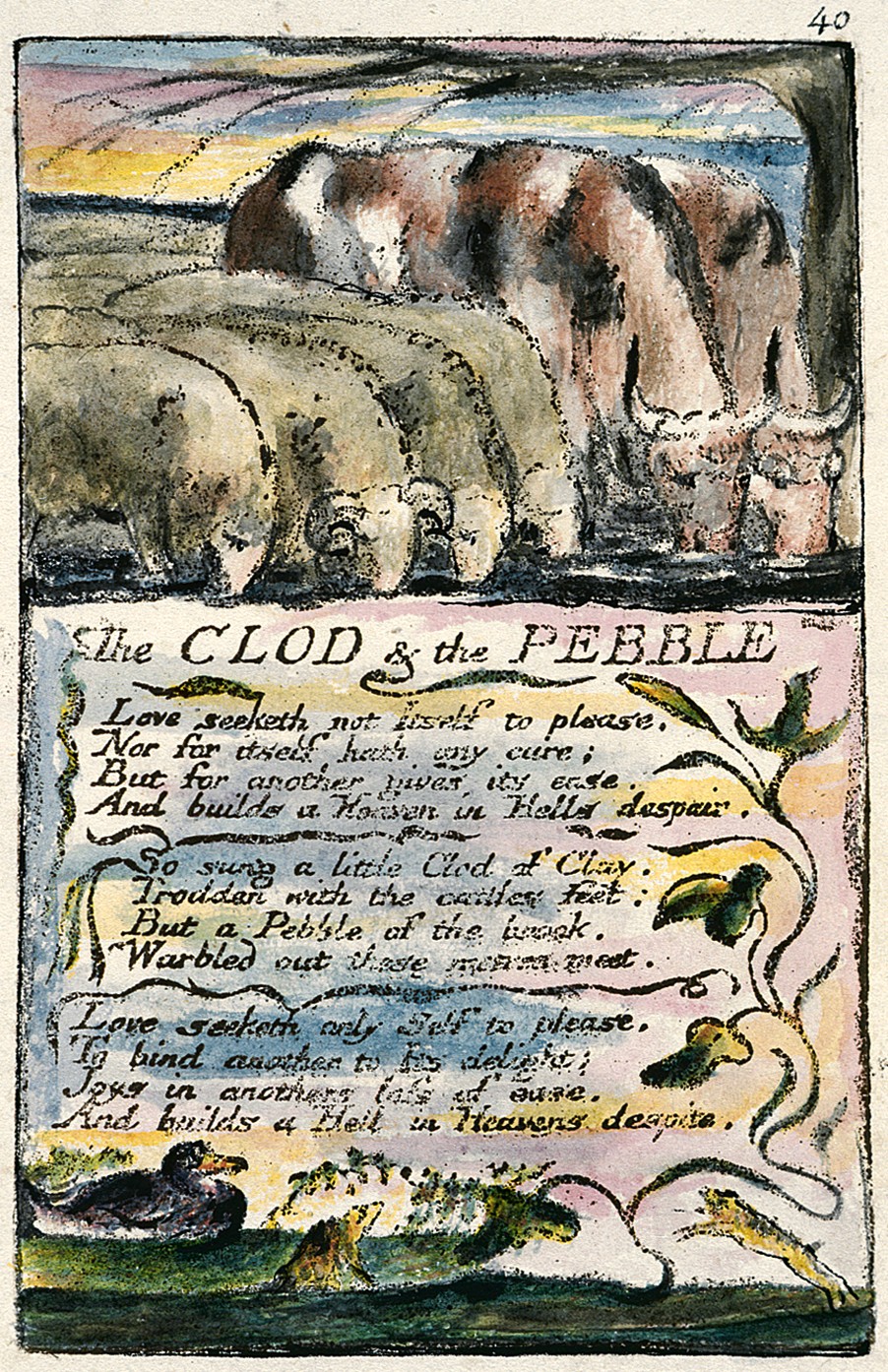
Songs of Innocence & of Experience
Plate 40, Copy L

This is an extract from Chapter Two of Ram Horn'd With Gold by Larry Clayton. 


 A very elementary lesson about love confronts the reader of "The Clod and the Pebble". It shows with stark simplicity the two kinds of love, divine and demonic.


Two kinds of love! Blake will explore the pebble's love with its infinite variety of forms before he allows us to rest again in the love of God. Blake's poem,Visions of the Daughters of Albion, (Look also at the Plates) begins with the words, "I loved Theotormon".


The heroine, Oothoon, thus describes the first significant act in a life of horror. Before the consummation of her love for Theotormon she is raped by Bromion. Then Theotormon won't have her; well named, he's tormented by God. Woman as a possession makes life hell for everyone. Here we find Blake's first full manifestation of the "torments of love and jealousy".


At the climax of this strange love song, with the irony all spent, Oothoon properly assesses conventional love and brands it, 
"self-love that envies all, a creeping skeleton With lamplike eyes watching around the frozen marriage bed." 
     Those are hot, passionate words of righteous indignation at what fallen men have made of love. Oothoon then proceeds to offer a happier form of married love: 
"But silken nets and traps of adamant will Oothoon spread, And catch for thee girls of mild silver, or of furious gold. I'll lie beside thee on a bank & view their wanton play In lovely copulation, bliss on bliss, with Theotormon"


With these extravagant images the young poet shocks his reader into an awareness of love's spectrum of value. In the ironic language of 'The Marriage of Heaven and Hell' the first, jealous love, is the love of Heaven or Restraint, and the second, the selfless love, is that of Hell or Eternal Delight. This version of values set the style for Blake's use of the word. It became in his hands a sharp sword penetrating to the core of society's ills.


The subtitle of The Four Zoas begins, "The Torments of Love & Jealousy". Violent and passionate feelings characterize the entire epic. As soon as the reader can envision 4Z as a whole, he will perceive that all these passionate feelings in all of these characters have a common destructiveness and alienating effect, until the Moment of Grace recorded in Night vii. Love, hate, fear, pride, humiliation, all are united in this common fallenness.


In Night i the primeval pair, Los and Enitharmon, set the tone for the meaning of love in this fallen world. (They all too aptly portray the emotional universe of many married couples):


"Alternate Love & Hate [filled] his breast: hers Scorn & Jealousy". 
Enitharmon believes love to be a one way street. Speaking to Los of their parents: "...if we grateful prove They will withhold sweet love, whose food is thorns & bitter roots."

And in Night ii she announces her philosophy of the relations between man and woman: "The joy of woman is the death of her most best beloved Who dies for Love of her In torments of fierce jealousy & pangs of adoration."


There you have love at its worst! This fairly represents Blake's ironic use of the word in his major work. In Blake's symbolic structure of thought love is most often a function of woman, who is a symbol of fallenness . Not until 'Jerusalem' do we meet the feminine embodiment of the Christian graces, among them love divine.


The notebook poem which begins, "My Spectre around me night and day" merits study as an approach to understanding the use of Blake's symbolism to express his deepest feelings about life. I quote the climax of it. In the first verse Blake means by 'love' very much what Paul in Romans 8 meant by 'flesh'. In the second, without using the word, he expresses in the fullest possible way what divine love meant to him: 
"Let us agree to give up Love, And root up the infernal grove;  
Then shall we return & see The worlds of happy Eternity.
& Throughout all Eternity I forgive you, you forgive me.  
As our dear Redeemer said:

This the Wine & this the Bread."

As these lines suggest, Blake had a strong sense of reticence about using the sacred words in the sacred sense, perhaps because he had so exhaustively explored their profane senses. Nevertheless in the poem "William Bond" from the Pickering Manuscript he gave an exquisite portrait of romantic love, purified of fallenness and filled with the divine. Read the last two verses: 
"I thought Love livd in the hot sun Shine                 
But O he lives in the Moony light
I thought to find Love in the heat of day
But sweet Love is the Comforter of Night

Seek Love in the Pity of others Woe
In the gentle relief of anothers care               
In the darkness of night & the winters snow
In the naked & outcast Seek Love there"

Thursday, March 07, 2019

Larry's Dream

British Museum
Illustrations to Young's Night Thoughts

On plate 12 of The Marriage of Heaven and Hell Blake relates what he calls a Memorable Fancy. The passage has proven to be memorable because it tells a story, contains significant truth and is amusing. Larry was so impressed with Blake's interaction with Isaiah and Ezekiel that he posted an account of his own experience in Heaven with William Blake.   

Marriage of Heaven & Hell, Plate 12, (E 38)
"                    A Memorable Fancy.                            
   The Prophets Isaiah and Ezekiel dined with me, and I asked
them how they dared so roundly to assert. that God spake to them; 
and  whether they did not think at the time, that they would be 
misunderstood, & so be the cause of imposition.
   Isaiah answer'd. I saw no God. nor heard any, in a finite
organical perception; but my senses discover'd the infinite in
every thing, and as  I was then perswaded. & remain confirm'd;
that the voice of honest indignation is the voice of God, I cared
not for consequences but  wrote.
   Then I asked: does a firm perswasion that a thing is so, make it so?
   He replied.  All poets believe that it does, & in ages of imagination
this firm perswasion removed mountains; but many are not capable
of a firm perswasion of any thing.
   Then Ezekiel said. The philosophy of the east taught the first 
principles of human perception     some nations held one
principle for  the origin & some another, we of Israel taught
that the Poetic Genius (as  you now call it) was the first
principle and all the others merely  derivative, which was the
cause of our despising the Priests & Philosophers  of other
countries, and prophecying that all Gods [PL 13] would at last be
proved. to originate in ours & to be the tributaries of the
Poetic  Genius, it was this. that our great poet King David
desired so fervently  & invokes so patheticly, saying by this he
conquers enemies & governs kingdoms; and we so loved our God.
that we cursed in his name all  the deities of surrounding
nations, and asserted that they had rebelled; from these opinions
the vulgar came to think that all nations would at last be
subject to the jews.
   This said he, like all firm perswasions, is come to pass, for all 
nations believe the jews code and worship the jews god, and what
greater subjection can be
   I heard this with some wonder, & must confess my own
conviction.  After dinner I ask'd Isaiah to favour the world with
his lost works, he said none of equal value was lost.  Ezekiel
said the same of his.
   I also asked Isaiah what made him go naked and barefoot three
years? he answerd, the same that made our friend Diogenes the
Grecian.
   I then asked Ezekiel. why he eat dung, & lay so long on his
right  & left side? he answerd. the desire of raising other men
into a  perception of the infinite this the North American tribes
practise. & is he honest who resists his genius or conscience.
only for the sake of present  ease or gratification?"          

Larry's post from September 23, 2010:

A Dream
Catherine Blake said her only problem with her husband was that he spent too much time in Heaven. In our dreams we may be closer to Blake's Heaven than is possible in our waking hours. Some day we may realize that where we live now is largely vaporous.

Larry's dream: The other day I had dinner with Blake, and I asked him if he had said all he had to say by 1828. He said "'pretty much', 'pretty much', especially if you've experienced all the words and pictures that I left behind."

I asked him if there was anything more he would like to tell us now from his present life. He said, "Oh yes, a great deal; but I've experienced nothing that your corporeal mind would find meaningful." he went on to say that where he now lived and what he now knew was separated from me by a great chasm, much like the one between Lazarus in Abraham's bosom and Dives.

He reminded me of Paul's experience in the Third Heaven where "He heard unspeakable words, which it is not lawful for a man to utter".


I asked Blake if he had recently come in contact with Isaiah or Ezekiel. He said that Ezekiel and he had become bosom buddies, "we laughed together over the peculiar directive that Ezekiel had received from God". He also told Ezekiel that that affair had meant a lot to him and given him a vivid awareness of the "perception of the infinite" (MHH13, E39)

Blake went on to say that in due course, at the acceptable time, he would be glad to introduce me to Ezekiel or to anyone else I desired to meet. He also arranged a tennis match for me with Kenny Rosewall.
I asked Blake how his Spectre had been most hurtful to him. He promptly replied as follows: in my Revolutionary zeal for Liberty I bad mouthed a fair number of people who seemed to be against it. I've now met these people one by one and come with them to good accord, I include Bacon, Newton, Locke, and a host of others" (It was too many for me to remember, even in that rapturous state.)

I was just about to make further requests when the alarm clock sounded, and I was aroused from my Heavenly Vision or perhaps I went back to the corporeal sleep.


Larry did not often engage in such fanciful thinking but I can remember another time when he set up an imagined situation to illustrate a point. In the old days when segregation was practiced throughout much of the United States, there was a question among some as to whether blacks and whites would associate with one another when they got to heaven. Larry's answer was that in heaven all sang together in the celestial choir under the direction of a black choirmaster. People who found it unacceptable could withdrew and find themselves a segregated corner of hell. Larry, like Blake, was not very careful about saying things that could get him into trouble.


Ezekiel 4
[4] Lie thou also upon thy left side, and lay the iniquity of the house of Israel upon it: according to the number of the days that thou shalt lie upon it thou shalt bear their iniquity.
[5] For I have laid upon thee the years of their iniquity, according to the number of the days, three hundred and ninety days: so shalt thou bear the iniquity of the house of Israel.
[6] And when thou hast accomplished them, lie again on thy right side, and thou shalt bear the iniquity of the house of Judah forty days: I have appointed thee each day for a year.
[7] Therefore thou shalt set thy face toward the siege of Jerusalem, and thine arm shall be uncovered, and thou shalt prophesy against it.
[8] And, behold, I will lay bands upon thee, and thou shalt not turn thee from one side to another, till thou hast ended the days of thy siege.
[9] Take thou also unto thee wheat, and barley, and beans, and lentiles, and millet, and fitches, and put them in one vessel, and make thee bread thereof, according to the number of the days that thou shalt lie upon thy side, three hundred and ninety days shalt thou eat thereof.
[10] And thy meat which thou shalt eat shall be by weight, twenty shekels a day: from time to time shalt thou eat it.
[11] Thou shalt drink also water by measure, the sixth part of an hin: from time to time shalt thou drink.
[12] And thou shalt eat it as barley cakes, and thou shalt bake it with dung that cometh out of man, in their sight.
[13] And the LORD said, Even thus shall the children of Israel eat their defiled bread among the Gentiles, whither I will drive them.
[14] Then said I, Ah Lord GOD! behold, my soul hath not been polluted: for from my youth up even till now have I not eaten of that which dieth of itself, or is torn in pieces; neither came there abominable flesh into my mouth.
[15] Then he said unto me, Lo, I have given thee cow's dung for man's dung, and thou shalt prepare thy bread therewith.
[16] Moreover he said unto me, Son of man, behold, I will break the staff of bread in Jerusalem: and they shall eat bread by weight, and with care; and they shall drink water by measure, and with astonishment:
[17] That they may want bread and water, and be astonied one with another, and consume away for their iniquity.

Wednesday, March 06, 2019

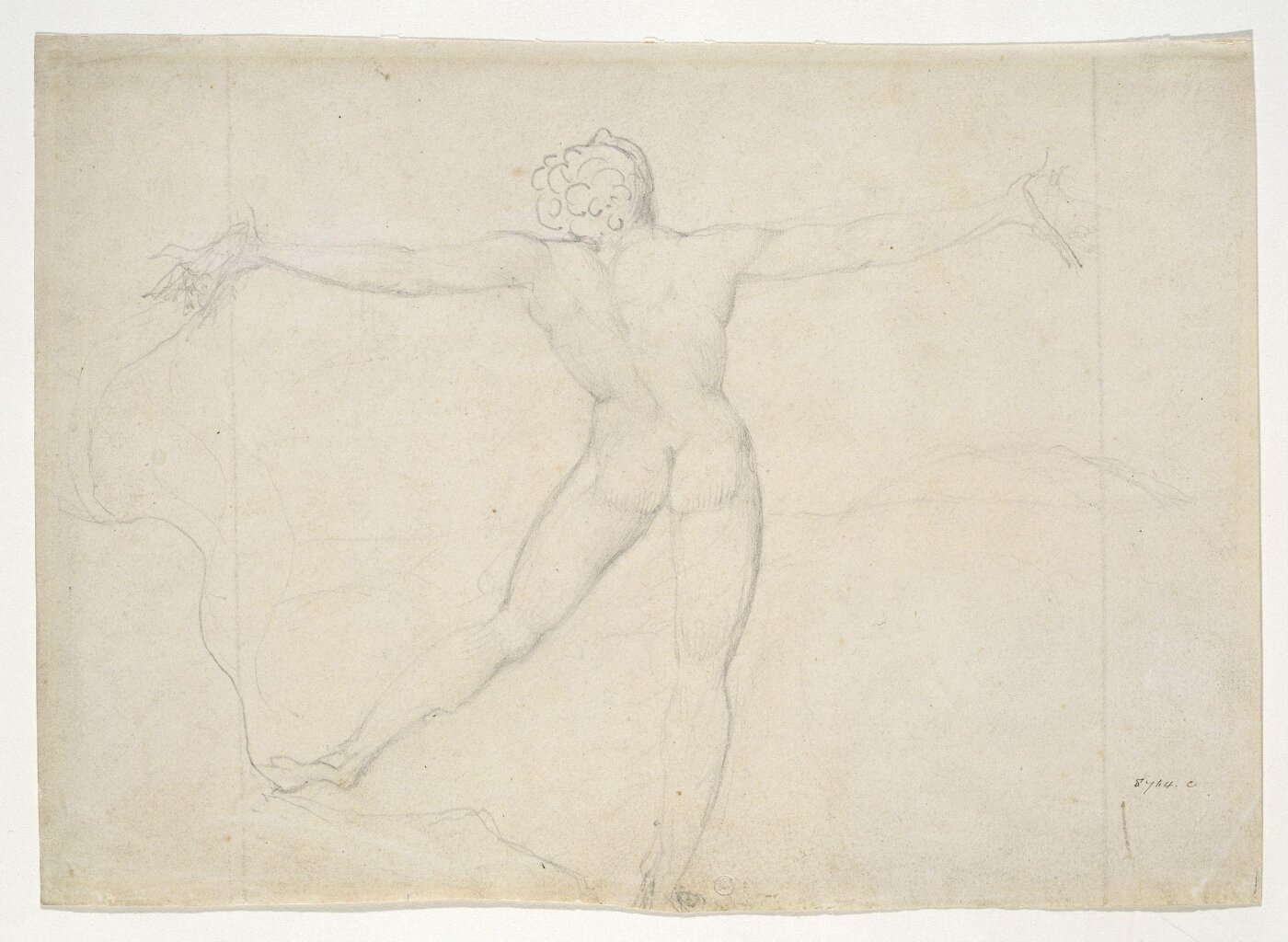
ALBION ROSE


Victoria & Albert Museum
Pencil Drawing 
ca. 1780
British Museum
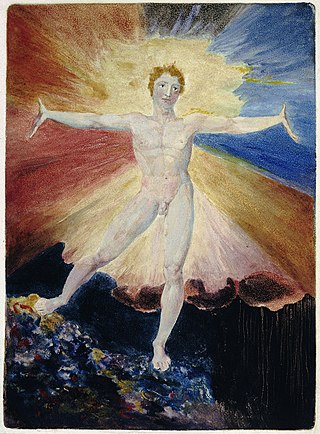
Large Book of Designs
Albion Rose
Color Engraving, 1794-96

Legend: Albion rose from where he labourd at the Mill with Slaves
National Gallery
The Dance of Albion
Engraving
c. 1803/1810

Blake used Albion as a symbol for all of mankind and particularly of the people with whom he was best acquainted: the British. The body of the individual was extrapolated and superimposed onto one human body which was inclusive of all humanity. Being the image created by God in reflection of His own image, Albion was perfect and complete.

Artist as he was, Blake pictured Albion in his vitality. He invented his image as an engraving in 1780 revised it after 1803. He color printed it between 1794 and 1796.

The Tate Gallery book William Blake on page 242 includes this statement:
"The emergence of this image of British liberty as a giant form was the outcome of Blake's desire to create an Albion for his own times but also rooted in ancient mythology."

Annotations to Berkley's Siris, (E 663) 
"Harmony [&] Proportion are Qualities & Not Things The
Harmony & Proportion of a Horse are not the same with those of a
Bull Every Thing has its 
own Harmony & Proportion Two Inferior Qualities in it For its
Reality is Its Imaginative Form" 
Four Zoas, Night VII, Page 98 [90], (E 370) 
"Los drew them forth out of the deeps planting his right foot firm
Upon the Iron crag of Urizen thence springing up aloft
Into the heavens of Enitharmon in a mighty circle

And first he drew a line upon the walls of shining heaven    
And Enitharmon tincturd it with beams of blushing love
It remaind permanent a lovely form inspird divinely human
Dividing into just proportions Los unwearied labourd
The immortal lines upon the heavens till with sighs of love
Sweet Enitharmon mild Entrancd breathd forth upon the wind   
The spectrous dead Weeping the Spectres viewd the immortal works
Of Los Assimilating to those forms Embodied & Lovely
In youth & beauty in the arms of Enitharmon mild reposing"
Inscriptions, WB inv 1780, (E 671) 
     "Albion rose from where he labourd at the Mill with Slaves
     Giving himself for the Nations he danc'd the dance of Eternal Death"

Four Zoas, Night IX, Page 134, (E 402) 
"Let the slave grinding at the mill run out into the field
Let him look up into the heavens & laugh in the bright air
Let the inchaind soul shut up in darkness & in sighing           
Whose face has never seen a smile in thirty weary years
Rise & look out   his chains are loose his dungeon doors are open" 
Leonardo da Vinci's Vitruvian Man:  
  More More.
 

Friday, March 01, 2019

MY SPECTRE

British Museum
Illustrations to Young's Night Thoughts

One of the facets of self-knowledge is the realization that we have within ourselves a bundle of inconsistencies. We act out these contrary states without consciousness of their source. There is value in tracing our feelings, rationalizations or outward behaviors to the facets of ourselves which are being expressed. In so doing we inform ourselves of the dynamics of the divisions within ourselves which prevent us from measuring up to the image of ourselves we hope to attain. In The King and the Corpse, Heinrich Zimmer refers to Blake's poem My Spectre in elucidating the powers which are actively preventing (or assisting) the transformation which man is seeking.

From The King and the Corpse, Page 221:
"As William Blake has put it: 'My Spectre around me night & day.' Wherever we look we discover our own inescapable selves. Wherever we step, a portion of our unknown self steps before us significantly, mysteriously fashioned and projected. Our destiny, our environment, our enemies, our companions - we have built them all. They stalk out of the depth, essential and self-produced. That is why to an enlightened person everything encountered is a manifestation of the initiating priest, a spiritual guide able to bestow the key. The shapes of the initiating powers change, but always in accordance with out own need and guilt; they reflect the degree of our own nescience or maturity. And they prefigure the transformation required of us, the tasks we have yet to solve,"      

Songs and Ballads, My Spectre, (E 475)
"My Spectre around me night & day
Like a Wild beast guards my way
My Emanation far within               
Weeps incessantly for my Sin                                  

A Fathomless & boundless deep     
There we wander there we weep
On the hungry craving wind
My Spectre follows thee behind

He scents thy footsteps in the snow
Wheresoever thou dost go               
Thro the wintry hail & rain
When wilt thou return again

Dost thou not in Pride & scorn        
Fill with tempests all my morn 
And with jealousies & fears
Fill my pleasant nights with tears

Seven of my sweet loves thy knife
Has bereaved of their life
Their marble tombs I built with tears  
And with cold & shuddering fears   

Seven more loves weep night & day
Round the tombs where my loves lay     
And seven more loves attend each night
Around my couch with torches bright

And seven more Loves in my bed
Crown with wine my mournful head       
Pitying & forgiving all
Thy transgressions great & small

When wilt thou return & view
My loves & them to life renew     
When wilt thou return & live
When wilt thou pity as I forgive       

Never Never I return                   
Still for Victory I burn
Living thee alone Ill have                
And when dead Ill be thy Grave

Thro the Heavn & Earth & Hell
Thou shalt never never quell
I will fly & thou pursue
Night & Morn the flight renew       

Till I turn from Female Love            
And root up the Infernal Grove          
I shall never worthy be                 
To Step into Eternity

And to end thy cruel mocks             
Annihilate thee on the rocks
And another form create
To be subservient to my Fate

Let us agree to give up Love
And root up the infernal grove                                 
Then shall we return & see
The worlds of happy Eternity

& Throughout all Eternity                     
I forgive you you forgive me
As our dear Redeemer said                                   
This the Wine & this the Bread"
Blake used many symbols to reveal the process of ridding oneself from impediments to spiritual growth. In the phrase; 'Till I turn from Female Love And root up the Infernal Grove,' he is giving instruction on how to solve the problem of being entrapped by the Spectre in a mind that repeats the 'same dull round.'  That is if we turn from our devotion to the the outward enticements, and if we remove form our minds our false ideas and the ways of thinking that keep us bewildered, we will find ourselves capable of reaching a level of consciousness beyond our present ability. 

Milton, Plate 14 [15], (E 108)
"I in my Selfhood am that Satan: I am that Evil One!             
He is my Spectre! in my obedience to loose him from my Hells
To claim the Hells, my Furnaces, I go to Eternal Death." 

Jerusalem, Plate 7, (E 150)
"Such are the Generations of the Giant Albion,
To separate a Law of Sin, to punish thee in thy members.         

Los answer'd. Altho' I know not this! I know far worse than this:
I know that Albion hath divided me, and that thou O my Spectre,
Hast just cause to be irritated: but look stedfastly upon me:
Comfort thyself in my strength the time will arrive,
When all Albions injuries shall cease, and when we shall         
Embrace him tenfold bright, rising from his tomb in immortality.
They have divided themselves by Wrath. they must be united by
Pity: let us therefore take example & warning O my Spectre,
O that I could abstain from wrath! O that the Lamb
Of God would look upon me and pity me in my fury.                
In anguish of regeneration! in terrors of self annihilation:
Pity must join together those whom wrath has torn in sunder,"

Jerusalem, Plate 73, (E 173)
 "And O thou Lamb of God, whom I    
Slew in my dark self-righteous pride:
  Art thou return'd to Albions Land!
And is Jerusalem thy Bride?

  Come to my arms & never more
Depart; but dwell for ever here:         
  Create my Spirit to thy Love:
Subdue my Spectre to thy Fear,

  Spectre of Albion! warlike Fiend!
In clouds of blood & ruin roll'd:
  I here reclaim thee as my own         
My Selfhood! Satan! armd in gold."

Jerusalem, Plate 41, (E 184)
[illustration, with inscription, reversed: 
"Each Man is in his Spectre's power
Until the arrival of that hour,  
When his Humanity awake
And cast his Spectre into the Lake"