Wednesday, April 03, 2019

Transition

Wikipedia Commons
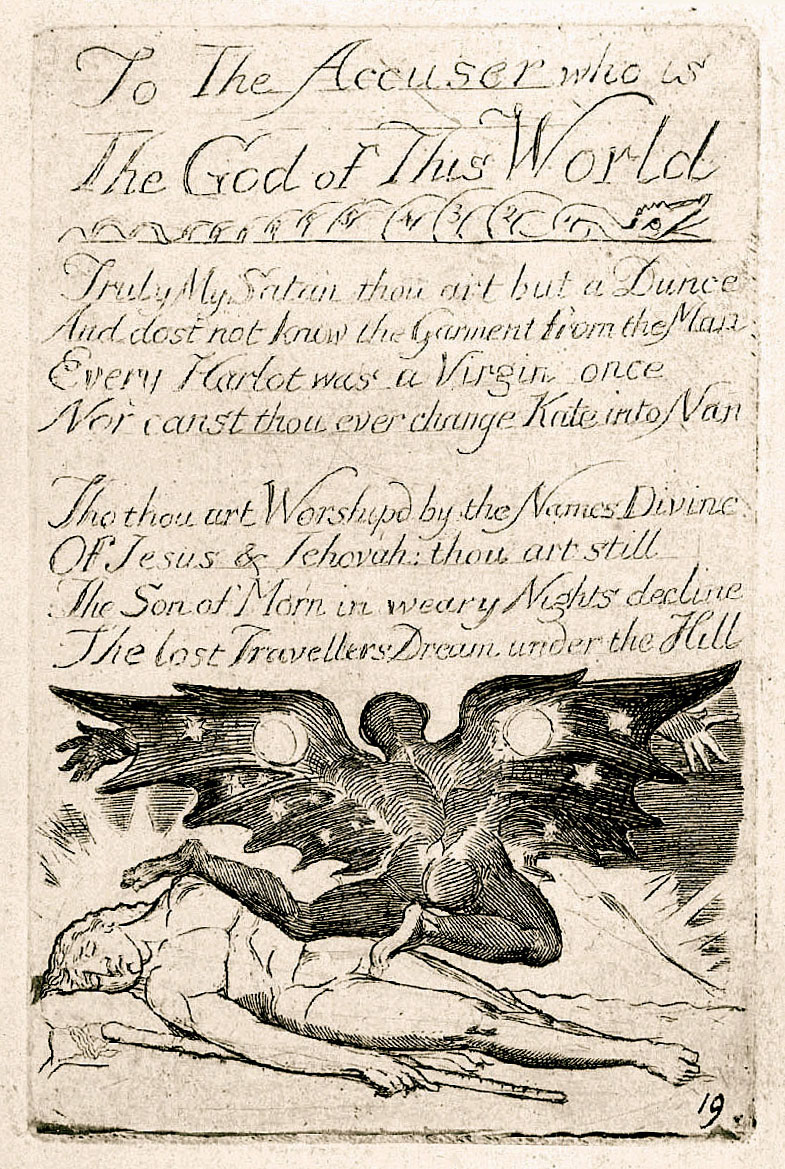
For the Sexes: The Gates of Paradise
Plate 21, Epilogue

This is an extract (5) from Chapter Five (GOD) of Ram Horn'd With Gold by Larry Clayton.

Humanism

With idols no longer possible what's left to worship? The answer depends upon your experience. With all the idols gone the true God remains, for those who can meet him. For others the highest possible is the Human Form, and here Blake settled before he came to see Jesus as God. He began by worshiping the Human Form, the Highest and Best Imaginable, and in 1800 he recognized this Highest and Best in Jesus. In terms of conventional theology Blake was a humanist before he became a committed Christian. In "The Marriage of Heaven and Hell' he loudly proclaimed his humanism: "God only Acts and Is, in existing beings or Men". And a few pages later:

The worship of God is: "Honouring his gifts in other men, each according to his genius, and loving the greatest men best: those who envy or calumniate great men hate God; for there is no other God."

According to Kathleen Raine it was "the central doctrine of the Swedenborgian New Church that God can only be known in human form". Blake illustrated this with his quatrain at the end of "Auguries of Innocence":
"God Appears and God is Light
To those poor Souls who dwell in Night,
But does a Human Form Display
To those who Dwell in Realms of day."

Finally in his "Annotations to Berkeley's Siris", which he read about 1820, he wrote "God is Man and exists in us and we in him". He was still a humanist, but his humanism had gained a strong Christian dimension. Blake's argument against the conventional images of God, from beginning to end, hinged upon their sub-human nature. The biblical writers frequently ascribed to their God attitudes and behaviour beneath the moral level of any self respecting human. God cannot be less than man; therefore the appropriate response to such an image is derision, especially in the face of the common credulous awe.

The spiritually open person, free of the common credulous awe and capable of a clear eyed gaze at the Bible, no longer finds it possible to view all the biblical images as portraying a God worthy of worship. Furthermore when one looks freely at the actions of political and religious leaders of Christendom of the past 2000 years, it becomes clear that they were often worshipping something other than the true God. Finally the actions and attitudes of our contemporaries and even our own point to domination by a vision that is something less than the Highest and Best. In his poetry Blake documents these three observations with voluminous detail. They led to his ultimate evaluation of the universal false God. The name he settled upon is refreshingly biblical and authentic:


For the Sexes: The Gates of Paradise, Plate 21, (E 269)
"To the Accuser, who is
The God of this World
...
Tho' thou art Worship'd by the Names Divine
Of Jesus and Jehovah, thou art still
The Son of Morn1 in weary Night's decline,
The Lost Traveller's1 Dream under the Hill."

Jesus had said it a long time before: "Why call ye me Lord, Lord...." 

God of this World

Who is the God of this World? He is the God of those whose life is based upon the physical senses and centered in material existence, in this world. They provide for themselves now because there is no Other. They use law and power for their own advantage at the expense of others and consider that to be the nature of reality. These are the worshippers of the God of this World. In the end nothing could be more authentically biblical.

Once he began to focus upon the God of this World, Blake found in the Bible much positive information: he masquerades as an angel of light; he tempts; he accuses. "We do not find anywhere that Satan is accused of sin. He is only accused of Unbelief and thereby drawing man into sin that he may accuse him." Satan is particularly attached to the rulers of the world--economic, political, and ecclesiastical--and they to him. He is "Worshiped as God by the Mighty Ones of the Earth" (Jerusalem 29:18). They naturally regard him as God because their faithfulness to his values and methods has led them to great prosperity.

But in Satan's kingdom more basic than oppressive power is fear and timidity. Northrup Frye explains: "The morally good man tries to obey an external God instead of bringing out the God in himself. The external God [is] only the shadow of Caesar." Tyranny is only possible because men are willing victims. That's why the flaming rebel has such an important place in the renewal of life .

Interpreters have greatly misunderstood the role of Satan in Blake's structure of thought because he used the image of the devil to represent two different things. The Satan of 'Paradise Lost' was a flaming rebel against a ridiculous God, and in MHH Blake ironically identified himself with this devil and even claimed that Milton belonged to the devil's party without knowing it.

But the God of this World is an altogether sinister image. The devils of MHH represent fiery creativity. The God of this World opposes creativity of every sort in favor of rigid obedience to the powers that be. They are his powers. A lineal descendant of Urizen, he claims everything he can touch for Eternal Death.

Blake's reversal of symbols is admittedly confusing. But then everyone has or should take the freedom to change his values and symbols as he goes through life. Actually in the course of his development as a poet and thinker Blake used 'Satan' with a variety of meanings. The God of this World is a less ambiguous term. It connotes Deceiver, Tempter, Perverter, Accuser, Killer. The God of this World is the God of Eternal Death.

The third temptation of Jesus in the wilderness was to fall down and worship the God of this World. Had he succumbed, the Jews would have had their political messiah, and the spiritual history of the world would have been different. The story of this temptation is a critical element in Blake's system of thought. He doesn't apply it to the historical Jesus so much; he applies it to the members of Christ.

When a pilgrim sets out to pursue the narrow path, his primary problem remains the temptation to worship the God of this World. With great interest Blake watched the careers of his fellow men as they met and responded to that moment. 'The Four Zoas', as its biblical superscription suggests, is largely devoted to wrestling against the rulers of the darkness of this world. In CHAPTER ONE we saw how Blake's life may be interpreted in terms of this fundamental psychic and spiritual event.

The Felpham Moment represented the ultimate level of the problem posed to him. Blake knew that Hayley was his friend and wished him well. But at Felpham he came to realize that life offers us two kinds of friends. "Corporeal friends are spiritual enemies." A corporeal friend may offer you the world and take your soul. Hayley was Blake's corporeal friend; he wanted for him the best that he knew; he wanted to help him make his way in the world!

Hayley was a worldling; he knew nothing of the Realms of day. His corporeal friendship was eternally dangerous to his protege. As a matter of fact he had sponsored Godwin, before that spiritually oriented poet went crazy. It took Blake a while to work all this out, but when he did, the whole problem of God became clear. The God of this World was clarified, named, cast into the lake, and soon thereafter the Divine Vision came to him with power. We have already quoted Blake's eloquent poetic description of the event:

Jerusalem, Plate 37 [41], (E 184)
"Each man is in his Spectre's power
Until the arrival of that Hour
When his Humanity awake
And cast his Spectre into the lake."

In the circumstances of the Felpham visit Hayley incarnated to Blake the Spectre, the God of this World--not Hayley the man, but Hayley the spiritual principle who had acted upon Blake at his point of weakness to take his soul. Hayley the man was simply a fellow sufferer whom Blake continued to encourage through the years ahead, but what he had represented in Blake's mind, the smiling worldling, no longer had influence upon Blake's life. The Spectre was cast into the lake.

The Spectre is the individual internal form of Satan or the God of this World. Another name for him is the Selfhood. He is the internal egocentric principle that causes a man to see himself over against the rest of humanity. In his poem, 'Milton', Blake makes this identity clear with the words of Milton at the conclusion of the "Bard's Song", which has been devoted to an elaborate description of how Satan arises and acts in human life: "I in my Selfhood am that Satan: I am that Evil One!/ He is my Spectre!"

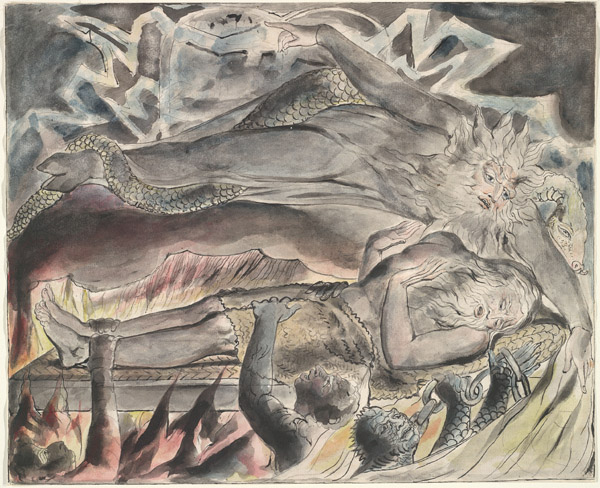
The Job series shows more eloquently than any words could how the conventional idea of God, a part of a man's psyche, eventually proves to be satanic. Job, a ruler of the world, comes to recognize that his God is satanic, passes through a spiritual death, and is reborn with a clarified vision. That's Job's story and Blake's story and everyman's story.

The gospel truth reveals that the satanic God of this World, our Spectre, our Selfhood, will die, and the Divine Image in us will rise to meet the true God in the Realms of day. The theology here is a composite of Job and Revelation. Blake's life and work both attest that the way in which the satanic God dies is through our becoming aware of him. Blake strove to do this consciously as an artist through what he called "building Golgonooza", but the Moment of Grace for him as always was not something that he did, but something that happened to him when he had made himself ready.

Tuesday, April 02, 2019

Destination


Yale Center for British Art
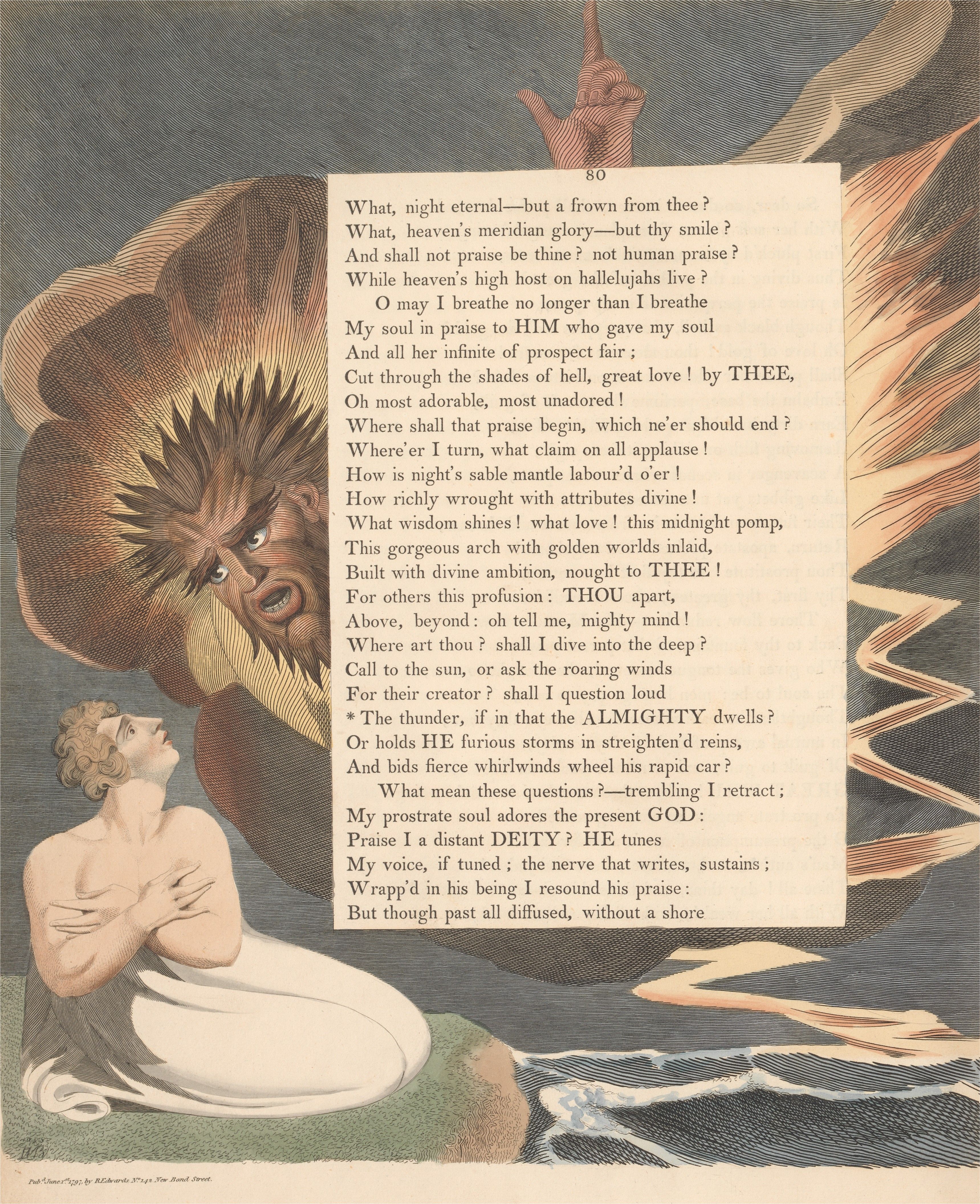
Illustrations to Young's Night Thoughts
 
This is an extract from Chapter Five (GOD) of Ram Horn'd With Gold by Larry Clayton.
 
 The Divine Vision

Throughout this chapter we have followed Blake as he encountered, faced, studied, named, and denounced the false God in the many guises in which he appears to man. This enterprise occupied the first half of his adult life. But during this time he was always aware of something real behind the shadow. As a child he had loved the Lamb:

Songs of Innocence, Song 8, (E 9)
"Little Lamb, who made thee?
Dost thou know who made thee?
Gave thee life, and bid thee feed
By the stream and o'er the mead;

Gave thee clothing of delight,
Softest clothing, wooly, bright;
Gave thee such a tender voice
Making all the vales rejoice?
Little Lamb, who made thee?
Dost thou know who made thee?

Little Lamb, I'll tell thee,
Little Lamb, I'll tell thee:
He is called by thy name,
For he calls himself a Lamb.
He is meek, and he is mild;
He became a little child.
I a child, and thou a lamb,
We are called by his name.
Little Lamb, God bless thee!
Little Lamb, God bless thee!"

As a youth Blake's mind came to be overshadowed by the Tyger. Some interpreters believe that at a certain point he began to see Jesus as misguided: in the 'Song of Los' he wrote that Jesus "received a Gospel from wretched Theotormon". Theotormon symbolizes the legalistic repression of impulse. If Blake did turn away from Jesus, it was by no means an uncommon stage of life for a young man.

Blake always put an ultimate trust in the imaginative power that gave him visions of infinite joy. But at the age of 24 through a failure of consciousness he had chosen a measure of satanic power with a consequent loss of spiritual perception; the Divine Vision faded. There followed the years of struggle with the God of this World, and as we have seen, his experience at Felpham (his "first Vision of Light") led to his definite rejection of the Tempter. In 1803 he returned to London, having prepared himself for an additional grace which shortly fell upon him. In a letter to Hayley dated Oct. 23, 1804 he gave an account of an awesome change that had come into his life:

Letters, To William Hayley, (E 756)
"Suddenly on the day after visiting the Truchsessian Gallery of pictures, I was again enlightened with the light I enjoyed in my youth, and which has for exactly twenty years been closed from me as by a door and by window-shutters."

It's doubtful that he expected Hayley to understand this fully, but we are eternally indebted to both of them for passing it down to us. It marks in a most objective way the return of the Divine Vision, who had been overshadowed by Blake's preoccupation with the God of this World.

The progression of Blake's poetry shows the eclipse of Christ through the long struggle of the nineties. Now he proceeded to introduce the Lamb into 4Z with a group of additional lines at strategic places. These images means relatively little to the secular reader, but cause great joy to the Christian.

The Destination

The healing of Los, described in Night vii of 'The Four Zoas', prepares the way for Christ's coming into history. Night viii tells the story of Jesus: the Incarnation, the Crucifixion, and the Resurrection of the spiritual body. It's important to remember that in Blake's mental world and in his poetry these are psychic rather than historical events.

Blake had always worshiped the Divine Vision. In his twenty years in the wilderness the Divine Vision dimmed and lost the immediacy which had informed the beautiful poems of Innocence. Kathleen Raine points to a few lines that describe with peculiar luminosity this dimming of the Divine Vision:

Jerusalem , Plate 66, (E 219)
"And as their eye & ear shrunk, the heavens shrunk away:
The Divine Vision became First a burning flame [Moses], then a column
Of fire [the Exodus],then an awful fiery wheel surrounding earth and heaven [Ezekiel],
And then a globe of blood wandering distant in an unknown night:" [false Christianity]
This describes Blake's personal experience and that of Mankind. But at or after Felpham he recovered the Divine Vision and realized that his name is Jesus.

He spent the rest of his life celebrating the momentous event and the Name and proclaiming its reality in a hundred ways. It had happened to him, and it would happen to the world.

With the ensuing works of art Blake gives us a portrait of Jesus in many ways original. It may prove to be the most vital portrait of Jesus for the present age. The quest for the historical Jesus long ago became a vain enterprise. Every worshiper has endowed the Divine Man with his own highest values, and Blake was no exception. His mature or final portrait of Jesus has four salient features. Three of them expressed convictions that he had held for a lifetime and repeatedly expressed poetically and pictorially. The fourth was a new experience, the touch of grace; it irradiated the first three with glory.
 
.

Monday, April 01, 2019

Reconciliation With Jesus

British Museum
Illustrations to Young's Night Thoughts


This is an extract (7) from Chapter Five (GOD) of Ram Horn'd With Gold by Larry Clayton.
 
i

Perhaps the most basic feature of Blake's Jesus is the Oneness that he embodied. It's also the most orthodox. Blake was in many ways an unorthodox thinker and theologian, as the preceding pages have shown, but the Oneness of Jesus comes straight out of the New Testament. A wealth of texts demonstrate this; those of the Bible and those of Blake show a profound simultaneity of intention:

The Evangelist John quotes Jesus in his starkest statement of his identity: "I and my Father are One" John 10:30. And later he recorded Jesus' great prayer of intercession for us,

"That they all may be one, as thou Father, art in me, and I in thee, that they also may be one is us."

If any one verse in the Bible most clearly expresses Blake's fundamental faith, that's it. Look at Blake's first mention of Jesus in 4Z:

"Then those in Great Eternity met in the Council of God
...
As One Man all the Universal family; and that One Man
They call Jesus the Christ, and they in him and he in them
Live in Perfect harmony, in Eden the land of life."
(The Four Zoas [Nt 1], 21.1-6; E310)

In the total structure of his theological vision Blake has imaginatively answered thoroughly and completely the prayer of Jesus in the Garden of Gethsemane. According to his vision Jesus, the One, comprises the true nature of you and me when we are healed and whole. Once again nothing could be more biblical.

Long before his encounter with Jesus Blake's myth was thoroughly grounded in the Oneness of Man. Albion was One, the Universe. His division was the Fall, and his return to unity the ultimate good. Thus Blake describes Albion, the Universal Man at the very beginning of 4Z:

Four Zoas, Night I, Page 4, (E 310)
"Daughter of Beulah, Sing,
His fall into Division and his Resurrection to Unity:
His fall into the Generation of decay and death, and his
Regeneration by the Resurrection from the dead."

That was the shape of the original myth. After Felpham Jesus became the One and Albion became one of his members--and so did Blake. 'Jerusalem' begins with a plate headed by the stark phrase in Greek, "Jesus only", and Blake reports hearing these words from the Savior:

Jerusalem, Plate 4, (E 146)
"I am not a God afar off, I am a brother and friend;
Within your bosoms I reside, and you reside in me:
Lo! we are One, forgiving all Evil, Not seeking recompense.
Ye are my members...."

And near the end of 'Jerusalem':

Jerusalem, Plate 91, (E 251)
"He who would see the Divinity must see him in his Children,
One first, in friendship and love, then a Divine Family, and in midst
Jesus will appear....
But General Forms have their vitality in Particulars, and every
Particular is a Man, a Divine Member of the Divine Jesus."

Jesus claimed to be one with God and prayed that we might join him in the oneness. Blake's pilgrimage, with his successive visions of God, those he hated as well as those he loved, provides a fascinating example of how a man becomes one with God. To love the true God is to hate all false Gods.

ii

The philosophic garment with which Blake clothed Jesus was his Neo-platonic idealism. The Eternal Jesus whom Blake envisioned and worshiped is radically separated from the Hebrew peasant who lived in the first century. Blake understood that the worship of the historical Jesus had become an insidious form of idolatry, an advanced form of Satanism.

The priest claims the historical Jesus as his exclusive possession and as the ultimate sanction of his particular form of religious tyranny. He uses the figure first to cow and then to exploit his credulous followers. In this way he denies the indwelling Spirit in himself as well as in his flock. Blake's Jesus, in contrast to the priests', exists not in history but in heaven, which is not a far off never, never land, but a psychic reality.

The never, never land is a materialistic illusion. The reality of Jesus is eternal rather than material; preoccupation with the material Blake saw clearly as a rejection or refusal of the eternal. In 4Z Jerusalem, the embodiment of the church, responds materialistically to the death of Jesus: "let us build a Sepulcher and worship Death in fear while yet we live." What a powerful commentary on the response of the Church to the Christ event!

As long as our minds are centered in that particular century, Christ is dead for us. Preoccupied with the corporeal, we fail to discern the (spiritual) body. A few pages later we read that "Jerusalem wept over the Sepulcher two thousand years". Blake means that we Christians have done this under the influence of the established Church, dominated by the materialistic spirit of the age. While Jerusalem weeps over the corporeal body, like Mary Magdalen at the empty tomb, Jesus in his spiritual body stands beside her waiting to be recognized, but this won't happen until we (Jerusalem) awaken from our obsession with the material:

"And Los and Enitharmon builded Jerusalem, weeping
Over the Sepulcher and over the Crucified body
Which, to their Phantom Eyes, appear'd still in the Sepulcher;
But Jesus stood beside them in the spirit...."
(FZ9-117.1-4; E386|)

The Eternal Man, both First and Second Adam, had God (Spirit) for father and Earth (Clay, Matter) for mother. Blake's profound allegiance to this traditional symbolism led to what many have perceived as a savage attack on Jesus' mother. The attack was savage, but the object of Blake's savagery was not Mary herself but the veneration of Mary, which he could only see as a reversion to Nature Worship and the fertility cults. He understood the veneration of Mary as an alternative to the Living Christ, a direct rival in fact of true Christianity.

This background helps one to understand the psychic meaning of the "Visions of Elohim Jehovah" concerning Joseph and Mary found on Plate 61 of 'Jerusalem'. Too lengthy to quote here, it gives the clearest picture of Blake's feelings about the corporeal ancestry of Christ. A brief but cogent statement of the same thing appears in 'The Everlasting Gospel':

iii

As soon as people attempt to frame Christianity within rules and fit it into a prescribed law and order, it stops being Christianity. There is a general failure to understand that Christians are handed over to the Holy Ghost.... Where God's Spirit is, there freedom must be; there Moses must keep silent, all laws withdraw, and let no one be so bold as to prescribe law, rules, order, goals, and measures to the Holy Ghost, nor attempt to reach, govern, and lead those who belong to him.

All his life Blake had an implacable hatred of law, which he equated with coercion or hindering of others; to him that was the only sin. Consequently Blake's Jesus was a thorough going antinomian. Perhaps his most extreme expression of this occurs in MHH, written before his conversion:

Marriage of Heaven & Hell, Plate 21, (E 43)
"If Jesus Christ is the greatest man, you ought to
love him in the greatest degree; now hear how he has
given his sanction to the law of the ten
commandments: did he not mock at the sabbath, and so
mock the sabbath's God? murder those who were
murder'd because of him? turn away the law from the
woman taken in adultery? steal the labor of others
to support him? bear false witness when he omitted
making a defence before Pilate? covet when he pray'd
for his disciples, and when he bid them shake off
the dust of their feet against such as refused to
lodge them? I tell you, no virtue can exist without
breaking these ten commandments. Jesus was all
virtue, and acted from impulse, not from rules."

That's the proud, tongue in cheek, announcement of a young man not yet marked by the suffering of life. As he matured, his language became more moderate, but his attitude remained substantially the same. Blake hates the law, and his Jesus forgives the lawbreaker. The letter kills, but the Spirit gives life.

Law is an expression of authority. Life presents to us two kinds of authority: spiritual authority or God and political authority, his worldly shadow. Blake consumed his early years in rebellion against the shadow. Then at age 43 he met God and was able to submit to and affirm the true authority.

Some means of coercion characterizes all forms of political authority; ecclesiastical authority is no exception. Blake temperamentally renounced all forms of political authority; he felt that they were satanic, based on coercion and fear and earthly power. Political authority is the authority of this world, and he had no use for it.

In contrast, spiritual authority as Blake experienced it, is the exercise of the purest form of love with an absence of any sort of constraint. The release from constraint by the active goodwill calls forth the Divine Image from the dark sepulcher or cave of corporeal life. Blake had uniquely experienced this spiritual authority as a child; he rediscovered it in the experience which he understood as Self-annihilation or Forgiveness.

Henceforth for him this was the basic and intimate character and quality of Jesus. This was the good news. In 'Milton' the old antinomian made his commitment to the law of self giving love, referring to it as the "Universal Dictate". A free Blakean translation of John 3.16 with a touch of Philippians 2 added might read: God so forgave the world that he annihilated his transcendent Deity and united himself through a corporeal sepulcher with sinful, materialistic man to lift us up to Eternity. Here is the ultimate of spiritual authority, and those who meet Jesus begin to exercise it in the way that he did.

Although Blake did not often use the conventional Christian symbolism of the cross, after his conversion he did believe from the depths that by dying for one another we live eternally:

"Jesus said: "Wouldest thou love one who never died
For thee, or ever die for one who had not died for thee?
And if God dieth not for Man and giveth not himself
Eternally for Man, Man could not exist; for Man is Love
As God is Love; every kindness to another is a little Death
In the Divine Image, nor can Man exist but by Brotherhood."
(Jerusalem, 96.23ff; E256)

Freedom from materialism and from the law are the philosophic and moral coloring which Blake gave to his portrait of Jesus the One. In this way he accommodated his new vision of God to his existing value structure.

iv

But the fourth feature of Jesus came into Blake's consciousness as a new experience. It came from Beyond. That is to say it was not an inward expression of Blake's psyche; it came like the Son of God who had joined the three friends in Nebuchadnezzar's furnace. It wasn't something he thought of; it was something that happened to him.

It was the experience of forgiveness and self-annihilation, which are two sides of the same coin. No one forgives until he has found the grace to annihilate at least momentarily the law bound accusing spectre which is his Selfhood. And this is only possible as an act of the Imagination, which is eternal, which is Christ. Whenever you successfully annihilate your old self to the point of truly forgiving another, the eternal Christ is alive and at work in your soul. In fact it is he who does it. He is in you, and you are in him; that's eternal life.

Reduced to its barest essential that's what Jesus finally came to mean for Blake. The only unique thing about the man of Nazareth was that he taught forgiveness of one's enemies. In this sense he incarnated God. God is love, is forgiveness. "If Morality was Christianity, Socrates was the Saviour." Unlike Socrates Jesus was a man in whom God dwelt through his vision and his acts of forgiveness.

The significance of the resurrection lies in the coming to life of Forgiveness, Jesus, in you and me. In this way we defeat death.

Textual note for Everlasting Gospel, (E 875)
"There is not one Moral Virtue that Jesus Inculcated but Plato
and Cicero did Inculcate before him; what then did Christ
Inculcate? Forgiveness of Sins. This alone is the Gospel,
and this is the Life and Immortality brought to light by Jesus,
Even the Covenant of Jehovah, which is This: If you forgive
one another your Trespasses, so shall Jehovah forgive you,
That he himself may dwell among you; but if you Avenge, you
Murder the Divine Image, and he cannot dwell among you; because
you Murder him he arises again, and you deny that he is Arisen,
and are blind to Spirit."

Textual note for Everlasting Gospel, (E 875)
   "If Moral Virtue was Christianity
     Christs Pretensions were all Vanity
     And Caiphas & Pilate Men
     Praise Worthy & the Lions Den
     And not the Sheepfold Allegories
     Of God & Heaven & their Glories 
     The Moral Christian is the Cause 
     Of the Unbeliever & his Laws 
     Take Jesus & Jehovahs Name.
     For what is Antichrist but those
     Who against Sinners Heaven close
     With Iron bars in Virtuous State
     And Rhadamanthus at the Gate"
     ...
     It was when Jesus said to Me
     Thy Sins are all forgiven thee
     The Christian trumpets loud proclaim
     Thro all the World in Jesus name
     Mutual forgiveness of each Vice
     And oped the Gates of Paradise
     The Moral Virtues in Great fear
     Formed the Cross & Nails & Spear
     And the Accuser standing by
     Cried out Crucify Crucify
     Our Moral Virtues neer can be
     Nor Warlike pomp & Majesty
     For Moral Virtues all begin
     In the Accusations of Sin
     And all the Heroic Virtues End 
     In destroying the Sinners Friend" 
 
End of Chapter Five of Ram Horn'd With Gold.

Saturday, March 30, 2019

Two Ways

Wikipedia Commons 
Illustration to the Book of Job 
Linnell Set
This is an extract from Chapter Four (FAITH) of Ram Horn'd With Gold by Larry Clayton.  

The Two Ways

      In 'Milton' Blake speaks of two streams flowing from a fountain in a rock of crystal: one goes straight to Eden; the other is more torturous. They represent of course two possible journeys through life, and he could speak of both because he lived both. The first stream represents the child-like consciousness that enabled Blake (that enables anyone gifted with it) to live every moment in the light of Eternity. The other, more common path wanders all over this God-forsaken vale of tears, but it winds up at the same place.

      That's the most incredible good news for anybody who can hear it. The apostle Paul hinted at it a time or two; perhaps it was the truth that he was forbidden to tell. Origen believed it, no doubt one of the reasons the Church Fathers kicked him out. In the 19th Century an entire denomination arose whose primary emphasis was this particular good news--the Universalists. Actually this good news could not be pronounced with authority except by someone like Blake who had traveled both journeys; he knew whereof he spoke.

      If you believe that all came originally from the One and that in the fullness of time all things in Christ are gathered together in one, then as a consequence the two paths do meet at the end as Blake claimed. We can put this in a more properly theological context with Blake's expressed response to the Calvinistic doctrine of Double Predestination.

      Double Predestination contains as its lower half the grim old notion of Hell that has probably done as much as anything else in theology to discredit the Christian faith in the eyes of the modern world. Calvin taught the hoary old superstition that most of the world's population are destined to live without Christ and to die and move on to eternal torment; a lucky few have a happier destiny. The lucky few included Calvin of course and his friends, especially his obedient friends. In contrast Origen, perhaps Paul, and surely Blake believed in single predestination: the two streams converge at the end.

      Blake expended an enormous amount of his creative energy combating Double Predestination. He heaped scorn upon scorn on the Calvinistic God who curses his children. His break with Swedenborg followed his discovery that Swedenborg was a "Spiritual Predestinarian, more abominable than Calvin's". He later lamented over him and called him the "Samson, shorn by the Churches."
In Milton Blake ironically inverted the Calvinistic categories of 'elect' and 'reprobate'. With incredible elegance he used Jesus' words on Calvin like a two edged sword. He simply pronounced on behalf of Christ the obvious truth, as if to say, "Calvin, your doctrine is of the world, and your first shall be last in my kingdom."

      Double Predestination is a consequence of a more fundamental error of Rahab, the whore of Babylon, the organized Church, "Imputing sin and righteousness to individuals". Blake addressed that error with his doctrine of states, which we look at in a moment.

      In Marriage of Heaven and Hell Blake examined most directly the conventional idea of Hell and pronounced it a delusion of a certain type of mind. In Visions of the Last Judgment he gave his straightforward views about the meaning of the biblical Hell. Again in 'Jerusalem', "What are the Pains of Hell but Ignorance, Bodily Lust, Idleness & devastation of the things of the Spirit?"

      However the conventional Hell does seem to have some biblical basis: Isaiah 66:24, Mark 9:43ff, Matthew 25:41 provide examples. How do you deal with all those scriptures? In the first place Blake felt perfectly free to discount anything in the Bible that he found incongruent with his vision, at least to discount its conventional meaning. The immediate experience always exercised authority over anything second hand. The inerrancy of scripture, another of the Five Fundamentals, meant just about as much to him as Double Predestination.

      In the second place, although the doctrine of hell has most often been used as a means of anathematizing those with whom one disagrees, there are certainly more creative ways to deal with it. Blake chose one of these, what he called the doctrine of states. In a conversation with the "seven Angels of the Presence" Milton is told by Lucifer: "We are not individuals but states.../ Distinguish therefore states from individuals in those states."

      And at the end of the first chapter of Jerusalem the daughters of Beulah pray as follows:
"Descend O Lamb of God & take away the imputation of Sin
By the Creation of States & the deliverance of Individuals  Evermore Amen...
But many doubted & despaird & imputed Sin & Righteousness       
To Individuals & not to States, and these Slept in Ulro"
      (Jerusalem, 25.12 Erdman 170)

      To distinguish states from individuals is the only means of forgiveness of sins. In the centuries since Blake enlightened Christians have learned to condemn sin without condemning the sinner. The most enlightened condemn no one, realizing that they themselves are as sinful as anyone else. For such a consciousness the only authentic preaching becomes confessional preaching.

      The relationship between Blake's doctrine of states and the conventional doctrine of hell becomes clear in Plate 16 of the Job series where Job and his wife watch the 'old man' in themselves take the plunge with their master "into the everlasting fire prepared for the devil and his angels". This of course is a spiritual or psychic event. The crude and ludicrous superstition of the conventional doctrine of hell stems from a spiritual blindness that attempts to impose the material upon the Beyond--once again the Lockian fallacy, the assumption that 'material' is 'real'.

      The Last Judgment in Blake is the consummation devoutly to be hoped for when truth takes its rightful place in man's psyche. Error is "burnt up the Moment Men cease to behold it". The person wedded to error finds this a fearsome prospect; the one who wants to be free finds it a glorious one. We're all headed for the last judgment--by the direct childlike route or the torturous worldly route. It's the fervent hope of the eternalist and the bane of the materialist. Blake as was said before, traveled both routes. His exquisite lyrics attest to the first; his (often tormented) prophetic declamation to the second. The childlike route is so crystal clear as to need little explanation; the second obviously needs a great deal. Looking closely at the first may be good preparation for the second.

      An incident from Blake's last years suggests something of the nature of the torturous route which was Blake's life. The old poet was telling the story of the Prodigal Son. He got to the moment when the wandering boy at last returns to the Father. At that point Blake broke down in tears; he couldn't go on. The story casts a revealing light on a primitive relationship that must have provided a lot of the dynamic for Blake's creativity.

      Psychologists tell us that a person's early relationship with his father has a great bearing on his image of God. Applying that idea to Blake's poetry one could infer that Blake as a child had a gruesome relationship with his father. However we find little suggestion of this in the biography. On the contrary the preponderance of the evidence suggests a permissive and understanding parent. (The only exception seems to be the threat to beat the eight year old for his 'lie' about the tree full of angels.) In any event 'father' has unpleasant associations in Blake's poetry, especially in the theological realm. He adored Jesus, but he obviously had trouble believing Jesus' word about the loving Father.
       
The Neo-platonic interpreters have theorized that Blake couldn't forgive the Creator for condemning us to this prison house of mortal life. I think a more universal explanation fits the facts. Everyone has difficulty forgiving his father and/or creator for the dimensions of horror in life which threaten in one way or another to overwhelm the psyche. Few or none of us have done a really adequate job of this. Most often we've repressed the sensitive idealist; we've closed off from consciousness those unpleasant ultimate realities which seem to have no answer.

      "Did he who made the Lamb make thee?" Has anyone really asked that question since 1794? Nietzsche asked it and went crazy. In our generation Jung has come closest, and that's what makes him great. Most of us, even the best of Christians, have partitioned off and closed out that ultimate question, the ultimate doubt expressed by the dying Saviour on the cross. This William Blake could not do; like Jesus he was condemned to face consciously the penalty of our finitude.

Songs of Innocence and Experience, Song 42, Erdman 24 
"The Tyger.                           

Tyger Tyger, burning bright,
In the forests of the night;
What immortal hand or eye,
Could frame thy fearful symmetry?

In what distant deeps or skies.      
Burnt the fire of thine eyes?          
On what wings dare he aspire?     
What the hand, dare sieze the fire?

And what shoulder, & what art,
Could twist the sinews of thy heart?
And when thy heart began to beat,
What dread hand? & what dread feet?
 
What the hammer? what the chain, 
In what furnace was thy brain?
What the anvil? what dread grasp,       
Dare its deadly terrors clasp!              

When the stars threw down their spears 
And water'd heaven with their tears:
Did he smile his work to see?                
Did he who made the Lamb make thee? 

Tyger Tyger burning bright,
In the forests of the night:           
What immortal hand or eye,         
Dare frame thy fearful symmetry?"

      Frye has spoken of the 'abyss of consciousness'. Enion, the primeval mother in 4Z is condemned to it by her love of her children. At the end of Night ii she calls our attention to this blindness which we have chosen and its opposite, the abyss of consciousness which she (and Blake in her) is condemned to face; here is her complaint.

      Something is terribly wrong in this created universe, and in the face of this underlying wrongness the idea of a loving Father as Creator simply doesn't fit all the facts. This consciousness, which Blake shared with Dostoevsky in the person of Ivan Karamazov, interrupted Blake's childlike innocence and precipitated the torturous journey "through the Aerial Void and all the Churches".

      Probably a majority of people will always refuse such an invitation; they will cling to the refuge of their Church, or Bible, or President, or fraternity, or whatever form of authority they have made their obeisance to, whatever they have found to block out the abyss of consciousness. A few will have at least a sympathetic or vicarious interest in the problem posed by Blake and Dostoevsky. A handful will perceive that to realize their full humanity and the God Within they must proceed beyond innocence. They, too, must take that long journey and plumb life to its wholeness. The art of Blake offers a good map for the trip.

Saturday, March 23, 2019

Grace

Wikipedia Commons
Woman Taken in Adultery


This is an extract from Chapter Four (FAITH) of Ram Horn'd With Gold by Larry Clayton.  


 If the primary moral wrong is hindering, the primary grace is forgiveness. Redemption came for Blake when forgiveness first entered the horizon of his vision; it increasingly came to dominate it. Prior to 1800 with all his denunciations of Urizen, the Restrainer, and of morality Blake was growing more and more into the role of judge. He was becoming in fact a judge of judges. The later Lambeth books witness the resultant decrease in vitality; in the language of Zion he suffered a loss of faith. It coincided with a slowly dawning realization that Urizen had infested his own mind all the while he was denouncing him in others. There awakened in his mind a new awareness of sin, a sin more basic than hindering others, or rather an awareness of the inner cause of hindering. He called it the Selfhood, the Spectre, Satan. As many of us have since that day, Blake realized that he saw the God-playing in others because he was so good at it himself. This new vision of his Selfhood led to the Moment of Grace.

      At Felpham, in the major crisis of his life, he faced the need to forgive both the impositions of his corporeal friend, Hayley, and the resentful thunderer, William Blake, as well. The appearance of his first Vision of Light marks the coming of Christ into his life with the power of this forgiveness; henceforth he called him Jesus, the Forgiveness.

      The old Urizenic monstrosity that had haunted him, first in the outer world and increasingly as a component of his own psyche, was recognized, accepted, subdued, and forgiven. It was undoubtedly the greatest event of his life, a new birth of hope at the age of 43. He shared with us the psychic unfolding of this experience in Night vii of 'The Four Zoas' where Los embraces his Spectre (equivalent to Jung's acceptance of the shadow) and soon thereafter finds Urizen miraculously changed:
      "Startled was Los; he found his Enemy Urizen now In his hands; he wonder'd that he felt love & not hate. His whole soul loved him; he beheld him an infant Lovely..."
      Has anyone better portrayed the psychodynamics of forgiveness? In order to forgive you first withdraw the projection, then you forgive yourself. It's your baby!

      We can't say that's the end of the story; in Night viii Urizen continues to afflict life with his judgments, hostility and violence; Satan comes forth from his War. The Saviour dies for him, and we are still waiting for the ultimate victory. Nor was Blake himself fully delivered from the resentments and self justifications of the 'old man.' Hard times ahead, the deceitfulness and opprobrium of others continued to afflict and to warp his psyche and caused him to participate in sin (mostly by suffering through the sins of others against him), but now he knew the answer: through recurring awareness and Self-annihilation he could forgive again and again. The wheat and tares continued to grow together.

      Blake had a deep grasp of what students of the Bible have called the kenosis. At his Moment of Grace it became for him an existential reality. He rewrote 4Z to show Jesus throughout the drama coming from above, hovering over Mankind, descending into mortal flesh to join us and to take on our burdens, our sorrow and pain and travail. Blake referred to this as the "dark Satanic body". This is the body we all wear until Jesus glorifies it in us.

      According to Blake's faith this coming of Jesus is the ultimate act of forgiveness for what we have become in our brokenness. It empowers us to become through a new birth what we were originally and what we are called to be again. The new birth is an alteration of consciousness. Blake had an inkling of this as early as 'The Marriage of Heaven and Hell', where he referred to it as "an improvement of sensual enjoyment" In the same plate he referred to it as a cleansing of the "doors of perception" and likened the former state to life in Plato's cave.

      In the lovely "first Light" poem quoted above he used the thoroughly biblical figure of Jesus purging away "all my mire and my clay". Forgiveness is not a temporal event, but an eternal one. The Lamb of God was slain from the foundation of the world. We must forgive not once, but seventy times seven times. Blake deals with sin and forgiveness as ultimates in his notebook poem, "My Spectre around me night and day". The poem speaks primarily to the advanced student, but with crystal clarity stanza 14 bears on the primary grace:
    "& Throughout all Eternity
    I forgive you, you forgive me.
    As our dear Redeemer said:
    This the Wine & this the Bread."

      The unforgiving, accusing, egocentric, spectrous Selfhood is the stuff of Ulro, the life that is Eternal Death. Forgiveness through Self-annihilation is the stuff of that life which is life indeed. In the eternal realm Good and Evil, Virtue and Sin, all are forgiven and replaced by Truth and Error, which constitute the matter of the eternal wars of love. We fight these with Blake's weapons (the burning arrows of thought, etc.) or with Paul's "whole armor of God". Error meets an eternal consummation as we grow closer and closer to the Perfect Man. The apocalypse in Blake's structure of faith comes as an alteration of consciousness by which "this world" fades out (is consumed) and is replaced by the Eternal. Albion awakes. "Whenever any Individual Rejects Error and Embraces Truth, a Last Judgment passes upon that Individual".

Milton, Plate 39 [44], (E 140)  
"Suddenly around Milton on my Path, the Starry Seven
Burnd terrible! my Path became a solid fire, as bright
As the clear Sun & Milton silent came down on my Path.           
And there went forth from the Starry limbs of the Seven: Forms
Human; with Trumpets innumerable, sounding articulate
As the Seven spake; and they stood in a mighty Column of Fire
Surrounding Felphams Vale, reaching to the Mundane Shell, Saying

Awake Albion awake! reclaim thy Reasoning Spectre. Subdue        

Him to the Divine Mercy, Cast him down into the Lake
Of Los, that ever burneth with fire, ever & ever Amen!
Let the Four Zoa's awake from Slumbers of Six Thousand Years" 

       This was Blake's religion; unfortunately he does not seem to have found it in any of the churches which he knew. Instead many of his deepest convictions directly contravened the prevailing theology. He discovered that he "must create a system, or be enslaved by another mans". The pages that follow trace some of the contrarieties between Blake's vision of eternal reality and the mainstream of Christian orthodoxy.