Wednesday, April 15, 2020

HOLY WEEK 10

First posted, January 2013 as LIFE OF CHRIST XX.

John 19
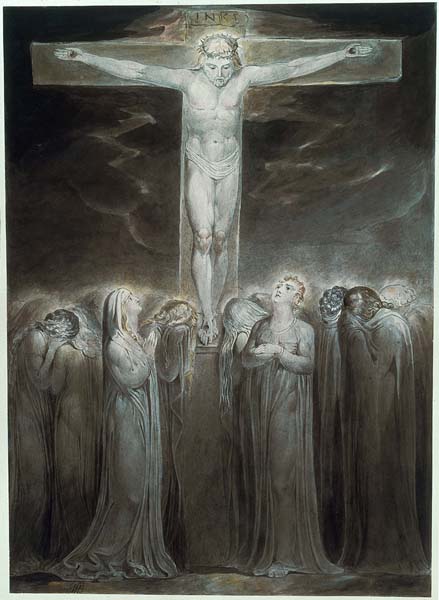
[25] Now there stood by the cross of Jesus his mother, and his mother's sister, Mary the wife of Cleophas, and Mary Magdalene.
[26] When Jesus therefore saw his mother, and the disciple standing by, whom he loved, he saith unto his mother, Woman, behold thy son!
[27] Then saith he to the disciple, Behold thy mother! And from that hour that disciple took her unto his own home.
[28] After this, Jesus knowing that all things were now accomplished, that the scripture might be fulfilled, saith, I thirst.
[29] Now there was set a vessel full of vinegar: and they filled a spunge with vinegar, and put it upon hyssop, and put it to his mouth.
[30] When Jesus therefore had received the vinegar, he said, It is finished: and he bowed his head, and gave up the ghost.

 
Image in the Blake Archive entitled The Crucifixion: "Behold Thy Mother".
 
 
Matthew 27
[50] Jesus, when he had cried again with a loud voice, yielded up the ghost.
[51] And, behold, the veil of the temple was rent in twain from the top to the bottom; and the earth did quake, and the rocks rent;
[52] And the graves were opened; and many bodies of the saints which slept arose,
[53] And came out of the graves after his resurrection, and went into the holy city, and appeared unto many.
[54] Now when the centurion, and they that were with him, watching Jesus, saw the earthquake, and those things that were done, they feared greatly, saying, Truly this was the Son of God.
[55] And many women were there beholding afar off, which followed Jesus from Galilee, ministering unto him:
[56] Among which was Mary Magdalene, and Mary the mother of James and Joses, and the mother of Zebedee's children.
 
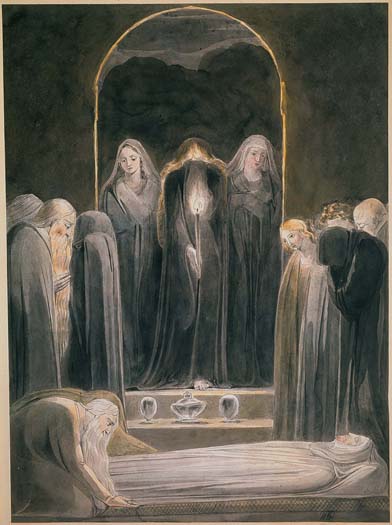
Image in Blake Archive entitled The Entombment.
 
Luke 24
[1] Now upon the first day of the week, very early in the morning, they came unto the sepulchre, bringing the spices which they had prepared, and certain others with them.
[2] And they found the stone rolled away from the sepulchre.
[3] And they entered in, and found not the body of the Lord Jesus.
[4] And it came to pass, as they were much perplexed thereabout, behold, two men stood by them in shining garments:
[5] And as they were afraid, and bowed down their faces to the earth, they said unto them, Why seek ye the living among the dead?
[6] He is not here, but is risen: remember how he spake unto you when he was yet in Galilee,
[7] Saying, The Son of man must be delivered into the hands of sinful men, and be crucified, and the third day rise again.
[8] And they remembered his words,
[9] And returned from the sepulchre, and told all these things unto the eleven, and to all the rest.
[10] It was Mary Magdalene, and Joanna, and Mary the mother of James, and other women that were with them, which told these things unto the apostles.
[11] And their words seemed to them as idle tales, and they believed them not.
[12] Then arose Peter, and ran unto the sepulchre; and stooping down, he beheld the linen clothes laid by themselves, and departed, wondering in himself at that which was come to pass.
 

Fitzwilliam Museum

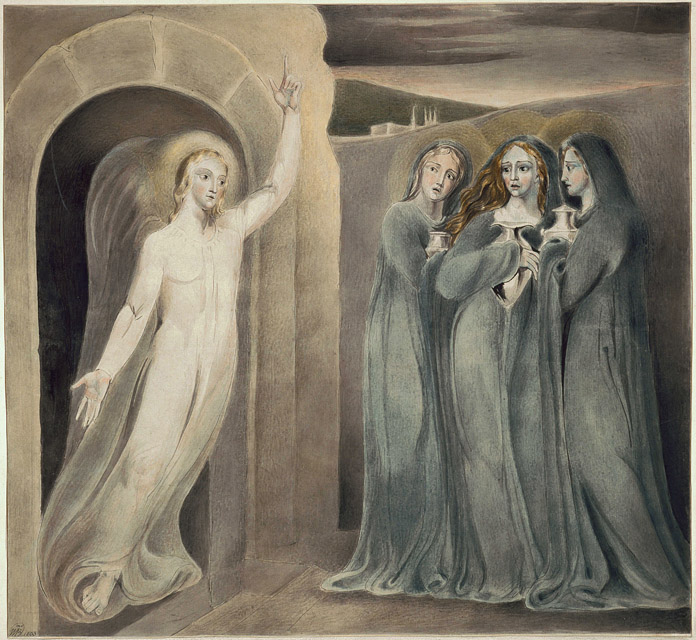
The Three Maries at the Sepulchre

In his life William Blake was surrounded by women named Catherine: his mother, his sister and his wife. Jesus was surrounded by women named Mary. There are more Maries in the gospels than I can sort out but three are prominent: Jesus' mother, Mary Magdalene, and Mary the sister of Lazarus and Martha. The varied ways in which the Maries reacted to Jesus were defined by the relationship they had to him. They attempted to protect, comfort, and support him. He was their teacher, healer and guide. There is little doubt that the women around Jesus loved, trusted and gave him more loyalty than did his male disciples. In his illustrations to the  Bible, Blake has women appear prominently as being able to perceive the message of Jesus.

Blake elevates the role of women in his system of thought. The Four Zoas are incomplete without their Emanations. Jerusalem acting as the Emanation of Albion ushers in the new day of 'Awaking into his Bosom in the Life of Immortality.' Many of Blake's women are troublesome as a result of being split from their male counterparts. But like the three Maries they act, in the long run, as the facilitators of the momentous events that take place around them.
Gates of Paradise, For the Sexes, The Keys, (E 269) 
"16  Thou'rt my Mother from the Womb 
     Wife, Sister, Daughter to the Tomb 
     Weaving to Dreams the Sexual strife
     And weeping over the Web of Life"  
 Jerusalem, Plate 97, (E 256)
"Awake! Awake Jerusalem! O lovely Emanation of Albion
Awake and overspread all Nations as in Ancient Time
For lo! the Night of Death is past and the Eternal Day
Appears upon our Hills: Awake Jerusalem, and come away

So spake the Vision of Albion & in him so spake in my hearing   
The Universal Father. Then Albion stretchd his hand into
     Infinitude.
And took his Bow. Fourfold the Vision for bright beaming Urizen
Layd his hand on the South & took a breathing Bow of carved Gold
Luvah his hand stretch'd to the East & bore a Silver Bow bright
     shining
Tharmas Westward a Bow of Brass pure flaming richly wrought   
Urthona Northward in thick storms a Bow of Iron terrible thundering.

And the Bow is a Male & Female & the Quiver of the Arrows of Love,
Are the Children of this Bow: a Bow of Mercy & Loving-kindness: laying
Open the hidden Heart in Wars of mutual Benevolence Wars of Love
And the Hand of Man grasps firm between the Male & Female Loves"
 Jerusalem, PLATE 99, (E 258)     
"All Human Forms identified even Tree Metal Earth & Stone. all
Human Forms identified, living going forth & returning wearied
Into the Planetary lives of Years Months Days & Hours reposing
And then Awaking into his Bosom in the Life of Immortality.

And I heard the Name of their Emanations they are named Jerusalem" 
 
. 

Tuesday, April 14, 2020

HOLY WEEK 9

Wikimedia Commons    Large Color Prints    Christ Appearing to the Apostles after the Resurrection
 
First posted April 2016 as IMAGES OF CHRIST.
 
Blake produced this image of Christ as one of the thirteen Large Color Prints which he began in 1795. The import of this image is that it represents the beginning of the transition that the disciples of Christ must make as they adapt to the presence of Christ with them in a spiritual body rather than in a physical body. The resurrected Christ strives to demonstrate that although he has passed through the experience of death and has been changed, he is not a phantom or a ghost but a real presence in a real, though spiritual, body.

The change that occurred in Christ was designed to produce changes in the disciples if they incorporated the presence of Christ into their own psyches. The transformative experience would be perceiving the post-resurrection Christ as alive and active. The disciples are instructed that Christ becomes available to live and act in individuals who receive him into their souls.
 

Annotations to Berkley, (E 664)
 
"The Natural Body is an Obstruction to the Soul or Spiritual
Body"
Songs of Experience, To Tirzah, (E 30)
"Thou Mother of my Mortal part.
With cruelty didst mould my Heart. 
And with false self-decieving tears,
Didst bind my Nostrils Eyes & Ears.

Didst close my Tongue in senseless clay
And me to Mortal Life betray:
The Death of Jesus set me free, 
Then what have I to do with thee? 
It is Raised a Spiritual Body" 
Four Zoas, Night VIII, PAGE 104 (SECOND PORTION), (E 378)
"Los said to Enitbarmon Pitying I saw
Pitying the Lamb of God Descended thro Jerusalems gates
To put off Mystery time after time & as a Man
Is born on Earth so was he born of Fair Jerusalem
In mysterys woven mantle & in the Robes of Luvah 

He stood in fair Jerusalem to awake up into Eden
The fallen Man but first to Give his vegetated body    
To be cut off & separated that the Spiritual body may be Reveald"

Annotations to Berkley, (E 663)
  "They also considerd God as abstracted or distinct from the
Imaginative World but Jesus as also Abraham & David considerd God
as a Man in the Spiritual or Imaginative Vision
     Jesus considerd Imagination to be the Real Man & says I will
not leave you Orphanned and I will manifest myself to you   he
says also the Spiritual Body or Angel as little Children always
behold the Face of the Heavenly Father"

There is No Natural Religion, [b], (E 3)
  "VII The desire of Man being Infinite the possession is Infinite
& himself Infinite
     Conclusion,   If it were not for the Poetic or Prophetic
character. the Philosophic & Experimental would soon be at the
ratio of all things & stand still, unable to do other than repeat
the same dull round over again
     Application.   He who sees the Infinite in all things sees
God.  He who sees the Ratio only sees himself only.
Therefore God becomes as we are, that we may be as he is" 
Luke 24
[30] And it came to pass, as he sat at meat with them, he took bread, and blessed it, and brake, and gave to them.
[31] And their eyes were opened, and they knew him; and he vanished out of their sight.
[32] And they said one to another, Did not our heart burn within us, while he talked with us by the way, and while he opened to us the scriptures?
[33] And they rose up the same hour, and returned to Jerusalem, and found the eleven gathered together, and them that were with them,
[34] Saying, The Lord is risen indeed, and hath appeared to Simon.
[35] And they told what things were done in the way, and how he was known of them in breaking of bread.
[36] And as they thus spake, Jesus himself stood in the midst of them, and saith unto them, Peace be unto you.
[37] But they were terrified and affrighted, and supposed that they had seen a spirit.
[38] And he said unto them, Why are ye troubled? and why do thoughts arise in your hearts?
[39] Behold my hands and my feet, that it is I myself: handle me, and see; for a spirit hath not flesh and bones, as ye see me have.
[40] And when he had thus spoken, he shewed them his hands and his feet.
[41] And while they yet believed not for joy, and wondered, he said unto them, Have ye here any meat?
[42] And they gave him a piece of a broiled fish, and of an honeycomb.
[43] And he took it, and did eat before them.
[44] And he said unto them, These are the words which I spake unto you, while I was yet with you, that all things must be fulfilled, which were written in the law of Moses, and in the prophets, and in the psalms, concerning me.
[45] Then opened he their understanding, that they might understand the scriptures,

First Corinthians 15
[42] So also is the resurrection of the dead. It is sown in corruption; it is raised in incorruption:
[43] It is sown in dishonour; it is raised in glory: it is sown in weakness; it is raised in power:
[44] It is sown a natural body; it is raised a spiritual body. There is a natural body, and there is a spiritual body.
[45] And so it is written, The first man Adam was made a living soul; the last Adam was made a quickening spirit.
 
.

Monday, April 13, 2020

HOLY WEEK 8

First posted May 2016 as IMAGES OF CHRIST 11.

British Museum
Illustrations to Young's Night Thoughts

This image of Christ portrays him transformed. He has shed the linen cloths he wore in the grave as well as the garment of flesh which he wore in the mundane world. He is not confined to the cave of death or to the earth on which he walked in Palestine or on England's green and pleasant hills. Air is his medium; light is his garment. 

Blake presents this image to show more than the condition of Christ when he achieved the passage through death to life. Blake's intention is that his reader/viewer also shed his encumbrances and enter the state of consciousness where he can see clearly that he is a member of the Brotherhood of Eden. That man may enter Life Eternal through following the path that Jesus trod, is pictured in the illustration by Christ parting the clouds and opening a clear way for entry into a world beyond experience.

Milton, PLATE 41 [48], (E 142)
"To bathe in the Waters of Life; to wash off the Not Human
I come in Self-annihilation & the grandeur of Inspiration
To cast off Rational Demonstration by Faith in the Saviour
To cast off the rotten rags of Memory by Inspiration
To cast off Bacon, Locke & Newton from Albions covering
To take off his filthy garments, & clothe him with Imagination
To cast aside from Poetry, all that is not Inspiration"

1ST Corinthians 15
[53] For this corruptible must put on incorruption, and this mortal must put on immortality.
[54] So when this corruptible shall have put on incorruption, and this mortal shall have put on immortality, then shall be brought to pass the saying that is written, Death is swallowed up in victory.
[55] O death, where is thy sting? O grave, where is thy victory?
[56] The sting of death is sin; and the strength of sin is the law.
[57] But thanks be to God, which giveth us the victory through our Lord Jesus Christ.

Jerusalem, Plate 96, (E 255)
"Then Jesus appeared standing by Albion as the Good Shepherd
By the lost Sheep that he hath found & Albion knew that it
Was the Lord the Universal Humanity, & Albion saw his Form     
A Man. & they conversed as Man with Man, in Ages of Eternity
And the Divine Appearance was the likeness & similitude of Los

Albion said. O Lord what can I do! my Selfhood cruel
Marches against thee deceitful from Sinai & from Edom
Into the Wilderness of Judah to meet thee in his pride       
I behold the Visions of my deadly Sleep of Six Thousand Years
Dazling around thy skirts like a Serpent of precious stones & gold
I know it is my Self. O my Divine Creator & Redeemer

Jesus replied Fear not Albion unless I die thou canst not live
But if I die I shall arise again & thou with me            
This is Friendship & Brotherhood without it Man Is Not

So Jesus spoke! the Covering Cherub coming on in darkness
Overshadowd them & Jesus said Thus do Men in Eternity
One for another to put off by forgiveness, every sin

Albion replyd. Cannot Man exist without Mysterious          
Offering of Self for Another, is this Friendship & Brotherhood
I see thee in the likeness & similitude of Los my Friend

Jesus said. Wouldest thou love one who never died
For thee or ever die for one who had not died for thee
And if God dieth not for Man & giveth not himself           
Eternally for Man Man could not exist. for Man is Love:
As God is Love: every kindness to another is a little Death
In the Divine Image nor can Man exist but by Brotherhood

So saying. the Cloud overshadowing divided them asunder
Albion stood in terror: not for himself but for his Friend     
Divine, & Self was lost in the contemplation of faith
And wonder at the Divine Mercy & at Los's sublime honour"

Four Zoas, Night VIII, PAGE 104 (FIRST PORTION), (E 376) 
"And Enitharmon namd the Female Jerusalem the holy
Wondring she saw the Lamb of God within Jerusalems Veil
The divine Vision seen within the inmost deep recess
Of fair Jerusalems bosom in a gently beaming fire

Then sang the Sons of Eden round the Lamb of God & said 
Glory Glory Glory to the holy Lamb of God
Who now beginneth to put off the dark Satanic body
Now we behold redemption Now we know that life Eternal
Depends alone upon the Universal hand & not in us
Is aught but death In individual weakness sorrow & pain"
John 10
[7] Then said Jesus unto them again, Verily, verily, I say unto you, I am the door of the sheep.
[8] All that ever came before me are thieves and robbers: but the sheep did not hear them.
[9] I am the door: by me if any man enter in, he shall be saved, and shall go in and out, and find pasture.
[10] The thief cometh not, but for to steal, and to kill, and to destroy: I am come that they might have life, and that they might have it more abundantly.
[11] I am the good shepherd: the good shepherd giveth his life for the sheep.
[12] But he that is an hireling, and not the shepherd, whose own the sheep are not, seeth the wolf coming, and leaveth the sheep, and fleeth: and the wolf catcheth them, and scattereth the sheep.
[13] The hireling fleeth, because he is an hireling, and careth not for the sheep.
[14] I am the good shepherd, and know my sheep, and am known of mine.
[15] As the Father knoweth me, even so know I the Father: and I lay down my life for the sheep.


.

Sunday, April 12, 2020

HOLY WEEK 7

First posted May 2017 as JOSEPH OF ARIMATHEA.

Detail of the Crucifixion of St. Peter 
by Michelangelo in the Cappella Paolina. 

When Blake was a young apprentice just learning his trade of engraving he choose as his subject an image from a figure by Michelangelo. Blake was familiar with the work of Michelangelo through prints which he studied to become familiar with the great art of the past. A small portion of a fresco in the Pauline Chapel of the Vatican presented an image of a powerful but pensive man caught in the crowd gathered around the crucifixion of Peter. The craft of engraving requires the artist to intensely concentrate his focus on the image he is engraving . Michelangelo's figure became to Blake more than just a picture. It became Joseph of Arimathea, if became William Blake, it became everyman, it became Albion.


British Museum
Nicolas Beatrizet
(after Michelangelo)
Figure of a Man

British Museum
Student Engraving
1773

British Museum
Joseph of Arimathea Among the Rocks of Albion 
c. 1810
According to the Gospel of John it was Joseph of Arimathea who requested that Roman governor Pilate release the body of Jesus for burial. Legends grew up around Joseph including that he was Jesus' uncle, a tin merchant who had taken Jesus on a trip to England with him when Jesus was an adolescent. The legend included the idea that Joseph stood by helplessly when Jesus was crucified, perhaps standing at a distance to avoid arousing the attention of the Roman Soldiers or the Jewish authorities. The legend continued with Joseph using a Chalice to catch the blood of the Lord as it flowed from the wound in his side. The Chalice became identified as the Holy Grail and as the story goes, traveled to England with Joseph.
The legend tells of Joseph founding Christianity in England at Glastonbury in Cornwall. It is events in this tale which led to Blake's writing the lines:
"And did those feet in ancient time,
Walk upon Englands mountains green:
And was the holy Lamb of God,
On Englands pleasant pastures seen!"


Blake did not forget the image which he had made when an apprentice to Basire. He returned to it years later reengraved it with additional detail and words to explain what it meant to him. The image tied him to Joseph of Arimathea, to Jesus, to Michelangelo and to the restored Albion which incorporated the idea of Jerusalem being built in England's green and pleasant land.

Harold Bloom commenting on The Everlasting Gospel, (E 876):

"But in the 1818 fragment the drama remains the static threefold scene: Christ and Lucifer arguing their opposite views before "Me" (Every man, or Joseph of Arimathea, or Blake)."


 Inscriptions, (E 671)

     "JOSEPH of Arimathea among The Rocks of Albion
     
Engraved by W Blake 1773 from an old Italian Drawing 
     This is One of the Gothic Artists who Built the Cathedrals
in what we call the Dark Ages    Wandering about in sheep skins &
goat skins of  whom  the World was not worthy   such were the
Christians in all Ages
     Michael Angelo Pinxit" 

Inscriptions, (E 671)
[on a proof of the early state of the plate]
     "Engraved when I was a beginner at Basires from a drawing by
Salviati after Michael Angelo"  

Four Zoas, Night VIII, Page 110 [106], (E 379)
"Thus was the Lamb of God condemnd to Death            
They naild him upon the tree of Mystery weeping over him
And then mocking & then worshipping calling him Lord & King
Sometimes as twelve daughters lovely & sometimes as five
They stood in beaming beauty & sometimes as one even Rahab
Who is Mystery Babylon the Great the Mother of Harlots    

Jerusalem saw the Body dead upon the Cross She fled away 
Saying Is this Eternal Death   Where shall I hide from Death
Pity me Los pity me Urizen & let us build    
A Sepulcher & worship Death in fear while yet we live 
Death! God of All from whom we rise to whom we all return
And Let all Nations of the Earth worship at the Sepulcher      
With Gifts & Spices with lamps rich embossd jewels & gold

Los took the Body from the Cross Jerusalem weeping over
They bore it to the Sepulcher which Los had hewn in the rock 
Of Eternity for himself he hewd it despairing of Life Eternal" 
Four Zoas, Night VIII, PAGE 103, (E 375) 
"The sorrower of Eternity in love with tears submiss I rear
My Eyes to thy Pavilions hear my prayer for Luvahs sake
I see the murderer of my Luvah clothd in robes of blood
He who assured my Luvahs throne in times of Everlasting
Where hast thou hid him whom I love in what remote Abyss 
Resides that God of my delight O might my eyes behold
My Luvah then could I deliver all the sons of God
From Bondage of these terrors & with influences sweet   
As once in those eternal fields in brotherhood & Love
United we should live in bliss as those who sinned not 
The Eternal Man is seald by thee never to be deliverd
We are all servants to thy will O King of Light relent
Thy furious power be our father & our loved King
But if my Luvah is no more If thou hast smitten him
And laid him in the Sepulcher Or if thou wilt revenge     
His murder on another Silent I bow with dread
But happiness can never [come] to thee O King nor me
For he was source of every joy that this mysterious tree
Unfolds in Allegoric fruit. When shall the dead revive
Can that which has existed cease or can love & life Expire"


John 19
[33] But when they came to Jesus, and saw that he was dead already, they brake not his legs:
[34] But one of the soldiers with a spear pierced his side, and forthwith came there out blood and water.
[35] And he that saw it bare record, and his record is true: and he knoweth that he saith true, that ye might believe.
[36] For these things were done, that the scripture should be fulfilled, A bone of him shall not be broken.
[37] And again another scripture saith, They shall look on him whom they pierced.
[38] And after this Joseph of Arimathaea, being a disciple of Jesus, but secretly for fear of the Jews, besought Pilate that he might take away the body of Jesus: and Pilate gave him leave. He came therefore, and took the body of Jesus.
[39] And there came also Nicodemus, which at the first came to Jesus by night, and brought a mixture of myrrh and aloes, about an hundred pound weight.
[40] Then took they the body of Jesus, and wound it in linen clothes with the spices, as the manner of the Jews is to bury.
[41] Now in the place where he was crucified there was a garden; and in the garden a new sepulchre, wherein was never man yet laid.
[42] There laid they Jesus therefore because of the Jews' preparation day; for the sepulchre was nigh at hand.

Matthew 27
[57] When the even was come, there came a rich man of Arimathaea, named Joseph, who also himself was Jesus' disciple:
[58] He went to Pilate, and begged the body of Jesus. Then Pilate commanded the body to be delivered.
[59] And when Joseph had taken the body, he wrapped it in a clean linen cloth,
[60] And laid it in his own new tomb, which he had hewn out in the rock: and he rolled a great stone to the door of the sepulchre, and departed.


.

HOLY WEEK 6

Victoria & Albert Museum
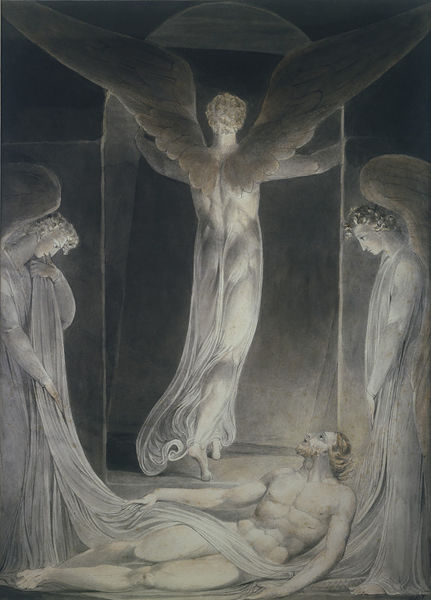
The Resurrection:
The angel rolling away the stone from the sepulchre
First posted April 2016 as IMAGES OF CHRIST 10.

Within the sepulcher where the body of Jesus was lain, transformation took place. Blake interest was in the process through which the spirit was freed from the body which had encumbered it. The goal was to see the new spiritual man emerging from the tomb in which it had been enclosed.

Assistance from above was needed for release to occur. Angels were sent to remove the garment which Jesus wore in the world of matter. An angel also removed the stone which secured the body in a prison of law which had been provided as the pedagogue until man could live in the liberty of the spirit.

The apostle Paul wrote to the Galatians of the dichotomy between living under the liberty of faith, or under the dominance the law. Jesus introduced the reign of faith, and its incipience can be represented by the removal of the stone blocking the exit from the grave.

Galatians 3
[23] But before faith came, we were kept under the law, shut up unto the faith which should afterwards be revealed.
[24] Wherefore the law was our schoolmaster to bring us unto Christ, that we might be justified by faith.
[25] But after that faith is come, we are no longer under a schoolmaster.
[26] For ye are all the children of God by faith in Christ Jesus

Blake sets this picture within the sepulcher rather than in the garden where Mary first encountered and recognized the risen Christ. Angels are removing from the body of Jesus the linen cloth which will remain behind when Jesus is adorned with the glory of his new spiritual body. The stone which is removed from the entrance to the sepulcher is a rectangular, finished stone to indicate that it is the stone on which the law was written. The angel took it away because it blocked the door to the abundant life in the spirit. 

In esoteric teaching truth which is codified and hardened becomes an impediment to spiritual growth. To reach a higher level of truth, rigid, literal truth must be transcended, making way for the mind to be receptive to perceiving the infinite.


Four Zoas, Night IX, PAGE 117, (E 386)
"               VALA

          Night the Ninth
               Being
          The Last Judgment

And Los & Enitharmon builded Jerusalem weeping      
Over the Sepulcher & over the Crucified body
Which to their Phantom Eyes appear'd still in the Sepulcher
But Jesus stood beside them in the Spirit Separating
Their Spirit from their body. Terrified at Non Existence 
For such they deemd the death of the body. Los his vegetable hands
Outstretchd his right hand branching out in fibrous Strength
Siezd the Sun. His left hand like dark roots coverd the Moon
And tore them down cracking the heavens across from immense to immense
Then fell the fires of Eternity with loud & shrill 
Sound of Loud Trumpet thundering along from heaven to heaven
A mighty sound articulate Awake ye dead & come
To judgment from the four winds Awake & Come away
Folding like scrolls of the Enormous volume of Heaven & Earth"

Everlasting Gospel, (E 522)
"My Sin thou hast forgiven me        
Canst thou forgive my Blasphemy
Canst thou return to this dark Hell
And in my burning bosom dwell
And canst thou Die that I may live
And canst thou Pity & forgive       
Then Rolld the shadowy Man away
From the Limbs of Jesus to make them his prey
An Ever devouring appetite
Glittering with festering Venoms bright
Crying Crucify this cause of distress
Who dont keep the secrets of Holiness
All Mental Powers by Diseases we bind
But he heals the Deaf & the Dumb & the Blind
Whom God has afflicted for Secret Ends
He comforts & Heals & calls them Friends  
But when Jesus was Crucified
Then was perfected his glittring pride
In three Nights he devourd his prey
And still he devours the Body of Clay
For Dust & Clay is the Serpents meat
Which never was made for Man to Eat"

Mark 15
[43] Joseph of Arimathaea, and honourable counseller, which also waited for the kingdom of God, came, and went in boldly unto Pilate, and craved the body of Jesus.
[44] And Pilate marvelled if he were already dead: and calling unto him the centurion, he asked him whether he had been any while dead.
[45] And when he knew it of the centurion, he gave the body to Joseph.
[46] And he bought fine linen, and took him down, and wrapped him in the linen, and laid him in a sepulchre which was hewn out of a rock, and rolled a stone unto the door of the sepulchre.
[47] And Mary Magdalene and Mary the mother of Joses beheld where he was laid.

John 20
[1] The first day of the week cometh Mary Magdalene early, when it was yet dark, unto the sepulchre, and seeth the stone taken away from the sepulchre.
[2] Then she runneth, and cometh to Simon Peter, and to the other disciple, whom Jesus loved, and saith unto them, They have taken away the Lord out of the sepulchre, and we know not where they have laid him.
[3] Peter therefore went forth, and that other disciple, and came to the sepulchre.
[4] So they ran both together: and the other disciple did outrun Peter, and came first to the sepulchre.
[5] And he stooping down, and looking in, saw the linen clothes lying; yet went he not in.
[6] Then cometh Simon Peter following him, and went into the sepulchre, and seeth the linen clothes lie,
[7] And the napkin, that was about his head, not lying with the linen clothes, but wrapped together in a place by itself.
[8] Then went in also that other disciple, which came first to the sepulchre, and he saw, and believed.
[9] For as yet they knew not the scripture, that he must rise again from the dead.
[10] Then the disciples went away again unto their own home.
[11] But Mary stood without at the sepulchre weeping: and as she wept, she stooped down, and looked into the sepulchre,
[12] And seeth two angels in white sitting, the one at the head, and the other at the feet, where the body of Jesus had lain.
[13] And they say unto her, Woman, why weepest thou? She saith unto them, Because they have taken away my Lord, and I know not where they have laid him.
[14] And when she had thus said, she turned herself back, and saw Jesus standing, and knew not that it was Jesus.

2ND Corinthians 3
[1] Do we begin again to commend ourselves? or need we, as some others, epistles of commendation to you, or letters of commendation from you?
[2] Ye are our epistle written in our hearts, known and read of all men:
[3] Forasmuch as ye are manifestly declared to be the epistle of Christ ministered by us, written not with ink, but with the Spirit of the living God; not in tables of stone, but in fleshy tables of the heart.
[4] And such trust have we through Christ to God-ward:
[5] Not that we are sufficient of ourselves to think any thing as of ourselves; but our sufficiency is of God;
[6] Who also hath made us able ministers of the new testament; not of the letter, but of the spirit: for the letter killeth, but the spirit giveth life.
[7] But if the ministration of death, written and engraven in stones, was glorious, so that the children of Israel could not stedfastly behold the face of Moses for the glory of his countenance; which glory was to be done away:
[8] How shall not the ministration of the spirit be rather glorious?
...
[15] But even unto this day, when Moses is read, the vail is upon their heart.
[16] Nevertheless when it shall turn to the Lord, the vail shall be taken away.
[17] Now the Lord is that Spirit: and where the Spirit of the Lord is, there is liberty.
[18] But we all, with open face beholding as in a glass the glory of the Lord, are changed into the same image from glory to glory, even as by the Spirit of the Lord.

Maurice Nicoll in his book The New Man taught of the process of transition as man develops psychologically:
 
Page 11
"Stone represents the most external and literal form of esoteric Truth. It represents esoteric Truth in its most inflexible sense. The commandments were written on tables of stone.
It must be understood that Truth about a higher evolution must rest upon a firm basis, for those incapable of seeing any deeper meaning."

Page 17
"What they taught a man was that he was an individual—that is, unique—who could reach this higher state of himself and that this was his real meaning and that this only could satisfy him most deeply. They began with teaching this Truth—or knowledge of this special Truth—but they led to something else. They led from Truth to a definite state of a man where he acted no longer from the Truth that brought him up to this level, but from the level itself. This was sometimes called  Good. All Truth must lead to some good state as its goal.
This was the idea belonging to the term "vineyard". Wine was produced. A man began to act from Good, not Truth, thus becoming a New Man."
.

Saturday, April 11, 2020

HOLY WEEK 5

First posted January 2013 as LIFE OF CHRIST XVI

Matthew 27
[26] Then released he Barabbas unto them: and when he had scourged Jesus, he delivered him to be crucified.
[27] Then the soldiers of the governor took Jesus into the common hall, and gathered unto him the whole band of soldiers.
[28] And they stripped him, and put on him a scarlet robe.
[29] And when they had platted a crown of thorns, they put it upon his head, and a reed in his right hand: and they bowed the knee before him, and mocked him, saying, Hail, King of the Jews!
[30] And they spit upon him, and took the reed, and smote him on the head.
[31] And after that they had mocked him, they took the robe off from him, and put his own raiment on him, and led him away to crucify him.
[32] And as they came out, they found a man of Cyrene, Simon by name: him they compelled to bear his cross.
[33] And when they were come unto a place called Golgotha, that is to say, a place of a skull,
[34] They gave him vinegar to drink mingled with gall: and when he had tasted thereof, he would not drink.
[35] And they crucified him, and parted his garments, casting lots: that it might be fulfilled which was spoken by the prophet, They parted my garments among them, and upon my vesture did they cast lots.


Psalms 22
[16] For dogs have compassed me: the assembly of the wicked have inclosed me: they pierced my hands and my feet.
[17] I may tell all my bones: they look and stare upon me.
[18] They part my garments among them, and cast lots upon my vesture.
[19] But be not thou far from me, O LORD: O my strength, haste thee to help me.
[20] Deliver my soul from the sword; my darling from the power of the dog.
[21] Save me from the lion's mouth: for thou hast heard me from the horns of the unicorns.
[22] I will declare thy name unto my brethren: in the midst of the congregation will I praise thee.


Courtesy of wiki commons
Original in Fitzwilliam Museum
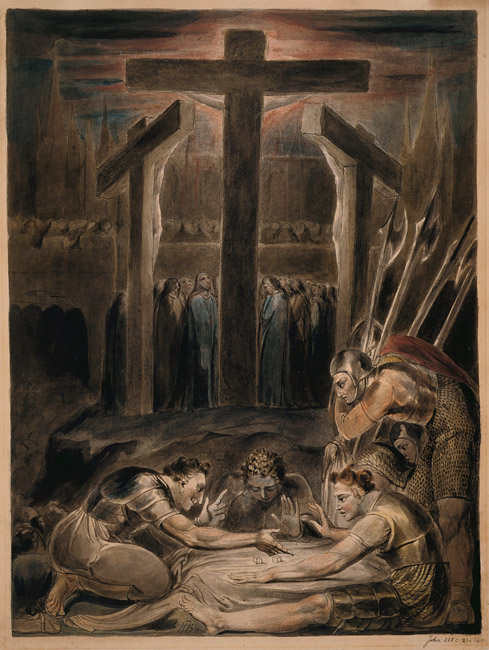
The Soldiers Casting Lots for Christ's Garments
In this picture the foreground is occupied by the Roman soldiers whose duty is to carry out the execution of Jesus as ordered by the political and religious authorities. The inscription on the cross identifying Jesus as King of the Jews was abbreviated in three languages: in the language of the military/political authority, in the language of the religious authority and in a common spoken language of the people. Blake includes three groups of people in his image, the soldiers in the foreground, the people who supported Jesus around the foot of the cross, and a shadowy group in the background who followed the religious leaders in rejecting Jesus.
 

Blake uses this picture in which the crucified Jesus is not himself visible, to emphasize the reaction that individuals make to the treatment that Jesus received from those who had the opportunity of watching him, hearing him and interacting with him. The prominence of the soldiers remind us of Blake's opposition to war and empire. Their activity of casting lots reminds us of his belief that choices should not be left to chance.

The image in the Blake Archive provides greater detail. Click on image to enlarge.

Jerusalem, Plate 60, (E 211)
"But the Divine Lamb stood beside Jerusalem. oft she saw          
The lineaments Divine & oft the Voice heard, & oft she said:

O Lord & Saviour, have the Gods of the Heathen pierced thee?
Or hast thou been pierced in the House of thy Friends?
Art thou alive! & livest thou for-evermore? or art thou
Not: but a delusive shadow, a thought that liveth not.  
Babel mocks saying, there is no God nor Son of God
That thou O Human Imagination, O Divine Body art all
A delusion. but I know thee O Lord when thou arisest upon
My weary eyes even in this dungeon & this iron mill.
The Stars of Albion cruel rise; thou bindest to sweet influences:
For thou also sufferest with me altho I behold thee not;
And altho I sin & blaspheme thy holy name, thou pitiest me;
Because thou knowest I am deluded by the turning mills.
And by these visions of pity & love because of Albions death.

Thus spake Jerusalem, & thus the Divine Voice replied.           

Mild Shade of Man, pitiest thou these Visions of terror & woe!
Give forth thy pity & love. fear not! lo I am with thee always.
Only believe in me that I have power to raise from death
Thy Brother who Sleepeth in Albion: fear not trembling Shade

PLATE 61
Behold: in the Visions of Elohim Jehovah, behold Joseph & Mary   
And be comforted O Jerusalem in the Visions of Jehovah Elohim" 
. 

HOLY WEEK 4

Giclee Prints from Private Collection
Hymn of Christ and the Apostles
1805
First posted April 2015 as Hymn of Christ.

Only one incident of hymn singing is recorded in the Gospels. Following the Last Supper Jesus and his disciples sang a hymn before they proceeded to the mount of Olives and the Garden of Gethsemane. Blake pictures two female and four male musicians with Jesus. Judging from the expressions on the faces, each is feeling the sadness occasioned by Jesus' announcement that he expects to be betrayed by one of the twelve disciples. None of his followers is able to understand why Jesus had offered his Body and Blood as he passed the bread and wine. The hymn is a pause between the celebration of the Passover and the drama of the arrest, trial and condemnation of Jesus.

Mark 14 
[22] And as they did eat, Jesus took bread, and blessed, and brake it, and gave to them, and said, Take, eat: this is my body. 
[23] And he took the cup, and when he had given thanks, he gave it to them: and they all drank of it. 
[24] And he said unto them, This is my blood of the new testament, which is shed for many. 
[25] Verily I say unto you, I will drink no more of the fruit of the vine, until that day that I drink it new in the kingdom of God. 
[26] And when they had sung an hymn, they went out into the mount of Olives. 
[27] And Jesus saith unto them, All ye shall be offended because of me this night: for it is written, I will smite the shepherd, and the sheep shall be scattered. 
[28] But after that I am risen, I will go before you into Galilee.

In the Four Zoas Blake wrote a transitional passage in which music is the metaphor for preparation for the birth of Orc. Blake echoed the interlude of music which introduced the ordeal which Jesus faced as Orc became dominant in his myth.  Orc, the generate form of Luvah, released repressed sexuality and violence as Urizen was 'bound in chains.' There is a pause in the Four Zoas as there is in the Gospel of Mark before the destructive forces take sway.

Four Zoas, Night V, Page 57, (E 339)
"Los from the furnaces a Space immense & left the cold           
Prince of Light bound in chains of intellect among the furnaces
But all the furnaces were out & the bellows had ceast to blow

He stood trembling & Enitharmon clung around his knees
Their senses unexpansive in one stedfast bulk remain
The night blew cold & Enitharmon shriekd on the dismal wind      
PAGE 58 
Her pale hands cling around her husband & over her weak head
Shadows of Eternal death sit in the leaden air

But the soft pipe the flute the viol organ harp & cymbal
And the sweet sound of silver voices calm the weary couch
Of Enitharmon but her groans drown the immortal harps           
Loud & more loud the living music floats upon the air
Faint & more faint the daylight wanes. The wheels of turning darkness
Began in solemn revolutions. Earth convulsd with rending pangs
Rockd to & fro & cried sore at the groans of Enitharmon  
Still the faint harps & silver voices calm the weary couch      
But from the caves of deepest night ascending in clouds of mist
The winter spread his wide black wings across from pole to pole
Grim frost beneath & terrible snow linkd in a marriage chain
Began a dismal dance. The winds around on pointed rocks
Settled like bats innumerable ready to fly abroad            
The groans of Enitharmon shake the skies the labring Earth
Till from her heart rending his way a terrible Child sprang forth
In thunder smoke & sullen flames & howlings & fury & blood

Soon as his burning Eyes were opend on the Abyss
The horrid trumpets of the deep bellowd with bitter blasts      
The Enormous Demons woke & howld around the new born king    
Crying Luvah King of Love thou art the King of rage & death
Urizen cast deep darkness round him raging Luvah pourd       
The spears of Urizen from Chariots round the Eternal tent
Discord began then yells & cries shook the wide firmament" 


.

Thursday, April 09, 2020

HOLY WEEK 3

First Posted July 2012 as  AGONY IN THE GARDEN.

Luke 22
[39] And he came out, and went, as he was wont, to the mount of Olives; and his disciples also followed him.
[40] And when he was at the place, he said unto them, Pray that ye enter not into temptation.
[41] And he was withdrawn from them about a stone's cast, and kneeled down, and prayed,
[42] Saying, Father, if thou be willing, remove this cup from me: nevertheless not my will, but thine, be done.
[43] And there appeared an angel unto him from heaven, strengthening him.
[44] And being in an agony he prayed more earnestly: and his sweat was as it were great drops of blood falling down to the ground.
[45] And when he rose up from prayer, and was come to his disciples, he found them sleeping for sorrow,
[46] And said unto them, Why sleep ye? rise and pray, lest ye enter into temptation.
[47] And while he yet spake, behold a multitude, and he that was called Judas, one of the twelve, went before them, and drew near unto Jesus to kiss him
.


Wikidata.org 
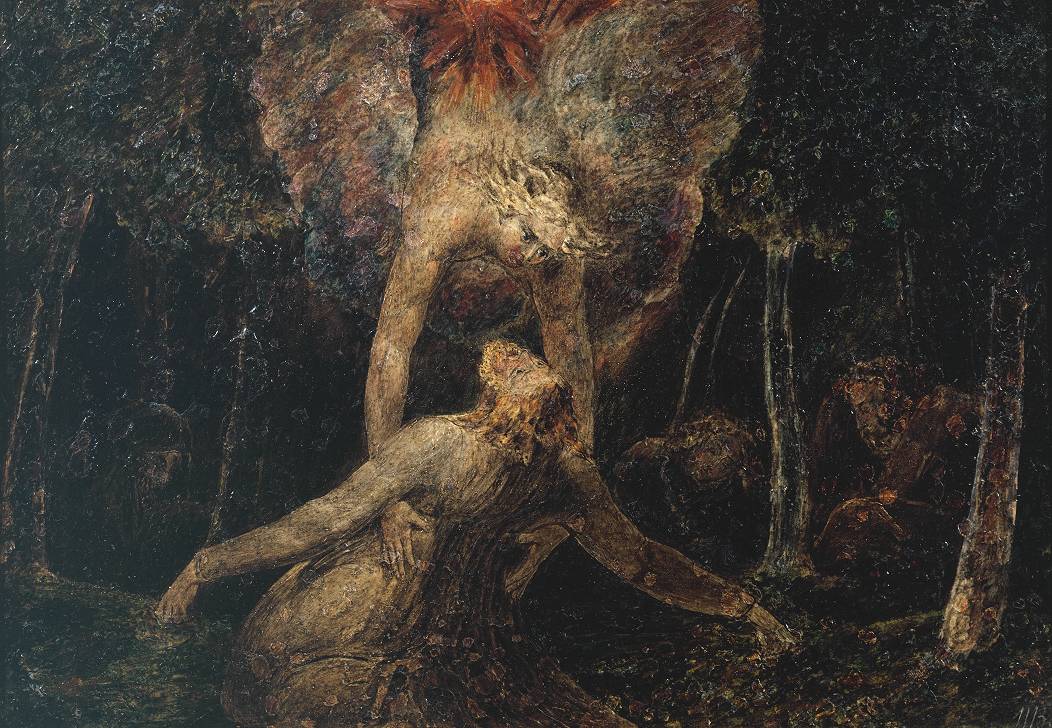
 Agony in the Garden 
In Blake's image called 'Agony in the Garden' the two central figures, Jesus and the comforter, are in the light. The disciples who accompanied Jesus are barely visible in the surrounding shadows. The title of the picture aptly describes the state of mind of Jesus as he struggles to understand and accept the role he is to play in the redemption of humanity. But the figure reaching down to support Jesus is portrayed as equally central to the dynamic event. We may name this figure, who is in the human form although reaching out of a cloud and the source of radiating energy and light, the Holy Spirit.

Many times Blake reiterated the theme that man is not alone in his situation no matter how bleak the circumstances look. God has made provisions for the return of man to the eternal condition of unity, forgiveness and brotherhood.
 
Four Zoas, Page 56, (E 338)
"And first he found the Limit of Opacity & namd it Satan
In Albions bosom for in every human bosom these limits stand
And next he found the Limit of Contraction & namd it Adam
While yet those beings were not born nor knew of good or Evil

Then wondrously the Starry Wheels felt the divine hand. Limit
Was put to Eternal Death Los felt the Limit & saw
The Finger of God touch the Seventh furnace in terror
And Los beheld the hand of God over his furnaces
Beneath the Deeps in dismal Darkness beneath immensity
And he who takes vengeance alone is the criminal of Providence;"

Jerusalem, Plate 62, (E 213)
"Jesus replied. I am the Resurrection & the Life.
I Die & pass the limits of possibility, as it appears
To individual perception. Luvah must be Created
And Vala; for I cannot leave them in the gnawing Grave.
But will prepare a way for my banished-ones to return
Come now with me into the villages. walk thro all the cities.
Tho thou art taken to prison & judgment, starved in the streets
I will command the cloud to give thee food & the hard rock
To flow with milk & wine, tho thou seest me not a season
Even a long season & a hard journey & a howling wilderness!
Tho Valas cloud hide thee & Luvahs fires follow thee!
Only believe & trust in me, Lo. I am always with thee!"

Jerusalem, Plate 82, (E 241) 
"Los saw & was comforted at his Furnaces uttering thus his voice.
I know I am Urthona keeper of the Gates of Heaven,
And that I can at will expatiate in the Gardens of bliss;
But pangs of love draw me down to my loins which are
Become a fountain of veiny pipes: O Albion! my brother!
Plate 83
Corruptibility appears upon thy limbs, and never more
Can I arise and leave thy side, but labour here incessant
Till thy awaking! yet alas I shall forget Eternity! Against the
Patriarchal pomp and cruelty, labouring incessant
I shall become an Infant horror. Enion! Tharmas! friends
Absorb me not in such dire grief: O Albion, my brother!
Jerusalem hungers in the desart! affection to her children!
The scorn'd and contemnd youthful girl, where shall she fly?
Sussex shuts up her Villages. Hants, Devon & Wilts
Surrounded with masses of stone in orderd forms, determine then
A form for Vala and a form for Luvah, here on the Thames
Where the Victim nightly howls beneath the Druids knife:
A Form of Vegetation, nail them down on the stems of Mystery:
O when shall the Saxon return with the English his redeemed brother!
O when shall the Lamb of God descend among the Reprobate!"

Much of Blake's vision is the ability to recognize and understand the 'ways of God' as he provides the means that man may perceive his own Divine Humanity. For Blake the spirit is always reaching down and lifting up and becoming one with his beloved mankind.

.

HOLY WEEK 2

First posted May 2012.

LAST SUPPER
 
Letters, (E 703)
"Mr [George] Cumberland, Bishopsgate, Windsor Great Park
Hercules Buildings, Lambeth. Augst 26. 1799
Dear Cumberland
...
Pray let me intreat you to persevere in your Designing it is the only source of Pleasure all your other pleasures depend upon It. It is the Tree Your Pleasures are the Fruit. Your Inventions of Intellectual Visions are the Stamina of every thing you value. Go on if not for your own sake yet for ours who love & admire your works. but above all For the Sake of the Arts. Do not throw aside for any long time the honour intended you by Nature to revive the Greek workmanship. I study your outlines as usual just as if they were antiques. As to Myself about whom you are so kindly Interested. I live by Miracle. I am Painting small Pictures from the Bible. For as to Engraving in which art I cannot reproach myself with any neglect yet I am laid by in a corner as if I did not Exist & Since my Youngs Night Thoughts have been publishd Even Johnson & Fuseli have discarded my Graver. But as I know that He who Works & has his health cannot starve. I laugh at Fortune & Go on & on. I think I foresee better Things than I have ever seen. My Work pleases my employer & I have an order for Fifty small Pictures at One Guinea each which is Something better than mere copying after another artist. But above all I feel myself happy & contented let what will come having passed now near twenty years in ups & downs I am used to them & perhaps a little practise in them may turn out to benefit. It is now Exactly Twenty years since I was upon the ocean of business & Tho I laugh at Fortune I am perswaded that She Alone is the Governor of Worldly Riches. & when it is Fit She will call on me till then I wait with Patience in hopes that She is busied among my Friends. With Mine & My Wifes best compliments to Mrs Cumberland I remain
Yours sincerely
WILLm BLAKE"

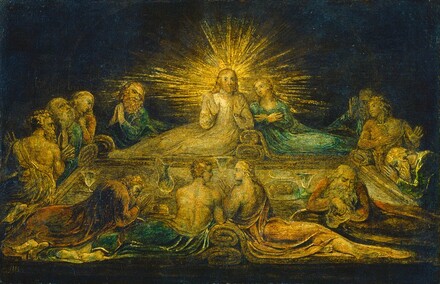
One of the tempera paintings which Blake made for Thomas Butts in 1799 is a portrayal of the Last Supper. Blake created a dramatic image of Jesus and the twelve disciples involved in a scene where each displays his individual emotions at this critical juncture. Jesus himself, surrounded by the radiance, looks beyond his present circumstances to a future that is to be revealed. His hand gesture seems to be that of reluctant acceptance. 

Gathered around Jesus are the twelve men whom he chose as his special companions. Each seems to be in his own separate world: praying, contemplating the past or future, or meditating on the strange events which have taken place and where they might lead. Beside Jesus sits 'the disciple whom Jesus loved' appearing in Blake's portrayal to assume feminine characteristics. In the foreground to the left there might be Peter already traumatised by knowing he would be tempted to deny his Lord. To his right the two figures deep in discussion may be continuing their earlier discussion
about who would be greatest in the kingdom. Most easily recognised is Judas to the right counting the coins he had accepted to betray Jesus to the authorities. Each disciple struggles with his own issues including doubts, awe, disappointment, fears and anticipation of possible outcomes.

National Gallery Washington
1799
Rosenwald Collection

A Descriptive Catalog, (E 543)
"Mr. B. has done, as all the ancients did, and as all the moderns, who are worthy of fame, given the historical fact in its poetical vigour; so as it always happens, and not in that dull way that some Historians pretend, who being weakly organized themselves, cannot see either miracle or prodigy; all is to them a dull round of probabilities and possibilities; but the history of all times and places, is nothing else but improbabilities and impossibilities; what we should say, was impossible if we did not see it always before our eyes."

Jerusalem , Plate 13, (E 157)
"And all that has existed in the space of six thousand years:
Permanent, & not lost not lost nor vanishd, & every little act,
Word, work, & wish, that has existed, all remaining still

In those Churches ever consuming & ever building by the Spectres
Of all the inhabitants of Earth wailing to be Created:
Shadowy to those who dwell not in them, meer possibilities:
But to those who enter into them they seem the only substances
For every thing exists & not one sigh nor smile nor tear,
Plate 14
One hair nor particle of dust, not one can pass away." 
. 

Wednesday, April 08, 2020

HOLY WEEK 1

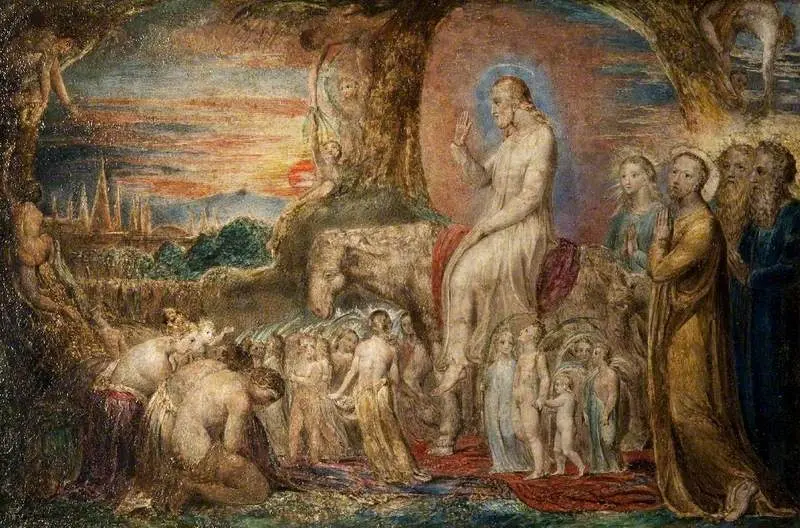
Entry of Christ into Jerusalem 
Reposted from April 2015 
Luke 19
[28] And when he had thus spoken, he went before, ascending up to Jerusalem.
[29] And it came to pass, when he was come nigh to Bethphage and Bethany, at the mount called the mount of Olives, he sent two of his disciples,
[30] Saying, Go ye into the village over against you; in the which at your entering ye shall find a colt tied, whereon yet never man sat: loose him, and bring him hither.
[31] And if any man ask you, Why do ye loose him? thus shall ye say unto him, Because the Lord hath need of him.
[32] And they that were sent went their way, and found even as he had said unto them.
[33] And as they were loosing the colt, the owners thereof said unto them, Why loose ye the colt?
[34] And they said, The Lord hath need of him.
[35] And they brought him to Jesus: and they cast their garments upon the colt, and they set Jesus thereon.
[36] And as he went, they spread their clothes in the way.
[37] And when he was come nigh, even now at the descent of the mount of Olives, the whole multitude of the disciples began to rejoice and praise God with a loud voice for all the mighty works that they had seen;
[38] Saying, Blessed be the King that cometh in the name of the Lord: peace in heaven, and glory in the highest.

[39] And some of the Pharisees from among the multitude said unto him, Master, rebuke thy disciples.
[40] And he answered and said unto them, I tell you that, if these should hold their peace, the stones would immediately cry out.
[41] And when he was come near, he beheld the city, and wept over it,
 
John 12
[12] On the next day much people that were come to the feast, when they heard that Jesus was coming to Jerusalem,
[13] Took branches of palm trees, and went forth to meet him, and cried, Hosanna: Blessed is the King of Israel that cometh in the name of the Lord.
[14] And Jesus, when he had found a young ass, sat thereon; as it is written,
[15] Fear not, daughter of Sion: behold, thy King cometh, sitting on an ass's colt.
[16] These things understood not his disciples at the first: but when Jesus was glorified, then remembered they that these things were written of him, and that they had done these things unto him.

This image by Blake painted in oil on copper for Thomas Butts is out of the ordinary even for Blake. The subject of Jesus entering Jerusalem on Palm Sunday receives a distinctive treatment. Jesus and his party of disciples enjoy a conventional treatment although they display the elongated bodies and reduced sized heads which Blake adopted for a period of time. The crowd gathered around Jesus are definitely unconventional since they are in various degrees of undress. The contrasting sizes of the various figures leads to a confusion of scale and perspective.
 

The 'window' through which Jerusalem is visible is framed by trees which are being climbed by figures of individuals attempting to reach a higher level. Jerusalem is not pictured as the earthly city of Jesus's day but as the heavenly Jerusalem of the vision of John of Patmos.
 

During the period when Blake was reevaluating Classical thought as an influence on his myth and prophecy, he seems to have reconsidered the neoclassical style of art which he had adopted in much of his work. Neoclassicism gained prominence with the enlightenment; Blake looked to replace them both. This picture owes much to Mannerism, a style of the 16th century. According to this National Gallery website Mannerism demonstrated that "excellence in painting demanded refinement, richness of invention, and virtuoso technique, criteria that emphasized the artist’s intellect." Blake found that this technique allowed him to use his intellect  and inventiveness to stimulate a fresh view of a Biblical scene which could be opened to vision.
Four Zoas, Night IX, Page 122, (E 391)
"The times revolve the time is coming when all these delights
Shall be renewd & all these Elements that now consume            
Shall reflourish. Then bright Ahania shall awake from death
A glorious Vision to thine Eyes a Self renewing Vision  
The spring. the summer to be thine then Sleep the wintry days
In silken garments spun by her own hands against her funeral
The winter thou shalt plow & lay thy stores into thy barns       
Expecting to recieve Ahania in the spring with joy
Immortal thou. Regenerate She & all the lovely Sex
From her shall learn obedience & prepare for a wintry grave
That spring may see them rise in tenfold joy & sweet delight
Thus shall the male & female live the life of Eternity           
Because the Lamb of God Creates himself a bride & wife
That we his Children evermore may live in Jerusalem
Which now descendeth out of heaven a City yet a Woman
Mother of myriads redeemd & born in her spiritual palaces
By a New Spiritual birth Regenerated from Death"                  

Friday, April 03, 2020

REMEMBERING

British Museum
Illustrations to Young's Night Thoughts

In 2011 Larry and I each selected some passages from Blake's poetry which we found had entered our minds and lodged there because they are appropos to our condition. Here are a few more quotes which move me although I have not committed them to memory. I wish I had as ready mental access to Blake's poetry as I have to simple songs that I learned in childhood, to popular songs from in youth, and to hymns I learned through years of church attendance. It seems to me that the combination of music and words was the key to remembering. Writing posts for this blog is now my tool for learning what Blake had to teach.
Four Zoas, Night V, Page 64, (E 343)
"He gave to me a silver scepter & crownd me with a golden crown
& said Go forth & guide my Son who wanders on the ocean   
I went not forth. I hid myself in black clouds of my wrath"

Four Zoas, Night VII,  Page 98 [90], (E 370)
"if thou my Los
Wilt in sweet moderated fury. fabricate forms sublime     
Such as the piteous spectres may assimilate themselves into
They shall be ransoms for our Souls that we may live"

Four Zoas, Night VII,  Page 98 [90], (E 370)
"And first he drew a line upon the walls of shining heaven    
And Enitharmon tincturd it with beams of blushing love"

Milton, Plate 28 [30], (E 126)
"While the poor indigent is like the diamond which tho cloth'd
In rugged covering in the mine, is open all within
And in his hallowd center holds the heavens of bright eternity"

Jerusalem, Plate 88, (E 247)
"The blow of his Hammer is Justice. the swing of his Hammer: Mercy.
The force of Los's Hammer is eternal Forgiveness;" 

Four Zoas, Night I, Page 9, (E 304)
"Then Eno a daughter of Beulah took a Moment of Time      
And drew it out to Seven thousand years with much care & affliction 
And many tears & in Every year made windows into Eden   
She also took an atom of space & opend its center
Into Infinitude & ornamented it with wondrous art"

Letters,  To Trusler, (E 702)
"But you ought to know that What is Grand is necessarily obscure to
Weak men.  That which can be made Explicit to the Idiot is not
worth my care.  The wisest of the Ancients considerd what is not
too Explicit as the fittest for Instruction because it rouzes the
faculties to act."

Letters, to Butts, (E 712)
"Each grain of Sand
     Every Stone on the Land
     Each rock & each hill
     Each fountain & rill
     Each herb & each tree
     Mountain hill Earth & Sea
     Cloud Meteor & Star
     Are Men Seen Afar
...
And I heard his voice Mild
     Saying This is My Fold
     O thou Ram hornd with gold
...
The loud sea & deep gulf
     These are guards of My Fold
     O thou Ram hornd with gold"

Letters, to Butts, (E 722)
"This Earth breeds not our happiness"
     "Another Sun feeds our lifes streams"
     "We are not warmed with thy beams"
     "Thou measurest not the Time to me"
     "Nor yet the Space that I do see"
     "My Mind is not with thy light arrayd"
     "Thy terrors shall not make me afraid"
...
 Now I a fourfold vision see
     And a fourfold vision is given to me
     Tis fourfold in my supreme delight
     And three fold in soft Beulahs night
     And twofold Always.  May God us keep
     From Single vision & Newtons sleep"

Milton, Plate 30 (E 808)
[Inscription in reverse writing]
"How wide the Gulf &
Unpassable! between Simplicity & Insipidity / Contraries are
Positives / A Negation is not a Contrary"