Sunday, September 03, 2023

LIKE A BEAST

British Museum
Illustrations to Young's Night Thoughts

The King and the Corpse: Tales of the Soul's Conquest of Evil, by Heinrich Zimmer, Edited by Joseph Campbell attempts to provide means through which the reader can 'converse with the fascinating figures of folklore and myth.' Zimmer seeks to give opportunities to delight in encountering the 'well known symbols of life.'

Included in the book is the fifteenth century legend of Saint John Chrysostom who was the fourth century bishop of Constantinople. John was brought up by a pope to be the vehicle for relieving the suffering of a man in hell who had appealed to the pope. The innocent John was ordained a priest at the age of sixteen in order to offer masses for the condemned man. Realizing that his youth disqualified him communing with God as an intermediary for others, John withdrew to the wilderness to live as a hermit. 

However when a girl appeared at his cell he allowed her in and he fell into sin. His remorse drove him to push the girl over a cliff, committing a worse sin. He sought forgiveness from the pope who had raised him like a son but he received only condemnation. Returning to the wilderness he resolved to live on all-fours like a beast until God would accept his atonement.

Years later through another miraculous intervention John was released to resume his priestly role and become a bishop 'serving God with the utmost devotion.'

On page 62 Zimmer wrote:

"He comprehended that the highest human office - that of communicating with God and dispensing God's grace in the form of the Eucharist - was meant to be held not by an 'innocent' but by one who had had 'experience.' 'I am yet too young! This must be very much against the Heavenly will.'...And the required experience John subsequently learned, was of those dark and evil forces which it is the virtue of the Holy Sacrament to overcome. The young priest's feeling of unworthiness sent him to the wilderness - but it was the wilderness of life. 

...John's intuitive realization of his actual spiritual state and the sincere humility of his character prevent his seduction. His genius knows how important it is to integrate the wisdom of the dark powers from which he has been defended both by his clerical upbringing and by the innocence of his unassuming nature. Yet he cannot anticipate the humiliations, suffering and iniquities that the rugged path of integration through experience is going to entail. Nobody can ever anticipate such things...Such ignorance is basic - not only basic, actually salutary; for without it there can be no fructifying impact of experience, no 'new thing,' to take root, grow up, and mature through life into wisdom. Only he who is honestly ignorant can grow really wise."   


Four Zoas, Night VI, Page 72, (E 349)

  "O thou poor ruind world   
Thou horrible ruin once like me thou wast all glorious
And now like me partaking desolate thy masters lot
Art thou O ruin the once glorious heaven are these thy rocks
Where joy sang in the trees & pleasure sported on the rivers
Page 73 
And laughter sat beneath the Oaks & innocence sported round
Upon the green plains & sweet friendship met in palaces
And books & instruments of song & pictures of delight
Where are they whelmd beneath these ruins in horrible destruction                                                t
And if Eternal falling I repose on the dark bosom              
Of winds & waters or thence fall into a Void where air
Is not down falling thro immensity ever & ever
I lose my powers weakend every revolution till a death
Shuts up my powers then a seed in the vast womb of darkness
I dwell in dim oblivion. brooding over me the Enormous worlds    
Reorganize me shooting forth in bones & flesh & blood
I am regenerated to fall or rise at will or to remain
A labourer of ages a dire discontent a living woe
Wandring in vain. Here will I fix my foot & here rebuild
Here Mountains of Brass promise much riches in their dreadful bosoms

So he began to dig forming of gold silver & iron  
And brass vast instruments to measure out the immense & fix
The whole into another world better suited to obey
His will where none should dare oppose his will himself being King
Of All & all futurity be bound in his vast chain" 
 ALL RELIGIONS are ONE, (E 1)  
 "The Voice of one crying in the Wilderness

  The Argument    As the true method of knowledge is experiment
the true faculty of knowing must be the faculty which
experiences.  This faculty I treat of." 

Four Zoas, Night II, Page 35, (E 325)

"What is the price of Experience do men buy it for a song
Or wisdom for a dance in the street? No it is bought with the price
Of all that a man hath his house his wife his children
Wisdom is sold in the desolate market where none come to buy
And in the witherd field where the farmer plows for bread in vain

It is an easy thing to triumph in the summers sun
And in the vintage & to sing on the waggon loaded with corn
It is an easy thing to talk of patience to the afflicted
To speak the laws of prudence to the houseless wanderer
Page 36 
To listen to the hungry ravens cry in wintry season
When the red blood is filld with wine & with the marrow of lambs

It is an easy thing to laugh at wrathful elements
To hear the dog howl at the wintry door, the ox in the slaughter house moan
To see a god on every wind & a blessing on every blast           
To hear sounds of love in the thunder storm that destroys our enemies house
To rejoice in the blight that covers his field, & the sickness that cuts off his children
While our olive & vine sing & laugh round our door & our children bring fruits & flowers

Then the groan & the dolor are quite forgotten & the slave grinding at the mill
And the captive in chains & the poor in the prison, & the soldier in the field
When the shatterd bone hath laid him groaning among the happier dead

It is an easy thing to rejoice in the tents of prosperity
Thus could I sing & thus rejoice, but it is not so with me!" 
Songs and Ballads, Notebook, (E 467)
"I saw a chapel all of gold
That none did dare to enter in
And many weeping stood without
Weeping mourning worshipping

I saw a serpent rise between               
The white pillars of the door
And he forcd & forcd & forcd
Down the golden hinges tore    

And along the pavement sweet
Set with pearls & rubies bright                    
All his slimy length he drew
Till upon the altar white

Vomiting his poison out
On the bread & on the wine
So I turnd into a sty                                  
And laid me down among the swine"
Annotations to Swedenborg's Divine Love and Divine Wisdom, (E602) 
  "Understanding or Thought is not natural to Man it is
acquired by means of Suffering & Distress i.e Experience.  Will,
Desire, Love, Rage, Envy, & all other Affections are Natural. but
Understanding is Acquired   But Observe. without these is to be
less than Man.  Man could never have received light from
heaven without aid of the affections" 

More posts about episodes of Living Like A Beast:

Nebuchadnezzar

Seeking Oblivion 

Blake' Crisis


Friday, September 01, 2023

SAMUEL

National Gallery of Art
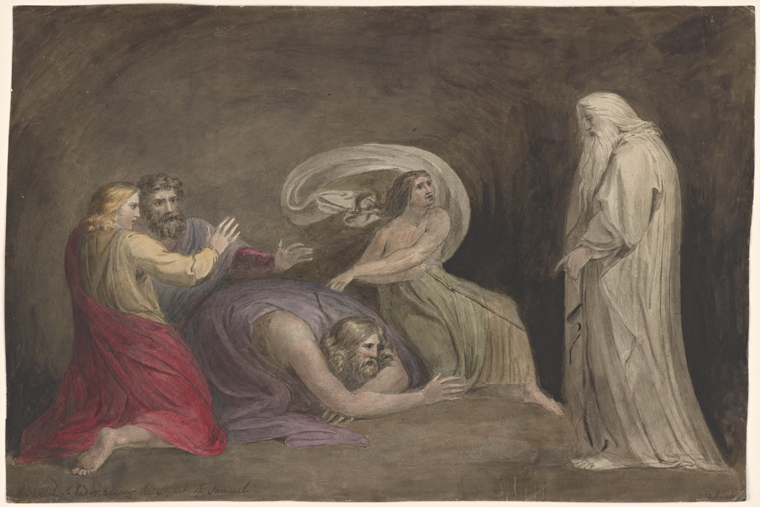
The Witch of Endor
1800

1Samuel 28

[3] Now Samuel was dead, and all Israel had lamented him, and buried him in Ramah, even in his own city. And Saul had put away those that had familiar spirits, and the wizards, out of the land.
[4] And the Philistines gathered themselves together, and came and pitched in Shunem: and Saul gathered all Israel together, and they pitched in Gilboa.
[5] And when Saul saw the host of the Philistines, he was afraid, and his heart greatly trembled.
[6] And when Saul inquired of the LORD, the LORD answered him not, neither by dreams nor by Urim, nor by prophets.
[7] Then said Saul unto his servants, Seek me a woman that hath a familiar spirit, that I may go to her, and inquire of her. And his servants said to him, Behold, there is a woman that hath a familiar spirit at Endor.
[8] And Saul disguised himself, and put on other raiment, and he went, and two men with him, and they came to the woman by night: and he said, I pray thee, divine unto me by the familiar spirit, and bring me him up, whom I shall name unto thee.
[9] And the woman said unto him, Behold, thou knowest what Saul hath done, how he hath cut off those that have familiar spirits, and the wizards, out of the land: wherefore then layest thou a snare for my life, to cause me to die?
[10] And Saul sware to her by the LORD, saying, As the LORD liveth, there shall no punishment happen to thee for this thing.
[11] Then said the woman, Whom shall I bring up unto thee? And he said, Bring me up Samuel.
[12] And when the woman saw Samuel, she cried with a loud voice: and the woman spake to Saul, saying, Why hast thou deceived me? for thou art Saul.
[13] And the king said unto her, Be not afraid: for what sawest thou? And the woman said unto Saul, I saw gods ascending out of the earth.
[14] And he said unto her, What form is he of? And she said, An old man cometh up; and he is covered with a mantle. And Saul perceived that it was Samuel, and he stooped with his face to the ground, and bowed himself.
[15] And Samuel said to Saul, Why hast thou disquieted me, to bring me up? And Saul answered, I am sore distressed; for the Philistines make war against me, and God is departed from me, and answereth me no more, neither by prophets, nor by dreams: therefore I have called thee, that thou mayest make known unto me what I shall do.
[16] Then said Samuel, Wherefore then dost thou ask of me, seeing the LORD is departed from thee, and is become thine enemy?
[17] And the LORD hath done to him, as he spake by me: for the LORD hath rent the kingdom out of thine hand, and given it to thy neighbour, even to David:
[18] Because thou obeyedst not the voice of the LORD, nor executedst his fierce wrath upon Amalek, therefore hath the LORD done this thing unto thee this day.
[19] Moreover the LORD will also deliver Israel with thee into the hand of the Philistines: and to morrow shalt thou and thy sons be with me: the LORD also shall deliver the host of Israel into the hand of the Philistines.
[20] Then Saul fell straightway all along on the earth, and was sore afraid, because of the words of Samuel: and there was no strength in him; for he had eaten no bread all the day, nor all the night.
[21] And the woman came unto Saul, and saw that he was sore troubled, and said unto him, Behold, thine handmaid hath obeyed thy voice, and I have put my life in my hand, and have hearkened unto thy words which thou spakest unto me.
[22] Now therefore, I pray thee, hearken thou also unto the voice of thine handmaid, and let me set a morsel of bread before thee; and eat, that thou mayest have strength, when thou goest on thy way.
[23] But he refused, and said, I will not eat. But his servants, together with the woman, compelled him; and he hearkened unto their voice. So he arose from the earth, and sat upon the bed.
[24] And the woman had a fat calf in the house; and she hasted, and killed it, and took flour, and kneaded it, and did bake unleavened bread thereof:
[25] And she brought it before Saul, and before his servants; and they did eat. Then they rose up, and went away that night.

1Samuel 31

[6] So Saul died, and his three sons, and his armourbearer, and all his men, that same day together.
[7] And when the men of Israel that were on the other side of the valley, and they that were on the other side Jordan, saw that the men of Israel fled, and that Saul and his sons were dead, they forsook the cities, and fled; and the Philistines came and dwelt in them.


NYPL
The Witch of Endor raising the Spirit of Samuel
1783

After William Blake completed his apprenticeship in engraving he was anxious to get established as an artist in addition to being qualified as a reproductive engraver. An early attempt at producing art was by painting historical pictures, which was a popular pursuit among artists. When he was twenty six years old he made a watercolor image of a dramatic scene from the book of Samuel in the Old Testament. The image shows King Saul and two friends with the Witch of Endor and the Ghost of Samuel.

Blake's conventional treatment of the subject matter shows that he began his career painting in a far different way than the style with which we may be more familiar. His later picture of The Witch of Endor is more typical of the visionary artist which he became. When he produced the second version he was interested in showing more than can be shown in a purely descriptive image of the scene. In the second portrayal the Ghost of Samuel reveals with eyes focused on Saul that a dreadful experience is about to befall him. His downward pointing fingers warn Saul of the defeat and fall which will result from the coming battle. Saul seeks to ward off the message from Samuel's ghost with outstretched fingers of his raised hands. Most dramatic is the witch herself: her spiky hair, her glaring eyes, and her anguished mouth, convey the message of the impending loss of the Kingdom of Israel and its leaders. Blake had learned to use symbolic expressions and gestures to suggest more than what could be revealed plainly.

The account in the Bible of the past (Samuel) speaking to the present (the Witch) about the future (Saul) appealed to Blake's sense that the natural world is infused by the world of spirit. It was Blake's conviction that the events we experience in our daily lives have spiritual causes. Blake was convinced that Saul's encounter with the Ghost of Samuel was no more than a particularly pronounced example of the type of interactions between the spiritual and natural worlds which happen routinely.   

Jerusalem, Plate 47, (E 196)
"Hark! the mingling cries of Luvah with the Sons of Albion
Hark! & Record the terrible wonder! that the Punisher
Mingles with his Victims Spectre, enslaved and tormented         
To him whom he has murderd, bound in vengeance & enmity
Shudder not, but Write, & the hand of God will assist you!
Therefore I write Albions last words. Hope is banish'd from me.
Plate 48
These were his last words, and the merciful Saviour in his arms
Reciev'd him, in the arms of tender mercy and repos'd
The pale limbs of his Eternal Individuality
Upon the Rock of Ages. Then, surrounded with a Cloud:
In silence the Divine Lord builded with immortal labour,         
Of gold & jewels a sublime Ornament, a Couch of repose,
With Sixteen pillars: canopied with emblems & written verse.
Spiritual Verse, order'd & measur'd, from whence, time shall reveal.
The Five books of the Decologue, the books of Joshua & Judges,
Samuel, a double book & Kings, a double book, the Psalms & Prophets 
The Four-fold Gospel, and the Revelations everlasting
Eternity groan'd. & was troubled, at the image of Eternal Death!"
Jerusalem, Plate 73, (E 228)
"in holiness of Natural Religion
Which Los with his mighty Hammer demolishes time on time
In miracles & wonders in the Four-fold Desart of Albion
Permanently Creating to be in Time Reveald & Demolishd
Satan Cain Tubal Nimrod Pharoh Priam Bladud Belin                
Arthur Alfred the Norman Conqueror Richard John
[Edward Henry Elizabeth James Charles William George]
And all the Kings & Nobles of the Earth & all their Glories
These are Created by Rahab & Tirzah in Ulro: but around
These, to preserve them from Eternal Death Los Creates           
Adam Noah Abraham Moses Samuel David Ezekiel
[Pythagoras Socrates Euripedes Virgil Dante Milton] 
Dissipating the rocky forms of Death, by his thunderous Hammer
As the Pilgrim passes while the Country permanent remains
So Men pass on: but States remain permanent for ever" 
Milton, Plate 26 [28] 123
"So they are born on Earth, & every Class is determinate
But not by Natural but by Spiritual power alone, Because         
The Natural power continually seeks & tends to Destruction
Ending in Death: which would of itself be Eternal Death
And all are Class'd by Spiritual, & not by Natural power.

And every Natural Effect has a Spiritual Cause, and Not
A Natural: for a Natural Cause only seems, it is a Delusion      
Of Ulro: & a ratio of the perishing Vegetable Memory."
 

Thursday, August 24, 2023

BLAKE & PLATO

First posted 2011

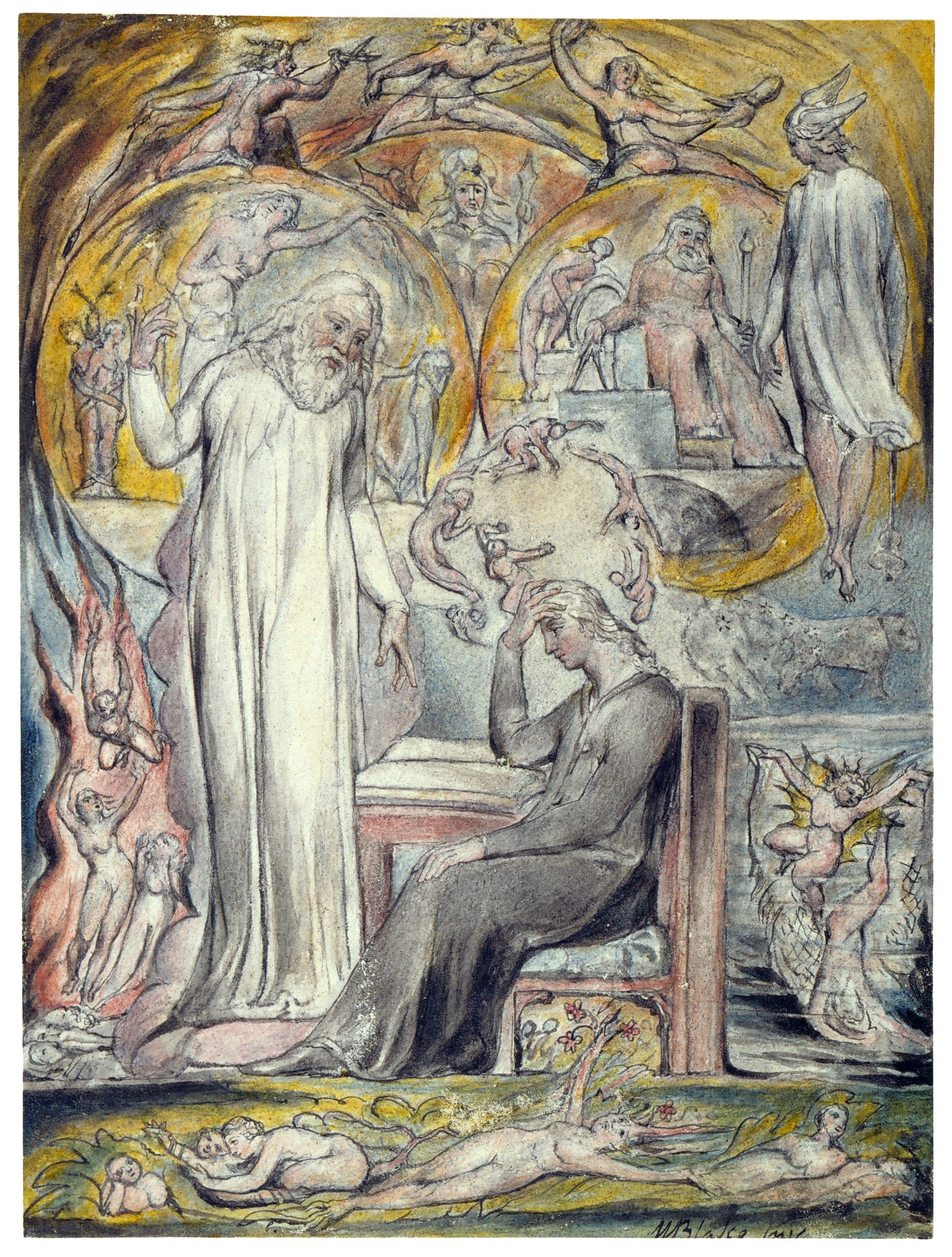
Commentary on Blake's six illustrations to Milton's Il Penseroso is found in Bette Charlene Werner's book Blake's vision of the poetry of Milton: illustrations to six poems. Blake 'invented', (he signed images WBlake inv), the third illustration The Spirit of Plato as a means of presenting a number of Plato's ideas as Milton contemplated them.

Il Penseroso

"Or let my lamp, at midnight hour,
Be seen in some high lonely tower,
Where I may oft outwatch the Bear,
With thrice great Hermes, or unsphere
The spirit of Plato, to unfold
What worlds or what vast regions hold
The immortal mind that hath forsook
Her mansion in this fleshly nook;
And of those demons that are found
In fire, air, flood, or underground,"
(lines 85-95)

In the picture we see how Plato divided the soul between the three worlds of Venus, Jupiter, Mars - senses, reason and energy. The Great Bear is the constellation around which the constellations revolve; it never sets - symbolizing an ever circling round.

Blake added a few lines of descriptive material to each of his illustrations to Il Penseroso.
Blake's description: "The Spirit of Plato unfolds his Worlds to Milton in Contemplation. The three destinies sit on the Circles of Plato's Heavens weaving their Thread of Mortal Life; these Heavens are Venus Jupiter and Mars. Hermes flies before as attending on the Heaven of Jupiter, the Great Bear is seen in the Sky beneath Hermes & The Spirits of Fire, Air, Water & Earth Surround Milton's Chair."

In this the third illustration to Il Penseroso illustrating lines 85-95 of Milton's poem, Blake goes to pains to include the import of the lines of the poem but adds details to indicate the ideas of Plato to which he objected.

Damon enumerates the points at which Plato's thought differed from Blake's:
"Thus it is that although Plato banished poets from his Republic, made God a geometrician, preached morality, was a fatalist when he accepted the Three Fates, debased love to homosexuality, admitted war to his ideal state, and considered Art an imitation of Nature (hence second rate), Blake was indebted to him." Blake knew that there was much to be admired in Plato's thought although he said that "What Jesus came to remove was the Heathen or Platonic Philosophy, which blinds the eye to Imagination, The real Man." (E 664 ). Blake portrays the Greek learned and wise among the saved in the Last Judgment.

The prominence in the illustration of Hermes perhaps in his role of as the guide for souls in the underworld, may be Blake's assertion that both Plato and Milton are still in need of guidance in matters of the soul. None of the Platonic images contemplated by Milton seems to show the positive outcome for Man's plight for which Blake is working.

Blake's ambivalence to Plato and Greek thought can be seen in these 2 short passages:

Songs and Ballads,(E 479)
"Twas the Greeks love of war
Turnd Love into a Boy
And Woman into a Statue of Stone
And away fled every joy"

Letter to Trusler, (E 702)
"The wisest of the Ancients considerd what is not
too Explicit as the fittest for Instruction because it rouzes the
faculties to act. I name Moses Solomon Esop Homer Plato"

Wednesday, August 23, 2023

BLAKE'S ARCHETYPES

Wikipedia Commons
America 
Plate 10 
 
When we attempt to understand how our own psyches are structured we realize that our reasoning power developed upon a pre-existing capability of which the reason has no knowledge. The 'form' on which the subsequent development built is called by Jung 'archetypes'. For the psyche to reach its maximum state the individual has the task of recognizing what is hidden from his conscious mind in the archetypes.
 
Jung postulates that the form of the archetypes are inborn. The brain of each individual is organized in such a way that awareness of similar archetypes is common to us all. As the mind becomes aware of the patterns which are innate they become filled with content from the experience of the individual.  
  
Four Archetypes, CG Jung 
Page 1

"There is an a priori factor in all human activities, namely the inborn, preconscious and unconscious individual structure of the psyche."

Page 12

... "There are present in every psyche forms which are unconscious but nevertheless active-living dispositions, ideas in the Platonic sense, that perform and and continually influence our thoughts and feelings and actions...archetypes are not determined as regards their content, but only as regards their form and then only to a very limited degree."

Page 18 

"Our task is not, therefore, to deny the archetype, but to dissolve the projections, in order to restore their contents to the individual who has involuntarily lost them by projecting them outside himself."  

Like Jung, Blake knew that the reasoning power was incomplete. There are abilities which are outside of the purview of reasoning, sensation, and consciousness.  Blake states that man "percieves more than sense (tho' ever so acute) can discover".   
 
THERE is NO NATURAL RELIGION, [a], (E 2)
  "The Argument   Man has no notion of moral fitness but from
Education.  Naturally he is only a natural organ subject to
Sense.
  I  Man cannot naturally Percieve, but through his natural or 
bodily organs
  II  Man by his reasoning power. can only compare & judge of 
what he has already perciev'd.
  III  From a perception of only 3 senses or 3 elements none 
could deduce a fourth or fifth
  IV  None could have other than natural or organic thoughts if
he had none but organic perceptions
  V  Mans desires are limited by his perceptions. none can desire
what he has not perciev'd
  VI  The desires & perceptions of man untaught by any thing but
organs of sense, must be limited to objects of sense."

THERE is NO NATURAL RELIGION, [b], (E 2)
  "I  Mans perceptions are not bounded by organs of perception. he
percieves more than sense (tho' ever so acute) can discover.
  II  Reason or the ratio of all we have already known. is not
the same that it shall be when we know more.
  [III lacking]
  IV  The bounded is loathed by its possessor.  The same dull
round even of a univer[s]e would soon become a mill with
complicated wheels.
  V  If the many become the same as the few, when possess'd,
More! More! is the cry of a mistaken soul, less than All cannot
satisfy Man.
  VI  If any could desire what he is incapable of possessing, 
despair must be his eternal lot.
VII The desire of Man being Infinite the possession is Infinite
& himself Infinite
     Conclusion,   If it were not for the Poetic or Prophetic
character. the Philosophic & Experimental would soon be at the
ratio of all things & stand still, unable to do other than repeat
the same dull round over again
     Application.   He who sees the Infinite in all things sees
God.  He who sees the Ratio only sees himself only.

Therefore God becomes as we are, that we may be as he is" 
Blake's awareness of the structure of the mind was his recognition of the permanence of mental realities which were not limited by temporal/spacial considerations.

Although Blake used the word 'archetype' only once, he used the word permanent numerous times with reference to the mental world which we inhabit:

America, Plate 10, (E 55)
"Thus wept the Angel voice & as he wept the terrible blasts
Of trumpets, blew a loud alarm across the Atlantic deep.
No trumpets answer; no reply of clarions or of fifes,
Silent the Colonies remain and refuse the loud alarm.

On those vast shady hills between America & Albions shore;       
Now barr'd out by the Atlantic sea: call'd Atlantean hills:
Because from their bright summits you may pass to the Golden world
An ancient palace, archetype of mighty Emperies,
Rears its immortal pinnacles, built in the forest of God
By Ariston the king of beauty for his stolen bride,              

Here on their magic seats the thirteen Angels sat perturb'd
For clouds from the Atlantic hover o'er the solemn roof."
Milton, Plate 22[24], (E 117)
"I in Six Thousand Years walk up and down: for not one Moment
Of Time is lost, nor one Event of Space unpermanent
But all remain: every fabric of Six Thousand Years               
Remains permanent: tho' on the Earth where Satan
Fell, and was cut off  all things vanish & are seen no more
They vanish not from me & mine, we guard them first & last
The generations of men run on in the tide of Time
But leave their destind lineaments permanent for ever & ever." 
Jerusalem, Plate 13, (E 157) 
"A Concave Earth wondrous, Chasmal, Abyssal, Incoherent!
Forming the Mundane Shell: above; beneath: on all sides surrounding 
Golgonooza: Los walks round the walls night and day.             

He views the City of Golgonooza, & its smaller Cities:
The Looms & Mills & Prisons & Work-houses of Og & Anak:
The Amalekite: the Canaanite: the Moabite: the Egyptian:
And all that has existed in the space of six thousand years:
Permanent, & not lost  not lost nor vanishd, & every little act,  
Word, work, & wish, that has existed, all remaining still" 

Four Zoas, Night Night VII, Page 98, (E 370)

"And first he drew a line upon the walls of shining heaven    
And Enitharmon tincturd it with beams of blushing love
It remaind permanent a lovely form inspird divinely human
Dividing into just proportions Los unwearied labourd
The immortal lines upon the heavens till with sighs of love
Sweet Enitharmon mild Entrancd breathd forth upon the wind   
The spectrous dead Weeping the Spectres viewd the immortal works
Of Los Assimilating to those forms Embodied & Lovely
In youth & beauty in the arms of Enitharmon mild reposing"
Four Zoas, Night VIII, Page 113, (E384) 
"The furrowd field replies to the grave I hear her reply to me
Behold the time approaches fast that thou shalt be as a thing
Forgotten when one speaks of thee he will not be believd 
When the man gently fades away in his immortality
When the mortal disappears in improved knowledge cast away
The former things so shall the Mortal gently fade away
And so become invisible to those who still remain
Listen I will tell thee what is done in the caverns of the grave  
Vision of Last Judgment, Page 70, (E 555)
 "The Nature of Visionary Fancy or Imagination is very little
Known & the Eternal nature & permanence of its ever Existent
Images is considerd as less permanent than the things of
Vegetative & Generative Nature yet the Oak dies as well as the
Lettuce but Its Eternal Image & Individuality never dies." 
Vision of Last Judgment, Page 71, (E 555)
"There Exist
in that Eternal World the Permanent Realities of Every Thing
which we see are reflected in this Vegetable Glass of Nature" 


Tuesday, August 22, 2023

Mentions of Plato

First posted October 2012

Wikipedia Commons
Illustrations to Milton's Il Penseroso
The Spirit of Plato

Blake and Plato

   Thomas Taylor, 1758-1835, was an early friend of Blake's.
He was the first translator into English of Plato. As a young
man  Blake came under Taylor's influence.  His station in life
was a bit above Blake's; he was influential in the organization
that became the Royal Society of Arts.
 
Encouraged to pursue Classical Greek he became famous as an
admirer of Hellenism.(Like Blake he severely criticized the 
corruption of the Established Church.)
 
Taylor was a prolific writer and translator. In an early satire 
Blake referred to himself as Quid the Cynic and to Taylor as  
Sipsop.
____________________________________________________
What Blake said about Plato from the Concordance:
 
Plate 1 Milton
                                Preface.
The Stolen and Perverted Writings of Homer & Ovid: of Plato &
Cicero. which all Men ought to contemn: are set up by artifice
against the Sublime of the Bible.
____________________________________________________

O Swedenborg! strongest of men, the Samson shorn by the Churches!
Shewing the Transgresors in Hell, the proud Warriors in Heaven:
Heaven as a Punisher & Hell as One under Punishment:
With Laws from Plato & his Greeks to renew the Trojan Gods,
In Albion; & to deny the value of the Saviours blood.
(Erdman 117-18)
____________________________________________________                                         The Laocoon
The Gods of Greece & Egypt were Mathematical Diagrams See Plato's
Works
(Erdman 274; The Laocoon)
____________________________________________________
                   A Vision of the Last Judgment
Allegory & Vision ought
to be known as Two Distinct Things & so calld for the Sake of
Eternal Life Plato has made Socrates say that Poets & Prophets do
not Know or Understand what they write or Utter this is a most
Pernicious Falshood.  If they do not pray is an inferior Kind to
be calld Knowing Plato confutes himself
(Erdman 554)
____________________________________________________
The Gospel is Forgiveness of Sins & has No Moral Precepts
these belong to Plato & Seneca & Nero
(Erdman 619; Annotations to Watson)
____________________________________________________
Plato and Aristotle considered God as abstracted or
distinct from the natural  world.  But the Aegyptians considered
God and nature as making one whole, or all things together as
making one universe.
(Erdman 663; Annotations to Berkeley)
____________________________________________________
 What Jesus came to Remove was the Heathen or Platonic
Philosophy which blinds the Eye of Imagination The Real Man
( 664)
____________________________________________________
There is not one Moral Virtue that Jesus Inculcated but Plato &
Cicero did Inculcate before him what then did Christ Inculcate.
Forgiveness of Sins This alone is the Gospel & this is the Life &
Immortality brought to light by Jesus.
(Erdman 875)
_____________________________________________________
Where I may oft outwatch the Bear
         With thrice great Hermes or unsphear
         The Spirit of Plato to unfold
         What Worlds or what vast regions hold
         The Immortal Mind that has forsook Its
         Mansion in this Fleshly nook
         And of those Spirits that are found
         In Fire.  Air.  Flood. & Underground</!WB>
    The Spirit of Plato unfolds his Worlds to Milton in
Contemplation. The Three destinies sit on the Circles of Platos
Heavens weaving the Thread of Mortal Life these Heavens are Venus
Jupiter & Mars, Hermes flies before as attending on the Heaven of
Jupiter the Great Bear is seen in the Sky beneath Hermes & The
Spirits of Fire.  Air.  Water & Earth Surround Miltons Chair
((Erdman 685) (See also this post.)
______________________________________________________

If you've looked over these places where Blake mentioned Plato, you've probably concluded that Blake in general took a dim view of Plato and Platonism. He thought it was instrumental in the inferior forms of religion, such as Deism.

But following 'Golgonooza' by Kathleen Raine we perceived that Urizen's cave bore much resemblance to Plato's cave. In both cases man was shut off from the Eternal Sun and confined to the five senses, which is to say that our lives are essentially sensual and purely materialistic, utterly lacking a spiritual consciousness.

In this particular Blake and Plato were closely akin. From this we may see that Blake's evaluation of Plato was ambivalent.


Saturday, August 19, 2023

10 QUOTES TENTH

Wikipedia Commons
Illustrations to Pilgrim's Progress
Christian With the Shield of Faith
*
 He who Loves feels love descend into him & if he has wisdom
may percieve it is from the Poetic Genius which is the Lord
 * 
Man can have no idea of any thing greater than Man as a cup
cannot contain more than its capaciousness  But God is a man not
because he is so percievd by man but because he is the creator of
man 
*
Even I already feel a World within 
Opening its gates & in it all the real substances 
Of which these in the outward World are shadows which pass away
*
Thy pity is from the foundation of the World & thy Redemption
Begun Already in Eternity   Come then O Lamb of God  
Come Lord Jesus come quickly
*

These represent those who tho willing were too weak to Reject Error without the Assistance & Countenance of those Already in the Truth  for a Man Can only Reject Error by the Advice of a Friend or by the Immediate Inspiration of God 

*
 The Elect is one Class: You
Shall bind them separate: they cannot Believe in Eternal Life
Except by Miracle & a New Birth. The other two Classes;
The Reprobate who never cease to Believe, and the Redeemd,       
Who live in doubts & fears perpetually tormented by the Elect
*
no man can do a Vicious action & think it to be Virtuous. no man can take darkness for light. he may pretend to do so & may pretend to be a modest Enquirer. but is a Knave 
*
And by came an Angel who had a bright key,
And he open'd the coffins & set them all free.
Then down a green plain leaping laughing they run      
And wash in a river and shine in the Sun. 
*
Execution
is only the result of Invention
*
Nature Teaches nothing of Spiritual Life but only of Natural
Life 
* 
 

Friday, August 11, 2023

MY SPECTRE

First posted March 2019

British Museum
Illustrations to Young's Night Thoughts

One of the facets of self-knowledge is the realization that we have within ourselves a bundle of inconsistencies. We act out these contrary states without consciousness of their source. There is value in tracing our feelings, rationalizations or outward behaviors to the facets of ourselves which are being expressed. In so doing we inform ourselves of the dynamics of the divisions within ourselves which prevent us from measuring up to the image of ourselves we hope to attain. In The King and the Corpse, Heinrich Zimmer refers to Blake's poem My Spectre in elucidating the powers which are actively preventing (or assisting) the transformation which man is seeking.

From The King and the Corpse, Page 221:
"As William Blake has put it: 'My Spectre around me night & day.' Wherever we look we discover our own inescapable selves. Wherever we step, a portion of our unknown self steps before us significantly, mysteriously fashioned and projected. Our destiny, our environment, our enemies, our companions - we have built them all. They stalk out of the depth, essential and self-produced. That is why to an enlightened person everything encountered is a manifestation of the initiating priest, a spiritual guide able to bestow the key. The shapes of the initiating powers change, but always in accordance with our own need and guilt; they reflect the degree of our spiritual nescience or maturity. And they prefigure the transformation required of us, the tasks we have yet to solve,"      

Songs and Ballads, My Spectre, (E 475)
"My Spectre around me night & day
Like a Wild beast guards my way
My Emanation far within               
Weeps incessantly for my Sin                                  

A Fathomless & boundless deep     
There we wander there we weep
On the hungry craving wind
My Spectre follows thee behind

He scents thy footsteps in the snow
Wheresoever thou dost go               
Thro the wintry hail & rain
When wilt thou return again

Dost thou not in Pride & scorn        
Fill with tempests all my morn 
And with jealousies & fears
Fill my pleasant nights with tears

Seven of my sweet loves thy knife
Has bereaved of their life
Their marble tombs I built with tears  
And with cold & shuddering fears   

Seven more loves weep night & day
Round the tombs where my loves lay     
And seven more loves attend each night
Around my couch with torches bright

And seven more Loves in my bed
Crown with wine my mournful head       
Pitying & forgiving all
Thy transgressions great & small

When wilt thou return & view
My loves & them to life renew     
When wilt thou return & live
When wilt thou pity as I forgive       

Never Never I return                   
Still for Victory I burn
Living thee alone Ill have                
And when dead Ill be thy Grave

Thro the Heavn & Earth & Hell
Thou shalt never never quell
I will fly & thou pursue
Night & Morn the flight renew       

Till I turn from Female Love            
And root up the Infernal Grove          
I shall never worthy be                 
To Step into Eternity

And to end thy cruel mocks             
Annihilate thee on the rocks
And another form create
To be subservient to my Fate

Let us agree to give up Love
And root up the infernal grove                                 
Then shall we return & see
The worlds of happy Eternity

& Throughout all Eternity                     
I forgive you you forgive me
As our dear Redeemer said                                   
This the Wine & this the Bread"
Blake used many symbols to reveal the process of ridding oneself from impediments to spiritual growth. In the phrase; 'Till I turn from Female Love And root up the Infernal Grove,' he is giving instruction on how to solve the problem of being entrapped by the Spectre in a mind that repeats the 'same dull round.'  That is if we turn from our devotion to the the outward enticements, and if we remove form our  minds our false ideas and the ways of thinking that keep us bewildered, we will find ourselves capable of reaching a level of consciousness beyond our present ability. 

Milton, Plate 14 [15], (E 108)
"I in my Selfhood am that Satan: I am that Evil One!             
He is my Spectre! in my obedience to loose him from my Hells
To claim the Hells, my Furnaces, I go to Eternal Death." 

Jerusalem, Plate 7, (E 150)
"Such are the Generations of the Giant Albion,
To separate a Law of Sin, to punish thee in thy members.         

Los answer'd. Altho' I know not this! I know far worse than this:
I know that Albion hath divided me, and that thou O my Spectre,
Hast just cause to be irritated: but look stedfastly upon me:
Comfort thyself in my strength the time will arrive,
When all Albions injuries shall cease, and when we shall         
Embrace him tenfold bright, rising from his tomb in immortality.
They have divided themselves by Wrath. they must be united by
Pity: let us therefore take example & warning O my Spectre,
O that I could abstain from wrath! O that the Lamb
Of God would look upon me and pity me in my fury.                
In anguish of regeneration! in terrors of self annihilation:
Pity must join together those whom wrath has torn in sunder,"

Jerusalem, Plate 73, (E 173)
 "And O thou Lamb of God, whom I    
Slew in my dark self-righteous pride:
  Art thou return'd to Albions Land!
And is Jerusalem thy Bride?

  Come to my arms & never more
Depart; but dwell for ever here:         
  Create my Spirit to thy Love:
Subdue my Spectre to thy Fear,

  Spectre of Albion! warlike Fiend!
In clouds of blood & ruin roll'd:
  I here reclaim thee as my own         
My Selfhood! Satan! armd in gold."

Jerusalem, Plate 41, (E 184)
[illustration, with inscription, reversed: 
"Each Man is in his Spectre's power
Until the arrival of that hour,  
When his Humanity awake
And cast his Spectre into the Lake" 


More posts on My Spectre:

Sea of Time and Space

https://ramhornd.blogspot.com/2010/09/my-spectre-n.html

Inner war

https://ramhornd.blogspot.com/2011/06/inner-war.html


Thursday, August 10, 2023

NELSON HILTON

Title - Blake An Illustrated Quarterly - 1999

Article - www.english.uga.edu/wblake

"The 'Blake Digital Text Project' (http://www.english.uga.edu/wblake) originated in 1994 with the desire to create an electronic, online, interactive, enhanced version of the long out-of-print 1967 Concordance to the Writings of William Blake, edited by David V. Erdman."

[ An online Concordance to Blake is available now at:

http://victorian-studies.net/concordance/blake/         ]

When Nelson Hilton was Professor of English at the University of Georgia he worked at making Erdman's The Complete Poetry and Prose of William Blake accessible in digitized form. He indexed Blake's works and linked each item with the file containing the contents. Unlike Erdman's book he included line numbers for easy referencing. Page numbers from the book were on each line.

When Hilton left the University of Georgia, the Blake digitizing project migrated to the University of Arizona with which Hilton became associated. 

Each section of Erdman's book is easily located in this listing of the contents. It is convenient to click on any listing and read the selection that interests you. 

Contents, The Complete Poetry and Prose of William Blake

https://blake.lib.asu.edu/html/home.html

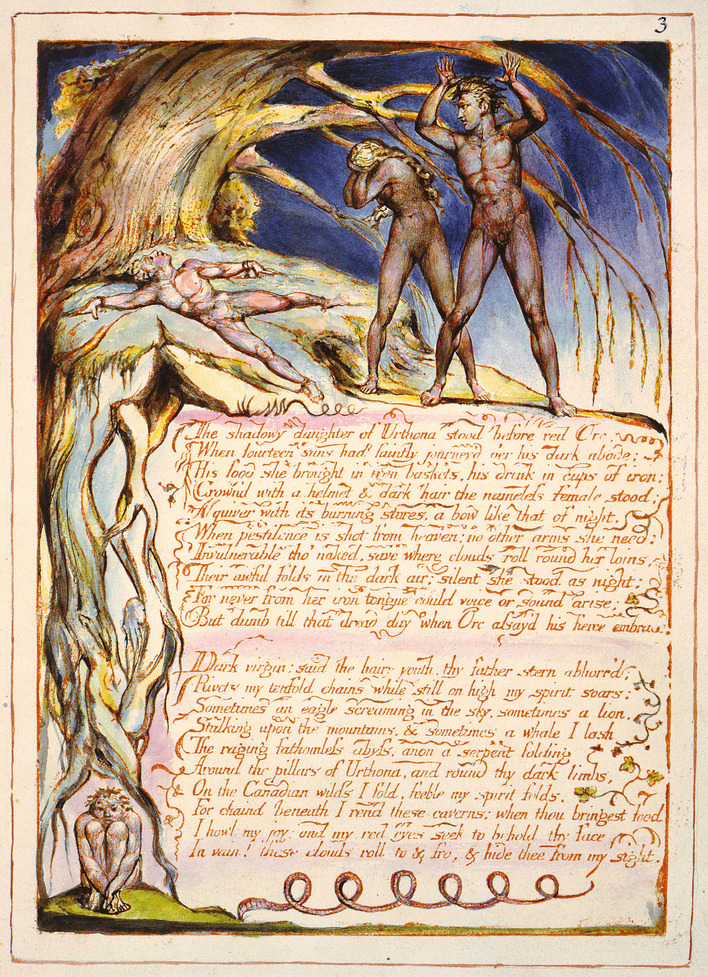
In Hilton's CONTENTS here is text from America:

America, Plate 3, (E 51)

Am1.1; E51    "The shadowy daughter of Urthona stood before red Orc.
Am1.2; E51    When fourteen suns had faintly journey'd o'er his dark abode;
Am1.3; E51    His food she brought in iron baskets, his drink in cups of iron;
Am1.4; E51    Crown'd with a helmet & dark hair the nameless female stood;
Am1.5; E51    A quiver with its burning stores, a bow like that of night,
Am1.6; E51    When pestilence is shot from heaven; no other arms she need:
Am1.7; E51    Invulnerable tho' naked, save where clouds roll round her loins,
Am1.8; E51    Their awful folds in the dark air; silent she stood as night;
Am1.9; E51    For never from her iron tongue could voice or sound arise;
Am1.10; E51  But dumb till that dread day when Orc assay'd his fierce                                    embrace.   

Am1.11; E51  Dark virgin; said the hairy youth, thy father stern abhorr'd;
Am1.12; E51  Rivets my tenfold chains while still on high my spirit soars;
Am1.13; E51  Sometimes an eagle screaming in the sky, sometimes a lion,
Am1.14; E51  Stalking upon the mountains, & sometimes a whale I lash
Am1.15; E51  The raging fathomless abyss, anon a serpent folding

Am1.16; E51  Around the pillars of Urthona, and round thy dark limbs,
Am1.17; E51  On the Canadian wilds I fold, feeble my spirit folds.
Am1.18; E51  For chaind beneath I rend these caverns; when thou bringest food
Am1.19; E51  I howl my joy! and my red eyes seek to behold thy face
Am1.20; E51  In vain! these clouds roll to & fro, & hide thee from my sight."

Wikipedia Commons
America
Plate 3
 
Los (Time) and Enitharmon (Space) children of Enion and Urthona (Nature and Spirit) become themselves the parents of Orc (the spirit of change or revolution.)  

So Blake announces that he will write about things happening in the natural word but clothed in symbols which will hide and reveal reality as befits his myth of  creation, fall, redemption and apocalypse.

We find the daughter of Urthona - a manifestation of Urthona in the Natural World - providing the food of dissension to Orc who is approaching maturity. She is armed with a supply of ideas and the means to direct them, but it takes the awakening of the revolutionary spirit to give them voice. Incidents that demand change repeatedly occur but a clear view of a way forward is not in sight.

Four Zoas, Night VII, Page 79, (E 355)

"Urizen answerd Read my books explore my Constellations 
Enquire of my Sons & they shall teach thee how to War
Enquire of my Daughters who accursd in the dark depths
Knead bread of Sorrow by my stern command for I am God
Of all this dreadful ruin   Rise O daughters at my Stern command

Rending the Rocks Eleth & Uveth rose & Ona rose       
Terrific with their iron vessels driving them across
In the dim air they took the book of iron & placd above
On clouds of death & sang their songs Kneading the bread of Orc
Orc listend to the song compelld hungring on the cold wind
That swaggd heavy with the accursed dough. the hoar frost ragd   
Thro Onas sieve   the torrent rain pourd from the iron pail
Of Eleth & the icy hands of Uveth kneaded the bread
The heavens bow with terror underneath their iron hands
Singing at their dire work the words of Urizens book of iron
While the enormous scrolls rolld dreadful in the heavens above   
And still the burden of their song in tears was poured forth
The bread is Kneaded let us rest O cruel father of children
But Urizen remitted not their labours upon his rock" 
 

Thursday, August 03, 2023

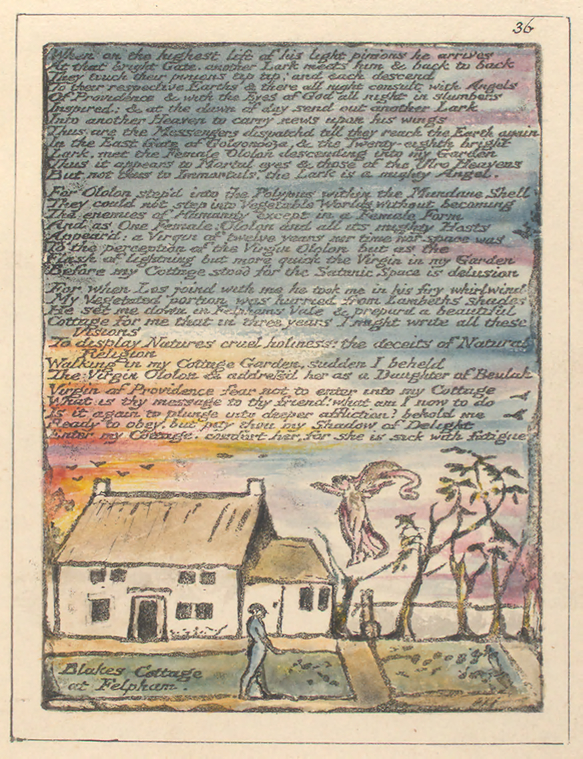
William Blake and His Reader

New York Public Library
Milton
Plate 36

First posted by Larry in Nov 2009

Inspired primarily by Blake's Sublime Allegory (Roger
Easson, p. 313) :

In 1800, when he was 33, Blake went to Felpham (on the
sea) under the sponsorship of a wealthy man who pretended
an interest in his welfare (Blake was well nigh starving
about that time).

In his Preface to Jerusalem he spoke of returning from the
sea. He was disillusioned because he had hoped for a
spiritual friend, but found a corporeal one.

"Corporeal Friends are Spiritual Enemies" (in Milton,
4.26; E98 and again in Jerusalem, 44.10; E193)

Blake was disillusioned with the public; they had failed
to show him any interest or respect.

Easson tells us that in Jerusalem the disillusioned poet
attempted to promote a dialogue with his readers (that's
us). With a typical prophetic attitude he expected a
response-- . Prophets don't say things to please their
listeners but to arouse them, provoke them, above all
awaken them
. Like Ezekiel Blake had "the desire of
raising other men to a perception of the Infinite"
(MHH13; Erdman 39).

In Jerusalem Blake is deliberately illusive (every Plate
might be thought of as a detective story or a crossword
puzzle). He means us to read it-- and consider! Like his
Vision of Christ in The Everlasting Gospel "he spoke in
parables to the blind".

Blake had been well received by a (very!) few from whom
their "love and friendship" was the highest reward. In
the preface he asks for our love and friendship; it can
only be reached through "the severe contentions of [true!]
friendship."

Blake took the freedom to contend with us, and whether or
to what degree we can respond creatively depends upon us.

Has anyone ever fully understood Blake? Ah! that's the
challenge.


Tuesday, August 01, 2023

WAR

Wikipedia Commons
America 
Plate 6, Copy a

War is Blake's method of separating Truth from Error. The condition of War in Eternity is the clash of ideas or as David Erdman writes in Prophet Against Empire on Page 356, the separation of 'wheat from chaff.'

Blake distinguishes between the Wars of Man which in Eternity are experienced as visionary, and the violent conflicts with which we are familiar. Ololon looking down into our world sees that War has become the vehicle of decay & death. Ideas are meant to be expressions of the Divine Vision and not cause for bitterness and terror.

Milton, Plate 34 [38], (E 134) 
"And Ololon looked down into the Heavens of Ulro in fear
They said. How are the Wars of Man which in Great Eternity       
Appear around, in the External Spheres of Visionary Life
Here renderd Deadly within the Life & Interior Vision
How are the Beasts & Birds & Fishes, & Plants & Minerals
Here fixd into a frozen bulk subject to decay & death?
Those Visions of Human Life & Shadows of Wisdom & Knowledge      
Plate 35 [39]
Are here frozen to unexpansive deadly destroying terrors[.]
And War & Hunting: the Two Fountains of the River of Life
Are become Fountains of bitter Death & of corroding Hell
Till Brotherhood is changd into a Curse & a Flattery
By Differences between Ideas, that Ideas themselves, (which are  
The Divine Members) may be slain in offerings for sin"

Blake writes of the transition from corporeal war to mental war as The Four Zoas is brought to a close "as an extended song of harvest." Erdman furnishes the details. "Enion and Tharmas are at last united, appearing in Eden as innocent boy and girl in Eternal Childhood, he the rivers and seas, she the moon that woos them. ...The clouds of war dissipate and sink into the Seas of Tharmas. "... 

"Urizen combines the drying and cutting operations, and the winnowing is done by Tharmas as Tongue making the honest man's ultimate separation of wheat from chaff, exulting over the downfall of the great Whore and and all her "Kings & Councellors & Giant Warriors":

Four Zoas, Night IX, Page 134, (E 402)
"O Mystery Fierce Tharmas cries Behold thy end is come Art thou she that made the nations drunk with the cup of Religion Go down ye Kings & Councellors & Giant Warriors Go down into the depths go down & hide yourselves beneath Go down with horse & Chariots & Trumpets of hoarse war Lo how the Pomp of Mystery goes down into the Caves Her great men howl & throw the dust & rend their hoary hair Her delicate women & children shriek upon the bitter wind Spoild of their beauty their hair rent & their skin shriveld up Lo darkness covers the long pomp of banners on the wind And black horses & armed men & miserable bound captives Where shall the graves recieve them all & where shall be their place And who shall mourn for Mystery who never loosd her Captives Let the slave grinding at the mill run out into the field Let him look up into the heavens & laugh in the bright air Let the inchaind soul shut up in darkness & in sighing Whose face has never seen a smile in thirty weary years Rise & look out his chains are loose his dungeon doors are open And let his wife & children return from the opressors scourge They look behind at every step & believe it is a dream Are these the Slaves that groand along the streets of Mystery Where are your bonds & task masters are these the prisoners Where are your chains where are your tears why do you look around If you are thirsty there is the river go bathe your parched limbs The good of all the Land is before you for Mystery is no more Then All the Slaves from every Earth in the wide Universe Sing a New Song drowning confusion in its happy notes While the flail of Urizen sounded loud & the winnowing wind of Tharmas So loud so clear in the wide heavens & the song that they sung was this Composed by an African Black from the little Earth of Sotha"

After referring to the above passage near the end of the Four Zoas, Erdman continues: 

"This is the end so long foretold, and now Tharmas recites the beginning foretold in America, repeating Blake' paraphrase of the second and third demands of the Declaration of Independence, Life having been attained. The slaves and prisoners attaining Liberty are urged to pursue their Happiness as earth-owners, free of religion's tithes: The good of all the Land is before you for Mystery is no more"

Declaration of Independence

"all men are created equal, that they are endowed by their Creator with certain unalienable Rights, that among these are Life, Liberty and the pursuit of Happiness."

America, Plate 6, (E 53)

"The morning comes, the night decays, the watchmen leave their stations;
The grave is burst, the spices shed, the linen wrapped up;
The bones of death, the cov'ring clay, the sinews shrunk & dry'd.
Reviving shake, inspiring move, breathing! awakening!
Spring like redeemed captives when their bonds & bars are burst; 

Let the slave grinding at the mill, run out into the field:
Let him look up into the heavens & laugh in the bright air;
Let the inchained soul shut up in darkness and in sighing,
Whose face has never seen a smile in thirty weary years;
Rise and look out, his chains are loose, his dungeon doors are open.     
And let his wife and children return from the opressors scourge;
They look behind at every step & believe it is a dream.
Singing. The Sun has left his blackness, & has found a fresher morning
And the fair Moon rejoices in the clear & cloudless night;
For Empire is no more, and now the Lion & Wolf shall cease." 
Matthew 3
[11] I indeed baptize you with water unto repentance: but he that
 cometh after me is mightier than I, whose shoes I am not worthy to 
bear: he shall baptize you with the Holy Ghost, and with fire:
[12] Whose fan is in his hand, and he will throughly purge his floor, and gather his wheat into the garner; but he will burn up the chaff with unquenchable fire.

[13] Then cometh Jesus from Galilee to Jordan unto John, to be baptized of him.