Wednesday, December 20, 2023

ESCAPING FROM DEVILS


Illustrations to Divine Comedy
Hell Canto 23
Dante and Virgil Escaping from the Devils

The more attractive illustrations Blake made to Dante's Divine Comedy are those in which the pilgrims succeed in passing through threats or impediments. Although a large share of the illustrations involve cruel punishments realistically portrayed, there are beautiful images too. The trust and friendship between Virgil and Dante is apparent in this image of the two of them escaping from the devils. 

Divine Comedy

28  "For even now your thoughts have joined my own;
in both our acts and aspects we are kin—
with both our minds I’ve come to one decision.

If that right bank is not extremely steep,
we can descend into the other moat
and so escape from the imagined chase.”

He’d hardly finished telling me his plan
when I saw them approach with outstretched wings,
not too far off, and keen on taking us.

My guide snatched me up instantly, just as
the mother who is wakened by a roar
and catches sight of blazing flames beside her,

will lift her son and run without a stop—
she cares more for the child than for herself—
not pausing even to throw on a shift;

and down the hard embankment’s edge—his back
lay flat along the sloping rock that closes
one side of the adjacent moat—he slid.

No water ever ran so fast along
a sluice to turn the wheels of a land mill,
not even when its flow approached the paddles,

as did my master race down that embankment
while bearing me with him upon his chest,
just like a son, and not like a companion.

His feet had scarcely reached the bed that lies
along the deep below, than those ten demons
were on the edge above us
; but there was

nothing to fear; for that High Providence
that willed them ministers of the fifth ditch,
denies to all of them the power to leave it."


Jerusalem, Plate 91, (E 251)

"I have tried to make friends by corporeal gifts but have only 
 Made enemies: I never made friends but by spiritual gifts; 
By severe contentions of friendship & the burning fire of thought. 
He who would see the Divinity must see him in his Children 
 One first, in friendship & love; then a Divine Family, & in the midst 
Jesus will appear; so he who wishes to see a Vision; a perfect Whole 
 Must see it in its Minute Particulars;"

Milton, Plate 29 [31], (E 127)

"And every Seven Ages is Incircled with a Flaming Fire.
Now Seven Ages is amounting to Two Hundred Years
Each has its Guard.
each Moment Minute Hour Day Month & Year.
All are the work of Fairy hands of the Four Elements
The Guard are Angels of Providence on duty evermore
Every Time less than a pulsation of the artery
Is equal in its period & value to Six Thousand Years.
PLATE 29 [31]
For in this Period the Poets Work is Done: and all the Great
Events of Time start forth & are concievd in such a Period
Within a Moment: a Pulsation of the Artery."

Jerusalem, Plate 45 [31], (E 194) 
"What shall I do! what could I do, if I could find these Criminals
I could not dare to take vengeance; for all things are so constructed    
And builded by the Divine hand, that the sinner shall always escape,
And he who takes vengeance alone is the criminal of Providence;
If I should dare to lay my finger on a grain of sand
In way of vengeance; I punish the already punishd: O whom
Should I pity if I pity not the sinner who is gone astray!       
O Albion, if thou takest vengeance; if thou revengest thy wrongs
Thou art for ever lost! What can I do to hinder the Sons
Of Albion from taking vengeance? or how shall I them perswade.

So spoke Los, travelling thro darkness & horrid solitude:"

Friday, December 15, 2023

DANTE & EDEN

First posted May 2012

Blake had reservations about creating the illustrations for Dante's Divine Comedy. Dante's ideas of sin, punishment, and a God of vengeance were far from the image of God Blake knew from experience. Although he often created his illustrations with complete adherence to Dante's descriptions, as opportunity arose Blake altered the images to convey his own ideas.

Jerusalem, Plate 22, (E 168)
"Jerusalem then stretchd her hand toward the Moon & spoke
Why should Punishment Weave the Veil with Iron Wheels of War
When Forgiveness might it Weave with Wings of Cherubim" 
Jerusalem, Plate 31 [35], (E 177)
"And the Divine voice came from the Furnaces, as multitudes without
Number! the voices of the innumerable multitudes of Eternity.
And the appearance of a Man was seen in the Furnaces;            
Saving those who have sinned from the punishment of the Law,
(In pity of the punisher whose state is eternal death,)
And keeping them from Sin by the mild counsels of his love."
Inscriptions, On Blake's Illustrations to Dante, (E 688)
"Whatever Book is for Vengeance for Sin & whatever Book is
Against the Forgiveness of Sins is not of the Father but of Satan
the Accuser & Father of Hell" 
British Museum
Illustrations to Dante's Divine Comedy
'Beatrice on the car, Matilda and Dante'
One illustration which Blake seems to have taken pleasure in working on is titled Beatrice on the car, Matilda and Dante. Dante has arrived at the river Lethe having passed through purgatory. Virgil who has been his guide through hell and purgatory was not to cross over with him to Eden, the Earthly Paradise, because he was a pagan. Henceforth Dante's guide will be Beatrice who awaits him in the procession on the far bank. The procession is composed of entities from the Book of Revelation: the candelabra with seven candles, the four-and-twenty elders and the Griffin drawing the car in which Beatrice rides. The Griffin which is a combination of two animals, was used by Dante to symbolize Christ who is of a double nature. A point of disagreement between Dante and Blake concerns Beatrice who represents to Dante the church, which to Blake was not the sole vehicle for salvation but a fallen flawed institution.  

The blessedness of Eden is represented in the light which radiates from the candelabra and stretches across the heavens in a rainbow. Dante is prepared to cross the river Lethe and bathe in its waters which will wash away his memories. He will cross another river also; the Eunoe whose waters will restore happy, helpful, life-giving memories to carry with him to the upper heavens.

Although Blake portrayed a positive uplifting scene, you may notice a long string of clouds surrounding much of the procession; these are the type of clouds which Blake associates with Vala who was in such opposition to Jerusalem. This is a reminder that Dante's system diverged from the truth Blake perceived.

Canto 30-32

"I saw the lady who had first appeared
to me beneath the veils of the angelic
flowers look at me across the stream.

Although the veil she wore—down from her head,
which was encircled by Minerva’s leaves—
did not allow her to be seen distinctly,

her stance still regal and disdainful, she
continued, just as one who speaks but keeps
until the end the fiercest parts of speech:

“Look here! For I am Beatrice, I am!
How were you able to ascend the mountain?
Did you not know that man is happy here?”

My lowered eyes caught sight of the clear stream,
but when I saw myself reflected there,
such shame weighed on my brow, my eyes drew back
...
He fell so far there were no other means
to lead him to salvation, except this:
to let him see the people who were lost.

For this I visited the gateway of
the dead; to him who guided him above
my prayers were offered even as I wept.

The deep design of God would have been broken
if Lethe had been crossed and he had drunk
such waters but had not discharged the debt

of penitence that’s paid when tears are shed.”...

Then, when my heart restored my outer sense,
I saw the woman whom I’d found alone,
standing above me, saying: “Hold, hold me!”

She’d plunged me, up to my throat, in the river,
and, drawing me behind her, she now crossed,
light as a gondola, along the surface.

When I was near the blessed shore, I heard
“Asperges me” so sweetly sung that I
cannot remember or, much less, transcribe it.

The lovely woman opened wide her arms;
she clasped my head, and then she thrust me under
to that point where I had to swallow water.

That done, she drew me out and led me, bathed,
into the dance of the four lovely women;
and each one placed her arm above my head..."

Thursday, December 14, 2023

BEATRICE & DANTE

Wikipedia Commons
Illustrations to Dante's Divine Comedy
Beatrice Addressing Dante

Dante stands on the right side of the Griffin which has the head and wings of an eagle, and the body of a lion. The Griffin represents the dual nature of Christ, man and God. The women represent the Christian virtues of hope (green), charity (red) and faith (white). The four encircled heads stand for the four gospel writers: Matthew the man, Mark the lion, Luke the ox, and John the eagle. Beatrice delivers her message from the chariot. In the Book of Ezekiel the four living creatures are covered with eyes all around. The Book of Revelation tells us:
4:8 And the four beasts had each of them six wings about him; and they were full of eyes within: and they rest not day and night, saying, Holy, holy, holy, Lord God Almighty, which was, and is, and is to come. 

In this section Beatrice addresses Dante after his guide Virgil has been left behind.

Canto 29

50 “Dante, though Virgil’s leaving you, do not
yet weep, do not weep yet; you’ll need your tears
for what another sword must yet inflict.”


73 “Look here! For I am Beatrice, I am!
How were you able to ascend the mountain?
Did you not know that man is happy here?”

My lowered eyes caught sight of the clear stream,
but when I saw myself reflected there,
such shame weighed on my brow
, my eyes drew back

and toward the grass; just as a mother seems
harsh to her child, so did she seem to me—
how bitter is the savor of stern pity!

100 Still standing motionless upon the left
side of the chariot, she then addressed
the angels who had been compassionate:

“You are awake in never—ending day,
and neither night nor sleep can steal from you
one step the world would take along its way;

therefore, I’m more concerned that my reply
be understood by him who weeps beyond,
so that his sorrow’s measure match his sin.


121 My countenance sustained him for a while;
showing my youthful eyes to him, I led
him with me toward the way of righteousness.

As soon as I, upon the threshold of
my second age, had changed my life, he took
himself away from me and followed after

another; when, from flesh to spirit, I
had risen, and my goodness and my beauty
had grown, I was less dear to him, less welcome:

he turned his footsteps toward an untrue path;
he followed counterfeits of goodness, which
will never pay in full what they have promised.

136 He fell so far there were no other means
to lead him to salvation, except this:
to let him see the people who were lost.


For this I visited the gateway of
the dead; to him who guided him above
my prayers were offered even as I wept.

The deep design of God would have been broken
if Lethe had been crossed and he had drunk
such waters but had not discharged the debt
of penitence that’s paid when tears are shed.”


This is what Blake has to say about sin, repentance, vengeance, and forgiveness.

Jerusalem, Plate 77, (E 232) 
"But Jesus is the bright Preacher of Life
Creating Nature from this fiery Law,
By self-denial & forgiveness of Sin.

Go therefore, cast out devils in Christs name
Heal thou the sick of spiritual disease           
Pity the evil, for thou art not sent
To smite with terror & with punishments
Those that are sick, like the Pharisees
Crucifying &,encompassing sea & land
For proselytes to tyranny & wrath,                
But to the Publicans & Harlots go!
Teach them True Happiness, but let no curse
Go forth out of thy mouth to blight their peace
For Hell is opend to heaven; thine eyes beheld
The dungeons burst & the Prisoners set free." 
Jerusalem, Plate 25, (E 170)
"Why did you take Vengeance O ye Sons of the mighty Albion?
Planting these Oaken Groves: Erecting these Dragon Temples
Injury the Lord heals but Vengeance cannot be healed:            
As the Sons of Albion have done to Luvah: so they have in him
Done to the Divine Lord & Saviour, who suffers with those that suffer:
For not one sparrow can suffer, & the whole Universe not suffer also,
In all its Regions, & its Father & Saviour not pity and weep.
But Vengeance is the destroyer of Grace & Repentance in the bosom
Of the Injurer: in which the Divine Lamb is cruelly slain:
Descend O Lamb of God & take away the imputation of Sin
By the Creation of States & the deliverance of Individuals Evermore Amen"
Jerusalem, Plate 61, (E 211)
"Behold: in the Visions of Elohim Jehovah, behold Joseph & Mary   
And be comforted O Jerusalem in the Visions of Jehovah Elohim

She looked & saw Joseph the Carpenter in Nazareth & Mary
His espoused Wife. And Mary said, If thou put me away from thee
Dost thou not murder me? Joseph spoke in anger & fury. Should I  
Marry a Harlot & an Adulteress? Mary answerd, Art thou more pure
Than thy Maker who forgiveth Sins & calls again Her that is Lost
Tho She hates. he calls her again in love. I love my dear Joseph
But he driveth me away from his presence. yet I hear the voice of God
In the voice of my Husband. tho he is angry for a moment, he will not      
Utterly cast me away. if I were pure, never could I taste the sweets
Of the Forgiveness of Sins! if I were holy! I never could behold the tears
Of love! of him who loves me in the midst of his anger in furnace of fire.

Ah my Mary: said Joseph: weeping over & embracing her closely in
His arms: Doth he forgive Jerusalem & not exact Purity from her who is
Polluted. I heard his voice in my sleep O his Angel in my dream:

Saying, Doth Jehovah Forgive a Debt only on condition that it shall
Be Payed? Doth he Forgive Pollution only on conditions of Purity
That Debt is not Forgiven! That Pollution is not Forgiven
Such is the Forgiveness of the Gods, the Moral Virtues of the    
Heathen, whose tender Mercies are Cruelty. But Jehovahs Salvation
Is without Money & without Price, in the Continual Forgiveness of Sins
In the Perpetual Mutual Sacrifice in Great Eternity! for behold!
There is none that liveth & Sinneth not! And this is the Covenant
Of Jehovah: If you Forgive one-another, so shall Jehovah Forgive You:    
That He Himself may Dwell among You. Fear not then to take
To thee Mary thy Wife, for she is with Child by the Holy Ghost

Then Mary burst forth into a Song! she flowed like a River of
Many Streams in the arms of Joseph & gave forth her tears of joy
Like many waters, and Emanating into gardens & palaces upon
Euphrates & to forests & floods & animals wild & tame from
Gihon to Hiddekel, & to corn fields & villages & inhabitants
Upon Pison & Arnon & Jordan. And I heard the voice among
The Reapers Saying, Am I Jerusalem the lost Adulteress? or am I
Babylon come up to Jerusalem? And another voice answerd Saying   

Does the voice of my Lord call me again? am I pure thro his Mercy
And Pity. Am I become lovely as a Virgin in his sight who am
Indeed a Harlot drunken with the Sacrifice of Idols does he
Call her pure as he did in the days of her Infancy when She
Was cast out to the loathing of her person. The Chaldean took
Me from my Cradle. The Amalekite stole me away upon his Camels
Before I had ever beheld with love the Face of Jehovah; or known
That there was a God of Mercy: O Mercy O Divine Humanity!
O Forgiveness & Pity & Compassion! If I were Pure I should never
Have known Thee; If I were Unpolluted I should never have        
Glorified thy Holiness, or rejoiced in thy great Salvation.

Mary leaned her side against Jerusalem, Jerusalem recieved
The Infant into her hands in the Visions of Jehovah. Times passed on
Jerusalem fainted over the Cross & Sepulcher She heard the voice
Wilt thou make Rome thy Patriarch Druid & the Kings of Europe his
Horsemen? Man in the Resurrection changes his Sexual Garments at will
Every Harlot was once a Virgin: every Criminal an Infant Love!

PLATE 62
Repose on me till the morning of the Grave. I am thy life."

Sunday, December 10, 2023

DANTE'S HELL

Illustrations to Dante's The Divine Comedy
The Angel at the Gate of the City of Dis

In order to continue their journey through the underworld Virgil and Dante needed assistance in transitioning from the Inferno to the Pergatorio. First Lucia carried the sleeping Dante up the steepest assent out of Hell. But they arrived at a locked gate guarded by Dis (or Satan or Pluto.) Virgil called for assistance and an Angel was sent to unlock the gate so that they could enter the outer reaches of Purgatory and continue their travels.

Blake portrays Virgil and Dante outside the wall. They are both fearful: Dante that they will never get out of hell, and Virgil that the help that they needed would never arrive. Above the gate in the wall, the Furies who determined the span of a human's life, threatened the travelers. When the Angel arrived he carried a wand whose touch effortlessly opened the gate.

This passage in Dante would have been one of the more pleasing for Blake to illustrate. Blake understood that Divine Intervention was required in desperate situations. When blocked by closed pathways and unfounded fears, the circumstances may necessitate help from the very force which had initiated the journey. Dante and Virgil are pictured as small and cowering in despair. The Angel is large and strong, fully capable of accomplishing his assignment.

Matthew 17
[20] If ye have faith as a grain of mustard seed, ye shall say unto this mountain, Remove hence to yonder place; and it shall remove; and nothing shall be impossible unto you.

Dante Alighieri
Canto IX

“O my lov’d guide! who more than seven times
Security hast render’d me, and drawn
From peril deep, whereto I stood expos’d,
Desert me not,” I cried, “in this extreme.
And if our onward going be denied,
Together trace we back our steps with speed.”

My liege, who thither had conducted me,
Replied: “Fear not: for of our passage none
Hath power to disappoint us, by such high
Authority permitted. But do thou
Expect me here; meanwhile thy wearied spirit
Comfort, and feed with kindly hope, assur’d
I will not leave thee in this lower world.” 

...and even now
On this side of its entrance, down the steep,
Passing the circles, unescorted, comes
One whose strong might can open us this land
.” 


 Jerusalem, Plate 62, (E 213)

"Jesus replied. I am the Resurrection & the Life.
I Die & pass the limits of possibility, as it appears
To individual perception. Luvah must be Created                  
And Vala; for I cannot leave them in the gnawing Grave.
But will prepare a way for my banished-ones to return
Come now with me into the villages. walk thro all the cities.
Tho thou art taken to prison & judgment, starved in the streets
I will command the cloud to give thee food & the hard rock       
To flow with milk & wine, tho thou seest me not a season
Even a long season & a hard journey & a howling wilderness!
Tho Valas cloud hide thee & Luvahs fires follow thee!
Only believe & trust in me, Lo. I am always with thee!"

Marriage of Heaven and Hell, Plate 21, (E 43)

 "Have now another plain fact: Any man of mechanical talents
may from the writings of Paracelsus or Jacob Behmen, produce ten
thousand volumes of equal value with Swedenborg's.
and from those of Dante or Shakespear, an infinite number.
  But when he has done this, let him not say that he knows
better than his master, for he only holds a candle in sunshine."
Inscriptions, (E 690) 
   "It seems as if Dantes supreme Good was something Superior to
the Father or Jesus [as] <for> if he gives his rain to
the Evil & the Good & his Sun to the just & the Unjust He could
never have Builded Dantes Hell nor the Hell of the Bible neither
in the way our Parsons explain it   It must have been originally
Formed by the Devil Himself & So I understand it to have been
     Whatever Book is for Vengeance for Sin & whatever Book is
Against the Forgiveness of Sins is not of the Father but of Satan
the Accuser & Father of Hell"

Letters, (E 781)
"Mr Linnell, Cirencester Place, Fitzroy Square
[February 1827]
Dear Sir
     I thank you for the Five Pounds recievd to Day am getting
better every Morning but slowly. as I am still feeble &
tottering. tho all the Symptoms of
my complaint seem almost gone as the fine weather is very
beneficial & comfortable to me I go on as I think improving my
Engravings of Dante more & more & shall soon get Proofs of these
Four which I have & beg the favor of you to send me the two
Plates of Dante which you have that I may finish them
sufficiently to make some Shew of Colour & Strength"


Notes from post by John Stamps

"A pentecostal wind announces the arrival of a great spiritual power: “A sound like the sound of a violent wind.” A great spiritual siege is about to erupt against the malevolent forces of darkness.

... God sends us an anonymous angel. 

...He holds a wand — a little tiny wand!

...All the warnings by the demons and the Furies were one-hundred-and-ten percent bluster and bluff. Virgil and Dante enter the iron walls of Dis completely unopposed.

...We see how the demons bluster, bluff, and threaten us. But we know their only power is deceit and deception. If you buy the lies of the demons, their power is terrifying."


Monday, November 27, 2023

Church 8

Fitzwilliam Museum
Songs of Innocence and of Experience
Plate 45,Copy AA

What he Said

        In 'Songs of Experience' Blake expressed some biting truths about the  place of the church in the lives of ordinary people:

"A little black thing among the snow,
Crying "'weep! 'weep!" in notes of woe!
"Where are thy father & mother? Say?"
They are both gone up to the church to
pray. Because I was happy upon the heath,
And smil'd among the winter's snow,
They clothed me in the clothes of death,
And taught me to sing the notes of woe.
And because I am happy & dance & sing,
They think they have done me no injury,
And are gone to praise God & his Priest & King,
Who make up a heaven of our misery."    

(The Chimney Sweeper from Songs of Experience, Song 37, (E 22))     

 Surely the church has become more human since Blake's day, when it could condone the employment of five year olds as chimney sweepers and in fact their legal sale by their parents for such a purpose. Even more bald in its
ecclesiastical implications is The Little Vagabond, which sounds very much like a Ranter's song:

  "Dear Mother, dear Mother, the Church is cold,
 But the Ale-house is healthy & pleasant & warm;
 Besides I can tell where I am used well,
Such usage in heaven will never do well.
 But if at the Church they would give us some Ale,
And a pleasant fire our souls to regale,
We'd sing and we'd pray all the live-long day,
Nor ever once wish from the Church to stray.
Then the Parson might preach, & drink, & sing,
And we'd be as happy as birds in the spring;
And modest dame Lurch, who is always at Church,
Would not have bandy children, nor fasting, nor birch.
And God, like a father rejoicing to see
His children as pleasant and happy as he,
Would have no more quarrel with the Devil or the Barrel,
But kiss him, & give him both drink and apparel."
      (The Little Vagabond, Song 45, (E 26) )

       In Europe, written about the same time, Blake recounts the degradation of the church with the cult of chivalry and the Queen of Heaven:

"Now comes the night of Enitharmon's joy!
Who shall I call? Who shall I send,
That Woman, lovely Woman, may have dominion?
Arise, O Rintrah, thee I call! & Palambron, thee!
Go! tell the Human race that Woman's love is Sin;
That an Eternal life awaits the worms of sixty winters
In an allegorical abode where existence hath never come.
Forbid all Joy, & from her childhood shall the little female
Spread nets in every secret path."
      (Europe 5:1ff, (E 62) )

       Enitharmon's grammar in the second line indicates her essential falsity,
assuming the place of the true God (See Isaiah 6 ). But after 1800 Blake
rehabilitates Enitharmon, and Rahab becomes his symbol of the false church;
she continually afflicts Jerusalem and finally crucifies Jesus (See 4Z and J).
Blake used the word 'church' in some rather unconventional ways. In Milton,
Plate 37 and later in 'Jerusalem' Plate 76 he divided human history into 27
Churches, made up of three groups. The first corresponds to the nine
antediluvian patriarchs (Adam to Lamech) taken from Genesis 5. The second
group includes the patriarchs from Noah to Terah, the father of Abraham. For
the third series Blake chose seven famous religious leaders from Abraham to
Luther; each of these represents for Blake a certain type or phase of religious
history:

       The first two groups were druidic (devoted to cultic murder), but Abraham
began to curtail human sacrifice when he chose a ram instead of Issac (See
Genesis 22 ). Moses brought the Law; Solomon represents Wisdom. Paul
represents the early Christian Church. Constantine marks its embrace by the
highest satanic power. Charlemayne founded the Holy Roman Empire, and
Luther brings us to the modern age. All of these except Paul resorted to war;
therefore Blake referred to these Churches as "Religion hid in war".

       Blake felt that he had described a natural progression going nowhere for
"where Luther ends, Adam begins again in Eternal Circle", but this "Eternal
Circle" is interrupted by Jesus, who, "breaking thro' the Central zones of Death & Hell,/ Opens Eternity in Time & Space, triumphant in Mercy". There in its most concentrated form is Blake's 6000 year history of the church.

       Bear in mind that 27 is a super sinister number; Frye described it as "the
cube of thee, the supreme aggravation of three". A happier constellation of 28 (a composite of the complete numbers four and seven) occurs in Jerusalem where England's cathedral cities are called the Friends of Albion. With this image Blake  recognized that in spite of all its sins the church had exercised a beneficent influence upon the course of history. Blake habitually picked one of these cities to represent an important historical personage.

       For example Ely, the cathedral city of Cambridgeshire, stands for Milton, the greatest man produced by Cambridge. Verulam, an ancient name for
Canterbury, represents Francis Bacon , one of Blake's chief devils. Professor
Erdman informed us that Bath represents Rev. Richard Warner, a courageous
minister who preached against war in 1804, when to do such a thing bordered
on sedition. Blake's admiration for Warner led to the prominence which he gave Bath in the second chapter of Jerusalem.

      Aside from these prophetic and poetic excursions the Blakean doctrine of
the church found in the myth is roughly as follows: The Church is Beulah. The
majority of the population exist beneath it, spiritually asleep, living what Blake
called Eternal Death without even a murmur of discontent. Their eyes are closed to the spirit. They are seeds that do not generate. The hungry generally take refuge in a church and surrender their spiritual destiny into the keeping of a priest or a priestly community.

    A few still suffer hunger and eventually may come out into the sunlight .
That chosen few are, like Blake, compelled to live in a state of tension with the
church that belongs to the world. The best of them continually court martyrdom and may be honored posthumously if at all. But of such is the kingdom of heaven, where like Blake they cast off the enslavement of other men's systems and create their own.

       (Nels Ferre, who may or may not have known Blake, wrote a short parable
that describes the Blakean doctrine of the church as well or better than Frye did. It appears in the beginning of a small book entitled The Sun and the Umbrella. The image of the church as an umbrella keeping us from the full force of the Sun is compelling and quite Blakean.

(See also Religion and War)
 

Tuesday, November 21, 2023

ETERNAL LIFE

Wikipedia Commons
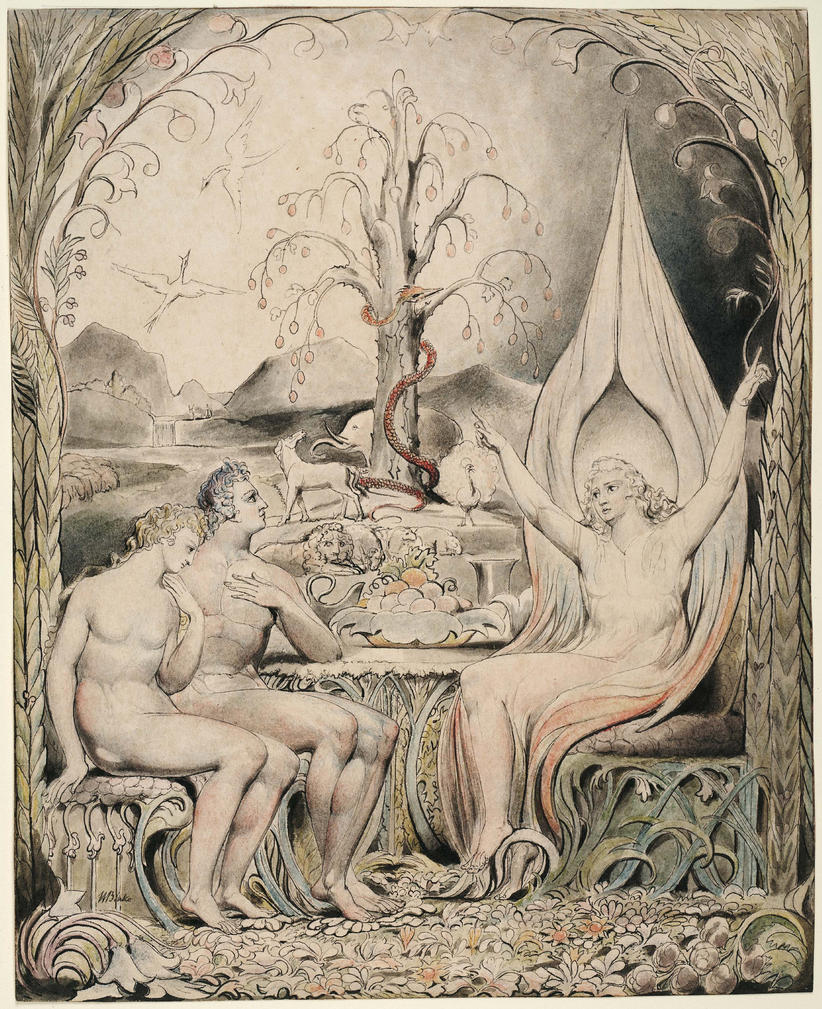
Paradise Lost
Object 6, Thomas Set
Raphael Warns Adam and Eve

Time is the illusion, Eternity is the real. Time comes to us as particles, Eternity as a whole. Time is scattered, Eternity is indivisible.

Time is nourished by Eternity which has no hunger because it is complete. 

If one believes that God created man in his own image, one recognizes in oneself a spiritual nature. One's body is a material gift for one's spirit to use in the material world. Body and spirit become one during the mortal life. 

Perhaps it is easier for a young person to think of him/herself as a body because he or she has not encountered difficulties in life that called on resources beyond those of a physical body. If a person is challenged by loss or sadness, by personal deficiencies, or by threatening destructive forces, he or she may be compelled to look beyond the physical to the intangible mental, spiritual and emotional resources within.

Such experiences may provide the first glimmer to a person that he or she lives in the eternal world as well as in the natural world. The natural life has a beginning and an ending but the spark of eternity is not extinguished with mortal death.

Gospel of Thomas
Verse 29 
Jesus said, "If the flesh came into being because of spirit, that is a marvel,
but if spirit came into being because of the body, that is a marvel of marvels.
Yet I marvel at how this great wealth has come to dwell in this poverty." 

Songs of Innocence and of Experience, Plate 52, (E 30)

"To Tirzah                                     
Whate'er is Born of Mortal Birth,
Must be consumed with the Earth
To rise from Generation free;
Then what have I to do with thee?

The Sexes sprung from Shame & Pride
Blow'd in the morn: in evening died
But Mercy changd Death into Sleep;
The Sexes rose to work & weep.

Thou Mother of my Mortal part.
With cruelty didst mould my Heart. 
And with false self-decieving tears,
Didst bind my Nostrils Eyes & Ears.

Didst close my Tongue in senseless clay
And me to Mortal Life betray:
The Death of Jesus set me free, 
Then what have I to do with thee?

[text on illustration: It is Raised a Spiritual Body]"

Jerusalem, Plate 1, (E 144)

"There is a Void, outside of Existence, which if enterd into
Englobes itself & becomes a Womb, such was Albions Couch
A pleasant Shadow of Repose calld Albions lovely Land

His Sublime & Pathos become Two Rocks fixd in the Earth
His Reason his Spectrous Power, covers them above                
Jerusalem his Emanation is a Stone laying beneath
O [Albion behold Pitying] behold the Vision of Albion 

Half Friendship is the bitterest Enmity said Los
As he enterd the Door of Death for Albions sake Inspired
The long sufferings of God are not for ever there is a Judgment 

Every Thing has its Vermin O Spectre of the Sleeping Dead!"

Vision of Last Judgment, (E 555) 

"This world of Imagination is the World of Eternity it is the Divine bosom into which we shall all go after

the death of the Vegetated body This World of Imagination is Infinite & Eternal whereas the world of Generation or Vegetation is Finite & Temporal There Exist in that Eternal World the Permanent Realities of Every Thing which we see are reflected in this Vegetable Glass of Nature   All Things are comprehended in their Eternal Forms in the Divine body of the Saviour the True Vine of Eternity  The Human Imagination who appeard to Me as Coming to Judgment. among his Saints & throwing off the Temporal that the Eternal might be Establishd. around him were seen the Images of Existences according to a certain order suited to my Imaginative Eye"

Milton, Plate 41 [48] (E 143) 
"we Contraries O Milton, Thou & I            
O Immortal! how were we led to War the Wars of Death
Is this the Void Outside of Existence, which if enterd into
Plate 42 [49]                
Becomes a Womb? & is this the Death Couch of Albion
Thou goest to Eternal Death & all must go with thee

So saying, the Virgin divided Six-fold & with a shriek
Dolorous that ran thro all Creation a Double Six-fold Wonder!
Away from Ololon she divided & fled into the depths              
Of Miltons Shadow as a Dove upon the stormy Sea.

Then as a Moony Ark Ololon descended to Felphams Vale
In clouds of blood, in streams of gore, with dreadful thunderings
Into the Fires of Intellect that rejoic'd in Felphams Vale
Around the Starry Eight: with one accord the Starry Eight became 
One Man Jesus the Saviour. wonderful!"

Saturday, November 18, 2023

Forgiving God

Wikipedia Commons
The Soldiers Casting Lots for Christ's Garments

From Ram Horn'd with Gold with added image and quotes.

The Neo-platonic interpreters have theorized that Blake couldn't forgive the creator for condemning us to this prison house of mortal life. I think a more universal explanation fits the facts. Everyone has difficulty forgiving his father and/or creator for the dimensions of horror in life which threaten in one way or another to overwhelm the psyche. Few or none of us have done a really adequate job of this. Most often we've repressed the sensitive idealist; we've closed off from consciousness those unpleasant ultimate realities which seem to have no answer.

"Did he who made the Lamb make thee?" Has anyone really asked that question since 1794? Neitszche asked it and went crazy. In our generation Jung has come closest, and that's what makes him great. Most of us, even the best of Christians, have partitioned off and closed out that ultimate question, the ultimate doubt expressed by the dying Saviour on the cross. This William Blake could not do; like Jesus he was condemned to face consciously the penalty of our finitude. 

Psalms 22

[1] My God, my God, why hast thou forsaken me? why art thou so far from helping me, and from the words of my roaring?

Matthew 27

[46] And about the ninth hour Jesus cried with a loud voice, saying, Eli, Eli, lama sabachthani? that is to say, My God, my God, why hast thou forsaken me?

Frye has spoken of the 'abyss of consciousness'. Enion, the primeval mother in 4Z is condemned to it by her love of her children. At the end of Night II she calls our attention to this blindness which we have chosen and its opposite, the abyss of consciousness which she (and Blake in her) is condemned to face; here is her complaint. 

Four Zoas, Night II, Page 35, (E 325)
"What is the price of Experience do men buy it for a song
Or wisdom for a dance in the street? No it is bought with the price
Of all that a man hath his house his wife his children
Wisdom is sold in the desolate market where none come to buy 
And in the witherd field where the farmer plows for bread in vain

It is an easy thing to triumph in the summers sun
And in the vintage & to sing on the waggon loaded with corn
It is an easy thing to talk of patience to the afflicted
To speak the laws of prudence to the houseless wanderer
Page 36 
To listen to the hungry ravens cry in wintry season
When the red blood is filld with wine & with the marrow of lambs

It is an easy thing to laugh at wrathful elements
To hear the dog howl at the wintry door, the ox in the slaughter house moan
To see a god on every wind & a blessing on every blast           
To hear sounds of love in the thunder storm that destroys our enemies house
To rejoice in the blight that covers his field, & the sickness that cuts off his children
While our olive & vine sing & laugh round our door & our children bring fruits & flowers

Then the groan & the dolor are quite forgotten & the slave grinding at the mill
And the captive in chains & the poor in the prison, & the soldier in the field
When the shatterd bone hath laid him groaning among the happier dead

It is an easy thing to rejoice in the tents of prosperity
Thus could I sing & thus rejoice, but it is not so with me!" 

Something is terribly wrong in this created universe, and in the face of this underlying wrongness the idea of a loving Father as Creator simply doesn't fit all the facts. This consciousness, which Blake shared with Dostoevski in the person of Ivan Karamazov, interrupted Blake's childlike innocence and precipitated the torturous journey "through the Aerial Void and all the Churches". 

 Fyodor Dostoyevsky, The Brothers Karamazov

“Look, suppose that there was one among all those who desire nothing but material and filthy lucre, that one, at least, is like my old Inquisitor, who himself ate roots in the desert and raved, overcoming his flesh, in order to make himself free and perfect, but who still loved mankind all his life, and suddenly opened his eyes and he saw that there is no great moral blessedness in achieving perfection of the will only to become convinced, at the same time, that millions of the rest of God's creatures have been set up only for mockery, that they will never be strong enough to manage their freedom, that from such pitiful rebels will never come giants to complete the tower, that it was not for such geese that the great idealist dreamt his dream of harmony.”

Milton, Plate 35 [39],(E 136) 
"Just in this Moment when the morning odours rise abroad
And first from the Wild Thyme, stands a Fountain in a rock
Of crystal flowing into two Streams, one flows thro Golgonooza   

And thro Beulah to Eden beneath Los's western Wall
The other flows thro the Aerial Void & all the Churches
Meeting again in Golgonooza beyond Satans Seat"

Probably a majority of people will always refuse such an invitation; they will cling to the refuge of their Church, or Bible, or President, or fraternity, or whatever form of authority they have made their obeisance to, whatever they have found to block out the abyss of consciousness. A few will have at least a sympathetic or vicarious interest in the problem posed by Blake and Dostoevski. A handful will perceive that to realize their full humanity and the God Within they must proceed beyond innocence. They, too, must take that long journey and plumb life to its wholeness. The art of Blake offers a good map for the trip.

Songs and Ballads (E 476) 

"My Spectre around me night & day 
Like a Wild beast guards my way 
My Emanation far within  
Weeps incessantly for my Sin
...
& Throughout all Eternity  
I forgive you you forgive me 
As our dear Redeemer said 
This the Wine & this the Bread"


Tuesday, November 14, 2023

FOURFOLD HUMAN

First Posted Sept 2014. 

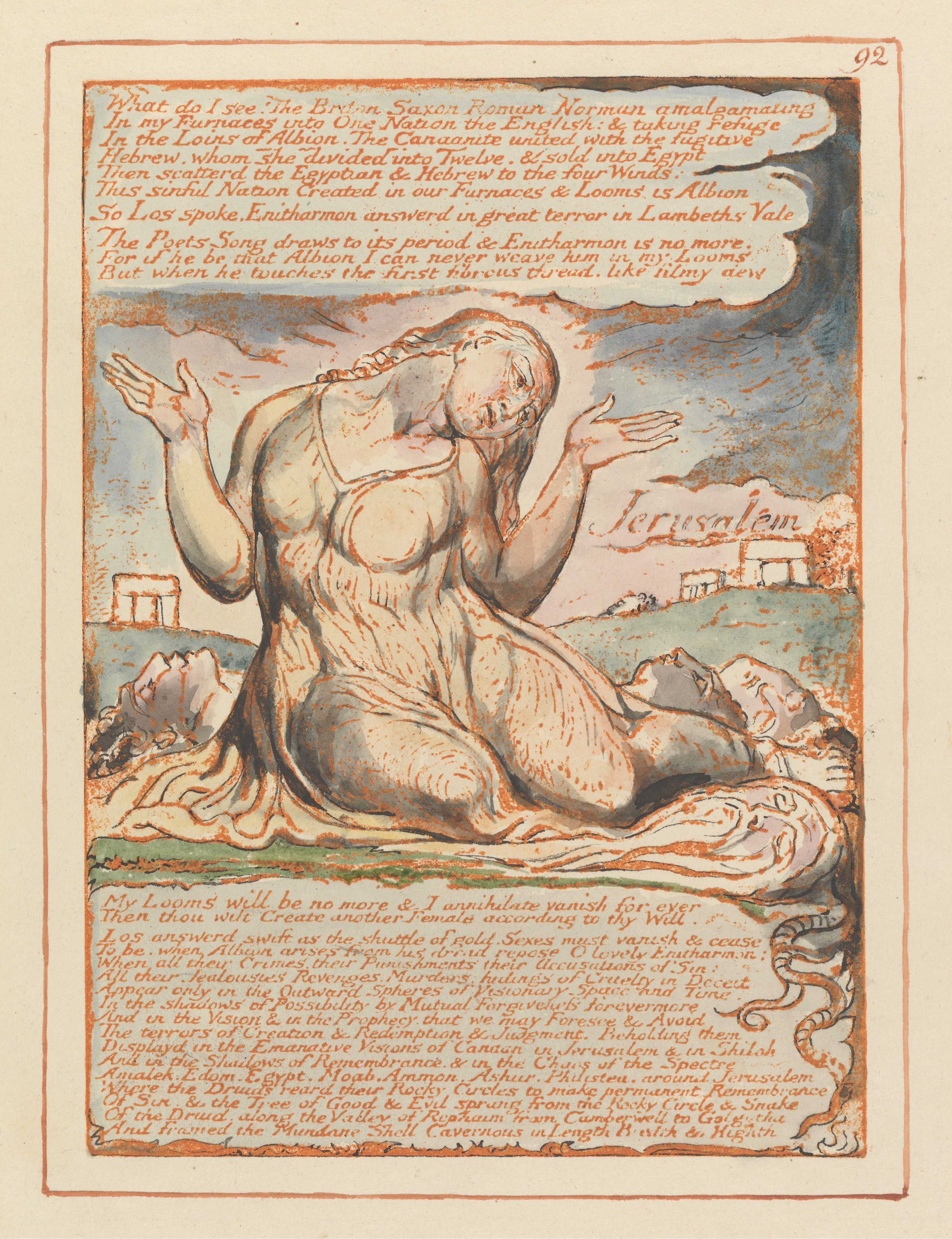
Yale Center for British Art
Jerusalem
Plate 92

Blake teaches that the human is Fourfold incorporating reason, emotions, body and imagination. The Sexual world of Generation is Threefold. The head, heart and loins are functioning but the imagination is dormant. Without the imagination the other aspects engage in selfish strife among the three.  

Blake's myth treats the fall from an original state of unity in Eden through the consequences of division which are many and devastating. Tharmas, the body, struggles in the flood of materiality to avoid losing his grasp on existence. Urizen, the reason, follows mistaken pursuits attempting to go it alone as the solitary arbitrator. Luvah, the emotions, is split between his powerful emanation Vala, and his revolutionary force, Orc. Urthona, the imagination, delegates his role to his materialized form, Los, who continually attempts to eliminate the errors which plague the divided man. Until the four work out their differences, see the value in the other, and relinquish aspirations of autonomy, they are condemned to a cycle of failure.

Although being fully human means being unified, achieving unity is facilitated through becoming conscious to the four forces which are active in the mind and in the outer world in which we live. An individual may unconsciously express in his behavior any of the four forces. Gaining an understanding of the dynamics of the interchanges of the four can enable the individual to quell the dissensions within and the conflicts encountered outwardly.

The image from near the end of Jerusalem when unity is being restored, shows the heads of four men emerging from the ground as if released to assume their proper places in the psyche of Albion.

 Milton, Plate 4, (E 97)
"Beneath the Plow of Rintrah & the harrow of the Almighty
In the hands of Palamabron. Where the Starry Mills of Satan
Are built beneath the Earth & Waters of the Mundane Shell
Here the Three Classes of Men take their Sexual texture Woven
The Sexual is Threefold: the Human is Fourfold"              

Jerusalem, Plate 12, (E 155)
"Go on, builders in hope: tho Jerusalem wanders far away,
Without the gate of Los: among the dark Satanic wheels.

Fourfold the Sons of Los in their divisions: and fourfold,       
The great City of Golgonooza: fourfold toward the north
And toward the south fourfold, & fourfold toward the east & west
Each within other toward the four points: that toward
Eden, and that toward the World of Generation,
And that toward Beulah, and that toward Ulro:                    
Ulro is the space of the terrible starry wheels of Albions sons:
But that toward Eden is walled up, till time of renovation:
Yet it is perfect in its building, ornaments & perfection."

Jerusalem, Plate 98, (E 258)
"The Sons & Daughters of Albion on soft clouds Waking from Sleep
Soon all around remote the Heavens burnt with flaming fires    
And Urizen & Luvah & Tharmas & Urthona arose into
Albions Bosom: Then Albion stood before Jesus in the Clouds
Of Heaven Fourfold among the Visions of God in Eternity"

Letters, To Thomas Butts, (E 722)
     "Now I a fourfold vision see
     And a fourfold vision is given to me
     Tis fourfold in my supreme delight
     And three fold in soft Beulahs night
     And twofold Always.  May God us keep
     From Single vision & Newtons sleep" 
 

Saturday, November 11, 2023

TRUTH

Cleveland Art Museum
Christ in the Lap of Truth

Truth with a capital T is a poetic term not a literal term. Although it is definite and means only one thing in the abstract, it is so many faceted that it can be viewed from many perspectives. Blake could say "Every thing possible to be believ'd is an image of truth," because to believe is an act of will. To 'believe' a specific thing is to give wholehearted allegiance to what is valued most highly.

We see in the picture above a young child who, according to the title is Christ. He is not the infant Jesus as he may appear to be, but is the word made flesh who dwells within us. He sits in the lap of a woman whom he resembles. She is however, more than a woman. She is Truth herself with the appearance of a woman. Truth presents to the world, Herself reborn. Christ is the 'image of Truth new born.'

This picture is an invitation to experience rebirth by believing that the image of Truth is being born anew within. Abandon Doubt and the 'clouds or reason, 'dark disputes' and the 'endless maze.' Be not led by others who know not. Let Christ Himself be your teacher.   

Songs of Innocence and of Experience, Plate 54, (E 31)

"The Voice of the Ancient Bard. 
Youth of delight come hither:
And see the opening morn,
Image of truth new born.
Doubt is fled & clouds of reason.
Dark disputes & artful teazing.
Folly is an endless maze,
Tangled roots perplex her ways,

How many have fallen there!
They stumble all night over bones of the dead,
And feel they know not what but care
And wish to lead others, when they should be led."
Marriage of Heaven and Hell, Plate 8, (E 36)
"Every thing possible to be believ'd is an image of truth." 
Jerusalem, Plate 77, (E 231) 
"What are all the Gifts. of the Gospel, are they not
all Mental Gifts? Is God a Spirit who must be worshipped in
Spirit & in Truth and are not the Gifts of the Spirit Every-thing
to Man? O ye Religious discountenance every one among
you who shall pretend to despise Art & Science! I call upon you
in the Name of Jesus! What is the Life of Man but Art & Science?
is it Meat & Drink? is not the Body more than Raiment? What is
Mortality but the things relating to the Body, which Dies? What
is Immortality but the things relating to the Spirit, which Lives
Eternally! What is the joy of Heaven but Improvement in the
things of the Spirit? What are the Pains of Hell but Ignorance,
Bodily Lust, Idleness & devastation of the things of the
Spirit?
  Answer this to yourselves, & expel from among you those who
pretend to despise the labours of Art & Science, which alone are
the labours of the Gospel: Is not this plain & manifest to the
thought? Can you think at all & not pronounce heartily! That to
Labour in Knowledge. is to Build up Jerusalem: and to Despise
Knowledge, is to Despise Jerusalem & her Builders. 
  And remember: He who despises & mocks a Mental Gift in another;
calling it pride & selfishness & sin; mocks Jesus the giver of
every Mental Gift, which always appear to the ignorance-loving
Hypocrite, as Sins. but that which is a Sin in the sight of cruel
Man, is not so in the sight of our kind God. 
  Let every Christian as much as in him lies engage himself
openly & publicly before all the World in some Mental pursuit for
the Building up of Jerusalem" 

John 1
[12] But as many as received him, to them gave he power to become the sons of God, even to them that believe on his name:
[13] Which were born, not of blood, nor of the will of the flesh, nor of the will of man, but of God.
[14] And the Word was made flesh, and dwelt among us, (and we beheld his glory, the glory as of the only begotten of the Father,) full of grace and truth.
[15] John bare witness of him, and cried, saying, This was he of whom I spake, He that cometh after me is preferred before me: for he was before me.
[16] And of his fulness have all we received, and grace for grace.
[17] For the law was given by Moses, but grace and truth came by Jesus Christ.
John 4
[23] But the hour cometh, and now is, when the true worshippers shall worship the Father in spirit and in truth: for the Father seeketh such to worship him.
[24] God is a Spirit: and they that worship him must worship him in spirit and in truth.
John 14

[16] And I will pray the Father, and he shall give you another Comforter, that he may abide with you for ever;
[17] Even the Spirit of truth; whom the world cannot receive, because it seeth him not, neither knoweth him: but ye know him; for he dwelleth with you, and shall be in you.

John 18

[37] To this end was I born, and for this cause came I into the world, that I should bear witness unto the truth. Every one that is of the truth heareth my voice.

1 Thessalonians 2

[13] For this cause also thank we God without ceasing, because, when ye received the word of God which ye heard of us, ye received it not as the word of men, but as it is in truth, the word of God, which effectually worketh also in you that believe.

Mercy and Truth Are Met Together  
 

Sunday, November 05, 2023

PROPHET OF ETERNITY

There are events that take place in the outer world which we observe through our senses and interpret through our reason. Blake, however, looks at the inner dimension which determines the activity underlying the outer events. For this reason Blake gave each of the Zoas a name and personality in both the inner and outer worlds. Frye refers to these as their Eternal names, and their Time names:
Luvah = Orc
Urizen = Satan
Tharmas = Covering Cherub
Urthona = Los 

When Los acts as the Prophet of Eternity he is acting for Urthona to accomplish Eternal endeavors.

Binding of Urizen.

Book of Urizen, Plate 5, (E 94)

2: Upfolding his Fibres together
To a Form of impregnable strength
Los astonish'd and terrified, built                 
Furnaces; he formed an Anvil
A  Hammer of adamant then began
The binding of Urizen day and night

3: Circling round the dark Demon, with howlings
Dismay & sharp blightings; the Prophet               
Of Eternity beat on his iron links

4: And first from those infinite fires
The light that flow'd down on the winds
lie siez'd; beating incessant, condensing
The subtil particles in an Orb.                    

5: Roaring indignant the bright sparks
Endur'd the vast Hammer; but unwearied
Los beat on the Anvil; till glorious
An immense Orb of fire be fram'd"
Directing Satan to his "own station."
Milton, Plate 7, (E 101) 
Loud as the wind of Beulah that unroots the rocks & hills        
Palamabron call'd! and Los & Satan came before him
And Palamabron shew'd the horses & the servants. Satan wept,
And mildly cursing Palamabron, him accus'd of crimes
Himself had wrought. Los trembled; Satans blandishments almost 
Perswaded the Prophet of Eternity that Palamabron
Was Satans enemy, & that the Gnomes being Palamabron's friends
Were leagued together against Satan thro' ancient enmity.
What could Los do? how could be judge, when Satans self, believ'd
That he had not oppres'd the horses of the Harrow, nor the servants.  

So Los said, Henceforth Palamabron, let each his own station
Keep: nor in pity false, nor in officious brotherhood, where
None needs, be active. Mean time Palamabrons horses.
Rag'd with thick flames redundant, & the Harrow maddend with fury.
Trembling Palamabron stood, the strongest of Demons trembled:  
Curbing his living creatures; many of the strongest Gnomes,
They bit in their wild fury, who also maddend like wildest beasts

Mark well my words; they are of your eternal salvation 
Disrupting the "Eternal Hatred" and the "chain of sorrows" initiated by Urizen. 
Jerusalem, Plate 53, (E 336)
"The voice of Los compelld he labourd round the Furnaces

And thus began the binding of Urizen day & night in fear         
Circling round the dark Demon with howlings dismay & sharp blightings
The Prophet of Eternity beat on his iron links & links of brass
And as he beat round the hurtling Demon. terrified at the Shapes
Enslavd humanity put on he became what he beheld
Raging against Tharmas his God & uttering                        
Ambiguous words blasphemous filld with envy firm resolvd
On hate Eternal in his vast disdain he labourd beating
The Links of fate link after link an endless chain of sorrows" 

Damon states "Prophets are not foretellers of future facts; they are revealers of eternal truths." Blake accepted the role of prophet when he took on his Great Task of opening the Eternal Worlds to our immortal Eyes, for which I am forever grateful. He was following his hero Los who acted for Urthona who "never manifests in time" but dwells in the subconscious asserting his influence. 

Jerusalem, Plate 5, (E 147) 
"Trembling I sit day and night, my friends are astonish'd at me.
Yet they forgive my wanderings, I rest not from my great task!
To open the Eternal Worlds, to open the immortal Eyes
Of Man inwards into the Worlds of Thought: into Eternity
Ever expanding in the Bosom of God. the Human Imagination        
O Saviour pour upon me thy Spirit of meekness & love:
Annihilate the Selfhood in me, be thou all my life!
Guide thou my hand which trembles exceedingly upon the rock of ages,"
Four Zoas, Night I, Page 9, (E 305)
"His [Los'] head beamd light & in his vigorous voice was prophecy
He could controll the times & seasons, & the days & years"
Milton, Plate 24 [26], (E 121) 
"Los is by mortals nam'd Time Enitharmon is nam'd Space
But they depict him bald & aged who is in eternal youth
All powerful and his locks flourish like the brows of morning    
He is the Spirit of Prophecy the ever apparent Elias
Time is the mercy of Eternity; without Times swiftness
Which is the swiftest of all things: all were eternal torment:
All the Gods of the Kingdoms of Earth labour in Los's Halls.
Every one is a fallen Son of the Spirit of Prophecy             
He is the Fourth Zoa, that stood around the Throne Divine. 
Jerusalem, Plate 39 [44], (E 187) 
"And feeling the damps of death they with one accord delegated Los
Conjuring him by the Highest that he should Watch over them
Till Jesus shall appear: & they gave their power to Los       
Naming him the Spirit of Prophecy, calling him Elijah" 

Revelation 20
[1] And I saw an angel come down from heaven, having the key of the bottomless pit and a great chain in his hand.
[2] And he laid hold on the dragon, that old serpent, which is the Devil, and Satan, and bound him a thousand years,
[3] And cast him into the bottomless pit, and shut him up, and set a seal upon him, that he should deceive the nations no more, till the thousand years should be fulfilled: and after that he must be loosed a little season.
Harvard Art Museums/Fogg Museum 
The Angel Michael Binding Satan 
("He Cast him into the Bottomless Pit, and Shut him up") 
 

Friday, November 03, 2023

TIME & ETERNITY

First published September 2020

British Museum 
Illustrations to Young's Night Thoughts
 
Time and space are among the mind forged manacles which bind and limit us. There is a material dimension and a spiritual dimension. The matrix of the Material World is time and space. The matrix of the Spiritual World is eternity and infinity. Man being both material and spiritual has the possibility of living in both worlds. But if we confine our mental processing to sensation and rational thought, we lose the ability to pass through the portal to the infinite, eternal world of intuition and imagination.

Thanks to Blake, the image I have of Eternity is that it is not bound by sequential processing. Past, present and future are flexible. The whole can be experienced either simultaneously or distinctly. Whenever in our ordinary temporal life, we have the experience of being caught up in a moment of clarity of vision, or a realization of the connection of all things, the barrier between Time and Eternity has been breached.    
Vision of Last Judgment, (E 555)
 "This world of Imagination is the World of
Eternity it is the Divine bosom into which we shall all go after
the death of the Vegetated body   This World of Imagination is
Infinite & Eternal whereas the world of Generation or Vegetation
is Finite & Temporal      There Exist
in that Eternal World the Permanent Realities of Every Thing
which we see are reflected in this Vegetable Glass of Nature
     All Things are comprehended in their Eternal Forms in the
Divine body of the Saviour the True Vine of Eternity
The Human Imagination who appeard to Me as Coming to Judgment.
among his Saints & throwing off the Temporal that the Eternal
might be Establishd. around him were seen the Images of
Existences according to a certain order suited to my Imaginative Eye" 
Vision of Last Judgment, (E 565) 
"The Last Judgment is an Overwhelming of Bad Art & Science. 
Mental Things are alone Real what is Calld Corporeal Nobody Knows
of its Dwelling Place it is in Fallacy & its Existence an
Imposture  Where is the Existence Out of Mind or Thought Where is
it but in the Mind of a Fool.  Some People flatter themselves
that there will be No Last Judgment & that Bad Art will be
adopted & mixed with Good Art That Error or Experiment will make
a Part of Truth & they Boast that it is its Foundation these
People flatter themselves     I will not Flatter them    Error is
Created    Truth is Eternal    Error or Creation will be Burned Up &
then & not till then Truth or Eternity will appear It is Burnt up
the Moment Men cease to behold it I assert for My self that I do
not behold the Outward Creation & that to me it is hindrance &
not Action it is as the Dirt upon my feet No part of Me."