Thursday, February 08, 2024

SOUL QUOTES

Wikipedia Commons
Introduction to Songs of Experience
Some of what Blake wrote about the soul can be found in the passages quoted below. They include these words about the soul:  
The soul is subject to falling away, to passing through states, but is never defiled. It can be hidden or return to the mortal state or be 'harrowd with grief & fear & love & desire,' It can conceal sin. The soul can experience terror or view the 'Infernal Storm.' The soul can be given away and can seek for her maker. The sinless soul dwells with the immortal spirit. When the soul approaches the gates of death, or dies within, the Divine Saviour descends and the Divine Vision weeps. Error & Illusion rent the soul.
June Singer in Seeing Through the Visible World, gives these insights into how the soul functions beginning on page xxii:
"...The more you encompass of the visible world with the knowing of the mind, the more aware you may become of the expanse of the unknowable. 
But there is another way of knowing: the knowing of the soul. This kind of knowing has been called gnosis since ancient times to distinguish it from the kind of knowledge that comes from intellect and reason alone. Psyche is the Greek term for soul, and it is in this sense that I use it. Soul or psyche, is that aspect of the individual that is composed of both conscious and unconscious aspects: ways of knowing of which we are primarily aware (such as thinking, feeling, and sensation),  and ways of knowing that seem to be mobilized primarily in realms of the unconscious (for example, intuition, speculation, imagination, and dreaming). All these ways of knowing belong to the realm of the psyche or soul. Mind is included in the psyche, but the psyche is not limited to the exercise of the mental processes. The soul bridges the gap between what can be learned through the mind, through the senses, through the intellect and through the exercise of scientific observation - and the intuitive awareness of a deep abiding space that may be penetrated by consciousness but can never be encompassed by it."
Songs of Innocence and of Experience, Songs 30, (E 18)
"Introduction.
Hear the voice of the Bard! 
Who Present, Past, & Future sees
Whose ears have heard,
The Holy Word,
That walk'd among the ancient trees.

Calling the lapsed Soul
And weeping in the evening dew:
That might controll,
The starry pole;
And fallen fallen light renew!" 
Songs of Innocence and of Experience, Combined Title Page, (E 6)
"Shewing the Two Contrary States of the Human Soul"    
America, Plate 8, (E 54)
"For every thing that lives is holy, life delights in life;
Because the soul of sweet delight can never be defil'd."
Jerusalem, Plate 22, (E 168)
"Loud groand Albion from mountain to mountain & replied
Plate 23
Jerusalem! Jerusalem! deluding shadow of Albion!
Daughter of my phantasy! unlawful pleasure! Albions curse!
I came here with intention to annihilate thee! But
My soul is melted away, inwoven within the Veil
Hast thou again knitted the Veil of Vala, which I for thee       
Pitying rent in ancient times. I see it whole and more
Perfect, and shining with beauty! But thou! O wretched Father! 

Jerusalem reply'd, like a voice heard from a sepulcher:
Father! once piteous! Is Pity. a Sin? Embalm'd in Vala's bosom
In an Eternal Death for. Albions sake, our best beloved.         
Thou art my Father & my Brother: Why hast thou hidden me,
Remote from the divine Vision: my Lord and Saviour."
Milton, Plate 42 [49], (E 143)
"Terror struck in the Vale I stood at that immortal sound
My bones trembled. I fell outstretchd upon the path              
A moment, & my Soul returnd into its mortal state
To Resurrection & Judgment in the Vegetable Body
And my sweet Shadow of Delight stood trembling by my side

Immediately the Lark mounted with a loud trill from Felphams Vale
And the Wild Thyme from Wimbletons green & impurpled Hills"       
Jerusalem, Plate 68, (E 222)
"Once Man was occupied in intellectual pleasures & energies   
But now my soul is harrowd with grief & fear & love & desire
And now I hate & now I love & Intellect is no more:
There is no time for any thing but the torments of love & desire
The Feminine & Masculine Shadows soft, mild & ever varying
In beauty: are Shadows now no more, but Rocks in Horeb           
Plate 69
Then all the Males combined into One Male & every one
Became a ravening eating Cancer growing in the Female
A Polypus of Roots of Reasoning Doubt Despair & Death.
Going forth & returning from Albions Rocks to Canaan:
Devouring Jerusalem from every Nation of the Earth."
Four Zoas, Night I, Page 4, (E 301)
"Enion said--Thy fear has made me tremble thy terrors have surrounded me                                              t
All Love is lost Terror succeeds & Hatred instead of Love
And stern demands of Right & Duty instead of Liberty.
Once thou wast to Me the loveliest son of heaven--But now        
 
Why art thou Terrible and yet I love thee in thy terror till
I am almost Extinct & soon shall be a Shadow in Oblivion
Unless some way can be found that I may look upon thee & live
Hide me some Shadowy semblance. secret whispring in my Ear
In secret of soft wings. in mazes of delusive beauty             
I have lookd into the secret soul of him I lovd
And in the Dark recesses found Sin & cannot return

Trembling & pale sat Tharmas weeping in his clouds
Why wilt thou Examine every little fibre of my soul
Spreading them out before the Sun like Stalks of flax to dry     
The infant joy is beautiful but its anatomy
Horrible Ghast & Deadly nought shalt thou find in it
But Death Despair & Everlasting brooding Melancholy
Four Zoas, Night VII, Page 85, (E 360)
"Thus they conferrd among the intoxicating fumes of Mystery    
Till Enitharmons shadow pregnant in the deeps beneath
Brought forth a wonder horrible. While Enitharmon shriekd
And trembled thro the Worlds above Los wept his fierce soul was terrifid
At the shrieks of Enitharmon at her tossings nor could his eyes percieve
The cause of her dire anguish for she lay the image of Death     
Movd by strong shudders till her shadow was deliverd then she ran
Raving about the upper Elements in maddning fury

She burst the Gates of Enitharmons heart with direful Crash
Nor could they ever be closd again the golden hinges were broken
And the gates broke in sunder & their ornaments defacd       
Beneath the tree of Mystery for the immortal shadow shuddering
Brought forth this wonder horrible a Cloud she grew & grew
Till many of the dead burst forth from the bottoms of their tombs
In male forms without female counterparts or Emanations    
Cruel and ravening with Enmity & Hatred & War  
In dreams of Ulro dark delusive drawn by the lovely shadow 

The Spectre terrified gave her Charge over the howling Orc" 
Songs and Ballads, (E 480)
[From Blake's Notebook] 
 "The Caverns of the Grave Ive seen 
And these I shewd to Englands Queen
But now the Caves of Hell I view     
Who shall I dare to shew them to
What mighty Soul in Beautys form     
Shall dauntless View the Infernal Storm 
Egremonts Countess can controll         
The flames of Hell that round me roll   
If she refuse I still go on"
Four Zoas, Night II, Page 26, (E 317)
"I brought her thro' the Wilderness, a dry & thirsty land
And I commanded springs to rise for her in the black desart
Till she became a Dragon winged bright & poisonous  
I opend all the floodgates of the heavens to quench her thirst
Plate 27 
And I commanded the Great deep to hide her in his hand
Till she became a little weeping Infant a span long
I carried her in my bosom as a man carries a lamb
I loved her I gave her all my soul & my delight
I hid her in soft gardens & in secret bowers of Summer           
Weaving mazes of delight along the sunny Paradise
Inextricable labyrinths, She bore me sons & daughters
And they have taken her away & hid her from my sight
They have surrounded me with walls of iron & brass, O Lamb     
Of God clothed in Luvahs garments little knowest thou          
Of death Eternal that we all go to Eternal Death"
Four Zoas, Night IX, Page 127, (E 396)
"Rise sluggish Soul why sitst thou here why dost thou sit & weep
Yon Sun shall wax old & decay but thou shalt ever flourish 
The fruit shall ripen & fall down & the flowers consume away
But thou shalt still survive arise O dry thy dewy tears

Hah! Shall I still survive whence came that sweet & comforting voice
And whence that voice of sorrow O sun thou art nothing now to me
Go on thy course rejoicing & let us both rejoice together 
I walk among his flocks & hear the bleating of his lambs
O that I could behold his face & follow his pure feet
I walk by the footsteps of his flocks come hither tender flocks
Can you converse with a pure Soul that seeketh for her maker
You answer not then am I set your mistress in this garden 
Ill watch you & attend your footsteps you are not like the birds"
Four Zoas, Night IX, Page 127, (E 397)
"My Luvah here hath placd me in a Sweet & pleasant Land
And given me fruits & pleasant waters & warm hills & cool valleys
Here will I build myself a house & here Ill call on his name
Here Ill return when I am weary & take my pleasant rest

So spoke the Sinless Soul & laid her head on the downy fleece 
Of a curld Ram who stretchd himself in sleep beside his mistress
And soft sleep fell upon her eyelids in the silent noon of day

Then Luvah passed by & saw the sinless Soul
And said   Let a pleasant house arise to be the dwelling place
Of this immortal Spirit growing in lower Paradise" 
Milton, Plate 14 [15], (E 108)
"And Milton said, I go to Eternal Death! The Nations still
Follow after the detestable Gods of Priam; in pomp               
Of warlike selfhood, contradicting and blaspheming.
When will the Resurrection come; to deliver the sleeping body
From corruptibility: O when Lord Jesus wilt thou come?
Tarry no longer; for my soul lies at the gates of death.
I will arise and look forth for the morning of the grave.       
I will go down to the sepulcher to see if morning breaks!
I will go down to self annihilation and eternal death,
Lest the Last Judgment come & find me unannihilate"

Jerusalem, Plate 42, (E 189)
"Thus Albion sat, studious of others in his pale disease:
Brooding on evil: but when Los opend the Furnaces before him:
He saw that the accursed things were his own affections,
And his own beloveds: then he turn'd sick! his soul died within him
Also Los sick & terrified beheld the Furnaces of Death           
And must have died, but the Divine Saviour descended
Among the infant loves & affections, and the Divine Vision wept
Like evening dew on every herb upon the breathing ground"
Jerusalem, Plate 35 [39], (E 181)

"Los answerd, troubled: and his soul was rent in twain: 
Must the Wise die for an Atonement? does Mercy endure Atonement? 
 No! It is Moral Severity, & destroys Mercy in its Victim. 
So speaking, not yet infected with the Error & Illusion,"


Friday, February 02, 2024

GOD ACTS

British Museum
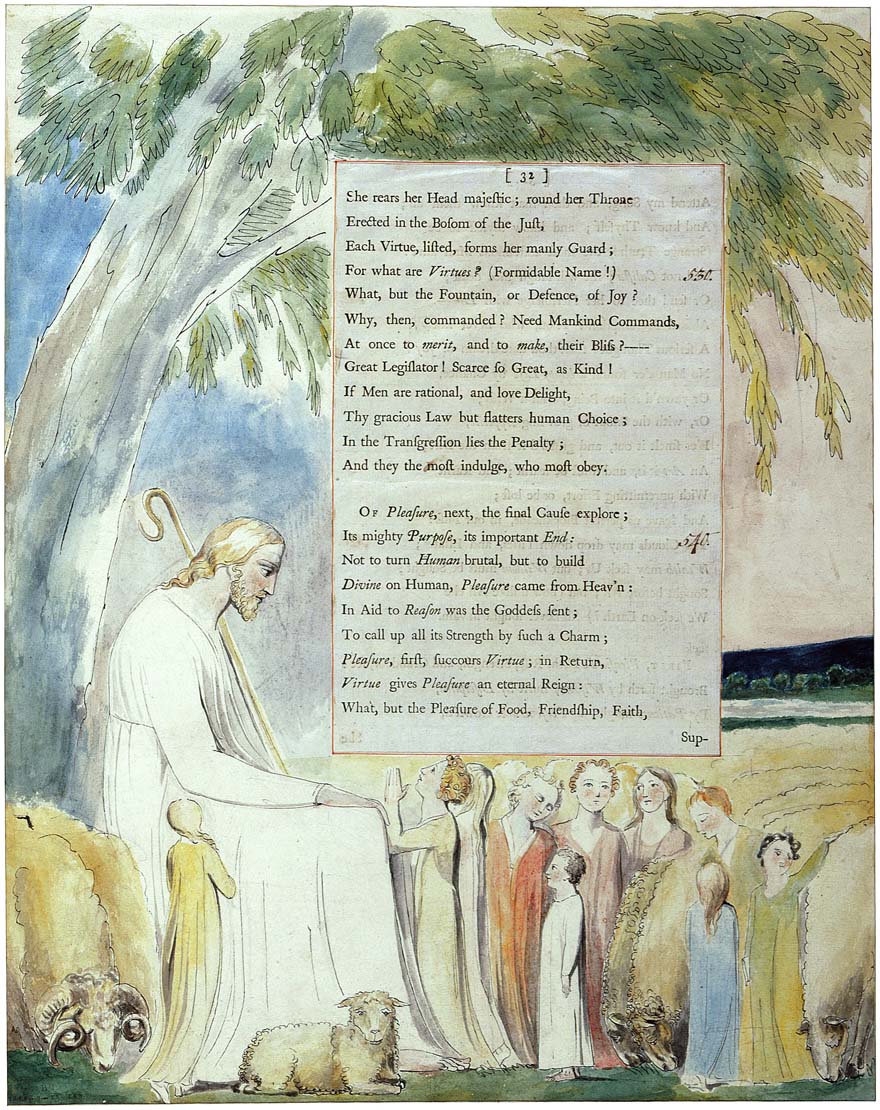
Illustrations to Young's Night Thoughts

Marriage of Heaven and Hell, Plate 16, (E 40) "Some will say, Is not God alone the Prolific? I answer, God
only   Acts & Is, in existing beings or Men."

Blake reserved the word Action to denote something which is coming not through man alone but through God acting through man. 

Descriptive Catalogue, (E 543)
"The stories of Arthur are the acts of Albion,
applied to a Prince of the fifth century, who conquered
Europe, and held the Empire of the world in the dark age, which
the Romans never again recovered."

When we read of the acts of Albion we are reading of Albion being a tool through
whom we may follow man's either placing himself under the guidance of God or
rejecting God and turning away.

Jerusalem, Plate 43 [29], (E 191)
"And thus the Voice Divine went forth upon the rocks of Albion    

I elected Albion for my glory; I gave to him the Nations,
Of the whole Earth. he was the Angel of my Presence: and all
The Sons of God were Albions Sons: and Jerusalem was my joy.
The Reactor hath hid himself thro envy. I behold him.
But you cannot behold him till he be reveald in his System       
Albions Reactor must have a Place prepard: Albion must Sleep
The Sleep of Death, till the Man of Sin & Repentance be reveald.
Hidden in Albions Forests he lurks: he admits of no Reply
From Albion: but hath founded his Reaction into a Law
Of Action, for Obedience to destroy the Contraries of Man.     
He hath compelld Albion to become a Punisher & hath possessd
Himself of Albions Forests & Wilds! and Jerusalem is taken!
The City of the Woods in the Forest of Ephratah is taken!
London is a stone of her ruins; Oxford is the dust of her walls!
Sussex & Kent are her scatterd garments: Ireland her holy place! 
And the murderd bodies of her little ones are Scotland and Wales
The Cities of the Nations are the smoke of her consummation
The Nations are her dust! ground by the chariot wheels
Of her lordly conquerors, her palaces levelld with the dust
I come that I may find a way for my banished ones to return      
Fear not O little Flock I come! Albion shall rise again."

Through following the acts of Albion we discern the journey that man travels as
he is guided along the path to completeness.

Descriptive Catalogue, (E 544)
"Reasons and opinions concerning acts, are not
history.  Acts themselves alone are history, and these are
neither the exclusive property of Hume, Gibbon nor Voltaire,
Echard, Rapin, Plutarch, nor Herodotus.  Tell me the Acts, O
historian, and leave me to reason upon them as I please; away
with your reasoning and your rubbish.  All that is not action is
not worth reading.  Tell me the What; I do not want you to
tell me the Why, and the How; I can find that out myself, as well
as you can, and I will not be fooled by you into opinions, that
you please to impose, to disbelieve what you think improbable or
impossible.  His opinions, who does not see spiritual agency, is
not worth any man's reading; he who rejects a fact because it is
improbable, must reject all History and retain doubts only.

Blake found that action, not opinion or explanations, provided him with an
understanding of the spirit which was being expressed in what he discerned himself.

Jerusalem, Plate 95, (E 254)
"Her voice pierc'd Albions clay cold ear. he moved upon the Rock
The Breath Divine went forth upon the morning hills, Albion mov'd

Upon the Rock, he opend his eyelids in pain; in pain he mov'd
His stony members, he saw England. Ah! shall the Dead live again

The Breath Divine went forth over the morning hills Albion rose 
In anger: the wrath of God breaking bright flaming on all sides around
His awful limbs: into the Heavens he walked clothed in flames
Loud thundring, with broad flashes of flaming lightning & pillars
Of fire, speaking the Words of Eternity in Human Forms, in direful
Revolutions of Action & Passion, thro the Four Elements on all sides  
Surrounding his awful Members. Thou seest the Sun in heavy clouds
Struggling to rise above the Mountains. in his burning hand
He takes his Bow, then chooses out his arrows of flaming gold
Murmuring the Bowstring breathes with ardor! clouds roll around the
Horns of the wide Bow, loud sounding winds sport on the mountain brows
Compelling Urizen to his Furrow; & Tharmas to his Sheepfold;
And Luvah to his Loom: Urthona he beheld mighty labouring at
His Anvil, in the Great Spectre Los unwearied labouring & weeping
Therefore the Sons of Eden praise Urthonas Spectre in songs
Because he kept the Divine Vision in time of trouble. 
When Albion began to perceive the voice of God, a cascade of action followed.
Hearing the voice pierce his 'clay cold
ear' was the key to releasing movement,
speech, emotion, and thought which together restored his fourfold Zoas.
Vision of Last Judgment, (E 565)
"I will not Flatter them Error is Created Truth is Eternal Error or Creation will be Burned Up & then & not till then Truth or Eternity will appear It is Burnt up the Moment Men cease to behold it I assert for My self that I do not behold the Outward Creation & that to me it is hindrance & not Action it is as the Dirt upon my feet No part of Me. What it will be Questiond When the Sun rises do you not see a round Disk of fire somewhat like a Guinea O no no I see an Innumerable company of the Heavenly host crying Holy Holy Holy is the Lord God Almighty I question not my Corporeal or Vegetative Eye any more than I would Question a Window concerning a Sight I look thro it & not with it."

The inner life which is the life of the spirit is Eternal. Whatever is material
and temporal passes away. What is in response to Truth is lasting and fosters
development of the spiritual life.

Annotations to Swedenborg, (E 601)
"To hinder another is not an act it is the
contrary it is a restraint on action both in ourselves & in the
person hinderd. for he who hinders another omits his own duty at
the time." 

Action results from following the guidance of the spirit. Preventing another's
spiritual development is contrary to being led oneself.

Annotations to Watson, (E 614)
"The truth & certainty of Virtue &
Honesty i.e Inspiration needs no one to prove it   it is Evident
as the Sun & Moon [What doubt is virtuous even Honest that
depends upon Examination] He who stands doubting of what he
intends whether it is Virtuous or Vicious knows not what Virtue
means. no man can do a Vicious action & think it to be Virtuous.
no man can take darkness for light. he may pretend to do so & may
pretend to be a modest Enquirer. but he is a Knave"

There is within us the ability to discern truth. The spirit itself
informs us whether what we are considering is 'Virtuous or Vicious.'
We cannot take 'darkness for light.'


Saturday, January 27, 2024

Vision of God

British Museum
Illustrations to Young's Night Thoughts

First posted June 2010

Northrup Frye with his background in both religious studies and literary criticism was uniquely qualified to clarify William Blake's writings - which he did in his earliest book Fearful Symmetry. In the first paragraph of Chapter 5, Frey delineates the relationship between the individual and mind of God. He refers to fallen man as the ego, which perceives the general. As a part of the Universal Creator, man perceives or creates as a mental form. It is in the mind of the totality of creative power that we are able to perceive the particular. If we see through that seed of truth planted within us, we perceive this world as a 'single creature' fallen and redeemed. Frey states, 'This is the vision of God (subjective genitive: the vision which God in us has).'

This is the fourfold vision of which Blake speaks in a Letter to Thomas Butts, (E 722):
"Now I a fourfold vision see
And a fourfold vision is given to me
Tis fourfold in my supreme delight
And three fold in soft Beulahs night
And twofold Always. May God us keep
From Single vision & Newtons sleep"

Blake's idea that we must see not with but through the eye, is true at the level of vision as well; we are not to see the vision, or with the vision but through the vision to the transcendent reality which provides the vision and the means of apprehending it.

Auguries of Innocence, (E 520)
"This Lifes dim Windows of the Soul
Distorts the Heavens from Pole to Pole
And leads you to Believe a Lie
When you see with not thro the Eye
That was born in a night to perish in a night
When the Soul slept in the beams of Light."


Fearful Symmetry, Page 108:
"The vision of the Last Judgment. said Blake, 'is seen by the Imaginative Eye of Every one according to the situation he holds.' And the greater the work of art, the more completely it reveals the gigantic myth which is the vision of the world as God sees it, the outlines of that vision being creation, fall redemption and apocalypse."

Friday, January 26, 2024

ENITHARMON WEAVES

Wikipedia Commons
Image from British Library
Four Zoas
Page 5

Milton, Plate 21[23], (E 115)

"But I knew not that it was Milton, for man cannot know
What passes in his members till periods of Space & Time
Reveal the secrets of Eternity: for more extensive
Than any other earthly things, are Mans earthly lineaments."


Blake was not entirely consistent in describing the meaning of the soul in his poetry. This is what I can discern from Blake's statements about body and Soul.

Outside of Time, in the World which neither begins or ends, there are Spiritual Bodies and their garments or Souls. But when the world of matter comes into existence as a result of Time and Space receiving their separate forms, the Body may be divided from its Soul. 

Blake concerned himself with understanding Souls and Bodies: how they were associated, how they split apart, and how they were reunited. Each of the Zoas and his Emanation are essentially one unit which is expressed in two aspects of one being. The Zoa is the Form and the Emanation is the Manifestation. However the Zoa is more like the Soul, because the Form is Spirit not matter. The Emanation functions as the Body because she manifests in the world discernible to the senses. 

Since we are dependent on our senses for information outside of our minds and bodies, we give priority to sense data rather than to Spiritual Sensation which is generated within or received from an unknown source. This distorts our perception limiting our ability to perceive the Infinite Eternal which if more real than what we can touch, smell, hear, feel and see. To Blake it was the Imagination which gave us access to the real world of Spirit.

Letters, To  Trusler, (E 703)

"But I am happy to find a Great Majority of Fellow Mortals who can Elucidate My Visions & Particularly they have been Elucidated by Children who have taken a greater delight in contemplating my Pictures than I even hoped. Neither Youth nor Childhood is Folly or Incapacity Some Children are Fools & so are some Old Men. But There is a vast Majority on the side of Imagination or Spiritual Sensation"

The Everlasting Gospel, (E 520)

"When the Soul fell into Sleep
And Archangels round it weep
Shooting out against the Light
Fibres of a deadly night        
Reasoning upon its own Dark Fiction
In Doubt which is Self Contradiction
Humility is only Doubt
And does the Sun & Moon blot out
Rooting over with thorns & stems     
The buried Soul & all its Gems
This Lifes dim Windows of the Soul
Distorts the Heavens from Pole to Pole
And leads you to Believe a Lie
When you see with not thro the Eye   
That was born in a night to perish in a night
When the Soul slept in the beams of Light."

Jerusalem, Plate 18, (E 163) 

(For Vala produc'd the Bodies. Jerusalem gave the Souls)

Four Zoas, Night VIII, Page 103,(E 376)

"Enitharmon wove in tears Singing Songs of Lamentations
And pitying comfort as she sighd forth on the wind the spectres
And wove them bodies calling them her belovd sons & daughters
Employing the daughters in her looms & Los employd the Sons 
In Golgonoozas Furnaces among the Anvils of time & space
Thus forming a Vast family wondrous in beauty & love
And they appeard a Universal female form created
From those who were dead in Ulro from the Spectres of the dead
PAGE 104 (FIRST PORTION) 
And Enitharmon namd the Female Jerusalem the holy
Wondring she saw the Lamb of God within Jerusalems Veil
The divine Vision seen within the inmost deep recess
Of fair Jerusalems bosom in a gently beaming fire"
Annotations to Berkley, (E 664)
"The Natural Body is an Obstruction to the Soul or Spiritual
Body"  
Vision of Last Judgment, (E 563)
 "By this it will be seen that I do not consider either the Just
or the Wicked to be in a Supreme State but to be every one of
them States of the Sleep which the Soul may fall into in its
Deadly Dreams of Good & Evil when it leaves Paradise
following the Serpent" 
Auguries of Innocence, (E 492)
"Every Night & every Morn
Some to Misery are Born 
Every Morn & every Night
Some are Born to sweet delight
Some are Born to Endless Night
We are led to Believe a Lie 
When we see not Thro the Eye        

Which was Born in a Night to perish in a Night
When the Soul Slept in Beams of Light
God Appears & God is Light
To those poor Souls who dwell in Night 
But does a Human Form Display
To those who Dwell in Realms of day"
Auguries of Inocence, (E 491)
"It is right it should be so 
Man was made for Joy & Woe
And when this we rightly know
Thro the World we safely go
Joy & Woe are woven fine
A Clothing for the soul divine 
Under every grief & pine
Runs a joy with silken twine
The Babe is more than swadling Bands
Throughout all these Human Lands
Tools were made & Born were hands
Every Farmer Understands
Every Tear from Every Eye
Becomes a Babe in Eternity"
Four Zoas, Night IX, Page 134, (E 402)
"Let the slave grinding at the mill run out into the field
Let him look up into the heavens & laugh in the bright air
Let the inchaind soul shut up in darkness & in sighing           
Whose face has never seen a smile in thirty weary years
Rise & look out his chains are loose his dungeon doors are open
And let his wife & children return from the opressors scourge
They look behind at every step & believe it is a dream
Are these the Slaves that groand along the streets of Mystery    
Where are your bonds & task masters are these the prisoners
Where are your chains where are your tears why do you look around
If you are thirsty there is the river go bathe your parched limbs
The good of all the Land is before you for Mystery is no more"
Four Zoas, Night VIII, Page 98, (E 371)
"Startled was Los he found his Enemy Urizen now
In his hands. he wonderd that he felt love & not hate     
His whole soul loved him he beheld him an infant
Lovely breathd from Enitharmon he trembled within himself"
Four Zoas, Night VIII, Page 98, (E 370)
"Enitharmon spread her beaming locks upon the wind & said   
O Lovely terrible Los wonder of Eternity O Los my defence & guide                                                      t
Thy works are all my joy. & in thy fires my soul delights
If mild they burn in just proportion & in secret night
And silence build their day in shadow of soft clouds & dews
Then I can sigh forth on the winds of Golgonooza piteous forms  
That vanish again into my bosom   but if thou my Los
Wilt in sweet moderated fury. fabricate forms sublime  
Such as the piteous spectres may assimilate themselves into
They shall be ransoms for our Souls that we may live"
Four Zoas, Night VII, Page 95 [87], (E 368)
My lovely Enitharmon. I will quell my fury & teach
Peace to the Soul of dark revenge & repentance to Cruelty
So spoke Los & Embracing Enitharmon & the Spectre
Clouds would have folded round in Extacy & Love uniting
PAGE 87 
But Enitharmon trembling fled & hid beneath Urizens tree
But mingling together with his Spectre the Spectre of Urthona  
Wondering beheld the Center opend by Divine Mercy inspired     
He in his turn Gave Tasks to Los Enormous to destroy    
That body he created but in vain for Los performd Wonders of labour 
They Builded Golgonooza"
Laocoon, (E 273)
"Adam is only The Natural Man & not the Soul or Imagination

The Eternal Body of Man is The IMAGINATION."
Jerusalem, Plate 71, (E 224)
"As the Soul is to the Body, so Jerusalems Sons,
Are to the Sons of Albion: and Jerusalem is Albions Emanation"    
Jerusalem, Plate 52, (E 200)
                                      |The Spiritual States of
                                      |the Soul are all Eternal  
Rahab is an   |   To the Deists.      |Distinguish between the 
Eternal State |                       |Man, & his present State 
Milton, Plate 42, (E143)
"Terror struck in the Vale I stood at that immortal sound
My bones trembled. I fell outstretchd upon the path              
A moment, & my Soul returnd into its mortal state
To Resurrection & Judgment in the Vegetable Body
And my sweet Shadow of Delight stood trembling by my side

Immediately the Lark mounted with a loud trill from Felphams Vale
And the Wild Thyme from Wimbletons green & impurpled Hills "      
Marriage of Heaven and Hell, Plate 4, (E 34)
"But the following Contraries to these are True
  1 Man has no Body distinct from his Soul for that calld Body is
a portion of Soul discernd by the five Senses. the chief inlets
of Soul in this age
  2. Energy is the only life and is from the Body and Reason is
the bound or outward circumference of Energy.
  3 Energy is Eternal Delight"

Monday, January 22, 2024

EMBODIED FORMS

Yale Center for British Art
Jerusalem
Plate 36 [40]

David Erdman, on page 315 of the Illuminated Blake, sees William (Los) and Catherine (Enitharmon) "working in Line and color." The poet's writing arm is free while his painting arm is creating. He walks the line which connects him with Enitharmon who reaches for the fruit of the vine. 

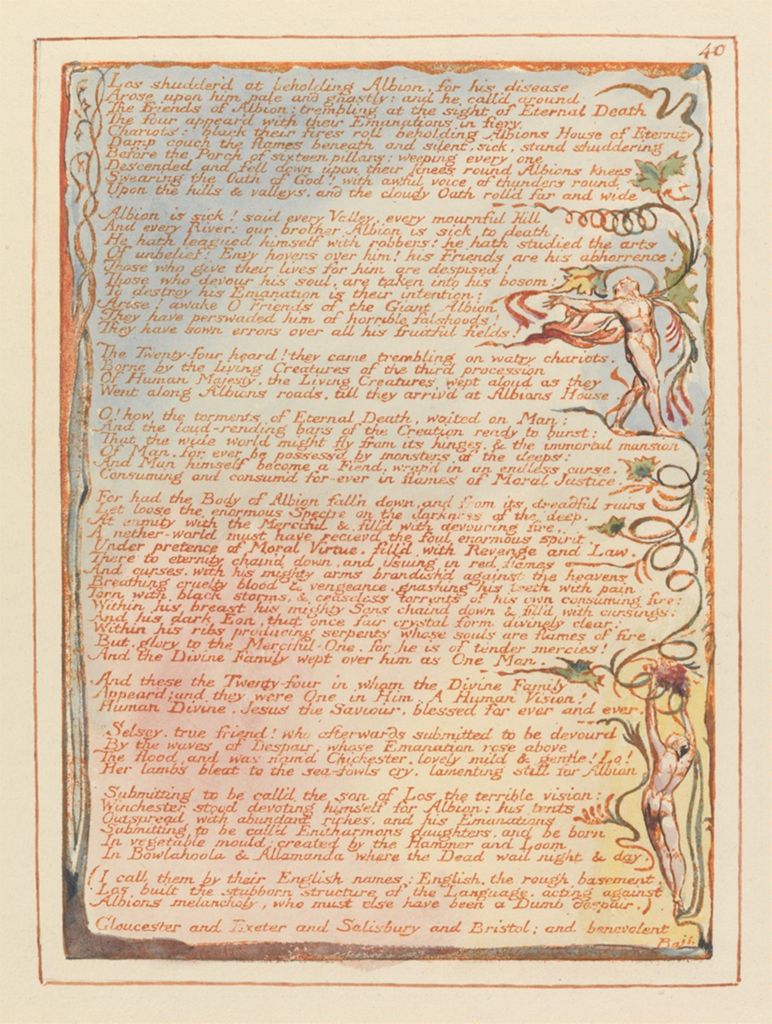
Jerusalem, Plate 36 [40], (E 183) 
"(I call them by their English names: English, the rough basement.
Los built the stubborn structure of the Language, acting against
Albions melancholy, who must else have been a Dumb despair.) "  
There is a dialog which is enacted between the inner self which is solely experienced deep within one's own mentality, and the surface of the mind that is revealed through the outer world. We tend to give more attention to what the world is telling us than to what we are being told by the thoughts which originate within our minds.

We are given the opportunity to bring forth the image of truth which exists within. It can be revealed in the body which lives in the outer world. Within us is "Lovely terrible Los wonder of Eternity" who must modulate his fires by expressing them through Imagination. 

Cooperation between Los, the dynamic interior, and Enitharmon, who can give form to thought, is required if the mental images are to receive life in matter. Two of the sources of dissension in the world (Urizen and Orc) are drawn from war and become objects of "love & not hate". 

Transformation of the outer world results from "the immortal works Of Los Assimilating to those forms Embodied & Lovely." 

Four Zoas, Night VII, Page 98, (E 370) 

"O Lovely terrible Los wonder of Eternity O Los my defence & guide
Thy works are all my joy. & in thy fires my soul delights
If mild they burn in just proportion & in secret night
And silence build their day in shadow of soft clouds & dews
Then I can sigh forth on the winds of Golgonooza piteous forms  
That vanish again into my bosom   but if thou my Los
Wilt in sweet moderated fury. fabricate forms sublime    
Such as the piteous spectres may assimilate themselves into
They shall be ransoms for our Souls that we may live
So Enitharmon spoke & Los his hands divine inspired began 
To modulate his fires studious the loud roaring flames
He vanquishd with the strength of Art bending their iron points
And drawing them forth delighted upon the winds of Golgonooza 
From out the ranks of Urizens war & from the fiery lake
Of Orc bending down as the binder of the Sheaves follows   
The reaper in both arms embracing the furious raging flames
Los drew them forth out of the deeps planting his right foot firm
Upon the Iron crag of Urizen thence springing up aloft
Into the heavens of Enitharmon in a mighty circle
And first he drew a line upon the walls of shining heaven    
And Enitharmon tincturd it with beams of blushing love
It remaind permanent a lovely form inspird divinely human
Dividing into just proportions Los unwearied labourd
The immortal lines upon the heavens till with sighs of love
Sweet Enitharmon mild Entrancd breathd forth upon the wind   
The spectrous dead Weeping the Spectres viewd the immortal works
Of Los Assimilating to those forms Embodied & Lovely
In youth & beauty in the arms of Enitharmon mild reposing
First Rintrah & then Palamabron drawn from out the ranks of war
In infant innocence reposd on Enitharmons bosom     
Orc was comforted in the deeps his soul revivd in them
As the Eldest brother is the fathers image So Orc became 
As Los a father to his brethren & he joyd in the dark lake
Tho bound with chains of Jealousy & in scales of iron & brass
But Los loved them & refusd to Sacrifice their infant limbs   
And Enitharmons smiles & tears prevaild over self protection
They rather chose to meet Eternal death than to destroy
The offspring of their Care & Pity Urthonas spectre was comforted
But Tharmas most rejoicd in hope of Enions return
For he beheld new Female forms born forth upon the air    
Who wove soft silken veils of covering in sweet rapturd trance
Mortal & not as Enitharmon without a covering veil
First his immortal spirit drew Urizens Shadow away 
From out the ranks of war separating him in sunder
Leaving his Spectrous form which could not be drawn away     
Then he divided Thiriel the Eldest of Urizens sons
Urizen became Rintrah Thiriel became Palamabron
Thus dividing the powers of Every Warrior
Startled was Los he found his Enemy Urizen now
In his hands. he wonderd that he felt love & not hate     
His whole soul loved him he beheld him an infant
Lovely breathd from Enitharmon he trembled within himself
         End of The Seventh Night "   

First Corinthians12

[1] Now concerning spiritual gifts, brethren, I would not have you ignorant.
[2] Ye know that ye were Gentiles, carried away unto these dumb idols, even as ye were led.
[3] Wherefore I give you to understand, that no man speaking by the Spirit of God calleth Jesus accursed: and that no man can say that Jesus is the Lord, but by the Holy Ghost.
[4] Now there are diversities of gifts, but the same Spirit.
[5] And there are differences of administrations, but the same Lord.
[6] And there are diversities of operations, but it is the same God which worketh all in all.
[7] But the manifestation of the Spirit is given to every man to profit withal.
[8] For to one is given by the Spirit the word of wisdom; to another the word of knowledge by the same Spirit;
[9] To another faith by the same Spirit; to another the gifts of healing by the same Spirit;
[10] To another the working of miracles; to another prophecy; to another discerning of spirits; to another divers kinds of tongues; to another the interpretation of tongues:
[11] But all these worketh that one and the selfsame Spirit, dividing to every man severally as he will.
[12] For as the body is one, and hath many members, and all the members of that one body, being many, are one body: so also is Christ.
[13] For by one Spirit are we all baptized into one body, whether we be Jews or Gentiles, whether we be bond or free; and have been all made to drink into one Spirit.
[14] For the body is not one member, but many.
[15] If the foot shall say, Because I am not the hand, I am not of the body; is it therefore not of the body?
[16] And if the ear shall say, Because I am not the eye, I am not of the body; is it therefore not of the body?
[17] If the whole body were an eye, where were the hearing? If the whole were hearing, where were the smelling?
[18] But now hath God set the members every one of them in the body, as it hath pleased him.
[19] And if they were all one member, where were the body?
[20] But now are they many members, yet but one body.
[21] And the eye cannot say unto the hand, I have no need of thee: nor again the head to the feet, I have no need of you.
[22] Nay, much more those members of the body, which seem to be more feeble, are necessary:
[23] And those members of the body, which we think to be less honourable, upon these we bestow more abundant honour; and our uncomely parts have more abundant comeliness.
[24] For our comely parts have no need: but God hath tempered the body together, having given more abundant honour to that part which lacked:
[25] That there should be no schism in the body; but that the members should have the same care one for another.
[26] And whether one member suffer, all the members suffer with it; or one member be honoured, all the members rejoice with it.
[27] Now ye are the body of Christ, and members in particular.
[28] And God hath set some in the church, first apostles, secondarily prophets, thirdly teachers, after that miracles, then gifts of healings, helps, governments, diversities of tongues.
[29] Are all apostles? are all prophets? are all teachers? are all workers of miracles?
[30] Have all the gifts of healing? do all speak with tongues? do all interpret?

[31] But covet earnestly the best gifts: and yet shew I unto you a more excellent way.   


Wednesday, January 17, 2024

INDIVIDUATION

Wikipedia Commons
Four Zoas, Night VII
Page 39

To seek self-knowledge is to enter the maze through which there is no direct path.

Quotes from On the Nature of the Psyche, by C G Jung:

Page 133

"Every other science has so to speak an outside; not so psychology, whose object is the inside subject of all science.

Psychology therefore culminates of necessity in a developmental process which is peculiar to the psyche and consists of integrating the unconscious contents into consciousness. 

I doubt my ability to give a proper account of the change that comes over the subject under the influence of the individuation process; ... if the unconscious if to be integrated indispensable business of coming to terms with the unconscious components of the personality. Once these unconscious components are made conscious, it results not only in their assimilation to the already existing personality, but a transformation of the latter." 

Page 134

"the ego ... cannot easily be altered ... If the structure of the ego-consciousness is strong enough to withstand the assault ... there is an alteration of the ego as well as of the unconscious contents... the ego is ousted from its central and dominating position... the unconscious contents has vitalized the personality, enriched it  and created a figure that somehow dwarfs the ego in scope and intensity...In this way the will, as disposable energy, gradually subordinates itself to the stronger factor, namely the new totality-figure I call the self."  

Page 135 (Note)

"Conscious wholeness consists in a successful union of ego and self, so that both preserve their intrinsic qualities. If, instead of this union, the ego is overpowered by the self, then the self too does not attain the form it ought to have, but remains on a primitive level and can express itself only in archaic symbols."

Page 136

"the self comprises infinitely more than a mere ego, as the symbolism has shown of old. It is as much one's own self, and all other selves, as the ego. Individuation does not shut on out from the world, but gathers the world to oneself."


Both William Blake and Carl Jung were consumed with understanding the human psyche. As a starting point they each looked inward into their own condition. To share their insights Blake used poetic language and Jung used a more prosaic or scientific style. Each man developed his own vocabulary to describe the inner realities he discovered. But if we look closely at what they found we see  the similarities.  


THERE is NO NATURAL RELIGION, (E 2)
The Author & Printer W Blake
IV  None could have other than natural or organic thoughts if
he had none but organic perceptions
  V  Mans desires are limited by his perceptions. none can desire
what he has not perciev'd
  VI  The desires & perceptions of man untaught by any thing but
organs of sense, must be limited to objects of sense.
  THERE is NO NATURAL RELIGION [b]   
I  Mans perceptions are not bounded by organs of perception. he
percieves more than sense (tho' ever so acute) can discover. ...
VII The desire of Man being Infinite the possession is Infinite
& himself Infinite"
Milton, Plate 2, (E 96)  
"Come into my hand    
By your mild power; descending down the Nerves of my right arm
From out the Portals of my Brain, where by your ministry
The Eternal Great Humanity Divine. planted his Paradise,
And in it caus'd the Spectres of the Dead to take sweet forms
In likeness of himself. Tell also of the False Tongue! vegetated
Beneath your land of shadows: of its sacrifices. and
Its offerings; even till Jesus, the image of the Invisible God
Became its prey; a curec, an offering, and an atonement,
For Death Eternal in the heavens of Albion, & before the Gates
Of Jerusalem his Emanation, in the heavens beneath Beulah  
Jerusalem, Plate 4, (E 146)
"Of the Sleep of Ulro! and of the passage through
Eternal Death! and of the awaking to Eternal Life.

This theme calls me in sleep night after night, & ev'ry morn
Awakes me at sun-rise, then I see the Saviour over me 
Spreading his beams of love, & dictating the words of this mild song.  
Awake! awake O sleeper of the land of shadows, wake! expand!
I am in you and you in me, mutual in love divine:" 
Milton, Plate 35 [39], (E 35)
"So spake Ololon in reminiscence astonishd, but they
Could not behold Golgonooza without passing the Polypus
A wondrous journey not passable by Immortal feet, & none         
But the Divine Saviour can pass it without annihilation.
For Golgonooza cannot be seen till having passd the Polypus
It is viewed on all sides round by a Four-fold Vision
Or till you become Mortal & Vegetable in Sexuality
Then you behold its mighty Spires & Domes of ivory & gold        
And Ololon examined all the Couches of the Dead.
Even of Los & Enitharmon & all the Sons of Albion
And his Four Zoas terrified & on the verge of Death"
Jerusalem, PLATE 63, (213)
"Jehovah stood among the Druids in the Valley of Annandale
When the Four Zoas of Albion, the Four Living Creatures, the Cherubim
Of Albion tremble before the Spectre, in the starry likeness of the Plow
Of Nations. And their Names are Urizen & Luvah & Tharmas & Urthona"
Four Zoas, Night 1, Page 1, E 300)
" THE FOUR ZOAS

          The torments of Love & Jealousy in 
                The Death and Judgement
               of Albion the Ancient Man
                                  by William Blake 1797
...
Night the First
The Song of the Aged Mother which shook the heavens with wrath
Hearing the march of long resounding strong heroic Verse
Marshalld in order for the day of Intellectual Battle

Four Mighty Ones are in every Man;
   a Perfect Unity                   John XVII c. 21 & 22 & 23 v
Cannot Exist. but from the Universal                             
   Brotherhood of Eden                 John I c. 14. v

The Universal Man. To Whom be
     Glory Evermore Amen       <Greek [kai eskanosen en [h]amen]>

[What] are the Natures of those Living Creatures the
     Heavenly Father only
[Knoweth] no Individual [Knoweth nor] Can know
     in all Eternity  

Los was the fourth immortal starry one, & in the Earth
Of a bright Universe Empery attended day & night                 
Days & nights of revolving joy, Urthona was his name

PAGE 4  
In Eden; in the Auricular Nerves of Human life
Which is the Earth of Eden, he his Emanations propagated
Fairies of Albion afterwards Gods of the Heathen, Daughter of Beulah Sing
His fall into Division & his Resurrection to Unity
His fall into the Generation of Decay & Death & his Regeneration 
     by the Resurrection from the dead"  
Milton, (Plate 24 [26], (E 119)
"the Seven Eyes of God continually
Guard round them, but I the Fourth Zoa am also set
The Watchman of Eternity, the Three are not! & I am preserved
Still my four mighty ones are left to me in Golgonooza           
Still Rintrah fierce, and Palamabron mild & piteous
Theotormon filld with care, Bromion loving Science

You O my Sons still guard round Los. O wander not & leave me Rintrah,"
Milton, Plate 28 [30], (E 126)
"While the poor indigent is like the diamond which tho cloth'd
In rugged covering in the mine, is open all within
And in his hallowd center holds the heavens of bright eternity
Milton, Plate 30 [33], (E 131)
"And none can tell how from so small a center comes such sweets
Forgetting that within that Center Eternity expands
Its ever during doors, that Og & Anak fiercely guard"
Four Zoas, Night VIII, Page 114, (E 385)
"He touches the remotest pole & in the Center weeps
That Man should Labour & sorrow & learn & forget & return
To the dark valley whence he came to begin his labours anew
In pain he sighs in pain he labours in his universe
Screaming in birds over the deep & howling in the Wolf
Over the slain & moaning in the cattle & in the winds
And weeping over Orc & Urizen in clouds & flaming fires   
And in the cries of birth & in the groans of death his voice 
Is heard throughout the Universe whereever a grass grows
Or a leaf buds   The Eternal Man is seen is heard   is felt
And all his Sorrows till he reassumes his ancient bliss

Such are the words of Ahania & Enion. Los hears & weeps" 

Monday, January 15, 2024

INTEGRATION

Wikipedia Commons
A Large Book of Designs
Albion Rose

"Albion rose from where he labourd at the Mill with Slaves
Giving himself for the Nations he danc'd the dance of
Eternal Death"

In Blake's Four Zoas: The Design of a Dream by Brian Wilkie and Mary Lynn Johnson we read of the finalization of of the poem in the last 31 lines which Blake wrote. The Four Zoas ends quickly after each of the Zoas has returned to his proper position and resumed his ordained function: Tharmas the shepherd, Urizen the Plowman, Luvah the Weaver, and Urthona the Blacksmith.

The final task is reassembling Albion in his pristine unity. All of the dividing, dissension and disintegration that went before is counter-balanced by synthesyzing the symbols which were so carefully developed in analyzing the process of dividing the Eternal Man.

Four Zoas , Night IX, (E 406)

"The Sun has left his blackness & has found a fresher morning     

And the mild moon rejoices in the clear & cloudless night  
And Man walks forth from midst of the fires  the evil is all consumd
His eyes behold the Angelic spheres arising night & day
The stars consumd like a lamp blown out & in their stead behold
The Expanding Eyes of Man behold the depths of wondrous worlds
One Earth one sea beneath nor Erring Globes wander but Stars
Of fire rise up nightly from the Ocean & one Sun
Each morning like a New born Man issues with songs & Joy
Calling the Plowman to his Labour & the Shepherd to his rest
He walks upon the Eternal Mountains raising his heavenly voice   
Conversing with the Animal forms of wisdom night & day
That risen from the Sea of fire renewd walk oer the Earth

For Tharmas brought his flocks upon the hills & in the Vales
Around the Eternal Mans bright tent the little Children play
Among the wooly flocks The hammer of Urthona sounds              
In the deep caves beneath his limbs renewd  his Lions roar
Around the Furnaces & in Evening sport upon the plains
They raise their faces from the Earth conversing with the Man

How is it we have walkd thro fires & yet are not consumd
How is it that all things are changd even as in ancient times    

PAGE 139 
The Sun arises from his dewy bed & the fresh airs
Play in his smiling beams giving the seeds of life to grow
And the fresh Earth beams forth ten thousand thousand springs of life
Urthona is arisen in his strength no longer now
Divided from Enitharmon no longer the Spectre Los                
Where is the Spectre of Prophecy where the delusive Phantom
Departed & Urthona rises from the ruinous walls
In all his ancient strength to form the golden armour of science
For intellectual War The war of swords departed now
The dark Religions are departed & sweet Science reigns           

                  End of The Dream
Only Luvah and Vala do not return to their original functioning. They are cast into the 'World of Shadows' until the 'winter is over and gone'. We may think of the unconscious as the shadow world which is unknown to consciousness. In our world of time and space Luvah and Vala function in the outer world of which we are conscious.  But although the dream is over the final restoration is not complete.  Until time and space no longer exist and have been subsumed by Eternity, the place of Luvah and Vala will remain in the shadowy unconscious where they will not disturb the unity of Albion's consciousness. 

Four Zoas, Night IX, Page 137, (E 405) 

"Luvah & Vala woke & all the sons & daughters of Luvah
Awoke they wept to one another & they reascended
To the Eternal Man in woe he cast them wailing into              
The world of shadows thro the air till winter is over & gone"
Urthona too has a place in the unconscious where his work is continued. He feeds the conscious mind with the bread of sweet thought and the wine of delight.

Four Zoas, Night IX, Page 137, (E 405)

"But the Human Wine stood wondering in all their delightful Expanses
The Elements subside the heavens rolld on with vocal harmony

Then Los who is Urthona rose in all his regenerate power

The Sea that rolld & foamd with darkness & the shadows of death  
Vomited out & gave up all the floods lift up their hands
Singing & shouting to the Man they bow their hoary heads
And murmuring in their channels flow & circle round his feet

PAGE 138 
Then Dark Urthona took the Corn out of the Stores of Urizen
He ground it in his rumbling Mills Terrible the distress
Of all the Nations of Earth ground in the Mills of Urthona
In his hand Tharmas takes the Storms. he turns the whirlwind Loose
Upon the wheels the stormy seas howl at his dread command        
And Eddying fierce rejoice in the fierce agitation of the wheels
Of Dark Urthona Thunders Earthquakes Fires Water floods
Rejoice to one another loud their voices shake the Abyss
Their dread forms tending the dire mills The grey hoar frost was there
And his pale wife the aged Snow they watch over the fires        
They build the Ovens of Urthona Nature in darkness groans
And Men are bound to sullen contemplations in the night
Restless they turn on beds of sorrow. in their inmost brain
Feeling the crushing Wheels they rise they write the bitter words
Of Stern Philosophy & knead the bread of knowledge with tears & groans
Four Zoas , Night IX, Page 138, (E 406)

"Such are the works of Dark Urthona  Tharmas sifted the corn

Urthona made the Bread of Ages & he placed it
In golden & in silver baskets in heavens of precious stone
And then took his repose in Winter in the night of Time"

Letters,To Flaxman, (E 709)

"My Friend & Thine Descend & Ascend with the Bread & the Wine The Bread of sweet Thought & the Wine of Delight Feeds the Village of Felpham by day & by night"

Songs and Ballads, (E 476)

"Then shall we return & see
The worlds of happy Eternity

& Throughout all Eternity             
I forgive you you forgive me
As our dear Redeemer said                                   
This the Wine & this the Bread"

__________________________________________________

Tuesday, January 02, 2024

WHOLENESS

 Reposted from Nov 12, 2010 

Jerusalem, PLATE 63, (E 213)
"Jehovah stood among the Druids in the Valley of Annandale
When the Four Zoas of Albion, the Four Living Creatures, the Cherubim
Of Albion tremble before the Spectre, in the starry likeness of the Plow
Of Nations. And their Names are Urizen & Luvah & Tharmas & Urthona"

Milton Percival, author of William Blake's Circle of Destiny, was capable of revealing psychological meaning in Blake's poetry and pictures. He understood that Blake was depicting internal dynamics as he presented his Four Mighty ones in the one giant body of Albion.

On page 20 we read:
"It is in his presentation of the Zoas that much of the power of Blake's myth lies. They are not the bloodless abstractions common to allegory. Blake believed in them. They are in consequence realities of the imagination, with power to terrify us as they terrified their creator. No other poet has given us so profound a sense of the helplessness of man before the primal forces of life; and no other poet, so passionate a denial of that helplessness. He fears these forces, because he sees them as demonic, with power over him; but he takes hope from the fact that these forces are in him - that they are himself. When man shall have brought them again into harmony, they will become his willing servants."

Jung touches on several of the same paradigms of psychic development as does Percival in this passage from his Psychological Commentary in Tibetan Book of the Dead, Edited by W. Y. Evans-Wentz:

"Fear of self-sacrifice lurks deep in every ego, and this fear is often only [of] the precariously controlled demand of the unconscious forces to burst out in full strength. No one who strives for selfhood (individuation) is spared this dangerous passage, for that which is feared also belongs to the wholeness of the self -- the sub-human, or supra-human world of psychic ‘dominants’ (archetypes) from which the ego originally emancipated itself with enormous effort, and then only partially, for the sake of a more or less illusory freedom. This liberation is certainly a very necessary and very heroic undertaking, but it represents nothing final: it is merely the creation of a subject, who, in order to find fulfillment, has still to be confronted by an object. This [object], at first sight, would appear to be the world, which is swelled out with projections for that very purpose. Here we seek and find our difficulties, here we seek and find our enemy, here we seek and find what is dear and precious to us; and it is comforting to know that all evil and all good is to be found out there, in the visible object, where it can be conquered, punished, destroyed, or enjoyed. But nature herself does not allow this paradisal state of innocence to continue for ever. There are, and always have been, those who cannot help but see that the world and its experiences are in the nature of a symbol, and that it really reflects something that lies hidden in the subject himself, in his own trans-subjective reality."

In the beginning of the Book of Urizen Blake expresses a recognition of the disturbance in the psyche which has given power to a force which is 'Obscure, shadowy, void, solitary.' He gladly hears the call to have the 'dark visions of torment' revealed to him.

Urizen, PLATE 2, (E 74)
"PRELUDIUM TO THE [FIRST] BOOK OF URIZEN

Of the primeval Priests assum'd power,
When Eternals spurn'd back his religion;
And gave him a place in the north,
Obscure, shadowy, void, solitary.

Eternals I hear your call gladly,
Dictate swift winged words, & fear not
To unfold your dark visions of torment."

Entering in the dark, unknown aspects of the psyche changes the occupation of the mind to the experience of emotional states which are both pleasant and painful and which appear to be outside of the mind.

Jerusalem, Plate 68, (E 222)
"Sometimes I curse & sometimes bless thy fascinating beauty
Once Man was occupied in intellectual pleasures & energies
But now my soul is harrowd with grief & fear & love & desire
And now I hate & now I love & Intellect is no more:
There is no time for any thing but the torments of love & desire
The Feminine & Masculine Shadows soft, mild & ever varying
In beauty: are Shadows now no more, but Rocks in Horeb"

To be torn asunder, to be under the control of your own wrath, to experience fury, anguish and terror - these are the 'far worse' things of which Los and Blake know. But they know too that Albion will be made whole.

Jerusalem, Plate 7, (E 150)
"Los answer'd. Altho' I know not this! I know far worse than this:
I know that Albion hath divided me, and that thou O my Spectre,
Hast just cause to be irritated: but look stedfastly upon me:
Comfort thyself in my strength the time will arrive,
When all Albions injuries shall cease, and when we shall
Embrace him tenfold bright, rising from his tomb in immortality.
They have divided themselves by Wrath. they must be united by
Pity: let us therefore take example & warning O my Spectre,
O that I could abstain from wrath! O that the Lamb
Of God would look upon me and pity me in my fury.
In anguish of regeneration! in terrors of self annihilation:
Pity must join together those whom wrath has torn in sunder,
And the Religion of Generation which was meant for the destruction
Of Jerusalem, become her covering, till the time of the End."

The reunification of Albion, the archetype of the complete (individuated) individual and of the undivided mankind, restores the connection between humanity and the 'Universal Father' in 'Infinitude.'

Jerusalem, PLATE 97, (E 256)
Jerusalem, Plate 99

"Awake! Awake Jerusalem! O lovely Emanation of Albion
Awake and overspread all Nations as in Ancient Time
For lo! the Night of Death is past and the Eternal Day
Appears upon our Hills: Awake Jerusalem, and come away

So spake the Vision of Albion & in him so spake in my hearing
The Universal Father. Then Albion stretchd his hand into Infinitude."


Wednesday, December 27, 2023

GIANT FIGURES

First posted June 2011

Blake was conflicted in regard to illustrating Dante's Divine Comedy. Although he admired Dante's genius, he deplored much in Dante's theology. Notice that Blake mentioned Dante among various luminaries in a positive role in Jerusalem.

Jerusalem , Plate 73, (E 228)
"And all the Kings & Nobles of the Earth & all their Glories
These are Created by Rahab & Tirzah in Ulro: but around

These, to preserve them from Eternal Death Los Creates
Adam Noah Abraham Moses Samuel David Ezekiel
[Pythagoras Socrates Euripedes Virgil Dante Milton]
Dissipating the rocky forms of Death, by his thunderous Hammer
As the Pilgrim passes while the Country permanent remains
So Men pass on: but States remain permanent for ever"

The line on Plate 73 of Jerusalem mentioning Dante was deleted by Blake after further consideration. Blake had included geniuses of Greek and European literature along with the most influential Old Testament characters, as individuals created by Los to preserve imagination. Apparently Blake later decided that he could not put all of these men in the same category.
When late in life Blake was commissioned to illustrate the Divine Comedy, he went about the task with enthusiasm but skepticism. A particular illustration in which the giant Antaeus transports Virgil and Dante to a lower circle of hell as per their request, gave Blake an opportunity to show a benevolent giant gently placing the two pilgrims on the ledge below. If Blake was making a bit of a joke by picturing an acrobatic giant clinging to the cliftside with an expression of loving concern on his face, some think that Dante too was making a joke with Virgil's negotiations with Antaeus.

Blake produced other pictures contrasting the size of giants with ordinary humans. The Angel of Revelation pictures a vision being recorded by John of Patmos as he sits between the feet of the gigantic angel who commanded him to prophesy. Plate 62 of Jerusalem pictures the agonized giant Albion standing above the diminutive Los, the One who stood forth to warn Albion. The Eternal Zoas were giants too although we don't see them pictured with ordinary humans. In the illustrations to Night Thoughts there is occasionally a contrast between giant figures and ordinary sized ones. Much as Blake in his poetry used words to describe various levels of existence, he used size in images to portray different orders of reality. Becoming conscious of the Gigantic forms represents a mental awakening.

It appears that Blake used the image of Antaeus, Virgil and Dante as a reminder that powerful forces may offer unexpected assistance.


Monday, December 25, 2023

DANTE ENGRAVINGS


Birmingham Art Museum
Illustrations to Divine Comedy
Circle of the Lustful

38  I learned that those who undergo this torment

are damned because they sinned within the flesh,
subjecting reason to the rule of lust.

And as, in the cold season, starlings’ wings
bear them along in broad and crowded ranks
so does that blast bear on the guilty spirits:

now here, now there, now down, now up, it drives them.
There is no hope that ever comforts them—
no hope for rest and none for lesser pain.

73  My first words: “Poet, I should willingly
speak with those two who go together there
and seem so lightly carried by the wind.”

And he to me: “You’ll see when they draw closer
to us, and then you may appeal to them
by that love which impels them. They will come.”

No sooner had the wind bent them toward us
than I urged on my voice: “O battered souls
if One does not forbid it, speak with us.”

103   Love, that releases no beloved from loving,
took hold of me so strongly through his beauty
that, as you see, it has not left me yet.

Love led the two of us unto one death.
Caina waits for him who took our life."


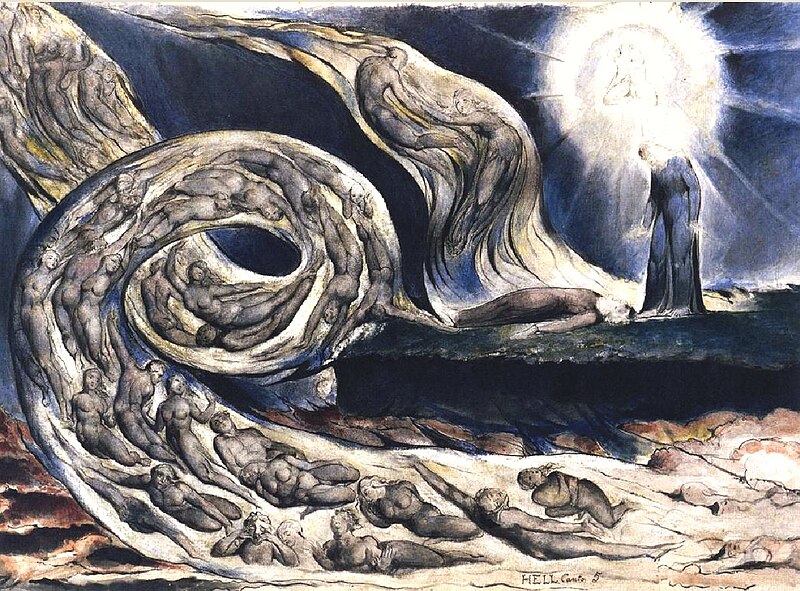
Above is the watercolor of the Circle of the Lustful which was one of the six items designated for the Birmingham Museum. Blake was moved to produce engravings of his illustration to the Divine Comedy while working on the 102 watercolor sketches and drawings. This same design was engraved on copper along with six other designs. In 1937 the copperplates were sold by John Linnell's descendants to Lessing J. Rosenwald who was a principle benefactor of the National Gallery in Washington DC.
In various Museums are prints from the copperplates from as early as Blake's own proofs, to 25 sets made in 1968 from the copperplates in the National Gallery.

The set shown below is from the National Gallery Victoria.


The Circle Of the Lustful, Paolo and Francesca  


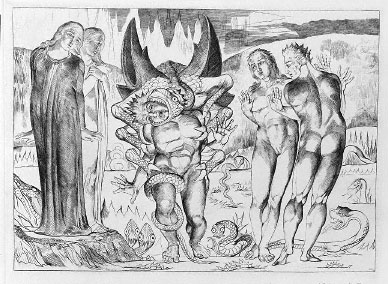
The Circle of the Corrupt Officials. The Devils Tormenting Ciampolo   1826-27\


The Circle of the Corrupt Officials. The Devils Mauling Each Other   1826-27


The Circle of Thieves. Agnello dei Brunelleschi Attacked by a Six-Footed Serpent   1826-27


The Circle of Thieves. Buoso dei Donati Attacked by the Serpent   1826-27


The Circle of the Falsifiers. Dante and Virgil Covering Their Noses Because of the Stench   1826-27


The Circle of the Traitors: Dante's Foot Striking Bocca degli Abbati   1826-27

  
Additional information about Blake's engravings for the Divine Comedy is available in an article by Robert Essick in "Blake: An Illuminated Quarterly." 

Read commentary about Hell Canto 5 and the Circle of the Lustful at Digital Dante provided by Columbia University.