Tuesday, January 12, 2010

LAST VINTAGE


Egg Shaped World of Los

Blake managed to remain upbeat in his expectation for the outcome of the grand experiment which we know as life and intelligence. We too, with consciousness and vision, may become aware of the possibility of Eternity becoming manifest in all creation. Milton Percival ( William Blake's Circle of Destiny, Page 248.) outlines Blake's struggle in delineating and living the faith he had in God's wisdom and mercy. Percival's words:

"It is none too certain, however, that the world will take the path of deliverance. An outward and feminine religion of Mystery challenges the masculine gospel of Christ. But when Mystery is at last stripped of its trappings, and the grinning skeleton of Deism stands revealed, it is time for the Last Judgment. With Deism the wheel of Natural Religion, which began its circuit centuries ago, has swung full circle, and must now submit to Christ or swing round once again. Which will it do? Will the world today, having come to the edge of the abyss over the path of mutual fear, renounce that policy and enter into the ways of peace? Are we purged and pure - true gold - or must we be cast, as dross, once more into the furnaces of affliction? The question haunted Blake, as it haunted Shelley. The prophet in him, especially around the year 1790, filled him with hope of the great renunciation. The Spectre in him pointed out the power of error to renew itself. Where Babylon ends Babylon might begin again. Generation might not be swallowed up in regeneration. This fear is never absent from Los's mind or Blake's. Los's Herculean efforts are necessary, that the "wheel of religion" may disappear in the current of creation." He dare not relinquish his activities, lest the creation itself (the egg-shaped world of Los, and Blake's symbol for what had already been accomplished in a regenerative way) be destroyed. But, though Blake's fear was great, his will to believe was greater. He persuaded himself that man would take the path of Job taken in the Illustrations. He would cast his pride and selfhood (which betrayed him into the cruelty of Natural Religion) into the lake of fire, and be transformed into the likeness of Christ."

Milton, Plate 24 , (E 118)

"But Los dispersd the clouds even as the strong winds of Jehovah,

And Los thus spoke. O noble Sons, be patient yet a little
I have embracd the falling Death, he is become One with me
O Sons we live not by wrath. by mercy alone we live!
I recollect an old Prophecy in Eden recorded in gold; and oft
Sung to the harp: That Milton of the land of Albion.
Should up ascend forward from Felphams Vale & break the Chain
Of jealousy from all its roots; be patient therefore O my Sons
These lovely Females form sweet night and silence and secret
Obscurities to bide from Satans Watch-Fiends. Human loves
And graces; lest they write them in their Books, & in the Scroll
Of mortal life, to condemn the accused: who at Satans Bar
Tremble in Spectrous Bodies continually day and night
While on the Earth they live in sorrowful Vegetations
O when shall we tread our Wine-presses in heaven; and Reap
Our wheat with shoutings of joy, and leave the Earth in peace

Remember how Calvin and Luther in fury premature
Sow'd War and stern division between Papists & Protestants
Let it not be so now! O go not forth in Martyrdoms & Wars
We were plac'd here by the Universal Brotherhood & Mercy
With powers fitted to circumscribe this dark Satanic death
And that the Seven Eyes of God may have space for Redemption.
But how this is as yet we know not, and we cannot know;
Till Albion is arisen; then patient wait a little while,
Six Thousand years are passd away the end approaches fast;
This mighty one is come from Eden, he is of the Elect,
Who died from Earth & he is returnd before the Judgment.
This thing Was never known that one of the holy dead should willing return
Then patient wait a little while till the Last Vintage is over:
"

Angel of Revelation

Percival obviously shared Blake's fears and his faith, as well as his strenuous effort on the part of regeneration.

Monday, January 11, 2010

Blake a Gnostic?

Blake was not a Gnostic!  But he freely used Gnostic ideas 
like he freely used biblical ideas, platonic and neo-platonic 
ideas and many other ideologies.  Here's an extract from a 
google book :


Gnostics by Tobias Churton


But there is certainly a relationship. Blake's myth involved
four levels: Eternity, Beulah, Ulro, generation/regeneration.

"In the Gnostic view, Hylics, also called Somatics (from Gk το σώμα, soma the body or 'of the body'), were the lowest order of the three types of human. The other two were the Psychics and the Pneumatics (from Gk το πνεύμα, spirit, breath). So humanity comprised matter-bound beings, matter-dwelling spirits and the matter-free or immaterial, souls." in the Free Dictionary.

"When the Morning Stars Sang Together" Illustrations to the Book of Job (Butts Set)  Click on picture for details.

The somatic (or hylic) level corresponds roughly to Paul's
appellation
or his 'slackers': "their god is their stomach"
(Philippians 3:19).
For Blake they dwell in Ulro.

The psychic dwell in matter, but that's not the only thing on their
minds. For Blake they are the created, the redeemed, those
struggling for a spiritual dimension under the care of Los.
They may eventually rise to Beulah.

The Pneumatic is matter free. We're told that in the Gospel of
Judas
that
Jesus was pneumatic and his disciples were somatic.
Jesus, the
Universal Man, came down from Eternity for our
sakes. Blake calls his
universal man Albion. He came down to
Beulah, passed through the
two lower types, and finally at the
end of Jerusalem became
synonymous with Jesus.

Blake perceived that as the eventual fate of all of us.

So did Blake get his levels of humanity from this Gnostic
system?
Who can tell? He may have developed his system
from any number of
sources. He was a voracious reader. A
good way to learn about Blake's sources is by reading the
Perennial Philosphy, which contains thousands of sources of
divine meaning throughout Western civilization.

Saturday, January 09, 2010

Before the Fall


What was Blake saying with this Picture?

It's about the world, and about everyone:

The biblical source is obvious (Genesis 3), the Garden scene:
Adam and Eve and the snake! Just before the fatal meal that
made us all mortal. But who's the 3rd figure above our
ancestors with the snake all coiled around him? Well Genesis
3 mentions a third figure called "cherubim and a flaming
sword flashing back and forth to guard the way to the tree of
life."

Now look at Blake's myth:
The third figure has a thousand faces: serpent, Satan, Covering Cherub...Urizen! above all the Spectre, the Selfhood!

Blake, the world, you and I are three: masculine, feminine,
and spectrous.

Man and woman work together amicably-- with love;
the spectre, (Satan, Lucifer, Urizen, the Covering Cherub!)
is jealous; his thoughts are evil.

The Fall of Man began Blake's myth, and he wrote many ends (the Bible does as well). One of Blake's earliest and most dramatic ones come in Plate 14 of MHH:

"The ancient tradition that the world will be consumed in fire at the end of six thousand years is true, as I have heard from Hell.

For the cherub with his flaming sword is hereby commanded to leave his guard at tree of life, and when he does, the whole creation will be consumed, and appear infinite, and holy whereas it now appears finite & corrupt."

Once again the poem, My Spectre Round me Night and Day tells the whole story in microcosm.

7 EYES OF GOD

Seven Eyes of God from Illustrations of the Book of Job.
Click on picture for enlargement; the date indicates that this is one of Blake's last works. 

When Divine Spirits fall into the world of mortality, they are not left unprotected. The Eternals elected seven of their own to guide and protect them until the day of their return. These seven are the Seven Eyes of God. Blake sees them as forming structures which allow the Soul to exist in the conditions and stage of development in which the Soul finds itself. Each of the Seven eyes is associated with a historic period of religious development. So they may be seen as the evolution of Spiritual consciousness in the collective society. Thus Blake calls the seven by names of characters prominent in Biblical accounts: Lucifer, Molech, Elohim, Shaddai, Pahad, Jehovah, Jesus.                                      
Like the world of Generation, they are created as mercies that man may not fall into the abyss of non-existence. They are not perfect solutions to the condition of man. Percival in William Blake's Circle of Destiny identifies the chief characteristic of each stage. Lucifer is pride, Molech is impatience, Elohim is vengeance, Shaddai is anger, Pachad is fear, Jehovah is mystery, and Jesus is deliverance. 'The Seven are one within the other'. (Four Zoas, Page 21, (E 312))

The psychic stages through which man passes, frequently follow the same path that is represented by the progression through the Seven Eyes. Blake's Illustrations of the Book of Job presents the development of Job's relationship to God as progressing through the Seven Eyes and returning. During the process Job's psyche is altered as well as is his perception of God. 


Here are the six passages in which Blake mentions the Eyes of God:

1) Four Zoas, Night I, Page 21, (E 312)

"So spoke the Messengers of Beulah. Silently removing
The Family Divine drew up the Universal tent
Above High Snowdon & closd the Messengers in clouds around  
Till the time of the End. Then they Elected Seven. called the Seven
Eyes of God & the Seven lamps of the Almighty                    
The Seven are one within the other the Seventh is named Jesus"

2) Milton, Plate 23, (E 118)
"We were plac'd here by the Universal Brotherhood & Mercy
 

With powers fitted to circumscribe this dark Satanic death
And that the Seven Eyes of God may have space for Redemption.
But how this is as yet we know not" 

3) Milton, PLATE 24 [26] (E 118)
"& the Seven Eyes of God continually

Guard round them, but I the Fourth Zoa am also set 
The Watchman of Eternity, the Three are not! & I am preserved
Still my four mighty ones are left to me in Golgonooza
 

Still Rintrah fierce, and Palamabron mild & piteous
Theotormon filld with care, Bromion loving Science" 

4) Milton, Plate 29 (31), (E 127)
"But Enitharmon and her Daughters take the pleasant charge. 
To give them to their lovely heavens till the Great Judgment Day
Such is their lovely charge. But Rahab & Tirzah pervert

Their mild influences, therefore the Seven Eyes of God walk round
The Three Heavens of Ulro, where Tirzah & her Sisters

Weave the black Woof of Death upon Entuthon Benython" 

5) Milton, Plate 35, (E 135)
"But the Larks Nest is at the Gate of Los, at the eastern
 

Gate of wide Golgonooza & the Lark is Los's Messenger
PLATE 36 [40]
When on the highest lift of his light pinions he arrives
At that bright Gate, another Lark meets him & back to back
 

They touch their pinions tip tip: and each descend
To their respective Earths & there all night consult with Angels

Of Providence & with the Eyes of God all night in slumbers
Inspired: & at the dawn of day send out another Lark

Into another Heaven to carry news upon his wings
Thus are the Messengers dispatchd till they reach the Earth again"


6) Jerusalem, Plate 55, (E 203)
"The Stars in their courses fought. the Sun! Moon! Heaven! Earth.
Contending for Albion & for Jerusalem his Emanation
And for Shiloh, the Emanation of France & for lovely Vala.

Then far the greatest number were about to make a Separation
And they Elected Seven, calld the Seven Eyes of God;
Lucifer, Molech, Elohim, Shaddai, Pahad, Jehovah, Jesus.
They namd the Eighth. he came not, he hid in Albions Forests"


Friday, January 08, 2010

Bacon, Newton, and Locke

"I consider them [Bacon, Newton, and Locke] as the three greatest men that have ever lived, without any exception.." (from the pen of Thomas Jefferson in a letter in 1789.

You can see what Blake thought of Bacon by reading his annotations to one of Bacon's books (Erdman pp 620-32). Here's are two examples:

"7. Bacon a Liar
AnnBacon62; E624

8. Bacon has no notion of any thing but Mammon
AnnBacon69; E625"

Re Newton look at the end of a famous letter (23) to Butts in 1802:
"Now I a fourfold vision see
And a fourfold vision is given to me
Tis fourfold in my supreme delight
And three fold in soft Beulahs night
And twofold Always.  May God us keep
From Single vision & Newtons sleep" (Erdman 722) 
 Re Locke: the tabula raza was particularly offense to Blake
who thought intelligence and imagination were inherent in us
all.  
 In Milton plate 41 Blake dispatches all three with this:
"To cleanse the Face of my Spirit by Self-examination.
To bathe in the Waters of Life; to wash off the Not Human
I come in Self-annihilation & the grandeur of Inspiration
To cast off Rational Demonstration by Faith in the Saviour
To cast off the rotten rags of Memory by Inspiration
To cast off Bacon, Locke & Newton from Albions covering
To take off his filthy garments, & clothe him with
Imagination" (Erdman 142)

Blake felt that these three men (Blake's 'unholy trinity')
had led England into a thoroughly materialistic,
spirit-denying culture dominated by greed.  What he said
about them was largely true although they had a positive
dimension as well. Blake acknowledged the positive dimension
in plate 98 near the end of Jerusalem:
"The Druid Spectre was Annihilate loud thundring rejoicing
terrific vanishing
Fourfold Annihilation & at the clangor of the Arrows of
Intellect
The innumerable Chariots of the Almighty appeard in Heaven
And Bacon & Newton & Locke, & Milton & Shakspear &
Chaucer"(Erdman 257)
Although he had excoriated them systematically throughout
his works, he realized that they were not negatives, but
contraries.  The essential polarity of the mind means that
the opposites are also true. 

Thursday, January 07, 2010

Blake's God

Here we go again:
We start of course with the four year old who ran screaming to his mother after seeing an angry God in the window. This certainly suggests exposure to one of the angry preachers who (then and now) project their own misery onto the God they describe for their parishioners. It set for Blake the mode for 25 years of defiance for a God so destructive to the human psyche. Christians through the ages have repressed the anger they feel toward such a God. But Blake did not repress! He let it all out.

By the age of 33 in MHH he had learned to express complete skepticism re the God and the Church that directed the religious life of the multitude. In particular he saw it as a conspiracy of rogues (look again at Plate 11).

Now look again at Milton, plate 37:
"The Monstrous Churches of Beulah, the Gods of Ulro
Twelve monstrous dishumanizd terrors Synagogues of Satan.
A Double Twelve & Thrice Nine: such their divisions:"

Here Blake named twelve (prechristian) "Gods, the Twelve Spectre Sons of the Druid Albion " and twenty-seven "Heavens & their Churches" in three groups: the antediluvian ones, the Judaic ones, and the supposed Christian ones. So he's talking about fallen religion, where many of us attend every Sunday (that would be the church of Luther).

The religious denomination that goes by the name of 'Witnesses' would take great issue with the description that Blake made of Jehovah:

Jehovah was Urizen, even Satan, the Angel of the Divine Presence, the Gnostic demiurge who made a hash of his Creation. So much for that God. He was called everything but 'Loving'.

Blake mentioned Jehovah 64 times; here is a fairly representative

one from his notes on The Last Judgment:

" The Aged Figure with Wings having a writing tablet & taking
account of the numbers who arise is That Angel of the Divine
Presence mentiond in Exodus XIVc 19v & in other Places
this Angelis frequently calld by the Name of Jehovah Elohim The I am of the Oaks of Albion"

Jehovah was too often identified with condemnation:

In the Epilogue to Gates of Paradise we read:
" To The Accuser Who is
The God of This World
Truly My Satan thou art but a Dunce
And dost not know the Garment from the Man
Every Harlot was a Virgin once
Nor canst thou ever change Kate into Nan
Tho thou art Worshipd by the Names Divine
Of Jesus & Jehovah thou art still
The Son of Morn in weary Nights decline
The lost Travellers Dream under the Hill"

The most derogatory figure Blake used for authorities
such as King George or Jehovah is in Nobodaddy, a term
used again in an indelicate doggerel on Erdman 499.

Blake accurately portrayed the leading spirit of the Old Testament in the above discussion.

We come now to the gospel. Blake considered Jesus the only God. In his mind Jesus was largely about forgiveness; many examples of Blake's forgiveness (the forgiveness Jesus taught can be found throughout his poetry.) The most succinct one has
appeared in these posts before: the little unnamed poem
going by the name of My Spectre; here's the end of it:

"And Throughout all Eternity I forgive you; you forgive me.
As the dear Redeemer said, this the Wine and this the Bread."

If you want more on Blake and God, look at the
Spiritual Autobiography, Chapter Five.

Wednesday, January 06, 2010

COUCH OF DEATH

Wikimedia Commons
Christ in the Sepulcher 
Guarded by Angels
At a critical moment in Blake's myth, he represents one of the low points in the condition of Albion, the Universal Man. Although this picture is labeled "Christ in the Sepulcher", the angels duplicate those described at the beginning of Night VIII of the Four Zoas. The appearance of the Lamb of God signals the impending resolution of Albion's plight.
 Four Zoas, Night VIII, Page 99 (E 370)

"The Fallen Man stretchd like a Corse upon the oozy Rock
Washd with the tides Pale overgrown with weeds
Two winged immortal shapes one standing at his feet
Toward the East one standing at his head toward the west
Their wings joind in the Zenith over head
Such is a Vision of All Beulah hovring over the Sleeper

The limit of Contraction now was fixd & Man began
To wake upon the Couch of Death he sneezed seven times
A tear of blood dropped from either eye again he reposd
In the saviours arms, in the arms of tender mercy & loving
kindness

Then Los said I behold the Divine Vision thro the broken Gates
Of thy poor broken heart astonishd melted into Compassion & Love
And Enitharmon said I see the Lamb of God upon Mount Zion
Wondring with love & Awe they felt the divine hand upon them"

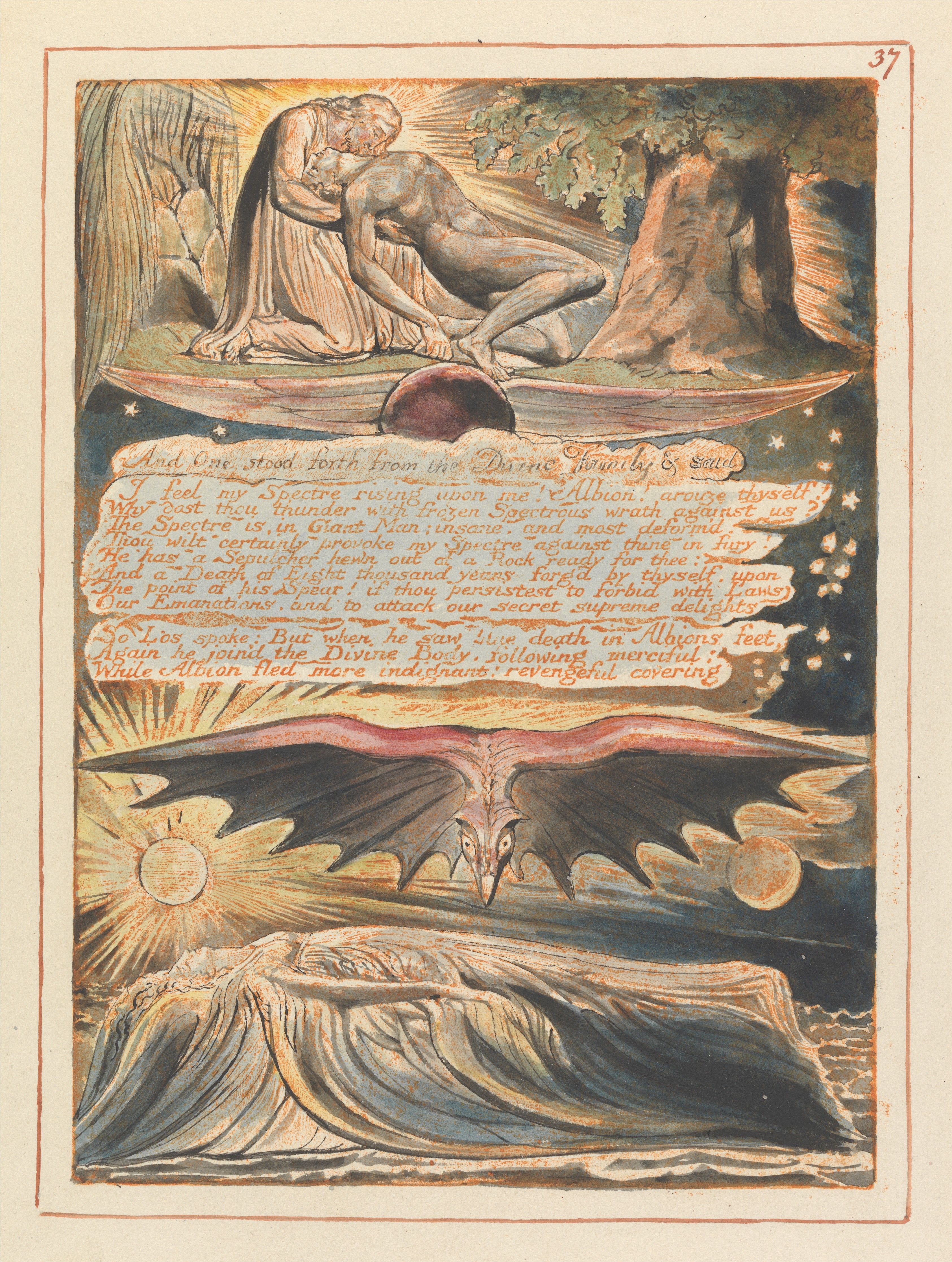
Although Blake never completed and illuminated the Four Zoas, the image of Albion in the arms of Jesus appears on Plate 37 of Jerusalem, along with a description of Los attempting to turn Albion in the right direction.

Albion in the Arms of Jesus

Tuesday, January 05, 2010

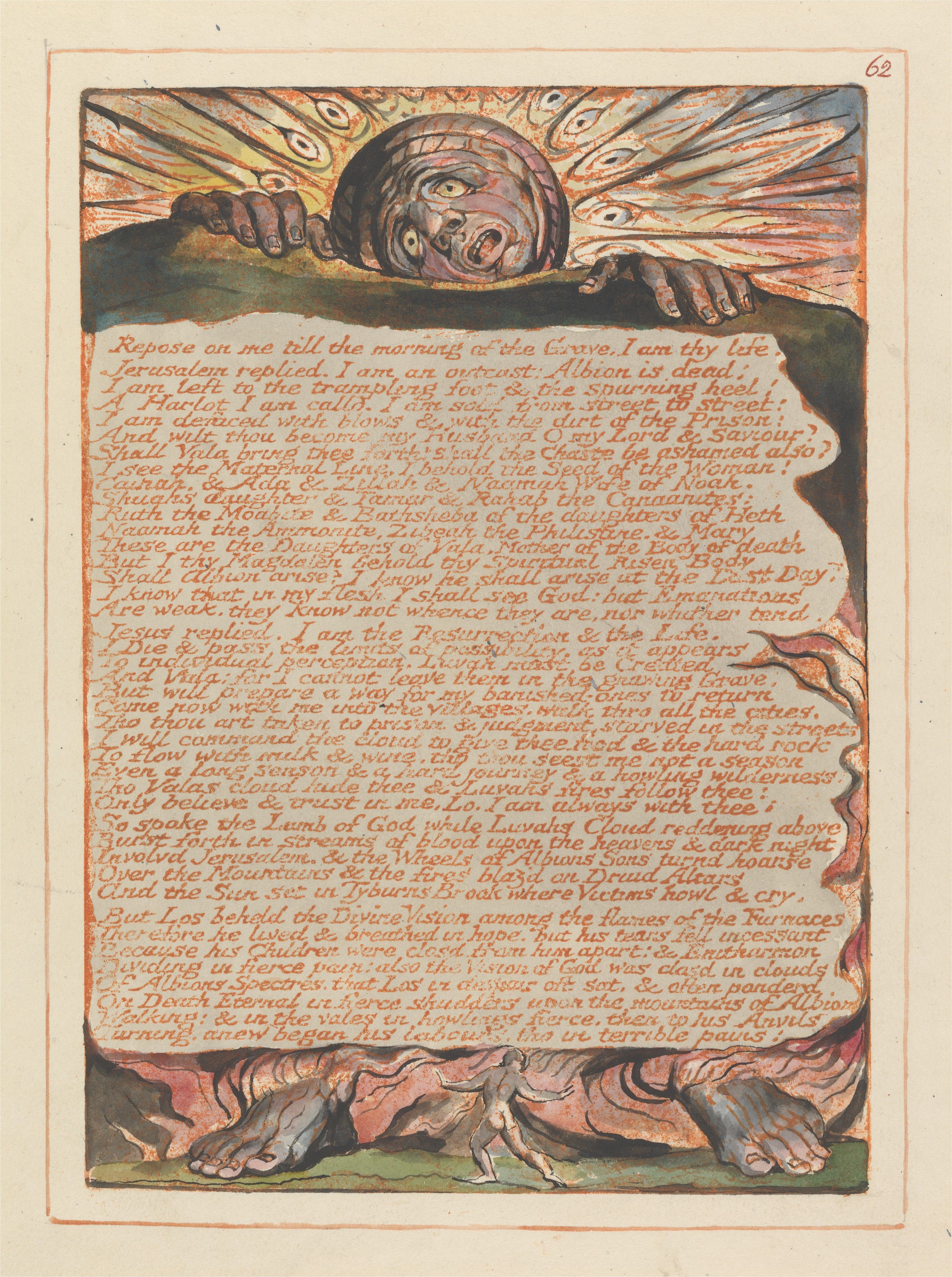
ALBION & LOS

Yale Center for British Art
Jerusalem
Plate 62

FOLLOWUP TO 'LAMB OF GOD'

Since it is hard to correlate the text of Plate 62 of Jerusalem with the picture, we can look elsewhere for text that matches the image. We find it on Plates 33 and 34.

IMAGE: Jerusalem, Plate 62, Albion and Los


TEXT: Jerusalem, PLATE 33 [37] (E 179):

"And One stood forth from the Divine Family &, said

I feel my Spectre rising upon me! Albion! arouze thyself!
Why dost thou thunder with frozen Spectrous wrath against us?
The Spectre is, in Giant Man; insane, and most deform'd.
Thou wilt certainly provoke my Spectre against thine in fury!
He has a Sepulcher hewn out of a Rock ready for thee:
And a Death of Eight thousand years forg'd by thyself, upon
The point of his Spear! if thou persistest to forbid with Laws
Our Emanations, and to attack our secret supreme delights

So Los spoke: But when he saw blue death in Albions feet,
Again he join'd the Divine Body, following merciful;
While Albion fled more indignant! revengeful covering

PLATE 34 [38]
"His face and bosom with petrific hardness, and his hands
And feet, lest any should enter his bosom & embrace
His hidden heart; his Emanation wept & trembled within him:
Uttering not his jealousy, but hiding it as with
Iron and steel, dark and opake, with clouds & tempests brooding:
His strong limbs shudderd upon his mountains high and dark.

Turning from Universal Love petrific as he went,
His cold against the warmth of Eden rag'd with loud
Thunders of deadly war (the fever of the human soul)
Fires and clouds of rolling smoke! but mild the Saviour follow'd him,
Displaying the Eternal Vision! the Divine Similitude!
In loves and tears of brothers, sisters, sons, fathers, and friends
Which if Man ceases to behold, he ceases to exist:"

So we see Albion hard and cold and crazed, (with his blue feet), but under the protection of the seven eyes of God which surround his head in the picture. Los, as a tiny figure between the gigantic feet, is the One who stood forth to warn Albion of his fate.

Albion has mounted his defenses, but he is not abandoned by the Savior who follows him. This is the link forward to Plate 62 with the promise of the Lamb of God to be with us always.

I believe that Blake would be pleased that his readers are persistent enough to ferret out the more obscure references and hidden connections. Those who like to work puzzles or solve mysteries should find Blake fascinating.


Monday, January 04, 2010

LAMB OF GOD

Frequently Blake used a shorthand to present his ideas. He quoted words or phrases from his sources to evoke larger bodies of ideas without stating them explicitly.

On Plate 62 of Jerusalem he points our attention to various Biblical passages to expand the context of the statements he is making about Jesus and about his own developing myth. To facilitate a more complete understanding of part of Plate 62, here are some Biblical passages which incorporated phrases from Blake's poem.


John 20:11-12 - But Mary [Maglalen] stood just outside the tomb, and she was crying. And as she cried, she looked into the tomb and saw two angels in white who sat, one at the head and the other at the foot of the place where the body of Jesus had lain.
20:13 - The angels spoke to her, "Why are you crying?" they asked. "Because they have taken away my Lord, and I don't know where they have put him!" she said.
20:14 - Then she turned and noticed Jesus standing there, without realising that it was Jesus.
20:15 - "Why are you crying?" said Jesus to her. "Who are you looking for?" She, supposing that he was the gardener, said, "Oh, sir, if you have carried him away, please tell me where you have put him and I will take him away."
20:16 - Jesus said to her, "Mary!" At this she turned right round and said to him, in Hebrew, "Master!"
 

Mark 1:2 - just as the prophet Isaiah had written: "Look, I am sending my messenger ahead of you, and he will prepare your way.

Numbers 10:12 - and the sons of Israel set out on their journeys from the wilderness of Sinai. Then the cloud settled down in the wilderness of Paran.

Nehemiah 9:19 - You, in Your great compassion, Did not forsake them in the wilderness; The pillar of cloud did not leave them by day, To guide them on their way, Nor the pillar of fire by night, to light for them the way in which they were to go

Exodus 17:5-6 -
The Lord answered Moses, “Walk on ahead of the people. Take with you some of the elders of Israel and take in your hand the staff with which you struck the Nile, and go. I will stand there before you by the rock at Horeb. Strike the rock, and water will come out of it for the people to drink.” So Moses did this in the sight of the elders of Israel.

Exodus 16:4 Then the LORD said to Moses, "Behold, I will rain bread from heaven for you; and the people shall go out and gather a day's portion every day, that I may test them, whether or not they will walk in My instruction.

John 11:24 - "I  know," said Martha, "that he [her brother Lazarus]
will rise again in the resurrection at the last day."

John 11:25-26 - "I myself am the resurrection and the life," Jesus
told her. "The man who believes in me will live even though he
dies, and anyone who is alive and believes in me will never die
at all. Can you believe that?"

John 14:28 - You have heard me say, 'I am going away and I am
coming back to you. ' If you really loved me, you would be glad
because I am going to my Father, for my Father is greater than I.
And I have told you of it now, before it happens, so that when
it does happen, your faith in me will not be shaken.
Revelation 14:20 - And the wine press was trodden outside the city, and blood came out from the wine press, up to the horses' bridles, for a distance of two hundred miles.

This may seem like a lot of Biblical references for one short passage but with some effort you can find even more.

Jerusalem, Plate 62, (E 212)
[Jerusalem speaking:]
"These are the Daughters of Vala, Mother of the Body of death
But I thy Magdalen behold thy Spiritual Risen Body
Shall Albion arise? I know he shall arise at the Last Day!
I know that in my flesh I shall see God: but Emanations
Are weak. they know not whence they are, nor whither tend.

Jesus replied. I am the Resurrection & the Life.
I Die & pass the limits of possibility, as it appears
To individual perception. Luvah must be Created
And Vala; for I cannot leave them in the gnawing Grave.
But will prepare a way for my banished-ones to return
Come now with me into the villages. walk thro all the cities.
Tho thou art taken to prison & judgment, starved in the streets
I will command the cloud to give thee food & the hard rock
To flow with milk & wine
, tho thou seest me not a season
Even a long season & a hard journey & a howling wilderness!
Tho Valas cloud hide thee & Luvahs fires follow thee!
Only believe & trust in me, Lo. I am always with thee!

So spoke the Lamb of God while Luvahs Cloud reddening above
Burst forth in streams of blood upon the heavens & dark night
Involvd Jerusalem. & the Wheels of Albions Sons turnd hoarse
Over the Mountains & the fires blaz'd on Druid Altars
And the Sun set in Tyburns Brook where Victims howl & cry.

But Los beheld the Divine Vision among the flames of the Furnaces
Therefore he lived & breathed in hope."

Jerusalem, Plate 62
 

As you may gather after viewing the plate, Blake is attempting to convey much more in this Plate than has been suggested in this post.

Friday, January 01, 2010

Blake's Bible

You might say that how you read the Bible is a key to
how you understand Blake. Blake honored the Bible, but
he considered bibliolatry to be anathema:

A young theologian asked his O.T. professor if he
believed God told the Israelites to exterminate
the Canaanites; "yes" was the reply, "because they
were totally depraved" (Ah!, the babies, too?)

Blake read it differently. Quoting Fearful
Symmetry, p. 109: "Jehovah often urges a ferocious
cruelty extremely repugnant to the civilized mind.
If one gives up the attempt to extract a unified
moral code out of the Bible, this becomes a
profoundly true vision of a false god..."

Plate 11 of The Marriage of Heaven and Hell:
" The ancient Poets animated all sensible objects with Gods or
Geniuses calling them by the names and adorning them with the properties of woods, rivers, mountains, lakes, cities, nations, and whatever their enlarged & numerous senses could percieve. And particularly they studied the genius of each city &country. placing it under its mental deity. Till a system was formed, which some took advantage of & enslav'd the vulgar by attempting to realize or abstract the mental deities from their objects: thus began Priesthood. Choosing forms of worship from poetic tales. And at length they pronounced that the Gods had orderd such things. Thus men forgot that All deities reside in the human breast."

And "Everything possible to be believ'd is an image of truth"
(MHH: Proverbs of Hell).

The Bible of course is about God; it portrays a
great many visions of God: those of primitive
savages and those of wise men like Abraham,
Moses, and Isaiah. They are the "Ancient Poets"
of MHH.

Until Jesus! he came into the picture when Blake
got to the N.T. Although Blake may not have
focused on it, the vision of the Loving Heavenly
Father should be more acceptable to the "civilized
mind."

Blake of course memorialized the moments when
Jesus "came into the picture"; look again at the
First Vision of God. There are many others.

For years Blake attempted to explicate what Jesus
meant to him. For years he worked on The Everlasting 

Gospel. But as we all know Jesus cannot be explicated; 
for me and perhaps for Blake that of God in everyone 
was about as close as you can get.

Blake's poetic gift was at the service of his Art and
his Religion (both very changeable throughout his
lifetime).

"Prayer is the Study of Art
praise is the Practise of Art
Fasting &c. all relate to Art
The outward Ceremony is Antichrist
Without Unceasing Practise nothing can be done
Practise is Art If you leave off you are Lost
A Poet a Painter a Musician an Architect:
the Man Or Woman who is not one of these is not a Christian"
(The Lacoon; Erdman 274)

Thursday, December 31, 2009

UNCONSCIOUS

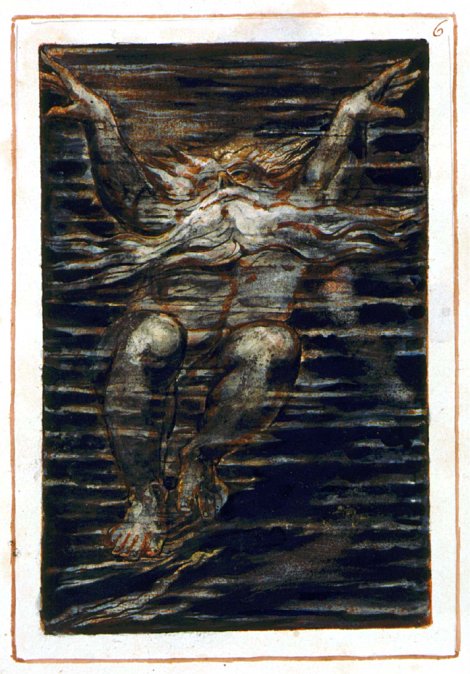
Sea of Unconsciousness
Book of Urizen, Plate 6

The aspect of the psyche which is hidden, buried and unknown is spoken of as the unconscious. It is unknown but not unknowable. Although the gate is closed to enter the unconscious; the gate for unconscious content to come out is not entirely closed. Much of what Blake has written about in his poetry has come from his unconscious.

One of the Four Zoas is mentioned less frequently than the others - Urthona - and when he is mentioned his name is frequently prefixed by the word dark. He has a manifestation in the outer world who is named Los, but as an Eternal he seems to play a lessor role. He is dark for Blake because he is in the unconscious. As he enters consciousness his forms and activities become a part of the world of consciousness.

Jung called Reason and Feeling the rational functions; Sensation and Intuition were called irrational. Blake has Tharmas and Urthona working together to repel the advances of Urizen into Urthona's territory. I have spoken of Tharmas (Blake's image for the physical body or senses) functioning as the Id, Urthona can be seen as functioning as the Intuition. Both reside in man's unconscious.

Here is an account of Urizen's attempt to invade the territory of Urthona, Four Zoas :

Night VI
, Page 74, (E 350):
"And now he came into the Abhorred world of Dark Urthona
By Providence divine conducted not bent from his own will
Lest death Eternal should be the result for the Will cannot be
violated
Into the doleful vales where no tree grew nor river flowd
Nor man nor beast nor creeping thing nor sun nor cloud nor star
Still he with his globe of fire immense in his venturous hand
Bore on thro the Affrighted vales ascending & descending
Oerwearied or in cumbrous flight he venturd oer dark rifts
Or down dark precipices or climbd with pain and labour huge
Till he beheld the world of Los from the Peaked rock of Urthona
And heard the howling of red Orc distincter & distincter"

Urizen fails to occupy Urthona's territory. Later near the end of the Four Zoas, Urthona resumes his work which had been interrupted as he fell from Eternity with Urizen and Luvah. The association between Urthona and Tharmas continues.
___________
Four Zoas: Night IX, PAGE 138 (E 405)

"Then Dark Urthona took the Corn out of the Stores of Urizen'
He ground it in his rumbling Mills Terrible the distress
Of all the Nations
of Earth ground in the Mills of Urthona
In his hand Tharmas takes the Storms. he turns the whirlwind
Loose
Upon the wheels the stormy seas howl at his dread command
And Eddying fierce rejoice in the fierce agitation of the wheels
Of Dark Urthona Thunders Earthquakes Fires Water floods
Rejoice to one another loud their voices shake the Abyss
Their dread forms tending the dire mills The grey hoar frost
was there
And his pale wife the aged Snow they watch over the fires
They build the Ovens of Urthona Nature in darkness groans
And Men are bound to sullen contemplations in the night
Restless they turn on beds of sorrow. in their inmost brain
Feeling the crushing Wheels they rise they write the bitter words
Of Stern Philosophy & knead the bread of knowledge with
tears & groans


Such are the works of Dark Urthona Tharmas sifted the corn
Urthona made the Bread of Ages & he placed it
In golden & in silver baskets in heavens of precious stone
And then took his repose in Winter in the night of Time"

As the Four Zoas ends it is Urthona who is the image of the restored and unified psyche. He is strong and undivided residing as always in man's 'inmost brain' after providing 'bread for the ages' from the 'distress of the nations.'

PAGE 139
"Urthona is arisen in his strength no longer now
Divided from Enitharmon no longer the Spectre Los
Where is the Spectre of Prophecy where the delusive Phantom
Departed & Urthona rises from the ruinous walls
In all his ancient strength to form the golden armour of science
For intellectual War The war of swords departed now
The dark Religions are departed & sweet Science reigns"

Wednesday, December 30, 2009

The Word within the Word

Northrup Frye was a very famous literary critic,
and a great deal can be found about him on the
web. A Canadian, Frye went to seminary and became
a parish minister; then he went to Oxford and got
an M.A. in English Literature. He wrote his
thesis on William Blake.

A great many books came from his pen; the first
one was Fearful Symmetry (1944). Frye opens the
door to a depth understanding of Blake's poetry (and
pictures). It took five readings of Fearful Symetry
(30 years ago) to open my mind to William Blake.

In the eighties, near the end of his life, Frye
published two monumental volumes of "The Bible as
Literature"; they speak directly to the depth
understanding of our poet.

Some of the statements in 'The Word with the Word'
(chapter five of Fearful Symmetry) may sound
enigmatic; just stay with them, and light will come.
This chapter is a lucid description of Frye's primary
gift to literature, to meaning and religion.

All words are metaphors; the meanings they convey
depend upon the author's mind - and frame of mind
when he writes them; and upon the reader's (or
hearer's) mind when he reads or hears them. (Most
of the purposeless arguments over virtually anything
stem from failure to understand this basic fact.)

For Western culture the Bible is the Great Code of
Art; it embodies the Universal Myth, basically
fourfold: Creation, The Fall, Redemption,
Apocalypse. Blake believed that it was the
guiding myth undergirding virtually all discourse.

"Blake's poetry is all related to a central myth...
and the primary basis of this myth is the Bible.
...
The Bible is therefore the archetype of Western
culture, and the Bible...provides the basis for most
of our major art" (Fearful Symmetry, p. 109).

The word of God was Jesus (cf John 1). Anything
that you say or write may be the Word of God-- the
Jesus in you (Paul).

In Plate 3 of Jerusalem (Erdman p. 145) we can read:
"I also hope the Reader will be with me, wholly One in
Jesus our Lord, who is the God [of Fire] and Lord [of
Love] to whom the Ancients look'd and saw his day afar off,
with trembling & amazement. The Spirit of Jesus is continual
forgiveness of sin"

This is the Word in Blake's consciousness.
Jerusalem, (Erdman p. 180):
"Saying. Albion! Our wars are wars of life, & wounds of love,
With intellectual spears, & long winged arrows of thought:
Mutual in one anothers love and wrath all renewing
We live as One Man; for contracting our infinite senses
We behold multitude; or expanding: we behold as one,
As One Man all the Universal Family; and that One Man
We call Jesus the Christ: and he in us, and we in him,
Live in perfect harmony in Eden the land of life,
Giving, receiving, and forgiving each others trespasses.
He is the Good shepherd, he is the Lord and master:
He is the Shepherd of Albion, he is all in all,
In Eden: in the garden of God: and in heavenly Jerusalem."

Tuesday, December 29, 2009

URIZEN & SHADOW

The character Urizen dominates much of Blake's writing. He appears and reappears from the First Book of Urizen to the end of the Four Zoas. Why was his configuration of characteristics so important in the mind of Blake?

Trying to recall Urizen to his former self and to union with the Botherhood, Albion speaks thus to Urizen in Four Zoas, Night IX, PAGE 120 (E 389):

"The Eternal Man sat on the Rocks & cried with awful voice

O Prince of Light where art thou I behold thee not as once
In those Eternal fields in clouds of morning stepping forth
With harps & songs where bright Ahania sang before thy face
And all thy sons & daughters gatherd round my ample table
See you not all this wracking furious confusion
Come forth from slumbers of thy cold abstraction come forth
Arise to Eternal births shake off thy cold repose
Schoolmaster of souls great opposer of change arise
That the Eternal worlds may see thy face in peace & joy
That thou dread form of Certainty maist sit in town & village

While little children play around thy feet in gentle awe
Fearing thy frown loving thy smile O Urizen Prince of light"

Reclining Urizen This is an image of a man who lives almost entirely in his head; his body is atrophied and his hand rests on a second skull.

These are the characteristics which Albion sees as dividing Urizen from his Eternal form. He is cold, he deals in abstractions, he is asleep, and repetitive, and certain of his own correctness. Albion's hope is that he can return to a condition in which the Eternals as well as little children may enjoy his former demeanor.

During the unfolding of Blake's myth, Urizen's characteristics become expressed in the law. Urizen is portrayed as projecting his inner characteristics onto his outer experience; including his attitude as to how the world should function and the people in it should behave.

Blake himself outwardly rejects Urizen's attitudes of distance, rigidness, non-involvement, inflexibility, blindness, and fear of the unknown. But his poetry may reveal that he struggled internally against the very characteristics he objected to. His Shadow may have been expressed in Urizen.

Monday, December 28, 2009

LOS, LUVAH & URIZEN


Labor of Los

Quoting from A BLAKE DICTIONARY, S. Foster Damon, Introduction, Page XI:

"Every sect is self-limited, whereas Truth is Universal. Instead of any religion, Blake wanted the truth - the whole truth including all errors, life including death, the soul including the body, the world of mind including the world of matter, the profound discoveries of the mystics reconciled with the scoffing of the skeptics, heaven and hell married and working together, and in the ultimate heart, Man eternally in the arms of God."

The puzzle of the shift in relationship between Luvah and Urizen deserves careful consideration. Neither Urizen nor Luvah had an indisputable claim to the horses of light or the dominant position they represented; that should should have fallen to Urthona whose 'Vehicular Form' is Los. (Percival refers to Urthona as the 'essential' man.)

The struggle among Urizen, Luvah and Los occupies Blake's imagination. The conflict may be interpreted internally. In Blake's myth either reason or emotion is frequently firmly in control of the psyche. The balance between them shifts as they negotiate and seize power. Sometimes reason is recognized as the higher function and emotion is at the service of reason (or visa versa). Disasters ensue as each function tries to eliminate the other. The higher function, inspiration or Los, eventually succeeds in wresting power and reconstructing the psyche.

Often it is easier to observe the operation of the functions externally before we can recognize them internally. Blake's portrayal of the 4Zs may show us aspects of ourselves we do not already recognize. Likewise, we are more likely to identify another person under the domination of one aspect of the psyche (suppressing the expression of the others), before we can see the same thing in ourselves. But to have it brought to our attention either by reading Blake, or by observing associates consistently and unconsciously coming under the dominion of reason or emotion, may encourage us to deal with unconscious forces which are controlling us. (So too, these imbalances are visible in societal behaviors.)

In The Four Zoas, Night Four, Blake portrays a violent confrontation between Urizen and Los. Urizen is subdued but the cost to Los is high. Los has come under the dominion of his lower nature, expressing revenge, wrath and cruelty, and having taken on the characteristics of the entity whom he was trying to eliminate .

FZ4-53.11; (E335)
"The lovely female howld & Urizen beneath deep groand
Deadly between the hammers beating grateful to the Ears
Of Los. absorbd in dire revenge he drank with joy the cries
Of Enitharmon & the groans of Urizen fuel for his wrath
And for his pity secret feeding on thoughts of cruelty

The Spectre wept at his dire labours"

FZ4-53.21; E336
"And thus began the binding of Urizen day & night in fear
Circling round the dark Demon with howlings dismay & sharp
blightings
The Prophet of Eternity beat on his iron links & links of brass
And as he beat round the hurtling Demon. terrified at the Shapes
Enslavd humanity put on he became what he beheld"

Some scholars have suggested that the portrayal of this type of situation in The Four Zoas led to Blake's abandonment of the writing of the book. In Blake's later poetry, the solution to the problems between Los and Urizen comes through recognition of error, forgiveness, anniliation of the Selfhood, and restoration of Brotherhood.

The unity of the psyche - allowing each function to play its ordained role is the goal toward which Blake directed his readers.

Sunday, December 27, 2009

TWOFOLD

Blake has given us a treasure of insight, experience, and imagery. The cost to him of producing it was enormous. The reward was the satisfaction of using his innate gifts in expressing his imagination. That he produced a body of work that nourishes us two hundred years after his death, expresses the joy and gratitude with which he exercised his gifts. I like to think that in his case, "Eternity is in love with the productions of time." Marriage of Heaven and Hell, Plate 7, (E36)

From George W. Digby, Symbol and Image in William Blake, Page 19:

"He had as it were two eyes, an eye for the verbal image as it is spoken and written, and an eye for the pictorial image. The inner truth that he apprehended was something other than either of these, not confined or explicit in either of them, but something which could be expressed or implied by their means. For truth, reality, is always beyond the formulation of both words and of pictorial images. Sometimes the pictorial symbol parallels or amplifies the written one; sometimes gives the contrasting aspect, or opposite and contrary point of view. But always this double mode of expression is focused on man's subtle and complex nature, his illusions, self-deceptions, conceits, and his contradictory and insatiable desires. This twofold artistic capacity, and his vision of the infinite which the coarseness and opaqueness of human nature unnecessarily obscures, makes the creative work of Blake in art and poetry such an incomparable source of wisdom."

As Blake wrote in The Four Zoas on Page 35 (E324):


"What is the price of Experience do men buy it for a song
Or wisdom for a dance in the street? No it is bought with the price
Of all that a man hath his house his wife his children
Wisdom is sold in the desolate market where none come to buy
And in the witherd field where the farmer plows for bread in vain"

Thursday, December 24, 2009

NATIVITY IV

Chorus of Angels

Since the first image we form of ourselves is that of a body, we may formulate the idea that at some point the spirit enters the body and begins to express itself through the body. But as Blake explains here, it is the bodies which are made for the spirits which pre-exist.

As Albion represents the Universal Man, Jerusalem represents the Universal Woman: the 'vast family wondrous in beauty and love.' Albion is fourfold, Jerusalem is unified: the expression of the Divine Vision within the Universal Man.

In this passage, Blake presents the idea that redemption begins when 'the Lamb of God' becomes visible within the Unified Spiritual Body which is Jerusalem. The song of the angels, sung when the birth of Jesus was announced to the shepherds, is echoed in Blake's verses at this point.

GOSPEL OF LUKE
2:8-12 - "There were some shepherds living in the same part of the country, keeping guard throughout the night over their flocks in the open fields. Suddenly an angel of the Lord stood by their side, the splendour of the Lord blazed around them, and they were terror-stricken. But the angel said to them, 'Do not be afraid! Listen, I bring you glorious news of great joy which is for all the people. This very day, in David's town, a Saviour has been born for you. He is Christ, the Lord. Let this prove it to you: you will find a baby, wrapped up and lying in a manger.'
2:13-14 - And in a flash there appeared with the angel a vast host of the armies of Heaven, praising God, saying, 'Glory to God in the highest Heaven! Peace upon earth among men of goodwill!'"

Four Zoas: Night the Eighth, Page 103 (E376):

"Enitharmon wove in tears Singing Songs of Lamentations
And pitying comfort as she sighd forth on the wind the spectres
And wove them bodies calling them her belovd sons and daughters

Employing the daughters in her looms & Los employd the Sons
In Golgonoozas Furnaces among the Anvils of time & space
Thus forming a Vast family wondrous in beauty & love
And they appeard a Universal female form created
From those who were dead in Ulro from the Spectres of the dead

PAGE 104 (FIRST PORTION)
And Enitharmon namd the Female Jerusa[le]m the holy
Wondring
she saw the Lamb of God within Jerusalems Veil
The divine Vision seen within the inmost deep recess
Of fair Jerusalems bosom in a gently beaming fire


Then sang the Sons of Eden round the Lamb of God & said
Glory Glory Glory to the holy Lamb of God
Who now beginneth to put off the dark Satanic body

Now we behold redemption Now we know that life Eternal
Depends alone upon the Universal hand & not in us
"

GOSPEL OF LUKE
2:25-32 - "In Jerusalem was a man by the name of Simeon. He was an upright man, devoted to the service of God, living in expectation of the 'salvation of Israel'. His heart was open to the Holy Spirit, and it had been revealed to him that he would not die before he saw the Lord's Christ. He had been led by the Spirit to go into the Temple, and when Jesus' parents brought the child in to have done to him what the Law required, he took him up in his arms, blessed God, and said - 'At last, Lord, you can dismiss your servant in peace, as you promised! For with my own eyes I have seen your salvation which you have made ready for every people - a light to show truth to the Gentiles and bring glory to your people Israel.'"

Tuesday, December 22, 2009

STATES

Milton, Plate 32
 

Plate 32 does not appear in the first two copies (A&B) of Milton. It was added later to explain the important concept of 'states'. Blake had clarified his thinking and so gave Milton and the readers the benefit of his understanding. The idea of states is essential to understanding Blake's ideas about 'good and evil', imputing sin, annihilation, and forgiveness. The concept of a merciful and benevolent God, which is incompatible with a God of cruelty and vengeance, requires the idea of states to deal with the problem of handling evil. The understanding of 'states' allows us to 'turn our backs on Heavens builded on cruelty'.

Milton, Plate 32 [35], (E130)
"And Milton oft sat up on the Couch of Death & oft conversed
In vision & dream beatific with the Seven Angels of the Presence

I have turned my back upon these Heavens builded on cruelty
My Spectre still wandering thro' them follows my Emanation
He hunts her footsteps thro' the snow & the wintry hail & rain
The idiot Reasoner laughs at the Man of Imagination
And from laughter proceeds to murder by undervaluing calumny

Then Hillel who is Lucifer replied over the Couch of Death
And thus the Seven Angels instructed him & thus they converse.

We are not Individuals but States: Combinations of Individuals
We were Angels of the Divine Presence: & were Druids in Annandale
Compelld to combine into Form by Satan, the Spectre of Albion,
Who made himself a God &, destroyed the Human Form Divine.
But the Divine Humanity & Mercy gave us a Human Form
Because we were combind in Freedom & holy Brotherhood
While those combind by Satans Tyranny first in the blood of War
And Sacrifice &, next, in Chains of imprisonment: are Shapeless Rocks

Retaining only Satans Mathematic Holiness, Length: Bredth & Highth
Calling the Human Imagination: which is the Divine Vision & Fruition
In which Man liveth eternally: madness & blasphemy, against Its own Qualities,
which are Servants of Humanity, not Gods or Lords[.]

Distinguish therefore States from Individuals in those States.
States Change: but Individual Identities never change nor cease:
You cannot go to Eternal Death in that which can never Die.
Satan & Adam are States Created into Twenty-seven Churches
And thou O Milton art a State about to be Created
Called Eternal Annihilation
that none but the Living shall
Dare to enter: & they shall enter triumphant over Death
And Hell & the Grave! States that are not, but ah! Seem to be.


Judge then of thy Own Self: thy Eternal Lineaments explore
What is Eternal & what Changeable? & what Annihilable!


The Imagination is not a State: it is the Human Existence itself
Affection or Love becomes a State, when divided from Imagination
The Memory is a State always, & the Reason is a State
Created to be Annihilated
& a new Ratio Created
Whatever can be Created can be Annihilated Forms cannot
The Oak is cut down by the Ax, the Lamb falls by the Knife
But their Forms Eternal Exist, For-ever. Amen Halle[l]ujah

Thus they converse with the Dead watching round the Couch of Death.
For God himself enters Death's Door always with those that enter
And lays down in the Grave with them, in Visions of Eternity
Till they awake & see Jesus & the Linen Clothes lying
That the Females had Woven for them, & the Gates of their Fathers House"


The Eternal dimension which seems shadowy to the unawakened, is seen to be substantial and vividly real by those who have been given a 'perception of the infinite.' They have entered the door of death and prepared themselves for transformation. In awakening, they see their physical bodies as garments that can be discarded as they enter the true world of unencumbered Spirit.

From The Grave
 

Philippians 2:5-8 
"Let Christ himself be your example as to what your attitude should be. For he, who had always been God by nature, did not cling to his prerogatives as God's equal, but stripped himself of all privilege by consenting to be a slave by nature and being born as mortal man. And, having become man, he humbled himself by living a life of utter obedience, even to the extent of dying, and the death he died was the death of a common criminal."

Sunday, December 20, 2009

BEYOND EXPERIENCE

In later copies of Songs of Innocence and of Experience, the last three poems are TO TIRZAH, THE SCHOOL BOY, and THE VOICE OF THE ANCIENT BARD. In his The Illuminated Blake, Erdman postulates that, this "arrangement of the concluding plates impl[ies] an apocalyptic metamorphosis at the end of the series of emblems, beyond Innocence and Experience." Erdman suggests "that the Eternal Man 'has risen' out of the realm of' 'Contrary States.' 

TO TIRZAH picture
Songs of Innocence & of Experience, Plate 49, (E 30)
  "To Tirzah  

Whate'er is Born of Mortal Birth, 
Must be consumed with the Earth 
To rise from Generation free; 
Then what have I to do with thee? 
The Sexes sprung from Shame & Pride 
Blow'd in the morn: in evening died 
But Mercy changd Death into Sleep; 
The Sexes rose to work & weep. 
Thou Mother of my Mortal part. 
With cruelty didst mould my Heart. 
And with false self-decieving tears, 
Didst bind my Nostrils Eyes & Ears. 
Didst close my Tongue in senseless clay 
And me to Mortal Life betray: 
The Death of Jesus set me free, 
Then what have I to do with thee? 
[text on illustration: It is Raised a Spiritual Body]"

So looking at these three poems as a group, we ask why they are chosen to conclude Songs of Innocence and of Experience. TO TIRZAH represents the realization that mortal life has been a temporary substitute for the real thing in Eternity. The mortal body is to be raised a spiritual body. The picture recalls to my mind both the Good Samaritan and the Raising of Lazarus, two stories of healing and recovery.
SCHOOL BOY picture

Songs of Innocence & of Experience, Song 53, (E 31)
"The School Boy                                                 t 

I love to rise in a summer morn,
When the birds sing on every tree;
The distant huntsman winds his horn,
And the sky-lark sings with me.
O! what sweet company. 

But to go to school in a summer morn,
O! it drives all joy away;
Under a cruel eye outworn,
The little ones spend the day,
In sighing and dismay.

Ah! then at times I drooping sit,
And spend many an anxious hour.
Nor in my book can I take delight,
Nor sit in learnings bower,
Worn thro' with the dreary shower. 
 
How can the bird that is born for joy,
Sit in a cage and sing.
How can a child when fears annoy,
But droop his tender wing,
And forget his youthful spring.

O! father & mother, if buds are nip'd,
And blossoms blown away,
And if the tender plants are strip'd
Of their joy in the springing day,
By sorrow and cares dismay, 

How shall the summer arise in joy.
Or the summer fruits appear,
Or how shall we gather what griefs destroy
Or bless the mellowing year,
When the blasts of winter appear." 

The School Boy appears to be autobiographical. Young William was not forced to attend school, and his imagination benefited from the freedom he was allowed. He asks how can the adult have the resources to go beyond innocence and experience if the imagination has not been fed and nourished on the sights and sounds and simple joys of unfettered thought and play. He illustrates this by a delightful group of children playing marbles, stretching, climbing, swinging and reading. This plate was originally in Songs of Innocence; now we see it illustrating the stage beyond Experience where the contraries have been resolved through recognition, love and forgiveness. Blake himself has survived the 'blasts of winter' mentioned in the plate, and made us better for it.

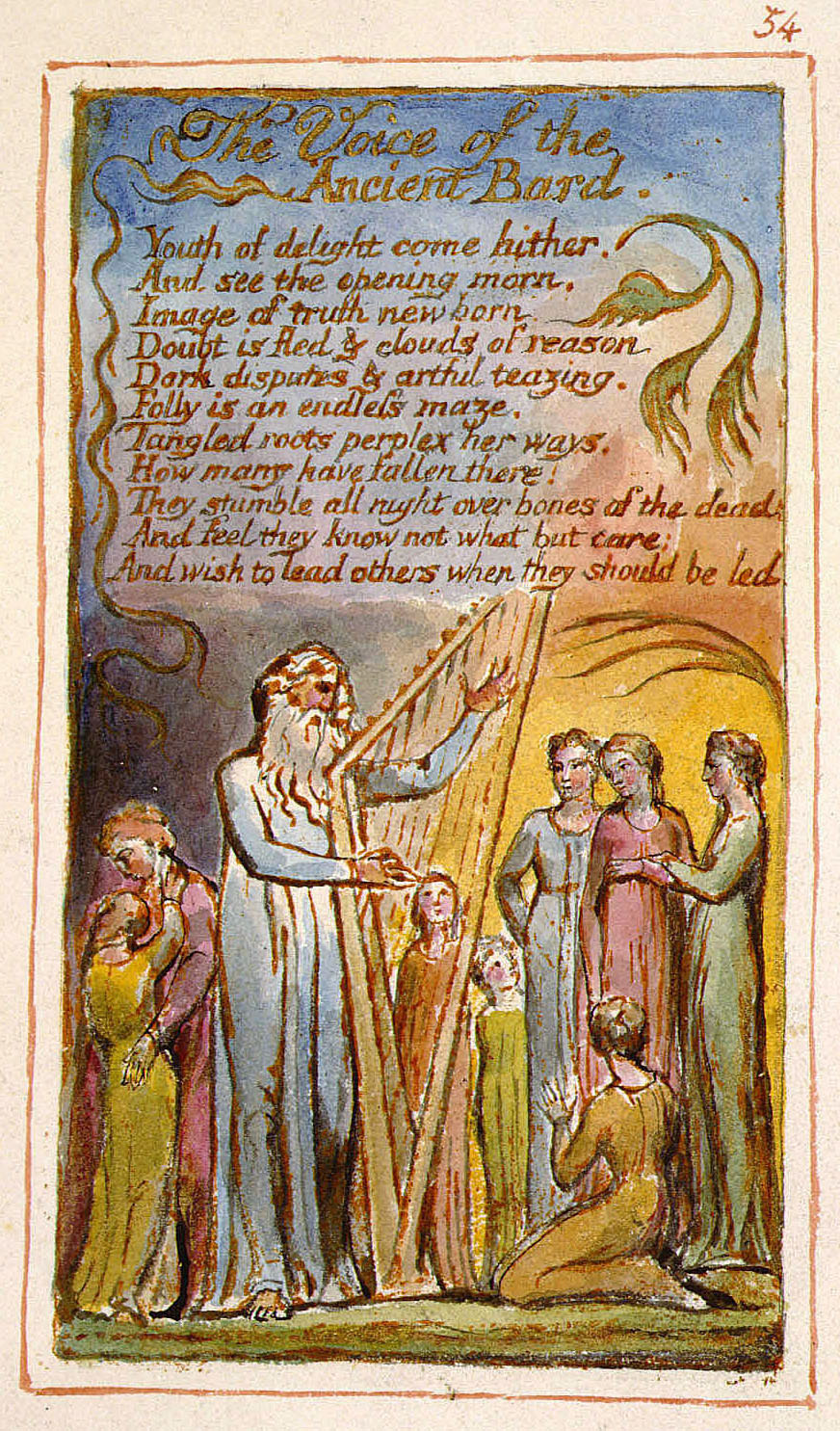
The Voice of the Ancient Bard completes the series on an ambivalent note. The old man is singing and playing his song, and gathers a new generation about him, but he wears a shackle on his ankle. The faces of the children reveal anxiety as they are invited to the new morn and warned about past mistakes. Only if they can avoid being led by those who are not qualified, can they avoid repeating the cycle of despair which the previous generation followed. Blake's unstated answer to the children is that they should trust their own imaginations to provide them with the thread that connects them to the infinite.

So perhaps as a group the three poems are meant to be an invitation to go beyond Experience into Blake's favorite place, the world of Imagination and Vision.

BARD picture


Songs of Innocence & of Experience, Song 54, (E 31)
"The Voice of the Ancient Bard

Youth of delight! come hither
And see the opening morn,
Image of Truth new-born.
Doubt is fled, and clouds of reason,
Dark disputes and artful teazing.
Folly is an endless maze;
Tangled roots perplex her ways;
How many have fallen there!
They stumble all night over bones of the dead;
And feel—they know not what but care;
And wish to lead others, when they should be led."

Friday, December 18, 2009

Beulah II

I cut my teeth on Beulah Land; I was one of those babies sleeping on the front bench while my father preached. At about 9 years of age I read John Bunyan's Pilgrims Progress; here's a snippet:

"Now I saw in my dream, that by this time the Pilgrims were got over the Enchanted Ground, and entering into the country of Beulah, whose air was very sweet and pleasant, the way lying directly through it, they solaced themselves there for a season.

Yea, here they heard continually the singing of birds,and saw every day the flowers appear on the earth, and heard the voice of the turtle in the land. In this country the sun shineth night and day. wherefore this was beyond the Valley of the Shadow of Death, and also out of the reach of Giant Despair, neither could they from this place so much as see Doubting Castle.

Here they were within sight of the city they were going to,also here met them some of the inhabitants thereof; for in this land the Shining Ones commonly walked, because it was upon the borders of heaven. In this land also, the contract between the bride and the bridegroom was renewed; yea, here, As the bridegroom rejoiceth over the bride, so did their God rejoice over them.

Here they had no want of corn and wine; for in this place they met with abundance of what they had sought for in all their pilgrimage. Here they heard voices from out of the city, loud voices,saying, Say ye to the daughter of Zion, Behold, thy salvation cometh! Behold, his reward is with him! Here all the inhabitants of the country called them, The holy people, The redeemed of the Lord, Sought out"

Beulah appears in the Bible once; speaking of Jerusalem Isaiah wrote in 62:4:
"No longer will they call you Deserted, or name your land Desolate. But you will be called Hephzibah (King Hezekiah's wife), and your land Beulah; for the LORD will take delight in you, and your land will be married."

Blake drew on Isaiah and John Bunyan for Beulah; this is only one of many, many sources in the Bible that he used (for his own purposes!).

BEULAH

When Larry retired from working for the government in Washington, DC, we left the 'fast lane' and removed ourselves to the foot of the mountains in South Carolina. For the first and only time in our lives we had a few acres of land to enjoy and to tend. This retreat from congestion, traffic and competition, Larry was fond of calling Beulah.

He was following the nomenclature of his hero, William Blake, who called the level of existence just below the level of Eden, by the name Beulah. From Beulah one may return to 'the severe contentions of eternity' after a period of stress-free relaxation in Beulah. If one got addicted to a life of ease and intellectual laziness, one might slip down into the level of Generation or Ulro. Beulah was meant to be a transitional state not a permanent way of life.

Here is a passage from Symbol and Image in William Blake, by George W Digby, Page 51:

"The 'Daughters of Beulah' are man's inherent powers of recovering his inner harmony and sense of direction. They hold him by secret threads and represent a sort of psychological umbilical cord. They represent the power of the imagination to throw up symbols and present them intuitively to the mind (as these symbols come from the region of the mind most remote and other than ego-consciousness, they appear to come from the unconscious.) By means of these symbols, which are the 'Daughters of Beulah', the lost man may be rescued. Although they may become more and more obscure and tenuous the farther he sinks into the meshes of maya, yet the threads are always there and do not break. The compassion of the 'Daughters of Beulah' endures, as does man's capacity for acceptance and assimilation."

Milton, Plate 30 (E129)

"But the Emanations trembled exceedingly, nor could they
Live, because the life of Man was too exceeding unbounded
His joy became terrible to them they trembled & wept
Crying with one voice. Give us a habitation & a place
In which we may be hidden under the shadow of wings
For if we who are but for a time, & who pass away in winter
Behold these wonders of Eternity we shall consume
But you O our Fathers & Brothers, remain in Eternity
But grant us a Temporal Habitation. do you speak
To us; we will obey your words as you obey Jesus
The Eternal who is blessed for ever & ever. Amen

So spake the lovely Emanations;"

Four Zoas, Night 1, Page 5, Line 29 (E303)

"There is from Great Eternity a mild & pleasant rest
Namd Beulah a Soft Moony Universe feminine lovely
Pure mild & Gentle given in Mercy to those who sleep
Eternally. Created by the Lamb of God around
On all sides within & without the Universal Man
The Daughters of Beulah follow sleepers in all their Dreams
Creating Spaces lest they fall into Eternal Death"

MILTON: BOOK THE SECOND, PLATE 30 (E129)

"There is a place where Contrarieties are equally True
This place is called Beulah, It is a pleasant lovely Shadow
Where no dispute can come. Because of those who Sleep.
Into this place the Sons & Daughters of Ololon descended
With solemn mourning into Beulahs moony shades & hills
Weeping for Milton: mute wonder held the Daughters of Beulah
Enrapturd with affection sweet and mild benevolence

Beulah is evermore Created around Eternity; appearing
To the Inhabitants of Eden, around them on all sides.
But Beulah to its Inhabitants appears within each district
As the beloved infant in his mothers bosom round incircled
With arms of love & pity & sweet compassion. But to
The Sons of Eden the moony habitations of Beulah,
Are from Great Eternity a mild & pleasant Rest."

In the Blake Dictionary, Damon states that Beulah is the subconscious. As such it is out of touch with what we call the 'real world' of conscious thought, sensation, and ego-control. Since what it presents to consciousness is non rational - dreams, fantasy, intuitions,and imaginary constructs - we tend to classify it as illusionary. Psychologists however have found it an avenue for healing the psyche by revealing hidden damage deeper within the unconscious.

An Image of Beulah
Blake seems to have recognized the healing nature of a state where ideas were not rejected or judged; where there was not pressure to produce or conform; where the darkness could appear but not harm; where one could feel that one was held in compassionate arms. Blake's Beulah could be entered through gates from his other worlds, to provide the healing which souls needed to progress along their journeys. Perhaps he saw himself as requiring such recovery from his trials and toils, and wanted to share with us his gentle place where his imagination could spread its wings.

Milton, Plate 42