Wednesday, October 13, 2010

BLAKE & DYLAN

An illustration extracted from page 61 of
William Blake, painter and poet
by Richard Garnett

A plaintive song of Bob Dylan's which was evidently written under the influence of William Blake is titled EVERY GRAIN OF SAND. It was written during what is know as Dylan's Christian period. I see in the song echoes of "Auguries of Innocence" and what may be called the "Jerusalem Hymn" from the beginning of Blake's Milton. Dylan writes of the faith and fears experienced as one travels on the spiritual journey in a world of danger and temptation. Blake's images provide an affirmative note of comfort.


Milton,
Plate 1, (E 95)
"And did those feet in ancient time,
Walk upon Englands mountains green:
And was the holy Lamb of God,
On Englands pleasant pastures seen!

And did the Countenance Divine,
Shine forth upon our clouded hills?
And was Jerusalem builded here,
Among these dark Satanic Mills?

Bring me my Bow of burning gold:
Bring me my Arrows of desire:
Bring me my Spear: O clouds unfold!
Bring me my Chariot of fire!

I will not cease from Mental Fight,
Nor shall my Sword sleep in my hand:
Till we have built Jerusalem,
In Englands green & pleasant Land."

[Pickering Manuscript], Blake's Notebook, (E 490)
AUGURIES OF INNOCENCE
"To see a World in a Grain of Sand
And a Heaven in a Wild Flower
Hold Infinity in the palm of your hand
And Eternity in an hour
A Robin Red breast in a Cage
Puts all Heaven in a Rage
A Dove house filld with doves & Pigeons
Shudders Hell thro all its regions
A dog starvd at his Masters Gate
Predicts the ruin of the State"

This poem continues for 132 lines. The final lines were used prominently in the movie "Dead Man".

EVERY GRAIN OF SAND
by Bob Dylan
"In the time of my confession, in the hour of my deepest need
When the pool of tears beneath my feet flood every newborn seed
There’s a dyin’ voice within me reaching out somewhere
Toiling in the danger and in the morals of despair

Don’t have the inclination to look back on any mistake
Like Cain, I now behold this chain of events that I must break
In the fury of the moment I can see the Master’s hand
In every leaf that trembles, in every grain of sand

Oh, the flowers of indulgence and the weeds of yesteryear
Like criminals, they have choked the breath of conscience and good cheer
The sun beat down upon the steps of time to light the way
To ease the pain of idleness and the memory of decay

I gaze into the doorway of temptation’s angry flame
And every time I pass that way I always hear my name
Then onward in my journey I come to understand
That every hair is numbered like every grain of sand

I have gone from rags to riches in the sorrow of the night
In the violence of a summer’s dream, in the chill of a wintry light
In the bitter dance of loneliness fading into space
In the broken mirror of innocence on each forgotten face

I hear the ancient footsteps like the motion of the sea
Sometimes I turn, there’s someone there, other times it’s only me
I am hanging in the balance of the reality of man
Like every sparrow falling, like every grain of sand"

Copyright © 1981 by Special Rider Music

Emmy Lou Harris singing EVERY GRAIN OF SAND

Tuesday, October 12, 2010

Blake's Style

The Perennial Philosophy was about as good a description of Blake's thought as we can find.  Not trained and conditioned to the Enlightenment philosophy of radical materialism,  he used for it his favorite metaphor, Bacon, Newton, and Locke (Jerusalem Plate 54, line 22; Erdman 203).  

Blake was steeped with the wisdom of the ages, but it was in poor repute to cultured people of his day. At its apogee the radical materialists became logical positivists; they considered statements of anything not measureable in height or weight to be meaningless; they frowned on emotion and considered it enthusiasm (a pejorative).

The cultured people of that day tended to be primarily deistical and purely materialistic: God created the world and wound it up like a clock and thereafter had no interest in what went on in this planet.

Blake had his problems with God, but he knew that the word indicated something other than that; he despised the Deists. In Plate 52 at the beginning of his Chapter Three of Jerusalem (To the Deists) he told them what's what. Read it, and get a fuller grasp of Blake's faith.

The traditional symbols make up the stuff of poetry; 18th century English poetry by and large can be seen as peurile. Blake initiated the Romantic movement in poetry leading to the Romantic poets and artists; they were rich in the symbolism of tradition.

You may trace the deterioration of 18th Century English poetic thought through Shakespeare, Spencer, and Milton to William Hayley. At that low ebb Blake and the other Romantics intervened to bring about another renaissance.

Society had been utterly commercial, especially in things like marriage, even in Dickens' day. (The first 50 pages of his masterpiece, Our Mutual Friend, show to what lengths they went even in his day.)

Blake revolted emphatically against materialistic attitudes, disgusting the materialists who made up his age. So he spent his creative life in obscurity, his brilliance largely unrecognized. (There are others like that, the general consequence of caring more for art than money.)

He was excluded because his thought forms were too radical; his language lacked the comfortable familiarity of the conventional majority.  More than that he was too deep: completely beyond comprehension to the positivists, and just too dense for everyone.  They called him mad!

Until today! Blake is coming alive in the 21st Century. Throughout the last century you could find innumerable epigrams by Blake in books and chapters of books. And now there's a rebirth of reading, critique, commentaries, etc. (This blog is an example.)

Monday, October 11, 2010

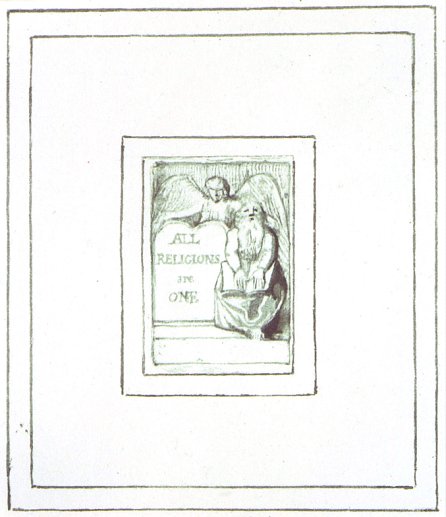
ALL RELIGIONS ARE ONE


View all the 10 Plates of All Religions Are One (E 1) in the Blake Archive.

It could be said that Blake began his prophetic ministry with the little book, All Religions Are One (of which only one copy survives). A close look at it will give us a concise preview of his message, his methods and his goal: "the desire of raising other men into a perception of the infinite." My comments on the poem are in blue.

Plate 1
The voice of one crying in the wilderness
The ministry of John the Baptist was a lonely one. He placed himself outside of his tribe, living in the wilderness and depriving himself of the normal comforts of life. His role was that of a forerunner for the prophet who was to follow him. Blake identified with the role of the outsider who choose to have his voice heard with the aim of pointing toward a new age. (Matthew 3)
All Religions Are One
Each religion claims uniqueness and exclusive access to God and truth. Not so asserts Blake. Religions can be united as one.
The Arguement
As the true meth-
-od of knowledge
is experiment,
the true faculty
of knowing must
be the faculty which
experiences. This
faculty I treat of.

Our knowledge is acquired through our experience. The faculty through which we gain experience will be the subject of this argument. The argument will not be based on authority or second hand knowledge.
Principle 1st
That the Poetic Genius is
the True Man, and that
the body or outward form
of Man is derived from the
Poetic Genius. Likewise
that the forms of all things
are derived from their
Genius, which by the
Ancients was calld an
Angel & Spirit & Demon.

The outer form or appearance of man is not the True Man. The spirit which resides in Man and in all things is what the outer forms derive from.
Principle 2nd
As all men are alike in
outward form, So (and
with the same infinite
variety) all are alike in the Poetic Genius

Humanity shares some qualities in spite of outer variety of appearance. So does man share the inner spiritual nature.
Principle 3rd
No man can think write
or speak from his
heart, but he must intend
truth. Thus all sects of
Philosophy are from the
Poetic Genius, adapted
to the weaknesses of
every individual.

All humanity intends to speak truth when he speaks from his inmost nature. Differences in philosophy result from individual weaknesses (inability to perceive the infinite).
Principle 4th
As none by trave
ling over known
lands can find out
the unknown, So,
from already ac
quired knowledge
Man could not ac
quire more; there
fore an universal
Poetic Genius exists

Man is not dependent upon the knowledge which comes only from his individual experience because a Universal Source, the Poetic Genius, provides knowledge he cannot acquire elsewhere.
Principle 5th
The Religions of all Nat-
-ions are derived from each
Nations different reception
of the Poetic Genius which
is every where call'd the Spi
rit of Prophecy

Different abilities to receive the Poetic Genius result in variety, although the Spirit of Prophecy is universally recognized.
Principle 6th
The Jewish & Chris-
tian Testaments are
An original derivati-
-on from the Poetic Ge-
nius: this is necessary
from the confined natu
re of bodily sensation

The Old and New Testaments of the Bible although deriving from the Poetic Genius, result from limited perceptions according to the varied ability to perceive the Poetic Genius.
Principle 7th
As all men are alike
(tho' infinitely vari
ous) So all Religions:
& as all similars have
one source,
The true Man is the
source, he being the
Poetic Genius

Religions - Man's attempts to perceive the Poetic Genius - though varied, have one Source. That source coming through the True Man is One and not many. So religions likewise are One and not many. 

The true or inner man which is in touch with the Poetic Genius and is the Poetic Genius as experienced by each man as he journeys into his inner being, is indistinguishable from the Self as described by Carl Jung.

Here is an article by a psychologist on self and religion:
CARL JUNG AND HIS IDEAS ON SELF Stephen A. Martin, Psy.D.

 "To Jung our Self was not our ego. Our Self was not who we thought we were. Our Self rather was who we really are, all of us, both the known and the unknown, the integrated and that which is yet to be integrated. Our perception of ourselves is hence our ego, but our true Self is a great deal more. "

Sunday, October 10, 2010

The Three Periods

In accordance with what has been said it seems appropriate
to divide William Blake's artistic and poetic career into three
periods:

1. Before age 29 he was blessed with the Heavenly
Visions.

2. For the next 20 years the visionary powers seem to have
deserted him.

3. At that point a new birth restored Blake's immagination and
faith.

(See The Vision).

The timeline is valuable here; it helps us understand what was written when:

Born 1757
1783 (at 25) published Poetical Sketches.
(This seems to be his only published work before the dismal 20 years that he mentioned in letter 51 in 1804. This letter is well worth reading several times (and with care). It casts light on where Blake was and where he was going.

So ended Period One.

Everything until the writing of Milton Letter 51 leads us to believe that Blake was working with what we might call carnal inspiration. He lambasted the bad people in every shape and form, sometimes descending to crudity. It was all brilliant, but in Blake's opinion not divinely inspired; instead he shared his values: political, social, spiritual, you name it. During Period Two, his dismal period in retrospect, following the way of the world (pursuing the main chance), he produced all of the following:

1788 All Religions are One and There is No Natural Religion

1789 Published Songs of Innocence

1789 Published The Book of Thel (1789-1790)

1790 Published The Marriage of Heaven and Hell

1793 Published Visions of the Daughters of Albion

1793 Published America a Prophecy

1794 Published Songs of Innocence and of Experience

1794 Published Europe: a Prophecy

1794 Published The [First] Book of Urizen

1795 Published The Song of Los, the Book of Los, the Book of Ahania

The fact that Milton and Jerusalem came out in 1804 and thereafter indicates that he perceived them to be different in kind from what went before; he called it taking dictation .

1804 Published Milton a Poem (c. 1804-18)

1804 Published Jerusalem (c. 1804-20)

1820 Published For the Sexes: The Gates of Paradise

1822 Published On Homers Poetry [and] On Virgil

1822 Published The Ghost of Abel

1823 Published Illustrations to the Book of Job

1827 Passed away on August 12, 1827.

Blake seemed to be telling us that none of the poetry of his twenties was dictated like Milton and Jerusalem were. The visionary power returned, and he left employment; Felpham had been essentially commercial art. He forsook it and lived in penury like so many of the greatest have done. And he proceeded to produce his greatest works.

He's said to have died with a song on his lips.

Saturday, October 09, 2010

BLAKE'S TRIAL

Another Post: Confrontation with Satan

Image from "William Blake's illustrations to the Divine Comedy"

William Blake had the misfortune of being placed on trial for sedition in 1803. Although Blake was acquitted in the matter, David Erdman believes that the ordeal caused Blake to become cautious in speaking out on the subject of politics. The episode began with Blake removing from his garden a private in the Royal Dragoons. Schofield brought charges of 'assault and Seditious words.' For five months it was uncertain if Blake would be found guilty and imprisoned or could resume his normal artistic pursuits without fear of harassment. Britain was at war and there was little tolerance for dissent against the empire. The stress took a toll on William and Catherine.

David V Erdman, in William Blake: Prophet Against Empire commented on the incident which led to the accusations and the effect it had on Blake and his poetry in his chapter 'Another England There'.

These are quotes from Erdman's Chapter 22:

Page 412
"Inevitably the effect of the experience was to intensify Blake's self-censorship and the tension between man and prophet. He parades his name and address and declares his theme to be social and contemporary - 'I write in South Molton Street, what I both see and hear In regions of Humanity, in London's opening streets' (J 34[38]). Yet he seeks to prevent 'Satan's Watch-fiends' from entering into the meaning of what he writes by concealing, as he says in riddles, the 'Gate' in his own head (J 35[39]. He tempts the curious with reverse writing which must be read in a mirror."...
Page 414
"The most immediate poetic record of Blake's suffering in time of trial, however, is the plaintive notebook ballad partly incorporated in the preface to the third chapter of Jerusalem and partly transcribed into another manuscript as The Grey Monk. This story of a tortured pacifist who will not recant is associated with Blake's trial by the fact that the Gothic courtroom of Chichester was known to have been the chancel of a Grey Friars convent church. The monk's martyrdom is that of an honest man who has written against war and empire and whose writings have been found out."
Page 415
"To write against War has nevertheless been his duty as a soldier of Christ, and he is ready to endure the tortures of 'the wrack & grinding chain' for the sake of his 'Brother,' the poor man, 'starved between two walls' (that is to say, in the street) and the poor man's children, whose cry ever 'my Soul appalls.'"

Erdman tells us that in the original draft the 'lazy monk' was the 'seditious monk'.

Here is the passage in Jerusalem, (Plate 52, (E 201)) associated with Blake's 'run in with the law':

"I saw a Monk of Charlemaine
Arise before my sight
I talkd with the Grey Monk as we stood
In beams of infernal light

Gibbon arose with a lash of steel
And Voltaire with a wracking wheel
The Schools in clouds of learning rolld
Arose with War in iron & gold.

Thou lazy Monk they sound afar
In vain condemning glorious War
And in your Cell you shall ever dwell
Rise War & bind him in his Cell.

The blood. red ran from the Grey Monks side
His hands & feet were wounded wide
His body bent, his arms & knees
Like to the roots of ancient trees

When Satan first the black bow bent
And the Moral Law from the Gospel rent
He forgd the Law into a Sword
And spilld the blood of mercys Lord.

Titus! Constantine! Charlemaine!
O Voltaire! Rousseau! Gibbon! Vain
Your Grecian Mocks & Roman Sword
Against this image of his Lord!

For a Tear is an Intellectual thing;
And a Sigh is the Sword of an Angel King
And the bitter groan of a Martyrs woe
Is an Arrow from the Almighties Bow!"

Here is a link to the longer poem,
The Grey Monk, from the Pickering Manuscript, (E 489).

Friday, October 08, 2010

The Vision

Blessed from birth with free and spontaneous Visions (as we all were until conditioned by conventionality) Blake happily wrote, drew, etched and painted until at age 29 (in 1786) he lost the gifts of innocence (start at "I have entirely reduced that spectrous Fiend), opting for the 'main chance' (which is to say 'the way of the world'). That period lasted for 20 years and ended while he was at Felpham.

Blake's years with Hayley (search for Hayley), were a 'trial by fire', a fire that tempered his psyche and made him strong enough to stand up against the world in a decisive and emphatic way. Henceforth he would not work for Hayley, but for God. The year 1804 was essentially a rebirth (of which we may have many if we're fortunate).

Blake's life followed closely the Circle of Destiny (page 5, lines 8-12) that described his myth. Every day is (or should be) a reenactment of the lifelong cycle of life. In the still of morning seek the silence until the mind becomes a blank, especially if you can 'annihilate' your personal Spectre. Now you're ready to hear and see God and respond to him(her,it).

The Savior gave the pattern for morning prayer:
1. Our Father: you realize you're not your own, but like a soldier under orders.
2. The Kingdom Come: you want more than the goodies you've promised for yourself.
3. Thy will be done: two wills always operate in my life: mine and God's; that's the struggle of life.
3. We seek daily bread: for me that's the Vision, the work I've been assigned, the project I'm to work on today.
4. Forgive us as we forgive. That was a monumental task for Blake, for me and you. We must forgive ourselves, God, and neighbor. Blake had threefold forgiving problems (just like we do).
5. Lead us not into temptation; in retrospect Blake realized that the temptation of Hayley, to which he had succumbed, was actually the agency of his salvation; unlike the temptations of Jesus in the wilderness Blake had fallen to his devil, Hayley, but he 'got smart' and found the better way.

(Blake loved and respected the Lord's Prayer, but he was sheerly disgusted with its performance by corrupt priests leading it for the devout 'Elect' who would immediately continue preying on the poor.  Writing marginalia on Robert John Thornton's pious book about it    Blake parodied the misuse of The Lords Prayer (Erdman 667-70) by the Conventional Religious Establishment.)

After his three years at Felpham, released, he and Catherine went back to London and poverty; the Visions flowed freely and led to his greatest work.  He knew he had lost twenty years; that led to his exhortation to industry found at Plate 77 of Jerusalem  (line 11ff; he had undoubtedly read Wesley's writing on "redeeming the time"). He began to etch and paint those magnificent plates of Milton and Jerusalem, a closer representation of God's Kingdom than the thousands of words he had written during that (dismal?) 20 years of trying to 'succeed'.

Thursday, October 07, 2010

GOD IN US

Jeremiah 23
[23] Am I a God at hand, saith the LORD, and not a God afar off?
[24]Can any hide himself in secret places that I shall not see him? saith the LORD. Do not I fill heaven and earth? saith the LORD.


From the beginning to the end of his work Blake attempted to communicate his image of God. Primarily Blake's experience was of what theologians call the immanent God, a God who is accessible and ever-present. When we gather together a number of Blake's references to God it is obvious that Blake's God was the incarnate God present within the whole of creation and particularly within humanity.

THERE IS NO NATURAL RELIGION, (E 2)
"VII The desire of Man being Infinite the possession is Infinite
& himself Infinite
Conclusion, If it were not for the Poetic or Prophetic
character. the Philosophic & Experimental would soon be at the
ratio of all things & stand still, unable to do other than repeat
the same dull round over again
Application. He who sees the Infinite in all things sees
God. He who sees the Ratio only sees himself only.

Therefore God becomes as we are, that we may be as he is"

Songs of Innocence and Experience, (E 9)
Little Black Boy
"Look on the rising sun: there God does live
And gives his light, and gives his heat away.
And flowers and trees and beasts and men recieve
Comfort in morning joy in the noon day.

And we are put on earth a little space,
That we may learn to bear the beams of love,
And these black bodies and this sun-burnt face
Is but a cloud, and like a shady grove."

New York Public Library
Milton
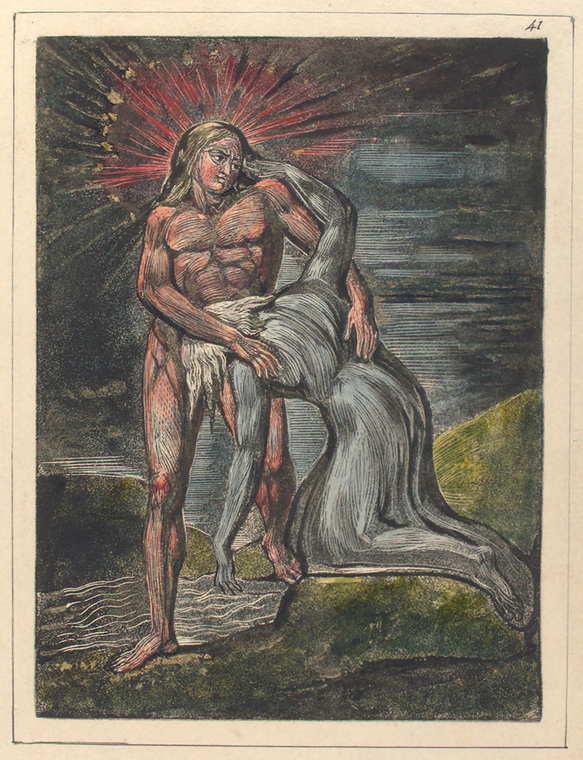
Plate 41


Songs of Innocence, (E 12)
The Divine Image.


"To Mercy Pity Peace and Love,
All pray in their distress:
And to these virtues of delight

Return their thankfulness.

For Mercy Pity Peace and Love,
Is God our father dear:
And Mercy Pity Peace and Love,
Is Man his child and care.

For Mercy has a human heart
Pity, a human face:
And Love, the human form divine,
And Peace, the human dress.

Then every man of every clime,
That prays in his distress,
Prays to the human form divine
Love Mercy Pity Peace.

And all must love the human form,
In heathen, turk or jew.
Where Mercy, Love & Pity dwell,
There God is dwelling too"

Milton, PLATE 32 [35],(E 131)
"But the Divine Humanity & Mercy gave us a Human [Hebrew text -multitudes]
Form as multitudes
Because we were combind in Freedom & holy Vox Populi [voice of the people]
Brotherhood"

Milton, Plate 32 [35], (E 131)
"For God himself enters Death's Door always with those that enter
And lays down in the Grave with them, in Visions of Eternity
Till they awake & see Jesus & the Linen Clothes lying
That the Females had Woven for them, & the Gates of their Fathers
House"

Jerusalem, Plate 4, (E 146)
"I am not a God afar off, I am a brother and friend;
Within your bosoms I reside, and you reside in me:
Lo! we are One; forgiving all Evil; Not seeking recompense!"

Jerusalem, Plate 5, (E 147)
"Trembling I sit day and night, my friends are astonish'd at me.
Yet they forgive my wanderings, I rest not from my great task!
To open the Eternal Worlds, to open the immortal Eyes
Of Man inwards into the Worlds of Thought: into Eternity
Ever expanding in the Bosom of God. the Human Imagination
O Saviour pour upon me thy Spirit of meekness & love:
Annihilate the Selfhood in me, be thou all my life!
Guide thou my hand which trembles exceedingly upon the rock of
ages,

While I write of the building of Golgonooza
Ye are my members O ye sleepers of Beulah, land of shades!"

Jerusalem
, Plate 38 [43], (E 184)
"O God of Albion descend! deliver Jerusalem from the Oaken Groves!

Then Los grew furious raging: Why stand we here trembling around
Calling on God for help; and not ourselves in whom God dwells
Stretching a hand to save the falling Man: are we not Four
Beholding Albion upon the Precipice ready to fall into
Non-Entity:"

Jerusalem, Plate 45 [31],(E 195)
"So spoke Los, travelling thro darkness & horrid solitude:
And he beheld Jerusalem in Westminster & Marybone,
Among the ruins of the Temple: and Vala who is her Shadow,
Jerusalems Shadow bent northward over the Island white.
At length he sat on London Stone, & heard Jerusalems voice.

Albion I cannot be thy Wife. thine own Minute Particulars,
Belong to God alone. and all thy little ones are holy
They are of Faith & not of Demonstration: wherefore is Vala
Clothd in black mourning upon my rivers currents, Vala awake!
I hear thy shuttles sing in the sky, and round my limbs
I feel the iron threads of love & jealousy & despair."

Satiric Verses, (E 516)
"To God

If you have formd a Circle to go into
Go into it yourself & see how you would do"

Annotations to Lavater, (E 599)
"God is in the lowest effects as well as in the highest
causes for he is become a worm that he may nourish the weak
For let it be rememberd that creation is. God descending
according to the weakness of man for our Lord is the word of God
& every thing on earth is the word of God & in its essence is God"

As well as expressing the sentiments of the prophet Jeremiah, Blake was reflecting the message of the New Testament as stated by Paul in Colossians 1:


[26] Even the mystery which hath been hid from ages and from generations, but now is made manifest to his saints:
[27] To whom God would make known what is the riches of the glory of this mystery among the Gentiles; which is Christ in you, the hope of glory:

Wednesday, October 06, 2010

Minute Particulars

Most of this post came from Damon's A Blake Dictionary, pages 280-81: "Minute Particulars are the outward expression in this world of the eternal individualities of all things. God, "the Divine-Humanity," is ultimately "the Only General and Universal Form""

(Jerusalem plate 38[43], line 20; Erdman 185)(Quoted on page 280 of Damon):
"He who would see the Divinity must see him in his Children
One first, in friendship & love; then a Divine Family, & in the
midst
Jesus will appear (verse 20) so he who wishes to see a Vision; a perfect
Whole
Must see it in its Minute Particulars; Organized & not as thou
O Fiend of Righteousness pretendest; thine is a Disorganized
And snowy cloud: brooder of tempests & destructive War
You smile with pomp & rigor: you talk of benevolence & virtue!
I act with benevolence & virtue & get murderd time after time:
You accumulate Particulars, & murder by analyzing, that you
May take the aggregate; & you call the aggregate Moral Law:
And you call that Swelld & bloated Form; a Minute Particular.
But General Forms have their vitality in Particulars: & every
Particular is a Man; a Divine Member of the Divine Jesus.

So the minute particulars are the outward expression of the individuals!, our fathers, mothers, children-- and of course many other things.

Let's go back to Letter 16 at Erdman 712;

The Light of the Morning
Heavens Mountains adorning
In particles bright
The jewels of Light
Distinct shone & clear--
Amazd & in fear
I each particle gazed
Astonishd Amazed
For each was a Man
Human formd. Swift I ran
For they beckond to me
Remote by the Sea
Saying. Each grain of Sand
Every Stone on the Land
Each rock & each hill
Each fountain & rill
Each herb & each tree
Mountain hill Earth & Sea
Cloud Meteor & Star
Are Men Seen Afar


Your might see "Men Seen Afar" in terms of fourfold vision; now look at the final six lines of Letter 23:
"Now I a fourfold vision see
     And a fourfold vision is given to me
     Tis fourfold in my supreme delight
     And three fold in soft Beulahs night
     And twofold Always.  May God us keep
     From Single vision & Newtons sleep
"Labour well the Minute Particulars, attend to the Little-ones:
And those who are in misery cannot remain so long
If we do but our duty: labour well the teeming Earth"
(Jerusalem 55:51;Erdman 205)
Here's an extended essay on Blake's minute particulars as they relate to the atomicity of "Newton or even Democritus (the founder of the concept of atomicity) and classical physics to Niels Bohr and quantum physics."

Finally Damon in his first paragraph summarizes the elements of our experience:
"The Minute Particulars of God are men (J92:31);
of men they are children (J55:51);
of life the joys of living, especially the embraces of love (J69:42);
of ethics forgiveness instead if judgment (J43:61);
of art the vision and the finished product; of science, the basic facts. (J55:62)"

With so much material to study we must certainly expand our understanding of Minute Particulars.

Tuesday, October 05, 2010

EARLY INTERPRETERS

Alexander Gilchrist wrote the first book on William Blake and his work, Life and Works of William Blake. After Gilchrist's book was published in 1863, interest in Blake began to develop. Algernon Charles Swinburne wrote in 1868, William Blake: A Critical Essay.

Swinburne, poet that he was, wrote his book length essay on William Blake in poetic language evoking emotions and calling on the intuition to assimilate the images presented. Here is his account of the beginning of Gates of Paradise
(Page 19-23):

"In the first plate of the 'Gates of Paradise,' the woman finds the child under a tree, sprung of the earth like a mandrake, which he who plucks up and hears groan must go mad or die; grown under the tree of physical life, which is rooted in death, and the leaf of it is poisonous, and it bears as fruit the wisdom of the serpent, moral reason or rational truth, which invents the names of virtue and vice, and divides moral life into good and evil. Out of earth is rent violently forth the child of dust and clay, naked, wide-eyed, shrieking ; the woman bends down to gather him as a flower, half blind with fierce surprise and eagerness, half smiling with foolish love and pitiful pleasure ; with one hand she holds other children, small and new-blown also as flowers, huddled in the lap of her garment; with the other she plucks him up by the hair, regardless of his deadly shriek and convulsed arms, heedless that this uprooting of the mandrake is the seal of her own death also.

"Then follow symbols of the four created elements from which the corporeal man is made; the water, blind and mutable as doting age, emblem of ignorant doubt and moral jealousy ; the heavy melancholy earth, grievous to life, oppressive of the spirit, type of all sorrows and tyrannies that are brought forth upon it, saddest of all the elements, tightest as a curb and painfullest as a load upon the soul: then the air wherein man is naked, the fire wherein man is blind; ashamed and afraid of his own nature and its nakedness, surrounded with similitudes of severance and strife:...

"In these first six plates is the kernel of the book ; round these the subsecpient symbols revolve, and toward these converge. The seventh we may assume to be an emblem of desire as it is upon earth, blind and wild, glad and sad, destroying the pleasures it catches hold of, losing those it lets go. One Love, a moth-like spirit, lies crushed at the feet of the boy who pursues another, flinging his cap towards it as though to trap a butterfly; startled with the laugh of triumphant capture even at his lips, as the wingless flying thing eludes him and soars beyond the enclosure of summer leaves and stems toward upper air and cloud."

Blake expresses some of above sentiments about fleeting joys in this poem from his notebook (E 470) except those who release joys in this poem experience a higher level of existence:

Eternity

"He who binds to himself a joy
Does the winged life destroy
But he who kisses the joy as it flies
Lives in eternity's sun rise"


Swinburne wrote 5 years after the Gilchrist biography was published, 41 years after Blake's death, and he wrote with the enthusiasm of a convert.

You can read Gilchrist's biography and Swinburne essays as Google books on your computer. Gilchrist's book is also available as a text document.

Here is Joseph Viscomi comments on the Gilchrist Life.

To learn more about Gilchrist and his book read on Wiki:
Alexander Gilchrist
Gilchrist's book
Volume II Blake's writings
Versions of Gilchrist's Book

Sunday, October 03, 2010

A Minute Particular

(See Damon pp 280-82) There are many ways to learn 'Blake'; a (rarely used) one is studying the minute particulars one by one.  'Blake' is made up of thousands of symbols, or metaphors, call it what you will.  
 
If you studied one every day, three years would add up to a good thousand of them, still by no means a mastery of the subject, but a 'speaking acquaintance' to be respected. 
 
Here is one particular. Catherine Blake called the subject of Blake's thought Heaven; that was the metaphor that she used.  Blake used material objects to represent platonic ideas. The symbols and metaphors of his poetry are infinitely varied. 
 
Mastering a foreign language involves learning the meaning of each word; understanding Blake's language involves gaining familiarity (one by one) with what Blake meant by his metaphors. 
 
As an example take garments; getting some idea of what the word meant to Blake will enhance your ability to understand his poetry; the Blake concordance shows it 53 times: Two biblically oriented cases spring to mind; for example:

1."These are the Sons of Los! These the Visions of Eternity But we see only as it were the hem of their garments when with our vegetable eyes we view these wond'rous Visions (Milton, plate 26; Erdman 123).

(No doubt the 'Bible soaked Protestant, William Blake, got this figure from Matthew 9:20: "And suddenly, a woman who had a flow of blood for twelve years came from behind and touched the hem of His garment.")


2 "The Soldiers casting lots for Christ's Garment - A Drawing. (A Descriptive Catalog, Number X11; Erdman 548)


This came perhaps from John 19:24: "They said therefore among themselves, Let us not rend it, but cast lots for it, whose it shall be: that the scripture might be fulfilled, which saith, They parted my raiment among them, and for my vesture they did cast lots. These things therefore the soldiers did."

The robe implies similar ideas; of the 46 items here's one:

"When Urizen saw the Lamb of God clothed in Luvahs robes"(4Z 8; Erdman 373) And here's a contrary: "The red robe of terror, the crown of oppression, the shoes of contempt" (French Revolution 222; Erdman 296)

In Isaiah 61:10 the two words come together in unison:  "I will greatly rejoice in the LORD, my soul shall be joyful in my God; for he hath clothed me with the garments of salvation, he hath covered me with the robe of righteousness, as a bridegroom decketh himself with ornaments, and as a bride adorneth herself with her jewels."

Speaking in general you might say that both words (garment and robe) suggest the body, the mortal dimension of someone's life.  The body must die, but the spirit lives on (or comes to life in some ways of speaking).

This may seem like a pretty tiresome way to get a familiarity with Blake's thought; it's what he called the minute particulars.  It may seem tiresome to the novice, but an advanced student may find great profit in browsing through Blake's works-- and the Bible.

Today in the internet we have powerful tools (concordances, editors, interpretators and commentaries) for that kind of study; it may gladden the hours, especially for an older person, who has retired from the modern race of life.

Saturday, October 02, 2010

PRINTMAKER

Blake's London
- follow the sites in London where Blake lived, was educated and worked.

In addition to home-schooling from his Moravian mother and his hosier father, Blake's formal schooling came from Henry Par's drawing school.
For his parents to provide this opportunity to him, he must shown a talent for art and a strong interest in it early in life. There is no way to know how much skill in art he had picked up before he was sent to drawing school at age 10, or how rigorous his training was at Par's. When he was apprenticed at age 14 to the engraver James Basire, he began a thorough education in a demanding discipline. Basire's apprenticeship made him into an accomplished engraver with the wide range of technical and artistic skills necessary for a mastery of the trade.

With his apprenticeship complete, Blake knew that he had acquired a skill with which he could with diligence earn a living. But Blake's desire was to be an artist not an artisan. He never let his engraving skills lie fallow, but his work as an artist was his passion. He could use his engraving skills for illustrating other people's books or producing advertisements and leaflets, or producing pictures for a catalog. He preferred to put his engraving to the service of his own art and poetry.

We see from the first books that he produced (1788), All Religions Are One, and There Is No Natural Religion, that he was willing to start small and simple as if he were beginning an exploration. These tiny books had images less that 2x3 inches in size. With combined text and images in
black and white, they would lead to further experiments with size, color, media, and techniques. Sometimes his poetry took center stage and left the images as the supporting cast. In other cases the image provided the essence of what he wanted to communicate.

He experimented with a technique of adding colored pigments directly to his engraved plates before they were printed. This produced images in which the color rather than the line was of the greatest import in the work. Images from this short lived period are among my favorites. However Blake did not stick with this technique, probably because the defining line which was all important to him was less evident in this style of printing. Blake valued originality, the unique expression. His artwork evolved throughout his lifetime to give continuing fresh expression to his imagination.
_____Book of Los, image 1________________America, image 8


Blake repeatedly stated his loyalty to the use of outline in his works of art:

Jerusalem, Plate 74, (E 229)
"I tell how Albions Sons by Harmonies of Concords & Discords
Opposed to Melody, and by Lights & Shades, opposed to Outline
And by Abstraction opposed to the Visions of Imagination"

Descriptive Catalog (E 549)
[BLAKE'S EXHIBITION AND CATALOGUE OF 1809]
"If losing and obliterating the outline constitutes a
Picture, Mr. B. will never be so foolish as to do one. Such
art of losing the outlines is the art of Venice and Flanders; it
loses all character, and leaves what some people call,
expression: but this is a false notion of expression; expression
cannot exist without character as its stamina; and neither
character nor expression can exist without firm and determinate
outline."

Annotations to Reynolds, (E 651)
[Reynolds - Page 75] "A firm and determined outline is one of the
characteristics of the great style in painting; and . . . he who
possesses the knowledge of the exact form which every part of
nature ought to have, will be fond of expressing that knowledge
with correctness and precision in all his works."
[Blake's comment] "A Noble Sentence
Here is a Sentence Which overthrows all his Book"

Friday, October 01, 2010

The Inner Life


Blake's life, like all our lives, is made up of an outer
life of various sorts of pursuits and an inner life of
non-material pursuits, such as prayer and other forms of
worship. Most of us are more disposed toward the outer
life. In contrast Blake's inner life took up most of his
time; he considered the outer life of relatively little consequence.

I assert for My self that I do
not behold the Outward Creation & that to me it is hindrance &
not Action it is as the Dirt upon my feet" (Vision of the Last Judgment;
Erdman 565)

All of Blake's magnificent creations came of
course from his inner life.To understand Blake and read him 

intelligently we must have some command of our own inner life. 
For him it came naturally, but we have to make some effort for it. 
 
Our inner life begins with learning self control (which was said to be the last of the fruits of the Spirit). A friend of mine, Elizabeth O'Connor wrote a book entitled Search for Silence which helped me move into the inner life better than anything else I know.

The inner life can only be expressed metaphorically. Everyone, even Blake, was forced to use metaphors: the language of the inner life is completely metaphorical, poetic, mythopoeic.  So who do you suppose is most likely to have a robust inner life?

Religious folk? Well Blake wasn't so warm about them.  In MHH he referred to them as the Elect, using heaven irony. As for religious professionals he poured the heaviest scorn:

"The ancient Poets animated all sensible objects with Gods or Geniuses, calling them by the names and adorning them with the properties of woods, rivers, mountains, lakes, cities, nations, and whatever their enlarged & numerous senses could percieve.
And particularly they studied the genius of each city & country, placing it under its mental deity;
Till a system was formed, which some took advantage of & enslav'd the vulgar by attempting to realize or abstract the mental deities from their objects: thus began Priesthood;
Choosing forms of worship from poetic tales.
And at length they pronounc'd that the Gods had order'd such things.
Thus men forgot that All deities reside in the human breast.
(
MHH, Plate 11)

No, he said artists!
"Let every Christian as much as in him lies engage himself
openly & publicly before all the World in some Mental pursuit for
the Building up of Jerusalem (Jerusalem, Erdman 232) and

"A Poet a Painter a Musician an Architect: the Man
Or Woman who is not one of these is not a Christian
....The unproductive Man is not a Christian much less the Destroyer
(The Laocoon; Erdman 274)


Everyhone has an inner life, but it may be '
ulroni' or heavenly, lust or worship, Martha or Mary, materialistic or heavenly depending according to your disposition
(See also Damon pp 416-17).  Call it God's will or your will. Blake was guilty of both forms, but he  leaned strongly toward the heavenly.  To be blakean involves doing the same.

Thursday, September 30, 2010

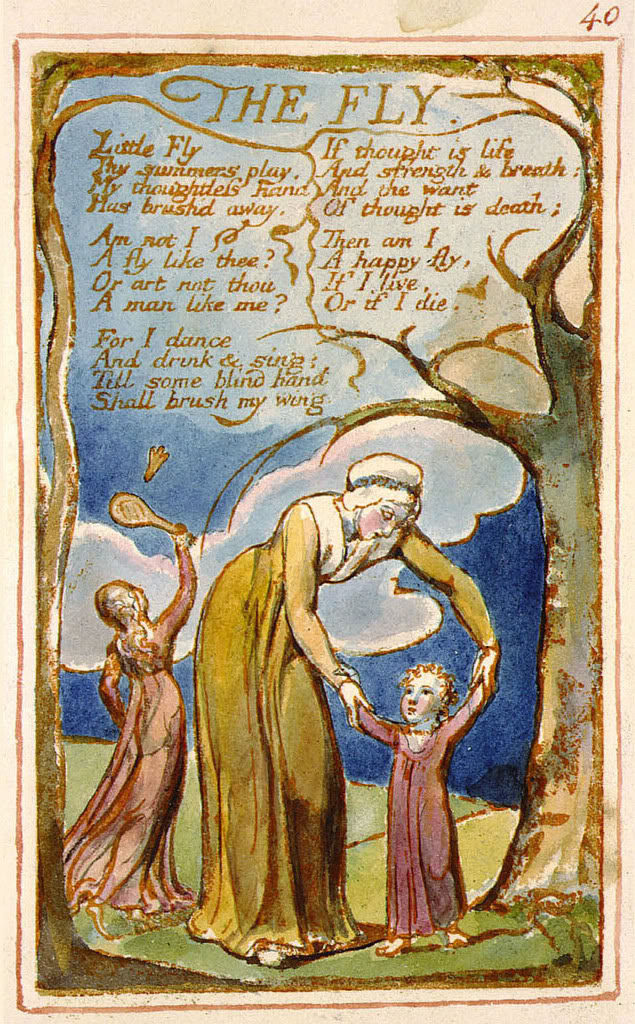
MAN IS A WORM

Some have suggested that Blake meant butterfly by fly, and caterpillar by worm.

SONGS OF EXPERIENCE, 40, THE FLY,(E 23)

Little Fly
Thy summers play,
My thoughtless hand
Has brush'd away.

Am not I
A fly like thee?
Or art not thou
A man like me?

For I dance
And drink & sing:
Till some blind hand
Shall brush my wing.

If thought is life
And strength & breath:
And the want
Of thought is death;

Then am I
A happy fly,
If I live,
Or if I die.

Man who knows himself to be a mind and spirit frequently seeks an explanation for his being a material being in a world of matter.

Here are some explanations which have been devised:

*It pleased God to have some companions.
*Man is being punished for some disobedience.
*Life is meant to be a learning experience.
*The material world spontaneously produced life including mind.
*We are placed here to figure out why we were placed here.
*We are paced here to love God and serve him forever.
*Matter is a manifestation and expression of Spirit.

Blake of course had his explanation which he expressed in poetic language. At the Golden Feast these words were spoken:

Four Zoas, Page 133, (E 401)
"This is the Generative world they rememberd the Days of old
And One of the Eternals spoke All was silent at the feast

Man is a Worm wearied with joy he seeks the caves of sleep
Among the Flowers of Beulah in his Selfish cold repose
Forsaking Brotherhood & Universal love in selfish clay
Folding the pure wings of his mind seeking the places dark
Abstracted from the roots of Science then inclosd around
In walls of Gold we cast him like a Seed into the Earth
Till times & spaces have passd over him duly every morn
We visit him covering with a Veil the immortal seed
With windows from the inclement sky we cover him & with walls
And hearths protect the Selfish terror till divided all

In families we see our shadows born. & thence we know | Ephesians
That Man subsists by Brotherhood & Universal Love | iii c.
We fall on one anothers necks more closely we embrace | 10 v

Not for ourselves but for the Eternal family we live
Man liveth not by Self alone but in his brothers face
Each shall behold the Eternal Father & love & joy abound

So spoke the Eternal at the Feast they embracd the New born Man
Calling him Brother image of the Eternal Father."

The Bible verse referenced in the passage in the Four Zoas:
Ephesians 3
[10] To the intent that now unto the principalities and powers in heavenly places might be known by the church the manifold wisdom of God,

The above verse in context:
[9] And to make all men see what is the fellowship of the mystery, which from the beginning of the world hath been hid in God, who created all things by Jesus Christ:
[10] To the intent that now unto the principalities and powers in heavenly places might be known by the church the manifold wisdom of God,
[11] According to the eternal purpose which he purposed in Christ Jesus our Lord:

I think that you can say unequivocally that Blake does not think that life in the physical world is a punishment. Blake affirms that God in his love presents man with life as a mercy, grace and gift. Time and matter are gifts too, to incubate the seed which is to grow into a replica and brother of the Eternal Father.

Wednesday, September 29, 2010

Satan


Here's another of Blake's Words (with 254 occurrences) that (at the least) conveys various meanings throughout his works .

Three of them are in The Marriage of Heaven and Hell. In this work Blake primarily used irony throughout: the most (truly) godly characters are given diabolic names:


Plate Five reads


"....The history of this is written in Paradise Lost. & the Governor or Reason is call'd Messiah.
And the original Archangel or possessor of the command of the heavenly host, is calld the Devil or Satan and his children are call'd Sin & Death
But in the Book of Job Miltons Messiah is call'd Satan. For this history has been adopted by both parties"


In The Four Zoas we begin to see another of the special uses Blake made of the word, Satan:


"And first he found the Limit of Opacity & namd it Satan
In Albions bosom for in every human bosom these limits stand
And next he found the Limit of Contraction & namd it Adam" (FZ4-56.19-21; E338)


Which is to say that the higher nature was completely opaque to Satan, just as Shakespeare or Latin or Greek is opaque to most of us.

And now here's a more proper use of Satan, closer to the general common useage, describing the climax of Urizen's futile attempt to order the universe in accordance with his Book of Brass:


"But Urizen his mighty rage let loose in the mid deep
Sparkles of Dire affliction issud round his frozen limbs
Horrible hooks & nets he formd twisting the cords of iron
And brass & molten metals cast in hollow globes & bor'd
Tubes in petrific steel & rammd combustiles & wheels
And chains & pullies fabricated all round the heavens of Los
Communing with the Serpent of Orc in dark dissimulation
And with the Synagogue of Satan in dark Sanhedrim
To undermine the World of Los & tear bright Enitharmon
To the four winds hopeless of future."
(FZ8-100[2nd]26-34; E373)


For Blake the Synagogue of Satan was a pet symbol; he used it 9 times, and a good example is found in plate 52 of Jerusalem:


"Man must & will have Some Religion; if he has not the Religion of Jesus, he will have the Religion of Satan, & will erect the Synagogue of Satan. calling the Prince of this World, God; and destroying all who do not worship Satan under the Name of God. Will any one say: Where are those who worship Satan under the Name of God! Where are they? Listen! Every Religion that Preaches Vengeance for Sins the Religion of the Enemy & Avenger; and not the Forgiver of Sin, and their God is Satan, Named by the Divine Name Your Religion O Deists: Deism, is the Worship of the God of this World by the means of what you call Natural Religion and Natural Philosophy, and of Natural Morality or Self-Righteousness, the Selfish Virtues of the Natural Heart. This was the Religion of the Pharisees who murderd Jesus. Deism is the same & ends in the same."

Tuesday, September 28, 2010

MARTHA & MARY

The biblical story of Mary and Martha presents two sisters who view life differently. Martha is the efficient housekeeper whose goal is to provide material comforts for her family and guests. When Jesus visits her and her sister Mary and her brother Lazarus, Martha has many duties in the kitchen and in serving her honored friend. Her sister Mary wishes only to enjoy Jesus' presence. Mary express the spiritual nature which can focus all its attention on things of the spirit neglecting outer interests and circumstances. Jesus accepted each sister for what she was and what she offered him. Martha could not recognize Mary's gifts; she wanted her sister to serve in the same way she herself did.

Luke 10
[38] Now it came to pass, as they went, that he entered into a certain village: and a certain woman named Martha received him into her house.
[39] And she had a sister called Mary, which also sat at Jesus' feet, and heard his word.
[40] But Martha was cumbered about much serving, and came to him, and said, Lord, dost thou not care that my sister hath left me to serve alone? bid her therefore that she help me.
[41] And Jesus answered and said unto her, Martha, Martha, thou art careful and troubled about many things:
[42] But one thing is needful: and Mary hath chosen that good part, which shall not be taken away from her.

Martha's complaint to Jesus that she was left alone to serve provoked Jesus' reply that, "Mary hath chosen that good part, which shall not be taken away from her." Jesus like Blake valued the spiritual nature which often went unexpressed while the material world absorbed the total attention.

Wikipedia Commons

Mary sits at Jesus' feet and meditates on his words while Martha holds a serving tray and questions Jesus' reaction to Mary's behavior. Blake, himself, was inclined to neglect worldly things when he heard the voice of prophetic imagination. I have no evidence that Jesus neglected worldly things but his mother and brothers may have thought he neglected family duties. (Mark 3: 31-34)

People who embark on the journey of psychological development often find themselves in a similar situation. Friends or family may resent the time and effort that is spent by an individual in looking inward to discern the dimensions and dynamics of the psyche.

When Blake was living at Felpham he was especially aware of the conflict between fulfilling the outer requirements of pleasing others and earning a living, and the inner requirement of living under the direction of his 'Messengers from Heaven'. It was impossible for Blake to reject the demands of the spirit in favor of 'Natural Fears or Natural Desires'. He resolved his conflict by determining to 'go on again with my Task Fearless' and forgo worldly wealth and success.

Letters, 24, Mr Butts, (E 424)
"I find on all hands great objections to my doing any thing but the meer
drudgery of business & intimations that if I do not confine
myself to this I shall not live. this has always pursud me. You
will understand by this the source of all my uneasiness This from
Johnson & Fuseli brought me down here & this from Mr H will
bring me back again for that I cannot live without doing my duty
to lay up treasures in heaven is Certain & Determined & to this I
have long made up my mind & why this should be made an objection
to Me while Drunkenness Lewdness Gluttony & even Idleness itself
does not hurt other men let Satan himself Explain--The Thing I
have most at Heart! more than life or all that seems to make life
comfortable without. Is the Interest of True Religion & Science
& whenever any thing appears to affect that Interest. (Especially
if I myself omit any duty to my [self] as a
Soldier of Christ) It gives me the greatest of torments, I am not
ashamed afraid or averse to tell You what Ought to be Told. That
I am under the direction of Messengers from Heaven Daily &
Nightly but the nature of such things is not as some suppose.
without trouble or care. Temptations are on the right hand &
left behind the sea of time & space roars & follows swiftly he
who keeps not right onward is lost & if our footsteps slide in
clay how can we do otherwise than fear & tremble. but I should
not have troubled You with this account of my spiritual state
unless it had been necessary in explaining the actual cause of my
uneasiness into which you are so kind as to Enquire for I never
obtrude such things on others unless questiond & then I never
disguise the truth--But if we fear to do the dictates of our
Angels & tremble at the Tasks set before us. if we refuse to do
Spiritual Acts. because of Natural Fears or Natural Desires! Who
can describe the dismal torments of such a state!--I too well
remember the Threats I heard!--If you who are organized by Divine
Providence for Spiritual communion. Refuse & bury your Talent in
the Earth even tho you should want Natural Bread. Sorrow &
Desperation pursues you thro life!"

In the wilderness Jesus too was tempted by Satan with success and power in the world and choose the course of following spiritual direction.

Monday, September 27, 2010

Blake's Words

A Friend pointed out that words may confuse more than enlighten us. Look at the thousands of words we hear on TV: are any of them true or enlightening? Just a few! What's true of TV is often true of social intercourse in general.

Among Blake's words let's choose Annihilat..:  he used it 40 times, all but 6 in Milton and Jerusalem. I associate the word with doing away with forever, but Blake's annihilation doesn't stick; it keeps coming back.  The labels for this blog show 14 posts, and I'm still trying to elucidate what it meant to Blake.

Milton, plate 32:

"Judge then of thy Own Self: thy Eternal Lineaments explore 
What is Eternal & what Changeable? & what Annihilable! 
The Imagination is not a State: 
It is the Human Existence itself 

Affection or Love becomes a State, when divided from 
Imagination 
The Memory is a State always, & the Reason is a State 
Created to be Annihilated & a new Ratio Created 
Whatever can be Created can be Annihilated Forms cannot 
The Oak is cut down by the Ax, the Lamb falls by the Knife 
 But their Forms Eternal Exist, For-ever. Amen Halle[l]ujah"   

And Plate 38 (Erdman 139):

"In the Eastern porch of Satans Universe Milton stood & said Satan! my Spectre! I know my power thee to annihilate And be a greater in thy place, & be thy Tabernacle 
A covering for thee to do thy will, till one greater comes And smites me as I smote thee & becomes my covering. 
Such are the Laws of thy false Heavns! 
But Laws of Eternity Are not such: know thou: 
I come to Self Annihilation Such are the Laws of Eternity that each shall mutually Annihilate himself for others good, as I for thee[.] 

Thy purpose & the purpose of thy Priests & of thy Churches Is to impress on men the fear of death; 
to teach Trembling & fear, terror, constriction; abject selfishness 
Mine is to teach Men to despise death & 
to go on In fearless majesty annihilating Self, 
laughing to scorn Thy Laws & terrors, 
shaking down thy Synagogues as webs 

I come to discover before Heavn & Hell the Self righteousness In all its Hypocritic turpitude, 
opening to every eye These wonders of Satans holiness shewing to the Earth 
The Idol Virtues of the Natural Heart, & 
Satans Seat Explore in all its Selfish Natural Virtue 
& put off In Self annihilation all that is not of God alone: 
To put off Self & all I have ever & ever Amen"   

The point is that as much as we may hate the Spectre it's  
the shape of the world we live in, our mortal life.  So the process of redemption seems to be to continuously "annihilate the  Spectre", which is to say that part of it that is  certainly less than God wants for us.

Sunday, September 26, 2010

MENTAL TRAVELLER CONCLUSION

The End is the Beginning.

In his chapter, The Aim of Blake's Prophecies, included in Blake's Sublime Allegory, Jerome J McCann, makes this statement:
"...as in Blake, these poems are precisely designed to foster ambivalent perspectives...Poems like these are silent forms teasing us into and out of our own thoughts...
Thus, the extreme diversity of opinion among critics of Blake about the meaning of particular poems or passages of poems is perhaps the most eloquent testimony we have to the success of his work. Interpretations of the meanings of Blake's poems are necessarily legion, since his poetry was written to break in upon the centers of individual life and call their meanings into the open. Like Jesus, Blake came to send not peace but a sword. His work is a sign of contention."
 

These are some observations I want to remember from studying the poem:
1) Spirit and matter are complementary
2) One grows young when the other grows old
3) The one growing young feeds on the one growing old
4) Transition points occur where the one growing young becomes a babe
5) Matter and spirit want to supplant (or suppress) one another
6) The system needs both, when they engage in struggle neither prospers
.

Here are two passages from Blake which may describe what happens after The Mental Traveller ends:

Four Zoas, Book One, Page 5, (E 302)
"Tharmas groand among his Clouds
Weeping, then bending from his Clouds he stoopd his innocent head
And stretching out his holy hand in the vast Deep sublime
Turnd round the circle of Destiny with tears & bitter sighs
And said. Return O Wanderer when the Day of Clouds is oer

So saying he sunk down into the sea a pale white corse
In torment he sunk down & flowd among her filmy Woof
His Spectre issuing from his feet in flames of fire
In gnawing pain drawn out by her lovd fingers every nerve
She counted. every vein & lacteal threading them among
Her woof of terror. Terrified & drinking tears of woe
Shuddring she wove--nine days & nights Sleepless her food was tears
Wondring she saw her woof begin to animate. & not
As Garments woven subservient to her hands but having a will
Of its own perverse & wayward Enion lovd & wept

Nine days she labourd at her work. & nine dark sleepless nights
But on the tenth trembling morn the Circle of Destiny Complete
Round rolld the Sea Englobing in a watry Globe self balancd"

Or this better may describe what happens next:

Milton, Plate 32 [35], (E 132)

"but Individual Identities never change nor cease:
You cannot go to Eternal Death in that which can never Die.
Satan & Adam are States Created into Twenty-seven Churches
And thou O Milton art a State about to be Created
Called Eternal Annihilation that none but the Living shall
Dare to enter: & they shall enter triumphant over Death
And Hell & the Grave! States that are not, but ah! Seem to be.

Judge then of thy Own Self: thy Eternal Lineaments explore
What is Eternal & what Changeable? & what Annihilable!"

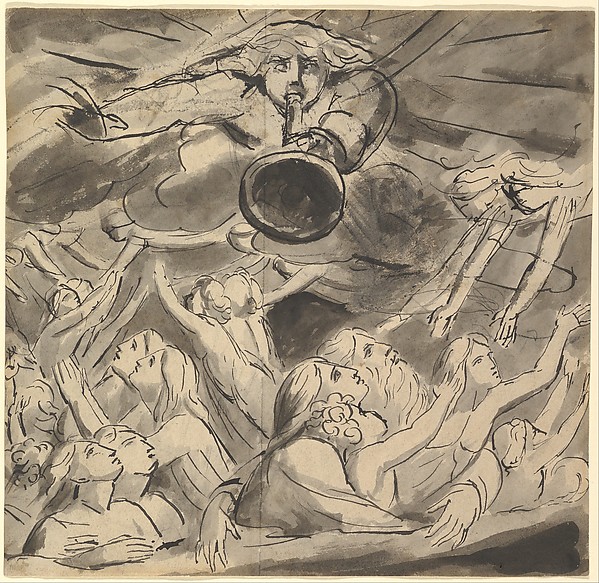
Metropolitan Museum
    Last Trumpet
"resurrection of believing souls at the last day"

You have been a mental traveller if you have followed the phases of development in The Mental Traveller. You have seen growth and decline, cyclical patterns, increase and decrease. You may have felt hope and futility. Blake put these things in his poem for you to find. You have been given a chance to think about what is permanent and what is transitory. You may have asked if we have the power to interrupt patterns which are fed by invisible forces. The poem is yours to claim as your own and respond to out of your own identity.


Letters, to Revd Dr Trusler, (E 702)
"The wisest of the Ancients considerd what is not too Explicit as the fittest for Instruction because it rouzes the faculties to act."


From Blake and the Bible:
Biblical Exegesis in the Work of William Blake, by Christopher Rowland:
"Blake wishes to do all he can to resist the idea that there is an authoritative interpretation offered by authoritative interpreters. His texts are there for all to use and for the stimulation of the imagination."