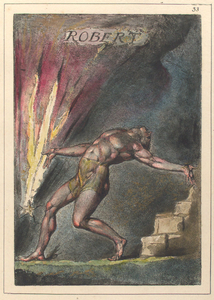
Sunday, October 16, 2011

TROUBLED DREAM

In the last five images for Blake's illustrations to Paradise Regained Blake availed himself of the opportunity to elaborate his ideas on Milton's text. Milton and Blake used the arrangement of the temptations of Jesus in the order of Luke's rather than Matthew's version. In Luke the final temptation involves Jesus being taken to the pinnacle of the temple.
After Jesus withstood the second temptation to accept worldly power, Milton inserted this account of a night where Jesus' dreams are fraught with terrifying images.
Paradise Regained
"for at his head
The Tempter watched, and soon with ugly dreams
Disturbed his sleep. And either tropic now
'Gan thunder, and both ends of heaven; the clouds [410]
From many a horrid rift abortive poured
Fierce rain with lightning mixed, water with fire,
In ruin reconciled; nor slept the winds
Within their stony caves, but rushed abroad
From the four hinges of the world, and fell
On the vexed wilderness, whose tallest pines,
Though rooted deep as high, and sturdiest oaks,
Bowed their stiff necks, loaden with stormy blasts,
Or torn up sheer. Ill wast thou shrouded then,
O patient Son of God, yet only stood'st [420]
Unshaken! Nor yet staid the terror there:
Infernal ghosts and hellish furies round
Environed thee; some howled, some yelled, some shrieked,
Some bent at thee their fiery darts, while thou
Sat'st unappalled in calm and sinless peace.
Thus passed the night so foul,"

Blake portrays the calmly sleeping Jesus surrounded by serpents indicating that the storms and destruction described by Milton are works of the serpent form of Satan. Most terrifying is that the serpents appear to be emerging from the image of God at the top of the page. Blake was aware of distorted images of the Divine which resulted from man projecting his own vengefulness, anger and deceit upon his God. Jesus could sleep in peace in spite of these dreams because his vision of God was not the weak, worn out, distracted creature with darkened wings and halo which emerged in the dream state.

The appearance of the serpents and the image at the top of the page, which seems to be a combination of Satan and Jehovah, is Blake's own response to the night of troubling dreams. The final plate of Gates of Paradise: for the Sexes, comments on the illusion from which man must awake to be freed from the "God of this World."

The dream state is portrayed in Blake's Milton but in these passages the Seven Angels of the Presence provide the protection which create a '
dream beatific.'

Milton, Plate 15 [17], (E 109)
"The Seven Angels of the Presence wept over Miltons Shadow!

As when a man dreams, he reflects not that his body sleeps,
Else he would wake; so seem'd he entering his Shadow: but
With him the Spirits of the Seven Angels of the Presence
Entering; they gave him still perceptions of his Sleeping Body;
Which now arose and walk'd with them in Eden, as an Eighth
Image Divine tho' darken'd; and tho walking as one walks
In sleep; and the Seven comforted and supported him."

Milton, Plate 32 [35], (E 131)
"Such is a Vision of the lamentation of Beulah over Ololon

And Milton oft sat up on the Couch of Death & oft conversed
In vision & dream beatific with the Seven Angels of the Presence

I have turned my back upon these Heavens builded on cruelty
My Spectre still wandering thro' them follows my Emanation
He hunts her footsteps thro' the snow & the wintry hail & rain
The idiot Reasoner laughs at the Man of Imagination
And from laughter proceeds to murder by undervaluing calumny"

Geoge W. Digby, in Symbol and Image in William Blake states:
"This projected image, call it by what name you will, is ultimately man's greatest enemy. It is a mental phenomenon, which spring from the mind and is limited by the mind. It is the dream of the traveller who has gone astray, who has lost his way. It is necessary to realize the illusion of this." (Page 53)

Blake is illustrating his perception that Jesus has freed himself from the illusion that he can be harmed by the a projected image of serpents or the tempter.

Saturday, October 15, 2011

America Frontispiece

America a Prophecy begins with this frontispiece (copied from Wikipedia):

We really need a better representation to see the significant details. This one is wikicommon blake category.

The best way to see this picture is with the Blake Archive Fitzwilliam Museum, plate i (or this) Albion's Angel, the giant figure sits shackled and despondent. He's a giant, but the very human figure is a woman with two small children. The giant is eternal and the woman and children mortals.


PLATE 3 (of Jerusalem) SHEEP GOATS

To the Public

After my three years slumber on the banks of

the Ocean, I again display my Giant forms to

the Public: My former Giants & Fairies having

reciev'd the highest reward possible: the [love]

and [friendship] of those with whom to be connected, is to be [blessed]:

When Blake wrote of Giant forms as he beganJerusalem we have good reason to assume he meant the four zoas.


Two pictures later in the Preludium we learn that "his food she brought in iron baskets".

Taking the two images together it looks like an advance version of the sad story of Los taking his firstborn, Orc, up the the mountain and chaining him to a rock. Enitharmon feeds him until his strength grows; a man at last he pulls the chains out of the rock.

Read the Book of Urizen,

Plates 19 and 20. (E 79)

PLATE 19
They call'd her Pity, and fled

11. "Spread a Tent, with strong curtains around them
"Let cords & stakes bind in the Void
That Eternals may no more behold them"

12. They began to weave curtains of darkness They erected large pillars round the Void
With golden hooks fastend in the pillars With infinite labour the Eternals
A woof wove, and called it Science

1. But Los saw the Female & pitied
He embrac'd her, she wept, she refus'd
In perverse and cruel delight
She fled from his arms, yet he followd

2. Eternity shudder'd when they saw,
Man begetting his likeness,
On his own divided image.

3. A time passed over, the Eternals
Began to erect the tent;
When Enitharmon sick,
Felt a Worm within her womb.

4. Yet helpless it lay like a Worm
In the trembling womb
To be moulded into existence

5. All day the worm lay on her bosom
All night within her womb
The worm lay till it grew to a serpent
With dolorous hissings & poisons
Round Enitharmons loins folding,

6. Coild within Enitharmons womb
The serpent grew casting its scales,
With sharp pangs the hissings began
To change to a grating cry,
Many sorrows and dismal throes,
Many forms of fish, bird & beast,
Brought forth an Infant form
Where was a worm before.

7. The Eternals their tent finished
Alarm'd with these gloomy visions
When Enitharmon groaning
Produc'd a man Child to the light.

8. A shriek ran thro' Eternity:
And a paralytic stroke;
At the birth of the Human shadow.

9. Delving earth in his resistless way;
Howling, the Child with fierce flames
Issu'd from Enitharmon.

10. The Eternals, closed the tent
They beat down the stakes the cords

From The Book of Urizen:

PLATE 20

Stretch'd for a work of eternity; No more Los beheld
Eternity. 11. In his hands he siez'd the infant He bathed him
in springs of sorrow He gave him to Enitharmon

1. They named the child Orc, he grew Fed with milk of Enitharmon
2. Los awoke her; O sorrow & pain! A tight'ning girdle grew,
Around his bosom. In sobbings He burst the girdle in twain,
But still another girdle Opressd his bosom,
In sobbings Again he burst it. Again Another girdle succeeds
The girdle was form'd by day; By night was burst in twain.
3. These falling down on the rock Into an iron Chain
In each other link by link lock'd
4. They took Orc to the top of a mountain. O how Enitharmon wept!
They chain'd his young limbs to the rock With the Chain of Jealousy
Beneath Urizens deathful shadow

Plate 22 (from the British Museum) shows Urizen who shackled himself with his own laws.


Friday, October 14, 2011

PROPHETIC COMMENTARY

Quote from Blake's Sublime Allegory, chapter by Joseph Anthony Wittreich, Jr., Opening the Seals, Page 30:

"Each prophet is both creator of his visions and interpreter of them; and every subsequent repeats the pattern but, in the process, becomes both the interpreter of his own visions and of the visions of his predecessors...The Apocalypse is simultaneously an interpretation and a prophecy; by way of repeating all previous prophecies it comments on them, but it introduces a series of seven new visions, each of which interprets the one it supersedes until in the final vision all things burst into clarity....
Blake's epics turn to St. John, the last great prophet in Scripture, and to John Milton, the last great prophet in the epic mode; and then they in turn, for their structural model, to the culminating vision of each prophet: Milton's vision of paradise regained and John's of apocalypse. In these prophecies, 'The summe of Religion is shewed,' and it is Blake's task to reveal the essence of these visions, which commentators on Revelation understood as 'allegories,' penetrable by only the initiated, and which eighteenth-century commentators on Milton seemed not have understood at all."

Wittreich explores the poetry of John Milton and William Blake within the literary forms of the epic and prophecy. In this passage he explains characteristics of prophecy which are exhibited in both Blake and Milton. In the light of this explanation we see Blake as a prophet building on his predecessor Milton. Specifically we can explore Blake's illustrations to Paradise Regained as prophetic commentary on Milton's poem seen as prophecy. Milton in turn was building on the prophetic vision incorporated in the biblical account of the testing of Jesus prior to the inception of his ministry.

So two things we need to be looking for in the images are how Milton explored and commented on and expanded the brief accounts of temptation of Jesus by the devil in Matthew and Luke; and how Blake commented on Milton's vision and supplemented it with his own vision which complemented that of Milton. The Biblical vision is incorporated and transformed by both Milton and Blake.

Blake's second image of his illustrations to Paradise Regained responds to these words in Matthew:

Matthew 4
[1] Then was Jesus led up of the Spirit into the wilderness to be tempted of the devil.
[2] And when he had fasted forty days and forty nights, he was afterward an hungred.
[3] And when the tempter came to him, he said, If thou be the Son of God, command that these stones be made bread.
[4] But he answered and said, It is written, Man shall not live by bread alone, but by every word that proceedeth out of the mouth of God.

And these words in Paradise Regained:

"But now an aged man in rural weeds,
Following, as seemed, the quest of some stray eye,
Or withered sticks to gather,
...
then with words thus uttered spake: -- [320]
"Sir, what ill chance hath brought thee to this place,
...
To whom the Son of God: -- "Who brought me hither
Will bring me hence; no other guide I seek."
"By miracle he may," replied the swain;
"What other way I see not; for we here
Live on tough roots and stubs, to thirst inured
More than the camel, and to drink go far -- [340]
Men to much misery and hardship born.
But, if thou be the Son of God, command
That out of these hard stones be made thee bread;
So shalt thou save thyself, and us relieve
With food, whereof we wretched seldom taste."
He ended, and the Son of God replied: --
"Think'st thou such force in bread? Is it not written
(For I discern thee other than thou seem'st),
Man lives not by bread only, but each word
Proceeding from the mouth of God, who fed [350]
Our fathers here with manna? In the Mount
Moses was forty days, nor eat nor drank;
And forty days Eliah without food
Wandered this barren waste; the same I now.
Why dost thou, then, suggest to me distrust
Knowing who I am, as I know who thou art?"

Matthew, Milton and Blake focus attention on the essence of the scene that Jesus quotes in scripture indicating that: "Man lives not by bread only, but each word Proceeding from the mouth of God." Blake pictures Jesus pointing upwards to the heavens from which the word of God issues. By pointing to his own mouth as well Jesus indicates that the word of God is spoken by him also. In contrast the devil in disguise points downward suggesting that the words from his mouth come from below.

The vision which Blake adds to the Bible and Milton is less obvious. The position of Christ's body, except for the arms, is an echo of the position of Milton on the title page of Milton associating with one another the two characters and the events which will be portrayed . Both figures are poised to move forward which Blake emphasizes by the position of the right foot, a position which is repeated at critical times in Blake's imagery. Blake is associating the whole of his book Milton and the place in his mythology which it represents with the critical point in the life of Jesus portrayed in Matthew and in Paradise Regained.

The disguise that the devil has assumed in this picture resembles images Blake most commonly uses for Urizen and Jehovah. Blake is drawing the viewer into connecting characters and situations which reappear throughout his myth with the temptation of Jesus.

The Bible and Milton's writings were stimuli that provoked Blake to continue to express his imagination in his unique art.

Thursday, October 13, 2011

America Introduction to Commentary


Material taken from David Erdman's Prophet Against Empire:

Glad Day


In 1780 Blake was 22, and the War in America was approaching an end; he produced a picture that came to be called Glad Day. England was about to recognize America's independence. It was a joyous moment for our poet and artist.

In England anti-war people were an overwhelming majority; there may have been as many patriots in England as there were in America. But the bloodshed was about over (it's never been entirely over!) Many of King George's German mercenaries had become good Americans.

In 1776 England's green and pleasant land which had meant so much to Blake as a youth had turned to a nightmare; but the nightmare was ending.
******************************************************************
Many different meanings have been attached to this picture.
Look at the William Blake Page.
Look at William-Blake.org.
Look at Wiki-Albion
"engraving (revised and inscribed ca 1803-10) WB inv 1780:
Albion rose from where he labourd at the Mill with Slaves Giving himself for the Nations he danc'd the dance of Eternal Death"
(Erdman 671)


Erdman tells us that the poem, America is not so much about America, the country; it's about the reactions of England to the American Revolution:

The 'King's friends' dominated the political scene and opted for war with the colonies (the nations according to Blake). But the merchants, the commercial centers and the people in general opposed the war.

There were open demonstrations against the war: in London and in Bristol.
From Plate 15:
"The millions sent up a howl of anguish and threw off their hammerd mail, And cast their swords & spears to earth, & stood a naked multitude." (Blake refers here to the English people.)

In June of the year Glad Day was done the Gordon Riots occurred. Ostensibly against Papists, it was actually more against the economic hardships resulting from the Revolution. Blake was in the forefront of a mob that freed the inmates from Newgate Prison, although as a participant or simple bystander is uncertain.

*****************************************************************************
"But all rush together in the night in wrath and
raging fire The red fires rag'd! the plagues
recoil'd! then rolld they back with fury"

PLATE 15 (Erdman 56-7):

"On Albions Angels; then
the Pestilence began in
streaks of red Across the
limbs of Albions Guardian,
the spotted plague smote
Bristols
And the Leprosy Londons
Spirit, sickening all their
bands:
The millions sent up a howl
of anguish and threw off
their hammerd mail, And
cast their swords & spears
to earth, & stood a naked
multitude.
Albions Guardian [the King]
writhed in torment on the
eastern sky
Pale quivring toward the brain his glimmering eyes,
teeth chattering Howling & shuddering his legs
quivering; convuls'd each muscle & sinew
Sick'ning lay Londons Guardian, and the ancient
miter'd York
Their heads on snowy hills, their ensigns sick'ning
in the sky
The plagues creep on the burning winds driven by
flames of Orc
,
And by the fierce Americans rushing together in
the night
Driven o'er the Guardians of Ireland and Scotland
and Wales
They spotted with plagues forsook the frontiers &
their banners
seard With fires of hell, deform their ancient
ion felt the enormous plagues.
nd a cowl of flesh grew o'er his head & scales on
his back & ribs;
And rough with black scales all his Angels fright
their ancient heavens"

Wednesday, October 12, 2011

WILDERNESS

Blake made only one copy of the illustrations to Paradise Regained. At one time it belonged to his friend John Linnell; now it belongs to the Fitzwilliam Museum of Cambridge University. There are twelve watercolors in the series which in the Fitzwilliam are called:

The Baptism of Christ
Christ temped by Satan to turn the stones into bread
Andrew and Peter searching for Christ
Mary's lamentation for Christ
Satan addressing his potentates
Christ refusing the banquet
Satan tempts Christ with the Kingdoms of the Earth
Christ's troubled sleep
Morning chasing away the phantoms
Christ placed on the pinnacle of the Temple
Angels ministering to Christ
Christ returns to His mother

Although much of Milton's poem is occupied with Satan's discourses, most of Blake's illustration are concerned with Christ and those who support him and share his vison. Images of Satan take a back seat in Blake's pictures. Satan is sometimes represented as a vigorous man in his youth or prime, and sometimes as an old man with the features of Urizen . Nine of the images include Christ himself; also included are John the Baptist, the disciples Andrew and Peter, Mary, Morning, and Angels.

Perhaps John Milton's views were nearer to Blake's when he wrote Paradise Regained than they had been earlier. Paradise Regained covers the short period in the life of Jesus between his approach to John the Baptist in the wilderness to be baptized and his return to the village where he was raised. Satan was the agent who, in the wilderness, facilitated the exploration by Jesus of the meaning of his baptism and the next step on his journey.

The encounter with Satan in the wilderness although recounting the experience of Jesus, is not unlike the encounters with the Selfhood narrated in Milton. The issues with which Jesus struggles are like those with which Milton, Blake and Los struggled on their journeys. The role of expressing vision through prophecy is explored in Milton as it is the temptations of Jesus, in the Bible and in Paradise Regained.

The image of Christ in the Wilderness is not part of this series of illustrations, but represents Christ as he struggled to integrate himself around the new illumination of vision he received at his baptism.

Jerusalem, Plate 77, (E 232)
"But Jesus is the bright Preacher of Life
Creating Nature from this fiery Law,
By self-denial & forgiveness of Sin.
Go therefore, cast out devils in Christs name
Heal thou the sick of spiritual disease
Pity the evil, for thou art not sent
To smite with terror & with punishments

Crucifying &,encompassing sea & land
For proselytes to tyranny & wrath,
But to the Publicans & Harlots go!
Teach them True Happiness, but let no curse
Go forth out of thy mouth to blight their peace
For Hell is opend to heaven; thine eyes beheld
The dungeons burst & the Prisoners set free."

Tuesday, October 11, 2011

America Summary Section IV


More America
PLATE 13

What time the thirteen Governors that England sent convene
In Bernards house; the flames coverd the land, they rouze they
cry
Shaking their mental chains they rush in fury to the sea
To quench their anguish; at the feet of Washington down fall'n
They grovel on the sand and writhing lie, while all

The British soldiers thro' the thirteen states sent up a howl
Of anguish: threw their swords & muskets to the earth & ran
From their encampments and dark castles seeking where to hide
From the grim flames; and from the visions of Orc; in sight
Of Albions Angel; who enrag'd his secret clouds open'd
From north to south, and burnt outstretchd on wings of wrath
cov'ring
The eastern sky, spreading his awful wings across the heavens;
Beneath him roll'd his num'rous hosts, all Albions Angels camp'd
Darkend the Atlantic mountains & their trumpets shook the valleys
Arm'd with diseases of the earth to cast upon the Abyss,
Their numbers forty millions, must'ring in the eastern sky.


PLATE 14
In the flames stood & view'd the armies drawn out in the sky
Washington Franklin Paine & Warren Allen Gates & Lee:
And heard the voice of Albions Angel give the thunderous command:
His plagues obedient to his voice flew forth out of their clouds
Falling upon America, as a storm to cut them off
As a blight cuts the tender corn when it begins to appear.
Dark is the heaven above, & cold & hard the earth beneath;
And as a plague wind fill'd with insects cuts off man & beast;
And as a sea o'erwhelms a land in the day of an earthquake;
Fury! rage! madness! in a wind swept through America
And the red flames of Orc that folded roaring fierce around
The angry shores, and the fierce rushing of th'inhabitants
together:
The citizens of New-York close their books & lock their chests;
The mariners of Boston drop their anchors and unlade;
The scribe of Pensylvania casts his pen upon the earth;
The builder of Virginia throws his hammer down in fear.

Then had America been lost, o'erwhelm'd by the Atlantic,
And Earth had lost another portion of the infinite,
But all rush together in the night in wrath and raging fire
The red fires rag'd! the plagues recoil'd! then rolld they back with fury

PLATE 15

On Albions Angels; then the Pestilence began in streaks of red
Across the limbs of Albions Guardian, the spotted plague smote
Bristols
And the Leprosy Londons Spirit, sickening all their bands:
The millions sent up a howl of anguish and threw off their
hammerd mail,
And cast their swords & spears to earth, & stood a naked
multitude.
Albions Guardian writhed in torment on the eastern sky
Pale quivring toward the brain his glimmering eyes, teeth
chattering
Howling & shuddering his legs quivering; convuls'd each muscle &
sinew
Sick'ning lay Londons Guardian, and the ancient miter'd York
Their heads on snowy hills, their ensigns sick'ning in the sky

The plagues creep on the burning winds driven by flames of Orc,
And by the fierce Americans rushing together in the night
Driven o'er the Guardians of Ireland and Scotland and Wales
They spotted with plagues forsook the frontiers & their banners
seard
With fires of hell, deform their ancient heavens with shame &
woe.
Hid in his eaves the Bard of Albion felt the enormous plagues.
And a cowl of flesh grew o'er his head & scales on his back & ribs;
And rough with black scales all his Angels fright their ancient heavens
The doors of marriage are open, and the Priests in rustling scales
Rush into reptile coverts, hiding from the fires of Orc,
That play around the golden roofs in wreaths of fierce desire,
Leaving the females naked and glowing with the lusts of youth
For the female spirits of the dead pining in bonds of religion;
Run from their fetters reddening, & in long drawn arches sitting:
They feel the nerves of youth renew, and desires of ancient
times, Over their pale limbs as a vine when the tender grape appears

Monday, October 10, 2011

ILLUSTRATING MILTON

Illustrations for Paradise Regained
Image 1
Baptism of Christ

Well before Blake wrote his poem Milton, he was interpreting Milton's works through illustrations. First Blake produced illustrations for Paradise Lost, then Comus, The Ode on the Morning of Christ's Nativity, L'Allegro and Il Penseroso and finally Paradise Regained. Including multiple copies for various patrons, the work spanned the years 1801-1822. Blake is believed to have illustrated Paradise Regained in 1816-18.


Paradise Regained recounts the early life of Jesus especially the temptation incidents in the gospels of Mark, Luke and Matthew, expanding them and giving Satan a leading role. A closer look at Paradise Regained sheds light on Blake's dispute with Milton which is explored in Blake prophetic poem.

Kay Parkhurst Easson and Roger Easson's commentary on Milton focuses our attention on differences between Milton's and Blake's views on the fall and judgment.

Milton: A Poem by William Blake, Page 165
"John Milton, Blake thought, had seen people as being like sheep, appointed to their respective sheepfolds by the shepherd. Blake's view, in clear contrast is individual; judgment of an individual's merit is the individual's responsibility.
Consequently, Blake disliked the way in which Milton conceived of the fall and judgment of man in Paradise Lost, and his third thematic division of Milton counters that conception by showing that there was no fall and judgment is individual...
While the third division of Milton also concerns a fall, it is a descent made willingly by Ololon, the Eternals, not mortals, and it is a descent of the Family Divine as One Man, united with the Eternals. Thus Blake shows not a punishing, judgmental God managing a fall, but a God who in love and mercy always descends with those who enter 'Death's Door'."

In the opening lines of Paradise Regained we notice the appearance of the doctrine that paradise was lost through the disobedience of one man, and shall be recovered by the obedience of one man.

John Milton
Paradise Regained, Book 1
"I, WHO erewhile the happy Garden sung
By one man's disobedience lost, now sing
Recovered Paradise to all mankind,
By one man's firm obedience fully tried
Through all temptation, and the Tempter foiled
In all his wiles, defeated and repulsed,"

William Blake
Vision of the Last Judgment, (E 555)
"The Last judgment is one of these Stupendous
Visions[.] I have represented it as I saw it[.]
to different People it appears differently as every
thing else does for tho on Earth things seem Permanent they are
less permanent than a Shadow as we all know too well
The Nature of Visionary Fancy or Imagination is very little
Known & the Eternal nature & permanence of its ever Existent
Images is considerd as less permanent than the things of
Vegetative & Generative Nature yet the Oak dies as well as the
Lettuce but Its Eternal Image & Individuality never dies."

Vision of the Last Judgment, (E 562)
"What are all the Gifts of the
Spirit but Mental Gifts whenever any Individual Rejects Error &
Embraces Truth a Last Judgment passes upon that Individual"

Judgment is not for Blake pronounced for all as the result of the acts of Adam and Eve, nor can the one man Jesus absolve the individual from the responsibility of recognizing error.

Milton, Plate 32 [35],(E 132)
"Judge then of thy Own Self: thy Eternal Lineaments explore
What is Eternal & what Changeable? & what Annihilable!"

Sunday, October 09, 2011

America Summary Section III

Plate 7:
In thunders ends the voice. Then Albions
Angel wrathful burnt Beside the Stone of
Night; and like the Eternal Lions howl
In famine & war, reply'd. Art thou not
Orc, who serpent-form'dStands at the gate
of Enitharmon to devour her children;
Blasphemous Demon, Antichrist, hater of
Dignities.


PLATE 8 The terror answerd: I am Orc,
wreath'd round the accursed tree: The
times are ended; shadows pass the
morning gins to break; The fiery joy,
that Urizen perverted to ten commands,
What night he led the starry hosts thro'
the wide wilderness: That stony law I stamp
to dust: and scatter religion abroad To the
four winds as a torn book, & none shall
gather the leaves; But they shall rot on
desart sands, & consume in bottomless deeps;
To make the desarts blossom, & the deeps
shrink to their fountains, And to renew the
fiery joy, and burst the stony roof. That
pale religious letchery, seeking Virginity,


May find it in a harlot, and in coarse-clad honesty The undefil'd tho'
ravish'd in her cradle night and morn: For every thing that
lives is holy, life delights in life; Because the soul of sweet delight
can never be defil'd. Fires inwrap the earthly globe, yet man is not
consumd; Amidst the lustful fires he walks: his feet become like brass,
His knees and thighs like silver, & his breast and head like gold.


PLATE 9 Sound! sound! my loud war-trumpets &
alarm my Thirteen Angels! Loud howls the
eternal Wolf! the eternal Lion lashes his tail!
America is darkned; and my punishing Demons
terrified Crouch howling before their caverns
deep like skins dry'd in the wind. They cannot
smite the wheat, nor quench the fatness of the
earth.
They cannot smite with sorrows, nor, subdue the
plow and spade. They cannot wall the city, nor
moat round the castle of princes. They cannot
bring the stubbed oak to overgrow the hills.
For terrible men stand on the shores, &,in their
robes I see Children take shelter from the
lightnings, there stands Washington And Paine
and Warren with their foreheads reard toward the
east But clouds obscure my aged sight. A vision
from afar! Sound! sound! my loud war-trumpets &
alarm my thirteen Angels: Ah vision from afar! Ah rebel form that rent the
ancient Heavens; Eternal Viper self-renew'd, rolling in clouds I see thee
in thick clouds and darkness on America's shore. Writhing in pangs of
abhorred birth; red flames the crest ebellious And eves of death; the harlot
womb oft opened in vain Heaves in enormous circles, now the times are
return'd upon thee, Devourer of thy parent, now thy unutterable torment
renews.
Sound! sound! my loud war trumpets & alarm my thirteen Angels! Ah terrible
birth! a young one bursting! where is the weeping mouth? And where the
mothers milk? instead those ever-hissing jaws And parched lips drop with
fresh gore; now roll thou in the clouds Thy mother lays her length
outstretch'd upon the shore beneath. Sound! sound! my loud war-trumpets
& alarm my thirteen Angels! Loud howls the eternal Wolf: the eternal Lion
lashes his tail!


Saturday, October 08, 2011

BLAKE'S JOURNEY

Image is from
Yale Center for British Art, Paul Mellon Collection
Young's Night Thoughts, Page 63
"This King of Terrors Is the Prince of Peace"

John Middleton Murry, whose book William Blake was published in 1933, approaches Milton not as a scholar but as a student who is learning from Blake's wisdom. He says of Milton:

Page 218
"It is in my opinion, Blake's prophetic masterpiece (if such a word can be used without a kind of sacrilege). And certainly, my love and admiration for it do not stop on this side of idolatry. It is a unique imperishable work: a ladder of angels to the real Eternity."

Murry is interested in following Blake's spiritual journey through the incidents related in the Four Zoas and Milton and in the personal tidbits revealed in his letters. Knowing the contentions Blake experienced in Felpham through the conflicted relationship he developed with Hayley, and through the accusations of Schofield, Murry looks for remnants of Blake's inner struggles in his poetry. First Murry focuses on Night VII of the Four Zoas:

Page 196
"Soon after the moment when, in Night VII, Los is united with the Spectre, 'by Divine Mercy inspired', gives him 'tasks enormous' to fulfill. The two and a half lines which tell of them are a later addition. Originally the lines ran:
[added lines inserted in bold]

Four Zoas , Night VII, Page 87 (E 368)
"But mingling together with his Spectre the Spectre of Urthona
Wondering beheld the Center opend by Divine Mercy inspired

He in his turn Gave Tasks to Los Enormous to destroy
That body he created but in vain for Los performd
Wonders of labour


They Builded Golgonooza"

"The discarding of the previous version of Night VII, and the substitution for it of the Night which this union of Spectres is the culmination, marks the point of change in Blake's total conception of the work. This point of change is marked, psychologically and spiritually, by the union of the Spectre through Los's Self-annihilation; it is marked artistically and creatively, by the building of Golgonnoza. At some time not long afterwards Blake looked back, in the light of new experience and added two lines and a half [as shown above]."

Page 164
"..the psychological meaning is, that by being reconciled to the Spectre within himself, by recognizing and receiving Urizen as a part of his own Self, Los/Blake attains a new understanding, a new synthesis (as we might call it today). Not, of course, an intellectual synthesis; but a real and decisive act of a new spiritual understanding, involving a revolution of the total man - an act of the Self-annihilation which is Imagination. Blake understands now that Urizen is not a separate, demonic power, from whose dominion Blake alone is free; he is in Blake himself, a necessary element of Blake's being."


Page 171
"...I think, in order to understand the quality of Blake's glorious humanity, we need to have known, in the stress of our own small life-experience, what it is, and how far beyond all other achievements it is, at some crucial moment when the unconscious choice lay between the security which is death and the insecurity which is life, to have 'destroyed the Negation, to redeem the contraries.'"

Milton, Plate 40 [46], (E 142)
"There is a Negation, & there is a Contrary
The Negation must be destroyd to redeem the Contraries
The Negation is the Spectre; the Reasoning Power in Man
This is a false Body: an Incrustation over my Immortal
Spirit; a Selfhood, which must be put off & annihilated alway
To cleanse the Face of my Spirit by Self-examination.
Plate 41 [48]
To bathe in the Waters of Life; to wash off the Not Human
I come in Self-annihilation & the grandeur of Inspiration"

Page 218
"Milton is a re-living, a further exploring, a final deepening of precisely the same actual 'moment' which is differently and more cursorily recorded in Night VII of the Four Zoas."

Friday, October 07, 2011

America Summary Section Two

America-II

Continuing our study of America a Prophecy we look now at Plates
10-12
The fiery young man in the picture can certainly be thought
of as Orc, harbinger of Revolution, which appalls the King
(or the forces of oppression), and also Albion's Angel
because of the violence and blood shed.

PLATE 10:
Thus wept the Angel voice & as he wept the terrible blasts
Of trumpets, blew a loud alarm across the Atlantic deep.
No trumpets answer; no reply of clarions or of fifes,
Silent the Colonies remain and refuse the loud alarm.

On those vast shady hills between America & Albions shore;       
Now barr'd out by the Atlantic sea: call'd Atlantean hills:
Because from their bright summits you may pass to the Golden
     world
An ancient palace, archetype of mighty Emperies,
Rears its immortal pinnacles, built in the forest of God
By Ariston the king of beauty for his stolen bride,              

Here on their magic seats the thirteen Angels sat perturb'd
For clouds from the Atlantic hover o'er the solemn roof.
According to Plato, Atlantis was a naval power 'in front of the 
Pillars of Hercules' that conquered much much of Western 
Europe and Africa about 9600 BC.  After a failed attempt to 
invade Athens Atlantis sank into the ocean 'in a single day 
and night of misfortune'.
*******************************************************

lc plate 11

PLATE 11:
"Fiery the Angels rose, & as they rose deep thunder roll'd
Around their shores: indignant burning with the fires of Orc
And Bostons Angel cried aloud as they flew thro' the dark night.
He cried: Why trembles honesty and like a murderer"
(This is timely, brothers: our country is so parlous that 
to ever speak of it is a no, no.)
"Why seeks he refuge from the frowns of his immortal station!     
Must the generous tremble & leave his joy, to the idle: to the
 pestilence!
That mock him? who commanded this? what God? what Angel!
To keep the gen'rous from experience till the ungenerous
Are unrestraind performers of the energies of nature;
Till pity is become a trade, and generosity a science,           
That men get rich by, & the sandy desart is giv'n to the strong
(Read Erdman 33, the Argument of the Marriage of Heaven and Hell.)
What God is he, writes laws of peace, & clothes him in a tempest
What pitying Angel lusts for tears, and fans himself with sighs
What crawling villain preaches abstinence & wraps himself
In fat of lambs? no more I follow, no more obedience pay." 
'What God?' Blake was painfully aware of the close allegiance of 
the (Established) Church to the empirical forces of oppression that
must lead to war.
PLATE 12 "So cried he, rending off his robe & throwing down his scepter. In sight of 
Albions Guardian, and all the thirteen Angels Rent off their robes to the hungry wind, & 
threw their golden scepters Down on the land of America. indignant they descended 
Headlong from out their heav'nly heights, descending swift as fires Over the land; naked & 
flaming are their lineaments seen In the deep gloom, by Washington & Paine & Warren 
they stood And the flame folded roaring fierce within the pitchy night Before the Demon red 
[Orc], who burnt towards America, In black smoke thunders and loud winds rejoicing in its terror 
Breaking in smoky wreaths from the wild deep, & gath'ring thick In flames as of a furnace 
on the land from North to South" 

Thursday, October 06, 2011

ETERNAL SPACES

Illusory Spaces are deceptions and continue to be only as long they are held on to out of fear, defensiveness or hate. Created spaces are provided to us to overcome the limitations of illusion by annihilating error. The third class of Spaces is Eternal Spaces which exist as facets of the eternal, infinite world of spiritual reality: Eden, Beulah and Golgoonoza.

In
Milton: A Poem by William Blake, Kay Parkhurst Easson and Roger Easson refer to the Eternal spaces as archetypal. Eden is the archetype of 'the garden and the harvest'; Beulah of 'revitalization'; Golgonooza of the pattern for all creative works.

"Golgonooza is the only space that Blake considered to be both a created space and an eternal archetypal form. As a created space Golgonooza is any work of art - a book, a poem, a painting... As city and country of art, then it represents the active imagination creating individual eternal identity through works of art, and it represents the imagination - the prophetic, visionary perception, which is the 'Human Existence' itself." (Page 145)

John Middleton Murry in William Blake characterizes Golgonooza as "a symbol of the redemption of the universe of which the individual man is a member, into unity by the Imagination." (Page 199)


Paul Mellon Collection
Illustration for Night Thoughts
Text by Edward Young


So if Eden is a symbol for the unified condition of man in his active nature, and Beulah is a symbol for the division into a dual perception including passive repose for renewal, Golgonooza is a symbol for awakening; for the transition which accommodates the co-existence of Eden and Beulah.


Milton, PLATE 30 [33], (E 129)
"Beulah is evermore Created around Eternity; appearing
To the Inhabitants of Eden, around them on all sides.
But Beulah to its Inhabitants appears within each district
As the beloved infant in his mothers bosom round incircled
With arms of love & pity & sweet compassion. But to
The Sons of Eden the moony habitations of Beulah,
Are from Great Eternity a mild & pleasant Rest.

And it is thus Created. Lo the Eternal Great Humanity
To whom be Glory & Dominion Evermore Amen
Walks among all his awful Family seen in every face
As the breath of the Almighty. such are the words of man to man
In the great Wars of Eternity, in fury of Poetic Inspiration,
To build the Universe stupendous: Mental forms Creating

But the Emanations trembled exceedingly, nor could they
Live, because the life of Man was too exceeding unbounded
His joy became terrible to them they trembled & wept
Crying with one voice. Give us a habitation & a place
In which we may be hidden under the shadow of wings
For if we who are but for a time, & who pass away in winter
Behold these wonders of Eternity we shall consume
But you O our Fathers & Brothers, remain in Eternity"

Milton, PLATE 35 [39], (E 136)
"Just in this Moment when the morning odours rise abroad
And first from the Wild Thyme, stands a Fountain in a rock
Of crystal flowing into two Streams, one flows thro Golgonooza

And thro Beulah to Eden beneath Los's western Wall
The other flows thro the Aerial Void & all the Churches
Meeting again in Golgonooza beyond Satans Seat"

Milton, PLATE 34 [38], (E 179)
"Fires and clouds of rolling smoke! but mild the Saviour follow'd him,
Displaying the Eternal Vision! the Divine Similitude!
In loves and tears of brothers, sisters, sons, fathers, and
friends
Which if Man ceases to behold, he ceases to exist:

Saying. Albion! Our wars are wars of life, & wounds of love,
With intellectual spears, & long winged arrows of thought:
Mutual in one anothers love and wrath all renewing
We live as One Man; for contracting our infinite senses
We behold multitude; or expanding: we behold as one,
As One Man all the Universal Family; and that One Man
We call Jesus the Christ: and he in us, and we in him,
Live in perfect harmony in Eden the land of life,
Giving, recieving, and forgiving each others trespasses.
He is the Good shepherd, he is the Lord and master:
He is the Shepherd of Albion, he is all in all,
In Eden: in the garden of God: and in heavenly Jerusalem.
If we have offended, forgive us, take not vengeance against us."

Wednesday, October 05, 2011

Good and Evil


Fatal words: they came to us early in the Bible. The creation was very good; God had put all kinds of trees in the Garden, including the Tree of the Knowledge of Good and Evil (found in the 3rd chapter of Genesis).

Blake had a dim view of 'good and evil'; the term good & evil appears in Erdman 21 times, six of them in Vision of the Last Judgment; but first it appears in Plate 3 of the Marriage of Heaven and Hell:

"Without Contraries is no progression. Attraction and Repulsion, Reason and Energy, Love and Hate, are necessary to Human existence. From these spring what the religious call Good & Evil. Good is the passive that obeys Reason[.] Evil is the active springing from Energy. Good is Heaven."
Bear in mind that this is a parody; Blake is satirizing.

In Erdman Blake introduced A Vision of the Last Judgment:

"The Last Judgment when all those are Cast away who trouble Religion with Questions concerning God & Evil or Eating of the Tree of those Knowledges or Reasoning which hinder the Vision of God turning all into a Consuming fire.."
Then "they are no longer talking of what is Good &
Evil or of what is Right or Wrong & puzzling themselves in Satans Labyrinth But are Conversing with Eternal
Realities as they Exist in the Human Imagination.."

What's next:
[PAGE 86] The Combats of Good & Evil is Eating of the Tree of Knowledge
The Combats of Truth and Error is Eating of the Tree of Life....These are not only Universal but Particular:....There is not a Truth but it has also a Man Good & Evil are Qualities in Every Man whether Good or Evil Man"


What's next: "Satan thinks that Sin is displeasing to God he ought to know that Nothing is displeasing to God but Unbelief &
Eating of the Tree of Knowledge of Good & Evil
[Page 87]

What's next:
[Page 94]...Angel are happier than Men because they are not always
Prying after Good & Evil in One Another & eating the Tree of Knowledge for Satans Gratification."
(Erdman 554-65)

(Speaking in general VLJ is an excellent place to get an inkling
of what Blake's system in about.)

We find good and evil at several other places in Erdman's book:

Annotations to Swedenborg's Heaven and Hell
London 1784:
In Erdman 604

Memoranda from the Notebook

In Jerusalem we find the phrase 4 times:
in Erdman 152 In Jerusalem Plate 10:
"And this is the manner of the Sons of Albion in their strength
They take the Two Contraries which are call Qualities, with which\
Every Substance is clothed, they name them Good & Evil
From them they make an Abstract, which is a Negation
Not only of the substance from which it is derived
A murderer of its own Body: but also a murderer of every Divine Member:
It is the Reasoning Power An Abstract objecting power,
that Negative every thing This is the Spectre of Man:
the Holy Reasoning Power
And in its Holiness is closed the Abomination of Desolation."
(We could write a post on that paragraph!)

Plate 74 (in E230):
"......Moral Virtue the fair deciever; offspring
Of Good & Evil, they [daughters of Albion] divided him in love upon the Thames..."


Plate 92 (in E253):
"Where the Druids reard their Rocky Circles t make permanent Remembrance
Of Sin & the Tree of Good & Evil sprang from the Rocky Circle & Snake Of the Druid...."


And Plate 98 (in E258):
Where is the Covenant of Priam, the Moral Virtues of the Heathen
Where is the Tree of Good & Evil that rooted beneath the cruel hell
of Albions Spectre the Patriarch Druid! where are all his Human Sacrifices
For Sin in War & in the Druid Temples of the Accuser of Sin:
beneath
The Oak Groves of Albion that coverd the whole Earth beneath his Spectre
Where are the Kingdoms of the World & all their glory that grew on Desolation...."
(Another passage well worth another post!)


Blake used good & evil several other times.
To review these quote as time permits gives you a pretty good idea of what Blake was talking about. All of them may be considered as commentary on Genesis 3.

Tuesday, October 04, 2011

CREATED SPACES

The post Illusory Spaces concerned the mental constructs which result from the inability to perceive eternity. Kay Parkhurst Easson and Roger Easson, in Milton: A Poem by William Blake, teach about Blake's created spaces as well. The names Blake gives these spaces which have the ability to transform the illusory spaces to spaces of mercy and love are: Allamanda, Bowlahoola and Golgoonooza. Quoting from the Easson book:
Page 140
"But Blake demonstrates consistently in his works that all settings are created by perception. Despite Milton's many settings, therefore, there is only one geography for Blake from which all settings are derived - the human body with its anatomy and physiology of perception."

Page 141
"Blake describes the earth as concave, as a cavern of 'labyrinthine intricacy"; this earth is the human skull or body which, if observed from without, is convex but, if observed from within, is concave."

Page 142
"Blake believes that as a consequence of vision from within, the result of the spiritual journey, the spaces of the 'dull round' (Entuthon Benython, Udan-Adan, and Ulro) are transformed into energizing, formative spaces, wherein all the component parts of the body and its universe may be formed into human lineaments, the contours of an eternal body...Blake calls these spaces Allamanda, Bowlahoola, and Golgonooza."

Page 144
"As Allamanda is the nervous System, Bowlahoola is the system of organs within the body which support the nervous system. And as Allamanda is the plowed ground, Bowlahoola is like the sun and energy which warm it. In addition, Allamanda produces the bread of the eternal body in the harvest, Bowlahoola produces the energizing blood of the body in its winepress...Finally Golgonooza which includes both Allamanda and Bowlohoola is 'named Art & Manufacture.' ...Thus Allamanda and Bowlohoola represent the country which supplies sustenance to the city of Golgoonoza."

What Blake is describing with these three 'spaces' are interrelated processes which operate within the living human. The imagination which operates in Golgoonoza is supported by the activities of the mind and nervous system which he calls Allamanda. In turn Allamanda is supported by systems which the body furnishes to produce energy including the digestive system and the circulatory system, characterized as Bowlohoola.

Image from New York Public Library
Milton
Plate 37


What takes place within the body is manifest as outward experience. Psychologically speaking, a phenomena may appear to be happening in outer relationships when it is triggered by inner conflict or inner peace. What goes on in the outer world can best be dealt with through tending to the interrelated processes in which the body engages internally.


Jerusalem
, PLATE 71, (E 224)
"And above Albions Land was seen the Heavenly Canaan
As the Substance is to the Shadow: and above Albions Twelve Sons
Were seen Jerusalems Sons: and all the Twelve Tribes spreading
Over Albion. As the Soul is to the Body, so Jerusalems Sons,
Are to the Sons of Albion: and Jerusalem is Albions Emanation

What is Above is Within, for every-thing in Eternity is translucent:
The Circumference is Within: Without, is formed the Selfish Center
And the Circumference still expands going forward to Eternity.
And the Center has Eternal States! these States we now explore
...
For all are Men in Eternity. Rivers Mountains Cities Villages,
All are Human & when you enter into their Bosoms you walk
In Heavens & Earths; as in your own Bosom you bear your Heaven
And Earth, & all you behold, tho it appears Without it is Within
In your Imagination of which this World of Mortality is but a Shadow."

Milton, PLATE 37 [41], (E 138)
"From Star to Star, Mountains & Valleys, terrible dimension
Stretchd out, compose the Mundane Shell, a mighty Incrustation
Of Forty-eight deformed Human Wonders of the Almighty
With Caverns whose remotest bottoms meet again beyond
The Mundane Shell in Golgonooza, but the Fires of Los, rage
In the remotest bottoms of the Caves, that none can pass
Into Eternity that way, but all descend to Los
To Bowlahoola & Allamanda & to Entuthon Benython
"

Monday, October 03, 2011

Summary of Blake's America a Prophecy Section One

Wikipedia Commons
America a Prophecy 
Plate 1
 
 
If you read the pair of posts on Angels in Blake's America, you doubtless have some questions re meanings of various words, thoughts and ideas. 
Here we attempt  a fuller interpretation of Blake's poem.  
 
David Erdman, in Prophets Against Empire, donated Part One to the American War; reading from page 7: 
"In 1780 in the fifth year of the war..Blake was 22 and free both from his apprenticeship and from 'Matrimony's golden cage' [An Island in the Moon; E460])."  In earlier years (of Innocence) he had learned to love England (a 'green and pleasant land'.  But now the indescribable horrors to which England had descended were evidenced by the Gordon Riots with open violence on the streets as well as across the Atlantic. With those violent events in his mind Blake began to write the poem.

From Plate 3:
"for a terrible blast swept over the heaving sea;
The eastern cloud rent; on his cliffs stood Albions wrathful Prince
[the British king of course]                                                     
A dragon form [Orc of course: bloody revolution] clashing his scales at midnight he arose,          
And flam'd red meteors round the land of Albion beneath      
His voice, his locks, his awful shoulders, and his glowing eyes, 
Appear to the Americans upon the cloudy night.
Solemn heave the Atlantic waves between the gloomy nations,
Swelling, belching from its deeps red clouds & raging Fires!
Albion is sick. America faints! enrag'd the Zenith grew.
As human blood shooting its veins all round the orbed heaven     
Red rose the clouds from the Atlantic in vast wheels of blood
And in the red clouds rose a Wonder  o'er the Atlantic sea; 
[Here Blake  introduces Orc]: 
"Intense! naked! a Human fire fierce glowing, as the wedge
Of iron heated in the furnace; his terrible limbs were fire
With myriads of cloudy terrors banners dark & towers             
Surrounded; heat but not light went thro' the murky atmosphere"
(Erdman 52-3). 
 Now read from America (Plates 14 and 15) in Erdman 56-7): 
"Fury! rage! madness! in a wind swept through America             
And the red flames of Orc that folded roaring fierce around
The angry shores, and the fierce rushing of th'inhabitants
     together:
The citizens of New-York close their books & lock their chests;
The mariners of Boston drop their anchors and unlade;
The scribe of Pensylvania [Benjamin Franklin?] casts his pen upon the earth;          
The builder of Virginia [Washington?] throws his hammer down in fear.

Then had America been lost, o'erwhelm'd by the Atlantic,
And Earth had lost another portion of the infinite,
But all rush together in the night in wrath and raging fire
The red fires rag'd! the plagues recoil'd! then rolld they back with fury 
On Albions Angels; then the Pestilence began in streaks of red
Across the limbs of Albions Guardian, the spotted plague smote
     
And the Leprosy Londons Spirit, sickening all their bands:
The millions sent up a howl of anguish and threw off their hammerd mail,
And cast their swords & spears to earth, & stood a naked multitude.      
Albions Guardian writhed in torment on the eastern sky
Pale quivring toward the brain his glimmering eyes, teeth chattering
Howling & shuddering his legs quivering; convuls'd each muscle & sinew
Sick'ning lay Londons Guardian, and the ancient miter'd York
Their heads on snowy hills, their ensigns sick'ning in the sky" 
 ************************************************************** 
Albions Angel (which appeared 7 times in America) stood beside 
the  Stone of night). Damon tells us that "The Stone of Night 
is the druidic doctrine of revenge"; he also tells us  that 
"Albion is the father of all mankind"; but here Albion's Angel represents America.

In America a Prophecy (1793), Orc is described as a threat to the British colonies in America and to society. The angel of Albion sees Orc as an antichrist figure, and  the prince of Albion views Orc as a dragon. 

During the work(?), Orc has an apocalyptic vision where the empire is destroyed and the oppressors of the world are stopped. Following the vision, Orc is able to get the Americans to rise up in revolution and they begin to attack their oppressors.
 
(From Wiki)
The image "A Breach in a City" served as the frontispiece for America and was originally shown on its own at the Royal Academy during April 1784. The work was probably based on the Gordon riots at Newgate Prison during June 1780.[10]
The implications of the work are taken up again in America with the King of England trembling as he sees Orc, the embodiment of the American colonies. The Angel of Albion believes Orc is the anti-christ and Orc believes the King of England is the same. This is followed by Orc's apocalyptic vision:[11]

Here is a fragment from Plate 6:
"The morning comes, the night decays, the watchmen leave their stations;
The grave is burst, the spices shed, the linen wrapped up
The bones of death, the cov'ring clay, the sinews shrunk & dry'd.
Reviving shake, inspiring move, breathing! awakening!
Spring like redeemed captives when their bonds & bars are burst; 

Let the slave grinding at the mill, run out into the field:
Let him look up into the heavens & laugh in the bright air;
Let the inchained soul shut up in darkness and in sighing,
Whose face has never seen a smile in thirty weary years;
Rise and look out, his chains are loose, his dungeon doors are open.     
And let his wife and children return from the opressors scourge;
They look behind at every step & believe it is a dream.
Singing. The Sun has left his blackness, & has found a fresher morning
And the fair Moon rejoices in the clear & cloudless night;
For Empire is no more, and now the Lion & Wolf shall cease."

This is (to me) one of Blake's most illustrious (apocalyptic) 

statements. At this point in his life Blake (extravagant as

always) equates the successful American Revolution to the Parousia.

Blake as a young man applauded the Americans (as did half of the

Brits), but his attitude toward Orc changed when he saw all the

violence (In America and in England) that resulted from his outbreak.