Wednesday, October 17, 2012

Visions of the Daughters of Albion 2


                                        Visions of the Daughters of Albion

 Since the 'Vision' represents several themes (America, the 'slave empire', marriage customs in England) and is closely associated with Thel (and perhaps several other long poems), perhaps the best thing we can do is to guess what Blake was thinking about with his use of each of these symbols and metaphors.

In one sense the Daughters of Albion is a metaphor for the African slaves.                                                                                                         


Plate 2
                                                                                            
Now thou maist marry Bromions harlot, and protect the child
Of Bromions rage, that Oothoon shall put forth in nine moons time
Then storms rent Theotormons limbs; he rolld his waves around.
And folded his black jealous waters round the adulterate pair
Bound back to back in Bromions caves terror & meekness dwell
At entrance Theotormon sits wearing the threshold hard
With secret tears; beneath him sound like waves on a desart shore
The voice of slaves beneath the sun, and children bought with money,
That shiver in religious caves beneath the burning fores
Of lust, that belch incessant from the summits of the earth

Oothoon weeps not. she cannot weep! her tears are locked up;
But she can howl incessant writhing her soft snowy limbs.
And calling Theotormons Eagles to prey upon her flesh.
I call with holy voice! kings of the sounding air,
Rend away this defiled bosom that I may reflect,
The image of Theotormon on my pure transparent breast.
The Eagles at her call descend & rend their bleeding prey;
Theotormon severely smiles. Her soul reflects the smile;
As the clear spring muddled with feet of beasts grows pure & smiles
The Daughters of Albion hear her woes, & eccho back her sighs.

Why does Theotormon sit weeping upon the threshold:
And Oothoon hovers by his side, perswading him in vain:
I cry arise O Theotormon for the village dog
Barks at the breaking day. the nightingale has done lamenting
The lark does rustle in the ripe corn, and the Eagle returns
From nightly prey, and lifts his golden beak to the pure east;
Shaking the dust from his immortal points to awake
The sun that sleeps too long. Arise my Theotormon I am pure.
Because the night is gone that closed me in its deadly black.
They told me that the night & day were all that I could see;
They told me that I had five senses to inclose me up.
And they inclos'd my infinite brain into a narrow circle,
And sunk my heart into the Abyss, a red round globe hot burning
.............
That Theotormon hears me not! to him the night and morn
Are both alike: A night of sighs, a morning of fresh tears;
And none but Bromion can hear my lamentations.
........
Silent I hover all the night, and all day could be silent,
If Theotormon once would turn his loved eyes upon me;
How can I be defild when I reflect my image pure?
Sweetest the fruit that the worms feeds on. & the soul prey'd on by woe,
The new wash'd lamb ting'd with the village smoke & the bright swan
By the red earth of our immortal river: I bathe my wings,
And I am white and pure to hover round Theotormons breast.

Then Theotormon broke his silence, and he answered.
Tell me what is the night or day to one o'erflowd with woe?
Tell me what is a thought? & of what substance is it made?
Tell me what is a joy? & in what gardens do joys grow?
And in what rivers swim the sorrows? and upon what mountains 

                   Plate 3
Wave shadows of discontent? and in what houses dwell the wretched
Drunken with a woe forgotten. and shut up from cold despair,
Tell me where dwell the thoughts forgotten till thou call them forth
Tell me where dwell the joys of old! & where the ancient loves?
And when will they renew again & the night of oblivion past?
That I might traverse times and spaces far remote and bring
Comforts into a pre[s]ent sorrow and a night of pain
Where goest thou O thought! to what remote land is thy flight?
If thou returnest to the present moment of affliction
Wilt thou bring comforts on thy wings, and dews and honey and balm;
Or poison from the desart wilds, from the eyes of the envier.
Then Bromion said: and shook the cavern with his lamentation
Thou knowest that the ancient trees seen by thy eyes have fruit;
But knowest thou that trees and fruit flourish upon the earth
.......To gratify senses unknown? 
Then Oothoon waited silent all the day, and all the night
But when the morn arose, her lamentation renewd,
The Daughters of Albion hear her woes, & eccho back her sighs.
Urizen! Creator of men! mistaken Demon of heaven;
Thy joys are tears! thy labour vain, to form men to thine image.
How can one absorb another? are not different joys
Holy, eternal, infinite! and each joy is a Love.

The outcome of this tragic triangle appears in Jerusalem Plate 61.

Here's a fragments;  it begins:
Plate 61 of Jerusalem:
"Behold: in the Visions of Elohim Jehovah, behold Joseph & Mary
And be comforted O Jerusalem in the Visions of Jehovah Elohim

She looked & saw Joseph the Carpenter in Nazareth & Mary
His espoused Wife. And Mary said, If thou put me away from thee
Dost thou not murder me? Joseph spoke in anger & fury. Should I
Marry a Harlot & an Adulteress? Mary answerd, Art thou more pure
Than thy Maker who forgiveth Sins & calls again Her that is Lost
Tho She hates. he calls her again in love. I love my dear Joseph
But he driveth me away from his presence. yet I hear the voice of
God
In the voice of my Husband. tho he is angry for a moment, he not
Utterly cast me away. if I were pure, never could I taste the
sweets
Of the Forgive[ne]ss of Sins! if I were holy! I never could behold the tears
Of love! of him who loves me in the midst of his anger in furnace of fire.

Ah my Mary: said Joseph: weeping over & embracing her closely in his arms"

-------------------------------------------------------------------------------------------------

If Theotormon loved God, he might have done what Joseph did in this story. You may find a closely related theme in the Book of Hosea.

Tuesday, October 16, 2012

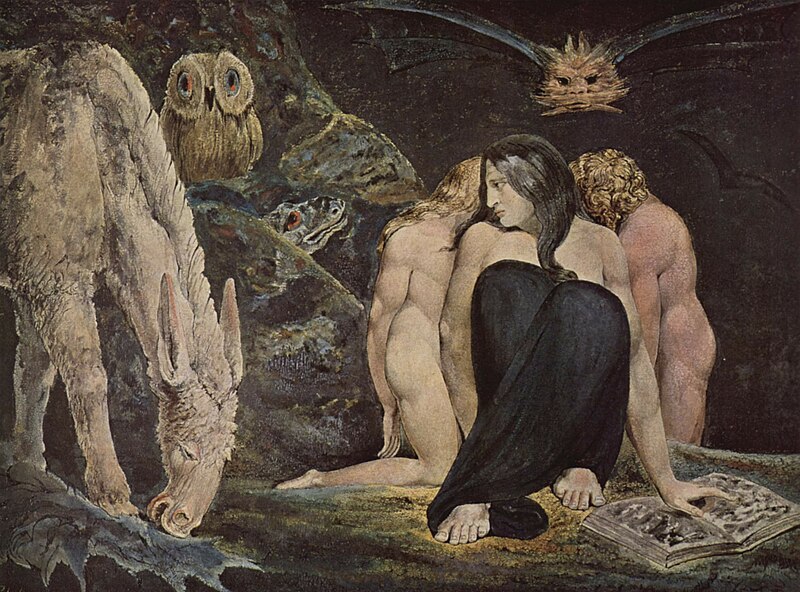
HECATE


Blake's picture which goes both by the names Hecate and The Night of Enitharmon's Joy is one of his Large Color Printed Drawings of 1795. There are reasons why the picture came to be called by different names. Blake would have been familiar with Hecate's role in ancient mythology and with the instances in which she appears in Shakespeare's Macbeth and Midsummer Night's Dream. The central figure is pictured threefold as the goddess Hecate was imagined by the Greeks, but for Blake she includes a young male and a young female with the central woman. She is beautiful as Blake said the the witches in Shakespeare should be represented. 


Descriptive Catalogue, (E 535)
"By way of illustration, I instance Shakspeare's Witches in
Macbeth.  Those who dress them for the stage, consider
them as wretched old women, and not is as Shakspeare intended, the
Goddesses of Destiny; this shews how Chaucer has been
misunderstood in his sublime work.  Shakspeare's Fairies also 
are the rulers of the vegetable world, and so are Chaucer's; 
let them be so considered, and then the poet will be understood, 
and not else."
She is accompanied by the bat, the snake and the owl which are associated with Hecate as a goddess of the night and the underworld. Since the donkey is not generally associated with Hecate its presence is a reference to Titania, Queen of the fairies, who in Midsummer Night's Dream under a spell, falls in love with a man with the appearance of a donkey. This reference would indicate the foolishness of the male submitting to female dominance.

The phrase Enitharmon's Joy comes from the poem Europe which speaks of the rise of Orc or revolution. Preliminary to the outbreak of Orc's conflagration is the night of Enitharmon's Joy, the dominance of woman or female love which results from the idea that loving a woman is sinful, that heaven comes after death and that joy is forbidden. After being under female dominion for Eighteen Hundred Years the active energy of the male breaks out of the webs and nets which have bound him. 

Europe, Plate 4 , (E 62)

"The horrent Demon rose, surrounded with red stars of fire,
Whirling about in furious circles round the immortal fiend.

Then Enitharmon down descended into his red light,
And thus her voice rose to her children, the distant heavens reply.
Plate 5
Now comes the night of Enitharmons joy!                          
Who shall I call? Who shall I send?
That Woman, lovely Woman! may have dominion?
Arise O Rintrah thee I call! & Palamabron thee!
Go! tell the human race that Womans love is Sin!                 
That an Eternal life awaits the worms of sixty winters
In an allegorical abode where existence hath never come:
Forbid all joy, & from her childhood shall the little female
Spread nets in every secret path.

My weary eyelids draw towards the evening, my bliss is yet but
     new."    
Milton Klonsky in William Blake, The Seer and His Visions comments on Hecate on page 60:
"Both Hecate and Pity ... were meant to illustrate dual aspects of what Blake regarded as the domineering Female Will, which attempts to ensnare the male in a web of religion woven out of sexual repression, chastity and jealousy. 'O Woman-born/ And Woman-nourish'd & Woman-educated & Woman-scorn'd' he wrote in Jerusalem (64:16-17)."

Jerusalem, Plate 30 [34], (E 176)

"I hear the screeh of Childbirth loud pealing, & the groans
Of Death, in Albions clouds dreadful utterd over all the Earth
What may Man be? who can tell! but what may Woman be?            
To have power over Man from Cradle to corruptible Grave.
There is a Throne in every Man,it is the Throne of God
This Woman has claimd as her own & Man is no more!
Albion is the Tabernacle of Vala & her Temple
And not the Tabernacle & Temple of the Most High                 
O Albion why wilt thou Create a Female Will?

To hide the most evident God in a hidden covert, even
In the shadows of a Woman & a secluded Holy Place
That we may pry after him as after a stolen treasure
Hidden among the Dead & mured up from the paths of life"  

Monday, October 15, 2012

Visions of the Daughters of Albion I


                                  Visions of the Daughters of Albion

Here's a Blakean twist on the ubiquitous eternal triangle of all the love stories.

Oothoon  (Persephone?) loves Theotormon, but she's raped by Bromion.

       Here we see clearly the moral species. Blake used it to express his emphatic displeasure at the notion that a raped girl is 'damaged goods' and no longer worthy of the love of her erswhile lover. He considered that a high degree of immorality, another expression of the Jealousy that was for Blake the primary sin;  to perceive a woman as property was all too prevalent in Blake's day and still quite common in ours.

***********************************************************************************************

Plate i

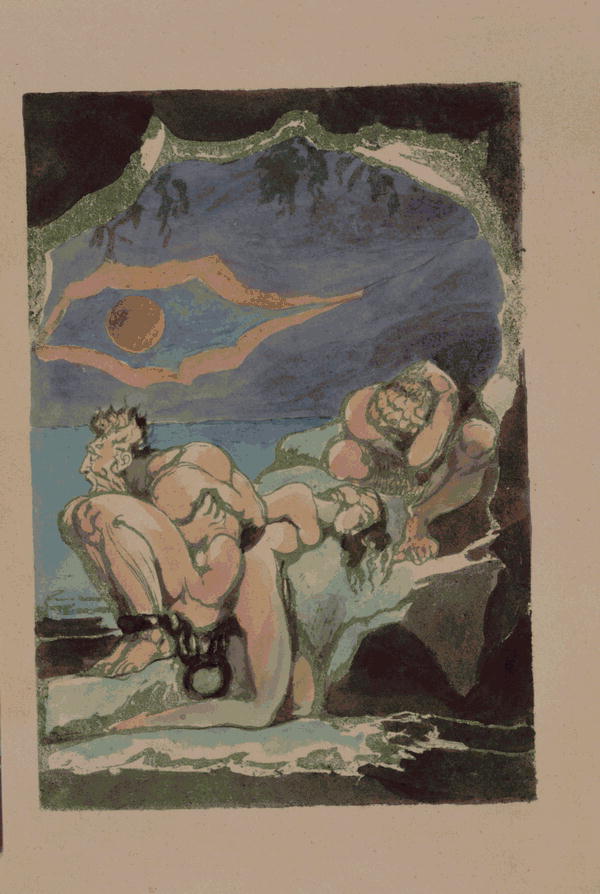
Oothoon (Persephone?) loves Theotormon, but she's raped by Bromion, and Theo can’t deal with that.


The three are chained together at the mouth of Bromion's cave.
Bromion, the only one with his eyes open, has a terrified look on his face.

The tide is coming in, and Theotormon, in the highest spot covers his eyes. Meanwhile Oothoon is down in the water.  

The water represents the fall into materiality.


Plate ii, the Frontspiece


The Argument


                                                                                   Plate III


I loved Theotormon
And I was not ashamed
I trembled in my virgin fears
And I hid in Leutha's Vale!

I plucked Leutha's flower,
And I rose up from the vale;
But the terrible thunders tore
My virgin mantle in twain.

All Blake's pictures have multiple meanings:
"And I rose up from the vale"
That sounds like Thel; Blake appears to be saying that Bromin's rape resulted in sending the nymph, Oothoon, into mortal life.

But for Erdman's Prophet Against Empire  (page 226ff) Lutha's vale may point to 'suffering Africa' and the poem a prophecy against the Slave Trade.


               Plate I
This Plate shows the relationship between Visions of the Daughters of Albion and America, the poem that follows immediately.

Visions

Enslav'd, the Daughters of Albion weep; a trembling lamentation
Upon their mountains; in their valleys, sighs towards America.
For the soft soul of America, Oothoon wanderd in woe,
Along the vales of Leutha seeking flowers to comfort her;
And thus she spoke to the bright Marygold of Leutha's vale
Art thou a flower! art though a nymph! I see thee now a flower;
Now a nymph! I dare not pluck thee from thy dewy bed!

The Golden nymph replied; pluck thou my flower Oothoon the mild
Another flower shall spring. because the soul of sweet delight
Can never pass away, she ceas'd & closed her golden shrine.
Then Oothoon pluck'd the flower saying, I pluck thee from thy bed
Sweet flower. and put thee here to glow between my breasts
And thus I turn to where my whole soul seeks.

Over the waves she went in wing'd exulting swift delight;
And over Theotormon's reign, took her impetuous course.

Bromion rent her with his thunders. on his stormy bed
Lay the faint maid, and soon her woes apalld his thunders hoarse

Bromion spoke. behold this harlot here on Bromions bed.
And let the jealous dolphins sport around the lovely maid:
Thy soft American plains are mine, and mine thy north & south:
Stampt with my signet are the swarthy children of the sun;
They are obedient, they resist not, they obey the scourge:
Their daughters worship terrors and obey the violent:

Bromion's speech displays the typical attitude of conventional people in Blake's day as well as our own.
It also illustrates common racial attitudes--in the 18th, 19th, 20th, and 21st centures.

Sunday, October 14, 2012

MILTON VS URIZEN

There are several encounters in Milton between Milton and Urizen. Although each is instructive, they are all inconclusive. The final mention of Urizen occurs in this passage:

Milton, Plate 39 [44], (E 141)
"He [Albion] strove to rise to walk into the Deep. but strength failing    
Forbad & down with dreadful groans he sunk upon his Couch
In moony Beulah. Los his strong Guard walks round beneath the Moon

Urizen faints in terror striving among the Brooks of Arnon
With Miltons Spirit: as the Plowman or Artificer or Shepherd
While in the labours of his Calling sends his Thought abroad 
To labour in the ocean or in the starry heaven. So Milton
Labourd in Chasms of the Mundane Shell, tho here before
My Cottage midst the Starry Seven, where the Virgin Ololon
Stood trembling in the Porch: loud Satan thunderd on the stormy Sea
Circling Albions Cliffs in which the Four-fold World resides     
Tho seen in fallacy outside: a fallacy of Satans Churches

Plate 40 [46]
I see thee strive upon the Brooks of Arnon. there a dread
And awful Man I see, oercoverd with the mantle of years.   
I behold Los & Urizen. I behold Orc & Tharmas;
The Four Zoa's of Albion & thy Spirit with them striving
In Self annihilation giving thy life to thy enemies
Are those who contemn Religion & seek to annihilate it
Become in their Femin[in]e portions the causes & promoters       
Of these Religions, how is this thing? this Newtonian Phantasm
This Voltaire & Rousseau: this Hume & Gibbon & Bolingbroke
This Natural Religion! this impossible absurdity
Is Ololon the cause of this? O where shall I hide my face
These tears fall for the little-ones: the Children of Jerusalem  
Lest they be annihilated in thy annihilation.

No sooner she had spoke but Rahab Babylon appeard
Eastward upon the Paved work across Europe & Asia
Glorious as the midday Sun in Satans bosom glowing:
A Female hidden in a Male, Religion hidden in War           
Namd Moral Virtue; cruel two-fold Monster shining bright
A Dragon red & hidden Harlot which John in Patmos saw

And all beneath the Nations innumerable of Ulro
Appeard, the Seven Kingdoms of Canaan & Five Baalim
Of Philistea. into Twelve divided, calld after the Names      
Of Israel: as they are in Eden. Mountain. River & Plain
City & sandy Desart intermingled beyond mortal ken

But turning toward Ololon in terrible majesty Milton
Replied. Obey thou the Words of the Inspired Man
All that can be annihilated must be annihilated   

That the Children of Jerusalem may be saved from slavery
There is a Negation, & there is a Contrary
The Negation must be destroyd to redeem the Contraries
The Negation is the Spectre; the Reasoning Power in Man
This is a false Body: an Incrustation over my Immortal           
Spirit; a Selfhood, which must be put off & annihilated alway
To cleanse the Face of my Spirit by Self-examination.

Plate 41 [48]
To bathe in the Waters of Life; to wash off the Not Human
I come in Self-annihilation & the grandeur of Inspiration
To cast off Rational Demonstration by Faith in the Saviour
To cast off the rotten rags of Memory by Inspiration
To cast off Bacon, Locke & Newton from Albions covering          
To take off his filthy garments, & clothe him with Imagination
To cast aside from Poetry, all that is not Inspiration"
British Museum

Michael Contending with Satan 
Study for illustration to Young's Night Thoughts
Milton and Blake both participate in the 'great battle' but there are many other entities as well. This battle is taking place in the natural world between natural religion and spiritual religion, in the mental world among the Four Zoas, in the Eternal world between Satan and Ololon.  The role of Urizen in this battle unfolds on several levels: spiritually as Satan, psychologically as the selfhood, morally as the Spectre and intellectually as the false reasoning.

These combatants are the Good Guys:
Blake
Milton
Albion
Ololon
Children of Jerusalem

and these are the Bad Guys:
Urizen
Satan
Fallen Zoas of Albion
Those who condemn religion and seek to annihilate it
Rahab Babylon (moral virtue)


The battle is not concluded with the defeat of Urizen but with the recognition of the forces that participate in the struggle. When the enemy is recognized as negation which by its nature can and must be destroyed, Milton consents to the annihilation of all that can be annihilated. This cleanses his mind, frees his spirit, releases his relationships, and alters his perception.

Saturday, October 13, 2012

Cupid and Psyche

                                                 Cupid and Psyche
(Cupid is God; Psyche is the soul.)

       Blake had read Taylors' translation of Apuleius' Marriage of Cupid and Psyche.
 In her discussion of Blake's use of Cupid and Psyche Raine refers us to a passage in
Night ii of The Four Zoas:

"And I commanded the Great deep to hide her in his hand
Till she became a little weeping Infant a span long
I carried her in my bosom as a man carries a lamb
I loved her I gave her all my soul & my delight
I hid her in soft gardens & in secret bowers of Summer
Weaving mazes of delight along the sunny Paradise
Inextricable labyrinths, She bore me sons & daughters
And they have taken her away & hid her from my sight."
(Erdman 317)

       This is a "paradise of shadows" (Raine 24). Blake described here the coming of an
eternal soul into generation;  in this (long!) poem Blake provided a creative rational for 'generation' (the descent of the soul).

       In this passage Luvah has (more or less) created Vala, and then (for an unknown reason here)
he found himself shut off from her and she from him.

       Cupid provides a magnificent house for Psyche, and Luvah does the same thing for Vala, just as Solomon had done (your house is traditionally a symbol of your body). Cupid, Luvah, Solomon build houses for Psyche, Vala, and the Shulamite respectively. They made a house for them, just as God makes a house for us all.

Psyche's House (From Apuleius):

"And when she had refreshed her selfe sufficiently with sleepe,
she rose with a more quiet and pacified minde, and fortuned to
espy a pleasant wood invironed with great and mighty trees. Shee
espied likewise a running river as cleare as crystall : in the midst
of the wood well nigh at the fall of the river was a princely Edifice,
wrought and builded not by the art or hand of man, but by the mighty
power of God : and you would judge at the first entry therin, that it
were some pleasant and worthy mansion for the powers of heaven.
For the embowings above were of Citron and Ivory, propped and
undermined with pillars of gold, the walls covered and seeled with
silver, divers sorts of beasts were graven and carved, that seemed to
encounter with such as entered in. All things were so curiously and
finely wrought, that it seemed either to be the worke of some Demy
god, or of God himselfe. The pavement was all of pretious stones,
divided and cut one from another, whereon was carved divers kindes
of pictures, in such sort that blessed and thrice blessed were they that
might goe upon such a pavement : Every part and angle of the house
was so well adorned, that by reason of the pretious stones and inestimable
treasure there, it glittered and shone in such sort, that the chambers,
porches, and doores gave light as it had beene the Sunne."

       Words of Vala:
"My Luvah here hath placd me in a Sweet & pleasant Land
And given me fruits & pleasant waters & warm hills & cool valleys
Here will I build myself a house & here Ill call on his name
Here Ill return when I am weary & take my pleasant rest
So spoke the Sinless Soul and laid her head on the downy fleece
Of a curld Ram who stretchd himself in sleep beside his mistress
And soft sleep fell upon her eyelids in the silent noon of day
Then Luvah passed by & saw the sinless Soul
And said Let a pleasant house arise to be the dwelling place
Of this immortal Spirit growing in lower Paradise
He spoke & pillars were builded & walls as white as ivory
The grass she slept upon was pavd with pavement as of pearl. Beneath her rose a downy bed & a cieling coverd all"
(Night 9 of 4Z 128:20-33; quoted by Raine on page 26)

       The pleasant house has the symbolic meaning of the Beloved's (that's us!) body. In the Song of Solomon we have this duet:

Solomon:
"If she is a wall, we will build towers of silver on her. If she is a door, we will enclose her
with panels of cedar.

Shulamite:
I am a wall, and my breasts are like towers. Thus I have become in his eyes like one bringing contentment."
(Song of Solomon 8:9-10)

       All of these three ladies (Psyche, Vala, and the Shulamite) mourn the absence of her husband. Each lady's husband acts as a surrogate for God. Descending into mortal life is a downer that stays with us until the mortal end.
       With a rhapsodic verse from Solomon re his "beloved" in Blake and Tradition (but not Blake and Antiquity) Raine makes for us an extremely significant revelation:

Song of Solomon 6:4:
Thou art beautiful, O my love, as Tirzah, comely as Jerusalem"
In the Bible Tirzah is a city, but something entirely different to Blake.

       As you read 4Z, it becomes more and more apparent that Tirzah is the type of Vala fallen. Jerusalem represent's Vala redeemed.

"Blake took the name Tirzah to be a symbolic reference to worldly materialism, as opposed to the spiritual realm of Jerusalem." (from Wikipedia)

An earlier version of this can be found here.


Friday, October 12, 2012

WELCOME

Songs of Innocence
The Echoing Green
British Museum

We welcome your visit to our blog and invite you to spend some time with us. Although we try to share our understanding of Blake with our guests, we are most interested in making available to you the tools to study Blake independently. The links that are provided in almost every post connect you with sites, articles and individuals which have information and insight to share. We recommend books which have enriched our understanding of Blake: some of which you may read online, others which may be borrowed through your library's interlibrary loan system, or others may be purchased new or used through online services such as Better World Books.

The Complete Poetry and Prose of William Blake edited by David V Erdman is available as a html document which can be downloaded to your computer. The passages from Blake which we print are usually from this file and the page numbers (E ___) refer to it.

The pictures we include come from many sources. The Blake Archive acts a repository for a large and increasing volume of Blake's images but restricts the use to viewing and linking only. We do not post pictures retrieved from the Blake Archive. Other institutions allow the use of their images since they are long out of copyright. Many of our images come from the Library of Congress Rosenwald Collection. Both the British Museum and Yale University, which have large holdings, are sources of images we are allowed to post. Wikimedia Commons presents a wide variety of Blake images which we use freely. We have also used many images from a site called the Complete Works which is advertising copies of paintings for sale. A large number of institutions have Blake works which are rarely seen; some have been digitized and made available for copying. It is far more possible for the public to view and use Blake images now than it was just a couple of years ago.

Our blog now has over 1200 posts which are archived and sometimes indexed. The search box at top left of the blog allows you to search for specific terms of phrases (enclosed in quotes). Resources which may help your studies are linked in the sidebar and heading.

We hope you have found something here which you are looking for. The study and enjoyment of Blake offers many possibilities. We welcome suggestions on how to improve our blog and better meet the needs of our readers.

Thursday, October 11, 2012

Thomas Taylor, the Grecian

According to the letter that Blake wrote to John Flaxman, Milton, Shakespeare, Boehme and 
Paracelsus were his teachers, but there were others:

Unlike the ones above Thomas Taylor was Blake's own age.  About 1784
Taylor gave 12 lectures at Flaxman's home on Neoplatonism.
Blake undoubtedly attended (at least some of) these lectures.

Blake hitherto had frowned on Plato, but he was impressed by Taylor's lectures.
He found a new world in Plotinus and the others; they exercised a marked
influence on his poetry and pictures.

On page six of Milton Percival's Circle of Destiny he quoted this passage from Plotinus:
"No: our reasoning is our own.  We ourselves think the thoughts that
occupy the understanding--for this is actually the We--but the operation
of the Intellectual Principle enters from above" (sounds remarkably like WB).

The same year (1784) Blake wrote his satiric parody: An Island in the
Moon: he referred to Taylor as Obtuse Angle and to himself as Quid:

" Obtuse Angle came in Oh I am glad you are come said quid......

Obtuse Angle giving a grin said Voltaire understood nothing of the 
Mathematics and a man must be a fool ifaith not to understand the 
Mathematics .........

"But Ob[t]use Angle, entering the room having made a

gentle bow, proceeded to empty his pockets of a vast number of
papers, turned about & sat down   wiped his [head]
 with his pocket handkerchief & shutting his eyes began to
scratch his head--well gentlemen said he what is the cause of
strife   the Cynic answerd. they are only quarreling about:
Voltaire--Yes said the Epicurean & having a bit of fun with him.
And said the Pythagorean endeavoring to incorporate their souls
with their bodies 
  Obtuse Angle giving a grin said   Voltaire understood nothing
of the Mathematics and a man must be a fool in faith not to
understand the Mathematics"  
Read it!

Blake had derogatory things to say about Voltaire:
he mentioned him 25 times; check the Blake Concordance; here are a couple:
"Mock on mock on Voltaire...." (the Notebook).
"Her Two Covering Cherubs  afterwards named Voltaire & Rousseau"

In spite of Blake's ambivalence re Greek  art he depended on it to a great degree;
look for example at the Arlington Tempera: Kathleen Raine demonstrates just how
Greek it is.  In Blake and Antiquity she showed how Blake used several Greek
myths including the Cave of the Nymphs, the myth of Psyche, the myth of 
Persephone and the myth of the Great Year.

Blake's friendship as a young man with Thomas Taylor  is largely responsible for
the enormous amount of Greek thought that fills his pages and his art.


Wednesday, October 10, 2012

TIMELESS MOMENTS

It is easy to get discouraged when reading Blake's longer poems because of the lack of continuity and the introduction of multiple unfamiliar metaphors in close proximity. Jerome McGann in his chapter in Blake's Sublime Allegory, Essays on The Four Zoas, Milton and Jerusalem, Edited by Curran and Wittreich, gives an explanation of the reasoning behind the unfamiliar structure and composition encountered in the Four Zoas, Milton and Jerusalem. But we have to assume that Blake did not arrive at his way of writing poetry through his reasoning power but through the faculty he is trying to develop in his reader - the Imagination.

Quoting Jerome McGann on page 16:
"Fourfold vision is not rest but activity. Its first demand is that all things be forsaken, since only by fostering a condition of total perceptual indigence can one begin the preparation for infinite vision. Possessing nothing one finds that all things are possible. But to describe fourfold vision in this way is almost to parody it, Blake's poems resort to enactment and dramatization. However this is done it always comes in the "Moment in each Day that Satan cannot find" (M 35: 42). (Note how Blake's statement assures us that such visionary, timeless moments are continually borne to us through fallen time, even by Satan's 'Watch Fiends' themselves.) Between the pulsation of an artery, suspended from time in time, such a moment contains an experience of dying to an old form of thought and gaining a new world of perception.


New York Public Library
Milton
Plate 16
Blake's poems aim to establish the conditions which will rouse the faculties of his readers to this very death and release. He sets out contrarious perceptions of the universe, and by violent acts of juxtaposition forces us to 'To build the Universe stupendous: Mental forms Creating' (M 30: 20). The demand is that we set the poem's terms into successively different types of relations with each other. Blake's art is a sort of Glass-Bead Game. To 'make sense' of his words we establish in and for them different forms of order based on shifting sets of dissociations and associations, contrasts and analogies. To cease the act of creating these sets of relations, or of ironically unbuilding them again, is to lapse into single vision...As far as Blake is concerned, the process is infinite."   


Milton, PLATE 35 [39], (E 135)
"O how the Starry Eight rejoic'd to see Ololon descended!
And now that a wide road was open to Eternity,                   

By Ololons descent thro Beulah to Los & Enitharmon,

For mighty were the multitudes of Ololon, vast the extent
Of their great sway, reaching from Ulro to Eternity

Surrounding the Mundane Shell outside in its Caverns
And through Beulah. and all silent forbore to contend            
With Ololon for they saw the Lord in the Clouds of Ololon

There is a Moment in each Day that Satan cannot find
Nor can his Watch Fiends find it, but the Industrious find
This Moment & it multiply. & when it once is found
It renovates every Moment of the Day if rightly placed[.]        
In this Moment Ololon descended to Los & Enitharmon
Unseen beyond the Mundane Shell Southward in Miltons track"
            

Milton, PLATE 30 [33], (E 129)
"Lo the Eternal Great Humanity            
To whom be Glory & Dominion Evermore Amen
Walks among all his awful Family seen in every face
As the breath of the Almighty. such are the words of man to man
In the great Wars of Eternity, in fury of Poetic Inspiration,
To build the Universe stupendous: Mental forms Creating          

But the Emanations trembled exceedingly, nor could they
Live, because the life of Man was too exceeding unbounded
His joy became terrible to them they trembled & wept
Crying with one voice. Give us a habitation & a place
In which we may be hidden under the shadow of wings              
For if we who are but for a time, & who pass away in winter
Behold these wonders of Eternity we shall consume
But you O our Fathers & Brothers, remain in Eternity
But grant us a Temporal Habitation."
Perhaps we have a tendency to plead along with the Emanations for a temporal habitation when the Wars of Eternity become too intense for our comprehension.

Tuesday, October 09, 2012

Boehme 1

In 1800 Blake wrote to John Flaxman, an early friend; the letter contained this passage:
"Now my lot in the Heavens is this; Milton lovd me in childhood & shewd me his face Ezra
came with Isaiah the Prophet, but Shakespeare in riper years gave me his hand Paracelsus &
Behmen appeard to me." (Behmen was the English name for Boehme).

The Bible of course was Blake's first and greatest love, but he had less commitment to the thoughts
of Shakespeare or Milton than he had to those of Boehme. When he read Boehme,  probably in the
English translation of William Law, he found a friend and a brother.  Boehme shared most or all of
the values that Blake held dear. When you read the two men you see immediately how similar they
were, in language as well as values.

Boehme loved the Bible and treated it very freely, much in the way Blake did in 'creating his
system'. Both men saw things in a biblical word or sentence which differed vastly  from the way it
was seen by conventional Bible interpreters. I believe it was through reading Boehme that Blake
learned how much the Bible says that is completely foreign to the ordinary reader.

"Jakob Böhme (probably April 24, 1575[ – November 17, 1624) was a German Christian mystic
and theologian. He is considered an original thinker within the Lutheran tradition, and his first book,
commonly known as Aurora, caused a great scandal. In contemporary English, his name may be
spelled Jacob Boehme; in seventeenth-century England it was also spelled Behmen, approximating
the contemporary English pronunciation of the German Böhme."
(A paragraph from Jakob Boehme): 
this link provides an easy way to begin to get acquainted with Boehme, Bohme, Beymen.

You can find volumes of material about and on Boehme. Here is one small extract that gives
something of the flavor of what Blake loved:

Extracts from "PREFACE TO THE READER" of 'Signature'
(Bohme wrote this preface in straight prose pointing out the use of the "language of Zion", which he
used much more often that William Blake did. He was able to maintain the common devout
language to express the divergences that he (and Blake as well) held regarding orthodoxy.)

"HIS book is a true mystical mirror of the highest wisdom. The best treasure that a man can attain
unto in this world is true knowledge; even the knowledge of himself: For man is the great mystery of
God, the microcosm, or the complete abridgment of the whole universe: He is the mirandum Dei
opus, God's masterpiece, a living emblem and hieroglyphic of eternity and time; and therefore to
know whence he is, and what his temporal and eternal being and well-being are, must needs be that
ONE necessary thing, to which all our chief study should aim, and in comparison of which all the
wealth of this world is but dross, and a loss to us.
..............................................................................................................................................................

This is that wisdom which dwells in nothing, and yet possesses all things, and the humble resigned
soul is its playfellow; this is the divine alloquy, the inspiration of the Almighty, the breath of God,
the holy unction, which sanctifies the soul to be the temple of the Holy Ghost, which instructs it
aright in all things,

This is the precious pearl, whose beauty is more glorious, and whose virtue more sovereign than the
sun: It is a never-failing comfort in all afflictions, a balsam for all sores, a panacea for all diseases, a
sure antidote against all poison, and death itself; it is that joyful and assured companion and guide,
which never forsakes a man, but convoys him through this valley of misery and death into the
blessed paradise of perfect bliss.

If you ask, What is the way to attain to this wisdom? Behold! Christ, who is the way, the truth, and
the life, tells you plainly in these words; "If any man will come after me, let him deny himself, and
take up his cross daily and follow me;" [*2] or as he
says elsewhere, "Unless you be born again, you cannot see the kingdom of heaven:" or as St. Paul
says, "If any man seemeth to be wise in this world, let him become a fool that he may be wise." [*1]

Herein lies that simple childlike way to the highest wisdom, which no sharp reason or worldly
learning can reach unto; nay, it is foolishness to reason, and therefore so few go the way to find it:
The proud sophisters and wiselings of this world have always trampled it under foot with scorn and
contempt, and have called it enthusiasm, madness, melancholy, whimsy, fancy, etc., but wisdom is
justified of her children.
.................................................................................................................................................................

This is the true theosophic school wherein this author learned the first rudiments and principles of
wisdom, and to which we must go if we would understand his deep writings: For we must know that
the sons of Hermes, who have commenced in the high school of true magic and theosophy, have
always spoken their hidden wisdom in a mystery; and have so couched it under shadows and figures,
parables and similies, that none can understand their obscure, yet clear writings, but those who have
had admittance into the same school, and have tasted of the Feast of Pentecost.

And this does not seem at all strange to the children of divine Mercury; for the mysteries of
philosophy, divinity, and theosophy must not be profaned, and laid open to the view of the outward
astral reason, which turns all to its selfish pride, covetousness, envy, wrath, and cunning hypocrisy;
and therefore a parabolical or magical phrase or dialect is the best and plainest habit and dress that
mysteries can have to travel in up and down this wicked world: And thus parable have a double and
different respect and use; for as they conceal and hide secrets from the rude and vulgar sort,
patient to bear anything but what suits with their common conceits and opinions, so likewise they
sweetly lead the mind of the true searcher into the depths of wisdom's council. They are as the
cloudy pillar of Moses; they have a dark part, and they have a light part; they are dark to the
Egyptians, the pharisaical sons of sophistry, but light to the true Israel, the children of the mystery.

(*******************************************************************************
We see here a mixture of New Testament wisdom and esoteric wisdom, such as "the sons of
Hermes" and "children of divine Mercury"; this indicates that (like Blake) Bohme did not consider
the Bible to be the sole Word of God.

This also shows the unorthodox way with which Bohme used Scripture; it also gives evidence that
both men were widely read.) 
*******************************************************************************
And therefore whoever will be nurtured and trained up by Sophia, and learn to understand and speak
the language of wisdom, must be born again of and in the Word of Wisdom, Christ Jesus, the
Immortal Seed: The divine essence which God breathed into his paradisical soul must be revived,
and he must become one again with that which he was in God before he was a creature, and then his
Eternal Spirit may enter into that which is within the veil, and see not only the literal, but the moral,
allegorical, and anagogical meaning of the wise and their dark sayings: He then will be fit to enter,
not only into Solomon's porch, the outer court of natural philosophy, sense and reason, but likewise
into the inward court of holy and spiritual exercises, in divine understanding and knowledge; and so
he may step into the most inward and holiest place of theosophical mysteries, into which none are
admitted to come, but those who have received the high and holy unction.
***********************************************************
(Blake said:
"Ive a wife I love and that loves me.
Ive all but Riches Bodily"

Paul, the apostle wrote in Philippians 3:
"What is more, I consider everything a loss because of the surpassing worth of knowing Christ Jesus
my Lord, for whose sake I have lost all things. I consider them garbage, that I may gain Christ"
*****************************************************************************
I will now endeavour briefly to hint to the reader what this book contains, though in it the spirit of
wisdom cannot be delineated with pen and ink, no more than a sound can be painted, or the wind
grasped in the hollow of the hand: But know, that in it he deciphers and represents in a lively
manner the Signature of all Things, and gives you the contents of eternity and time, and glances at
all mysteries.
In a word, his intent is to let you know the inward power and property by the outward sign;

But the proud scorner that will take no warning is of Lucifer's regiment, who saw the mystery of
God's kingdom to stand in meekness, simplicity, and deep humility, and therefore out of his pride
would aspire to be above the divine love, and harmony of obedience to God's will, and so fell into
the abyss of the dark world, into the outmost darkness of the first principle, which we call Hell,
where he and his legions are captives; from which the Almighty God of Love deliver us.

I will end with the words of the author at the conclusion of the book, where he says thus; "I have
faithfully, with all true admonition, represented to the reader what the Lord of all beings has given
me; he may behold himself in this looking-glass [*1] within and without, and so he shall find what
and who he is: Every reader, be he good or bad, will find his profit and benefit therein: It is a very
clear gate of the great mystery of all beings: By glosses, commentaries, curiosity and self-wit, none
shall be able to reach or apprehend it in his own ground; but it may very well meet and embrace the
true seeker, and create him much profit and joy; yea be helpful to him in all natural things, provided
he applies himself to it aright, and seeks in the fear of God, seeing it is now a time of seeking; for a
lily blossoms upon the mountains and valleys in all the ends of the earth: 'He that seeketh findeth.'"

And so I commend the reader to the grace and love of Jesus Christ, in whom are hidden all the
treasures of wisdom and knowledge."

Monday, October 08, 2012

MILTON'S ILPENSEROSO VI a

In his manuscript notes accompanying his watercolors Blake singles out these verses from Milton for his sixth illustration to Il Penseroso: 
Descriptions of Illustrations to Milton's L'Allegro and Il Penseroso (E 684)

 "And may at last my weary Age 
 Find out the peaceful Hermitage 
The hairy Gown the mossy Cell 
Where I may sit & rightly spell 
Of every Star that heavn doth shew 
And every Herb that sips the dew 
Till old Experience do attain 
To somewhat like Prophetic strain" 

Blake wrote: 
"Milton in his Old Age sitting in his Mossy Cell Contemplating the Constellations. surrounded by the Spirits of the Herbs & Flowers. bursts forth into a rapturous Prophetic Strain"


The lower part of illustration six of Il Penseroso can be thought of as showing Milton's achievements in life. The lower right hand corner shows a nursing mother and two infants. The lower left shows a woman being drawn from the earth by another woman who reaches for heaven. In the center are a man and woman entwined in loving embrace below garlands of flowers. Beside Milton is his open book resting on a golden stand. A candle of illumination burns beside the book.

The expression on Milton's face betrays his hearing the 'rapturous Prophetic Strain'. A line in Il Penseroso not quoted by Blake mentions Milton's desire to 'Dissolve me into exstasies, And bring all Heav'n before mine eyes.' Blake shows Milton not with the eyes of a blind man but with eyes that see the world of vision, not in the cave, not in the sky, but in the dimension which illumines the infinite, and eternal.

Milton's cave is filled with the ornaments of a successful life, but he is still portrayed in a cave; even with the ability to perceive the visionary world Milton has not been released from the cave of his mind into the ever expanding World of Eternity. He has not been able: 
"To open the Eternal Worlds, to open the immortal Eyes 
Of Man inwards into the Worlds of Thought: into Eternity 
Ever expanding in the Bosom of God. the Human Imagination", Jerusalem, Plate 5, (E 147)

 Milton wrote
      the following sonnet after the onset of his blindness and before
      the compositions of his great poetic works. Blake pictures Milton
      as having learned to watch and wait and serve as were the goals he
      expressed in his poem.

"When I consider how my light is spent,
Ere half my days, in this dark world and wide,
And that one talent which is death to hide,
Lodged with me useless, though my soul more bent
To serve therewith my maker, and present
My true account, lest he returning chide,
Doth God exact day-labour, light denied?
I fondly ask; but Patience to prevent
That murmur, soon replies, God doth not need
Either man's work or his own gifts, who best
Bear his mild yoke, they serve him best, his state
Is kingly. Thousands at his bidding speed
And post o'er land and ocean without rest:
They also serve who only stand and wait."

Important psychological work is accomplished in the deep caverns of the unconscious. This image may imply that Milton's work is incomplete, that he is still gathering together the 'scatterd portions of his immortal body'. When Jesus restored Lazarus to life it occurred in three stages, the last of which was to come forth from the sepulchre. Picturing Milton both as a man who travelled a great distance on the journey to wholeness, but who remained trapped in his limited confines, speaks to the condition of man waiting for the final revelation and redemption. 

Four Zoas, Night VIII, Page 114, (E 384)
"Listen I will tell thee what is done in the caverns of the grave 

PAGE 114 [110] 
The Lamb of God has rent the Veil of Mystery soon to return
In Clouds & Fires around the rock & the Mysterious tree
As the seed waits Eagerly watching for its flower & fruit
Anxious its little soul looks out into the clear expanse
To see if hungry winds are abroad with their invisible army 
So Man looks out in tree & herb & fish & bird & beast
Collecting up the scatterd portions of his immortal body
Into the Elemental forms of every thing that grows
He tries the sullen north wind riding on its angry furrows
The sultry south when the sun rises & the angry east 
When the sun sets when the clods harden & the cattle stand
Drooping & the birds hide in their silent nests. he stores his thoughts
As in a store house in his memory he regulates the forms
Of all beneath & all above   & in the gentle West
Reposes where the Suns heat dwells   he rises to the Sun
And to the Planets of the Night & to the stars that gild
The Zodiac & the stars that sullen stand to north & south
He touches the remotest pole & in the Center weeps
That Man should Labour & sorrow & learn & forget & return
To the dark valley whence he came to begin his labours anew
In pain he sighs in pain he labours in his universe
Screaming in birds over the deep & howling in the Wolf
Over the slain & moaning in the cattle & in the winds
And weeping over Orc & Urizen in clouds & flaming fires    
And in the cries of birth & in the groans of death his voice 
Is heard throughout the Universe whereever a grass grows
Or a leaf buds   The Eternal Man is seen is heard   is felt
And all his Sorrows till he reassumes his ancient bliss

Such are the words of Ahania & Enion. Los hears & weeps    
And Los & Enitharmon took the Body of the Lamb 
Down from the Cross & placd it in a Sepulcher which Los had hewn
For himself in the Rock of Eternity trembling & in despair 
Jerusalem wept over the Sepulcher two thousand Years"

Sunday, October 07, 2012

The Cave and the Sea

                                             Cave of the Nymphs

Unquestionably the Bible was Blake's main source in developing his primary myth of creation, fall, regeneration (or redemption) and return. However he was fully capable of using other sources, and in The Sea of Time and Space he drew primarily upon Homer (and Plato).

(In Kathleen Raines' book Blake and Tradition she gave a good interpretation of the Cave of the Nymphs as used by Blake.)  A condensation of Raines' great work may be found at Blake and Antiquity;  it contains considerable stuff on the Sea of Time and Space.
Three things stand out prominently in this wonderful picture:
On the right is the cave of the nymphs who conduct innocent souls by the northern gate down into mortal life.
Below the cave spread across the bottom is the Sea of Time and Space.
On the upper left you see a representation of the Heavenly Realm.
Homer wrote about the Cave of the Nymphs in the 13th book of the Odyssey:

At the head of this harbour there is a large olive tree, and at no great distance a fine overarching cavern sacred to the nymphs who are called Naiads. There are mixing bowls within it and wine-jars of stone, and the bees hive there. Moreover, there are great looms of stone on which the nymphs weave their robes of sea purple--very curious to see--and at all times there is water within it. It has two entrances, one facing North by which mortals can go down into the cave, while the other comes from the South and is more mysterious; mortals cannot possibly get in by it, it is the way taken by the gods.

The Arlington Tempera contains virtually all of the items in Homer's description. Blake faithfully followed Homer in furnishing his cave. The Naiads use the mixing bowls and stone jars to prepare provisions for the descending souls. On the looms the nymphs weave bodies for them; the purple indicates these bodies contain blood.
Blake loved the looms and used them repeatedly in his prophecies; in his larger prophecies he described the "nymphs" as vicious wicked women; in fact there are pages of these wicked women.
(The feminine of course connotes the earthly (under the moon), and the masculine heavenly (under the sun) (As offensive as this may be to many readers, I don't know any help for it. It might be considered the guideline that men used in their subjugation of women. Blake wasn't responsible; he adopted all the ancient symbols, including this one.)

Blake's picture portrays the two realms, connected by two passsages, sometimes called gates or bars or stairs. The picture shows them as stairs. The prominent gate on the right, called the northern bar, is especially rich in symbols that Blake used over and over as he wrote, etched, drew and painted.
Immediately to the left of the northern gate is the southern gate of 'return' where worthy mortals ascend into the higher realm of immortality.

In the upper part of the picture the nymphs prepare souls for the descent into the "sea of time and space". The northern gate is filled with a stream, the current moving downward into the sea.
Blake shows two souls scheduled for mortal life; each possesses a tub or pail which the nymphs prepared for them containing spiritual truth and power for the hazardous journey into the world.
At the bottom of the cave one of these 'women' lies in the water blissfully asleep; her tub is turned on its side, all the spiritual things spilled and replaced by the water of mortal life.
The other woman has carefully protected her pail and against the opposition of the nymphs turned decisively back toward the higher realm; following Heraclitus she may be said to be a dry soul. (This scene evokes Jesus' story of the wise and foolish virgins.)  The dry soul also suggests Thel, who crossed the northern bar, but drew back in horror at the miry clay ahead. The two imaginary humans represent the choices that each of us make every moment: to go the heavenly way or the worldly way, the two ways that that Jesus spoke of ).

In the symbolic language water denotes matter, the inferior, the worldly. Souls in the higher realm are attracted by the moisture. 'Time and space' is a sea where mortal creatures suffer adventures that may be creative or destructive.
Similar and closely related to dry and moist souls are those awake and those sleeping (this runs like a current throughout the Bible and through Blake as well.)


                  The Sea of Time and Space

The River of Adonis in the cave issues into the Sea of Time and Space (one of the common titles of Blake's tempera). There is (relatively) little to report about the sea; it's just about life, about my life and your life and every brother or sister's life.
But emerging from the sea we find Odysseus, the hero of Homer's Odyssey on the near shore; with his back to the shore he is putting something in the water: in accordance with Leucothea's instructions he is returning her (magic) girdle which she had lent him so he could swim ashore. In the distance Leucothea appears getting her girdle and dissolving "in a spiral of radiant cloud" (Blake and Antiquity page 6).
Behind Odysseus stands his protector goddess, Athena pointing him to the courts above.

(The return of Odysseus to his home closely parallels Elijah's ascent on the fiery chariot into Heaven, and of course the Ascension of Our Lord. The thing to remember is that rather than material events these are metaphors. Our metaphors are spacious and temporal; not so in Eternity.)

The upper left of the picture shows God upon a chariot, driven by the four zoas and surrounded by the immortals. God appears to be a right sleepy god; the import is that it's the inner God who goes to sleep when the soul finds the couch of death and awakens to mortal life (Blake and Antiquity page 15). Raine quotes:

My Eternal Man set in Repose
The Female from his darkness rose
(The Gates of Paradise; Erdman 268)
Once you've grasped the whole of this story you may notice how closely it parallels the primary Bible myth of Creation, Fall and eventual Redemption. It's the old, old story, and in the end there's only one story. (Jesus gave us an abbreviated version of it with The Prodigal Son.)

(You my find an earlier version of this work at Myths.)

Saturday, October 06, 2012

MILTON'S IL PENSEROSO VI

In his manuscript notes accompanying his watercolors Blake singles out these verses from Milton for his sixth illustration to Il Penseroso

Descriptions of Illustrations to Milton's L'Allegro and Il Penseroso (E 684)
"And may at last my weary Age 
Find out the peaceful Hermitage   
The hairy Gown the mossy Cell 
Where I may sit & rightly spell
Of every Star that heavn doth shew
And every Herb that sips the dew 
Till old Experience do attain 
To somewhat like Prophetic strain"

Blake wrote: 
"Milton in his Old Age sitting in his Mossy Cell Contemplating the Constellations. surrounded by the Spirits of the Herbs & Flowers. bursts forth into a rapturous Prophetic Strain"
 
This illustration is divided practically in half, between the cave in which Milton sits and the outside in which the signs of the Zodiac are personified in the night sky. Since there is a lot that can be said about this image, only the upper part will be treated here.

Blake has pictured four constellations of the Zodiac in the sky. Cancer - the crab, Gemini - the twins, Taurus - the bull, and Aries - the ram. These are the first four signs of the Zodiac and appear in the winter sky. An astrology website describes them thus:

"One is the force or impulse of life itself (Aries) and can represent both collective (God) or singular (drop or ray of God) oneness. Two is base matter (Taurus), duality, or the feminine-receptive principle that uses or absorbs spirit to give it life and mind. Some would say that matter is condensed or slowed-down spirit and therefore represents the dying or degenerative principle. Three is mental activity or consciousness (Gemini) or the result of raw spirit or force (Aries) interacting with pure matter (Taurus). Aries is the father, Taurus is the mother, and Gemini is the child. Four is primal soul or memory (Cancer) or the result of spirit's infusion into matter."

Blake may have seen Urthona in Aries, Tharmas in Taurus, Luvah in Gemini, and Urizen in Cancer. The presence of the four Zoas in the heavens above Milton may be a symbol of maturity achieved by Milton in his old age.

Blake also pictures
the constellation Orion directly above Milton's head. The myth of Orion tells of a great hunter who was blinded by a vengeful king and had his sight restored by Helios the sun. Orion was assisted in seeking healing by Hephaestus, the smith and metalworker who resemble Blake's hero Los.  Milton who lost his natural sight when he was in his forties, had received the light of inspiration from God which allowed him to write his greatest poetry while sightless.

The women among the trees in the upper half of the picture are lamenting the fall from the Eternal realm which resulted in the creation of the stars. The stars for Blake were only the remnants of the light which had been lost when Albion turned away from his source. However, the stars and all creation although dimmed and obscured compared to Eternal realities are Sons of Los capable of '
Uttering prophecies & speaking instructive words to the sons Of men.'     
Jerusalem, Plate 59, (E 208)
"For the Veil of Vala which Albion cast into the Atlantic Deep
To catch the Souls of the Dead: began to Vegetate & Petrify
Around the Earth of Albion. among the Roots of his Tree
This Los formed into the Gates & mighty Wall, between the Oak    
Of Weeping & the Palm of Suffering beneath Albions Tomb,
Thus in process of time it became the beautiful Mundane Shell,
The Habitation of the Spectres of the Dead & the Place
Of Redemption & of awaking again into Eternity

For Four Universes round the Mundane Egg remain Chaotic          
One to the North; Urthona: One to the South; Urizen:
One to the East: Luvah: One to the West, Tharmas;
They are the Four Zoas that stood around the Throne Divine
Verulam: London: York & Edinburgh: their English names" 
Milton, Plate 25 [27] (E 123)  
"While Los calld his Sons around him to the Harvest & the Vintage.

Thou seest the Constellations in the deep & wondrous Night
They rise in order and continue their immortal courses
Upon the mountains & in vales with harp & heavenly song
With flute & clarion; with cups & measures filld with foaming wine.
Glittring the streams reflect the Vision of beatitude,           
And the calm Ocean joys beneath & smooths his awful waves!
Plate 26 [28]
These are the Sons of Los, & these the Labourers of the Vintage
Thou seest the gorgeous clothed Flies that dance & sport in summer
Upon the sunny brooks & meadows: every one the dance
Knows in its intricate mazes of delight artful to weave:
Each one to sound his instruments of music in the dance,      
To touch each other & recede; to cross & change & return
These are the Children of Los; thou seest the Trees on mountains
The wind blows heavy, loud they thunder thro' the darksom sky
Uttering prophecies & speaking instructive words to the sons
Of men: These are the Sons of Los! These the Visions of Eternity 

But we see only as it were the hem of their garments
When with our vegetable eyes we view these wond'rous Visions"