Monday, April 20, 2015

SUFFERING OF ALBION

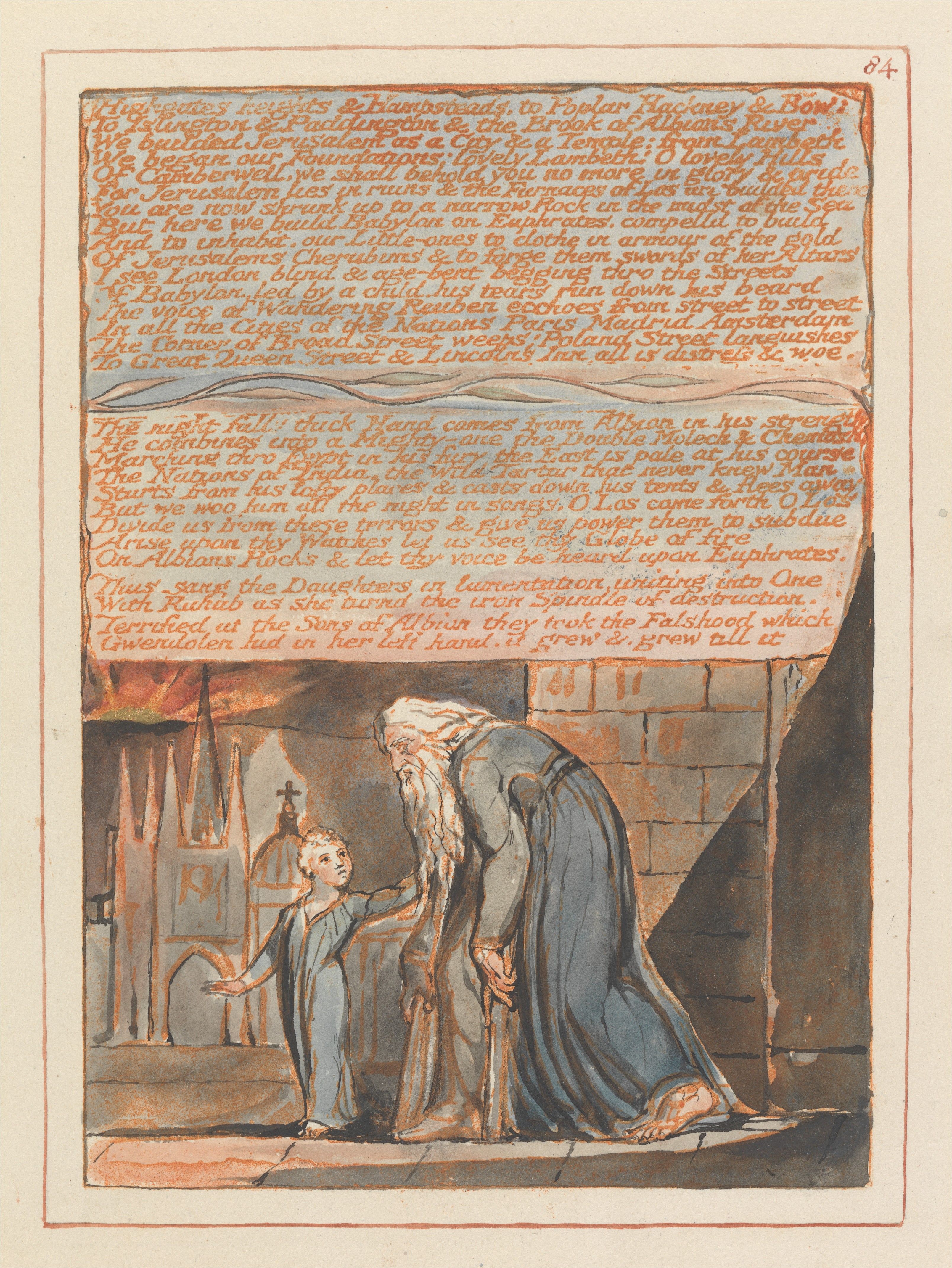
Yale Center for British Art
Jerusalem
Plate 84  
Blake saw the alienation which Albion experienced manifested in multiple ways. There was the isolation he felt because of the loss of his perception of the Eternal. There was the internal contention which arose from the imbalance among the demands of his psychic factions. And he saw Albion's alienation expressed in the failure of humanity to live in a harmonious community of brotherhood.
 

If man could become conscious of the source of the suffering within himself and surrounding himself, it would become intolerable. The hardness of his heart would be melted and he would be consumed by the pity, love and compassion which could heal the world's wounds. 


From: An Interview Conducted with Kathleen Raine on July 12, 1993 by Donald E. Stanford:

"Yeats describes genius as bringing together at certain moments the waking and the sleeping mind. The available knowledge is greater in states of inspiration. Blake certainly had this. There is much suffering, as your critic says, in the writings of Blake: the turmoil, the anguish of Jerusalem. But this was not a personal thing; he was talking about the nation. He was a spiritual patriot, and he was speaking of the suffering of the giant Albion, as he calls the English nation. He was a prophet in the sense of the Old Testament prophets in the Jewish Bible, who also were speaking for their nation. They were not speaking of their individual suffering; they were speaking of the national psyche, if you like, into which Blake had certainly a remarkably clear insight. He speaks of living. He says, “in South Molton Street I see and hear” what is going on in the soul of Albion, which is, of course, the soul of England. In other words, here in South Moulton Street I both see and hear the sufferings of the military, or the war against France that broke out after the French Revolution, of the conscription of soldiers, and the suffering of child labor, the endless sufferings of his people at that time, the hangings of boys at Tyburn for the theft of a yard of cloth, the injustices, the national crimes against which Blake spoke out. You may say these were descriptions of deep, deep suffering, the psychological sufferings of various kinds of mental and physical and spiritual tyrannies in his nation at the time. I wonder what he would have been writing about had he lived now. Certainly many things would have been the same — perhaps not all — but when he writes of London and marking, “in every face marks of weakness, marks of woe,” he felt the collective suffering: that was the nature of his inspiration. He was not a personal poet expressing himself. He was a
national prophet, calling to his nation to awake from their “deadly sleep,” which is unconsciousness of what is going on, and to awake to the truths of the imagination and to reform many things. This is not madness."


Jerusalem, Plate 34 [38], (E 180) 
"Thus speaking; the Divine Family follow Albion:
I see them in the Vision of God upon my pleasant valleys.

I behold London; a Human awful wonder of God!
He says: Return, Albion, return! I give myself for thee:         
My Streets are my, Ideas of Imagination.
Awake Albion, awake! and let us awake up together.
My Houses are Thoughts: my Inhabitants; Affections,
The children of my thoughts, walking within my blood-vessels,
Shut from my nervous form which sleeps upon the verge of Beulah  
In dreams of darkness, while my vegetating blood in veiny pipes,
Rolls dreadful thro' the Furnaces of Los, and the Mills of Satan.
For Albions sake, and for Jerusalem thy Emanation
I give myself, and these my brethren give themselves for Albion.

So spoke London, immortal Guardian! I heard in Lambeths shades:  
In Felpham I heard and saw the Visions of Albion
I write in South Molton Street, what I both see and hear
In regions of Humanity, in Londons opening streets."

Four Zoas, Night VIII, Page 99, (E 371)
"Then All in Great Eternity Met in the Council of God 
as one Man Even Jesus upon Gilead & Hermon            
Upon the Limit of Contraction to create the fallen Man
The Fallen Man stretchd like a Corse upon the oozy Rock
Washd with the tides Pale overgrown with weeds  
That movd with horrible dreams hovring high over his head
Two winged immortal shapes one standing at his feet
Toward the East one standing at his head toward the west
Their wings joind in the Zenith over head     
Such is a Vision of All Beulah hovring over the Sleeper     

The limit of Contraction now was fixd & Man began
To wake upon the Couch of Death   he sneezed seven times
A tear of blood dropped from either eye again he reposd
In the saviours arms, in the arms of tender mercy & loving kindness

Then Los said I behold the Divine Vision thro the broken Gates
Of thy poor broken heart astonishd melted into Compassion & Love
And Enitharmon said I see the Lamb of God upon Mount Zion     
Wondring with love & Awe they felt the divine hand upon them  

For nothing could restrain the dead in Beulah from descending
Unto Ulros night tempted by the Shadowy females sweet    
Delusive cruelty they descend away from the Daughters of Beulah
And Enter Urizens temple Enitharmon pitying & her heart
Gates broken down. they descend thro the Gate of Pity
The broken heart Gate of Enitharmon She sighs them forth upon the wind
Of Golgonooza Los stood recieving them         
For Los could enter into Enitharmons bosom & explore
Its intricate Labyrinths now the Obdurate heart was broken"
 
___________________________________________________________
Thanks to remarks from Susan on her own blog, I append this passage form Ezekiel with the reminder that, to Blake, Israel symbolically was synonymous with Albion (England) in its fallenness and potential or redemption.

Ezekiel 36
[7] Therefore thus saith the Lord GOD; I have lifted up mine hand, Surely the heathen that are about you, they shall bear their shame.
[8] But ye, O mountains of Israel, ye shall shoot forth your branches, and yield your fruit to my people of Israel; for they are at hand to come.
[9] For, behold, I am for you, and I will turn unto you, and ye shall be tilled and sown:
[10] And I will multiply men upon you, all the house of Israel, even all of it: and the cities shall be inhabited, and the wastes shall be builded:
[11] And I will multiply upon you man and beast; and they shall increase and bring fruit: and I will settle you after your old estates, and will do better unto you than at your beginnings: and ye shall know that I am the LORD.
[12] Yea, I will cause men to walk upon you, even my people Israel; and they shall possess thee, and thou shalt be their inheritance, and thou shalt no more henceforth bereave them of men.

...
[24] For I will take you from among the heathen, and gather you out of all countries, and will bring you into your own land.
[25] Then will I sprinkle clean water upon you, and ye shall be clean: from all your filthiness, and from all your idols, will I cleanse you.
[26] A new heart also will I give you, and a new spirit will I put within you: and I will take away the stony heart out of your flesh, and I will give you an heart of flesh.
[27] And I will put my spirit within you, and cause you to walk in my statutes, and ye shall keep my judgments, and do them.
[28] And ye shall dwell in the land that I gave to your fathers; and ye shall be my people, and I will be your God.


Sunday, April 19, 2015

pilgrim 4

Reading Pilgrim's Progress:

 Interpreter: Then said Interpreter, Come in; I will show thee that
   which will be profitable to thee. So he commanded his man to light the
   candle, and bid Christian follow him; so he had him into a private
   room, and bid his man open a door; the which when he had done,
   Christian saw the picture a very grave person hang up against the wall;
   and this was the fashion of it: It had eyes lifted up to heaven, the
   best of books in his hand, the law of truth was written upon its lips,
   the world was behind its back; it stood as if it pleaded with men, and
   a crown of gold did hang over its head.

   Christian: Then said Christian, What means this?

   Interpreter: The man whose picture this is, is one of a thousand: he
   can beget children, 
1 Cor. 4:15
, travail in birth with children, 
Gal. 4:19,
 and nurse them himself when they are born. And whereas thou seest
   him with his eyes lift up to heaven, the best of books in his hand, and
   the law of truth writ on his lips: it is to show thee, that his work is
   to know, and unfold dark things to sinners; even as also thou seest him
   stand as if he pleaded with men. And whereas thou seest the world as
   cast behind him, and that a crown hangs over his head; that is to show
   thee, that slighting and despising the things that are present, for the
   love that he hath to his Master's service, he is sure in the world that
   comes next, to have glory for his reward. Now, said the Interpreter, I
   have showed thee this picture first, because the man whose picture this
   is, is the only man whom the Lord of the place whither thou art going
   hath authorized to be thy guide in all difficult places thou mayest
   meet with in the way: wherefore take good heed to what I have showed
   thee, and bear well in thy mind what thou hast seen, lest in thy
   journey thou meet with some that pretend to lead thee right, but their
   way goes down to death.

   Then he took him by the hand, and led him into a very large parlor that
   was full of dust, because never swept; the which after he had reviewed
   it a little while, the Interpreter called for a man to sweep. Now, when
   he began to sweep, the dust began so abundantly to fly about, that
   Christian had almost therewith been choked. Then said the Interpreter
   to a damsel that stood by, "Bring hither water, and sprinkle the room;"
   the which when she had done, it was swept and cleansed with pleasure.

   Christian: Then said Christian, What means this?

   Interpreter: The Interpreter answered, This parlor is the heart of a
   man that was never sanctified by the sweet grace of the Gospel. The
   dust is his original sin, and inward corruptions, that have defiled the
   whole man. He that began to sweep at first, is the law; but she that
   brought water, and did sprinkle it, is the Gospel. Now whereas thou
   sawest, that so soon as the first began to sweep, the dust did so fly
   about that the room by him could not be cleansed, but that thou wast
   almost choked therewith; this is to show thee, that the law, instead of
   cleansing the heart (by its working) from sin, doth revive, 
Rom. 7:9,
   put strength into, 
1 Cor. 15:56

Rom.5:20 and increase it in the soul, 
even as it doth discover and forbid it; for it doth not give
   power to subdue. Again, as thou sawest the damsel sprinkle the room
   with water, upon which it was cleansed with pleasure, this is to show
   thee, that when the Gospel comes in the sweet and precious influences
   thereof to the heart, then, I say, even as thou sawest the damsel lay
   the dust by sprinkling the floor with water, so is sin vanquished and
   subdued, and the soul made clean, through the faith of it, and
   consequently fit for the King of glory to inhabit. 


William Blake - John Bunyan - The Man Sweeping the Interprener's Parlour
wiki common
John 15:3:
Already you are clean because of the word that I have spoken to you.

King James Version (KJV)

John 15
1 I am the true vine, and my Father is the husbandman.
2 Every branch in me that beareth not fruit he taketh away: and every branch that beareth fruit, he purgeth it, that it may bring forth more fruit.
3 Now ye are clean through the word which I have spoken unto you.
Eph.5:26: 

King James Version (KJV)

26 That he might sanctify and cleanse it with the washing of water by the word

Acts 15:9:

King James Version (KJV)

9 And put no difference between us and them, purifying their hearts by faith.
Rom. 16:25,26.
Now to him that is of power to stablish you according to my gospel, and the preaching of Jesus Christ, according to the revelation of the mystery, which was kept secret since the world began,
26 But now is made manifest, and by the scriptures of the prophets, according to the commandment of the everlasting God, made known to all nations for the obedience of faith:

Saturday, April 18, 2015

SAVING ALBION

First posted Dec 12, 2010.

Wikimedia Commons
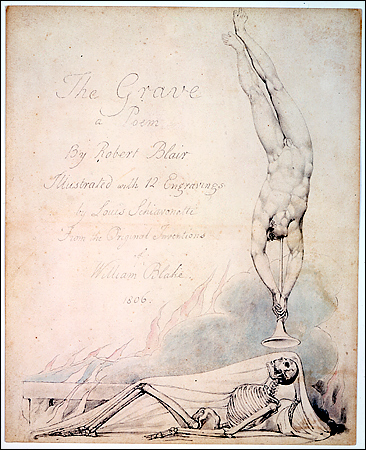
Drawing for Title Page
Blair's The Grave
In your journey have you ever turned away from the Divine Vision? Or have you known others who have become lost in a wilderness of pain and despair? Do you know of anyone who has refused the assistance of friends and family who attempted to show one the error of one's ways? Blake shows Albion in the circumstances of such a person - disintegrating in a morass of bad decisions, insisting on continuing along the road to destruction.

Albion's life is in a shambles when Los as the agent of the Divine Family continues his mission of saving Albion. Here he gives Albion a reminder of Albion's home in Eden.

Jerusalem, Plate 34 [38], (E 179)
"So Los spoke: But when he saw blue death in Albions feet,
Again he join'd the Divine Body, following merciful;
While Albion fled more indignant! revengeful covering

His face and bosom with petrific hardness, and his hands
And feet, lest any should enter his bosom & embrace
His hidden heart; his Emanation wept & trembled within him:
Uttering not his jealousy, but hiding it as with
Iron and steel, dark and opake, with clouds & tempests brooding:
His strong limbs shudderd upon his mountains high and dark.

Turning from Universal Love petrific as he [Albion] went,
His cold against the warmth of Eden rag'd with loud
Thunders of deadly war (the fever of the human soul)
Fires and clouds of rolling smoke! but mild the Saviour follow'd him,

Displaying the Eternal Vision! the Divine Similitude!
In loves and tears of brothers, sisters, sons, fathers, and friends
Which if Man ceases to behold, he ceases to exist:

Saying. Albion! Our wars are wars of life, & wounds of love,
With intellectual spears, & long winged arrows of thought:
Mutual in one anothers love and wrath all renewing
We live as One Man; for contracting our infinite senses
We behold multitude; or expanding: we behold as one,
As One Man all the Universal Family; and that One Man
We call Jesus the Christ: and he in us, and we in him,
Live in perfect harmony in Eden the land of life,
Giving, recieving, and forgiving each others trespasses.
He is the Good shepherd, he is the Lord and master:
He is the Shepherd of Albion, he is all in all,
In Eden: in the garden of God: and in heavenly Jerusalem.
If we have offended, forgive us, take not vengeance against us.

Thus speaking; the Divine Family follow Albion:
I see them in the Vision of God upon my pleasant valleys."

Albion's plight is obvious as are attempts to save him. Here he is given a reminder that whatever heights one may have reached, the Selfhood must be annihilated if the process of healing is to continue. The incarnation which was first manifest through the life, death, and resurrection of Jesus is presented to Albion for his salvation. He again refuses.

Jerusalem, Plate 40 [45], (E 187)
"Bath, healing City! whose wisdom in midst of Poetic
Fervor: mild spoke thro' the Western Porch, in soft gentle tears

O Albion mildest Son of Eden! clos'd is thy Western Gate
Brothers of Eternity! this Man whose great example
We all admir'd & lov'd, whose all benevolent countenance, seen
In Eden, in lovely Jerusalem, drew even from envy
The, tear: and the confession of honesty, open & undisguis'd
From mistrust and suspition. The Man is himself become
A piteous example of oblivion. To teach the Sons
Of Eden, that however great and glorious; however loving
And merciful the Individuality; however high
Our palaces and cities, and however fruitful are our fields
In Selfhood, we are nothing: but fade away in mornings breath,
Our mildness is nothing: the greatest mildness we can use
Is incapable and nothing! none but the Lamb of God call heal
This dread disease: none but Jesus! O Lord descend and save!
Albions Western Gate is clos'd: his death is coming apace!
Jesus alone can save him; for alas we none can know
How soon his lot may be our own. When Africa in sleep
Rose in the night of Beulah, and bound down the Sun & Moon
His friends cut his strong chains, & overwhelm'd his dark
Machines in fury & destruction, and the Man reviving repented
He wept before his wrathful brethren, thankful & considerate
For their well timed wrath. But Albions sleep is not
Like Africa's: and his machines are woven with his life
Nothing but mercy can save him! nothing but mercy interposing
Lest he should slay Jerusalem in his fearful jealousy
O God descend! gather our brethren, deliver Jerusalem
But that we may omit no office of the friendly spirit
Oxford take thou these leaves of the Tree of Life: with eloquence
That thy immortal tongue inspires; present them to Albion:
Perhaps he may recieve them, offerd from thy loved hands.

So spoke, unheard by Albion. the merciful Son of Heaven
To those whose Western Gates were open, as they stood weeping
Around Albion: but Albion heard him not; obdurate! hard!
He frown'd on all his Friends, counting them enemies in his
sorrow

And the Seventeen conjoining with Bath, the Seventh:
In whom the other Ten shone manifest, a Divine Vision!
Assimilated and embrac'd Eternal Death for Albions sake."

We can see ourselves in Albion, and Albion in ourselves. His experiences are our experiences.

Friday, April 17, 2015

pilgrim 3

Here are the words with which Pilgrims's Progress begins:
As I walked through the wilderness of this world, I lighted on a certain place where was a den, and laid me down in that place to sleep; and as I slept, I dreamed a dream. I dreamed, and behold, I saw a man clothed with rags, standing in a certain place, with his face from his own house, a book in his hand, and a great burden upon his back.


  1. Isaiah 64:6 All of us have become like one who is unclean ...


    64:6-12 The people of God, in affliction, confess and bewail their sins, owning themselves unworthy of his mercy. Sin is that abominable thing which the Lord ...
  2. Luke 14:33: In the same way, any of you who does not give up everything he has cannot be my disciple.
  3. Psalm 38:4. For my iniquities have gone over my head; like a heavy burden, they are too heavy for me.
Plate 1 of Pilgrim's Progress
wikipedia
Some of his dreams show up above the den where he was sleeping.
Under the bed is a sleeping lion
(Look at the little girl)

The book was of course the Bible; look at this:

"I looked and saw him open the book, and read therein; and as he read, he wept and trembled; and not being able longer to contain, he brake out with a lamentable cry, saying, “What shall I do?” 

Acts 2:37
When the people heard this, they were cut to the heart and said to Peter and the other apostles, "Brothers, what shall we do?"

16:30; 
He then brought them out and asked, “Sirs, what must I do to be saved?”

These biblical quotations supposedly appear throughout the story.

Thursday, April 16, 2015

ALBION & ZOAS

Yale Center For British Art
Jerusalem
Plate 46

Albion and his Emanation Jerusalem, both asleep, sit aboard their chariot, which is under the control of beings of which they are unaware. Two beasts  with the faces of man supply the energy which move the vehicle in which they passively ride. The turning wheels in the form of serpents propel the vehicle under the direction of two tiny bird-headed winged creatures riding on the backs of the ox-like creatures. What is meant to be Albion's chariot of fire, without direction from human consciousness, moves man into deeper error.  

Before Los initiates the process of restoring Albion to the Humanity Divine, each of the four Zoas has fallen to the point that his outlook is totally opposite to his role in eternity.


Jerusalem, Plate 38, (E184)
"They [the Four Zoas] saw their Wheels rising up poisonous against Albion
Urizen, cold & scientific: Luvah, pitying & weeping
Tharmas, indolent & sullen: Urthona, doubting & despairing
Victims to one another & dreadfully plotting against each other
To prevent Albion walking about in the Four Complexions."

Jerusalem, Plate 46, (E 188)
"Thou art in Error Albion, the Land of Ulro:               
One Error not remov'd, will destroy a human Soul
Repose in Beulahs night, till the Error is remov'd
Reason not on both sides. Repose upon our bosoms
Till the Plow of Jehovah, and the Harrow of Shaddai
Have passed over the Dead, to awake the Dead to Judgment.     
But Albion turn'd away refusing comfort." 
Urizen, meant to be the active intellect involving itself in interfacing with information and developing understanding of relationships, has become cold and detached. He has reduced interactions to measurements, and objective descriptions from his frozen mind.

Luvah, meant to be the source of empathy and delight through the expression of emotional attachments, has been reduced to regret and depression. The spontaneous outpouring of approval or disapproval no longer flows from his detached heart.

Tharmas, meant to be energetic and active, involved in giving outer expression to inner dynamics, is passive and lifeless. The energy which should be generated through sensory perception and the impetus to create life is not flowing in his lethargic body.

Urthona, meant to be faith and vision, the connective function which holds together disparate parts, has lost the 'blessed assurance' and fallen into a dark pit of isolation. The connection of the body with the wholeness of purposeful living finds no expression without imagination.

From Blake's Poetry and Designs, Edited by Mary Lynn Johnson and John E. Grant, we get a sense of the origin on Blake's term Zoas and the change they underwent as Albion fell:
"Cosmic man, lying unconscious in England, is dominated by his 'Zoas,' Blake's English plural for a word (already a plural in Greek) which in the Authorized Version is translated 'beasts' in Revelation 4:6, though the Hebrew equivalent is translated 'living creatures' in Ezekiel 1:5, 19-23. Both of these Biblical passages describe the four beings who surround God's presence. From this hint, as suggested in postbiblical iconography, Blake developed a conception of man's fourfold nature. Humanity should be composed of wisdom, love, imagination, and strength, but in the fallen state it is torn apart by hypocritical morality, lust, rage, confused fantasy, and chaotic weakness. The personifications of cold reason, wild emotion, misguided imagination, and weakened instinct behave like Titans with fallible human personalities." (Page 215) 

Ezekiel 1
[3] The word of the LORD came expressly unto Ezekiel the priest, the son of Buzi, in the land of the Chaldeans by the river Chebar; and the hand of the LORD was there upon him.
[4] And I looked, and, behold, a whirlwind came out of the north, a great cloud, and a fire infolding itself, and a brightness was about it, and out of the midst thereof as the colour of amber, out of the midst of the fire.
[5] Also out of the midst thereof came the likeness of four living creatures. And this was their appearance; they had the likeness of a man.
[6] And every one had four faces, and every one had four wings.
[7] And their feet were straight feet; and the sole of their feet was like the sole of a calf's foot: and they sparkled like the colour of burnished brass.
[8] And they had the hands of a man under their wings on their four sides; and they four had their faces and their wings.
[9] Their wings were joined one to another; they turned not when they went; they went every one straight forward.
[10] As for the likeness of their faces, they four had the face of a man, and the face of a lion, on the right side: and they four had the face of an ox on the left side; they four also had the face of an eagle.
[11] Thus were their faces: and their wings were stretched upward; two wings of every one were joined one to another, and two covered their bodies.
[12] And they went every one straight forward: whither the spirit was to go, they went; and they turned not when they went.
[13] As for the likeness of the living creatures, their appearance was like burning coals of fire, and like the appearance of lamps: it went up and down among the living creatures; and the fire was bright, and out of the fire went forth lightning.
[14] And the living creatures ran and returned as the appearance of a flash of lightning.

Revelation 4
[5] And out of the throne proceeded lightnings and thunderings and voices: and there were seven lamps of fire burning before the throne, which are the seven Spirits of God.
[6] And before the throne there was a sea of glass like unto crystal: and in the midst of the throne, and round about the throne, were four beasts full of eyes before and behind.
[7] And the first beast was like a lion, and the second beast like a calf, and the third beast had a face as a man, and the fourth beast was like a flying eagle.
[8] And the four beasts had each of them six wings about him; and they were full of eyes within: and they rest not day and night, saying, Holy, holy, holy, Lord God Almighty, which was, and is, and is to come.
[9] And when those beasts give glory and honour and thanks to him that sat on the throne, who liveth for ever and ever,

One's greatest gifts can turn into one's worst liabilities if not recognized as gifts and put to work in the service of the giver. The Zoas will recover their gifts as Albion is restored to Eternity through the work of Jesus and Los.

Wednesday, April 15, 2015

Pilgrim 2

Pilgrim's Progress


Here are the words with which Pilgrims's Progress begins:
As I walked through the wilderness of this world, I lighted on a certain place where was a den,3 and laid me down in that place to sleep; and as I slept, I dreamed a dream. I dreamed, and behold, I saw a man clothed with rags, standing in a certain place, with his face from his own house, a book in his hand, and a great burden upon his back.
Isaiah 64:6; Luke 14:33; Psalm 38:4.

I looked and saw him open the book, and read therein; and as he read, he wept and trembled; and not being able longer to contain, he brake out with a lamentable cry, saying, “What shall I do?” Acts 2:37; 16:30; Habak 1:2,3.

In this plight, therefore, he went home, and restrained himself as long as he could, that his wife and children should not perceive his distress; but he could not be silent long, because that his trouble increased. Wherefore at length he brake his mind to his wife and children; and thus he began to talk to them: “O, my dear wife,” said he, “and you the children of my bowels, I, your dear friend, am in myself undone by reason of a burden that lieth hard upon me; moreover, I am certainly informed that this our city will be burnt with fire from heaven; in which fearful overthrow, both myself, with thee my wife, and you my sweet babes, shall miserably come to ruin, except (the which yet I see not) some way of escape can be found whereby we may be delivered.”

At this his relations were sore amazed; not for that they believed that what he had said to them was true, but because they thought that some frenzy distemper had got into his head; therefore, it drawing towards night, and they hoping that sleep might settle his brains, with all haste they got him to bed. But the night was as troublesome to him as the day; wherefore, instead of sleeping, he spent it in sighs and tears. So when the morning was come, they would know how he did. He told them, “Worse and worse:” he also set to talking to them again; but they began to be hardened.

They also thought to drive away his distemper by harsh and surly carriage to him; sometimes they would deride, sometimes they would chide, and sometimes they would quite neglect him. Wherefore he began to retire himself to his chamber to pray for and pity them, and also to condole his own misery; he would also walk solitarily in the fields, sometimes reading, and sometimes praying: and thus for some days he spent his time.

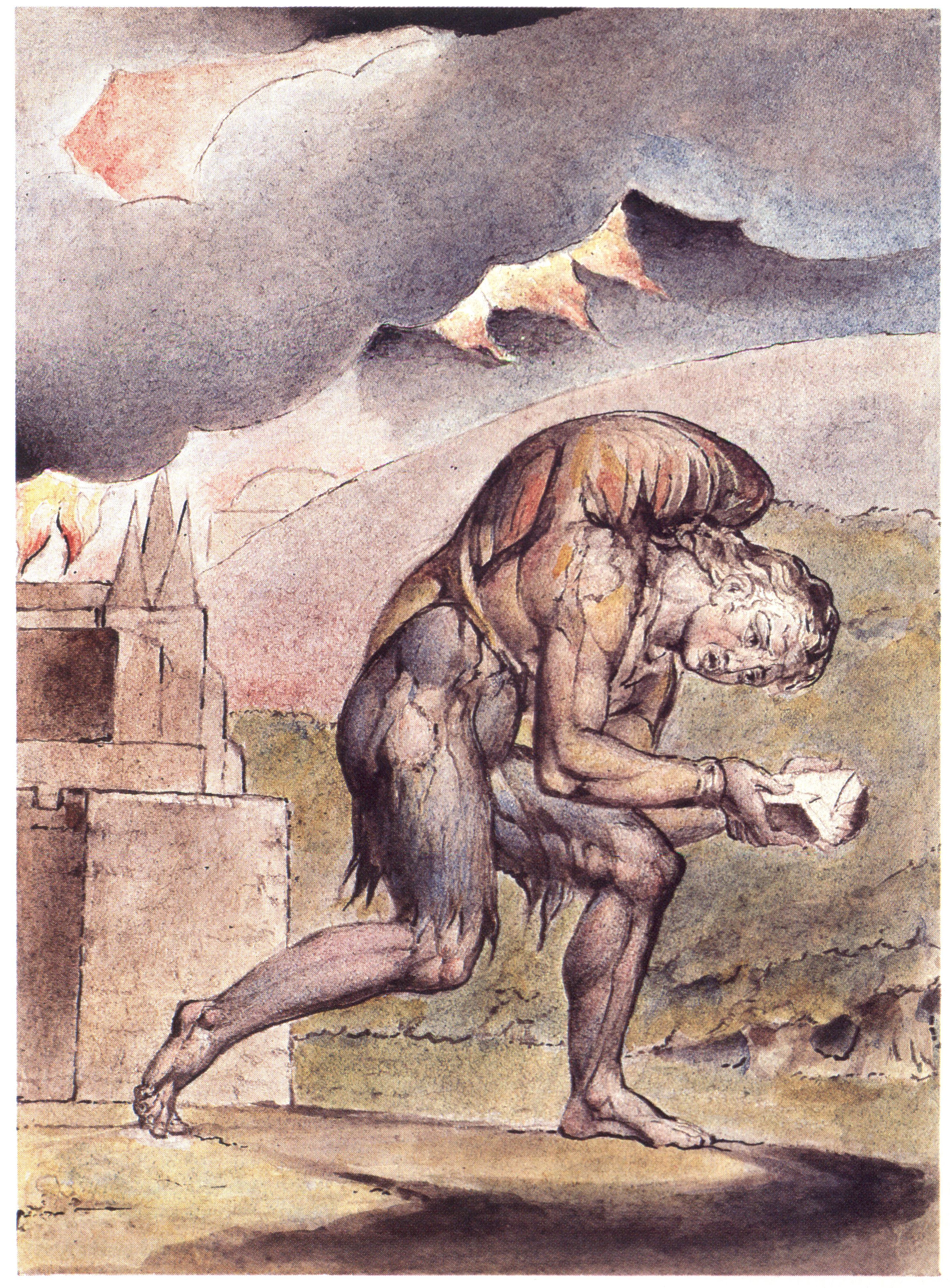
Christian, an everyman character, is the protagonist of the allegory, which centres itself in his journey from his hometown, the "City of Destruction" ("this world"), to the "Celestial City" ("that which is to come": Heaven) atop Mount Zion. Christian is weighed down by a great burden—the knowledge of his sin—which he believed came from his reading "the book in his hand" (the Bible). This burden, which would cause him to sink into Hell, is so unbearable that Christian must seek deliverance.


- Cristian Reading in His Book - 
wikimedia commons
http://commons.wikimedia.org/

Tuesday, April 14, 2015

ALBION AS LAZARUS

The plight of Albion as he falls from his original unity as an Eternal, is portrayed in Night the First of the Four Zoas:

Four Zoas, Night I, Page 21, (E 310)
"Then those in Great Eternity met in the Council of God
As one Man for contracting their Exalted Senses
They behold Multitude or Expanding they behold as one
As One Man all the Universal family & that one Man
They call Jesus the Christ & they in him & he in them
Live in Perfect harmony in Eden the land of life
Consulting as One Man above the Mountain of Snowdon Sublime

For messengers from Beulah come in tears & darkning clouds
Saying Shiloh is in ruins our brother is sick Albion He
Whom thou lovest is sick he wanders from his house of Eternity
The daughters of Beulah terrified have closd the Gate of the Tongue
Luvah & Urizen contend in war around the holy tent

So spoke the Ambassadors from Beulah & with solemn mourning
They were introducd to the divine presence & they kneeled down
In Conways Vale thus recounting the Wars of Death Eternal

The Eternal Man wept in the holy tent Our Brother in Eternity
Even Albion whom thou lovest wept in pain his family
Slept round on hills & valleys in the regions of his love
But Urizen awoke & Luvah woke & thus conferrd

Thou Luvah said the Prince of Light behold our sons & daughters
Reposd on beds. let them sleep on."

It is confusing but enlightening that Blake brought to our minds a reference to the death and resurrection of Jesus' friend Lazarus by including familiar words from the story as told in John's Gospel. Lazarus was Jesus's friend whom he loved. Jesus knew his friend was sick but held back from visiting until Lazarus had been in the grave four days. Jesus wept over his friend and then brought him back to life.

John 11
[11] These things said he: and after that he saith unto them, Our friend Lazarus sleepeth; but I go, that I may awake him out of sleep.
[12] Then said his disciples, Lord, if he sleep, he shall do well.
[13] Howbeit Jesus spake of his death: but they thought that he had spoken of taking of rest in sleep.
[14] Then said Jesus unto them plainly, Lazarus is dead.
...
[30] Now Jesus was not yet come into the town, but was in that place where Martha met him.
[31] The Jews then which were with her in the house, and comforted her, when they saw Mary, that she rose up hastily and went out, followed her, saying, She goeth unto the grave to weep there.
[32] Then when Mary was come where Jesus was, and saw him, she fell down at his feet, saying unto him, Lord, if thou hadst been here, my brother had not died.
[33] When Jesus therefore saw her weeping, and the Jews also weeping which came with her, he groaned in the spirit, and was troubled,
[34] And said, Where have ye laid him? They said unto him, Lord, come and see.
[35] Jesus wept.
[36] Then said the Jews, Behold how he loved him!
[37] And some of them said, Could not this man, which opened the eyes of the blind, have caused that even this man should not have died?
[38] Jesus therefore again groaning in himself cometh to the grave. It was a cave, and a stone lay upon it.
[39] Jesus said, Take ye away the stone. Martha, the sister of him that was dead, saith unto him, Lord, by this time he stinketh: for he hath been dead four days.
[40] Jesus saith unto her, Said I not unto thee, that, if thou wouldest believe, thou shouldest see the glory of God?
[41] Then they took away the stone from the place where the dead was laid. And Jesus lifted up his eyes, and said, Father, I thank thee that thou hast heard me.
[42] And I knew that thou hearest me always: but because of the people which stand by I said it, that they may believe that thou hast sent me.
[43] And when he thus had spoken, he cried with a loud voice, Lazarus, come forth.
[44] And he that was dead came forth, bound hand and foot with graveclothes: and his face was bound about with a napkin. Jesus saith unto them, Loose him, and let him go.
[45] Then many of the Jews which came to Mary, and had seen the things which Jesus did, believed on him.

British Museum
Illustrations to Young's Night Thoughts
When Jesus revived Lazarus it was a four stage process: he had the stone removed from the entrance to the grave, he woke him up, he removed the grave clothes that restrained him, and then he called him forth. In John, the account of the raising of Lazarus is followed immediately by the passage in which the determination is made by the Priests and Pharisees that Jesus must be killed.

Albion will be brought back from the brink of Eternal Death, but it will be a multi-stage process involving the four Zoas, the Emanations, the Spectres, and ultimately Jesus himself. Blake, through the retelling of the Christian myth using psychological and mythopoeic methods, aimed to follow the instruction of Jesus as described in this verse:
John 11:4 - "When Jesus received the message, he said, 'This illness is not meant to end in death; it is going to bring glory to God - for it will show the glory of the Son of God.'"

Blake was introducing a process of restoring Albion which would be the the subject of his epic myth Jerusalem.


Jerusalem, PLATE 15, (E 158)
"And Hand & Hyle rooted into Jerusalem by a fibre
Of strong revenge & Skofeld Vegetated by Reubens Gate

In every Nation of the Earth till the Twelve Sons of Albion
Enrooted into every Nation: a mighty Polypus growing
From Albion over the whole Earth: such is my awful Vision.   

I see the Four-fold Man. The Humanity in deadly sleep
And its fallen Emanation. The Spectre & its cruel Shadow.
I see the Past, Present & Future, existing all at once
Before me; O Divine Spirit sustain me on thy wings!
That I may awake Albion from His long & cold repose.             
For Bacon & Newton sheathd in dismal steel, their terrors hang
Like iron scourges over Albion, Reasonings like vast Serpents
Infold around my limbs, bruising my minute articulations

I turn my eyes to the Schools & Universities of Europe
And there behold the Loom of Locke whose Woof rages dire  
Washd by the Water-wheels of Newton. black the cloth
In heavy wreathes folds over every Nation; cruel Works
Of many Wheels I View, wheel without wheel, with cogs tyrannic
Moving by compulsion each other: not as those in Eden: which
Wheel within Wheel in freedom revolve in harmony & peace." 

Jerusalem, Plate 55, (E 285)
"Every one knows, we are One Family! One Man blessed for ever

Silence remaind & every one resumd his Human Majesty
And many conversed on these things as they labourd at the furrow
Saying: It is better to prevent misery, than to release from misery
It is better to prevent error, than to  forgive the criminal:    
Labour well the Minute Particulars, attend to the Little-ones:
And those who are in misery cannot remain so long
If we do but our duty: labour well the teeming Earth."

Monday, April 13, 2015

FINAL LESSON

 The Blog Lessons was used for lesson material in a class given on 4 Tuesdays in July at the College of Central Florida.

If you have become sufficiently interested in Blake after this lesson, I expect to continue these lessons in this blog. http://lessons-blake.blogspot.com/ "I give you the end of a golden string, Only wind it into a ball: It will lead you in at Heavens gate Built in Jerusalem's wall." Very famous of course; you may find books entitled 'The Golden String.' Does it remind you of anything? Greek? the Minotaur. What is the golden string? Read my post, or just read on. Last week's biography ended in 1804 with "After three years Blake had had enough. He and Catherine returned to London and to abject poverty, glorified by the tremendous production of his last decade.

Output during that time:
Milton

Jerusalem, from Biography

Jerusalem, a Commentary

Paradise Lost

Illustrations to the Book of Job
Dante's Inferno"

*********************************************

Today's Biography is confined to the 19th Century, Blake's last 28 years. Marriage had brought young Blake responsibilities; he was an artist; it meant producing stuff for sale. (The poet is out of it entirely; he had best never marry unless he knows a rich heiress.) Blake married an illiterate farm girl; she was more than that when he died; she had been pretty well educated by her husband. Blake wrote (and inscribed) a lot of things: Thel Songs of Innocence and Experience (they became classics, but seen by very few in his day.) Everybody knows or at least has heard of The Tyger. As a married man Blake produced pictures and other objects of art; but the sale was dismal. They struggled along with contributions of a few friends. William Hayley, a successful although mediocre poet, took Blake under his wing. Hayley insisted on Blake painting miniatures, all day. Blake had no time for the poetry or the Visions that meant so much to him. He and Catherine left their cottage on the sea and Hayley's support; they returned to poverty-- and sweet joy.

In the second half of his career Blake had largely dropped his preoccupation with the Old Testament God and in favor of the New Testament God. His first large prophetic poem, Milton begins with a famous poem called Jerusalem that latter became the theme song of the British Labor party; used to sing it as a hymn.
(Blake was not the first person to see the presence of
Jesus in ancient England. Tradition tells us that he was
there in the first century.)
*********************************************

Look especially at the two major prophecies (poems): Milton and Jerusalem.

Milton Here are the Plates, 1 by 1 go to a terminal Do evince open ~/Downloads/1802rosen1811.pdf or ~/Documents/1802rosen1811.pdf There are two discussions of Milton here: 1. The synopsis found in wiki 2.. A section in my Blake Primer This synopsis of Milton comes from a wiki:

Milton a Poem is an epic poem by William Blake, written and illustrated between 1804 and 1810. Its hero is John Milton, who returns from heaven and unites with Blake to explore the relationship between living writers and their predecessors, and to undergo a mystical journey to correct his own spiritual errors.

The poem is divided into two "books".

Book I opens with an epic invocation to the muses, drawing on the classical models of Homer and Virgil, and also used by John Milton in Paradise Lost. However, Blake describes inspiration in bodily terms, vitalising the nerves of his arm. Blake goes on to describe the activities of Los, one of his mythological characters, who creates a complex universe from within which other Blakean characters debate the actions of Satan.

Referring to the doctrines of Calvinism, Blake asserts that humanity is divided into the "Elect", the "Reprobate" and the "Redeemed". Inverting Calvinist values, Blake insists that the "Reprobate" are the true believers, while the "Elect" are locked in narcissistic moralism. At this point Milton appears and agrees to return to earth to purge the errors of his own Puritanism and go to "Eternal death".

Milton travels to Lambeth, taking in the form of a falling comet, and enters Blake's foot. This allows Blake to treat the ordinary world as perceived by the five senses as a sandal formed of "precious stones and gold" that he can now wear. Blake ties the sandal and, guided by Los, walks with it into the City of Art, inspired by the spirit of poetic creativity.

Book II finds Blake in the garden of his cottage in Felpham. Ololon, a female figure linked to Milton, descends to meet him. Blake sees a skylark, which mutates into a twelve year old girl, who he thinks is one of his own muses. He invites her into his cottage to meet his wife. The girl states that she is actually looking for Milton. Milton then descends to meet with her, and in an apocalyptic scene he is eventually unified with the girl, who is identified as Ololon and becomes his own feminine aspect.

The poem concludes with a vision of a final union of living and dead; internal and external reality; male and female and a transformation of all of human perception.

-------------------------------------------------------------------
The Mature Works
'Milton', Blake's first overtly Christian work, is his testimony of faith. It's also his way of rehabilitating his childhood hero, John Milton. Finally it's a difficult poem; it contains unfathomable depths. This review can do no more than introduce the reader to the poem and call attention to some of the new elements in the mature development of Blake's myth.

'Milton' is a very autobiographical work. Blake used many of the characters that his readers might be familiar with from earlier works, but in this very personal poem they often assume other (although related) identities. Particularly we understand that Blake was Los; Hayley was Satan (he had suborned Blake from his true work to hack work: from Eternity to Ulro.)
John Milton, the author of 'Paradise Lost', had been a major force in Blake's life; he had been many things to Blake through the years. In Blake's day Milton enjoyed enormous spiritual stature among the English people. Even today the general understanding of Heaven, Hell, God and Satan (among people interested in those concepts) tends to be more often Miltonic than Biblical. In the first half of his life Blake was very much under the shadow of Milton, the great epic poet of the English people. All subsequent English poets lived and wrote in Milton's shadow, and the greatest ones aspired to achieve an epic comparable to 'Paradise Lost'. 

Although Blake had much in common with the puritan poet, he disagreed with Milton about a number of things. For example, as a young man he despised the God of 'Paradise Lost' and admired Milton's Devil. Blake made that clear in 'The Marriage of Heaven and Hell' and tried to put Milton in his place by saying that he was of the Devil's party without knowing it. Ten years later the experience of grace empowered Blake to deal with Milton in a better way. He called him back to earth to straighten out his theology, and he identified with him and his spiritual power in a radical way. He recreated Milton as Milton had recreated the Bible.

As Blake's poem begins, Milton has been in Heaven for a hundred years, obedient although not very happy there. The 'Bard's Song' (which takes up the first third of the poem) recreates the war in Heaven of 'Paradise Lost'. The other Eternals find the Bard's song appalling, but Milton embraces the Bard and his song. In a thrilling imaginative triumph he announces his intention of leaving Heaven to complete the work on earth that he had left undone. Although Blake doesn't say this, any Christian should recognize that Milton thus follows in the footsteps of Christ as described in the famous Kenosis passage in Philippians 2:

He took off the robe of the promise and ungirded himself from the oath of God. And Milton said: "I go to Eternal Death! The Nations still Follow after the detestable Gods of Priam [king of Troy], in pomp of Warlike Selfhood." 

Milton: plate 14 reads "----contradicting and blaspheming. 
When will the Resurrection come to deliver the sleeping body 
From corruptibility? O when, Lord Jesus, wilt thou come? 
Tarry no longer, for my soul lies at the gates of death. 
I will arise and look forth for the morning of the grave: 
I will go down to the sepulcher to see if morning breaks: 
I will go down to self annihilation and eternal death, Lest the 
Last Judgment come and find me unannihilate 
And I be seized and given into the hands of my own Selfhood."

Anyone familiar with the gospel story will see biblical allusions and references here.

In Blake's cottage he sees Milton's shadow, a horrible vision:
Milton Plate 37, lines 7-46: "Miltons Shadow heard & condensing all his Fibres Into a strength impregnable of majesty & beauty infinite I saw he was the Covering Cherub & within him Satan And Rahab, ----, in the Selfhood deadly And he appeard the Wicker Man of Scandinavia in whom Jerusalems children consume in flames among the Stars Descending down into my Garden, a Human Wonder of God Reaching from heaven to earth a Cloud & Human Form beheld Milton with astonishment & in him beheld The Monstrous Churches of Beulah, the Gods of Ulro dark Twelve monstrous dishumanizd terrors Synagogues of Satan. ........ All these are seen in Miltons Shadow who is the Covering Cherub The Spectre of Albion."

An attempt to translate this visionary poetry into "common sense" might suggest that in Milton's shadow Blake suddenly became immediately aware of all the fallen nature of the world (and his mind) that had consumed most of his poetry to that point. Now he became aware of all these things, but in the light of a person now full of light. 

Back on earth Milton encounters many of the characters whom we met in 'The Four Zoas'. Tirzah and Rahab tempt him; his contest with Urizen has special interest as a record of the resolution of Blake's life long struggle with the things that Urizen represented to him:

"Silent they met and silent strove among the streams of Arnon 
Even to Mahanaim, when with cold hand Urizen stoop'd down 
And took up water from the river Jordan, pouring on 
To Milton's brain the icy fluid from his broad cold palm. 
But Milton took of the red clay of Succoth, moulding it with care 
Between his palms and filling up the furrows of many years, 
Beginning at the feet of Urizen, and on the bones 
Creating new flesh on the Demon cold and building him 
As with new clay, a Human form in the Valley of Beth Peor."

A Bible dictionary, or even better, Damon's Blake Dictionary, will help to clarify the associations with biblical locations. Here we see the old Urizen still trying to freeze the poet's brain, but instead he finds himself being humanized by an emissary from Heaven. Blake is vividly depicting the battle between the forces of positivism and spirit.

Milton meets other obstacles and temptations on his journey, a journey that begins to bear increasing resemblance to that of Bunyan's Pilgrim or even of Jesus himself. He unites with Los and with Blake. He finally meets Satan, confronts him and overcomes him as Jesus had done. These dramatic events give Blake ample opportunity to describe in detail the eternal and satanic dimensions of life, the conflict betwen the two and the inevitable victory of the eternal. For the first and perhaps the only time Blake is writing a traditional morality story.

This material is autobiographical and written in the honeymoon phase of his new spiritual life. Blake's full meanings yield only to intensive study, but from the beginning there are thrilling lines to delight and inspire the reader. In his esoteric language Blake describes for us what has happened to him, and nothing could be more engrossing for the reader interested in the life of the spirit and in Blake. The relationship of this story to the myth described above should be obvious. But 'Milton' is more real than the previous material because Blake has lived it and writes (and sketches) with spiritual senses enlarged and tuned by his recent experience of grace.

A digression occurs in the second half of Book One of 'Milton', a detailed description of the "World of Los"; it contains much of Blake's most delightful poetry. The reader will remember that in 4Z Los had passed through several stages of development. Beginning as the primitive prophetic boy, he became first disciple and later adversary of Urizen. He bound Urizen into fallen forms of life, then "became what he beheld". But in Night vii we recall that he embraced his Spectre, actually the Urizen within, and thereupon became the hero of the epic.
This is the full paged picture introducing the poem Jerusalem The picture below is the "curtain call", Plate 100 of Jerusalem. In his last years Blake often visited theaters with his young friends, the Shoreham Ancients.

Pilgrim 1

Here is a copy of Pilgrim's  Progress from the ccel.

There's an interesting time line:

Death of Queen Elizabeth 1603
Birth of Shakespeare: 1616
Birth of George Fox: 1624 was a few years older than Bunyan.
Baptism of John Bunyan 1628; he died in 1688.
Birth of William Blake 1758

Bunyan was among the best of the Puritans; he lived before the Enlightenment. Like Bunyan Fox was a dissenter but by no means a puritan.


Blake lived during the Enlightenment and virtually initiated the Romantic Movement (1800-1850).

Bunyan's father was a tinker (: a person who in the past traveled to different places and made money by selling or repairing small items such as pots and pans).

His son traveled in his father's footsteps.


The Bunyans were nonconformists, and John Bunyan joined the Parliamentary Army. At the end of the war he (and many others spent some time in prison.


Blake disagreed theologically with Fox and Bunyan, but was certainly to some extent influenced by each of them.

           Title: The Pilgrim's Progress
      Creator(s): Bunyan, John (1628-1688)
          Rights: Public Domain
   CCEL Subjects: All; Classic; Fiction
      LC Call no: PR3300
     LC Subjects:

                  English literature

                  17th and 18th centuries (1640-1770)
     ________________________________________________

                             The Pilgrim's Progress

From This World to That Which is to Come;

Delivered under the Similitude of a Dream

by John Bunyan

Sunday, April 12, 2015

SLEEP OF ALBION

Albion's fall into disease, disaster and despair is the result of his loss of the fine-tuned integrity of the integrated whole. When he loses the ability to perceive the vision of the Form Divine, he loses access to his Jerusalem, his Soul where his image of God resides. There are three simultaneous occurrences: Albion falls asleep, Jerusalem is lost to him and his Spectre arises. 

Albion's fall is not complete. He is not allowed to reach the depths of the void outside of existence for it becomes a womb to nurture his regeneration. He reaches the precipice but does not fall into non-entity.

Yale Center for British Arts
Jerusalem
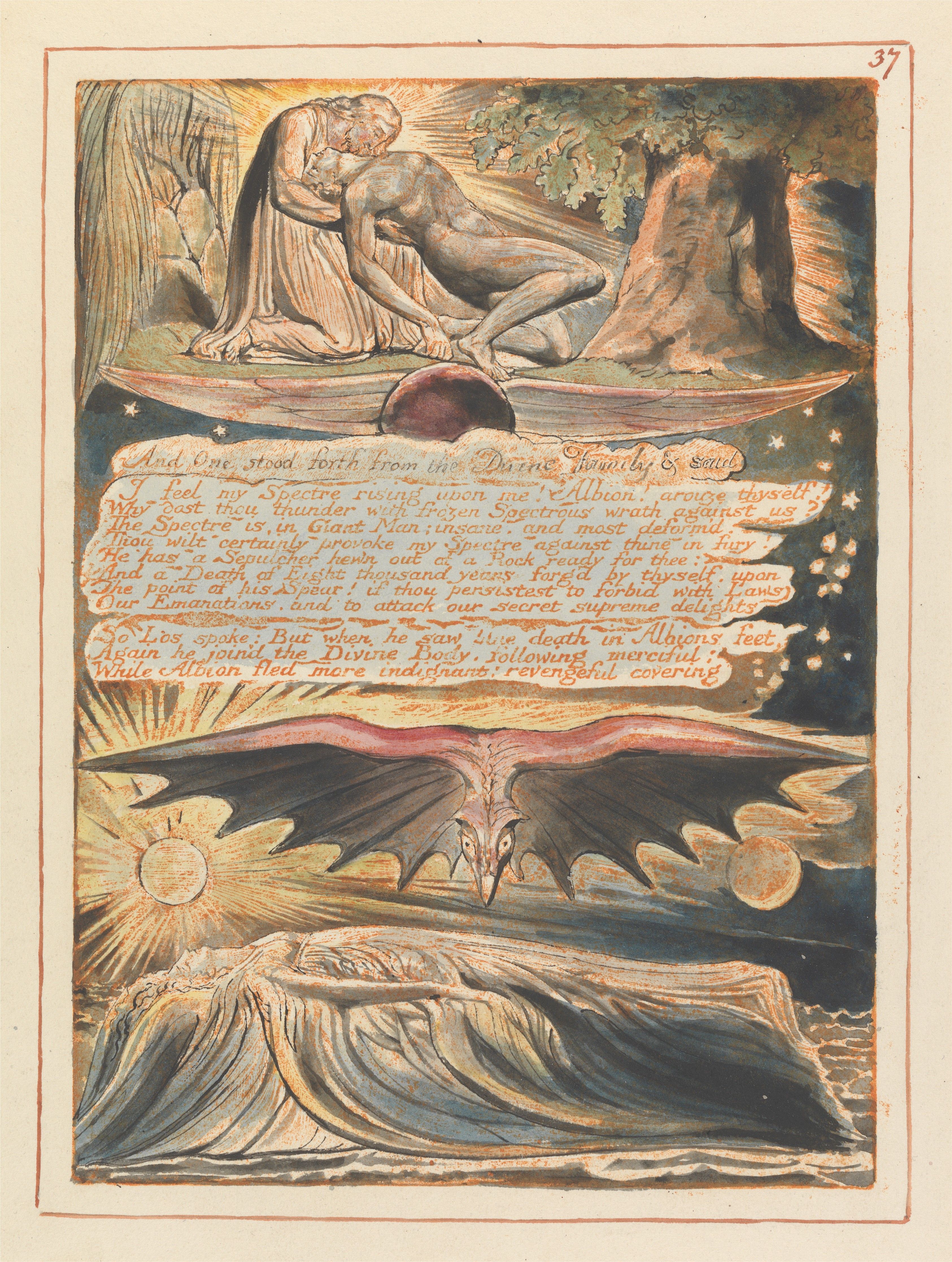
Plate 37
In Plate 37 Blake incorporates Jesus, the incarnate God, cradling the unconscious Albion between the palm of suffering and the oak of sacrifice, supported by the moon of generation on the wings of regeneration. The text is surrounded by the stars of redemption. The lower section portrays the fractured aspects of the divided Albion: his Spectre and his Emanation.

Jerusalem, Plate 23, (E 168) 

"Jerusalem reply'd, like a voice heard from a sepulcher: 

Father! once piteous! Is Pity. a Sin? Embalm'd in Vala's bosom 

In an Eternal Death for. Albions sake, our best beloved. 

Thou art my Father & my Brother: Why hast thou hidden me, 

Remote from the divine Vision: my Lord and Saviour.  

Trembling stood Albion at her words in jealous dark despair:

He felt that Love and Pity are the same; a soft repose!
Inward complacency of Soul: a Self-annihilation!                 

I have erred! I am ashamed! and will never return more:
I have taught my children sacrifices of cruelty: what shall I answer?
I will hide it from Eternals! I will give myself for my Children!
Which way soever I turn, I behold Humanity and Pity!

He recoil'd: he rush'd outwards; he bore the Veil whole away     
His fires redound from his Dragon Altars in Errors returning.
He drew the Veil of Moral Virtue, woven for Cruel Laws,
And cast it into the Atlantic Deep, to catch the Souls of the Dead.
He stood between the Palm tree & the Oak of weeping
Which stand upon the edge of Beulah; and there Albion sunk       
Down in sick pallid languor! These were his last words, relapsing!
Hoarse from his rocks, from caverns of Derbyshire & Wales
And Scotland, utter'd from the Circumference into Eternity.

Blasphemous Sons of Feminine delusion! God in the dreary Void
Dwells from Eternity, wide separated from the Human Soul         

But thou deluding Image by whom imbu'd the Veil I rent
Lo here is Valas Veil whole, for a Law, a Terror  & a Curse!
And therefore God takes vengeance on me: from my clay-cold bosom
My children wander trembling victims of his Moral justice."
Jerusalem, Plate 36 [40], (E 182)
"O! how the torments of Eternal Death, waited on Man:     
And the loud-rending bars of the Creation ready to burst:
That the wide world might fly from its hinges, & the immortal mansion
Of Man, for ever be possess'd by monsters of the deeps:
And Man himself become a Fiend, wrap'd in an endless curse,
Consuming and consum'd for-ever in flames of Moral Justice.

For had the Body of Albion fall'n down, and from its dreadful ruins
Let loose the enormous Spectre on the darkness of the deep,
At enmity with the Merciful & fill'd with devouring fire,
A nether-world must have recievd the foul enormous spirit,
Under pretence of Moral Virtue, fill'd with Revenge and Law."

Albion's members must be returned to consciousness of their connectivity. The oneness of the many must override their identification as individuals whose self-interest supersedes membership in the one body. 

1 Corinthians 12
[11] But all these worketh that one and the selfsame Spirit, dividing to every man severally as he will.
[12] For as the body is one, and hath many members, and all the members of that one body, being many, are one body: so also is Christ.
[13] For by one Spirit are we all baptized into one body, whether we be Jews or Gentiles, whether we be bond or free; and have been all made to drink into one Spirit.
[14] For the body is not one member, but many.
...
[25] That there should be no schism in the body; but that the members should have the same care one for another.
[26] And whether one member suffer, all the members suffer with it; or one member be honoured, all the members rejoice with it.
[27] Now ye are the body of Christ, and members in particular.