Monday, June 27, 2016

The Universal Symbols

First posted by Larry on March 7, 2011, his 85TH birthday.

Yale Center for British Art
Illustrations for Young's Night Thoughts
Perhaps Blake's greatest gift to any of us may be the Faculty of perceiving the realities around us in terms of the Universal Symbols:

For example the character Jane in Jane Eyre may serve as a Christ Symbol (or in Blake's lexicon as Eternity). Rochester represents Everyman; the flossie, to whom he was considering marriage, is the Way of the World, the purely material.

The half cousin who wanted Jane to marry him and go to Africa with him represents Conventional Religion; his sisters are the Blakean Redeemed.

Rochester's wife is the victim of his accumulated moral failings, which led to spiritual blindness.

The happy ending is echoed by the ending of most Detective Stories. The crime is solved, the detective enjoys real life, the harm remains, but it no longer affects him. In the Sacred Story every tear has been wiped away.

In this post I've expressed the reality of the story in terms of the Blakean universal symbols. That's only one of many ways you might find universal meaning is a work of art.

IMO it was Northrup Frye who introduced to the Blake community (in 1947) to an understanding of Blake's use of symbols, images, metaphor; armed with that knowledge understanding of his poetry, his myth, the import of his pictures proceeded apace. But that's appropriate for another post.
Four Zoas, Night IX, PAGE 121, (E 390) 
"Urizen wept in the dark deep anxious his Scaly form
To reassume the human & he wept in the dark deep

Saying O that I had never drank the wine nor eat the bread
Of dark mortality nor cast my view into futurity nor turnd  
My back darkning the present clouding with a cloud               
And building arches high & cities turrets & towers & domes  
Whose smoke destroyd the pleasant gardens & whose running Kennels
Chokd the bright rivers burdning with my Ships the angry deep
Thro Chaos seeking for delight & in spaces remote
Seeking the Eternal which is always present to the wise          
Seeking for pleasure which unsought falls round the infants path
And on the fleeces of mild flocks who neither care nor labour
But I the labourer of ages whose unwearied hands
Are thus deformd with hardness with the sword & with the spear
And with the Chisel & the mallet I whose labours vast            
Order the nations separating family by family
Alone enjoy not   I alone in misery supreme
Ungratified give all my joy unto this Luvah & Vala    
Then Go O dark futurity I will cast thee forth from these
Heavens of my brain nor will I look upon futurity more   
I cast futurity away & turn my back upon that void       
Which I have made for lo futurity is in this moment      
Let Orc consume let Tharmas rage let dark Urthona give
All strength to Los & Enitharmon & let Los self-cursd
Rend down this fabric as a wall ruind & family extinct           
Rage Orc Rage Tharmas Urizen no longer curbs your rage

So Urizen spoke he shook his snows from off his Shoulders & arose"
 

Saturday, June 25, 2016

IN GOD'S PRESENCE

Matthew 6
[24] No man can serve two masters: for either he will hate the one, and love the other; or else he will hold to the one, and despise the other. Ye cannot serve God and mammon.


Luke 4
[5] And the devil, taking him up into an high mountain, shewed unto him all the kingdoms of the world in a moment of time.
[6] And the devil said unto him, All this power will I give thee, and the glory of them: for that is delivered unto me; and to whomsoever I will I give it.
[7] If thou therefore wilt worship me, all shall be thine.
[8] And Jesus answered and said unto him, Get thee behind me, Satan: for it is written, Thou shalt worship the Lord thy God, and him only shalt thou serve.


John Linnell appreciated William Blake for his artistic ability and for his spiritual perception, but he also appreciated him for his friendship. Linnell welcomed Blake into his home and into his family circle. When Linnell and his family moved from London proper to the countryside north of the city, Blake became a frequent visitor to their farm in Hampstead. On one of these visits Linnell prevailed on Blake to pose for this sketch. Linnell knew Blake well enough to capture a likeness showing alertness, perception and good humor.

The lighthearted Blake is apparent in this poem from Blake's Notebook.

Wikipedia Commons 
Portrait by John Linnell

Songs & Ballads, From Blake's Notebook, (E 481)
"I rose up at the dawn of day
Get thee away get thee away
Prayst thou for Riches away away
This is the Throne of Mammon grey

Said I this sure is very odd                                     
I took it to be the Throne of God
For every Thing besides I have
It is only for Riches that I can crave

I have Mental Joy & Mental Health
And Mental Friends & Mental wealth
Ive a Wife I love & that loves me
Ive all But Riches Bodily
                
I am in Gods presence night & day 
And he never turns his face away
The accuser of sins by my side does stand                      
And he holds my money bag in his hand

For my worldly things God makes him pay
And hed pay for more if to him I would pray
And so you may do the worst you can do
Be assurd Mr Devil I wont pray to you 
Then If for Riches I must not Pray
God knows I little of Prayers need say
So as a Church is known by its Steeple 
If I pray it must be for other People 

He says if I do not worship him for a God                     
I shall eat coarser food & go worse shod
So as I dont value such things as these
You must do Mr Devil just as God please"

Blake's poor health in the last few years of his life prevented him from enjoying the company of Linnell as often as he would have liked. He relished his visits to Collins Farm until he was forced to curtail his activities.
Letters, To John Linnell Esqre, N 6 Cirencester Place, Fitzroy Square, (E 778)
[Postmark: 2 July 1826]
"My dearest Friend
     This sudden cold weather has cut .up all my hopes by the
roots.  Everyone who knows of our intended flight into your
delightful Country concur in saying: "Do not Venture till summer
appears again".  I also feel Myself weaker than I was aware,
being not able as yet to sit up longer than six hours at a
time. & also feel the Cold too much to dare venture beyond my
present precincts.  My heartiest Thanks for your care in my
accomodation & the trouble you will yet have with me.  But I get
better & stronger every day, tho weaker in muscle & bone than I
supposed. As to pleasantness of Prospect it is All pleasant
Prospect at North End.  Mrs Hurd's I should like as well as
any--But think of the Expense & how it may be spared & never mind
appearances
     I intend to bring with me besides our necessary change of
apparel Only My Book of Drawings from Dante & one Plate shut up
in the Book.  All will go very well in the Coach. which at
present would be a rumble I fear I could not go thro.  So that
I conclude another Week must pass before I dare Venture upon what
I ardently desire--the seeing you with your happy Family once
again & that for a longer Period than I had ever hoped in my
health full hours
I am dear Sir
Yours most gratefully
WILLIAM BLAKE"
Museum of London
John Linnell
Collins's Farm, North End, Hampstead


Wednesday, June 22, 2016

MENTAL FIGHT

On page 26 of Fearful Symmetry, Frye writes:
"It appears then, then, that there are not only two worlds, but three: the world of vision, the world of sight and the world of memory: the world we create, the world we live in and the world we run away to. The world of memory is an unreal world of reflection and abstract ideas; the world of sight is the potentially real world of  subjects and objects; the world of vision is the world of creators and creatures. In the world  of memory we see nothing; in the world of sight we see what we have to see; in the world of vision we see what we want to see. There are not three different worlds, as in the religions which speak of a heaven and hell in addition to ordinary life; they are the egocentric, the ordinary and the visionary ways of looking at the same world."
British Museum
Illustrations to Young's Night Thoughts

The world of vision, of creator and creatures, is Blake's world of Imagination; Jung's of Intuition. This is the mental world of which Blake writes and in which he lives. He takes up the sword for mental fight and never puts it down.

Blake is the teacher par excellence who presents his subject, asks his students to incorporate an understanding of it into their own thinking and then gives them opportunities to practice the paradigm of acting which he hopes to teach. The student has not learned anything experientially until he incorporates an altered behavior into his range of options.

An aspect of becoming aware of the imaginative dimension in what goes on in the world around us, is finding patterns which enable us to fit together diverse pieces of our experience. If we recognize similar patterns in, for example religion and science, we expand our ability to assimilate a cohesive view rather than multiple limited views. If we look through a different window of perception, if we alter our preconceived assumptions, or back away form emotional involvement, the whole picture may begin to become visible.

When I was trying to catch site of a comet in the sky, I simply couldn't see it although I knew its location and that it was visible to the naked eye. I was trying to focus my eyes as I would when looking for detail in a picture. When I instead gave up on seeing the comet and looked at the whole sky, the faint light of the comet came into view. Our eyes are actually constructed with special receptors to see faint light as well as receptors for bright light. Until I 'turned off' the receptors for bright light, the receptors for dim light couldn't make the comet visible.

Frye and Blake are telling us that we have receptors for peering into the mental world of vision or imagination. But if our focus of attention is occupied with sensation, emotion or rationalization, we miss the fainter light of intuition.      
Milton, Plate 1, (E 95)
"I will not cease from Mental Fight,
Nor shall my Sword sleep in my hand:
Till we have built Jerusalem,
In Englands green & pleasant Land."

A Vision of The Last Judgment, (E 555)
                   For the Year 1810
        Additions to Blakes Catalogue of Pictures &c 
"This world of Imagination is the World of
Eternity it is the Divine bosom into which we shall all go after
the death of the Vegetated body   This World of Imagination is
Infinite & Eternal whereas the world of Generation or Vegetation
is Finite & Temporal    There Exist
in that Eternal World the Permanent Realities of Every Thing
which we see are reflected in this Vegetable Glass of Nature
     All Things are comprehended in their Eternal Forms in the
Divine body of the Saviour the True Vine of Eternity
The Human Imagination who appeard to Me as Coming to Judgment.
among his Saints & throwing off the Temporal that the Eternal
might be Establishd. around him were seen the Images of
Existences according to a certain order suited to my Imaginative Eye 
     Here follows the description of the Picture" 

Friday, June 17, 2016

HAYLEY'S BALLADS

The relationship between William Blake and William Hayley was complex. Each was well intentioned and intelligent. Hayley was interested in promoting scholarship and in assisting artists who had a hard time getting along in the harsh world. Before Hayley befriended Blake he tried to assist the hymn writer Cowper by writing a biography of the poet. But the personalities of Blake and Hayley were not compatible; each held too firmly to his own convictions. Hayley wanted to help Blake to become more affluent; Blake wanted to pursue his spiritual interests above his material interests. 

Hayley, being well intentioned, devised a scheme of writing for Blake to illustrate some trivial poetry which he thought would have popular appeal. Blake would be the illustrator and would profit from the sale of the publication. Blake made 14 engraving for this project which was issued in 1802 as the first of a series of pamphlets. Before the work was complete Blake had left Felpham and returned to London. He and Hayley maintained a cordial relationship which can be followed in Blake's letters. Like most of Blake's projects, this one involved enormous effort on Blake's part, and very little income.

Hayley wrote: "There is hardly any kind of ingenious employment in which the mind requires more to be cheared and diverted, than the slow and sometimes very irksome progress of engraving; especially when the art is exercised by a person of varied talents; and of a creative imagination. To amuse the Artist in his patient labour," Hayley provided his poems. He felt it a "duty incumbent on me to use every liberal method, in my power, to obtain for his industrious ingenuity, the notice and favour of my countrymen." (The Engravings of William Blake, by Archibald G.B. Russell, Page 86)
 

Blake learned to separate his difficulties in enduring the world's slights and arrows, from the benefits of his Spiritual Victories.
 
Letters, (E 766)
To Hayley, 
Sth Molton Street Decembr 11. 1805
Dear Sir
...
"You Dear Sir are one who has my Particular Gratitude. having
conducted me thro Three that would have been the Darkest Years
that ever Mortal Sufferd. which were renderd thro your means a
Mild & Pleasant Slumber.  I speak of Spiritual Things.  Not of
Natural. of Things known only to Myself & to Spirits Good &
Evil. but Not Known to Men on Earth.  It is the passage thro
these Three Years that has brought me into my Present State. & I
know that if I had not been with You I must have
Perish'd--Those Dangers are now Passed & I can see them beneath
my feet It will not be long before I shall be able to present the
full history of my Spiritual Sufferings to the Dwellers upon
Earth. & of the Spiritual Victories obtaind for me by my
Friends--Excuse this Effusion of the Spirit from One who cares
little for this World which passes away. whose Happiness is
Secure in Jesus our Lord. & who looks for Suffering till the time
of complete Deliverance."
    
BALLADS,
BY WILLIAM HAYLEY, ESQ.
FOUNDED ON ANECDOTES RELATING TO ANIMALS,
WITH PRINTS, DESIGNED AND ENGRAVED BY WILLIAM BLAKE.

1802

British Museum
Illustrations to Hayley's Ballads
The Eagle
THE EAGLE.
BALLAD THE THIRD.
...
The savage bird the kid renounc'd,
But round the cottage oft
Rapid he wheel'd, and there he pounc'd,
And bore the babe aloft.
...
Lo! Donald flies.--She touches earth:
O form'd on earth to shine!
O mother of unrivall'd worth,
And sav'd by aid divine!

She lives unhurt--unhurt too lies
The baby in her clasp;
And her aerial tyrant dies
Just strangled in her grasp.

What triumph swelled in Donald's breast,
And o'er his features spread.
When he his living mother prest,
And held the Eagle dead!

Angels, who left your realms of bliss.
And on this parent smil'd,
Guard every mother brave as this,
In rescuing her child!"

Friday, June 10, 2016

LUCIA & DANTE

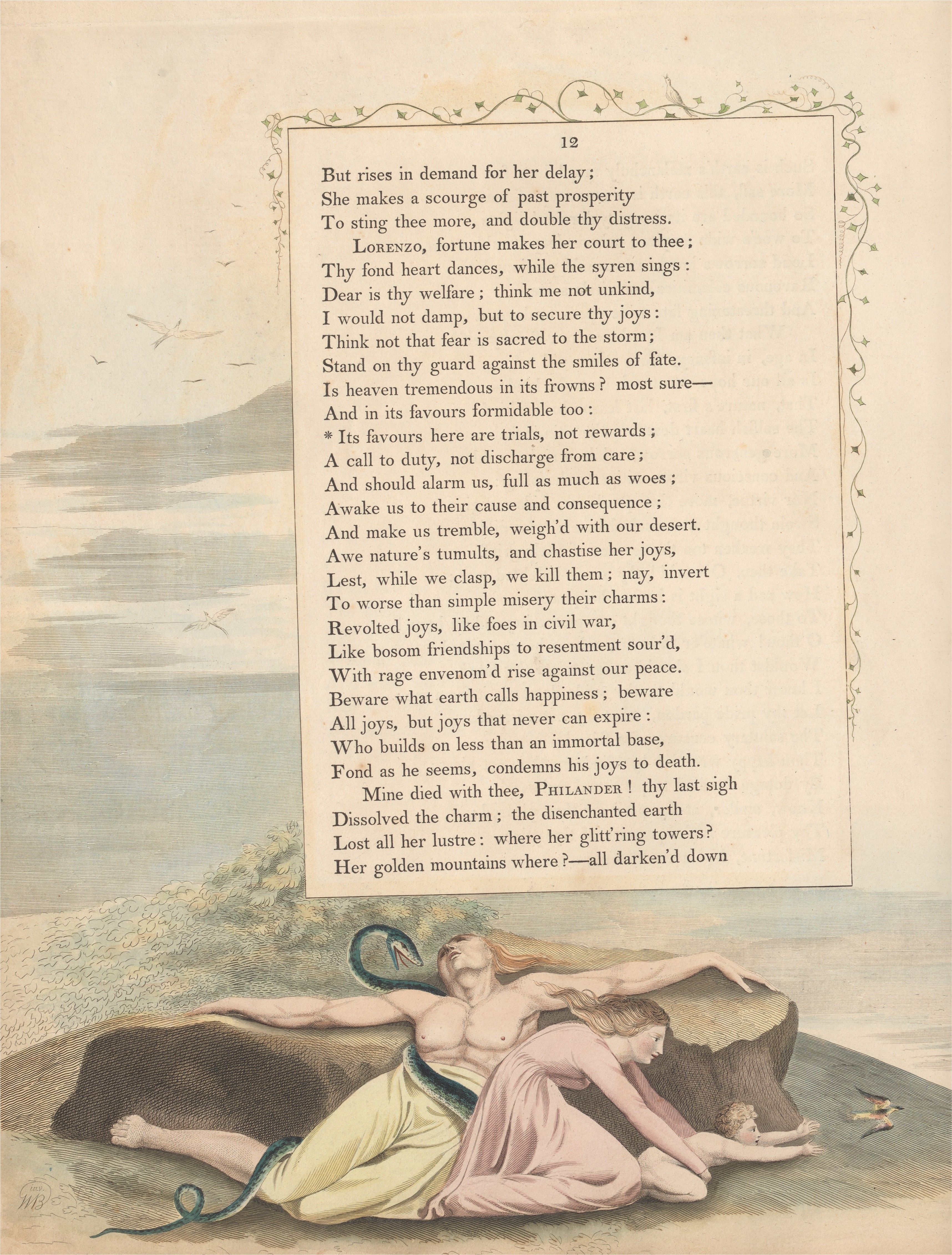
Harvard Art Museums/Fogg Museum, Bequest of Grenville L. Winthrop
Illustrations to The Divine Comedy
Plate 80
Lucia Carrying Dante in His Sleep
Perhaps Blake hesitated to illustrate Dante's Divine Comedy. He began the project only when he was at an advanced age and only when his friend John Linnell induced him to do so. Blake decided upon specific passages which he wished to illustrate, disproportionately settling on the punishments of the Inferno for which Dante had devised such ingenious tortures. But Blake selected other passages because of their congruence with his own inclinations and with the myth which illustrated his own understanding of God's design.

Among the latter passages is one in Canto IX in which Lucia assists Dante in achieving the transition from the Inferno to Purgatory. Dante had introduced Lucia in Canto II as a pivotal figure in Dante gaining the courage to make his initial move of entering the Inferno. Later Lucia was called upon to assist him in the final ascent from the Inferno to Purgatory.


The Divine Comedy, Inferno
Book 1, Canto II
by Dante Aligheri
Translated by Charles Eliot Norton
 

'Since thou wishest 
 to know so inwardly, I will tell thee briefly,' she replied to
me, 'wherefore I fear not to come here within. One ought to fear
those things only that have power of doing harm, the others not,
for they are not dreadful. I am made by God, thanks be to Him,
such that your misery toucheth me not, nor doth the flame of this
burning assail me. A gentle Lady is in heaven who hath pity
for this hindrance whereto I send thee, so that stern judgment
there above she breaketh. She summoned Lucia in her request, and
said, "Thy faithful one now hath need of thee, and unto thee I
commend him." Lucia, the foe of every cruel one, rose and came to
the place where I was, seated with the ancient Rachel. She said,
"Beatrice, true praise of God, why dost thou not succor him who
so loved thee that for thee he came forth from the vulgar throng?
Dost thou not hear the pity of his plaint? Dost thou not see the
death that combats him beside the stream whereof the sea hath no
vaunt?" In the world never were persons swift to seek their good,
and to fly their harm, as I, after these words were uttered, came
here below, from my blessed seat, putting my trust in thy upright
speech, which honors thee and them who have heard it.' After she
had said this to me, weeping she turned her lucent eyes, whereby
she made me more speedy in coming. And I came to thee as she
willed. Thee have I delivered from that wild beast that took from
thee the short ascent of the beautiful mountain. What is it then?
Why, why dost thou hold back? why dost thou harbor such cowardice
in thy heart? why hast thou not daring and boldness, since three
blessed Ladies care for thee in the court of Heaven, and my
speech pledges thee such good?"
...
As flowerets, bent and closed by the chill of night, after the
sun shines on them straighten themselves all open on their stem,
so I became with my weak virtue, and such good daring hastened to
my heart that I began like one enfranchised: "Oh compassionate
she who succored me! and thou courteous who didst speedily obey
the true words that she addressed to thee! Thou by thy words hast
so disposed my heart with desire of going, that I have returned
unto my first intent. Go on now, for one sole will is in us both:
Thou Leader, thou Lord, and thou Master." Thus I said to him; and
when he had moved on, I entered along the deep and savage road.

The Divine Comedy, Purgatory
Book 2, Canto IX
by Dante Aligheri
Translated by Charles Eliot Norton  
At the hour near the morning when the little swallow begins her
sad lays, perchance in memory of her former woes, and when our
mind, more a wanderer from the flesh and less captive to the
thought, is in its visions almost divine, in dream it seemed
to me that I saw poised in the sky an eagle with feathers of
gold, with wings widespread, and intent to stoop. And it seemed
to me that I was there where his own people were abandoned by
Ganymede, when he was rapt to the supreme consistory. In myself I
thought, "Perhaps this bird strikes only here through wont, and
perhaps from other place disdains to carry anyone upward in his
feet." Then it seemed to me that, having wheeled a little, it
descended terrible as a thunderbolt, and snatched me upwards far
as the fire. There it seemed that it and I burned, and the
imagined fire so scorched that of necessity the sleep was broken.
...
At my side was my Comforter only, and
the sun was now more than two hours high,[2] and my face was
turned toward the sea. "Have no fear," said my Lord; "be
reassured, for we are at a good point; restrain not, but increase
all thy force. Thou art now arrived at Purgatory; see there the
cliff that closes it around; see the entrance, there where it
appears divided. A while ago in the dawn that precedes the day,
when thy soul was sleeping within thee, upon the flowers
wherewith the place down yonder is adorned, came a lady, and
said, "I am Lucia; let me take this one who is sleeping; thus
will I assist him along his way.' Sordello remained, and the
other gentle forms: she took thee, and when the day was bright,
she came upward, and I along her footprints. Here she laid thee
down: and first her beautiful eyes showed me that open entrance;
then she and slumber went away together." Like a man that in
perplexity is reassured, and that alters his fear to confidence
after the truth is disclosed to him, did I change; and when my
Leader saw me without solicitude, up along the cliff he moved on,
and I behind, toward the height.

Blake would have been pleased that it was mercy, not justice, that allowed the fictional Dante to escape the punishments of hell. Dante introduced a dream sequence, featuring an eagle, to portray the inhibiting fear which retards the progress of spiritual development. In contrast mercy, in the shape of Lucia, transported Dante in his sleep to the Gate of Purgatory without any effort on his part. Scholars tell us that Dante used the eagle as a symbol of Rome's military power, in contrast to Lucia as a symbol of the Church's spiritual power.  

Whatever Dante may have implied by his words, Blake used his picture to show Dante effortlessly being carried by loving female arms to what we might call a higher level of consciousness: one in which forgiveness begins to wipe away fear of eternal punishment.

Blake attitude to the response which should be made to the sinner was diametrically opposed to that of Dante. Blake found moral judgement to be the villain which turned man away from perceiving the Divine within himself and his brother. 


Jerusalem, PLATE 45 [31], (E 194)
"Fearing that Albion should turn his back against the Divine Vision
Los took his globe of fire to search the interiors of Albions
Bosom, in all the terrors of friendship, entering the caves
Of despair & death, to search the tempters out, walking among 
Albions rocks & precipices! caves of solitude & dark despair,
And saw every Minute Particular of Albion degraded & murderd
But saw not by whom; they were hidden within in the minute particulars
...
Every Universal Form, was become barren mountains of Moral
Virtue: and every Minute Particular hardend into grains of sand:
And all the tendernesses of the soul cast forth as filth & mire,
...
What shall I do! what could I do, if I could find these Criminals
I could not dare to take vengeance; for all things are so constructed    
And builded by the Divine hand, that the sinner shall always escape,
And he who takes vengeance alone is the criminal of Providence;
If I should dare to lay my finger on a grain of sand
In way of vengeance; I punish the already punishd: O whom
Should I pity if I pity not the sinner who is gone astray!       
O Albion, if thou takest vengeance; if thou revengest thy wrongs
Thou art for ever lost! What can I do to hinder the Sons
Of Albion from taking vengeance? or how shall I them perswade.

So spoke Los, travelling thro darkness & horrid solitude:"
     
Lucia in song.

Wednesday, June 08, 2016

ADAM, EVE & SATAN

Genesis 2
[21] And the LORD God caused a deep sleep to fall upon Adam and he slept: and he took one of his ribs, and closed up the flesh instead thereof;
[22] And the rib, which the LORD God had taken from man, made he a woman, and brought her unto the man.
[23] And Adam said, This is now bone of my bones, and flesh of my flesh: she shall be called Woman, because she was taken out of Man.

Wikipedia Commons
Adam, Eve & Satan

Looking at this picture through the natural eye we see a loving couple in an idyllic setting separated from outside influences by a flowery bower. Floating above them is a menacing figure of whom they are unaware.

We supply the identifications of Adam, Eve and Satan because we are familiar with the the story in Genesis of the first man and woman who were tempted by Satan to disobey the creator. So we see the figures as Adam, the first man; Eve the woman who was taken form the side of Adam; and Satan, or the tempter, who destroyed the tranquility of Eden.

We can also look at the figures in the picture in the light of the understanding of cosmology which Blake developed through his mythical experience. In the created world man is not unified but divided into male and female, inner and outer, spirit and body, himself and his emanation. Creation itself is the origin of this division of original unity. If man retained the ability (or desire) to return to the pleroma there would be no disunity, for he would be capable of reuniting his disparate functions. However if he forgot the condition of blissful wholeness he would relinquish the ability to return.

Now we see that man does lose his way back because when the Emanation acquires a separate existence, a third being is generated whom Blake speaks of as a Spectre. Adam's Spectre is Satan, the generate form of Urizen, who resists the return of Adam to a condition of unity. The Spectre is able to manipulate the Emanation with the promise that she may gain dominance over Adam. The Specter and the Emanation gain control of the psyche of the man causing him to lose the ability to envision perfect wholeness.

Being cast out of the Garden of Eden meant to Blake this state of alienation from the infinite, eternal reality which gradually destroyed the bonds holding together the created world.

The temporary answer to this conundrum is the limits which are set to the fall by Los. Adam and Satan are these limits: Adam of contraction; Satan of opacity. Eve provides the avenue through which experience is gained. Through her brokenness she bears a son who incarnates the completed man who transcends the constraints which prevent man from seeing within his own soul. 

Four Zoas, Night II, Page 24, (E 314)
"Mighty was the draught of Voidness to draw Existence in

Terrific Urizen strode above, in fear & pale dismay
He saw the indefinite space beneath & his soul shrunk with horror
His feet upon the verge of Non Existence; his voice went forth 

Luvah & Vala trembling & shrinking, beheld the great Work master    
And heard his Word! Divide ye bands influence by influence
Build we a Bower for heavens darling in the grizly deep
Build we the Mundane Shell around the Rock of Albion
...
Their eyes their ears nostrils & tongues roll outward   they behold
What is within now seen without they are raw to the hungry wind"

Jerusalem, Plate 42, 189
[Los to Albion]
"Thou wast the Image of God surrounded by the Four Zoa's
Mighty was the draught of Voidness to draw Existence in

Terrific Urizen strode above, in fear & pale dismay
He saw the indefinite space beneath & his soul shrunk with horror
His feet upon the verge of Non Existence; his voice went forth 

Luvah & Vala trembling & shrinking, beheld the great Work master    
And heard his Word! Divide ye bands influence by influence
Build we a Bower for heavens darling in the grizly deep
Build we the Mundane Shell around the Rock of Albion
...
Their eyes their ears nostrils & tongues roll outward   they behold
What is within now seen without they are raw to the hungry wind

Three thou hast slain! I am the Fourth: thou canst not destroy me.
Thou art in Error; trouble me not with thy righteousness.      
I have innocence to defend and ignorance to instruct:
I have no time for seeming; and little arts of compliment,
In morality and virtue: in self-glorying and pride.
There is a limit of Opakeness, and a limit of Contraction;
In every Individual Man, and the limit of Opakeness,             
Is named Satan: and the limit of Contraction is named Adam.
But when Man sleeps in Beulah, the Saviour in mercy takes
Contractions Limit, and of the Limit he forms Woman: That
Himself may in process of time be born Man to redeem
But there is no Limit of Expansion! there is no Limit of Translucence.   
In the bosom of Man for ever from eternity to eternity."

Milton, Plate 23 [25], (E 119)
"But Los dispersd the clouds even as the strong winds of Jehovah, 

And Los thus spoke. O noble Sons, be patient yet a little
I have embracd the falling Death, he is become One with me
O Sons we live not by wrath. by mercy alone we live!
I recollect an old Prophecy in Eden recorded in gold; and oft
Sung to the harp: That Milton of the land of Albion.
Should up ascend forward from Felphams Vale & break the Chain
Of jealousy from all its roots; be patient therefore O my Sons
These lovely Females form sweet night and silence and secret
Obscurities to hide from Satans Watch-Fiends. Human loves        
And graces; lest they write them in their Books, & in the Scroll
Of mortal life, to condemn the accused: who at Satans Bar
Tremble in Spectrous Bodies continually day and night
While on the Earth they live in sorrowful Vegetations
O when shall we tread our Wine-presses in heaven; and Reap      
Our wheat with shoutings of joy, and leave the Earth in peace"
.

Friday, June 03, 2016

Blake's Bible

First published by Larry on February 07, 2010.

Genesis 3
[22] And the LORD God said, Behold, the man is become as one of us, to know good and evil: and now, lest he put forth his hand, and take also of the tree of life, and eat, and live for ever:
[23] Therefore the LORD God sent him forth from the garden of Eden, to till the ground from whence he was taken.
[24] So he drove out the man; and he placed at the east of the garden of Eden Cherubims, and a flaming sword which turned every way, to keep the way of the tree of life.

 
Northrup Frye referred to Blake as a 'Bible soaked Protestant.' He was certainly that-- and much more. He read the Bible like no other scholar I've come across. He read it uninhibited by conventions.

In his last years Frye published two large volumes with subtitles: The Bible and Literature. He had started out as a young minister, but made the fatal mistake of studying Blake, after which he became a literary critic - a real change for the better, IMO.

Working on his thesis (called Fearful Symmetry) Frye had discovered that Blake read the Bible very freely; so he became, like Blake, a Bible soaked Protestant but not (NO, NO!) a bibliolater. He read it with more freedom to go beyond the literal meaning than any conforming establishmentarian would dare to do.

In his visions Blake talked to Isaiah and Ezekiel. Re the cherub God put before the Gate of Eden with a flaming sword Blake had this to say:


"For the cherub with his flaming sword is hereby commanded to leave his guard at the tree of life, and when he does, the whole creation will be consumed, and appear infinite. and holy where as it now appears finite and corrupt. This will come to pass by an improvement of sensual enjoyment."  (MHH, Plate 14)
Wikipedia Commons
River of Life

Blake's desire was that the gate leading back into Eden be left open and unguarded because only a God of Vengeance would expel his children from his presence. Blake preferred to picture the River of Life drawing mankind back into the Garden where he may serve the Lord with joy. The Angel with the flaming sword is not among Blake's pictures, because his God empowered his children to re-enter Eden whenever they found their way back to the Gate.


Milton, Plate 34 [38], (E 135)
"Those Visions of Human Life & Shadows of Wisdom & Knowledge
PLATE 35 [39]
Are here frozen to unexpansive deadly destroying terrors[.]
And War & Hunting: the Two Fountains of the River of Life
Are become Fountains of bitter Death & of corroding Hell

Till Brotherhood is changd into a Curse & a Flattery
By Differences between Ideas, that Ideas themselves, (which are
The Divine Members) may be slain in offerings for sin"


Revelation 22
[1] And he shewed me a pure river of water of life, clear as crystal, proceeding out of the throne of God and of the Lamb.
[2] In the midst of the street of it, and on either side of the river, was there the tree of life, which bare twelve manner of fruits, and yielded her fruit every month: and the leaves of the tree were for the healing of the nations.
[3] And there shall be no more curse: but the throne of God and of the Lamb shall be in it; and his servants shall serve him:
[4] And they shall see his face; and his name shall be in their foreheads.
[5] And there shall be no night there; and they need no candle, neither light of the sun; for the Lord God giveth them light: and they shall reign for ever and ever.

Just poetry! you might say. Yes, but a fountain of life to non-authoritarians, free spirits who don't feel bound by the inerrancy-of-the-bible crowd. Blake sought Meaning in the Bible, not Law. Bible students divide along that line between free spirits and authoritarian types. Blake belonged to the first category, and so do I, and (hopefully) so do you. Let me know.

Tuesday, May 31, 2016

Shadows

Quote from Larry Clayton's Blake Primer - Chapter Two - Style.

To think and speak eternally is no small achievement for Blake or for us. Pursuing this aim he floundered for many years.

The words of Los in The Four Zoas record the moment when Blake got a firm grip on what he sought for himself and for us: "I already feel a World within Opening its gates, & in it all the real substances Of which these in the outward World are shadows which pass away." (E368) After twenty years in the visionary wilderness that "World within" opened its gates into the mind of the mature artist and poet. 

Four Zoas, Night VII, PAGE 86, (E 368) 
"Los furious answerd. Spectre horrible thy words astound my Ear
With irresistible conviction I feel I am not one of those 
Who when convincd can still persist. tho furious.controllable
By Reasons power. Even I already feel a World within
Opening its gates & in it all the real substances
Of which these in the outward World are shadows which pass away
Come then into my Bosom & in thy shadowy arms bring with thee   
My lovely Enitharmon. I will quell my fury & teach
Peace to the Soul of dark revenge & repentance to Cruelty

So spoke Los & Embracing Enitharmon & the Spectre
Clouds would have folded round in Extacy & Love uniting"
Illustrations to Poems of Thomas Gray
Ode to Adversity
Then he began to exercise the greatest freedom in his artistic use of the shadows.

They served him in every conceivable way to elucidate the real world within. All the shadows, all natural phenomena, all historical events, all works of art, his own included, he treated as fluctuating insubstantials which illustrate or point to the eternal reality.

Blake thought so much of Infinity that he learned to take great liberties with time and space. In this he followed the style of the most imaginative books of the Bible. As a young man sitting at the feet of Swedenborg he had learned the doctrine of correspondences which had come down from the Bible through the heterodox tradition. As Blake applied it, every material thing has a spiritual or eternal referrent. In the words of the alchemical tradition, "As above, so below".

In the Book of Revelation for example Babylon, a code word for Rome, more generally connotes the citadel of worldly power and evil. Blake of course used it in the same way. He used geographical locations of all sorts to point to spiritual realities. Africa symbolizes slavery in all its forms, particularly the "mind forg'd manacles" (from London) of the moral law. America symbolizes the hope of freedom. In the 16th plate of 'Jerusalem' (E 160) Blake went to extremes with this sort of symbolization; he superimposed the territorial tribes of Israel upon the map of England. The lapse into obscurantism was an unfortunate attempt to evoke spiritual values from a very prosaic material reality.

He more often succeeded in translating historical events and personages into spiritual realities. Constantine and Charlemagne symbolize war with religion as its handmaid. Albion is Blake's master symbol for Man, but sometimes Moses symbolizes Man; Michael and Satan then symbolize the forces of light and darkness in contest for Man. In Blake's last great work Job became the archetypal man.

Some of his symbols (Orc, Urizen, Los) Blake elaborated into the dramatis personae of his complete myth. Their identities, not immediately apparent, grow and take on new and fuller meaning throughout a life time of reading Blake. The fascination of the prophecies lies in watching these strange symbols come forth from the mists of confusion and speak with ever increasing authority to the reader about himself and his world.
Beginning with the traditional language of symbolic discourse Blake learned to translate every facet of man's experience into a symbol of the ultimate:

    Letters, To Thomas Butts, (E 712)
    "...Each grain of Sand,
    Every Stone on the Land,
    Each rock & each hill,
    Each fountain & rill,
    Each herb & each tree,
    Mountain, hill, earth & sea,
    Cloud, Meteor & Star,
    Are Men Seen Afar."

And two years later, in another letter poem:  
Letters, To Thomas Butts, (E 722)
"For double the vision my Eyes do see,
And a double vision is always with me.
With my inward Eye 'tis an old Man grey;
With my outward, a Thistle across my way."

Blake used earlier works of art as symbols which he put together to convey his thoughts about the eternal struggle and flux of values. He used the Bible, Milton, earlier Blake in the same way, all as a reservoir of ideational symbols combined into new forms to convey spiritual truth. This habit of mind can be described awkwardly at best. But it can be experienced vividly by the reader who will live into Blake's poetry. It's one of the ways in which he expressed his "desire of raising other men into a perception of the infinite".

Saturday, May 28, 2016

WOMAN & DRAGON

The following passage in Revelation had a powerful influence on Milton and Blake. It provided the imagery through which they each could formulate myths about the origin of man's fallen condition. There was a war in heaven which spilled into the earth. The conflict between Michael and his Angels on one side and the great red Dragon on the other, allowed the deceiver to gain a foothold through which the woman was sent to experience life in time. Man lost the unity of Eternity and acquired a dualistic nature which could only be expressed in a temporal world. The woman became the vehicle through which the outer was made manifest.
 
Revelation 12
[1] And there appeared a great wonder in heaven; a woman clothed with the sun, and the moon under her feet, and upon her head a crown of twelve stars:
[2] And she being with child cried, travailing in birth, and pained to be delivered.
[3] And there appeared another wonder in heaven; and behold a great red dragon, having seven heads and ten horns, and seven crowns upon his heads.
[4] And his tail drew the third part of the stars of heaven, and did cast them to the earth: and the dragon stood before the woman which was ready to be delivered, for to devour her child as soon as it was born.
[5] And she brought forth a man child, who was to rule all nations with a rod of iron: and her child was caught up unto God, and to his throne.
[6] And the woman fled into the wilderness, where she hath a place prepared of God, that they should feed her there a thousand two hundred and threescore days.
[7] And there was war in heaven: Michael and his angels fought against the dragon; and the dragon fought and his angels,
[8] And prevailed not; neither was their place found any more in heaven.
[9] And the great dragon was cast out, that old serpent, called the Devil, and Satan, which deceiveth the whole world: he was cast out into the earth, and his angels were cast out with him.
[10] And I heard a loud voice saying in heaven, Now is come salvation, and strength, and the kingdom of our God, and the power of his Christ: for the accuser of our brethren is cast down, which accused them before our God day and night.
[11] And they overcame him by the blood of the Lamb, and by the word of their testimony; and they loved not their lives unto the death.
[12] Therefore rejoice, ye heavens, and ye that dwell in them. Woe to the inhabiters of the earth and of the sea! for the devil is come down unto you, having great wrath, because he knoweth that he hath but a short time.
[13] And when the dragon saw that he was cast unto the earth, he persecuted the woman which brought forth the man child.
[14] And to the woman were given two wings of a great eagle, that she might fly into the wilderness, into her place, where she is nourished for a time, and times, and half a time, from the face of the serpent.
[15] And the serpent cast out of his mouth water as a flood after the woman, that he might cause her to be carried away of the flood.
[16] And the earth helped the woman, and the earth opened her mouth, and swallowed up the flood which the dragon cast out of his mouth.
[17] And the dragon was wroth with the woman, and went to make war with the remnant of her seed, which keep the commandments of God, and have the testimony of Jesus Christ.

Brooklyn Museum
The Great Red Dragon 
and the Woman Clothed with the Sun
1803-05


The dragon of the picture is the fallen angel who took with him a third of heaven's content when he was cast out of heaven. John of Patmos failed to explicate the origin of the dragon or the scenario which led him to rebel against the Divine order. Milton and Blake looked deep into their own psyches and historical situations attempting to learn why the perfect harmony of Eternity became fractured.


Four Zoas, Night V,Page 64, (E 343)
[Urzien speaks] 
"My songs are turned to cries of Lamentation 
Heard on my Mountains & deep sighs under my palace roofs 
Because the Steeds of Urizen once swifter than the light 
Were kept back from my Lord & from his chariot of mercies
O did I keep the horses of the day in silver pastures
O I refusd the Lord of day the horses of his prince
O did I close my treasuries with roofs of solid stone            
And darken all my Palace walls with envyings & hate

O Fool to think that I could hide from his all piercing eyes
The gold & silver & costly stones his holy workmanship
O Fool could I forget the light that filled my bright spheres
Was a reflection of his face who calld me from the deep          

I well remember for I heard the mild & holy voice
Saying O light spring up & shine & I sprang up from the deep
He gave to me a silver scepter & crownd me with a golden crown
& said Go forth & guide my Son who wanders on the ocean     

I went not forth. I hid myself in black clouds of my wrath       
I calld the stars around my feet in the night of councils dark
The stars threw down their spears & fled naked away
We fell. I siezd thee dark Urthona In my left hand falling

I siezd thee beauteous Luvah thou art faded like a flower
And like a lilly is thy wife Vala witherd by winds               
When thou didst bear the golden cup at the immortal tables
Thy children smote their fiery wings crownd with the gold of heaven

PAGE 65 
Thy pure feet stepd on the steps divine. too pure for other feet
And thy fair locks shadowd thine eyes from the divine effulgence
Then thou didst keep with Strong Urthona the living gates of heaven
But now thou art bound down with him even to the gates of hell

Because thou gavest Urizen the wine of the Almighty             
For steeds of Light that they might run in thy golden chariot of pride
I gave to thee the Steeds   I pourd the stolen wine
And drunken with the immortal draught fell from my throne sublime"

Paradise Lost, Book 5 
John Milton 
"all obey'd
The wonted signal, and superior voice [ 705 ]
Of thir great Potentate; for great indeed
His name, and high was his degree in Heav'n;
His count'nance, as the Morning Starr that guides
The starrie flock, allur'd them, and with lyes
Drew after him the third part of Heav'ns Host: [ 710 ]
Mean while th' Eternal eye, whose sight discernes
Abstrusest thoughts, from forth his holy Mount
And from within the golden Lamps that burne
Nightly before him, saw without thir light
Rebellion rising, saw in whom, how spred [ 715 ]
Among the sons of Morn, what multitudes
Were banded to oppose his high Decree;"

Wednesday, May 25, 2016

LYCA

Kathleen Raine focused her study of Blake on tracing Blake's sources using all the clues that he left in his writings and visual imagery. She read what he was known to have read going back through the centuries. One of the outcomes of her pursuit was the realization that Greek Mythology had an enormous influence on the creation of Blake's myth of fall and redemption. Blake seamlessly wove the threads of Biblical influences with the thought revealed in the totality of Greek myth. Raine's two volume masterpiece, Blake and Tradition, plunges into the depths of esoteric and mythopoeic writings to reveal Blake's intent in the choice of his symbols. She later condensed some of her insight in Blake and Antiquity. Raine was my guide in becoming better acquainted with the following poems.

If we take a careful look at Blake's The Little Girl Lost and The Little Girl Found from Songs of Experience, we may recognize that we are seeing a preview of characters in his later poems. After becoming acquainted with Thomas Taylor and saturating himself with the work Taylor was doing in translating Greek Mythology and philosophy into English, Blake incorporated characters and scenarios from Greek myths into his lexicon of imagery. The character Lyca in The Little Girl Lost and The Little Girl Found, by being assigned the role of Persephone, is a precursor for Vala. The depth of meaning in the tale of Persephone which formed the structure of the Eleusinian Mysteries, is seen running through Blake's recurring tale of fall, wandering, and return. 

Persephone was among the loveliest of immortals before she plucked the flower, (as did Oothoon), that introduced her to another level of consciousness. In her tale the young woman, who represents the Soul, is abducted by Pluto, called by Raine 'material nature'. She was carried away from the world of the immortals and down into the earth.
 

Blake's Little Girl is not innocent to the attraction of the 'wild birds song.' In the first image we see not the child we read about, but a couple - a male and female - embracing. The call to materiality has been heard. The division between body and soul, which characterizes Ulro and Generation, has already occurred. The stage is set for the fall into our material world which is dualistic or 'sexual.'
 

Lyca accepts the invitation to enter the state of sleep thereby inviting the 'beasts of prey' to join her. She views the kingly lion, who Raine tells us represents the lion in the Zodiac, Pluto, king of the underworld and ruler of souls entering the afterlife. This is the traditional sleep of death when the body lies in the grave.
 

Blake's imagery bifurcates here representing, on the one hand, the experience of death in the material world and, on the other, exit from the eternal world to enter the world of time and space. In Lyca's sleep she is brought to a cavern where she later is joined by her parents. There is no return to Eternity in this tale. But there is no threat or fear in Lyca's cave from the wild animals with whom she plays.

Persephone represented the fertility of the earth among other things. Her disappearance underground interfered with the agricultural output. The Gods came up with a compromise in which she would send half of her time on the earth and half below the surface. Thus the cyclical rotation between the time when the fields were fallow and resting, and the time of production and harvest. Blake incorporated the fluctuation between the repose of Beulah and the activity of Eden into his system. We see here as well the symbiosis of body and soul, each in love with the other, and relinquishing itself for the other's life.
 

The implication in these poems is that the Soul may retain the ability to discern the Eternal in the time/space continuum. The mother of Persephone, Cerus (identified as intellect), engaged in a search similar to that undertaken by Lyca's mother which culminated in their being reunited at Eleusis. Blake's poems have the soul and intellect reunite in the unconscious. 

The task of achieving a reunion with 'her maker' is expected in the future when the desert once again is a garden. In a future time she: 
Songs of Experience, Song 34, (E 20)
"Shall arise and seek
For her maker meek:
And the desart wild
Become a garden mild."
But now she has a different task; she must pass through a world in which she lives in a body and knows woe as well as joy:
Jerusalem, Plate 4, (E 146)
"Chap: 1
Of the Sleep of Ulro! and of the passage through
Eternal Death! and of the awaking to Eternal Life."

Songs of Experience, SONGS 34, 35, 36, (E 20-21) 
"The Little Girl Lost        

In futurity
I prophetic see,
That the earth from sleep,
(Grave the sentence deep)

Shall arise and seek
For her maker meek:
And the desart wild
Become a garden mild.
___________________

In the southern clime,
Where the summers prime,
Never fades away;
Lovely Lyca lay.

Seven summers old
Lovely Lyca told,
She had wanderd long, 
Hearing wild birds song.

Sweet sleep come to me
Underneath this tree;
Do father, mother weep.--
Where can Lyca sleep.

Lost in desart wild
Is your little child.
How can Lyca sleep,
If her mother weep.

If her heart does ake, 
Then let Lyca wake;
If my mother sleep,
Lyca shall not weep.

Frowning frowning night,
O'er this desart bright,
Let thy moon arise,
While I close my eyes.

Sleeping Lyca lay;
While the beasts of prey,
Come from caverns deep, 
View'd the maid asleep

The kingly lion stood
And the virgin view'd,
Then he gambold round
O'er the hallowd ground;

SONGS 35
Leopards, tygers play,
Round her as she lay;
While the lion old,
Bow'd his mane of gold.

And her bosom lick,
And upon her neck,
From his eyes of flame,
Ruby tears there came;

While the lioness,
Loos'd her slender dress,
And naked they convey'd
To caves the sleeping maid.

The Little Girl Found

All the night in woe,
Lyca's parents go:
Over vallies deep,
While the desarts weep.

Tired and woe-begone, 
Hoarse with making moan:
Arm in arm seven days,
They trac'd the desart ways.

Seven nights they sleep,
Among shadows deep:
And dream they see their child
Starv'd in desart wild.

Pale thro' pathless ways
The fancied image strays,

SONGS 36 
Famish'd, weeping, weak
With hollow piteous shriek

Rising from unrest,
The trembling woman prest,
With feet of weary woe;
She could no further go. 

In his arms he bore,
Her arm'd with sorrow sore;
Till before their way,
A couching lion lay.

Turning back was vain, 
Soon his heavy mane,
Bore them to the ground;
Then he stalk'd around,

Smelling to his prey.
But their fears allay,
When he licks their hands;
And silent by them stands.

They look upon his eyes
Fill'd with deep surprise:
And wondering behold,
A spirit arm'd in gold. 

On his head a crown
On his shoulders down,
Flow'd his golden hair.
Gone was all their care. 

Follow me he said,
Weep not for the maid;
In my palace deep,
Lyca lies asleep.

Then they followed, 
Where the vision led:
And saw their sleeping child,
Among tygers wild.

To this day they dwell
In a lonely dell
Nor fear the wolvish howl,
Nor the lions growl."
British Museum
Songs of Experience
Song 34, Copy B
The Little Girl Lost
British Museum
Songs of Experience
Song 35, Copy B
The Little Girl Found
British Museum
Songs of Experience
Song 36, Copy B
The Little Girl Found


Look at enlarged images on this website.

Saturday, May 21, 2016

Jerusalem & Vala

This material is from Chapter 8, section VI of Larry Clayton's book, A Blake Primer.
 
In the extended passage from Jerusalem which follows, Blake gives a colloquy with the fainting, confused Albion and the two females competing for his heart - Vala and Jerusalem. It's actually a recreation of the earlier colloquy in Visions of the Daughters of Albion, and infinitely richer and fuller. Albion wavers exactly like Theotormon; Vala, like Bromion, is implacably blind; and Jerusalem has the eloquence of the earlier heroine, Oothoon. In this scene, like the earlier one, Blake describes the eternal battle between faith and worldliness.
Jerusalem, Plate 20, (E 165)
"But when they saw Albion fall'n upon mild Lambeths vale:
Astonish'd! Terrified! they hover'd over his Giant limbs.
Then thus Jerusalem spoke, while Vala wove the veil of tears:
Weeping in pleadings of Love, in the web of despair.

Wherefore hast thou shut me into the winter of human life   
And clos'd up the sweet regions of youth and virgin innocence:
Where we live, forgetting error, not pondering on evil:
Among my lambs & brooks of water, among my warbling birds:
Where we delight in innocence before the face of the Lamb:
Going in and out before him in his love and sweet affection. 

Vala replied weeping & trembling, hiding in her veil.

When winter rends the hungry family and the snow falls:
Upon the ways of men hiding the paths of man and beast,
Then mourns the wanderer: then he repents his wanderings & eyes
The distant forest; then the slave groans in the dungeon of stone.    
The captive in the mill of the stranger, sold for scanty hire.
They view their former life: they number moments over and over;
Stringing them on their remembrance as on a thread of sorrow.
Thou art my sister and my daughter! thy shame is mine also!
Ask me not of my griefs! thou knowest all my griefs.             

Jerusalem answer'd with soft tears over the valleys.

O Vala what is Sin? that thou shudderest and weepest
At sight of thy once lov'd Jerusalem! What is Sin but a little
Error & fault that is soon forgiven; but mercy is not a Sin
Nor pity nor love nor kind forgiveness! O! if I have Sinned      
Forgive & pity me! O! unfold thy Veil in mercy & love!
Slay not my little ones, beloved Virgin daughter of Babylon
Slay not my infant loves & graces, beautiful daughter of Moab
I cannot put off the human form I strive but strive in vain
When Albion rent thy beautiful net of gold and silver twine;
Thou hadst woven it with art, thou hadst caught me in the bands
Of love; thou refusedst to let me go: Albion beheld thy beauty
Beautiful thro' our Love's comeliness, beautiful thro' pity.
The Veil shone with thy brightness in the eyes of Albion,
Because it inclosd pity & love; because we lov'd one-another!
Albion lov'd thee! he rent thy Veil! he embrac'd thee! he lov'd thee!
Astonish'd at his beauty & perfection, thou forgavest his furious love:
I redounded from Albions bosom in my virgin loveliness.
The Lamb of God reciev'd me in his arms he smil'd upon us:

He made me his Bride & Wife: he gave thee to Albion.             
Then was a time of love: O why is it passed away!"
Look also at the passage on Plate 31 and remember that Albion, Vala and Los each speaks from his own viewpoint. To understand Blake's vision the reader must imaginatively enter the psychic state of each of the three characters. Los most often speaks from the poet's true standpoint, and the following lines put his position about as plainly as it can be put:

Jerusalem, Plate 30 [34], (E 176)
"What may Man be? who can tell! but what may Woman be
To have power over Man from Cradle to corruptible Grave?
There is a Throne in every Man, it is the Throne of God:
This, Woman has claim'd as her own, and Man is no more!
Albion is the Tabernacle of Vala and her Temple,
And not the Tabernacle and Temple of the Most High.
0 Albion, why wilt thou Create a Female Will?
...
Is this the Female Will, 0 ye lovely Daughters of Albion, To
Converse concerning Weight & Distance in the Wilds of Newton & Locke?"

As the epic progresses, Blake continues to define the two women:

Jerusalem, Plate 39 [44], (E 187)
"Man is adjoin'd to Man by his Emanative portion
Who is Jerusalem in every individual Man, and her
Shadow is Vala, builded by the Reasoning power in Man."

British Museum Jerusalem Copy A, Plate 46
Omitting further detail we can begin our summary of Blake's theory of sex with Jesus' reply to the Sadducee's mocking question about the woman married to seven husbands: "for when they shall rise from the dead, they neither marry nor are given in marriage, but are as the angels which are in heaven."

Blake begins here, with the assumption that sexual division relates to this world, but not to Eternity. Sex appears in Beulah, a moony rest from the arduous creative activity of Eden. The "Female Will" condemns Man to the loss of Eternity, which Blake calls "the Sleep of Ulro". Sex signifies fallenness, and the jealous and proudly chaste female symbolizes the active principle of evil, also identified with a materialistic viewpoint whose values are coercion and love of power.

Blake's vision of Jesus humanized his theory of sex. He began to use the biblical image of Jerusalem as the bride of Christ, named his last and greatest epic Jerusalem, and ultimately was able to rationalize the heterodox doctrine of sex with the glorified female as the emanation of the Eternal Man. Blake's female thus joined all the rest of his personal images in traveling the Circle of Destiny, materializing in the Fall and etherealizing in the Return.

Through all his journey Blake had a characteristically liberal and enlightened view of womankind, an entirely different matter from the sexual symbolism that filled his pages. His true and abiding feelings about the relation between men and women appear early in his works in his "Annotations to Lavater": "Let the men do their duty and the women will be such wonders; the female life lives from the light of the male: see a man's female dependents, you know the man." Admittedly short of the high standards of present day feminism, Blake's vision of womanhood considerably surpassed that of most of his contemporaries-- and perhaps most of ours.

Luke 20
[27] Then came to him certain of the Sadducees, which deny that there is any resurrection; and they asked him,
[28] Saying, Master, Moses wrote unto us, If any man's brother die, having a wife, and he die without children, that his brother should take his wife, and raise up seed unto his brother.
[29] There were therefore seven brethren: and the first took a wife, and died without children.
[30] And the second took her to wife, and he died childless.
[31] And the third took her; and in like manner the seven also: and they left no children, and died.
[32] Last of all the woman died also.
[33] Therefore in the resurrection whose wife of them is she? for seven had her to wife.
[34] And Jesus answering said unto them, The children of this world marry, and are given in marriage:
[35] But they which shall be accounted worthy to obtain that world, and the resurrection from the dead, neither marry, nor are given in marriage:
[36] Neither can they die any more: for they are equal unto the angels; and are the children of God, being the children of the resurrection.
[37] Now that the dead are raised, even Moses shewed at the bush, when he calleth the Lord the God of Abraham, and the God of Isaac, and the God of Jacob.
[38] For he is not a God of the dead, but of the living: for all live unto him.
[39] Then certain of the scribes answering said, Master, thou hast well said.
[40] And after that they durst not ask him any question at all.