Sunday, October 03, 2021

LARGE COLOR PRINTS 4

First posted Feb 2014

Genesis 2
[9] And out of the ground the LORD God made to grow every tree that is pleasant to the sight and good for food, the tree of life also in the midst of the garden, and the tree of the knowledge of good and evil.
[16] And the LORD God commanded the man, saying, "You may freely eat of every tree of the garden;
[17] but of the tree of the knowledge of good and evil you shall not eat, for in the day that you eat of it you shall die." 
 
The drama which took place in the Garden of Eden revolved around the tree which bore the fruit which if eaten would provide knowledge of Good & Evil. Without that knowledge nothing was of greater or lesser value. Thinking as Blake did that man could return to Eden at any time, this knowledge of Good & Evil became a pivotal point for him. 
 
As Blake worked it out, man, as a consequence of dualistic thinking, named an opposed characteristics to each entity he identified. Then he compounded his error by declaring one of the pair good and the other evil. Himself and what he preferred, he identified with the good, and the other object, person, idea or word he identified with evil. From this description it is apparent that good and evil are arbitrary. 
 
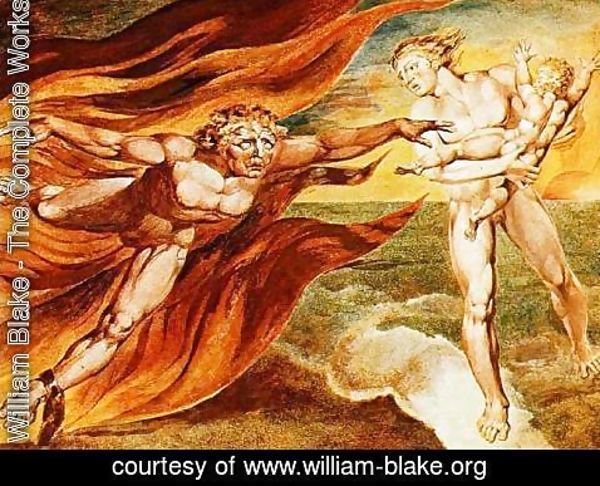
In the two previous posts on the Large Color Prints, the Fall of man was seen as the consequence of division: man dividing from God, then man dividing from woman. In the Good & Evil Angels Struggling for Possession of a Child we see that the process of division has come to permeate everything. And that the divisions lead to contentions between two sides seeking dominance. To Blake the dualistic thinking which leads to the labels of good and evil is the root of the whole process of accusation, condemnation and vengeance. Brotherhood cannot come until the other is not seen as evil. 
williamblake.org 
The Good and Evil Angels Struggling for Possession of a Child


In the Editors' Notes for this picture in the Blake Archive we read:
"The color print may also indicate the fall into the errors of the good/evil, body/soul, energy/reason dualities. The child may thus represent humanity caught between these contending oppositions."

A Vision of The Last Judgment, (E 554)
                   For the Year 1810
        Additions to Blakes Catalogue of Pictures &c

     "The Last Judgment when all those are Cast away who trouble
Religion with Questions concerning Good & Evil or Eating of the
Tree of those Knowledges or Reasonings which hinder the Vision of
God turning all into a Consuming fire  Imaginative Art &
Science & all Intellectual Gifts all the Gifts of the Holy Ghost
are [despisd] lookd upon as of no use & only Contention
remains to Man then the Last Judgment begins & its Vision is seen
by the [Imaginative Eye] of Every one according to the
situation he holds"

A Vision of The Last Judgment, (E 562)
"Here they are no longer talking of what is Good &
Evil or of what is Right or Wrong & puzzling themselves in Satans
[Maze] Labyrinth But are Conversing with Eternal
Realities as they Exist in the Human Imagination   We are in a
World of Generation & death & this world we must cast off" 

A Vision of The Last Judgment, (E 563)
 "By this it will be seen that I do not consider either the Just
or the Wicked to be in a Supreme State but to be every one of
them States of the Sleep which the Soul may fall into in its
Deadly Dreams of Good & Evil when it leaves Paradise
[with]  the Serpent" 

A Vision of The Last Judgment, (E 564)
"Nothing is displeasing to God but Unbelief & Eating of the Tree
of Knowledge of Good & Evil 
 Men are admitted into Heaven not because they have
 governd their Passions or have No Passions but because
they have Cultivated their Understandings.  The Treasures of
Heaven are not Negations of Passion but Realities of Intellect
from which All the Passions Emanate  in their Eternal
Glory   The Fool shall not enter into Heaven let him be ever so
Holy.  Holiness is not The Price of Enterance into Heaven Those
who are cast out Are All Those who having no Passions of their
own because No Intellect.  Have spent their lives in Curbing &
Governing other Peoples by the Various arts of Poverty & Cruelty
of all kinds"

Saturday, October 02, 2021

LARGE COLOR PRINTS 3

First posted Feb 2014

Genesis 2
[21] So the LORD God caused a deep sleep to fall upon the man, and while he slept took one of his ribs and closed up its place with flesh;
[22] and the rib which the LORD God had taken from the man he made into a woman and brought her to the man.
[23] Then the man said, "This at last is bone of my bones ad flesh of my flesh; she shall be called Woman, because she was taken out of Man."

 
Genesis 3
[2] And the woman said to the serpent, "We may eat of the fruit of the trees of the garden;
[3] but God said, `You shall not eat of the fruit of the tree which is in the midst of the garden, neither shall you touch it, lest you die.'"
[4] But the serpent said to the woman, "You will not die.
[5] For God knows that when you eat of it your eyes will be opened, and you will be like God, knowing good and evil."
[6] So when the woman saw that the tree was good for food, and that it was a delight to the eyes, and that the tree was to be desired to make one wise, she took of its fruit and ate; and she also gave some to her husband, and he ate. 

Wikipedia Commons
Large Color Printed Paintings
Satan Exaulting Over Eve


The name Satan does not appear in the book of Genesis. Eve's tempter is the serpent. We owe to Milton's Paradise Lost much of the imagery involving Satan in the Fall. Satan is rarely mentioned in the Old Testament outside of the book of Job where he is assigned by God the role of testing Job.
 
In Blake's picture Satan Exaulting Over Eve we see Eve lying prone with Satan in the air above her. Satan is the active figure, armed with spear and shield, held aloft by powerful wings, surrounded by energetic flames. Eve lies sleeping with the fruit in her hand and the serpent twining her body.

 
To Blake the two phases of man's consciousness, the active and passive, are balanced in the unified man. When man, through Creation, is divided from the unifying principle which is God, he undergoes a further division which can be expressed as various contraries, one of which is active and passive. The passive becomes the female or emanation or outer expression. The creation of Eve implies that the Fall has already been initiated because man has been divided from his emanation.

 
Although we may have been taught that the Fall was an event in which Eve ate the forbidden fruit, Blake sees the Fall as the accumulation of actions which draw man farther from the unity which he experienced in Eternity. 

 
Damon states in A Blake Dictionary that: "the division of the Emanation from the Individual is a split in the personality, a stage in the Fall of Man, symbolized in Genesis by the extraction of Eve from the side of sleeping Adam...
The separated Emanation takes the female form, an event which horrifies the Eternals. Man is left 'a dark Spectre', of perhaps only in his Spectre's power. Worse yet, the Emanation acquires a will of her own, which by definition is turned against her consort." (Page 121)  

 
Spectre of Urthona speaks to Shade of Enitharmon: 
 
Four Zoas, Night VII, Page 84, (E 359)
"This thou well rememberest listen I will tell
What thou forgettest. They in us & we in them alternate Livd
Drinking the joys of Universal Manhood. One dread morn
Listen O vision of Delight One dread morn of goary blood
The manhood was divided for the gentle passions making way
Thro the infinite labyrinths of the heart & thro the nostrils issuing
In odorous stupefaction stood before the Eyes of Man
A female bright. I stood beside my anvil dark a mass
Of iron glowd bright prepard for spades & plowshares. sudden down
I sunk with cries of blood issuing downward in the veins
Which now my rivers were become rolling in tubelike forms
Shut up within themselves descending down I sunk along,
The goary tide even to the place of seed & there dividing
I was divided in darkness & oblivion thou an infant woe
And I an infant terror in the womb of Enion
My masculine spirit scorning the frail body issud forth
From Enions brain In this deformed form leaving thee there
Till times passd over thee but still my spirit returning hoverd
And formd a Male to be a counterpart to thee O Love
Darkend & Lost In due time issuing forth from Enions womb
Thou & that demon Los wert born Ah jealousy & woe
Ah poor divided dark Urthona now a Spectre wandering
The deeps of Los the Slave of that Creation I created

I labour night & day for Los but listen thou my vision
I view futurity in thee I will bring down soft Vala
To the embraces of this terror & I will destroy
That body I created then shall we unite again in bliss"
 

.

Friday, October 01, 2021

LARGE COLOR PRINTS 2

First posted Feb 2014

Genesis 2
[4]These are the generations of the heavens and the earth when they were created.In the day that the LORD God made the earth and the heavens,
[5] when no plant of the field was yet in the earth and no herb of the field had yet sprung up -- for the LORD God had not caused it to rain upon the earth, and there was no man to till the ground;
[6] but a mist went up from the earth and watered the whole face of the ground --
[7] then the LORD God formed man of dust from the ground, and breathed into his nostrils the breath of life; and man became a living being.
[8] And the LORD God planted a garden in Eden, in the east; and there he put the man whom he had formed.
[9] And out of the ground the LORD God made to grow every tree that is pleasant to the sight and good for food, the tree of life also in the midst of the garden, and the tree of the knowledge of good and evil.

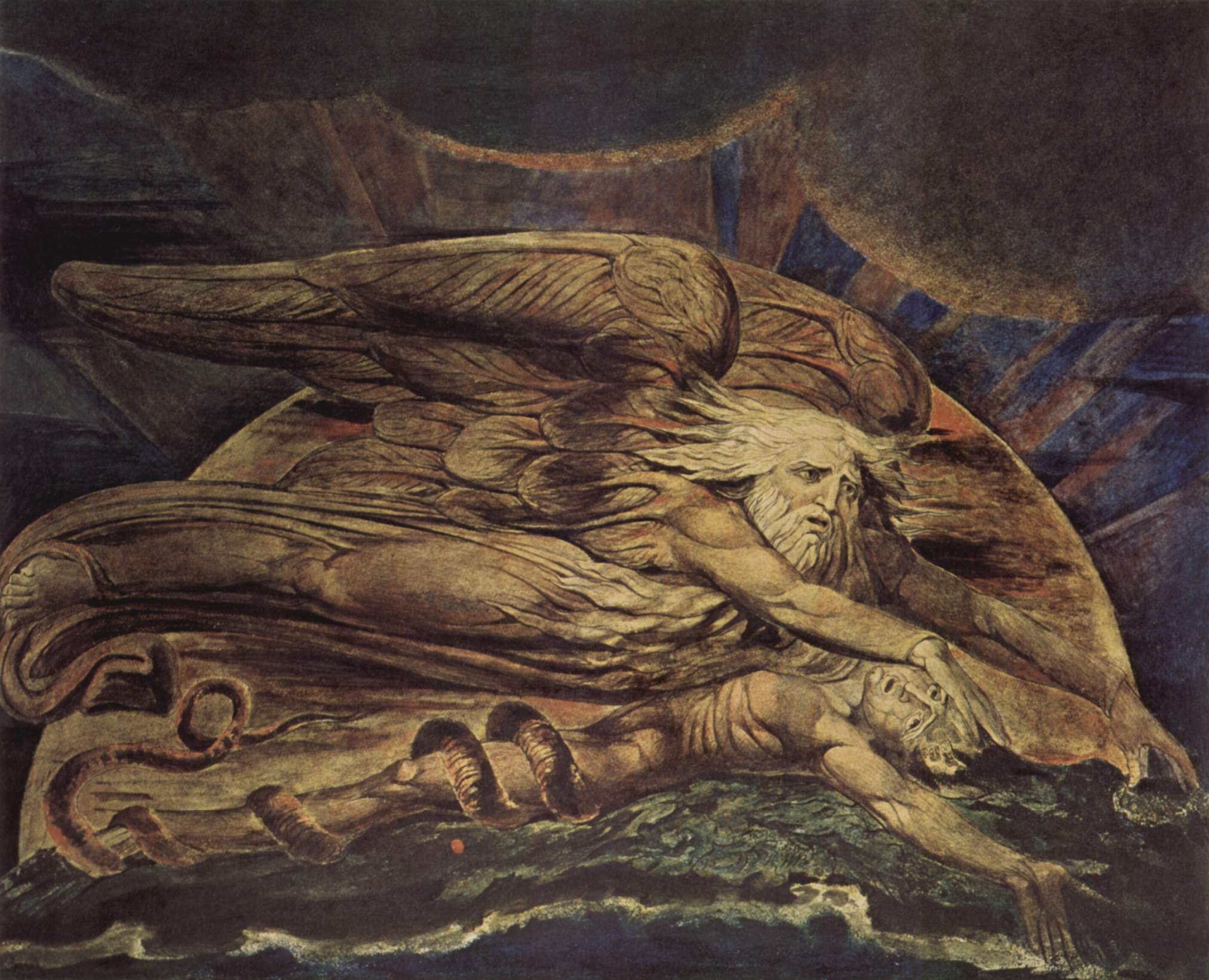
https://upload.wikimedia.org/wikipedia/commons/0/01/William_Blake_008.jpg

Wikimedia Commons
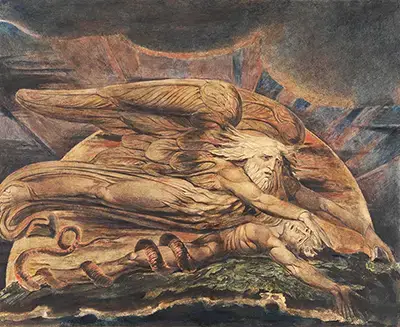
Elohim Creating Adam

The Life of William Blake  by Alexander Gilchrist provides comments on the series of images known as The Large Color Printed Paintings and on the first image 'Elohim creating Adam':

"No two proofs were identical, as the variations of the stamped colour ever led the artist's brush into fresh inventions.
As these curious works, half printed, half painted, represent Blake's highest achievement in technique, so are they also among the mightiest of his designs.
In the grand composition, " Elohim creating Adam," he enters the lists with his life-long idol, Michael Angelo, yet avoids comparison by the complete originality of his conception.
In the "Creation" of Michael Angelo—perhaps the noblest picture the world possesses—God sweeps past upborne by Cherubim and, with a touch of His extended finger, kindles life in man.
Blake, on entirely different lines, sets before us an almost equally haunting vision.
A weary God, spent with ages of labour, broods over Adam on flagging wings. Virtue is gone out of Him and, as the great sun of the Sixth Day sinks below the newmade world, for the drawing of a breath He pauses before the final effort is made.
Michael Angelo represents the Creation of Man by the Deity. Blake shows the mystery of all Creations; the birth of anything or of everything, born of the Maker's Agony and leaving Him weary—for God rested the Seventh Day.
Beneath His hands the first man takes shape and is resolved out of the elements; a piteous, helpless creature, marl-stained and almost without form, his weak limbs wrapped about by a monstrous worm.
Beyond the two figures the golden disk of the setting sun shoots forth dark purple rays across blue tracts of sky, lighting the overhanging cloud-canopies with a dim radiance. The great wings of God are golden, tinged here and there with crimson, the colour throughout the picture is somberly magnificent."

It might be said that Blake looked at creation from the perspective of Adam and Michelangelo viewed from God's perspective. Events for Blake took place within the mind. Creation was the rending of the unity which the mind experienced before it was torn from infinity. 

Blake's first imaging of Genesis was rendered in the Book of Urizen. The overall impression of the account is of violence and pain which leads to man's isolation in a dualistic material world.

Book of Urizen, Plate 15, (E 77)
"I. In terrors Los shrunk from his task:          
His great hammer fell from his hand:
His fires beheld, and sickening,
Hid their strong limbs in smoke.
For with noises ruinous loud;
With hurtlings & clashings & groans             
The Immortal endur'd his chains,
Tho' bound in a deadly sleep.

2. All the myriads of Eternity:
All the wisdom & joy of life:
Roll like a sea around him,                   
Except what his little orbs
Of sight by degrees unfold.

3. And now his eternal life
Like a dream was obliterated

4. Shudd'ring, the Eternal Prophet smote         
With a stroke, from his north to south region
The bellows & hammer are silent now
A nerveless silence, his prophetic voice
Siez'd; a cold solitude & dark void
The Eternal Prophet & Urizen clos'd"            

Northrop Frye provides further understanding of the nature of creation and its relationship to mankind as portrayed by Blake:

Fearful Symmetry, Page 41
"In Blake there are certain modifications in the orthodox account of the Fall. One is that as all reality is  mental, the fall of man's mind involved a corresponding fall of the physical world. Another is, that as God is Man, Blake follows some of the Gnostics and Boehme in believing that the fall of man involved a falling of part of the divine nature. Not all, for then there would there would be no imagination left to this one; but part, because it is impossible to derive a bad world from a good God, without a great deal of unconvincing special pleading and an implicit denial of the central fact of Christianity, the  identity of God and Man. The conclusion for Blake and the key to much of his symbolism, is that the fall of  man and the creation of the physical world is the same event."
Page 44
"The particular 'Giant form' or 'Eternal' to which we belong, the aggregate of spirits we call mankind or humanity and Blake calls Albion (Adam in Blake has his regular place as the symbol of the physical body or the natural man). When Albion or mankind fell, the unity of man fell too, and although our imagination tells us we belong to some larger organism even if we cannot see it as God, in the meantime we are locked up in separated opaque scattered bodies. If the whole of mankind were once more integrated in a single spiritual body the universe as we see it would burst."


Thursday, September 30, 2021

LARGE COLOR PRINTS

First posted Feb 2014

In 1795 the creative juices were flowing so copiously in William Blake that he hadn't finished one project before he started another. The printings of illuminated books led to his creating the series of painting know as The Large Color Printed Drawings. The group is held together by their large size, in the range of dimensions of 12 to 24 inches, compared to the illuminated books whose pages were typically under 9 inches in size, sometimes only 4 or 5 inches. In addition the method of production was unusual and fairly uniform for the group. The technique was that of a monoprint, although two or three prints were made from each painted drawing created. This was facilitated by the additional work Blake put into the image after it was pulled from the painted surface which made it into a highly finished painting. 
 
Although the paintings are much admired, there has been little agreement on the theme which Blake intended in deciding on the subject matter of particular images. Individual pictures are associated with Shakespeare, Milton, the Old and New Testament of the Bible, and events of Blake's own time.

 
By arranging the series from creation to resurrection it is possible to see in the series the habitual structure of creation, fall and return which Blake discerns as the paradigm of human or spiritual development. The order I will follow in later posts is:


1. Elohim Creating Adam
2. Satan Exaulting Over Eve
3. The Good  and Evil Angels
4. God Judging Adam
5. Lamech and His Two Wives
6. Nebuchadnezzar
7. The House of Death
8. Hecate or The Night of Enitharmon's Joy
9. Newton
10. Naomi Entreating Ruth
11. Pity
12. Christ Appearing to the Apostles


Blake uses the term fresco to refer to his painting in watercolor harkening back to Michelangelo's technique on plaster.

Public Address, (E 577)
 "Fresco Painting is properly Miniature, or Enamel Painting;
every thing in Fresco is as high finished as Miniature or Enamel,
although in Works larger than Life.  The Art has been lost: I
have recovered it.  How this was done, will be told, together
with the whole Process, in a Work on Art, now in the Press.  The
ignorant Insults of Individuals will not hinder me from doing my
duty to my Art.  Fresco Painting, as it is now practised, is like
most other things, the contrary of what it pretends to be.
  The execution of my Designs, being all in Water-colours,
(that is in Fresco) are regularly refused to be exhibited by the
Royal Academy, and the British Institution has, 
this year, followed its example, and has effectually excluded me 
by this Resolution; I therefore invite those Noblemen and 
Gentlem[e]n, who are its Subscribers, to inspect what they have 
excluded: and those who have been told that my Works are
but an unscientific and irregular Eccentricity, a Madman's
Scrawls, I demand of them to do me the justice to examine before
they decide.
  There cannot be more than two or three great Painters or
Poets in any Age or Country; and these, in a corrupt state of
Society, are easily excluded, but not so easily obstructed.  They
have ex[c]luded Watercolours; it is therefore become necessary
that I should exhibit to the Public, in an Exhibition of my own,
my Designs, Painted in Watercolours.  If Italy is enriched and
made great by RAPHAEL, if MICHAEL ANGELO is its supreme glory, if
Art is the glory of a Nation, if Genius and Inspiration are the
great Origin and Bond of Society, the distinction my Works have
obtained from those who best understand such things, calls for my
Exhibition as the greatest of Duties to my Country."
May 15. 1809
                                             WILLIAM BLAKE

Yale Center for British Art
Jerusalem
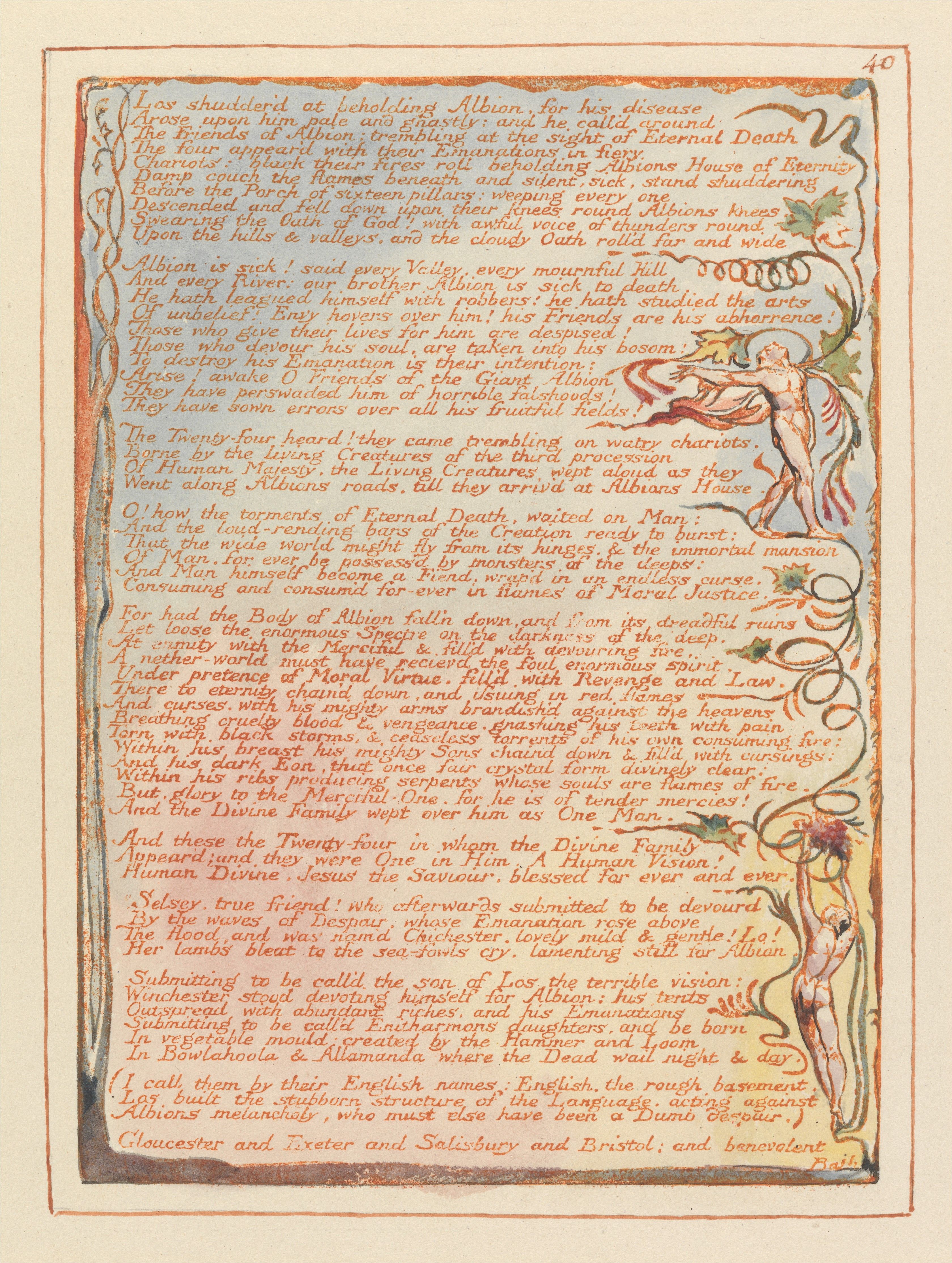
Plate 40
In The Illuminated Blake, Erdman tells us that in the right border of this plate we can see William and Catherine Blake at work creating the designs we so enjoy. "These two are Los and Enitharmon working in line and color, but in their mundane vehicles ... i.e. William and Catherine Blake...Here he is walking in the line...which his right foot sends down to Catherine's arms and feet. This leaves the poet's writing arm free while his sixfold printing arm can fill the sky with grape leaves in three color varieties and spin a tight wiery coil of communication to break past its limit...Catherine's influence turns the vine to green ribbons; a spare paintbrush with five red dipped fingers and a flower brush curls at her other side." 

Wednesday, September 29, 2021

COLOUR PRINTING

williamblake.org
Elohim Creating Adam

Ever the artist and the inventor, Blake embarked on the project in 1795 of developing a new technique and a fresh method of communicating his thoughts. In addition to creating his illuminated books which combined his engraved poetry and illuminations in book form, he worked out a method to make larger images suitable for display on walls. These would not use his small printing press to print from engraved copper plates but would make prints from paintings on mill board transferred to sheets of paper. Working quickly he could make up to three pictures from one painting on the mill board.

In his illuminated books his images were supplemented by words. In his large colour prints the image itself would convey his symbolic thought by implication. Blake chose designs with which his audience may be familiar from reading the Old and New Testaments of the Bible, or Shakespeare or Milton. The individual pictures recalled specific stories which contributed to his own concepts of the relationship of God and Man. For Blake Man was bound to God by an indelible cord, but the relationship between the two was constantly developing. The Large Colour Printed Drawings convey stages in the tense process of evolving spiritual consciousness.

Scholars have not definitively described how Blake made his Large Coloured Printed Drawings but many have attempted to understand his process which involved layering, pigments, binders and fixatives.

An early description of Blake's tempera technique by Frederick Tatham:

"Blake, when he wanted to make his prints in oil, took a common thick millboard, and drew in some strong ink or colour his design on it strong and thick. He then painted on it in such oil colours and in such a fashion that they would blur well. He painted roughly and quickly, so that no colour would have time to dry. He then took a print of that on paper, and this impression he coloured up in water-colours, repainting his outline on the millboard when he wanted to take another print...he could vary slightly each impression; and each having a sort of accidental look, he could branch out so as to make each one different."

Bruce MacEvoy on his website wrote that Blake's Large Color Printed Drawings were:

"likely made by creating a strong line drawing in ink on a large firm sheet of absorbent millboard, then roughly painting the areas within this outline with an oily paint (sometimes mixed with chalk). Sheets of paper were pressed against this plate before the paint had dried, transferring the colored image to the paper with a fresco like mottling and unevenness (visible at the top of the image). Once dried, these prints were lightly coated with a glue sizing, then further colored with watercolors, and the black outlines clarified and elaborated with pen and ink. This method of making prints was much faster and simpler than cutting a large copper plate; it also introduced random textural and color variations in each print, and allowed changes in the coloring or design as the paints on the millboard were refreshed for new prints."

Milton, Plate 29 [31], (E 128)
"The River rises above his banks to wash the Woof:                
He takes it in his arms: be passes it in strength thro his current
The veil of human miseries is woven over the Ocean
From the Atlantic to the Great South Sea, the Erythrean.

Such is the World of Los the labour of six thousand years.
Thus Nature is a Vision of the Science of the Elohim.            

                 End of the First Book." 
Jerusalem, Plate 73, (E 228) 
"Where Luvahs World of Opakeness grew to a period: It
Became a Limit, a Rocky hardness without form & void
Accumulating without end: here Los. who is of the Elohim
Opens the Furnaces of affliction in the Emanation                
Fixing The Sexual into an ever-prolific Generation
Naming the Limit of Opakeness Satan & the Limit of Contraction
Adam, who is Peleg & Joktan: & Esau & Jacob: & Saul & David

Voltaire insinuates that these Limits are the cruel work of God
Mocking the Remover of Limits & the Resurrection of the Dead     
Setting up Kings in wrath: in holiness of Natural Religion
Which Los with his mighty Hammer demolishes time on time
In miracles & wonders in the Four-fold Desart of Albion
Permanently Creating to be in Time Reveald & Demolishd" 
 

Friday, September 17, 2021

PITY IMAGED

First posted March 2014

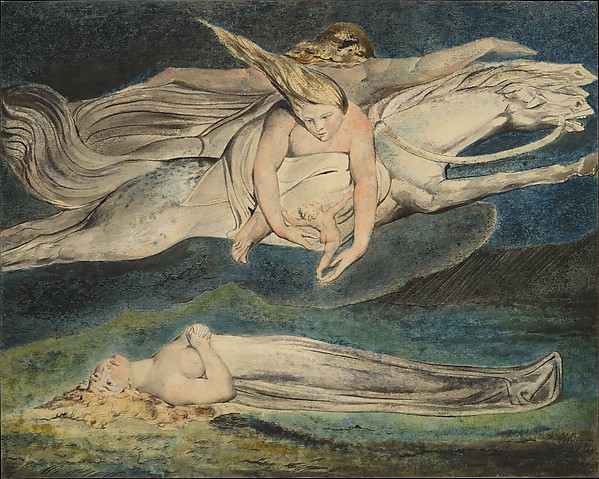
None of Blake's images conveys more passion, power or enigma than does the Large Color Print which goes by the name Pity. Blake seems to be representing the compassion of a divine being in providing for the supine woman whose feet are in a shroud. The babe is descending from the hands of a woman on an airborne horse. In this copy the resting woman's breast is bare as if prepared to nurse the child.

Metropolitan Museum of Art 
Large Color Print
Pity 
In Blake's poetry pity can be cruel and destructive when in the hands of fallen men and women. Los's pity for Urizen in chains prevented him from halting the fall.
Urizen, Plate 14, (E 77)
"6. Los wept obscur'd with mourning:
His bosom earthquak'd with sighs;
He saw Urizen deadly black,                     
In his chains bound, & Pity began,

7. In anguish dividing & dividing
For pity divides the soul" 
In this poem the attributes which are beneficent in the hands of the angel are used by the devil to create misery. 
Songs and Ballads, (E 470)
"I heard an Angel singing
When the day was springing                                      
Mercy Pity Peace    
Is the worlds release

Thus he sung all day                         
Over the new mown hay
Till the sun went down
And haycocks looked brown

I heard a Devil curse
Over the heath & the furze                
Mercy could be no more
If there was nobody poor

And pity no more could be
If all were as happy as we
At his curse the sun went down
And the heavens gave a frown

Down pourd the heavy rain   
Over the new reapd grain
And Miseries increase       
Is Mercy Pity Peace"   
As a means of understanding the return journey from the depths of Ulro, the pity of which we speak is an Eternal characteristic. If we look at the picture Pity as a stage in the return of man to Eternity, it portrays the assistance which is provided to man by the Divine Hand and by the emanation in reaching the point at which the Savior can be born in his heart.
Jerusalem, Plate 50, (E 200) 
Come O thou Lamb of God and take away the remembrance of Sin
To Sin & to hide the Sin in sweet deceit. is lovely!!            
To Sin in the open face of day is cruel & pitiless! But
To record the Sin for a reproach: to let the Sun go down
In a remembrance of the Sin: is a Woe & a Horror!
A brooder of an Evil Day, and a Sun rising in blood
Come then O Lamb of God and take away the remembrance of Sin     

Jerusalem, Plate 59, (E 209)
"And one Daughter of Los sat at the fiery Reel & another
Sat at the shining Loom with her Sisters attending round
Terrible their distress & their sorrow cannot be utterd
And another Daughter of Los sat at the Spinning Wheel
Endless their labour, with bitter food. void of sleep,           
Tho hungry they labour: they rouze themselves anxious
Hour after hour labouring at the whirling Wheel
Many Wheels & as many lovely Daughters sit weeping

Yet the intoxicating delight that they take in their work
Obliterates every other evil; none pities their tears            
Yet they regard not pity & they expect no one to pity
For they labour for life & love, regardless of any one
But the poor Spectres that they work for, always incessantly"

Jerusalem, Plate 77  (E 232)
"But Jesus is the bright Preacher of Life
Creating Nature from this fiery Law,
By self-denial & forgiveness of Sin.

Go therefore, cast out devils in Christs name
Heal thou the sick of spiritual disease           
Pity the evil, for thou art not sent
To smite with terror & with punishments
Those that are sick, like the Pharisees
Crucifying &,encompassing sea & land
For proselytes to tyranny & wrath,                
But to the Publicans & Harlots go!
Teach them True Happiness, but let no curse
Go forth out of thy mouth to blight their peace
For Hell is opend to heaven; thine eyes beheld
The dungeons burst & the Prisoners set free."      
                                     
Four Zoas, Night IV, Page 56, (E 337)
"The Saviour mild & gentle bent over the corse of Death
Saying If ye will Believe your Brother shall rise again   

And first he found the Limit of Opacity & namd it Satan
In Albions bosom for in every human bosom these limits stand     
And next he found the Limit of Contraction & namd it Adam
While yet those beings were not born nor knew of good or Evil

Then wondrously the Starry Wheels felt the divine hand. Limit 
Was put to Eternal Death Los felt the Limit & saw
The Finger of God touch the Seventh furnace in terror            
And Los beheld the hand of God over his furnaces
Beneath the Deeps in dismal Darkness beneath immensity"

_________________________________

Mark 1
[39] And he went throughout all Galilee, preaching in their synagogues and casting out demons.
[40] And a leper came to him beseeching him, and kneeling said to him, "If you will, you can make me clean."
[41] Moved with pity, he stretched out his hand and touched him, and said to him, "I will; be clean."
[42] And immediately the leprosy left him, and he was made clean.

John 11
[38] Jesus therefore again groaning in himself cometh to the grave. It was a cave, and a stone lay upon it.
[39] Jesus said, Take ye away the stone. Martha, the sister of him that was dead, saith unto him, Lord, by this time he stinketh: for he hath been dead four days.
[40] Jesus saith unto her, Said I not unto thee, that, if thou wouldest believe, thou shouldest see the glory of God?
[41] Then they took away the stone from the place where the dead was laid. And Jesus lifted up his eyes, and said, Father, I thank thee that thou hast heard me.
[42] And I knew that thou hearest me always: but because of the people which stand by I said it, that they may believe that thou hast sent me.
[43] And when he thus had spoken, he cried with a loud voice, Lazarus, come forth.
[44] And he that was dead came forth, bound hand and foot with graveclothes: and his face was bound about with a napkin. Jesus saith unto them, Loose him, and let him go.


Thursday, September 09, 2021

HEAVEN'S GATE

 First posted Nov 2009

Wikipedia Commons

Book of Thel

Plate 1


Wikipedia Commons

Book of Thel

Plate 1

Among other things this abiding image provides a

link between Blake and Dylan's Heaven's Door.

Once again:
"I give you the end of a golden string
Only wind it into a ball:
It will lead you in at Heaven's gate
Built in Jerusalem's wall."
Jeusalem (E 231)

What about the gate? Can you go in? go out?
The Arlington Tempera offers visual instruction
in the matter. From the beginning of time
there have been two passages: to and from
Heaven. The northern passage leads down into
the Sea of Time and Space; the southern passage
leads back up to Eternity. This is the crux of
Blake's myth, and of the Judeo-Chistian one as
well.

If you apply 'gate' to the concordance, you
will find 262 of them. Quite a few gates of
Hell! Two noteworthy gates are (1) at the little
poem, To Morning (E410):

"O holy virgin! clad in purest white,
Unlock heav's' golden gates, and issue forth;
Awake the dawn that sleeps in heaven; let light..."

And then (2) Thel notably traversed the gate in
both directions. From the Vales of Thar (a
region in Heaven) Thel considered the subject
of mortal life, and decided to give it a whirl:
" The eternal gates' terrific porter lifted the
northern bar. Thel enter'd in & saw the
secrets of the land unknown."

But seeing the horrors of 'this vale of tears'
Thel screamed and "Fled back unhinder'd till
she came into the vales of Har."

From the Arlington Tempera you may notice a
maiden holding her bucket and making her way
upward against the stream. Like Thel she had
seen enough and refused mortality.
-----------------------------

"O Christ who holds the open gate,
O Christ who drives the furrow straight,
O Christ, the plough, 0 Christ, the laughter
Of holy white birds flying after,

Lo, all my heart’s field red and torn,
And Thou wilt bring the young green corn,
The young green corn divinely springing,
The young green corn forever singing;

And when the field is fresh and fair
Thy blessed feet shall glitter there,
And we will walk the weeded field,
And tell the golden harvest’s yield,

The corn that makes the holy bread
By which the soul of man is fed,
The holy bread, the food unpriced,
Thy everlasting mercy, Christ." 

Hymn by John Masefield. How Blakean can you get!

Saturday, September 04, 2021

SOUL'S JOURNEY VIII

 First posted  April 2012


Central figures of Arlington Tempera 

 Kathleen Raine has much more to say about the Arlington Tempera from the perspective of one immersed in the classic literature. She traced the influences on Blake from the ancients on through the wisdom handed down through the ages which is known as the perennial philosophy. Because she was conversant with Blake's sources she was able to recognise both the minute detail and the complete design in Blake's symbolism.   

Quotes from Blake and Tradition:

Page 78
"Behind Odysseus, Athena's hand reaches to the lowest steps of the staircase that ascends to the sun's shining realm. Both godesses are pointing the way to the eternal world, though for the moment Odysseus sees neither of them - Leucothea by her own command, Athena because (as Homer tells) he has not yet recognized her. The body, like the soul, returns to eternity, the one as a dissolving cloud, the other as 'the true man.'"

Page 86 
"Porphyry's cave is the womb by which man enters life; but, seen otherwise, it is the grave in which he dies to eternity. However, for those who leave it by the southern gate, it is, conversely, the grave of this world, from which returning souls are born into the world of immortals." 

Page 93
"Homer speaks of the northern and southern entrances of the Cave of the Nymphs; and in explaining these Porphyry passes to astronomical symbolism...by the logic of astrological symbolism it follows that souls enter generation by the moon-governed gate of Cancer, since the moon is the ruler of generation and also of the waters. Conversely, souls leaving this world through the gate of Capricorn enter Saturn's golden country of eternity...These two entrances Blake faithfully depicted in the vital downward current of generation and the radiant staircase rising from the distant extremity of the cave into the golden world."

Page 96
"Blake is suggesting the contrasting states of life in this world as death in the other; or, in this case, the waking in the one as sleep in the other, for the symbolic meaning of sleep and death is the same: the lost vision becomes, in psychological terms, the 'unconscious.'" 

Page 97
"Job is the traveler who enters Experience, the state in which the divine in man sleeps, of dies; when the lost traveller returns, the God awakes. The contrasting states of sleep and waking, a death into life and a reawakening into eternity, form the very substance of Blake's thought."    
  
Just as the consciousness of Odysseus developed through the experiences of his travels, the consciousness of the soul is altered by its passage through materiality. The individual psyche is not static; it is given the opportunity to evolve. The process can be thought of as cyclical. The old is discarded in order that it may be replaced by the new. The awakening is a consequence of going to sleep. Entering into the feminine or projected (externalised) status provides the means of gaining experience. When a new level of development has been assimilated, the psyche returns to the unified wholeness called eternity. Although eternity may not be altered in its completeness by the return of the psyche, the patterns of expression are modified.     

Europe, Plate 3, (E 61)
A PROPHECY
"The deep of winter came; 
What time the secret child,
Descended thro' the orient gates of the eternal day:
War ceas'd, & all the troops like shadows fled to their abodes.

Then Enitharmon saw her sons & daughters rise around. 
Like pearly clouds they meet together in the crystal house:
And Los, possessor of the moon, joy'd in the peaceful night:
Thus speaking while his num'rous sons shook their bright fiery wings

Again the night is come 
That strong Urthona takes his rest, 
And Urizen unloos'd from chains 
Glows like a meteor in the distant north
Stretch forth your hands and strike the elemental strings!
Awake the thunders of the deep."

Here is an earlier post based on the Arlington Tempera.


Thursday, September 02, 2021

SOUL'S JOURNEY VII

Center portion of Arlington Tempera
 From Myspace


First posted Apr 2012 

In the Odyssey, when he returns to Ithaca, Odysseus has a additional task to accomplish. It is that of reuniting with his wife after a ten year absence without communication. He enlists the assistance of Athena and is eventually reunited with Penelope after their long separation. 

To Blake the reunion of the Zoa with his Emanation is an important step in achieving regeneration. Symptomatic of the disintegration of the whole man is the loss of the feminine. An example of the recovery of the emanation is reported in this post of Ahania's return to Urizen. The process is that of re-generation, not of simple return to former conditions.

The central figure in the Arlington Tempera may be simple in appearance but she represents a complex symbol because she is the reconciliation or culmination of multiple mythopoeic threads. If seen as Athena she is the divine assistance which aided Odysseus in his travels and brought about his reunion with his wife. Some may see as well as Athena (the intuition or imagination), Aphrodite (the emotions or source of life, born herself from the sea). 

In Blake's mythic construction she is primarily Jerusalem the spiritual connection of man to God. She is also Vala from whom the veil has been removed returning her to her unblemished beauty of eternity. She is Enitharmon whose work with Los wrought the bodies in which generation traversed the Sea of Time and Space. She is Enion who knew most acutely what it meant for spirit to be separated from matter.   

The emanations are necessary in the created world; in fact they are the expression outwardly of internal realities:  

Jerusalem, Plate 88, (E 246)
"For Man cannot unite with Man but by their Emanations 
Which stand both Male & Female at the Gates of each Humanity
How then can I ever again be united as Man with Man
While thou my Emanation refusest my Fibres of dominion.
When Souls mingle & join thro all the Fibres of Brotherhood
Can there be any secret joy on Earth greater than this?" 

The paradox of Blake's use of the female to connect heaven and earth, is that the separateness of the female is extinguished when man awakes to the unity of Eternity. The fragmentation, which in some accounts began with the appearance of the first female, ends with her disappearance:

Jerusalem, Plate 92, (E 252)
"So Los spoke. Enitharmon answerd in great terror in Lambeths Vale

The Poets Song draws to its period & Enitharmon is no more.
For if he be that Albion I can never weave him in my Looms
But when he touches the first fibrous thread, like filmy dew 
My Looms will be no more & I annihilate vanish for ever
Then thou wilt Create another Female according to thy Will.

Los answerd swift as the shuttle of gold. Sexes must vanish & cease
To be, when Albion arises from his dread repose O lovely Enitharmon:
When all their Crimes, their Punishments their Accusations of Sin: 
All their Jealousies Revenges. Murders. hidings of Cruelty in Deceit
Appear only in the Outward Spheres of Visionary Space and Time.
In the shadows of Possibility by Mutual Forgiveness forevermore
And in the Vision & in the Prophecy, that we may Foresee & Avoid
The terrors of Creation & Redemption & Judgment."


Thursday, August 26, 2021

THE SOUL'S JOURNEY VI

First posted April 2012

Center left portion of Arlington Tempera

By relating the themes in Blake's Arlington Tempera to myths from ancient Greece, Kathleen Raine, in Blake and Tradition, supplies a key to understanding the puzzling picture:

"The living spirits of light and water, reborn in their everlasting youth from Blake's imagination are age-old. They enact the perpetual cycle of the descent and return of souls between an eternal and a temporal world, and the journey through life, under the symbol of a crossing of the sea. Of this journey, the voyage of Odysseus, his dangers and his adventures, his departure and his home-coming to Ithaca, is the type and symbol. In Blake's painting the figure on the sea-verge is Odysseus, newly landed on his native shore, in the cove of the sea god Phorcys, close to the Cave of the Nymphs." (Page 75)

The picture is opened to Homer's archetypal myth by looking through Raine's eyes:
"Odysseus, for the Neoplatonists, symbolised man, whose progress from birth to death, through material existence, is likened to the hero's perilous journey." (Page 79)

The sea itself dominates this segment to the picture. Kathleen Raine identifies the kneeling man in the red robe as Odysseus. The Odyssey records an account of Odysseus' return to his home over the waters after the Battle of Troy. In his sea journey he encounters a series of adventures which expose him to various situations which have psychological import.

Instead of representing the trials of man as he gains experience, Blake suggests the whole of life's journey by portraying a single event from Odysseus' story upon the mighty sea. Probably the main clue to the identity of the man kneeling on the shore is the turning of the gaze away from the direction in which the man is tossing an object into the sea. The account of such an event is in Book V of the Odyssey where the goddess Leucothea (Ino) instructs Odysseus on how to return her girdle which has saved his life:

"Which you shall cast far distant from the shore
Into the Deep, Turning thy face away."

Leucothea had come to the rescue of Odysseus after he had lost all his men and his last ship and even the raft to which he was clinging. In his desperation, Odysseus is assisted by the sea itself in the form of the girdle of the goddess providing the means through which he may reach the islands of the Phaeacians.

On the horizon, the sea goddess accompanied by four horses, is reaching upward into a cloud. Raine tells us that Blake identified the girdle with the body, and that Blake often used the cloud to represent the body. So this portion of the image represents the end of the cycle of physical embodiment of the Soul. Odysseus has relinquished the physical body which was lent to him to traverse the sea (of time and space). Raine points out that Homer used a team of four stallions as a metaphor for the ship which took Odysseus on the final stage of his journey from Phaeacia where he relinquished the girdle. His ultimate destination was Ithaca, the home to which he was returning. The Cave of the Nymphs in the upper right portion of the Arlington Tempera where the descent into a material body began lies near the shore of his homeland.

In The Eternal Drama, Edward Edinger provides this insight into the conclusion of the journey of Odysseus: for the final stage of the return, the body was not required because the ships of the Phaeacians themselves understand the thoughts and minds of men. (Page 121)


Milton, Plate 25 [27], (E 121)
"And Los stood & cried to the Labourers of the Vintage in voice of awe.

Fellow Labourers! The Great Vintage & Harvest is now upon Earth
The whole extent of the Globe is explored: Every scatterd Atom
Of Human Intellect now is flocking to the sound of the Trumpet
All the Wisdom which was hidden in caves & dens, from ancient
Time; is now sought out from Animal & Vegetable & Mineral

The Awakener is come. outstretchd over Europe! the Vision of God is fulfilled
The Ancient Man upon the Rock of Albion Awakes,"

Four Zoas, Night IX, Page 138, (E 406)
"The Sun has left his blackness & has found a fresher morning     
And the mild moon rejoices in the clear & cloudless night 
And Man walks forth from midst of the fires the evil is all consumd
His eyes behold the Angelic spheres arising night & day
The stars consumd like a lamp blown out & in their stead behold
The Expanding Eyes of Man behold the depths of wondrous worlds 
One Earth one sea beneath nor Erring Globes wander but Stars
Of fire rise up nightly from the Ocean & one Sun
Each morning like a New born Man issues with songs & Joy"
 

Tuesday, August 24, 2021

THE SOUL'S JOURNEY V

First posted April 2012

Lower left portion of Arlington Tempera

Following the clockwise circle of life, the soul having been clothed in the garment of flesh, is prepared to enter the Sea of Time and Space. Human life flows into the river of time to be under the dominion to the three fates. Providing the cord with which the fates will allot the life span of each individual, is Blake's Zoa Tharmas. Here is the third male in the picture. In Blake's myth he represents the body including the senses; his element is water. This portion of the Arlington Tempera represents the entry of the soul into the mortal world. The body is experienced as divided from the soul and subject to death.

The three fates are seen allocating the thread of life, measuring it and determining its length. Through the fates we are introduced to the death of the physical life.

Four Zoas , Night IV. PAGE 56, (E 337)
"The Corse of Albion lay on the Rock the sea of Time & Space
Beat round the Rock in mighty waves & as a Polypus
That vegetates beneath the Sea the limbs of Man vegetated
In monstrous forms of Death a Human polypus of Death"

Milton O. Percival, who wrote William Blake's Circle of Destiny, helps us to connect entry into the wartry world of Tharmas with the division into the contraries of spirit and matter; male and female:

"Henceforth the world will know both good and evil and the rigors of vengeance for sin.

Still, Tharmas is not satisfied. Though, as the principle of life within the physical universe he scorns matter, he cannot live with out it. Separated from Enion, he finds himself little more than a formless and meaningless will to be. What is more, he can find no release from his suffering; he is now "immortal in immortal torment." Deathless in his despair, he wanders seeking oblivion. Enion alone can provide it. It is to satisfy this hunger of one contrary for another that the mortal world is made. It is built at Tharmas's command in forms of "death and decay," in the hope that "some little semblance" of Enion may return. In short a mortal world is the logical answer to a dualism of spirit and matter. It is the only conceivable world that will take account of both the physical contraries, one of which has been driven into matter."
(Page 184)
 
Milton, Plate 29 [31], (E 128) 
"Tirzah & her Sisters 
Weave the black Woof of Death upon Entuthon Benython 
In the Vale of Surrey where Horeb terminates in Rephaim 
The stamping feet of Zelophehads Daughters are coverd with Human gore 
Upon the treddles of the Loom, they sing to the winged shuttle: 
The River rises above his banks to wash the Woof: 
He takes it in his arms: be passes it in strength thro his current 
The veil of human miseries is woven over the Ocean 
From the Atlantic to the Great South Sea, the Erythrean.
Such is the World of Los the labour of six thousand years.
Thus Nature is a Vision of the Science of the Elohim.            

                 End of the First Book."
Four Zoas , Night IV, Page 48, (E 332)
"Deformd I see these lineaments of ungratified Desire
The all powerful curse of an honest man be upon Urizen & Luvah
But thou My Son Glorious in brightness comforter of Tharmas
Go forth Rebuild this Universe beneath my indignant power
A Universe of Death & Decay.
Let Enitharmons hands
Weave soft delusive forms of Man above my watry world
Renew these ruind souls of Men thro Earth Sea Air & Fire
To waste in endless corruption. renew thou I will destroy
Perhaps Enion may resume some little semblance
To ease my pangs of heart & to restore some peace to Tharmas

Los answerd in his furious pride sparks issuing from his hair
Hitherto shalt thou come. no further. here thy proud waves cease
"