Showing posts sorted by relevance for query bunyan. Sort by date Show all posts

Tuesday, January 11, 2011

BLAKE & PILGRIM'S PROGRESS

Our posts mentioning Bunyan. 

There were three great English dissenting poets:
John Milton (9 December 1608 - 8 November 1674)
John Bunyan (28 November 1628 - 31 August 1688)
William Blake (28 November 1757 - 12 August 1827)

The first two were influential on the third - William Blake - the subject of this blog. Milton's influence has frequently been mentioned here but we have said less about Bunyan's. Gerda S. Norvig's book Dark Figures in the Desired Country: Blake's Illustrations to the Pilgrim's Progress gives deserved attention to the primary way in which Blake interacted with Bunyan's writing.

Illustrations to Pilgrim's Progress
Plate 8 
Christian Fears the Fire from the Mountain
Blake was slow to acknowledge a debt to Bunyan. It was not until near the end of his life that he took the task of illustrating Pilgrim's Progress. Blake's Bunyan illustrations were made around 1824 after the completion of Illustrations to Book of Job. He had no prospect of having them published in a new edition of Pilgrim's Progress. They were done like most of his work in response to the promptings of his imagination to present his vision in a form which may someday be received.


Blake's early opinion of Bunyan as compared to Milton is expressed in this letter to Hayley:

Letter 52, (E 758)
To William Hayley Esqre Felpham
near Chichester, Sussex

Sth Molton St 4 Decr. 1804
"-- I was about to
have written to you to express my wish that two so unequal
labourers might not be yoked to the same Plow & to desire you if
you could to get Flaxman to do the whole because I thought it
would be (to say the best of myself) like putting John Milton
with John Bunyan"

In Blake's opinion, allegory, as was employed by Bunyan, was a lower form of communication than vision which Blake aimed to use himself as alluded to in this passage:

Vision of the Last Judgment, (E 554)

"The Hebrew Bible & the Gospel of
Jesus are not Allegory but Eternal Vision or Imagination of All
that Exists Fable [al] <&> Allegory]
[<& Visions of Imagination>] ought
to be known as Two Distinct Things & so calld for the Sake of
Eternal Life Plato has made Socrates say that Poets & Prophets do
not Know or Understand what they write or Utter this is a most
Pernicious Falshood. If they do not pray is an inferior Kind to
be calld Knowing Plato confutes himself>"

As Blake matured as an artist and as a Christian (which were one and the same thing to him), he found ways to probe the depths of meaning in Bunyan according to Norvig:

"But in the active days of the Lambeth period (1790 -1800, when Blake lived at 13 Hercules Building, Lambeth), absorbed in the dynamic relations and counterposes of his own prophetic art to the energies of Milton's religious Poetics, Blake evidently did not consider Bunyan compatriot or rival worthy of systematic attention.
...
By the time he had developed a style of serial illustration adequate to handle literary critiques that were, simultaneously, visions of individuation, he was ready to turn to the hermeneutic complexity of the Progress and give it the innovative treatment I will be examining in Chapter 3."
(Page 47)

The illustrations to Pilgrim's Progress have continued to be neglected compared to Blake's other work. Norvig's book, deep as it is, has created an opening for the illustrations to receive the attention they deserve.

"In part the relative neglect of the Bunyan designs is due to the fact that the watercolors themselves, currently among the holdings of the Frick collection in New York city, have been on general view only four times since their arrival in the United States during World War II, and before that in England only once."

Norvig's book is available online.The twenty-eight plates are included following page 128; you will find it hard to locate them elsewhere.

Tuesday, March 03, 2015

Blake and Bunyan


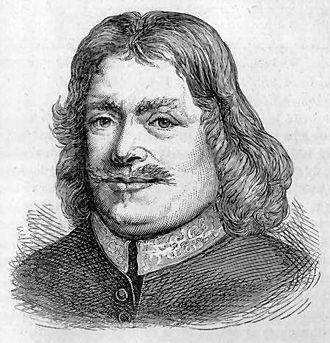
John Bunyan from Wikipedia
The timeline of John Bunyan (1628) lies  between Milton (1608) and Blake (1758).  
Blake was thoroughly familiar with Bunyan but had some serious theological differences 
with him.  In the first place Bunyan's masterpiece, Pilgrim's Progress was an allegory; 
Blake depreciates allegory:

"[[A Vision of the Last Judgment] PAGE 68]:
 The Last Judgment is not Fable or Allegory  but Vision 
Fable or Allegory are a totally distinct & inferior"
(Erdman 554)

However Blake knew and respected Bunyan in spite of their differences.

Blake died in 1828 and began his illustrations of Pilgrim's Progress in 1824.


Here's Bunyan's Introduction to Pilgrim's Progress:

WHEN at the first I took my pen in hand Thus for to write,
 I did not understand That I at all should make a little book In such a mode: 
nay, I had undertook To make another, which when almost done, Before I was aware, 
this begun. And thus it was: I, writing of the way And race of saints in this our gospel day, 
Fell suddenly into an allegory About their journey and the way to glory, 
In more than twenty things, which I set down. This done, I twenty more had in my crown; 
And they again began to multiply, Like sparks that from the coals of fire do fly. 
Nay, then, thought I, if that you breed so fast, I’ll put you by yourselves, 
lest you at last Should prove ad infinitum, and eat out The book that I already am about. 
 Well, so I did: but yet I did not think To show to all the world my pen and ink 
In such a mode; I only thought to make I knew not what. Nor did I undertake 
Thereby to please my neighbour — no, not I! I did it mine own self to gratify.


John Bunyan , baptised 28 November 1628 – 31 August 1688) was an English writer and preacher best remembered as the author of the religious allegory The Pilgrim's Progress.

In addition to The Pilgrim's Progress, Bunyan wrote nearly sixty titles, many of them expanded sermons.

Bunyan came from the village of Elstow, near Bedford. He had little schooling and at the age of sixteen joined the Parliamentary army during the first stage of the English Civil War. After three years in the army he returned to Elstow and took up the trade of tinker, which he had learnt from his father.

He became interested in religion after his marriage, attending first the parish church and then joining the Bedford Meeting, a nonconformist group in Bedford, and becoming a preacher.

After the restoration of the monarch, when the freedom of nonconformists was curtailed, Bunyan was arrested and spent the next twelve years in gaol as he refused to undertake to give up preaching. During this time he wrote a spiritual autobiography, Grace Abounding to the Chief of Sinners, and began work on his most famous book, The Pilgrim's Progress, which was not published until some years after his release.

Bunyan's later years, in spite of another shorter term of imprisonment, were spent in relative comfort as a popular author and preacher, and pastor of the Bedford Meeting. He died aged 59 or 60 after falling ill on a journey to London and is buried in Bunhill Fields.

The Pilgrim's Progress became one of the most published books in the English language; 1,300 editions having been printed by 1938, 250 years after the author's death.

Thursday, May 14, 2015

Pilgrim 14


Here is Plate 3 of Blake's Illustrations:


Pilgrims's Progress John Bunyan 
"{12} Now, I saw, upon a time, when he was walking in the fields, that he was, as he was wont, reading in his book, and greatly distressed in his mind; and, as he read, he burst out, as he had done before, crying, "What shall I do to be saved?" 
{13} I saw also that he looked this way and that way, as if he would run; yet he stood still, because, as I perceived, he could not tell which way to go. I looked then, and saw a man named Evangelist coming to him and asked, Wherefore dost thou cry? 


(KJV). 
Job 13:23
If there be a messenger with him, an interpreter, one among a thousand, to shew unto man his uprightness: 
)
{14} He answered, Sir, I perceive by the book in my hand, that I am condemned to die, and after that to come to judgement [Heb. 9:27];

KingJamesBible 
And as it is appointed unto men once to die, but after this the judgment: .

and I find that I am not willing to do the first 
,
JOB 16:21 (1611 KING JAMES BIBLE)
 O that one might plead for a man with God, as a man pleadeth for his neighbour. ... 

nor able to do the second.
 [Ezekiel 22:14 Can thine heart endure, or can thine hands be strong, in the days that I shall deal with thee? I the LORD have spoken [it], and will do [it].

CHRISTIAN no sooner leaves the World but meets EVANGELIST, who lovingly him greets With tidings of another: and doth show Him how to mount to that from this below. 
{15} Then said Evangelist, Why not willing to die, since this life is attended with so many evils? The man answered, Because I fear that this burden is upon my back will sink me lower than the grave, and I shall fall into Tophet. 
Isaiah 30:33 For Tophet is ordained of old; yea, for the... Read chapter in King James Version.

 And, Sir, if I be not fit to go to prison, I am not fit, I am sure, to go to judgement, and from thence to execution; and the thoughts of these things make me cry. 
{16} Then said Evangelist, If this be thy condition, why standest thou still? He answered, Because I know not whither to go. Then he gave him a parchment roll, and there was written within, Flee from the wrath to come. 

[Matt. 3.7] 
But when he saw many of the Pharisees and Sadducees coming to his baptism, he said to them, “You brood of vipers! Who warned you to flee from...


{17} The man therefore read it, and looking upon Evangelist very carefully, said, Whither must I fly? Then said Evangelist, pointing with his finger over a very wide field, Do you see yonder wicket-gate? 
Matt. 7:13,14] 
Enter by the narrow gate. For the gate is wide and the way is easy that leads to destruction, and those who enter by it are many.


He said, I think I do. Then said Evangelist, Keep that light in your eye, and go up directly thereto: so shalt thou see the gate; at which, when thou knockest, it shall be told thee what thou shalt do."

Illustrations to Pilgrim's Progress
Plate 3
Christian Meets Evangelist
Blake's third illustration to Bunyan's Pilgrim's Progress shows the meeting of Christian and the Evangelist. Bunyan himself could be the Evangelist since he was employed as both a tinker and an itinerant preacher. Blake pictures alternatives which are available to Pilgrim as he considers his journey: the city of destruction from which he came, the forest of confusion, the mountain of illumination, and the gate to which Evangelist directs him. The gate, however, is not pictured in the direction Evangelist points but close-by if Christian were to look back. Significantly Pilgrim is no longer is scrutinizing his book of scripture from which he could directly encounter God's Word.  

There was a broad range of dissenting Christians in England from the time of Bunyan and Milton and Fox in the 17th century to Blake's time in the 18th and 19th centuries. Although Blake and Bunyan were both dissenters their theologies were vastly different. Bunyan was from the Puritan tradition, Blake determined to create his own system rather than be enslaved to another mans. Pilgrim's Progress conforms to the approach to religious faith and practice which Bunyan sought to propagate. The path was predetermined and one's choices were limited. Bunyan and Blake both went to scripture as their primary source of spiritual teaching but approached it differently.  

Bunyan nterpreted scripture literally; Blake saw each passage symbolizes spiritual rather than literal truth.

Gerda Norvig explains this difference on Page 37 of Dark Figures in the Desired Country:
"The reason for this rigidity was that there was no [Puritan] sanction for interpreting episodes of Scripture as dynamic myth or vision, quite the reverse. Many influential tracts warned readers not to 'raise their contemplations by fancy and imagination above Scripture revelation' lest they dark[en] counsel without  knowledge, uttering thing which they understood not, which have no substance or spiritual food of faith in them.' Blake's conception that the purpose of scriptural prophecy, like that of art, was 'to open the immortal Eyes of Man inwards into the Worlds of Thought: into Eternity / Ever expanding' would have seemed anathema to the Puritan exegete of Bunyan's day. The inner worlds of thought were simply not felt to be trustworthy enough regions in which to find truth, and the idea of expanding into eternity would have terrified men and women who sought definitive boundaries to clarify a shaky divine identity and to keep them safely focused on the straight and narrow." 

Blake searched Pilgrim's Progress for episodes which would lend themselves to support his own experience that the scripture was meant to be internalized, enabling it to become transformative. Bunyan thought in terms of altering outward behavior by following the path to salvation outlined by his Puritan faith. Blake, however recognized the critical events in Pilgrim's journey were changes in the psyche which allowed the pilgrim or the dreamer to achieve further growth toward becoming healed and whole (or individuated as Jung would define it.) 

Letters, Number 52, (E 758) 
 "For O happiness never enough to be
grateful for! I have lost my Confusion of Thought while at work &
am as much myself when I take the Pencil or Graver into my hand
as I used to be in my Youth I have indeed fought thro a Hell of
terrors & horrors (which none could know but myself.) in a
Divided Existence now no longer Divided. nor at war with myself I
shall travel on in the Strength of the Lord God as Poor Pilgrim
says" 
Vision of Last Judgment, (E 554)
"The Last Judgment is not Fable or Allegory
but Vision   Fable or Allegory are a totally distinct & inferior
kind of Poetry.  Vision or Imagination is a Representation of
what Eternally Exists.  Really & Unchangeably.  Fable or Allegory
is Formd by the Daughters of Memory.  Imagination is Surrounded
by the daughters of Inspiration who in the aggregate are calld
Jerusalem     The Hebrew Bible & the Gospel of
Jesus are not Allegory but Eternal Vision or Imagination of All
that Exists   Pilgrims Progress is full of it   the Greek Poets the
same but  ought
to be known as Two Distinct Things & so calld for the Sake of
Eternal Life"  

Wednesday, February 04, 2015

PILGRIM & EVANGELIST

Pilgrims's Progress John Bunyan
"{12} Now, I saw, upon a time, when he was walking in the fields, that he was, as he was wont, reading in his book, and greatly distressed in his mind; and, as he read, he burst out, as he had done before, crying, "What shall I do to be saved?"
{13} I saw also that he looked this way and that way, as if he would run; yet he stood still, because, as I perceived, he could not tell which way to go. I looked then, and saw a man named Evangelist coming to him and asked, Wherefore dost thou cry? [Job 33:23]
{14} He answered, Sir, I perceive by the book in my hand, that I am condemned to die, and after that to come to judgement [Heb. 9:27]; and I find that I am not willing to do the first [Job 16:21], nor able to do the second. [Ezek. 22:14]
CHRISTIAN no sooner leaves the World but meets EVANGELIST, who lovingly him greets With tidings of another: and doth show Him how to mount to that from this below.
{15} Then said Evangelist, Why not willing to die, since this life is attended with so many evils? The man answered, Because I fear that this burden is upon my back will sink me lower than the grave, and I shall fall into Tophet. [Isa. 30:33] And, Sir, if I be not fit to go to prison, I am not fit, I am sure, to go to judgement, and from thence to execution; and the thoughts of these things make me cry.
{16} Then said Evangelist, If this be thy condition, why standest thou still? He answered, Because I know not whither to go. Then he gave him a parchment roll, and there was written within, Flee from the wrath to come. [Matt. 3.7]
{17} The man therefore read it, and looking upon Evangelist very carefully, said, Whither must I fly? Then said Evangelist, pointing with his finger over a very wide field, Do you see yonder wicket-gate? [Matt. 7:13,14] The man said, No. Then said the other, Do you see yonder shining light? [Ps. 119:105; 2 Pet. 1:19] He said, I think I do. Then said Evangelist, Keep that light in your eye, and go up directly thereto: so shalt thou see the gate; at which, when thou knockest, it shall be told thee what thou shalt do."
Illustrations to Pilgrim's Progress
Plate 3
Christian Meets Evangelist
Blake's third illustration to Bunyan's Pilgrim's Progress shows the meeting of Christian and the Evangelist. Bunyan himself could be the Evangelist since he was employed as both a tinker and an itinerant preacher. Blake pictures alternatives which are available to Pilgrim as he considers his journey: the city of destruction from which he came, the forest of confusion, the mountain of illumination, and the gate to which Evangelist directs him. The gate, however, is not pictured in the direction Evangelist points but close-by if Christian were to look back. Significantly Pilgrim is no longer is scrutinizing his book of scripture from which he could directly encounter God's Word. 

There was a broad range of dissenting Christians in England from the time of Bunyan and Milton and Fox in the 17th century to Blake's time in the 18th and 19th centuries. Although Blake and Bunyan were both dissenters their theologies were vastly different. Bunyan was from the Puritan tradition, Blake determined to create his own system rather than be enslaved to another mans. Pilgrim's Progress conforms to the approach to religious faith and practice which Bunyan sought to propagate. The path was predetermined and one's choices were limited. Bunyan and Blake both went to scripture as their primary source of spiritual teaching but approached it differently. 

Gerda Norvig explains this difference on Page 37 of Dark Figures in the Desired Country:
"The reason for this rigidity was that there was no [Puritan] sanction for interpreting episodes of Scripture as dynamic myth or vision, quite the reverse. Many influential tracts warned readers not to 'raise their contemplations by fancy and imagination above Scripture revelation' lest they dark[en] counsel without  knowledge, uttering thing which they understood not, which have no substance or spiritual food of faith in them.' Blake's conception that the purpose of scriptural prophecy, like that of art, was 'to open the immortal Eyes of Man inwards into the Worlds of Thought: into Eternity / Ever expanding' would have seemed anathema to the Puritan exegete of Bunyan's day. The inner worlds of thought were simply not felt to be trustworthy enough regions in which to find truth, and the idea of expanding into eternity would have terrified men and women who sought definitive boundaries to clarify a shaky divine identity and to keep them safely focused on the straight and narrow."

Blake searched Pilgrim's Progress for episodes which would lend themselves to support his own experience that the scripture was meant to be internalized, enabling it to become transformative. Bunyan thought in terms of altering outward behavior by following the path to salvation outlined by his Puritan faith. Blake, however recognized the critical events in Pilgrim's journey were changes in the psyche which allowed the pilgrim or the dreamer to achieve further growth toward becoming healed and whole (or individuated as Jung would define it.)

Letters, Number 52, (E 758) 
 "For O happiness never enough to be
grateful for! I have lost my Confusion of Thought while at work &
am as much myself when I take the Pencil or Graver into my hand
as I used to be in my Youth I have indeed fought thro a Hell of
terrors & horrors (which none could know but myself.) in a
Divided Existence now no longer Divided. nor at war with myself I
shall travel on in the Strength of the Lord God as Poor Pilgrim
says" 
Vision of Last Judgment, (E 554)
"The Last Judgment is not Fable or Allegory
but Vision   Fable or Allegory are a totally distinct & inferior
kind of Poetry.  Vision or Imagination is a Representation of
what Eternally Exists.  Really & Unchangeably.  Fable or Allegory
is Formd by the Daughters of Memory.  Imagination is Surrounded
by the daughters of Inspiration who in the aggregate are calld
Jerusalem     The Hebrew Bible & the Gospel of
Jesus are not Allegory but Eternal Vision or Imagination of All
that Exists   Pilgrims Progressis full of it   the Greek Poets the
same but  ought
to be known as Two Distinct Things & so calld for the Sake of
Eternal Life"  

Monday, March 21, 2016

PILGRIM & EVANGELIST

Reposted from February 04, 2015. 

Pilgrims's Progress 
John Bunyan
"{12} Now, I saw, upon a time, when he was walking in the fields, that he was, as he was wont, reading in his book, and greatly distressed in his mind; and, as he read, he burst out, as he had done before, crying, "What shall I do to be saved?"
{13} I saw also that he looked this way and that way, as if he would run; yet he stood still, because, as I perceived, he could not tell which way to go. I looked then, and saw a man named Evangelist coming to him and asked, Wherefore dost thou cry? [Job 33:23]
{14} He answered, Sir, I perceive by the book in my hand, that I am condemned to die, and after that to come to judgement [Heb. 9:27]; and I find that I am not willing to do the first [Job 16:21], nor able to do the second. [Ezek. 22:14]
CHRISTIAN no sooner leaves the World but meets EVANGELIST, who lovingly him greets With tidings of another: and doth show Him how to mount to that from this below.
{15} Then said Evangelist, Why not willing to die, since this life is attended with so many evils? The man answered, Because I fear that this burden is upon my back will sink me lower than the grave, and I shall fall into Tophet. [Isa. 30:33] And, Sir, if I be not fit to go to prison, I am not fit, I am sure, to go to judgement, and from thence to execution; and the thoughts of these things make me cry.
{16} Then said Evangelist, If this be thy condition, why standest thou still? He answered, Because I know not whither to go. Then he gave him a parchment roll, and there was written within, Flee from the wrath to come. [Matt. 3.7]
{17} The man therefore read it, and looking upon Evangelist very carefully, said, Whither must I fly? Then said Evangelist, pointing with his finger over a very wide field, Do you see yonder wicket-gate? [Matt. 7:13,14] The man said, No. Then said the other, Do you see yonder shining light? [Ps. 119:105; 2 Pet. 1:19] He said, I think I do. Then said Evangelist, Keep that light in your eye, and go up directly thereto: so shalt thou see the gate; at which, when thou knockest, it shall be told thee what thou shalt do."

Illustrations to Pilgrim's Progress
Plate 3
Christian Meets Evangelist
Blake's third illustration to Bunyan's Pilgrim's Progress shows the meeting of Christian and the Evangelist. Bunyan himself could be the Evangelist since he was employed as both a tinker and an itinerant preacher. Blake pictures alternatives which are available to Pilgrim as he considers his journey: the city of destruction from which he came, the forest of confusion, the mountain of illumination, and the gate to which Evangelist directs him. The gate, however, is not pictured in the direction Evangelist points but close-by if Christian were to look back. Significantly Pilgrim is no longer is scrutinizing his book of scripture from which he could directly encounter God's Word. 

There was a broad range of dissenting Christians in England from the time of Bunyan and Milton and Fox in the 17th century to Blake's time in the 18th and 19th centuries. Although Blake and Bunyan were both dissenters their theologies were vastly different. Bunyan was from the Puritan tradition; Blake determined to create his own system rather than be enslaved to another mans. Pilgrim's Progress conforms to the approach to religious faith and practice which Bunyan sought to propagate. The path was predetermined and one's choices were limited. Bunyan and Blake both went to scripture as their primary source of spiritual teaching but approached it differently. 

Gerda Norvig explains this difference on Page 37 of Dark Figures in the Desired Country:
"The reason for this rigidity was that there was no [Puritan] sanction for interpreting episodes of Scripture as dynamic myth or vision, quite the reverse. Many influential tracts warned readers not to 'raise their contemplations by fancy and imagination above Scripture revelation' lest they dark[en] counsel without  knowledge, uttering thing which they understood not, which have no substance or spiritual food of faith in them.' Blake's conception that the purpose of scriptural prophecy, like that of art, was 'to open the immortal Eyes of Man inwards into the Worlds of Thought: into Eternity / Ever expanding' would have seemed anathema to the Puritan exegete of Bunyan's day. The inner worlds of thought were simply not felt to be trustworthy enough regions in which to find truth, and the idea of expanding into eternity would have terrified men and women who sought definitive boundaries to clarify a shaky divine identity and to keep them safely focused on the straight and narrow."

Blake searched Pilgrim's Progress for episodes which would lend themselves to support his own experience that the scripture was meant to be internalized, enabling it to become transformative. Bunyan thought in terms of altering outward behavior by following the path to salvation outlined by his Puritan faith. Blake, however recognized the critical events in Pilgrim's journey were changes in the psyche which allowed the pilgrim or the dreamer to achieve further growth toward becoming healed and whole (or individuated as Jung would define it.)

Letters, Number 52, (E 758) 
 "For O happiness never enough to be
grateful for! I have lost my Confusion of Thought while at work &
am as much myself when I take the Pencil or Graver into my hand
as I used to be in my Youth I have indeed fought thro a Hell of
terrors & horrors (which none could know but myself.) in a
Divided Existence now no longer Divided. nor at war with myself I
shall travel on in the Strength of the Lord God as Poor Pilgrim
says" 

Vision of Last Judgment, (E 554)
"The Last Judgment is not Fable or Allegory
but Vision   Fable or Allegory are a totally distinct & inferior
kind of Poetry.  Vision or Imagination is a Representation of
what Eternally Exists.  Really & Unchangeably.  Fable or Allegory
is Formd by the Daughters of Memory.  Imagination is Surrounded
by the daughters of Inspiration who in the aggregate are calld
Jerusalem     The Hebrew Bible & the Gospel of
Jesus are not Allegory but Eternal Vision or Imagination of All
that Exists   Pilgrims Progress is full of it   the Greek Poets the
same but  ought
to be known as Two Distinct Things & so calld for the Sake of
Eternal Life"  

Monday, April 13, 2015

Pilgrim 1

Here is a copy of Pilgrim's  Progress from the ccel.

There's an interesting time line:

Death of Queen Elizabeth 1603
Birth of Shakespeare: 1616
Birth of George Fox: 1624 was a few years older than Bunyan.
Baptism of John Bunyan 1628; he died in 1688.
Birth of William Blake 1758

Bunyan was among the best of the Puritans; he lived before the Enlightenment. Like Bunyan Fox was a dissenter but by no means a puritan.


Blake lived during the Enlightenment and virtually initiated the Romantic Movement (1800-1850).

Bunyan's father was a tinker (: a person who in the past traveled to different places and made money by selling or repairing small items such as pots and pans).

His son traveled in his father's footsteps.


The Bunyans were nonconformists, and John Bunyan joined the Parliamentary Army. At the end of the war he (and many others spent some time in prison.


Blake disagreed theologically with Fox and Bunyan, but was certainly to some extent influenced by each of them.

           Title: The Pilgrim's Progress
      Creator(s): Bunyan, John (1628-1688)
          Rights: Public Domain
   CCEL Subjects: All; Classic; Fiction
      LC Call no: PR3300
     LC Subjects:

                  English literature

                  17th and 18th centuries (1640-1770)
     ________________________________________________

                             The Pilgrim's Progress

From This World to That Which is to Come;

Delivered under the Similitude of a Dream

by John Bunyan

Friday, January 21, 2011

BLAKE AS PILGRIM

Blake made one illustration to Pilgrim's Progress which is not considered to be a part of the 28 plate series which Norvig focused her attention on. It belongs to the National Gallery of Art in Washington, DC rather than to the Frick Collection in New York. It was once called A Warrior with Angels but now goes by the name of Christian with the Shield of Faith, Taking Leave of His Companions.
National Gallery of Art

Christian with the Shield of Faith,
Taking Leave of His Companions
A friend has made the observation that the central character in this image which represents Christian, has the appearance of William Blake himself as a young man. Perhaps Blake cast himself and his loved ones or his characters in the roles of Christian and his companions. The appearance of Christian in this image does not resemble Christian in the series, and these companions don't appear elsewhere in the illustration to Pilgrim's Progress.

If Blake identified with Bunyan's Christian and inserted himself in an illustration, who would be the lovely ladies who accompany him? Could one be Catherine (the one to Blake's left), his companion in life, his Enitharmon? I suggest that the woman to Christian's (Blake's) right is his Jerusalem the source of his inspiration and imagination, the Divine Vision which he recognized in every individual. Vala the shadow of Jerusalem is shown perhaps as the woman behind Jerusalem in the second tier. The fourth woman who is reaching upward as if a connecting link to the Celestial City may be Enion of whom Damon says "The eternal [not the temporal] Enion rises in the dawn of the third day, in a whirlwind...she casts off her death-clothes, for the winter is gone, and all nature is rejuvenated. Tharmas embraces her and raises her through the heavens, sounding his trumpet to wake the dead." These identifications would turn the image into an illustration for Blake's life and myth rather than for Bunyan's allegory.

Jerusalem, PLATE 54 (E 203)
"In Great Eternity, every particular Form gives forth or Emanates
Its own peculiar Light, & the Form is the Divine Vision
And the Light is his Garment This is Jerusalem in every Man
A Tent & Tabernacle of Mutual Forgiveness Male & Female
Clothings.
And Jerusalem is called Liberty among the Children of Albion"

Jerusalem, PLATE 39 [44],(E 187)
"Man is adjoind to Man by his Emanative portion:
Who is Jerusalem in every individual Man: and her
Shadow is Vala, builded by the Reasoning power in Man
O search & see: turn your eyes inward: open O thou World
Of Love & Harmony in Man: expand thy ever lovely Gates."

If Blake broke away from the overall structure of his series, it is understandable that he would withdraw the illustration from the series. It would have become his personal record of his role as a pilgrim or traveller to Eternity.

Blake's ideas about the destination of the traveller are different from Bunyan's since Bunyan was a Puritan who adhered to the doctrine of predestination including eternal damnation. Bake's traveller's journey would not be measured by moral virtue or inclusion in the class of the elect. Blake would not be receptive to the accumulation of doctrine through which the Puritans sought to regulate and demonstrate their status as among the saved. Bunyan stopped short of the entry into the divine province by his dreamer, although the pilgrims entered the city after crossing the river of death. Bunyan's Celestial City was to be the destiny in the afterlife of those who followed the path outlined for the repentant sinner. One of Bunyan's final scenes shows that one ignorant of the requirements of that route would find himself destined for hell. In contrast Blake's teaching was that error would be annihilated so that all may experience Eternity through connecting with the inner Divinity (that of God in every man as Quakers say.)

Consider the words in the following passage from the beginning of Jerusalem as Blake's response to Bunyan's dreamer who followed the journey of the pilgrim. Awake from the dream that 'states' through which men pass are human existence. Awake from the image of God as afar rather than within. Awake from the idea that Evil must be punished rather than forgiven. Awake to the idea that the Emanation is to be interiorized not projected or rejected.

Jerusalem, Plate 4,(E 146)
"Awake! awake O sleeper of the land of shadows, wake! expand!
I am in you and you in me, mutual in love divine:
Fibres of love from man to man thro Albions pleasant land.
In all the dark Atlantic vale down from the hills of Surrey
A black water accumulates, return Albion! return!
Thy brethren call thee, and thy fathers, and thy sons,
Thy nurses and thy mothers, thy sisters and thy daughters
Weep at thy souls disease, and the Divine Vision is darkend:
Thy Emanation that was wont to play before thy face,
Beaming forth with her daughters into the Divine bosom
[Where!!]
Where hast thou hidden thy Emanation lovely Jerusalem
From the vision and fruition of the Holy-one?
I am not a God afar off, I am a brother and friend;
Within your bosoms I reside, and you reside in me:
Lo! we are One; forgiving all Evil; Not seeking recompense!
Ye are my members O ye sleepers of Beulah, land of shades!"

Friday, January 23, 2015

THE INTERPRETER

Wikimedia Commons
Christian with the Shield of Faith
When Blake met John Linnell in 1818 and there gathered around him a group of young men, mostly artists, he became their mentor. They were drawn to him because they recognized his skills as an artist and because they saw the light of truth which shown through his life and work. A fellowship grew among the youthful followers and the man whom only the eyes of vision could identify as Bunyan's Interpreter.

 
In Pilgrim's Progress, Bunyan introduces Pilgrim to the House of the Interpreter midway through his journey, in order to receive guidance which would inwardly prepare him for the challenges ahead.

 
It was Blake's privilege, as one of a long line of dissenting Christians, to take up the mantle of Interpreter from Bunyan's character who directed Christian along the path to the Celestial City.

 
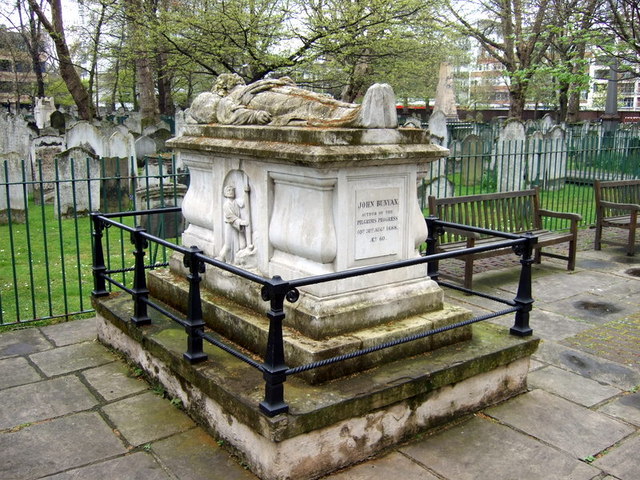
As reported in an earlier post, Bunhill Fields is the final resting place of William Blake, George Fox and John Wesley (nearby). John Bunyan is among the company of dissenters resting there too. Included also are Blake's parents and his brother Robert.

Four Zoas, Night IV, Page 64, (E 344)
"O Fool to think that I could hide from his all piercing eyes
The gold & silver & costly stones his holy workmanship
O Fool could I forget the light that filled my bright spheres
Was a reflection of his face who calld me from the deep          

I well remember for I heard the mild & holy voice
Saying O light spring up & shine & I sprang up from the deep   
He gave to me a silver scepter & crownd me with a golden crown
& said Go forth & guide my Son who wanders on the ocean"  
Pilgrim's Progress
by John Bunyan
        "Then Christian began to gird up his loins, and to address himself to his Journey. So the other told him, That by that he was gone some distance from the Gate, he would come at the house of the Interpreter, at whose door he should knock, and he would show him excellent things. Then Christian took his leave of his Friend, and he again bid him God speed.

        Then he went on till he came at the house of the Interpreter, where he knocked over and over; at last one came to the door, and asked, Who was there?

        Christian: Sir, here is a Traveler, who was bid by an acquaintance of the Good Man of this house, to call here from my profit; I would therefore speak with the Master of the house: So he called for the Master of the house; who after a little time came to Christian, and asked him what he would have?

        Christian: Sir, said Christian, I am a man that am come from the City of Destruction, and am going to the Mount Zion; and I was told by the Man that stands at the Gate, at the head of this way, that if I called here, you would show me excellent things, such as would be a help to me in my Journey.

        Interpreter: Then said the Interpreter, Come in; I will show you that which will be profitable to you. So he commanded his man to light the Candle, and bid Christian follow him."


Bunyan's grave. More about Bunhill Fields. Another post featuring this picture.

Saturday, February 07, 2015

Thomas Taylor

Thomas Taylor

The Hymns of Orpheus, Thomas Taylor, translator
A Dissertation on the Life and Theology of Orpheus: 
The Hymns of Orpheus, Thomas Taylor, translator

The complete poetry and prose of ... - Google BooksSince its first publication in 1965, this collection has been widely hailed as the best available text of William Blake's poetry and prose. It is now expanded to include a new foreword by Harold Bloom, his definitive statement on Blake's greatness.

Dark figures in the desired country ... - Google BooksToward the end of his life, William Blake produced a beautiful sequence of 28 watercolor drawings to illustrate Bunyan's Pilgrim's Progress. These rarely seen drawings show him at the peak of his powers, radically reinterpreting one of the central texts of English literature. Gerda Norvig's book, with its stunning color reproductions, offers the first detailed study of these important works of art.Norvig sets the watercolors in the context of Blake's lifelong engagement with Bunyan's myth and in relation to the Puritan writer's own artistic and critical methods. She shows how deeply Blake's love-hate relationship with Bunyan influenced not only these particular drawings but also Blake's revolutionary theories of art and poetics. With judicious use of psychoanalytical and post-structuralist critical theory, she demonstrates that Blake's pictorial interpretation of The Pilgrim's Progress tells a contemporary, self-reflexive tale about interpretation. Blake implicates author, narrator, and reader in a dream-protagonist's never-ending search for a proper stance on the relations of self and other. Toward the end of his life, William Blake produced a beautiful sequence of 28 watercolor drawings to illustrate Bunyan's Pilgrim's Progress. These rarely seen drawings show him at the peak of his powers, radically reinterpreting one of the central texts of English literature. Gerda Norvig's book, with its stunning color reproductions, offers the first detailed study of these important works of art.Norvig sets the watercolors in the context of Blake's lifelong engagement with Bunyan's myth and in relation to the Puritan writer's own artistic and critical methods. She shows how deeply Blake's love-hate relationship with Bunyan influenced not only these particular drawings but also Blake's revolutionary theories of art and poetics. With judicious use of psychoanalytical and post-structuralist critical theory, she demonstrates that Blake's pictorial interpretation of The Pilgrim's Progress tells a contemporary, self-reflexive tale about interpretation. Blake implicates author, narrator, and reader in a dream-protagonist's never-ending search for a proper stance on the relations of self and other.

THOMAS TAYLOR, THE PLATONIST.\

This from:
(A Biographical and Bibliographical Sketch. BY WILLIAM E. A. AXON. ) The singular and interesting man who is known to us as
Taylor, the Platonist, was born in London in the year 1758, and
his parents we are told were "obscure but worthy." His father
was Joseph Taylor, staymaker, of Round Court, St. Martins-le-
Grand, where the future Platonist was probably born.
He was a weakly child, and signs of consumption induced his family to
send him into Staffordshire. He returned to the metropolis in
his ninth year, and was admitted at St. Paul's School, April ,1767.
His parents designed him for the Nonconformist ministry.
His affection for philosophy, as distinguished from
the mere verbal acquaintance with classics, was so marked, that
when an ethical or specially grand sentence occurred in an
author he was construing, the surmaster, Mr. William Rider,
would say, " Come, here is something worthy the attention of
a philosopher."
He early discovered critical powers, which
enabled him to notice and correct a blunder in the printing of a
Latin Testament. He had now to disappoint his father, whose
reverence for the ministerial office led him to regard it as
"the most desirable and most enviable employment upon earth",
and who was correspondingly troubled when he found that his
talented son had no desire to occupy that office, and had so great
a dislike to the public school teaching and languages as it then
was that he begged to be taken home again.
At home young Taylor picked up a copy of Ward's Young
Mathematician's Guide, and this gave him a turn for mathematics,
in which he afterwards excelled, and to which he himself as-
cribed no small share of his success afterwards as a translator
of Greek philosophy. Owing to his father's opposition his early
studies in mathematics were pursued in hours stolen from rest,
and he slept with a tinder-box under his pillow. He was sent
at fifteen to work under an uncle-in-law at Sheerness Dockyard,
but rather than endure this unpleasant situation he attempted to
fall in with his father's views and became pupil to a dissenting
minister. He studied Greek and Latin in the day, courted Miss
Morton in the evening, and at night read Simson's Conic Sections
in the Latin edition. His judgment on Newton, after reading
the Principia, was that he was a great mathematician but no
philosopher ! Miss Morton's father intended his daughter for
a richer man, but the young couple decided upon the imme-
diate performance of the marriage ceremony, whilst postponing
married life until the return of the bridegroom from Aberdeen
University, where he was to finish his education.
The stepmother of Taylor found out the secret, and the young\couple had a bad time of it. The bride's father was induced whendying to leave any payments to her to the discretion of a rela-
tive whose fault was not that of open-handed liberality. For
about a year the philosopher and his wife had only about seven
shillings a week on which to live. Taylor obtained a situation
as usher, and was only able to see his wife upon the Saturday
afternoon. He next obtained a position in Lubbock's Bank at a
salary of fifty pounds, paid quarterly, and endured great priva-
tions from want of money, so that frequently from want of food
he would be in a fainting condition on reaching home. Even
under these discouraging circumstances Taylor did not neglect
study, and turned his mind to the unprofitable consideration of
Becker's Physica Subterranea and quadrature of the circle.


Wednesday, February 18, 2015

INTERPRETER'S PARLOUR II

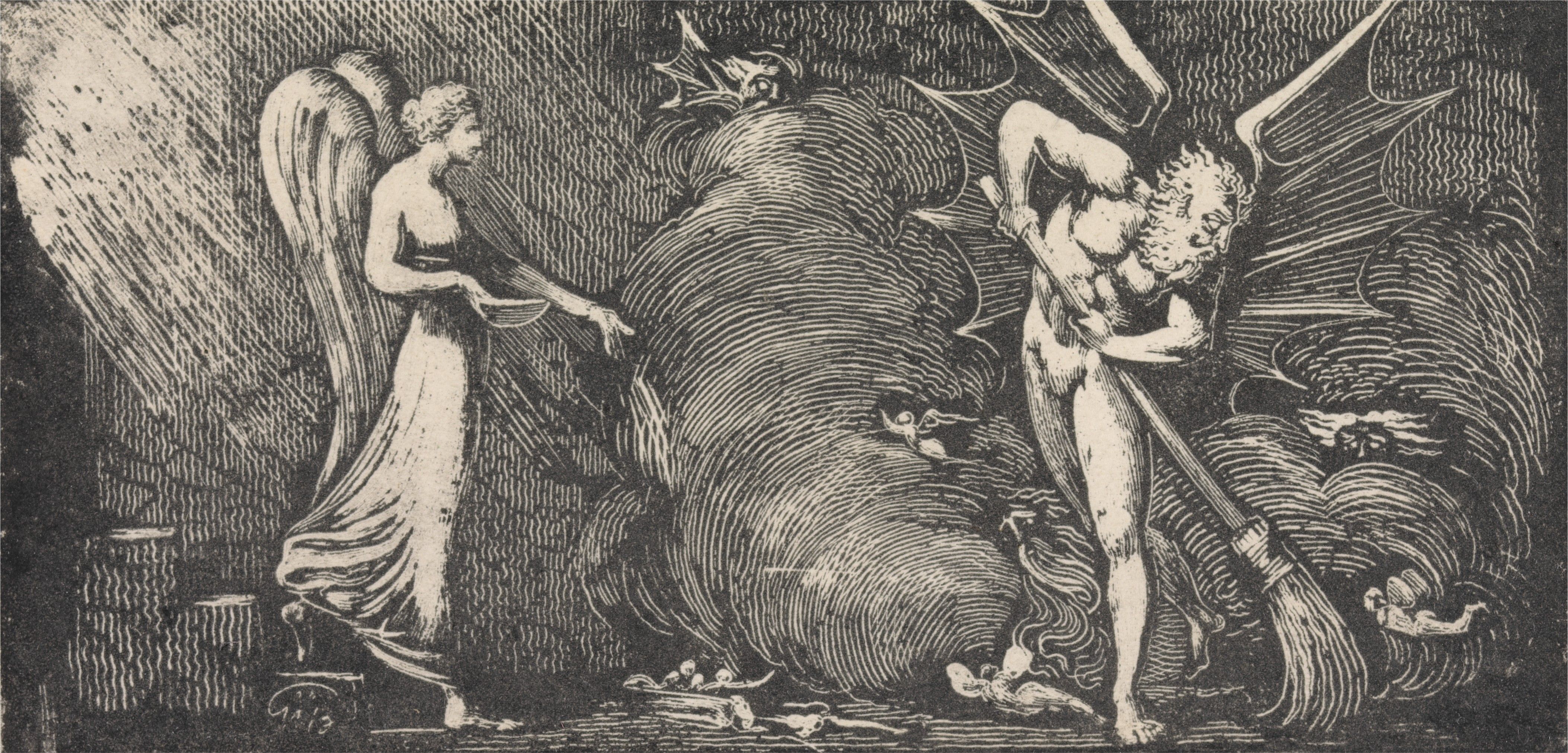
The first illustration Blake made for Bunyan's Pilgrim's Progress was a print which he produced before 1822, perhaps much earlier. He created a white line engraving of The Man Sweeping the Interpreter's Parlor which illustrated the second lesson of the Interpreter to Christian in Pilgrim's Progress. The series of 28 watercolor illustrations to Pilgrim's Progress was painted in approximately 1824. 

Yale Center for British Art
Man Sweeping Interpreter's Parlour

Sin did not play the same role in Blake's theology as it did in Bunyan's. Because Blake believed that everything that lives is holy, his effort was directed toward releasing man's energies, not toward removing his sinfulness. Blake's picture The Man Sweeping the Interpreter's Parlor may be seen allegorically as Bunyan wrote his account: representing the sinful, corrupt nature of man which is brought under control by the Law & the Gospel. However Blake's image lends itself to further insight apropos to his own attitude to sin. Blake saw the child as born innocent, not as burdened by original sin which Bunyan saw to be the heritage of humanity from Adam and Eve. Sin to Blake was simply failure to exercise one's ability to perceive the Eternal. It was not man's sinfulness which had to be eradicated but his blindness to the bliss which he was meant to experience. The nearest Blake can to imputing sin was calling man to task for hindering - preventing others from developing their own spiritual potential.

To Blake man needed to cleanse himself of the idea that the world can be separated into 'good and evil.' There are functions of the psyche which perform different tasks but all are valuable and necessary to completeness. By picturing the Law as the Devil and the Gospel as the Angel, Blake impels us to think of how the Law functions in performing necessary tasks which complete the tasks performed by the Gospel. As Paul said in Galatians 3, 'The law is the pedagogue'.  

Although there is no mention of either in Bunyan's account, Blake pictures an angel and a devil in his engraving of The Man Sweeping the Interpreter's Parlor. Blake may well have been picturing the energies of the diabolic figure as removing, not sin, but the chains that bound man to the conventions of a tyrannical society and a repressive religion. In which case the angelic damsel who is descending the stair, represents reason, 'the bound and outward circumference of Energy.' Blake has encouraged us to see contraries united, not opposed but functioning together. Wrath and Pity, Woe and Joy, Time and Eternity, Evil and Good, Body and Soul, Energy and Reason: not combating but cooperating.

Marriage of Heaven & Hell, Plate 4, (E 35)
                 "The voice of the Devil
  All Bibles or sacred codes. have been the causes of the
following Errors.
  1. That Man has two real existing principles Viz: a Body & a
Soul.
  2. That Energy. calld Evil. is alone from the Body. & that
Reason. calld Good. is alone from the Soul.
  3. That God will torment Man in Eternity for following his
Energies.
  But the following Contraries to these are True
  1 Man has no Body distinct from his Soul for that calld Body is
a portion of Soul discernd by the five Senses. the chief inlets
of Soul in this age
  2. Energy is the only life and is from the Body and Reason is
the bound or outward circumference of Energy.
  3 Energy is Eternal Delight" 

By writing an allegory Bunyan attempted to pin down his metaphors to single meanings. Blake's mind could not allow a one-to-one correspondence between a word and the thoughts which could be attached to it. Blake saw such a correspondence as Urizenic and wrote extensively on the pitfalls of following the reasoning mind into the labyrinths of delusion.


Vision of The Last Judgment, (E 554)
                     "For the Year 1810
        Additions to Blakes Catalogue of Pictures 

     The Last Judgment when all those are Cast away who trouble
Religion with Questions concerning Good & Evil or Eating of the
Tree of those Knowledges or Reasonings which hinder the Vision of
God turning all into a Consuming fire  Imaginative Art &
Science & all Intellectual Gifts all the Gifts of the Holy Ghost
are [despisd] lookd upon as of no use & only Contention
remains to Man then the Last Judgment begins & its Vision is seen
by the [Imaginative Eye] of Every one according to the
situation he holds
      The Last Judgment is not Fable or Allegory
but   Vision Fable or Allegory are a totally distinct & inferior
kind of Poetry.  Vision or Imagination is a Representation of
what Eternally Exists.  Really & Unchangeably.  Fable or Allegory
is Formd by the Daughters of Memory.  Imagination is Surrounded
by the daughters of Inspiration who in the aggregate are calld
Jerusalem" 


Galatians 3 
 [24] Wherefore the law was our schoolmaster to bring us unto Christ, that we might be justified by faith. 
[25] But after that faith is come, we are no longer under a schoolmaster. 
[26] For ye are all the children of God by faith in Christ Jesus.

Romans 12
[14] Bless them which persecute you: bless, and curse not.
[15] Rejoice with them that do rejoice, and weep with them that weep.
[16] Be of the same mind one toward another. Mind not high things, but condescend to men of low estate. Be not wise in your own conceits.
[17] Recompense to no man evil for evil. Provide things honest in the sight of all men.
[18] If it be possible, as much as lieth in you, live peaceably with all men.
[19] Dearly beloved, avenge not yourselves, but rather give place unto wrath: for it is written, Vengeance is mine; I will repay, saith the Lord.
[20] Therefore if thine enemy hunger, feed him; if he thirst, give him drink: for in so doing thou shalt heap coals of fire on his head.
[21] Be not overcome of evil, but overcome evil with good.

Gerda Norvig's commentary on The Interpreter's Parlor is found on pages 48-61 of Dark Figures in the Desired Country.


Pilgrim's Progress
John Bunyan
"CHR. Sir, said Christian, I am a man that am come from the City of Destruction, and am going to the Mount Zion; and I was told by the man that stands at the gate, at the head of this way, that if I called here, you would show me excellent things, such as would be a help to me in my journey.
 

{72} INTER. Then said the Interpreter, Come in; I will show that which will be profitable to thee. So he commanded his man to light the candle, and bid Christian follow him: so he had him into a private room, and bid his man open a door; the which when he had done, Christian saw the picture of a very grave person hang up against the wall; and this was the fashion of it. It had eyes lifted up to heaven, the best of books in his hand, the law of truth was written upon his lips, the world was behind his back. It stood as if it pleaded with men, and a crown of gold did hang over his head.
CHR. Then said Christian, What meaneth this?
 

{73} INTER. The man whose picture this is, is one of a thousand; he can beget children [1 Cor. 4:15], travail in birth with children [Gal. 4:19], and nurse them himself when they are born. And whereas thou seest him with his eyes lift up to heaven, the best of books in his hand, and the law of truth writ on his lips, it is to show thee that his work is to know and unfold dark things to sinners; even as also thou seest him stand as if he pleaded with men: and whereas thou seest the world as cast behind him, and that a crown hangs over his head, that is to show thee that slighting and despising the things that are present, for the love that he hath to his Master's service, he is sure in the world that comes next to have glory for his reward. Now, said the Interpreter, I have showed thee this picture first, because the man whose picture this is, is the only man whom the Lord of the place whither thou art going, hath authorised to be thy guide in all difficult places thou mayest meet with in the way; wherefore, take good heed to what I have shewed thee, and bear well in thy mind what thou hast seen, lest in thy journey thou meet with some that pretend to lead thee right, but their way goes down to death.
 

{74} Then he took him by the hand, and led him into a very large parlour that was full of dust, because never swept; the which after he had reviewed a little while, the Interpreter called for a man to sweep. Now, when he began to sweep, the dust began so abundantly to fly about, that Christian had almost therewith been choked. Then said the Interpreter to a damsel that stood by, Bring hither the water, and sprinkle the room; the which, when she had done, it was swept and cleansed with pleasure.
 

{75} CHR. Then said Christian, What means this?
INTER. The Interpreter answered, This parlour is the heart of a man that was never sanctified by the sweet grace of the gospel; the dust is his original sin and inward corruptions, that have defiled the whole man. He that began to sweep at first, is the Law; but she that brought water, and did sprinkle it, is the Gospel. Now, whereas thou sawest, that so soon as the first began to sweep, the dust did so fly about that the room by him could not be cleansed, but that thou wast almost choked therewith; this is to shew thee, that the law, instead of cleansing the heart (by its working) from sin, doth revive, put strength into, and increase it in the soul, even as it doth discover and forbid it, for it doth not give power to subdue. [Rom. 7:6; 1 Cor. 15:56; Rom. 5:20]
 

{76} Again, as thou sawest the damsel sprinkle the room with water, upon which it was cleansed with pleasure; this is to show thee, that when the gospel comes in the sweet and precious influences thereof to the heart, then, I say, even as thou sawest the damsel lay the dust by sprinkling the floor with water, so is sin vanquished and subdued, and the soul made clean through the faith of it, and consequently fit for the King of glory to inhabit. [John 15:3; Eph. 5:26; Acts 15:9; Rom. 16:25,26; John 15:13] "
.