Monday, January 17, 2011

BUNYAN'S DREAM

The dream motif within which Pilgrim's Progress is enclosed was developed and enhanced by Blake's imagery. Dreaming is a metaphor for a level of consciousness below ego-consciousness as we ordinarily experience it. Since Christian exists within the dream; his experiences are associated with a level of consciousness which has access to archetypal material from the collective unconscious as well as the personal unconscious. Blake is picking up on and presenting the psychological implications of milestones Christian passes through as indications of internal development of the psyche itself. The narrator, the dreamer, the pilgrim, the companions, and the interpreter are all represented as archetypes which play roles in individuation.

The midpoint of the series of Blake's illustrations, the plate on which Pilgrim encounters Christ is preceded by the plate titled THE MAN WHO DREAMED OF A DAY OF JUDGMENT. So within the narrator's dream of Pilgrim's journey we find an encounter with another dreaming man - a dream within a dream - symbolic of descending to a deeper psychological level. It is at this level that it is possible that the burden which Christian has been bearing - the consciousness of sin - can be removed. In Blake as in Genesis, the division of reality into the categories of Good and Evil precipitates the divisions in man which constitute the 'fall'. The reversal of this consciousness (of sin) opens the way for the appearance of Christ and reunification. 

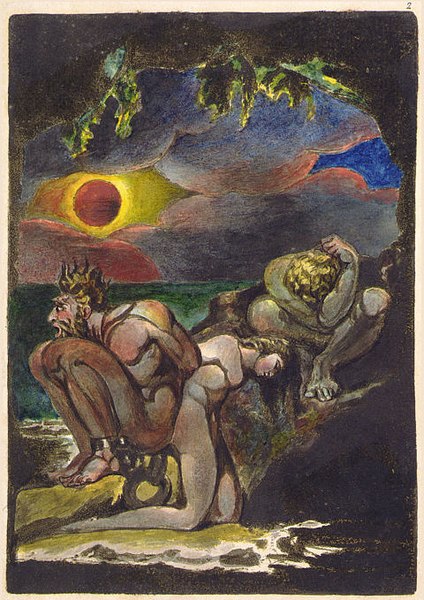
This is plate 13 of Blake's illustrations to Bunyan's Pilgrim's Progress - THE MAN WHO DREAMED OF A DAY OF JUDGMENT. 
The observer is Christian - the pilgrim with the burden of sin strapped to his back as it has been represented since Plate 2. Norvig sees the encounter represented in Plate 13 as bringing into consciousness the image of the Last Judgment as a scene of fear and punishment. 

Encountering this dream content allows Pilgrim to move to the next scene - an encounter with the Christ and a release from the burden which he had been carrying. Just as the consciousness of sin had become an ever present burden to Pilgrim, the fear of punishment at judgment was acting as a detriment to encountering Christ.
 

In Gerda S.Norvig's book Dark Figures in the Desired Country: Blake's Illustrations to the Pilgrim's Progress she comments on Plate 13, THE MAN WHO DREAMED OF THE DAY OF JUDGMENT:
"From Bunyan's text we know that the man in this emblem is meant to he a warning to Christian, just as the subject of the previous illustration was. But there is a big difference in the mentality of the two characters, a difference Blake picks up on and generously amplifies to his own interpretive purpose. For although Bunyan's version of this emblematic dreamer-within-a dream shakes and trembles from his haunting fear that he is doomed, he is not so fixated or developed in his anxiety that he has lost all perspective on it. Unlike the man in the iron cage, he talks about his fear and about his vision. He thus creates a certain amount of figural and dialogic distance between himself and his feeling state figured in his dream. That is the saving grace, and indeed for Blake this figure from the Progress typifies the very possibility of a saving grace in everyone's psychic organization. Thus, despite the man's dream-vision that he will be rejected by God at the Last Day, he has two valuable attributes (themselves God-given) that help to counteract the implosive effects of his negative intuition: he has the visionary power to create a clear embodiment of his fear and the capacity to reflect consciously on its imaged content." (Page 164-5)


This is the crux of the issue as Norvig sees it: "It is as though the articulation of the damnation-fantasy held by the man dreaming of the Last Judgment in the House of the Interpreter released this contrary image of deliverance through his own visionary opening in obedience to an inner law of psychological compensation in the mind of the original dreamer."

Romans:
8:1-2 - No condemnation now hangs over the head of those who are "in" Jesus Christ. For the new spiritual principle of life "in" Christ lifts me out of the old vicious circle of sin and death.

Norvig: "It is the identification Christian himself
makes between his [own] imaginative nature and Christ's resurrection that permits and denotes the falling away of the burden. Therefore, the burden in its death throes appropriately recalls the burial of Jesus, whereby a corruptible body was converted to an incorruptible. To enhance the hints Bunyan gives of this connection, Blake fashions the burden to look like an unborn human embryo crouched by the transept of the sepulcher's doorway. It also has the appearance of crumpled clothing, a possible allusion to the linen cloths found folded up beside Christ's tomb after the resurrection." (p 169)


The point of return has been achieved; challenges remain but the result is assured.

Jerusalem, PLATE 43 [29], E(191)
"Then the Divine Vision like a silent Sun appeard above
Albions dark rocks: setting behind the Gardens of Kensington
On Tyburns River, in clouds of blood: where was mild Zion Hills
Most ancient promontory, and in the Sun, a Human Form appeard
And thus the Voice Divine went forth upon the rocks of Albion"

Sunday, January 16, 2011

Blake's Nakedness

Every creative thought is the God Within.

What did T.S.Eliot mean when he said that Blake was naked?

"the [Blake's] peculiarity is seen to be the peculiarity of all great poetry: ....It is merely a peculiar honesty, which, in a world too frightened to be honest, is peculiarly terrifying. It is an honesty against which the whole world conspires, because it is unpleasant. Blake's poetry has the unpleasantness of great poetry."

And a little way on in The Sacred Wood:
"He was naked, and saw man naked, and from the centre of his own crystal. ..... He approached everything with a mind unclouded by current opinions. There was nothing of the superior person about him. This makes him terrifying."

(I have to wonder what he meant by superior person. Can anybody elucidate that? And what did he mean by Blake being naked?)

At the beginning of the Preface of The Great Divorce C.S.Lewis, like Eliot, also recognized Blake's greatness:
"Blake wrote The Marriage of Heaven and Hell. If I have written The Great Divorce, this is not because I think of myself as a fit antagonist for so great a genius...."

And I think he was equally terrified: he recognized Blake's power, but not his godliness; imo his faith wasn't up to that.

This url addresses the psychological meaning of nakedness.

I found that Blake used the word (naked) 58 times. Some may hint toward what Eliot may have meant in the above quote.

Here are some examples of Blake's use of naked:
"Art can never exist without Naked Beauty displayed" (Lacoon; E275)

"Then down a green plain leaping, laughing, they run,
And wash in a river, and shine in the sun.

Then naked and white, all their bags left behind,
They rise upon clouds and sport in the wind;"
(The Chimney Sweeper; Erdman 10)

"I also asked Isaiah what made him go naked and barefoot three years? he answerd, the same that made our friend Diogenes the Grecian." (MHH, plate 13; E39)

"The Britons (say historians) were naked civilized men, learned, studious, abstruse in thought and contemplation; naked, simple, plain, in their acts and manners" (Descriptive Catalog; E542)

Can anyone tell me what Eliot meant by Blake's nakedness, and what he meant by the superior person?

Saturday, January 15, 2011

BLAKE'S BUNYAN

"My dark and cloudy words, they do but hold
The truth, as cabinets enclose the gold." Bunyan

The process of learning invariably involves going from the known into the unknown. We begin with what we are capable of doing and proceed to what is beyond our present capabilities. In our lives we have crossed this threshold many times from the very first times when we learned to suck air into our lungs and milk from our mothers' breast. Nevertheless learning always involves overcoming inertia and taking risk. Reluctance to relinquish our present positions for the uncertain prospect of finding security in that hazy possibilities which may replace them is perceived as threat.

Learning to see as Blake sees may seem a particularly threatening activity because we have invested so much in learning to think rationally - trusting only evidence and proof and linear thought patterns. Blake has devised an approach to design and writing which breaks down the patterns or rationality to facilitate imaginative activity.

In one sense Norvig's book (Dark Figures in the Desired Country: Blake's Illustrations to the Pilgrim's Progress) is an account of her learning Visionary Hermeneutics. She says:
"Normally hermeneutics refers to a set of predetermined interpretive strategies that a reader brings to and imposes on a work for one or more ulterior purposes..." (Page 4) However Blake's strategy was to apply the imagination in such a way that the internal and external context of the work interact to stimulate the activity of the imagination of the reader. But the imagination is not just put to use for interpretation, but gains self awareness and is strengthened through the process. "I have been speaking of visionary hermeneutics as a process that depends less on rules of interpretation than on an imaginative perspective, meaning both a perspective we learn to take toward the image and a perspective the imagination gradually gains on itself." (Page 6)                 
Illustrations to Pilgrim's Progress Plate 28
At the Gates of Heaven
Norvig attempts to enlighten her audience on Blake's practice of Visionary Hermeneutics which she learned from her teacher William Blake by studying his illustrations to Bunyan's Pilgrim's Progress. The heart of her book is her commentary on each of Blake's 28 illustrations. But the illustrations are not to be viewed individually but as a whole, commenting on one another and complementing others as do Blake's Illustration to the Book of Job. She compares the process that they illustrate in detail to the process delineated in Gates of Paradise. In the illustrations to Pilgrim's Progress as in his work from beginning to end, Blake sought to open the avenue to the visionary world he experienced to his readers.
Descriptive Catalogue, Penance of Jane Shore,(E 550)
"This Drawing was done above Thirty Years ago, and proves
to the Author, and he thinks will prove to any discerning eye,
that the productions of our youth and of our maturer age
are equal in all essential points."

Norvig observes: "Even in the Songs [of Innocence and Experience] itself a much more intricate pattern of mutual commentary, plotted by the progressive permutations of repeated verbal and pictorial motifs shown in changing contexts throughout the song cycle, emerges to enrich the work as a sort of primer of visionary literacy." (Page 5)

Friday, January 14, 2011

Blake's Sex IV

Blake may have written his short poem, "Mary", with Wollstonecraft in mind; however he wrote an earlier and larger work reflecting her philosophy of sex: About the time he completed 'The Marriage of Heaven and Hell' Blake produced a large illuminated poem called 'Visions of the Daughters of Albion'. Like all of his creations VDA addresses metaphysical and political concerns. The reader unfamiliar with Blake's thought forms and symbology will find much of it enigmatic, but a number of passages transparently reveal his thoughts and feelings about the relations between man and woman:

Oothoon, the soft soul of America, like an earlier maiden named Proserpine, plucks a flower and pays the price. Proserpine, you may remember, was rapt away into the underworld to be the bride of Pluto. In Oothoon's case the price began when, on her way with delight to her lover, Theotormon, she is raped by Bromion, a most rigid representative of the law, in fact a law abiding the slave trade.

Thereafter Oothoon and Bromion are bound back to back in Theotormon's cave with what is commonly known as a ball and chain. The poem largely consists of a colloquy among these three: Oothoon, the idealist; Bromion, the materialist; and Theotormon, a timid soul who can't make up his mind. As his name suggests, this young man is tormented by God given taboos about damaged goods. The God in this vision is named Urizen and also called the Father of Jealousy.

Typically Blake lays sexual oppression at the door of false religion. In the midst of Oothoon's lament, after a long series of Job-like questions, we read:

    " With what sense does the parson claim the labour
    of the farmer? What are his nets & gins and

    traps; & how does he surround him With cold
    floods of abstraction, and with forests of
    solitude, To build him castles and high spires,
    where kings and priests may dwell; Till she who
    burns with youth, and knows no fixed lot, is
    bound In spells of law to one she loaths? and
    must she drag the chain of Life in weary lust?
    must chilling, murderous thoughts obscure The
    clear heaven of her eternal spring;"
    (VDA 5:17-24 Key 193)

A loveless marriage is a profanation of the greatest gift of life; nothing could arouse Blake to a whiter heat of indignation. Wollstonecraft had called it legal prostitution. In the lines that follow Oothoon names and radically disaffirms the sick social attitudes that make sex a hidden and forbidden secret pleasure, and that degrade the highest sacrament, marriage, into a life sentence at hard labor.

Visions of Daughters of Albion, Plate 6, (E 49)
"Over his porch these words are written. Take thy bliss O Man!
And sweet shall be thy taste & sweet thy infant joys renew!

Infancy, fearless, lustful, happy! nestling for delight
In laps of pleasure; Innocence! honest, open, seeking         
The vigorous joys of morning light; open to virgin bliss.
Who taught thee modesty, subtil modesty! child of night & sleep
When thou awakest, wilt thou dissemble all thy secret joys
Or wert thou not awake when all this mystery was disclos'd!
Then com'st thou forth a modest virgin knowing to dissemble      

With nets found under thy night pillow, to catch virgin joy,
And brand it with the name of whore; & sell it in the night,
In silence. ev'n without a whisper, and in seeming sleep:
Religious dreams and holy vespers, light thy smoky fires:
Once were thy fires lighted by the eyes of honest morn           

And does my Theotormon seek this hypocrite modesty!
This knowing, artful, secret, fearful, cautious, trembling hypocrite."

Theotormon's jealousy casts Oothoon out and darkens her into "a solitary shadow wailing on the margin of non-entity". Blake developed this theme at the beginning of 'The Four Zoas'. There he ascribed the jealousy to Enion; it precipitated the Circle of Destiny (The Four Zoas, Night 1, Page 5, E 302), sank Tharmas into the sea and condemned Enion to the very "margin of non-entity" of which Oothoon had spoken.

To perceive a lover or spouse as a possession (a thing) is a fatal act that brings about the deterioration of life. In fact the nature of fallenness is to degrade the person (the real) to the material (the illusory). The one tormented by jealousy loses the capability of creative life; in biblical language he covers his soul with a thick layer of miry clay, not to mention what he does to others! The profound theological corollary suggested by VDA. is that if we weren't jealous people, we wouldn't have a jealous God. Obviously the Old Testament symbol of a jealous God has other meanings, but rightly or wrongly that is what it seems to have meant to Blake.

Long before Freud's day Blake understood and described the close relationship, in fact the identity, between sexuality and creativity. He considered sexual fulfillment the primary means of artistic achievement.

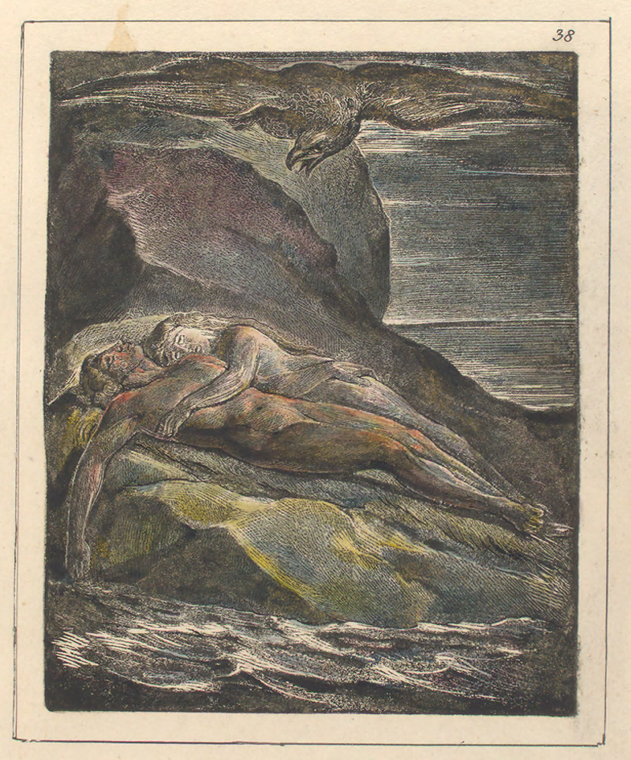
The picture in 'Milton' plate 42 portrays the post coital moment with the eagle of inspiration hovering above.

On the other hand all the evils of life Blake related to frustrated or sick sex. War in particular is perverted sexuality. The worship of the Queen of Heaven induces chastity with war as a substitute fulfillment. Blake's warrior cries, "I am drunk with unsatiated love, I must rush again to War, for the Virgin has frowned and refused."

Blake's mind was fourfold, which means that most of what he wrote is susceptible to more than one meaning. David Erdman in Prophet Against Empire saw VDA as political oratory at the service of the anti-slavery lobby. Oothoon is the type of the slave (of either sex); (in slave times the owner often claimed prenuptial privileges with the body of his slave). Bromion is the type of the merciless slave trader, and Theotormon of the wishy-washy conformist who can't quite bring himself to express his opposition to slavery (much as the many good Christians in America who couldn't quite bring themselves to condemn the war).


Thursday, January 13, 2011

BUNYAN'S DARK FIGURES

We were fortunate to purchase (for less the $20) a copy of Gerda S. Norvig's book Dark Figures in the Desired Country in which she presents her study of Blake's illustrations of Pilgrim's Progress.

It is refreshing to read Blake criticism from a scholar who thinks with a psychological perspective. Norvig is a qualified clinical psychologist as well a professor of English literature. Her book was assembled over a period of twenty years during which she was refining her understanding of Blake and of the human psyche. She sees Blake's development as being a process in which he gained the self-understanding which allowed him to understand the process through which Bunyan produced Pilgrim's Progress.

Norvig says "When in the following chapters I explore Blake's psychologizing of Bunyan's myth, I draw often, as mentioned in the preface, on the vocabulary of Jungian and post-Jungian theory to articulate some of Blake's most characteristic moves. What led me to choose the Jungian perspectives of analytical and archetypal psychology for this task is that the central vision of these approaches so clearly echoes the conception of the imagination dominating Blake's every word and every stroke of graphic expression...
for both Blake and the Jungians, "imagination is not a state" (M 32, E132/K522), nor is it just one of the many faculties of the mind; rather, it is the root capacity conditioning all mental functioning. [Page 17]..

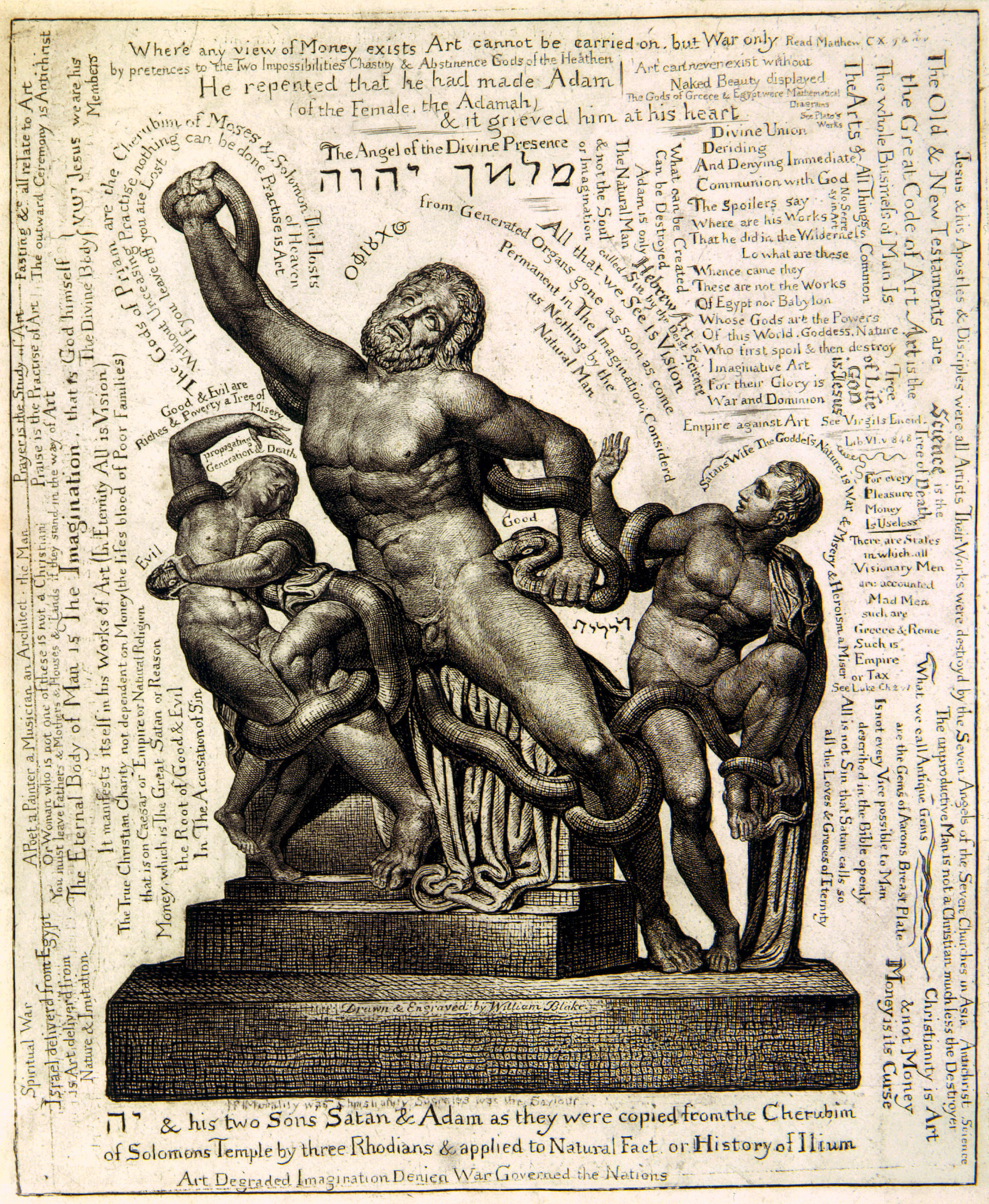
"For him, too, the archetypal structures, functions, fictions and images of the human imagination have both primacy over and ontological independence from the psychodynamics of any individuals case history. Thus his statement that "The Eternal Body of Man is the IMAGINATION that is God himself The Divine Body...JESUS we are his Members" (Laocoon, E273/K776) creates a picture of the psyche as larger than the body and life of the the individual subjects who articulate it." [Page 18]

Bringing these strategies to bear in discerning the meaning which Blake perceives in Bunyan's allegory and presents through images of archetypal experiences, Norvig reveals Bunyan and Blake delving into the collective psyche.


Blake's Laocoon
Text on Laocoon

Wednesday, January 12, 2011

Blake's Disciples

People or groups show discipleship of someone by expressing that person's values. We might look at four occurrences of Blake's disciples:

1. The Shoreham Ancients:
"a group of English artists who were brought together by their attraction to archaism in art and admiration for the work of William Blake."

2. The Flower Children: In terms of two of Blake's most sacred values the Sixties saw perhaps the first generation of Blakeans; they were the antiwar movement and sexual liberty. The promiscuity of a few of the flower children represented the most excessive expression of Blake's witness to sexual freedom. In the long term it led to a healthier level of association between men and women.

The sixties saw the first generation of true Blakeans (people who patterned their lives after Blake's tenents) in the San Francisco area. But the seventies brought recession, and many of them lapsed into the materialistic pretensions of their elders.

The anti-war fever that broke out in the late sixties was an eloquent witness to one of Blake's primary values. Since "
Whitefield & Westley" a handful of our fellow men have witnessed to the destructive futility of War (chief among them are the Quakers). Hence they might be thought of as the third group among Blake's disciples.

Re the Peace Witness one might more properly say that Blake was a disciple of the Quakers, although strangely enough he never saw fit to mention them, and few Quakers of my acquaintance today see fit to mention him.)

Finally (4th) there are a growing number of us who just love Blake. We love his values; I love his courage to choose at a critical time in his life to choose Art ("A Poet a Painter a Musician an Architect: the Man Or Woman who is not one of these is not a Christian You must leave Fathers & Mothers & Houses & Lands if they stand in the way of ART";E274) over materialistic desires. The overt evidence of that came when he went back to London after his 'three years' on the coast. He had the same courage that Albert Schweitzer had when he gave up fame and fortune to give help to the most needy (in darkest Africa).

Tuesday, January 11, 2011

BLAKE & PILGRIM'S PROGRESS

Our posts mentioning Bunyan. 

There were three great English dissenting poets:
John Milton (9 December 1608 - 8 November 1674)
John Bunyan (28 November 1628 - 31 August 1688)
William Blake (28 November 1757 - 12 August 1827)

The first two were influential on the third - William Blake - the subject of this blog. Milton's influence has frequently been mentioned here but we have said less about Bunyan's. Gerda S. Norvig's book Dark Figures in the Desired Country: Blake's Illustrations to the Pilgrim's Progress gives deserved attention to the primary way in which Blake interacted with Bunyan's writing.

Illustrations to Pilgrim's Progress
Plate 8 
Christian Fears the Fire from the Mountain
Blake was slow to acknowledge a debt to Bunyan. It was not until near the end of his life that he took the task of illustrating Pilgrim's Progress. Blake's Bunyan illustrations were made around 1824 after the completion of Illustrations to Book of Job. He had no prospect of having them published in a new edition of Pilgrim's Progress. They were done like most of his work in response to the promptings of his imagination to present his vision in a form which may someday be received.


Blake's early opinion of Bunyan as compared to Milton is expressed in this letter to Hayley:

Letter 52, (E 758)
To William Hayley Esqre Felpham
near Chichester, Sussex

Sth Molton St 4 Decr. 1804
"-- I was about to
have written to you to express my wish that two so unequal
labourers might not be yoked to the same Plow & to desire you if
you could to get Flaxman to do the whole because I thought it
would be (to say the best of myself) like putting John Milton
with John Bunyan"

In Blake's opinion, allegory, as was employed by Bunyan, was a lower form of communication than vision which Blake aimed to use himself as alluded to in this passage:

Vision of the Last Judgment, (E 554)

"The Hebrew Bible & the Gospel of
Jesus are not Allegory but Eternal Vision or Imagination of All
that Exists Fable [al] <&> Allegory]
[<& Visions of Imagination>] ought
to be known as Two Distinct Things & so calld for the Sake of
Eternal Life Plato has made Socrates say that Poets & Prophets do
not Know or Understand what they write or Utter this is a most
Pernicious Falshood. If they do not pray is an inferior Kind to
be calld Knowing Plato confutes himself>"

As Blake matured as an artist and as a Christian (which were one and the same thing to him), he found ways to probe the depths of meaning in Bunyan according to Norvig:

"But in the active days of the Lambeth period (1790 -1800, when Blake lived at 13 Hercules Building, Lambeth), absorbed in the dynamic relations and counterposes of his own prophetic art to the energies of Milton's religious Poetics, Blake evidently did not consider Bunyan compatriot or rival worthy of systematic attention.
...
By the time he had developed a style of serial illustration adequate to handle literary critiques that were, simultaneously, visions of individuation, he was ready to turn to the hermeneutic complexity of the Progress and give it the innovative treatment I will be examining in Chapter 3."
(Page 47)

The illustrations to Pilgrim's Progress have continued to be neglected compared to Blake's other work. Norvig's book, deep as it is, has created an opening for the illustrations to receive the attention they deserve.

"In part the relative neglect of the Bunyan designs is due to the fact that the watercolors themselves, currently among the holdings of the Frick collection in New York city, have been on general view only four times since their arrival in the United States during World War II, and before that in England only once."

Norvig's book is available online.The twenty-eight plates are included following page 128; you will find it hard to locate them elsewhere.

Monday, January 10, 2011

Earth and Heaven in this life

The ideas that Blake had about these two things closely resemble similar ideas by the apostle Paul. What Pauline scholars might call a state of grace Blake called Heaven. For both prophets that meant living in a level of close attention to God and to the Way of God.

Both men were conscious of the two ways of life, and for both men the heavenly way became more and more prominent to them until the end of their mortal lives.

Paul wrote, "I have a desire to depart and be with Christ, which is far better; Blake died singing, his life heavenly at the end.

Blake taught us about states:
In the Book of Urizen Blake used this exression 7 times:
"a state of dismal woe". "
The book takes its name from the character Urizen in Blake's mythology, who represents alienated reason as the source of oppression. The book describes Urizen as the "primeval priest" and tells how he became separated from the other Eternals to create his own alienated and enslaving realm of religious dogma. (Wikepedia)

The seven 'states of dismal woe' represent the seven acts of creation by Urizen, the demiurge in 'seven ages'. In effect Urizen had created Man (his physical form) concentrating on the five senses. (This section of the book is repeated -with some variation- in Night 4 of The Four Zoas.)

Blake, the man, did not consider the physical body as a misfortune, but an encumbrance.

It's interesting that Blake referred to these processes of creation as states, so we might ask what might that mean? Looking farther we find Blake calling Satan a state:

"There is a State namd Satan learn distinct to know O Rahab
The Difference between States & Individuals of those States

The State namd Satan never can be redeemd in all Eternity" (Erdman 380). Hence the State named Satan will be annihilated (completely)at the Last Judgement:
"
whenever any Individual Rejects Error &
Embraces Truth a Last Judgment passes upon that Individual" which is to say that the earth (the earthly!) facet of that Individual passes away.

Look finally at this extract from Visions of the Last Judgment: some "
say we will not Converse concerning Good & Evil we will live in
Paradise & Liberty You may do so in Spirit but not
in the Body as you pretend till after the Last Judgment
for in Paradise they have no Corporeal <& Mortal>
Body that originated with the Fall & was calld Death &
cannot be removed but by a Last judgment while we are
in the world of Mortality we Must Suffer 'The Whole
Creation Groans to be deliverd' there will always be as
many Hypocrites born as Honest Men & they will always
have superior Power in Mortal Things..."


Sunday, January 09, 2011

BLAKE READS THE BIBLE

Bishop Richard Watson’s An Apology for the Bible was published in 1796 and annotated by Blake in 1798. When Blake annoted Watson's Apology for the Bible he expressd his unorthodox, inclusive views. He argued that man should realize he has direct access to God through the faculty of the imagination. He urged his reader to look within for the work of God in his own life and to be receptive to God's gifts. 

 Annotation to an Apology for the Bible (Bishop Watson) 

THE COMPLETE POETRY & PROSE OF WILLIAM BLAKE edited by David V. Erdman, Link to index

Page 615

"That the Jews assumed a right to the benefits of God. will be a lasting witness against them. & the same will it be [of] against Christians" 

Page 615 

"The Bible or Word of God, Exclusive of Conscience or the Word of God Universal, is that Abomination which like the Jewish ceremonies is for ever removed & henceforth every man may converse with God & be a King & Priest in his own house" 

Page 615 

"It is strange that God should speak to man formerly & not now. because it is not true" 

Page 615 

"The Bible tells me that the plan of Providence was Subverted at the Fall of Adam & that it was not restored till [we in] Christ [?made ?restoration]" 

Page 616 

"He who writes things for true which none could write. but the actor. such are most of the acts of Moses. must either be the actor or a fable writer or a liar. If Moses did not write the history of his acts, it takes away the authority altogether it ceases to be history & becomes a Poem of probable impossibilities fabricated for pleasure as moderns say but I say by Inspiration." 

 Page 617 

"look over the events of your own life & if you do not find that you have both done such miracles & lived by such you do not see as I do True I cannot do a miracle thro experiment & to domineer over & prove to others my superior power as neither could Christ But I can & do work such as both astonish & comfort me & mine" 

 Page 617 

"a Prophet is a Seer not an Arbitrary Dictator. It is mans fault if God is not able to do him good. for he gives to the just & to the unjust but the unjust reject his gift" 

Page 617 

"for the facts are such as none but the actor could tell, if it is True Moses & none but he could write it unless we allow it to be Poetry & that poetry inspired"  

Blake's heart was touched by man's failure to open the doors of perception. It grieved him that man had built walls to separate himself from the Divine. He showed us that the manacles we endure are forged in our own minds.  

Book of Urizen, Plate 27, (E 83)

 "And their children wept, & built Tombs in the desolate places, And form'd laws of prudence, and call'd them The eternal laws of God"

Wikipedia Commons
Book of Urizen
Copy G, Plate 26
____________________________________________________ 

Learn more about Blake's annotation in this review of Blake's Margins: An Interpretive Study of the Annotations, by Hazard Adam (Reviewed by Morton D. Paley on 2010-05-22).


Saturday, January 08, 2011

Blake's Sex III

Yale Center for British Art
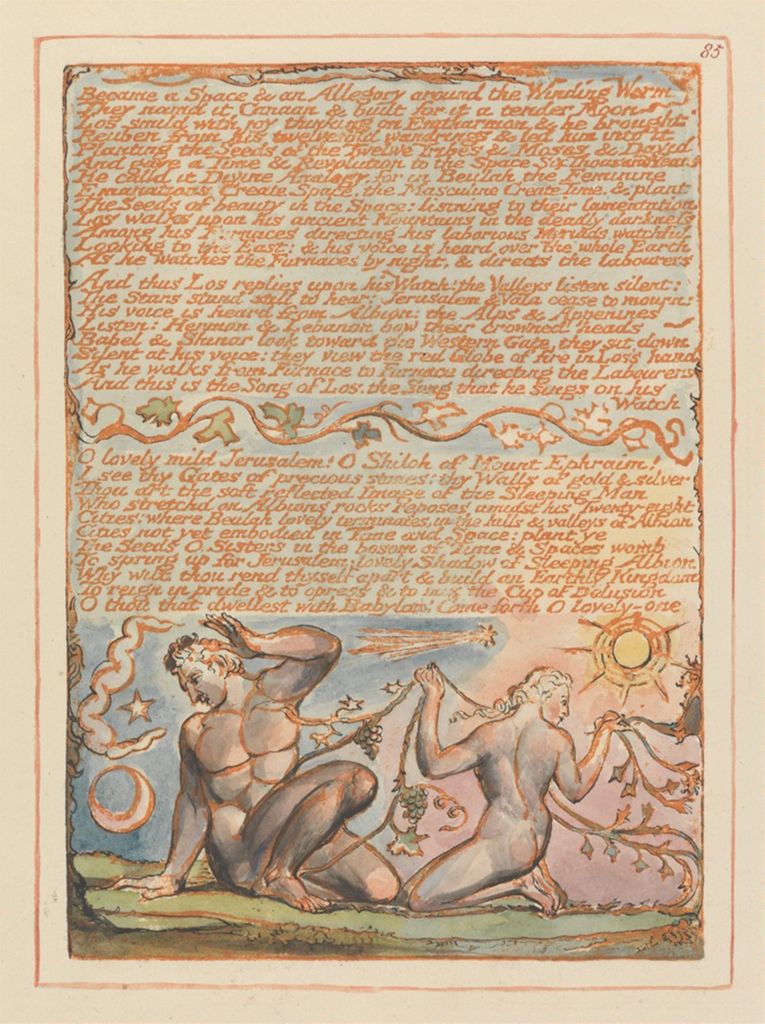
Jerusalem
Plate 85

What Blake hated was not monogamy but jealousy and the idea of a lover or spouse as a possession:

    "He who binds to himself a joy
    Doth the winged life destroy;
    But he who kisses the joy as it flies
    Lives in Eternity's sun rise."
    (Eternity, in Songs and Ballards; Erdman 474 )

We have a story to the effect that early in his marriage Blake proposed to bring home a concubine (sneaking around was futhest from his thoughts!) His young wife cried at the idea, and he dropped it. In all likelihood the concubine notion came from Blake's friend, Mary Wollstonecraft, one of the earliest of liberated women.

Blake had illustrated two of this lady's works shortly before she wrote a sensational essay called "Vindication of the Rights of Women". Mary Wollstonecraft advocated the radical equality of the sexes, which Blake endorsed. She tried to live in the freedom generally reserved for men (and claimed by few even of them!) Blake was among those who supported her in this endeavor. She lived an adventurous and tragic life and died giving birth to another Mary, who became the wife of the poet, Shelley.

Blake had a very complex psyche; one could discuss to exhaustion his various sexual attitudes and points of view. According to Damon, who wrote A Blake Dictionary, Blake believed that "the domination of woman is one of the greatest forces corrupting society" (page 447); he quoted as follows:

    "What may Woman be?
    To have power over Man from cradle to corruptible grave.
    There's a throne in every man; it's the throne of God;
    This Woman has claimed as her own & Man is no more!"
    (Jerusalem plate 30 [34], lines 25-28, (E 176 )


Friday, January 07, 2011

BLAKE & 'DEAD MAN' II

Read the first post on BLAKE & 'DEAD MAN'.

These are some Blake quotes which were used in the movie Dead Man.

Auguries of Innocence (E 492)
"Every Night & every Morn
Some to Misery are Born
Every Morn & every Night
Some are Born to sweet delight
Some are Born to Endless Night"

Marriage of Heaven and Hell , Plate 8, (E 37)
"The eagle never lost so much time, as when he submitted to learn
of the crow."

Marriage of Heaven and Hell , Plate 5, (E 35)
"Drive your cart and your plow over the bones of the dead."

Everlasting Gospel, (E 525)
"The Vision of Christ that thou dost see
Is my Visions Greatest Enemy"

Innocence is the state in which the character William Blake begins his journey in the movie Dead Man. The destination to which he is traveling is the end of the railroad line - a town named Machine. The optimistic innocence of William Blake has been disrupted even before he disembarks from the train. The disappointment of finding the promised employment unavailable leaves him destitute of hope and resources. Another innocent crosses his path: Thel, who makes and sells paper flowers. The two are outcasts who find each other. William Blake, the poet wrote a short book about Thel - the lovely innocent who refused to enter the world of generation and embark on the path of experience. In the scenario of the movie Thel is killed by the same bullet which lodges in the dead or dying William Blake. Her innocence is preserved but he proceeds along the road of experience.

A Native American who has been trained in white man's ways assumes the care of William Blake because he has read the poet Blake and found his writing the only thing he understood in the white culture. Blake is a hunted man, fleeing from the law, hired killers and the vengeance of the father of the man he shot. The Native American, who calls himself Nobody, acts as guide and protector of William Blake supplying wisdom from the poet Blake along with tribal insights as the pair head for completion of William Blake's return to his origin.

We can look at William Blake's journey in the movie in the light of the journey Milton took to redeem the errors of his life in Blake's Milton .

Milton, PLATE 14 [15], (E 108)
[Milton speaking]
"I will arise and look forth for the morning of the grave.
I will go down to the sepulcher to see if morning breaks!
I will go down to self annihilation and eternal death,
Lest the Last Judgment come & find me unannihilate
And I be siez'd & giv'n into the hands of my own Selfhood
The Lamb of God is seen thro' mists & shadows, hov'ring
Over the sepulchers in clouds of Jehovah & winds of Elohim
A disk of blood, distant; & heav'ns & earth's roll dark between"

One haunting image from the film pictures William Blake whose 'life' is slowly draining from his body lying beside a dead fawn. It is easy to see the fawn as a reminder of the 'Lamb of God', a term which occurs frequently in Jerusalem and the Four Zoas. The appearance of the Lamb of God in Blake's poetry is a portent of redemption.
Picture by William James Linton after William Blake from Gilchrist's Life,

Watch images from the movie along with the soundtrack by Neil Young.

Thursday, January 06, 2011

Blake's Hell

The meaning of Hell to ordinary people with a religious faith is a place of unending torture and misery at death for those who have not deserved a better fate. This idea has been deeply ingrained in the public consciousness, and it has been expressed by millions of religious practitioners.

William Blake's idea of Hell was very different. In The Marriage of Heaven and Hell he parodied Conventional Christians' ideas of Heaven and Hell, of angels and devils. The Elect (angels) are the CC people, especially the priests. The Reprobates (devils) are those who deny the conventional priests; they have the Energy of Imagination. Blake kept these categories through the course of his poetry;

Eventually it became evident that Jesus was one of the Reprobates; look at Milton Plate 13[14]:


"Around the Lamb, a Female Tabernacle woven in Cathedrons Looms
He died as a Reprobate. he was Punish'd as a Transgressor!

Glory! Glory! Glory! to the Holy Lamb of God

I touch the heavens as an instrument to glorify the Lord!" (Erdman 107)

MHH ends with these magical words:
"For every thing that lives is Holy."

That is one of Blake's statements of Universalism (The original American Universalists believed that everyone in the world was and will remain a child of God.)

Blake's MHH was likely a response to Swedenborg's Heaven and Hell, published in 1758, the year Blake was born. Blake, in his early days, was influenced by Swedenborg, but by his late twenties he had become disenchanted with S's thought.

Quoting Wikipedia Swedenborg's Heaven and hell
"is a detailed description of the afterlife where people go after the death of the physical body. It deals with God, heaven, hell, angels, spirits, and devils, which the author claimed to have witnessed first hand."

Blake dealt with all these subjects in his MHH, but his perspective on them was far different from those of the earlier writer.

*****************************************

We may read Blake's definition of Hell in Erdman 590 (one of Blake's Annotations of Lavater):
"
to hell till he behaves better. mark that I do not believe there is such a thing litterally. but hell is the being shut up in the possession of corporeal desires which shortly weary the man for all life is holy."


Wednesday, January 05, 2011

BLAKE & 'DEAD MAN'

In 1995 Jim Jarmusch directed a movie, Dead Man, which follows the character named William Blake through harrowing experiences. Although the character has no knowledge of William Blake's poetry he is befriended by a Native American under the influence of Blake. To a person familiar with Blake's writing, the movie is presenting Blake's thought in a contemporary media. To one unfamiliar with Blake the film may be either a slow moving Western exhibiting sex and violence, or an opportunity to become acquainted with quotes from Blake. If a person can view the movie psychologically as a myth of psychic and spiritual development, he may experience some of what one experiences in reading Blake's poetry.

The website 366 Weird Movies comments on the movie Dead Man:
"On it’s release, Dead Man received mostly negative reviews. It was criticized as too slow and too pretentious, appearing to be thoughtful but actually delivering no ideas worth mentioning. Time has been kind to the movie, however, which has emerged as Jarmusch’s best work to date. In Dead Man, a measured journey into an odd, somber, dark and funny wilderness of the spirit, Jarmusch created a myth with staying power. Filled with poetic images like Johnny Depp reclining with a slaughtered fawn, Dead Man has proven a mysterious power to linger in the memory. It may never yield up its meaning, but that doesn’t make it empty."

It would be impossible to explain the movie Dead Man in the same way that it is impossible to explain Jerusalem. But there are a few things it might be beneficial to say about it. It is not just a movie which takes the name William Blake and attaches it to a character in a Western. It is a movie which attempts to emulate Blake's enigmatic methods of communication and present Blakean images and ideas in an alternate media. If one is prepared to discern repeated references to the processes enacted in Blake's poetry as well as to listen for quotes from Blake's work, the movie will become more than a series of killings.

The theme of annihilation is prominent in Jerusalem and Milton as the means of eliminating error and fostering forgiveness. The furnaces of Los through which characters must pass on the way to redemption play a large part in the activity which reverses the fall. Annihilation through killing is repeated throughout Dead Man. If the killing is meant to portray the murder of men, the movie is only about senseless violence. If error or wrong ideas are being destroyed to promote the journey of William Blake through the underworld, it makes more sense. Milton O. Percival, in Circle of Destiny says "In the destruction of these forms by the restless energy of time lies man's hope of release from error. 'All that can be annihilated must be annihilated.' [Milton, E 142] The eternal will live on. For that reason error must be provided with a mortal body capable of destruction by the energy of time."

The title of the movie, Dead Man, suggests that the protagonist, William Blake (played by Johnny Depp), is dead from the beginning. At least the suggestion is that he died immediately (early in the movie) when he was shot in Thel's room. The action takes on different meaning if William Blake is not a living man trying to escape from multiple pursuers. As a myth we see the journey of a man attempting to reach his home in a world beyond the trials and errors of ordinary life.

This is Blake's advice on viewing symbolic images like those that are abundant in the movie.

Vision of the Last Judgment , (E 560):
"If the Spectator could Enter into these Images in his
Imagination approaching them on the Fiery Chariot of his
Contemplative Thought, if he could Enter into Noahs Rainbow or into his bosom or could make a Friend & Companion of one of these Images of wonder which always intreats him to leave mortal things as he must know then would he arise from his Grave then would he meet the Lord in the Air & then he would be happy"

The following passage helps us understand how Blake viewed existence in this world compared to existence in the permanent world.

Jerusalem , Plate 13, (E 157)
"Los walks round the walls night and day.

He views the City of Golgonooza, & its smaller Cities:
The Looms & Mills & Prisons & Work-houses of Og & Anak:
The Amalekite: the Canaanite: the Moabite: the Egyptian:
And all that has existed in the space of six thousand years:
Permanent, & not lost not lost nor vanishd, & every little act,
Word, work, & wish, that has existed, all remaining still
In those Churches ever consuming & ever building by the Spectres
Of all the inhabitants of Earth wailing to be Created:
Shadowy to those who dwell not in them, meer possibilities:
But to those who enter into them they seem the only substances
For every thing exists & not one sigh nor smile nor tear,
PLATE 14
One hair nor particle of dust, not one can pass away."

This next section in Blake may be correlated with the 'men' who pursue William Blake in the movie. They 'die' because they are negations which must be compelled into non-entity.

Jerusalem, Plate 17, (E 162)
"Negations are not Contraries: Contraries mutually Exist:
But Negations Exist Not: Exceptions & Objections & Unbeliefs
Exist not: nor shall they ever be Organized for ever & ever:
If thou separate from me, thou art a Negation: a meer
Reasoning & Derogation from Me, an Objecting & cruel Spite
And Malice & Envy: but my Emanation, Alas! will become
My Contrary: O thou Negation, I will continually compell
Thee to be invisible to any but whom I please, & when
And where & how I please, and never! never! shalt thou be Organized
But as a distorted & reversed Reflexion in the Darkness
And in the Non Entity: nor shall that which is above
Ever descend into thee: but thou shalt be a Non Entity for ever
And if any enter into thee, thou shalt be an Unquenchable Fire
And he shall be a never dying Worm, mutually tormented by
Those that thou tormentest, a Hell & Despair for ever & ever."

A future post will bring up the quotes from Blake which are included in the movie.

Tuesday, January 04, 2011

Blake's Sex II

Blake Archive
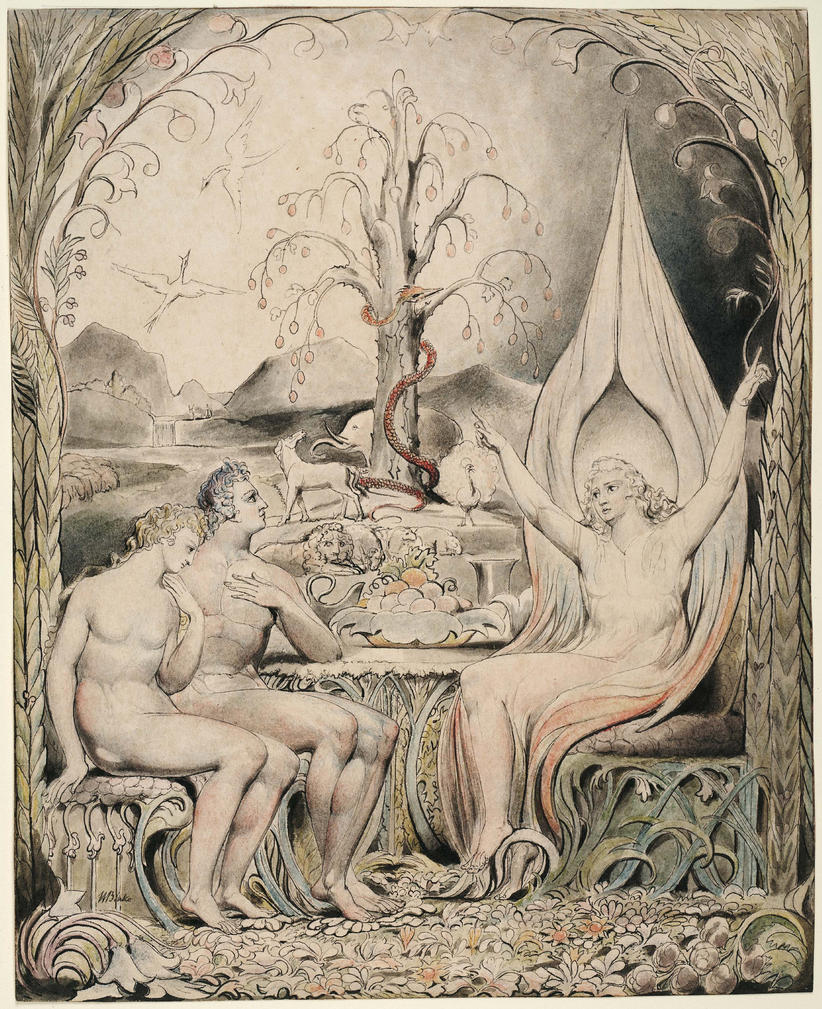
Illustrations to Paradise Lost
Raphael warns Adam and Eve
Object 8

A review of Blake's early life suggests the most normal and ordinary psychosexual development, to which the biographers testify. Through his refusal of formal education (See CHAPTER ONE ) Blake appears to have escaped many of the common pathologies of sex that afflicted his age as ours. In fact he systematically held some of them up to ridicule.

Blake never tired of painting the human form, and he usually refused to hide it with clothes. His primary models appear to have been his wife and himself. We read that a friend once found them naked in the garden of their home. In all probability they were planning poses and postures for his illustrations of Paradise Lost.

In his early twenties Blake formed an emotional attachment to a young woman named Polly Wood. Unfortunately Polly had other interests, and when he showed jealousy, she asked him if he were a fool. The experience seems to have cured him of jealousy; in fact the foolishness of jealousy became a life long motif; his false God received the name (among others) of Father of Jealousy.

On the rebound he met a beautiful girl named Catherine Boucher, a gardener's daughter. He told Catherine his mournful story, and when she pitied him, he promptly transfered his affection to her. A year later they were married, a relationship that according to all the evidence seems to have been made in heaven.

Illiterate at her marriage, Catherine Blake must have been a gifted and rare person; she had a great deal to do with Blake's enormous creativity. Her high and continuous level of affirmation released Blake from the drain of domestic preoccupations. She affirmed and encouraged his gift of vision even when it meant long hours of wakefulness while he communed with heaven. She provided the appreciative audience that the world in general denied Blake and made him a happy creative artist in the same way that J.S.Bach was happy.

One important influence on Blake's ideology of sex came from certain left wing religious dissenters. The ranters and other antinomians deeply affected Blake's world of thought. They considered marriage a part of the law which they wanted to abolish. They claimed the right, living above the law, to cohabitate with whomever, whenever and wherever they felt led. We find evidence of similar excesses among fringe groups both in the New Testament and in the 20th Century:

    Remove away that black'ning church:
    Remove away that marriage hearse:
    Remove away that ..... blood:
    You'll quite remove the ancient curse.
    (An Ancient Proverb; in Songs and Ballards; Erdman p. 475)

Blake found these ideas attractive as a young man, but no one believes that he carried them very far in practice. Libertines and hedonists have at times made Blake their hero, but they simply don't know their man. All the evidence suggests that Blake lived as a faithful and loving husband for some forty five years--and a happy one as well (This is spite of a recent fanciful 'biography' of Catherine Blake).

Songs and Ballads [from Notebook] (E480)
"I rose up at the dawn of day
Get thee away get thee away
Prayst thou for Riches away away
This is the Throne of Mammon grey

Said I this sure is very odd                                     
I took it to be the Throne of God
For every Thing besides I have
It is only for Riches that I can crave

I have Mental Joy & Mental Health
And Mental Friends & Mental wealth      
Ive a Wife I love & that loves me
Ive all But Riches Bodily
                
I am in Gods presence night & day    
And he never turns his face away
The accuser of sins by my side does stand                      
And he holds my money bag in his hand

For my worldly things God makes him pay        
And hed pay for more if to him I would pray
And so you may do the worst you can do
Be assurd Mr Devil I wont pray to you                         
                
Then If for Riches I must not Pray
God knows I little of Prayers need say
So as a Church is known by its Steeple   
If I pray it must be for other People    

He says if I do not worship him for a God                     
I shall eat coarser food & go worse shod
So as I dont value such things as these
You must do Mr Devil just as God please"


Monday, January 03, 2011

EDEN & GENERATION

Saturated as was Blake's mind with the thought of Milton, his writings and paintings are permeated with Milton's ideas. Blake painted three sets of illustrations to Milton's Paradise Lost - one each for his supporters Butts, Thomas and Linnell. In Book 5 the Archangel Raphael is sent by God to warn Adam and Eve of the threat that Satan poses. Book 7 of Paradise Lost recounts the Biblical story of creation as told to Adam by Raphael. The Genesis account is embellished with the fall of Lucifer which is not included in the Bible. In Book 8 Adam narrates to Raphael the aspects of creation which took place after his own creation.

Book 5 - Raphael warns Adam and
Eve about Satan


This illustration for Book 5 represents the warning. The idyllic world as pictured has not been disturbed, but symbols of division (or contraries) are manifest: the lion and the lamb, the horse and the peacock. The tree bears its tempting fruit and the Serpent has made his appearance.

The scene is set for the fall which leads to Blake's world of Generation: Los' world, our world.


The world in which we live is meant to be the path through experience by which fallen man can return to consciousness of the Eternal. Blake's world of Generation affords fallen man the opportunity to realize the incarnation and return to Eden as a new being. The path through generation is not easy but this is where man finds himself. The outcome should be regeneration. Blake's progression is from innocence through experience to Eternity. He offers many levels, many gates and many paths. Only the destination is single - the return to Eternity. This can be reached any time (because it is not in time) by its realization - which he calls the Last Judgment:

Vision of the Last Judgment, (E 562)
"Thus My Picture is a
History of Art & Science [& /its/] Which is Humanity itself. What are all the Gifts of the
Spirit but Mental Gifts whenever any Individual Rejects Error &
Embraces Truth a Last Judgment passes upon that Individual"

Many people understand the Biblical Garden of Eden as an idealized material world with a creator God who is outside of creation; with man being given 'dominion' over the animals; and with man walking with an external God in the cool of the evening. Blake's Eden was the state of mind in which the vision of God was not obscured. William Blake's personal goal was to spend as much time in Eden as possible. To transcend to fourfold vision - the ability to perceive the Infinite - was his supreme delight. But to him Eden meant more than vision it also meant creative energy, forgiveness, brotherhood and the oneness of wholeness. Eden to Blake was an internal not an external experience.

MILTON: BOOK THE SECOND, PLATE 30 [33], (E 129)
"Beulah is evermore Created around Eternity; appearing
To the Inhabitants of Eden, around them on all sides.
But Beulah to its Inhabitants appears within each district
As the beloved infant in his mothers bosom round incircled
With arms of love & pity & sweet compassion. But to
The Sons of Eden the moony habitations of Beulah,
Are from Great Eternity a mild & pleasant Rest."

Jerusalem, Plate 12, (E 156)
"fourfold,
The great City of Golgonooza: fourfold toward the north
And toward the south fourfold, & fourfold toward the east & west
Each within other toward the four points: that toward
Eden, and that toward the World of Generation,
And that toward Beulah, and that toward Ulro:
Ulro is the space of the terrible starry wheels of Albions sons:
But that toward Eden is walled up, till time of renovation:
Yet it is perfect in its building, ornaments & perfection.

Jerusalem, PLATE 34 [38],(E 179)
"Turning from Universal Love petrific as he [Albion] went,
His cold against the warmth of Eden rag'd with loud
Thunders of deadly war (the fever of the human soul)
Fires and clouds of rolling smoke! but mild the Saviour follow'd
him,"

Sunday, January 02, 2011

Blake's Sex I

 Wikipedia Commons
The Angel of the Divine Presence Clothing Adam and Eve with Coats of Skins 
1803 

Following his Fundamental Presuppositions Blake, like virtually every mystic and esoteric perceived sex a primary created duality. Paracelsus may have best described his point.

(The following from Franz Hartman, quoted by Percival on page 91.)
"Woman as such represents the will (including love and desire), and man as such represents intellect (including the imagination). Woman represents substance; man represents spirit. Man imagines; woman executes. Man creates images; woman renders them substantial.
The divine man (the angel) is male and female in one; such Adam was before the woman became separated from him."

(Blake disagreed emphatically with the biblical creation story, Blake considered the separation of the original Adam into male and female as more of a Fall than a Creation. Of course you and I and Blake as well are faced with the Reality of our circumstances.) At any rate after the Fall:

"Man was like the Sun; woman as such resembles the Moon, receiving her light from the Sun, and man without woman (in him) is a consuming fire in want of fuel."

This means that Blake (and Paracelsus) in their use of sex have a primarily metaphysical rather than a physical connotation. Nevertheless Blake began working with a sexual hangup of some sort, which he seems to have satisfactorily worked through with some 40 years of happy marriage.


In the Christian faith marriage is a sacrament, and for many of us the primary sacrament. However living the sacrament was no more common in Blake's day than in ours. 18th and 19th century England seemed largely to view marriage more as a commercial transaction.

Such a view led Blake to condemn the marriage hearse. He also condemned jealousy.

*******************

Many people have deeply misunderstood Blake's doctrine of sex. It has complex roots and abounds in paradoxes that defy casual acquaintance. But like most things the subject yields to close and careful study. If we can separate the conflicting strands of thought and resolve the paradoxes, we may achieve a better understanding of Blake, the man and the thinker, than is enjoyed by most, even among his interpreters.

Saturday, January 01, 2011

ILLUSTRATING THE BIBLE

The Blake Archive has recently announced the addition of a series of Blake's paintings produced for Thomas Butts and identified as Paintings Illustrating the Bible. There are nineteen subjects for the Old and New Testaments.

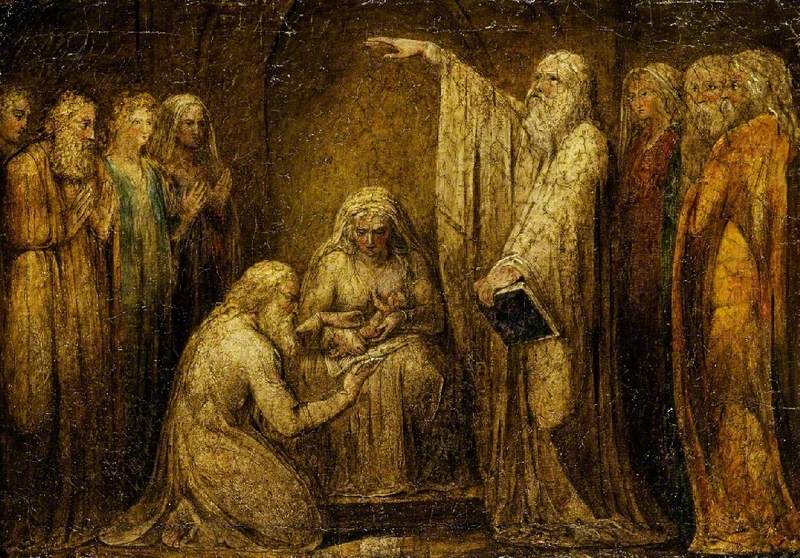
Luke 2:21,  And when eight days were accomplished for the circumcising of the child, his name was called JESUS, which was so named of the angel before he was conceived in the womb.

Fitzwilliam Museum
The Circumcision

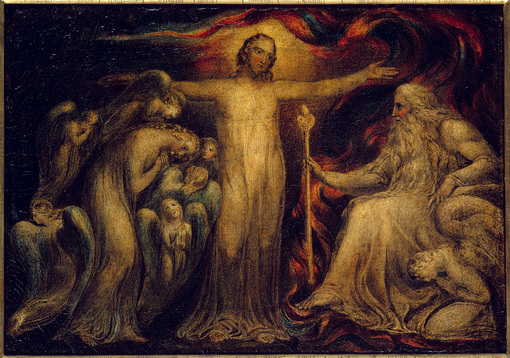
The final picture of the group in the Archive is particularly appealing : "Christ The Mediator": Christ Pleading Before the Father for St. Mary Magdalene. In this picture Blake portrays the theme of forgiveness. Christ acting as the advocate for the sinner intervenes with Jehovah on the part of Magdalene who was said to have been a harlot.

Mark 16
[9] Now when Jesus was risen early the first day of the week, he appeared first to Mary Magdalene, out of whom he had cast seven devils.

On this the eighth day after the celebration of the birth of Jesus (the first day of the new year), the day on which circumcision is performed according to the Law of Moses, it is appropriate to observe Christ intervening in the exercise of the Law before the Father on the part of the woman who both was forgiven and discovered the empty grave.