Tuesday, August 14, 2012

Blake's Moment


"There is a moment in each day that Satan cannot find."

In 4Z Blake described the Moment of Grace in terms that closely resemble those of Jungian psychology: shadow and anima (Blake calls them spectre and emanation) are integrated into the self. But without question Blake described here a personal spiritual event of the greatest importance. It was the moment when the divided selves found themselves reconciled into a new being under a new Lord; it marked a radical alteration of consciousness.

 Blake had shared with mankind a consciousness fallen through a decision for the world and senses constricted through turning his back upon the Divine Vision. Less guilty than most of us, he had not reached the level of spiritual blindness which characterizes true worldliness; nevertheless he was guilty. But in his brokenness he opened himself to unmerited grace, with the inevitable gracious consequences.

In Night vii of 4Z Urizen, the ice man, the great opposer of change, effects the metamorphosis of fierce and fiery Orc, personification of change, into a serpent who crawls up the Tree of Mystery. An earlier prophet had written about a serpent and a tree at the dawn of history, and since that day the two figures have served as the basic symbols of the Fall. But Moses had used the same combined image to symbolize healing, and Jesus harked back to it in predicting his own impending exit from the world and its purpose.


Knowledge of the full weight of meaning carried by serpent and tree alerts us to an impending climax in Blake's story. Back in Night I Los, the spirit of prophecy, the personification of creativity, was estranged from his emanation, Enitharmon. In Night v she gave birth to Orc, but Los chained him to earth with the Chain of Jealousy, a sort of reverse Oedipus myth. This left the creative selves a sorry shambles. But now in Night vii Enitharmon's shadow meets and unites with Los' spectre, and their issue is twofold, the Whore and the Lamb. The Whore will burn, and the Lamb will find a spotless bride.

There's no way anyone can fully appreciate the joy of this moment without having participated deeply in the agony and travail which preceded it. This is but a way of saying that there's no way anyone can appreciate the salvation of the world without having first quenched the cup of the fallenness of the world. Long ago a book appeared entitled No Cross, No Crown, suggesting that we don't appreciate what God has done simply because we refuse the cup. Jesus accepted it on our behalf, and Blake did too in his way, as does every artist or prophet or saint who follows the narrow path.

 At the Moment of Grace the narrow path opens out into the limitless expanse of eternity. The last half of Night vii marks that moment in Blake's life and describes his own personal experience of Easter. Once it happened, he went on to what Kathleen Raine called the Christianizing of his myth. In Night viii he told the old, old story in the old, old terms, but the new creation had taken place in Night vii.

Next to the Bible the poet John Milton was Blake's most formative spiritual influence. 'Paradise Lost' was the great religious epic in the English language, and Blake's calling as an epic poet is closely related to his affinity with Milton. As early as 'The Marriage of Heaven and Hell' he commented on Milton's vision. Quotations from 'Paradise Lost' and allusions to it fill the pages of 4Z. The evolving myth of Urizen, Los, and Orc may be understood at one level as a meditation upon Milton's leading characters--the Almighty, Satan, and Messiah.

In the first six nights of 4Z Blake had exhausted his vision and didn't know at first how to proceed. Then he was surprised by joy and enabled to construct a Christian conclusion to the myth. But he didn't bother to engrave 4Z because his interests had changed. In the next long poem, 'Milton', he worked through and meditated upon the Moment of Grace and savored the new spiritual world which he had inherited. 'Milton' is a record of Blake's Christian honeymoon.

In the first part of 'Milton', called the "Bard's Song', Blake deals with the dramatic years at Felpham. Here we find Blake's definitive and full bodied portrait of Satan. Blake had come full circle from his ironic identification with the Devil in MHH. Now he identified Hayley with Satan, which seems rather uncharitable. We need to bear in mind that there were two Hayleys in Blake's mind. The first Hayley was a corporeal friend who had lured him to Felpham and tried to do him in spiritually: "Corporeal friends are spiritual enemies". This Hayley served as tempter in what we may call Blake's last temptation. The other Hayley was a fellow sufferer with Blake, an artist whom Blake continued to encourage and nurture, as the letters attest.

In the remainder of 'Milton' Blake's hero, John Milton, after a hundred years in Eternity, reenacts the kenosis (self emptying) of Christ and descends to redeem his successor, Blake, and mankind. The poem is full of a beauty and joy which had been largely absent from Blake's pen since 'Songs of Innocence'. It contains some of his finest nature poetry. Between the end of SI and the Moment of Grace Blake had seen and described nature as corrupt, as groaning in travail. Now in 'Milton' he sees creation redeemed just as Paul had said that it would be:

"Thou hearest the Nightingale begin the Song of Spring; The Lark sitting upon his earthy bed: just as the morn Appears; listens silent;
then springing from the waving Corn-field! loud He leads the Choir of Day! trill, trill, trill, trill, Mounting upon the wings of light into the Great Expanse: Reecchoing against the lovely blue & shining heavenly Shell: His little throat labours with inspiration; every feather On throat & breast & wings vibrates with the effluence Divine
All Nature listens silent to him & the awful Sun Stands still upon the Mountain looking on this little Bird" (Erdman 130)

The Church periodically gave birth to men and women who, from the platform of the orthodox tradition, were elevated to a direct vision of God. This is particularly true of our poet. Most of the creative change in the Church originated with such types. The Church rather uniformly discouraged mystical visions of God unless they conformed in full detail to the orthodoxy of the moment. God refused such limitations; the entire period prophetically judged the priestly position. A long volume could be written about the many prophetic visions which in one way or another resemble that of our poet; Boehme.

The Church was broad enough to include and even honor many of these free spirits, but the works which followed them in the hands of their more militant disciples generally fell into ill repute. The early Franciscan movement is a case in point. St. Francis preached to his little sisters the birds; he shared the stigmata of Christ and suggested that to share Christ's poverty might be fitting for his disciples, an extremely radical idea which an extremely wealthy pope indulged. But many of Francis' disciples faced persecution of various sorts.

Roughly contemporary with Francis another monk named Joachim of Flora rediscovered for the nth time the dominance of the Spirit over the letter. Preaching what he called the Everlasting Gospel Joachim proposed to dispense with the corrupt and worldly political structures of the establishment and move into a New Age, the era of the Holy Spirit. The New Age would replace the age of the Church; it would be an age of freedom with everyone led directly by the Spirit. Jeremiah had foretold this. Even Moses had said, "would to God that all the Lord's people were prophets". For the creative poet the New Age represented freedom at its best, exactly what Jesus had come to bring us. For most of the priests it represented antinomianism at its worst.

The Everlasting Gospel and the New Age came down the centuries through the various subterranean channels of the heterodox tradition. Swedenborg announced its advent in 1757, which happened to be the year of Blake's birth; Blake noted this with obvious delight in 'The Marriage of Heaven and Hell'. Years later, in the autumn of his life, Blake filled his spiritual journal with a fragmentary poem called 'The Everlasting Gospel'. It was his systematic attempt to set forth in the most direct terms possible his precise view of Christianity and its founder. He probably never concluded the project to his full satisfaction.

Monday, August 13, 2012

TRANSFORMATION II

The mood of rejoicing which Blake experienced when he moved to Felpham and wrote of his 'first vision of light' was shortlived. The visionary experience impelled him to continue writing prophetic poetry and follow the lead of his imagination wherever it took him. The last illuminated book he had completed was the Song of Los in 1795. Work on an epic which began as Vala and continued as the Four Zoas had been in progress for several years but was bogged down in an incomplete state. A new phase in Blake's career was about to begin, initiated by a clarifying of his vision of God and man and the prophetic role he might play.
http://www.britishmuseum.org/collectionimages/AN00012/AN00012505_001_l.jpg
British Museum   
Milton  
Plate 29, Copy A


Although Blake was called to a new mission and message by the new vision which he reported in his letter to Butts, it was not a turn away from Christianity but to a closer commitment to the Jesus whom he knew and loved. He experienced new conflicts as he reoriented his priorities. In November 1802 Blake reassured Butts that the challenges he was facing were being withstood. In January 1803 he expands on the battle which had been consuming his mind and energy.


 Letters, (E 720)
Mr Butts, Gr Marlborough Street
Felpham Novr. 22: 18O2
...
"And now let me finish with assuring you that Tho I have been
very unhappy I am so no longer I am again Emerged into the light
of Day I still & shall to Eternity Embrace Christianity and Adore
him who is the Express image of God but I have traveld thro
Perils & Darkness not unlike a Champion I have Conquerd and shall
still Go on Conquering Nothing can withstand the fury of my
Course among the Stars of God & in the Abysses of the Accuser My
Enthusiasm is still what it was only Enlarged and confirmd"

Letters, (E 724) 
Felpham Jany 10. 180[3] 
...
"It gives me the greatest of torments, I am not
ashamed afraid or averse to tell You what Ought to be Told.  That
I am under the direction of Messengers from Heaven Daily &
Nightly but the nature of such things is not as some suppose.
without trouble or care.  Temptations are on the right hand &
left behind the sea of time & space roars & follows swiftly he
who keeps not right onward is lost & if our footsteps slide in
clay how can we do otherwise than fear & tremble. but I should
not have troubled You with this account of my spiritual state
unless it had been necessary in explaining the actual cause of my
uneasiness into which you are so kind as to Enquire"

The vision which had been given him and his commitment to Christ tore him from worldly pursuits which might earn money and please his patron William Hayley. But he responded by incorporating the very conflicts which absorbed him into the writing of another prophetic book which he named Milton. Appropriately Jesus appears at the culmination of Milton:

Milton, Plate 49, (E 143)
"Jesus wept & walked forth
From Felphams Vale clothed in Clouds of blood, to enter into     
Albions Bosom, the bosom of death & the Four surrounded him
In the Column of Fire in Felphams Vale; then to their mouths the Four
Applied their Four Trumpets & them sounded to the Four winds

Terror struck in the Vale I stood at that immortal sound
My bones trembled. I fell outstretchd upon the path              
A moment, & my Soul returnd into its mortal state
To Resurrection & Judgment in the Vegetable Body"
Blake commitment to Jesus is seen in these passages in the Four Zoas and Jerusalem. We see also his understanding of the suffering such commitment may bring. 
Four Zoas, Night VIII, PAGE 104 (FIRST PORTION), (E 376)
 "And Enitharmon namd the Female Jerusa[le]m the holy
 Wondring she saw the Lamb of God within Jerusalems Veil
 The divine Vision seen within the inmost deep recess
 Of fair Jerusalems bosom in a gently beaming fire

 Then sang the Sons of Eden round the Lamb of God &  said
 Glory Glory Glory to the holy Lamb of God
 Who now beginneth to put off the dark Satanic body
 Now we behold redemption Now we know that life Eternal
 Depends alone upon the Universal hand & not in us
 Is aught but death In individual weakness sorrow & pain" 
Jerusalem, Plate 25, (E 170)
"As the Sons of Albion have done to Luvah: so they have in him
Done to the Divine Lord & Saviour, who suffers with those that suffer:
For not one sparrow can suffer, & the whole Universe not  suffer also,
In all its Regions, & its Father & Saviour not pity and  weep.
But Vengeance is the destroyer of Grace & Repentance in the bosom
Of the Injurer: in which the Divine Lamb is cruelly slain:
Descend O Lamb of God & take away the imputation of Sin
By the Creation of States & the deliverance of Individuals Evermore Amen" 

Sunday, August 12, 2012

Faith IX

The Neo-platonic interpreters have theorized that Blake couldn't forgive the creator for
condemning us to this prison house of mortal life. I think a more universal explanation
fits the facts. Everyone has difficulty forgiving his father and/or creator for the
 dimensions of horror in life which threaten in one way or another to overwhelm the
psyche. Few or none of us have done a really adequate job of this. Most often we've
repressed the sensitive idealist; we've closed off from consciousness those unpleasant
ultimate realities which seem to have no answer.

"Did he who made the Lamb make thee?" Has anyone really asked that question since
 1794? Neitszche asked it and went crazy. In our generation Jung has come closest, and
 that's what makes him great. Most of us, even the best of Christians, have partitioned
 off and closed out that ultimate question, the ultimate doubt expressed by the dying
 Saviour on the cross. This William Blake could not do; like Jesus he was condemned
 to face consciously the penalty of our finitude.

Frye has spoken of the 'abyss of consciousness'. Enion, the primeval mother in 4Z is
 condemned to it by her love of her children. at the end of Night ii she calls our
 attention to this blindness which we have chosen and its opposite, the abyss of
 consciousness which she (and Blake in her) is condemned to face; here is her complaint.

Something is terribly wrong in this created universe, and in the face of this underlying
wrongness the idea of a loving Father as Creator simply doesn't fit all the facts. This
 consciousness, which Blake shared with Dostoevski in the person of Ivan Karamazov
, interrupted Blake's childlike innocence and precipitated the torturous journey "through
 the Aerial Void and all the Churches".

Probably a majority of people will always refuse such an invitation; they will cling to
 the refuge of their Church, or Bible, or President, or fraternity, or whatever form of
 authority they have made their obeisance to, whatever they have found to block out the
 abyss of consciousness. A few will have at least a sympathetic or vicarious interest in
 the problem posed by Blake and Dostoevski. A handful will perceive that to realize
 their full humanity and the God Within they must proceed beyond innocence. They,
 too, must take that long journey and plumb life to its wholeness. The art of Blake
 offers a good map for the trip.

******************************************************************
To read all the Faith posts together click on the label: Faith at the end of any of them.

An earlier version of Faith I-IX may be seen as a composite in Chapter Four of the Primer.

Saturday, August 11, 2012

TRANSFORMATION

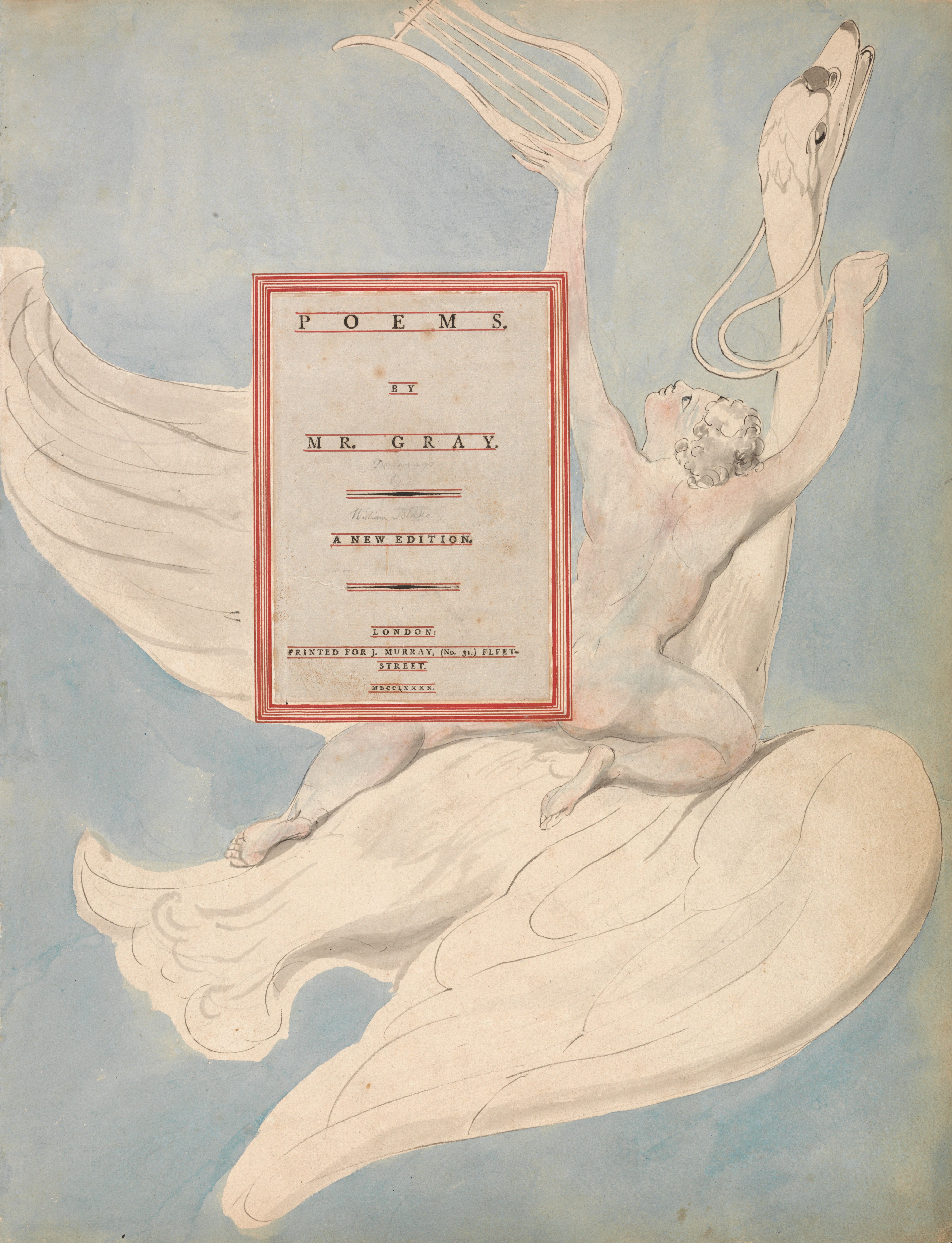
The period in Blake's life immediately before, after and during the time he resided in Felpham, was critical to his spiritual development. Before his move from London in September 1800, he was discouraged by political conditions and by personal experiences.

Yale Center for British Art
Blake's Watercolours
for the Poems of Thomas Gray
We can follow some of the developments in Blake's life through letters he wrote to Thomas Butts from Felpham. 

In the second letter we have from Blake to Thomas Butts he enclosed a poem rejoicing in the new setting in which he found himself. He wrote of 'My first Vision of Light', of 'each particle' seen as 'a Man'. He identified himself with the 'Ram hornd with gold' awakening 'from sleep' and being introduced to the Fold by the visionary voice.
 
There is no doubt that Blake was reporting a true and immediate experience in his poem. He introduces it by saying: "verses such as Felpham produces by me tho not such as she produces by her Eldest Son." That is to say the verses are by his true identity, his imagination, and not by his reasoning powers: the Elder Brother who was conformed to this world and not to the eternal.

Blake may have identified the experience described in the poem to Butts as turning toward God and the beginning of a new life lived in God's kingdom. However there would be pitfalls and turning points to come because he would be tried by 'the Devil' as are many who are young in Christ. Jesus himself encountered Satan after he consented to baptism by John in the Jordan. For a detailed account of the attempts of 'Our Father Below' to subvert the newly committed Christian's attempts to alter his priorities and behavior, read C. S. Lewis' Screwtape Letters.

Letters, (E 713)
[To] Mr [Thomas] Butts, Great Marlborough Street
Felpham Octr 2d 1800
...
I have not got any
forwarder with the three Marys or with any other of your
commissions but hope, now I have commenced a new life of industry
to do credit to that new life by Improved Works: Recieve from me
a return of verses such as Felpham produces by me tho not
such as she produces by her Eldest Son. however such as they
are.  I cannot resist the temptation to send them to you

To my Friend Butts I write
 My first Vision of Light
 On the yellow sands sitting
 The Sun was Emitting
 His Glorious beams
 From Heavens high Streams
 Over Sea over Land
 My Eyes did Expand
 Into regions of air
 Away from all Care
 Into regions of fire
 Remote from Desire
...
 Saying.  Each grain of Sand
 Every Stone on the Land
 Each rock & each hill
 Each fountain & rill
 Each herb & each tree
 Mountain hill Earth & Sea
 Cloud Meteor & Star
 Are Men Seen Afar
 ...
 My Eyes more & more
 Like a Sea without shore
 Continue Expanding
 The Heavens commanding
 Till the jewels of Light
 Heavenly Men beaming bright
 Appeard as One Man
 Who Complacent began
 My limbs to infold
 In his beams of bright gold
 Like dross purgd away
 All my mire & my clay
 Soft consumd in delight
 In his bosom sun bright
 I remaind.  Soft he smild
 And I heard his voice Mild
 Saying This is My Fold
 O thou Ram hornd with gold
 Who awakest from sleep" 

In Blake's letters and poetry written over the next few years we can follow some of the roadblocks he encountered and some of the breakthroughs he achieved. In Milton and Jerusalem we hear echoes of his poem included in the letter to Butts.


Milton, Plate 22 [24], (E 116)
"While Los heard indistinct in fear, what time I bound my sandals
On; to walk forward thro' Eternity, Los descended to me:
And Los behind me stood; a terrible flaming Sun: just close
Behind my back; I turned round in terror, and behold.
Los stood in that fierce glowing fire; & he also stoop'd down
And bound my sandals on in Udan-Adan; trembling I stood
Exceedingly with fear & terror, standing in the Vale
Of Lambeth: but he kissed me and wishd me health.
And I became One Man with him arising in my strength:
Twas too late now to recede. Los had enterd into my soul:
His terrors now posses'd me whole! I arose in fury & strength."

Jerusalem, Plate 99, (E 257)
"All Human Forms identified even Tree Metal Earth & Stone. all
Human Forms identified, living going forth & returning wearied
Into the Planetary lives of Years Months Days & Hours reposing
And then Awaking into his Bosom in the Life of Immortality.
And I heard the Name of their Emanations they are named Jerusalem

The End of The Song
of Jerusalem"


Friday, August 10, 2012

Faith VIII

In MHH Blake examined most directly the conventional idea of Hell
and pronounced it a delusion of a certain type of mind. 
In VLJ he gave his straightforward views about the meaning 
of the biblical Hell. 

In 'Jerusalem:
"What are the Pains of Hell but Ignorance, Bodily Lust, Idleness & 
devastation of the things of the Spirit?" However the conventional Hell 
does seem to have some biblical basis: 

Isaiah 66.24, Mark 9.43ff; Matthew 25.41 provide examples. 
How do you deal with all those scriptures? 
In the first place Blake felt perfectly free to discount anything in the 
Bible that he found incongruent with his vision, at least to discount 
its conventional meaning. The immediate experience always exercised 
authority over anything second hand. The inerrancy of scripture, another 
of the Five Fundamentals, meant just about as much to him as 
Double Predestination.

 In the second place, although the doctrine of hell has most often 
been used as a means of anathematizing those with whom one disagrees, 
there are certainly more creative ways to deal with it. 
Blake chose one of these, what he called the doctrine of states
In a conversation with the "seven Angels of the Presence" 
Milton is told by Lucifer: "We are not individuals but states...
Distinguish therefore states from individuals in those states.
 And at the end of the first chapter of 'Jerusalem' the daughters of 
Beulah pray as follows:

Descend, O Lamb of God and take away the imputation of Sin
By the Creation of State and the deliverance of Individuals Evermore
But many doubted & despair'd and imputed Sin and Righteousness
To individuals and not to States, and these Slept in Ulro.
(Jerusalem, 25.12; Erdman 170)

Double Predestination is a consequence of a more fundamental 
error of Rahab, the whore of Babylon, the organized Church, 
"Imputing sin and righteousness to individuals". 
Blake addressed that error with his doctrine of states, 
which we look at in a moment.

To distinguish states from individuals is the only means of 
forgiveness of sins. 
In the centuries since Blake enlightened Christians have learned 
to condemn sin without condemning the sinner. 
The most enlightened condemn no one, realizing that we ourselves are 
as sinful as anyone else. 
For such a consciousness the only authentic preaching 
becomes confessional preaching. 
 The relationship between Blake's doctrine of states and the 
conventional doctrine of hell becomes clear in plate 16 of Illustrations
to Job series where Job and his wife watch the 'old man' in themselves 
take the plunge with their master "into the everlasting fire prepared 
for the devil and his angels". 

This of course is a spiritual or psychic event. 
The crude and ludicrous superstition of the conventional doctrine of hell 
stems from a spiritual blindness that attempts to impose the material 
upon the Beyond--once again the Lockian fallacy, 
the assumption that 'material' is 'real'. 

 The Last Judgment in Blake is the consummation devoutly to be hoped 
for when truth takes its rightful place in man's psyche. 
Error is "burnt up the Moment Men cease to behold it". 
The person wedded to error finds this a fearsome prospect; 
the one who wants to be free finds it a glorious one. 

We're all headed for the last judgment--by the direct childlike route 
or the torturous worldly route. 
It's the fervent hope of the eternalist and the bane of the materialist. 
Blake, as was said before, traveled both routes. 
His exquisite lyrics attest to the first; 
his (often tormented) prophetic declamation to the second. 

The childlike route is so crystal clear as to need little explanation; 
the second obviously needs a great deal. 
Looking closely at the first may be good preparation for the second. 

An incident from Blake's last years suggests something of the nature 
of the torturous route which was Blake's life. 
The old poet was telling the story of the Prodigal Son. 
He got to the moment when the wandering boy at last returns to the Father. 
At that point Blake broke down in tears; he couldn't go on. 
The story casts a revealing light on a primitive relationship 
that must have provided a lot of the dynamic for Blake's creativity. 
 Psychologists tell us that a person's early relationship with his father
has a great bearing on his image of God. 
Applying that idea to Blake's poetry one could infer that Blake
as a child had a gruesome relationship with his father. 
However we find little suggestion of this in the biography. 
On the contrary the preponderance of the evidence suggests
a permissive and understanding parent. 
(The only exception seems to be the threat to beat the eight year old 
for his 'lie' about the tree full of angels.) 
In any event 'father' has unpleasant associations in Blake's poetry, 
especially in the theological realm. 
He adored Jesus, but he obviously had trouble believing Jesus' word 
about the loving Father.


Thursday, August 09, 2012

THARMAS & ENION

British Museum
Jerusalem
Plate 96
Copy A
Link
Tharmas the last named of the Four Zoas was also 'the parent power.' He emerged from the water like the first living land creatures which appeared in the evolutionary process. He is not as active and articulate as the other three Zoas. His role is that of a motivating force, always seeking and searching and impelling others to speak and act. The object of his search is his emanation Enion whose reunion with Tharmas is a feature at the feast of the Eternals at the culmination of the Four Zoas.
Link
The image of Albion's reunion with England could represent Tharmas' reunion with Enion.


Four Zoas, Night IX, Page 132, (E 400):
"The feast was spread in the bright South & the Regenerate Man
Sat at the feast rejoicing & the wine of Eternity
Was servd round by the flames of Luvah all Day & all the Night
And when Morning began to dawn upon the distant hills
a whirlwind rose up in the Center & in the Whirlwind a shriek
And in the Shriek a rattling of bones & in the rattling of bones
A dolorous groan & from the dolorous groan in tears
Rose Enion like a gentle light & Enion spoke saying
O Dreams of Death the human form dissolving companied
By beasts & worms & creeping things & darkness & despair
The clouds fall off from my wet brow the dust from my cold limbs

Into the Sea of Tharmas Soon renewd a Golden Moth
I shall cast off my death clothes & Embrace Tharmas again
For Lo the winter melted away upon the distant hills
And all the black mould sings. She speaks to her infant race her milk
Descends down on the sand. the thirsty sand drinks & rejoices
Wondering to behold the Emmet the Grasshopper the jointed worm
The roots shoot thick thro the solid rocks bursting their way
They cry out in joys of existence. the broad stems
Rear on the mountains stem after stem the scaly newt creeps
From the stone & the armed fly springs from the rocky crevice
The spider. The bat burst from the hardend slime crying
To one another what are we & whence is our joy & delight
Lo the little moss begins to spring & the tender weed
Creeps round our secret nest. Flocks brighten the Mountains
Herds throng up the Valley wild beasts fill the forests

Joy thrilld thro all the Furious form of Tharmas humanizing
Mild he Embracd her whom he sought he raisd her thro the heavens
Sounding his trumpet to awake the Dead on high he soard
Over the ruind worlds the smoking tomb of the Eternal Prophet

PAGE 133

The Eternal Man arose he welcomd them to the Feast
The feast was spread in the bright South & the Eternal Man
Sat at the feast rejoicing & the wine of Eternity
Was servd round by the flames of Luvah all day & all the night"


Wednesday, August 08, 2012

Faith VII


       According to Blake's faith the coming of Jesus is the ultimate act of forgiveness for what we have become in our brokenness. It empowers us to become through a new birth what we were originally and what we are called to be again. The new birth is an alteration of consciousness. Blake had an inkling of this as early as 'The Marriage of Heaven and Hell', where he referred to it as "an improvement of sensual enjoyment" In the same plate he referred to it as a cleansing of the "doors of perception" and likened the former state to life in Plato's cave.


In the lovely "first Light" poem already quoted he used the thoroughly biblical figure of Jesus purging away "all my mire and my clay". Forgiveness is not a temporal event, but an eternal one. The Lamb of God was slain from the foundation of the world. We must forgive not once, but seventy times seven times. Blake deals with sin and forgiveness as ultimates in his notebook poem, "My Spectre around me night and day". The poem speaks primarily to the advanced student, but with crystal clarity stanza 14 bears on the primary grace:

 Throughout all Eternity I forgive you, you forgive me.  

As our dear Redeemer said:  
This the Wine and this the Bread.

       The unforgiving, accusing, egocentric, spectrous Selfhood is the stuff of Ulro, the life that is Eternal Death. Forgiveness through Self-annihilation is the stuff of that life which is life indeed. In the eternal realm Good and Evil, Virtue and Sin, all are forgiven and replaced by Truth and Error, which constitute the matter of the eternal wars of love. 

We fight these with Blake's weapons (the burning arrows of thought, etc.) or with Paul's "whole armor of God". Error meets an eternal consummation as we grow closer and closer to the Perfect Man. The apocalypse in Blake's structure of faith comes as an alteration of consciousness by which "this world" fades out (is consumed) and is replaced by the Eternal. Albion awakes. "Whenever any Individual Rejects Error and Embraces Truth, a Last Judgment passes upon that Individual".

       This was Blake's religion; unfortunately he does not seem to have found it in any of the churches which he knew. Instead many of his deepest convictions directly contravened the prevailing theology. He discovered that he "must create a system, or be enslated by another mans". The pages that follow trace some of the contrarieties between Blake's vision of eternal reality and the mainstream of Christian orthodoxy.

                               The Two Ways


       In his poem Milton Blake speaks of two streams flowing from a fountain in a rock of crystal: one goes straight to Eden; the other is more torturous. They represent of course two possible journeys through life, and he could speak of both because he lived both. The first stream represents the child-like consciousness that enabled Blake (that enables anyone gifted with it) to live every moment in the light of Eternity. The other, more common path wanders all over this God-forsaken vale of tears, but it winds up at the same place.

       That's the most incredible good news for anybody who can hear it. The apostle Paul hinted at it a time or two; perhaps it was the truth that he was forbidden to tell. Origen believed it, no doubt one of the reasons the Church Fathers kicked him out. In the 19th Century an entire denomination arose whose primary emphasis was this particular good news--the Universalists. Actually this good news could not be pronounced with authority except by someone like Blake who had traveled both journeys; he knew whereof he spoke.

       If you believe that all came originally from the One and that in the fullness of time all things in Christ are gathered together in one, then as a consequence the two paths do meet at the end as Blake claimed. We can put this in a more properly theological context with Blake's expressed response to the calvinistic doctrine of Double Predestination.

       Double Predestination contains as its lower half the grim old notion of Hell that has probably done as much as anything else in theology to discredit the Christian faith in the eyes of the modern world. Calvin taught the hoary old superstition that most of the world's population are destined to live without Christ and to die and move on to eternal torment; a lucky few have a happier destiny. The lucky few included Calvin of course and his friends, especially his obedient friends. In contrast Origen, perhaps Paul, and surely Blake believed in single predestination: the two streams converge at the end.

       Blake expended an enormous amount of his creative energy combating Double Predestination. He heaped scorn upon scorn on the calvinistic God who curses his children. His break with Swedenborg followed his discovery that Swedenborg was a "Spiritual Predestinarian, more abominable than Calvin's". He later lamented over him and called him the "Samson, shorn by the Churches".

Tuesday, August 07, 2012

GREAT ETERNITY

Repost from Nov 30 2009


Blake offers us four levels of existence in time, plus a level of existence outside of time: Great Eternity.

The first thing to focus on in considering Great Eternity is that Eternity is not time. Eternity is not an extension of time. Eternity may contain time, but time cannot contain Eternity. Eternity may interact with time. There is a flexibility in Eternity that does not exist in time, because time is a restraint allowing only sequential experience (access.) Without time multiplicity and unity are not contradictory. In Eternity essence remains, appearances fluctuate.


"Then those in Great Eternity met in the Council of God
As one Man for contracting their Exalted Senses
They behold Multitude or Expanding they behold as one
As One Man all the Universal family & that one Man
They call Jesus the Christ & they in him & he in them
Live in Perfect harmony in Eden the land of life
Consulting as One Man above the Mountain of Snowdon Sublime"

This passage in Night the First of the Four Zoas, Page 21, (E 310) uses the word one, five times in seven lines. It seems that Blake wanted to emphasize that in Great Eternity there is no division. Blake does not envision Great Eternity as a static place but as one in which the movement does not result in separation. Although envisioning Eternity is impossible for mortals, these are characteristics Blake offers:

1 Contracting their Exalted Senses, they see Multitude (Four Zoas, Page 21)
2 Expanding they see as One (Four Zoas, Page 21)
3 Visions of Human Life & Shadows of Wisdom & Knowledge are expandable (Milton, Plate34)
4 War & Hunting are the Two Fountains of the River of Life (Milton, Plate35)
5 Universal Brotherhood exists in Eternity (Four Zoas, E300, Lines 3.4-3.5)
6 Ideas may not be slain (they are the Divine Members) (Milton, Plate35)
7 Every particular form is the Divine Vision (Jerusalem, Plate 54)
8 Every form Emanates its Light which is its Garment (Jerusalem, Plate 54)
9 There is Continual Forgiveness of Sins and Perpetual Mutual Sacrifice (Jerusalem, Plate 61, Line 23-4)
______________________________________________
The Eternal can be expressed but it cannot be contained.
We can be present to it, and it can be present to us as imagination and inspiration.
Forgiveness and Brotherhood are expressions of the Eternal.
Divisions and limitations disappear in Eternity.
Life and Light participate in the great exchange.
The energies of the mind and body and spirit interact freely and cooperatively in Great Eternity.

Monday, August 06, 2012

Faith VI


iii

Sin and Forgiveness

      "Whosoever of you are justified by the law: ye are fallen from grace" (Paul)

       Just as he redefined hell, so Blake redefined sin. The only sin for Blake consisted of hindering, oneself or another: "Murder is Hindering Another, Theft is Hindering Another." To subvert one's individuality is the sin against the Holy Spirit. "He who desires but acts not, breeds pestilence".

       The responsibility for hindering another falls upon the Lawmaker and Enforcer, who has polluted life with his prohibitions: "over the doors Thou shalt not". One could say that Blake took Paul's letters to the Romans and to the Galatians too seriously. Luther had taken those epistles seriously enough to throw off the Roman yoke. Blake took them more radically and threw off the mosaic yoke--as Paul had suggested.

       Paul had identified the Law with the flesh and opposed it with the Spirit. Our poet took with utmost seriousness these stirring passages calling the Christian to freedom from the Law. He didn't have the benefit of the 'interpretations' of such ideas afforded by the educational process. Sin stems from our ideas of morality, which Blake called hindering. When we presume to know what someone else should or must do, we have entered the state of Caiaphas, the Pharisee, who crucified Jesus, but "was in his own Mind/a benefactor to Mankind."

       We lay down the law to another--our law--and thus violate the other's nature: "One law for the Lion and Ox is Oppression". We tell him what to do, and then we use the power of the Accuser, the God of this World, to compell him to do it and to punish him for his failures. This is sin, the way life happens in Ulro. As we have seen, Blake didn't call it life, he called it Eternal Death. Paul had said, "The wages of sin is death but the gift of God is eternal life."

       The categories of sin and righteousness divide mankind. The division often proceeds to the point of physical violence. Corporeal war always rests upon a base of self righteousness and condemnation of the sins of the enemy. Religion too often allies itself with those attitudes and their violent results. Long before the peaceniks of the sixties Blake said in effect, "Make love, not war!" He said it at great length in dozens of different ways. He saw war as the ultimate end of hindering another.  In the Book of Urizen we read how Urizen, the great Lawgiver (who lives in all of us!) discovers that none of his children can obey his laws, "for he saw that no flesh nor spirit could keep His iron laws one moment".

       So we see that Blake opposed the idea of sin; he opposed morality; he opposed Law. Parodoxically Blake lived a very law abiding life. Only such a person can afford the luxury of antinomianism without losing his integrity. For example Blake despised the marriage laws--and lived as a faithful and dutiful husband for forty years. But beyond the surface absurdities of his anarchism Blake tells us something profound about life: Goodness cannot be compelled; goodness grows only in a context of freedom. "To the pure all things are pure". Blake was basically pure; one of his mottoes was "everything that lives is holy". That in itself would have been enough to make him famous.

       If we can suspend our judgments about people's conduct and stop tormenting ourselves because of our failures to do the good which we have laid upon ourselves, if we can accept what we have called bad, but which may be simply disowned facets of our true nature, in Blake's terminology if we can forgive, then we can put sin behind us and receive the gift of eternal life. Blake, drinking deeply from the prmary fountains of scripture, intuitively expressed these universal truths in poetic terms. 100 years later Jung came along and clothed them with the respectability of a scientific jargon.

       From what has been said it is obvious that Blake didn't believe in Sin as it is commonly understood: "Satan thinks that Sin is displeasing to God; he ought to know that Nothing is displeasing to God but Unbelief;of the Tree of Knowledge of Good & Evil". Jerusalem, Blake's symbol of the redeemed and pure consciousness, speaking to Vala his symbol of the fallen mind, expressed Blake's candid evaluation of Sin as such: "Oh Vala...what is sin but a little error & fault that is soon forgiven?"

       If the primary moral wrong is hindering, the primary grace is forgiveness. 
Redemption came for Blake when forgiveness first entered the horizon of his vision; it increasingly came to dominate it. Prior to 1800 with all his denunciations of Urizen, the Restrainer, and of morality Blake was growing more and more into the role of judge. He was becoming in fact a judge of judges. The later Lambeth books witness the resultant decrease in vitality; in the language of Zion he suffered a loss of faith. It coincided with a slowly dawning realization that Urizen had infested his own mind all the while he was denouncing him in others.

There awakened in his mind a new awareness of sin, a sin more basic than hindering others, or rather an awareness of the inner cause of hindering. He called it the Selfhood, the Spectre, Satan. As many of us have since that day, Blake realized that he saw the God-playing in others because he was so good at it himself. This new vision of his Selfhood led to the Moment of Grace.

       At Felpham, in the major crisis of his life, he faced the need to forgive both the impositions of his corporeal friend, Hayley, and the resentful thunderer, William Blake, as well. The appearance of his first Vision of Light marks the coming of Christ into his life with the power of this forgiveness; henceforth he called him Jesus, the Forgiveness.

       The old urizenic monstrosity that had haunted him, first in the outer world and increasingly as a component of his own psyche, was recognized, accepted, subdued, and forgiven. It was undoubtedly the greatest event of his life, a new birth of hope at the age of 43. He shared with us the psychic unfolding of this experience in Night vii of 'The Four Zoas' where Los embraces his Spectre (equivalent to Jung's acceptance of the shadow) and soon thereafter finds Urizen miraculously changed:

       Startled was Los; he found his Enemy Urizen now In his hands; he wonder'd that he felt love & not hate. His whole soul loved him; he beheld him an infant Lovely....

       Has anyone better portrayed the psychodynamics of forgiveness? In order to forgive you first withdraw the projection, then you forgive yourself. It's your baby!

       We can't say that's the end of the story; in Night viii Urizen continues to afflict life with his judgments, hostility and violence; Satan comes forth from his War. The Saviour dies for him, and we are still waiting for the ultimate victory. Nor was Blake himself fully delivered from the resentments and self justifications of the old man. Hard times ahead, the deceitfulness and opprobrium of others continued to afflict and to warp his psyche and caused him to participate in sin (mostly by suffering through the sins of others against him), but now he knew the answer: through recurring awareness and Self-annihilation he could forgive again and again. The wheat and tares continued to grow together.

       Blake had a deep grasp of what students of the Bible have called the kenosis. At his Moment of Grace it became for him an existential reality. He rewrote 4Z to show Jesus throughout the drama coming from above, hovering over Mankind, descending into mortal flesh to join us and to take on our burdens, our sorrow and pain and travail. Blake referred to this as the "dark Satanic body". This is the body we all wear until Jesus glorifies it in us.

Sunday, August 05, 2012

GOD & MAN

 http://www.britishmuseum.org/collectionimages/AN00020/AN00020094_001_l.jpg
British Museum
Young's Night Thoughts

Blake's relationship with God was intimate. God was brother and friend to him. God was within his breast, his brain and his hand. His Imagination was filled with God. Human nature was God's image which man should adore.   

Jerusalem, Plate 4, (E 146)
"I am not a God afar off, I am a brother and friend;
Within your bosoms I reside, and you reside in me:
Lo! we are One; forgiving all Evil; Not seeking recompense!"


Marriage of Heaven & Hell, Plate 11, (E 38)
"Thus men forgot that All deities reside in the human breast."

Annotation to Berkley, (E 664) 
"Man is All Imagination God is Man & exists in us & we in him What Jesus came to Remove was the Heathen or Platonic Philosophy which blinds the Eye of Imagination The Real Man"
  
Annotations to Lavater, (E 597)
"human nature is the image of God" 
 
Everlasting Gospel, (E 520)
"God wants not Man to Humble himself
This is the trick of the ancient Elf
This is the Race that Jesus ran   
Humble to God Haughty to Man
Cursing the Rulers before the People    
Even to the temples highest Steeple
And when he Humbled himself to God
Then descended the Cruel Rod
If thou humblest thyself thou humblest me    
Thou also dwellst in Eternity       
Thou art a Man God is no more
Thy own humanity learn to adore
For that is my Spirit of Life" 
Milton, Plate 2, (E 96) 
"Come into my hand    
By your mild power; descending down the Nerves of my right arm
From out the Portals of my Brain, where by your ministry
The Eternal Great Humanity Divine. planted his Paradise,
And in it caus'd the Spectres of the Dead to take sweet forms
In likeness of himself. "

Saturday, August 04, 2012

Faith V


Heaven and Hell

       Who among us shall dwell with everlasting burnings? (Isaiah 33:14)
       No one knows of the Beyond. Still men throughout history have seen visions of it. These visions have informed their faith and galvanized them to the words and deeds by which they have lived. Look now at Blake's visions of Heaven and Hell:
       For Isaiah (and Blake) 'everlasting burnings' had connotations opposite to those of conventional thinking.
Indeed throughout the Bible fire more often symbolizes God than the Devil: "our God is a consuming fire".Note also the burning bush seen by Moses and the forks of flame at Pentecost. In Eden every bush burns and flaming tongues fill the air; Blake referred to them as burning arrows of thought.
       Blake's eternity, both here and hereafter, is characterized by two intense activities, War and Hunting (Milton: Plate 35:2), "the Two Fountains of the River of Life". Both are intellectual in nature and aimed at growth into Truth. In this world they have been prostituted into "corporeal war" and the killing of the innocent. War and Hunting of course exhaust the eternals, so periodic rest is provided in what might be called Lower Heaven; Blake called it Beulah:aThere is from Great Eternity a mild & pleasant rest Nam'd Beulah, a soft Moony Universe, feminine, lovely, Pure, mild & Gentle, given in Mercy to those who sleep, Eternally created by the Lamb of God around, On all sides, within & without the Universal Man.
       Blake tells us relatively little about Eden, but in his larger poems he had a lot to say about Beulah. He described it as a sort of way station between Eden and Ulro, which we might roughly translate as this vale of tears. Two way traffic passes through Beulah. Those who reach it from Ulro are in good shape and headed for something better. Those coming from the other direction are also okay for the moment but in deadly peril if they go farther.
       We could also call Ulro "this world". In a sense "this world" is as close to the conventional hell as Blake got. In Blake as in the Bible, especially in Paul, "this world" has a technical meaning. It does not mean the present stage of life as opposed to a heavenly (or hellish) existence beyond physical death. Basically "this world" means a level of consciousness that sees only the material, which Blake called the corporeal. Ulro is the state in which "Reality was forgot, and the Vanities of Time and Space only Remembered and called Reality" (Vision of the Last Judgment; Erdman 555; his comments on an astounding canvas; it concerns Revelation 20:11-15).
       Ulro, Blake's hell, denotes a form of blindness or sleep, from which one may awaken:
       This is his theme, Blake tells us. Students of the New Testament know that sleep and waking are thoroughly biblical figures for the spiritual realities which concerned Blake here. He envisioned Eternal Death as the fallenness of "this world" through which we pass before "awaking to Eternal Life". Blake thus saw hell as man's fallen state before the coming of Jesus to awaken us and set us free.
       The biblical writers as they are generally understood had not adequately grasped the fullness of Jesus' power to rescue mankind totally from the darkness which Blake called Eternal Death. They wrote most of the New Testament in a time of persecution. In their effort to stiffen the spine of the believer in the face of that persecution they retreated into a degree of thralldom to the Old Testament God of Wrath, in the spirit of Jonathan Edwards' sermon,"Sinners in the Hands of an Angry God".
       One can readily understand why the worldly ecclesiastics who followed Peter and Paul picked up on the angry God. All too often he became their primary weapon; the image of hell is the ultimate form of coercion. Blake made no such mistake, probably because of the ten years which he had spent confronting and subduing that "shadow from his wearied intellect", years of suffering, but it turned to glory.
       In those years he laid to rest the Punisher who has afflicted the minds of believers through the centuries, but he retained the creative possibility which represents the best of the Christian faith. The rationalists and deists had thrown out both and confined us to Ulro, which today threatens to engulf mankind. The reader must decide for himself whose hell is most real--the place of unending punishment or the sleep from which man may awaken.

Friday, August 03, 2012

REJOICE & TREMBLE

http://www.britishmuseum.org/collectionimages/AN00042/AN00042361_001_l.jpg
British Museum
Fear & Hope are Vision 
Gates of Paradise
Plate 13


During Blake's sojourn in Felpham, a correspondence developed between Blake and Thomas Butts who became the primary collector of Blake's works. Fortunately Butts preserved Blake's letters as well as his images and illuminated manuscripts. From the letters we learn of Blake's emotional, physical and spiritual conditions. A portion of the letter of April 25, 1806 seems to be addressed to advice Butts had given Blake on using the Psalms to lift his spirits. Blake's response is a tour de force of unidentified references to Biblical passages, mainly from Psalms. I hope that Butts had a thorough acquaintance with the Bible since he didn't have the internet to track down relevant passages.


   Letters,  26, (E 728) 
"Mr Butts, Grt Marlborough Street
Felpham April 25: 1803
...
 I have a thousand & ten thousand things to say to you.  My
heart is full of futurity. I percieve that the sore travel which
has been given me these three years leads to Glory & Honour.  I
rejoice & I tremble "I am fearfully & wonderfully made".  I had
been reading the cxxxix Psalm a little before your Letter
arrived.  I take your advice.  I see the face of my Heavenly
Father he lays his Hand upon my Head & gives a blessing to all my
works why should I be troubled why should my heart & flesh cry
out.  I will go on in the Strength of the Lord through Hell will
I sing forth his Praises. that the Dragons of the Deep may praise
him & that those who dwell in darkness & on the Sea coasts may be
gatherd into his Kingdom." 

The phrases I've highlighted in Blake's letter may lead us to these verses and chapters: 

Psalms 8
[5] For thou hast made him a little lower than the angels, and hast crowned him with  
glory and honour.

Luke 6
[23]  Rejoice ye in that day, and leap for joy: for, behold, your reward is great in heaven:
 for in the like manner did their fathers unto the prophets.

Psalm 119
[120] My flesh  trembleth for fear of thee; and I am afraid of thy judgments.

Psalms 139
[14] I will praise thee; for I am fearfully and wonderfully made: marvellous are thy works; 
and that my soul knoweth right well.

Matthew 6
[26] Behold the fowls of the air: for they sow not, neither do they reap, nor gather into barns; 
yet your heavenly Father feedeth them. Are ye not much better than they?

Psalms 139
[5] Thou hast beset me behind and before, and laid thine hand upon me.

1 Peter 3
[9] Not rendering evil for evil, or railing for railing: but contrariwise blessing; knowing that 
ye are thereunto called, that ye should inherit a blessing.

John 14
[27] Peace I leave with you, my peace I give unto you: not as the world giveth, give I unto you. 
Let not your heart  be troubled, neither let it be afraid. 

Psalms 84
[2] My soul longeth, yea, even fainteth for the courts of the LORD: my heart and my flesh 
crieth out for the living God.

Psalms 71
[16] I will go in the  strength of the Lord GOD: I will make mention of thy righteousness, 
even of thine only.

Psalms 146
[2] While I live will I praise the LORD: I will sing  praises unto my God while I have any being.

Psalms 148
[7] Praise the LORD from the earth, ye dragons, and all deeps:

Psalms 143
[3] For the enemy hath persecuted my soul; he hath smitten my life down to the ground; 
he hath made me to  dwell in darkness, as those that have been long dead.

Psalms 107
[1] O give thanks unto the LORD, for he is good: for his mercy endureth for ever.
[2] Let the redeemed of the LORD say so, whom he hath redeemed from the hand of the enemy;
[3] And gathered them out of the lands, from the east, and from the west, from the north, and 
from the south.
[4] They wandered in the wilderness in a solitary way; they found no city to dwell in.
[5] Hungry and thirsty, their soul fainted in them.
[6] Then they cried unto the LORD in their trouble, and he delivered them out of their distresses.

Zephaniah 2
[6] And the sea coast shall be dwellings and cottages for shepherds, and folds for flocks. 

Luke 6
[17] And he came down with them, and stood in the plain, and the company of his disciples, 
and a great multitude of people out of all Judaea and Jerusalem, and from the  sea coast of 
Tyre and Sidon, which came to hear him, and to be healed of their diseases;

Psalms 103
[19] The LORD hath prepared his throne in the heavens; and his kingdom ruleth over all.

Luke 1
[33] And he shall reign over the house of Jacob for ever; and of his kingdom there 
shall be no end.

Thursday, August 02, 2012

Faith IV


      Here is a detailed description of Jesus as the mature Blake envisioned him: in the lovely poem Blake wrote to Butts in October, 1800 he reported on an early appearance of Jesus to him, perhaps the first--when he was 43. He aptly called it "My first Vision of Light":
        To my Friend Butts I write
        My first Vision of Light,
        On the yellow sands sitting.
        The Sun was Emitting
        His Glorious beams
        From Heaven's high Streams.
        Over Sea, over Land
        My Eyes did Expand
        Into regions of air
        Away from all Care,
        Into regions of fire
        Remote from Desire;
        The Light of the Morning
        Heaven's Mountains adorning:

        In particles bright
        The jewels of Light
        Distinct shone & clear.
        Amaz'd & in fear
        I each particle gazed,
        Astonish'd, Amazed;
        For each was a Man
        Human-form'd.....
        I stood in the Streams
        Of Heaven's bright beams,
        And Saw Felpham sweet
        Beneath my bright feet
        In soft Female charms;
        And in her fair arms
        My Shadow I knew
        And my wife's shadow too
        And my sister & Friend.
        We like Infants descend
        In our Shadows on Earth
        Like a weak mortal birth.
        My Eyes more & more
        Like a Sea without shore
        Continue Expanding,
        The Heavens commanding,
        Till the Jewels of Light,
        Heavenly Men beaming bright,
        Appear'd as One Man
        Who Complacent began
        My limbs to infold
        In his beams of bright gold;
        Like dross purg'd away
        All my mire & my clay.
        Soft consum'd in delight
        In his bosom Sun bright
        I remain'd.  Soft he smil'd
        And I heard his voice Mild
        Saying: This is My Fold,
        O thou Ram horn'd with gold!
        And the voice faded mild.

      Following John and Paul quite literally Blake believed that all things belong to Jesus. He is in them (us) and they (we) are in him. All his life Blake had kept a firm grip on the oneness of humanity and its identity with God. At the Moment of Grace he came to see all as One Man and his own forgiven and accepted place in that Man's bosom. In the poem the Man refers to the All as "My Fold" and names the awakened Blake as his herald: "Thou Ram horn'd with gold".

      Blake sent this poem to the one faithful Christian he knew who had befriended and loved him. The circumstances leave no doubt as to the identity of the One Man. The poem poetically expresses Blake's faith as it relates to God, Man and the relationship between the two. It expresses what the Christian faith has to say about the relationship as well as it can be expressed verbally. It also expresses with vivid eloquence the child like nature of the entrance to the kingdom of God. Blake here celebrates and confesses it. 

To interpret Blake's experience we could use any number of hackneyed phrases representing the various dialects of the language of Zion; suffice it to say that for most of them as for Blake this is the main event, the center of the Moment of Grace. At this point Jesus became and forever afterward remained the One and the ever present Reality which Blake had formerly known as the Infinite or Eternal. For Blake Jesus was a Man, the Reality of Life, and most ultimately the All. In every instance Blake strictly followed Johannine and Pauline strains of the New Testament.

Wednesday, August 01, 2012

HELP FROM LOS


http://www.britishmuseum.org/collectionimages/AN00023/AN00023553_001_l.jpg
British Museum
Song of Los
Plate 8, Copy A


Los accepted the challenge of waking Albion from the Sleep of Death in Jerusalem. Earlier in the Book of Urizen Los had had the assignment of shepherding Urizen into formal existence after Urizen rejected eternity.  Blake saw Los as the part of himself which could lead him to health and wholeness. Blake knew that his mind was conflicted and divided. He feared the possibility of being unable to fully express the genius which had been given to him if he were unable to control his inner demons. 

Blake learned to turn to his intuition, his imagination, the Christ within himself to mediate the demands which aspects of his fractured psyche made.
Book of Urizen, Plate 5, (E 73)
"like a black globe
View'd by sons of Eternity, standing
On the shore of the infinite ocean                               
Like a human heart strugling & beating
The vast world of Urizen appear'd.

8. And Los round the dark globe of Urizen,
Kept watch for Eternals to confine,
The obscure separation alone;                                 
For Eternity stood wide apart,

PLATE 6
As the stars are apart from the earth

9. Los wept howling around the dark Demon:
And cursing his lot; for in anguish,
Urizen was rent from his side;
 
Jerusalem, Plate 38 [43], (E 184)
"They saw their Wheels rising up poisonous against Albion
Urizen, cold & scientific: Luvah, pitying & weeping
Tharmas, indolent & sullen: Urthona, doubting & despairing
Victims to one another & dreadfully plotting against each other
To prevent Albion walking about in the Four Complexions.      

They saw America clos'd out by the Oaks of the western shore;
And Tharmas dash'd on the Rocks of the Altars of Victims in Mexico.
If we are wrathful Albion will destroy Jerusalem with rooty Groves
If we are merciful, ourselves must suffer destruction on his Oaks!
Why should we enter into our Spectres, to behold our own corruptions
O God of Albion descend! deliver Jerusalem from the Oaken Groves!

Then Los grew furious raging: Why stand we here trembling around
Calling on God for help; and not ourselves in whom God dwells
Stretching a hand to save the falling Man: are we not Four
Beholding Albion upon the Precipice ready to fall into Non-Entity:
Seeing these Heavens & Hells conglobing in the Void."

Romans 7
[24] O wretched man that I am! who shall deliver me from the body of this death? 
[25] I thank God through Jesus Christ our Lord.