Thursday, December 25, 2014

Shakespeare 15


Brutus and Caesar's Ghost, illustration to 'Julius Caesar' IV, iii by William Blake


Act IV, Scene 3
Brutus’s tent.

Julius Caesar

Hamlet and Julius Caesar

Around 1599, Shakespeare took a sudden departure from writing comedies to focus on the darker themes of moral ambiguity and corruption, both of the state and the individual. The result was two of his finest works, Hamlet and Julius Caesar, which share many common elements. Both plays revolve around the grave ramifications of "the cease of majesty." Both Hamlet's father and Caesar return as spirits to demand revenge. Both tragic heroes, Hamlet and Brutus, are philosophical men with high moral ideals who are forced out of their element and into action, but fail to act appropriately; Hamlet due to irresolution and Brutus to self-delusion. One could find many more parallels. Interestingly, Shakespeare alludes to Julius Caesar twice in Hamlet, in 1.1:
In the most high and palmy state of Rome,
A little ere the mightiest Julius fell,
The graves stood tenantless and the sheeted dead
Did squeak and gibber in the Roman streets. (113-116)


---
Enter BRUTUS and CASSIUS
  • Cassius. That you have wrong'd me doth appear in this:
    You have condemn'd and noted Lucius Pella 1980
    For taking bribes here of the Sardians;
    Wherein my letters, praying on his side,
    Because I knew the man, were slighted off.
  • Brutus. You wronged yourself to write in such a case.
  • Cassius. In such a time as this it is not meet 1985
    That every nice offence should bear his comment.
  • Brutus. Let me tell you, Cassius, you yourself
    Are much condemn'd to have an itching palm;
    To sell and mart your offices for gold
    To undeservers.1990
  • Cassius. I an itching palm!
    You know that you are Brutus that speak this,
    Or, by the gods, this speech were else your last.
  • Brutus. The name of Cassius honours this corruption,
    And chastisement doth therefore hide his head.1995
  • Brutus. Remember March, the ides of March remember:
    Did not great Julius bleed for justice' sake?
    What villain touch'd his body, that did stab,
    And not for justice? What, shall one of us 2000
    That struck the foremost man of all this world
    But for supporting robbers, shall we now
    Contaminate our fingers with base bribes,
    And sell the mighty space of our large honours
    For so much trash as may be grasped thus? 2005
    I had rather be a dog, and bay the moon,
    Than such a Roman.
  • Cassius. Brutus, bay not me;
    I'll not endure it: you forget yourself,
    To hedge me in; I am a soldier, I, 2010
    Older in practise, abler than yourself
    To make conditions.
  • Brutus. Go to; you are not, Cassius.
  • Brutus. I say you are not.2015
  • Cassius. Urge me no more, I shall forget myself;
    Have mind upon your health, tempt me no further.
  • Brutus. Hear me, for I will speak. 2020
    Must I give way and room to your rash choler?
    Shall I be frighted when a madman stares?
  • Cassius. O ye gods, ye gods! must I endure all this?
  • Brutus. All this! ay, more: fret till your proud heart break;
    Go show your slaves how choleric you are, 2025
    And make your bondmen tremble. Must I budge?
    Must I observe you? must I stand and crouch
    Under your testy humour? By the gods
    You shall digest the venom of your spleen,
    Though it do split you; for, from this day forth, 2030
    I'll use you for my mirth, yea, for my laughter,
    When you are waspish.
  • Brutus. You say you are a better soldier:
    Let it appear so; make your vaunting true, 2035
    And it shall please me well: for mine own part,
    I shall be glad to learn of noble men.
  • Cassius. You wrong me every way; you wrong me, Brutus;
    I said, an elder soldier, not a better:
    Did I say 'better'?2040
  • Brutus. If you did, I care not.
  • Cassius. When Caesar lived, he durst not thus have moved me.
  • Brutus. Peace, peace! you durst not so have tempted him.
  • Cassius. What, durst not tempt him!
  • Brutus. For your life you durst not!
  • Cassius. Do not presume too much upon my love;
    I may do that I shall be sorry for.
  • Brutus. You have done that you should be sorry for. 2050
    There is no terror, Cassius, in your threats,
    For I am arm'd so strong in honesty
    That they pass by me as the idle wind,
    Which I respect not. I did send to you
    For certain sums of gold, which you denied me: 2055
    For I can raise no money by vile means:
    By heaven, I had rather coin my heart,
    And drop my blood for drachmas, than to wring
    From the hard hands of peasants their vile trash
    By any indirection: I did send 2060
    To you for gold to pay my legions,
    Which you denied me: was that done like Cassius?
    Should I have answer'd Caius Cassius so?
    When Marcus Brutus grows so covetous,
    To lock such rascal counters from his friends, 2065
    Be ready, gods, with all your thunderbolts;
    Dash him to pieces!
  • Cassius. I did not: he was but a fool that brought 2070
    My answer back. Brutus hath rived my heart:
    A friend should bear his friend's infirmities,
    But Brutus makes mine greater than they are.
  • Brutus. I do not, till you practise them on me.
  • Brutus. I do not like your faults.
  • Cassius. A friendly eye could never see such faults.
  • Brutus. A flatterer's would not, though they do appear
    As huge as high Olympus.
  • Cassius. Come, Antony, and young Octavius, come, 2080
    Revenge yourselves alone on Cassius,
    For Cassius is aweary of the world;
    Hated by one he loves; braved by his brother;
    Cheque'd like a bondman; all his faults observed,
    Set in a note-book, learn'd, and conn'd by rote, 2085
    To cast into my teeth. O, I could weep
    My spirit from mine eyes! There is my dagger,
    And here my naked breast; within, a heart
    Dearer than Plutus' mine, richer than gold:
    If that thou be'st a Roman, take it forth; 2090
    I, that denied thee gold, will give my heart:
    Strike, as thou didst at Caesar; for, I know,
    When thou didst hate him worst, thou lovedst him better
    Than ever thou lovedst Cassius.
  • Brutus. Sheathe your dagger: 2095
    Be angry when you will, it shall have scope;
    Do what you will, dishonour shall be humour.
    O Cassius, you are yoked with a lamb
    That carries anger as the flint bears fire;
    Who, much enforced, shows a hasty spark, 2100
    And straight is cold again.
  • Cassius. Hath Cassius lived
    To be but mirth and laughter to his Brutus,
    When grief, and blood ill-temper'd, vexeth him?
  • Brutus. When I spoke that, I was ill-temper'd too.2105
  • Cassius. Do you confess so much? Give me your hand.
  • Cassius. Have not you love enough to bear with me, 2110
    When that rash humour which my mother gave me
    Makes me forgetful?
  • Brutus. Yes, Cassius; and, from henceforth,
    When you are over-earnest with your Brutus,
    He'll think your mother chides, and leave you so.2115
  • Poet. [Within] Let me go in to see the generals;
    There is some grudge between 'em, 'tis not meet
    They be alone.
  • Lucilius. [Within] You shall not come to them.
  • Poet. [Within] Nothing but death shall stay me.2120
Enter Poet, followed by LUCILIUS, Tintinius, and LUCIUS
  • Cassius. How now! what's the matter?
  • Poet. For shame, you generals! what do you mean?
    Love, and be friends, as two such men should be;
    For I have seen more years, I'm sure, than ye.2125
  • Cassius. Ha, ha! how vilely doth this cynic rhyme!
  • Brutus. Get you hence, sirrah; saucy fellow, hence!
  • Cassius. Bear with him, Brutus; 'tis his fashion.
  • Brutus. I'll know his humour, when he knows his time:
    What should the wars do with these jigging fools? 2130
    Companion, hence!
Exit Poet
  • Brutus. Lucilius and Tintinius, bid the commanders
    Prepare to lodge their companies to-night.2135
  • Cassius. And come yourselves, and bring Messala with you
    Immediately to us.
Exeunt LUCILIUS and Tintinius
  • Brutus. Lucius, a bowl of wine!
Exit LUCIUS
  • Cassius. I did not think you could have been so angry.
  • Brutus. O Cassius, I am sick of many griefs.
  • Cassius. Of your philosophy you make no use,
    If you give place to accidental evils.
  • Brutus. No man bears sorrow better. Portia is dead.2145
  • Cassius. How 'scaped I killing when I cross'd you so?
    O insupportable and touching loss!
    Upon what sickness?2150
  • Brutus. Impatient of my absence,
    And grief that young Octavius with Mark Antony
    Have made themselves so strong:—for with her death
    That tidings came;—with this she fell distract,
    And, her attendants absent, swallow'd fire.2155
Re-enter LUCIUS, with wine and taper
  • Brutus. Speak no more of her. Give me a bowl of wine. 2160
    In this I bury all unkindness, Cassius.
  • Cassius. My heart is thirsty for that noble pledge.
    Fill, Lucius, till the wine o'erswell the cup;
    I cannot drink too much of Brutus' love.
  • Brutus. Come in, Tintinius! 2165
    [Exit LUCIUS]
    [Re-enter Tintinius, with MESSALA]
    Welcome, good Messala.
    Now sit we close about this taper here,
    And call in question our necessities.2170
  • Brutus. No more, I pray you.
    Messala, I have here received letters,
    That young Octavius and Mark Antony
    Come down upon us with a mighty power, 2175
    Bending their expedition toward Philippi.
  • Messala. Myself have letters of the selfsame tenor.
  • Brutus. With what addition?
  • Messala. That by proscription and bills of outlawry,
    Octavius, Antony, and Lepidus, 2180
    Have put to death an hundred senators.
  • Brutus. Therein our letters do not well agree;
    Mine speak of seventy senators that died
    By their proscriptions, Cicero being one.
  • Messala. Cicero is dead,
    And by that order of proscription.
    Had you your letters from your wife, my lord?
  • Messala. Nor nothing in your letters writ of her?2190
  • Messala. That, methinks, is strange.
  • Brutus. Why ask you? hear you aught of her in yours?
  • Brutus. Now, as you are a Roman, tell me true.2195
  • Messala. Then like a Roman bear the truth I tell:
    For certain she is dead, and by strange manner.
  • Brutus. Why, farewell, Portia. We must die, Messala:
    With meditating that she must die once,
    I have the patience to endure it now.2200
  • Messala. Even so great men great losses should endure.
  • Cassius. I have as much of this in art as you,
    But yet my nature could not bear it so.
  • Brutus. Well, to our work alive. What do you think
    Of marching to Philippi presently?2205
  • Cassius. I do not think it good.
  • Cassius. This it is:
    'Tis better that the enemy seek us:
    So shall he waste his means, weary his soldiers, 2210
    Doing himself offence; whilst we, lying still,
    Are full of rest, defense, and nimbleness.
  • Brutus. Good reasons must, of force, give place to better.
    The people 'twixt Philippi and this ground
    Do stand but in a forced affection; 2215
    For they have grudged us contribution:
    The enemy, marching along by them,
    By them shall make a fuller number up,
    Come on refresh'd, new-added, and encouraged;
    From which advantage shall we cut him off, 2220
    If at Philippi we do face him there,
    These people at our back.
  • Brutus. Under your pardon. You must note beside,
    That we have tried the utmost of our friends, 2225
    Our legions are brim-full, our cause is ripe:
    The enemy increaseth every day;
    We, at the height, are ready to decline.
    There is a tide in the affairs of men,
    Which, taken at the flood, leads on to fortune; 2230
    Omitted, all the voyage of their life
    Is bound in shallows and in miseries.
    On such a full sea are we now afloat;
    And we must take the current when it serves,
    Or lose our ventures.2235
  • Cassius. Then, with your will, go on;
    We'll along ourselves, and meet them at Philippi.
  • Brutus. The deep of night is crept upon our talk,
    And nature must obey necessity;
    Which we will niggard with a little rest. 2240
    There is no more to say?
  • Cassius. No more. Good night:
    Early to-morrow will we rise, and hence.
  • Brutus. Lucius!
    [Enter LUCIUS] 2245
    My gown.
    [Exit LUCIUS]
    Farewell, good Messala:
    Good night, Tintinius. Noble, noble Cassius,
    Good night, and good repose.2250
  • Cassius. O my dear brother!
    This was an ill beginning of the night:
    Never come such division 'tween our souls!
    Let it not, Brutus.
  • Brutus. Every thing is well.2255
  • Brutus. Good night, good brother.
  • Tintinius. [with MESSALA] Good night, Lord Brutus.
  • Brutus. Farewell, every one.
    [Exeunt all but BRUTUS] 2260
    [Re-enter LUCIUS, with the gown]
    Give me the gown. Where is thy instrument?
  • Brutus. What, thou speak'st drowsily?
    Poor knave, I blame thee not; thou art o'er-watch'd. 2265
    Call Claudius and some other of my men:
    I'll have them sleep on cushions in my tent.
  • Lucius. Varro and Claudius!
Enter VARRO and CLAUDIUS
  • Varro. Calls my lord?2270
  • Brutus. I pray you, sirs, lie in my tent and sleep;
    It may be I shall raise you by and by
    On business to my brother Cassius.
  • Varro. So please you, we will stand and watch your pleasure.
  • Brutus. I will not have it so: lie down, good sirs; 2275
    It may be I shall otherwise bethink me.
    Look, Lucius, here's the book I sought for so;
    I put it in the pocket of my gown.
VARRO and CLAUDIUS lie down
  • Lucius. I was sure your lordship did not give it me.2280
  • Brutus. Bear with me, good boy, I am much forgetful.
    Canst thou hold up thy heavy eyes awhile,
    And touch thy instrument a strain or two?
  • Lucius. Ay, my lord, an't please you.
  • Brutus. It does, my boy: 2285
    I trouble thee too much, but thou art willing.
  • Lucius. It is my duty, sir.
  • Brutus. I should not urge thy duty past thy might;
    I know young bloods look for a time of rest.
  • Lucius. I have slept, my lord, already.2290
  • Brutus. It was well done; and thou shalt sleep again;
    I will not hold thee long: if I do live,
    I will be good to thee.
    [Music, and a song]
    This is a sleepy tune. O murderous slumber, 2295
    Lay'st thou thy leaden mace upon my boy,
    That plays thee music? Gentle knave, good night;
    I will not do thee so much wrong to wake thee:
    If thou dost nod, thou break'st thy instrument;
    I'll take it from thee; and, good boy, good night. 2300
    Let me see, let me see; is not the leaf turn'd down
    Where I left reading? Here it is, I think.
    [Enter the Ghost of CAESAR]
    How ill this taper burns! Ha! who comes here?
    I think it is the weakness of mine eyes 2305
    That shapes this monstrous apparition.
    It comes upon me. Art thou any thing?
    Art thou some god, some angel, or some devil,
    That makest my blood cold and my hair to stare?
    Speak to me what thou art.2310
  • Caesar. Thy evil spirit, Brutus.
  • Caesar. To tell thee thou shalt see me at Philippi.
  • Brutus. Well; then I shall see thee again?
  • Caesar. Ay, at Philippi.2315
  • Brutus. Why, I will see thee at Philippi, then.
    [Exit Ghost]
    Now I have taken heart thou vanishest:
    Ill spirit, I would hold more talk with thee.
    Boy, Lucius! Varro! Claudius! Sirs, awake! Claudius!2320
  • Lucius. The strings, my lord, are false.
  • Brutus. He thinks he still is at his instrument.
    Lucius, awake!
  • Brutus. Didst thou dream, Lucius, that thou so criedst out?2325
  • Lucius. My lord, I do not know that I did cry.
  • Brutus. Yes, that thou didst: didst thou see any thing?
  • Brutus. Sleep again, Lucius. Sirrah Claudius!
    [To VARRO] 2330
    Fellow thou, awake!
  • Brutus. Why did you so cry out, sirs, in your sleep?
  • Varro. [with Claudius] Did we, my lord?2335
  • Brutus. Ay: saw you any thing?
  • Varro. No, my lord, I saw nothing.
  • Brutus. Go and commend me to my brother Cassius;
    Bid him set on his powers betimes before, 2340
    And we will follow.
  • Varro. [with Claudius] It shall be done, my lord.
[Exeunt]
---

Wednesday, December 24, 2014

TRUMPET'S SOUND

A Vision of the Last Judgment
Page 51
Drawings of William Blake: 92 Pencil Studies
By Sir Geoffrey Keynes
Blake's interest in making images of the Last Judgment seems never to have flagged. There is a drawing of the Last Judgment in the National Gallery of Art in  Washington DC which is tentatively dated as 1809. Scholars tell us that it most closely matches the description in A Vision of the Last Judgment which Blake appended to A Descriptive Catalogue in 1810, although differences make it plain that it was another similar, lost version which was being described. 
 
David Bindman, in William Blake: His Art and Times, gives us an idea of the reason Blake returned to portraying the Last Judgment over a period of many years.

 
"If the Old and New Testament contain 'All that Exists', then the artist must aspire to bring all the spiritual states of man together in one mighty work. Blake's greatest painting, now lost, would have been the tempera of the Last Judgment, containing, according to someone who saw it in his lifetime, 'upwards of one thousand figures.' He worked on it for the last twenty-five of his life, and it is known from a detailed description and a number of watercolors and drawings. Although seemingly conventional in structure and recognizable in terms of traditional iconography, as an attempt to encompass all the history of the human spirit from Fall to Redemption it is an equivalent in pictorial terms of Jerusalem, which was the culmination of Blake's efforts, beginning with the Prophecies of the 1790s, to create a Bible of his own." (Page 20)

 
In picturing not individual humans but the states through which man travels, Blake is able to give us an image which portrays Biblical history, the development of civilization, the journey man travels in his life in time and space, and the psyche's evolution toward wholeness -  depending on the perspective through which one studies it.

 
Because of the length of Blake's description, the text for this post will include only the Fall which is portrayed to the left of Jesus or the right side of the picture.

A Vision of the Last Judgment, (E 555)
            "For the Year 1810 
    Additions to Blakes Catalogue of Pictures &
...
Here follows the description of the Picture 
Jesus seated between the Two Pillars Jachin &
Boaz with the Word of Revelation on his Knees & on each
side the
four & twenty Elders sitting in Judgment the Heavens opening
around him by unfolding the clouds around his throne The Old
H[eaven] & old Earth are passing away & the
N[ew] H[eaven] & N[ew] Earth
descending The Just arise on his right &
the wicked on his Left hand A Sea of fire Issues from before the
Throne Adam & Eve appear first before the [throne]
 in humiliation Abel surrounded by Innocents &
Cain with the flint in his hand with which he slew his brother
falling with the head downward From the Cloud on which Eve stands
Satan is seen falling headlong wound round by the tail of the
serpent whose bulk naild to the Cross round which he wreathes is
falling into the Abyss Sin is also represented as a female bound
in one of the Serpents folds surrounded by her fiends Death is
Chaind to the Cross & Time falls together with death dragged down
by [an Angel] a Demon crownd with Laurel another demon
with a Key has the charge of Sin & is dragging her down by the
hair beside them a figure is seen scaled with iron scales from
head to feet precipitating himself into the Abyss with the Sword
& Balances he is Og King of Bashan--
     <On the Right> Beneath the Cloud on which Abel kneels is
Abraham with Sarah & Isaac also Hagar & Ishmael.
Abel kneels on a bloody Cloud descriptive of those
Churches before the flood that they were filld with blood & fire
& vapour of smoke even till Abrahams time the vapour & heat was
not Extinguishd These States Exist now Man Passes on but States
remain for Ever he passes thro them like a traveller who may as
well suppose that the places he has passed thro exist no more as
a Man may suppose that the States he has passd thro exist no more
Every Thing is Eternal
In Eternity one Thing never Changes into
another Thing Each Identity is Eternal consequently Apuleius's
Golden Ass & Ovids Metamorphosis & others of the like kind are
Fable yet they contain Vision in a Sublime degree being derived
from real Vision in More Ancient Writings  Lots Wife
being Changed into Pillar of Salt alludes to the Mortal Body
being renderd a Permanent Statue but not Changed or Transformed
into Another Identity while it retains its own Individuality.  A
Man can never become Ass nor Horse some are born with shapes of
Men who may be both but Eternal Identity is one thing & Corporeal
Vegetation is another thing Changing Water into Wine by Jesus &
into Blood by Moses relates to Vegetable Nature also 
Beneath Ishmael is Mahomet
beneath the falling figure of Cain is Moses casting his tables of
stone into the Deeps. it ought to be understood that the Persons
Moses & Abraham are not here meant but the States Signified by
those Names the Individuals being representatives or Visions of
those States as they were reveald to Mortal Man in the Series of
Divine Revelations. as they are written in the Bible these
various States I have seen in my Imagination when distant they
appear as One Man but as you approach they appear
- 556 -
Multitudes of Nations.  Abraham hovers above his posterity which
appear as Multitudes of Children ascending from the Earth
surrounded by Stars as it was said As the Stars of Heaven for
Multitude  Jacob & his Twelve Sons hover beneath
the feet of Abraham & recieve their children from the Earth  I
have seen when at a distance Multitudes of Men in Harmony appear
like a single Infant sometimes in the Arms of a Female
this represented the Church
     But to proceed with the description of those on the Left
hand. beneath the Cloud on which Moses kneels is two figures a
Male & Female chaind together by the feet. they
represent those who perishd by the flood. beneath them a
multitude of their associates are seen falling headlong. by the
side of them is a Mighty fiend with a Book in his hand which is
Shut he represents the person namd in Isaiah XXII.c & 20.V.
Eliakim the Son of Hilkiah he drags Satan down headlong he is
crownd with oak  by the side of the Scaled figure
representing Og King of Bashan is a Figure with a Basket emptiing
out the vanities of Riches & Worldly Honours  he is Araunah the
Jebusite master of the threshing floor   above him are two
figures elevated on a Cloud representing the Pharisees who
plead their own Righteousness before the throne. they are weighed
down by two fiends. Beneath the Man with the Basket are three
fiery fiends with grey beards & scourges of fire they represent
Cruel Laws they scourge a groupe of figures down into the Deeps
beneath them are various figures in attitudes of contention
representing various States of Misery which alas every one on
Earth is liable to enter into & against which we should all watch
     The Ladies will be pleasd to see that I have represented the
Furies by Three Men & not by three Women It is not because I
think the Ancients wrong but they will be pleasd to remember that
mine is Vision & not Fable The Spectator may suppose them
Clergymen in the Pulpit Scourging Sin instead of Forgiving it
     The Earth beneath these falling Groupes of figures is rocky
& burning and seems as if convulsd by Earthquakes a Great City
 is seen in the Distance  On the foreground hell is opened & many figures
are descending into it down stone steps & beside a Gate beneath a
rock where Sin & Death are to be
closed Eternally by that Fiend who carries the Key in one hand &
drags them down with the other  On the rock & above the Gate a
fiend with wings urges the wicked onwards with fiery darts he
is Hazael the Syrian who 
drives abroad all those who rebell against their Saviour  
beneath the steps Babylon represented by a King crowned Grasping
his Sword & his Scepter he is just awakend out of his Grave
around him are other Kingdoms arising to Judgment. represented in
this Picture as Single Personages according to the descriptions
in the Prophets The Figure dragging up a Woman by her hair
represents the
- 557 -
Inquisition as do those contending on the sides of the Pit & in
Particular the Man Strangling two Women represents a Cruel Church 
Two persons one in Purple the other in Scarlet are
descending down the Steps into the Pit
these are Caiphas & Pilate Two States where all those reside who
Calumniate & Murder under Pretence of Holiness & Justice
Caiphas has a Blue Flame like a Miter on his head   Pilate has
bloody hands that never can be cleansed the Females behind them
represent the Females belonging to such States who are under
perpetual terrors & vain dreams plots & secret deceit.  Those
figures that descend into the Flames before Caiphas & Pilate are
Judas & those of his Class Achitophel is also here with the cord
in his hand 
Between the Figures of Adam & Eve appears a fiery
Gulph descending from the sea of fire Before the throne in this
Cataract Four Angels descend headlong  with four trumpets to
awake the Dead. beneath these is the Seat of the Harlot namd
Mystery in the Revelations.  She is siezed by
Two Beings each with three heads they Represent Vegetative
Existence. it is written in Revelations they strip her naked
& burn her with fire it represents the Eternal Consummation of
Vegetable Life & Death with its Lusts The wreathed Torches in
their hands represents Eternal Fire which is the fire of
Generation or Vegetation it is an Eternal Consummation Those who
are blessed with Imaginative Vision see This Eternal Female &
tremble at what others fear not while they  laugh at
what others fear> . beneath her
feet is a flaming Cavern in which is seen the Great Red Dragon
with Seven heads & ten Horns  he has Satans book
of Accusations lying on the rock open before him he is bound
in chains by Two strong demons they are Gog & Magog who have 
been compelld to subdue their Master Ezekiel  with
their Hammer & Tongs about to new Create the Seven Headed
Kingdoms.  The Graves beneath are opend & the Dead awake & obey
the call of the Trumpet those on the Right hand awake in joy
those on the Left in Horror. beneath the Dragons Cavern a
Skeleton begins to Animate starting into life at the Trumpets
sound" 
 

Tuesday, December 23, 2014

Shakespeare 14

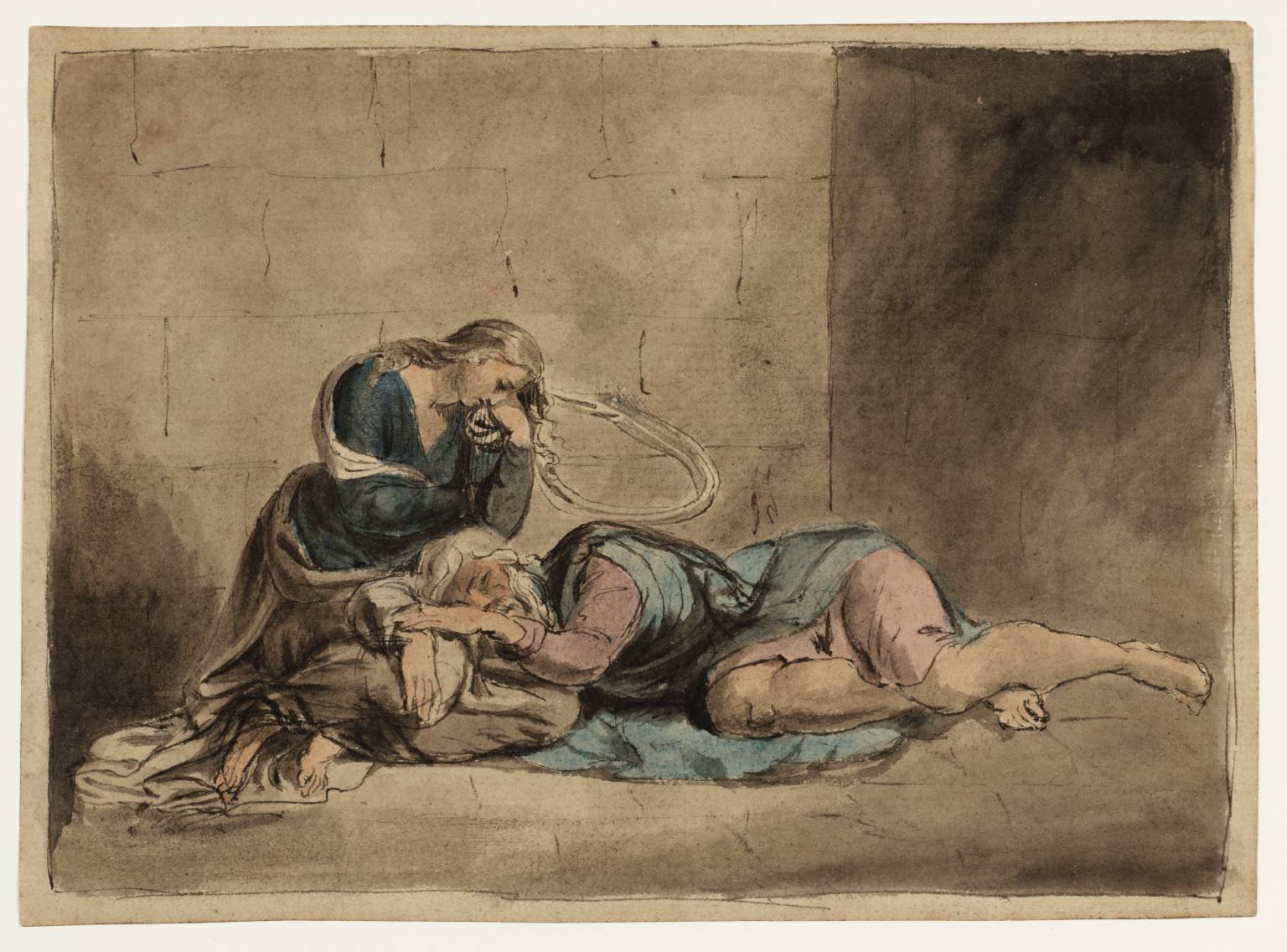
Lear and daughter in prision
Wikipidea Commons
William Blake


Here are other pictures

King Lear is a tragedy by William Shakespeare. The titular character descends into madness after disposing of his estate between two of his three daughters based on their flattery, bringing tragic consequences for all. Based on the legend of Leir of Britain, a mythological pre-Roman Celtic king, the play has been widely adapted for the stage and motion pictures, with the title role coveted by many of the world's most accomplished actors.
Originally drafted between 1603 and its first known performance in 1607, the first attribution to Shakespeare was a 1608 publication in quarto of uncertain provenance; it may be an early draft or simply reflect the first performance text.[1] The Tragedy of King Lear, a more theatrical revision, was included in the 1623 First Folio. Modern editors usually conflate the two, though some insist that each version has its individual integrity that should be preserved.[2]
After the Restoration, the play was often revised with a happy ending for audiences who disliked its dark and depressing tone, but since the 19th century Shakespeare's original version has been regarded as one of his supreme achievements. The tragedy is particularly noted for its probing observations on the nature of human suffering and kinship. George Bernard Shaw wrote, "No man will ever write a better tragedy than Lear".[3]

Here is the Gutenberg copy of King Lear

From Wikipedia:

Synopsis[edit]


The play begins as the Earl of Gloucester and the Earl of Kent meet and observe that King Lear has awarded equal shares of his realm to the Duke of Cornwall and the Duke of Albany. Gloucester then introduces his illegitimate son Edmund to the Earl of Kent. In the next scene, King Lear, who is elderly and wants to retire from power, decides to divide his realm among his three daughters, and declares he'll offer the largest share to the one who loves him best. The eldest, Goneril, speaks first, declaring her love for her father in fulsome terms. Moved by her flattery Lear proceeds to grant to Goneril her share as soon as she's finished her declaration, before Regan and Cordelia have a chance to speak. He then awards to Regan her share as soon as she has spoken. When it is finally the turn of his youngest daughter, Cordelia, at first she refuses to say anything ("Nothing, my Lord") and then declares there is nothing to compare her love to, nor words to properly express it; she speaks honestly but bluntly, which infuriates him. In his anger he disinherits Cordelia and divides her share between Regan and Goneril. Kent objects to this unfair treatment. Enraged by Kent's protests, Lear banishes him from the country. Lear summons the Duke of Burgundy and the King of France, who have both proposed marriage to Cordelia. Learning that Cordelia has been disinherited, the Duke of Burgundy withdraws his suit, but the King of France is impressed by her honesty and marries her anyway.
Lear announces he will live alternately with Goneril and Regan, and their husbands, the Dukes of Albany and Cornwall respectively. He reserves to himself aretinue of one hundred knights, to be supported by his daughters. Goneril and Regan speak privately, revealing that their declarations of love were fake, and they view Lear as an old and foolish man.
Edmund resents his illegitimate status, and plots to dispose of his legitimate older brother Edgar. He tricks their father Gloucester with a forged letter, making him think Edgar plans to usurp the estate. Kent returns from exile in disguise under the name of Caius, and Lear hires him as a servant. Lear and Caius quarrel with Oswald, Goneril's steward. Lear discovers that now that Goneril has power, she no longer respects him. She orders him to behave better and reduces his retinue. Enraged, Lear departs for Regan's home. The Fool mocks Lear's misfortune.
Edmund learns from Curan, a courtier, that there is likely to be war between Albany and Cornwall, and that Regan and Cornwall are to arrive at Gloucester's house that evening. Taking advantage of the arrival of the duke and Regan, Edmund fakes an attack by Edgar, and Gloucester is completely taken in. He disinherits Edgar and proclaims him an outlaw.
Bearing Lear's message to Regan, Caius meets Oswald again at Gloucester's home, quarrels with him again, and is put in the stocks by Regan and her husband Cornwall. When Lear arrives, he objects to the mistreatment of his messenger, but Regan is as dismissive of her father as Goneril was. Lear is enraged but impotent. Goneril arrives and supports Regan's argument against him. Lear yields completely to his rage. He rushes out into a storm to rantagainst his ungrateful daughters, accompanied by the mocking Fool. Kent later follows to protect him. Gloucester protests against Lear's mistreatment. With Lear's retinue of a hundred knights dissolved, the only companions he has left are his Fool and Caius. Wandering on the heath after the storm, Lear meets Edgar, in the guise of a madman named Tom O'Bedlam. Edgar babbles madly while Lear denounces his daughters. Kent leads them all to shelter.
Edmund betrays Gloucester to Cornwall, Regan, and Goneril. He reveals evidence that his father knows of an impending French invasion designed to reinstate Lear to the throne; and in fact a French army has landed in Britain. Once Edmund leaves with Goneril to warn Albany about the invasion, Gloucester is arrested, and Regan and Cornwall gouge out Gloucester's eyes. As he is doing so, a servant is overcome with rage by what he is witnessing and attacks Cornwall, mortally wounding him. Regan kills the servant, and tells Gloucester that Edmund betrayed him; then she turns him out to wander the heathtoo. Edgar, in his madman's guise, meets his blinded father on the heath. Gloucester, not recognising him, begs Tom to lead him to a cliff at Dover so that he may jump to his death.
Goneril discovers that she finds Edmund more attractive than her honest husband Albany, whom she regards as cowardly. Albany has developed a conscience - he is disgusted by the sisters' treatment of Lear, and the mutilation of Gloucester, and denounces his wife. Goneril sends Edmund back to Regan; receiving news of Cornwall's death, she fears her newly widowed sister may steal Edmund and sends him a letter through Oswald. By now alone with Lear, Kent leads him to the French army, which is commanded by Cordelia. But Lear is half-mad and terribly embarrassed by his earlier follies. At Regan's instigation, Albany joins his forces with hers against the French. Goneril's suspicions about Regan's motives are confirmed and returned, as Regan rightly guesses the meaning of her letter and declares to Oswald that she is a more appropriate match for Edmund. Edgar pretends to lead Gloucester to a cliff, then changes his voice and tells Gloucester he has miraculously survived a great fall. Lear appears, by now completely mad. He rants that the whole world is corrupt and runs off.
Lear and Cordelia by Ford Madox Brown
Oswald appears, still looking for Edmund. On Regan's orders, he tries to kill Gloucester but is killed by Edgar. In Oswald's pocket, Edgar finds Goneril's letter, in which she encourages Edmund to kill her husband and take her as his wife. Kent and Cordelia take charge of Lear, whose madness slowly passes. Regan, Goneril, Albany, and Edmund meet with their forces. Albany insists that they fight the French invaders but not harm Lear or Cordelia. The two sisters lust for Edmund, who has made promises to both. He considers the dilemma and plots the deaths of Albany, Lear, and Cordelia. Edgar gives Goneril's letter to Albany. The armies meet in battle, the British defeat the French, and Lear and Cordelia are captured. Edmund sends Lear and Cordelia off with secret-joint orders from him (representing Regan and her forces) and Goneril (representing Albany's) for the execution of Cordelia.
The victorious British leaders meet, and the recently widowed Regan now declares she will marry Edmund. But Albany exposes the intrigues of Edmund and Goneril and proclaims Edmund a traitor. Regan falls ill, having been poisoned by Goneril, and is escorted offstage, where she dies. Edmund defies Albany, who calls for a trial by combat. Edgar appears masked and in armor, and challenges Edmund to a duel. No one knows who he is. Edgar wounds Edmund fatally, though he does not die immediately. Albany confronts Goneril with the letter which was intended to be his death warrant; she flees in shame and rage. Edgar reveals himself, and reports that Gloucester died offstage from the shock and joy of learning that Edgar is alive, after Edgar revealed himself to his father.
Offstage, Goneril, with all her evil plans thwarted, commits suicide. The dying Edmund decides, though he admits it is against his own character, to try and save Lear and Cordelia; however, his confession comes too late. Soon after Albany sends men to countermand Edmund's orders, Lear enters bearing Cordelia's corpse in his arms, having survived by killing the executioner. Kent appears and Lear now recognises him. Albany urges Lear to resume his throne, but like Gloucester, the trials Lear has been through have finally overwhelmed him, and he dies. Albany then asks Kent and Edgar to take charge of the throne. Kent declines, explaining that his master is calling him on a journey. Finally, either Albany (in the Quarto version) or Edgar (in the Folio version) has the final speech, with the implication that he will now become king.[6][7]\

Monday, December 22, 2014

DAY OF JUDGMENT

Wikimedia Commons
The Grave
Day of Judgment

Watercolor by Blake

Wikimedia Commons
The Grave
Day of Judgment

Engraving by Sciavonetti

The watercolors which Blake designed to illustrate The Grave were not engraved by him for publication. The commission to execute the engravings went to Sciavonetti whose style was more commercial. Blake's nineteen watercolors were lost and not relocated until 2001. We now have the opportunity to compare the original designs with the published engravings.

Blake's illustrations for Robert Blair's The Grave include one named the Day of Judgment which bears similarity to Blake's images of the Last Judgment which appear in previous posts.

The author of the comments for Blake's designs in The Grave is unknown but thought to be one of Blake's close associates. The description of The Last Judgment on Page 37 is detailed:  

"XIL THE LAST JUDGMENT. 
Christ coming to judgment in the clouds of 
heaven, with the "Thrones set, and the Books 
opened." On his knees lies the Book of Life. 
The Recording Angels kneel on each side of his 
throne, and the Elders are also seated on each side 
of Him to judge the world. Surrounding the 
throne are the blessed, entering into their joy ; and 
arising from these, on each hand, are two clouds of 
figures: one with the insignia of Baptism; the 
other with the insignia of the Lord's Supper, 
inclosing a glorification of angels, with harps. 
Beneath, on the right hand of Christ, are the 
blessed, rising in the air to judgment ; on the left 
hand are the cursed : Some are precipitating them- 
selves from the face of Him that sitteth on the 
Throne (among them is Satan, wound round with 
the Serpent), others are pleading their own right- 
eousness, and others, beneath, fleeing with banners 
and spears among the rocks, crying to the "rocks 
to cover them." Beneath these are represented 
the harlot's mystery, and the dragon, who flee 
before the face of the Judge. In the centre, 
standing on the midst of the earth, is the angel with 
the last trumpet. On each side of him is an angel : 
that on the left is drawing his sword on the wicked ; 
that on the right is sheathing his sword on the just, 
who are rising in various groups, with joy and 
affection, family by family. The angel with the 
trumpet, and his accompanying ministers of judg- 
ment, are surrounded by a column of flame, which 
spreads itself in various directions over the earth, 
from which the dead are bursting forth, some in 
terror, some in joy. On the opening cloud, on 
each hand of Christ, are two figures, supporting the 
books of remembrance : that over the just is beheld 
with humiliation ; that over the wicked with arro- 
gance. A sea of fire issues from beneath the 
throne of Christ, destructive to the wicked, but 
salutary to the righteous. Before the sea of Fire 
the clouds are rolled back, and the heavens are 
rolled together as a scroll." 
Among  the lines of Robert Blair's poetry which are illustrated are these:
The Grave, Robert Blair, Pages 28, 29
"But know that thou must render up the dead
And with high interest too ! they are not thine ; 
But only in thy keeping for a season, 
Till the great promis'd day of restitution. 
When loud diffusive sound from brazen trump 
Of strong-lung'd cherub shall alarm thy captives. 
And rouse the long, long sleepers into life. 
Daylight, and liberty. — 
Then must thy doors fly open, and reveal 
The minds that lay long forming under ground. 
In their dark cells immur'd ; but now full ripe, 
And pure as silver from the crucible. 
...
Heaven's portals wide expand to let him in ; 
Nor are his friends shut out : as a great prince 
Not for himself alone procures admission, 
But for his train ; it was his royal will, 
That where he is there should his followers be." 
Jerusalem, Plate 98, (E 258)
"Such is the Cry from all the Earth from the Living Creatures of the Earth
And from the great City of Golgonooza in the Shadowy Generation 
And from the Thirty-two Nations of the Earth among the Living Creatures
Plate 99
All Human Forms identified even Tree Metal Earth & Stone. all
Human Forms identified, living going forth & returning wearied
Into the Planetary lives of Years Months Days & Hours reposing
And then Awaking into his Bosom in the Life of Immortality."

Sunday, December 21, 2014

Shakespeare 13


From WiKIPEDIA:
Timon of Athens is a collaborative play by William Shakespeare and perhaps Thomas Middleton about the fortunes of an Athenian named Timon (and probably influenced by the philosopher of the same name). The central character is a well beloved citizen of Athens who through tremendous generosity spends his entire fortunes on corrupt hangers-on only interested in getting the next payout. Timon of Athens is one of Shakespeare's most obscure and least-known works. It was originally grouped with the tragedies, but some scholars name it one of the problem plays.

Known as "Timon and Alcibiades"; Timon, nude, is seated in his cave, 
a spade beside him; in the l foreground, Alcibiades has entered wearing 
a helmet; with him are partially draped women, Phrynia and Timandra; 
image framed by trees. 1783 Etching

Timon and Alcibiades

Open Source Shakespeare


Some fragments of speeches of Alcibiades

in "Timon of Athens"

Act, Scene, Line
text:
I,1,295
Sir, you have saved my longing, and I feed
Most hungerly on your sight.

I,2,415
My heart is ever at your service, my lord.

III,5,1312
Honour, health, and compassion to the senate!

III,5,1314
I am an humble suitor to your virtues;
For pity is the virtue of the law,...

III,5,1349
My lords, then, under favour, pardon me,
If I speak like a captain....

III,5,1369
In vain! his service done
At Lacedaemon and Byzantium...

III,5,1373
I say, my lords, he has done fair service,
And slain in fight many of your enemies:...

III,5,1386
Hard fate! he might have died in war.
My lords, if not for any parts in him—...

III,5,1400
Must it be so? it must not be. My lords,
I do beseech you, know me.

Why, fare thee well:
Here is some gold for thee.

IV,3,1779
When I have laid proud Athens on a heap,—

IV,3,1781
Ay, Timon, and have cause.

IV,3,1784
Why me, Timon?

IV,3,1809
Hast thou gold yet? I'll take the gold thou
givest me,...

IV,3,1851
Strike up the drum towards Athens! Farewell, Timon:
If I thrive well, I'll visit thee again.

IV,3,1854
I never did thee harm.

IV,3,1856
Call'st thou that harm?

IV,3,1859
We but offend him. Strike!
[Drum beats. Exeunt ALCIBIADES, PHRYNIA,]...

V,4,2556
Sound to this coward and lascivious town
Our terrible approach....

V,4,2621
Then there's my glove;
Descend, and open your uncharged ports:...

V,4,2632
Descend, and keep your words.

V,4,2640
[Reads the epitaph] 'Here lies a
wretched corse, of wretched soul bereft:...


Saturday, December 20, 2014

MEDITATIONS

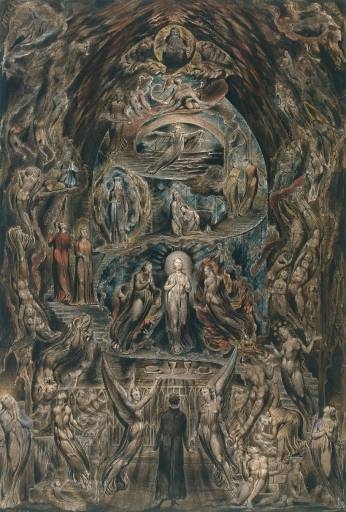
MutualArt.com Epitome of James Hervey’s ‘Meditations among the Tombs’
Date c.1820–5


For his friend Thomas Butts, Blake painted a picture which is similar to his pictures of the Last Judgment in that he includes numerous figures to represent a vision of history from Adam to the Apocalypse. This watercolor is named The Epitome of Hervey's Meditations among the Tombs and derived from James Hervey's book. This image provides a useful guide to identifying figures in other versions of the creation, fall and return, because Blake put names on the individuals or states which they represent.   


Inscriptions, (E 691)
[On Blake's Epitome of Hervey's Meditations among the Tombs] 
[Reading from left to right, bottom to top]
"Babe   Widow   Father   Baptism.   Hervey   Angel of Death  
Virgin   Wife   Old Age   Infancy   Husband   Angel of Providence 
 Guardian Angel   Child   Angel of Death   Mother   Where is your
Father   The Lost Child   Sophronia died in Childbed   She died
on the Wedding Day   Orphan   Moses   Elias   JESUS   David  
Solomon   Protecting Angel   Aaron   Abraham believed God   These
died for love   Ministering Angels   Mother of Leah & Rachel  
Mother of Rebecca   Recording Angels   Protecting Angel   Orphans 
 NOAH   Enoch   Cain   Serpent   Abel   Eve   Adam   God out of
Christ is a Consuming Fire  
MERCY     WRATH"
In Jerusalem Blake includes Hervey among five historical persons who guard the Gate of Los which leads to Beulah. Blake has named five of the 'gentle Souls' from history to look after those who descend to the Vegetated Earth to live in a mortal body.
Jerusalem, Plate 72, (E 227)
"And the Four Gates of Los surround the Universe Within and       
Without; & whatever is visible in the Vegetable Earth, the same
Is visible in the Mundane Shell; reversd in mountain & vale
And a Son of Eden was set over each Daughter of Beulah to guard
In Albions Tomb the wondrous Creation: & the Four-fold Gate
Towards Beulah is to the South. Fenelon, Guion, Teresa,    
Whitefield & Hervey, guard that Gate; with all the gentle Souls
Who guide the great Wine-press of Love; Four precious stones that Gate:
Plate 73
Such are Cathedrons golden Halls: in the City of Golgonooza"


Greater detail can be studied by linking to the image in the Tate Gallery.

Friday, December 19, 2014

Sheakspeare 12


Picture of Hayley's 'The Triumphs of Temper'
The Trustees of the British Museum
Illustration to "Canto VI. Verse 294 in Hayley's "The Triumphs of Temper" (London, 1803); a masquerade, in a vaulted interior; Sir Gilbert, Serena and Serena's aunt are in the foreground (l-r), dressed as characters from "The Tempest": Caliban, Ariel and Sycorax respectively; other figures in the background. 

**************************************
From the above link:
Hayley commissioned Blake to produce plates for two of his poems. The Triumphs of Temper was published in 1803, and contains six plates engraved by Blake while he was living at the sea, quite close to Hayley's house. 

Here's a bit of Hayley's text:
  to Ariel, Act 1 Scene 2:
This damn'd witch Sycorax,
For mischiefs manifold and sorceries terrible
To enter human hearing, from Argier,
Thou know'st, was banish'd.
From Wikipedia, the free encyclopedia:
Sycorax , an unseen character in William Shakespeare's play The Tempest (1611), is a vicious and powerful witch and the mother of Caliban, one of the few native inhabitants of the island on which Prospero, the hero of the play, is stranded.

According to the backstory provided by the play, Sycorax, while pregnant with Caliban, was banished from her home in Algiersto the island on which the play takes place. Memories of Sycorax, who dies several years before the main action of the play begins, define several of the relationships in the play. Relying on his filial connection to Sycorax, Caliban claims ownership of the island. Prospero constantly reminds Ariel of Sycorax's cruel treatment in order to maintain the sprite's service.

Scholars generally agree that Sycorax, a foil for Prospero, is closely related to the Medea of Ovid's Metamorphoses. Postcolonialist writers and critics see Sycorax as giving voice to peoples, particularly women, recovering from the effects of colonization. Later versions of The Tempest, beginning with William Davenant's eighteenth-century adaptation, have given Sycorax a vocal role in the play, but maintained her image as a malevolent antagonist to Prospero.


Thursday, December 18, 2014

A VISION

In order to focus on detail in the picture, right click on picture and select 'view in a new window'. This will allow you to enlarge the picture and concentrate on the details.
Wikimedia Commons
The Last Judgment
Commissioned by Countess of Egremont
1808
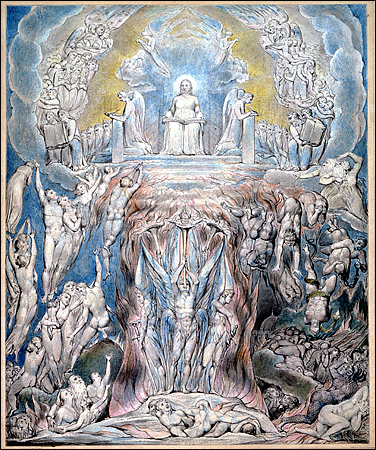
Blake's image of The Last Judgment can be seen as the cycle of creation, fall and redemption seen from the perspective of Eternity. In describing his image in prose Blake makes this statement: (I've added punctuation for ease of reading.)

A Vision of the Last Judgment, (E 563)
"Creation which was an act of Mercy. I have represented
those who are in Eternity by some in a Cloud within the Rainbow
that Surrounds the Throne. They merely appear as in a Cloud when
any thing of Creation Redemption or Judgment are the Subjects of
Contemplation. Tho their Whole Contemplation is Concerning these
things, the reason they so appear is The Humiliation of the
Reasoning & Doubting Selfhood & the Giving all up to Inspiration.
    By this it will be seen that I do not consider either the Just   
or the Wicked to be in a Supreme State but to be every one of
them States of the Sleep which the Soul may fall into in its
Deadly Dreams of Good & Evil when it leaves Paradise
following the Serpent" 

From the point of view of those in Creation, those in Eternity are unclear, as in a cloud, but actually they surround the fundamental reality which is represented by the throne on which Jesus is seated. The cloud is within the rainbow because the hope of redemption is an ever present promise to humanity.

Since Blake is presenting the cycle through which man travels in his material existence, the realities of Eternity are masked or obscured to the individual. The loss of the Divine Vision has led to the dependence of man on his Reasoning & Doubting Selfhood

The Everlasting Gospel, (E 520)
"Reasoning upon its own Dark Fiction
In Doubt which is Self Contradiction
Humility is only Doubt
And does the Sun & Moon blot out
Rooting over with thorns & stems     
The buried Soul & all its Gems
This Lifes dim Windows of the Soul
Distorts the Heavens from Pole to Pole
And leads you to Believe a Lie
When you see with not thro the Eye   
That was born in a night to perish in a night
When the Soul slept in the beams of Light."
But the world through which man travels is not as it seems.  When man mistakes the states through which he travels as the essential man, he is falling into the deadly dream of good and evil by following the serpent who leads man away from the ability to perceive the Divine Vision. Although we see pictured in the image, man in various times and conditions, Blake tells us that these are not individuals but symbols for the states experienced in life.    

A Vision of the Last Judgment, (E 556)
"it ought to be understood that the Persons
Moses & Abraham are not here meant but the States Signified by
those Names the Individuals being representatives or Visions of
those States as they were reveald to Mortal Man in the Series of
Divine Revelations. as they are written in the Bible these
various States I have seen in my Imagination when distant they
appear as One Man but as you approach they appear
Multitudes of Nations."

Blake is trying to reach men on whatever level of development they have attained. His symbolic poetry aims at a different audience. His picture of The Last Judgment is saying to those who can read the picture language such as was used by Michelangelo or in the stained glass windows of the Gothic cathedrals, that Creation is a Mercy designed to repair the damage of the Fall: that whatever adversity or advantage man experiences in this life there is provision made for re-entry into Paradise.