Friday, September 19, 2014

AWAKE FROM SLEEP


Blake was an optimist. He believed that man was not condemned to
      accept the cycle of descent into deeper and deeper destruction and
      despair. The opportunity to live in the material world of time and
      space could result in the renewal of vision, brotherhood, and
      integration. His formula for recovery entailed inner work to
      restructure the psyche and break free from destructive patterns of
      thought.

Blake was appalled at the unwillingness of men to see the errors which they accepted as normal and necessary. He called on men to look at themselves and the world they constructed in the light of the possibilities for a world in which Imagination prevailed. To Blake man was not distant from God but lived in God, and God lived in him. This gave man the power to change himself and change his surroundings.

British Museum Jerusalem
Copy A, Plate 37

Like Albion, the Universal Man of Blake's Jerusalem, man is asleep and must awake to fulfill his human potential of living with the consciousness of being God incarnate. Blake's call to every man is to wake from his stupor; to recognize how his own brokenness contributes to the brokenness of the world. Like Los, the individual can assume responsibility for breaking down the systems internally and externally which sustain the errors which cause man to at war within himself, at war with his brothers and at war with God.


Milton, Plate 14 [15], (E 108)
"And Milton said, I go to Eternal Death! The Nations stills 
Follow after the detestable Gods of Priam; in pomp               
Of warlike selfhood, contradicting and blaspheming.
When will the Resurrection come; to deliver the sleeping body
From corruptibility: O when Lord Jesus wilt thou come?
Tarry no longer; for my soul lies at the gates of death."

Milton, Plate 25 [27], (E 122) 
"Go forth Reapers with rejoicing. you sowed in tears
But the time of your refreshing cometh, only a little moment     
Still abstain from pleasure & rest, in the labours of eternity
And you shall Reap the whole Earth, from Pole to Pole! from Sea to Sea
Begining at Jerusalems Inner Court, Lambeth ruin'd and given
To the detestable Gods of Priam, to Apollo: and at the Asylum
Given to Hercules, who labour in Tirzahs Looms for bread    
Who set Pleasure against Duty: who Create Olympic crowns
To make Learning a burden & the Work of the Holy Spirit: Strife.
T[o] Thor & cruel Odin who first reard the Polar Caves  
Lambeth mourns calling Jerusalem. she weeps & looks abroad
For the Lords coming, that Jerusalem may overspread all Nations  
Crave not for the mortal & perishing delights, but leave them
To the weak, and pity the weak as your infant care; Break not
Forth in your wrath lest you also are vegetated by Tirzah
Wait till the Judgement is past, till the Creation is consumed
And then rush forward with me into the glorious spiritual    
Vegetation; the Supper of the Lamb & his Bride; and the
Awaking of Albion our friend and ancient companion.

So Los spoke. But lightnings of discontent broke on all sides
     round"

Jerusalem, Plate 73, (E 228)
"Voltaire insinuates that these Limits are the cruel work of God
Mocking the Remover of Limits & the Resurrection of the Dead     
Setting up Kings in wrath: in holiness of Natural Religion
Which Los with his mighty Hammer demolishes time on time
In miracles & wonders in the Four-fold Desart of Albion
Permanently Creating to be in Time Reveald & Demolishd
Satan Cain Tubal Nimrod Pharoh Priam Bladud Belin                
Arthur Alfred the Norman Conqueror Richard John
[Edward Henry Elizabeth James Charles William George] 
And all the Kings & Nobles of the Earth & all their Glories
These are Created by Rahab & Tirzah in Ulro: but around 
These, to preserve them from Eternal Death Los Creates           
Adam Noah Abraham Moses Samuel David Ezekiel
[Pythagoras Socrates Euripedes Virgil Dante Milton]  
Dissipating the rocky forms of Death, by his thunderous Hammer
As the Pilgrim passes while the Country permanent remains
So Men pass on: but States remain permanent for ever"       

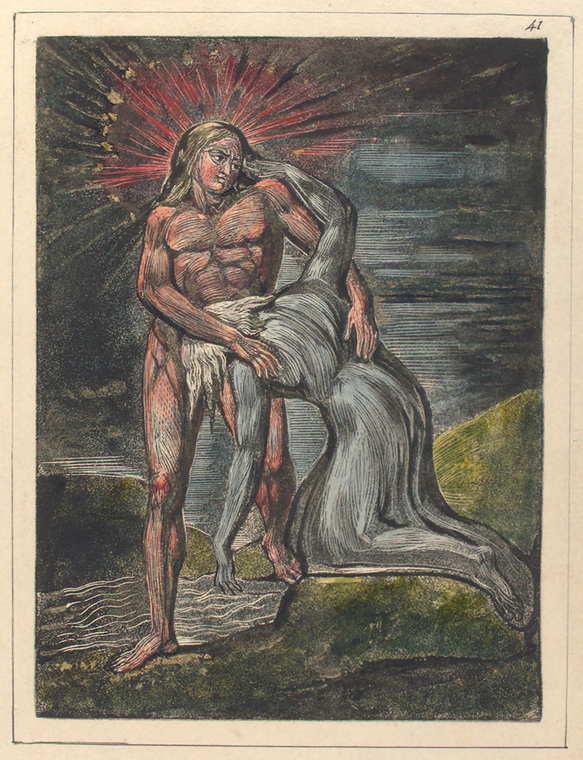
Jerusalem, Plate 37 [41], (E 183)
"The Twenty-eight trembled in Deaths dark caves, in cold despair
They kneeld around the Couch of Death in deep humiliation
And tortures of self condemnation while their Spectres ragd within.
The Four Zoa's in terrible combustion clouded rage
Drinking the shuddering fears & loves of Albions Families
Destroying by selfish affections the things that they most admire
Drinking & eating, & pitying & weeping, as at a trajic scene.
The soul drinks murder & revenge, & applauds its own holiness   

They saw Albion endeavouring to destroy their Emanations.

[illustration, with inscription, reversed: 
"Each Man is in
his Spectre's power 
Untill the arrival 
of that hour,
When his Humanity 
awake 
And cast his Spectre into the Lake"]

Jerusalem, Plate 38 [43], (E 184)
"They saw their Wheels rising up poisonous against Albion
Urizen, cold & scientific: Luvah, pitying & weeping
Tharmas, indolent & sullen: Urthona, doubting & despairing
Victims to one another & dreadfully plotting against each other
To prevent Albion walking about in the Four Complexions.      

They saw America clos'd out by the Oaks of the western shore;
And Tharmas dash'd on the Rocks of the Altars of Victims in Mexico.
If we are wrathful Albion will destroy Jerusalem with rooty Groves
If we are merciful, ourselves must suffer destruction on his Oaks!
Why should we enter into our Spectres, to behold our own corruptions
O God of Albion descend! deliver Jerusalem from the Oaken Groves!

Then Los grew furious raging: Why stand we here trembling around
Calling on God for help; and not ourselves in whom God dwells
Stretching a hand to save the falling Man: are we not Four
Beholding Albion upon the Precipice ready to fall into Non-Entity:
Seeing these Heavens & Hells conglobing in the Void. Heavens over Hells
Brooding in holy hypocritic lust, drinking the cries of pain

From howling victims of Law: building Heavens Twenty-seven-fold.
Swelld & bloated General Forms, repugnant to the Divine-
Humanity, who is the Only General and Universal Form         
To which all Lineaments tend & seek with love & sympathy
All broad & general principles belong to benevolence
Who protects minute particulars, every one in their own identity."

Thursday, September 18, 2014

Jerusalem Plate 92

The image found at Fourfold Human requires close attention with features often missed by 
those of us with limited vision (or simply not visually oriented).  It seems worthy of another 
post:

I've tried to make it clear with this image from the Library of Congress; if you blow it up as 
much as you can and focus on the lower part of the image you may discern four faces
perhaps seeming to be coming up out of the earth.


The one on the left (Under the woman's right arm) seems clearest.  You might surmise he  
represents the Zoa, Los.

On the right, very close together, might represent the two Zoas Urizen and Luvah.

At the bottom, larger than the others but perhaps in the water, would be Tharmas.


The Four Zoas 

Tharmas
In the mythological writings of William Blake, Tharmas is one of the four Zoas, who were created when Albion, the primordial man, was divided fourfold. He represents sensation, and his female counterpart is Enion, who represents sexual urges. He is connected to the God the Father aspect of the Christian Trinity and is the begetter of Los. Tharmas is mostly peaceful, and flees during most of his fights with Urizen. He is depicted in various ways ranging from a youth with wings to an old bearded man.
(from Wiki)
   
Urizen
       The word strongly suggests reason, the primary quality of Urizen. Blake felt that the hegemony of rational thinking since The Enlightenment had had a stultifying and destructive influence on the British culture. He chose Bacon, Newton and Locke to epitomize that destructive influence. He chose Urizen to exemplify it in his myth.
      
       In Night II of The Four Zoas Urizen lost his faith and in vision saw the world collapsing into darkness:
    Urizen rose from the bright Feast like a star thro' the evening sky.
    First he beheld the body of Man pale, cold; the horrors of death
    Beneath his feet shot thro' him as he stood in the Human Brain,
    Pale he beheld futurity; pale he beheld the Abyss
    ......[he said:]
    Build we a Bower for heavens darling in the grizzly deep,
    Build we the Mundane Shell around the Rock of Albion.
                  FZ2: 23:9-24.8; (314)
Luvah
If Urizen suggested reason, then Luvah likewise suggests love (and in the fallen state it's contrary). So Luvah in Eternity is Albion's quality of love, joy, forgiveness, all the positive feelings. But when Luvah crashes (like the other parts of Albion), the contrary comes to the fore: hate, which too often goes by the name of love, especially as in "the torments of love and desire". (It's not just the zoa who fell; the word he points to also fell!)
Percival said of Luvah "at the summit he is Christ; at the nadir he is Satan" (page 29).

       Luvah's first appearance in Beulah includes his emanation, Vala. They spend idyllic time in her garden of shadows. But this is interrupted when Luvah gives to Urizen the forbidden Wine of the Almighty.
       The Fall began when Luvah stole (or was given, lent) the horses of light (the Sun); you might say that Luvah, like Icarus got too close to the Sun. In Night 5 Urizen tells us about it in The Woes of Urizen:
           When Luvah sunk to the perversion of hate, he caused the Incarnation:
    Lest the state calld Luvah should cease, the Divine Vision
    Walked in robes of blood till he who slept should awake.
    Thus were the stars of heaven created like a golden chain.
                  (FZ2-33:14-16 [E322])
       Luvah, and Christ with him, spend the ages in the
Furnaces of Affliction, but we must know that a happy outcome will come (just as the Sun puts an end to
the dark Night.

Urthona

       "Earth owner": the creative imagination of the individual is how Damon first describes Urthona. He is the contrary of Urizen: In Blake's generation students of Kant and of other philosophers postulated "a form of intelligence superior to the rational mind" (Percival page 37), which eventually went by the name of the unconscious. Blake referred to it as the poetic genius and ascribed it to Urthona.

       Urthona is dark, but it isn't the darkness of fallenness; it's a creative darkness--the kind of darkness we find in The Cloud of Unknowing. The dark Urthona and Urizen are a pair: the dark (unconscious) superior intelligence and the light plodding, legalistic mind. With the initial Fall Urizen took control of the universe, but he soon made mess and was suceeded by Los, Urthona's earthly manifestation.
           Urthona's fall brought forth a triad:
              Los
              Enitharmon, Los' emanation
              the Spectre        Pure negativity, totally commited to absolute materialism negating any spiritual reality. Inventing good and evil the spectre reveled in the evil (of others) and saw none in himself.

       Blake saw, and hated the continually intrusive spectre in himself, who doubted, who judged, who forgot Eternity. The spectre condemns us to ulro where Eden and Beulah are alike forgotten and acting as 'realists' we evaluate life as dismal. There is a spectre in every man, and his unwelcome presence is most acutely suffered (night and day) by men of discernment, like Blake. 

Los

    Los was the fourth immortal starry one, & in the Earth
    Of a bright Universe Empery attended day & night
    Days & nights of revolving joy, Urthona was his name
                  (Four Zoas 1-3:9-11; 301)
       Los is "the expression in this world of the creative imagination" (Damon, 246), and in Beulah his name reverts to Urthona.
       A master smith, worker in metal Los worked at the furnaces, hopefully changing iron to gold; this happens, but it's realized only at the end of time. Los, master of time, is trying to work himself out of a job, and at the end he is in fact reabsorbed into Urthona, the poetic genius.
       In Ulro Urizen's sun has virtually gone out; Los labors to create a worldly sun (Sun is Los backward).
    Then wondrously the Starry Wheels felt the divine hand.
    Limit Was put to Eternal Death Los felt the Limit & saw
    The Finger of God touch the Seventh furnace in terror
    And Los beheld the hand of God over his furnaces
    Beneath the Deeps in dismal Darkness beneath immensity (Four Zoas 4-56:23-26 338)
       The paradoxical significance of the furnace is borne out in the Bible with Shadrach, Meshach. and Abednego.
       Once escaped from Ulro Los, the master builder, proceeded to build Golgonooza, representing material progress. Los builded it and builded it 'time on time'; each time a society went into eclipse, Golgonooza must be built again. This of course is a figure for worldly progress, all very good, but not in the same dimension as the City of God.

Another picture of  the four appear in The Four Faces of Man.

Wednesday, September 17, 2014

SELF-ANNIHILATION

To Blake the point at which regeneration could begin was the point of self-annihilation. Each person has within himself the desire for self-preservation. We feed this desire with layers of protective shielding. The possibility of self-annihilation is frightening.
 
This armor insulating us from threat may be called the Selfhood, the false reasoning power. We learn to build ourselves up by tearing others down; we learn to blame others for our shortcomings; we learn to claim as our own what we have been freely given by God. A Selfhood grows within us and distorts our ability to perceive clearly or allow the imagination to be expressed in us and through us. 
 

New York Public Library
Milton
Copy C, Plate 44
As Blake sat down to write Jerusalem he felt the need to ask that the Savior annihilate the Selfhood within him. To Blake the Imagination was equivalent to the Holy Spirit or the Christ within man. He intended that his poetry not come from himself as a individual, or from his Selfhood, but from the Imagination being expressed through him. If he expressed in his poetry his selfish, self-protective nature, then the ability to be a channel for the flow of the Spirit through him would  be blocked.

Through his struggles with understanding the internal facets of himself and how they inhibited his ability to maintain a clear channel for the expression of the Imagination, Blake learned that he could not use force to free himself to write. He needed to open pathways by being receptive to the positive contributions which could came to him even from the least promising sources.

Blake developed the realization that to rid himself of the inhibitions that his Selfhood presented he had to befriend it. He had to invite it into consciousness and determine what it said to him. He found that the power the Selfhood exercised over him was removed when he brought the Selfhood in, rather than giving it an external existence.
 

Annihilation of the Selfhood is a recurring process because the Selfhood grows again as the psyche accumulates more injuries and sees more choas around him. The solution is always to annihilate it by incorporating it. This process  may seem simple and straightforward but Blake presents the challenge and terror which he found it to be.

Jerusalem, Plate 5, (E 147)
"Trembling I sit day and night, my friends are astonish'd at me.
Yet they forgive my wanderings, I rest not from my great task!
To open the Eternal Worlds, to open the immortal Eyes
Of Man inwards into the Worlds of Thought: into Eternity
Ever expanding in the Bosom of God. the Human Imagination        
O Saviour pour upon me thy Spirit of meekness & love:
Annihilate the Selfhood in me, be thou all my life!
Guide thou my hand which trembles exceedingly upon the rock of ages,"

Milton, Plate 14 [15], (E 108)
"When will the Resurrection come; to deliver the sleeping body
From corruptibility: O when Lord Jesus wilt thou come?
Tarry no longer; for my soul lies at the gates of death.
I will arise and look forth for the morning of the grave.       
I will go down to the sepulcher to see if morning breaks!
I will go down to self annihilation and eternal death,
Lest the Last Judgment come & find me unannihilate
And I be siez'd & giv'n into the hands of my own Selfhood"

Milton, Plate 32 [35], (E 135)
"Judge then of thy Own Self: thy Eternal Lineaments explore       
What is Eternal & what Changeable? & what Annihilable!

The Imagination is not a State: it is the Human Existence itself
Affection or Love becomes a State, when divided from Imagination
The Memory is a State always, & the Reason is a State
Created to be Annihilated & a new Ratio Created                  
Whatever can be Created can be Annihilated Forms cannot"

Milton, Plate 38 [43], (E 139)
"In the Eastern porch of Satans Universe Milton stood & said

Satan! my Spectre! I know my power thee to annihilate
And be a greater in thy place, & be thy Tabernacle               
A covering for thee to do thy will, till one greater comes
And smites me as I smote thee & becomes my covering.
Such are the Laws of thy false Heavns! but Laws of Eternity
Are not such: know thou: I come to Self Annihilation
Such are the Laws of Eternity that each shall mutually     
Annihilate himself for others good, as I for thee[.]
Thy purpose & the purpose of thy Priests & of thy Churches
Is to impress on men the fear of death; to teach
Trembling & fear, terror, constriction; abject selfishness
Mine is to teach Men to despise death & to go on            
In fearless majesty annihilating Self, laughing to scorn
Thy Laws & terrors, shaking down thy Synagogues as webs
I come to discover before Heavn & Hell the Self righteousness
In all its Hypocritic turpitude, opening to every eye
These wonders of Satans holiness shewing to the Earth     
The Idol Virtues of the Natural Heart, & Satans Seat
Explore in all its Selfish Natural Virtue & put off
In Self annihilation all that is not of God alone:
To put off Self & all I have ever & ever Amen"

Milton, Plate 40 [46], (E 141)
"I see thee strive upon the Brooks of Arnon. there a dread
And awful Man I see, oercoverd with the mantle of years.   
I behold Los & Urizen. I behold Orc & Tharmas;
The Four Zoa's of Albion & thy Spirit with them striving
In Self annihilation giving thy life to thy enemies
Are those who contemn Religion & seek to annihilate it
Become in their Femin[in]e portions the causes & promoters
Of these Religions, how is this thing? this Newtonian Phantasm
This Voltaire & Rousseau: this Hume & Gibbon & Bolingbroke
This Natural Religion! this impossible absurdity
Is Ololon the cause of this? O where shall I hide my face
These tears fall for the little-ones: the Children of Jerusalem  
Lest they be annihilated in thy annihilation."

Milton, Plate 40 [46], (E 142)
 "Obey thou the Words of the Inspired Man
All that can be annihilated must be annihilated   

That the Children of Jerusalem may be saved from slavery
There is a Negation, & there is a Contrary
The Negation must be destroyd to redeem the Contraries
The Negation is the Spectre; the Reasoning Power in Man
This is a false Body: an Incrustation over my Immortal           
Spirit; a Selfhood, which must be put off & annihilated alway
To cleanse the Face of my Spirit by Self-examination."

Jerusalem, Plate 7, (E 150)
"Los answer'd. Altho' I know not this! I know far worse than this:
I know that Albion hath divided me, and that thou O my Spectre,
Hast just cause to be irritated: but look stedfastly upon me:
Comfort thyself in my strength the time will arrive,
When all Albions injuries shall cease, and when we shall         
Embrace him tenfold bright, rising from his tomb in immortality.
They have divided themselves by Wrath. they must be united by
Pity: let us therefore take example & warning O my Spectre,
O that I could abstain from wrath! O that the Lamb
Of God would look upon me and pity me in my fury.                
In anguish of regeneration! in terrors of self annihilation:
Pity must join together those whom wrath has torn in sunder,
And the Religion of Generation which was meant for the destruction
Of Jerusalem, become her covering, till the time of the End.
O holy Generation! [Image] of regeneration!
O point of mutual forgiveness between Enemies!
Birthplace of the Lamb of God incomprehensible!"

Tuesday, September 16, 2014

Blake Sex 4

The Woman

       A little poem which Blake attached to the end of 'Songs of Experience' casts light on his metaphysics as it relates to Mother Nature:  
  To Tirzah
      Whate'er is Born of Mortal Birth
      Must be consumed with the Earth
      To rise from Generation free:
      Then what have I to do with thee? 

      The Sexes sprung from Shame & Pride,
      Blow'd in the room; in evening died;
      But Mercy chang'd Death into Sleep;
      The Sexes rose to work & weep.
      Thou, Mother of my Mortal part,
      With cruelty didst mould my Heart,
      And with false self-deceiving tears
      Didst bind my Nostrils, Eyes and Ears:
      Didst close my Tongue in senseless clay,
      And me to Mortal Life betray.
      The Death of Jesus set me free:
      Then what have I to do with thee?

       "What have I to do with thee?" Here Blake quotes the words which Jesus spoke to his mother at the Wedding of Cana, which indicates the symbolic signification which Mary had for him, "Thou, Mother of my Mortal part"--my material part, my temporal part! Like Paul Blake wants us to know that the "things which are seen" are passing. He goes further than Paul in suggesting that the "things which are seen" are also cruel and oppressive.

      In Blake's prophecies after VDA the female comes to symbolize the temporal. She is associated with the fallen Sea of Time and Space. The first earthly female, Enitharmon, has her origin in a ghastly parody of the story of Adam and Eve: After Los chained Urizen into the fallen forms of creation, he sickened and "became what he beheld", and Enitharmon materialized as a Globe of Blood from his bosom.

       In "The Four Zoas" Enitharmon has a different origin; she and Los are born from the union of Enion and the Spectre of Tharmas. She is an altogether sinister female until the Moment of Grace. When Los comments on the burdens of their parents, she replies:
 
      To make us happy let them weary their immortal powers
      While we draw in their sweet delights, while we return them scorn
      On scorn to feed our discontent; for if we grateful prove
      They will withhold sweet love, whose food is thorns and  bitter roots.
(The Four Zoas [Nt 1], 10.3; E305)

and proceeds to sing him the "Song of Death". A thoroughgoing materialist, she has only the love of the Pebble; she sees the love of the Clod of Clay simply as a weakness to exploit. Enitharmon leads Los to the "Feast of Envy" (The Four Zoas [Nt 2], 23.10; E313), one of Blake's first and greatest epiphanies of Evil.
       At the end of Night ii we find Enitharmon at her worst, using her sex appeal to tease and frustrate, luring Los on only to withdraw, determined to possess him and give nothing:
 
     for thou art mine,
 Created for my will, my slave, tho' strong, tho' I am weak.
 Farewell, the God calls me away.  I depart in my sweet bliss,
(The Four Zoas [Nt 2], 34.46; E323)
and a few lines further:
 The joy of woman is the death of her most best beloved
 Who dies for Love of her
 In torments of fierce jealousy and pangs of adoration.
       These lines perhaps led some to postulate sexual deprivation in Blake's marriage. They certainly reveal first hand experience with a teasing bitch of the worst sort. But in my opinion Catherine could not possibly have been such a woman. However any who have seen materialistic lovers know that it rings true.

       With the fall of Urizen Enitharmon loses her vicious side and becomes simply a clinging, dependent woman. She gives birth to Orc and centers her affection upon him until the Moment of Grace. At that point she begins to cooperate with Los in the building of Golgonooza.

       A much more sinister female is Vala. In Night vii, at the critical hinge of Blake's myth, the Spectre of Urthona and the Shadow of Enitharmon meet beneath the Tree of Mystery and compare notes. Each gives his version of the Fateful Fall, and they agree that the cause was a female. Here is the Shadow's version:
 
      Among the Flowers of Beulah walk'd the Eternal Man & saw
      Vala, the lilly of the desart melting in high noon;
      Upon her bosom in sweet bliss he fainted.  Wonder siez'd
      All heaven; they saw him dark;
       And the Spectre's version:
 
      One dread morn of gory blood
      The manhood was divided, for the gentle passions, making way
      Thro' the infinite labyrinths of the heart & thro' the nostrils
      issuing
      In odorous stupefaction, stood before the Eyes of Man
      A female bright.

       Ahania's vision in Night iii makes the same point. (Bear in mind that in Blake's primary mythology the female represents materiality.) Again the reader should note that in all three of these accounts of the Fall the blame attaches, not to sensual enjoyment, but to the preoccupation with the material which it symbolizes. Blake uses these most vivid concrete images to arouse his reader to the consciousness that Man has turned his back upon the eternal. This becomes clearer as you read further, especially in the first of the three examples given above.


       Vala, called the goddess of Nature, generally stands for preoccupation with the material. 'Bacon, Newton, Locke', the Unholy Trinity of Materialism, and Satan, the God of this World, serve as alternative symbols for the same misfortune, but again and again Blake returns to the Female Will. He names her Vala in his early works. In the fully matured myth the concept broadens to include other female characters: Rahab, Tirzah, and the Daughters of Albion, but all these females represent various facets of Vala.

Monday, September 15, 2014

FOURFOLD HUMAN

Blake teaches that the human is Fourfold incorporating reason, emotions, body and imagination. The Sexual world of Generation is Threefold. The head, heart and loins are functioning but the imagination is dormant. Without the imagination the other aspects engage in selfish strife among the three.  

British Museum
Jerusalem
Copy A, Plate 92
Blake's myth treats the fall from an original state of unity in Eden through the consequences of division which are many and devastating. Tharmas, the body, struggles in the flood of materiality to avoid losing his grasp on existence. Urizen, the reason, follows mistaken pursuits attempting to go it alone as the solitary arbitrator. Luvah, the emotions, is split between his powerful emanation Vala, and his revolutionary force, Orc. Urthona, the imagination, delegates his role to his materialized form, Los, who continually attempts to eliminate the errors which plague the divided man. Until the four work out their differences, see the value in the other, and relinquish aspirations of autonomy, they are condemned to a cycle of failure.

Although being fully human means being unified, achieving unity is facilitated through becoming conscious to the four forces which are active in the mind and in the outer world in which we live. An individual may unconsciously express in his behavior any of the four forces. Gaining an understanding of the dynamics of the interchanges of the four can enable the individual to quell the dissensions within and the conflicts encountered outwardly.

The image from near the end of Jerusalem when unity is being restored, shows the heads of four men emerging from the ground as if released to assume their proper places in the in the psyche of Albion.

 Milton, Plate 4, (E 97)
"Beneath the Plow of Rintrah & the harrow of the Almighty
In the hands of Palamabron. Where the Starry Mills of Satan
Are built beneath the Earth & Waters of the Mundane Shell
Here the Three Classes of Men take their Sexual texture Woven
The Sexual is Threefold: the Human is Fourfold"              

Jerusalem, Plate 12, (E 155)
"Go on, builders in hope: tho Jerusalem wanders far away,
Without the gate of Los: among the dark Satanic wheels.

Fourfold the Sons of Los in their divisions: and fourfold,       
The great City of Golgonooza: fourfold toward the north
And toward the south fourfold, & fourfold toward the east & west
Each within other toward the four points: that toward
Eden, and that toward the World of Generation,
And that toward Beulah, and that toward Ulro:                    
Ulro is the space of the terrible starry wheels of Albions sons:
But that toward Eden is walled up, till time of renovation:
Yet it is perfect in its building, ornaments & perfection."

Jerusalem, Plate 98, (E 258)
"The Sons & Daughters of Albion on soft clouds Waking from Sleep
Soon all around remote the Heavens burnt with flaming fires    
And Urizen & Luvah & Tharmas & Urthona arose into
Albions Bosom: Then Albion stood before Jesus in the Clouds
Of Heaven Fourfold among the Visions of God in Eternity"

Letters, To Thomas Butts, (E 722)
     "Now I a fourfold vision see
     And a fourfold vision is given to me
     Tis fourfold in my supreme delight
     And three fold in soft Beulahs night
     And twofold Always.  May God us keep
     From Single vision & Newtons sleep"

Sunday, September 14, 2014

Generation

       Blake used the female as the basic symbol for the material and for the materialistic viewpoint. The history of this concept goes as far back as the beginning of time. The Sun represents a masculine God, the Moon, a Goddess, such as Diana, the great goddess of Ephesus, whose priests raised a riot against the apostle Paul, reported at Acts 19.

       Long after MHH he wrote 'Jerusalem' where the "female will" approaches identity with Satan. Both terms connote a preoccupation with the material, putting it first and only. Thus when we read a passage like
The Human is but a Worm, and thou, 0 Male! Thou art
Thyself Female, a Male, a breeder of Seed, a Son & Husband; & Lo
The Human Divine is Woman's Shadow, a Vapor in the summer's heat.
Go assume Papal dignity, thou Spectre, thou Male Harlot! Arthur,
Divide into the Kings of Europe in times remote, 0 Woman-born
and Woman-nourish'd and Woman-educated & Woman-scorned!
(Jerusalem, 64.12; E215)

spoken by Vala, the personification of the "female will", we understand that Blake is not talking about what we know as the sex economy, but rather making a hard nosed statement of the nature of fallenness: the dominance of the material over the spiritual, a dominance all too evident in his age as in ours. This sad situation was always Blake's major concern, and the basic symbol with which he expressed it was that of sex. When we remember to translate male/female into spiritual/material or eternal/temporal, we make a great gain understanding of Blake.


      Milton's theory of sex influenced Blake as much as any other literary source. 'Paradise Lost' provides a definitive model for much of the sexual imagery that Blake used. Professor Frye calls our attention to a line in Book iv of P . L. describing Adam and Eve: "Hee for God only, shee for God in him". Frye reminds us that this applies only to the unfallen pair; it assigns to Adam a purely spiritual authority. The male dominance of material history Frye calls a "fallen analogy" of that spiritual relationship.
     
All this enriches our understanding of the meaning of Astarte in her many forms and of the priests' reactions to her which color virtually every word of the Old Testament and its literary descendants: God is male, the Creator. Nature is female, the Creation. The soul (of man and woman) is female in relation to her Creator. Christ is the bridegroom; in union with him we all (of both sexes) become part of the bride. The modern man can accept this only as an imperfect metaphor for spiritual reality

Generation:

       According to Blake's myth sexes begin in the moony night of Beulah where the Eternals came to rest from the arduous wars of intellect that have filled their sunny days in Eden:

      There is from Great Eternity a mild and  pleasant rest
      Named Beulah, a Soft Moony Universe, feminine, lovely,
      Pure, mild and Gentle, given in Mercy to those who sleep..
(The Four Zoas [Nt 1], 5.29; E303)

       Beulah, one of Blake's most ambiguous images, is a way station between Eden and Ulro. The Eternal, sleeping in Beulah, may rise from his sexual dreams and return to the activity of Eden, or he may fall further into Death Eternal, which is exactly what happened to Albion. Unable to find his way back to Heaven he lapsed into a deeper form of sleep where the female develops a will of her own and lures the male into the "torments of love and Jealousy". Late in 'Jerusalem' the warrior, speaking for Albion, gives a glimpse of his true (fallen) situation and laments"

Once Man was occupied in intellectual pleasures and Energies,
But now my Soul is harrow'd with grief and fear & love & desire,
And now I hate, & now I love, and Intellect is no more.
There is no time for any thing but the torments of love and desire.
(Jerusalem, 68.65; E222)

       ( There are four worlds in Blake's psychic universe:
       Eternity
       Beulah
       Generation
       Ulro)
   
 Generation or the 'sexual' symbolizes for Blake this unfortunate materialization of spirit manifested in the Fall and in a fallen Creation. He also used the term 'vegetable'.
       Man in Eternity is androgynous. In Beulah, which means Married, the sexes are divided into loving and restful contraries. With the Fall the Female Will becomes dominant; the Human Form deteriorates to the sexual in which male and female, spirit and matter, exist in a state of constant warfare. Man has fallen into the fourth world of Ulro. But whatever falls may rise again.
     
The third world, Generation, is the world of Los, fallen man's imaginative faculty. Los generates or brings forth artistic creations, structures of thought, myths of meaning, much as a woman brings forth children. These creations always turn bad (or perhaps just moldy) and are broken up and cast into Los's furnace for renewal. The process of generation and destruction would go on indefinitely, like the cycle of Nature, but the Moment of Grace breaks in upon it. Los learns to forgive. His emanation, Enitharmon, now joins him as an instrument of a regeneration offering redemptive promise. Blake proclaims, "0 holy generation, image of regeneration".

       The change in Los and Enitharmon, who together make up fallen man's imaginative faculty, prepares the ground for the generation of Jesus. The Sons of Eden announce this event in Night viii of 4Z with a paean of praise. Careful study of the entire song will cast more light on the meaning of Blake's symbolism of sex and generation; here are the final seven lines:
we now behold the Ends of Beulah, and we now behold
Where death Eternal is put off Eternally.
Assume the dark Satanic body in the Virgin's womb,
0 Lamb Divine! it cannot thee annoy. 0 pitying one,
Thy pity is from the foundation of the world, & thy Redemption
Begun already in Eternity. Come then, 0 Lamb of God,
Come, Lord Jesus, come quickly.

       What Blake reports next should be a welcome change for the by now outraged feminist. With his usual consistency he follows the divine annunciation with the appearance of Satan, and the worst thing he can say about Satan is to call him a "male without a female":

The war roar'd round Jerusalem's Gates; it took a hideous form
Seen in the aggregate, a Vast Hermaphroditic form
Heav'd like an Earthquake lab'ring with convulsive groans
Intolerable; at length an awful wonder burst
From the Hermaphroditic bosom.  Satan he was nam'd,
Son of Perdition, terrible his form, dishumaniz'd, monstrous,
A male without a female counterpart, a howling fiend
Forlorn of Eden, repugnant to the forms of life,
Yet hiding the shadowy female Vala as in an ark & Curtains,
Abhorr'd, accursed, ever dying an Eternal death,
Being multitudes of tyrant Men in union blasphemous
Against the Divine Image, Congregated assemblies of wicked men.
(The Four Zoas [Nt 8], 104[2nd].30; E378)

Saturday, September 13, 2014

SIN & VENGEANCE


British Museum Jerusalem
Plate 25
The spiral of descent from Eden could have been stopped but for the emergence of the concepts of sin and vengeance which obscured the Divine Vision and deterred man's return.
 

 When mercy and justice prevail, they work together to produce forgiveness. Without mercy, cruelty destroys the balance and vengeance follows. Because vengeance is not justice but reprisal, it destroys the vengeful as well as his victim.
 
In the world of Generation injury cannot be avoided. If, however, every injury is named a sin for which a punishment is required, there is soon an escalation to violence and vengeance. Opportunities are sought to strike out and brotherhood is destroyed. Blake uses the term 'impute sin' which implies that an infraction may be harmless until it is named a sin and becomes toxic. Blake introduced the concept of 'state' through which an individual passes in order to avoid imputing sin and to allow for the annihilation of error.

 
Man however can fall into the state of Ulro as described in Blake's Four Zoas: The Design of a Dream by Brian Wilkie and Mary Lynn Johnson:

 
"Ulro will be Blake's lowest state of existence, a world of pure unreality where all things are reduced to their lowest common denominator of spiritless physical matter. Brooding with nurselike solicitude over the ultimate home of the spectrous, the Daughters of Beulah condemn the corrupted sexuality of Tharmas and Enion, exposing the Spectre, or shadow personality in every man, for what it is in relation to full humanity, 'insane & most / Deformed.' (Page 28)
...
But the fall of man is arrested at the Ulro-point; the limits of time, space, matter, and the human body are set. The species and most human beings will survive - just barely - through Tharmas, the vestigial voice of instinct that signals the absurdity of all this unhappiness and waste, through Los, the power that makes possible even in the fallen state moments of ecstatic vision, and through that mysterious providence or hope that Blake calls Jesus, the Council of God.' (Page 83)

 
The will to survive, the vision of an alternative, and the Divine Providence enable man to abandon vengeance in exchange for life.  


Book of Ahania, Plate 5, (E 90)
"14: But now alone over rocks, mountains
Cast out from thy lovely bosom:                          
Cruel jealousy! selfish fear!
Self-destroying: how can delight,
Renew in these chains of darkness
Where bones of beasts are strown
On the bleak and snowy mountains
Where bones from the birth are buried
Before they see the light."  
    
Milton, Plate 9, (E 103)
"For Satan flaming with Rintrahs fury hidden beneath his own mildness
Accus'd Palamabron before the Assembly of ingratitude! of malice:
He created Seven deadly Sins drawing out his infernal scroll,
Of Moral laws and cruel punishments upon the clouds of Jehovah
To pervert the Divine voice in its entrance to the earth
With thunder of war & trumpets sound, with armies of disease
Punisbments & deaths musterd & number'd; Saying I am God alone   
There is no other! let all obey my principles of moral individuality
I have brought them from the uppermost innermost recesses
Of my Eternal Mind, transgressors I will rend off for ever,
As now I rend this accursed Family from my covering."

Jerusalem, Plate 25, (E 170)
"And there was heard a great lamenting in Beulah: all the Regions
Of Beulah were moved as the tender bowels are moved: & they said:

Why did you take Vengeance O ye Sons of the mighty Albion?
Planting these Oaken Groves: Erecting these Dragon Temples
Injury the Lord heals but Vengeance cannot be healed:            
As the Sons of Albion have done to Luvah: so they have in him
Done to the Divine Lord & Saviour, who suffers with those that suffer:
For not one sparrow can suffer, & the whole Universe not suffer also,
In all its Regions, & its Father & Saviour not pity and weep.
But Vengeance is the destroyer of Grace & Repentance in the bosom
Of the Injurer: in which the Divine Lamb is cruelly slain:
Descend O Lamb of God & take away the imputation of Sin
By the Creation of States & the deliverance of Individuals Evermore Amen

Thus wept they in Beulah over the Four Regions of Albion
But many doubted & despaird & imputed Sin & Righteousness       
To Individuals & not to States, and these Slept in Ulro."

Friday, September 12, 2014

Blake Primer Sex 2


Blake may have written his short poem, "Mary", with Wollstonecraft in mind; however he wrote an earlier and larger work reflecting her philosophy of sex: About the time he completed 'The Marriage of Heaven and Hell' Blake produced a large illuminated poem called 'Visions of the Daughters of Albion'. Like all of his creations VDA addresses metaphysical and political concerns. The reader unfamiliar with Blake's thought forms and symbology will find much of it enigmatic, but a number of passages transparently reveal his thoughts and feelings about the relations between man and woman:

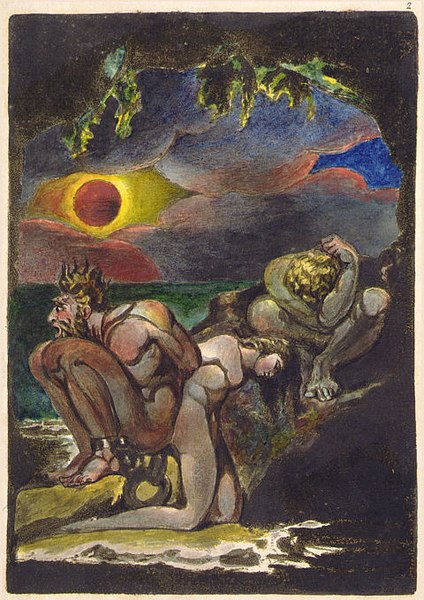
Oothoon, the soft soul of America, like an earlier maiden named Proserpine, plucks a flower and pays the price. Proserpine, you may remember, was rapt away into the underworld to be the bride of Pluto. In Oothoon's case the price began when, on her way with delight to her lover, Theotormon, she is raped by Bromion, a most rigid representative of the law, in fact a law abiding the slave trade.

Thereafter Oothoon and Bromion are bound back to back in Theotormon's cave with what is commonly known as a ball and chain. 

The poem largely consists of a colloquy among these three: Oothoon, the idealist; Bromion, the materialist; and Theotormon, a timid soul who can't make up his mind. As his name suggests, this young man is tormented by God given taboos about damaged goods. The God in this vision is named Urizen and also called the Father of Jealousy.
Typically Blake lays sexual oppression at the door of false religion. In the midst of Oothoon's lament, after a long series of Job-like questions, we read:
    " With what sense does the parson claim the labour
    of the farmer? What are his nets & gins and
    traps; & how does he surround him With cold
    floods of abstraction, and with forests of
    solitude, To build him castles and high spires,
    where kings and priests may dwell; Till she who
    burns with youth, and knows no fixed lot, is
    bound In spells of law to one she loaths? and
    must she drag the chain of Life in weary lust?
    must chilling, murderous thoughts obscure The
    clear heaven of her eternal spring;" 
    (VDA 5:17-24 Key 193)
A loveless marriage is a profanation of the greatest gift of life; nothing could arouse Blake to a whiter heat of indignation. Wollstonecraft had called it legal prostitution. In the lines that follow Oothoon names and radically disaffirms (go to VDA Plate 6, to the passage beginning "Take thy bliss, 0 Man!") the sick social attitudes that make sex a hidden and forbidden secret pleasure, and that degrade the highest sacrament, marriage, into a life sentence at hard labor:
Theotormon's jealousy casts Oothoon out and darkens her into "a solitary shadow wailing on the margin of non-entity". Blake developed this theme at the beginning of 'The Four Zoas'. There he ascribed the jealousy to Enion; it precipitated the Circle of Destiny (The Four Zoas [Nt 1], 5.)(all our sorrow!), sank Tharmas into the sea and condemned Enion to the very "margin of non-entity" of which Oothoon had spoken.
To perceive a lover or spouse as a possession (a thing) is a fatal act that brings about the deterioration of life. In fact the nature of fallenness is to degrade the person (the real) to the material (the illusory). The one tormented by jealousy loses the capability of creative life; in biblical language he covers his soul with a thick layer of miry clay, not to mention what he does to others! The profound theological corollary suggested by VDA. is that if we weren't jealous people, we wouldn't have a jealous God. Obviously the Old Testament symbol of a jealous God has other meanings, but rightly or wrongly that is what it seems to have meant to Blake.

Long before Freud's day Blake understood and described the close relationship, in fact the identity, between sexuality and creativity. He considered sexual fulfilment the primary means of artistic achievement.

 The picture in 'Milton' plate 42 portrays the post coital moment with the eagle of inspiration hovering above.
On the other hand all the evils of life Blake related to frustrated or sick sex. War in particular is perverted sexuality. The worship of the Queen of Heaven induces chastity with war as a substitute fulfilment. Blake's warrior cries, "I am drunk with unsatiated love, I must rush again to War, for the Virgin has frowned and refused."
Blake's mind was fourfold, which means that most of what he wrote is susceptible to more than one meaning. 

David Erdman in Prophet Against Empire saw VDA as political oratory at the service of the anti-slavery lobby. Oothoon is the type of the slave (of either sex); (in slave times the owner often claimed prenuptial privileges with the body of his slave). Bromion is the type of the merciless slave trader, and Theotormon of the wishy-washy conformist who can't quite bring himself to express his opposition to slavery (much as the many good Christians in America who couldn't quite bring themselves to condemn the war).

Thursday, September 11, 2014

IMAGINATION

British Museum
Songs of Innocence
Final Plate, Copy B


To Blake Imagination was the alternative to reason. Through imagination man had access to regions of thought that were unknown to reason. Reason is limited and static while imagination is expansive and dynamic. Reason delves within the spacial and temporal; imagination within the eternal.

Urthona is the Zoa who represents imagination. His work is carried on in the unconscious of man.  He corresponds to intuition in Jung's system. Urthona is an integrating force in the psyche providing the core organizing principles for the other Zoas.


Laocoon, (E 273) 
"The Eternal Body of Man is The IMAGINATION. 
that is God himself, The Divine Body, JESUS We are his Members"

Jerusalem, Plate 77, (E 231)
"I know of no other
Christianity and of no other Gospel than the liberty both of body
& mind to exercise the Divine Arts of Imagination.   
  Imagination the real & eternal World of which this Vegetable
Universe is but a faint shadow & in which we shall live in our
Eternal or Imaginative Bodies, when these Vegetable Mortal Bodies
are no more."
Jerusalem, Plate 5, (E 147) 
"Trembling I sit day and night, my friends are astonish'd at me.
Yet they forgive my wanderings, I rest not from my great task!
To open the Eternal Worlds, to open the immortal Eyes
Of Man inwards into the Worlds of Thought: into Eternity
Ever expanding in the Bosom of God. the Human Imagination        
O Saviour pour upon me thy Spirit of meekness & love:
Annihilate the Selfhood in me, be thou all my life!
Guide thou my hand which trembles exceedingly upon the rock of ages,
While I write of the building of Golgonooza,"
Jerusalem, Plate 71, E 225)
"For all are Men in Eternity. Rivers Mountains Cities Villages,
All are Human & when you enter into their Bosoms you walk
In Heavens & Earths; as in your own Bosom you bear your Heaven
And Earth, & all you behold, tho it appears Without it is Within
In your Imagination of which this World of Mortality is but a Shadow."


Wednesday, September 10, 2014

Blake Primer Sex


Following his Fundamental Presuppositions Blake, like virtually every mystic and esoteric perceived sex as the primary created duality. (Paracelsus may have best described his point.)

(The following from Franz Hartman, quoted by Percival on page 91.)
"Woman as such represents the will (including love and desire), and man as such represents intellect (including the imagination). Woman represents substance; man represents spirit. Man imagines; woman executes. Man creates images; woman renders them substantial.
    The divine man (the angel) is male and female in one; such Adam was before the woman became separated from him."
    (Blake disagreed emphatically with the biblical creation story, Blake considered the separation of the original Adam into male and female as more of a Fall than a Creation. Of course you and I and Blake as well are faced with the Reality of our circumstances. At any rate after the Fall):
    "Man was like the Sun; woman as such resembles the Moon, receiving her light from the Sun, and man without woman (in him) is a consuming fire in want of fuel.
This means that Blake (and Paracelsus) in their use of sex have a primarily metaphysical rather than a physical connotation. Nevertheless Blake began working with a sexual hangup of some sort, which he seems to have satisfactorily worked through with some 40 years of happy marriage.

In the Christian faith marriage is a sacrament, and for many of us the primary sacrament. However living the sacrament was no more common in Blake's day than in ours. 18th and 19th century England seemed largely to view marriage more as a commercial transaction.
Such a view led Blake to condemn the marriage hearse. He also condemned jealousy.

***********************

Many people have deeply misunderstood Blake's doctrine of sex. It has complex roots and abounds in parodoxes that defy casual acquaintance. But like most things the subject yields to close and careful study. If we can separate the conflicting strands of thought and resolve the parodoxes, we may achieve a better understanding of Blake, the man and the thinker, than is enjoyed by most even among his interpreters.
  In this chapter we start from the platform of his known personal experiences. Then we explore his early statements about sex in the light of what we know of his life. We examine the biblical and heterodox traditions and the symbolics of sex and finally look at the ways in which the mature Christian poet dealt with sex in his art. In the light of all this we may begin to perceive in Blake's poetry a journal of his spiritual progress; this is especially true of The Four Zoas, where the triangle of Blake, his wife, and the Spectre
bring about a reconciliation and level of understanding at the spiritual level where love finds its apogee. (Look especially at the last quatrain. Note that in this poem 'love' has a very special meaning, nothing like the use we've made of the word here.)
**************************************************
       A review of Blake's early life suggests the most normal and ordinary psychosexual development, to which the biographers testify. Through his refusal of formal education Blake appears to have escaped many of the common pathologies of sex that afflicted his age as ours. In fact he systematically held some of them up to ridicule.

       Blake never tired of painting the human form, and he usually refused to hide it with clothes. Virtually his only models were his wife and himself. We read that a friend once found them naked in the garden of their home. In all probability they were planning poses and postures for his illustrations of 'Paradise Lost'.

      In his early twenties Blake formed an emotional attachment to a young woman named Polly Wood. Unfortunately Polly had other interests, and when he showed jealousy, she asked him if he were a fool. The experience seems to have cured him of jealousy; in fact the foolishness of jealousy became a life long motif; his false God received the name (among others) of "Father of Jealousy".

       On the rebound he met a beautiful girl named Catherine Boucher, a gardener's daughter. He told Catherine his mournful story, and when she pitied him, he promptly transfered his affection to her. A year later they were married, a relationship that according to all the evidence seems to have been made in heaven. Illiterate at her marriage, Catherine Blake must have been a gifted and rare person; she had a great deal to do with Blake's enormous creativity. Her high and continuous level of affirmation released Blake from the drain of domestic preoccupations. She affirmed and encouraged his gift of vision even when it meant long hours of wakefulness while he communed with heaven. She provided the appreciative audience that the world in general denied Blake and made him a happy creative artist in the same way that J.S.Bach was happy.

       One important influence on Blake's ideology of sex came from certain left wing religious dissenters. The antinomians deeply affected Blake's world of thought. They considered marriage a part of the law which they wanted to abolish. They claimed the right, living above the law, to cohabitate with whomever, whenever and wherever they felt led. We find evidence of similar excesses among fringe groups both in the New Testament and in the 20th Century:
    Remove away that black'ning church:
    Remove away that marriage hearse:
    Remove away that man of blood:
    You'll quite remove the ancient curse.
           (An Ancient Proverb; in Songs and Ballard; Erdman p. 475)
       Blake found these ideas attractive as a young man, but no one believes that he carried them very far in practice. Libertines and hedonists have at times made Blake their hero, but they simply don't know their man. All the evidence suggests that Blake lived as a faithful and loving husband for some forty five years--and a happy one as well (This is spite of a recent fanciful 'biography' of Catherine Blake).
       What Blake hated was not monogamy but jealousy and the idea of a lover or spouse as a possession:
    He who binds to himself a joy
    Doth the winged life destroy;
    But he who kisses the joy as it flies
    Lives in Eternity's sun rise.
           (Eternity, in Songs and Ballards; Erdman 474 or Several Questions Answered )
       We have a story to the effect that early in his marriage Blake proposed to bring home a concubine (sneaking around was futhest from his thoughts!) His young wife cried at the idea, and he dropped it. In all likelihood the concubine notion came from Blake's friend, Mary Wollstonecraft, one of the earliest of liberated women.

      Blake had illustrated two of this lady's works shortly before she wrote a sensational essay called "Vindication of the Rights of Women". Mary Wollstonecraft advocated the radical equality of the sexes, which Blake endorsed. She tried to live in the freedom generally reserved for men (and claimed by few even of them!) Blake was among those who supported her in this endeavor. She lived an adventurous and tragic life and died giving birth to another Mary, who became the wife of the poet, Shelley.

       Blake had a very complex psyche one could discuss to exhaustion his various sexual attitude and points of view. According to Damon, who wrote A Blake Dictionary, Blake believed that "the domination of woman is one of the greatest forces corrupting society" (page 447); he quote as follows:
    What may Woman be
    to have power over Man from cradle to corruptible grave.
    There's a throne in every man;it's the throne of God;
    this Woman has claimed as her own and Man is no more!"
           (Jerusalem plate 30, lines 25-28)