Saturday, July 11, 2015

Dante 23


The Simoniac Pope


________


This from Wikisource:_

The Divine Comedy/Inferno/Canto XIX


William Blake: Inferno, Canto XIX, 10-120, The Simoniac Pope
O Simon Magus, O forlorn disciples,
   Ye who the things of God, which ought to be
   The brides of holiness, rapaciously

For silver and for gold do prostitute,
   Now it behoves for you the trumpet sound,
   Because in this third Bolgia ye abide.

We had already on the following tomb
   Ascended to that portion of the crag
   Which o'er the middle of the moat hangs plumb.

Wisdom supreme, O how great art thou showest
   In heaven, in earth, and in the evil world,
   And with what justice doth thy power distribute!

I saw upon the sides and on the bottom
   The livid stone with perforations filled,
   All of one size, and every one was round.

To me less ample seemed they not, nor greater
   Than those that in my beautiful Saint John
   Are fashioned for the place of the baptisers,

And one of which, not many years ago,
   I broke for some one, who was drowning in it;
   Be this a seal all men to undeceive.

Out of the mouth of each one there protruded
   The feet of a transgressor, and the legs
   Up to the calf, the rest within remained.

In all of them the soles were both on fire;
   Wherefore the joints so violently quivered,
   They would have snapped asunder withes and bands.

Even as the flame of unctuous things is wont
   To move upon the outer surface only,
   So likewise was it there from heel to point.

"Master, who is that one who writhes himself,
   More than his other comrades quivering,"
   I said, "and whom a redder flame is sucking?"

And he to me: "If thou wilt have me bear thee
   Down there along that bank which lowest lies,
   From him thou'lt know his errors and himself."

And I: "What pleases thee, to me is pleasing;
   Thou art my Lord, and knowest that I depart not
   From thy desire, and knowest what is not spoken."

Straightway upon the fourth dike we arrived;
   We turned, and on the left-hand side descended
   Down to the bottom full of holes and narrow.

And the good Master yet from off his haunch
   Deposed me not, till to the hole he brought me
   Of him who so lamented with his shanks.

"Whoe'er thou art, that standest upside down,
   O doleful soul, implanted like a stake,"
   To say began I, "if thou canst, speak out."

I stood even as the friar who is confessing
   The false assassin, who, when he is fixed,
   Recalls him, so that death may be delayed.

And he cried out: "Dost thou stand there already,
   Dost thou stand there already, Boniface?
   By many years the record lied to me.

Art thou so early satiate with that wealth,
   For which thou didst not fear to take by fraud
   The beautiful Lady, and then work her woe?"

Such I became, as people are who stand,
   Not comprehending what is answered them,
   As if bemocked, and know not how to answer.

Then said Virgilius: "Say to him straightway,
   'I am not he, I am not he thou thinkest.'"
   And I replied as was imposed on me.

Whereat the spirit writhed with both his feet,
   Then, sighing, with a voice of lamentation
   Said to me: "Then what wantest thou of me?

If who I am thou carest so much to know,
   That thou on that account hast crossed the bank,
   Know that I vested was with the great mantle;

And truly was I son of the She-bear,
   So eager to advance the cubs, that wealth
   Above, and here myself, I pocketed.

Beneath my head the others are dragged down
   Who have preceded me in simony,
   Flattened along the fissure of the rock.

Below there I shall likewise fall, whenever
   That one shall come who I believed thou wast,
   What time the sudden question I proposed.

But longer I my feet already toast,
   And here have been in this way upside down,
   Than he will planted stay with reddened feet;

For after him shall come of fouler deed
   From tow'rds the west a Pastor without law,
   Such as befits to cover him and me.

New Jason will he be, of whom we read
   In Maccabees; and as his king was pliant,
   So he who governs France shall be to this one."

I do not know if I were here too bold,
   That him I answered only in this metre:
   "I pray thee tell me now how great a treasure

Our Lord demanded of Saint Peter first,
   Before he put the keys into his keeping?
   Truly he nothing asked but 'Follow me.'

Nor Peter nor the rest asked of Matthias
   Silver or gold, when he by lot was chosen
   Unto the place the guilty soul had lost.

Therefore stay here, for thou art justly punished,
   And keep safe guard o'er the ill-gotten money,
   Which caused thee to be valiant against Charles.

And were it not that still forbids it me
   The reverence for the keys superlative
   Thou hadst in keeping in the gladsome life,

I would make use of words more grievous still;
   Because your avarice afflicts the world,
   Trampling the good and lifting the depraved.

The Evangelist you Pastors had in mind,
   When she who sitteth upon many waters
   To fornicate with kings by him was seen;

The same who with the seven heads was born,
   And power and strength from the ten horns received,
   So long as virtue to her spouse was pleasing.

Ye have made yourselves a god of gold and silver;
   And from the idolater how differ ye,
   Save that he one, and ye a hundred worship?

Ah, Constantine! of how much ill was mother,
   Not thy conversion, but that marriage dower
   Which the first wealthy Father took from thee!"

And while I sang to him such notes as these,
   Either that anger or that conscience stung him,
   He struggled violently with both his feet.

I think in sooth that it my Leader pleased,
   With such contented lip he listened ever
   Unto the sound of the true words expressed.

Therefore with both his arms he took me up,
   And when he had me all upon his breast,
   Remounted by the way where he descended.

Nor did he tire to have me clasped to him;
   But bore me to the summit of the arch
   Which from the fourth dike to the fifth is passage.

There tenderly he laid his burden down,
   Tenderly on the crag uneven and steep,
   That would have been hard passage for the goats:

Thence was unveiled to me another valley.


Friday, July 10, 2015

JERUSALEM SLUMBERS [21]

British Library
Four Zoas Manuscript
Page 22 [21]

Four Zoas, Night I, PAGE 22 [21], (E 313)
"The Daughters of Beulah beheld the Emanation they pitied
They wept before the Inner gates of Enitharmons bosom
And of her fine wrought brain & of her bowels within her loins
Three gates within Glorious & bright open into Beulah 
From Enitharmons inward parts but the bright female terror       
Refusd to open the bright gates she closd and barrd them fast
Lest Los should enter into Beulah thro her beautiful gates

The Emanation stood before the Gates of Enitharmon    
Weeping. the Daughters of Beulah silent in the Porches
Spread her a couch unknown to Enitharmon here reposd             
Jerusalem in slumbers soft lulld into silent rest
Terrific ragd the Eternal Wheels of intellect terrific ragd
The living creatures of the wheels in the Wars of Eternal life
But perverse rolld the wheels of Urizen & Luvah back reversd
Downwards & outwards consuming in the wars of Eternal Death" 

As the fall progressed Albion's emanation Jerusalem descended to Ulro with Albion. She finds herself barred from reentering Beulah as is Los. Enitharmon has substituted her vision of the world under female control for the Vision held by Jerusalem and Los. She blocks the gates of heart, and brain and loins forcing the avenue of return to be diverted through a long detour.

Jerusalem with her vision of the divine order is removed from the field of activity by causing her to sleep as Urizen and Luvah alter the direction in which the mechanism of creation moves. The intellect is induced to direct its efforts toward moving away from the eternal, invisible and toward the temporal, material.


Wikimedia Commons
Jerusalem
Plate 37, detail

Thursday, July 09, 2015

Dante 22


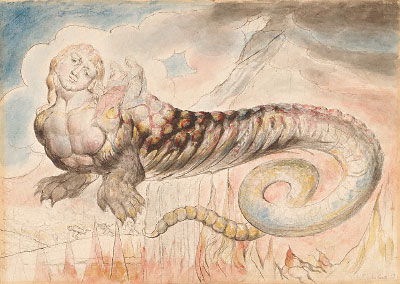
Going Down with Geryon

From Dante Inferno Canto XVII
.

The face was as the face of a just man,
  Its semblance outwardly was so benign,
  And of a serpent all the trunk beside.

Two paws it had, hairy unto the armpits;
  The back, and breast, and both the sides it had
  Depicted o'er with nooses and with shields.

His tail was wholly quivering in the void,
  Contorting upwards the envenomed fork,
  That in the guise of scorpion armed its point.

The Guide said: "Now perforce must turn aside
  Our way a little, even to that beast
  Malevolent, that yonder coucheth him."

We therefore on the right side descended,
  And made ten steps upon the outer verge,
  Completely to avoid the sand and flame;

And after we are come to him, I see
  A little farther off upon the sand
  A people sitting near the hollow place.

Then said to me the Master: "So that full
  Experience of this round thou bear away,
  Now go and see what their condition is.

There let thy conversation be concise;
  Till thou returnest I will speak with him,
  That he concede to us his stalwart shoulders."

Thus farther still upon the outermost
  Head of that seventh circle all alone
  I went, where sat the melancholy folk.

That from the neck of each there hung a pouch,
  Which certain colour had, and certain blazon;
  And thereupon it seems their eyes are feeding.

And as I gazing round me come among them,
  Upon a yellow pouch I azure saw
  That had the face and posture of a lion.

Proceeding then the current of my sight,
  Another of them saw I, red as blood,
  Display a goose more white than butter is.

And one, who with an azure sow and gravid
  Emblazoned had his little pouch of white,
  Said unto me: "What dost thou in this moat?

Now get thee gone; and since thou'rt still alive,
  Know that a neighbour of mine, Vitaliano,
  Will have his seat here on my left-hand side.

A Paduan am I with these Florentines;
  Full many a time they thunder in mine ears,
  Exclaiming, 'Come the sovereign cavalier,

I found my Guide, who had already mounted
  Upon the back of that wild animal,
  And said to me: "Now be both strong and bold.

Now we descend by stairways such as these;
  Mount thou in front, for I will be midway,
  So that the tail may have no power to harm thee."
 ......

I seated me upon those monstrous shoulders;
  I wished to say, and yet the voice came not
  As I believed, "Take heed that thou embrace me."

But he, who other times had rescued me
  In other peril, soon as I had mounted,
  Within his arms encircled and sustained me,

And said: "Now, Geryon, bestir thyself;
  The circles large, and the descent be little;
  Think of the novel burden which thou hast."

Onward he goeth, swimming slowly, slowly;
  Wheels and descends, but I perceive it only
  By wind upon my face and from below.

I heard already on the right the whirlpool
  Making a horrible crashing under us;
  Whence I thrust out my head with eyes cast downward.

Then was I still more fearful of the abyss;
  Because I fires beheld, and heard laments,
  Whereat I, trembling, all the closer cling.

Even thus did Geryon place us on the bottom,
  Close to the bases of the rough-hewn rock,
  And being disencumbered of our persons,

He sped away as arrow from the string.

Plate 33 of Blake's Illustrations to Inferno
from National Gallery of Victoria

Geryon

From Wikipedia
In the Inferno, the first part of Italian poet Dante's Divine Comedy epic, Geryon has become the Monster of Fraud, a winged beast with the face of an honest man, the paws of a lion, the body of a wyvern, and a poisonous sting at the tip of his tail.[14] He dwells somewhere in the depths below the cliff between the seventh and eighth circles of Hell (the circles of violence and simple fraud, respectively); Geryon rises from the pit at Virgil's call and bears the Poets to the eighth circle. To Dante's horror, the Poets ride on Geryon's back, and he slowly glides around and around the waterfall of the Phlegethon down the great depths to the Circle of Fraud.

Before the entrance to Virgil's version of the underworld in the sixth song of the Aeneid, Geryon is probably also to be found in the description "forma tricorporis umbrae," (the contour of a shade with three bodies) (Book VI, l. 289), in the company of countless other nightmarish creatures. Some read it as a reference to the three-headed monster Cerberus, though.

Geryon:
Going back a milleneon or so we find the Greek Myths:
Geryon:  a winged monster with three bodies joined at the waist, killed by Hercules, who stole the monster's cattle as his tenth labour.

Geryon strongly resembles the biblical and Blake serpent:

Now the serpent was more subtil than any beast of the field which the Lord God had made. And he said unto the woman, Yea, hath God said, Ye shall not eat of every tree of the garden?

From Marriage of Heaven and Hell:
Now the sneaking serpent walks
In mild humility.
And the just man rages in the wilds
Where lions roam.

Blake used the serpent in many, many other ways.

Wednesday, July 08, 2015

INTO UNKNOWN SPACE [20]

British Library
Four Zoas Manuscript
Page20

Four Zoas, Night I, PAGE 22 [20], (E 311)
"Luvah replied Dictate to thy Equals. am not I
The Prince of all the hosts of Men nor Equal know in Heaven
If I arise into the Zenith leaving thee to watch
The Emanation & her Sons the Satan & the Anak
Sihon and Og. wilt thou not rebel to my laws remain             
In darkness building thy strong throne & in my ancient night
Daring my power wilt arm my sons against me in the Atlantic 
My deep   My night which thou assuming hast assumed my Crown
I will remain as well as thou & here with hands of blood
Smite this dark sleeper in his tent then try my strength with thee 

While thus he spoke his fires reddend oer the holy tent
Urizen cast deep darkness round him silent brooding death
Eternal death to Luvah. raging Luvah pourd
The Lances of Urizen from chariots. round the holy tent
Discord began & yells & cries shook the wide firmament

Beside his anvil stood Urthona dark. a mass of iron
Glowd furious on the anvil prepard for spades & coulters   All
His sons fled from his side to join the conflict pale he heard
The Eternal voice he stood the sweat chilld on his mighty limbs
He dropd his hammer. dividing from his aking bosom fled          
A portion of his life shrieking upon the wind she fled
And Tharmas took her in pitying Then Enion in jealous fear
Murderd her & hid her in her bosom embalming her for fear
She should arise again to life Embalmd in Enions bosom
Enitharmon remains a corse such thing was never known            
In Eden that one died a death never to be revivd
Urthona stood in terror but not long his spectre fled
To Enion & his body fell. Tharmas beheld him fall
Endlong a raging serpent rolling round the holy tent
The sons of war astonishd at the Glittring monster drove         
Him far into the world of Tharmas into a cavernd rock

But Urizen with darkness overspreading all the armies
Sent round his heralds   secretly commanding to depart
Into the north Sudden with thunders sound his multitudes
Retreat from the fierce conflict all the sons of Urizen at once  
Mustring together in thick clouds leaving the rage of Luvah
To pour its fury on himself & on the Eternal Man

Sudden down fell they all together into an unknown Space
Deep horrible without End. Separated from Beulah far beneath
The Mans exteriors are become indefinite opend to pain           
In a fierce hungring void & none can visit his regions"

This passage reads like a precis of the fall as it occurs throughout Blake's poetry. All four of the Zoas and two of their Emanations are mentioned in this narrative. Luvah refuses to submit to the plan of Urizen and proposes to attack Albion on his own. As Luvah and Urizen enter their rage against each other, Urthona's sons abandon their father to enter the conflagration. Urthona is being dismembered as another portion of his life - Enitharmon - flees to be taken in by Tharmas.

Blake would have seen the fracturing of Urthona as the most tragic of the symptoms of the fall which he observed. Urthona's function as an Eternal Zoa was to hold the vision without which there could be no cohesion among the parts which contributed to the Eternal Man. Urthona had been the light of consciouness of the unified working of the Undivided Eternal dimension. When he lost his sons and his daughter, the outer evidence which supported his inner confidence failed. Urthona lost too his Spectre, and he entered a serpent form forced into the underground. Urthona had occupied the Zenith of man's functioning. Now that position was occupied by Urizen, and Urthona was forced to the Nadir. Henceforth his influence would occupy the subconscious which would seldom be consulted by the reason or the emotions.   


Wikipedia Commons
Visionary Heads
Head of Job
Perhaps Blake modeled Urthona on Job, an individual whose understanding of God was transformed by enduring suffering. The two began as favored by God to bring blessings to their fellows. However they found that their misconceptions about the workings of the Eternal world led to breakdowns. They were both torn down in order to be rebuilt as suitable vessels to carry the message of completeness.


Tuesday, July 07, 2015

Blake and Dante 1

In the study of Blake's  'Illustrations of Dante's Inferno' I came across a book in our library called 'The Traveler in the Evening'. by Morton D. Paley.  Chapter 3 on the 'Divine Comed'y takes up pages 101 to 177. I found these pages to be a gold mine for this study.

There are many relationships between Blake and Dante.


Plate 16 of Marriage of Heaven and Hell
This closely resembles pictures of Dante's Inferno.

We may move to Blake's Gates of Paradise:
Image 14 of Blake's Gates of Paradise by LC rare books

And here's another representation:


Here are the ugly details:
From Wikipedia, the free encyclopedia

Count Ugolino della Gherardesca (c. 1220 – March 1289), count of Donoratico, was an Italian nobleman, politician and naval commander. He was frequently accused of treason and features prominently in Dante's Divine Comedy.

Monday, July 06, 2015

COUNCIL OF GODS [19]


British Library
Four Zoas Manuscript
Page 21
 Four Zoas, Night I, PAGE 21 [19], (E 310)  
"Then those in Great Eternity met in the Council of God
As one Man for contracting their Exalted Senses

They behold Multitude or Expanding they behold as one
As One Man all the Universal family & that one Man 
They call Jesus the Christ & they in him & he in them            
Live in Perfect harmony in Eden the land of life
Consulting as One Man above the Mountain of Snowdon Sublime

For messengers from Beulah come in tears & darkning clouds
Saying Shiloh is in ruins our brother is sick Albion He 
Whom thou lovest is sick he wanders from his house of Eternity   
The daughters of Beulah terrified have closd the Gate of the Tongue
Luvah & Urizen contend in war around the holy tent

So spoke the Ambassadors from Beulah & with solemn mourning 
They were introducd to the divine presence & they kneeled down
In Conways Vale thus recounting the Wars of Death Eternal  

The Eternal Man wept in the holy tent Our Brother in Eternity
Even Albion whom thou lovest wept in pain his family
Slept round on hills & valleys in the regions of his love
But Urizen awoke & Luvah woke & thus conferrd

Thou Luvah said the Prince of Light behold our sons & daughters  
Reposd on beds. let them sleep on. do thou alone depart
Into thy wished Kingdom where in Majesty & Power
We may erect a throne. deep in the North I place my lot
Thou in the South listen attentive. In silent of this night
I will infold the Eternal tent in clouds opake while thou       
Siezing the chariots of the morning. Go outfleeting ride
Afar into the Zenith high bending thy furious course
Southward with half the tents of men inclosd in clouds
Will lay my scepter on Jerusalem the Emanation
On all her sons & on thy sons O Luvah & on mine  
Till dawn was wont to wake them then my trumpet sounding loud
Ravishd away in night my strong command shall be obeyd
For I have placd my centinels in stations each tenth man
Is bought & sold & in dim night my Word shall be their law"
 
The crisis created by the alteration of consciousness initiated by the instinctual functioning of the mind is not unnoticed by the mind as a whole. The Universal Family identified as Jesus the Christ draw together to confront the threat. In Beulah the sickness had originated; from Beulah come the signals that two other Zoas had become involved in destroying the precarious balance of mental functioning. 

The Eternal Man, the everlasting Word, is the one Man who weeps over the departure of Albion, the Divine Humanity, from his house in Eternity. Measures must be taken to restrict the spread of Eternal Death. Thus was the holy tent drawn up and the gate of the tongue closed.

The fracture which Tharmas and Enion created provided an opening for Urizen and Luvah to vie for control of the mind. Urizen (reason) proposes to move into Urthona's domain - the intuitive imaginative area. He plans to gain control of Albion's emanation Jerusalem, further damaging Albion's ability to recover. He aims to establish his rule of law to replace consensus as the mode of operation. He seeks the cooperation of Luvah (emotions) who will take over the territory abandoned by Urizen. 

The conflict of forces contending for control: 

British Museum
Young's Night Thoughts
Sketch for Night IX, page 34

British Museum
Young's Night Thoughts
Watercolor for Night IX, page 34


Sunday, July 05, 2015

Dante 21

Inferno XIV 94-120:
"These words were of my Leader; whence I prayed him
  That he would give me largess of the food,
  For which he had given me largess of desire.

"In the mid-sea there sits a wasted land,"
  Said he thereafterward, "whose name is Crete,
  Under whose king the world of old was chaste.

There is a mountain there, that once was glad
  With waters and with leaves, which was called Ida;
  Now 'tis deserted, as a thing worn out.

A grand old man stands in the mount erect,
  Who holds his shoulders turned tow'rds Damietta,
  And looks at Rome as if it were his mirror.

His head is fashioned of refined gold,
  And of pure silver are the arms and breast;
  Then he is brass as far down as the fork.

From that point downward all is chosen iron,
  Save that the right foot is of kiln-baked clay,
  And more he stands on that than on the other.

Each part, except the gold, is by a fissure
  Asunder cleft, that dripping is with tears,
  Which gathered together perforate that cavern.

From rock to rock they fall into this valley;
  Acheron, Styx, and Phlegethon they form;
  Then downward go along this narrow sluice

Unto that point where is no more descending.
  They form Cocytus; what that pool may be
  Thou shalt behold, so here 'tis not narrated."

And I to him: "If so the present runnel
  Doth take its rise in this way from our world,
  Why only on this verge appears it to us?"

And he to me: "Thou knowest the place is round,
  And notwithstanding thou hast journeyed far,
  Still to the left descending to the bottom,

Thou hast not yet through all the circle turned.
  Therefore if something new appear to us,
  It should not bring amazement to thy face."

And I again: "Master, where shall be found
  Lethe and Phlegethon, for of one thou'rt silent,
  And sayest the other of this rain is made?"

"In all thy questions truly thou dost please me,"
  Replied he; "but the boiling of the red
  Water might well solve one of them thou makest.

Thou shalt see Lethe, but outside this moat,
  There where the souls repair to lave themselves,
  When sin repented of has been removed."


Virgil describes  the Symbolic Figure of the course of Human History
William Blake's Illustrations of Dante's Poetry
Wiki Common


From UTexas Dante Studies:
"Dante invents the story of the large statue of an old man--located in Mount Ida on the Island of Crete--for both practical and symbolic purposes ( Inf. 14.94-120). Constructed of a descending hierarchy of materials--gold head, silver arms and chest, brass midsection, iron for the rest (except one clay foot)--the statue recalls the various ages of humankind (from the golden age to the iron age: Ovid, Met. 1.89-150) in a pessimistic view of history and civilization devolving from best to worst. Dante's statue also closely recalls the statue appearing in King Nebuchadnezzar's dream in the Bible; this dream is revealed in a vision to Daniel, who informs the king that the composition of the statue signifies a declining succession of kingdoms all inferior to the eternal kingdom of God (Daniel 2:31-45). That the statue is off-balance--leaning more heavily on the clay foot--and facing Rome ("as if in a mirror") probably reflects Dante's conviction that society suffers from the excessive political power of the pope and the absence of a strong secular ruler. 

Although the statue is not itself found in hell, the tears that flow down the crack in its body (only the golden head is whole) represent all the suffering of humanity and thus become the river in hell that goes by different names according to region: Acheron, Styx, Phlegethon, Cocytus (Inf. 14.112-20). 

Saturday, July 04, 2015

EDGE OF BEULAH [18]


British Library
Four Zoas Manuscript
Page 18
 Four Zoas, Night I,PAGE 18, (E 310)
"Why is the Sheep given to the knife? the Lamb plays in the Sun
He starts! he hears the foot of Man! he says, Take thou my wool
But spare my life, but he knows not that winter cometh fast..

The Spider sits in his labourd Web, eager watching for the Fly
Presently comes a famishd Bird & takes away the Spider           
His Web is left all desolate, that his little anxious heart
So careful wove; & spread it out with sighs and weariness.

This was the Lamentation of Enion round the golden Feast
Eternity groand and was troubled at the image of Eternal Death
Without the body of Man an Exudation from his sickning limbs     

Now Man was come to the Palm tree & to the Oak of Weeping
Which stand upon the Edge of Beulah & he sunk down
From the Supporting arms of the Eternal Saviour; who disposd
The pale limbs of his Eternal Individuality
Upon The Rock of Ages. Watching over him with Love & Care 
 
End of First Night"
Page 18 is one of two pages which Blake concludes with the words 'End of First Night.' After Page 18 there are four additional pages which are considered to be pages of the manuscript of the First Night. Blake initially seems to have intended to end the First Night with this image of a final separation of Tharmas and Enion as they exit from Beulah into the world of mortality. Enion was able to see the destruction of the complete psyche in a world of nature which on longer reflected the innocence of Eden. Tharmas was able to see the same disintegration in the body which has become subject to the decay of death. Their combined vision of the total man as body and spirit had been a cohesive force which cemented each of the functions of the psyche into a harmonious unity. The chain reaction of the fall reached critical mass when they steped across the border of the edge of Beulah between the Palm tree and the Oak. Eden had been left for Beulah, now Tharmas and Enion abandon Beulah as well.

For a recap of the events which led to the exit from Beulah, read DRIVEN OUTWARD, which comments on Page 5.

Blake's illustration can be seen as the Eternal Saviour reaching down and laying in a manger a divine child. A faint sketch of a kneeling figure receives the child to her care.  

Friday, July 03, 2015

Dante 20


*
The Blasphemer
Blake's Illustrations of Dante's Inferno
Plate 27


Inferno: Canto XIV


Because the charity of my native place
  Constrained me, gathered I the scattered leaves,
  And gave them back to him, who now was hoarse.

Then came we to the confine, where disparted
  The second round is from the third, and where
  A horrible form of Justice is beheld.

Clearly to manifest these novel things,
  I say that we arrived upon a plain,
  Which from its bed rejecteth every plant;

The dolorous forest is a garland to it
  All round about, as the sad moat to that;
  There close upon the edge we stayed our feet.

The soil was of an arid and thick sand,
  Not of another fashion made than that
  Which by the feet of Cato once was pressed.

Vengeance of God, O how much oughtest thou
  By each one to be dreaded, who doth read
  That which was manifest unto mine eyes!

Of naked souls beheld I many herds,
  Who all were weeping very miserably,
  And over them seemed set a law diverse.

Supine upon the ground some folk were lying;
  And some were sitting all drawn up together,
  And others went about continually.

Those who were going round were far the more,
  And those were less who lay down to their torment,
  But had their tongues more loosed to lamentation.

O'er all the sand-waste, with a gradual fall,
  Were raining down dilated flakes of fire,
  As of the snow on Alp without a wind.

As Alexander, in those torrid parts
  Of India, beheld upon his host
  Flames fall unbroken till they reached the ground.

Whence he provided with his phalanxes
  To trample down the soil, because the vapour
  Better extinguished was while it was single;

Thus was descending the eternal heat,
  Whereby the sand was set on fire, like tinder
  Beneath the steel, for doubling of the dole.

Without repose forever was the dance
  Of miserable hands, now there, now here,
  Shaking away from off them the fresh gleeds.

"Master," began I, "thou who overcomest
  All things except the demons dire, that issued
  Against us at the entrance of the gate,

Who is that mighty one who seems to heed not
  The fire, and lieth lowering and disdainful,
  So that the rain seems not to ripen him?"

And he himself, who had become aware
  That I was questioning my Guide about him,
  Cried: "Such as I was living, am I, dead.

If Jove should weary out his smith, from whom
  He seized in anger the sharp thunderbolt,
  Wherewith upon the last day I was smitten,

And if he wearied out by turns the others
  In Mongibello at the swarthy forge,
  Vociferating, 'Help, good Vulcan, help!'

Even as he did there at the fight of Phlegra,
  And shot his bolts at me with all his might,
  He would not have thereby a joyous vengeance."

Then did my Leader speak with such great force,
  That I had never heard him speak so loud:
  "O Capaneus, in that is not extinguished

Thine arrogance, thou punished art the more;
  Not any torment, saving thine own rage,
  Would be unto thy fury pain complete."
"

Capaneus

From Wikipedia, the free encyclopedia

Capaneus scales the city wall ofThebesCampanian red-figureamphora, ca. 340 BC, Getty Villa(92.AE.86).
In Greek mythologyCapaneus (GreekΚαπανεύς) was a son of Hipponous and either Astynome (daughter of Talaus)[1] or Laodice (daughter ofIphis),[2] and husband of Evadne, with whom he fathered Sthenelus.[3] Some call his wife Ianeira.[4]Mythology[edit]
According to the legend, Capaneus had immense strength and body size and was an outstanding warrior. He was also notorious for his arrogance. He stood just at the wall of Thebes at the siege of Thebes and shouted that Zeus himself could not stop him from invading it. In Aeschylus, he bears a shield with a man without armour withstanding fire, a torch in hand, which reads 'I will burn the city,' in token of this. While he was mounting the ladder, Zeus struck and killed Capaneus with a thunderbolt, and Evadne threw herself on her husband's funeral pyre and died.[5][6][7][8][9][10] His story was told by Aeschylus in his Seven against Thebes,[by Euripides, and by the Roman poet Statius.

  • In the fourteenth canto of his Inferno, Dante sees Capaneus in the seventh circle (third round) of Hell. Along with the other blasphemers, or those "violent against God", Capaneus is condemned to lie supine on a plain of burning sand while fire rains down on him. He continues to curse the deity (whom, being a pagan, he addresses as "Jove" a.k.a. Jupiter) despite the ever harsher pains he thus inflicts upon himself, so that God "thereby should not have glad vengeance."


Thursday, July 02, 2015

ENION'S GRIEF [17]


British Library
Four Zoas Manuscript
Page 17
Four Zoas, Night I, PAGE 17, (E 310) 
"Enion blind & age-bent wept upon the desolate wind 

Why does the Raven cry aloud and no eye pities her?
Why fall the Sparrow & the Robin in the foodless winter?
Faint! shivering they sit on leafless bush, or frozen stone

Wearied with seeking food across the snowy waste; the little     
Heart, cold; and the little tongue consum'd, that once in thoughtless joy
Gave songs of gratitude to waving corn fields round their nest.

Why howl the Lion & the Wolf? why do they roam abroad?
Deluded by summers heat they sport in enormous love
And cast their young out to the hungry wilds & sandy desarts"    

Following are passage from William Blake's Circle of Destiny by Milton Percival which shed light on Enion and the source of her suffering:
Page 295
"The Fall drags Enion into the indefinite of matter - into the Grave, whence she speaks with a comprehensive knowledge of the suffering of nature."
Page 173
"She feels herself on the way to the dark, blank, abstract matter where she would be but a 'shadow in oblivion.' To prevent that extinction, she weaves a nature that is but a 'shadowy semblance' of eternal nature, but which is nevertheless full of 'mazes of delusive beauty' wherein she can be protected as under the 'shadowy wings.'"
Page 174
"Man's conception of Being is reshaped to accord with his new beliefs. Urthona (man's essential self) is reborn as Time and Space in the persons of Los and Enitharmon. The temporal replaces the eternal. The concepts Time and Space cost Enion her claim to spiritual reality. As the finite and spacial take hold on the mind of man, the Earth-Mother withers into a thing of clay. Descending into matter she goes outward into the strife of the four elements.
...
The inner spirit turned self-righteous, the body pays the price in Enion's blood. Creature is the prey of creature. The curse placed on the earth in Genesis is in effect."
Page 368
"It is not until a dual universe has been achieved that death and decay make their appearance. They come into being with Los' generative world, in which the sexes are separate, in which good and evil struggle with one another, and Tharmas and Enion are known as distinct and antithetical principles. In the world as it is shaped after the Flood, not only are form and matter regarded as distinct, but the one is felt to be living, the other dead. Yet they both contribute their characteristics to the the physical world. Mortality is the logical outcome of their union."

Earlier posts may also help in understanding Enion and her anguish: 
Tharmas as the Zoa of the body in his fallen state is not matter but spirit with no expression in matter. Enion, the emanation of Tharmas becomes matter without association with spirit.

Feeling responsible for the suffering which manifests in Nature she wanders bent and blind and assumes the pain all around her.

Enion separated from Tharmas weaves from the outer and inner ability to perceive, a material instrument of perception; the physical body enclosing the spirit.

Wednesday, July 01, 2015

Dante 19

The Hell Hounds
From Dante's Inferno canto xiii:


In the same way as he is who perceives
  The boar and chase approaching to his stand,
  Who hears the crashing of the beasts and branches;

And two behold! upon our left-hand side,
  Naked and scratched, fleeing so furiously,
  That of the forest, every fan they broke.

He who was in advance: "Now help, Death, help!"
  And the other one, who seemed to lag too much,
  Was shouting: "Lano, were not so alert

Those legs of thine at joustings of the Toppo!"
  And then, perchance because his breath was failing,
  He grouped himself together with a bush.

Behind them was the forest full of black
  She-mastiffs, ravenous, and swift of foot
  As greyhounds, who are issuing from the chain.

On him who had crouched down they set their teeth,
  And him they lacerated piece by piece,
  Thereafter bore away those aching members.

Thereat my Escort took me by the hand,
  And led me to the bush, that all in vain
  Was weeping from its bloody lacerations.

"O Jacopo," it said, "of Sant' Andrea,
  What helped it thee of me to make a screen?
  What blame have I in thy nefarious life?"

When near him had the Master stayed his steps,
  He said: "Who wast thou, that through wounds so many
  Art blowing out with blood thy dolorous speech?"

And he to us: "O souls, that hither come
  To look upon the shameful massacre
  That has so rent away from me my leaves,

Gather them up beneath the dismal bush;
  I of that city was which to the Baptist
  Changed its first patron, wherefore he for this

Forever with his art will make it sad.
  And were it not that on the pass of Arno
  Some glimpses of him are remaining still,

Those citizens, who afterwards rebuilt it
  Upon the ashes left by Attila,
  In vain had caused their labour to be done.

Of my own house I made myself a gibbet."

Blake's Hell Hounds Plate 26 The Hell Hounds


what it mewhat it means

The two nudes are said to be Giacomo da Sant' Andrea 


133 Jacopo da Sant' Andrea of Padua, another squanderer, was murdered in 1239.

and Lano da Siena:
120 Lano da Siena, a well-known spendthrift, died fighting the Aretines in 12Cultural Reference: