Wednesday, June 24, 2015

VEGETATING LIFE [13]


British Library
Four Zoas Manuscript
Page 13

Four Zoas, Night I, PAGE 13, (E 308)
"They listend to the Elemental Harps & Sphery Song
They view'd the dancing Hours, quick sporting thro' the sky     
With winged radiance scattering joys thro the ever changing light

But Luvah & Vala standing in the bloody sky
On high remaind alone forsaken in fierce jealousy                
They stood above the heavens forsaken desolate suspended in blood
Descend they could not. nor from Each other avert their eyes
Eternity appeard above them as One Man infolded
In Luvah[s] robes of blood & bearing all his afflictions
As the sun shines down on the misty earth Such was the Vision    

But purple night and crimson morning & golden day descending
Thro' the clear changing atmosphere display'd green fields among
The varying clouds, like paradises stretch'd in the expanse
With towns & villages and temples, tents sheep-folds and pastures
Where dwell the children of the elemental worlds in harmony,     
Not long in harmony they dwell, their life is drawn away
And wintry woes succeed; successive driven into the Void
Where Enion craves: successive drawn into the golden feast

And Los & Enitharmon sat in discontent & scorn
The Nuptial Song arose from all the thousand thousand spirits
Over the joyful Earth & Sea, and ascended into the Heavens
For Elemental Gods their thunderous Organs blew; creating
Delicious Viands. Demons of Waves their watry Eccho's woke!
Bright Souls of vegetative life, budding and blossoming"

In this scene the location has shifted. We find ourselves viewing the Elemental, not the Eternal realities. This is the world of Time and Space of 'dancing Hours, quick sporting thro' the sky.' Seen as vision are Luvah and Vala poised above the world which has not yet felt the pain and strife they will bring.

The nuptial feast of Los and Enitharmon will introduce to the Elemental world 'Bright Souls of vegetative life, budding and blossoming.' Los and Enitharmon are seated at the table as time and space, but they are about to take on different forms. They will become the vehicles, chariots, which carry souls from Eternity to the Elemental world as vegetated beings.

In Milton Percival's William Blake's Circle of Destiny, on Page 166 we read:

"And the self - being outward and feminine and natural - is there to instigate these errors; and the woman is there to be their instrument.

When these and other forces come into action, there follows Blake's equivalent to Milton's war in heaven, and of the Greek's war of the Gods. In the Four Zoas four gods and four goddesses contend together. The archconspirators are Urizen and Luvah. Tharmas (the body) is a helpless and innocent victim. Enion, his outer self, retreats as far as possible to go - into the dark extremities  of the world, the mental conception of abstract matter. Tharmas becomes no more than the vital principle of a Stoic or a deistic world. Los and Enitharmon also pay the price, having to descend into the world of Generation. Urthona's body falls and becomes a serpent, the prototype of the serpentine religions." 

Tuesday, June 23, 2015

Dante 15

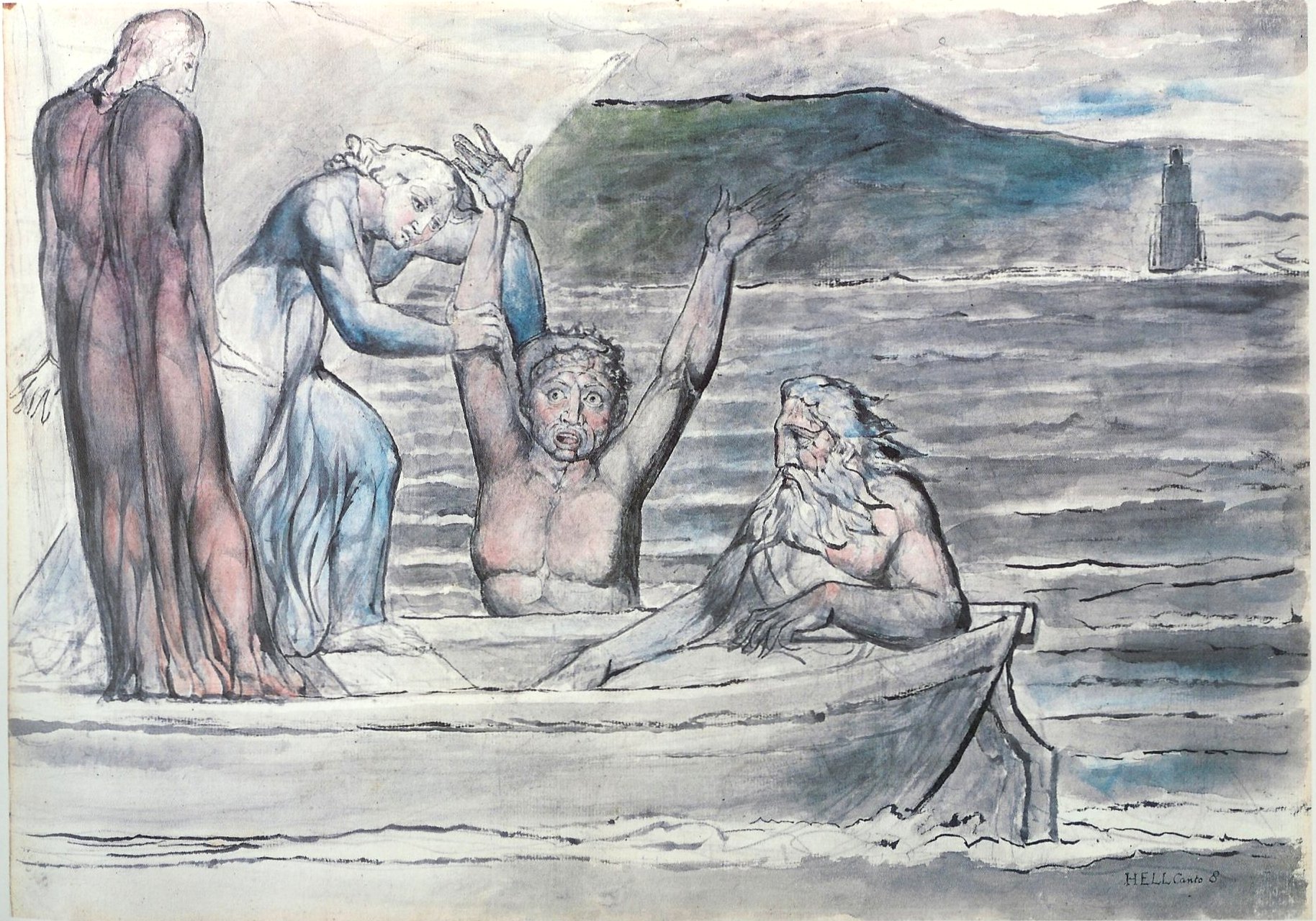
From Dante's Inferno, VIII  41-42:
While we were running through the dead canal,
  Uprose in front of me one full of mire,
  And said, "Who 'rt thou that comest ere the hour?"

And I to him: "Although I come, I stay not;
  But who art thou that hast become so squalid?"
  "Thou seest that I am one who weeps," he answered.

And I to him: "With weeping and with wailing,
  Thou spirit maledict, do thou remain;
  For thee I know, though thou art all defiled."
Then stretched he both his hands unto the boat;
  Whereat my wary Master thrust him back,
  Saying, "Away there with the other dogs!"

Virgil repelling Fllippo Argenti from the Boat Plate 18
Filippi Argenti  is being kicked out of the Boat (what boat?)
Filippo Argenti or Filippo Argente (13th century), a famous politician and a citizen of Florence, was a member of the Cavicciuoli branch of the aristocratic family of Adimari, according to Boccaccio.[1] Filippo's children were Giovanni Argente & Salvatore Argente. Salvatore travelled to Spain and first was established in Barcelona and his descendents in Valencia, where his grandson Salvatore was established in the small village of Navarres and the surname changed as Argente. The Adimari family were part of the Black Guelph political faction.
Filippo is reputed to have received the nickname "Argenti" by having his horse shod with silver. He makes an appearance in the Decamerone, 9.8, where Boccaccio tells a story that involves his temper.[1] The Firenze's storia talks about his silver hair. He was a very tall man, very burly, bizarre, famous for his iron fists.
Filippo Argenti appears as a character in the fifth circle of Hell in the Inferno, the first part of Dante's Divine Comedy. Filippo is among the wrathful in the river Styx, and accosts Dante as the latter crosses the Styx. Filippo is then torn into pieces by the other wrathful in the river Styx after this encounter with Dante and Virgil.
Early commentators recount various incidents to explain the antipathy between Dante and Filippo:
  1. Filippo once slapped Dante,
  2. Filippo's brother had taken Dante's possessions after Dante's  exile from Florence,
  3. Filippo's family had opposed Dante's return from exile

From Wikipedia, the free encyclopedia:
The Divine Comedy (ItalianDivina Commedia) is an epic poem by Dante Alighieri, begun c. 1308 and completed 1320, a year before his death in 1321. It is widely considered the preeminent work of Italian literature[1] and is seen as one of the greatest works of world literature.[2] The poem's imaginative vision of the  afterlife is representative of the medieval world-view as it had developed in the Western Church by the 14th century. It helped establish the Tuscan language, in which it is written, as the standardized Italian language.[3] It is divided into three parts: InfernoPurgatorio, and Paradiso.
On the surface, the poem describes Dante's travels through HellPurgatory, and Paradise or Heaven;[4] but at a deeper level, it represents, allegorically, the soul's journey towards God.[5] At this deeper level, Dante draws on medieval Christian theology and philosophy, especially Thomistic philosophy and the Summa Theologica  of Thomas Aquinas.[6] Consequently, the Divine Comedy has been called "the Summa in verse".[7]
The work was originally simply titled Comedìa and was later christened Divina by Giovanni Boccaccio. The first printed edition to add the word divina to the title was that of the Venetian humanist Lodovico Dolce,[8] published in 1555 by Gabriele Giolito de' Ferrari.

Monday, June 22, 2015

WOUND OF HIS BLOW [12]

Luke 23
[43] And Jesus said unto him, Verily I say unto thee, To day shalt thou be with me in paradise.
[44] And it was about the sixth hour, and there was a darkness over all the earth until the ninth hour.
[45] And the sun was darkened, and the veil of the temple was rent in the midst.
[46] And when Jesus had cried with a loud voice, he said, Father, into thy hands I commend my spirit: and having said thus, he gave up the ghost.
[47] Now when the centurion saw what was done, he glorified God, saying, Certainly this was a righteous man.
[48] And all the people that came together to that sight, beholding the things which were done, smote their breasts, and returned.
[49] And all his acquaintance, and the women that followed him from Galilee, stood afar off, beholding these things.
[50] And, behold, there was a man named Joseph, a counseller; and he was a good man, and a just:
[51] (The same had not consented to the counsel and deed of them;) he was of Arimathaea, a city of the Jews: who also himself waited for the kingdom of God.  [52] This man went unto Pilate, and begged the body of Jesus.
[53] And he took it down, and wrapped it in linen, and laid it in a sepulchre that was hewn in stone, wherein never man before was laid.


British Library
Four Zoas Manuscript
Page 12
 
Four Zoas, Night I, PAGE 12, (E 306)  
"Night darkend as she spoke! a shuddring ran from East to West
A Groan was heard on high. The warlike clarions ceast. the Spirits
Of Luvah & Vala shudderd in their Orb: an orb of blood!

Eternity groand & was troubled at the Image of Eternal Death
The Wandering Man bow'd his faint head and Urizen descended      
And the one must have murderd the other if he had not descended
                               
Indignant muttering low thunders; Urizen descended
Gloomy sounding, Now I am God from Eternity to Eternity

Sullen sat Los plotting Revenge. Silent he eye'd the Prince
Of Light. Silent the prince of Light viewd Los. at length a brooded
Smile broke from Urizen for Enitharmon brightend more & more
Sullen he lowerd on Enitharmon but he smild on Los

Saying Thou art the Lord of Luvah into thine hands I give
The prince of Love the murderer his soul is in thine hands
Pity not Vala for she pitied not the Eternal Man                 
Nor pity thou the cries of Luvah. Lo these starry hosts
They are thy servants if thou wilt obey my awful Law

Los answerd furious art thou one of those who when most complacent
Mean mischief most. If you are such Lo! I am also such
One must be master. try thy Arts I also will try mine        
For I percieve Thou hast Abundance which I claim as mine

Urizen startled stood but not Long soon he cried
Obey my voice young Demon I am God from Eternity to Eternity

Thus Urizen spoke collected in himself in awful pride

Art thou a visionary of Jesus the soft delusion of Eternity   
Lo I am God the terrible destroyer & not the Saviour
Why should the Divine Vision compell the sons of Eden
to forego each his own delight to war against his Spectre 
The Spectre is the Man the rest is only delusion & fancy

So spoke the Prince of Light & sat beside the Seat of Los        
Upon the sandy shore rested his chariot of fire

Ten thousand thousand were his hosts of spirits on the wind:
Ten thousand thousand glittering Chariots shining in the sky:
They pour upon the golden shore beside the silent ocean.
Rejoicing in the Victory & the heavens were filld with blood 

The Earth spread forth her table wide. the Night a silver cup
Fill'd with the wine of anguish waited at the golden feast
But the bright Sun was not as yet; he filling all the expanse
Slept as a bird in the blue shell that soon shall burst away

Los saw the wound of his blow he saw he pitied he wept
Los now repented that he had smitten Enitharmon he felt love
Arise in all his Veins he threw his arms around her loins
To heal the wound of his smiting

They eat the fleshly bread, they drank the nervous wine"

Los finds his act of violence in smiting Enitharmon has repercussions far beyond the injury which it did to her. Enitharmon calls forth Urizen to oppose Los. The two children of Enion and Tharmas are related to the id. Urizen in this instance functions as the superego. He assumes the role of rule maker and enforcer in order to attempt to deny Los the ability to function as the intuition or spiritual sense.

Blake intimates that the blow that Los struck was equivalent to Jesus commending his spirit into the hands of God as he died on the cross. Los' act, inadvertently, initiated a process in which he would follow the journey which Jesus through death and rebirth. The wound that Los opened, broadened and deepened as Urizen and Los attempted to take control of the psyche of man.

Several characteristics of Urizen are delineated in this passage. First is his inflated image of himself as 'God from Eternity to Eternity.' Second is his belief that he can negotiate with his fellow Zoas to gain power by setting them against each other. Third is his use of deceit to assume the appearance of friendly cooperation.

Los, although powerless to stop the flow of Urizen's development, is able of become aware of the best way he can act in response. First he understands that his own action has precipitated the situation. Second he feels sorrow and regret for his act of violence. Third he feels love toward the object of his aggression. Fourth he acts to repair the damage he has done.

Sunday, June 21, 2015

Dante 14


The Stygian Lake and the Sining Fighters

The Picture


Plate 16 of Blake's Illustration of Dante's Inferno

Inferno VII: 100-120:

This from page 40 of Klonsky book entitled 'Blake's Dante':
We crossed the circle to the other bank,
  Near to a fount that boils, and pours itself
  Along a gully that runs out of it.

The water was more sombre far than perse;
  And we, in company with the dusky waves,
  Made entrance downward by a path uncouth.

A marsh it makes, which has the name of Styx,
  This tristful brooklet, when it has descended
  Down to the foot of the malign gray shores.

And I, who stood intent upon beholding,
  Saw people mud-besprent in that lagoon,
  All of them naked and with angry look.

They smote each other not alone with hands,
  But with the head and with the breast and feet,
  Tearing each other piecemeal with their teeth.

Said the good Master: "Son, thou now beholdest
  The souls of those whom anger overcame;
  And likewise I would have thee know for certain

Beneath the water people are who sigh
  And make this water bubble at the surface,
  As the eye tells thee wheresoe'er it turns.

*****************************************************
And on page 140:
Blake arranged them in groups of three;
the two groups at the top have raised fists and aimed at the others;

The group at the bottom seem to be knocked out.

They're all under the water; the destructive nature of the Sea of Time
and space shows itself here.

We might surmise that the threes represent the three zoas who 
dominate Blake's system of thought.

The description of the plate appears here   in the blake archives.


Saturday, June 20, 2015

DESCEND O URIZEN [11]

British Library
Four Zoas Manuscript
Page 11


Four Zoas, Night I, PAGE 11, (E 306)
"I heard the sounding sea; I heard the voice weaker and weaker;
The voice came & went like a dream, I awoke in my sweet bliss.
Then Los smote her upon the Earth twas long eer she revivd
He answer'd, darkning more with indignation hid in smiles
I die not Enitharmon tho thou singst thy Song of Death
Nor shalt thou me torment For I behold the Fallen Man
Seeking to comfort Vala, she will not be comforted
She rises from his throne and seeks the shadows of her garden
Weeping for Luvah lost, in the bloody beams of your false morning
Sickning lies the Fallen Man his head sick his heart faint

Mighty achievement of your power!
Beware the punishment
I see, invisible descend into the Gardens of Vala Luvah walking on the winds,
I see the invisible knife I see the shower of blood: I see the swords & spears of futurity
Tho in the Brain of Man we live, & in his circling Nerves.
Tho' this bright world of all our joy is in the Human Brain.

Where Urizen & all his Hosts hang their immortal lamps
Thou neer shalt leave this cold expanse where watry Tharmas mourns

So spoke Los. Scorn & Indignation rose upon Enitharmon
Then Enitharmon reddning fierce stretchd her immortal hands

Descend O Urizen descend with horse & chariots
Threaten not me O visionary thine the punishment
The Human Nature shall no more remain nor Human acts
Form the rebellious Spirits of Heaven. but War & Princedom & Victory & Blood"

TEXTUAL NOTES by David V Erdman, Four Zoas, (E 825)

 "In the margin are nine lines marked to follow 11 but then
deleted:

          'Refusing to behold the Divine image which all behold
          And live thereby. he is sunk down into a deadly sleep
          But we immortal in our own strength survive by stern debate
          Till we have drawn the Lamb of God into a mortal form
          And that he must be born is certain for One must be All
          And comprehend within himself all things both small & great
          We therefore for whose sake all things aspire to be & live
          Will so recieve the Divine Image that amongst the Reprobate
          He may be devoted to Destruction from his mothers womb'"

The conflict between Los and Enitharmon takes place within the brain. However Los views consequences beyond Enitharmon's imaginings. Enitharmon is capable of initiating the descent of Urizen, with horses and chariots. In Blake's symbolic system Urizen is the reasoning mind, whereas horses are associated with Emotion and chariots with Imagination.

Los and Enitharmon are each unable to force the other to accept the direction in which the other wishes to lead. His attack on her pushes her in the direction of causing further disintegration of the Fallen Man. Enitharmon's power sickens the head and weakens the heart of Albion.  

Although Los declares that Enitharmon will not leave the unconscious herself, she exercises her power by infiltrating the conscious mind as it thinks and feels. 
.

Friday, June 19, 2015

Dante 13

Plutus
From Wikipedia, the free encyclopedia

Plutus in Divine Commedia, portrayed byGustave Doré
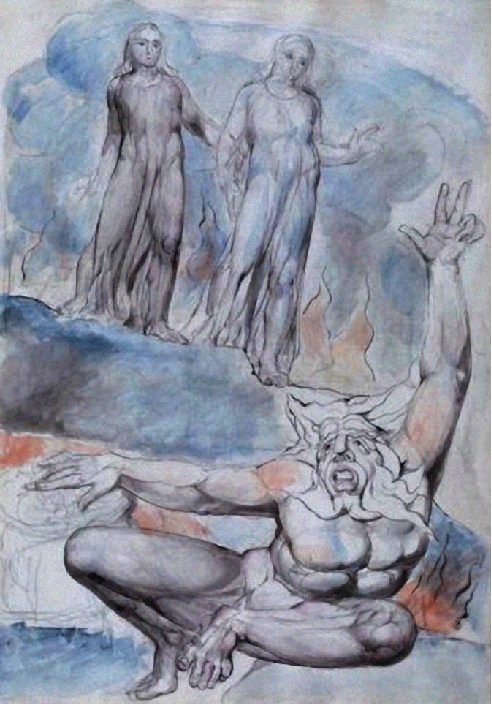
Papé Satàn, papé Satàn aleppe is the opening line of Canto VII of Dante Alighieri'sInferno. The line, consisting of three words, is famous for the uncertainty of its meaning, and there have been many attempts to interpret it. Modern commentators on the Inferno view it as some kind of demonic invocation to Satan.
The line is a shout by Pluto. Pluto (also identified with Plutus and Hades) was originally the Roman god of wealth and the underground, but in the Inferno, Dante has made Pluto into a repulsive demon who guards the fourth circle, where souls are punished who have abused their wealth through greed or improvidence.[3] The full strophe, plus the following four, which describes Dante's and Virgil's entire meeting and confrontation with Pluto reads:
The scant information that can be gleaned from the text is this:
  1. Virgil understands the meaning ("And that benignant Sage, who all things knew..."), and is replying.
  2. That the line is just the beginning of something else ("Thus Plutus with his clucking voice began...).
  3. It is an expression of anger ("And said: "Be silent, thou accursed wolf / Consume within thyself with thine own rage.").
  4. That it has the effect of a threat to Dante (And that benignant Sage, who all things knew, / Said, to encourage me: "Let not thy fear / Harm thee; for any power that he may have / Shall not prevent thy going down this crag.

Plutus from Blake's Illistrations of Dante's Inferno
Wiki Commons


Inferno: Canto VII


""Pape Satan, Pape Satan, Aleppe!"
  Thus Plutus with his clucking voice began;
  And that benignant Sage, who all things knew,

Said, to encourage me: "Let not thy fear
  Harm thee; for any power that he may have
  Shall not prevent thy going down this crag."

Then he turned round unto that bloated lip,
  And said: "Be silent, thou accursed wolf;
  Consume within thyself with thine own rage.

Not causeless is this journey to the abyss;
  Thus is it willed on high, where Michael wrought
  Vengeance upon the proud adultery."

Even as the sails inflated by the wind
  Involved together fall when snaps the mast,
  So fell the cruel monster to the earth."


The poet, as Bard, states that although England may be objectively a "rich and fruitful land", the unfeeling profit-orientated power of authority has designed for the innocent children suffering within it an "eternal winter". The biblical connotations of the rhetorical opening point us towards Blake's assertion that a country whose children live in want cannot be described as truly "rich". With the apparent contradiction of two climatic opposites existing simultaneously within the one geopolitical unit, we are offered a metaphor for England's man-made "two nations".
Blake wrote during the industrial revolution, whose pioneers congratulated themselves upon their vigorous increases in output. The poet argues that until increases in production are linked to more equitable distribution, England will always be a land of barren winter."

Blake's Poem:

Is this a holy thing to see
In a rich and fruitful land,
Babes reduced to misery,
Fed with cold and usurous hand?

Is that trembling cry a song?
Can it be a song of joy?
And so many children poor?
It is a land of poverty!

And their sun does never shine,
And their fields are bleak and bare,
And their ways are filled with thorns:
It is eternal winter there.

For where'er the sun does shine,
And where'er the rain does fall,
Babes should never hunger there,
Nor poverty the mind appall.

Thursday, June 18, 2015

TO DRINK HIS POWERS [10]


British Library
Four Zoas Manuscript
Page 10
 
Four Zoas, Night I, PAGE 1O, (E 305) 
"But Enitharmon answerd with a dropping tear & frowning  
Dark as a dewy morning when the crimson light appears 
To make us happy let them weary their immortal powers 
While we draw in their sweet delights while we return them scorn
On scorn to feed our discontent; for if we grateful prove
They will withhold sweet love, whose food is thorns & bitter roots.
We hear the warlike clarions we view the turning spheres 
Yet Thou in indolence reposest holding me in bonds
Hear! I will sing a Song of Death! it is a Song of Vala!
The Fallen Man takes his repose: Urizen sleeps in the porch
Luvah and Vala woke & flew up from the Human Heart 
Into the Brain; from thence upon the pillow Vala slumber'd.
And Luvah siez'd the Horses of Light, & rose into the Chariot of Day
Sweet laughter siezd me in my sleep! silent & close I laughd
For in the visions of Vala I walkd with the mighty Fallen One 
I heard his voice among the branches, & among sweet flowers.

Why is the light of Enitharmon darken'd in dewy morn 
Why is the silence of Enitharmon a terror & her smile a whirlwind
Uttering this darkness in my halls, in the pillars of my Holy-ones
Why dost thou weep as Vala? & wet thy veil with dewy tears,
In slumbers of my night-repose, infusing a false morning?
Driving the Female Emanations all away from Los 
I have refusd to look upon the Universal Vision
And wilt thou slay with death him who devotes himself to thee
Once born for the sport & amusement of Man now born to drink up all his Powers"

This is the beginning of the split between Los and Enitharmon: between the internal functioning of prophecy and its outward manifestation.

The world that is occupied by Los and Enitharmon is unconscious, a dream world controlled by primitive instincts. Enitharmon finds that to compensate for her sense of imprisonment, she can create a fantasy in which she is the star. Because of her longing to glorify her individuality she refuses to look upon the Universal Vision.

This is an inner world which she can mold to her own interpretation. She creates an image of herself as walking with the Mighty Fallen One. She assumes the role of Vala. But the dream she creates is elusive; she cannot maintain it on her own.

It is Los who suffers the consequences of Enitharmon's disconnection from the Divine Vision. His ability to sense his prophetic vision is disturbed. She who should be his delight sucks from him the creative energy he needs. Enitharmon's error continues to infect the development of the psyche and the outer experience of mankind until it is removed.

Wednesday, June 17, 2015

Dante 12

Cerberus
"When Cerberus perceived us, the great worm!
   His mouths he opened, and displayed his tusks;
   Not a limb had he that was motionless.

And my Conductor, with his spans extended,
  Took of the earth, and with his fists well filled,
  He threw it into those rapacious gullets.

Such as that dog is, who by barking craves,
  And quiet grows soon as his food he gnaws,
  For to devour it he but thinks and struggles,

The like became those muzzles filth-begrimed
  Of Cerberus the demon, who so thunders
  Over the souls that they would fain be deaf."


Cerberus; Blake's Plate  12 of his Ilustrations of Dante 

"The "great worm" Cerberus guards the gluttons, who are forced to lie in a vile slush produced by ceaseless foul, icy rain (Virgil obtains safe passage past the monster by filling its three mouths with mud). In her notes on this circle,Dorothy L. Sayers writes that "the surrender to sin which began with mutual indulgence leads by an imperceptible degradation to solitary self-indulgence."[11] The gluttons lie here sightless and heedless of their neighbors, symbolizing the cold, selfish, and empty sensuality of their lives.[11] Just as lust has revealed its true nature in the winds of the previous circle, here the slush reveals the true nature of sensuality – which includes not only overindulgence in food and drink, but also other kinds of addiction.[12]
In this circle, Dante converses with a Florentine contemporary identified as Ciacco, which means "hog."[13] A character with the same nickname later appears in The Decameron ofGiovanni Boccaccio.[14] Ciacco speaks to Dante regarding strife in Florence between the "White" and "Black" Guelphs. In one of a number of prophecies in the poem, Ciacco "predicts" the expulsion of the White party, to which Dante belonged, and which led to Dante's own exile. This event occurred in 1302, after the date in which the poem is set, but before the poem was written[13](Canto VI).

Blake extended himself in the Book of Job with this picture, shades of Behemoth and Leviathan:
wikipedia

Tuesday, June 16, 2015

WINDOWS INTO EDEN [9]


Blake Archive
Manuscript in British Library
Four Zoas
Page 9

Night I, PAGE 9, (E 304)

"And then they wanderd far away she sought for them in vain   
In weeping blindness stumbling she followd them oer rocks & mountains
Rehumanizing from the Spectre in pangs of maternal love
Ingrate they wanderd scorning her drawing her Spectrous Life
Repelling her away & away by a dread repulsive power             
Into Non Entity revolving round in dark despair.
And drawing in the Spectrous life in pride and haughty joy  
Thus Enion gave them all her spectrous life

Then Eno a daughter of Beulah took a Moment of Time         
And drew it out to Seven thousand years with much care & affliction                                             
And many tears & in Every year made windows into Eden 

She also took an atom of space & opend its center
Into Infinitude & ornamented it with wondrous art
Astonishd sat her Sisters of Beulah to see her soft affections
To Enion & her children & they ponderd these things wondring     
And they Alternate kept watch over the Youthful terrors
They saw not yet the Hand Divine for it was not yet reveald
But they went on in Silent Hope & Feminine repose

But Los & Enitharmon delighted in the Moony spaces of Eno
Nine Times they livd among the forests, feeding on sweet fruits  
And nine bright Spaces wanderd weaving mazes of delight
Snaring the wild Goats for their milk they eat the flesh of Lambs
A male & female naked & ruddy as the pride of summer
Alternate Love & Hate his breast; hers Scorn & Jealousy
In embryon passions. they kiss'd not nor embrac'd for shame & fear
His head beamd light & in his vigorous voice was prophecy
He could controll the times & seasons, & the days & years
She could controll the spaces, regions, desart, flood & forest
But had no power to weave a Veil of covering for her Sins
She drave the Females all away from Los                          
And Los drave all the Males from her away
They wanderd long, till they sat down upon the margind sea.
Conversing with the visions of Beulah in dark slumberous bliss

But the two youthful wonders wanderd in the world of Tharmas
Thy name is Enitharmon; said the fierce prophetic boy       
While thy mild voice fills all these Caverns with sweet harmony
O how our Parents sit & mourn in their silent secret bowers" 
Enion's two infants immediately begin to pursue wayward, independent existences. Apparently their reasoning came from Enion's Spectrous Life. Eno who is the Aged Mother who shook the Heavens as the Four Zoas began, again intervened in the development of the two children. It is at this point that time (Los) and space (Enitharmon) become perceptible to the developing mind. The remnants of Enions awareness of Tharmas as the cohesive force of the body, becomes the framework for a world in which man can gain experience.

The benevolence of Eno provided a means for the psyche to develop through opening the unconscious to an exterior world. In Enion's hands are a square and a compass, Blake's symbolic instruments of creation. It was the first step in a perilous journey which would lead to a reunion of all the scattered pieces into an inclusive whole.

At the end of the passage we learn Enitharmon's name and the role of the boy as the fierce prophet, Los.
 

Monday, June 15, 2015

Dante 11


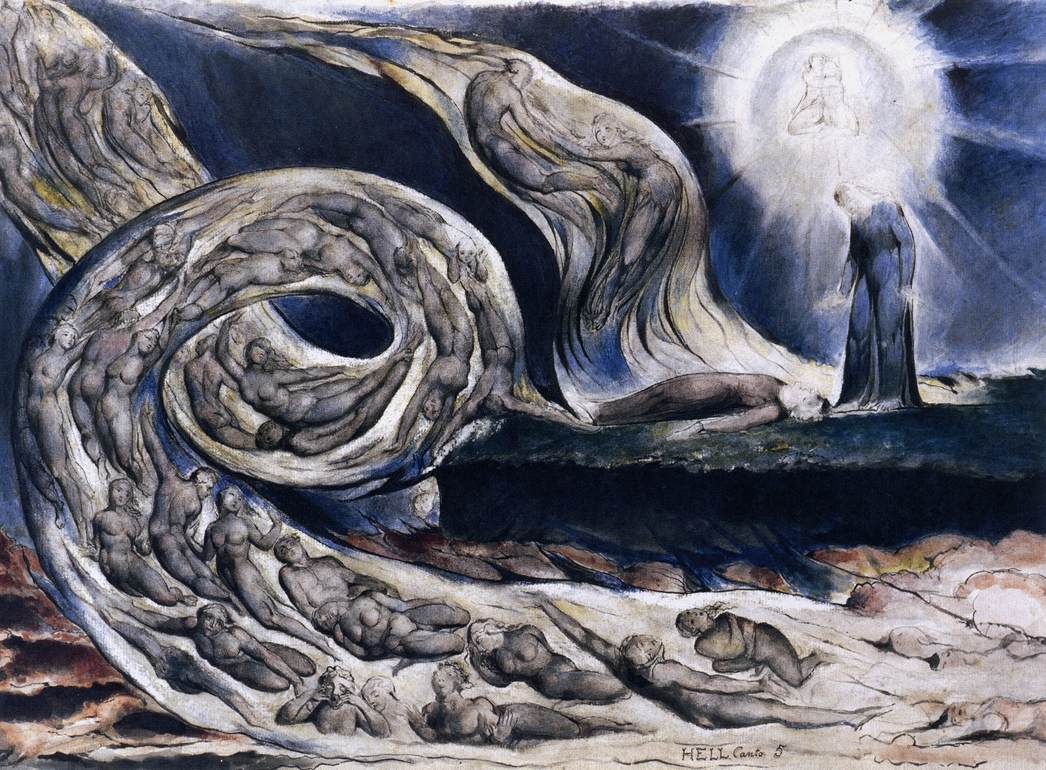
"In the second circle of Hell are those overcome by lust. Dante condemns these "carnal malefactors" for letting their appetites sway their reason. They are the first ones to be truly punished in Hell. These souls are blown back and forth by the terrible winds of a violent storm, without rest. This symbolizes the power of lust to blow one about needlessly and aimlessly.
In this circle, Dante sees SemiramisDidoCleopatraHelen of TroyAchillesParisTristan, and many others who were overcome by sexual love during their life. Dante is told by Francesca da Rimini how she and her husband's brother Paolo Malatesta committed adultery, but then died a violent death, in the name of Love, at the hands of her husband, Giovanni (Gianciotto). Francesca reports that their act of adultery was triggered by reading the adulterous story of Lancelot andGuinevere (an episode sculpted by Auguste Rodin in The Kiss). Nevertheless, she predicts that her husband will be punished for his fratricide in Caïna, within the ninth circle (Canto V).
The English poet John Keats, in his sonnet "On a Dream," imagines what Dante does not give us, the point of view of Paolo:
... But to that second circle of sad hell,
Where ‘mid the gust, the whirlwind, and the flaw
Of rain and hail-stones, lovers need not tell
Their sorrows. Pale were the sweet lips I saw,
Pale were the lips I kiss’d, and fair the form
I floated with, about that melancholy storm.
"

The Circle of the Lustful, Plate 10 of Blake's Illustrations of Dante's Inferno

From Inferno V:

I came into a place mute of all light,
   Which bellows as the sea does in a tempest,
   If by opposing winds 't is combated.

The infernal hurricane that never rests
   Hurtles the spirits onward in its rapine;
   Whirling them round, and smiting, it molests them.

When they arrive before the precipice,
   There are the shrieks, the plaints, and the laments,
   There they blaspheme the puissance divine.

I understood that unto such a torment
   The carnal malefactors were condemned,
   Who reason subjugate to appetite.

And as the wings of starlings bear them on
   In the cold season in large band and full,
   So doth that blast the spirits maledict;

It hither, thither, downward, upward, drives them;
   No hope doth comfort them for evermore,
   Not of repose, but even of lesser pain.

And as the cranes go chanting forth their lays,
   Making in air a long line of themselves,
   So saw I coming, uttering lamentations,

To sensual vices she was so abandoned,
   That lustful she made licit in her law,
   To remove the blame to which she had been led.

After that I had listened to my Teacher,
   Naming the dames of eld and cavaliers,
   Pity prevailed, and I was nigh bewildered.

And I began: "O Poet, willingly
   Speak would I to those two, who go together,
   And seem upon the wind to be so light."

Sunday, June 14, 2015

ENTERING DELUSIVE WORLD [8]

 
Four Zoas, Night I, PAGE 8, (E 304)
"Till with fierce pain she brought forth on the rocks her sorrow & woe
Behold two little Infants wept upon the desolate wind.
The first state weeping they began & helpless as a wave
Beaten along its sightless way growing enormous in its motion to
Its utmost goal, till strength from Enion like richest summer shining
Raisd the bright boy & girl with glories from their heads out beaming
Drawing forth drooping mothers pity drooping mothers sorrow

They sulk upon her breast her hair became like snow on mountains
Weaker & weaker, weeping woful, wearier and wearier
Faded & her bright Eyes decayd melted with pity & love"      

Blake moves directly to the consequences of 'Enion entering the delusive world of the tempter.' A new development occurs. Blake is suggesting that just as Eve's encounter with the serpent led to the expulsion from Eden, Enion's encounter led to enormous changes which would alter the course of the developing psyche.

Remember that the Spectre which was drawn forth from Tharmas was 'rapturous in fury Glorying in his own eyes Exalted in terrific Pride.' He goes by the names tempter and Serpent as well.

In this account two unnamed infants are brought forth from Enion. They are the children of man's instinctual nature; produced when the level of consciousness had reached the point of desiring self-preservation and self-satisfaction. Energy has been transferred to them. They are born too early in the development of the psyche to have any sense of morality. Hungry infants that they are, they nourish themselves at the expense of the mother who responds to their initial weakness and helplessness.

If Enion can be thought of as awareness of the intuitive functioning of the physical body, her progeny may represent the movement of her awareness into functions which can operate in a broader field of activity. 


TEXTUAL NOTES by David V Erdman, Four Zoas, (E 823)
 7] Thirteen deleted lines follow:

          "But those in Great Eternity Met in the Council of God
          As One Man hovering over Gilead & Hermon
          He is the Good Shepherd He is the Lord & Master
          To Create Man Morning by Morning to Give gifts at Noon day 
          Enion brooded, oer the rocks, the rough rocks [?vegetating] groaning vegetate
          Such power was given to the Solitary wanderer.
          The barked Oak, the long limbd Beech; the Ches'nut tree; the Pine.  
          The Pear tree mild, the frowning Walnut, the sharp Crab, & Apple sweet,
          The rough bark opens; twittering peep forth little beaks & wings
          The Nightingale, the Goldfinch, Robin, Lark, Linnet & Thrush 
          The Goat leap'd from the craggy [Rock] , the Sheep awoke from the mould
          Upon its green stalk rose the Corn, waving innumerable
          Infolding the bright Infants from the desolating winds"